
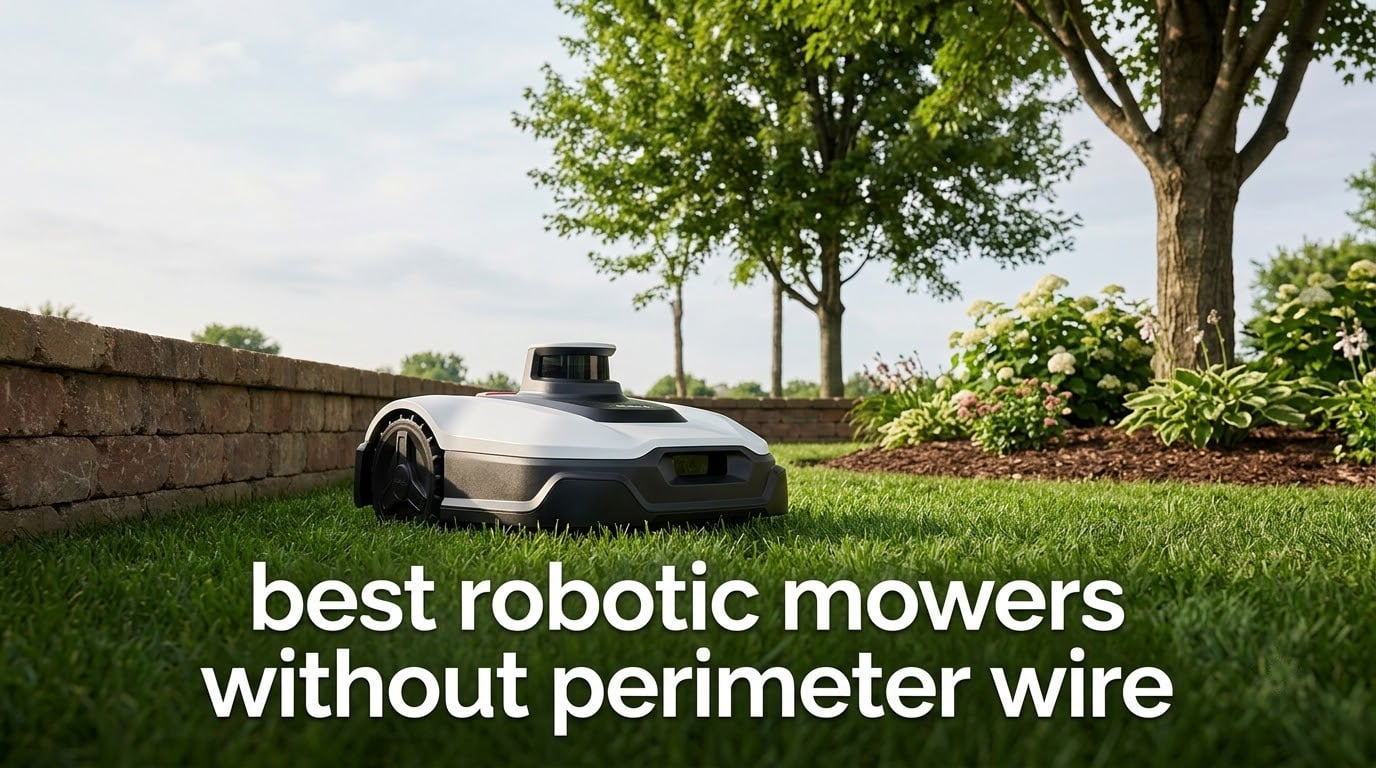
Digging a copper boundary wire around the whole lawn used to be the first weekend of owning a robot mower. That step is optional now, and for most buyers in 2026 it is the step they are trying to skip. The best robotic mowers without perimeter wire draw their boundary in software instead, then hold that line with corrected satellite positioning, laser scanning, onboard cameras, or a combination of all three.
That sounds simple, and it is for some yards. It is a genuine problem for others. A mower that cannot see enough sky will hunt for a signal, and one that relies on a vision system alone will drift when the light changes. The whole buying decision is really about matching a navigation stack to the conditions of your property, not about which machine has the longest specification list.
We compared eight wire-free robotic mowers side by side, weighing navigation approach against slope rating, coverage capacity, cutting width, noise level and app behaviour. The eight below cover the decision branches that matter: open lawns, tree-covered ground, steep hills, small suburban lots, multi-zone properties and yards where a wall or a tree canopy blocks the sky. Our methodology and sourcing notes sit at the end of the guide, and we also cover robotic mowers for large lawns separately if your property runs past an acre.
Table of Contents
Top 3 Best Robotic Mowers Without Perimeter Wire (October 2026)
These three cover the widest range of yards. If your property is rough, large or sloped, start at the top of this list. If it is a flat suburban lot, scroll to number three for the value pick.

Mammotion LUBA 2 AWD 5000HX
- 165W four-wheel motor
- 80% slope climbing
- UltraSense AI vision plus RTK
- 15.7 inch dual-blade disk

Mammotion LUBA mini 2 1500H
- 360 degree LiDAR plus dual cameras
- AWD with 80% slope climbing
- Dual discs with edge blade
- Up to 20 zones

Segway Navimow i105N
- EFLS 2.0 RTK plus vision
- AI-assisted automatic mapping
- 58 dB(A) operation
- Up to 12 zones
Quick Picks: All Eight Wire-Free Mowers Compared
Every model below is wire-free: none requires a buried boundary cable. Coverage figures are manufacturer ratings for the specific model listed, not for the wider product family.
| Product | Specifications | Action |
|---|---|---|
| Mammotion LUBA 2 AWD 5000HX |
|
Check Latest Price |
| Mammotion LUBA mini 2 1500H |
|
Check Latest Price |
| Segway Navimow i105N |
|
Check Latest Price |
 ANTHBOT M5 ANTHBOT M5 |
|
Check Latest Price |
 MOVA LiDAX Ultra 1000 MOVA LiDAX Ultra 1000 |
|
Check Latest Price |
 ECOVACS GOAT O1000 RTK ECOVACS GOAT O1000 RTK |
|
Check Latest Price |
 Roborock RockNeo Q110H Roborock RockNeo Q110H |
|
Check Latest Price |
 Sunseeker X3 Plus Sunseeker X3 Plus |
|
Check Latest Price |
1. Mammotion LUBA 2 AWD 5000HX – Best Overall Wire-Free Mower for Rough Ground
Mammotion LUBA 2 AWD 5000HX Robot Lawn Mower with 4G, Reception 1.25 Acres, Max. 1.48 Acres, All-Wheel-Drive for 80% Slope, UltraSense AI Vision & RTK Automatic Edge Mapping, 2.2″-4.0″ Cutting Height
Covers 1.25 acres with 1.48 acres max
RTK plus UltraSense AI vision
80% (38 degree) slope
41 pounds
Pros
- Climbs 80% slopes on four driven wheels
- Keeps working under tree cover where RTK alone fails
- 15.7 inch dual-blade disk covers a lot of ground per charge
- Handles up to 50 managed zones
- Recognises 200+ obstacle types
Cons
- Slow total mow time for its acreage rating
- Does not mulch or shred leaves
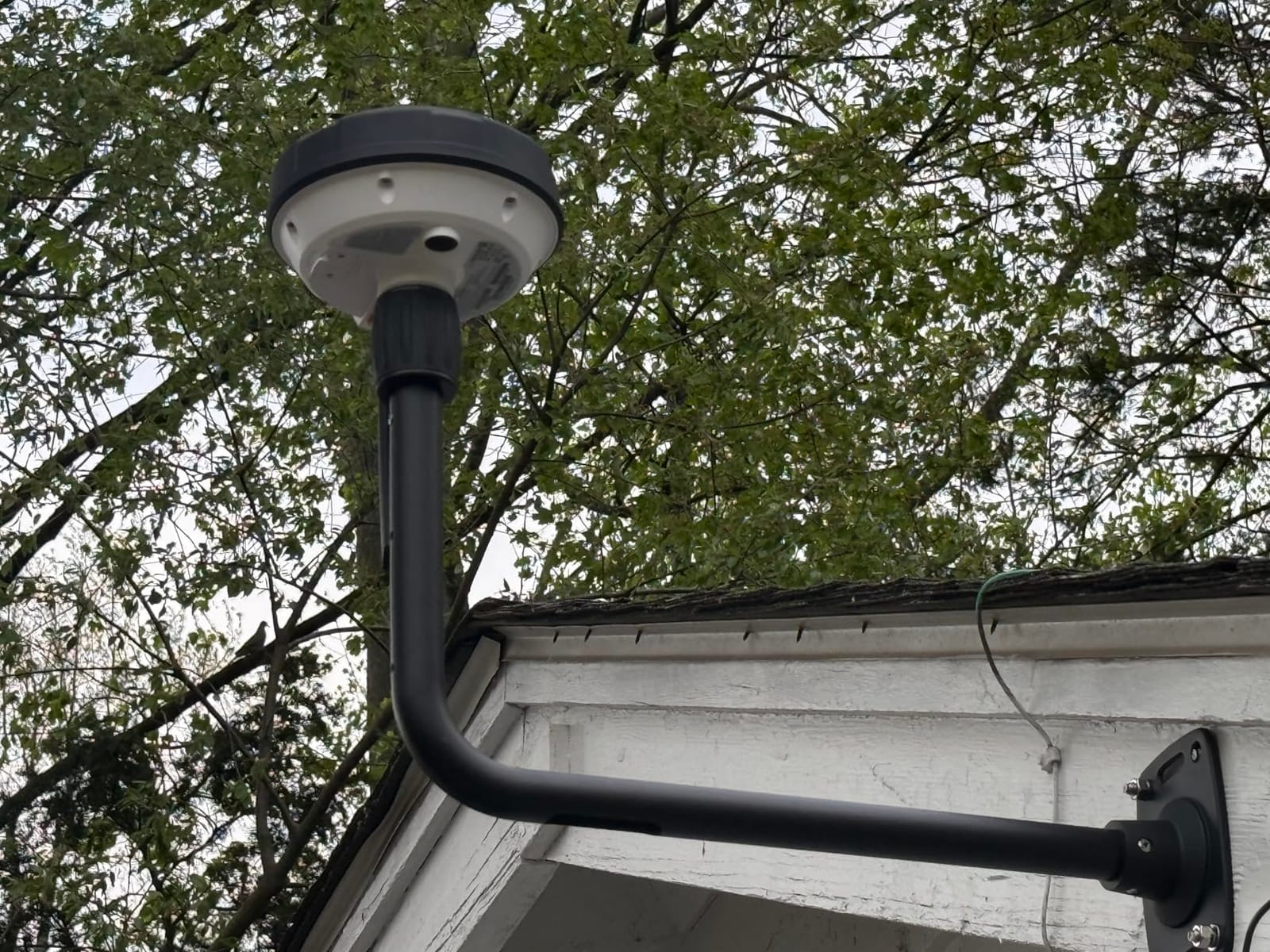
- RTK antenna mount needs drilling and a clear sky view
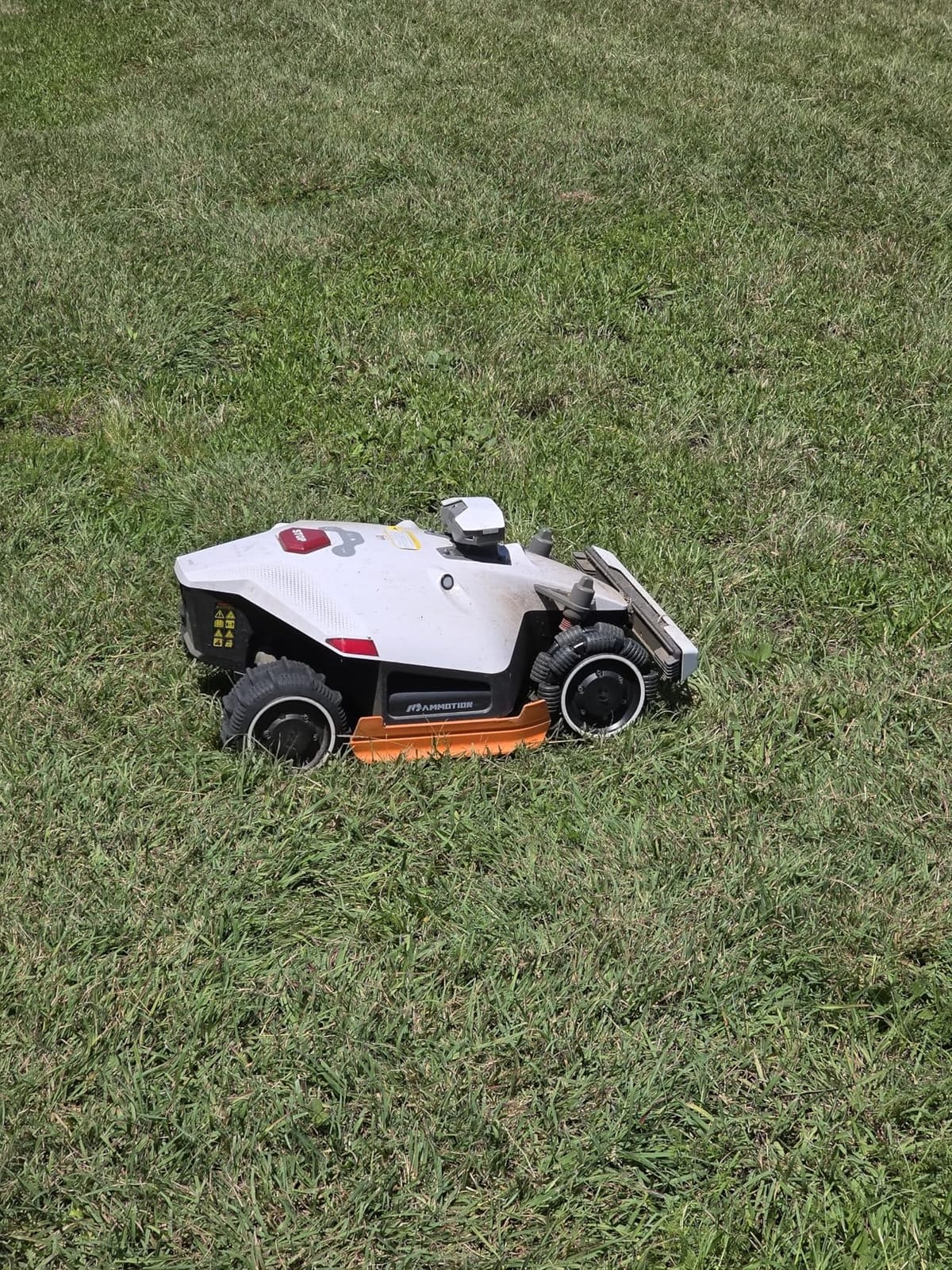
The LUBA 2 AWD 5000HX is the machine we would put on a property that fights back. Four driven motors rated at 165W climb an 80% grade, which is 38 degrees, and owners consistently report it crossing uneven ground and rough patches without getting wedged. At 41 pounds it is the heaviest unit in this roundup, and that mass is exactly why it holds traction on a hill instead of spinning.
Its navigation stack is RTK combined with UltraSense AI vision, so when the satellite signal fades under a canopy the camera system keeps the machine oriented to the lawn edge. The same vision hardware classifies 200+ obstacle types. Cut quality comes from a dual-blade disk spanning 15.7 inches across the deck, adjustable from 2.2 to 4.0 inches in 18 positions, with a riding-style edge pass that trims close to walls and kerbs.
Coverage is the headline number: 1.25 acres with satellite reception, up to 1.48 acres maximum, and up to 13000 square feet per charge. Zone management scales to 50 areas, so a large property with a front lawn, a back lawn and a side strip is manageable from one machine. Connectivity covers 4G, Bluetooth and Wi-Fi through the Mammotion app, with GPS tracking and an anti-theft lockout.
The honest weaknesses are speed and setup. A 15.7 inch deck on a machine this size still takes far longer than a walk-behind to cover the same ground, and it recharges mid-lawn rather than at the edge. The razor-style blades wear relatively quickly, and the machine will not mulch or shred fallen leaves, so autumn debris stays where it falls. Setting up the RTK antenna needs drilling and a wall or roof mount with a clear view of the sky. Owners on split front-and-back yards report placement problems with that antenna more than with the mower itself.
When this mower makes sense
Choose the LUBA 2 AWD 5000HX when your property is large, sloped or both, and when the lawn has trees that will interrupt a satellite signal. It suits owners who mow rough ground regularly and who want a single machine covering multiple zones rather than two smaller robots. The 50-zone limit and the wide deck also make it a good fit for a property with a complicated outline rather than a plain rectangle.
It also suits owners with a lawn that grows fast in a humid climate, since the larger deck finishes a full pass before the grass needs cutting again. If you mow near a road, a pond or a retaining wall, the edge-cutting pass and the steep-slope stability reduce the number of tight spots where a lighter machine would struggle.
When to buy something else
Look elsewhere if your lawn is flat and under half an acre, because the mowing time on this machine will feel long for the job. It is also the wrong pick if you want a machine that eats leaf litter or mulches clippings back into the lawn, or if drilling an antenna mount into your house is not an option. Anyone with a mostly open property will get more from a lighter LiDAR or RTK unit.
If your priority is pure obstacle recognition on a lawn full of pets and children, the 200+ object library is good but not the deepest here. And if you are on a tight budget with a small yard, this is far more machine than the lot needs.
2. Mammotion LUBA mini 2 1500H – Top Rated Antenna-Free Mower for Small Yards
(2026 Upgrade) Mammotion LUBA mini 2 AWD 1500H Robot Lawn Mower, for 0.37 Acres, 360° LiDAR+Dual-Camera AI Vision, 80% Slope, DropMow, 20 Multi-Zone Management
360 degree LiDAR plus dual cameras
0.37 acre across 20 zones
80% (38.6 degree) slope
75mm step-over height
Pros
- Highest rating in this roundup at 4.4 across 260 reviews
- Needs no satellite signal or antenna at all
- Two 88W motors climb 80% slopes
- Dual discs with a dedicated edge blade
- Adaptive suspension clears 75mm obstacles
Cons
- Narrow 7.9 inch deck makes for long total cut times
- Coverage ceiling of 0.37 acre
- Buyers should expect a learning period with DropMow and zone settings
At 4.4 stars across 260 reviews, the LUBA mini 2 1500H has the strongest owner satisfaction in this group, with 70% of reviews at five stars and only 4% at one star. The reason is the sensor stack: a 360-degree LiDAR with a 45-degree field of view paired with dual cameras gives redundant detection, so an object has to be missed by two different systems before the mower runs into it.
Because the LiDAR builds the map, this mower needs no RTK station, no antenna and no view of the sky. That removes the single most common install complaint in the wire-free category. Coverage is 0.37 acres across up to 20 independently scheduled zones, with 500 square meters handled per charge and roughly 60 minutes of running time between charges.
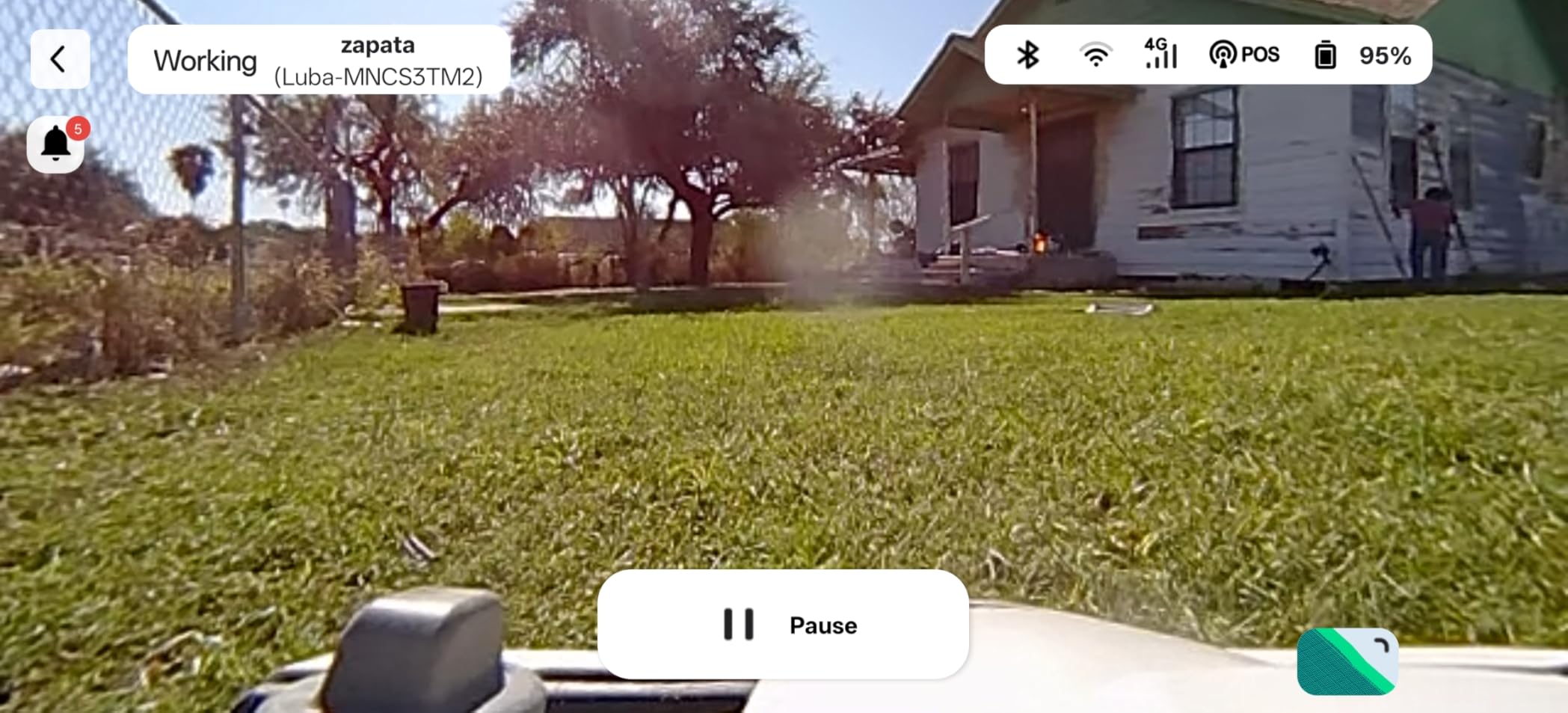
Traversability is the second strength. Two independent 88W motors drive all four wheels to an 80% grade, equal to 38.6 degrees, and adaptive suspension handles curbs, roots and thresholds up to 75mm. Cutting is handled by dual discs, one of them a dedicated edge blade, with automatic height adjustment on the main deck between 2.2 and 4.0 inches across nine positions. DropMow mode mows without a saved map, which is handy for a one-off strip after a storm.
The tradeoff is cutting width. At 7.9 inches the deck is the second narrowest here, so total cut time on a full session runs long even though the machine covers 500 square meters per charge. The 0.37 acre ceiling is also the tightest coverage limit in this roundup, which makes it a poor match for a property over about half an acre. Charging limits and off-peak scheduling can be configured in the app to protect battery life.
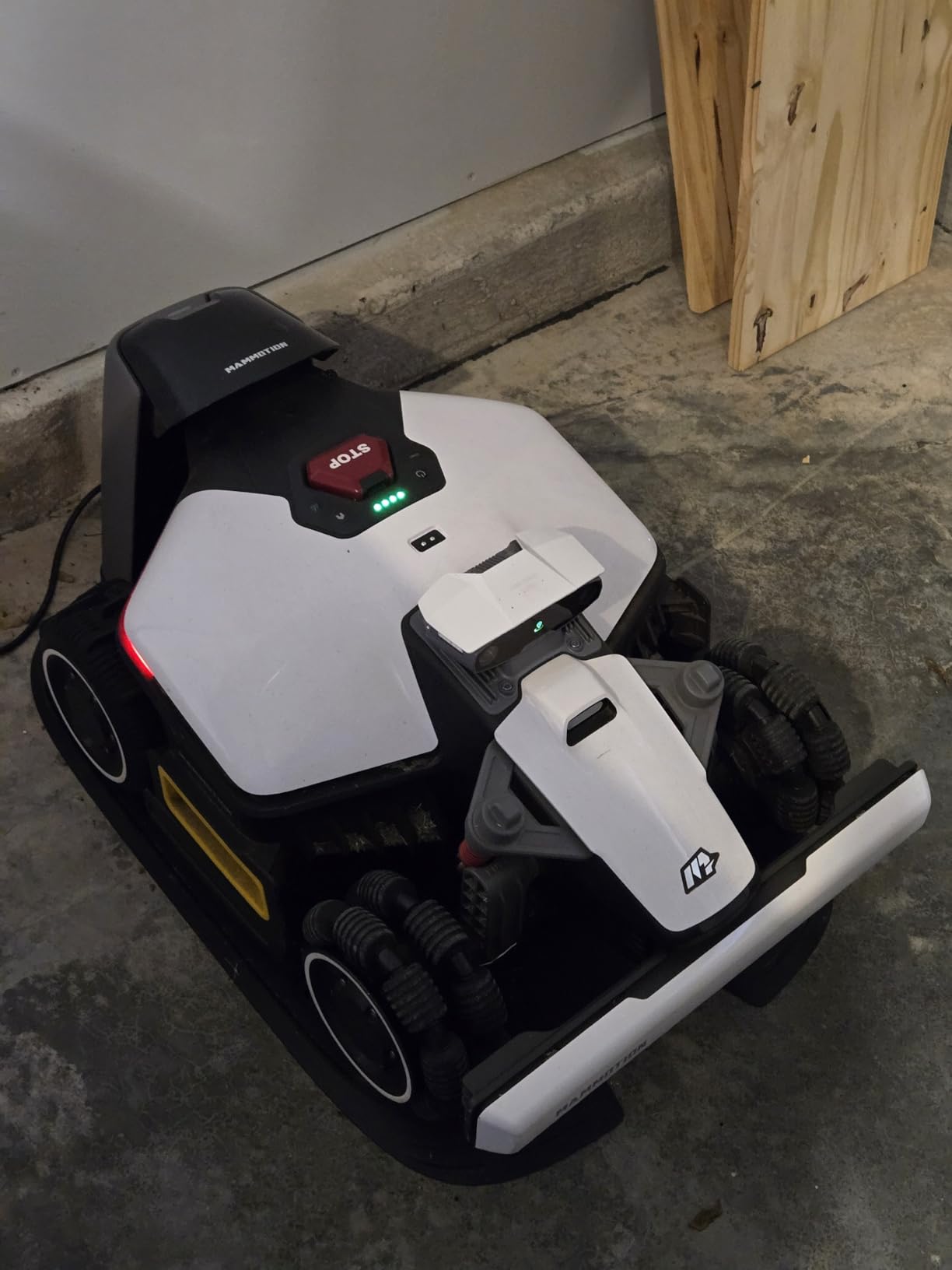
What this mower is built for
This is the pick for a small or mid-size yard with heavy tree cover, a lot of obstacles, or a property where installing an antenna is simply not practical. It handles slopes far steeper than most suburban lots need, so owners with a banked garden or a sloping side lawn get capability they would not get from a lighter machine.
It is also a sensible choice for anyone with pets, toys or a busy family lawn, since redundant LiDAR and camera detection is the strongest obstacle handling in this set. Physical bumpers add a last line of contact protection. For owners who want to try mowing an area before committing to a saved map, DropMow removes the mapping step entirely.
Where it falls short
Owners on a larger property will hit the 0.37 acre limit and the narrow deck together, and that combination is the main reason it does not sit at the top of this list despite the best rating. The edge disc helps, but you should expect a trimmer pass on hard boundaries.
Buyers should also plan time for the app. Zone setup, DropMow behaviour and charge limits all need configuring before the mower performs at its best. And with limited review volume recorded on this specific configuration, it is worth checking that current firmware behaves as expected in your grass before letting it run unsupervised overnight.
3. Segway Navimow i105N – Best Value Wire-Free Mower for Small and Mid-Size Lawns
Segway Navimow i105N Robot Lawn Mower Perimeter Wire Free 1/8 Acre RTK+Vision Robotic Lawnmower, AI-Assisted Mapping, Virtual Boundary, APP Control, 58dB(A) Quiet, Multi-Zone Management
Covers 1/8 acre with 12 zones
EFLS 2.0 RTK plus vision
7.1 inch cutting width
58 dB(A) quiet operation
Pros
- Strongest value in the GPS mower class
- Keeps centimetre-level positioning under trees
- Very quiet at 58 dB(A) for night mowing
- AI-assisted mapping detects lawn edges automatically
- Three-year full warranty
Cons
- Standard wheels snag on mulch and roots
- Vision Fence misses hard-boundary obstacles
- Map editing requires physically driving the mower
The Navimow i105N is the reason most buyers in 2026 do not need to spend flagship money to go wire-free. It carries the same EFLS 2.0 stack used on larger Navimow machines, combining RTK positioning with vision so it holds position under trees and in narrow corridors, and it ranks in the top ten of its Amazon category for a reason.
Coverage is 1/8 acre with up to 12 independently scheduled zones, which fits a typical suburban front and back lawn on a modest plot. The deck cuts 7.1 inches wide with height adjustment from 2 to 3.6 inches across five positions, and the 140-degree camera classifies 150+ obstacle types. At 24 pounds it is light enough to lift into a corner and easy to reposition.
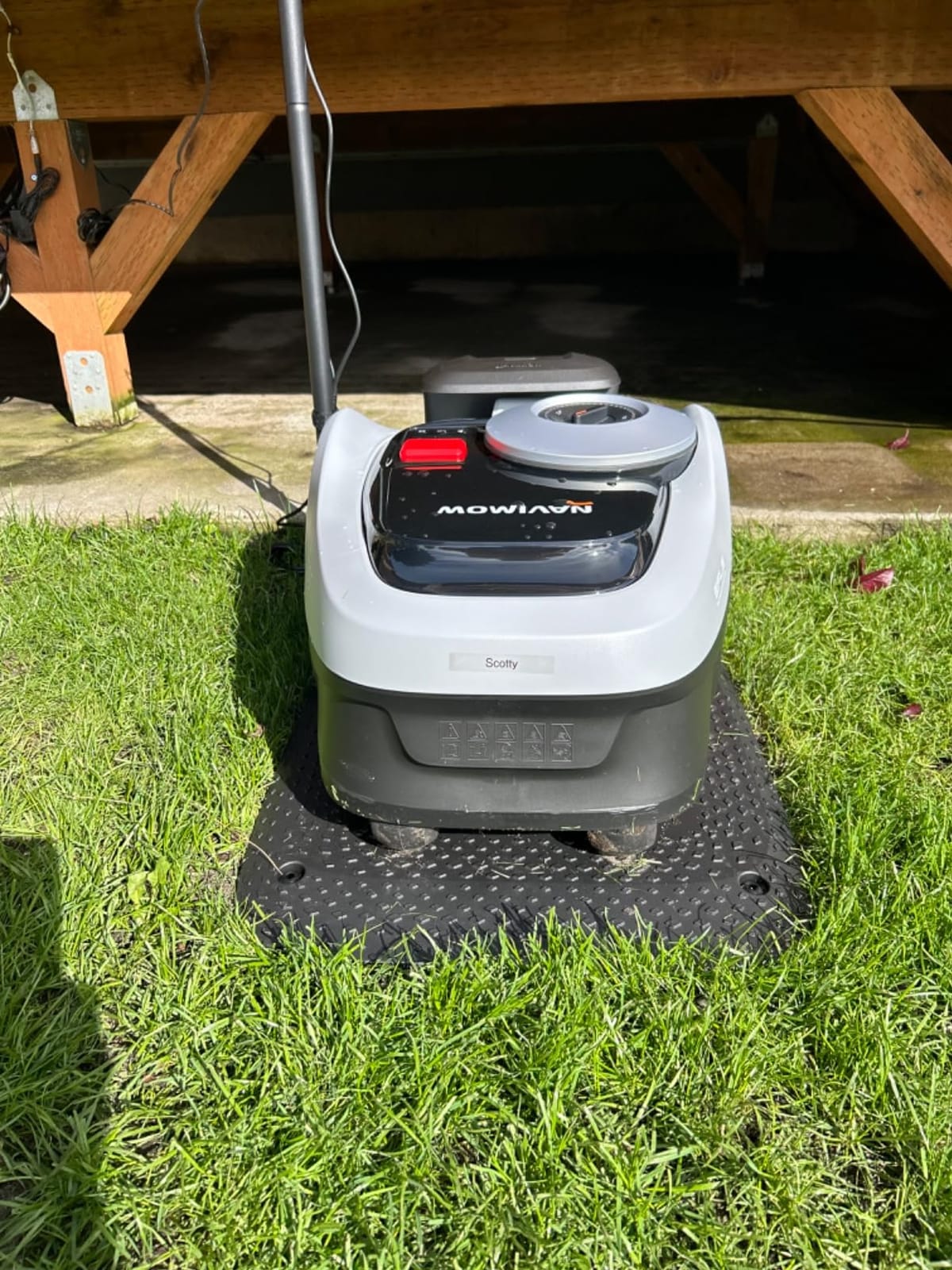
Quietness is the standout spec. At 58 dB(A) it is tied for the lowest figure in this roundup, which means night mowing will not disturb neighbours, and owners confirm the docking return is accurate and the machine recovers from many stuck positions. Connectivity runs through Wi-Fi and Bluetooth, with an optional 4G Access+ module if you want anti-theft tracking, and the three-year warranty is the longest stated here.
The honest problems are wheels and boundaries. The standard wheels have poor traction and snag on mulch, roots and slopes often enough that owners report getting stuck; off-road tyres help but cost extra. Vision Fence can miss obstacles sitting on a hard boundary such as a mailbox, a gate, a hose or a sprinkler head, and it can also trigger phantom detections. Map editing is manual, so changing a boundary means physically driving the mower.
Who gets the most out of it
Buyers on a first wire-free mower will find this the least intimidating machine here. AI-assisted mapping detects the lawn edge automatically, the app handles schedules and zones cleanly, and 58 dB(A) means you can run it early or late without negotiating with anyone. It suits small lots, narrow side lawns and properties where a heavier machine would be hard to store or lift.
It is also a good fit for owners whose lawn is mostly open with a couple of isolated trees rather than dense canopy, since the vision layer covers the weak spots. If your yard has a lot of mulch beds or loose bark, budget for better tyres at the first service.
Who should pick another model
If your lawn has deep tree cover with almost no sky, this RTK-led machine will spend time hunting for a fix. Move up to the LiDAR options instead. Owners with steep banks should also look at an all-wheel-drive model, because 24 pounds and the standard wheels will not manage a serious incline.
Anyone who expects the mower to be carried between separate lawns regularly should note the manual map editing routine. And if your property runs past a quarter acre, the coverage limit is the deciding factor, not the navigation quality.
4. ANTHBOT M5 – Best Wire-Free Mower for Fast Setup
ANTHBOT M5 Robot Lawn Mower 1/8 Acre, Dual Vision+Full-Band RTK Robotic Lawnmower, No Perimeter Wire, App Control Obstacle Avoidance, 45% Slope, Cutting Height, Multi-Zone Mapping
Full-band RTK with reference station included
Auto-maps in about 10 minutes
0.15 acre coverage
45% slope, 58 dB or less
Pros
- Maps a virtual yard in roughly ten minutes with no boundary driving
- Full-band RTK gives centimetre-level accuracy
- Recognises 1000+ common garden objects
- Handles 45% slopes and uneven ground
- Quiet at 58 dB or less
Cons
- Slow pace that often needs three passes
- Narrow 7.9 inch cutting path
- Leaves a thin unmown strip at edges
Most wire-free mowers ask you to drive the machine around the lawn perimeter at walking pace to teach it the boundary. The ANTHBOT M5 skips that. It builds a virtual yard map automatically in roughly ten minutes, which removes an entire evening and, more importantly, removes the most common source of mapping errors.
The navigation stack pairs full-band RTK with a bundled reference station and dual 150-degree HDR cameras, so positioning stays tight in the open and vision covers the interruptions. Obstacle recognition covers more than 1000 common garden object types, which is the largest library in this roundup and the reason it copes well with clutter on a small lawn.
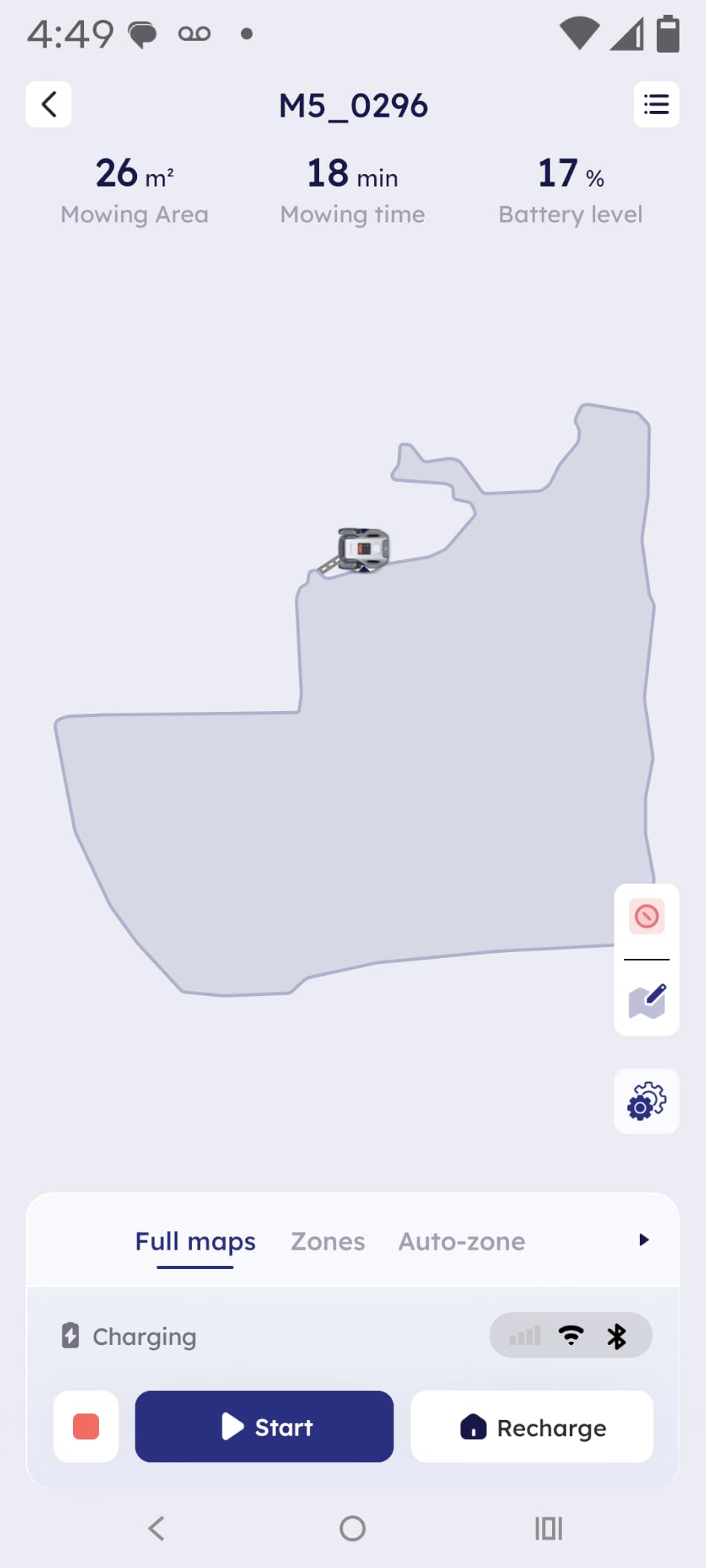
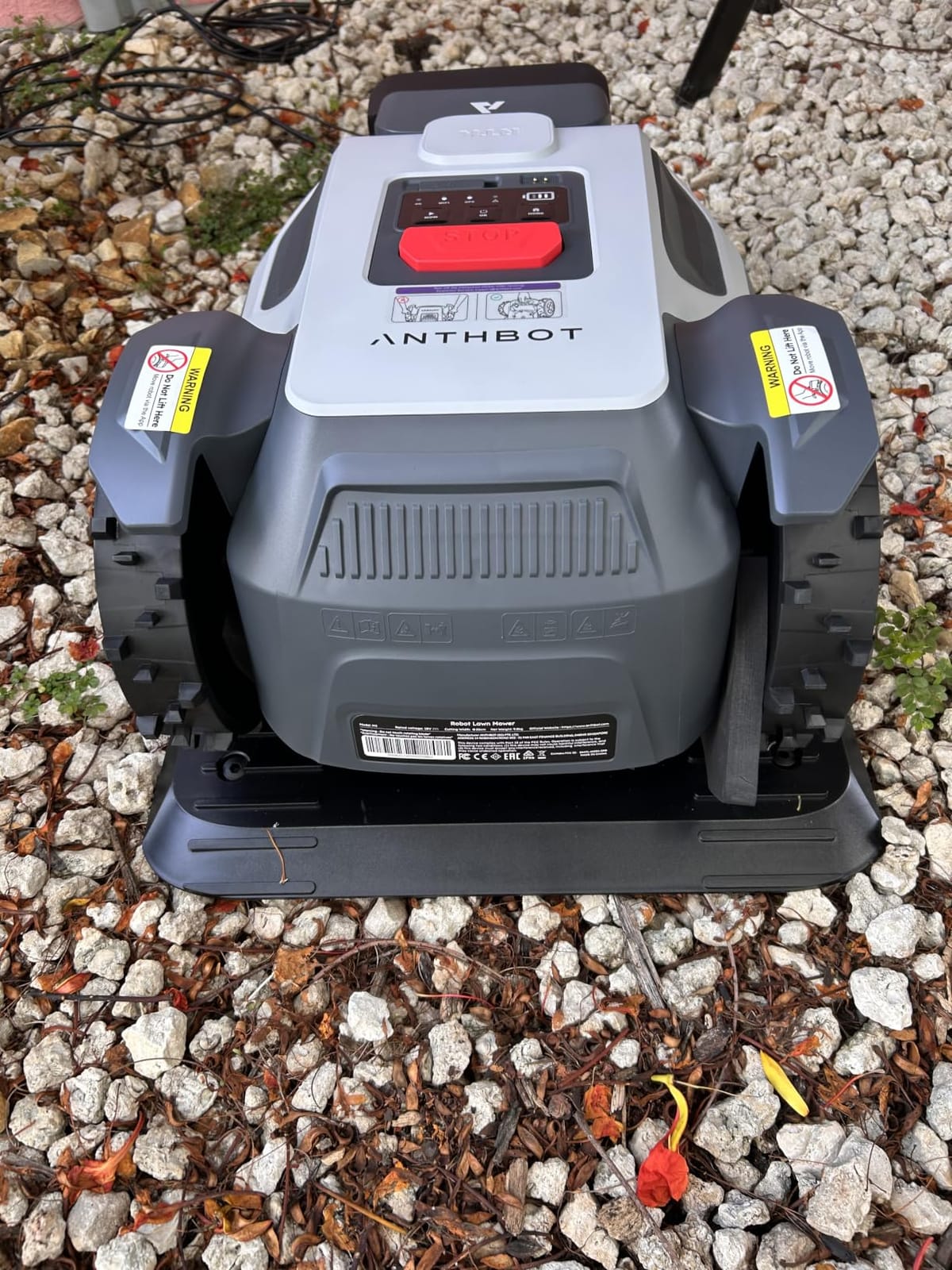
Capacity suits small to mid-size yards: 0.15 acre, up to 20 work zones with customisable no-go areas, and slopes to 45%. Cutting is handled by a five-blade free-rotating design across a 7.9 inch path, adjustable from 1.2 to 2.7 inches. At 12 kilograms with dimensions of 19.61 by 15.43 by 9.88 inches, it is one of the smallest machines here and easy to store against a wall.
Noise is rated at 58 dB or less, and the mower returns to the dock in rain and resumes automatically. Over-the-air updates and emergency braking are included. Owners rate the app straightforward for zones, no-go areas and schedules, and consider the whole package strong value for small and mid-size yards.
The common complaint is speed. The mowing pace is slow, and an even cut on most lawns needs three passes with repeated recharging, which the narrow 7.9 inch deck makes worse. A thin unmown strip at the lawn edge still needs a trimmer, and the machine struggles to cut through tall overgrown grass or uneven patches, so it suits a maintained lawn better than a neglected one. Some accessory bundles have also arrived without the promised garage.
Why this one suits first-time owners
If you have never installed a robot mower before, auto-mapping is the feature that removes the most risk. You place the dock, connect the antenna and let the mower survey the lawn. There is no boundary wire to peg and no perimeter drive to repeat after every firmware update.
The object library is another strong point for gardens with toys, pet items and fallen branches. Combined with emergency braking and rain-aware return, it is a sensible first machine for a household with children or dogs on a small lot.
Where the limits show
The 0.15 acre rating is the smallest coverage figure here, so this is a small-lot mower and nothing more. If your lawn is close to that ceiling, expect to trim the schedule rather than extend it. The 1.2 to 2.7 inch height range is also the lowest maximum in the roundup, which limits how tall you can let grass get before a manual cut.
If your lawn is steep, note that the 45% rating is well below what an all-wheel-drive machine handles, and the lighter chassis has less margin on a wet slope. Owners with overgrown yards should cut the grass down manually once before the first mow.
5. MOVA LiDAX Ultra 1000 – Best Wire-Free Mower for Yards With No Clear Sky View
MOVA LiDAX Ultra 1000 Robot Lawn Mower Wire Free for 1/4 Acre, RTK-Free+360° 3D LiDAR+AI Vision Auto Mapping, Zero-Edge Cutting, Cutting Height 1.2″-3.9″, 45% Slope, Up to 150 Managed Zones Dual Maps
RTK-free 360 degree 3D LiDAR plus AI vision
0.25 acre across two maps
45% slope
1.2 to 3.9 inch cutting height
Pros
- Runs with no perimeter wire and no RTK station
- Cuts to within about 2 inches of walls and hedges
- 300+ obstacle types detected by AI vision and 3D point cloud
- Up to 150 managed zones across two independent maps
- Three-year warranty with 24/7 after-sales service
Cons
- Battery life of about 60 minutes per charge
- No buyer reviews captured for this ASIN at enrichment
- Rear-wheel drive limits very rough terrain
If your lawn sits under heavy canopy, in a narrow walled garden or beside a building that blocks the horizon, the MOVA LiDAX Ultra 1000 removes the entire problem. It navigates on a 360-degree 3D LiDAR combined with AI vision, so there is no satellite signal to lose and no antenna to install.
The LiDAR builds a 3D map automatically, and the review data on this unit is thin, so treat the map accuracy claim with appropriate caution. What is well documented is the feature set: the 3D point cloud plus vision detects more than 300 obstacle types, and the UltraTrim 1.0 movable disc cuts to within about 2 inches of a wall or hedge, which is the tightest edge specification in this roundup.
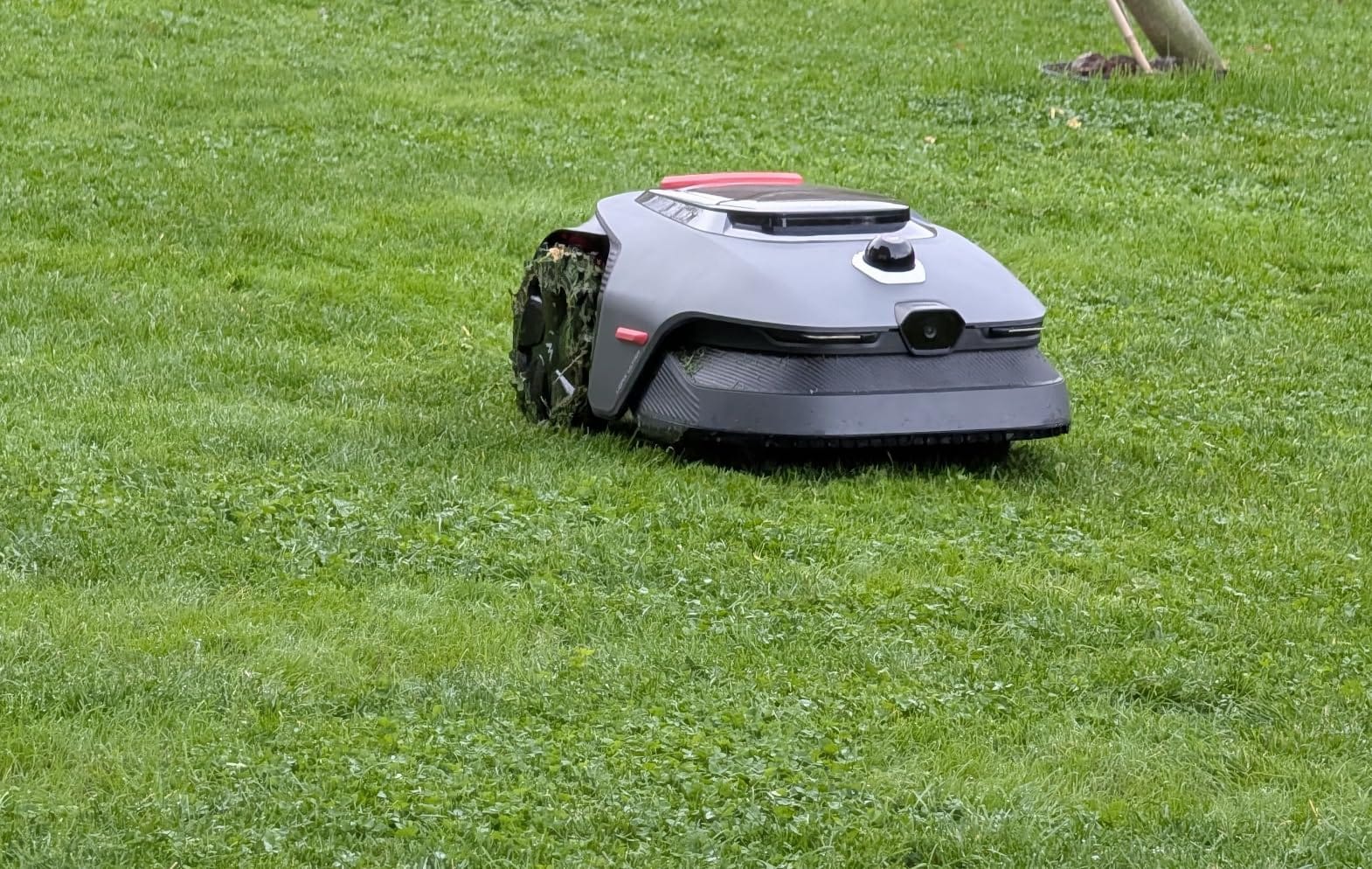
Coverage is up to a quarter acre, with up to 150 managed zones and two independent maps, which means one unit can handle a front lawn and a back lawn as separate areas. Cutting height spans 1.2 to 3.9 inches on an 8 inch deck, the widest adjustment range here. Rear-wheel drive with off-road wheels handles 45% slopes and obstacles up to 1.6 inches, and U-shaped path planning resumes automatically after charging.
Two practical notes. Battery life is listed at about 60 minutes per charge, so a quarter acre takes several cycles in a session. And the 3-year manufacturer warranty with 24/7 after-sales service is a genuine plus given the LiDAR component cost. TrueGuard anti-theft is built in, with an optional link module for real-time tracking. At 30 pounds and 34 by 20 by 16 inches, it is compact enough for a garage.
Because the review volume recorded against this exact ASIN is modest, we would treat it as a strong specification choice with less owner history than the picks above it. Buyers in the wider MOVA family commonly praise LiDAR accuracy, quietness and app usability compared with RTK-based machines, and the same MOVAhome app controls the LiDAX range.
Where LiDAR pays off
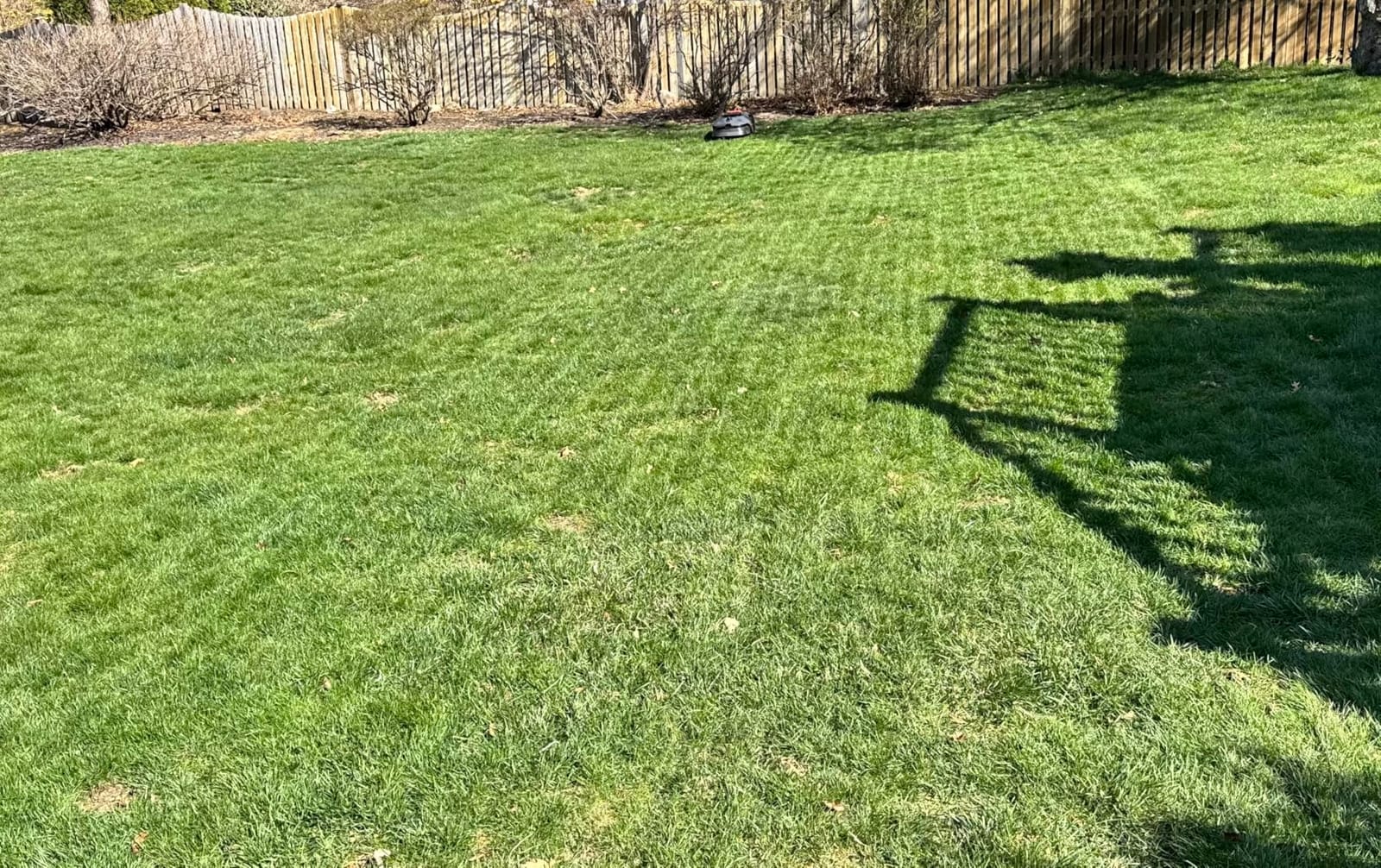
Two scenarios justify this machine. First, a lawn where satellites simply do not reach: dense trees, a walled courtyard, or a site beside a tall structure. Second, a garden with a lot of hard boundaries, because the 2 inch edge pass and the obstacle library handle kerbs, paths and garden furniture better than a vision-only system.
Multi-map support is the third case. Owners with two separate lawn areas that are not connected can run both from one machine rather than buying a second robot, and 150 managed zones is far more scheduling flexibility than most rivals offer.
Reasons to pick something else
Rear-wheel drive is a real limitation on a lawn full of molehills, tree roots or loose ground. An all-wheel-drive machine will keep cutting there. The 0.25 acre ceiling also means a property over a third of an acre needs a larger model.
Buyers who want a longer record of long-term owner reports should note the limited review history on this configuration. And if you have a very open, flat lawn with clear sky, you are paying for a LiDAR system you will not need.
6. ECOVACS GOAT O1000 RTK – Best Wire-Free Mower for Dense Warm-Season Grass
ECOVACS Goat O1000 RTK Care Robot Lawn Mower, RTK Navigation, 1/4 Acre
RTK centimetre positioning
1/4 acre coverage
8.66 inch cutting width
62 dB, 90 minute battery
Pros
- Handles dense fast-growing Bermuda and St Augustine grass
- Widest cutting deck relative to its class at 8.66 inches
- RTK extension cable allows better antenna placement
- 36 spare blades included in the CARE bundle
- 90 minute battery gives long sessions
Cons
- App produces false out-of-range lockouts
- No-go zones cannot be drawn on the map
- Auto mapping can merge separate lawn areas
The GOAT O1000 RTK is the one to consider if your lawn grows like a warm-season grass. Owners running it on Bermuda and St. Augustine report consistent striping and an even cut height across multiple zones, and the 90 minute battery is the second-longest session figure in this roundup. The 8.66 inch deck is wider than every other machine here except the LUBA 2 AWD.
Navigation is centimetre-level RTK with no wire, and the CARE bundle includes an RTK extension cable, which is genuinely useful. That cable lets you push the reference antenna to a spot with a better view of the sky without moving the dock, which solves the placement problem that trips up most RTK installs. Cutting height runs 1.2 to 3.2 inches and the mower returns to charge automatically with intelligent path planning.
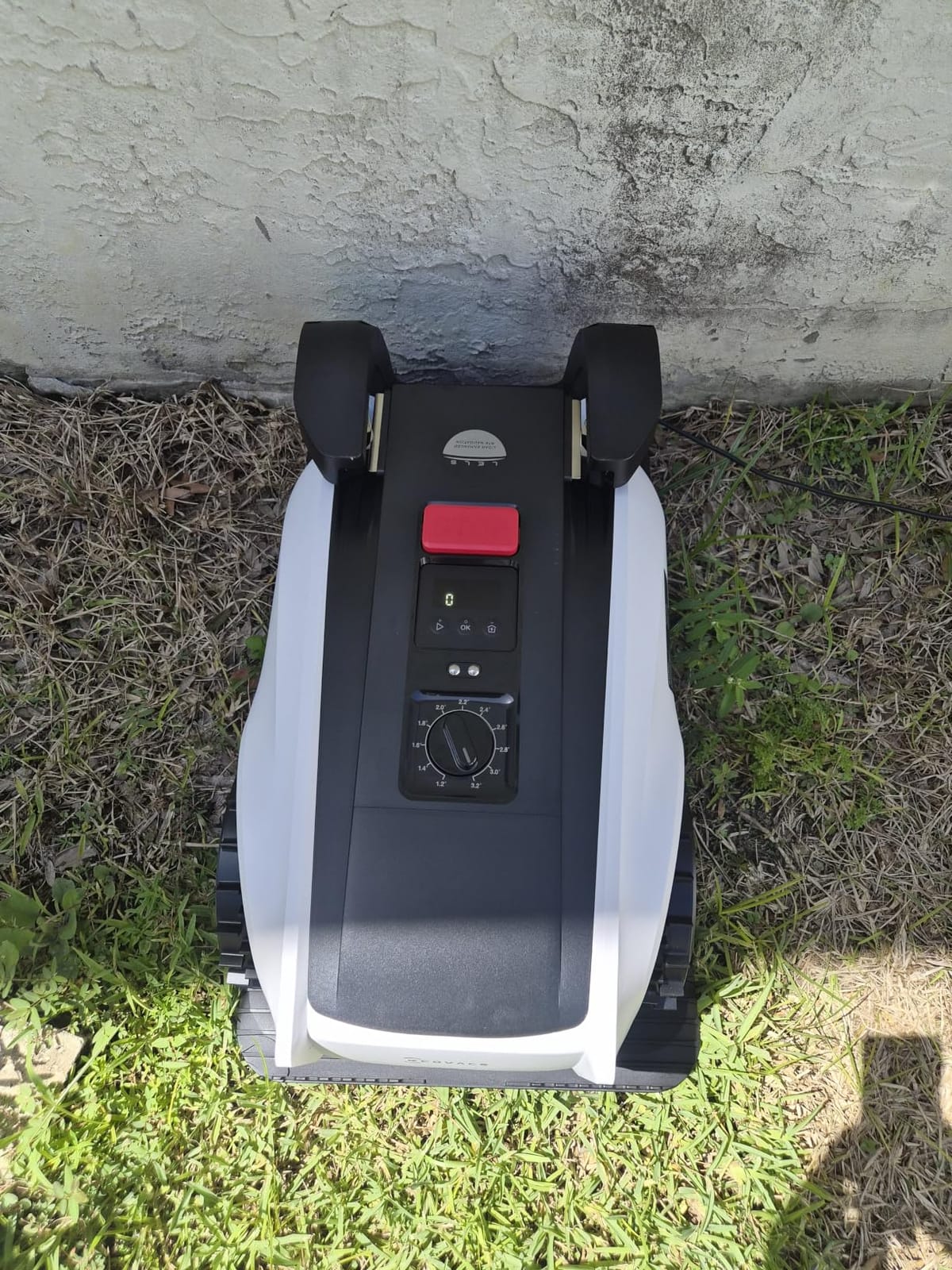
The 36 extra blades in the bundle extend maintenance intervals meaningfully on a machine that gets used hard. Operation is rated at 62 dB, and schedules and zone customisation are handled in the app alongside automatic yard scanning.
The problems are almost entirely in software. Owners report false out-of-range lockouts that need a physical reset of the machine, and no-go zones and boundaries cannot be drawn on the map, so they have to be created by remote control. Automatic mapping can also merge separate lawn areas across a fence or driveway, which is a serious issue for a property with a front and back lawn. Manual joystick steering is inaccurate, and the mower cannot be physically carried between zones. Several buyers moved to a competing model over these mapping issues.
Best fit for thick grass
If your lawn is a dense warm-season variety that needs cutting several times a week, the wide deck and long battery reduce the number of sessions needed. In our view this is the most mechanically capable machine for that specific job, and the blade bundle keeps the running cost down.
The extension cable is worth highlighting for anyone who has already had an RTK mower stall under trees. Being able to move the antenna while the dock stays put solves a problem that would otherwise push you toward a LiDAR machine.
Where the software holds it back
If you have two separate lawn areas, the auto-mapping merge behaviour is the dealbreaker. Buyers who need reliable map editing or drawn no-go zones should look at a machine with a mature app. Manual joystick control is too imprecise to rely on for zone setup.
Its 3.9 star rating reflects that split: hardware is well regarded, software is not. Anyone whose lawn is open and simple will get more satisfaction from one of the higher-rated navigation stacks.
7. Roborock RockNeo Q110H – Best Wire-Free Mower for Quiet Night Mowing
Roborock RockNeo Q110H Robot Lawn Mower, Wire-Free Robotic Lawn Mower with Full-Band RTK + VSLAM Navigation, Auto Mapping, AI Vision Obstacle Avoidance, App Control, 45% Slope, Covers Up to 1/4 Acre
Full-band RTK plus VSLAM navigation
1/4 acre coverage
130 minute battery
8.7 inch deck, 45% slope
Pros
- Fullest battery runtime here at 130 minutes
- Quiet operation with headlights for night mowing
- Cuts straight lines and handles 45% slopes
- App interface familiar from Roborock robot vacuums
- Handles passages as slim as 2.3 ft
Cons
- Boundary mapping is manual despite the auto-mapping claim
- Leaves 1 to 1.5 feet unmowed along boundaries
- Optional edge module sold separately
The RockNeo Q110H comes from a brand most buyers already know from robot vacuums, and that shows in the app. Configuration is familiar, multi-zone scheduling and cut-pattern customisation are easy to set, and a PIN lockout with alarm handles anti-theft. Owners also rate it as quiet, with headlights that allow genuine night mowing.
Navigation is full-band RTK combined with VSLAM, so the camera system covers the places satellites cannot. The spec sheet lists narrow passage support down to 2.3 feet, which matters if your lawn is split by a path or a hedge line. Coverage is up to a quarter acre, with a floating deck, large-diameter wheels, 45% slope capability and obstacle clearance up to 1.57 inches.
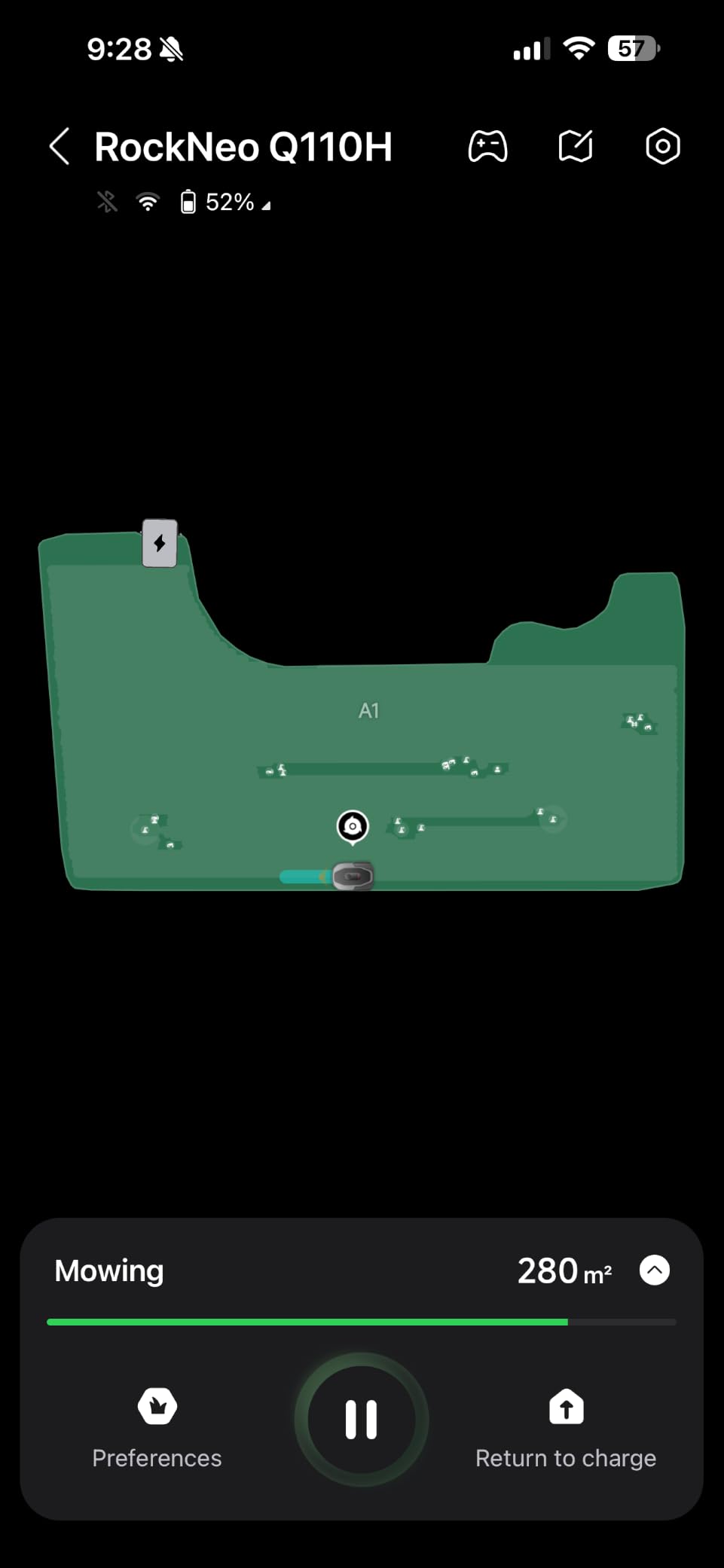
The 130 minute battery figure is the longest in this roundup by a wide margin, and paired with the 8.7 inch deck it explains why owners report straight, consistent cut lines. Cut height adjusts from 1.6 to 3.1 inches. Optional 4G anti-theft and a wildlife-friendly mode round out the feature list.
The catch is mapping and edges. Boundary mapping is manual through the app remote control despite the auto-mapping claim on the listing, so expect to drive the perimeter yourself. Edges are poorly cut, and the module that gives 1.2 inch edge precision is sold separately. Overly conservative no-go behaviour leaves 1 to 1.5 feet unmowed along fences, around trees and beside the antenna pole itself, and the mower refuses to pass through narrow openings such as gates even when the clearance looks sufficient. Maps cannot be edited without physically walking the machine, and partial zone mowing is unavailable.
Why owners keep it
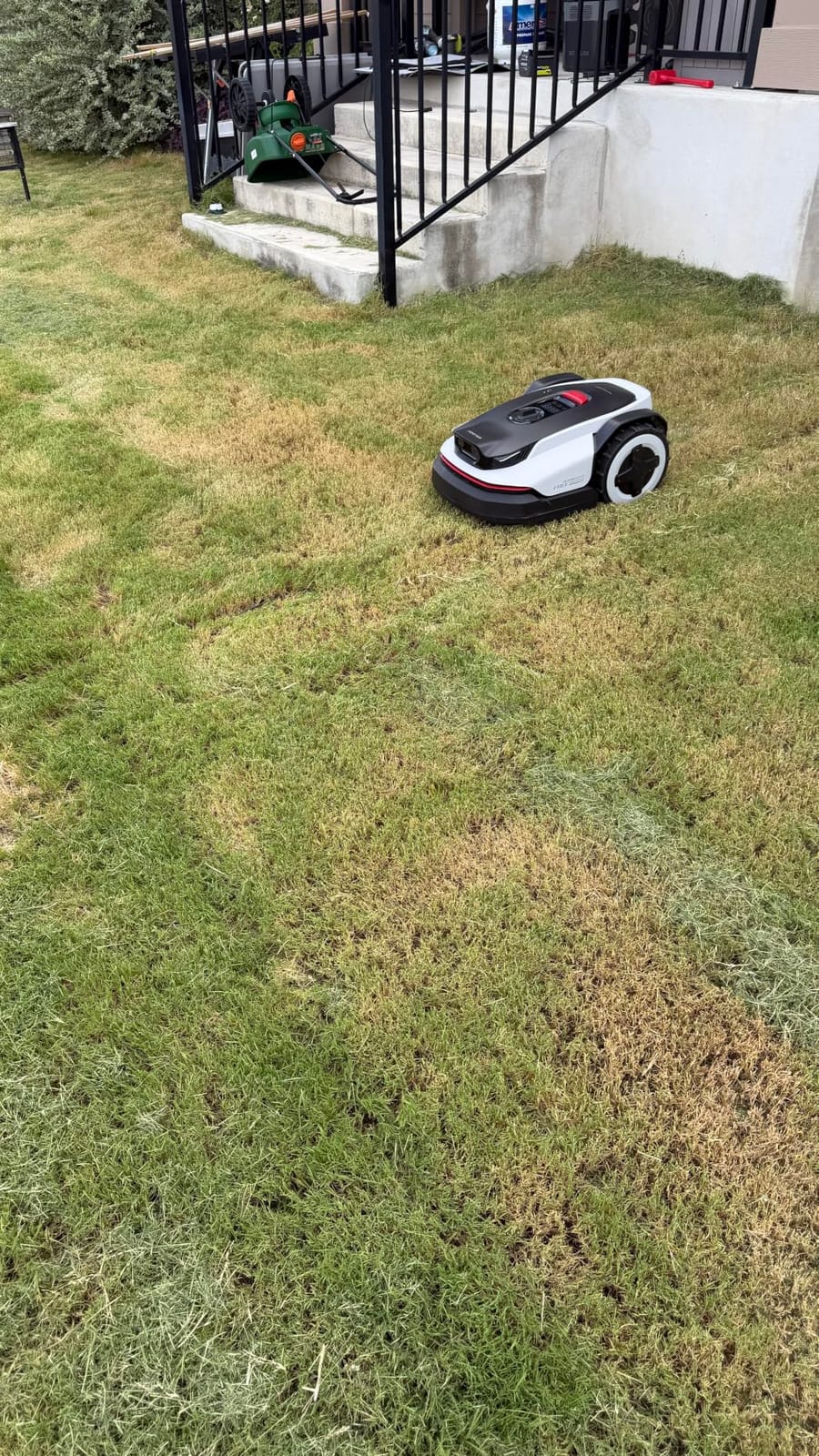
Three things carry this machine. The battery runtime means fewer charge cycles over a session, which suits anyone who mows a busy schedule. The VISO-grade navigation holds up under tree canopies and near fences, which is the failure mode of cheaper RTK units. And the app is the least frustrating here for anyone who has configured a Roborock vacuum already.
If your neighbours are sensitive to noise or you want to mow outside normal hours, the quiet operation plus headlights make this the pick. A quarter-acre lot with a single tree is also an easy fit.
What to watch out for
Traction is the practical issue in thick St. Augustine grass, where the wheels struggle and small bumps can trigger false lift alarms. The manual mapping routine and the unmowed boundary strips are the two things owners mention most often as frustrating.
Buyers who care about a clean edge should factor in the separately sold edge module. And if your lawn is connected by a gate, test it early, because the conservative no-go behaviour can block a passage the mower would physically fit through.
8. Sunseeker X3 Plus – Best Wire-Free Mower for Carrying Between Lawn Areas
Sunseeker X3 Plus Robot Lawn Mower, RTK, Vision AI, 0.3 Acre, Wire-Free
RTK plus VSLAM AONavi navigation
0.3 acre or 13000 sq ft
30% or 17 degree slope
19.9 pounds, 60 dB
Pros
- Under 20 pounds so it can be carried between lawn areas by hand
- Six saved maps with no-go zones and multi-zone scheduling
- Offset ride-on blade cuts close to fences and hardscape
- Quiet at 60 dB with voice control
- Two-year warranty with US-based support
Cons
- Software reliability issues with calibration and out-of-bounds errors
- App is painful to use with error messages in Chinese
- RTK cable must cross the lawn and mounting hardware is not sold by the brand
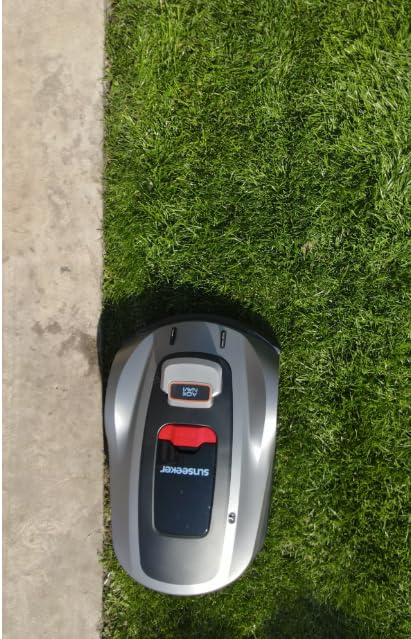
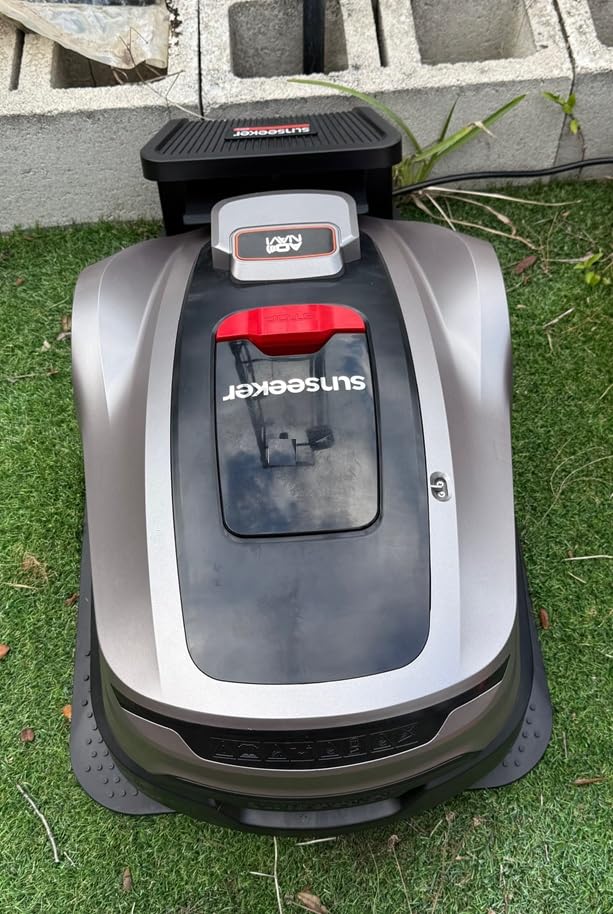
At 19.9 pounds the Sunseeker X3 Plus is the second-lightest machine here, and that weight is the reason to buy it. If your property has a front lawn and a back lawn with no connecting path, you can lift this mower and carry it. It stores six maps, supports no-go zones and multi-zone scheduling, and covers up to 0.3 acres or 13000 square feet.
Navigation is RTK combined with VSLAM under the AONavi stack, with vision AI and ultrasonic sensing for daytime object detection. Owners with flat, small yards on recent software report tidy results from the offset ride-on-edge blade, which cuts closer to fences and hardscape than a centred deck. At 60 dB it is quiet, and it supports Wi-Fi, Bluetooth and voice control. Two-year warranty and US-based support are both stated.
Owner feedback is sharply split, and the split follows the lawn. The 3.8 rating carries a 13% one-star share, the highest among RTK units here. Owners report frequent satellite calibration failures, random self-locking, false stuck and rain readings, deleted hazard zones reappearing in the app, and error messages arriving in Chinese. Several units lose connection and fail to return to the charging station.
Two practical issues stand out for installation. The antenna and RTK cable have to be routed across the lawn, and the advertised mounting hardware is not sold by the brand, so you may need to source a mount yourself. Slope capability is 17 degrees, or 30%, which is the lowest rating among the RTK units in this roundup. The mower also struggles in deep or fast-growing grass, sometimes reporting navigation failure on flat ground.
Who this suits
This is the pick when weight matters more than slope. A split lawn with steps, a small flat lot, or an older owner who does not want to move 40 pounds of machine around will find this the most practical wire-free option. Edge quality from the offset blade is a genuine benefit on a yard with a lot of fencing.
Owners with flat ground and grass kept to a normal height get dependable results. Six stored maps also make it flexible if the layout changes season to season.
Who should skip it
If your lawn has any real slope beyond gentle unevenness, the 30% rating and light chassis are a poor combination, and there are better all-wheel-drive options for that. Deep grass is also a problem, so you would be mowing a manual lawn down regularly as well as automating it.
Software reliability is the bigger concern. Buyers who have been burned by false lockouts and out-of-bounds errors should spend their budget on one of the higher-rated navigation stacks instead. And if the antenna cable across the lawn is unacceptable to you, a LiDAR model removes that constraint entirely.
How to Choose a Wire-Free Robot Mower: The Buying Guide
Work through these checks in order. Each one eliminates options faster than comparing specification lists.
1. Map your sky view. Stand in the middle of your lawn and look up. Dense canopy, a tall neighbouring building or a walled courtyard rules out RTK-only models. Clear sky across most of the property makes RTK the cheapest and most accurate route.
2. Measure lawn size against the coverage figure. Manufacturers rate the specific model, not the family. If your plot sits within 10% of a ceiling, choose the next size up, because coverage ratings assume ideal conditions and an even outline.
3. Measure your steepest slope. A 20% grade equals about 11 degrees, 30% is 17 degrees, 45% is 24 degrees and 80% is 38.6 degrees. Ratings are often quoted as maximum in ideal conditions, so keep a margin.
4. Check the narrowest route you need. If two lawn areas connect through a gap, measure it. Some machines will pass a 2.3 foot opening, others refuse a gate that looks wide enough.
5. Walk your boundaries. Note kerbs, steps, retaining walls, ponds and road edges. A virtual boundary is a software line, and steep drops deserve a physical barrier regardless of what the mower can sense.
6. Judge cutting width against your patience. Total mow time scales with area divided by deck width and speed. A 7 inch deck on a quarter acre takes considerably longer than a 15 inch deck, and slow models need repeated passes for an even finish.
7. Confirm the antenna or confirm you do not need one. RTK models need a reference antenna with open sky, sometimes mounted on a wall or roof. LiDAR and VSLAM models do not, which can save the whole install step.
8. Plan for hidden costs. Count cellular plans after any trial period, optional GPS tracking modules, replacement blades, and any mounting hardware the brand does not supply. Buying a deck of spare blades with the machine is cheaper than ordering them later. The same rule applies across household robotics generally: our robotic mops with a bucket and robotic mops with attachments roundups cover the identical consumables-versus-subscription question.
Safety at critical edges
Do not rely on a virtual boundary beside a road, pond, retaining wall or cliff. Cliff and step detection has improved, and it is one of the stronger arguments for LiDAR, but the margin between a saved map line and physical ground can be a few inches on an uneven property. Install a barrier at any drop a mower could survive.
Noise and night mowing
Noise figures here range from 58 dB(A) to 62 dB, which is a narrower spread than most buyers expect. The two quietest units, the Segway Navimow i105N and ANTHBOT M5, are also the two aimed at small lots. If you plan to mow at night, that difference is what decides between otherwise similar options.
When a Perimeter Wire Is Still the Better Answer
Wire-free navigation has genuinely solved the outer boundary for most lawns, and the models above are capable machines. There are still cases where digging cable in beats fighting with software.
A wire is the better answer when your lawn has no consistent edge: a grass-to-gravel transition that shifts each year, a border of loose mulch, or paving stones the mower repeatedly tries to climb. It is also better when you need very precise exclusion around delicate planting and the app will not let you draw the zone. A dealer-installed wire system costs an afternoon and a small amount of digging, and it does not need sky view, does not care about tree cover, and cannot be confused by a firmware update.
If your property is heavily wooded with no clear satellite view and you want to avoid the cost of a LiDAR machine, a wire mower solves it too. The trade is simple: you pay in installation labour and future repairs for a broken wire, rather than in subscription fees and mapping software. If lawn care is only half of the yard chore list, our robotic pool cleaners roundup covers the water side.
Frequently Asked Questions
Which robotic lawn mowers do not require a perimeter wire?
Every model in this roundup runs without a buried cable. They fall into four navigation types: network RTK with a base station antenna, full-band RTK paired with vision cameras, RTK combined with VSLAM, and LiDAR with AI vision. RTK models need a clear view of the sky for their reference antenna. LiDAR models need no satellite signal at all, which makes them the safest choice under dense tree cover or inside walled gardens.
Do wire-free robot mowers need Wi-Fi or cellular service?
Most need Wi-Fi and Bluetooth to set up schedules and maps from the app, but they keep mowing without a connection once a schedule is loaded. Cellular service is optional and usually sold as a bundle or an add-on module for anti-theft tracking and remote control. Check whether a data plan is included for a trial period and what it costs afterwards, because that recurring fee is the hidden cost buyers most often report being surprised by.
Do wire-free robot mowers work under trees?
It depends on the navigation stack. An RTK-only mower can stall or wander under a mature canopy because the satellite fix degrades. A hybrid model adds cameras that keep the machine tracking the grass edge when the signal weakens. A LiDAR model builds its map by scanning the yard, so tree cover does not affect it at all. For a heavily wooded lawn, choose LiDAR or a strong RTK plus vision combination.
Is LiDAR better than RTK for a robot lawn mower?
LiDAR does not need satellites, so it works anywhere, and it detects low obstacles and drop-offs well. RTK gives tighter boundary accuracy and usually maps faster, but it depends on sky view and sometimes on a physically mounted antenna. LiDAR models tend to cost more and run more slowly. On an open lawn with clear sky, RTK is the better value. Under trees, beside walls or in a courtyard, LiDAR is the safer choice.
How long does a robot mower take to mow one acre?
It depends mainly on cutting width, mowing speed and battery size rather than the navigation system. A narrow 7 to 8 inch deck needs far longer than a 15 inch deck, and slow models often need repeated passes for an even finish. Independent timed tests on an identical lawn have ranged from about 90 minutes on a fast tracked machine to more than six hours on a slower compact one. Always check the cutting width before buying for a large plot.
What size mower do I need for a small lawn?
For a lot under a quarter acre, a compact machine with a full-band RTK or LiDAR stack is enough, and the smaller deck is not a real drawback on a short lawn. The ANTHBOT M5 at 0.15 acre and the Segway Navimow i105N at 1/8 acre both cover typical small suburban plots. If your lawn is near a coverage ceiling, buy the next size up so the mower is not working at its limit every session.
Can a wire-free mower travel between separate lawn areas?
Usually not through a gate. Most machines can map and schedule several separate lawn areas, and some store two independent maps so one unit covers a front and back lawn, but many models refuse to drive through a narrow opening even when the clearance looks sufficient. If your lawn areas are only connected by a walkway, check the narrow passage figure for that model before buying. If they are completely separate, carry a light machine such as the Sunseeker X3 Plus.
Can I trust a virtual boundary beside a pond or road?
Treat it as a convenience, not a barrier. Virtual boundaries work well on flat, clearly defined lawn edges, but a software line has no physical presence at a steep drop. Install a real barrier beside roads, ponds, retaining walls and cliffs regardless of what the mower can sense. Cliff and step detection is better on LiDAR models, but it should be a second layer of protection rather than the only one.
What are the downsides of using a robotic lawn mower?
First, mowing time is much longer than a walk-behind, especially with a narrow deck. Second, edges usually need a trimmer pass. Third, hidden costs appear after the trial period, including cellular plans, optional GPS tracking modules and replacement blades. Fourth, firmware updates can change turning behaviour and mark turf. Fifth, a mower cannot mulch or shred leaf litter on most of these models. Sixth, a mapping or signal fault can send a machine toward a boundary instead of stopping at it.
Final Verdict
The best robotic mowers without perimeter wire are the ones whose navigation stack matches your yard, not the ones with the longest feature list. For rough ground, slopes and large acreage, the Mammotion LUBA 2 AWD 5000HX is the pick, with all-wheel drive, an 80% grade capability and vision that keeps working when the satellite signal does not. For tree-covered lawns, the MOVA LiDAX Ultra 1000 needs no sky view at all, and the Mammotion LUBA mini 2 1500H pairs LiDAR with all-wheel drive in a smaller frame.
For a typical suburban lot, the Segway Navimow i105N is the value answer and the quietest machine here at 58 dB(A), while the ANTHBOT M5 maps itself in about ten minutes. Dense warm-season grass suits the ECOVACS GOAT O1000 RTK, night mowing suits the Roborock RockNeo Q110H, and carrying between two lawn areas suits the light Sunseeker X3 Plus.
Whichever you choose, measure your lawn and walk your boundaries before you buy, and put a physical barrier at any drop a mower could survive. Last updated in 2026, and every model here was re-checked against its current specification listing for this roundup.