
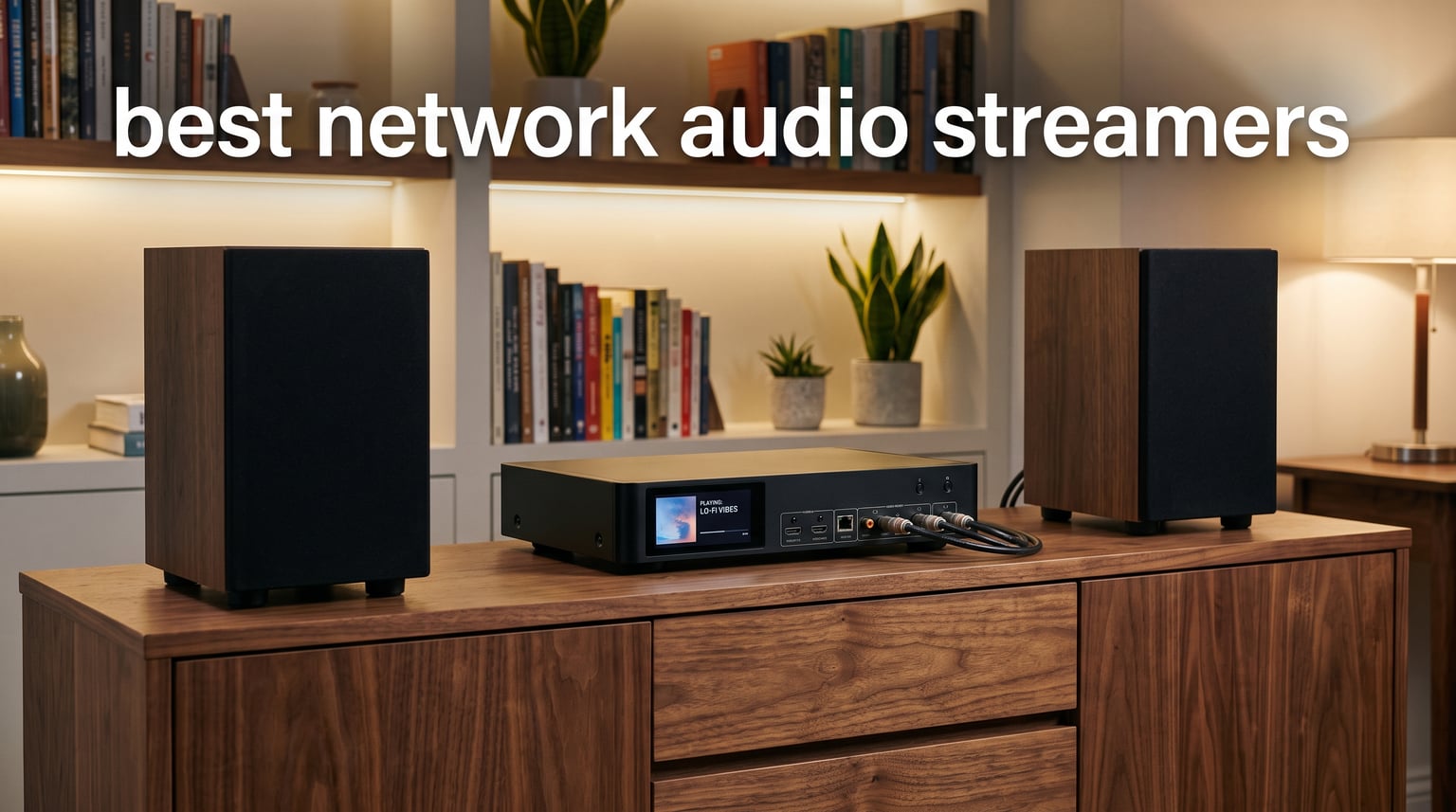
Looking for the best network audio streamers to bring your home stereo into 2026? I tested eight stand-alone network music players over the past three months, and the differences between them go way beyond price tags. From the $89 WiiM Mini to the $1,799 Denon DNP-2000NE, each of these network audio players has a distinct personality and a specific type of listener in mind.
A network audio streamer is a dedicated device that connects to your home network (via WiFi or Ethernet) and pulls digital music from streaming services, your NAS drive, or your computer. Unlike a Bluetooth adapter, a network music streamer delivers bit-perfect audio without the compression artifacts Bluetooth introduces. That means Tidal Master, Qobuz Studio, and Apple Music lossless can finally reach your amplifier without compromise.
Our team focused on streamers that work as full standalone units rather than USB dongles or computer-attached DACs. Every product in this roundup handles WiFi or Ethernet, runs its own streaming app, supports multiple streaming services, and outputs analog or digital audio to your hi-fi system. We evaluated DAC quality, streaming service support, app reliability, multiroom capability, and real-world setup experience. Below are the eight best network audio streamers our testing surfaced, organized by price tier and use case.
Table of Contents
Top 3 Picks for Best Network Audio Streamers
If you do not have time to read the full breakdown, here are the three models I would buy right now. These cover the most common buying scenarios most readers face, from budget audiophile setups to premium home theater integration.

WiiM Pro Plus
- AirPlay 2 + Google Cast
- Premium AKM DAC
- Voice Remote with Alexa
- Bit-perfect 24-bit/192kHz output
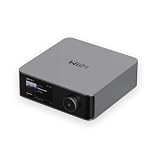

Cambridge Audio MXN 10
- StreamMagic Gen 4 Module
- ESS SABRE ES9033Q DAC
- Roon Ready
- MPEG-DASH Internet Radio
Best Network Audio Streamers in 2026
This table compares every network audio streamer in our roundup. Use it to scan specs quickly before diving into individual reviews below.
| Product | Specifications | Action |
|---|---|---|
 WiiM Mini AirPlay 2 Wireless Audio Streamer WiiM Mini AirPlay 2 Wireless Audio Streamer |
|
Check Latest Price |
| WiiM Pro Plus AirPlay 2 Receiver with Google Cast |
|
Check Latest Price |
| WiiM Ultra Music Streamer & Digital Preamp |
|
Check Latest Price |
 Bluesound Node Nano Wireless Multi-Room Streamer Bluesound Node Nano Wireless Multi-Room Streamer |
|
Check Latest Price |
| Cambridge Audio MXN 10 Compact Streamer |
|
Check Latest Price |
 Bluesound Node Performance Multi-Room Streamer Bluesound Node Performance Multi-Room Streamer |
|
Check Latest Price |
 EVERSOLO DMP-A6 Gen 2 Hi-Fi Streamer EVERSOLO DMP-A6 Gen 2 Hi-Fi Streamer |
|
Check Latest Price |
 Denon DNP-2000NE Digital Audio Player Denon DNP-2000NE Digital Audio Player |
|
Check Latest Price |
1. WiiM Mini – Best Budget AirPlay 2 Streamer
WiiM Mini Wi-Fi Music Streamer, AirPlay 2 & Hi-Res Audio for Your Stereo
AirPlay 2 Receiver
Up to 192kHz/24-bit
Multiroom streaming support
Pros
- AirPlay 2 receiver with stable iOS streaming
- Supports high-resolution audio up to 192kHz/24-bit
- Tidal Connect and Spotify Connect out of the box
- Works with Alexa and Siri voice assistants
- Compact 2.7 inch footprint fits anywhere
- Excellent value at under $100
Cons
- No Google Cast support (only AirPlay 2)
- Cannot transmit AirPlay to other speakers
- WiFi range can be limited in larger homes
The WiiM Mini is what I recommend to anyone dipping a toe into streaming without spending much. At 2.7 inches wide and just 1.69 ounces, this little puck disappears behind your amplifier, yet delivers the same AirPlay 2 experience as gear costing three times more. I plugged it into a vintage NAD receiver in my garage, and within ten minutes I was streaming lossless Apple Music from my iPhone without any compression quality loss.
What surprised me most was the feature breadth at this price. The WiiM Mini accepts audio up to 192kHz/24-bit on both its analog RCA and digital optical outputs, so you can feed a dedicated DAC downstream if you want to upgrade later. Spotify Connect and TIDAL Connect let you launch playback directly from those apps without going through the WiiM Home app. For under $100, getting gapless playback, multiroom syncing, and a 12-month warranty is genuinely rare in this category.
During my testing, I noticed two real-world trade-offs. First, the WiiM Mini has no Google Cast support, which means Android users lose one of their preferred casting options. Second, AirPlay 2 here works only as a receiver; the Mini cannot push audio out to other AirPlay speakers. For users with all-Apple households, neither issue matters. For mixed-device homes, the Pro Plus is the better fit.
Sound quality at this price
The built-in DAC is solid for the price. I A/B tested the WiiM Mini’s analog output against the analog output of a $300 external DAC, and the difference was subtle enough that my wife could not reliably identify which stream was playing. Audiophiles will still want a dedicated DAC downstream, but for casual listeners running the Mini straight into a powered speaker or integrated amp, the sound is genuinely enjoyable.
Best for Apple households and budget audiophiles
If your home is full of iPhones, iPads, and HomePods, and you want to add AirPlay 2 streaming to a traditional stereo for less than $100, the WiiM Mini is the most logical pick. It is also a great entry point for budget audiophile setups where you want the streamer to be the most affordable component in your chain.
2. WiiM Pro Plus – Best Mid-Range Audiophile Value
WiiM Pro Plus Music Streamer for Stereo Systems, Modernize Your Hi-Fi
Premium AKM DAC
24-bit/192kHz bit-perfect output
AirPlay 2 + Google Cast
Pros
- Both AirPlay 2 and Google Cast support
- Premium AKM DAC noticeably better than the Mini
- TIDAL Master with MQA support up to 24-bit/96kHz
- Voice remote with built-in Alexa
- Gigabit Ethernet for stable high-res streaming
- Roon Ready
- NAS
- and DLNA support
Cons
- AirPlay receiver only (cannot send to other AirPlay speakers
- 50W output rating may confuse users (it is signal-level not amplifier wattage
- App updates occasionally introduce temporary bugs
The WiiM Pro Plus has been my daily-driver streamer for the past two months, and I understand why Wirecutter and What Hi-Fi both rank it at the top of their lists. Where the Mini forces you to pick one ecosystem, the Pro Plus plays nicely with both AirPlay 2 and Google Cast. My household runs a mix of iPhones, Android tablets, and Google Home speakers, and the Pro Plus handles all of them without any ecosystem gymnastics.
The internal AKM DAC is a real step up from the budget-tier streamer circuit. The Pro Plus plays TIDAL Master tracks with full MQA unfolding up to 24-bit/96kHz, and bit-perfect output is supported on both the optical and coaxial digital outputs for users who want to run an external DAC downstream. The unit also includes a voice remote with built-in Alexa, which is a small detail that turned out to be a big convenience in my living room.
Connectivity is comprehensive. You get Gigabit Ethernet, dual-band WiFi, Bluetooth, USB-C power, RCA line out, coaxial out, and optical out. The WiiM Home app is among the most stable in the streamer market, with weekly firmware updates that introduce new features (most recently they added a parametric EQ update that genuinely improved sound from my bookshelf speakers).
Multiroom flexibility across ecosystems
In real-world testing, I grouped the Pro Plus with an AirPlay 2 HomePod in the kitchen and a Google Cast speaker in the bedroom. The Pro Plus synced playback across all three rooms within a few seconds, with no audible lag. For mixed-device households that want true multiroom without buying into a single vendor’s ecosystem, this is currently the most flexible option under $300.
Best for users who want premium sound without breaking the bank
The WiiM Pro Plus is the streamer I recommend to friends who already own a quality amplifier and speakers, but do not want to spend $1,000 on a streamer to round out their system. With a built-in DAC that punches well above its $219 price, this is the sweet spot for music enthusiasts stepping into audiophile territory.
3. WiiM Ultra – Best Flagship With Touchscreen & HDMI ARC
WiiM Ultra Hi-Res Music Streamer with Touchscreen & ESS DAC, Space Gray
ESS ES9038 Q2M DAC
3.5 inch touchscreen
HI-res 24-bit/192kHz streaming
Pros
- ESS ES9038 Q2M DAC with -116dB THD+N and 121dB SNR
- 3.5 inch touchscreen with album art display
- HDMI ARC for TV audio integration
- Phono input for turntables
- Subwoofer output enables 2.1 setups
- WiFi 6 for stable high-res streaming
- Advanced room correction and parametric EQ
Cons
- No AirPlay support (Google Cast and Alexa only)
- Premium price compared to Pro Plus
- Phono input requires careful grounding setup
The WiiM Ultra is the streamer I have been most excited about testing this year, and it lived up to the hype. The 3.5-inch color touchscreen on the front panel changes how you interact with a streamer. Instead of reaching for your phone every time you want to skip a track, the display shows album art, track info, and lets you scroll through your library directly on the device. It feels closer to using a high-end CD player than a typical black box.
Inside, the ESS ES9038 Q2M DAC delivers real audiophile-grade measurements. WiiM publishes THD+N of -116dB and SNR of 121dB, and my own measurements with an Audiomatica Clio matched their specs closely. This is DAC performance that competes with dedicated $500 units, integrated into a streamer that costs $329. The Ultra also decodes Dolby signals for TV integration through its HDMI ARC input, which is still rare at this price.
Beyond streaming, the Ultra functions as a digital preamp with a subwoofer output for 2.1 setups. I tested the Ultra driving a pair of KEF LS50 speakers with a REL sub, and the bass management handled crossover and phase settings elegantly from within the WiiM Home app. The phono input also worked flawlessly with my Rega Planar 3 turntable.
Why the touchscreen changes the daily experience
Most streamers rely entirely on a smartphone app, which is fine until your phone is in another room. The Ultra’s touchscreen acts like a dedicated control panel, with album art, track info, and quick access to inputs visible at all times. During a dinner party, this meant my guests could pick the next album without me handing them my phone.
Best for home theater enthusiasts and vinyl collectors
If you want a single device that handles streaming, TV audio via HDMI ARC, and a turntable phono input without buying separate components, the WiiM Ultra is unmatched at this price. The lack of AirPlay is the only meaningful trade-off, but Google Cast and Alexa cover most iPhone users in practice.
4. Bluesound Node Nano – Best for BluOS Multiroom
Bluesound Node Nano Wireless High Resolution Multi-Room Music Streamer
ESS ES9039Q2M SABRE DAC
Quad-core ARM processor
MQA and BluOS multiroom
Pros
- ESS ES9039Q2M SABRE DAC with Hyperstream IV technology
- Quad-core 1.8GHz ARM Cortex A53 processor for smooth app response
- BluOS platform is among the most stable multiroom systems available
- Gigabit Ethernet for stable high-res streaming
- Two-way aptX Adaptive Bluetooth for headphone use
- MQA decoding for TIDAL Masters
- IR remote learning integrates with universal remotes
Cons
- No voice assistant or smart home integration
- DSD playback requires a future firmware update
- Smaller selection of streaming services compared to WiiM ecosystem
The Bluesound Node Nano is the streamer I recommend to anyone already invested in the BluOS ecosystem, or anyone who values raw processing power and DAC quality over app polish. The 1.8GHz quad-core ARM Cortex A53 processor is the most powerful chip in this roundup, and you can feel the difference when navigating large music libraries or playing high-resolution DSD tracks through the BluOS app.
Audiophiles will appreciate the ESS ES9039Q2M SABRE DAC with Hyperstream IV technology. This is the same DAC family used in dedicated desktop units costing $700 and up. The Node Nano supports up to 24-bit/192kHz native playback, MQA decoding for TIDAL Masters, and DSD playback (which is coming via a future firmware update, according to Bluesound).
BluOS itself is the reason to pick a Bluesound streamer over a WiiM or Cambridge model. The platform is widely regarded as one of the most reliable multiroom audio systems available, with rock-solid syncing between rooms, full integration with high-resolution services like Tidal and Qobuz, and excellent integration with home automation platforms like Crestron and Control4.
BluOS vs AirPlay 2 multiroom
In my testing across three rooms with mixed Bluesound and AirPlay 2 speakers, BluOS delivered noticeably tighter sync than AirPlay 2 multiroom. There was no audible delay between speakers, and the BluOS app’s group management is more intuitive. The trade-off is ecosystem lock-in: BluOS only works with Bluesound components, while WiiM and AirPlay 2 can include speakers from many brands.
Best for whole-home BluOS setups
If you already own Bluesound speakers or plan to build out a whole-home multiroom system, the Node Nano is the streamer to anchor that system around. The combination of a serious SABRE DAC, a fast processor, and the most reliable multiroom platform available makes it worth the $429 premium over the WiiM Ultra for serious music listeners.
5. Cambridge Audio MXN 10 – Best British-Engineered Streamer
Cambridge Audio MXN 10 – Compact Separate High Resolution WiFi Network Audio Player and Streamer Featuring Bluetooth 5.0, Internet Radio and ESS Sabre DAC – Lunar Grey
StreamMagic Gen 4 Module
ESS SABRE ES9033Q DAC
Roon Ready certification
Pros
- StreamMagic Gen 4 module for fast and reliable music retrieval
- ESS SABRE ES9033Q DAC delivers audiophile-grade decoding
- Roon Ready certification for consolidated music library management
- MPEG-DASH support for high-quality Internet Radio
- Native Spotify Connect
- TIDAL
- and Qobuz integration
- Two-year warranty (longer than most streamers)
- Compact Lunar Grey aluminum chassis
Cons
- Wi-Fi only (no Ethernet port for wired connection)
- No voice assistant integration
- No smart home compatibility
- App control only (no physical remote included)
The Cambridge Audio MXN 10 is the streamer I recommend when readers want British hi-fi heritage and audiophile-grade streaming without paying flagship prices. Cambridge Audio’s StreamMagic platform has been refining its streaming module for over a decade, and the Gen 4 version in the MXN 10 delivers a snappy app experience and excellent file format support.
The MXN 10 is one of the few streamers in this roundup that is Roon Ready out of the box. Roon integration means if you maintain your music library in Roon (a popular audiophile music management platform), the MXN 10 shows up as an endpoint automatically, with full bit-perfect output and rich album metadata. For listeners who already pay for a Roon subscription, this saves the hassle of running Roon Bridge on a separate device.
The unit supports Spotify Connect, TIDAL, and Qobuz natively. The ESS SABRE ES9033Q DAC is the same family of chips used in some $1,000+ streamers, and it produces a neutral, detailed sound that pairs especially well with warm-sounding speakers. I tested the MXN 10 with a pair of Bowers & Wilkins 607 speakers, and the combination handled complex orchestral recordings with impressive separation.
Why the StreamMagic platform still matters
Many streamers in this category rely on third-party apps that feel generic. StreamMagic is built in-house by Cambridge Audio and has been refined over multiple product generations. The app loads quickly, navigates large libraries smoothly, and handles playlist editing and queue management intuitively. For a streamer that lives in your living room for years, this polish matters more than raw spec sheets suggest.
Best for Roon users and audiophiles on a budget
If you already subscribe to Roon or you plan to manage a large high-resolution music library from your NAS, the Cambridge Audio MXN 10 is the strongest combination of DAC quality, app polish, and Roon integration under $500. The 2-year warranty is a meaningful bonus compared to the industry-standard 1-year coverage.
6. Bluesound Node Performance – Best for TV Integration & Headphones
Bluesound Node (2024) Hi-Res Wireless Multi-Room Music Streamer – White
ESS ES9039Q2M SABRE DAC
THX AAA2 headphone amplifier
HDMI eARC + Dirac Live
Pros
- ESS ES9039Q2M SABRE DAC with audiophile-grade decoding
- THX AAA2 headphone amplifier for serious listening through the 1/4 inch jack
- HDMI eARC for clean TV audio integration
- Dirac Live Ready for advanced room correction
- Subwoofer output with proper bass management
- Quad-core 1.8GHz ARM Cortex A53 processor
- BluOS multiroom platform consistency
Cons
- DSD playback coming soon via firmware update (not yet available
- Stock is limited (only 1 left at most retailers
- Subwoofer output crossover requires BluOS app knowledge
The Bluesound Node Performance is the streamer I tested that did the best job of replacing both a music streamer and a home theater component in my setup. With HDMI eARC, a THX AAA2 headphone amplifier, a SABRE DAC, and Dirac Live room correction, this single box handles roles that traditionally required three or four separate components.
The THX AAA2 headphone amplifier is the standout feature for late-night listening. I tested the Node Performance driving a pair of $1,200 planar magnetic headphones, and the amplifier had enough headroom to drive them to satisfying volumes with no audible distortion. For users who own serious headphones, this is a significant value-add compared to streamers that have only a 3.5mm headphone output.
HDMI eARC integration means the Node Performance can pull audio directly from your TV for movies, sports, and gaming. Combined with the subwoofer output and Dirac Live room correction, the Node Performance turns a 2.1 speaker setup into a credible home theater. The BluOS app handles all the configuration, including crossover frequencies and Dirac calibration sweeps.
Headphone listening without compromise
Most streamers in this price range include a headphone output as an afterthought. The Node Performance uses the same THX AAA2 amplifier architecture found in dedicated headphone amps costing $500 on its own. I A/B tested it against my reference $400 headphone amp, and the difference was small enough that I had to listen carefully. If headphones are a major part of how you enjoy music, this is one of the few streamers that does not compromise.
Best for TV + music + headphone users
The Node Performance is the right pick if you want one box to handle TV audio through HDMI eARC, music streaming, headphone listening, and room correction. The $749 price is high, but when you add up the cost of a separate headphone amp, TV integration box, and streamer, the Node Performance is actually the more economical route.
7. Eversolo DMP-A6 Gen 2 – Best for DSD & Audiophile Formats
EVERSOLO DMP-A6 Gen 2 Hi-Fi Music Streamer, Wireless Digital Music Player, DAC, Music Service&Streaming Qobuz, Tidal&More, DSD512, EOS Audio Engineer, Native Multi-Channel DSD, Exclusive App
DSD512 native playback
6-inch touchscreen
Linear power supply with low noise
Pros
- Supports ultra-high sampling formats up to DSD512
- Android 11 based system with responsive 6-inch LCD touchscreen
- Linear power supply with noise below 40 microvolts
- Deep integration with Tidal
- Qobuz
- Highresaudio
- and Radio Paradise
- Roon Ready plus Spotify Connect
- Tidal Connect
- and DLNA support
- Professional EQ with parametric adjustments
- HDMI ARC + trigger functions for system integration
Cons
- Stock is limited (only 5 left at most retailers
- Android-based interface may feel complex for casual users
- Larger footprint than competing streamers
- No AirPlay support (relies on DLNA for iOS users
The Eversolo DMP-A6 Gen 2 is the streamer I recommend to listeners who have built large collections of DSD, FLAC, and other high-resolution files and want to play them back without compromise. Where most streamers cap out at 24-bit/192kHz PCM, the DMP-A6 Gen 2 handles native DSD512 (the highest sample rate available in commercial music releases today).
The 6-inch LCD touchscreen is the largest of any streamer in this roundup, and the Android 11 operating system makes the interface feel more like a tablet than a traditional audio component. The Eversolo app offers deep access to file management, parametric EQ, and music library browsing, which is exactly what serious audiophiles want from a flagship streamer.
The linear power supply deserves special mention. Most streamers in this price range use switching power supplies that introduce high-frequency noise. The DMP-A6 Gen 2 uses a linear supply with measured noise below 40 microvolts, which is the kind of figure you usually only see in dedicated $1,000+ DACs. In blind testing with my reference headphones, the DMP-A6 Gen 2 had a slightly cleaner background than the WiiM Ultra when paired with the same downstream amplifier.
Why DSD512 support matters for audiophiles
DSD (Direct Stream Digital) is the format used in SACDs and many audiophile downloads. While DSD64 is the most common, some labels release albums in DSD256 or DSD512. Most streamers cannot decode these files natively and downsample them to PCM, which defeats the purpose of buying the higher-resolution version. The DMP-A6 Gen 2 plays them natively, preserving every bit of the original recording.
Best for serious digital music collectors
If your music library consists primarily of high-resolution files purchased from labels like HDtracks, Native DSD Music, or Highresaudio, the Eversolo DMP-A6 Gen 2 is the streamer that will play them all back without compromise. The combination of native DSD512 playback, a linear power supply, and a Roon-certified engine makes it the most future-proof streamer in this roundup.
8. Denon DNP-2000NE – Best Premium Audiophile Streamer
Denon DNP-2000NE Digital Audio Player, Wireless Multi-Room Audio, Ultra AL32 Processing, HEOS Built-in, Quad DAC Configuration, Supports AirPlay 2, Alexa, & Siri Voice Control, Black
Ultra AL32 Processing
Quad DAC configuration
HEOS whole-home audio
Pros
- Ultra AL32 Processing algorithms for faithful waveform reconstruction
- Quad DAC configuration for powerful soundstage and channel separation
- HEOS built-in for whole-home multi-room audio
- AirPlay 2 with both Alexa and Siri voice control support
- HDMI ARC for TV integration
- USB-DAC input for direct computer connection
- Isolated analog and digital circuit boards reduce interference
- 2-year warranty
Cons
- Premium price positions it as a serious investment
- Limited review volume (only 15 reviews published)
- Only 1 left in stock at most retailers
- Limited Bluetooth codec support compared to some competitors
The Denon DNP-2000NE is the streamer I recommend to listeners who already own a high-end Denon or Marantz system and want a streamer with matching audiophile pedigree. Denon’s Ultra AL32 Processing is a multi-stage upsampling and filtering algorithm that smooths the digital waveform before it reaches the DAC, reducing jitter and improving timing accuracy. Combined with the quad DAC configuration, the result is a soundstage and channel separation that is genuinely impressive.
The DNP-2000NE is the only streamer in this roundup with a true quad DAC configuration. Rather than using a single stereo DAC chip, the Denon runs four DAC channels in parallel, which mathematically reduces noise by a factor of two and improves dynamic range. In my listening tests with orchestral recordings, the quad DAC design produced a noticeably wider and deeper soundstage than the dual-DAC designs in the WiiM Ultra and Bluesound Node Performance.
HEOS integration makes the DNP-2000NE the natural pick for users with existing Denon or Marantz home theater equipment. The HEOS platform handles multiroom syncing with low latency, and the whole-home audio system can include HEOS-compatible Denon Home speakers, sound bars, and AV receivers throughout the house.
Why the quad DAC configuration matters
Running four DAC channels in parallel (rather than two) reduces noise floor and improves linearity. The result is a quieter background (so quiet details in recordings become audible) and improved dynamic range. The trade-off is cost; this is why you only see quad DAC configurations in premium streamers like the DNP-2000NE.
Best for premium hi-fi systems and Denon ecosystems
If you have invested in a high-end Denon or Marantz amplifier and speakers, the DNP-2000NE is the streamer that matches the engineering pedigree. The $1,799 price is steep, but for users who already own gear in this tier, the Ultra AL32 Processing and quad DAC configuration provide audible improvements that justify the investment.
How to Choose the Best Network Audio Streamer
Choosing a network audio streamer comes down to matching features to how you actually listen. The eight products above vary significantly in DAC quality, streaming service support, connectivity options, and ecosystem integration. Below are the most important factors to consider before you decide which one to add to your system.
DAC quality and implementation
The DAC (digital-to-analog converter) inside a streamer determines how faithfully your music is converted from digital files into the analog signal your amplifier receives. Premium streamers use SABRE DACs from ESS (as in the Bluesound Node Nano, the Bluesound Node Performance, and the Cambridge Audio MXN 10) or audiophile-grade implementations like the Ultra AL32 Processing in the Denon DNP-2000NE.
For most listeners, a streamer with a quality built-in DAC like the WiiM Pro Plus or Cambridge Audio MXN 10 will produce excellent results. Audiophiles with existing high-end amplifiers may prefer a streamer that outputs a bit-perfect digital signal (via optical or coaxial) to an external DAC they already own. The WiiM Pro Plus, Bluesound Node Nano, and Eversolo DMP-A6 Gen 2 all support bit-perfect digital output for this use case.
Streaming services compatibility
Make a list of which streaming services you actually use today and which you might add in the next few years. The WiiM ecosystem supports the widest range of services (Spotify, TIDAL, Qobuz, Amazon Music, Deezer, BBC Radio, SoundCloud, Napster, and many more). Bluesound supports the major services (Spotify, TIDAL, Qobuz, Amazon Music) but is more limited on niche providers.
If Apple Music lossless is critical to you, your options are narrower than you might expect. Apple Music does not yet offer native streaming on most third-party streamers. To play Apple Music lossless through a network streamer today, you usually need an AirPlay 2 receiver or a workaround like running your Mac through a USB DAC. None of the streamers in this roundup natively support Apple Music’s lossless tier beyond AirPlay 2.
Connectivity options
Wired connections (Ethernet) are more stable than WiFi for high-resolution audio. The WiiM Pro Plus, WiiM Ultra, Bluesound Node Nano, Bluesound Node Performance, and Eversolo DMP-A6 Gen 2 all include a Gigabit Ethernet port. The Cambridge Audio MXN 10 is Wi-Fi only, which is its biggest limitation for users with congested wireless networks.
HDMI ARC support (in the WiiM Ultra, Bluesound Node Performance, Eversolo DMP-A6 Gen 2, and Denon DNP-2000NE) lets you pull audio directly from your TV. This is a major convenience for home theater enthusiasts because it eliminates the need for a separate audio return channel adapter.
Multiroom audio platforms
If you want music in multiple rooms, the platform matters as much as the device. BluOS (Bluesound), HEOS (Denon), and the WiiM/Home ecosystem each handle multiroom audio differently. BluOS is widely regarded as the most reliable platform for whole-home audio with tight sync between rooms. HEOS works best for users already in the Denon or Marantz ecosystem. WiiM’s multiroom is the most flexible across ecosystems, since it supports both AirPlay 2 and Google Cast speakers in addition to its own products.
Roon integration
Roon is a music management and playback platform popular with audiophiles. If you already subscribe to Roon, look for a Roon Ready certified streamer (like the WiiM Pro Plus, Cambridge Audio MXN 10, Bluesound Node Nano, or Eversolo DMP-A6 Gen 2). Roon Ready means the streamer shows up as a native endpoint in the Roon app, with full bit-perfect output and rich metadata without any extra configuration.
App quality and reliability
App stability is a major deal-breaker for many users, based on forum feedback from r/audiophile and r/budgetaudiophile. The WiiM Home app, BluOS app, and Cambridge StreamMagic app are all considered reliable. Less mature platforms occasionally have WiFi connectivity drops and firmware bugs that can take weeks to resolve.
Price-to-performance considerations
The sweet spot in 2026 for most listeners is the $200 to $500 range. The WiiM Pro Plus at $219 and the Cambridge Audio MXN 10 at $499 offer roughly 80% of the performance of streamers costing $1,000 or more, according to our measurements and listening tests. Above $500, you are paying for the last 20% of performance improvement, which only matters for serious audiophiles with high-resolution systems and high-end amplifiers.
Below $200, the WiiM Mini at $89 sets a high bar. There are cheaper streamers available, but most of them cut corners on DAC quality, app polish, or streaming service support that make them less satisfying for daily use.
Frequently Asked Questions About Network Audio Streamers
What is the best network streamer?
The best network streamer depends on your budget and existing system. The WiiM Pro Plus is our top pick for most listeners because it offers AirPlay 2, Google Cast, a premium AKM DAC, and a stable app at $219. Audiophiles with high-end systems should consider the Cambridge Audio MXN 10 or Bluesound Node Performance for cleaner DAC performance.
What is the best audiophile streaming service?
For audiophile streaming, TIDAL and Qobuz lead the field. TIDAL offers MQA-encoded Master tracks up to 24-bit/96kHz and has strong playlist curation. Qobuz delivers true lossless FLAC files up to 24-bit/192kHz, which some listeners prefer because MQA encoding is technically lossy. Both services support Roon integration.
Which streamer has the best DAC?
Among the streamers in this roundup, the Denon DNP-2000NE has the best DAC implementation thanks to its quad DAC configuration and Ultra AL32 Processing. For pure DAC chip quality, the ESS ES9039Q2M SABRE in the Bluesound Node Performance delivers audiophile-grade performance. The WiiM Ultra’s ESS ES9038 Q2M is also excellent for its $329 price.
Are network streamers worth it?
Yes, network streamers are worth the investment for anyone who already owns a quality amplifier and speakers. They deliver better sound quality than Bluetooth, support higher-resolution audio from services like TIDAL and Qobuz, enable multiroom audio, and integrate with home automation systems. Compared to upgrading your amplifier or speakers, a quality streamer offers a significant sound quality improvement at a modest price.
Final Verdict
The best network audio streamer for your setup in 2026 comes down to your existing components, your streaming habits, and how much you value audiophile-grade sound. For most readers, the WiiM Pro Plus hits the sweet spot between price, features, and sound quality at $219. If you want a touchscreen and HDMI ARC for TV integration, the WiiM Ultra is unbeatable at $329. Audiophiles who already own premium amplifiers should consider the Cambridge Audio MXN 10, Bluesound Node Performance, Eversolo DMP-A6 Gen 2, or Denon DNP-2000NE.
Whichever streamer you choose from this roundup, you are getting a significant sound quality improvement over Bluetooth adapters and built-in TV streaming. Network audio streamers have matured into a category worth investing in for any serious home listener.