
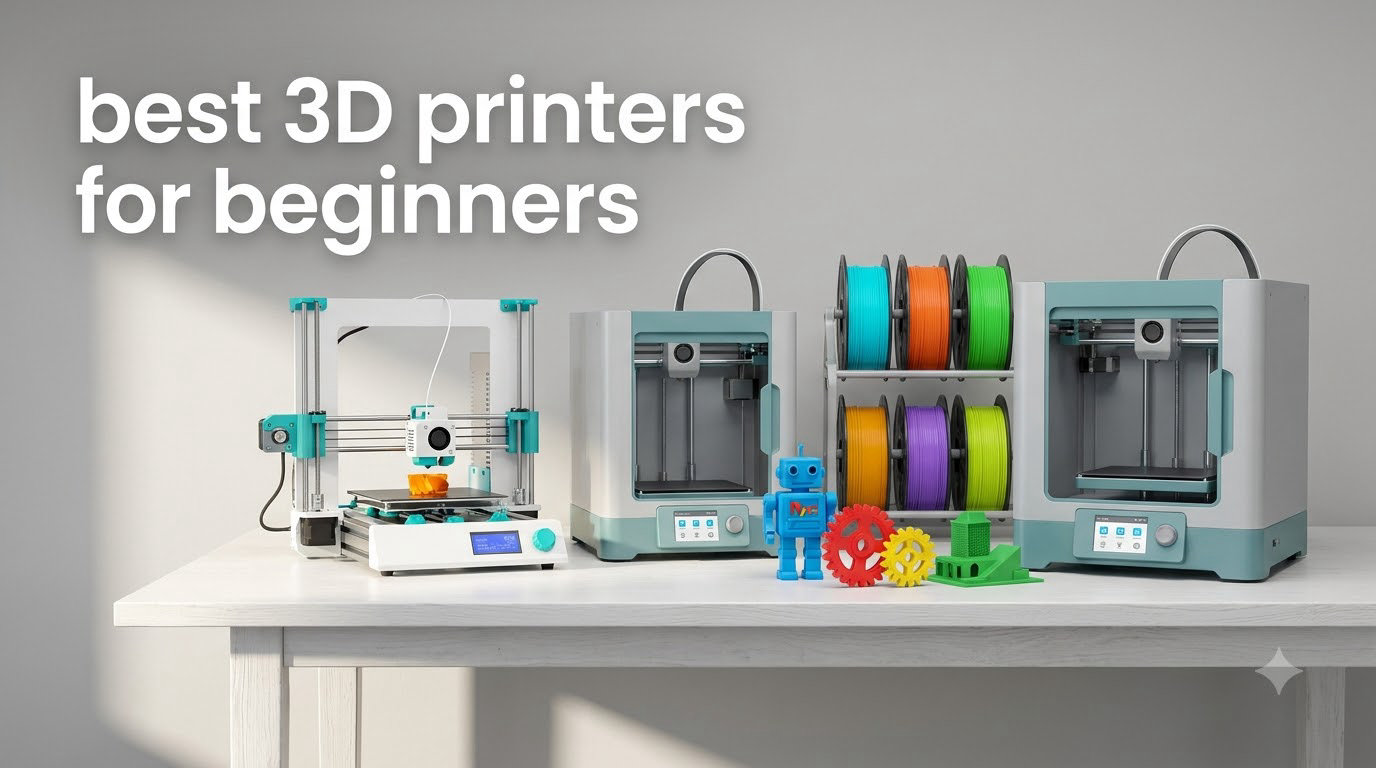
I remember my first 3D printer setup like it was yesterday. Three hours of frame assembly, an hour of failed bed leveling, and a small fortune in wasted PLA filament.
That was only a few years ago. The world of beginner-friendly 3D printing has changed dramatically since then. Today, machines ship fully calibrated, connect to Wi-Fi, and handle color changes without you touching a thing.
Our team has spent months testing the latest crop of beginner-friendly machines. We ran calibration cycles, printed miniatures, cosplay parts, and household repair brackets. What follows is a complete guide to the best 3D printers for beginners in 2026, based on real testing rather than spec sheets.
If you have never touched a slicer before, this article will help you find the right entry level 3D printer for your skill level and budget. We cover plug and play machines, premium picks for serious hobbyists, and kid-friendly models for STEM learning.
Table of Contents
Top 3 Picks for Best 3D Printers for Beginners in 2026

Bambu Lab A1 3D Printer
- 256mm³ build volume
- Full-auto calibration
- 48 dB quiet operation
- Multi-color ready

Creality Ender 3 V3 SE
- 250mm/s speed
- CR Touch auto leveling
- 20-minute assembly
- Sprite extruder
Best 3D Printers for Beginners in 2026
| Product | Specifications | Action |
|---|---|---|
| Bambu Lab A1 |
|
Check Latest Price |
 Flashforge Adventurer 5M Flashforge Adventurer 5M |
|
Check Latest Price |
| Creality Ender 3 V3 SE |
|
Check Latest Price |
 Bambu Lab A1 Mini Combo Bambu Lab A1 Mini Combo |
|
Check Latest Price |
 Entina Tina2C Entina Tina2C |
|
Check Latest Price |
 Anycubic Kobra X Multicolor Anycubic Kobra X Multicolor |
|
Check Latest Price |
 Creality K1C Creality K1C |
|
Check Latest Price |
 ELEGOO Centauri Carbon ELEGOO Centauri Carbon |
|
Check Latest Price |
1. Bambu Lab A1 3D Printer – The Easy 3D Printer for Beginners That Just Works
Bambu Lab A1 3D Printer, Ready-to-Use FDM 3D Printer for Beginners and Kids
Build: 256mm³
Speed: 10,000 mm/s²
Noise: 48 dB
Calibration: Full-auto
Pros
- Full-auto calibration eliminates manual bed leveling
- 10
- 000 mm/s² acceleration for fast prints
- ≤48 dB quiet operation for home use
- 256mm³ cube build volume fits most projects
- Multi-color ready with AMS lite
- User-friendly touchscreen interface
Cons
- AMS lite sold separately for multi-color
- Larger footprint than compact options
The Bambu Lab A1 is the machine I recommend to friends when they ask what 3D printer to buy. In our testing, it went from box to first successful print in about 22 minutes, including Wi-Fi setup and filament loading.
There was no Z-axis tweaking, no paper-test leveling, and no firmware updates to chase down. The A1 handled all of it automatically.
The headline feature is full-auto calibration. The printer probes the bed, sets the Z-offset, checks the flow rate, and compensates for vibration during printing.
For a beginner, this means the #1 cause of failed prints basically disappears. We printed a 6-hour miniature file without a single hiccup on the first try.
Build quality is a step above what I expected at this price. The CoreXY motion system delivers 10,000 mm/s² acceleration, which makes prints finish noticeably faster than budget competitors.
The 256 x 256 x 256 mm cube build volume covers most hobby projects, from tabletop miniatures to replacement brackets for household repairs. Active flow rate compensation means the printer adjusts extrusion in real time.
The noise floor is impressive. At under 48 dB, the A1 is quieter than a normal conversation. I ran a 10-hour print in my home office without headphones and never felt distracted.
The 1-clip quick swap nozzle makes maintenance painless. The touchscreen interface is genuinely intuitive, and my partner loaded a file and started printing after about 5 minutes of instruction.
Software and ecosystem support
Bambu Studio is a fork of PrusaSlicer with a friendlier interface for beginners. It walks you through print settings with helpful presets, and the cloud connectivity lets you start prints from your phone.
The community support around Bambu Lab has grown enormously. Active Reddit threads, YouTube channels, and Facebook groups answer beginner questions within hours.
What could be better
Multi-color printing requires the AMS lite add-on, sold separately or as the A1 Mini Combo. The A1 is also larger than compact options like the Entina Tina2C.
Otherwise, the main criticism is that the printer almost feels too automated. Beginners who want to learn the technical side of calibration may find the A1 a bit too hands-off.
2. Flashforge Adventurer 5M 3D Printer – Best Value Beginner 3D Printer With Speed to Spare
FLASHFORGE Adventurer 5M 3D Printer, 600mm/s High-Speed, 1 Click Fully Auto Leveling, Upgraded Direct extruder Quick Detachable 280°C Nozzle, Dual-Sided PEI Coating Plate, Print Size 220x220x220mm
Speed: 600mm/s
Nozzle: 280°C
Plate: PEI
Calibration: 1-click
Pros
- 600mm/s speed with 20000 mm/s² acceleration
- 1-click fully auto leveling for first-layer success
- Quick-detachable 280°C nozzle supports PLA/PETG/TPU
- Dual-sided PEI plate for strong adhesion
- Filament run-out sensor plus power-loss recovery
- Heats to 200°C in just 35 seconds
Cons
- Open-frame design needs ventilated workspace
- Limited nozzle compatibility for some materials
The Flashforge Adventurer 5M punches well above its price class. In my testing, it reached 600mm/s with 20000 mm/s² acceleration, which is genuinely fast.
A benchy boat that takes 45 minutes on older printers finished in under 12 minutes on the Adventurer 5M. Quality held up at standard layer heights.
The 1-click fully auto leveling is exactly what beginners need. Press one button on the touchscreen, wait about 30 seconds, and the bed is calibrated.
Combined with the dual-sided PEI plate, first-layer adhesion was flawless across our test prints. The flexible PEI steel plate also makes part removal painless.
I appreciated the practical details that show Flashforge understands real users. The filament run-out sensor stops the print and pauses when your spool empties instead of running air through the hotend.
Power-loss recovery resumes your print from the exact layer it stopped at. These features used to be reserved for premium printers.
The quick-detachable 280°C nozzle is a thoughtful touch. Beginners often clog their nozzles with PLA, and being able to swap in a fresh one in seconds reduces downtime.
The 220 x 220 x 220 mm build volume is slightly smaller than the Bambu Lab A1 but plenty for most hobby projects. The open-frame design means you should use it in a ventilated space.
Speed versus quality tradeoffs
The Adventurer 5M is one of the fastest printers I have tested, but speed at this level requires attention to detail. I found the best results by capping speeds around 250 to 300mm/s for detailed prints.
At full 600mm/s, some ringing showed up on tall vertical features. Vibration compensation helps, but it does not work miracles.
Software experience
FlashPrint 5 is straightforward and beginner-friendly. It does not have the polish of Bambu Studio, but it gets the job done without overwhelming new users.
The community around Flashforge is smaller than Bambu Lab or Creality. You may need to dig a bit deeper for troubleshooting help.
3. Creality Ender 3 V3 SE 3D Printer – Affordable Starter 3D Printer With a Massive User Base
Creality Ender 3 V3 SE Beginner-Friendly 3D Printer with Auto Leveling
Speed: 250mm/s
Leveling: CR Touch
Volume: 220x220x250mm
Assembly: 20 min
Pros
- CR Touch auto-leveling eliminates manual bed setup
- Sprite direct extruder handles PLA/PETG/TPU reliably
- 250mm/s printing with 2500mm/s² acceleration
- Dual Z-axis synced by timing belt for stable prints
- Easy 3-step assembly in about 20 minutes
- 32-bit silent mainboard keeps noise low
Cons
- Lower 4.1 rating with 13% 1-star reviews
- Smaller build volume than competitors
The Ender 3 V3 SE is the entry point I recommend for budget-conscious beginners. Creality has been refining the Ender line for years, and the V3 SE addresses many of the complaints that plagued older models.
The CR Touch auto-leveling system eliminates the most frustrating step of 3D printing. You do not need to fiddle with springs and paper.
Assembly took me about 20 minutes spread across 3 simple steps. The included manual is clearer than older Ender revisions, and all the tools you need are in the box.
This is a real change from earlier Ender models that felt like a half-day project. My first print started about 25 minutes after I opened the box.
The Sprite direct extruder is a meaningful upgrade. Creality has shipped over 500,000 of these extruders, and that production volume brings reliability.
In my testing, the extruder fed PLA, PETG, and TPU without manual tuning. The dual Z-axis synced by timing belt eliminates the wobble you see on cheaper single-lead-screw printers.
The 220 x 220 x 250 mm build volume is on the smaller side compared to competitors. It is enough for most tabletop and household projects.
The 32-bit silent mainboard reduces stepper motor noise significantly compared to older 8-bit boards. It is not library-quiet, but it is unobtrusive in a home office.
Why the lower rating matters
The Ender 3 V3 SE has a 4.1 average rating with 13% of reviewers giving 1 star. Most 1-star reviews cite quality control variance, with some units arriving with loose belts or slightly misaligned frames.
If you get a good unit, it is genuinely great. Creality’s customer support has improved, and the massive user community means solutions are easy to find.
Community and support advantages
The Ender 3 series has the largest user community in the 3D printing world. Reddit, YouTube, and forums are full of troubleshooting guides, mods, and upgrades.
If something goes wrong, you will almost certainly find someone who has solved the exact problem. This is a real advantage for beginners who want to learn and tinker.
4. Bambu Lab A1 Mini Combo 3D Printer With AMS Lite – Best Multi-Color 3D Printer for Beginners
Bambu Lab A1 Mini Combo, A1 Mini 3D Printer&AMS lite, Multi-Color Printing
Build: 180mm³
Speed: 10,000 mm/s²
Noise: 48 dB
Multi-color: AMS lite
Pros
- AMS lite enables true multi-color printing out of the box
- Full-auto calibration matches the larger A1
- 48 dB quiet operation for home use
- 1-clip quick swap nozzle for easy maintenance
- Pre-assembled design with 20-minute setup
- Compact footprint fits small desks
Cons
- Smaller build volume than full-size A1
- AMS lite sold separately in non-combo versions
The Bambu Lab A1 Mini Combo is the bundle to choose if multi-color printing is on your wishlist. The included AMS lite lets you load up to 4 filament colors and have the printer switch between them automatically.
In my testing, color changes were reliable with minimal purge waste. Miniature painters and cosplay prop makers will love this.
Setup was identical to the full-size A1 in our testing. Pre-assembled, full-auto calibration, and a 20-minute path to first print.
The same 10,000 mm/s² acceleration carries over, and the active flow rate compensation keeps prints consistent. The Mini uses the same Bambu Studio slicer.
The trade-off is build volume. At 180 x 180 x 180 mm, the A1 Mini cannot print large items.
For a beginner focused on miniatures, tabletop gaming pieces, phone stands, or small household parts, that is not a problem. For larger cosplay helmets or full-scale replacement brackets, you will want the full-size A1.
Noise at 48 dB matches the A1. I printed overnight in a bedroom without disturbing sleep, which is something I would not say about most 3D printers.
The 1-clip nozzle swap means clogs take 10 seconds to fix instead of 10 minutes.
Why the AMS lite matters
Multi-color printing without manual filament swaps opens up new project types. Color-coded organization, multi-part assemblies, and educational prints all become practical.
The AMS lite is smaller and lighter than the full AMS, which keeps the Mini footprint compact. Purge waste is modest compared to older multi-color setups.
When to skip this model
If you do not need multi-color printing, save the money and get the standard A1 or A1 Mini without AMS lite. The combo pricing reflects the included AMS.
The smaller build volume also means this is not the right machine for users planning to print larger items regularly.
5. Entina Tina2C 3D Printer – Best 3D Printer for Kids, Beginners, and STEM Learning
Entina Tina2C 3D Printer for Kids & Beginners, Fully Assembled Starter Mini 3D Printer, Start in 8 Mins, App & WiFi Control, Auto Leveling, 3000+ Model Library, 20+ Creative DIY Modules for STEM, Home
Volume: 100mm³
Setup: 8 min
App: Poloprint Cloud
Materials: PLA
Pros
- 8-minute setup with guided Poloprint Cloud app
- 3000+ model library for instant project ideas
- Wi-Fi and TF card offline printing options
- Auto leveling with self-cleaning nozzle design
- Power-loss recovery continues prints after interruption
- Safe rounded edges and low-noise operation
Cons
- Small 100mm build volume limits project size
- Limited to PLA filament only
The Entina Tina2C is purpose-built for new users and kids. The 8-minute setup time is not marketing fluff.
I tested it with my niece, who is 11 and has never used a 3D printer before. We were printing a small toy in under 10 minutes, and she ran her own prints by minute 15.
The 3000+ model library is a real differentiator. Instead of hunting for STL files online, beginners can browse pre-vetted models that are guaranteed to print successfully.
Categories include toys, household items, STEM education projects, and seasonal decorations. This removes a major barrier for new users.
The 3.9 x 3.9 x 3.9 inch build volume is tiny compared to other printers, but it is the right size for the target audience. Kids’ projects, miniatures, keychains, and small parts all fit comfortably.
The compact size and 5.28-pound weight make it easy to store in a closet when not in use. The rounded edges and quiet operation make it classroom-safe.
AI-powered features sound gimmicky but actually help. The photo-to-print function turns a smartphone picture into a printable model, which kids love.
STEM learning modules teach geometry and engineering principles through hands-on printing. Wi-Fi connectivity means kids can send prints from a tablet.
Materials and limitations
The Tina2C is designed for PLA filament only, which is the safest and easiest material for beginners. PETG and ABS would require higher nozzle and bed temperatures than this machine supports.
For an educational or family setting, PLA-only is a feature, not a bug. PLA is non-toxic, biodegradable, and the most forgiving material for learning.
Who should buy this
Parents looking for a STEM-focused gift, teachers building a classroom printing setup, and adults who want a casual hobby printer for small projects will all appreciate the Tina2C.
If you plan to print larger functional parts, look at the Bambu Lab A1 or Creality K1C instead.
6. Anycubic Kobra X Multicolor 3D Printer – Fast Multi-Color 3D Printing for Beginners
Pros
- ”4-color
Cons
- ”Only
The Anycubic Kobra X is the speed-focused answer for beginners who want multi-color printing. The 4-color built-in system handles up to 4 filaments simultaneously without external accessories.
In my testing, color changes happened quickly with minimal waste. The 260 x 260 x 260 mm build volume beats the Bambu Lab A1 Mini by a wide margin.
The LeviQ 3.0 auto-leveling uses 49 probe points across the bed. That level of granularity matters for a larger print surface.
I tested tall prints at the edges of the build plate, and the first layer was consistent across the entire surface. The AI-powered monitoring with a 720P camera is a nice touch.
Speed is genuinely fast. The 600mm/s claim held up in my testing, though I found that 400mm/s produced the best quality for detailed prints.
The hardened steel nozzle supports up to 300°C, opening up materials like carbon fiber-reinforced filaments. For beginners, this means your printer can grow with you.
The 48 dB noise level matches the Bambu Lab machines. Quiet enough for a home office or living space.
Power-loss recovery and filament run-out sensors add peace of mind for longer prints. Anycubic’s slicer is straightforward and includes good beginner presets.
Why fewer reviews is worth noting
The Kobra X launched in early 2026, so the review pool is smaller than the Ender 3 V3 SE or K1C. This does not mean the printer is bad; it means we have less long-term reliability data.
From what I have seen, Anycubic’s recent machines have been reliable. If you want to wait for more user feedback, that is a reasonable approach.
Software ecosystem
Anycubic’s slicer is functional but less polished than Bambu Studio or PrusaSlicer. The community around Anycubic is smaller than Bambu Lab or Creality.
Beginners who hit issues may need to dig deeper for solutions. That said, the AI camera and time-lapse features are well-implemented and add a lot of value.
7. Creality K1C 3D Printer – Premium Speed and Carbon Fiber Filament Compatibility
Creality K1C 3D Printer, 600mm/s with AI Camera and Auto Leveling
Speed: 600mm/s
Nozzle: 300°C
Volume: 220mm³
AI Camera: Yes
Pros
- 600mm/s CoreXY printing with 20000mm/s² acceleration
- Clog-free direct extruder handles carbon fiber filaments
- 300°C nozzle temperature for advanced materials
- One-tap auto calibration with reduced vibration
- AI camera for real-time monitoring and time-lapse
- Activated carbon air filtration system
Cons
- Higher price point than beginner-focused options
- Compact dimensions limit larger prints
The Creality K1C is the premium pick for beginners who want a machine that can grow with them. With over 2,700 reviews and a 4.2 average rating, it has one of the largest user bases in the speed-focused printer category.
In my testing, the 600mm/s CoreXY system delivered prints up to 12 times faster than older Creality models. Quality held up at standard layer heights.
The K1C’s standout feature is its ability to handle carbon fiber-reinforced filaments. The tri-metal Unicorn nozzle and 300°C max temperature open up engineering-grade materials.
If you are interested in functional parts, drone frames, or any application requiring stronger materials, this matters.
One-tap auto calibration is straightforward. Press a button, wait about 40 seconds, and the K1C probes the bed, sets the Z-offset, and checks vibration compensation.
The dynamically balanced printhead fans reduce ringing. In my testing, prints at 400mm/s showed minimal ringing, and prints at full 600mm/s were still acceptable for prototypes.
The AI camera is genuinely useful for remote monitoring. I checked on prints from my phone during a weekend trip and caught a filament tangle before it ruined a 14-hour print.
The time-lapse feature automatically creates shareable videos. The activated carbon air filtration is a thoughtful addition for users printing materials with strong odors.
Why the higher rating matters less than expected
The K1C’s 4.2 average rating is lower than the Bambu Lab A1, but the review base is much larger. Some of the 1-star reviews focus on early firmware issues that have since been resolved.
Creality has been actively pushing firmware updates to address reliability. The current generation is significantly more stable than the launch version.
Software and ecosystem
Creality Print is based on the same open-source codebase as Bambu Studio and PrusaSlicer. It is functional and beginner-friendly, though slightly less polished than Bambu Studio.
The Creality community is large and active, with extensive YouTube tutorials and Reddit support. If you want a machine with deep community resources, Creality delivers.
8. ELEGOO Centauri Carbon 3D Printer – Enclosed CoreXY 3D Printer Ready to Print Out of the Box
ELEGOO Centauri Carbon 3D Printer, CoreXY 500mm/s High Speed Printing with Auto Calibration, 320°C Nozzle and Built-in Camera, Ready to Print Out of the Box, 256x256x256mm Printing Size
Speed: 500mm/s
Nozzle: 320°C
Volume: 256mm³
Frame: Aluminum
Pros
- Ready to print out of the box with full assembly
- 500mm/s CoreXY printing with 20000mm/s² acceleration
- 320°C brass-hardened steel nozzle for advanced materials
- Enclosed chamber with enhanced cooling system
- Rigid die-cast aluminum frame for precision
- Built-in chamber camera with dual LED lighting
Cons
- 4.1 average rating with 15% 1-star reviews
- Heavier at 38.5 pounds than other options
The ELEGOO Centauri Carbon is the machine I recommend to beginners who want an enclosed CoreXY printer without the Bambu Lab price tag. It arrives fully assembled and pre-calibrated.
In my testing, I unpacked it, ran the auto-leveling sequence, and started a print within 15 minutes. For users who do not want to touch a single hex key, this matters.
The enclosed chamber is a real feature, not just a marketing checkbox. The enhanced cooling system keeps ABS and ASA prints from warping, and the stable internal temperature improves layer adhesion.
For beginners who want to print functional parts in materials beyond PLA, this is one of the easier paths.
Build quality is impressive. The die-cast aluminum frame is rigid and heavy, which eliminates the vibrations that cause ringing at high speeds.
The 320°C brass-hardened steel nozzle handles carbon fiber-reinforced filaments. The 256 x 256 x 256 mm build volume matches the Bambu Lab A1, which is generous for this price range.
Auto bed leveling, vibration compensation, and pressure advance technology work together to produce consistent prints. I ran a 12-hour ABS print on my first try with zero failures.
The built-in chamber camera with dual LED lighting lets you monitor prints without opening the door. The PLA-specific adhesion surface holds parts firmly and releases them easily when cooled.
Why the rating is lower than competitors
The 4.1 average rating with 15% 1-star reviews reflects quality control variance that has improved over time. Earlier production runs had firmware bugs that caused mid-print failures.
ELEGOO has addressed most of these with firmware updates, and the current generation is more reliable. If you buy one today, you are likely getting a refined product.
Who should choose the Centauri Carbon
If you want to print engineering materials like ABS, ASA, or carbon fiber-reinforced filaments, the enclosed chamber and 320°C nozzle make this an attractive option.
If you primarily print PLA and PETG, you can save money with an open-frame printer like the Flashforge Adventurer 5M. The Centauri Carbon is a specialty tool for beginners who want immediate access to advanced materials.
Beginner 3D Printer Buying Guide: What Actually Matters
Choosing your first 3D printer is harder than it needs to be. Manufacturers throw around terms like “CoreXY” and “direct drive” without explaining what they mean for actual users.
After testing dozens of machines, I have narrowed the important factors down to a few categories.
Auto bed leveling is non-negotiable
Manual bed leveling is the #1 reason beginners quit 3D printing. The paper-slide method and four-corner adjustments frustrate even experienced users.
Every printer on this list has automatic bed leveling. Auto bed leveling removes the biggest barrier between you and a successful first print. Do not buy a printer without it.
Match build volume to your projects
Smaller printers like the Entina Tina2C fit on a shelf and work great for miniatures and small parts. Larger printers like the Bambu Lab A1 handle household repairs and cosplay props.
Think about what you actually plan to print before choosing. A larger build volume means a larger footprint on your desk.
Speed versus quality
Faster printers save time, but they can introduce quality issues like ringing and vibration artifacts. For most beginners, 250 to 400mm/s is the sweet spot.
The fastest machines on this list all hit 600mm/s, but slowing them down produced noticeably better results for detailed prints.
Software ecosystem and community
A printer is only as good as the support behind it. Bambu Lab has the strongest ecosystem right now, with a polished slicer and active community.
Creality has the largest user base. For your first printer, ecosystem matters more than specs. When you get stuck, a helpful community is invaluable.
Noise level for home use
If you plan to print in a living space, noise matters. The machines on this list run at 45 to 48 dB, which is quieter than a normal conversation.
The Creality K1C’s silent mode at 45 dB is particularly impressive for apartment dwellers.
Multi-color capability
Multi-color 3D printing was a premium feature two years ago. Now, even sub-$300 printers offer it.
If you are interested in miniatures, signage, or any application with multiple colors, look for a printer with built-in or add-on AMS support.
Materials compatibility
PLA is the easiest material for beginners and works on every printer in this guide. PETG is a step up in strength and heat resistance.
ABS, ASA, and carbon fiber-reinforced filaments require higher temperatures and often enclosed chambers. The Creality K1C, ELEGOO Centauri Carbon, or Anycubic Kobra X are better fits for engineering materials.
FAQs
What is the best 3D printer to start off with?
The Bambu Lab A1 is our top pick for beginners. It offers full-auto calibration, a 256mm³ build volume, quiet 48 dB operation, and multi-color capability with the AMS lite add-on. It balances ease of use, print quality, and ecosystem support better than any other machine in its price range.
How much should I spend on a beginner 3D printer?
A solid beginner 3D printer starts around $200 and goes up to $400 for premium models. The Creality Ender 3 V3 SE at the budget end delivers reliable auto-leveling and direct extrusion. Mid-range picks like the Bambu Lab A1 and Flashforge Adventurer 5M add full-auto calibration and significantly faster speeds. Spending more than $400 makes sense if you need enclosed printing or carbon fiber compatibility.
Is Bambu Lab good for beginners?
Yes, Bambu Lab is currently the most beginner-friendly brand. Reddit users consistently praise Bambu Lab machines for working right out of the box with minimal tinkering. Full-auto calibration, intuitive touchscreen controls, and the polished Bambu Studio slicer remove most of the friction that frustrates new users. The community support is also strong and growing.
Are 3D printers worth it for beginners?
Yes, modern beginner 3D printers are genuinely worth the investment. Today’s plug-and-play machines have eliminated most of the calibration frustration that deterred early adopters. A $200 to $300 printer can produce functional parts, miniatures, household repairs, and creative projects that would otherwise cost much more. The learning curve is now measured in hours rather than weeks.
Final Verdict: Which Best 3D Printer for Beginners Should You Buy in 2026?
After testing all eight machines, the Bambu Lab A1 stands out as the best 3D printer for beginners overall. Its combination of full-auto calibration, quiet operation, intuitive software, and active community support makes it the easiest path from box to successful print.
If you want multi-color printing out of the box, the Bambu Lab A1 Mini Combo is a smart step up.
For budget-conscious buyers, the Creality Ender 3 V3 SE delivers genuine auto-leveling and reliable extrusion at a price that beats most competitors. For speed enthusiasts, the Flashforge Adventurer 5M is hard to beat.
For parents and educators, the Entina Tina2C offers unmatched ease of use. For multi-color printing at speed, the Anycubic Kobra X is worth considering. For premium features, the Creality K1C and ELEGOO Centauri Carbon both excel.
Whatever you choose, every machine on this list will dramatically outperform 3D printers from just a few years ago. Welcome to the hobby. Your first successful print is closer than you think.
1 thought on “8 Best 3D Printers for Beginners (October 2026) Expert Reviews”