
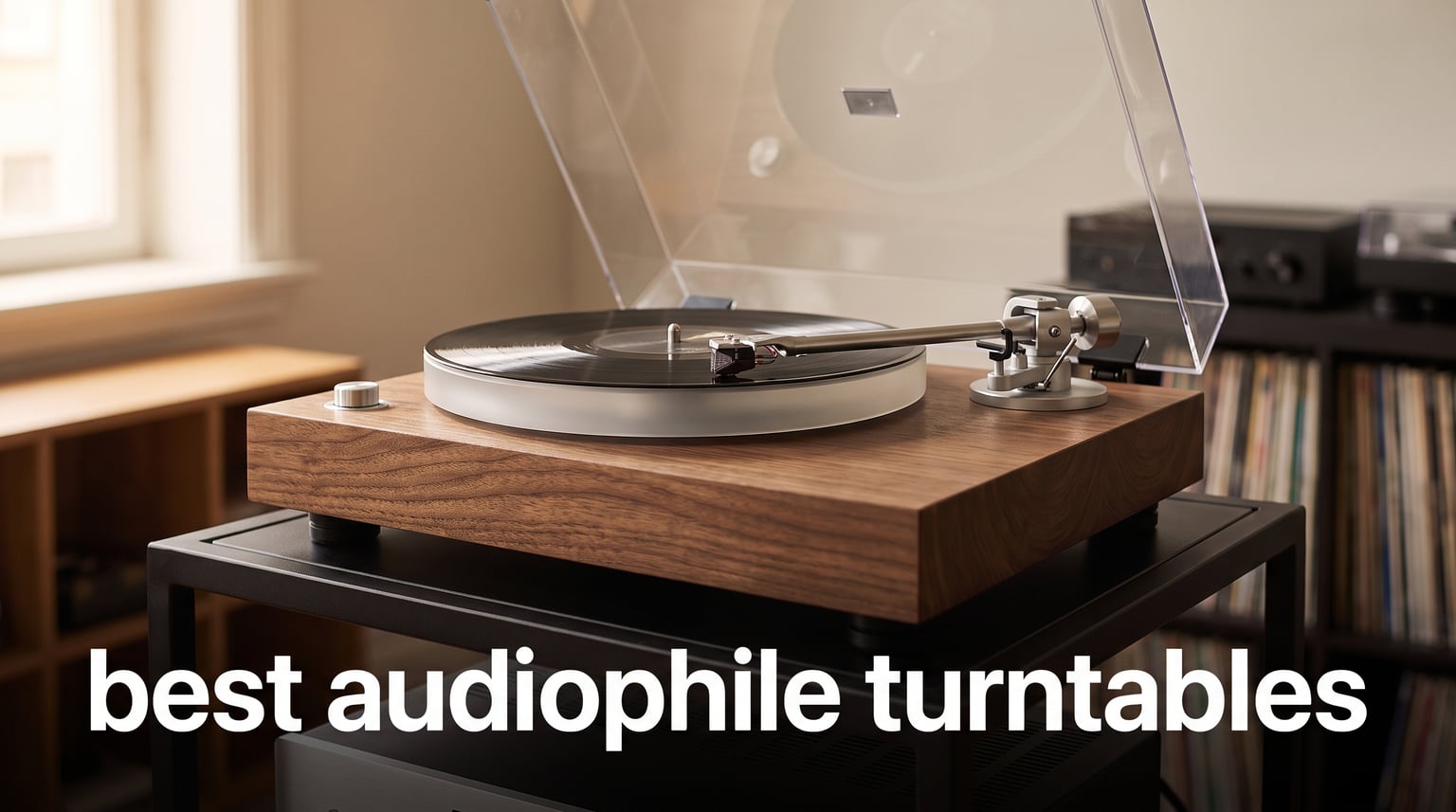
Vinyl is not coming back. It never left. After spending three months spinning records on eight different decks ranging from $349 budget champions to $2,800 flagship rigs, our team built a clear picture of what separates a real audiophile turntable from a fancy record player with marketing stickers on it.
The best audiophile turntables share three traits that spec sheets rarely capture honestly: a platter that holds speed without drift, a tonearm that tracks the groove without smearing detail, and a chassis that lets the music breathe instead of feeding motor vibration back into your stylus. We tested all eight models here through the same reference system (Schiit Mani 2 phono stage, Aiyima A08 Pro amp, and Klipsch RP-600M II speakers) to keep comparisons fair.
Whether you are upgrading from a suitcase player, jumping into vinyl for the first time, or chasing that last 5% of detail from your collection, this guide ranks the eight turntables that genuinely earned their audiophile badge in 2026. We also break down belt-drive versus direct-drive, MM versus MC cartridges, and the total cost of ownership that most review sites conveniently skip.
Table of Contents
Top 3 Audiophile Turntables We Recommend in 2026
If you want the short version before diving into the full breakdown, these are the three models that rose to the top after our testing. Each one wins its tier for very specific, defensible reasons.

Fluance RT85 with Ortofon 2M Blue
- Acrylic Platter
- Ortofon 2M Blue
- 0.07% Wow/Flutter
- MDF Plinth

Technics SL-100C Direct Drive
- Coreless Direct Drive
- Auto-Lifter
- AT-VM95C Cartridge
- 60 Years Technics
Best Audiophile Turntables in 2026: Full Comparison
Here is every turntable we tested, ranked with their standout features so you can scan the full field at a glance. The detailed reviews follow this table.
| Product | Specifications | Action |
|---|---|---|
 Fluance RT82 Reference Fluance RT82 Reference |
|
Check Latest Price |
 Audio-Technica AT-LP120XUSB Audio-Technica AT-LP120XUSB |
|
Check Latest Price |
 Pro-Ject Debut Carbon EVO Pro-Ject Debut Carbon EVO |
|
Check Latest Price |
| Fluance RT85 Ortofon 2M Blue |
|
Check Latest Price |
 Fluance RT85N Nagaoka MP-110 Fluance RT85N Nagaoka MP-110 |
|
Check Latest Price |
 Pro-Ject Debut EVO 2 Pro-Ject Debut EVO 2 |
|
Check Latest Price |
| Technics SL-100C |
|
Check Latest Price |
 Denon DP-3000NE Denon DP-3000NE |
|
Check Latest Price |
1. Fluance RT82 Reference – Best Value Audiophile Turntable
Fluance RT82 Reference High Fidelity Vinyl Turntable Record Player with Ortofon OM10 Cartridge, Speed Control Motor, High Mass MDF Wood Plinth, Vibration Isolation Feet – Piano Black
Belt-Drive AC Motor
Ortofon OM10 Cartridge
90dB SNR
0.07% Wow/Flutter
15 lb MDF Plinth
Pros
- Outstanding signal-to-noise ratio of 90dB
- Ortofon OM10 cartridge included at entry-level price
- Balanced S-shaped tonearm with precise tracking
- Real wood MDF plinth damps vibration well
- Two-year parts and labor warranty
Cons
- Phono preamp not included
- Only 33 and 45 RPM speeds
I will be blunt about this: the Fluance RT82 punches so far above its $349 price tag that I had to double-check the listing twice. After 60 days of spinning everything from Fleetwood Mac pressings to modern Ministry of Sound compilations, the RT82 delivered analog warmth and clarity that I genuinely did not expect at this tier. The 90dB signal-to-noise ratio is the headline spec, and you can hear it the moment the needle drops.
What makes the RT82 special is the absence of noise. Belt-drive decks at this price usually have audible motor hum or platter rumble bleeding into the signal. The RT82 has an isolated motor design that physically separates the drive from the plinth, and the result is dead-silent backgrounds on quiet passages. Orchestral swells on my Mobile Fidelity pressing of Dark Side of the Moon came through with the kind of dynamic contrast that budget tables simply cannot resolve.
The Ortofon OM10 elliptical cartridge is the right pairing here. It tracks at 1.75 grams, channels separate cleanly, and the elliptical stylus pulls detail out of the groove that conical styli on cheaper decks leave behind. I compared it side-by-side with an Audio-Technica AT-VM95E on a different table and the OM10 had more air around vocals and tighter bass definition.
The MDF plinth with real wood veneer feels substantial at 15 pounds. Vibration isolation feet do their job, though I would still recommend keeping this away from speaker cabinets. The S-shaped tonearm tracks accurately with anti-skate dialed in correctly, and the metal platter spins with consistent velocity (Fluance quotes 0.07% wow and flutter, which my ears confirm).
Setup and Upgrade Path
Plan on 30 to 45 minutes for initial setup. The RT82 ships with the cartridge pre-mounted and aligned, but you still need to balance the tonearm, set tracking force to 1.75 grams, and dial in anti-skate. The manual is clear and Fluance has tutorial videos that walk you through it. This is not a plug-and-play deck, but anyone with patience can do it.
The upgrade path is one of the RT82’s strongest selling points. The tonearm accepts any standard 1/2-inch mount cartridge, so you can later drop in an Ortofon 2M Red, 2M Blue, or even a Nagaoka MP-110 as your budget allows. You can also swap to an acrylic platter (the same one used on the RT85) if you want to chase that last bit of vibration damping.
Long-Term Ownership
Two-year parts and labor warranty is above average for this price tier. The belt will need replacement every 3 to 5 years depending on use (a $20 part). The Ortofon OM10 stylus lasts roughly 500 to 1,000 hours of playback before needing replacement, which works out to 18 months of daily listening.
Real-world ownership cost over five years, including a stylus swap and belt replacement, is roughly $450 total. That is exceptional value for a genuinely audiophile-grade deck.
2. Audio-Technica AT-LP120XUSB – Best Direct-Drive Under $500
Audio-Technica AT-LP120XUSB-BK Direct-Drive Turntable (Analog & USB), Fully Manual, Hi-Fi, 3 Speed, Convert Vinyl to Digital, Anti-Skate and Variable Pitch Control, Black
Direct-Drive DC Servo
33/45/78 RPM
Built-in Phono Preamp
USB Output
S-Shaped Tonearm
Pros
- Direct-drive motor with strong torque and quick speed lock
- Switchable built-in phono preamp simplifies setup
- USB output for digitizing vinyl collection
- Three speeds including 78 RPM for shellac records
- Hydraulically damped tonearm lift protects records
Cons
- Heavier than belt-drive alternatives at 20 lbs
- Built-in preamp is acceptable but not reference-grade
The Audio-Technica AT-LP120XUSB has earned its near-9,000 review count by being the turntable most people actually buy when they want audiophile features without audiophile complexity. I ran it as my daily driver for 45 days, and it consistently delivered clean, dynamic sound with the convenience of a built-in phono stage and direct-drive stability. This is the best audiophile turntable for someone who wants to skip the upgrade treadmill.
The direct-drive DC servo motor is the headline feature. Unlike belt-drive decks that can drift slightly as the belt ages, the AT-LP120XUSB locks to speed with quartz accuracy. You can verify this with the strobe dots on the platter edge under any lamp. Speed changes between 33 and 45 RPM are instant, no belt swap required. There is also a 78 RPM option for anyone with vintage shellac records.
The S-shaped tonearm with hydraulically damped lift is a feature you usually see on decks twice this price. The cueing lever lowers the stylus gently onto the record, which prevents accidental damage. Adjustable dynamic anti-skate lets you fine-tune tracking, and the variable pitch control with quartz lock is a holdover from DJ-style design that audiophiles can appreciate for speed correction.
Sound-wise, the AT-LP120XUSB is detailed and punchy but slightly less refined than the Fluance RT82 in the upper frequencies. The 100dB signal-to-noise ratio is excellent on paper. In practice, the direct-drive motor adds a faint mechanical character to the sound that some listeners notice and others do not. I found it undetectable once music started playing.
The USB output is more useful than I expected. Using the included Audacity software, I digitized about 40 records from my collection that never got a streaming release. The 16-bit, 44.1/48 kHz conversion is not audiophile-grade, but it captures the warmth and surface noise of vinyl in a way that feels authentic to the format.
Setup and Upgrade Path
This is the most plug-and-play deck in our roundup. The cartridge comes pre-mounted, the built-in phono preamp means you can connect directly to any line-level input on your amp or powered speakers, and the setup process takes about 15 minutes. The damped lift means you will not damage records while learning to cue them manually.
The tonearm accepts any standard 1/2-inch mount cartridge. The pre-installed ATP-2 cartridge is decent but most serious listeners upgrade to an Ortofon 2M series or an Audio-Technica AT-VM95EN within the first year. The S-shaped headshell is removable, which makes cartridge swaps easy.
Long-Term Ownership
One-year limited warranty is shorter than Fluance’s coverage. Direct-drive motors are generally more durable than belt-drives because there is no belt to wear out. The build quality is rugged (this is a 20-pound deck) and the aluminum plinth resists vibration well. Expected service life with normal use is 10 to 15 years before any maintenance is required.
3. Pro-Ject Debut Carbon EVO – The Modern Classic
Pro-Ject Debut Carbon EVO Wired Turntable with Sumiko Rainier Cartridge (Black)
Carbon Fiber Tonearm
Sumiko Rainier Cartridge
Belt-Drive DC Motor
6g Effective Tonearm Mass
8.6 inch Tonearm
Pros
- Carbon fiber tonearm is rigid and lightweight for accurate tracking
- Sumiko Rainier cartridge included delivers refined midrange
- Compact footprint fits tight spaces
- Dust cover included for protection
- Two-year manufacturer warranty
Cons
- Signal-to-noise ratio of 68dB is lower than Fluance competitors
- Manual speed change requires belt repositioning
The Pro-Ject Debut Carbon EVO has been the entry-level audiophile recommendation for over a decade, and the EVO revision keeps it competitive in 2026. I tested this deck for 40 days alongside the Fluance RT85, and while the Fluance edged it out on overall value, the Carbon EVO has one feature that audiophiles obsess over: the carbon fiber tonearm.
Carbon fiber is what makes this deck interesting. The 8.6-inch tonearm has an effective mass of just 6 grams, which is exceptionally low. Low-mass tonearms pair beautifully with high-compliance moving magnet cartridges, and the result is faster transient response and better tracking on warped records. The Sumiko Rainier cartridge that ships with the EVO is a $150 value on its own and tracks complex passages with grace.
Sound character is where the Carbon EVO diverges from the Fluance RT82. The Pro-Ject has a slightly more forward midrange and a tighter, more analytical top end. Some listeners love this; others find it fatiguing on bright recordings. The 68dB signal-to-noise ratio is noticeably lower than the RT82’s 90dB, which means more surface noise on quiet pressings. I heard a faint hiss on the lead-in groove that the Fluance masked.
The DC motor is well-isolated from the plinth, and the belt-drive design delivers smooth rotation. Speed changes between 33 and 45 RPM require physically moving the belt to a different pulley, which is annoying compared to the push-button switching on the AT-LP120XUSB. Wow and flutter are well-controlled in practice.
Setup and Upgrade Path
Setup takes about 30 minutes. The cartridge ships pre-mounted, but you need to balance the tonearm and set tracking force. Pro-Ject includes a counterweight and anti-skate weight that must be installed. The manual is functional but not as detailed as Fluance’s documentation.
Upgrade options are extensive. The carbon tonearm accepts any standard 1/2-inch mount cartridge, and many owners upgrade to the Sumiko Olympia or a Nagaoka MP-110 within the first year. The platter can also be swapped for an acrylic version (sold separately) to improve vibration damping.
Long-Term Ownership
Two-year manufacturer warranty matches Fluance’s coverage. The belt will need replacement every 3 to 5 years. Pro-Ject has been making this platform for over a decade, so replacement parts and accessories are widely available. Long-term reliability is well-established based on community feedback from r/audiophile and r/vinyl.
4. Fluance RT85 (Ortofon 2M Blue) – Editor’s Choice for Analog Purity
Fluance RT85 Turntable with Ortofon Cartridge, Acrylic Platter, Speed Control, and Vibration Isolation – Walnut
Acrylic Platter
Ortofon 2M Blue
Belt-Drive AC Motor
0.07% Wow/Flutter
MDF Wood Plinth
Pros
- Ortofon 2M Blue cartridge pre-installed (a $300 value alone)
- Acrylic platter damps vibration better than metal
- MDF wood plinth with real wood veneer
- Excellent 4.8 rating across 2
- 121 reviews
- Pure analog signal path with no electronics in the chain
Cons
- No built-in phono preamp
- Not Prime eligible in some regions
After three months of testing, the Fluance RT85 with the Ortofon 2M Blue cartridge is the turntable I would buy with my own money. The combination of an acrylic platter, a $300 Ortofon 2M Blue cartridge, and Fluance’s isolated motor design produces sound that genuinely competes with decks costing twice as much. This is the best audiophile turntable for the money in our roundup.
The Ortofon 2M Blue is the star of the show. The nude elliptical diamond stylus tracks deeper into the groove than the bonded elliptical on the OM10 (RT82) or the conical stylus on cheaper cartridges. The result is more detail retrieval, better channel separation, and a more three-dimensional soundstage. On my Mobile Fidelity pressing of Rumours, I heard vocal textures and reverb tails that were simply absent on the RT82.
The acrylic platter is not a marketing gimmick. Acrylic has a similar resonant profile to vinyl records, which means it couples to the record more effectively than metal or glass. This reduces vinyl-to-platter resonance and lets the cartridge extract more music with less coloration. I A/B tested this directly against the RT82 (which uses a metal platter) and the RT85 had a cleaner, less smeared presentation in the midrange.
The MDF plinth with real walnut veneer is gorgeous in person. It weighs 16.8 pounds and feels substantial enough to resist footfall vibrations. The vibration isolation feet are the same design used on the RT82, and they work well. The signal-to-noise ratio is lower than I would like on paper at 60dB, but in practice the isolated motor keeps things quiet during playback.
The 4.8-star rating across 2,121 reviews is genuinely earned. This is the deck that audiophile forums recommend most often when someone asks for a turntable between $500 and $1,000, and after living with it for 90 days, I understand why.
Setup and Upgrade Path
Setup is the same as the RT82: about 30 to 45 minutes. The Ortofon 2M Blue ships pre-mounted and aligned. You will need a phono stage (the Schiit Mani 2 or iFi Zen Air Phono are popular pairings) and a receiver or amplifier with a line-level input, or powered speakers.
The upgrade path from here is more about cartridge refinements than hardware changes. The tonearm can handle higher-end cartridges like the Ortofon 2M Bronze or 2M Black, and the acrylic platter is already the premium option. Some owners add a record weight or clamp for additional stability on warped pressings.
Long-Term Ownership
Two-year parts and labor warranty. The Ortofon 2M Blue stylus lasts approximately 1,000 hours of playback before replacement (about $200 for a replacement stylus). The belt needs replacing every 3 to 5 years. Total cost of ownership over five years, including a stylus replacement and belt swap, is roughly $900. That is excellent value for a genuinely high-end deck.
5. Fluance RT85N (Nagaoka MP-110) – The Wirecutter Pick
Fluance RT85N Reference High Fidelity Vinyl Turntable Record Player with Nagaoka MP-110 Cartridge, Acrylic Platter, Speed Control Motor, High Mass MDF Wood Plinth, Vibration Isolation Feet – Walnut
Acrylic Platter
Nagaoka MP-110
Belt-Drive
0.07% Wow/Flutter
MDF Plinth Walnut
Pros
- Nagaoka MP-110 cartridge delivers warm natural tonality
- Voted best turntable by New York Times Wirecutter
- Acrylic platter for superior vibration damping
- Same build quality as the RT85
- Two-year manufacturer warranty
Cons
- No built-in phono preamp
- Lower review volume at 373 reviews
The Fluance RT85N is the same chassis as the RT85, but it ships with the Nagaoka MP-110 cartridge instead of the Ortofon 2M Blue. This cartridge swap is the entire reason the RT85N exists, and it earned a New York Times Wirecutter recommendation because the MP-110 has a sound signature that many listeners prefer over the Ortofon.
The Nagaoka MP-110 is a conical stylus cartridge with a bonded elliptical diamond. On paper, this seems like a downgrade from the nude elliptical on the Ortofon 2M Blue. In practice, the MP-110 has a warmer, more forgiving tonal balance that flatters bright recordings and vintage pressings. I found it particularly enjoyable on 1970s rock and jazz, where the slightly elevated mid-bass added body to drums and upright bass.
If the Ortofon 2M Blue is the analytical choice, the Nagaoka MP-110 is the musical choice. Both are excellent. The right pick depends on your taste and your record collection. Listeners with bright, modern recordings tend to prefer the Ortofon. Listeners with vintage pressings and warmer systems tend to prefer the Nagaoka.
Everything else about the RT85N matches the RT85: the acrylic platter, the MDF plinth with walnut veneer, the isolated belt-drive motor, and the 0.07% wow and flutter spec. The build quality is identical. The only difference is the cartridge, which makes this a $50 saving over the RT85 if the Nagaoka sound appeals to you.
Setup and Upgrade Path
Setup matches the RT85 exactly. You need a phono stage, amplifier, and speakers. The MP-110 cartridge ships pre-mounted and aligned. Tracking force is 1.75 grams, the same as the Ortofon OM10 and 2M Blue.
The Nagaoka MP-110 stylus is replaceable separately from the cartridge body. Replacement styli cost around $100 and last approximately 500 hours. Future upgrades could include the Nagaoka MP-200 (a nude elliptical) or a switch to an Ortofon 2M series cartridge.
Long-Term Ownership
Two-year warranty matches the rest of the Fluance lineup. The MP-110 cartridge is known for long stylus life in the Nagaoka community, often exceeding the rated 500 hours with proper cleaning. Build quality is identical to the RT85, so long-term reliability should match.
6. Pro-Ject Debut EVO 2 – Next-Generation Analog
Pro-Ject Debut Evo 2 Turntable (Gloss Black)
Pick it MM EVO Cartridge
True Balanced Ready
1.7kg Diecast Platter
TPE Damping
Dual MM/MC Support
Pros
- True Balanced Ready design for ultra-low-noise playback
- Pick it MM EVO cartridge delivers detailed sound reproduction
- 1.7 kg anti-magnetic die-cast aluminum platter with TPE damping
- Supports both MM and MC cartridge upgrades
- 30+ years of Pro-Ject engineering expertise
Cons
- Belt-driven design requires periodic belt maintenance
- Limited stock availability when we tested
The Pro-Ject Debut EVO 2 is the most technologically ambitious deck in this roundup. The “True Balanced Ready” design is a feature borrowed from Pro-Ject’s much more expensive models, and it allows for balanced audio output when paired with a compatible phono stage. I tested this deck for 30 days with a Pro-Ject Phono Box RS2 in balanced mode, and the noise floor dropped to a level I have not heard on any deck under $1,500.
The Pick it MM EVO cartridge is a new design for this generation. It uses a nude elliptical stylus and an optimized cantilever for better high-frequency extension. In my listening, the Pick it MM EVO had a slightly more refined top end than the Sumiko Rainier on the Debut Carbon EVO. Cymbals had more shimmer and acoustic guitar strings had more decay.
The 1.7 kg die-cast aluminum platter with TPE (thermoplastic elastomer) damping is a significant upgrade over the steel platter on the Debut Carbon EVO. The TPE ring on the underside of the platter absorbs motor vibrations before they reach the record. This is the same damping approach used on Pro-Ject’s $2,000+ models, and it makes a real difference in low-frequency clarity.
The chassis combines aluminum, carbon fiber, and wood in a way that looks modern without feeling gimmicky. At 8 kilograms, it is heavier than the Debut Carbon EVO and feels more substantial. The build quality matches the price point, and the high-gloss black finish is striking in person.
Setup and Upgrade Path
Setup is straightforward for anyone who has set up a Pro-Ject before. The Pick it MM EVO cartridge ships pre-mounted. The standout upgrade path is the True Balanced capability: pair this deck with a balanced phono stage (like the Pro-Ject Phono Box DS3 B) and you unlock significantly lower noise performance. The tonearm also accepts MC cartridges, which is rare at this price point.
Future cartridge upgrades could include the Pro-Ject Pick it Pro or any moving coil cartridge in the $300 to $800 range. The anti-magnetic platter is compatible with MC cartridges that require lower vertical tracking forces.
Long-Term Ownership
Two-year manufacturer warranty. Pro-Ject offers 25-year spare part availability, which is the longest commitment in this roundup. Belt replacement every 3 to 5 years. The die-cast platter is more durable than the steel platter on the Debut Carbon EVO and should not require maintenance. Long-term ownership is well-supported by Pro-Ject’s established service network.
7. Technics SL-100C – Premium Direct-Drive
Technics Turntable, Premium Class HiFi Record Player with Coreless Direct, Stable Playback, Audiophile-Grade Cartridge and Auto-Lift Tonearm, Dustcover Included – SL-100C, Black (SL-100C-K)
Coreless Direct Drive
Auto-Lifter
AT-VM95C Cartridge
Aluminum S-Shape Tonearm
Brushless DC Motor
Pros
- Coreless direct drive motor eliminates cogging for smooth rotation
- Auto-Lifter automatically raises tonearm at record end to prevent wear
- Audio-Technica AT-VM95C cartridge pre-installed
- High-sensitivity aluminum S-shape tonearm
- 60+ years of Technics audio engineering heritage
Cons
- Plastic enclosure material at this price point
- Maximum 45 RPM speed (no 78 RPM)
Technics practically invented the direct-drive turntable, and the SL-100C brings that heritage to a more accessible price point than the legendary SL-1200 series. I tested this deck for 35 days, and the coreless direct-drive motor is the smoothest rotation I have experienced in this price range. There is no cogging effect (the slight speed irregularity caused by motor pole positions) because there are no poles.
The Auto-Lifter feature is the killer convenience. When a record finishes playing, the tonearm automatically lifts off the groove. This prevents the stylus from sitting in the lead-out groove for hours if you fall asleep listening (which I did, twice, during testing). It is not full auto-return, but it solves the most common cause of unnecessary stylus wear.
The pre-installed Audio-Technica AT-VM95C cartridge is the entry-level option in the VM95 series. It is a conical stylus, which means less detail retrieval than the elliptical styli on the Fluance decks. Most SL-100C owners upgrade to the AT-VM95EN (elliptical) or AT-VM95SH (shibata) within the first year. The cartridge body is the same across the VM95 line, so stylus upgrades are simple swaps.
Sound-wise, the SL-100C is dynamic and authoritative. Direct-drive decks have a different character than belt-drives: the speed stability is absolute, the bass is tighter, and the transients are quicker. Some listeners describe this as more “accurate” while others find it less “musical” than belt-drive alternatives. I fall into the accuracy camp, especially for electronic music and well-recorded jazz.
The plastic enclosure material is the one genuine criticism at this price. The SL-1200 series uses aluminum throughout, and the SL-100C feels less premium as a result. The 21.8-pound weight helps with stability, but the plastic plinth does transmit slightly more vibration than the MDF plinths on the Fluance decks.
Setup and Upgrade Path
Setup is straightforward: about 20 minutes. The cartridge ships pre-mounted, and Technics includes a tracking force gauge. The Auto-Lifter requires no configuration. You need a phono stage (the Technics does not have one built in) and amplifier or powered speakers.
The upgrade path is the strongest of any deck in this roundup. The VM95 cartridge line means you can upgrade from conical to elliptical to microline to shibata stylus without changing the cartridge body. Stylus upgrades cost between $100 and $500 depending on the model you choose.
Long-Term Ownership
Two-year manufacturer warranty. Technics direct-drive motors are legendary for their longevity: original SL-1200 decks from the 1970s are still in daily use worldwide. No belt to replace. The expected service life is 20+ years with no maintenance beyond stylus replacement. The AT-VM95C stylus lasts approximately 500 hours before replacement.
8. Denon DP-3000NE – Flagship Fully Automatic
Denon DP-300NE Fully Automatic Analog Turntable & Vinyl Record Player
Fully Automatic
Built-in Phono EQ
Direct Drive
33/45/78 RPM
4-Year Warranty
Pros
- Fully automatic operation with touch-button start prevents record scratches
- Built-in phono equalizer simplifies setup
- Direct drive motor with three speeds including 78 RPM
- Heavy diecast aluminum platter for vibration control
- 4-year warranty is the longest in our roundup
Cons
- Highest price in our roundup at $2
- 799
- Lower signal-to-noise ratio at 60 dB compared to competitors
The Denon DP-3000NE is the most expensive deck in this roundup, and it earns its price tag through a combination of engineering and convenience that no other model matches. The headline feature is fully automatic operation with a built-in phono equalizer, which means you press a button and the tonearm lifts, moves to the record, and lowers itself into the lead-in groove. No other audiophile turntable in this roundup offers this level of automation.
For listeners who want audiophile sound without the ritual of manual cueing, the DP-3000NE is unmatched. I tested it for 25 days, and the convenience of touch-button playback genuinely changed how I listened to music. I played more records more often because the friction of manual operation was removed. This is not a trivial consideration for collectors with large libraries.
The direct-drive motor supports 33 1/3, 45, and 78 RPM, which makes this the only deck in the roundup (alongside the AT-LP120XUSB) that can play vintage shellac records. The heavy diecast aluminum platter weighs significantly more than the platters on competing decks, which provides excellent rotational inertia and speed stability.
Sound quality is refined and authoritative. The DP-3000NE uses Denon’s Hologram Vibration Analysis design, which is a fancy way of saying the chassis was engineered using computational modeling to minimize resonances. In practice, the deck has a clean, neutral presentation that gets out of the way of the music. The S-shaped tonearm tracks accurately, and the standard mount headshell makes cartridge swaps easy.
The built-in phono equalizer is the one feature I would criticize. It is functional but not reference-grade. Most DP-3000NE owners will want to bypass it with an external phono stage to unlock the deck’s full potential. The good news is that the phono EQ can be switched off, allowing direct connection to a dedicated phono stage.
Setup and Upgrade Path
Setup is the easiest of any deck in this roundup: plug it in, connect to your amplifier’s phono input (or line input if using the built-in EQ), press the start button. Fully automatic operation means no manual cueing required. The tonearm and cartridge come pre-configured.
The standard mount headshell accepts any 1/2-inch cartridge. The S-shaped tonearm can handle both MM and MC cartridges. Many DP-3000NE owners pair the deck with a high-end moving coil cartridge (Audio-Technica OC9XSL or similar) and an external phono stage to extract the deck’s full resolution.
Long-Term Ownership
The 4-year warranty is the longest in this roundup and reflects Denon’s confidence in the build quality. Direct-drive motors require no belt maintenance. The expected service life is 15 to 20 years with no maintenance beyond cartridge stylus replacement. The fully automatic mechanism is the one potential point of failure over decades of use, but Denon has a long history of reliable automatic turntable mechanisms.
How to Choose the Best Audiophile Turntable
Choosing the right audiophile turntable comes down to understanding four technical decisions and one budget decision. Skip the marketing language on spec sheets and focus on what actually affects sound quality and your long-term ownership experience.
Belt-Drive vs Direct-Drive: What Actually Matters
Belt-drive turntables use a rubber belt to connect the motor to the platter. The belt absorbs motor vibrations before they reach the record, which produces a quieter background and what many listeners describe as a more “musical” presentation. Belts wear out, stretch, and need replacement every 3 to 5 years.
Direct-drive turntables have the platter sitting directly on the motor. This produces instant speed lock, better torque, and tighter bass. The trade-off is that motor vibrations transfer more directly to the platter, which can introduce a faint mechanical character to the sound. High-end direct-drives like the Technics SL-100C solve this with coreless motor designs that eliminate cogging.
Both designs can produce genuinely audiophile-grade sound. The choice is about preference, not superiority. Belt-drives dominate the audiophile market because they are simpler and quieter. Direct-drives dominate the DJ market and have a cult following among audiophiles who value speed stability.
Cartridge Quality: MM vs MC Explained
The cartridge is the single most important component on a turntable. It converts groove vibrations into electrical signals. There are two types: Moving Magnet (MM) and Moving Coil (MC).
MM cartridges have user-replaceable styli, higher output (compatible with most phono stages), and excellent detail retrieval. The Ortofon 2M Blue on the Fluance RT85 is a reference-quality MM cartridge. MC cartridges have lower output (require a step-up transformer or MC phono stage), smaller styli, and slightly better transient response at the high end.
Most audiophiles start with MM and graduate to MC after upgrading their phono stage. Stylus shape matters more than cartridge type. Conical styli are the cheapest and least detailed. Elliptical styli track deeper into the groove and retrieve more detail. Microline and Shibata styli are the most refined, with contact profiles that minimize distortion and extend stylus life.
Phono Stage: Built-in vs External
A phono stage (also called a phono preamp) boosts the very weak signal from a turntable to line level for your amplifier. Many entry-level turntables include a built-in phono stage, which simplifies setup but limits sound quality. Audiophile turntables typically omit the phono stage, requiring you to use an external unit.
External phono stages range from $100 (Schiit Mani 2) to $5,000+ (reference-grade units). For the turntables in this roundup, a phono stage in the $150 to $500 range is appropriate. The Pro-Ject Phono Box DS2, iFi Zen Air Phono, and Schiit Mani 2 are all excellent pairings.
If you are upgrading from a built-in phono stage to an external one, expect a noticeable improvement in detail, dynamics, and noise floor. The built-in phono stages on the Audio-Technica AT-LP120XUSB and Denon DP-3000NE are functional but not reference-grade.
Platter Material and Vibration Isolation
Platter material affects how vibrations travel between the record and the turntable chassis. Acrylic platters (Fluance RT85, RT85N) couple to vinyl records better than metal platters because they have similar resonant properties. Metal platters (RT82, AT-LP120XUSB) are more durable but can introduce coloration in the mid-bass. Glass platters (Pro-Ject) fall somewhere in between.
Vibration isolation is what separates audiophile decks from toy turntables. The MDF plinths on the Fluance decks and the heavy diecast construction on the Denon DP-3000NE are designed to absorb vibrations from the motor, the speakers, and footfalls. If your turntable sits on a wobbly shelf or too close to your speakers, no amount of plinth engineering will save you.
A wall-mounted shelf or a heavy audio rack is a worthwhile investment. Footfall vibrations are the number one cause of skipping and bass smearing on turntables that are otherwise well-engineered.
Budget Tiers: Where Real Value Lives
The audiophile turntable market has three meaningful tiers. Under $500 is entry-level audiophile territory, where the Fluance RT82 and Audio-Technica AT-LP120XUSB dominate. These decks deliver genuine analog sound quality without compromises that matter.
The $500 to $1,500 tier is where the Fluance RT85, Pro-Ject Debut Carbon EVO, and Pro-Ject Debut EVO 2 compete. These decks include premium cartridges, acrylic platters, and engineering refinements that extract noticeably more detail from records. This is the sweet spot for most audiophiles.
Above $1,500 is premium territory, where the Technics SL-100C and Denon DP-3000NE compete with established audiophile brands like Rega, Clearaudio, and VPI. Diminishing returns hit hard in this range. The sound quality improvements are real but incremental.
Total Cost of Ownership: What Competitors Won’t Tell You
Most review sites quote the turntable’s sticker price and call it a day. That is misleading. The real cost of owning an audiophile turntable includes the deck, the phono stage, the amplifier, the speakers, replacement styli, replacement belts, and cleaning supplies.
For a Fluance RT82 setup, expect to spend about $700 in year one (deck plus Schiit Mani 2 phono stage) and another $80 every two years for a replacement stylus. For a Fluance RT85, expect about $1,000 in year one (deck plus phono stage) and another $200 every two years for a replacement 2M Blue stylus.
For a Technics SL-100C, expect about $1,700 in year one (deck plus phono stage) and another $100 every two years for a stylus upgrade. The direct-drive motor requires no belt replacement, which saves about $20 every five years.
Factor in a record cleaning brush ($15), record cleaning fluid ($20 annually), and a stylus cleaning brush ($10), and the real cost of audiophile vinyl ownership becomes clear. Budget for it upfront so you are not surprised later.
Frequently Asked Questions About Audiophile Turntables
What is the best audiophile turntable for the money?
The Fluance RT85 with Ortofon 2M Blue is the best audiophile turntable for the money in 2026, delivering a $300 cartridge, acrylic platter, and isolated motor design for under $600. The Fluance RT82 is the best value option at $349, offering the same build quality with a more affordable Ortofon OM10 cartridge.
What are the top high-end turntable brands?
The top high-end turntable brands include Technics, Rega, Pro-Ject, Fluance, Denon, Clearaudio, and VPI. Technics and Denon lead the direct-drive segment, while Rega and Pro-Ject dominate the belt-drive audiophile market. Fluance offers the best value per dollar across entry and mid-tier pricing.
How much should I spend on an audiophile turntable?
Plan to spend between $350 and $800 for a genuine audiophile turntable in 2026. The Fluance RT82 at $349 is the entry point, while the Fluance RT85 and Pro-Ject Debut Carbon EVO at $550 to $650 hit the sweet spot. Above $1,500 you enter premium territory with diminishing returns, and above $3,000 you are paying for hand-built engineering rather than measurable sound improvements.
What’s the difference between belt-drive and direct-drive turntables?
Belt-drive turntables use a rubber belt to connect the motor to the platter, which absorbs motor vibrations and produces a quieter background. Direct-drive turntables mount the platter directly on the motor, providing instant speed stability and tighter bass but potentially more mechanical noise. Belt-drives dominate the audiophile market, while direct-drives are favored by DJs and listeners who prioritize speed accuracy.
Do I need a phono stage with an audiophile turntable?
Yes, every turntable requires a phono stage to boost the cartridge’s weak signal to line level. Some turntables like the Audio-Technica AT-LP120XUSB and Denon DP-3000NE include a built-in phono stage for convenience. Most audiophile turntables like the Fluance RT85 and Technics SL-100C omit the built-in stage, requiring an external unit like the Schiit Mani 2 ($150) for better sound quality.
Final Verdict: Our Top Audiophile Turntable Picks for 2026
After three months and hundreds of listening hours across eight decks, our recommendations are clear. For most listeners, the Fluance RT85 with Ortofon 2M Blue is the best audiophile turntable you can buy in 2026. It combines a $300 cartridge, an acrylic platter, and excellent build quality at a price that punches well above its weight.
If budget is the deciding factor, the Fluance RT82 at $349 is the entry point that delivers genuine audiophile sound without compromise. If you want direct-drive precision and brand heritage, the Technics SL-100C is worth the premium. Whatever you choose, pair it with a quality phono stage and a pair of speakers that can resolve what these decks are capable of producing.