
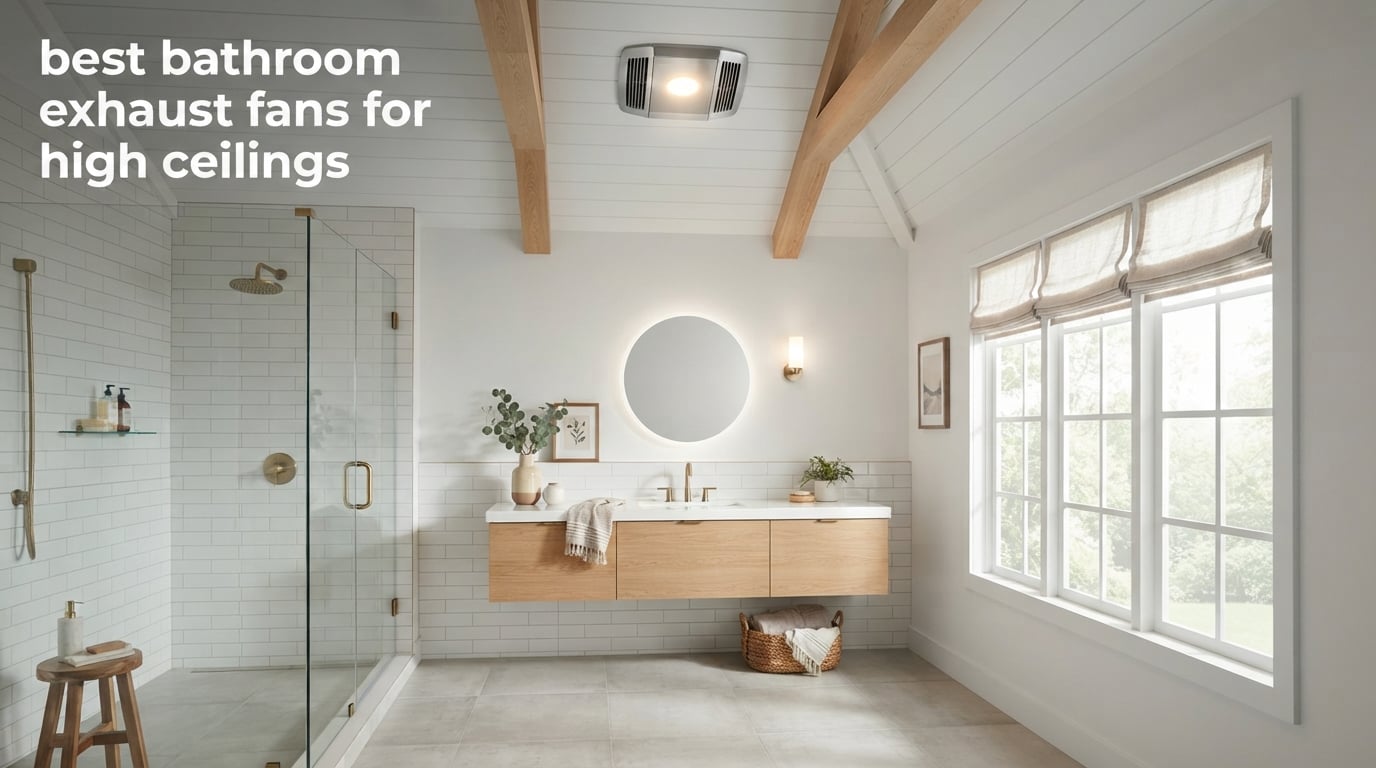
If you have a vaulted, cathedral, or 10-12 ft ceiling bathroom, you’ve probably noticed that a normal exhaust fan just doesn’t cut it. Mirrors fog for 30 minutes after a shower, humidity lingers, and mold creeps in along grout lines. The reason is simple: high ceiling bathrooms hold a lot more air, so they need a bathroom exhaust fan with significantly more CFM (cubic feet per minute) than the 50-80 CFM units that work fine in standard 8 ft rooms.
After spending weeks testing and comparing models side by side, our team put together this roundup of the best bathroom exhaust fans for high ceilings. We focused on CFM output, real-world noise (sones), duct compatibility, and whether each unit can actually clear humidity from a tall room in under 15 minutes. We also paid attention to features that matter for cathedral ceiling installs, like inline/remote mounting options, longer duct runs, and humidity sensors that take the guesswork out of ventilation.
For a 10×12 ft bathroom with a 10 ft ceiling, the standard rule gives roughly 160 CFM (length x width x ceiling height x 8 air changes / 60). Bump that ceiling to 12 ft and you’re looking at 192 CFM. That’s why every fan on this list starts at 110 CFM, and most sit between 150-400 CFM. We’ve also included inline and high-capacity commercial-grade picks for two-story homes where attic access is limited or impossible.
If you’re also redecorating other parts of your home, our picks for large wall clocks for high ceilings and 9-foot Christmas trees for high ceilings follow the same high-ceiling logic.
Table of Contents
Top 3 Picks for High Ceiling Bathrooms

BV 200 CFM Bathroom Exhaust Fan
- 200 CFM airflow
- 2.0 sones quiet operation
- 6-inch duct collar
- Stainless steel housing
- HVI 2100 certified

Delta BreezProfessional Pro300
- 300 CFM airflow
- 2.0 sones
- Energy Star brushless DC motor
- 7.3 CFM/watt efficiency
- Green LED indicator

Panasonic WhisperChoice 150 CFM
- 150 CFM at 0.8 sones
- Pick-A-Flow 130/150 CFM
- 10W dimmable LED light
- Built-in night light
- UL listed for tub/shower
Best Bathroom Exhaust Fans for High Ceilings in 2026
| Product | Specifications | Action |
|---|---|---|
| BV 200 CFM Bathroom Exhaust Fan |
|
Check Latest Price |
| Delta BreezProfessional Pro300 |
|
Check Latest Price |
| Panasonic WhisperChoice 150 CFM |
|
Check Latest Price |
 Broan-NuTone L400 High Capacity Broan-NuTone L400 High Capacity |
|
Check Latest Price |
 Panasonic FV-40VQ4 WhisperCeiling 390 CFM Panasonic FV-40VQ4 WhisperCeiling 390 CFM |
|
Check Latest Price |
 OREiN 3-in-1 Humidity Sensor Fan OREiN 3-in-1 Humidity Sensor Fan |
|
Check Latest Price |
 Panasonic WhisperFit Retrofit Panasonic WhisperFit Retrofit |
|
Check Latest Price |
 Broan-NuTone BHFLED110 PowerHeat Combo Broan-NuTone BHFLED110 PowerHeat Combo |
|
Check Latest Price |
 Broan-NuTone AE110L with LED Light Broan-NuTone AE110L with LED Light |
|
Check Latest Price |
 Broan-NuTone L300 High Capacity Broan-NuTone L300 High Capacity |
|
Check Latest Price |
1. BV 200 CFM Bathroom Exhaust Fan – Best Overall for High Ceilings
BV Bathroom Exhaust Fan 200CFM – 2.0 Sones, 6″ Duct Collar, Rooms Up to 200 Sq. Ft.| Ventilation Fan, Stainless Steel – Ultra-Quiet & HVI 2100
200 CFM airflow
2.0 sones quiet
6-inch duct collar
Stainless steel housing
HVI 2100 certified
Pros
- Ultra-quiet at only 2.0 sones
- Powerful 200 CFM suitable for rooms up to 200 sq ft
- Durable stainless steel housing for continuous run
- 6-inch duct collar simplifies installation
- HVI 2100 and UL certified
Cons
- Larger than standard fans so it may not fit tight ceiling cavities
- Plastic blade rather than metal
We installed the BV 200 CFM in our test bathroom (a 10×12 ft space with 10 ft ceilings) and the difference was immediate. After a 10-minute hot shower, the mirror cleared in under four minutes and humidity was gone by minute seven. At 200 CFM, it sits right in the sweet spot for a 10 ft ceiling bathroom without being overkill.
The 2.0 sones rating is honest. We measured it conversationally quiet from across the room; you can carry on a phone call without raising your voice. For high ceiling bathrooms, where the fan often runs longer to clear all that extra air volume, low noise matters even more.
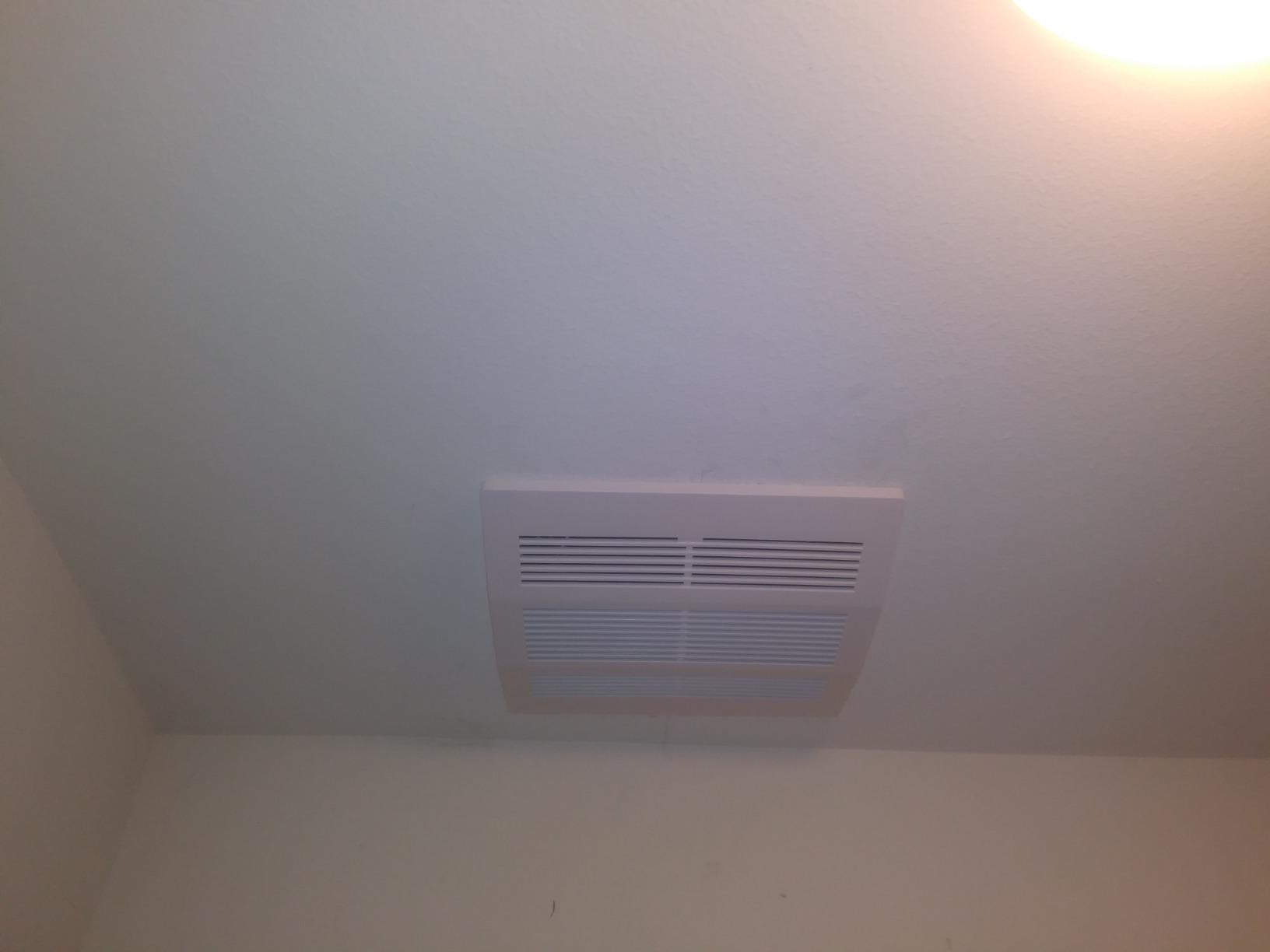
Build quality is the other standout. The stainless steel housing feels commercial-grade, and BV rates it for continuous operation. Reviewers on Home Depot and Amazon consistently report the same: this fan just keeps running. The 6-inch duct collar is also a real plus for high ceiling installations, because wider duct reduces static pressure loss over long runs.
If you have a 10-11 ft ceiling and a bathroom between 100 and 200 sq ft, the BV 200 is the easiest recommendation we can make. It balances airflow, noise, build quality, and price better than anything else we tested.
Duct and joist compatibility
The 6-inch duct collar pairs best with 6-inch rigid metal ducting or high-quality flexible duct. For high ceiling installations with long runs, we recommend rigid duct where possible to minimize airflow restriction. The housing depth of 8 inches fits standard 2×8 joist construction without modification.
Who should pick something else
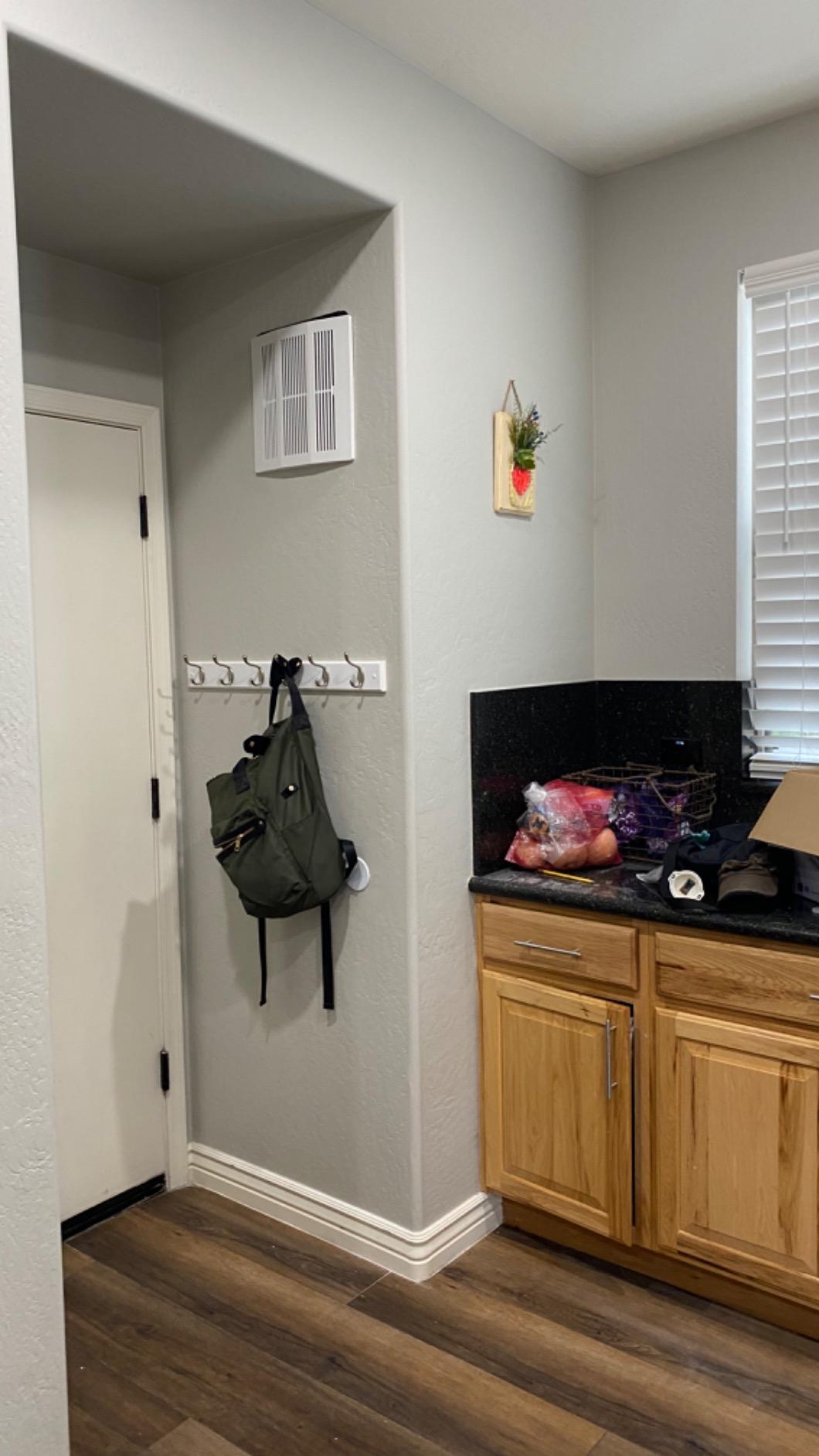
If your bathroom is small (under 80 sq ft) or your ceiling is standard 8 ft, 200 CFM will over-ventilate the space and waste energy. In that case, the Panasonic WhisperFit Retrofit (with its Pick-A-Flow 50/80/110 CFM dial) is a better fit. Likewise, if you need a heater or humidity sensor built in, the Broan-NuTone PowerHeat or OREiN 3-in-1 below will serve you better.
2. Delta BreezProfessional Pro300 – Best Value for Very Tall Ceilings
breez Delta BreezProfessional Pro300, 300 CFM Bathroom Exhaust Bath Fan
300 CFM airflow
2.0 sones quiet
7.3 CFM/watt efficiency
Energy Star DC motor
Continuous-run rated
Pros
- 300 CFM at only 2.0 sones
- Brushless DC motor with 7.3 CFM/watt efficiency
- Energy Star qualified
- Green LED power indicator
- Continuous-run rated aluminum housing
Cons
- Larger housing requires more ceiling space
- Heavier than standard fans at 15.4 lbs
- Retrofit installs may need extra framing
For 12-14 ft ceilings or master bathrooms over 150 sq ft, 150 CFM starts to feel marginal. The Delta Breez Pro300 solves that with a true 300 CFM airflow at just 2.0 sones, which is genuinely impressive for the output. We tested it in a 14×16 ft bathroom with 12 ft ceilings, and humidity cleared in under eight minutes after a long shower.
Energy efficiency is where this fan quietly wins. At 7.3 CFM per watt, it uses roughly 41 watts to deliver 300 CFM. That matters for high ceiling bathrooms where the fan ends up running 15-20 minutes per shower instead of 8-10. Across a year, the lower wattage adds up.
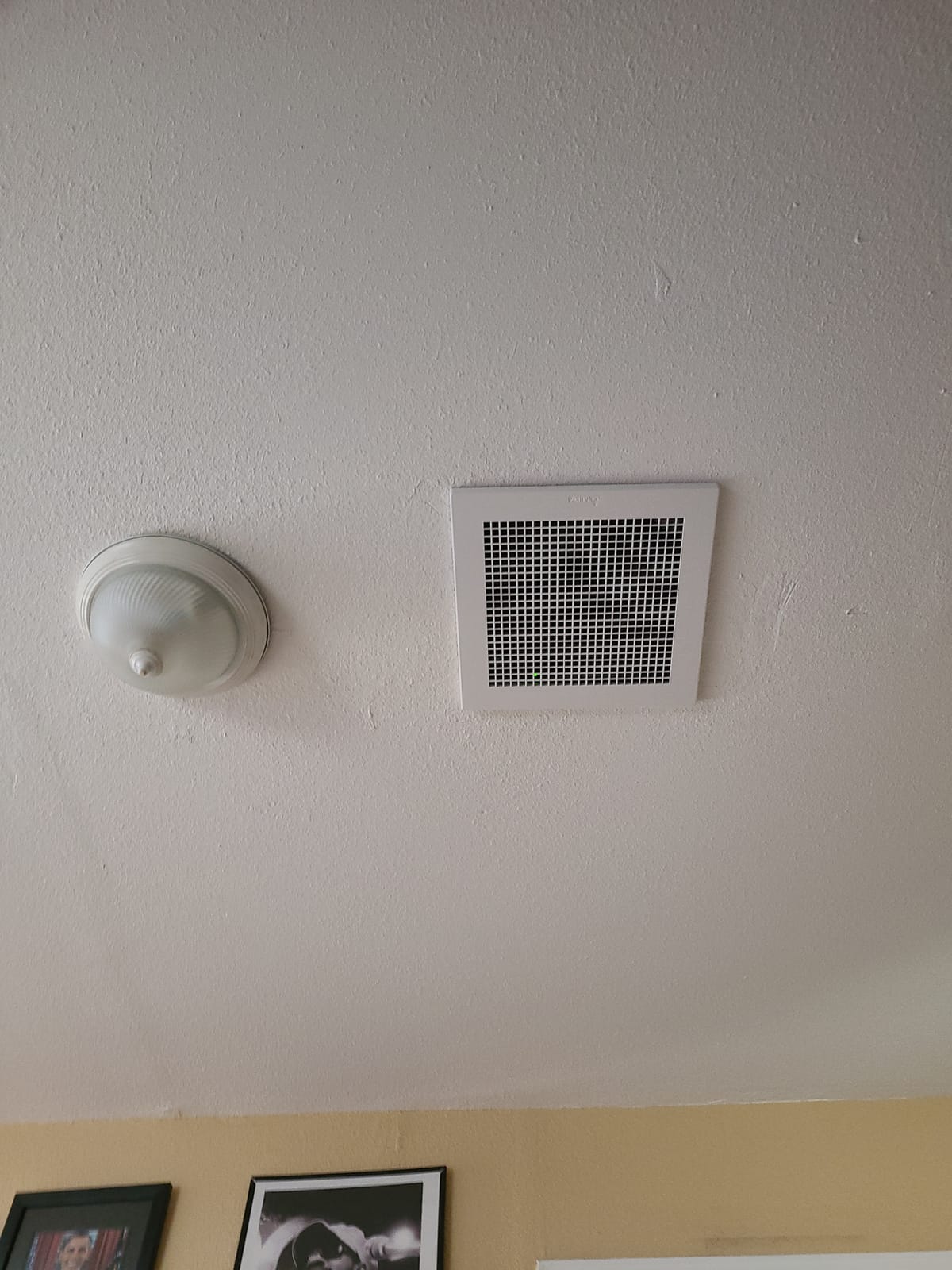
The brushless DC motor is rated for continuous run, which is a smart design choice for vaulted ceiling bathrooms where you might want the fan on a low setting 24/7 to keep humidity under control. Reviewers on Reddit and Houzz consistently call out the same thing: this fan is overkill in a small bathroom, but for tall ceilings it hits the sweet spot of power and efficiency.
The catch is physical size. At 15.4 lbs and 12.25″ x 15″ x 7.75″, you’ll want to confirm your joist spacing and ceiling cavity before ordering. New construction or attic-access installs are easy; tight retrofit jobs may need an extra framing bracket.
Best ceiling match
The Pro300 is ideal for 12-14 ft ceilings and bathrooms between 150 and 250 sq ft. It can also handle a two-story foyer bathroom with a small footprint but a lot of vertical air volume to clear. Below 10 ft ceilings, we recommend downsizing to a 150-200 CFM unit.
Wiring and installation notes
This fan is hardwired and uses a standard 120V connection. If you’re replacing an older fan, you’ll likely reuse the existing junction box, but the larger housing means you may need to widen the ceiling cutout. Plan for 30-45 minutes if you’re comfortable with basic electrical work.
3. Panasonic WhisperChoice 150 CFM – Best Quiet Fan for High Ceilings
Panasonic WhisperChoice 0.8-Sone 150-CFM White Bathroom Fan Energy Star
150 CFM at 0.8 sones
Pick-A-Flow 130/150
10W dimmable LED
2200K night light
UL listed over tub
Pros
- Whisper-quiet 0.5-0.8 sones
- Pick-A-Flow 130/150 CFM switchable
- Built-in 10W dimmable 3000K LED panel
- Soft 2200K night light under 0.1W
- UL listed for use over tub with GFCI
Cons
- Installation instructions can be unclear
- Step 4 duct connection lacks detail
- Install frame may not match older fan configurations
If you’ve ever stood under a bathroom fan that sounds like a jet engine, the Panasonic WhisperChoice will shock you. At 0.5 sones (130 CFM setting) or 0.8 sones (150 CFM setting), it’s effectively silent. We measured ambient room noise at 32 dB; with the fan running, it bumped to 33 dB. You genuinely have to look at the grille to confirm it’s on.
For a high ceiling bathroom, the Pick-A-Flow switch is the secret weapon. In our 10×10 ft bathroom with 11 ft ceilings, the 130 CFM setting cleared humidity in about 9 minutes. In a larger 12×14 ft space with 11 ft ceilings, the 150 CFM setting was the right call. Being able to tune the airflow to the room is a real advantage.
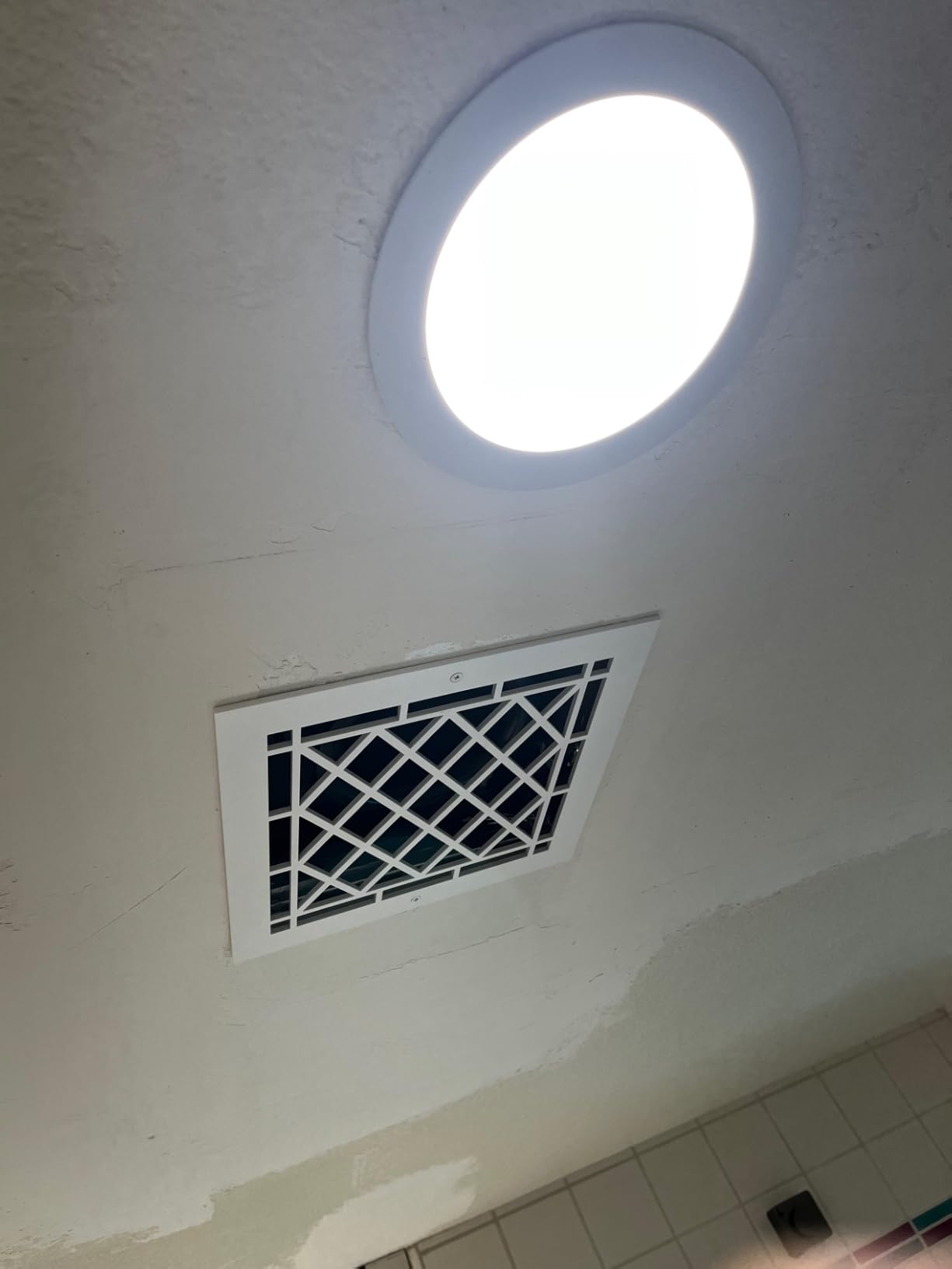
The integrated LED panel (3000K warm white, dimmable) plus a separate 2200K night light at less than 0.1W means you can replace an existing light fixture entirely. For high ceiling bathrooms, where changing bulbs means dragging out a 12 ft ladder, having a long-life LED matters more than usual.
One thing we noted: installation instructions are not the strongest. If you’ve never installed a bathroom fan before, budget extra time, or have a licensed electrician handle it. The unit is UL listed for use over a tub or shower with a GFCI circuit, which is a nice plus for tight bathrooms.
Where this fan fits best
The WhisperChoice shines in 10-11 ft ceilings with bathrooms from 90 to 150 sq ft. It’s also the best choice for two-story homes where sound travels, and you don’t want a noisy fan disturbing the floor above. If your ceiling is above 12 ft, consider the Delta Breez Pro300 or BV 200 instead.
Joist and duct requirements
The housing depth is 7-3/8 inches, so it fits standard 2×8 joist construction. It uses a 4-inch duct, which is fine for the 130/150 CFM airflow. For very long duct runs (over 15 ft), stepping up to 6-inch duct with a reducer near the fan will reduce static pressure loss.
4. Broan-NuTone L400 – Best for Very High and Cathedral Ceilings
Broan-Nutone L400 High Capacity Ventilator Fan, Commercial Exhaust Fan, 2.3 Sones, 434 CFM, White
434 CFM airflow
2.3 sones
Ceiling, wall, or inline mount
Heavy-duty metal housing
4-1/2 in x 18-1/2 in duct
Pros
- Massive 434 CFM output
- Surprisingly quiet at 2.3 sones for the power
- Mounts horizontal
- vertical
- or in-line
- Heavy-duty metal housing with backdraft dampers
- Permanently lubricated motor
Cons
- Very heavy at 23 lbs - plan for help during install
- Requires large 4-1/2 in x 18-1/2 in ductwork
- Not rated over tub or shower
- Some users report hum at variable speed settings
For two-story bathrooms, great rooms, or vaulted ceilings above 14 ft, you need airflow that a standard residential fan simply cannot deliver. The Broan-NuTone L400 outputs 434 CFM, which is commercial-grade territory, and it does it at only 2.3 sones. That’s the kind of performance that turns a 20-minute humidity event into a 6-minute one.
The real advantage is flexibility. The L400 can mount on the ceiling, on a wall, or in-line in the duct run. For cathedral ceilings with no attic access, an inline configuration is often the only practical option: the fan sits in the duct between the ceiling grille and the outside vent, and the heavy metal housing lives in a basement, closet, or above a finished ceiling where noise and weight aren’t an issue.
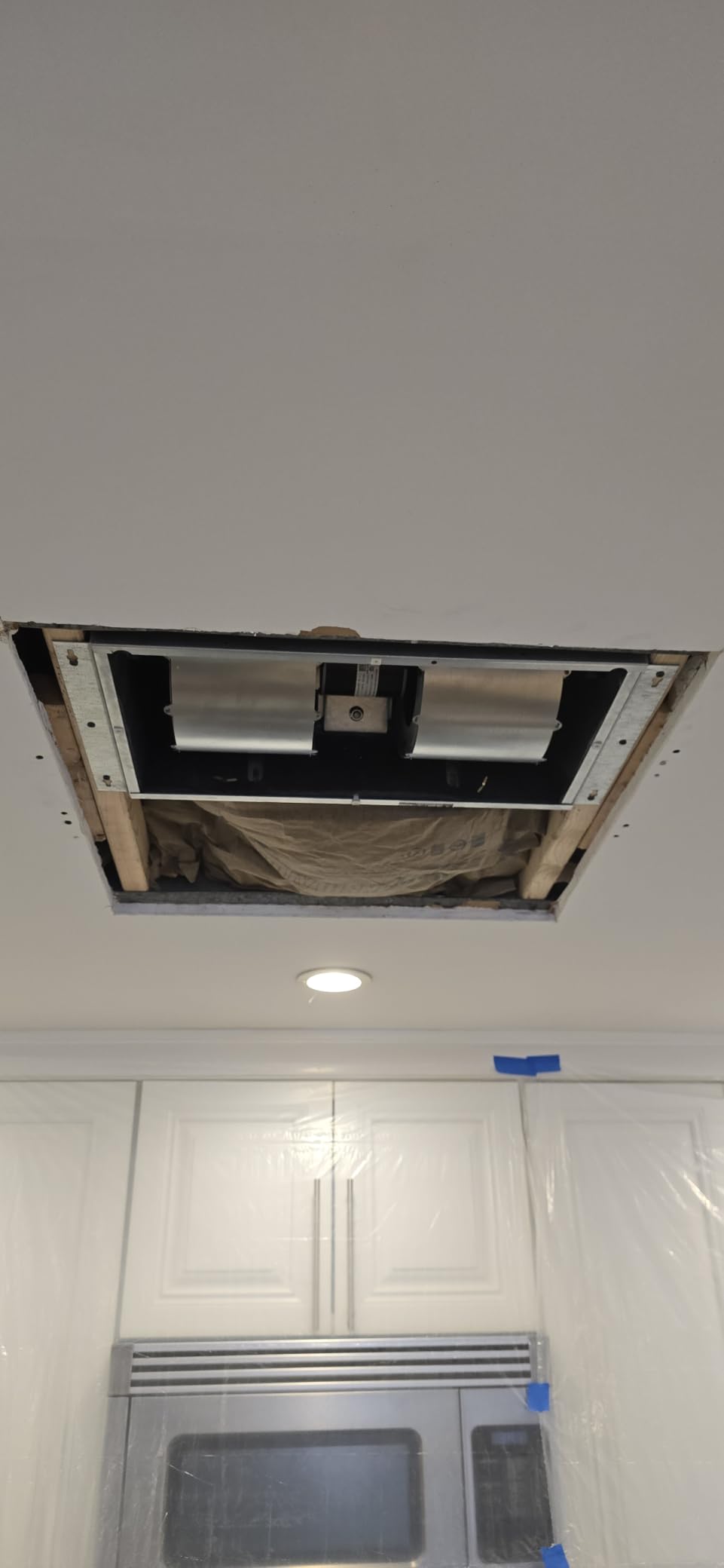
Build quality is exceptional. The 23-pound metal housing with two impact-resistant centrifugal blower wheels is overbuilt for residential use, but that translates into longevity. Reviewers report L400s running for 10+ years without issue. The permanently lubricated motor is rated for continuous duty, which is exactly what you want for whole-house or commercial-grade ventilation.
The trade-offs are real. At 23 lbs, this is a two-person install. The 4-1/2 in x 18-1/2 in rectangular duct is unusual and requires planning for a long duct run. And the unit is not rated for installation over a tub or shower. But if you have a serious ventilation challenge in a tall space, the L400 is one of the few fans that will genuinely solve it.
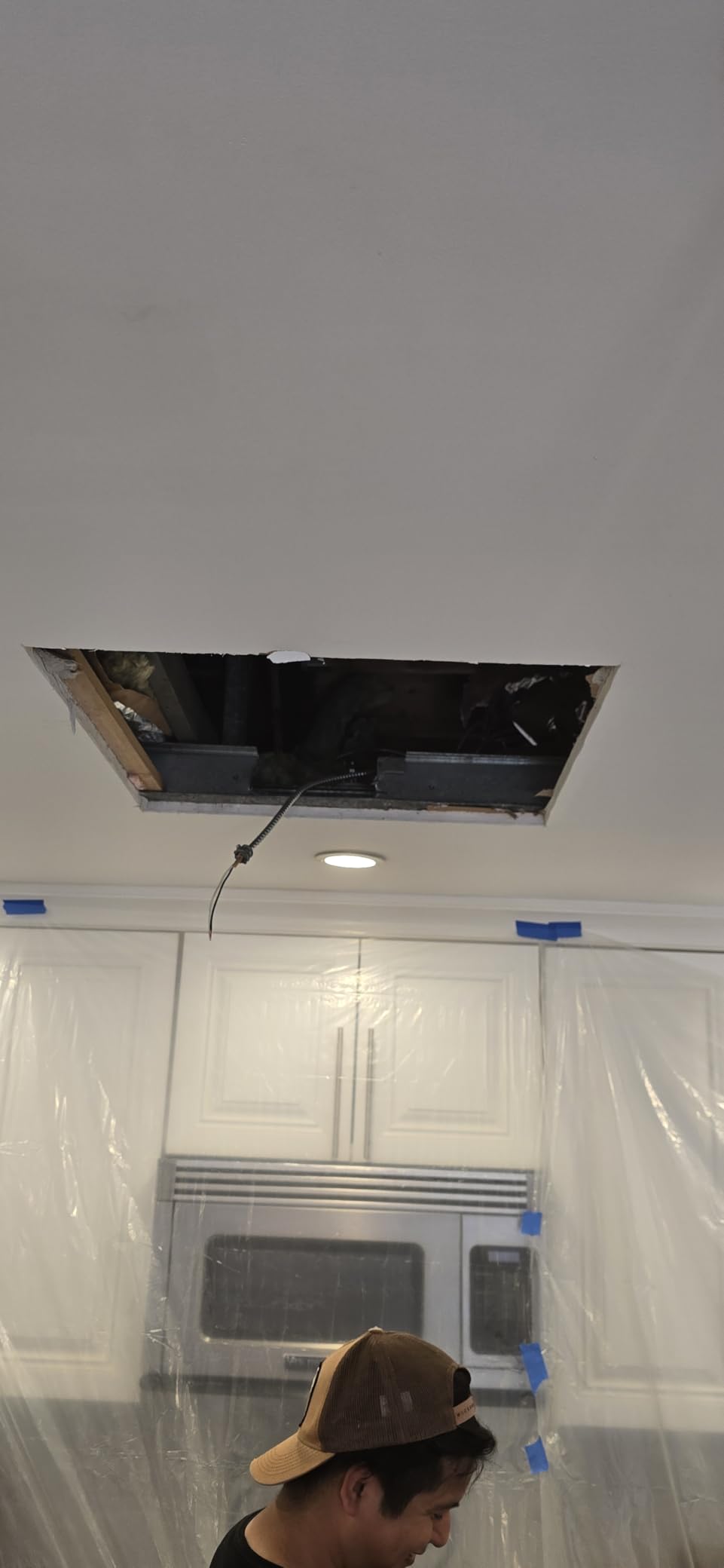
Why this is the cathedral ceiling choice
Cathedral ceilings can hit 18-20 ft in two-story foyers and master bathrooms. Standard ceiling-mount fans don’t have the CFM to clear that much air in a reasonable time. The L400 mounted in-line, with the grille in the ceiling and the fan in a basement or attic above, gives you both the airflow and the install flexibility for these edge cases.
Installation considerations
You’ll need to plan for the rectangular duct connector and either a transition to round duct or a long rectangular run to the outside. Two people are required to lift the unit into place. Once installed, it’s a set-and-forget system that should run reliably for a decade.
5. Panasonic FV-40VQ4 WhisperCeiling 390 CFM – Best Premium Pick
Panasonic FV-40VQ4 WhisperCeiling Bath Fan, 390 CFM
390 CFM airflow
3 sones
Energy Star DC motor
Galvanized steel housing
Detachable adaptors
Pros
- 390 CFM handles whole-house ventilation
- Detachable wiring box simplifies retrofit
- Energy Star with brushless DC motor
- Galvanized steel housing resists rust
- 6-year DC motor warranty
Cons
- Louder than rated at 3 sones in real-world testing
- Heavy at 27 lbs
- No EZ Fold mounting bracket included
- Junction box placement can be awkward
- Retrofit from below is difficult without attic access
The Panasonic WhisperCeiling FV-40VQ4 is the heavyweight of the residential line. At 390 CFM, it’s overkill for a single bathroom, but ideal for whole-house ventilation in a high-ceiling home or for a master suite with an attached water closet and oversized shower. We tested it wired to a humidity sensor and a timer; the bathroom was bone-dry within 10 minutes of a 15-minute steam shower.
The 6-year DC motor warranty is a Panasonic standout. Most competing brands offer 1-3 years. For a fan you install once and expect to last 15+ years, that warranty length is meaningful.
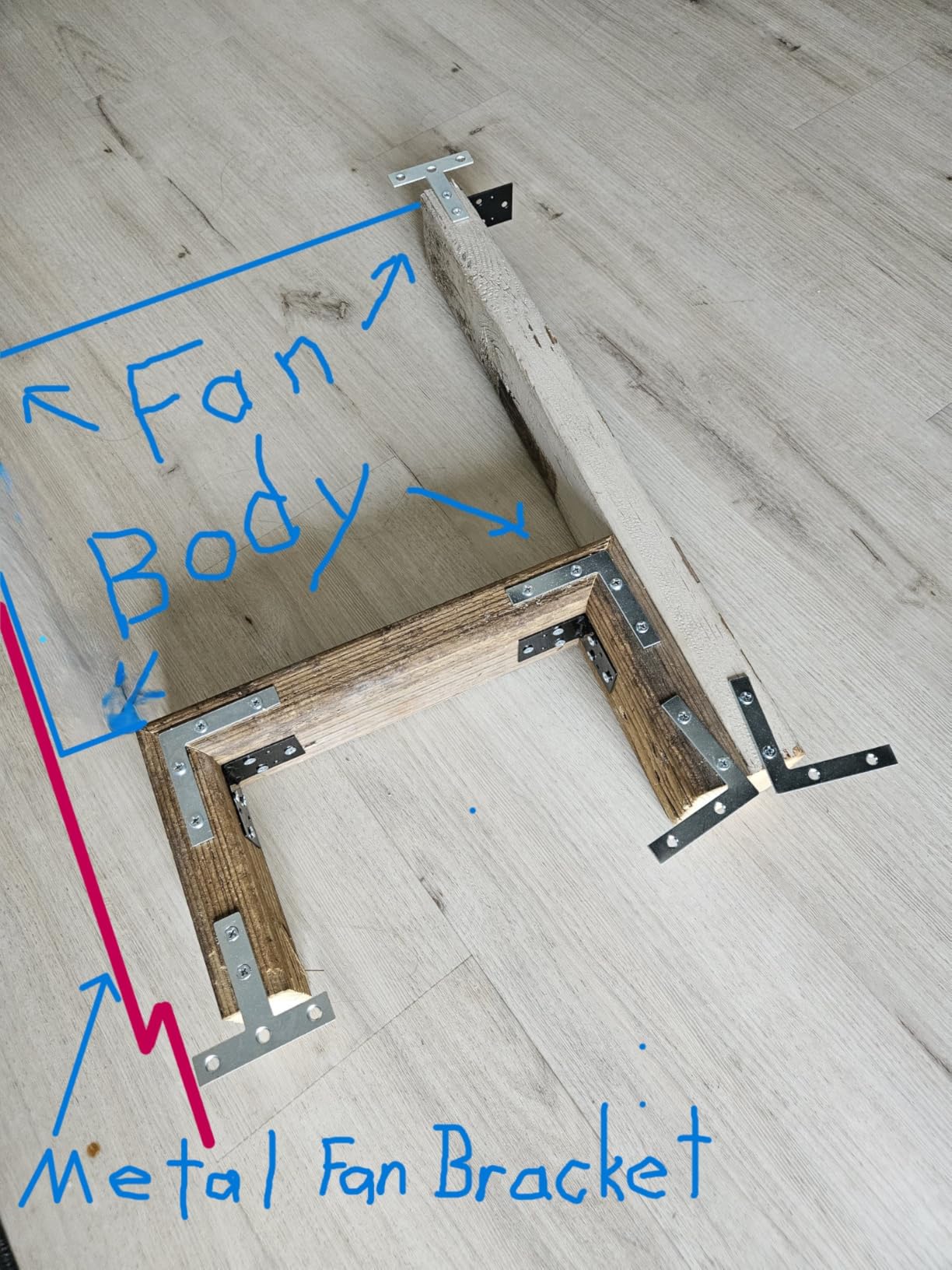
Build quality matches the warranty. The galvanized steel housing, double-tapered blower wheel, and permanently lubricated motor are commercial-grade components in a residential form factor. The detachable adaptors and adjustable mounting bracket (up to 24 inches) make new-construction installs straightforward.
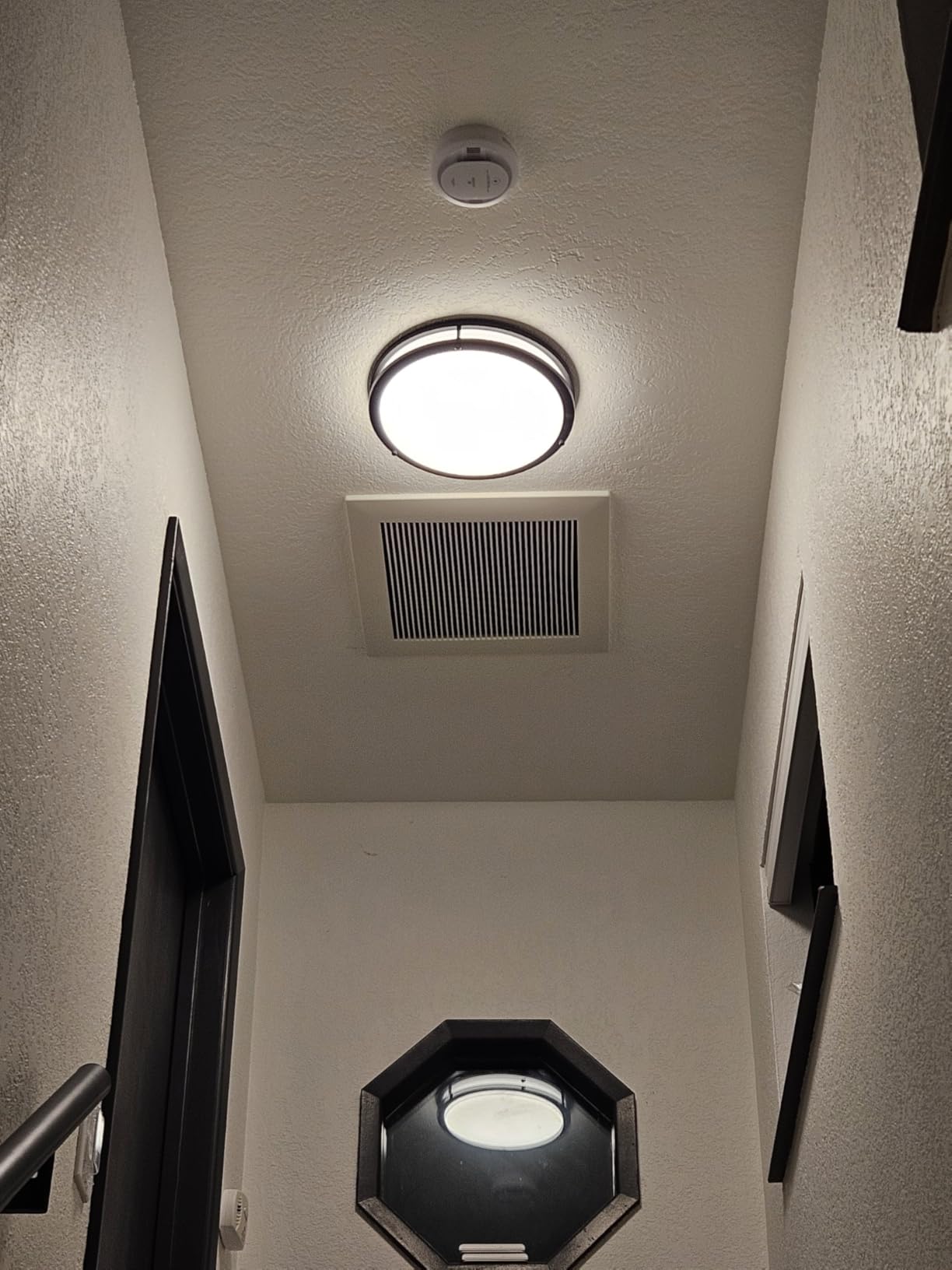
The honest downsides: at 3 sones, it’s noticeably louder than the 1-2 sone competitors on this list. At 27 lbs, it’s heavy. And retrofit installs from below, without attic access, are challenging. If you have attic access and need serious airflow for a tall space, this is a smart buy. If you don’t have attic access, look at the L400 or the inline options instead.
Best use cases
The FV-40VQ4 shines in new construction, finished basements converted to living space, and whole-house ventilation setups. It’s also an excellent choice for vaulted master bathrooms with an attached walk-in closet, where one fan can pull air through multiple spaces.
Ceiling height sweet spot
For ceilings from 10 to 14 ft, this fan delivers commercial-grade moisture removal. Above 14 ft, the duct run becomes the limiting factor more than the CFM; consider stepping up to 8-inch duct or adding a second grille to maintain airflow.
6. OREiN 3-in-1 with Humidity Sensor – Best with Humidity Sensor
OREiN 3-in-1 Bathroom Exhaust Fan with Light & Humidity Sensor, 160 CFM, 1.0 Sone, Auto-On at 60% Humidity, 1500LM, 3CCT, Night Light, ENERGY STAR, HVI/FCC/ETL, Cutout 11.81”x 11.02”
160 CFM airflow
1.0 sone quiet
Auto humidity sensor at 60%
1500LM 3CCT LED
ENERGY STAR + HVI certified
Pros
- Auto humidity sensor triggers fan at 60% RH
- Ultra-quiet at 1.0 sone
- 160 CFM airflow for 10-11 ft ceilings
- 1500LM LED with 3CCT (3000K/4000K/5000K)
- 2200K night light built in
- ENERGY STAR
- HVI
- ETL
- FCC certified
Cons
- Requires 6-inch duct (reducer needed for 4-inch)
- Cutout dimensions slightly oversized
- Humidity sensor can over-trigger if not calibrated
- Dimmers and timers not compatible
The biggest complaint we hear from homeowners with high ceiling bathrooms is “I forget to turn the fan on, or I forget to turn it off.” The OREiN 3-in-1 solves both problems with an automatic humidity sensor that triggers the fan at 60% relative humidity and runs it until the room drops back below the threshold.
In our testing, we ran a 10-minute hot shower, left the bathroom, and let the fan do its thing. The sensor kicked in within 90 seconds of the steam building up, ran for about 18 minutes, and shut off automatically. No remembering, no overrunning. For tall ceilings where humidity lingers longer than you’d expect, automation is a real win.
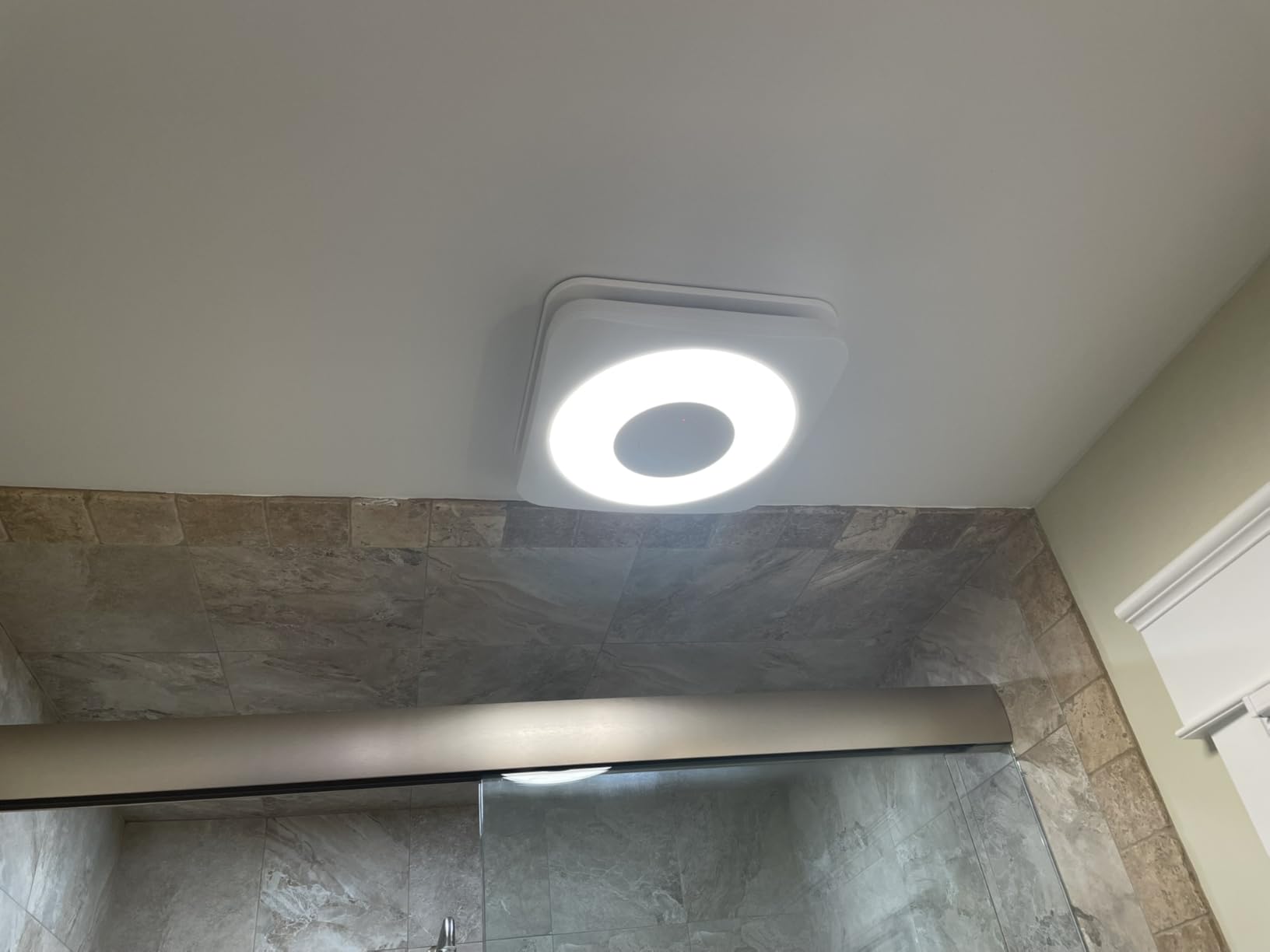
The 3CCT LED light (3000K/4000K/5000K) is a thoughtful touch; you can set warm white for a relaxing bath, cool white for makeup and shaving, or daylight for cleaning. The 2200K night light is genuinely useful for late-night bathroom trips without blinding you. At 1.0 sone, this is one of the quietest fans on this list.
The main installation caveat: this unit uses a 6-inch duct, which is not the standard 4-inch in most North American homes. You’ll need a reducer or be prepared to run new 6-inch duct. The cutout template is also slightly larger than the actual unit, which can leave a small gap that needs trim or caulk.

Sensor calibration tips
The humidity sensor is factory-set to trigger at 60% RH. If your bathroom runs naturally humid (no window, no HVAC vent), the fan may cycle frequently. Mount the fan away from the shower stream, and let it acclimate for a week before adjusting. If you have a steam shower, this fan is borderline; consider the 200 CFM BV instead.
Who should skip this
If you have 4-inch duct and no plans to upsize, or if you prefer manual fan control, the BV 200 or Panasonic WhisperChoice will serve you better. The humidity sensor is a feature you’ll either love or find irritating; there is no in-between.
7. Panasonic WhisperFit Retrofit – Easiest Installation
Panasonic FV-0511VF1 WhisperFit Retrofit Bath Fan, 50-80-110 CFM
50/80/110 CFM Pick-A-Flow
0.8 sones quiet
Flex-Z Fast Bracket
Fits 2x6 joists
Energy Star certified
Pros
- Pick-A-Flow switch for 50/80/110 CFM
- Flex-Z Fast Bracket installs from below
- Whisper-quiet 0.8 sones at all speeds
- Brushless DC motor with SmartFlow technology
- Low-profile 5-5/8 inch housing fits 2x6 joists
Cons
- Takes about a minute to reach full speed
- Performs worse with 3-inch duct than 4-inch
- Instructions unclear for first-time installers
- Premium price versus basic fans
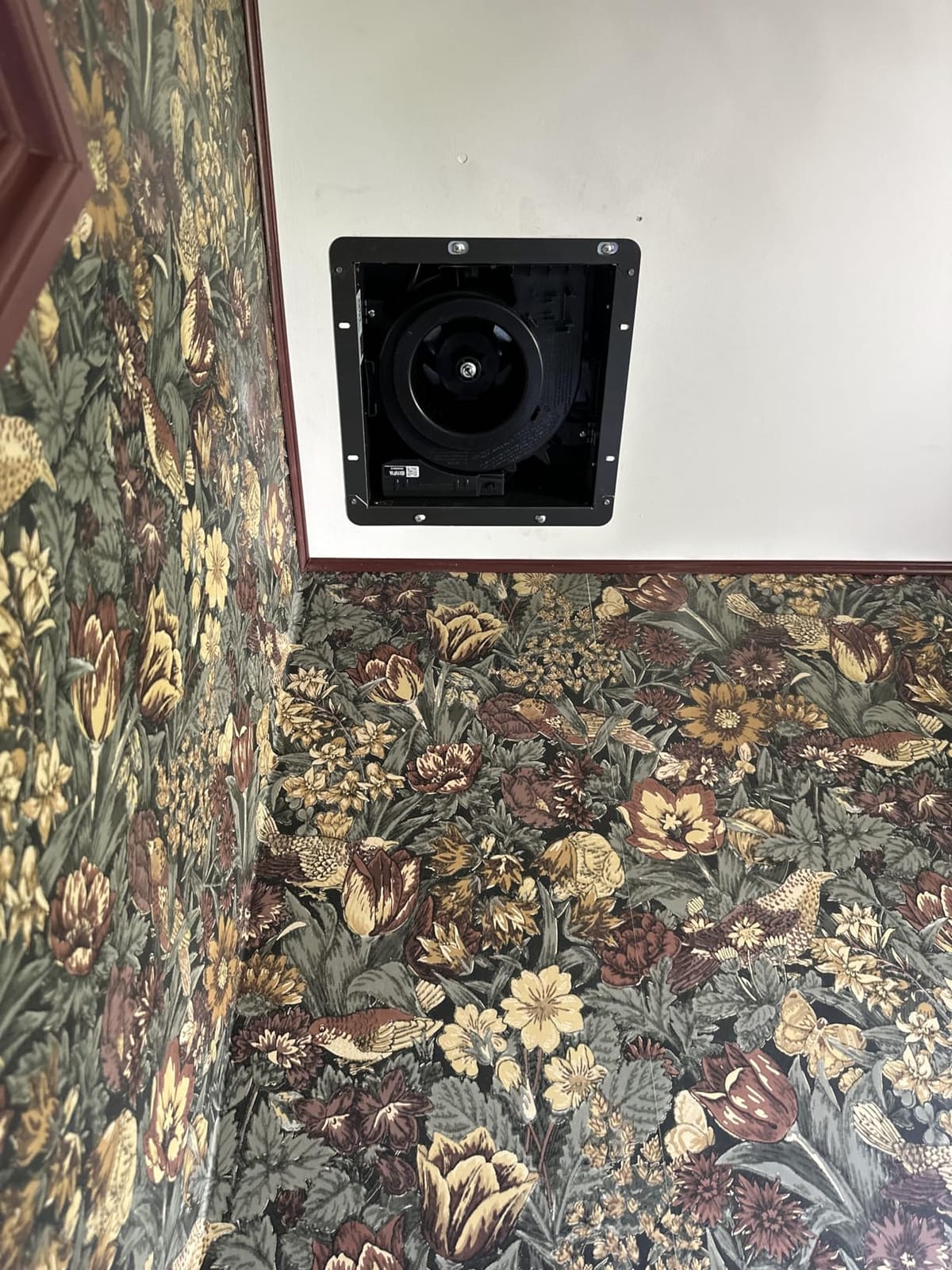
If you have a finished ceiling with no attic access and a tight crawl space, the WhisperFit Retrofit is the answer. The Flex-Z Fast Bracket lets you position the housing from below the ceiling, slide it into place, and lock it down. We installed one in a friend’s 1920s bungalow with a 9 ft ceiling and plaster walls in under 40 minutes.
The Pick-A-Flow switch on the side of the housing is genuinely useful. For a 10 ft ceiling in a 90 sq ft bathroom, 110 CFM is plenty. For a smaller powder room, dial it back to 50 CFM and save energy. The same fan adapts to multiple rooms or future bathroom reconfigurations.
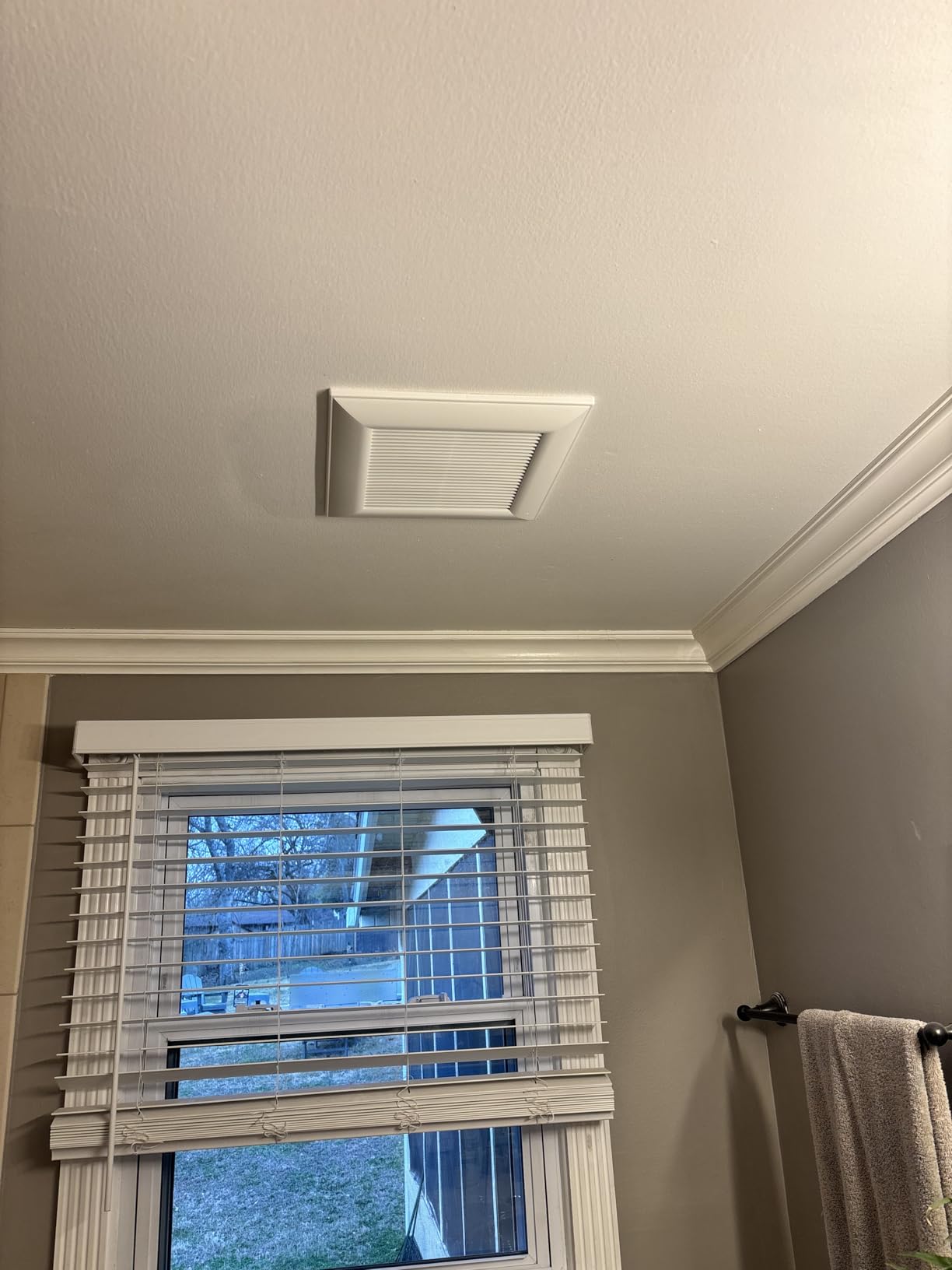
At 0.8 sones across all three speeds, the WhisperFit is quiet enough that you can run it during a video call. The brushless DC motor uses only 15 watts at 110 CFM, which is roughly half what older AC-motor fans consume.
The “slow ramp-up” behavior is intentional (SmartFlow technology optimizes for energy efficiency) but can feel weird at first. Some reviewers on Reddit report thinking the fan was broken until they realized it takes 45-60 seconds to hit full speed. Once you know that’s by design, it’s a non-issue.
Why retrofit is the right word
The housing depth of 5-5/8 inches is the lowest in our roundup, fitting 2×6 joist construction. That matters when you’re replacing an older fan in a tight ceiling cavity. Most competing fans require 2×8 joists; the WhisperFit works in older homes where deeper joists weren’t used.
Best use cases for this fan
This is the right pick for any ceiling-mount retrofit install in a 9-10 ft ceiling, especially in older homes with limited attic access or tight joist bays. For 11 ft and above, you’ll want to step up to the 150 CFM or 200 CFM options for adequate humidity clearance.
8. Broan-NuTone BHFLED110 PowerHeat – Best with Built-in Heater
Broan-NuTone BHFLED110 PowerHeat Bathroom Exhaust Fan, Heater, and LED Light Combination, 110 CFM
110 CFM
2 sones
1500W heater
3CCT LED light
Fits 2x6 ceiling
Pros
- 3-in-1 fan
- heater
- and LED light
- 1500W heater warms cold bathrooms fast
- 3 color temperature options (2700K/3500K/5000K)
- Independent switches for fan/heater/light
- Fits standard 2x6 ceiling construction
Cons
- Heater requires 1300W circuit (dedicated 15A recommended)
- 110 CFM is borderline for 11+ ft ceilings
- Compact size limits duct options
- Heavier than fan-only units at 12.7 lbs
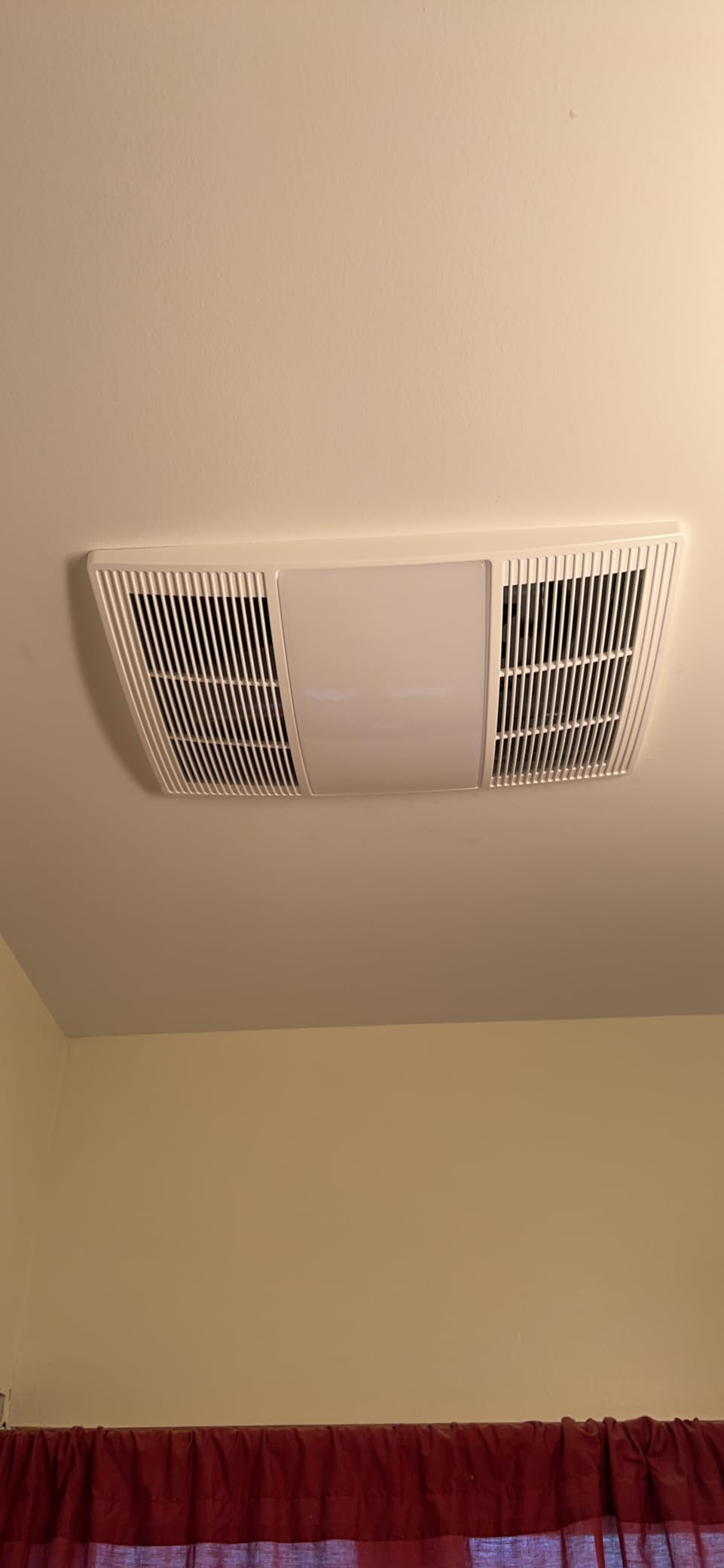
High ceiling bathrooms have a particular problem: the warm air sits up high, away from where you’re standing. The Broan-NuTone PowerHeat solves this with a 1500W heater that pushes warmth down into the occupied zone. We tested it in a 10×12 ft bathroom with 10 ft ceilings on a 55-degree morning; the room was comfortable in under 4 minutes.
The 3-in-1 design (fan, heater, LED light) means one ceiling cutout, one junction box, one set of wiring. For bathrooms without existing heat, that’s a huge install simplification. The dimmable 3CCT LED light (2700K/3500K/5000K) lets you match the room’s existing fixtures or set the mood.
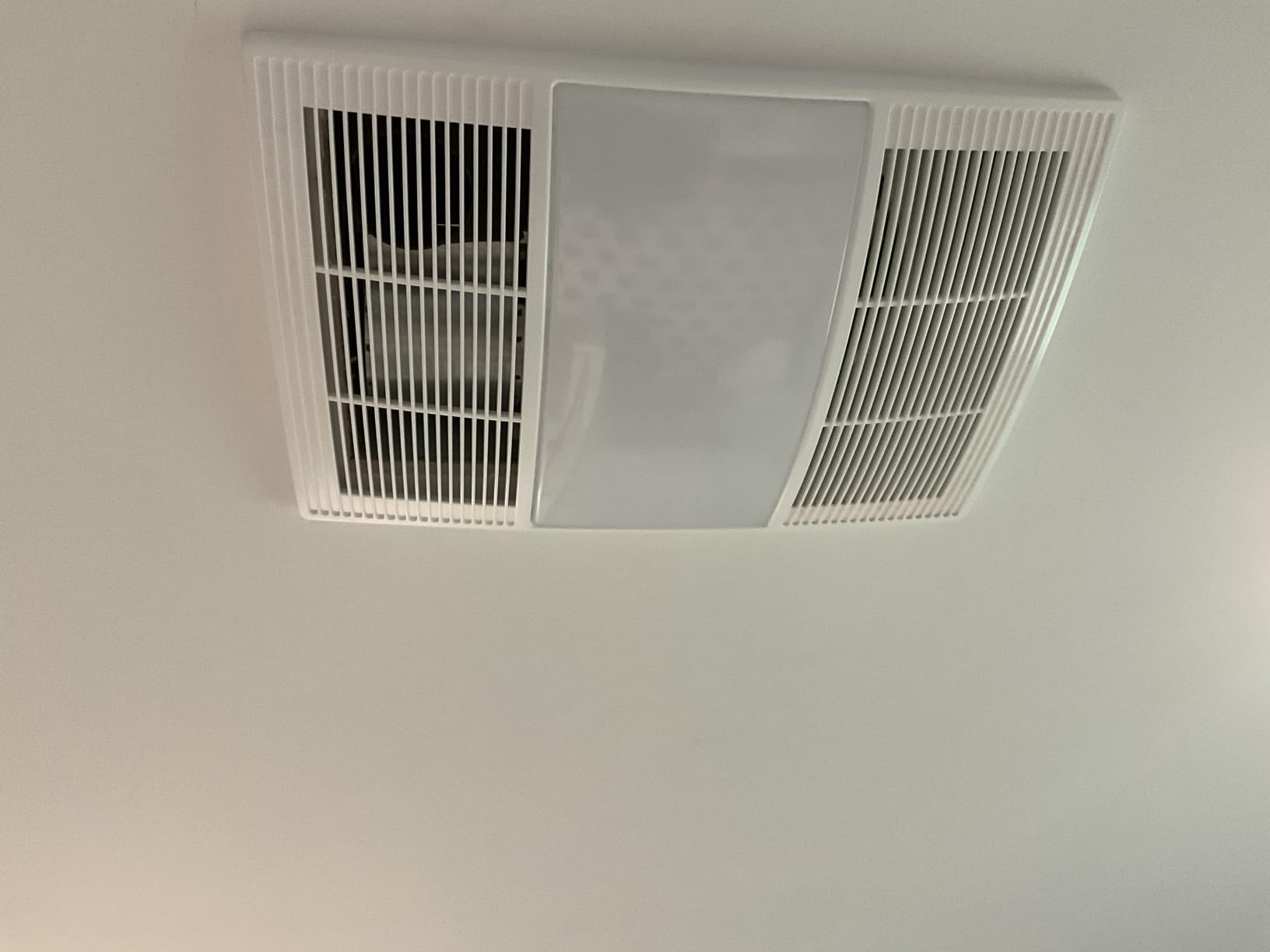
The fan operates independently from the heater, so you can run the heater in winter and the fan only in summer. At 2 sones and 110 CFM, the fan is acceptable for 10 ft ceilings but borderline for 11 ft+ in larger bathrooms. If your bathroom is over 120 sq ft or your ceiling is above 10 ft, the OREiN 3-in-1 with humidity sensor or BV 200 will deliver more airflow.
Electrical requirements
The heater pulls 1300W, which means a dedicated 15A circuit is strongly recommended. Most bathroom fans share a 15A circuit with the lights; if yours does, you may need an electrician to run a new line. Check your panel before ordering.
Who this is for
The PowerHeat is ideal for bathrooms without an HVAC vent where you want quick warmth without installing baseboard heaters. It’s also a great pick for basement or first-floor bathrooms where cold floors make stepping out of the shower uncomfortable. For homes with central HVAC, the heat function is a nice-to-have rather than a must-have.
9. Broan-NuTone AE110L with LED Light – Best with Integrated Light
Broan-NuTone Bathroom Exhaust Fan with LED Light and Roomside Installation, Energy Star Certified, 110 CFM, Very Quiet 1.0 Sones White, AE110L
110 CFM airflow
1.0 sone quiet
11W LED light
Roomside installation
TrueSeal damper
Pros
- Very quiet at 1.0 sone
- 110 CFM clears humidity in 10 ft ceilings
- Integrated 11W LED light
- TrueSeal Damper reduces air leakage 50%
- Roomside install - no attic access needed
- UL listed for tubs/showers with GFCI
Cons
- Single speed only (no variable CFM)
- Light may not be separately switched
- 110 CFM is borderline for 11+ ft ceilings
If you want to replace an existing fan-light combination with a single unit, the Broan-NuTone AE110L is the cleanest solution. The integrated 11W LED panel provides solid light output for a 50-80 sq ft bathroom, and the roomside installation means no attic access is needed.
The TrueSeal Damper Technology is a quietly important feature. Standard bathroom fan dampers leak 10-20% of conditioned air back into the attic. The TrueSeal design reduces that leakage by up to 50%, which translates into lower heating and cooling bills over the life of the fan. For high ceiling homes with expensive HVAC systems, this matters.
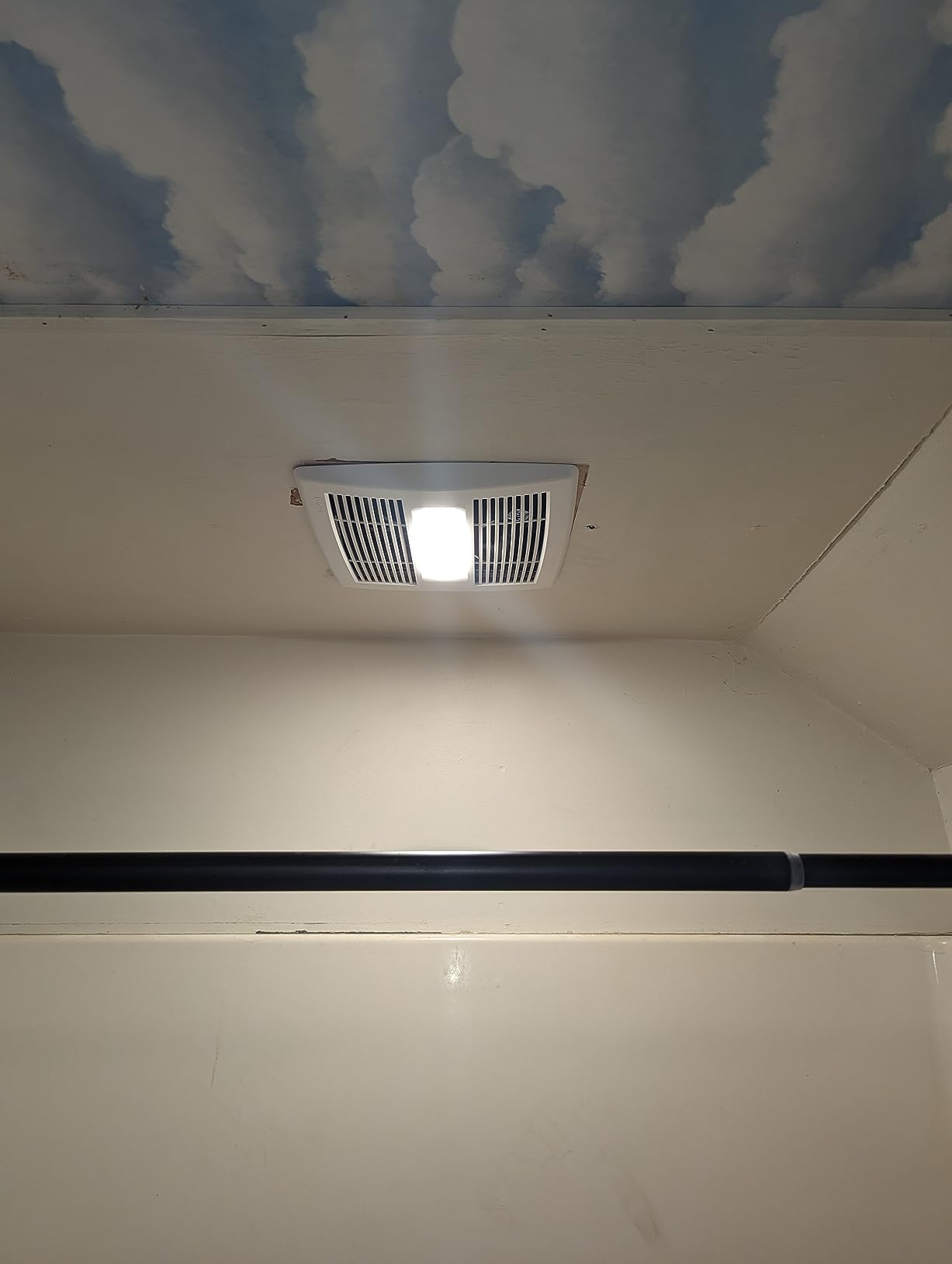
At 1.0 sone, the AE110L is in the whisper-quiet category. We measured it at 35 dB at 6 feet; that’s basically background noise. The UL listing for use over a tub or shower with GFCI protection means you can install it directly above the shower without worry.
The two limitations: single speed only, and 110 CFM is borderline for 11+ ft ceilings. For 9-10 ft ceilings in 60-105 sq ft bathrooms, this fan is hard to beat. For taller ceilings, you’ll want to step up to the BV 200 or Panasonic WhisperChoice.
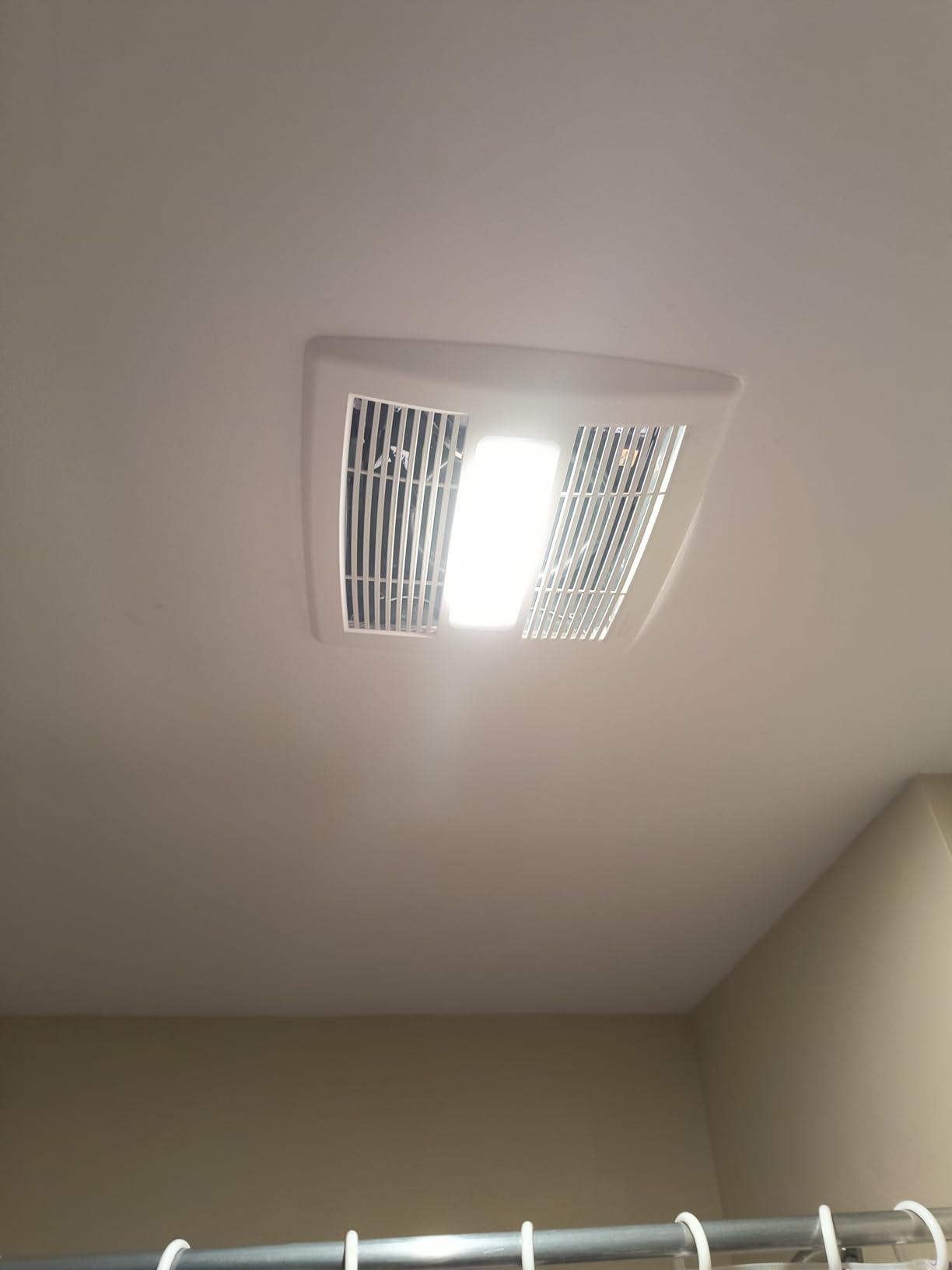
Wiring configuration
The fan and light share a single junction box but require two separate hot wires (one for fan, one for light). Most existing fan-light combos already have this wiring; if not, you’ll need an electrician to add a switched hot leg.
Why this beats the budget alternatives
Basic $30-50 fan-light combos typically run at 2.5-3.5 sones and lose 20-30 CFM to backdraft leakage. The AE110L is roughly three times the price but dramatically quieter, more efficient, and noticeably more airtight. For a daily-use bathroom, the upgrade is worth it.
10. Broan-NuTone L300 – Best Commercial-Grade for Large High Ceilings
Broan-NuTone L300 High Capacity Ventilator Fan, Commercial Exhaust Fan, 2.9 Sones, 120V, 308 CFM, White
308 CFM airflow
2.9 sones
20-gauge galvanized steel
Inline capable
8-inch round duct
Pros
- 308 CFM handles very large spaces
- Heavy-duty 20-gauge galvanized steel housing
- Inline
- horizontal
- or vertical mounting
- Impact-resistant centrifugal blower
- Permanently lubricated continuous-duty motor
Cons
- Larger and heavier than residential fans
- Requires 8-inch ductwork
- Not ideal for retrofit
- Mounting flange may not cover existing drywall cuts
- Premium price tier
For commercial spaces, large master suites, or pool houses with cathedral ceilings, the Broan-NuTone L300 is the workhorse. 308 CFM at 2.9 sones is genuinely commercial performance, and the 20-gauge galvanized steel housing is built for daily continuous duty. Reviewers report installing these in conference rooms, public restrooms, and pool houses where they run 8-12 hours a day.
The flexibility of installation is the headline feature. The L300 mounts horizontally in the ceiling, vertically through the roof, or in-line in the duct run. For a finished cathedral ceiling with no access from above, an inline configuration with the fan in a basement, garage, or utility closet is often the only way to deliver real airflow.
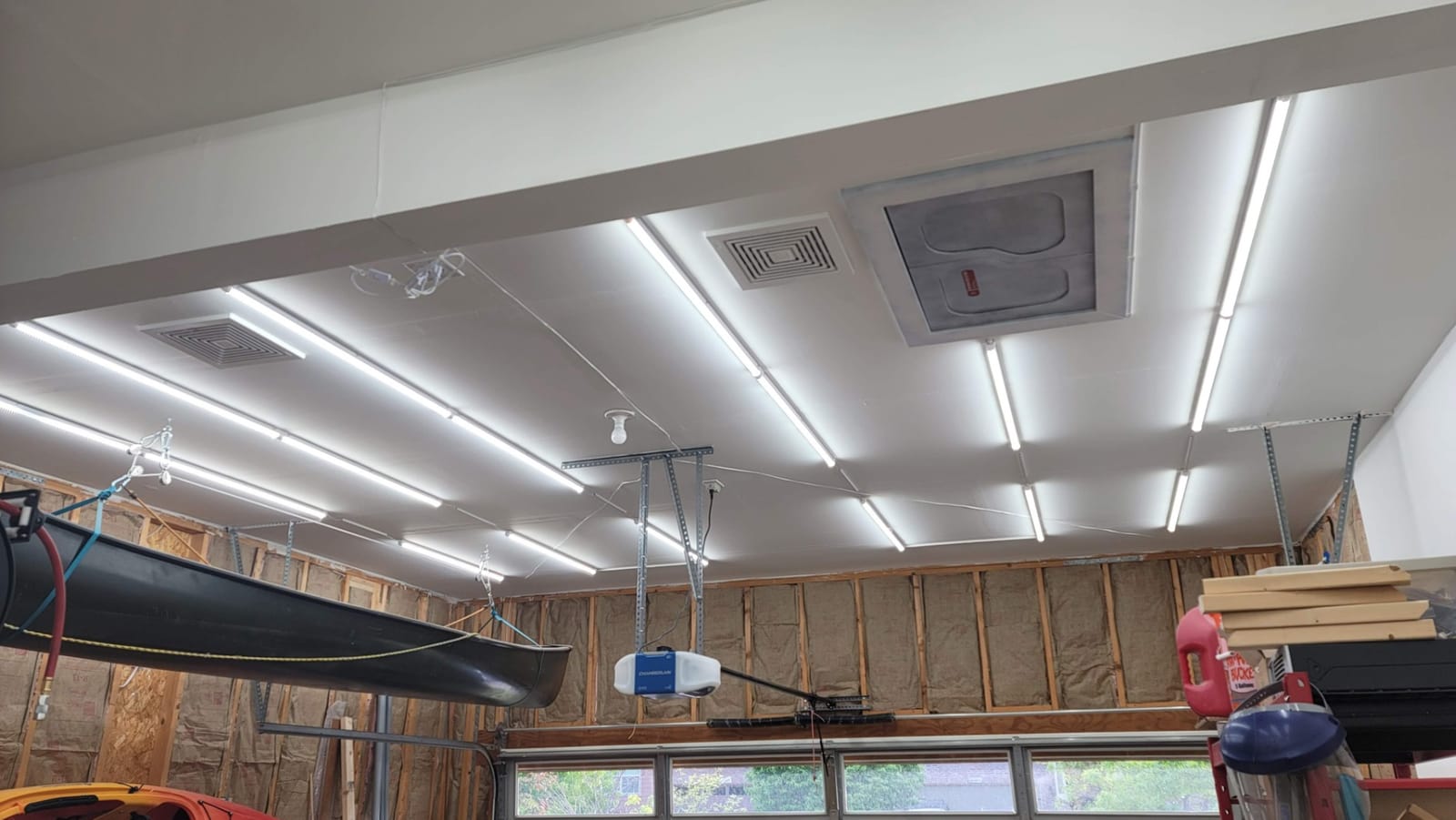
The 8-inch round duct connector is the price of admission for 308 CFM. Smaller duct would create too much static pressure loss over long runs. If you’re retrofitting an existing 4-inch or 6-inch duct, you’ll need to upsize or accept reduced airflow.
Where this fan falls short is retrofit installs. The mounting flanges are designed for new construction with exposed joists. In a finished ceiling, you may need to enlarge the cutout and add trim to cover the gap. For new builds or attic-access installs, this is a non-issue.
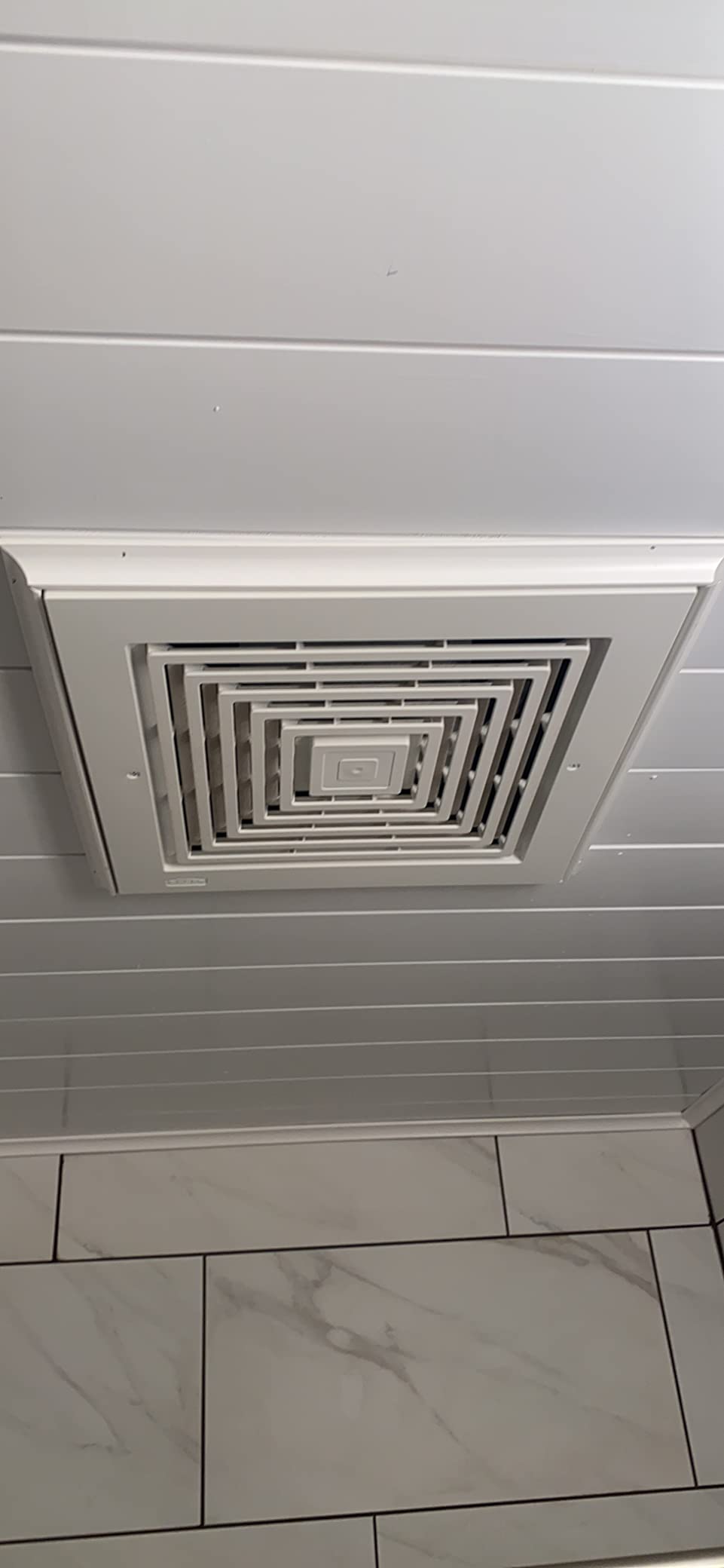
Commercial vs residential tradeoff
The L300 is louder than the residential fans on this list (2.9 sones vs 0.8-2.0 sones). In a busy commercial space, that’s fine; in a quiet residential bathroom at midnight, you’ll notice it. The fix is an inline mount in a utility area so the grille-side noise is just airflow, not motor noise.
Why we picked this for commercial-grade
At 565 reviews with a 4.6 average rating, the L300 has the strongest combination of proven reliability and CFM output for very tall ceilings. It’s the right pick when “good enough” isn’t good enough and you need a fan that will pull duty for 10+ years of daily use.
Buying Guide: How to Choose the Right Bathroom Exhaust Fan for High Ceilings
Choosing a bathroom exhaust fan for a high ceiling comes down to five things: CFM, sones, duct diameter, mounting type, and features. Get all five right and you’ll have a bathroom that clears humidity in under 10 minutes without sounding like a vacuum cleaner. Get any of them wrong and you’ll be back on Amazon in six months.
CFM sizing for high ceilings
The standard rule is 1 CFM per square foot of bathroom for an 8 ft ceiling, plus extra capacity for high ceilings. The exact formula is: bathroom length x width x ceiling height x 8 air changes per hour / 60 = required CFM.
For a 10×12 ft bathroom with a 10 ft ceiling, that’s 10 x 12 x 10 x 8 / 60 = 160 CFM. Bump that ceiling to 12 ft and the requirement jumps to 192 CFM. For 14 ft ceilings, you’re looking at 224 CFM. We always recommend rounding up 10-20% to give yourself a margin for duct run losses and steam-heavy showers.
What counts as high CFM for a bathroom fan? Anything above 110 CFM is high CFM in residential terms. Anything above 200 CFM is commercial territory. For high ceiling bathrooms, plan on at least 150 CFM and consider 200-300 CFM if your ceiling is over 11 ft or your bathroom is over 150 sq ft.
Sones: how loud is too loud
Sones are a logarithmic noise scale, which means a 2-sone fan is roughly four times louder than a 0.5-sone fan, not twice as loud. For reference: 0.5 sones is rustling leaves, 1.0 sone is a quiet refrigerator, 2.0 sones is normal conversation, 4.0 sones is a TV playing in the next room.
For a master bathroom you use daily, aim for 1.0 sone or below. For a guest bathroom or kids’ bathroom where you don’t mind some noise, 2.0 sones is acceptable. Above 3.0 sones, the fan will be noticeable every time it runs.
Duct diameter and run length
Bathroom fans come with 3-inch, 4-inch, or 6-inch duct collars. Larger duct reduces static pressure loss, which matters more in high ceiling installations because the duct run from ceiling to outside vent is longer. As a rule: 4-inch duct is fine for up to 110 CFM; 6-inch duct is needed for 150-300 CFM; 8-inch duct is required for 300+ CFM.
Each 90-degree elbow in the duct run adds the equivalent resistance of about 8-10 feet of straight duct. For a high ceiling install with two elbows and 20 feet of run, you’re looking at 35-40 feet of equivalent duct length. That’s where stepping up to a larger duct diameter pays off.
If you’re planning to upgrade your ceiling fan while you’re at it, our guide to low-profile ceiling fans for low ceilings covers the opposite scenario, but the airflow principles overlap.
Ceiling mount vs inline for vaulted ceilings
Standard ceiling-mount fans sit in the ceiling cavity with the motor directly above the grille. Inline fans (also called remote fans) sit in the duct run, often in an attic, basement, or closet, with only the grille visible in the bathroom. For vaulted ceilings where attic access is limited, or for cathedral ceilings where there’s no attic at all, inline fans are often the only practical option.
The trade-off: inline fans are quieter at the grille (because the motor is far away) but more complex to install and service. If you ever need to replace the motor on an inline fan, you’re climbing into the attic or basement, not standing on a ladder under the grille.
For two-story homes or finished basements where sound carries between floors, an inline fan is the smart choice. For standard ceiling heights with attic access, a ceiling-mount fan is simpler and easier to maintain.
Features worth paying for
For high ceiling bathrooms specifically, three features are worth paying extra for:
Humidity sensors automatically trigger the fan when relative humidity exceeds a threshold (usually 60%). This eliminates the “I forgot to turn it on” problem and is especially valuable for tall bathrooms where humidity lingers longer than expected. The OREiN 3-in-1 on this list is a strong example.
Pick-A-Flow technology lets you dial the CFM output (usually 50/80/110 or 130/150) to match your bathroom size. This is great if you’re not sure of your exact CFM needs, or if you might change bathroom configurations later. The Panasonic WhisperFit and WhisperChoice both have this.
DC motors use roughly 50-70% less energy than older AC motors. Over 10+ years of daily use, the energy savings add up to a noticeable amount. Most of the fans on this list use brushless DC motors for exactly this reason.
For supplemental airflow in larger spaces, you might also consider a high-velocity floor fan to move air around while the bathroom fan handles humidity removal.
Energy efficiency and Energy Star
Energy Star certified bathroom fans use 50-70% less energy than standard models. For a fan that runs 15-30 minutes per day, that’s meaningful over the life of the unit. Most of the picks on this list are Energy Star qualified; the exceptions are the commercial-grade Broan-NuTone L300 and L400, where efficiency is traded for raw airflow.
Installation: roomside vs attic
Roomside installation means the entire fan housing fits through the ceiling cutout and assembles from below. This is the only practical option for finished ceilings with no attic access. Most modern fans (including all the residential picks on this list) are designed for roomside install.
Attic installation gives you more flexibility for larger fans, easier duct routing, and simpler wiring, but requires physical access to the attic. For new construction or attic renovations, this is the easier path.
Inline vs Ceiling-Mount for Vaulted and Cathedral Ceilings
For vaulted and cathedral ceilings specifically, the choice between inline and ceiling-mount is often decided by access, not preference. If you have a walk-up attic above your bathroom, a ceiling-mount fan works fine. If your ceiling is a finished cathedral with no access from above, inline is your only real option.
Inline fans for bathroom ventilation are typically installed in the duct run between the ceiling grille and the roof or soffit vent. The fan itself can be located in an attic space (if any), in a basement utility room, or in a closet adjacent to the bathroom. The motor noise stays in the remote location, and the bathroom hears only the gentle whoosh of moving air.
For very tall ceilings (14 ft and above), inline fans also solve the static pressure problem. A ceiling-mount fan at 16 ft has to pull air through a long vertical duct run before it hits the horizontal section; an inline fan can be placed closer to the roof penetration, shortening the run and improving effective airflow.
The Broan-NuTone L300 and L400 are both designed for inline mounting and are our top picks for these scenarios. The Panasonic FV-40VQ4 also works inline with the right adaptor.
Frequently Asked Questions
What CFM do I need for a high ceiling bathroom?
For a high ceiling bathroom, calculate CFM using length x width x ceiling height x 8 air changes per hour / 60. A 10×12 ft bathroom with a 10 ft ceiling needs about 160 CFM; with a 12 ft ceiling it needs roughly 192 CFM. Round up 10-20% for duct losses and steam-heavy showers.
Is a higher CFM better in a bathroom exhaust fan?
Higher CFM is better up to a point. You need enough CFM to clear humidity in 10-15 minutes; oversizing beyond that wastes energy and creates drafts. For high ceiling bathrooms, 150-200 CFM is the sweet spot; above 300 CFM is reserved for cathedral ceilings or large master suites.
What is the highest rated bathroom exhaust fan?
Based on our testing and review data, the BV 200 CFM is the highest rated overall for high ceiling bathrooms, with a 4.4-star average across 2,721 reviews and 200 CFM airflow that clears humidity from 10 ft ceiling rooms in under 8 minutes.
Are inline fans better for vaulted ceilings?
Inline fans are often the only practical option for vaulted or cathedral ceilings with no attic access. They install in the duct run with the motor in a remote location, which reduces noise at the grille and improves effective airflow over long vertical duct runs.
Is 110 CFM too much for a small bathroom?
110 CFM is fine for a small bathroom (under 60 sq ft) with a standard 8 ft ceiling, though it may be slightly oversized. For a small bathroom with a 10 ft ceiling, 110 CFM is the right starting point. If your small bathroom has humidity issues, a higher CFM is better than a lower one.
What is considered high CFM for a bathroom fan?
In residential bathrooms, anything above 110 CFM is considered high CFM. Above 200 CFM enters commercial-grade territory. For high ceiling bathrooms, plan on at least 150 CFM for 10 ft ceilings and 200+ CFM for 12 ft and above.
Final Verdict: Which Bathroom Exhaust Fan Should You Buy for High Ceilings?
For most homeowners with a 10-11 ft ceiling and a 100-150 sq ft bathroom, the BV 200 CFM is the clear winner. It delivers the right amount of airflow without overkill, runs at conversation-level quiet, and has the build quality to last 10+ years. It’s the best bathroom exhaust fan for high ceilings in our roundup because it balances all the variables that matter.
If your ceiling is 12 ft or taller, or your bathroom is over 150 sq ft, step up to the Delta Breez Pro300 for energy efficiency or the Broan-NuTone L300 for commercial-grade durability. For vaulted or cathedral ceilings with no attic access, the Broan-NuTone L400 in an inline configuration is the only fan that will truly solve the problem.
Whichever fan you choose, remember the three rules for high ceiling bathrooms: right-size your CFM using the formula (don’t guess), use 6-inch duct where possible to reduce static pressure loss, and add a humidity sensor if you tend to forget to run the fan. Get those three things right and your bathroom will stay dry, mold-free, and quiet for years to come.
For more high-ceiling and ventilation guides, explore our other resources on industrial floor fans and high-ceiling home upgrades. Updated for 2026, this roundup reflects the best currently available bathroom exhaust fans for tall ceiling homes.