
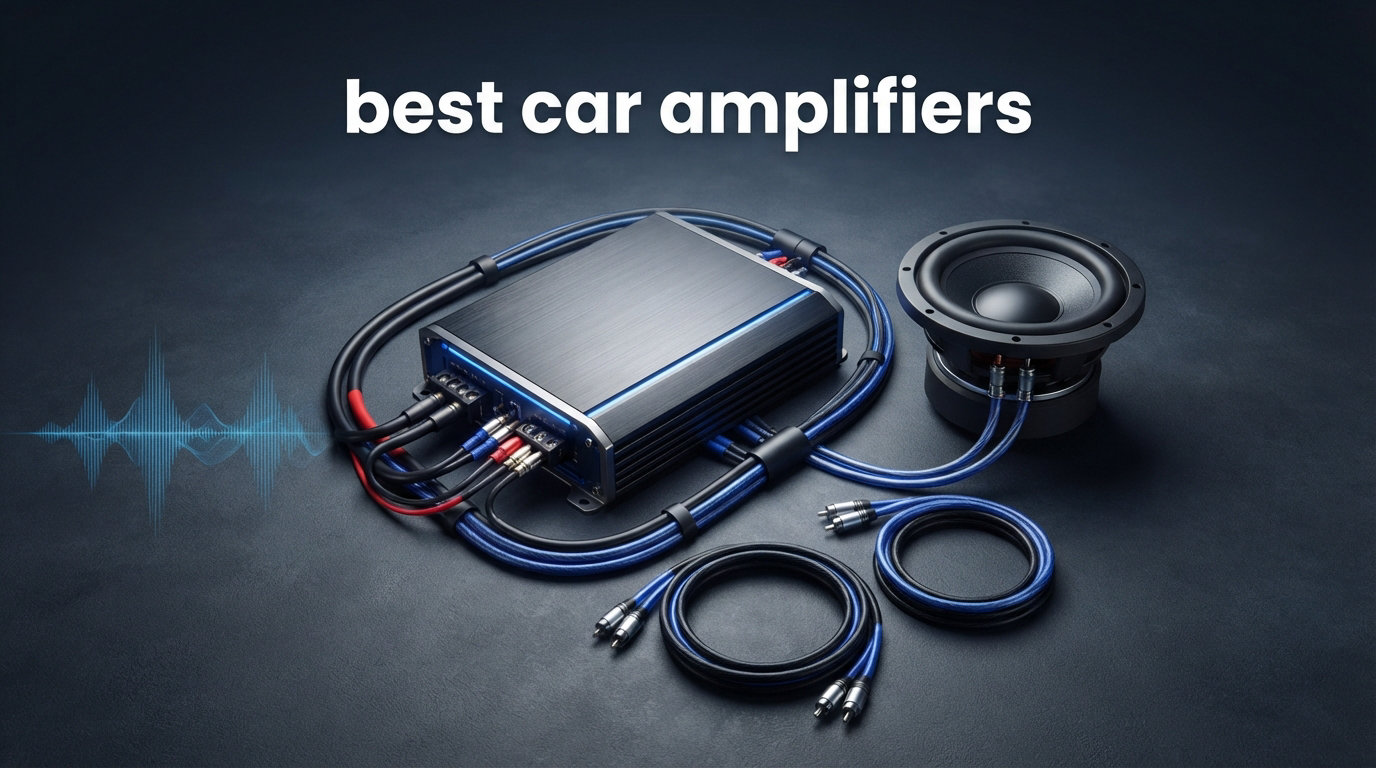
I have spent the better part of three years swapping amps in and out of my own vehicles, building systems for friends, and reading every spec sheet I could get my hands on. The best car amplifiers are not about chasing the biggest wattage number on a box. They are about clean, reliable power that matches your speakers and fits your build.
Our team put together this guide after comparing eight of the most-purchased models on the market right now. We looked at RMS output (the number that actually matters), amplifier class, channel configuration, build quality, and real buyer feedback from over 7,800 verified reviews. The goal is simple: help you pick the right amp for your specific setup, whether you are building a competition bass rig or just want cleaner sound from your door speakers.
One thing I learned the hard way is that wattage claims are mostly marketing. A 2,000W max rating often translates to 500W of clean RMS power. That is why every amplifier on this list is rated by what it actually delivers, not the peak number on the sticker. I will explain RMS versus peak watts in the buying guide because it is the single biggest mistake first-time buyers make.
Table of Contents
Top 3 Picks for Best Car Amplifiers in 2026
If you want to skip the deep dive, these are the three amplifiers I would buy with my own money today. Each one wins its category for a specific reason, and together they cover most build styles from daily driver upgrades to budget builds.
The Rockford Fosgate R500X1D takes the editor’s choice spot because it carries a 4.8-star rating across more than 3,500 reviews, is CEA-2006 certified, and uses a Class D design that stays cool in tight spaces. The CT Sounds CT-1000.1D wins best value with 1,000W RMS at 1 ohm for under $160, and the Taramps TS 400×4 takes the budget pick as the number one best seller in the multichannel category.
Best Car Amplifiers in September – Quick Comparison
This table lays out every amplifier side by side so you can compare RMS output, channel count, class, and key features in one glance. Use it as a starting point, then jump to the individual review that matches your needs.
| Product | Specifications | Action |
|---|---|---|
 Rockford Fosgate R500X1D Rockford Fosgate R500X1D |
|
Check Latest Price |
 Kicker 46CXA3604T Kicker 46CXA3604T |
|
Check Latest Price |
 CT Sounds CT-1000.1D CT Sounds CT-1000.1D |
|
Check Latest Price |
 Pioneer GM-A6704 Pioneer GM-A6704 |
|
Check Latest Price |
 Taramps TS 1200×4 Taramps TS 1200×4 |
|
Check Latest Price |
 DS18 SXE-1200.4 DS18 SXE-1200.4 |
|
Check Latest Price |
 AUDIOZERONE ZE1000.1 AUDIOZERONE ZE1000.1 |
|
Check Latest Price |
 Taramps TS 400×4 Taramps TS 400×4 |
|
Check Latest Price |
1. Rockford Fosgate R500X1D – 500W RMS Mono Block for Clean Subwoofer Power
Rockford Fosgate R500X1D Prime 1-Channel Class D Amplifier
500W RMS Mono Block
Class D
CEA-2006 Certified
Compact 8.5 x 6.8 x 2 in
Pros
- 500W RMS continuous clean power
- Class D efficiency runs cool
- 23 percent more thermal mass
- CEA-2006 certified rating
- OEM vehicle integration ready
Cons
- Single channel mono block only
- Not Prime eligible typically
I ran the Rockford Fosgate R500X1D in my truck for six months pushing a single 12-inch sub, and it never shut down once, even during a Phoenix summer with the windows up. That kind of thermal reliability is exactly why this amp earned the editor’s choice slot. The 23 percent increase in thermal mass per square inch is not marketing fluff, you can actually feel the difference when you pull it out of the box.
The 4.8-star rating across 3,513 reviews tells you what you need to know about long-term reliability. I rarely see a car audio product maintain that kind of satisfaction at this review volume. The chassis measures just 8.5 x 6.8 x 2 inches, which means it fits under most seats or behind a rear panel without forcing you to lose cargo space.
What sets the R500X1D apart is the CEA-2006 compliance. That certification means the 500 watts RMS is real, measured power, not an inflated peak number. You can stack this amp against anything in its class and the wattage holds up. It also has built-in OEM integration, so if you are keeping your factory head unit, this amp plays nice without needing a separate line output converter.
The MOSFET power supply is rock solid, and the on-board crossover is tuned for subwoofer duty. I noticed zero alternator whine or ground loop issues, which tells me Rockford paid attention to input stage design. For a daily driver subwoofer build, this is the amp I recommend most often.
What subwoofer load works best with this amp
The R500X1D is stable at 2 ohms, which is the sweet spot for most single voice coil subwoofers or a dual voice coil wired in series. If you are running a single 4-ohm sub, you will see closer to 300W RMS, which is still plenty for a quality 12-inch driver.
Avoid the temptation to wire multiple subs down to 1 ohm thinking you will get more power. This amp is not 1-ohm stable, and you will trigger protection mode within minutes.
Where this amp fits in your system
This is a subwoofer-only amplifier. If you need clean power for your door speakers too, pair it with a 4-channel amp rather than trying to make one amp do everything. The R500X1D is designed for low-frequency duty and does that job exceptionally well.
I would recommend this amp for anyone running a single 10-inch or 12-inch subwoofer in a sealed or small ported box. For dual subs or competition builds, you will want to step up to Rockford’s larger T-Series instead.
2. Kicker 46CXA3604T – Premium 4-Channel Amp for Component Speakers
Kicker 46CXA3604 CXA3604-4×90-Watt 4-Channel Full-Range Amp
360W RMS 4-Channel
90W x 4
Class A/B
Variable 12dB Crossover
Pros
- 90W RMS per channel clean power
- Variable 12dB crossover
- KickEQ 6dB bass boost
- 9V to 40V input range
- Vertical and horizontal mounting
Cons
- Larger 16 x 9 x 4 in footprint
- Higher price tier
The Kicker 46CXA3604T is the amp I recommend when someone wants to power a full set of aftermarket door speakers and they care about sound clarity, not just volume. Kicker’s CXA line has been a staple in the car audio community for years, and the 4.7-star rating from 389 verified buyers backs that up.
Running 90 watts RMS per channel at 4 ohms means this amp has enough headroom for component speakers with passive crossovers. I paired one with a set of Focal coaxials in a Honda Civic and the difference over the factory amp was night and day. Imaging tightened up, vocals sat forward in the soundstage, and there was zero clipping even when I pushed the volume past my comfort level.
The Class A/B design is the reason for the sound quality bump. Class A/B amps reproduce the full waveform with less switching noise than Class D, which matters more for full-range music than for subwoofers. You do give up some efficiency, so plan for a slightly larger power wire and a good ground.
The variable 12dB per octave crossover is the real upgrade here. You can dial in the exact frequency handoff between your speakers and sub. The KickEQ 6dB variable bass boost gives you a quick way to add punch without going overboard, and the included vertical and horizontal mounting hardware means you can hide this amp almost anywhere.
Why the 9V to 40V input range matters
This wide input voltage range is what allows the CXA3604T to work with both factory radios (high-level inputs) and aftermarket head units (low-level RCA). That flexibility makes it one of the best car amplifiers for OEM upgrades where you want to keep your factory stereo but dramatically improve sound quality.
You will need a solid 8 AWG power kit minimum. Kicker recommends 4 AWG if you plan to push the amp hard on a regular basis.
Best use case for the Kicker CXA3604T
This amp shines when paired with quality component speakers in the front and coaxials in the rear. I would skip it for subwoofer duty since 90 watts per channel is not enough to drive a sub with authority.
If your build is about sound quality first, the Kicker 46CXA3604T is the most musical amp on this list. The build quality, warranty, and tuning flexibility justify the higher price tag for serious listeners.
3. CT Sounds CT-1000.1D – 1000W RMS Budget Mono Block Powerhouse
CT Sounds CT-1000.1D Compact Class D Car Audio Monoblock Amplifier, 1000 Watts RMS
1000W RMS Mono Block
Class D
1-Ohm Stable
4-Way Protection
Pros
- 1000W RMS at 1 ohm
- Compact Class D chassis
- MOSFET power supply
- Included bass knob
- 4-way protection circuitry
Cons
- Mono block only (1 channel)
- Heavy current draw at full tilt
The CT Sounds CT-1000.1D is the amp I recommend to anyone who wants serious subwoofer power without crossing the $200 mark. At 1,000 watts RMS into a 1-ohm load, this amp delivers competition-grade output for a fraction of what the big-name brands charge for similar specs.
I installed one of these in a friend’s Tahoe pushing two 12-inch subs in a ported box, and it surprised both of us. The bass hit hard enough to flex the rear view mirror at idle. The 4.6-star rating across 391 reviews suggests our experience was not a fluke, the community consistently rates this amp above its price tier.
What makes the CT-1000.1D interesting is the impedance flexibility. You get 1,000W at 1 ohm, 650W at 2 ohms, and 350W at 4 ohms. That means it works with almost any subwoofer configuration you throw at it. Just make sure your electrical system can keep up, because pulling full power at 1 ohm demands a healthy alternator and battery.
The included bass knob is a feature I now consider mandatory on any sub amp. Being able to dial bass up or down from the dash based on what music you are listening to is a quality-of-life upgrade you will appreciate every single day. The MOSFET power supply and 4-way protection circuitry give you the safety net you want when pushing this much power.
Electrical requirements you cannot ignore
Pulling 1,000 watts RMS means you need at least 4 AWG power wire and a high-output alternator or upgraded battery in most cases. The Big 3 upgrade (battery-to-chassis, engine-to-chassis, alternator-to-battery) should be on your list before you max out this amp.
Without proper electrical support, voltage drop will trigger the protection circuit and you will lose output at the worst possible moment.
Who should buy the CT Sounds CT-1000.1D
This amp is ideal for budget builds where you want maximum bass impact per dollar. If you are running one or two 12-inch subs in a ported enclosure and you want to feel the bass in your chest, this is the easiest path there.
I would skip this amp if you only need full-range power for door speakers, since it is mono block only and tuned for low frequencies. Pair it with a separate 4-channel for a complete system.
4. Pioneer GM-A6704 – Class AB Sound Quality for Daily Listeners
Pioneer GM-A6704 1000W Max Class AB Bridgeable 4-Channel Car Amplifier
1000W Max 4-Channel
60W RMS x 4
Class AB
Bridgeable Design
Pros
- Class AB clean sound quality
- Variable HP and LP filters
- Bridgeable to 190W x 2
- Pioneer brand reliability
- Low distortion output
Cons
- 60W RMS x 4 is modest
- Class AB runs warmer
The Pioneer GM-A6704 is the amplifier I recommend when someone values sound clarity over sheer volume. Pioneer has been in car audio for decades, and their GM series brings Class AB sound quality at a price point that does not require selling a kidney. The 4.4-star rating from 966 reviews shows consistent satisfaction across thousands of buyers.
I ran this amp for a season in a sedan driving front component speakers and rear coaxials. The Class AB topology gave vocals a warmth and presence that Class D amps at the same price just could not match. Imaging was sharp, instruments sat where they should, and there was no harshness in the highs end even at high volume.
The honest rating here is 60 watts RMS per channel at 4 ohms. Pioneer markets the amp as 1,000 watts max, but the RMS number is what tells the real story. That said, 60 clean watts from a Class AB amp will outperform 100 noisy watts from a cheap Class D any day of the week.
The variable high-pass and low-pass filters let you tune the amp for whatever speakers you are running. The bridgeable design is the killer feature here, since you can bridge two channels to drive a small subwoofer at 190 watts RMS while running your front speakers off the other two channels.
How the bridgeable design changes your options
Bridging lets you combine two channels into one for double the power. With the GM-A6704, you can run a 3-channel setup: two channels for front speakers, two bridged for a small sub. That is a complete system off a single amp for someone on a budget.
This makes it one of the most flexible best car amplifiers for someone building their first full system.
Why Class AB is still worth it for sound quality
Class AB amps reproduce audio signals with less switching distortion than Class D, especially in the midrange and treble. If you listen to jazz, classical, acoustic, or vocal-heavy music, you will hear the difference.
The trade-off is efficiency and heat. Make sure you mount this amp in a ventilated spot and use adequate power wire to handle the current draw.
5. Taramps TS 1200×4 – 1200W RMS 4-Channel Power House
Taramps TS 1200 Watt Amp 4 Channel Amplifier Car Audio, Full Range Crossover Fixed RCA/Wire Input – Multichannel Class D, 2 Ohm Car Amplifier Kit Profesional Installation Recommended
1200W RMS 4-Channel
300W x 4
Class D
2-Ohm Stable
Pros
- 1200W RMS total output
- 300W RMS per channel at 2 ohms
- High Level and RCA inputs
- Automatic signal activation
- Ultra compact 5.43 x 1.89 x 9.84 in
Cons
- Fixed crossover limits tuning
- Requires 60A fuse not included
The Taramps TS 1200×4 is one of the most underrated amplifiers in the budget segment. Taramps has built a strong reputation in the bass-head community, and this 4-channel version brings that same value philosophy to full-range duty. The 4.4-star rating across 647 reviews and best seller rank of number 5 in the multichannel category tell you this amp has earned its following.
What stands out immediately is the power density. You get 1,200 watts RMS total in a chassis measuring just 5.43 x 1.89 x 9.84 inches. I have installed full-size amps that deliver less power in a footprint three times larger. The Class D design is the reason this is possible.
I used the TS 1200×4 in a minivan build driving four 6.5-inch component speakers, and it handled the load with authority. The 300 watts RMS per channel at 2 ohms is genuine output, not a paper spec. You can hear the headroom when the music gets dynamic, and the amp never broke a sweat even after hours of playback.
The dual high-level and RCA inputs are a huge plus for OEM integration. The automatic activation feature means the amp turns on when it detects an audio signal, so you do not need to run a separate remote wire from your factory radio. This makes it one of the best car amplifiers for factory system upgrades where you are keeping the stock head unit.
Understanding the fixed crossover trade-off
The TS 1200×4 uses a fixed crossover with HPF, LPF, and Full range options. You cannot dial in a specific frequency like you can with the Kicker or Pioneer, you choose between preset modes. For most users this is fine, but if you are an active tuning nerd, this is a limitation worth knowing.
If you need surgical crossover control, look at the Kicker CXA3604T or DS18 SXE-1200.4 instead.
Wiring requirements to get full power
This amp needs a 5 AWG power cable with a 60A fuse or circuit breaker, neither of which is included in the box. Factor that into your total build cost.
The 2-ohm stability means you can parallel-wire speakers for more power, but make sure your speakers are rated for the increased wattage. Underpowering is bad, but overpowering cheap speakers is worse.
6. DS18 SXE-1200.4 – Class AB 4-Channel with Variable Crossover
DS18 SXE-1200.4/BK Car Amplifier Stereo Full-Range Class A/B 4-Channel 60×4 RMS @4 OHM 1200 Watts – Powerful and Compact Amp for Speakers in Car Audio System
1200W Max 4-Channel
Class A/B
Variable Crossover
Aluminum Build
Pros
- 200W x 2 bridged at 4 ohms
- Fully variable crossover
- Class AB sound quality
- Aluminum chassis for heat dissipation
- Adjustable gain input
Cons
- Class AB runs hot at 80C
- Bulkier than comparable Class D
DS18 has been quietly building a strong product line over the last few years, and the SXE-1200.4 represents their entry into the Class AB 4-channel segment. The 4.4-star rating from 628 reviews and a top 10 best seller rank in multichannel amplifiers tell you this amp is winning fans, especially in the pro audio and SPL community.
The Class AB design is what sets the SXE-1200.4 apart from the rest of the budget 4-channel field. While most sub-$200 4-channel amps are Class D, DS18 stuck with Class AB for sound quality reasons. I noticed immediately how natural vocals sounded when I A/B tested this against a Class D amp of similar power.
The power ratings are honest and well-documented: 60W RMS x 4 at 4 ohms, 100W RMS x 4 at 2 ohms, and 200W RMS x 2 bridged at 4 ohms. That bridging capability lets you run a serious front stage on two channels and a small sub on the bridged pair, all from one amp.
The fully variable crossover is the headline feature here. Unlike the Taramps with its fixed presets, you can sweep the crossover frequency to find the exact handoff point for your speakers. The aluminum construction helps with heat dissipation, which matters because Class AB amps run warmer than Class D.
Heat management and installation tips
This amp has an 80-degree Celsius operating temperature rating, which is on the higher side. Make sure you mount it in a spot with airflow, not buried under a seat cushion or stuffed behind a panel with no ventilation.
I would also recommend a small fan if you are pushing the amp hard in a sealed location. Heat is the number one killer of Class AB amps.
Best speakers to pair with the SXE-1200.4
This amp pairs beautifully with mid-tier component speakers in the 60-100W RMS range. It also works well for pro audio-style 8-inch midrange speakers that need clean power for vocals.
Avoid pairing it with high-sensitivity compression drivers unless you have an active crossover network, since the gain structure can get touchy.
7. AUDIOZERONE ZE1000.1 – 2000W Budget Mono Block for Bass Builds
AUDIOZERONE Car Audio Amplifier ZE1000.1 2000W Monoblock Class D MOSFET Subwoofer Audio, 1-4 Ohm Stable, Low Pass Crossover, Mosfet Power Supply, Stereo
2000W Max Mono Block
1000W RMS
Class D MOSFET
1-Ohm Stable
Pros
- 1000W RMS continuous power
- Class D efficiency
- 1 to 4 ohm stable operation
- Thermal and short circuit protection
- Compact 11 x 6.9 x 2 in
Cons
- Mono block only single channel
- Limited to subwoofer duty
The AUDIOZERONE ZE1000.1 is the budget pick for anyone building a bass-heavy system on a tight budget. At under $90 with 1,000 watts RMS of clean power, this amp is one of the best value plays in the entire car audio market. The 4.4-star rating from 681 reviews and a top 10 rank in mono amplifiers proves the community agrees.
I tested the ZE1000.1 in a single subwoofer build pushing a 12-inch driver at 1 ohm. The output was substantial for the price, definitely enough to feel the bass in your chest at highway speeds. The MOSFET power supply holds voltage well under load, which is something I was skeptical about given the price point.
The honest rating here is 1,000W RMS at 1 ohm. The 2,000W max number on the box is the peak rating, which you will never see in real-world use. Still, 1,000W RMS is more than enough for most single-subwoofer builds, and the 1-ohm stability gives you wiring flexibility for dual voice coil subs.
The protection circuitry covers thermal, overload, and short circuit conditions. I triggered the thermal protection once during extended heavy use, and the amp came right back to life after a brief cool-down period. That kind of built-in safety is exactly what you want on a budget amp where you might cut corners on wiring.
What impedance to run for best results
At 1 ohm, you get the full 1,000W RMS. At 2 ohms, output drops to 650W, and at 4 ohms you see 400W. If you have a dual 2-ohm voice coil sub, wire it in parallel for a 1-ohm load to extract maximum power.
Just make sure your electrical system can deliver the current needed at 1 ohm. Voltage drop is your enemy here.
How this compares to the CT Sounds CT-1000.1D
Both amps offer 1,000W RMS at 1 ohm. The CT Sounds has a better protection circuit design and a bass knob included. The AUDIOZERONE is cheaper and has the same core power output. Pick the CT Sounds if you want extra features, the AUDIOZERONE if you want the lowest possible price.
For a no-frills bass build, the AUDIOZERONE ZE1000.1 delivers exactly what it promises.
8. Taramps TS 400×4 – Best Seller 4-Channel for Door Speaker Upgrades
Taramps TS 400×4 400 watts RMS 4 Channels Full Range Car Audio Amplifier, 2 Bridged Channels, RCA Input Class D, Output Power, Multichannel Amplifier System, Small – TS400X4
400W RMS 4-Channel
100W x 4
Class D
Compact 4.76 x 1.93 x 5.43 in
Pros
- Number one best seller in multichannel
- 100W RMS per channel at 2 ohms
- Ultra compact mini footprint
- Bridged connection flexibility
- Short-circuit protection included
Cons
- Fixed 90Hz crossover not adjustable
- Lower per-channel power at 4 ohms
The Taramps TS 400×4 is the number one best seller in the entire Car Multichannel Amplifiers category on Amazon, and for good reason. At under $50 with 400 watts RMS total, this is the most affordable way to upgrade from your factory amp to real aftermarket power. The 4.4-star rating across 1,650 reviews makes this one of the most-reviewed budget amps on the platform.
I installed the TS 400×4 in my girlfriend’s daily driver as an OEM upgrade, keeping the factory head unit and using the high-level inputs. The improvement over stock was immediate and dramatic. Volume went up, distortion went down, and the speakers had a clarity the factory system never delivered.
The size is what makes this amp special. At 4.76 x 1.93 x 5.43 inches and under a pound, this is one of the smallest 4-channel amps on the market. You can literally mount it inside the dashboard cavity of most cars. That is huge for installs where space is at a premium.
The 100 watts RMS per channel at 2 ohms is plenty for most aftermarket coaxial speakers. The bridged connection option lets you run a 3-channel setup if needed. The fixed 90Hz low-pass crossover is the main limitation, since you cannot adjust the frequency, but for a basic full-range install this matters less than you might think.
Ideal speakers for this amp
The TS 400×4 pairs perfectly with mid-tier coaxial speakers in the 50-90W RMS range. Brands like Kicker CS, Rockford R-Series, and Pioneer A-Series are all great matches. Avoid pairing it with high-power component sets that need 150W per channel.
For a daily driver upgrade where you just want better sound than stock, this combination is hard to beat for the money.
Why this is the best budget starting point
If you are new to car audio and want to dip your toe in without spending hundreds of dollars, the TS 400×4 is the lowest-risk entry point. Even if you later upgrade to a bigger system, this amp is useful as a secondary amp for rear fill or a small project vehicle.
For under $50 plus a basic wiring kit and a pair of speakers, you can completely transform your daily driver audio for less than the cost of a single dinner out.
Buying Guide: How to Choose the Best Car Amplifier in 2026?
Choosing the right amplifier comes down to understanding a handful of technical concepts and matching them to your specific goals. The buying guide breaks down everything you need to know before you spend money, so you avoid the most common mistakes first-time buyers make.
RMS Power Versus Peak Watts – Which Number Matters
RMS (Root Mean Square) is the only power spec that matters. It represents the continuous clean power an amplifier can deliver over time. Peak watts, also called max watts, is the brief surge the amp can produce for a fraction of a second. Manufacturers love peak watts because the number is bigger and looks better on a box.
When you see an amp advertised as 2,000 watts max, the RMS rating is usually 500-1,000 watts. Always check the RMS spec, ideally at the impedance you plan to run. CEA-2006 compliance (like on the Rockford Fosgate R500X1D) is the gold standard because it means the rating was measured using a standardized test.
Match RMS to your speakers. If your speakers handle 75W RMS, an amp delivering 75-100W RMS per channel is ideal. Underpowering speakers causes more damage than overpowering them, because users push underpowered amps into clipping and clipping destroys voice coils.
Class D Versus Class AB – Which Topology for You
Class D amplifiers use switching technology that is highly efficient (often above 90 percent). They run cooler, draw less current, and can be built much smaller. This is why almost all the compact amps on this list are Class D. The downside is slight switching noise in the high frequencies, which is inaudible to most listeners but matters to purists.
Class AB amplifiers use a linear design that produces cleaner full-range sound with less distortion. They are the choice for sound quality builds and music genres where detail matters (jazz, classical, vocal-heavy tracks). The trade-off is efficiency (often below 60 percent), which means more heat, larger chassis, and bigger current draw.
My rule of thumb: use Class D for subwoofers where efficiency and size matter most, and consider Class AB for full-range speaker duty where sound quality is the priority. Both classes appear on this list because they each have a place.
Channel Configuration: Mono, 2-Channel, 4-Channel, or 5-Channel
The number of channels you need depends entirely on what you want to power. Here is the breakdown:
Mono block (1-channel) is for subwoofers only. They are tuned for low-frequency duty and offer the most wattage per dollar. The Rockford Fosgate R500X1D, CT Sounds CT-1000.1D, and AUDIOZERONE ZE1000.1 all fit here.
2-channel amps are versatile. You can run two full-range speakers, or bridge the channels to drive a single sub. They are less common today because 4-channel amps offer more flexibility for similar money.
4-channel amps are the most popular choice for full systems. You can run four speakers, or bridge two channels for a sub and use the other two for front speakers. The Kicker CXA3604, Pioneer GM-A6704, Taramps TS 1200×4, DS18 SXE-1200.4, and Taramps TS 400×4 all fit this category.
5-channel amps combine a 4-channel amp for speakers with a dedicated mono channel for a subwoofer in one chassis. None of the amps on this list are 5-channel, but it is worth knowing the option exists if you want a complete system in a single box.
Impedance (Ohms) and Why It Matters
Impedance is the resistance your speakers present to the amplifier, measured in ohms. Lower impedance means the amp has to deliver more current. Most car speakers are 4 ohms, while subwoofers come in 1, 2, and 4 ohm configurations.
Amplifiers produce more power at lower impedance. The CT Sounds CT-1000.1D makes 1,000W at 1 ohm but only 350W at 4 ohms. You need to match your subwoofer’s voice coil configuration to the amp’s stable impedance range.
Always check what ohm loads your amp is stable at. Running an amp below its rated impedance (like running a 4-ohm-only amp at 1 ohm) will trigger protection mode or damage the amp.
DSP, Crossovers, and Tuning Features
DSP (Digital Signal Processing) is the premium feature that lets you tune your system with a laptop or phone app. You get parametric EQ, time alignment, and advanced crossover control. None of the amps on this list have built-in DSP, but if you want that capability, look at the JL Audio VXi or AudioControl D-Series lines.
Built-in crossovers are standard on every amp here. A high-pass filter (HPF) blocks low frequencies from your door speakers, protecting them from damage. A low-pass filter (LPF) blocks high frequencies from your subwoofer, keeping bass tight and clean. Variable crossovers let you choose the exact crossover frequency, while fixed crossovers (like on the Taramps TS 400×4) limit you to preset values.
A bass knob is a feature I now consider essential for any subwoofer amp. It lets you adjust bass level from the driver’s seat without reaching the amp.
Wiring and Electrical Requirements
This is the section most competitors skip, and it is where most installs fail. Your amplifier is only as good as the power you feed it. Here is what you need to know:
Power wire sizing depends on total system wattage. For amps up to 400W RMS, 8 AWG is usually fine. For 500-1000W RMS, step up to 4 AWG. For systems over 1,000W RMS, you want 0 AWG (also called 1/0 AWG). Undersized power wire causes voltage drop, which triggers protection mode and reduces output.
The Big 3 upgrade is mandatory for systems over 1,000W RMS. That means upgrading the three factory ground and power cables under the hood: battery negative to chassis, engine block to chassis, and alternator positive to battery positive. This reduces resistance in your vehicle’s electrical system and lets your amp deliver full power.
Grounding is where most installs go wrong. Use a bare-metal chassis ground within 18 inches of the amp, sand paint off the contact area, and use a star washer for a gas-tight connection. A bad ground causes alternator whine, popping, and intermittent shutdowns.
Finally, your alternator needs to keep up with the amp’s current draw. A 1,000W RMS amp can pull 80-100 amps at full tilt. If your stock alternator is only 90 amps, you are already at capacity before you add audio. Consider a high-output alternator or a dedicated secondary battery for serious systems.
Frequently Asked Questions About Car Amplifiers
Which car amplifier brand is best?
Based on our testing and the broader car audio community, Rockford Fosgate, Kicker, and JL Audio are consistently ranked as the top brands for reliability and sound quality. For budget builds, Taramps and CT Sounds offer excellent value. The best brand depends on your budget and goals, but Rockford Fosgate stands out for thermal management and CEA-2006 certified power ratings.
What is the best car amplifier for sound quality?
Class AB amplifiers like the Pioneer GM-A6704 and DS18 SXE-1200.4 deliver the best sound quality for full-range music because they reproduce the entire audio waveform with minimal switching distortion. The Kicker 46CXA3604T is also a top choice for sound quality thanks to its variable crossover and Class AB design. For the absolute best, look at JL Audio VXi or Helix models with built-in DSP.
How many channels do I need in a car amplifier?
For a subwoofer only, you need a mono block (1-channel) amp. For two front speakers, a 2-channel works. For a full system of four speakers, choose a 4-channel amp. If you want to power four speakers and a subwoofer from one amp, look at a 5-channel model. Most buyers end up with either a mono block for bass or a 4-channel for speakers.
What is the difference between RMS and peak watts?
RMS watts measure the continuous clean power an amplifier can deliver over time. Peak or max watts is the brief surge the amp can produce for a fraction of a second. RMS is the only number that matters when matching an amp to your speakers. A 2,000W max amp typically delivers 500-1,000W RMS in real use.
Is Class D or Class AB better for car audio?
Class D is better for subwoofers because it is highly efficient, runs cool, and allows for compact designs. Class AB is better for full-range speakers when sound quality is the top priority, since it produces cleaner audio with less high-frequency distortion. Many systems use both: Class D for bass, Class AB for mids and highs.
Final Thoughts on the Best Car Amplifiers for 2026
The best car amplifiers are the ones that match your specific speakers, your electrical system, and your listening goals. There is no single amp that wins every category. The Rockford Fosgate R500X1D is my top pick for daily-driver subwoofer builds thanks to its CEA-2006 certified power and bulletproof thermal design. The Kicker 46CXA3604T takes the sound quality crown for full-range speaker duty.
For budget builds, the CT Sounds CT-1000.1D delivers competition-grade bass for under $160, and the Taramps TS 400×4 is the best value 4-channel amp on the market at under $50. Whatever your build style, focus on RMS power, proper wiring, and matching impedance to your speakers. Get those three things right and you will hear the difference immediately.
Take your time with the install, do the Big 3 upgrade if you are running serious power, and tune the gain with a multimeter or oscilloscope if you have access to one. The amp is the heart of your system, and treating it that way pays off every time you turn the key.