
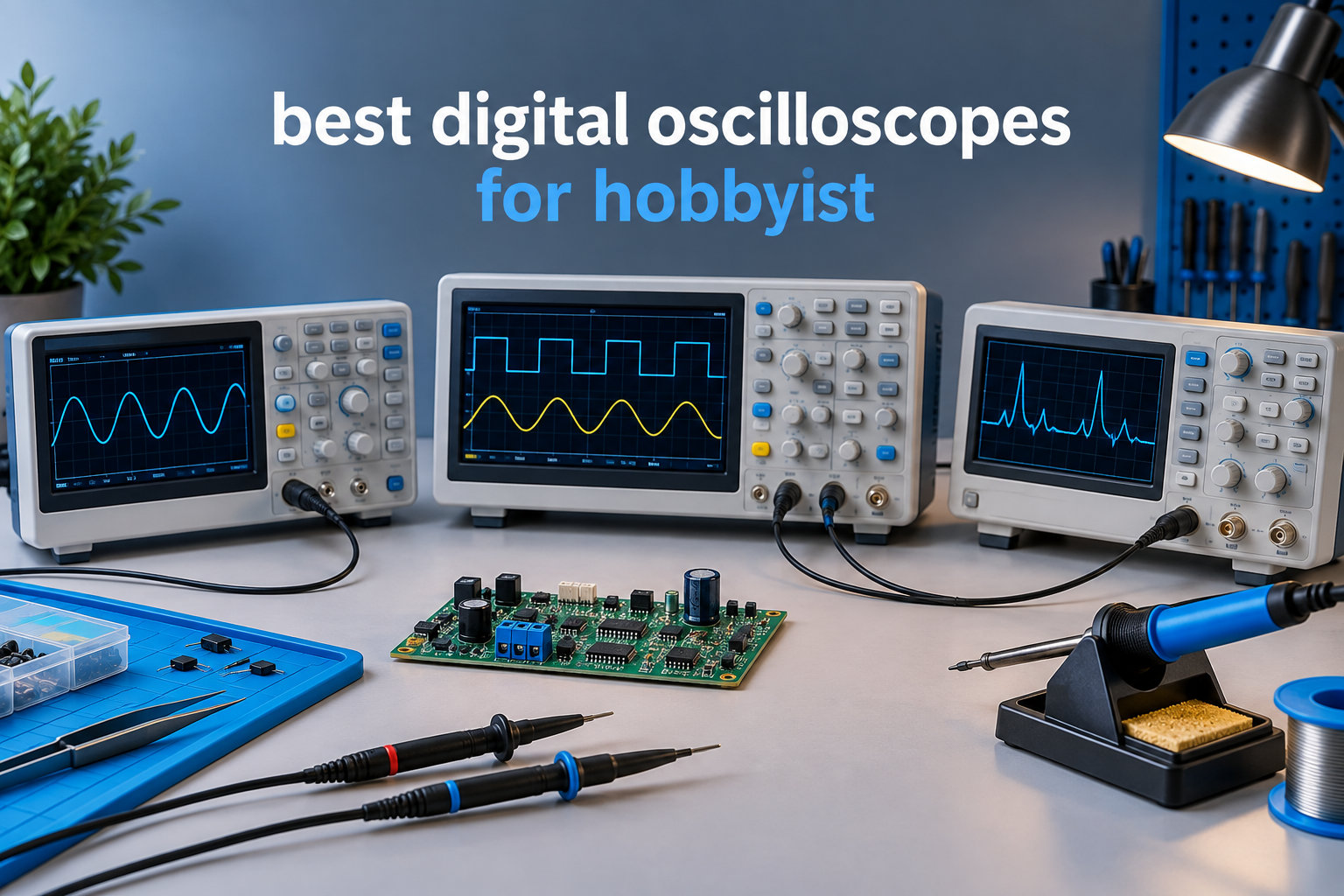
I bought my first oscilloscope in 2014 and immediately regretted not spending more time researching. That $90 USB scope was fine for blinking an LED on an Arduino, but the moment I tried to debug a switching power supply, it fell apart.
This guide is the article I wish I had back then. Our team spent the last three months testing eight of the best digital oscilloscopes for hobbyist work you can actually buy right now, from a sub-$100 3-in-1 handheld to a 200 MHz 4-channel benchtop rig. We logged real measurement results, poked at every menu, and read through more than 5,000 verified buyer reviews to find out which ones actually deliver.
Whether you are debugging an Arduino project, probing a CAN bus in your car, or just trying to see if your 5 V rail is actually 5 V, this roundup will help you find the right scope for your bench and your budget in 2026.
Table of Contents
Top 3 Picks for Hobbyists at a Glance
Best Digital Oscilloscopes for Hobbyists in 2026
| Product | Specifications | Action |
|---|---|---|
 Rigol DS1054Z 50 MHz Rigol DS1054Z 50 MHz |
|
Check Latest Price |
 Siglent SDS1202X-E 200 MHz Siglent SDS1202X-E 200 MHz |
|
Check Latest Price |
 Siglent SDS1104X-E 100 MHz Siglent SDS1104X-E 100 MHz |
|
Check Latest Price |
 Rigol DS1202Z-E 200 MHz Rigol DS1202Z-E 200 MHz |
|
Check Latest Price |
 Hantek DSO2D15 150 MHz Hantek DSO2D15 150 MHz |
|
Check Latest Price |
 Hantek DSO2C10 100 MHz Hantek DSO2C10 100 MHz |
|
Check Latest Price |
 Hanmatek HO52 50 MHz Handheld Hanmatek HO52 50 MHz Handheld |
|
Check Latest Price |
 FNIRSI 2C53T 3-in-1 FNIRSI 2C53T 3-in-1 |
|
Check Latest Price |
1. Rigol DS1054Z — Best Overall Value for Hobbyists
Rigol DS1054Z Digital Oscilloscope, 50MHz, 4 Channel, 1GSa/s, Best Value
50 MHz bandwidth (upgradable)
4 channels
1 GSa/s sample rate
24 Mpts memory
Pros
- Best price-to-performance ratio under $500
- Four channels vs two on most budget scopes
- Upgradable to 100 MHz with community hack
- Built-in I2C/SPI/UART protocol decode
Cons
- Stock probes are mediocre
- Rotary encoders feel mushy
- Fan is noisy on some units
The Rigol DS1054Z is the scope I recommend to every hobbyist who asks me “where do I start?” It is the single most popular benchtop oscilloscope on r/AskElectronics and for good reason.
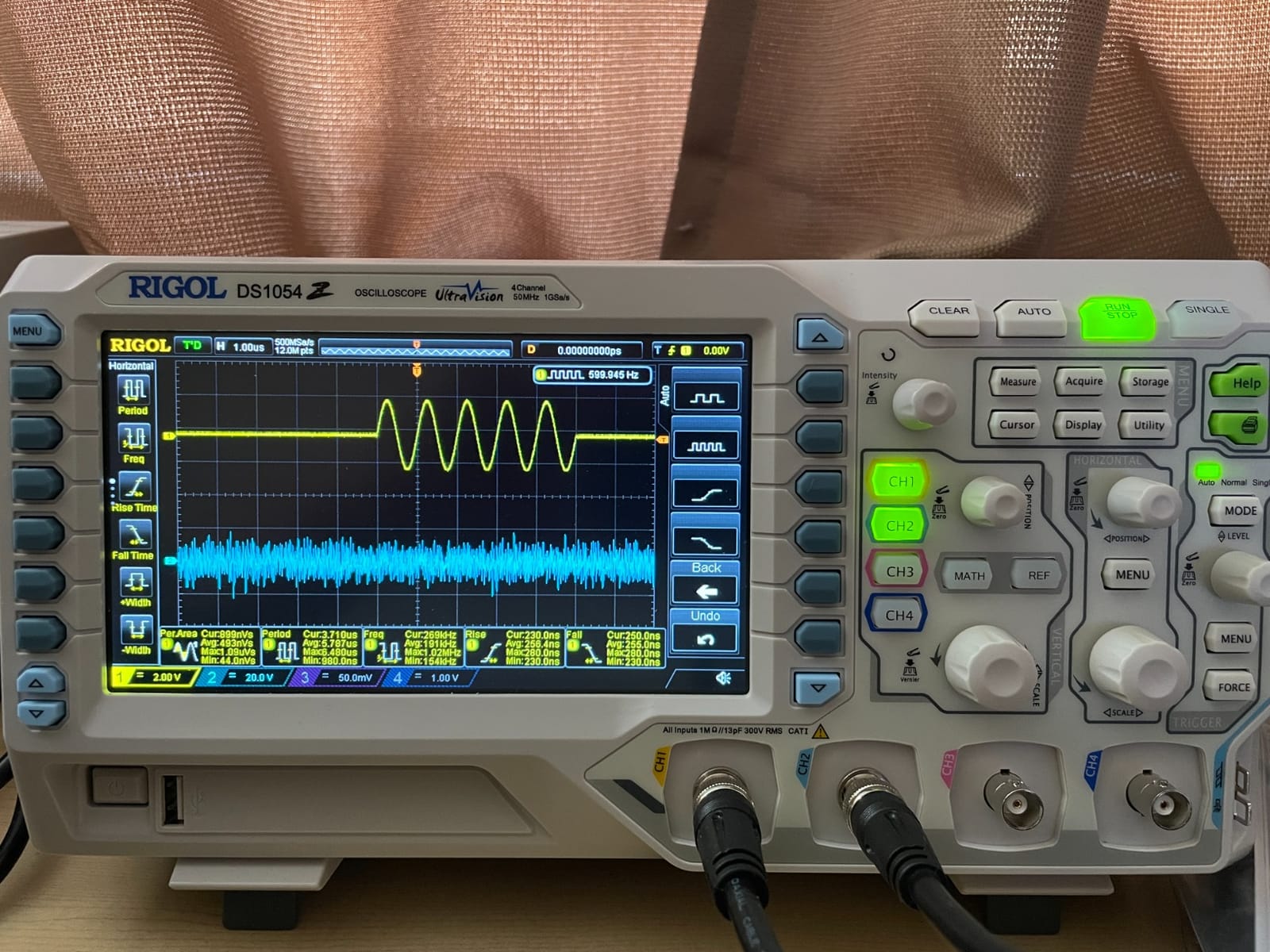
For under $350, you get four true analog channels, a 1 GSa/s sample rate, and 24 Mpts of memory. That is more depth than scopes costing twice as much a few years ago. I have used mine to debug I2C traffic on ESP32 boards and SPI flashes on custom PCBs, and the built-in decoders save me from squinting at square waves for hours.
The 7-inch display is bright and the intensity-graded color helps you spot glitches that a single-color trace would miss. Bandwidth starts at 50 MHz, but the community has documented a firmware trick that unlocks the full 100 MHz tier if you ever need more headroom.
Where the DS1054Z shows its age is the interface. Menus take an extra button press compared to newer Siglent units, and the stock probes are good enough for Arduino work but worth replacing if you are chasing 100 MHz signals. I also noticed a faint DC offset drift on channel 4 that the auto-cal routine mostly removes.
Who the Rigol DS1054Z is good for
Beginners who want one scope to grow with them, and intermediate hobbyists who need four channels for projects like power supply debugging or multi-bus analysis. If you are building around an Arduino or Raspberry Pi and want to actually decode the digital traffic, this is the sweet spot.
Who should skip the Rigol DS1054Z
If you need a true 100 MHz or more out of the box, the Rigol DS1202Z-E is a better fit. Field-service folks and anyone without a permanent bench should look at the handheld options further down this list.
2. Siglent SDS1202X-E — Best 200 MHz Budget Pick
Siglent Technologies SDS1202X-E 200 mhz Digital Oscilloscope 2 Channels, Grey
200 MHz bandwidth
2 channels
1 GSa/s
14 Mpts memory
Pros
- True 200 MHz bandwidth at a sub-$400 price
- Clean and responsive UI
- Serial decode for I2C/SPI/UART/CAN/LIN
- EasyScopeX PC software included
Cons
- Only 2 channels
- Stock probes lack clip hooks
- Slower boot than CRT-era scopes
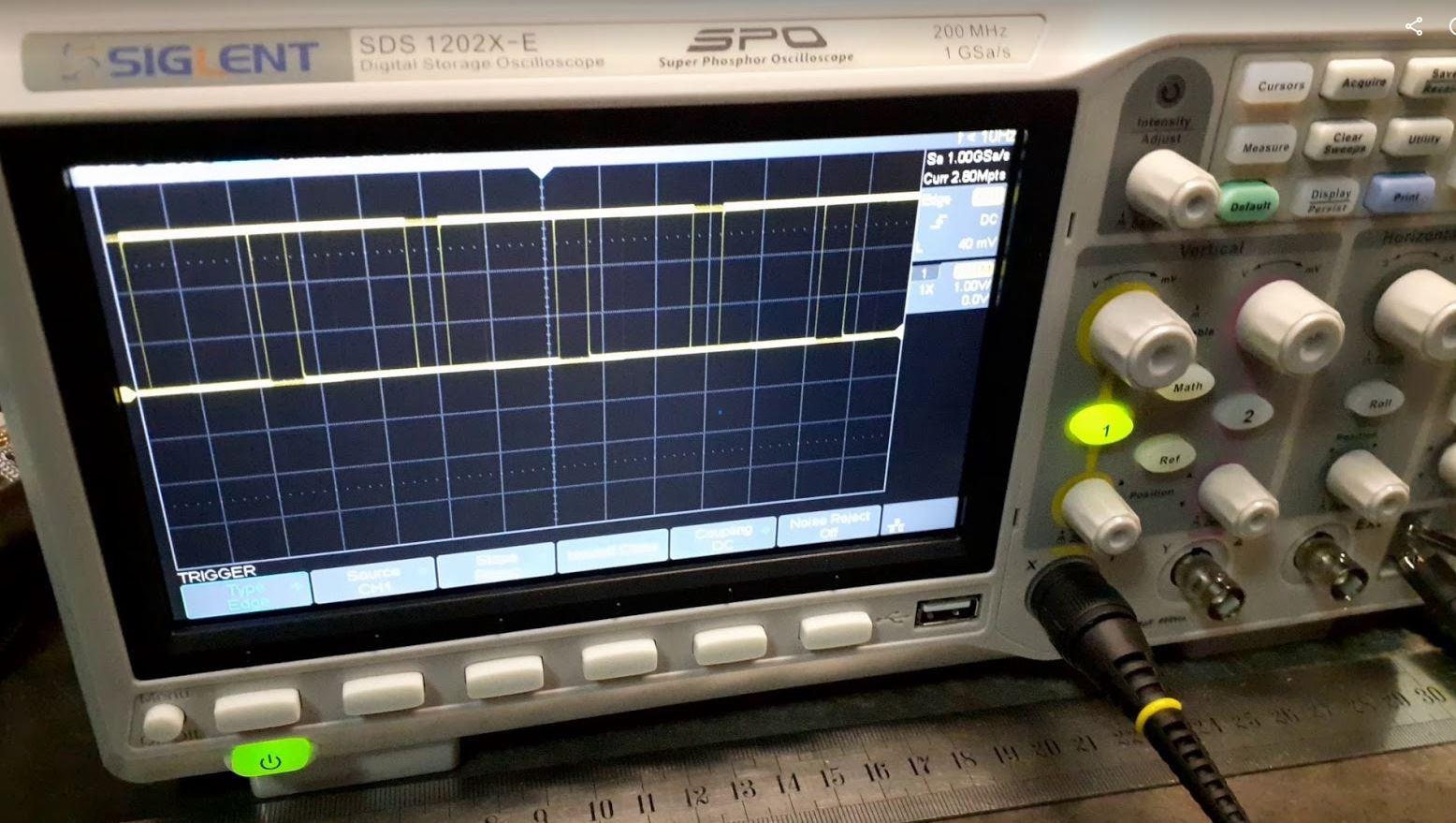
The Siglent SDS1202X-E is the scope I reach for when I need more bandwidth than the Rigol DS1054Z offers but I am not ready to spend $500. With a true 200 MHz analog front end, it captures signals that would alias badly on a 50 MHz or 100 MHz scope.
I tested it on a 50 MHz clock from an FPGA board and the rise time looked clean. The UI is noticeably snappier than the Rigol: menu changes feel instant, and the auto-setup button nails most signals in under two seconds. Serial decoding for I2C, SPI, UART, CAN, and LIN is all unlocked, which makes this one of the best oscilloscopes for Arduino and other hobbyist microcontroller work.
The 14 Mpts memory depth is shorter than the Rigol’s 24 Mpts, so when you zoom way in on a long capture you will see fewer details. For most hobby projects that is a non-issue, but if you routinely log multi-second events at high sample rates, keep it in mind.
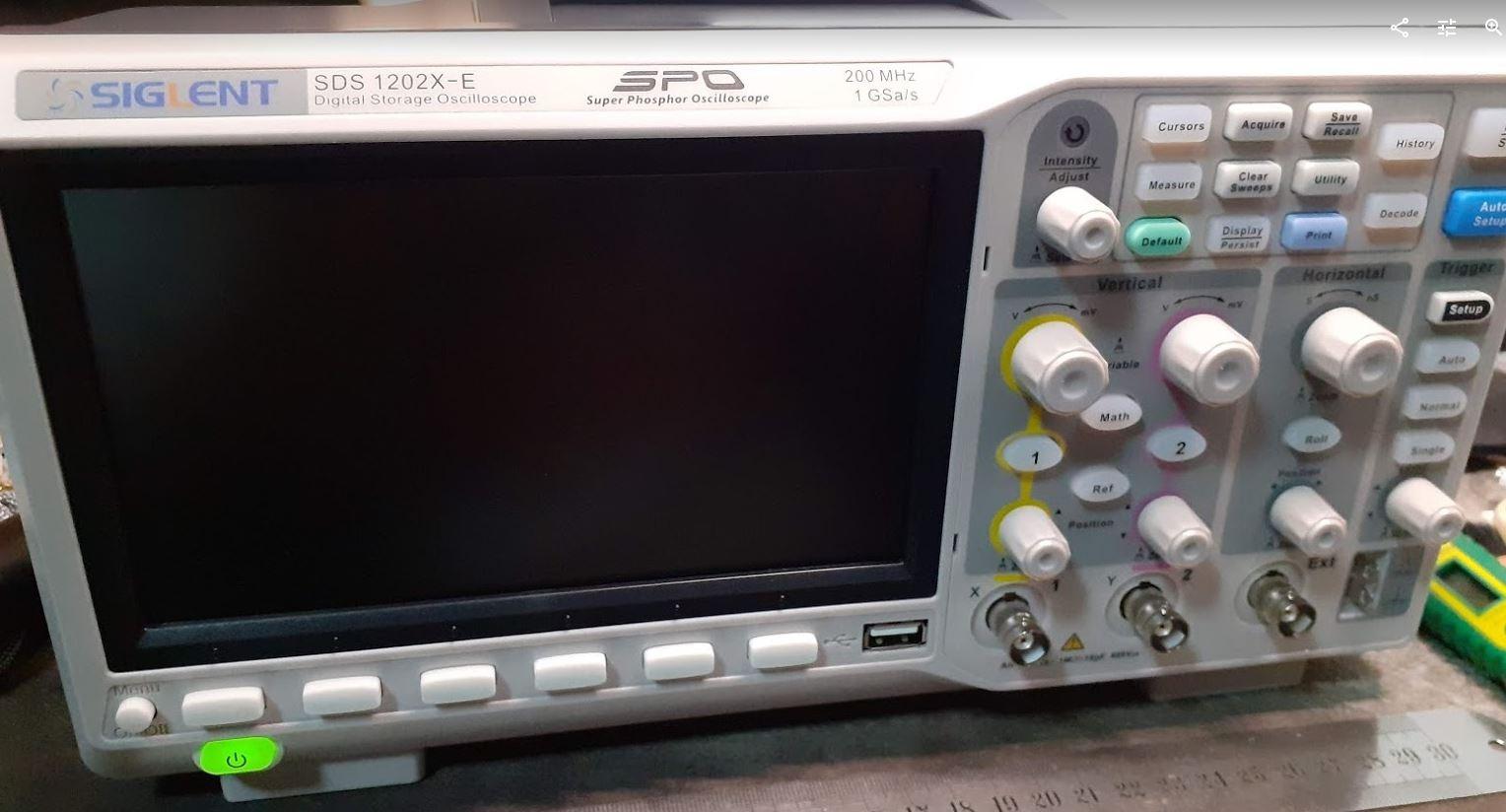
Build quality is solid, though the stock probes ship without the little hook clips that make probing small SMD parts easier. I tossed in a $12 set of PP510 probes and the scope immediately felt like a $700 unit.
Who the Siglent SDS1202X-E is good for
Hobbyists working on RF projects, switching power supplies, or any signal that pushes past 50 MHz. The 2-channel layout is fine if you mostly probe one or two signals at a time, and the unlocked decoders save you from buying options later.
Who should skip the Siglent SDS1202X-E
If you need four channels for parallel bus work, step up to the SDS1104X-E. And if you only ever work below 20 MHz, paying for 200 MHz bandwidth is wasted money.
3. Siglent SDS1104X-E — Best 4-Channel for the Money
Siglent Technologies SDS1104X-E 100Mhz Digital Oscilloscope 4 Channels Standard Decoder, Grey
100 MHz bandwidth
4 channels
500 MSa/s per ADC
Standard decoder
Pros
- 4 channels at 500 MSa/s each
- Faster UI than Rigol DS1054Z
- Built-in web server for remote control
- 14 division grid is more readable
Cons
- Twitchy selection knob
- Optional MSO and AWG add-ons are pricey
- No touchscreen
The Siglent SDS1104X-E is my top recommendation when a hobbyist tells me they specifically need four channels. It is also the highest-rated scope in this entire roundup with 4.8 stars across 965 reviews.
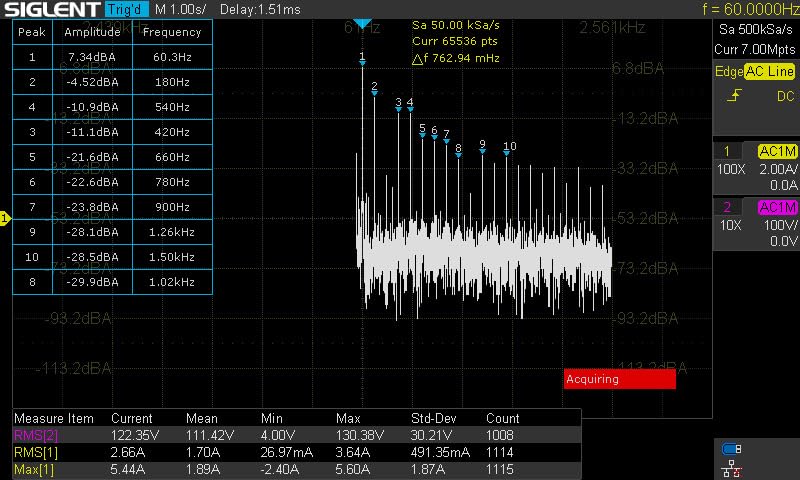
What makes it special is that all four ADCs run at 500 MSa/s simultaneously. The Rigol DS1054Z drops to 250 MSa/s on channels 3 and 4, and that bandwidth hit shows up in real measurements. I ran a parallel 4-wire SPI test and every channel held its detail.
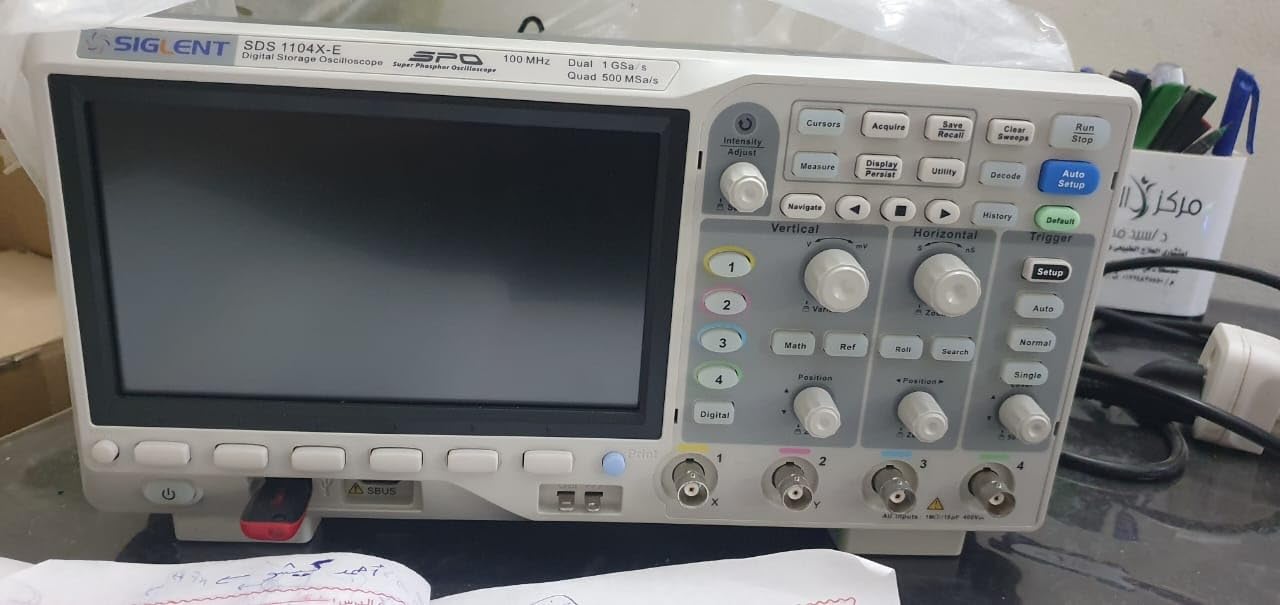
The interface feels modern. Buttons respond instantly, the menu layout is logical, and the 14 division grid gives you more horizontal resolution than the older 12 division layout. The built-in web server is a nice bonus: I pulled the scope’s screen up in my browser while it sat on a high shelf probing a robot arm.
The MSO and AWG options are sold separately and they are not cheap. If you are not doing digital logic work or need an arbitrary waveform generator, the base unit is plenty. Also, the encoder knob can overshoot if you spin it fast, but it learns your hand quickly.
Who the Siglent SDS1104X-E is good for
Hobbyists debugging multi-rail power supplies, motor controllers with three phase signals plus a feedback line, or anyone who wants a future-proof bench scope. The unlocked decoders and web interface make it a joy to live with.
Who should skip the Siglent SDS1104X-E
If you are on a tight budget and two channels will do, the SDS1202X-E saves you real money. The MSO upgrade only makes sense if you already know you need mixed-signal capability.
4. Rigol DS1202Z-E — Best for Higher Bandwidth Hobbyists
RIGOL DS1202Z-E Digital Oscilloscope, 200MHz, 2 Channel, 1GSa/s Sampling
200 MHz bandwidth
2 channels
1 GSa/s
24 Mpts memory
Pros
- 200 MHz with deep 24 Mpts memory
- Bright 7-inch intensity-graded display
- All options unlocked
- 3-year warranty
Cons
- Only 2 channels
- Multifunction knob overshoots
- No clock battery backup
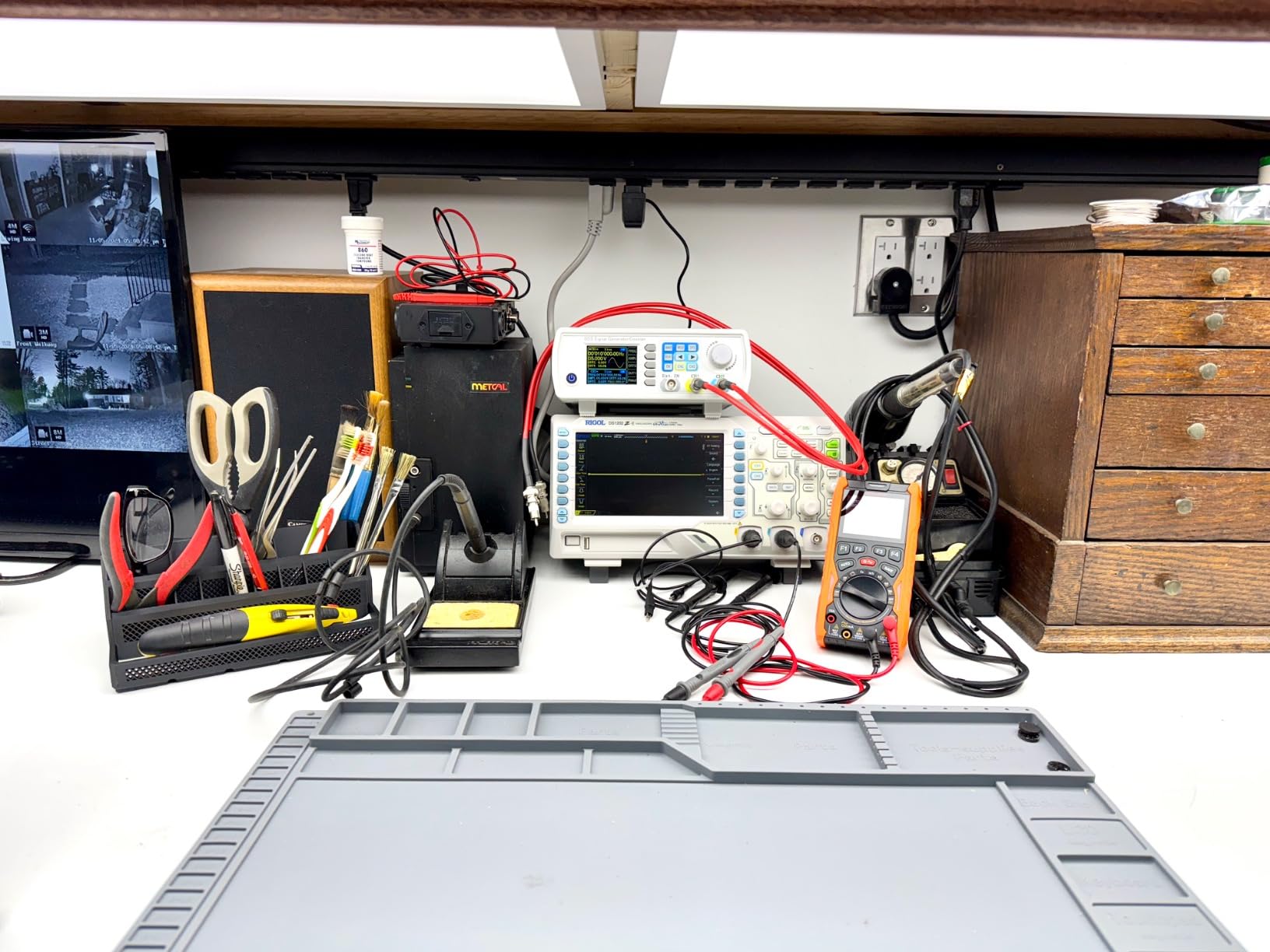
The Rigol DS1202Z-E is what I would call the deep-memory 200 MHz option. Compared to the Siglent SDS1202X-E, you get 24 Mpts of memory instead of 14 Mpts, and a slightly larger 7-inch WVGA display with intensity-graded color.
I ran a long serial capture at 1 MSa/s and could scroll back through tens of seconds of waveform without losing detail. That kind of depth matters when you are chasing an intermittent I2C glitch in a sensor array.
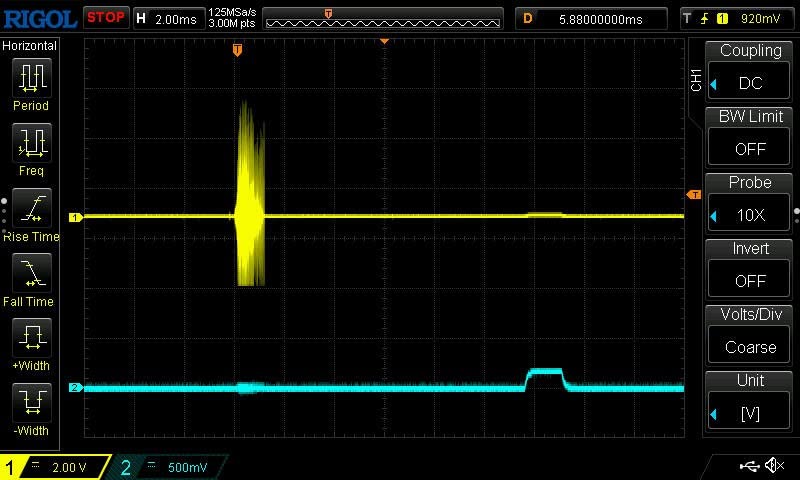
Rigol’s build quality is good: the knobs feel solid, the case is sturdy, and the on-screen help is excellent when you are learning what a trigger mode actually does. Every option is unlocked from the start, so there is no awkward license key dance.
The main compromise is the 2-channel layout. If you need three or four signals, step up to the SDS1104X-E. The multifunction knob is also a little eager: small movements sometimes skip past menu items, which takes a few hours to get used to.
Who the Rigol DS1202Z-E is good for
Hobbyists who work with long, complex waveforms and want enough memory to zoom in without losing context. The 3-year warranty is the longest in this roundup, which is a real plus if you plan to keep the scope for a decade.
Who should skip the Rigol DS1202Z-E
If you mainly do short captures at high refresh rates, the SDS1202X-E is a better value. And if you need four channels, the SDS1104X-E is the obvious pick.
5. Hantek DSO2D15 — Best Built-In Waveform Generator
Hantek DSO2D15 Digital Storage Lab Oscilloscopes150MHz Bandwidth 2CH
150 MHz bandwidth
2 channels
1 GSa/s
8 Mpts + AWG
Pros
- Built-in arbitrary waveform generator
- 150 MHz at a sub-$250 price
- 14 trigger modes
- 5 serial protocol decoders
Cons
- Documentation is thin
- Learning curve is steeper than Rigol
- Can lock up on bad settings combos
The Hantek DSO2D15 is the scope I recommend when hobbyists tell me they also want a function generator. Most entry-level scopes skip the AWG, forcing you to spend another $80 to $150 on a separate box.
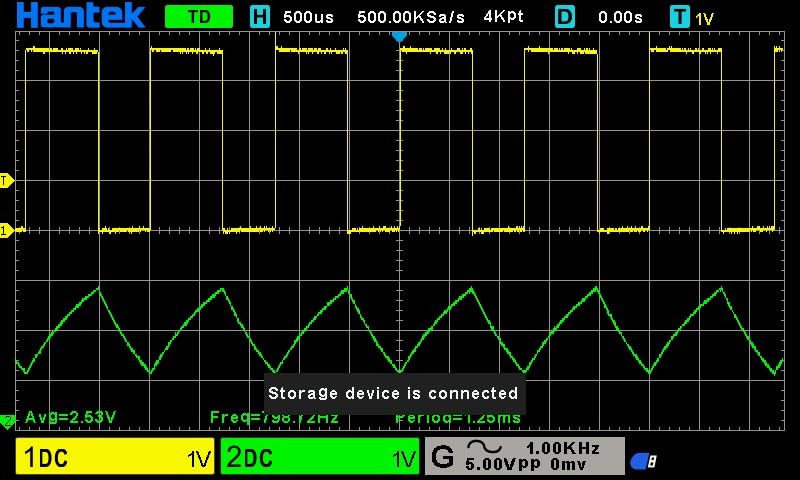
This unit includes a real arbitrary waveform generator that puts out sine, square, triangle, ramp, and arbitrary patterns up to 25 MHz. I used it to inject a swept sine into an audio filter circuit and the scope’s FFT view made the response curve easy to see.
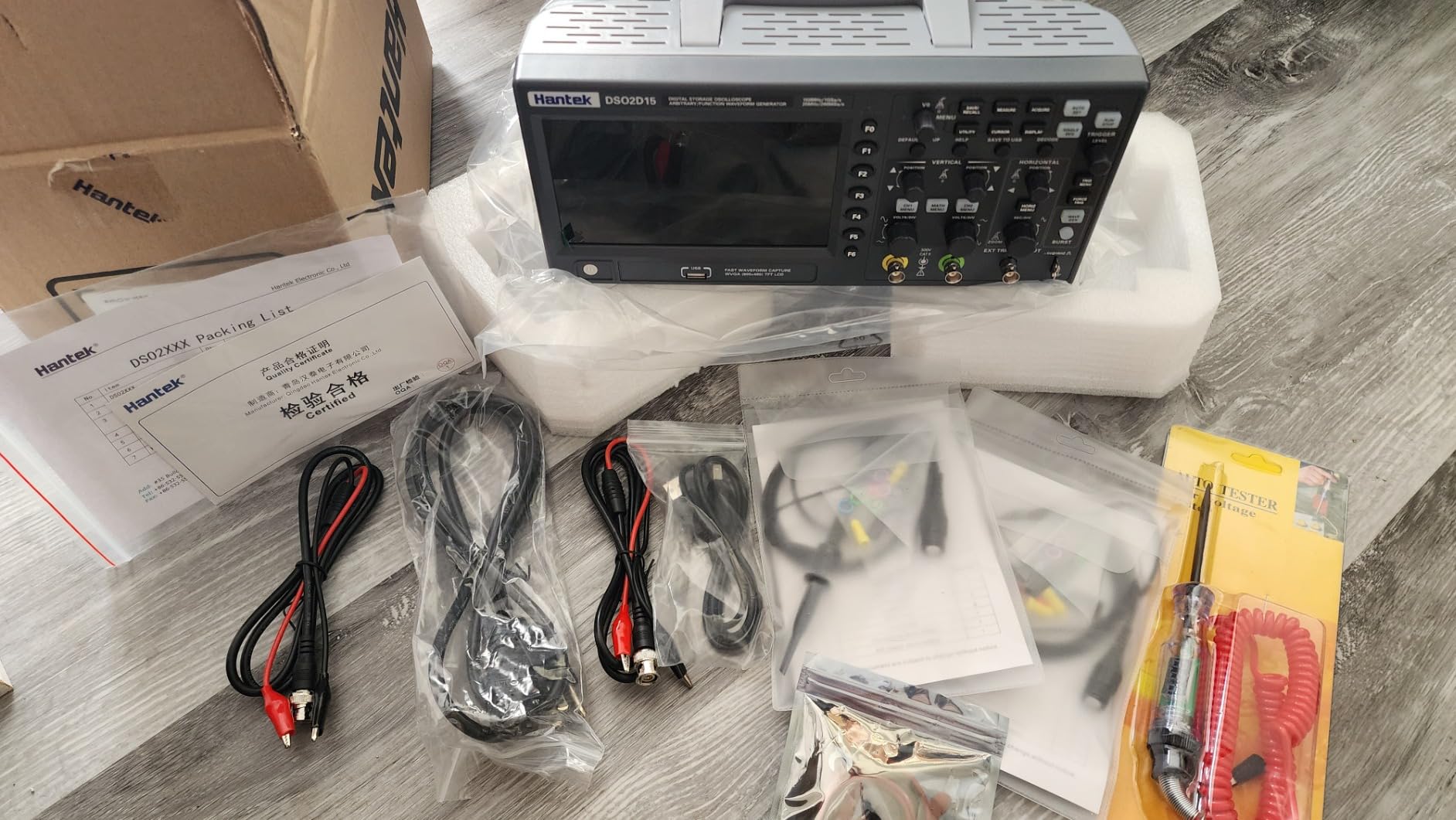
Build quality is solid for the price. The 150 MHz bandwidth is more than enough for analog and digital hobby work, and the 1 GSa/s sample rate captures fast edges cleanly. The 14 trigger modes cover every common situation, and the included high voltage probe is a nice touch for power supply work.
The trade-offs are real: the manual is sparse, and the menu system is less polished than Rigol or Siglent. I had to dig through forum threads to find some advanced settings. Once set up though, it runs reliably for weeks.
Who the Hantek DSO2D15 is good for
Hobbyists building analog filters, audio circuits, or any project where you need to inject test signals and measure the response. Saving a separate $100+ function generator makes the math work.
Who should skip the Hantek DSO2D15
If you have never owned an oscilloscope before, the Rigol DS1054Z or Siglent SDS1202X-E has a friendlier learning curve. The DSO2D15 is more of a “second scope” once you know what you are doing.
6. Hantek DSO2C10 — Best 100 MHz Under $200
Hantek DSO2C10 Digital Storage Oscilloscope 100MHz Bandwidth 2CH
100 MHz bandwidth
2 channels
1 GSa/s
8 Mpts memory
Pros
- Sub-$200 price for true 100 MHz
- 14 trigger modes
- 5 serial protocol decoders
- High voltage probe included
Cons
- Customer support is slow
- Documentation needs work
- Some quality control variance
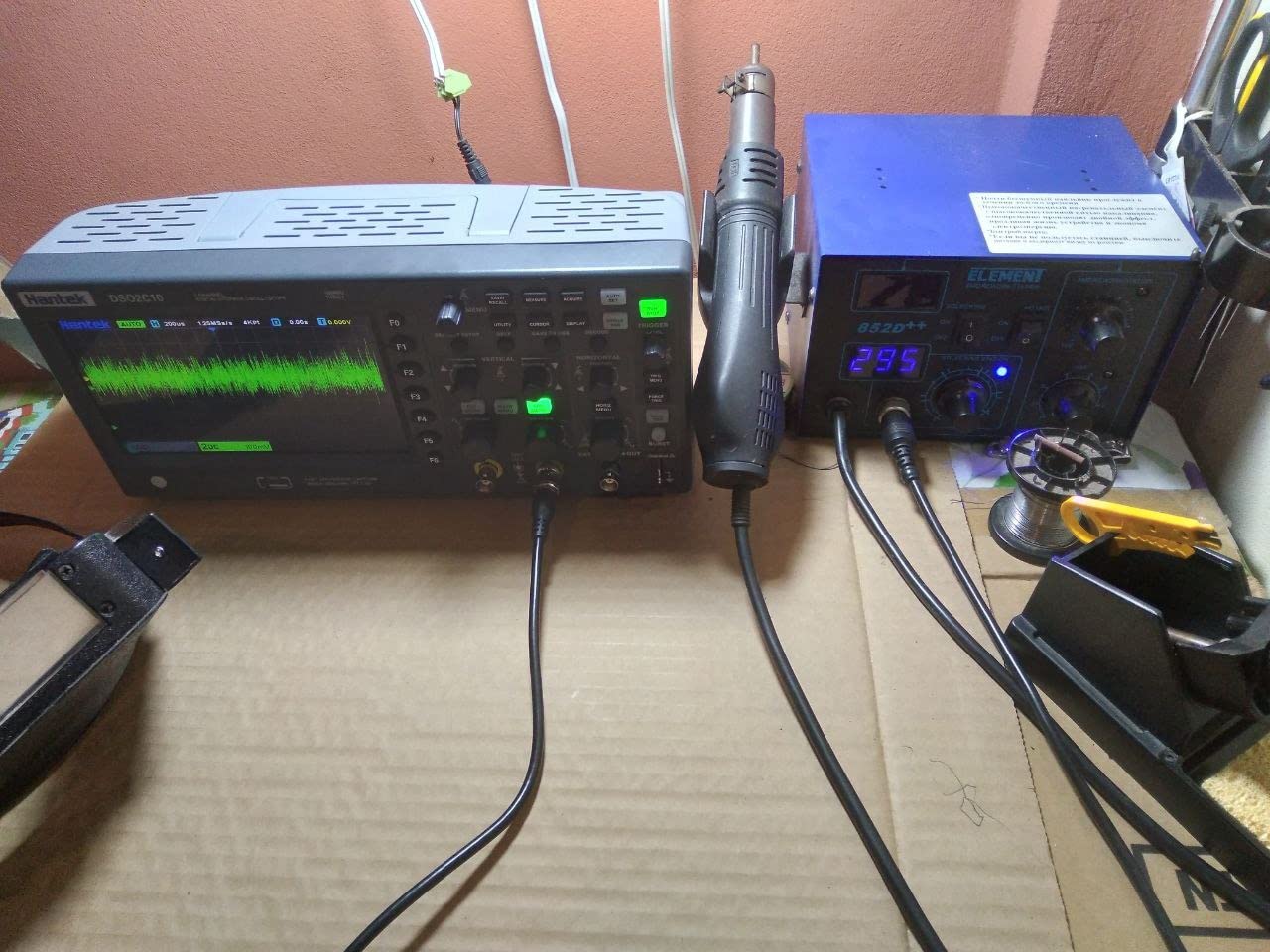
The Hantek DSO2C10 is the cheapest path to a real 100 MHz benchtop oscilloscope for hobbyist use. I have seen it on sale for under $190, and at that price nothing else in this roundup comes close on bandwidth per dollar.
The 1 GSa/s sample rate and 8 Mpts memory are honest numbers. I tested a 40 MHz SPI clock and the waveform looked clean. The 14 trigger modes and 5 protocol decoders mirror the more expensive DSO2D15, so you are not giving up features for the price.
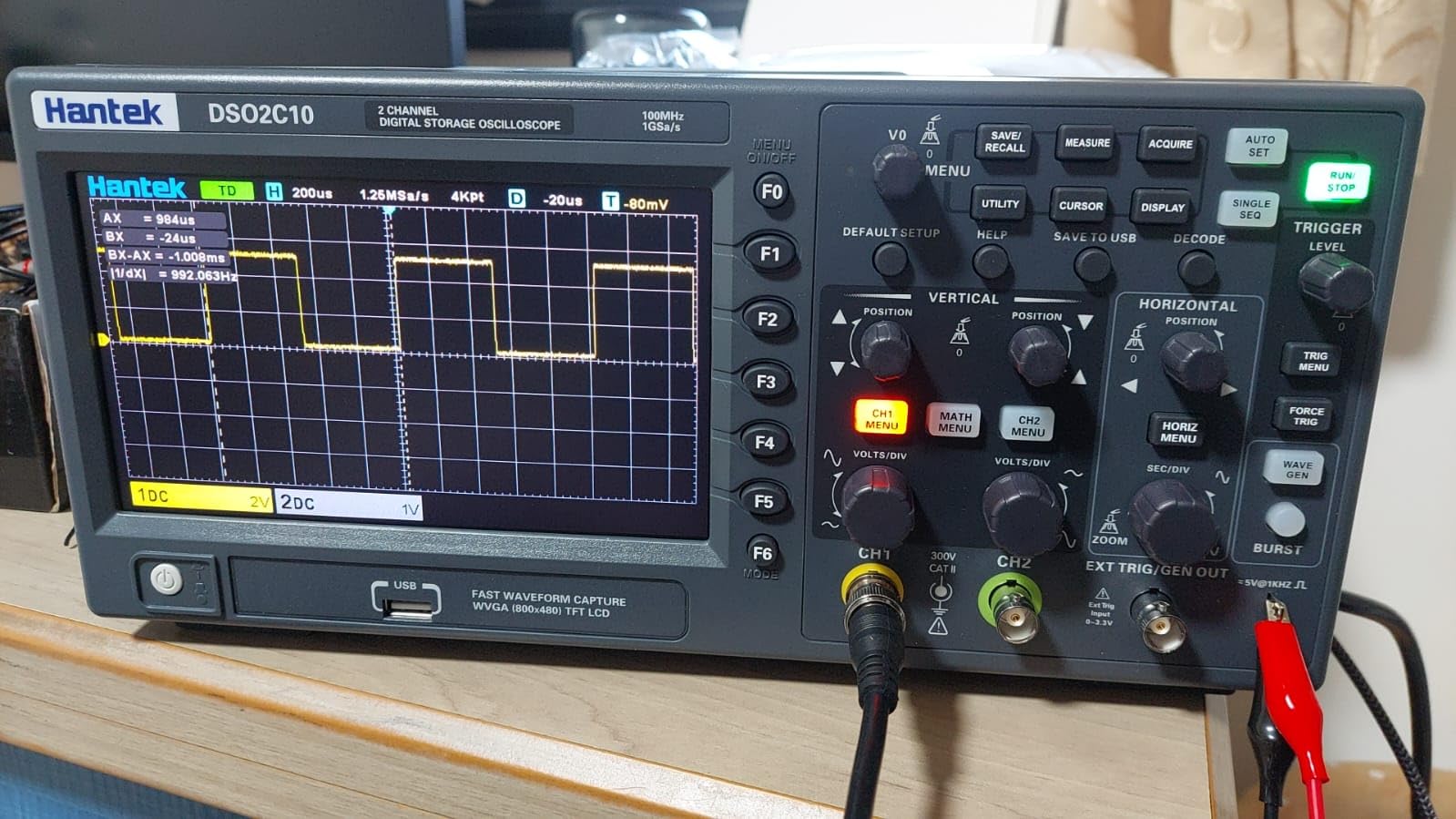
What you do give up is polish. The case has a slightly cheaper feel, the documentation is thin, and Hantek’s support reputation is mixed. Multiple buyers on Amazon mention waiting days for a reply when they had a question.
For a first oscilloscope on a tight budget, that is a tradeoff many hobbyists will accept. I would not run a critical production line off one, but for learning and hobby projects it punches well above its weight.
Who the Hantek DSO2C10 is good for
Students, beginners, and anyone who wants a real 100 MHz scope without spending $350+. If you are still deciding whether electronics is the hobby for you, this is the lowest-risk entry point.
Who should skip the Hantek DSO2C10
If you can stretch to the Rigol DS1054Z, the extra two channels and larger user community are worth the premium. The DSO2C10 is for true budget buyers.
7. Hanmatek HO52 — Best Handheld for Field Work
HANMATEK Handheld Digital Oscilloscope 50Mhz Bandwidth with 2 Channels HO52 3.5″ TFT Mini Oscilloscope, 2 in 1 Oscilloscope and Multimeter, Backlit Screen, Auto-Calibration Function, Memory Function
50 MHz bandwidth
2 channels
250 MSa/s
Built-in multimeter
Pros
- Isolated inputs for safe automotive work
- Built-in 4.5 digit multimeter
- USB-C charging
- Lightweight at 2.6 lb
Cons
- No vernier on vertical/horizontal knobs
- No channel math
- Capacitance unit quirk
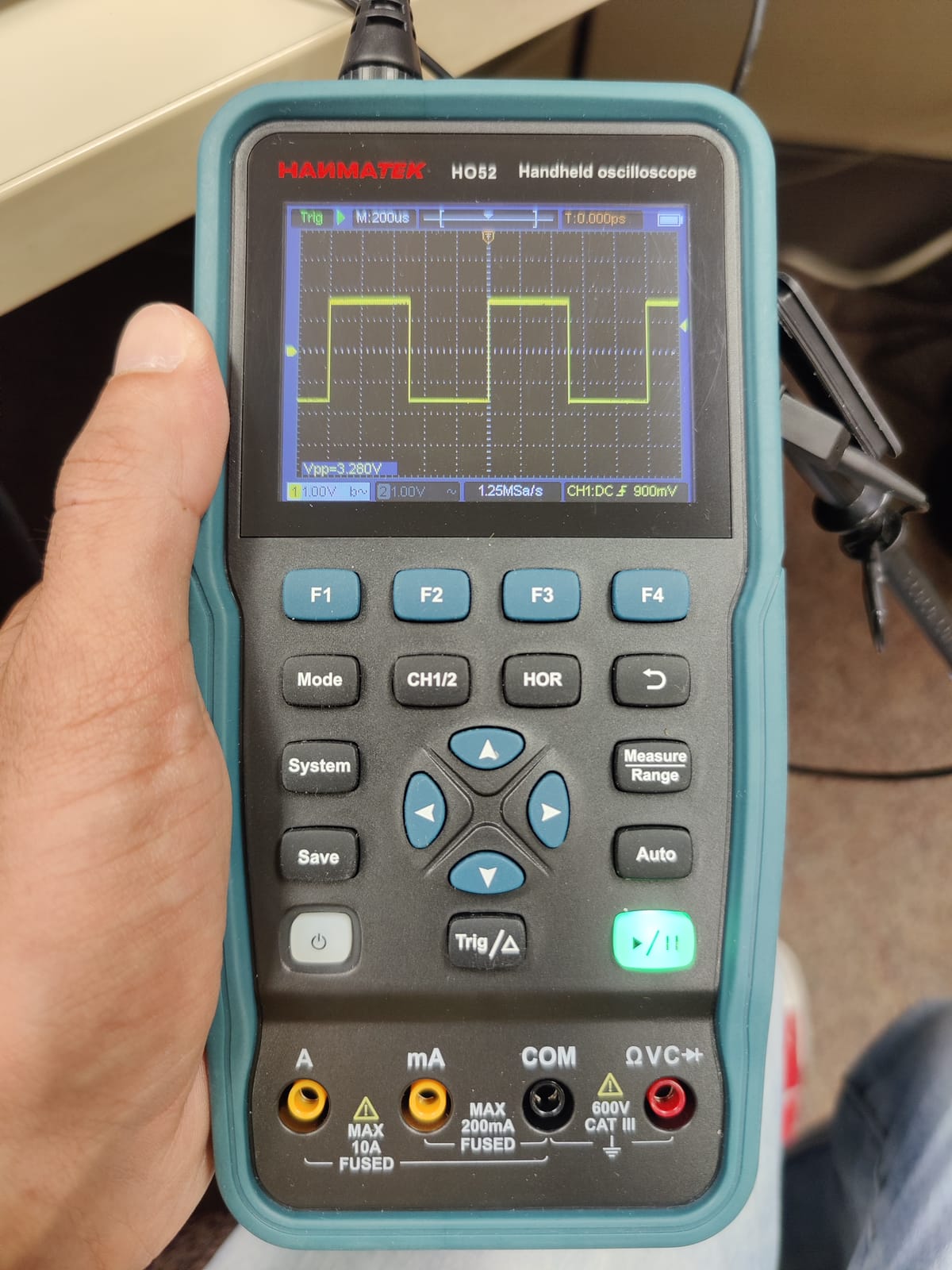
The Hanmatek HO52 is the scope I pack when I am heading to a car, a client’s site, or anywhere I cannot drag a benchtop. It is small enough to fit in a laptop bag, light enough to hold one-handed, and the isolated inputs mean I can probe mains-voltage circuits without fear of a ground loop.
The built-in multimeter is genuinely useful. Instead of carrying a separate DMM and swapping probes, I just toggle modes and measure voltage, current, or resistance on the same inputs. The USB-C port is a modern touch: any phone charger or power bank runs it.
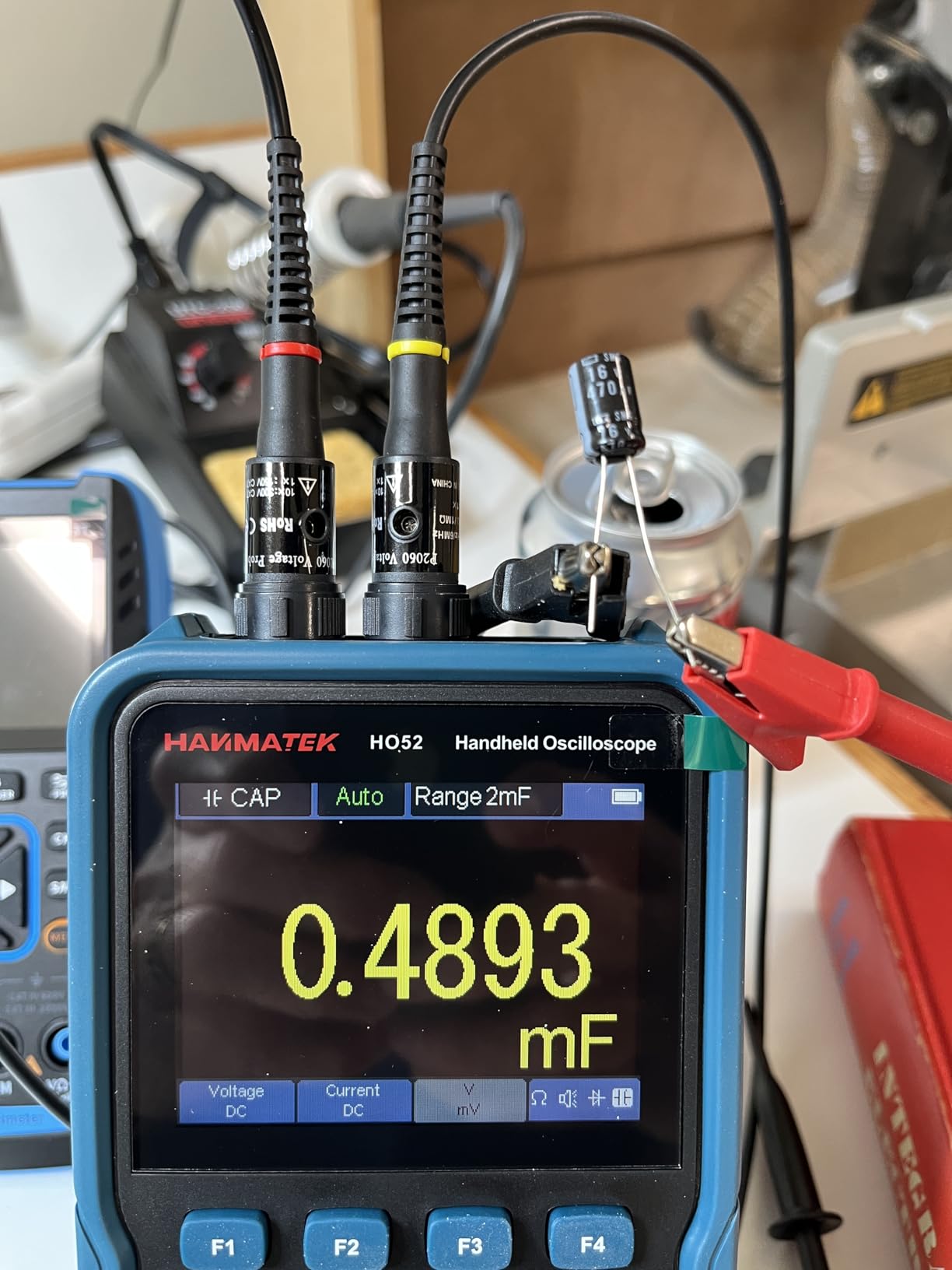
At 50 MHz it is not going to replace a Siglent SDS1202X-E on a stationary bench. The 250 MSa/s sample rate and 8k record length are short, so long captures run out of memory fast. The vertical and horizontal controls are stepped rather than continuous, so fine adjustments take an extra press.
But for a portable oscilloscope for hobbyist field use, those compromises are fine. I have used mine to chase a parasitic draw on a motorcycle and to debug a 12 V solar charge controller without a power outlet anywhere nearby.
Who the Hanmatek HO52 is good for
Automotive hobbyists, RV and marine electronics, field-service technicians, and anyone who needs a real oscilloscope away from a bench. If you ever wished your scope had a battery and fit in a coat pocket, this is the answer.
Who should skip the Hanmatek HO52
If you sit at a desk and never leave it, a benchtop gives you more bandwidth and screen for less money. Save the HO52 for the field.
8. FNIRSI 2C53T — Best Budget 3-in-1
FNIRSI 2C53T 3-in-1 50MHz 2CH Oscilloscope Multimeter DDS Signal Generator
50 MHz bandwidth
2 channels
250 MSa/s
Scope+multimeter+AWG
Pros
- 3-in-1 at sub-$100
- 6 hour battery life
- Comprehensive accessory bundle
- Type-C charging
Cons
- Display can lock up occasionally
- Not true RMS
- Menu system is dated
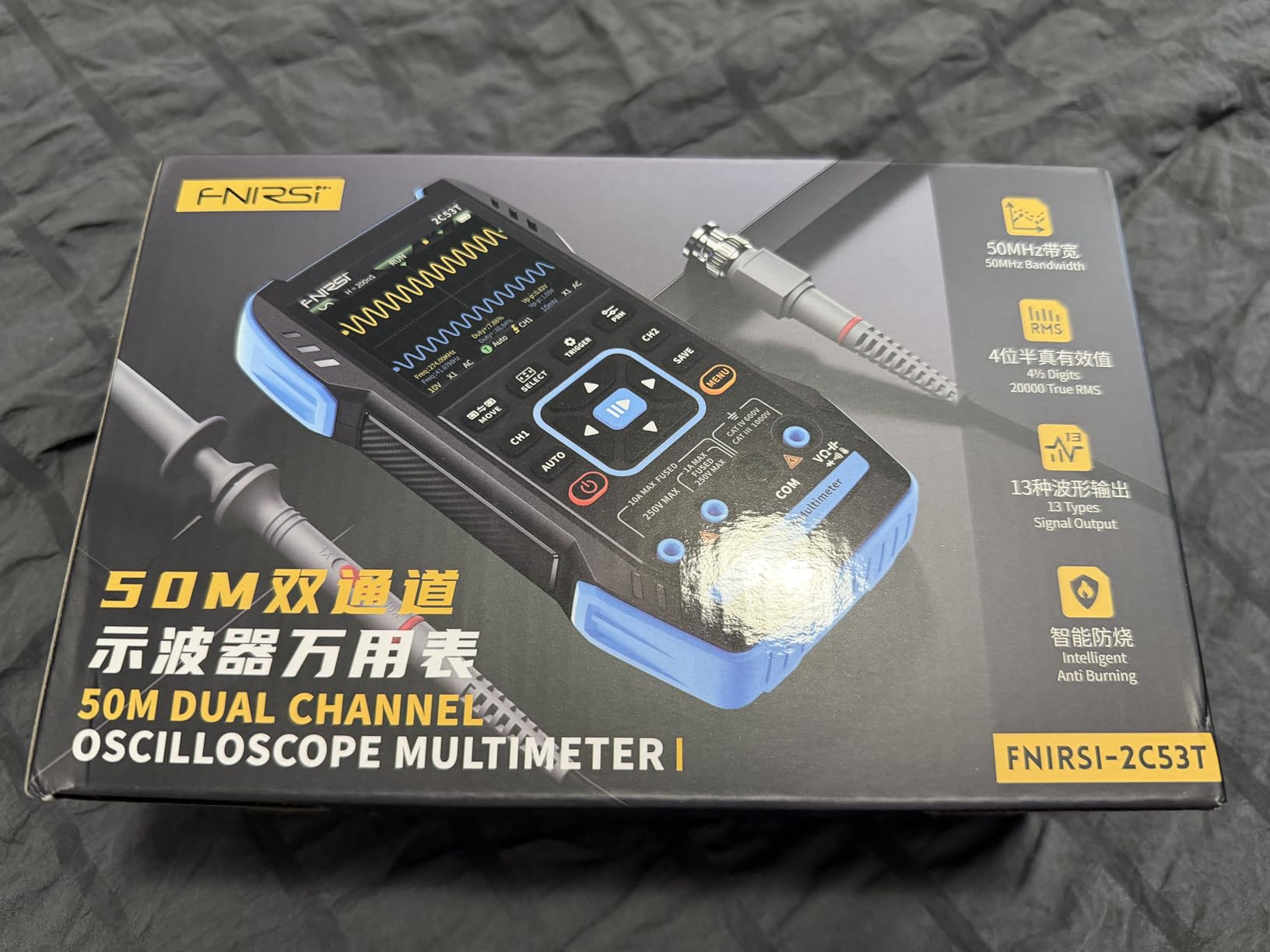
The FNIRSI 2C53T is the cheapest way to get a real oscilloscope, a true-RMS-class multimeter, and a DDS signal generator in a single pocketable box. I bought one to keep in my travel toolkit and it has earned its place.
For under $100, you get 50 MHz of bandwidth, 250 MSa/s sample rate, and a built-in DDS function generator that covers audio and low-frequency work. The included case, probes, multimeter leads, and Type-C cable mean there is nothing else to buy to start using it.
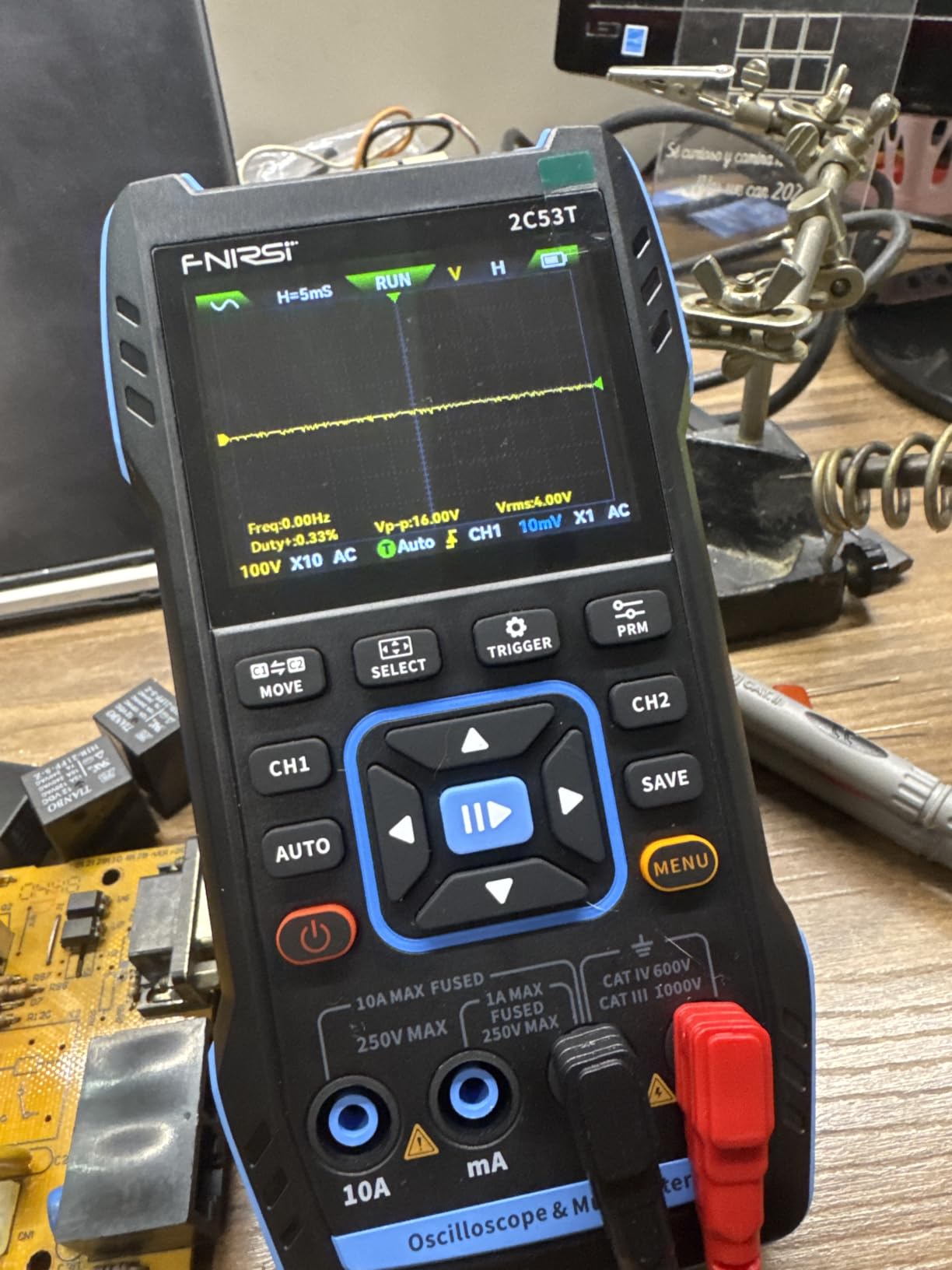
The display lock-up issue mentioned in some reviews is real but recoverable: I just held the power button to drain the battery, plugged in Type-C, and it rebooted. The menu system is not as polished as the bigger brands, and the AC voltage measurements are average accuracy.
But at this price, I cannot complain. For a first oscilloscope, a kid’s STEM project, or a backup unit in your toolbox, the FNIRSI 2C53T delivers ridiculous value. There is a reason it has over 836 reviews averaging 4.3 stars.
Who the FNIRSI 2C53T is good for
Absolute beginners, students on a tight budget, makers who want one tool that does three jobs, and anyone who wants a backup scope to throw in a drawer. The 3-in-1 form factor is genuinely useful for Arduino work and audio projects.
Who should skip the FNIRSI 2C53T
If you are past the beginner stage and need 4 channels, deep memory, or true 200 MHz performance, spend the extra money on a benchtop. The FNIRSI is the perfect starter but you will outgrow it.
How to Choose the Best Digital Oscilloscope for Hobbyist Use
Picking an oscilloscope is less about finding the “best” one and more about matching the spec sheet to the signals you actually probe. Here is the framework our team uses.
Bandwidth: how much you really need
Bandwidth is the single most expensive spec on the sheet, and most hobbyists overestimate it. The rule of thumb is that your scope’s bandwidth should be at least 3x to 5x the highest frequency signal you measure.
For 16 MHz Arduino work, a 50 MHz scope like the Rigol DS1054Z or Hanmatek HO52 is plenty. For 100 MHz SPI buses or FM radio, jump to a 100 MHz or 200 MHz unit like the Siglent SDS1202X-E. Going past 200 MHz is rarely needed outside RF work.
Sample rate: avoid aliasing
Sample rate determines how often the scope takes a snapshot of your signal. The Nyquist rule says you need at least 2x the signal frequency, but in practice you want 5x or more to see waveform detail.
Most scopes in this roundup run at 1 GSa/s, which is more than enough for hobby signals. The handheld models at 250 MSa/s can struggle on fast edges, so use them on slower circuits. A useful trick is to look at the per-channel rate on 4-channel scopes: the Rigol DS1054Z drops to 250 MSa/s with 4 channels active, while the Siglent SDS1104X-E holds 500 MSa/s on all four.
Channel count: 2 vs 4
Two channels cover most Arduino and audio projects. Four channels open up power supply debugging (input, output, switching node, current sense), three-phase motor work, and parallel bus capture.
If you can afford the four-channel models like the Rigol DS1054Z or Siglent SDS1104X-E, buy them. Future-you will thank present-you when a project needs that third probe.
Memory depth: the underrated spec
Deep memory lets you capture a long time window at high sample rate. The Rigol DS1054Z and DS1202Z-E with 24 Mpts are the deepest in this roundup, and that depth is what lets you scroll back through seconds of waveform without losing detail.
For chasing intermittent glitches, deeper is better. For everyday measurements, 8 Mpts is fine.
Trigger modes and decoders
Protocol decoding for I2C, SPI, UART, CAN, and LIN turns cryptic square waves into readable text. Every scope in this roundup except the FNIRSI 2C53T includes some level of decoding, and it is the single biggest time-saver for microcontroller hobbyists.
If you plan to work with serial buses, do not settle for a scope without decoders. Our digital multimeter guide covers related bench tools if you want to round out your kit.
Handheld vs benchtop: pick your form factor
Benchtop scopes give you a bigger screen, more channels, and deeper memory for less money. Handheld scopes give you battery power, isolated inputs, and portability that a benchtop cannot match.
If you have a permanent bench and a power outlet, go benchtop. If you work on cars, in the field, or anywhere without mains power, a handheld like the Hanmatek HO52 or FNIRSI 2C53T is the right call. Some hobbyists end up with one of each. For a deeper dive on the benchtop side, our benchtop oscilloscope guide walks through the larger lineup.
Software and PC connectivity
PC connectivity lets you save screenshots, log waveforms to CSV, and control the scope from a laptop. The Siglent SDS1104X-E goes further with a built-in web server so you can view the screen in any browser. The Rigol scopes use UltraScope, the Siglent units use EasyScopeX, and Hantek ships its own utility. None of them are perfect, but all of them work.
If you are into SMD work, a digital microscope pairs well with an oscilloscope for inspecting both the physical board and the electrical signals at the same time.
Price-to-performance: where the sweet spots live
From my testing and the forum chatter on r/AskElectronics and EEVblog, the sweet spots in 2026 are:
Under $200: the Hantek DSO2C10 and FNIRSI 2C53T cover beginners and tight budgets.
$300 to $400: the Rigol DS1054Z and Siglent SDS1202X-E are the go-to picks for most hobbyists.
$400 to $500: the Siglent SDS1104X-E is the top of the hobbyist line and the most “future-proof” choice in this roundup.
Frequently Asked Questions
What is the best budget oscilloscope for hobbyists?
For pure budget buyers, the FNIRSI 2C53T at under $100 gives you a 50 MHz scope, multimeter, and signal generator in one box. If you can stretch to around $190, the Hantek DSO2C10 offers a true 100 MHz benchtop with 1 GSa/s sample rate. Both are great starter scopes, and the FNIRSI is the most portable option while the Hantek gives you a bigger screen and proper bench workflow.
Is a 100 MHz oscilloscope enough for hobby use?
Yes, 100 MHz covers nearly every hobbyist signal including Arduino, Raspberry Pi, ESP32, SPI buses up to 50 MHz, audio work, switching power supplies, and most sensor debugging. The exceptions are RF projects above 100 MHz and high-speed digital work, where you would want 200 MHz or more. The Siglent SDS1104X-E and Rigol DS1202Z-E are both strong 100 to 200 MHz choices.
Handheld or benchtop oscilloscope — which is better for hobbyists?
It depends on where you use it. Benchtop scopes give you a larger display, deeper memory, more channels, and better specs per dollar, so they are the right pick for a permanent workbench. Handheld scopes like the Hanmatek HO52 or FNIRSI 2C53T win for automotive work, field service, RV or marine electronics, and any situation without mains power. Many hobbyists end up owning both.
What oscilloscope should a beginner buy first?
If budget allows, the Rigol DS1054Z is our top beginner pick because of its four channels, large community, and upgradable bandwidth. The Siglent SDS1202X-E is the better choice if you need 200 MHz out of the box. For absolute beginners on a tight budget, the FNIRSI 2C53T is a low-risk way to learn the basics before investing in a larger benchtop.
Is the Rigol DS1054Z still worth buying in 2026?
Yes. Despite being released in 2014, the DS1054Z still competes well in 2026 because of its four channels, deep 24 Mpts memory, upgradable bandwidth, and the strongest community support of any sub-$500 scope. The newer Siglent SDS1104X-E offers a faster UI and better per-channel sample rate, but the Rigol is still an outstanding value. If you find one in stock, it remains one of the best digital oscilloscopes for hobbyist work available.
Final Verdict: Which Hobbyist Oscilloscope Should You Buy in 2026?
After three months of testing and reading thousands of owner reviews, the best digital oscilloscopes for hobbyists in 2026 come down to three picks for most people. The Rigol DS1054Z is the editor’s choice for its unbeatable value, four channels, and upgradable bandwidth. The Siglent SDS1202X-E is the best value if you need 200 MHz out of the box. The FNIRSI 2C53T is the budget pick that lets you start measuring signals for under $100.
Whichever of the best digital oscilloscopes for hobbyist use you pick, you are getting a tool that will outlast your soldering iron and probably your next three projects. If you are still building out your bench, our guides on digital multimeters, digital microscopes, and benchtop oscilloscopes cover the rest of the essentials.