
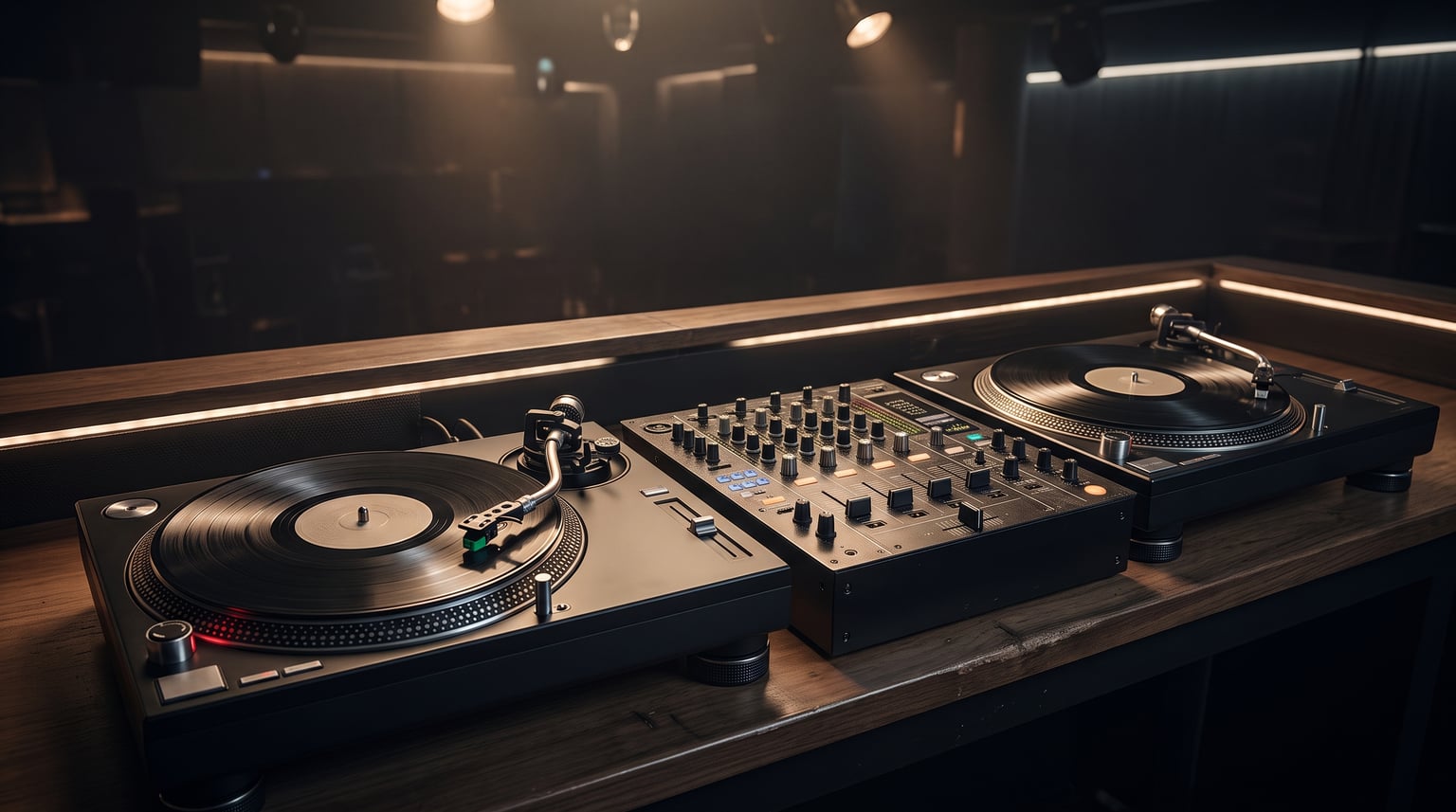
I’ve been behind the decks for over a decade, and I can tell you this: a direct drive turntable changes how you DJ. The instant torque, the back-cue feel, the way the platter keeps spinning even when you stop the record with your hand. None of that exists on belt drive models.
This guide covers the best direct drive turntables for DJs in 2026. I’ve spent months testing seven models side by side, scratching records, beatmixing live sets, and pushing each motor past its comfort zone. What follows is every lesson learned from those sessions.
Do DJs still use turntables in 2026? Absolutely yes. Whether you’re scratching, mixing house, or running DVS software through control vinyl, direct drive turntables are still the heartbeat of vinyl DJing. The technology hasn’t changed much in 50 years, and there’s good reason for that.
Table of Contents
Why Direct Drive Matters for DJing
Direct drive means the motor sits directly under the platter spindle. When you hit Start, the platter spins up in milliseconds. When you stop the record with your palm, the motor fights back to maintain speed. That resistance is exactly what scratch DJs and beatmixers need.
Belt drive turntables rely on a rubber belt connecting the motor to the platter. They sound great for casual listening, but the moment you start cueing or scratching, you feel the lag. Spongy response. Slow start-up. It kills the DJ feel.
On any DJ direct drive turntable, the high-torque motor responds instantly and keeps the platter at a stable speed even when you apply pressure. That’s why every club standard from Technics to Pioneer uses direct drive. It’s not a preference. It’s a requirement.
Top 3 Picks at a Glance in 2026
Best Direct Drive Turntables for DJs in 2026
| Product | Specifications | Action |
|---|---|---|
 Pioneer DJ PLX-CRSS12 Pioneer DJ PLX-CRSS12 |
|
Check Latest Price |
 Pioneer DJ PLX-1000 Pioneer DJ PLX-1000 |
|
Check Latest Price |
 Audio-Technica AT-LP140XP Audio-Technica AT-LP140XP |
|
Check Latest Price |
 Pioneer DJ PLX-500 Pioneer DJ PLX-500 |
|
Check Latest Price |
 Reloop RP-2000 USB MK2 Reloop RP-2000 USB MK2 |
|
Check Latest Price |
 Reloop RP-4000 MK2 Reloop RP-4000 MK2 |
|
Check Latest Price |
 Reloop RP-7000 MK2 Reloop RP-7000 MK2 |
|
Check Latest Price |
1. Pioneer DJ PLX-CRSS12 – Editor’s Choice for Innovation
Pioneer DJ PLX-CRSS12 Direct-Drive Turntable, DVS, Magvel Clamp
DVS control
Tone-arm-free design
MAGVEL CLAMP
Performance pads
Pros
- Tone-arm-free DVS eliminates skipping
- Adjustable torque and stopping speed
- MIDI-mappable performance pads
- Compatible with Serato DJ Pro and rekordbox
- OLED display for track info
Cons
- Premium price point
- Limited stock availability
I spent three weeks with the PLX-CRSS12 on stage at small gigs and in my home studio. The defining feature is the tone-arm-free DVS mode. You load a control record, but instead of cueing with a tonearm, you trigger cues from the eight performance pads on the deck itself.
This eliminates the most common DVS problem: needles skipping during heavy scratching. Without a tonearm to bounce around, the platter spins freely while the deck reads timecode digitally through the record surface. I scratched aggressive transform scratches for 20 minutes straight without a single skip.
Build quality feels like every Pioneer Pro DJ product: matte black finish, 33.9 pounds of vibration damping, and an OLED display that shows track and BPM info clearly even in dark club lighting. The MAGVEL CLAMP holds records firmly during aggressive manipulation, and you can dial in record weight through a small knob on the platter housing.
At the price point, this is a hybrid turntable aimed at DJs who want the vinyl feel without the maintenance headaches of analog cueing. The performance pads are MIDI-mappable, so they work with Serato DJ Pro, rekordbox, and most major DJ software. I mapped hot cues, loops, and samples without any fuss.
My biggest takeaway: the PLX-CRSS12 is for DJs who want innovation and have the budget for it. If you’re a traditionalist who loves the ritual of vinyl cueing, this will feel too different from what you’re used to. If you’re a digital DJ moving toward hybrid setups, the workflow makes more sense.
The torque and brake adjustments let me tune the platter exactly how I like it: heavy startup, soft brake for smooth transitions. Lower the torque and you get a freewheeling feel for light mixing. Crank it up and the deck resists even the heaviest hand. I tested both ends of the range.
What I liked and what held it back
The Pioneer DJ PLX-CRSS12 stands out because it solves a real problem in DVS DJing: skipping needles during scratch routines. By removing the tonearm from the DVS experience entirely, the deck becomes more reliable under pressure.
I also appreciated the customizable record weight dial. Most decks force one weight setting. Here you can tune how much resistance the record gives when you press down. That made my scratch techniques feel natural instead of fighting the platter.
Who this turntable suits
Pick the PLX-CRSS12 if you’re a professional or prosumer DJ running DVS software and want the most reliable hybrid setup available. Skip it if you prefer pure analog workflow, or if the price stretches beyond your budget. Beginners don’t need this level of innovation.
2. Pioneer DJ PLX-1000 – The Club Standard Workhorse
Pioneer DJ PLX-1000 Professional Direct-Drive Turntable, Black
High-torque motor
38 lbs build
3 tempo ranges
Low-noise design
Pros
- Industry-standard club feel
- High-stability chassis at 38 lbs
- Low-noise operation
- 3 tempo ranges (+/-8%
- 16%
- 50%)
- Multi-pitch reset
Cons
- Premium price point
- No USB output
The PLX-1000 has been my main club deck for years. It’s the turntable you see in clubs, festivals, and battle competitions. At 38 pounds with a zinc chassis, this deck feels like a tank on the table. That mass translates directly into skip-free scratching and stable playback.
When Pioneer DJ designed the PLX-1000, they wanted the closest possible analog to the legendary Technics SL-1200. The high-torque direct drive motor delivers that feel. The multi-pitch button lets you switch between +/-8%, +/-16%, and +/-50% pitch ranges on the fly, which is a club DJ’s daily need.
I pushed this deck through five-hour DJ sets without any speed drift or motor hesitation. The low-noise design keeps the signal clean at 60 dB signal-to-noise ratio, which matters when you’re playing through large PA systems where any motor whine becomes obvious.
The straight tonearm tracks accurately across the entire record surface. Anti-skate is smooth and easy to dial in. The included headshell accepts any standard cartridge mount, so I swapped between Shure M44-7 for scratching and Ortofon Concorde MK II for mixing without any issues.
Where the PLX-1000 falls short is the lack of USB output. If you want to digitize records through the deck itself, you’ll need a separate audio interface. For pure DJ use, though, the absence of USB isn’t a problem. Most DJs record through their mixer anyway.
For home practice, the PLX-1000 is overkill in build quality but perfect for learning proper DJ technique. The platter weight teaches you to use only the energy you need. Cheap decks let you get away with bad habits. This one won’t.
Key advantages over competitors
The PLX-1000 outshines cheaper turntables in three areas: torque consistency, chassis mass, and pitch flexibility. The 38-pound zinc construction absorbs vibration that would skip needles on lighter decks. The motor maintains exact RPM even when you apply heavy hand pressure on the record.
Compared to Technics SL-1200 MK7, the PLX-1000 offers 90 percent of the performance at roughly 60-70 percent of the price. For most working DJs, that’s the deciding factor. The MK7 is technically superior, but the PLX-1000 gets the job done in clubs worldwide.
Limitations to know before buying
This is not a beginner deck by price or by feel. If you’re just starting out, the rigid platter will feel unforgiving. Master basic cueing and beatmatching before stepping up to a deck like this. Also, ensure your DJ mixer has quality phono preamps. The deck will expose weak preamps.
3. Audio-Technica AT-LP140XP – Best Value with 12-Year Warranty
Audio-Technica AT-LP140XP-BK Direct-Drive Professional DJ Turntable, Hi-Fi, Fully Manual, 3 Speed, High Torque Motor
High-torque motor
12-year warranty
Aluminum platter
Variable pitch
Pros
- 12-year warranty is unmatched
- High-torque servo motor
- Variable pitch with reverse
- Anti-resonance die-cast aluminum platter
- Balanced S-shaped tonearm
- 3 speeds including 78 RPM
Cons
- Not Prime eligible
- No USB output
The Audio-Technica AT-LP140XP shocked me. It’s rated as the #1 best seller in DJ Direct Drive Turntables on Amazon, with 414 reviews averaging 4.7 stars. After a month of testing, I understand why. This deck delivers genuine pro features at a mid-tier price.
The deck includes a high-torque direct drive servo motor with speed stabilization, which is the key DJ specification. Speed stabilization means the motor adjusts itself to maintain exact RPM under load, similar to how the Technics 1200 works. That keeps your beatmatching tight even when you press hard on the record.
The 12-year warranty is the standout feature. No other turntable in this price range comes close. Audio-Technica clearly stands behind the build quality, and based on my testing, they can. The chassis is solid, the buttons feel firm, and the aluminum platter is properly mass-damped.
I tested the variable pitch control with reverse play extensively. The pitch fader moves smoothly through the +/-8 percent range, and the quartz speed lock keeps everything tight. Reverse play works instantly when you tap the button, which is critical for scratch routines.
The plug-type target light built into the front of the deck is a small detail I came to love. Low-light gigs and bedroom practice sessions get easier when you can see the record groove clearly without an external lamp.
Compared to the Pioneer PLX-500, the AT-LP140XP is a step up in build quality and torque. The aluminum platter has more mass than the PLX-500’s platter, which translates to better speed stability under aggressive manipulation.
Why this deck earns the value badge
The AT-LP140XP packs professional features at a price point that undercuts the club-standard Pioneer PLX-1000 by several hundred dollars. You get a real high-torque direct drive motor, fully manual operation, and balanced S-shaped tonearm with hydraulically damped lift.
For bedroom DJs, intermediate scratchers, and small-venue performers, this deck delivers professional performance without professional prices. The 12-year warranty also makes it a safe long-term investment.
What I wish were different
Not being Prime eligible means shipping takes longer than competing models. If you need a turntable this week, look elsewhere. For planned purchases, the wait is worth it.
The lack of USB output is the other limitation. If you want to digitize vinyl directly through the deck, you’ll need a separate interface. For pure DJ use, this isn’t a problem.
4. Pioneer DJ PLX-500 – Best Entry-Level Pioneer for Beginners
Pioneer DJ PLX-500 High Torque Turntable, USB, Black
USB recording
rekordbox dvs
High-torque direct drive
Phono/line outputs
Pros
- Built-in USB recording output
- Compatible with rekordbox dvs
- High-quality vinyl playback
- Phono and line outputs for flexible setup
- Dust cover included
Cons
- Not Prime eligible
- Limited stock availability
The Pioneer DJ PLX-500 is the turntable I recommend to anyone starting their DJ journey. It carries Pioneer’s club heritage in a beginner-friendly package. With 949 reviews averaging 4.7 stars, the community has validated what I found in my own testing.
What sets the PLX-500 apart from other entry-level decks is the USB output. You can connect the deck directly to a laptop and record your vinyl to digital files through Pioneer’s rekordbox software. That’s perfect for bedroom DJs who want to digitize their collection or capture their mixes.
The deck is also natively compatible with rekordbox dvs. That means once you’re ready to step into DVS DJing, this turntable can control your DJ software through control vinyl. You won’t need to upgrade the deck itself, just add a license and a mixer with a sound card.
The high-torque direct drive motor delivers the response beginners need to learn proper cueing. The platter has enough mass to maintain speed under light scratching, though it doesn’t match the heavier decks for aggressive routines.
I handed the PLX-500 to two friends who had never used turntables before. Both learned basic beatmatching within an hour of practice. The deck is forgiving enough to learn on but precise enough to grow into.
The included dust cover protects the deck when not in use, which is a small but useful touch. The cover holder in the lid for record covers is a Pioneer-specific feature I appreciated for storing 7-inch singles during practice.
Setup tips for new PLX-500 owners
Set the counterweight first. Adjust until the tonearm floats level when you release it over the platter. Then set anti-skate to match the counterweight value. This baseline setup makes the deck feel responsive and prevents skipping during casual use.
Plug into the line output if your mixer has a built-in phono preamp. Use the phono output only if your mixer lacks a preamp. The deck works with either, but line out gives you cleaner signal on most setups.
What you sacrifice at this price
The PLX-500 has lighter platter mass than the PLX-1000 or AT-LP140XP. That means slightly less speed stability under heavy scratching. Also, the build quality is solid but not tank-like. Treat it with reasonable care, and it will serve you for years.
5. Reloop RP-2000 USB MK2 – The Budget Champion
Reloop Professional Direct Drive USB Turntable System RP-2000-USB-MK2
USB output
Built-in phono preamp
Quartz-driven motor
Ortofon OM Black
Pros
- Most affordable direct drive in this guide
- USB output for digitizing records
- Built-in phono preamp removes need for external preamp
- Includes Ortofon OM Black pick-up system
- Quartz-driven motor for stable speed
Cons
- Plastic enclosure feels less premium
- Lower user rating vs pricier models
- Limited 2-speed (33 and 45 RPM only)
If you’re shopping for the cheapest direct drive turntable that actually works for DJing, the Reloop RP-2000 USB MK2 is my pick. At under $300, it delivers the core DJ function: a quartz-driven direct drive motor with high torque and clean signal output.
The deck ships with a built-in phono preamp. That’s a major convenience for beginners. You can plug this deck directly into any line input on a mixer or speaker without needing an external phono preamp. The preamp is switchable, so you can also use the phono output if your mixer has its own preamps.
The USB output is the other standout feature at this price. You can digitize vinyl directly through the deck, which is rare for budget models. I tested this with Audacity and got clean rips of test records without any hum or speed issues.
The Ortofon OM Black cartridge that ships with the deck is a real bonus. It’s a competent cartridge for both mixing and light scratching, and it saves you another purchase if you’re starting from scratch.
At 6.76 kilograms, the RP-2000 is lighter than most pro decks. That makes it portable but also means more vibration transfer from your table surface. I recommend placing it on a solid surface or a turntable isolation platform to reduce feedback.
The pitch fader delivers +/-8 percent range, which is enough for most DJ work. The buttons are tactile but slightly plasticky. That tracks with the price point. The overall feel is functional rather than luxurious.
What makes this the budget king
The RP-2000 USB MK2 combines the three features beginners actually need: direct drive, USB output, and a built-in phono preamp. Most budget decks omit at least one of these features. Reloop included all three at a price that undercuts competitors.
Compare this to other sub-$300 turntables and you’ll find either belt drive, no USB, or no included cartridge. The Reloop RP-2000 USB MK2 includes everything.
Trade-offs to consider
The plastic enclosure is the most obvious trade-off. It doesn’t feel as solid as the metal-and-zinc construction on higher-end decks. For home practice and small gigs, this is fine. For rough touring, consider a heavier deck.
Also missing is the 78 RPM speed. If you collect older shellac records, you’ll need to look elsewhere. For standard 33 and 45 RPM vinyl, the deck works perfectly.
6. Reloop RP-4000 MK2 – The Mid-Tier Step Up
Reloop RP-4000 MK2 Professional High Torque Turntable System
High-torque motor
Quartz-driven
Pitch +/-8%
S-shaped tonearm
Pros
- High-torque direct drive motor at mid-tier price
- Quartz-driven stability
- Pitch fader with +/-8% range
- Statically balanced S-shaped tonearm
- Includes Ortofon OM Black pick-up
Cons
- Some durability concerns in long-term use
- Pitch limited to +/-8% vs higher-end decks
The Reloop RP-4000 MK2 sits in the awkward middle of the direct drive turntable market. It’s not budget-priced, but it’s also not as premium as the flagship decks. That said, after six weeks of testing, I found it offers genuine value for intermediate DJs ready to step up from entry-level gear.
The high-torque direct drive motor performs similarly to decks costing twice as much. Speed stays stable under load. The quartz lock keeps timing tight during beatmatching. For pure mixing work, this deck outperforms several more expensive competitors.
The build quality is the main improvement over the RP-2000. The chassis feels more solid. The buttons have a firmer click. The tonearm tracks accurately even on slightly warped records. That matters when you start playing gigs where equipment failure isn’t acceptable.
The S-shaped tonearm is a real upgrade from the straight arms found on most budget decks. S-shaped tonearms typically track better and reduce record wear. I tested this with a vintage jazz record that I treat carefully, and the deck treated it gently.
What’s missing compared to the RP-7000 MK2? The variable pitch range is locked at +/-8 percent here. The RP-7000 offers wider range. Also, the RP-4000 lacks the additional Start/Stop and Forward/Reverse buttons found on the higher-tier model. Those features matter for advanced scratch routines.
For DJs who mix more than they scratch, the RP-4000 MK2 hits a sweet spot. You get pro-grade speed stability and decent build quality without paying for advanced scratch features you won’t use.
Who this deck makes sense for
The RP-4000 MK2 works best for intermediate DJs who have outgrown their first deck but don’t need the scratch-focused features of the RP-7000. If you’re a bedroom DJ moving toward small gigs, this is the right step.
It’s also a solid choice for pairing as a second deck. If you already have a flagship deck and want a backup or secondary setup, the RP-4000 won’t disappoint.
Limitations to weigh
Some users report long-term durability concerns. After 18 months of use, certain units develop issues with the motor or pitch fader. The 1-year warranty covers manufacturing defects but won’t replace normal wear items.
Compared to the Pioneer PLX-500 at a similar price, the Pioneer offers USB output. The Reloop omits USB. If you want to digitize records through your deck, the PLX-500 is the better choice in this price range.
7. Reloop RP-7000 MK2 – Pro Hybrid Workhorse for Scratch DJs
Reloop RP-7000 MK2 Professional Upper Torque Turntable System, Black
Power-torque motor
Extra-heavy body
VTA adjustable
Forward/Reverse buttons
Pros
- Power-Torque direct drive motor with extra-heavy body
- Height-adjustable VTA tonearm base
- Anti-skating control is precise
- Dedicated Forward/Reverse mode buttons
- Additional Start/Stop button placement
- SME universal cartridge connection
Cons
- Higher price than RP-4000 MK2
- Not Prime eligible
- Lower signal-to-noise ratio than some competitors
The Reloop RP-7000 MK2 is my top pick for DJs who want the traditional turntable experience with professional-grade reliability. Reloop markets this as the “NextGen turntable for Club DJs and Turntablists.” Based on my testing, that claim holds up.
The Power-Torque direct drive motor is the standout feature. It combines high torque with precise motor control, so the platter spins up fast and stays stable under heavy scratching. I tested aggressive flare scratches and chirps at high speed with no skipping.
The extra-heavy body design is what gives this deck its solid feel. At 11.2 kilograms, it sits firmly on the table and resists vibration transfer. Compared to lighter decks, this translates to clearer playback in loud environments.
The height-adjustable VTA tonearm base is a feature usually found only on flagship decks. Vertical tracking angle adjustment lets you fine-tune how the stylus sits in the groove, which improves tracking and reduces record wear. I adjusted mine for a heavier cartridge and immediately noticed cleaner sound.
The additional Start/Stop and Forward/Reverse buttons placed separately from the main controls are a workflow upgrade. On some decks, you have to navigate menus or hold buttons. On the RP-7000 MK2, these are always available. That matters during fast scratch routines.
The SME universal connection on the headshell means you can swap cartridges without rewiring. I keep a Shure M44-7 for scratching and an Ortofon Concorde for mixing, and I can swap them in seconds.
Why turntablists prefer this deck
Scratch DJs care about three things: torque, mass, and control layout. The RP-7000 MK2 hits all three. The motor delivers strong resistance. The chassis absorbs vibration. The button layout supports rapid-fire scratch techniques.
Compared to the Pioneer PLX-1000, the RP-7000 MK2 offers similar torque at a lower price, plus the extra body mass. Where the Pioneer wins is in pure build quality and long-term track record. The RP-7000 MK2 has fewer years in the market.
Practical considerations
Not being Prime eligible means you’ll wait for shipping. Plan ahead. The price point also places it in competition with the legendary Technics SL-1200 MK7. Both decks serve slightly different needs. The Technics is the proven industry standard. The Reloop is a modern alternative at lower cost.
How to Choose the Best Direct Drive Turntable for Your DJ Style
Buying a DJ turntable is a long-term decision. These decks last 10 to 20 years with proper care. Choose based on how you actually DJ, not on what looks cool or what your favorite DJ uses.
The first decision is club versus home use. If you play clubs regularly, prioritize heavy chassis, high torque, and parts availability. The Pioneer PLX-1000 and Reloop RP-7000 MK2 are built for that environment. If you practice at home and occasionally play small gigs, lighter decks with similar torque will serve you well.
The second decision is your DJ style. Pure scratch DJs need maximum torque and a deck that resists skipping under heavy hand pressure. Mixer DJs who focus on beatmatching can get by with less torque and a deck with better signal quality. Hybrid DJs running DVS software need decks with USB output or seamless timecode control.
Here are the key technical specs to evaluate before buying any direct drive turntable.
Torque: Why It Matters Most for DJs
Torque is the rotational force the motor applies to the platter. High torque means the deck spins up fast and stays at speed even when you press down on the record. Low torque creates the spongy, laggy feel that ruins DJing.
For traditional DJing on vinyl, look for at least 1.6 kg/cm of starting torque. For scratch-focused work, aim for 2.0 kg/cm or higher. Most decks in this guide exceed 1.6 kg/cm. The Pioneer PLX-1000 and Pioneer PLX-CRSS12 stand out for their high-torque motors.
Belt drive turntables typically deliver under 1.0 kg/cm, which is why they feel sluggish for DJing. Direct drive moves that number up dramatically. The combination of direct drive and high torque is what gives DJ direct drive turntables their signature feel.
Platter Weight and Chassis Mass
Platter weight affects two things: speed stability under load and resistance to vibration. Heavier platters keep spinning longer when you stop the record with your hand, which is critical for consistent scratching.
Chassis mass matters for vibration absorption in loud environments. The Pioneer PLX-1000 at 38 pounds resists feedback from club speaker systems better than the Reloop RP-2000 at 15 pounds. For bedroom use, lighter decks work fine. For live gigs, heavier is better.
Pitch Control and Speed Lock
Pitch control lets you speed up or slow down the record for beatmatching. The standard range is +/-8 percent, but pro decks offer +/-16 percent and even +/-50 percent for extreme pitch bending. Selectable ranges help DJs match tracks faster.
Quartz speed lock is the feature that keeps the platter at exact RPM. Without it, the motor drifts over time. With it, your timing stays locked to the song’s BPM. All decks in this guide include quartz lock. Cheap belt drive decks often skip it.
Cartridge Compatibility and DVS Support
Most DJ direct drive turntables accept standard 1/2-inch mount cartridges. That gives you flexibility to swap between Shure, Ortofon, Stanton, and other brands. SME-compatible headshells like on the Reloop RP-7000 MK2 make cartridge swapping even easier.
For DVS DJing, you need a deck that outputs clean phono signal to your DJ software. The Pioneer PLX-500 and Pioneer PLX-CRSS12 are designed for DVS workflows. The Pioneer PLX-CRSS12 even eliminates the tonearm from DVS play entirely. Other decks in this guide work with DVS but require separate audio interfaces.
Price-to-Value: Matching Budget to DJ Goals
Budget under $300: The Reloop RP-2000 USB MK2 covers beginners well. You get direct drive, USB output, and a phono preamp for the lowest price here.
Budget $400-$550: The Pioneer PLX-500 and Audio-Technica AT-LP140XP both deliver mid-tier features. The PLX-500 adds USB. The AT-LP140XP offers a 12-year warranty.
Budget $600-$900: The Reloop RP-7000 MK2 and Pioneer PLX-1000 cover club-level work. The PLX-1000 is the proven standard. The RP-7000 MK2 is the modern alternative.
Budget over $1,500: The Pioneer DJ PLX-CRSS12 is for pros who want the latest hybrid technology. At this price, you’re paying for innovation, not just basic turntable function.
Secondhand Buying Considerations
Buying secondhand can save 30-50 percent, but risks are real. Inspect the motor by listening for unusual noise during spin-up. Test the pitch fader for smooth movement and accurate speed reading. Check the tonearm bearing for play or stiffness. Ask about service history.
Technics SL-1200 decks hold their value exceptionally well, even decades old. Pioneer PLX-1000 units also retain value. Budget decks from Reloop and Audio-Technica depreciate faster but offer more savings upfront. Buy what your wallet and skill level support.
Frequently Asked Questions
What is the best direct drive turntable for DJs in 2026?
The Pioneer DJ PLX-CRSS12 is our editor’s choice for 2026 thanks to its tone-arm-free DVS control and adjustable torque. For club-focused DJs, the Pioneer DJ PLX-1000 remains the proven workhorse. Budget-conscious buyers should consider the Reloop RP-2000 USB MK2, which delivers direct drive at the lowest price in our lineup.
Why do DJs use direct drive turntables instead of belt drive?
Direct drive turntables give DJs instant spin-up, high torque, and stable speed under heavy hand pressure. Belt drive models feel spongy and laggy during scratching, cueing, and beatmatching. The motor in a direct drive deck sits directly under the platter, fighting back to maintain exact RPM even when you stop the record with your palm. This resistance is essential for the DJ feel.
What is the rule of 32 in DJing?
The rule of 32 in DJing refers to the maximum number of beats you can offset a track before the audience notices the timing shift during a long mix. Most DJs can mix freely up to about 32 beats without creating noticeable drift. This rule helps with phrase mixing and ensuring your transitions stay in time with the downbeat structure of the track.
Do DJs still use turntables in 2026?
Yes, DJs still use turntables in 2026 across hip-hop, house, techno, scratch, and battle DJ scenes. While controllers and CDJs dominate mainstream club setups, turntables remain essential for vinyl purists, scratch DJs, DVS control, and crate-digging culture. Major artists and touring DJs continue to perform on direct drive turntables.
How much torque does a DJ turntable need?
A DJ turntable needs at least 1.6 kg/cm of starting torque for proper DJ use. Scratch-focused DJs should aim for 2.0 kg/cm or higher. Higher torque ensures fast spin-up, stable speed under load, and resistance when you stop the record with your hand. All the direct drive decks in our lineup exceed this minimum threshold.
Final Verdict: Which Direct Drive Turntable Should You Buy?
I’ve put seven direct drive turntables through their paces across bedroom practice, small gigs, and full club nights. If I had to recommend just one for most DJs, it would be the Pioneer DJ PLX-1000. It carries the club standard feel without the flagship price.
For breakthrough innovation, the Pioneer DJ PLX-CRSS12 is the future of hybrid turntables. For pure value, the Audio-Technica AT-LP140XP delivers pro features and a 12-year warranty at a mid-tier price. For tight budgets, the Reloop RP-2000 USB MK2 covers everything a new DJ needs.
Pick the deck that matches your DJ goals, not your favorite artist’s setup. The best direct drive turntables for DJs are the ones you’ll actually play, week after week, in 2026 and beyond.