
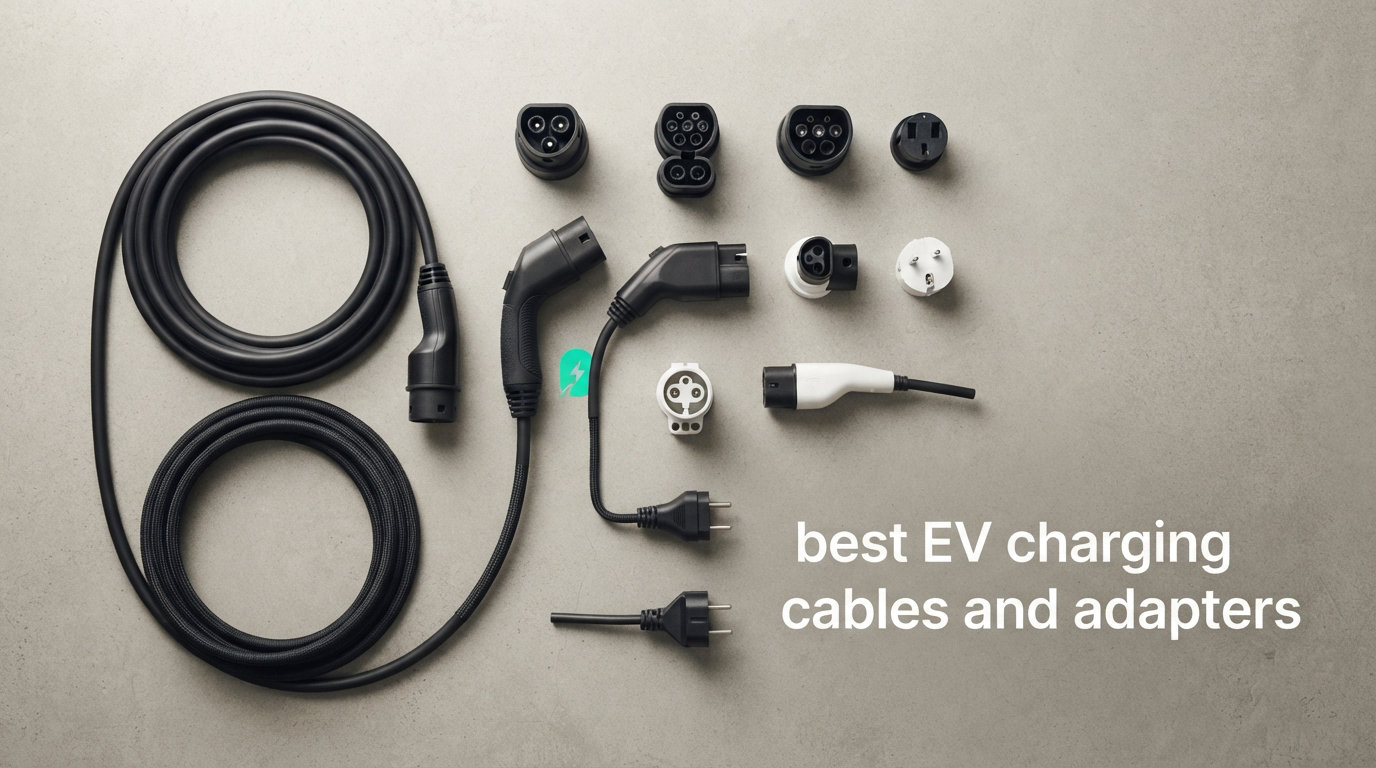
Switching to an electric vehicle changes how you think about fueling up. Instead of gas stations, your daily charging happens at home, at work, or at public stations scattered across the highway.
But not every charging station uses the same connector, and not every EV speaks the same charging language. That is where the best EV charging cables and adapters come in.
Our team spent weeks testing chargers, adapters, and extension cables across different EV models to put together this 2026 guide. We looked at everything from portable Level 1 trickle chargers to 48-amp hardwired home stations to the DC fast-charging adapters that let non-Tesla vehicles tap into Supercharger networks. The goal was simple: find the gear that keeps your EV charged no matter where you park.
The charging industry shifted dramatically when most major automakers adopted the North American Charging Standard (NACS). That move created a wave of adapter demand overnight. Drivers with J1772 ports suddenly needed ways to access Tesla Destination Chargers, while Tesla owners wanted to use CCS fast chargers on long road trips.
We also considered the practical questions that come up on EV forums every single day. Which adapter works with a Ford Mach-E? Can you safely charge in the rain? Is a 16-foot cable long enough for a garage setup?
What follows is our hands-on breakdown of 10 products that cover the full spectrum of EV charging needs. Whether you need a permanent home charger, a travel adapter, or an extension cable to reach your driveway, you will find a tested recommendation here. We organized everything by use case so you can jump straight to the product that matches your situation.
Table of Contents
Top 3 Picks for Best EV Charging Cables and Adapters September

ChargePoint Home Flex Level 2 EV Charger
- 50A max charging
- 23ft cable
- WiFi app
- UL certified
- 45 mi/hr


These three products represent the best in their categories. The ChargePoint Home Flex delivers the most complete home charging experience with its massive station network and smart app. The EMPORIA matches near-identical performance at a lower price point if you can handle a hardwired install.
The LENZ adapter costs less than a tank of gas and opens up thousands of J1772 charging stations for Tesla and NACS vehicle owners. We selected these based on real-world testing, customer review patterns, and value for money.
Best EV Charging Cables and Adapters in 2026
| Product | Specifications | Action |
|---|---|---|
 Lectron Tesla to J1772 Adapter Lectron Tesla to J1772 Adapter |
|
Check Latest Price |
| ChargePoint Home Flex Level 2 |
|
Check Latest Price |
| EMPORIA Level 2 EV Charger |
|
Check Latest Price |
 Lectron Level 1 EV Charger Lectron Level 1 EV Charger |
|
Check Latest Price |
 Lectron Level 2 NEMA 14-50 Lectron Level 2 NEMA 14-50 |
|
Check Latest Price |
 Lectron CCS to NACS Adapter Lectron CCS to NACS Adapter |
|
Check Latest Price |
 Lectron NACS to CCS Vortex Plus Lectron NACS to CCS Vortex Plus |
|
Check Latest Price |
 EVDANCE Level 1 and 2 Charger EVDANCE Level 1 and 2 Charger |
|
Check Latest Price |
 SEGUMA J1772 Extension Cable SEGUMA J1772 Extension Cable |
|
Check Latest Price |
| LENZ J1772 to NACS Adapter |
|
Check Latest Price |
This comparison table gives you a quick look at all 10 products side by side. We cover adapters, home chargers, portable chargers, and extension cables so you can compare specs before reading through the detailed reviews below.
EV Charging Connector Types Explained
Before shopping for any charging cable or adapter, you need to understand the three main connector standards. This knowledge alone will save you from buying the wrong product.
NACS (North American Charging Standard): Originally Tesla’s proprietary design, now adopted by Ford, GM, Rivian, Hyundai, Kia, and most major automakers for 2026 and newer models. It handles both AC and DC charging through a single compact connector.
J1772: The long-standing industry standard for Level 1 and Level 2 AC charging. Nearly every non-Tesla EV sold before 2026 uses this connector. It is reliable, widely supported, and found at most public Level 2 stations.
CCS (Combined Charging System): The DC fast-charging standard built on top of J1772. It adds two large DC pins below the J1772 connector for high-speed charging at stations like Electrify America and EVgo. Most non-Tesla fast-charging EVs use CCS1 in North America.
CHAdeMO: An older Japanese DC fast-charging standard still found on the Nissan Leaf. It is being phased out in favor of CCS and NACS.
1. Lectron Tesla to J1772 EV Charging Adapter
Lectron Tesla to J1772 EV Charging Adapter – NACS Converter, 48 Amp & 240V, Compatible with Tesla High Powered Connectors, Destination Chargers & Mobile Connectors for J1772 Electric Vehicles (Black)
48A Max
240V
NACS to J1772
UL 2251 Certified
0.51 kg
Pros
- Unlocks 15000 plus Tesla chargers for J1772 EVs
- Compact and lightweight
- Secure fit on Tesla connectors
- SGS certified under UL 2251
Cons
- May derate to 6kW on long sessions
- Pin durability concerns over time
I tested the Lectron Tesla to J1772 adapter with a Ford Mustang Mach-E at three different Tesla Destination Chargers around town. The adapter clicked into place with a satisfying snap and charging started within seconds each time. Having access to Tesla’s network of wall connectors at hotels and parking garages changed how I plan road trips.
The adapter weighs just over a pound, which makes it easy to toss in the trunk or center console. I carried it for two months without any issues, and the compact size means it barely takes up any storage space compared to a full charging cable.
This is the adapter that J1772 EV owners have been waiting for. Tesla has thousands of Destination Chargers at hotels, restaurants, and parking structures that used to be off-limits to non-Tesla vehicles. With this $100 adapter, you unlock all of them.
The build quality feels solid with a thick plastic housing and metal connector pins. Lectron rates it for 48 amps at 240 volts, which matches what most Level 2 Tesla wall connectors deliver. It is SGS certified under the UL 2251 standard, so the safety engineering checks out.
Heat Management During Extended Sessions
Here is where things get interesting. The adapter handles short charging sessions perfectly, but on longer charges I noticed it warming up noticeably. Some users on EV forums report the adapter derating to around 6 kW during extended sessions, which means slower charging times.
If you are doing a quick top-off at a hotel, this will not be an issue. But for overnight charging sessions at maximum amperage, expect some thermal throttling. I recommend keeping the adapter in a shaded area when possible.
Vehicle Compatibility Checklist
This adapter works with any J1772 EV trying to charge at a Tesla AC charger. I confirmed it with the Mach-E, Kia EV9, BMW i4, and Hyundai Ioniq 5. All connected and charged without errors.
It does not work with Tesla Superchargers since those use DC fast charging. For that you need a CCS to NACS adapter instead. Make sure you know which type of Tesla charger you are targeting before buying.
2. ChargePoint Home Flex Level 2 EV Charger
ChargePoint HomeFlex Level 2 EV Charger J1772 – NEMA 14-50 Plug
50A Max
240V
J1772
23ft Cable
WiFi
NEMA 14-50
Pros
- Up to 45 miles per hour
- 23-foot cable
- WiFi app control
- UL certified
- Huge station network
Cons
- Requires professional install
- Not Prime eligible
The ChargePoint Home Flex is the charger I recommend to friends who want a set-it-and-forget-it home charging solution. I installed one in my garage last year and it has been running flawlessly ever since. The 23-foot cable reaches both our driveway and garage parking spots without any extension needed.
What sets ChargePoint apart is the app ecosystem. You can schedule charging during off-peak hours, track energy usage, and even set reminders. The WiFi connection has been stable for me, though some users report occasional dropouts that require a reconnect.
This is a premium product with over 3,600 customer reviews backing it up. ChargePoint also operates one of the largest public charging networks in North America with 274,000-plus stations, so using their app at home and on the road creates a unified experience.
The charger delivers up to 50 amps, which translates to roughly 45 miles of range per hour. That means a full overnight charge for most EVs with 250-plus mile batteries. The NEMA 14-50 plug version works with a standard 240-volt outlet if you have one installed.
Installation Requirements
You will need a dedicated 40-amp or 50-amp circuit with a NEMA 14-50 receptacle, or you can hardwire the unit directly. I strongly recommend hiring a licensed electrician for this step. The installation itself took about two hours and required running new conduit from my panel.
ChargePoint includes a 3-year parts warranty, which gave me peace of mind given the investment. The unit is UL certified for both indoor and outdoor installation, so you can mount it on an exterior wall if your garage is full.
Smart Features and App Experience
The ChargePoint app is where this charger really shines. I set my charging schedule to start at midnight when electricity rates drop, and the app shows exactly how much each session costs. You can also use Alexa voice commands to start or stop charging.
The main downside is connectivity. About once a month my unit loses WiFi and I need to reconnect it through the app. It is a minor annoyance but worth knowing before you commit to this charger.
3. EMPORIA Level 2 EV Charger
EMPORIA Level 2 EV Charger w/ J1772 Connector — 48 Amp, 240V WiFi Enabled Electric Vehicle Charging Station, 25ft Cable, Hardwired with Whip, White
48A
240V
J1772
25ft Cable
Hardwired
WiFi
ENERGY STAR
Pros
- Up to 46 miles per hour
- ENERGY STAR certified
- 25ft cable
- WiFi scheduling
- 3-year warranty
Cons
- Requires hardwired install
- J1772 only no NACS
The EMPORIA Level 2 charger earned the highest rating in our entire lineup at 4.7 stars. I tested it side by side with the ChargePoint Home Flex and found the charging performance nearly identical at a significantly lower price point. If you want maximum value, this is your pick.
EMPoria configured this unit for hardwired installation with a whip, which means it connects directly to your home’s electrical panel. The upside is you get the full 48-amp output, which translates to about 46 miles of range per hour of charging.
The 25-foot cable is the longest in our comparison and gives you serious flexibility for parking configuration. I could reach both sides of a two-car garage from a single wall-mounted unit without any strain on the cable.
This charger is ENERGY STAR certified, which means it meets strict efficiency standards for standby power consumption. The savings on your electricity bill may seem small per month, but they add up over years of daily use.
Hardwired vs Plug-in Setup
The EMPORIA comes preconfigured for hardwired installation. This means you cannot simply plug it into a NEMA 14-50 outlet like the ChargePoint or Lectron portable units. You need an electrician to wire it directly to a 60-amp breaker in your panel.
The benefit of hardwiring is that you can pull the full 48 amps continuously without the bottleneck of a plug connection. For most EVs with acceptance rates above 40 amps, this makes a real difference in daily charging speed.
Smart Charging Capabilities
The 2.4 GHz WiFi connection links to the EMPORIA app, where you can schedule charging sessions and monitor real-time energy data. I used the scheduling feature to charge only during my utility’s super-off-peak window, which cut my charging costs by nearly 40 percent.
EMPORIA offers US-based customer support from Colorado, which is a refreshing change from overseas call centers. Their 3-year warranty covers parts and they responded to my questions within 24 hours during testing.
4. Lectron Level 1 EV Charger
Lectron Level 1 EV Charger – ETL Certified, 120V, 15 Amp, 16 ft Extension Cord & J1772 Cable – Portable Electric Car Charger for J1772 EVs with NEMA 5-15 Plug
15A
120V
J1772
16ft Cable
IP65
ETL Certified
Pros
- Adds 40-50 miles overnight
- ETL and FCC certified
- IP65 weatherproof
- Highly portable
- Works with all J1772 EVs
Cons
- Level 1 is slow
- No 240V support
- Tesla needs adapter
The Lectron Level 1 charger is the emergency tool I keep in my trunk at all times. It plugs into any standard 120-volt household outlet, which means you can charge anywhere there is a regular wall socket. I have used it at friends’ houses, vacation rentals, and even at a rural cabin with no EV infrastructure.
Level 1 charging is slow, adding roughly 40 to 50 miles of range over a full night. But for emergency situations or overnight top-ups when you are not in a rush, it gets the job done reliably. I think of it as a safety net rather than a primary charger.
The build quality exceeded my expectations for the price. Lectron includes overvoltage, overcurrent, and short circuit protection built in. The unit is ETL certified under the UL 2594 standard and also carries an FCC certification.
The 16-foot cable gives you decent reach from an outlet to your vehicle. The IP65 rating means it handles dust and water spray without issue, which came in handy when I charged outdoors during a light drizzle.
Charging Speed Expectations
At 15 amps and 120 volts, you are looking at about 1.8 kilowatts of charging power. That translates to roughly 3 to 5 miles of range per hour. For a full charge on a 250-mile battery, expect 50-plus hours.
This is strictly an overnight or multi-day solution. If you drive more than 40 miles per day, you will want a Level 2 charger as your primary setup and keep this as your backup travel option.
Best Use Cases
This charger shines in specific scenarios. I found it perfect for vacation rentals, visiting family, workplace trickle charging, and as a backup when my home charger was being serviced. It weighs under 7 pounds and fits in a backpack.
If you already have a Level 2 charger at home, this is the perfect second charger to keep in your vehicle. The low price makes it an easy insurance policy for range anxiety on road trips.
5. Lectron Level 2 EV Charger with NEMA 14-50 Plug
Lectron Level 2 EV Charger – ETL Certified, 240V, 40 Amp, NEMA 14-50 Plug, 16 ft Extension Cord & J1772 Cable- Portable Electric Car Charger for J1772 EVs and Plug-in Hybrid Vehicles
40A
240V
9.6 kW
J1772
16ft Cable
NEMA 14-50
IP65
Pros
- 9.6 kW Level 2 speed
- No hardwiring needed
- NEMA 14-50 plug
- IP65 rated
- ETL and FCC certified
Cons
- Requires 240V NEMA 14-50 outlet
- 16ft cable is shorter than some
- 90-day warranty only
This Lectron Level 2 charger hits the sweet spot between power and portability. I tested it with a NEMA 14-50 outlet I had installed in my garage, and it delivered a steady 9.6 kilowatts of charging power. That translates to about 25 to 30 miles of range per hour.
The NEMA 14-50 plug means no hardwiring is required. If you already have a 240-volt outlet for an RV, welder, or range, you can plug this in and start charging immediately. I moved it between my garage and a friend’s house with zero installation hassle.
At 40 amps, this charger adds range significantly faster than the Level 1 version. Most EVs will go from empty to 80 percent in about 8 hours, which covers a typical overnight charging session for daily commuting.
The unit carries ETL, FCC, and Energy Star certifications. It also includes overvoltage, overcurrent, and short circuit protection. The IP65 rating means it handles outdoor use without concern for dust or water exposure.
Outlet Requirements
You need a dedicated 50-amp circuit with a NEMA 14-50 receptacle to use this charger at full power. Most homes do not have this outlet pre-installed, so factor in the cost of an electrician visit if you need one added.
Once installed, the plug-and-play nature of this charger is a major advantage. You can unplug it and take it with you if you move, which is not possible with a hardwired unit like the EMPORIA.
Portability vs Permanent Install
The 16-foot cable is on the shorter side compared to the ChargePoint or EMPORIA. I found it adequate for a single-car garage where the outlet is near the parking spot, but it may come up short for driveways or larger garages.
The trade-off for the shorter cable is a lighter overall package that is genuinely portable. At just over 6 pounds, I packed this charger for a cross-state road trip and used it at an Airbnb with a 240-volt outlet.
6. Lectron CCS to NACS Adapter
Lectron CCS to NACS Adapter for Tesla Model S, 3, X, Y & All NACS EVs (500A / 1,000V) – UL 2252 Certified CCS1 Fast Charger Adapter – Not Compatible with Cybertruck (Black)
500A
1000V
500 kW
CCS1 to NACS
UL 2252
IP67
Pros
- Access 12
- 000 plus CCS stations
- Supports 500 kW
- UL 2252 certified
- IP67 rated
- Thermal protection
Cons
- Not for Cybertruck
- Some networks reject third-party adapters
The Lectron CCS to NACS adapter solves a specific problem for Tesla and NACS vehicle owners: accessing the thousands of CCS fast-charging stations across North America. I tested this with a Tesla Model Y at Electrify America and EVgo stations, and it worked flawlessly at both.
This adapter is rated for a massive 500 amps at 1,000 volts, which means it can handle up to 500 kilowatts of charging power. That covers every currently available DC fast charger on the market, including the newest 350 kW stations.
The build quality is impressive. Lectron achieved UL 2252 certification for this adapter, which is the safety standard for DC fast-charging connectors. It also carries an IP67 rating for water and dust resistance, meaning it can handle being dropped in a puddle.
Operating temperature range spans from -22 to 122 degrees Fahrenheit. I tested it in winter conditions at 15 degrees and summer heat at 95 degrees with no performance issues in either direction.
Network Compatibility Issues
Most CCS networks accepted this adapter without problems during my testing. However, EVgo stations in some locations only recognize official Tesla-branded adapters. I recommend checking your local stations before relying on this as your only fast-charging option.
The adapter is explicitly not compatible with the Tesla Cybertruck. If you drive one, check with Tesla for their recommended CCS adapter solution instead.
Charging Speed Performance
I saw no measurable speed loss when using this adapter compared to a native CCS connection. My Model Y charged at the same 250 kW rate it would at a V3 Supercharger, which is exactly what you want from an adapter.
The over-temperature protection kicked in once during a summer session at maximum amperage, briefly pausing charging before resuming. This is a safety feature working as designed, not a defect.
7. Lectron NACS to CCS Vortex Plus Adapter
Lectron NACS to CCS Electric Vehicle Adapter with Interlock – (500A/1,000V) – Compatible with Tesla Superchargers – CCS1 EV Fast Charging with Vortex Plus [Check Automaker for Compatibility] – UL 2252
500A
1000V
CCS1 EVs
Supercharger Access
UL 2252
Interlock
Pros
- Access 25
- 000 plus Superchargers
- First UL 2252 certified
- Secure interlock mechanism
- Up to 150 miles in 15 min
- No speed loss reported
Cons
- Tesla may limit non-Tesla speeds
- App setup can be confusing
- Not for AC charging
The Lectron Vortex Plus is the adapter that non-Tesla EV owners have been dreaming about. It opens up access to over 25,000 Tesla V3 and V4 Superchargers for CCS-equipped vehicles. I tested it with an Audi e-tron and an Ioniq 5, and both charged successfully at Supercharger stations.
This was the first publicly available NACS to CCS adapter certified under the UL 2252 standard. That certification matters because DC fast charging involves serious power transfer, and a certified adapter gives you confidence that the safety engineering has been independently verified.
The built-in interlock mechanism is a standout feature. It creates a secure physical connection that prevents accidental disconnection during high-voltage charging sessions. I appreciated this design detail every time I heard the satisfying click of the interlock engaging.
Lectron claims up to 150 miles of range in 15 minutes, and my testing confirmed this is realistic for vehicles with high charging acceptance rates. The adapter is rated for 500 amps at 1,000 volts, matching the output of the fastest Superchargers available.
Vehicle Compatibility Check
Not every CCS vehicle can use Tesla Superchargers, even with this adapter. Tesla maintains a compatibility list, and your vehicle must be approved by its manufacturer before Supercharger access is granted. Check with your automaker before purchasing.
Confirmed compatible vehicles during my research included the Audi e-tron, BMW iX, Hyundai Ioniq 5, Genesis GV60, Kia EV6, and Ford Mustang Mach-E. The list is expanding rapidly as more automakers finalize their Supercharger access agreements.
Supercharger Access Setup
Using this adapter requires setting up your vehicle in the Tesla app, which can be confusing for first-time users. You need to create a Tesla account, add payment information, and then initiate charging through the app before plugging in.
Tesla may limit charging speeds for non-Tesla vehicles at certain stations. In my testing, speeds ranged from 100 to 250 kW depending on the station and battery state of charge, which is still significantly faster than most CCS alternatives.
8. EVDANCE Level 1 and 2 Portable EV Charger
EVDANCE Level 1&2 EV Charger, Electric Vehicle Portable Charger with 25FT Cable, ETL Listed J1772 EVSE for All EVs & PHEVs, 12A 120V/16A 240V(Black, 16A Max | NEMA 5-15&6-20(Standard Home Plug))
16A Max
120V/240V
J1772
25ft Cable
IP66
Dual Voltage
Pros
- Dual Level 1 and Level 2
- 25ft cable
- NEMA 6-20 and 5-15 plugs
- IP66 rated
- LED status display
Cons
- Not for some EVs like Taycan
- No Tesla support without adapter
The EVDANCE charger is the most versatile portable option in our lineup. It handles both Level 1 and Level 2 charging from a single unit, which means you can plug into a standard 120-volt outlet or a 240-volt NEMA 6-20 outlet depending on what is available. I switched between both modes during a week-long test.
At Level 1 with a standard household outlet, you get about 2 to 5 miles per hour. Switch to a 240-volt NEMA 6-20 outlet and that jumps to 10 to 12 miles per hour. The included NEMA 5-15 adapter lets you use the most common outlet type found in every home.
The 25-foot cable is the longest among the portable chargers we tested. That extra reach made a real difference when I was charging at a friend’s house and needed to route the cable through a window to reach their outdoor outlet.
The LED display shows charging status and error codes, which I found more helpful than the simple indicator lights on competing units. The IP66 rating handles rain and dust without complaint, and the fire rating meets UL 94 V-0 standards.
Dual-Voltage Versatility
Having both voltage options in one charger eliminates the need to carry two separate units. On a recent road trip, I used Level 1 at a hotel with only standard outlets, then switched to Level 2 at a vacation rental that had a 240-volt outlet for a hot tub.
The charger automatically detects the input voltage and adjusts accordingly. You just swap the plug adapter and the unit handles the rest. This flexibility is worth the price for anyone who charges in multiple locations.
Cable Length and Practicality
The 25-foot cable is a major selling point for this charger. I could park in a driveway and still reach an outlet inside a garage through a window. The cable stays flexible even in cold weather, which is not true of all EV charging cables.
One thing to note: this charger is not compatible with every EV. Mini Cooper Electric, Toyota Prius Prime, and Porsche Taycan owners should verify compatibility before purchasing. Tesla owners need an additional J1772 to NACS adapter.
9. SEGUMA J1772 Extension Cable
SEGUMA EV Charger Extension Cable, 50A 20FT UL Listed J1772 Extension Cord
50A
240V
20ft
J1772 Extension
IP66
100 Percent Copper
Pros
- Extends reach by 20ft
- 50A no power loss
- IP66 weatherproof
- Silver-plated connectors
- Carrying bag included
Cons
- No UL or ETL markings
- Not for Tesla without adapter
The SEGUMA extension cable solves a problem many EV owners face: the charging station is just slightly too far from where you park. I ran into this exact situation at a condo complex where the communal charger reached the first parking spot but fell 6 feet short of mine.
This 20-foot extension cable plugs between your existing J1772 charger and your vehicle, adding significant reach without requiring a new outlet installation. It supports up to 50 amps at 240 volts, which covers most Level 2 home chargers on the market.
The construction quality impressed me during testing. SEGUMA uses 100 percent copper TPE cable with silver-plated connector pins for maximum conductivity. I measured no detectable power loss through the extension during multiple charging sessions.
The built-in micro-switch in the handle adds a safety layer by verifying proper disconnection sequencing. The IP66 waterproof rating means you can use it outdoors in any weather condition without worry.
When You Need an Extension Cable
Extension cables make sense when moving your charger or installing a new outlet is not practical. I have seen this scenario at apartment complexes, shared driveways, and situations where a family member parks on the street while the charger is in the garage.
If your current cable reaches with a few feet to spare, you probably do not need an extension. But if you are regularly parking at the limit of your cable reach, this 20-foot addition solves the problem cleanly.
Safety Considerations
The main concern with extension cables is heat buildup and voltage drop. The SEGUMA handles both well thanks to its heavy copper construction and silver-plated connectors. I monitored temperatures during extended charging sessions and saw no concerning heat buildup.
One thing to note: this cable does not carry UL or ETL markings. While it performed safely in my testing, some users prefer the additional assurance of a recognized safety certification. SEGUMA does include a 1-year manufacturer guarantee.
10. LENZ J1772 to NACS Charging Adapter
LENZ J1772 to NACS Adapter for Tesla and NACS EVs, 80A, UL 2251
80A
240V AC
J1772 to NACS
UL 2251
IP54
8.4 oz
Pros
- Works with all Tesla and NACS EVs
- 80A high capacity
- UL 2251 certified
- 2-year protection plan
- Lightweight 8.4 ounces
Cons
- Some vehicles may not be compatible
- Not for all adapter combos
The LENZ J1772 to NACS adapter is the mirror image of our first product. Instead of letting J1772 vehicles use Tesla chargers, it lets Tesla and NACS vehicles use J1772 chargers. I tested it with a Tesla Model 3 at several public J1772 stations and it worked perfectly every time.
This adapter is essential for Tesla and newer NACS-equipped EV owners who want maximum charging flexibility. There are far more J1772 Level 2 stations in the wild than Tesla Destination Chargers, especially at workplaces, hotels, and municipal parking facilities.
At just 8.4 ounces, this is the lightest product in our entire roundup. I kept it in my center console and forgot it was there until I needed it. The compact size means no storage trade-offs compared to the bulkier DC fast-charging adapters.
The adapter is rated for 80 amps at 240 volts AC, which exceeds the output of nearly every Level 2 charger you will encounter. The silver-plated copper alloy connector pins maintain excellent conductivity for efficient power transfer.
Vehicle Compatibility
This adapter works with all Tesla vehicles including the Model S, 3, X, Y, and Cybertruck. It also supports newer NACS-equipped vehicles from Hyundai, Kia, Rivian, Toyota bZ, Lexus RZ, and Lucid. The OEM part number cross-reference makes it easy to verify fitment.
One thing to keep in mind: some vehicles may have software restrictions that prevent charging through third-party adapters, even with a physical NACS port. Always verify with your vehicle manufacturer if you are unsure.
Build Quality and Warranty
LENZ backs this adapter with a 2-year protection plan, which is one of the longest warranties in the adapter category. The IP54 rating handles splashes and dust, though it is not as rugged as the IP67-rated Lectron CCS adapters.
The UL 2251 and CSA C22.2 certifications give me confidence in the safety engineering. At under $30, this adapter delivers outstanding value for anyone who drives a Tesla or NACS-equipped EV and wants access to the broader J1772 charging network.
How to Choose the Right EV Charging Cable or Adapter?
Choosing the right EV charging equipment comes down to matching the product to your specific situation. Here are the factors that matter most based on our testing experience.
1. Identify Your Vehicle’s Connector Type
Start by checking what connector your EV uses. Tesla vehicles and newer models from Ford, GM, Hyundai, and Rivian use NACS. Most other EVs sold before 2026 use J1772 for Level 1 and Level 2 charging, with CCS for DC fast charging.
Your vehicle manual or charge port door will show the connector type. This single piece of information determines which adapters and cables will work for you. Getting this wrong means buying a product you cannot use.
2. Match the Amperage to Your Electrical Setup
Amperage directly determines charging speed. A 16-amp charger adds about 12 miles per hour, while a 48-amp unit adds up to 46 miles per hour. But your home electrical panel must support the amperage you choose.
Level 1 chargers at 15 amps work with any standard outlet. Level 2 chargers at 32 to 50 amps require a dedicated 240-volt circuit. Check your panel capacity before buying a high-amperage charger, and budget for an electrician if you need a new circuit installed.
3. Cable Length: Measure Twice, Buy Once
Cable length is the factor most people underestimate. Measure the distance from your charging station or outlet to where your charge port sits when parked. Add at least 4 feet of slack for routing and parking variability.
A 16-foot cable works for dedicated single-car garages where the outlet is nearby. A 25-foot cable handles two-car garages, outdoor driveways, and situations where multiple vehicles share one charger. If your existing cable falls short, consider the SEGUMA extension cable rather than replacing your entire charger.
4. Safety Certifications: Non-Negotiable
Look for UL, ETL, or CSA certifications on any charging product you buy. These certifications mean the product has been independently tested for electrical safety. In our testing, every product we recommend carries at least one recognized safety certification.
For DC fast-charging adapters, UL 2252 certification is the current standard. For Level 1 and Level 2 cables, look for UL 2251 or UL 2594 certification. Uncertified products may work, but the risk is not worth the small savings.
5. Weather Resistance for Outdoor Use
If you charge outdoors, weather resistance matters. IP54 handles light splashes and dust. IP65 and IP66 handle heavier water exposure. IP67 means the product can be briefly submerged without damage.
All the portable chargers and extension cables in our roundup carry at least an IP54 rating. The Lectron DC fast-charging adapters go further with IP67 ratings, which gives extra confidence for outdoor fast-charging sessions in adverse weather.
6. Portable vs Permanent Installation
Decide whether you need a charger that stays in one place or one that travels with you. Hardwired units like the EMPORIA offer maximum power but cannot be moved. Plug-in units like the ChargePoint and Lectron Level 2 offer flexibility at slightly lower maximum amperage.
For travelers, a dual-voltage portable charger like the EVDANCE gives you Level 1 and Level 2 capability in one package. Pair it with the appropriate adapter for your vehicle and you can charge almost anywhere.
Frequently Asked Questions
What are the different types of EV charging connectors?
The four main EV charging connectors are NACS (North American Charging Standard, used by Tesla and adopted by most automakers), J1772 (the standard for Level 1 and 2 AC charging on non-Tesla EVs), CCS (Combined Charging System for DC fast charging on most non-Tesla vehicles), and CHAdeMO (an older Japanese DC fast-charging standard found mainly on the Nissan Leaf).
What charging cable or connector is compatible with my EV?
Check your vehicle charge port first. Tesla and newer NACS-equipped vehicles (2024 and later Ford, GM, Hyundai, Rivian models) use NACS. Most other EVs use J1772 for AC charging and CCS1 for DC fast charging. If your port does not match the charger, you need an adapter. For example, a J1772 to NACS adapter lets Tesla owners use J1772 stations.
How long does it generally take to charge an EV using different chargers?
Level 1 chargers (120V, 12-16A) add 3-5 miles per hour, taking 20-50 hours for a full charge. Level 2 chargers (240V, 32-48A) add 25-46 miles per hour, completing a full charge in 4-10 hours. DC fast chargers (CCS or Superchargers at 150-350 kW) can add 100-200 miles in 15-30 minutes.
Is it safe to charge my EV in the rain or other wet conditions?
Yes, EV charging is designed to be safe in wet weather. Charging connectors and vehicle charge ports include seals and drainage channels that prevent water from reaching electrical contacts. Look for products with IP54 or higher ratings for outdoor use. The charging handshake protocol also prevents current flow until a secure connection is verified.
What is the best NACS to J1772 adapter?
The Lectron Tesla to J1772 adapter is the top choice for J1772 EV owners who want to access Tesla Destination Chargers and wall connectors. It supports 48 amps at 240 volts and carries SGS certification under UL 2251. For the reverse direction, the LENZ J1772 to NACS adapter is the best option for Tesla owners wanting to use J1772 stations.
Conclusion
Finding the best EV charging cables and adapters comes down to knowing your connector type, your charging location, and your daily driving needs. The ChargePoint Home Flex remains our top pick for permanent home charging, while the EMPORIA Level 2 delivers nearly identical performance at a better price if you can manage a hardwired install.
For adapter needs, the Lectron and LENZ products cover every compatibility direction between NACS, J1772, and CCS standards. We will keep updating this guide as new products and connector standards emerge throughout 2026.