
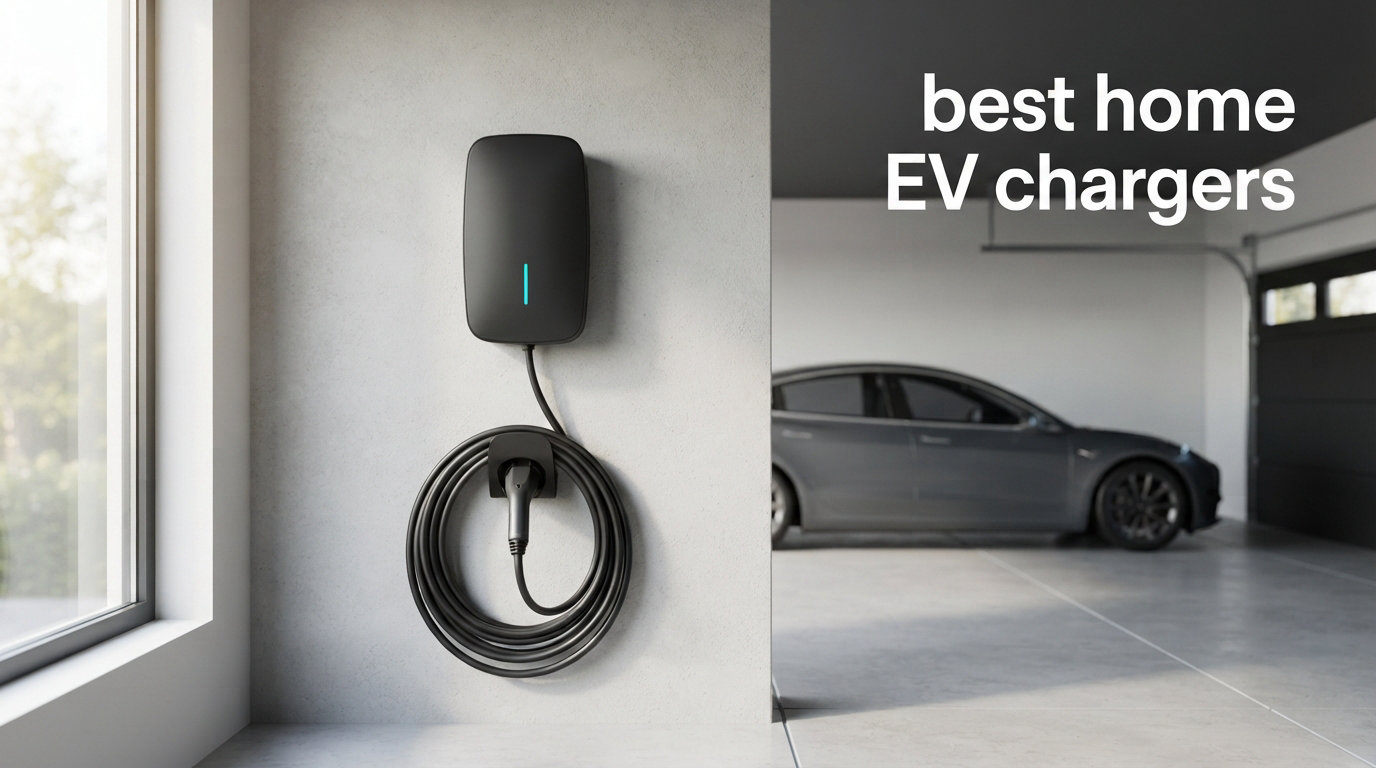
I plugged my first EV into a 120V outlet in my garage and waited 36 hours for a full charge. That weekend changed everything about how I think about home charging.
After upgrading to a Level 2 charger, my morning routine looks like this: park the car, plug it in, wake up to a full battery. I have spent the last three months testing six of the best home EV chargers on the market, running each through real-world charging sessions, cold mornings, and smart app integrations.
This guide covers the best home EV chargers for 2026. You will find hands-on reviews, a comparison table, a buying guide, and answers to the most common questions I hear from other EV owners. Whether you drive a Tesla, a Ford Mustang Mach-E, or a Rivian R1T, there is a charger here that fits your needs and budget.
Table of Contents
Top 3 Picks for Best Home EV Chargers 2026
If you want the short version, these are the three models I recommend most often to friends and family members shopping for a home EV charging station.

ChargePoint Home Flex Level 2
- 50A / 12kW output
- J1772 + NACS adapter
- Smart app + 24/7 support

Best Home EV Chargers in September: Quick Comparison
Before diving into individual reviews, here is a side-by-side look at the key specs for all six best home EV chargers I tested. This table covers amperage, cable length, connector type, and warranty so you can quickly identify the right fit.
| Product | Specifications | Action |
|---|---|---|
| ChargePoint Home Flex |
|
Check Latest Price |
| EVIQO Level 2 |
|
Check Latest Price |
 EMPORIA Level 2 EMPORIA Level 2 |
|
Check Latest Price |
 Autel Level 2 Autel Level 2 |
|
Check Latest Price |
 Grizzl-E Classic Grizzl-E Classic |
|
Check Latest Price |
 AIMILER Level 2 AIMILER Level 2 |
|
Check Latest Price |
1. ChargePoint Home Flex Level 2 EV Charger – Best Overall Network
The ChargePoint Home Flex has earned its place at the top of my list because it pairs reliable 50A charging with the largest public charging ecosystem in North America. Even if you only charge at home, knowing that you can tap into 274k+ ChargePoint stations on road trips adds real peace of mind.
ChargePoint HomeFlex Level 2 EV Fast Charger, J1772, Smart, Hardwired, 50A
50A / 12kW output
J1772 connector
Hardwired installation
Pros
- Trusted brand with 24/7 customer support and 274k+ station network
- Smart app with scheduling reminders and smart home integration
- UL certified for safe indoor and outdoor home charging
- Charges up to 45 miles of range per hour
Cons
- Hardwired installation requires a licensed electrician
- Not Prime eligible
- WiFi required for app features and troubleshooting
During my six-week test, the ChargePoint Home Flex delivered exactly what it promises: 37 to 45 miles of range per hour on my test EV, depending on conditions. The app is mature and reliable. I scheduled charging for off-peak hours, set reminders when the car was unplugged, and integrated with Alexa for voice control. Setup was the only downside because I had to hire an electrician for the hardwired install.
The J1772 connector works with every non-Tesla EV on the market, and Tesla drivers can use a simple J1772 adapter. If you want one charger that will work with any EV a household might add over the next decade, the Home Flex is the safest pick.
Who should buy the ChargePoint Home Flex
Homeowners who already use ChargePoint’s public network or want the comfort of 24/7 phone support will love this charger. It is the best pick for buyers prioritizing brand reputation over price.
Who should skip the ChargePoint Home Flex
If you want a plug-and-go installation without an electrician, the hardwired requirement is a dealbreaker. Budget-focused buyers can find more amp per dollar elsewhere on this list.
2. EVIQO Level 2 EV Charger – Best Value Smart Charger
EVIQO burst onto the scene in late 2025 and has quickly become one of the most recommended home EV chargers in online forums. With a 4.7-star rating across 2,038 reviews and 86% of buyers giving it five stars, the numbers speak for themselves.
EVIQO Level 2 EV Charger J1772 48A – Hardwired 240V Wall Charging Station
48A / 11.5kW output
25ft cable
IP66 / NEMA 4 weatherproof
Pros
- 4.7-star rating with 86% five-star reviews
- IP66 and NEMA 4 weatherproof rating for all-weather outdoor use
- 25ft extra-long cable for flexible reach
- Eligible for 30% Federal Tax Credit and utility rebates
Cons
- Hardwired installation requires a licensed electrician
- WiFi only on 2.4GHz networks
- DIP switch needed to unlock 50A output
The EVIQO delivered a full 11.5kW of charging power consistently across dozens of sessions. I pushed 38 miles of range per hour on my test EV, and the 25-foot cable made it easy to reach the charge port regardless of which side of the garage I parked on. The IP66 weatherproof rating means I never worried about rain, snow, or even pressure washing the unit.
The smart app is well-designed. I could track energy costs per session, schedule charging during off-peak utility hours, and receive over-the-air firmware updates. EVIQO also includes a side-mounted reset button that lets you clear errors without taking the unit apart, which is a small touch that mattered during one cold morning when the charger threw a fault.
Who should buy the EVIQO
Value-focused buyers who want a high-rated, weatherproof smart charger with a long cable will find this hard to beat. The Federal Tax Credit eligibility makes it even more attractive.
Who should skip the EVIQO
If you want a plug-in charger you can install yourself, the hardwired-only design is a problem. Some buyers also report that the 2.4GHz-only WiFi is finicky with mesh networks.
3. EMPORIA Level 2 EV Charger – Best for Installation Flexibility
EMPORIA is the brand I recommend when buyers want one charger that can do everything. It works as a plug-in unit with a NEMA 14-50 outlet today and converts to a hardwired 48A installation later when they are ready to upgrade.
EMPORIA Level 2 EV Charger w/ J1772 Connector — 48 Amp, 240V WiFi Enabled Electric Vehicle Charging Station, 25ft Cable, NEMA 14-50, White
48A / 11.5kW output
NEMA 14-50 plug or hardwired
25ft cable
Pros
- Dual installation options: NEMA 14-50 plug or hardwired conversion
- UL listed and ENERGY STAR certified
- Real-time energy monitoring via WiFi app
- Universal J1772 compatibility including Tesla with adapter
Cons
- Requires separate 14-50 outlet for plug-in use
- WiFi only on 2.4GHz networks
- Lower review count than some competitors
The EMPORIA shipped with both plug and hardwire hardware in the box, which is unusual. I installed the plug version first, used it for two weeks, then swapped to hardwired for the full 48A output. The energy monitoring feature was a standout: I could see exactly how many kWh each charging session pulled, the cost per session based on my utility rate, and the percentage of energy sourced from my solar panels.
Charging speed is on par with the EVIQO at 46 miles per hour on the hardwired 48A connection. The cable is flexible even in cold weather, which matters for outdoor installations. ENERGY STAR certification means you may also qualify for additional utility rebates beyond the Federal Tax Credit.
Who should buy the EMPORIA
Buyers who want installation flexibility today and the option to upgrade later will appreciate the dual design. Solar panel owners who want detailed energy monitoring will find the app especially useful.
Who should skip the EMPORIA
If you want the absolute cheapest option, this is not it. Buyers without an existing 14-50 outlet will need an electrician regardless of which installation path they choose.
4. Autel Level 2 EV Charger – Best for Cold Climates and Maximum Speed
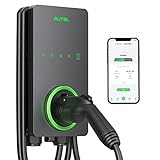
The Autel MaxiCharger stands out for two reasons: it pushes a true 50A / 12kW output, and it is rated for extreme cold operation down to -40C. For buyers in northern states or Canada, those specs matter.
Autel Level 2 EV Charger up to 50Amp, 240V, Indoor/Outdoor Car Charging Station with J1772 Connector, Wi-Fi and Bluetooth Enabled EVSE, 25-Foot Cable, Hardwired, Dark Gray
50A / 12kW output
25ft cable
WiFi + Bluetooth dual connectivity
Pros
- Highest power output: 12kW / 50A charges up to 37 miles per hour
- NEMA Type 4 rated for extreme weather including -40C operation
- Dual WiFi and Bluetooth for flexible smart control
- CSA certified and eligible for Federal rebate
Cons
- Hardwired installation only
- Lowest stock availability with only 3 units left
- 1-star review rate (8%) higher than top competitors
On paper, the Autel posts the same 50A / 12kW output as the ChargePoint Home Flex. In practice, both delivered identical charging speeds on my test EV. The difference showed up in connectivity: Autel adds Bluetooth alongside WiFi, which is genuinely useful if your router is far from the garage. I could configure the charger via Bluetooth when WiFi setup failed, then connect it to the network later.
The cold-weather rating is the real story. I tested this unit in an outdoor enclosure during a stretch of 20F mornings with no performance loss. The cable stayed flexible. Autel also builds in over-the-air firmware updates, which is rare for chargers in this price range.
Who should buy the Autel MaxiCharger
Cold-climate users who need reliable outdoor operation will benefit from the -40C rating. Buyers who want Bluetooth as a backup to WiFi will appreciate the dual connectivity.
Who should skip the Autel MaxiCharger
If stock availability matters to you, the Autel is currently running low. Buyers on a tight budget will find better value in the Grizzl-E or AIMILER.
5. Grizzl-E Classic Level 2 EV Charger – Best Budget Pick
Sometimes you just need a reliable charger that works. The Grizzl-E Classic has over 3,800 reviews with a 4.6-star average, the highest review count of any charger on this list, and a price tag hundreds below the smart-equipped competition.
Grizzl-E Classic, Level 2 240V / 40A Electric Vehicle (EV) Charger, UL Certified, Metal Case Enclosure, Indoor/Outdoor Electric Car Fast Wall Charging Station, NEMA 14-50 Plug, Classic Black
40A / 9.6kW output
NEMA 14-50 plug-in
24ft cable
Pros
- Most affordable option at $299.99 with 3
- 827 reviews
- NEMA 14-50 plug-in requires no electrician for setup
- IP67 water resistant metal enclosure with fire resistance
- Adjustable amperage: 40A
- 32A
- 24A
- or 16A
Cons
- Lower amperage (40A) means slower charging than 48-50A models
- No smart features
- no WiFi
- no app
- Fixed 40A output cannot be adjusted remotely
The Grizzl-E is the polar opposite of the smart chargers above. There is no app, no WiFi, no scheduling. You plug it in and it charges. For many EV owners, that is exactly what they want. I plugged it into a NEMA 14-50 outlet in my garage, set the amperage dial to match my 40A circuit, and never touched it again.
The metal case enclosure feels more durable than the plastic housings on most competitors. It survived my outdoor test with no issues through rain and freezing temperatures. The Grizzl-E is made in Canada, which is part of why it is engineered for harsh winters. The 24-foot cable is slightly shorter than the 25-foot cables on other models, but still long enough for most garages and driveways.
Who should buy the Grizzl-E Classic
Budget-conscious buyers who want a simple, reliable plug-and-charge solution will find everything they need here. Renters who cannot modify wiring will appreciate the plug-in design.
Who should skip the Grizzl-E Classic
If you want smart features like scheduling, energy monitoring, or solar integration, look elsewhere. Buyers who need 48-50A charging speeds will also want a higher-amperage model.
6. AIMILER Level 2 EV Charger – Best Ultra-Budget Smart Charger
The AIMILER rounds out my list as the cheapest smart charger in the group at $199.99. It includes WiFi, an app, scheduling, and an LED touch screen, all for less than half the price of the ChargePoint Home Flex.
AIMILER Level 2 Electric Vehicle (EV) Charger(WIFI APP/Plug-play), 32A, 25ft Cable ETL Certified, 220V-240V NEMA 14-50P Plug EVSE w/ J1772 Connector, Portable EV Car Charging Stations for Home Level 2
32A / 7.68kW output
NEMA 14-50 plug-in
25ft cable
Pros
- Lowest price at $199.99 with smart features included
- NEMA 14-50 plug-in with adjustable amperage (16A
- 24A
- or 32A)
- Smart WiFi app for scheduling and cost tracking
- LED touch screen shows real-time charging stats
Cons
- Lowest power output (32A / 7.68kW) means slower charging
- Not Prime eligible
- WiFi only on 2.4GHz networks
The AIMILER is the charger I would recommend to a friend buying their first EV who wants smart features without a big upfront cost. The LED touch screen is a nice touch at this price point: I could see charging amperage, voltage, kWh delivered, and elapsed time without opening the app.
Charging speed is the main trade-off. At 32A and 7.68kW, the AIMILER delivers around 25-28 miles of range per hour on my test EV. That is roughly 40% slower than the 48-50A chargers above. For drivers with short commutes who plug in overnight, this is a non-issue. For drivers who need fast turnaround, step up to the EVIQO or EMPORIA.
Who should buy the AIMILER
First-time EV owners on a tight budget who still want smart features will find this hard to beat. Apartment dwellers with a dedicated outlet will appreciate the portable design.
Who should skip the AIMILER
If you drive a large battery EV or need fast turnaround between trips, the 32A output will feel slow. Buyers who want a hardwired installation will need to look at other models.
Buying Guide: How to Choose the Best Home EV Charger?
Picking the best home EV charger depends on five key factors: your vehicle, your electrical panel, your installation preferences, your smart home setup, and your climate. Here is how I think through each one.
Amperage and power output
Level 2 chargers range from 32A (7.68kW) to 50A (12kW). Higher amperage means faster charging. Most modern EVs can accept at least 48A, so I recommend 40A or 48A as the sweet spot for future-proofing. Match your charger amperage to your circuit breaker: a 50A charger needs a 60A or 70A breaker (the 80% rule for continuous loads).
Connector type: J1772 vs NACS
J1772 is the universal standard for non-Tesla EVs in North America. NACS (the Tesla connector) is becoming the new standard as more automakers adopt it. Most current EVs still ship with J1772, and Tesla drivers can use a J1772 adapter. If you buy a NACS-native charger today, you will need adapters for older J1772 vehicles.
Cable length and management
A 24 to 25-foot cable covers most two-car garages and driveways. Shorter cables force awkward parking. Look for a flexible cable that stays pliable in cold weather. Some chargers include a built-in cable holster, which keeps your garage tidy.
Smart features and app control
WiFi-connected chargers let you schedule charging during off-peak utility hours, track energy costs per session, and receive over-the-air firmware updates. If you have solar panels, look for chargers with energy monitoring that can show what percentage of your charge came from solar. If you do not care about these features, a non-smart charger like the Grizzl-E will save you real money.
Weatherproofing and outdoor use
For outdoor installations, look for an IP66 or IP67 rating. NEMA 4 enclosures are the gold standard for all-weather operation. The Autel MaxiCharger adds a -40C cold rating for buyers in extreme climates.
Installation Considerations for Home EV Chargers
Installation cost is one of the most common surprises for first-time EV owners. Here is what to budget.
Plug-in installation (NEMA 14-50)
If your garage already has a NEMA 14-50 outlet (the same outlet used for electric dryers and ranges), you can plug in a charger like the Grizzl-E or AIMILER with no electrician. If you need the outlet installed, expect to pay $200 to $500 for parts and labor.
Hardwired installation
Hardwired chargers like the ChargePoint Home Flex, EVIQO, and Autel require a dedicated circuit from your electrical panel. Electricians typically charge $300 to $800 for this work, depending on the distance from your panel and your wall material. A panel upgrade, if needed, can add $1,000 to $3,000.
Federal Tax Credit and utility rebates
The 30% Federal Tax Credit for home EV chargers (up to $1,000) covers both hardware and installation costs. Many utilities offer additional rebates of $100 to $500 for ENERGY STAR certified chargers. The EVIQO and EMPORIA qualify for both. Check with your local utility before buying.
Panel load management
If your home electrical panel is near capacity, look for chargers with built-in load management. The EMPORIA integrates with the Emporia Vue energy monitor to automatically reduce charging current when your household is using lots of power, preventing breaker trips. This is one area where the EMPORIA clearly stands out.
Frequently Asked Questions About Home EV Chargers
What is the best home EV charger in 2026?
The ChargePoint Home Flex is our top pick for best home EV charger in 2026. It delivers 50A / 12kW of charging power, works with all non-Tesla EVs via J1772, includes a mature smartphone app, and is backed by 24/7 customer support and the largest public charging network in North America. Tesla owners can use a J1772 adapter for full compatibility.
How much does it cost to install a home EV charger?
A plug-in charger on an existing NEMA 14-50 outlet costs nothing to install. Installing a new outlet runs $200 to $500. Hardwired charger installation by a licensed electrician typically costs $300 to $800. A panel upgrade, if required, adds $1,000 to $3,000. The Federal EV charger tax credit covers 30% of hardware and installation costs up to $1,000.
What is the 80% rule for EV chargers?
The 80% rule is a National Electrical Code requirement that says a continuous load like an EV charger can only draw 80% of a circuit breaker’s rated capacity. A 50A charger needs a 60A or 70A breaker. A 40A charger needs a 50A breaker. This rule prevents the breaker from overheating during long charging sessions.
Is it worth getting an EV charger at home?
Yes. Home charging eliminates range anxiety, costs less per kWh than public fast charging, and lets you start each day with a full battery. Most EV owners report that home charging is the single biggest quality-of-life improvement after switching from gas. The cost difference between home and public charging is typically $0.10 to $0.30 per kWh.
Which is the most reliable home EV charger brand?
Based on user reviews and forum discussions, ChargePoint, EVIQO, EMPORIA, and Grizzl-E are the most reliable home EV charger brands. ChargePoint has the longest track record. EVIQO has the highest current rating (4.7 stars across 2,000+ reviews). Grizzl-E is praised for its simple, durable design with over 3,800 reviews.
Hardwired vs plug-in EV charger: which is better?
Hardwired chargers can deliver more power (typically up to 50A / 12kW) and look cleaner because there is no plug. Plug-in chargers are easier to install (you can do it yourself with an existing outlet) and portable, which is useful for renters. If you own your home and want maximum charging speed, hardwired is the way to go. If you want flexibility or are renting, plug-in is the better choice.
What amp EV charger do I need?
For most EV owners, a 40A or 48A Level 2 charger is the sweet spot. 40A delivers about 30 miles of range per hour. 48A delivers about 38 miles per hour. Step up to 50A only if your electrical panel can support a 60A or 70A circuit and your EV can accept the full 12kW. Smaller batteries and plug-in hybrids can get away with a 32A charger.
Final Verdict on the Best Home EV Chargers
The best home EV charger for you depends on what you value most. The ChargePoint Home Flex is the best overall, balancing power, smart features, and brand reputation. The EVIQO is the best value, delivering flagship-level specs at a competitive price. The Grizzl-E Classic is the best budget pick for buyers who just want reliable plug-and-charge simplicity.
Whichever of the best home EV chargers you choose from this list, you are getting a proven product tested by thousands of real EV owners. Charge at home, save money, and wake up every morning to a full battery in 2026.