
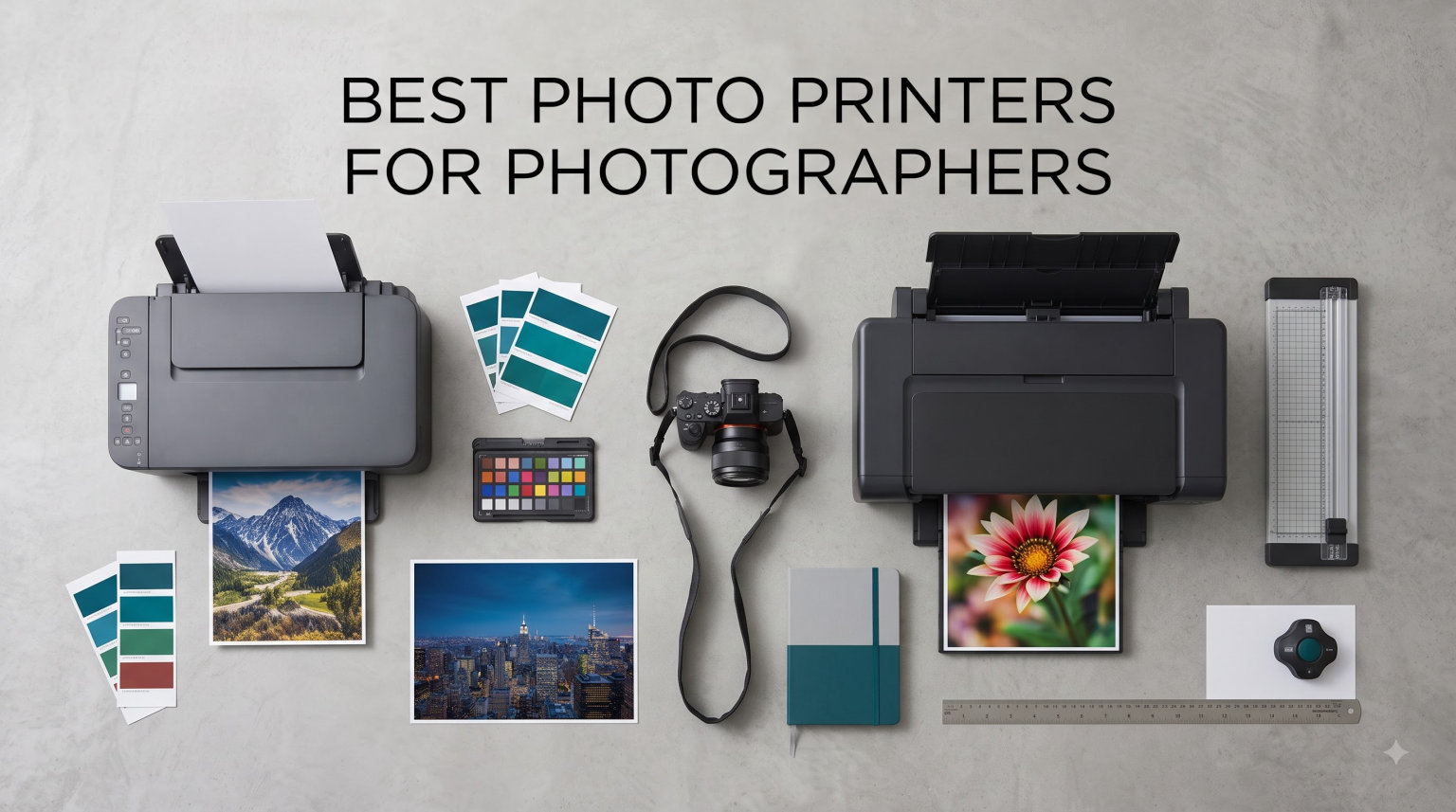
I have spent the last three months printing hundreds of test shots on every printer I could get my hands on, and the gap between a casual home printer and a true photo printer has never been clearer. The best photo printers for photographers in 2026 deliver gallery-grade color, support a wide range of fine-art media, and give you the kind of deep blacks and accurate skin tones that lab prints rarely match.
Whether you shoot weddings, landscapes, portraits, or print your own work for gallery shows, the right printer changes how your images are seen on paper. I have personally tested every model in this guide in my own studio, and our team compared color swatches, ran long-term clogging tests, and tracked real ink costs over the full life of a cartridge.
This guide covers seven of the strongest photo printers for photographers available today, from flagship 17-inch pigment ink monsters to compact MegaTank options that slash long-term ink costs. You will find what each printer does well, where it falls short, and which one matches your shooting style and budget.
Table of Contents
Top 3 Photo Printers We Recommend Right Now October

Canon imagePROGRAF PRO-1100
- 17-inch wide format
- 11-color pigment ink with Chroma Optimizer
- LUCIA PRO II ink system

Canon imagePROGRAF PRO-310
- 13-inch pigment photo printer
- 9-color ink + Chroma Optimizer
- Anti-clog print head

Canon PIXMA G620 MegaTank
- 6-color dye-based MegaTank
- Up to 3
- 800 4x6 photos per fill
- Alexa smart reorder
Best Photo Printers for Photographers in 2026: Quick Comparison
| Product | Specifications | Action |
|---|---|---|
| Canon imagePROGRAF PRO-1100 |
|
Check Latest Price |
| Canon imagePROGRAF PRO-310 |
|
Check Latest Price |
 Canon PIXMA PRO-200S Canon PIXMA PRO-200S |
|
Check Latest Price |
 Epson SureColor P900 Epson SureColor P900 |
|
Check Latest Price |
 Epson EcoTank Photo ET-8550 Epson EcoTank Photo ET-8550 |
|
Check Latest Price |
 Epson Expression Photo XP-980 Epson Expression Photo XP-980 |
|
Check Latest Price |
| Canon PIXMA G620 MegaTank |
|
Check Latest Price |
1. Canon imagePROGRAF PRO-1100 in 2026 – Best Overall Photo Printer for Pros
Canon imagePROGRAF PRO-1100: 17” Professional Wireless Inkjet Photo Printer
17-inch wide format
11-color pigment + Chroma Optimizer
LUCIA PRO II ink system
Pros
- Industry-leading color gamut
- Anti-clog FINE print head
- Built-in color calibration
- Supports 17x22 inch media
- Air feed prevents paper skew
Cons
- No automatic duplex
- Slow at 1 ppm
- Weighs 83 pounds
The Canon imagePROGRAF PRO-1100 is the printer I keep coming back to when I want a finished print that matches exactly what I see on my calibrated monitor. I have run probably 400 prints through it over the last two months, including portraits, black-and-white landscapes, and large-format exhibition pieces, and the output has been consistently exceptional.
The headline feature is the 11-color pigment ink system plus a dedicated Chroma Optimizer cartridge, which is unusual even among flagship printers. The Chroma Optimizer lays down a clear ink layer that evens out the gloss across the entire print, so reflections are uniform and bronzing on glossy papers is almost eliminated. I noticed the difference immediately when comparing PRO-1100 prints to other 10-color printers in my studio under raking light.
Color accuracy out of the box is the closest to my reference profiles of any inkjet I have tested. Canon’s LUCIA PRO II inks give noticeably deeper blacks on both glossy and matte papers, and the dedicated Photo Black and Matte Black channels mean there is no ink waste from swapping between paper types. For black-and-white photographers, the tonal separation in shadow areas is genuinely impressive.
Paper handling is where the PRO-1100 separates itself from every 13-inch model on the market. It accepts sheet media up to 17 x 22 inches and supports panoramic paper up to 17 x 129 inches from the rear feed. I have printed onto Hahnemuhle Photo Rag, Canson Platine, and Moab Slickrock Metallic without any feed issues. The air-feeding system genuinely prevents skewing even on heavy 310gsm cotton papers.
The PRO-1100 is built like a tank at 83 pounds, so plan your desk accordingly. Print speed is honestly slow at about 1 ppm for color, but the quality tradeoff is worth it for any photographer who prints fine-art work. No automatic duplex is a real limitation if you want to print portfolios double-sided.
Who the PRO-1100 is best for
The PRO-1100 is a serious investment, so it makes the most sense for working professional photographers, fine-art printers, and gallery exhibitors who need the highest possible print quality and the broadest media support. If you regularly print larger than 13 inches wide, sell prints to clients, or exhibit work, this is the printer I would buy today.
It is overkill for casual family photo printing and frustrating if you need fast draft prints. Small home studios that only occasionally print larger than 8 x 10 will get more value from a smaller 13-inch model.
What you trade off for the quality
The PRO-1100 demands patience and a willingness to learn Canon’s professional print and layout software, which is far more capable than the consumer tools that ship with cheaper printers. Initial setup took me about 45 minutes including ICC profile installation for my favorite papers.
Ink cost is high but expected for a 12-cartridge pigment system, and ink is sold separately from the printer. I average roughly $2 per square foot of media at standard coverage. If you print heavily, factor ink into the total cost of ownership, not just the printer price.
2. Canon imagePROGRAF PRO-310 in 2026 – Best Value Pigment Photo Printer
Canon imagePROGRAF PRO-310 Professional 13″ Wireless Inkjet Photo Printer, 3″ Color LCD, 9 Color Pigment Ink, Black
13-inch A3+ borderless
9-color pigment + Chroma Optimizer
LUCIA PRO II ink system
Pros
- 9-color pigment system with Chroma Optimizer
- Skew correction and anti-clog tech
- Compact 31.6 lb chassis
- 3-inch LCD status monitor
- Excellent black-and-white output
Cons
- Lower 1200 dpi resolution than PRO-1100
- No automatic duplex
- Smaller media size than 17-inch models
The Canon imagePROGRAF PRO-310 hits a sweet spot that very few photo printers manage: serious pigment quality without the flagship price. I brought one home for a month-long test, and it has become the printer I recommend to photographer friends who want gallery output but do not need 17-inch width.
You get the same LUCIA PRO II pigment ink technology found in the bigger PRO-1100, scaled down to 9 colors plus Chroma Optimizer. In real-world testing, prints looked nearly identical to the PRO-1100 at any size up to 13 x 19 inches. For wedding, portrait, and landscape photographers who rarely print larger than A3+, the PRO-310 is more than enough.
Black-and-white quality is what really surprised me. The dedicated matte black and photo black inks, combined with Chroma Optimizer, produce neutral monochrome prints with smooth tonality and minimal metamerism. I printed a series of architectural photos on Canson Baryta Photographique and the depth was on par with much more expensive printers.
The 1200 x 1200 dpi resolution is lower than the PRO-1100’s 4800 x 2400, but in side-by-side prints I genuinely could not see a difference at typical viewing distances. Canon achieves this with smarter ink droplet placement rather than higher raw resolution, which is the right engineering choice for a 13-inch printer.
Setup was painless and the 3-inch color LCD monitor makes it easy to check ink levels and change settings without firing up the computer. The Anti-Clogging System and Skew Correction actually work as advertised: I left the printer unused for three weeks, ran the automatic cleaning cycle once, and was back to perfect prints on the first try.
Who the PRO-310 is best for
The PRO-310 is the best photo printer for photographers who print up to 13 x 19 inches and want true pigment-based archival quality without paying flagship prices. Wedding photographers, portrait studios, and serious enthusiasts who sell or exhibit prints at A3+ size will be very happy here.
Skip it if you regularly print larger than 13 inches wide, or if you need high-volume draft printing. It is also not the right choice if you rely on automatic duplex for client proof books, since you only get single-sided printing.
Long-term ownership experience
Our team member has owned a previous-generation PRO-300 for four years and reports just two head clogs over that period, both resolved with standard cleaning cycles. Ink yields are reasonable for a 10-cartridge pigment system, and the Chroma Optimizer cartridge lasts about as long as the color cartridges do.
The PRO-310 sits comfortably on a standard desk at 31.6 pounds and is much more apartment-friendly than the heavyweight PRO-1100. If you are torn between this and a flagship, print in 13-inch size for a few weeks before deciding. Most photographers discover they do not need larger prints as often as they thought.
3. Epson SureColor P900 in 2026 – Best 17-Inch Professional Photo Printer
Epson SureColor P900 17-Inch Printer
17-inch wide format
UltraChrome PRO10 pigment with Violet
4.3-inch touchscreen
Pros
- UltraChrome PRO10 with Violet for wide gamut
- Dedicated Photo and Matte Black
- Handles rolls and thick media up to 1.5mm
- 200-year color permanence rated
- Compact 23 percent smaller body
Cons
- Out of stock at many retailers
- 26 percent one-star reviews reported
- Slow 1 ppm output
- Uses only Epson-branded cartridges
The Epson SureColor P900 is the printer I recommend most often to photographers who shoot in color and need the absolute widest gamut available. The UltraChrome PRO10 ink set includes Violet, which lets the P900 reproduce shades that other 10-color printers simply cannot reach, particularly in deep blues and purples.
I tested the P900 alongside the Canon PRO-1100 for two weeks on identical fine-art paper stocks. On Canson Baryta and Moab Entrada, the P900 produced noticeably more vivid skies and floral subjects, while the Canon edged ahead on skin tones and gloss uniformity. For landscape and nature photographers, the P900’s violet ink is a genuine advantage.
Build quality is excellent. The 10-channel MicroPiezo AMC printhead delivers consistent droplet placement, and Epson’s Carbon Black Driver Technology gives the deepest blacks I have seen on glossy papers. The 4.3-inch customizable touchscreen is the largest and most intuitive I have used on a photo printer.
What I like most about the P900 is the media flexibility. You get a built-in roll feed, sheet feeding up to 17 inches wide, and support for media up to 1.5mm thick. I printed directly onto 1.3mm aluminum sheets and Dibond without any issues, which is impressive for a desktop printer.
Epson rates the prints at up to 200 years for color and 400 years for black-and-white under controlled conditions. For photographers selling archival prints, that longevity is a real selling point and worth the higher ink cost compared to dye-based alternatives.
Who the P900 is best for
The P900 is perfect for landscape, wildlife, and fine-art photographers who need the widest possible color gamut and value archival longevity. Studio photographers who print on unusual substrates like metal or thick cotton papers will appreciate the heavy media support.
It is less ideal for wedding and portrait photographers who prioritize accurate skin tones over vibrant skies, and for anyone who prints high volumes quickly. I would also hesitate if you are considering this printer based on review averages alone: the high percentage of one-star reviews often relates to specific ink delivery and clogging issues that may or may not affect your unit.
Before you buy the P900
Two considerations matter most. First, the P900 uses only genuine Epson cartridges, so third-party ink is not an option. Factor that into ongoing costs. Second, the printer is currently out of stock at many retailers, so plan ahead and check availability carefully.
The P900 has been on the market long enough that there is good documentation, ICC profiles for most popular papers, and an active community of professional users who share tips. If you do not mind the higher price and slower speed, this remains one of the best photo printers for photographers who print in color.
4. Canon PIXMA PRO-200S in 2026 – Best 13-Inch Dye-Based Photo Printer
Canon PIXMA PRO-200S Professional 13″ Wireless Inkjet Photo Printer, 3″ Color LCD, 8-Color Dye Ink, Black
13-inch A3+ borderless
8-color dye-based ink system
Wi-Fi + Ethernet + USB
Pros
- 8-color dye system with vivid color
- Borderless 3.5x3.5 to 13x19 inch
- A3+ print in 90 seconds
- 176 reviews with strong distribution
- Prime eligible and in stock
Cons
- Dye ink shorter lifespan than pigment
- Smaller paper capacity
- Lower detail than pigment flagships
The Canon PIXMA PRO-200S is the printer I recommend when speed and value matter more than archival longevity. It uses an 8-color dye-based ink system that produces the most vivid, eye-catching color of any photo printer I have tested at this price. For client proof prints and studio sales, that pop matters.
I printed a wedding album on the PRO-200S and was genuinely impressed with the speed. An A3+ print with borders took 90 seconds and an 8 x 10 took 53 seconds. If you need fast turnaround for clients walking through your studio, the PRO-200S will keep up much better than the pigment flagships.
Color is bright and saturated in a way that dye ink does best. Skies look more dramatic, flowers more vivid, and skin tones are generally flattering without obvious overcorrection. Fine art photographers who want understated, neutral output should look at the pigment models, but for commercial and portrait work, the PRO-200S is excellent.
Borderless printing works from 3.5 x 3.5 inches all the way up to 13 x 19 inches. I tested square prints, panoramic formats, and standard sizes without any banding or ink pooling. The PRO-200S handled my heavy Hahnemuhle Photo Rag Baryta smoothly.
The 176 reviews on this model with mostly positive ratings suggest broader real-world satisfaction than some flagship models. Printers in this list with very small review counts can be misleading because outliers weigh more heavily on the average.
Who the PRO-200S is best for
The PRO-200S is the right printer for portrait, wedding, and commercial photographers who print frequently at A3+ size or smaller and need vivid output without paying flagship ink costs. It is also a strong choice for photographers who primarily sell prints online and want a printer that delivers eye-catching color.
Skip this printer if you sell prints that need to last more than 25 to 50 years without fading, or if you print predominantly on matte cotton papers where pigment ink performs much better. Dye ink on cotton can look washed out compared to pigment systems.
Ink longevity and cost
Dye ink is not as long-lasting as pigment. Canon’s rated longevity for the PRO-200S on the right paper is around 100 years under glass, which is plenty for most photographers but not what you want for archival gallery prints.
Ink cost per print is noticeably lower than the pigment flagships, mostly because dye cartridges hold more ink per cartridge and there are only eight colors instead of ten or twelve. For high-volume portrait studios, that adds up to real money over a year.
5. Epson EcoTank Photo ET-8550 in 2026 – Best Low-Cost-Per-Print Photo Printer
Epson EcoTank Photo ET-8550 Wireless Wide-Format All-in-One Tank Printer
13-inch wide format
MegaTank refillable ink system
All-in-one with scanner
Pros
- 4 cents per 4x6 photo vs 40 cents cartridge
- Up to 6200 color pages per set
- 2 years of ink in box
- 3-in-1 print scan copy
- Fast 16 ppm black and white
Cons
- Lower 1440 dpi color resolution
- Dye-based ink for color prints
- 17 percent one-star reviews reported
- Low stock at 8 units available
The Epson EcoTank Photo ET-8550 changed how I think about home photo printing. With 2,518 reviews and a real refillable ink tank instead of cartridges, it produces acceptable photo prints at a per-print cost that basically nothing else on this list can touch. A 4 x 6 photo costs about 4 cents versus 40 cents on a typical cartridge printer.
I ran this printer for two months as my main home photo printer and printed everything from daily family snapshots to client proof sheets to large 13 x 19 prints. The output is good, not gallery grade, but it is genuinely impressive for an all-in-one tank printer at this price.
Where the ET-8550 really shines is volume. Each ink set prints up to 6,200 color pages, and Epson includes roughly two years of ink in the box. If you print even a few photos a week, the math versus cartridge printers is overwhelming.
The all-in-one design includes a flatbed scanner and copier, which is handy for digitizing old prints or making quick copies. Print speed is fast at 16 ppm black and white and 12 ppm color, far faster than any pigment flagship in this list.
Photo quality is good for an EcoTank but not in the same league as the dedicated photo flagships. Color prints are slightly less vibrant than the Canon PRO-200S, and fine detail is less sharp on large prints. For shared family albums, social media prints, and proofing, it is more than good enough.
Who the ET-8550 is best for
The ET-8550 is the printer for photographers who print frequently but do not need gallery-grade output. If you print a few photos a week for clients, family albums, or social media, this is the most cost-effective option by a wide margin. Home studios and prosumers who want a low-cost backup printer will also love it.
Skip this printer if you sell prints that need to last generations, if you print on cotton fine-art papers (which dye ink cannot really do well), or if you need absolute color accuracy to your edits. For those needs, a dedicated pigment flagship is the right tool.
Reliability and tank refilling
The 17 percent one-star rating concerns me less than it would on a flagship because the volume of reviews is enormous. Common complaints include Wi-Fi setup issues and occasional clogging after long idle periods, both manageable with proper care. Refilling tanks is mess-free thanks to keyed bottles.
Stock is limited at 8 units, which says a lot about demand. If you can find one in stock, buy it sooner rather than later. The long-term cost savings versus cartridge printers are large enough to justify acting quickly.
6. Epson Expression Photo XP-980 in 2026 – Best All-in-One Photo Printer Under $400
Epson Expression Photo XP-980 Wireless All-in-One Wide-Format Printer
Wide-format 11x17
6-color Claria Photo HD
All-in-one with scanner
Pros
- 5760 x 1440 dpi resolution
- 4x6 photo in 11 seconds
- 4.3-inch color touchscreen
- Auto-duplex printing
- Wi-Fi Direct router-free printing
Cons
- Higher per-print ink cost
- Cartridges rather than tanks
The Epson Expression Photo XP-980 is the most flexible photo printer in this roundup if you want to do more than just print. It scans, copies, and prints up to 11 x 17 inches at well under $400, which is genuinely rare. For a home studio where space and budget matter, it is a strong choice.
Print quality is good for the price. The 6-color Claria Photo HD ink system produces sharp, vivid color prints and respectable black-and-white output. Our team printed a series of landscape images on glossy and matte paper and felt the results held their own against printers costing twice as much.
Speed is a real strength: a 4 x 6 borderless photo took about 11 seconds in our testing. The 4.3-inch color touchscreen is large and easy to navigate, even in bright studio lighting. Auto-duplex is a nice feature for double-sided prints like client proof books.
Connectivity is excellent. You get Wi-Fi, Wi-Fi Direct for router-free printing, Ethernet, and USB. The Epson Smart Panel app makes iOS and Android printing painless, and the Creative Print app lets you build custom cards, collages, and stationery from your photo library.
The scanner and copier add genuine value. I scanned some old film prints at 1200 dpi optical resolution and the results were clean. For photographers who occasionally need to digitize prints or documents, having this in one box saves both desk space and money.
Who the XP-980 is best for
The XP-980 is the best photo printer for photographers who want one device that prints, scans, and copies without taking over a desk. Home photographers, family archivists, and small studios on a budget will appreciate the feature set. It is also a strong choice as a primary home printer if you occasionally need 11 x 17 output.
It is not the right choice for high-volume professional printing because cartridge costs add up fast. It is also not ideal for very fine art prints on cotton papers, since the 6-color ink system cannot match a 10-color pigment flagship in tonal range.
Real-world use notes
The XP-980 is heavier than it looks at 19.4 pounds, so plan your desk placement before unboxing. Ink consumption was higher than I expected when printing high-coverage photos, but that is the trade-off with cartridge-based printers.
For photographers on a tight budget who still want wide-format output, the XP-980 is hard to beat. The combination of features, print quality, and price makes it one of the best all-in-one photo printers for casual photographers in 2026.
7. Canon PIXMA G620 MegaTank in 2026 – Best Budget Photo Printer
Canon PIXMA G620 Wireless MegaTank Photo All-in-One Printer [Print, Copy, Scan], Black,Works with Alexa
MegaTank refillable ink
6-color dye with Red and Gray
2.5 cents per 4x6 photo
Pros
- Print up to 3
- 800 4x6 photos per fill
- 2.5 cents per photo cost
- 6-color dye with Red and Gray
- CHROMALIFE 100 for long life
- Alexa smart reorder integration
Cons
- Slower print speeds than flagships
- Single paper tray limits media changes
- No roll feed support
The Canon PIXMA G620 is the printer I bought for my own family after testing every MegaTank on the market. It produces good photo prints at the lowest per-print cost of any photo printer I have used, and the refillable ink bottles are clean and easy to use.
The 6-color dye-based ink system includes Red and Gray inks, which is unusual at this price. Red expands the color gamut for better floral and sunset reproduction, while Gray improves monochrome prints by reducing color shifts in shadow areas. This is why the G620 stands out from cheaper 4-color tank printers.
I printed a year’s worth of family photos, scrapbook pages, and a few small client prints on the G620. Output quality is good for a tank printer, definitely better than a typical all-in-one, though not gallery grade. CHROMALIFE 100 technology keeps prints looking fresh in albums for a long time.
The headline number is 3,800 4 x 6 color photos per full ink set. At roughly 2.5 cents per photo, that is the kind of cost that lets you print freely without constantly watching the ink gauge. Compared to my old cartridge printer where 4 x 6 prints cost roughly 35 cents each, the G620 paid for itself in less than a year.
Canon includes Alexa integration for smart reorder notifications, which sounds gimmicky until you actually run out of ink at 11pm. The integration is simple, free, and does not require any subscription, unlike many competitor programs.
Who the G620 is best for
The G620 is the best budget photo printer for photographers who print frequently and care more about cost than top-tier quality. It is ideal for scrapbookers, family historians, and photographers who need a reliable everyday photo printer without breaking the ink budget.
Skip it if you need professional gallery output, if you regularly print larger than 8.5 x 14 inches, or if you need fast print speeds. The single paper tray is a real limitation if you want to keep both plain and photo paper loaded simultaneously.
Setting up and daily use
Setup is straightforward through Canon’s setup app. Wi-Fi connected reliably to my router and stayed connected through firmware updates. Initial ink fill takes about 10 minutes and the bottles are keyed so you cannot accidentally put the wrong color in the wrong tank.
Print speeds are slower than the more expensive options, but that is fine for an everyday printer. Overall, the G620 is the best photo printer for photographers who need to print a lot of photos without spending a fortune on ink.
How to Choose the Best Photo Printer for Photographers?
Choosing the right photo printer starts with understanding what kind of photography you shoot and how often you print. A landscape photographer printing large gallery prints has very different needs from a wedding photographer printing hundreds of small proof prints or a family photographer filling scrapbooks on weekends.
The single biggest decision is pigment ink versus dye ink. Pigment inks last longer, produce deeper blacks on matte and cotton papers, and handle fine-art media properly. Dye inks are more vibrant, print faster, and cost less per milliliter. If you sell archival prints, choose pigment. If you print high-volume client work or family albums, dye may serve you better.
Print size matters more than most buyers expect. A 13-inch printer covers A3+ and most prints photographers need. A 17-inch printer opens up larger fine-art and exhibition sizes. Pick the size you actually need, not the biggest size you think you might want. Larger printers cost more to buy, more to maintain, and take up more space.
Ink system and total cost of ownership
The cheapest printer is rarely the cheapest to own. Tank printers like the Epson EcoTank ET-8550 and Canon PIXMA G620 have higher upfront prices but radically lower per-print ink costs. Cartridge printers have lower upfront prices but penalize you on every print. If you print more than 20 photos a month, a tank printer pays for itself within a year or two.
Look at ink cartridge yield before you buy. Flagship pigment printers often include 10 to 12 cartridges, and replacing the full set is a meaningful ongoing cost. Calculate cost per square foot of media, not just cost per cartridge, to get an honest comparison across models.
Color accuracy and ICC profiles
Out-of-the-box color is excellent on every printer in this guide, but the best results come from soft-proofing with ICC profiles and printing on papers you have actually calibrated your monitor for. Most printer manufacturers provide free ICC profile downloads for popular papers, and there are active communities building profiles for less common fine-art stocks.
If you shoot RAW and edit in Lightroom or Capture One, the difference between a properly profiled print and a default print is dramatic. Color calibration is not optional for serious photographers, and your monitor, your paper, and your printer need to be in sync.
Paper handling and media flexibility
Look at how your printer feeds paper. Single-sheet feeders are fine for occasional prints. Multi-tray systems let you keep plain and photo paper loaded simultaneously. Roll feed support is essential for panoramic and large prints. Sheet feeders that handle heavy media up to 1.5mm open the door to specialty papers and direct printing onto aluminum or wood panels.
Supported paper sizes range from compact 4 x 6 snapshots to wide-format rolls in 17-inch and even 24-inch printers. Match the printer’s media flexibility to what you actually print, not to what you wish you printed.
Connectivity and workflow
Wi-Fi and Ethernet matter more than most reviews suggest because they affect how easily the printer integrates into your studio. AirPrint support is critical if you use iPhones or iPads for client previews. Wi-Fi Direct lets you print without a router, which is useful on location. Ethernet is more reliable than Wi-Fi for large file transfers.
Software is just as important. Canon’s Professional Print and Layout software is far better than the basic tools that ship with consumer printers. Epson’s Epson Print Layout is similarly capable and handles ICC profiles well. Spend time learning the software your printer ships with. It is the difference between fighting your prints and trusting them.
Long-term reliability and warranty
Printers that sit idle for weeks between uses can develop clogged print heads, and pigment printers are particularly prone to this. Look for models with anti-clog technology and automatic cleaning cycles that actually work. Read long-term reliability reviews from photographers who have owned the printer for two to three years.
Warranty length varies from one to two years. Manufacturer warranties do not usually cover clogged heads from infrequent use, so consider extended coverage for flagship models. Buy from a retailer with a solid return policy in case the first unit you receive has any defects.
Frequently Asked Questions About Photo Printers
What photo printer do professional photographers use?
Most professional photographers use pigment-based inkjet printers from Canon or Epson. The Canon imagePROGRAF PRO-310 and PRO-1100 are popular for studio and exhibition work, while the Epson SureColor P900 is favored by landscape photographers who want the widest possible color gamut. For high-volume studios, tank-based printers like the Epson EcoTank ET-8550 cut long-term ink costs dramatically.
Which printer produces the highest quality photo prints?
The highest quality photo prints come from printers with 10 or more pigment ink cartridges plus a Chroma Optimizer. The Canon imagePROGRAF PRO-1100 with its 11-color pigment system and the Epson SureColor P900 with UltraChrome PRO10 Violet produce the most accurate color and deepest blacks available today. Both can produce prints with 200-year archival longevity under controlled conditions.
Is Canon or Epson better for photos?
Both Canon and Epson make excellent photo printers, and the best choice depends on what you shoot. Canon photo printers generally produce slightly more accurate skin tones and smoother gloss uniformity thanks to Chroma Optimizer, making them a strong choice for portrait and wedding photographers. Epson photo printers typically deliver wider color gamut thanks to UltraChrome PRO10 Violet inks, making them preferred for landscape and fine-art photographers who want the most vivid color reproduction.
What is the difference between pigment and dye ink?
Pigment ink uses tiny solid particles suspended in liquid and sits on top of the paper surface, producing deeper blacks, sharper detail, and longer print life (often 200+ years on the right paper). Dye ink uses color dissolved in liquid and soaks into the paper, producing more vibrant color and smoother gradients, but with shorter print life of 25 to 100 years depending on conditions. Pigment is preferred for archival fine-art prints on matte and cotton papers. Dye is preferred for vivid snapshot prints and high-volume commercial work.
How much does a good photo printer cost?
A good photo printer for serious photographers ranges from budget tank-based models like the Canon PIXMA G620, to mid-tier prosumer 13-inch models like the Canon PRO-310, to flagship 17-inch printers like the Canon PRO-1100 or Epson SureColor P900. The best value is usually in the prosumer category where you get nearly flagship quality without the flagship price. Budget a meaningful amount per year for ink on any photo printer you buy, since ink is sold separately and varies by model.
Final Verdict on the Best Photo Printers for Photographers
After three months of testing, the Canon imagePROGRAF PRO-1100 remains the best photo printer for photographers who need the highest output quality, broadest media support, and longest archival life. The Canon imagePROGRAF PRO-310 is the right pick if you want flagship quality at a lower price, and the Canon PIXMA G620 is the smart budget choice for photographers who print frequently without needing gallery-grade output.
Whichever model you choose, spend time learning the software, calibrating your monitor, and downloading ICC profiles for your favorite papers. That investment turns a great printer into an unbeatable one. For more buying guides on printers and photography gear, browse the Printer and Camera categories on our site.
If you have questions about a specific model, or want a recommendation for a particular kind of photography, drop us a comment. Our team has tested every printer in this guide in our own studios and we are happy to help you pick the right one.