
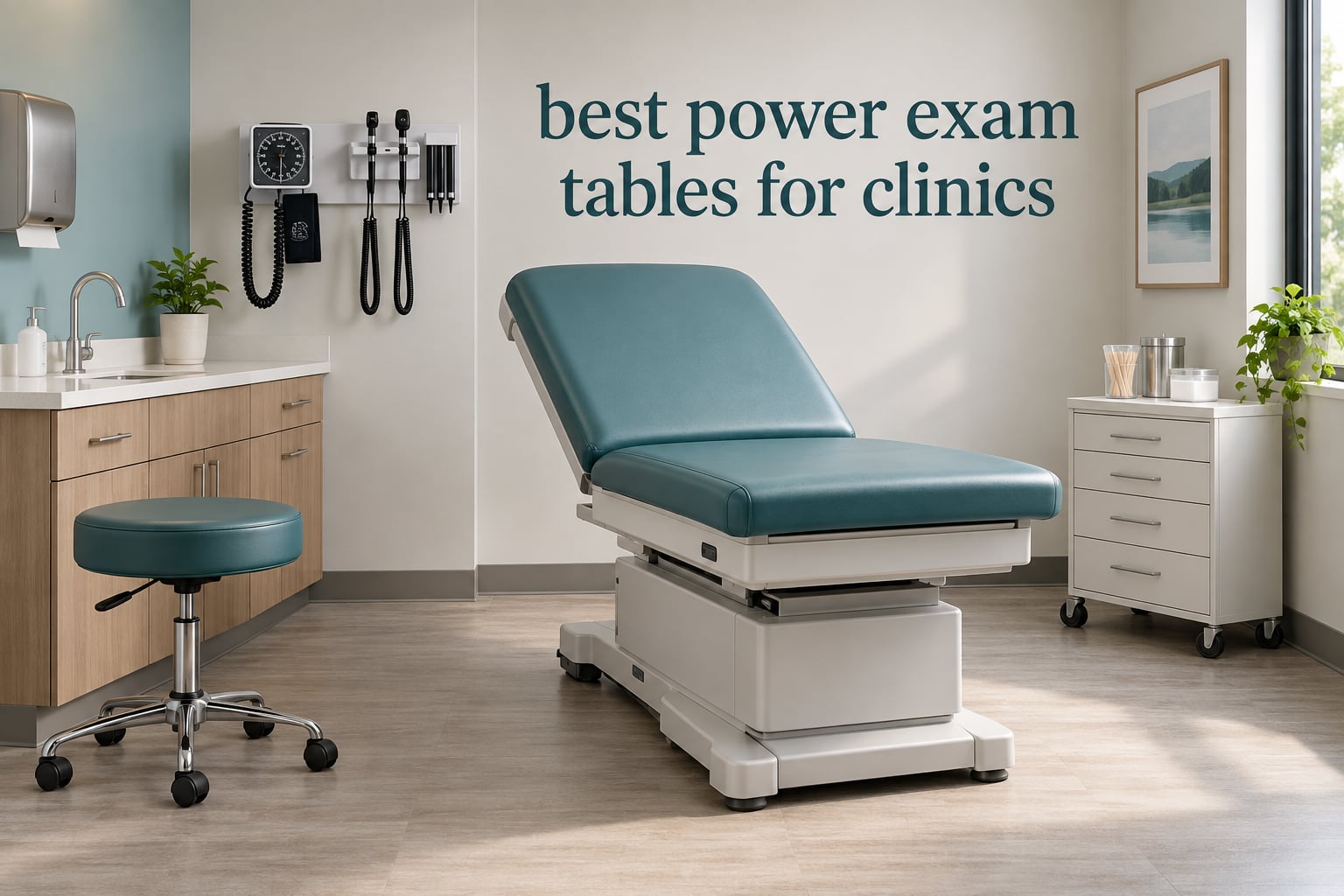
I have spent the last few months helping clinic managers and practice owners spec out exam room furniture, and the single most common question I get is which powered table to buy. Not which is prettiest, not which has the longest warranty card. Which one will still be working in year five, when a patient needs help transferring and a clinician needs to be standing rather than bent over.
That is what this guide is for. These are the best power exam tables for clinics I would put in front of a purchasing committee, based on published specifications, customer review patterns, and the things owners tell us after the box is opened. Every table here is moved by electric actuators rather than a hand crank or a hydraulic foot pump, which is the defining feature of the category.
One honest note before we start. The tables that dominate dealer catalogues for clinics are usually the ones with a powered back, a drop section and side rails. Almost none of them are sold online in this format, so what you can buy from mainstream retailers with next-day handling is a slightly different group: powered treatment tables and powered exam chairs built for physical therapy, rehab, med spa, chiropractic and general clinic use. I have kept to the powered category throughout, and I flag the limits of each one plainly.
We also keep a running guide to adjustable patient furniture, which is useful if you are also fitting out an infusion or recovery bay.
Table of Contents
Top 3 Best Power Exam Tables for Clinics
These are the three I keep coming back to when a clinic asks for a shortlist. Each one earns its place for a different reason, and the reasoning matters more than the ranking.

Dir 8103 Three-Motor Chair
- 3 motors: height
- back
- leg rest
- 400 lb steel frame
- Hand and foot remotes included

EarthLite Ellora Electric Lift
- Electric actuator with foot tap
- 3 inch three-layer cushioning
- Made in USA steel frame

Sierra Comfort SC-3000
- Pedal height control 16 to 31 in
- 500 lb capacity
- 2-year limited warranty
All 10 Power Exam Tables Compared in 2026
Here is the whole lineup on one page. Scan the height range and weight capacity columns first, because those two numbers eliminate more tables than anything else on this list.
| Product | Specifications | Action |
|---|---|---|
| Dir 8103 Three-Motor Powered Exam Chair |
|
Check Latest Price |
| EarthLite Ellora Electric Lift Massage Table |
|
Check Latest Price |
| Sierra Comfort SC-3000 Electric Lift Table |
|
Check Latest Price |
 Demixson Electric Hi-Lo Treatment Table Demixson Electric Hi-Lo Treatment Table |
|
Check Latest Price |
 Spa Luxe Insight Electric Exam Chair Spa Luxe Insight Electric Exam Chair |
|
Check Latest Price |
 LuxMed SYMPO 4-Motor Exam Chair LuxMed SYMPO 4-Motor Exam Chair |
|
Check Latest Price |
 SKINACT Rover Electric Treatment Table SKINACT Rover Electric Treatment Table |
|
Check Latest Price |
 SKINACT Palma 4-Motor Swivel Table SKINACT Palma 4-Motor Swivel Table |
|
Check Latest Price |
 SKINACT Kana 4-Motor Table with Stirrups SKINACT Kana 4-Motor Table with Stirrups |
|
Check Latest Price |
 Heliovax 3-Section Electric Treatment Table Heliovax 3-Section Electric Treatment Table |
|
Check Latest Price |
1. Dir 8103 Three-Motor Powered Exam Chair for Multi-Purpose Clinic Rooms
Dir Full Electrical Medical Aesthetic Chair Facial Beauty Bed Podiatry Doctors Office Chair with 3 Motors Ink
3 motors: height, backrest, leg rest
400 lb steel frame
75 x 35 x 35 in, 200 lb
1-year warranty
Pros
- Three powered motors cover height backrest and leg rest in one unit
- Hand remote and foot remote both included for flexible positioning
- Removable headrest with a breathing hole broadens procedure options
- Steel frame rated to 400 lbs
- Most reviews of any chair in this group with 563 ratings
Cons
- Armrest headrest and foot extension adjust by hand rather than by motor
- 200 lb unit weight makes room moves a two-person job
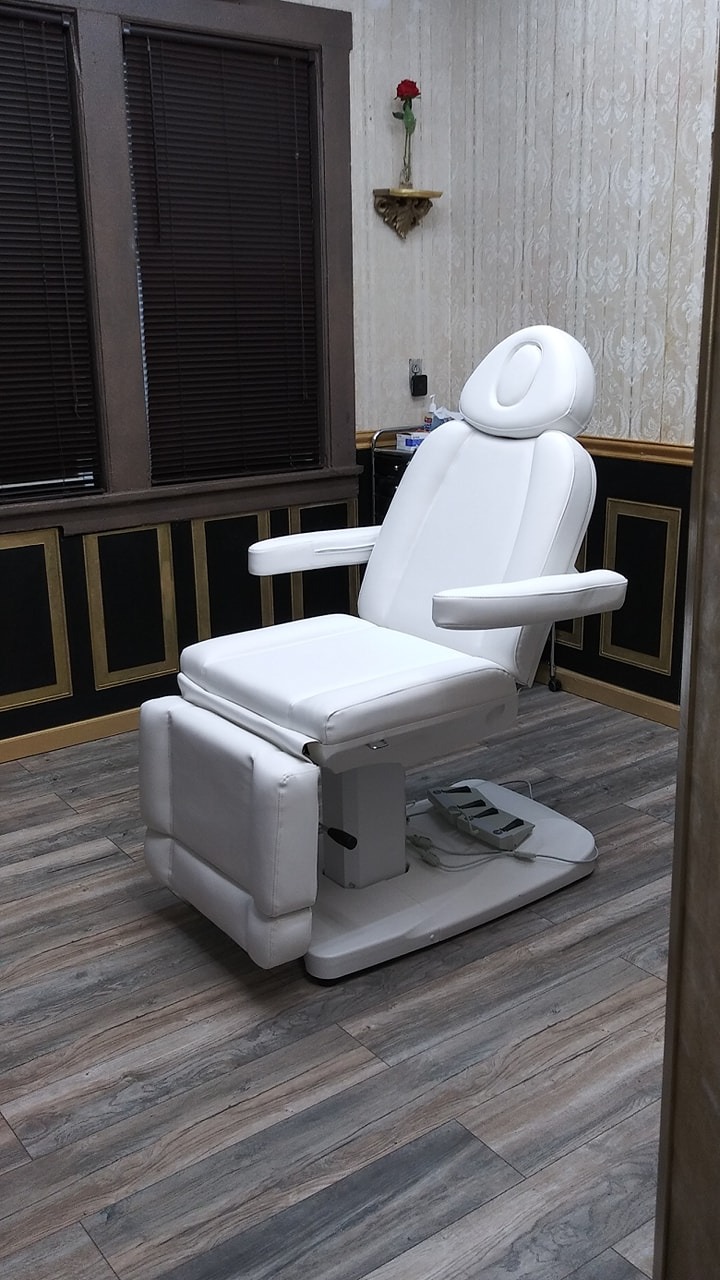
This is the chair I recommend to a clinic that only wants to buy one powered surface and stretch it across as many appointment types as possible. Three independent motors move the height, the backrest and the leg section, so a physical exam, a dermatology look and a facial treatment all happen on the same unit without anyone crouching to release a lever.
What stood out when I read through the 563 reviews is how consistently owners describe the remotes. Both a hand remote and a foot remote come in the box, and clinicians keep the foot unit in place once the table is positioned, then stay hands-free for the whole appointment. That is a bigger deal than it sounds, because a backrest you have to walk around and pull changes the flow of an exam.
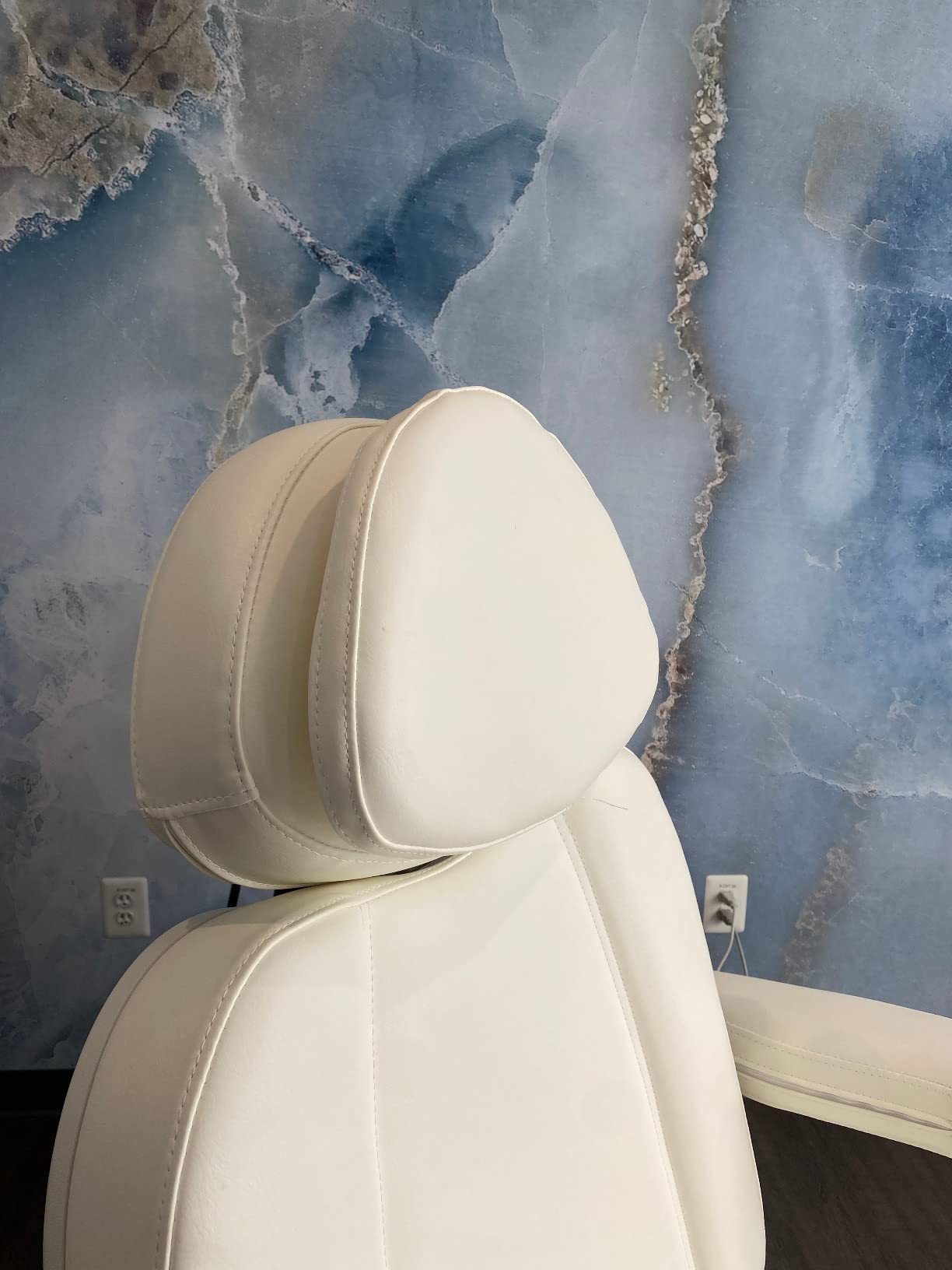
The removable headrest is the other detail that keeps coming up. It comes apart, and the top piece has a breathing hole cut into it, so a patient can lie face down for a longer treatment without the practitioner stacking towels. Reviewers also like the multi-function headrest, which can be set flat or raised as a pillow.
Build quality is the reason this is my first pick. The frame is steel rather than bolted aluminium, and it is rated to 400 lb, which covers the large majority of adult patients including anyone seen in a general practice or an urgent care setting. The unit itself weighs 200 lb and measures 75 by 35 by 35 inches, so plan the doorway route before it arrives.
Be clear about the limitation, because it is a real one. Only the three main sections are motorised. The armrests, the headrest and the foot extension all adjust manually, which means fine positioning work still involves hands-on adjustment, just faster positioning work does not.
Why clinics choose this model
Three motors in a single unit is the selling point. If your room sees general exams alongside minor procedures, wound checks, injections or aesthetic work, having powered height, powered back and powered legs removes the two most common reasons a clinician has to stop what they are doing mid-appointment.
The 4.8 star average across 563 reviews is the deepest evidence base in this roundup, with 93 percent five-star ratings. For a piece of equipment that has to take a beating for a decade, that consistency of feedback matters more to me than any single specification.
Where it will let you down
It is not a drop-section or stirrup table, and it is not a bariatric choice. The 400 lb rating is fine for standard adult patients but it is not the answer if your practice regularly sees patients well above that, and there is no drop section for gynaecological positioning.
At 200 lb the chair needs two people to plan for when it is moved into a room, and the doorway route is worth checking before delivery day.
2. EarthLite Ellora Electric Lift Table for Long-Term Clinic Use
EarthLite Ellora Electric Lift Massage Table, Flat Table Top, Made in USA, 32″ x 73, Black
Electric actuator with foot control
73 x 32 x 36 in, 190 lb
3 inch Pro-Plush cushioning
ADA compliant
Pros
- Quiet electric actuator adjusts height with a simple foot tap
- Three-layer Pro-Plush cushioning praised for comfort
- 32 inch top width reduces lateral reach for the practitioner
- Made in USA on a solid steel frame
Cons
- Does not include a matching headrest and compatible ones are hard to source
- Very heavy at 190 lb and delivered in a large crate
- Marketplace purchases void the manufacturer warranty unless the extended plan is added
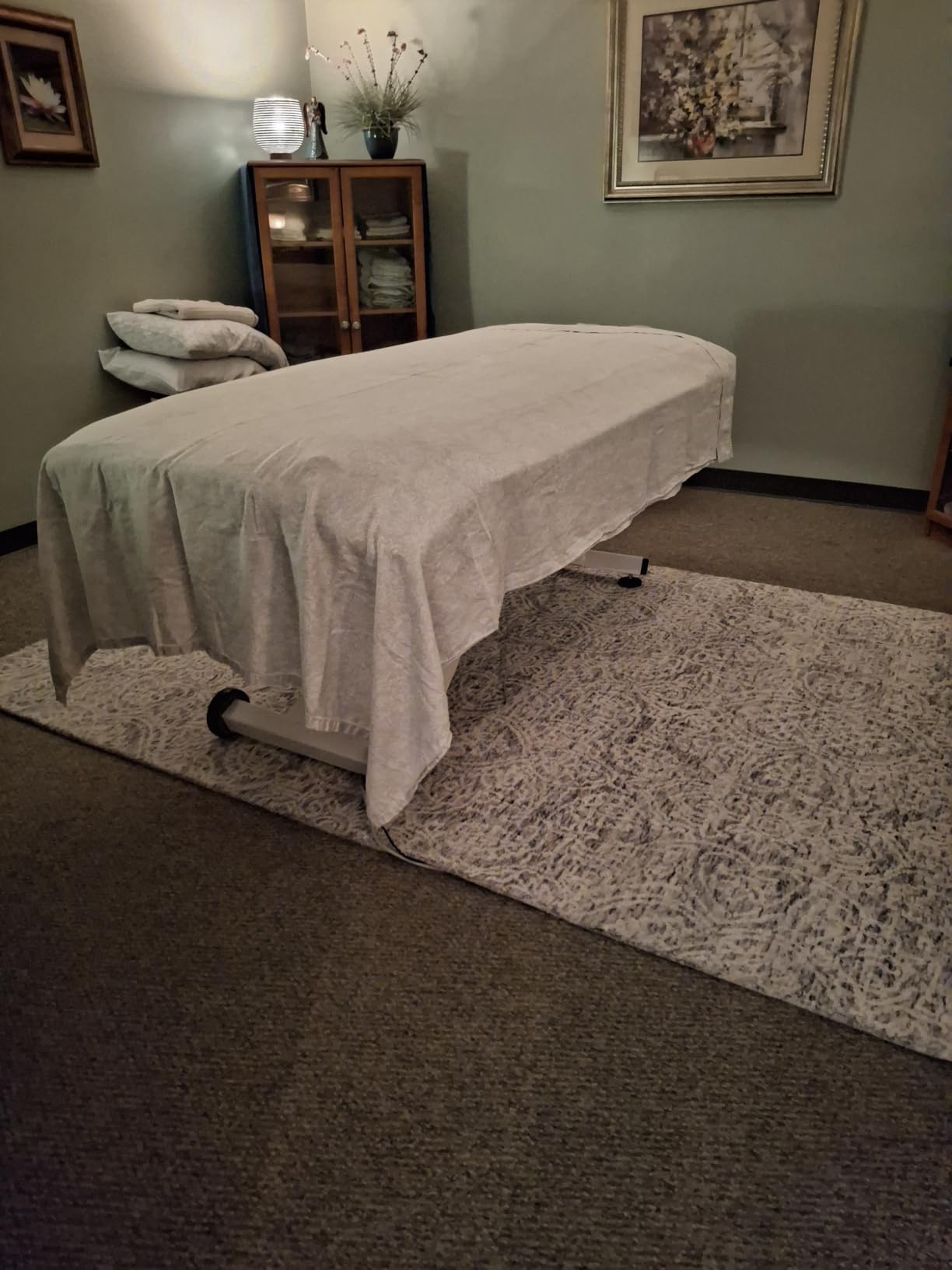
The EarthLite Ellora is a long-running design in this roundup and the one with the most settled ownership pattern. Owners describe buying it once, keeping it for years, and being the person other clinicians in the building ask about. It is a flat-top electric lift table, not a powered exam chair, so everything the motor does happens on the height axis.
What makes it work clinically is the combination of a quiet actuator you tap with a foot and cushioning that has no stitched seam running through the middle of the table. Owners in working clinics single out the three-layer Pro-Plush deck, and the reason they describe it as better than portable tables is the absence of those seams under a patient lying down for an hour.
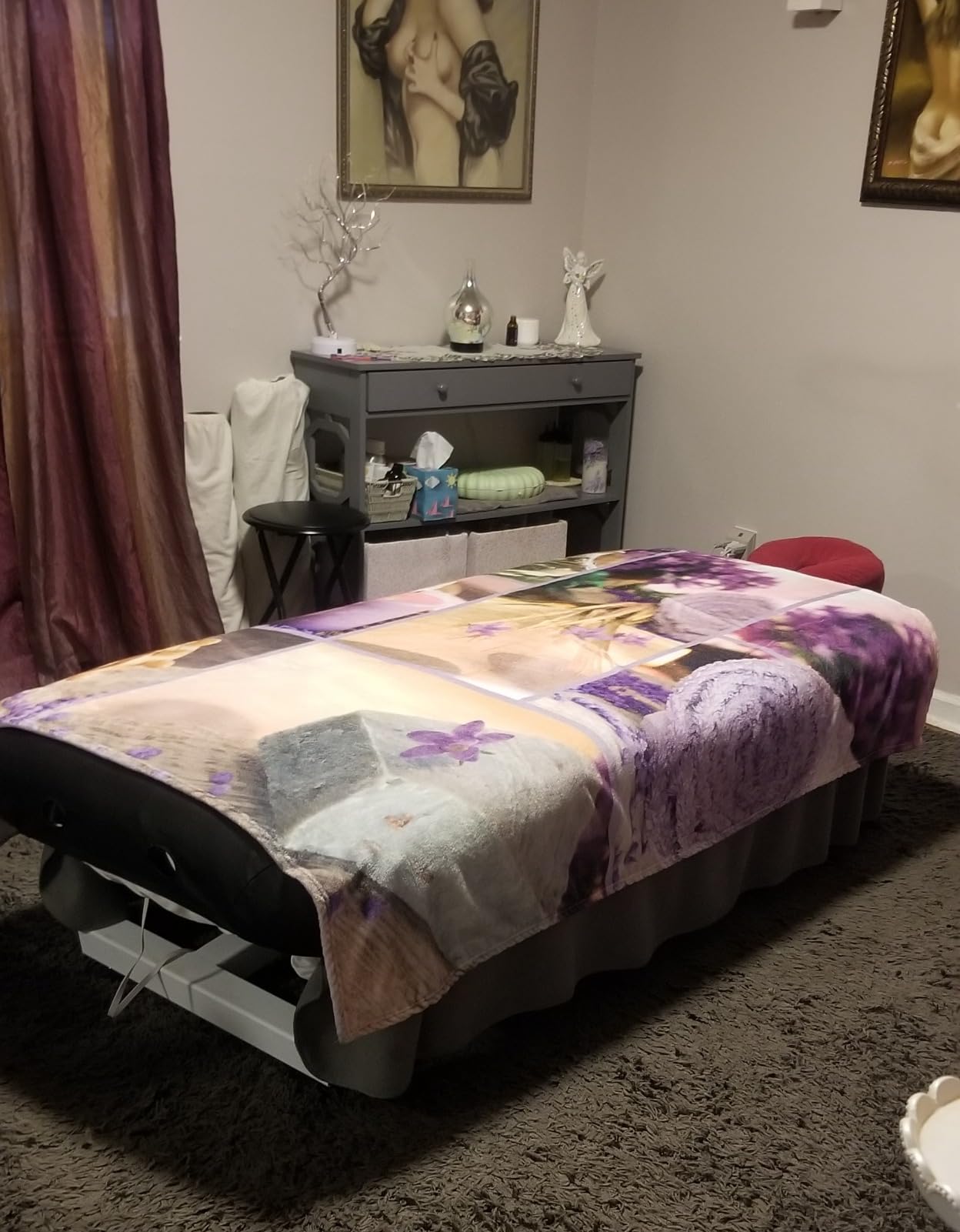
Reviewers also mention the lifting capacity directly. Multiple owners describe raising patients well over 400 lb without the actuator straining, and several note how much easier it is for a client with limited mobility to get on and off when the table comes down to an accessible height. That single feature is often what pushes a clinic from a manual table to a powered one.
The 32 inch width is worth understanding before you commit. Owners who came from a 30 inch table note that it takes a week or two to retrain their reach, but after that it feels more stable for larger patients and the practitioner spends less time leaning across the table.
Care instructions are simple, a damp cloth then a dry one, and the corners are rounded, which is easier on both patient skin and cleaning protocol. The frame is heavy duty steel and the unit is made in the USA, which is part of why parts and service have stayed available for a design this long-lived.
Why clinics choose this model
Choose it for the cushioning and the actuator, in that order. If your clinic runs long manual therapy sessions, back exams or physical therapy treatments where a patient is lying on the surface for 30 minutes or more, seam-free layered foam is a measurable comfort difference rather than a luxury.
It is also listed as ADA compliant, which matters if your practice sees a meaningful share of wheelchair transfer patients. The electric height range lets a clinician bring the surface to the level of the chair without asking a staff member to help, and that is a workflow win as much as an access one.
Where it will let you down
It is a flat table, so there is no powered back, no leg articulation and no drop section. If you need a seated patient exam, a knee examination or a gynaecological position, this is the wrong shape of furniture and you should be looking at a powered chair instead.
Two ownership frictions are worth planning around. The table does not come with a matching headrest and compatible replacements are hard to find, so source one before the table is installed. And buying through a marketplace can void the manufacturer warranty unless you add the optional extended plan, so read that term before you order.
3. Sierra Comfort SC-3000 Electric Lift Table for Budget-Conscious Clinics
Sierra Comfort Standard Electric Lift Massage Table, SC-3000 (Beige)
Pedal electric height 16 to 31 in
500 lb working capacity
73 x 30 in flat top
Alloy steel frame
Pros
- Entry point into powered tables with pedal height adjustment
- 3 inch high-density foam deck
- Water and oil resistant PU leather upholstery
- Includes elongated adjustable face cradle and face pillow
- 2-year limited warranty
Cons
- Motor and actuator need assembly before the table is used
- Rating spread is the most polarised in the group with a noticeable share of three-star feedback
- 30 inch top is narrower than the 32 inch alternatives
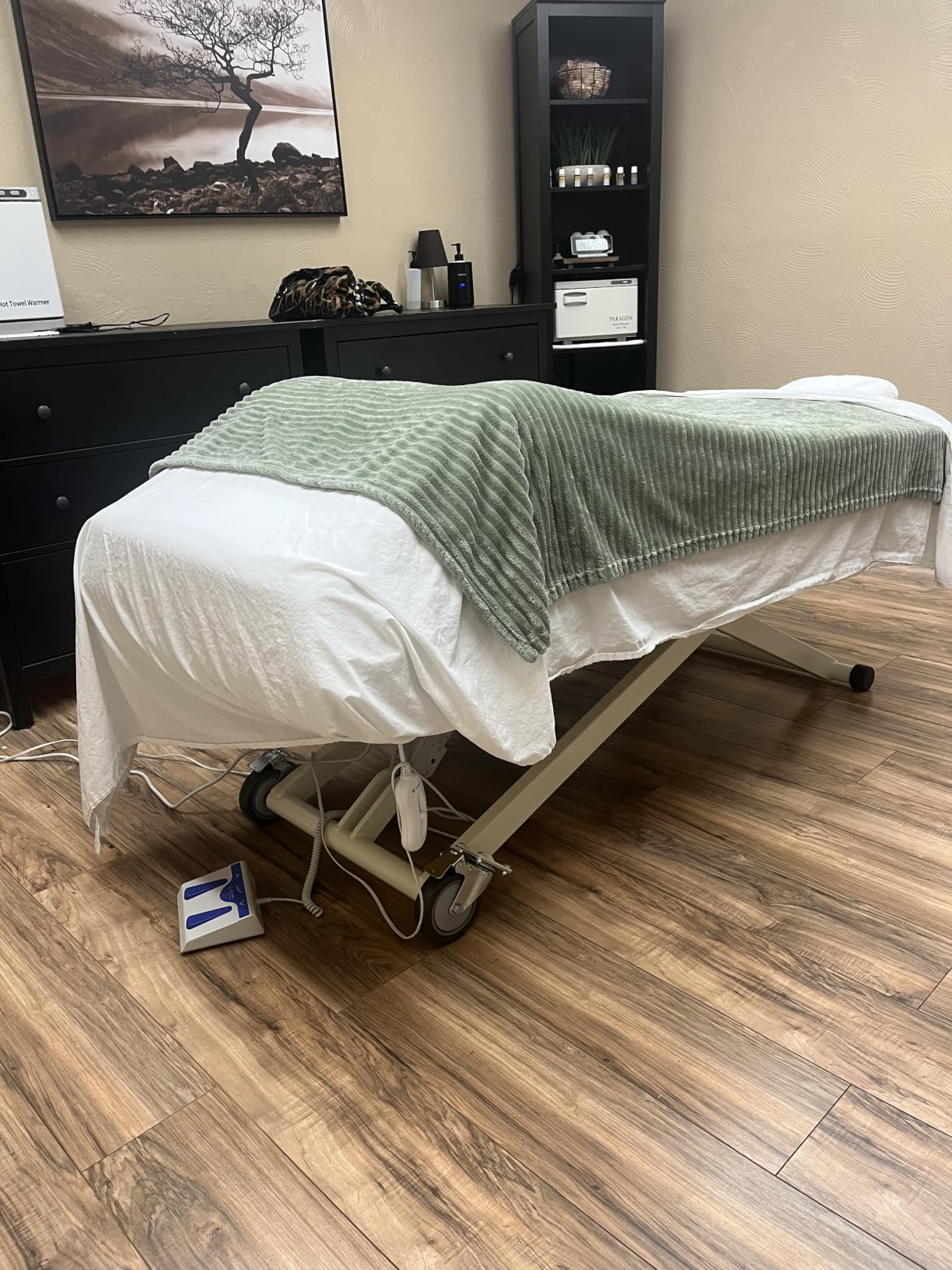
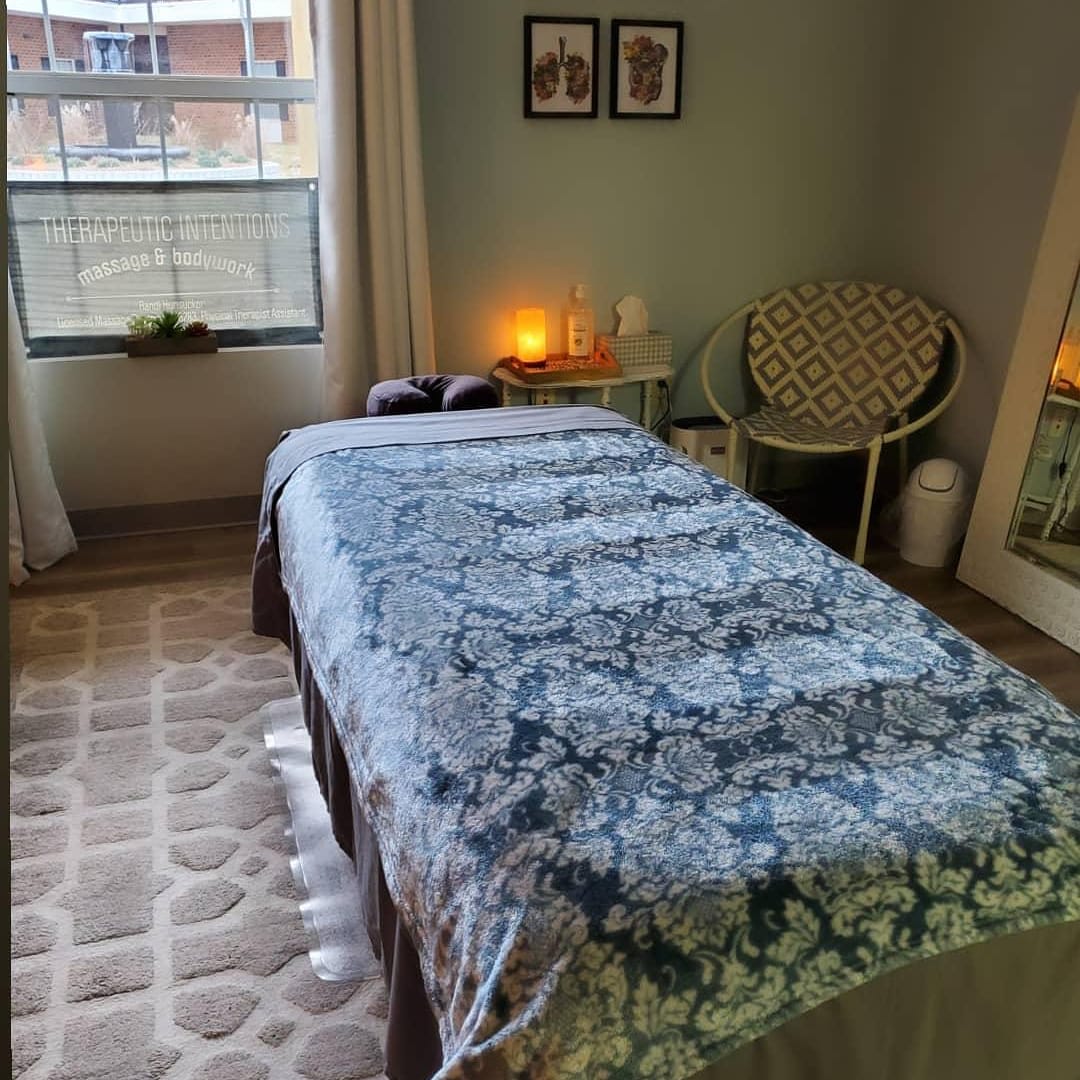
When a practice asks where to start with a powered table, this is the table I point at. You get electric pedal height adjustment across a 16 to 31 inch range, a 500 lb working capacity and a two-year limited warranty, which is the most generous warranty term among the single-motor options here.
The height range is the quiet strength. Sixteen inches at the bottom end is a genuinely low transfer height, and owners note that it is one of the easier tables in this category for clients with mobility limits to get onto. The pedal control means the clinician never has to step away from the patient to change height.
For the surface, you get a 3 inch high-density foam deck covered in water and oil resistant PU leather. That matters in a clinic setting because it wipes clean with mild soap and warm water and a lint-free cloth, and PU does not absorb the oils and lotions that end up on an exam table surface daily.
The included accessories matter too. The package includes an elongated adjustable face cradle and a matching face pillow, plus multiple face cradle outlets so you can reposition the support without buying another accessory. For a new clinic fitting out a therapy room, that removes a line item.
Worth noting that this listing gives a table weight of 110 lb in one place and 139 lb for the packaged item, so check the dimension you are working from before planning your floor layout. The top itself is 73 by 30 inches, and the height adjustment covers the full range from 16 to 31 inches.
Why clinics choose this model
It does the one thing that matters most for most rooms: powered height, cheaply and reliably. If your exam space only needs a surface that rises to standing height and drops to a low transfer height, paying for extra motors buys you features you will not use every day.
The 500 lb working capacity also covers a wider patient range than the 400 lb chairs in this group, and the two-year warranty gives you a defined service window that the one-year options cannot match.
Where it will let you down
The motor and actuator require assembly before the table can be used, so budget an hour and a second person. The instructions are minimal and this is not a table you want a new hire assembling alone on day one of service.
The other limitation is the rating spread. Across 91 reviews there is a larger share of three-star and two-star feedback than any other table here, which suggests the quality is consistent but the fit is not universal. A 30 inch top is narrower than the 32 inch Ellora, and there is no powered back at all, so seated and semi-reclined examinations are out of reach.
4. Demixson Electric Hi-Lo Table for Wheelchair Transfer Rooms
Demixson Electric Treatment Table – Power Hi-Lo Physical Therapy Bed with 17.7″-37″ Height Range, 500 lbs Weight Capacity & Seamless Medical Grade Vinyl – for Clinics, Rehab & Chiro (Black)
17.7 to 37 in electric height range
500 lb capacity
72.8 x 28.3 in, 65 lb
5-year frame warranty
Pros
- Widest height range in the group at 17.7 to 37 in for true wheelchair-level transfer
- Quiet actuator with smooth jitter-free height transitions
- Reinforced X-frame steel with no wobble at maximum height
- Seam-free medical grade vinyl over 2 inch high-density foam
- 5-year frame warranty is the longest in this roundup
Cons
- No mounting point for a face support which disappointed massage-oriented buyers
- Instructions cover safety and operation rather than installation
- Foot pedal runs continuously to the stop point so a switched outlet is advisable
This is the accessibility answer in the lineup. The height range runs from 17.7 inches to 37 inches, which means a patient can transfer from a wheelchair at their own level rather than being lifted or asked to step up, and a practitioner can raise the same surface to a working height for a standing exam.
Reviewers across chiropractic, physical therapy and rehab settings describe the actuator in consistently positive terms. It runs quietly and transitions without the herky-jerky stutter that cheaper lifts develop after a year of use, and at maximum height the reinforced X-frame steel shows no wobble or sway, which is the test that matters when a heavier patient is on the table.
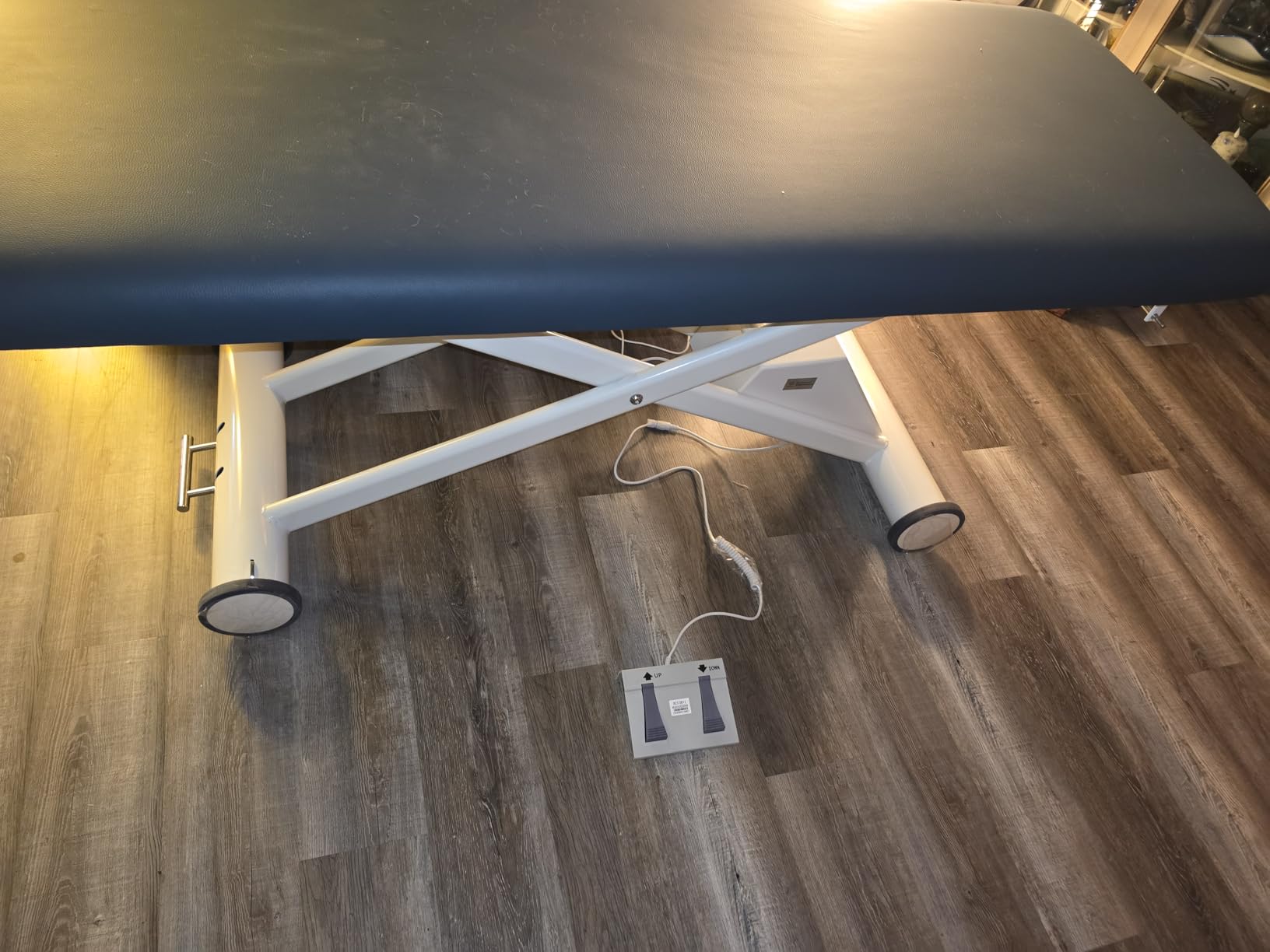
The 72 by 28 inch surface is wide enough for a range of body types without pushing the practitioner into an overreach, and the seamless medical grade vinyl over 2 inch foam is oil resistant and wipes down between sessions. Four independent locking casters plus integrated levelling feet handle uneven floors, which is common in older clinic buildings.
At 65 lb this is also by far the easiest unit in the roundup to reposition. If your exam room doubles as a procedure room and the table has to move, that 65 lb figure changes the conversation completely compared with the 200-plus-pound pieces.
One practical note: because the foot pedal runs continuously to the stop point, a switched wall outlet is worth installing nearby. Otherwise the actuator can run against the end stop indefinitely while a clinician is attending to a patient, and that is a service life issue rather than a safety one.
Why clinics choose this model
Choose it if your room has to serve patients who transfer from a wheelchair or who have limited lower-body strength. A 17.7 inch low point is what makes wheelchair-level transfer genuinely workable rather than an approximation, and combined with the 37 inch high point it covers both transfer and standing work from one surface.
The 5-year frame warranty is also the strongest in the group. On a piece of equipment that will be in daily use for a decade, the length of the structural warranty is a better indicator of manufacturer confidence than the number of features on the spec sheet.
Where it will let you down
There is no face support mounting point, and buyers who came at it for massage work noticed immediately. If your clinic performs facials, needling or any work where a face cradle is standard, you will be adding a separate support or choosing a different table.
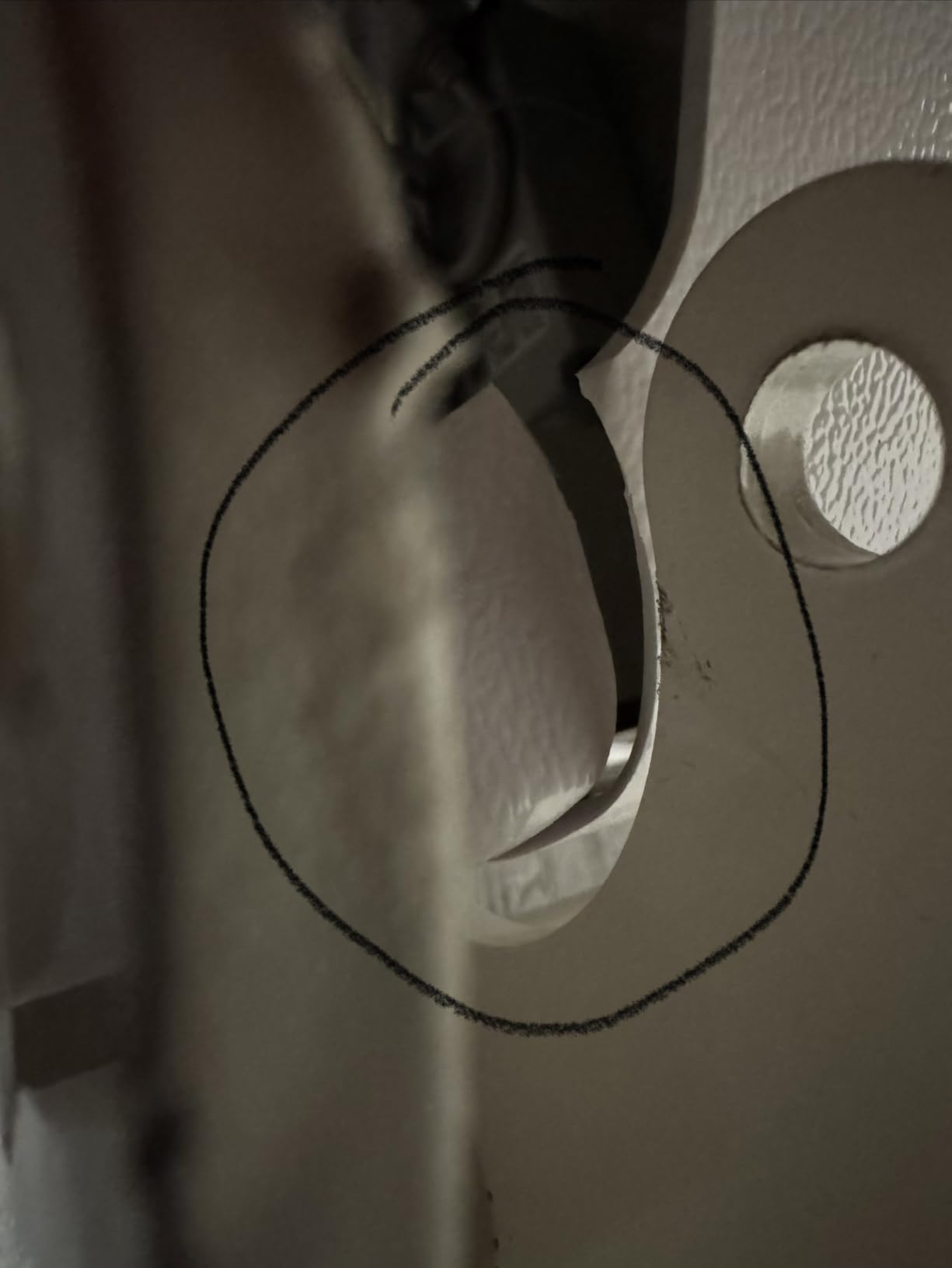
The evidence base is small at 10 reviews, and the paperwork is thin. The instructions cover safety and operation rather than installation, so expect to work out the assembly or levelling yourself, and inspect the unit and hardware carefully on arrival given reports of delivery damage.
5. Spa Luxe Insight Electric Exam Chair for Procedure and Med Spa Work
Spa Luxe Insight Med Spa Chair, Electric Medical Exam Table, Sand
4 motors with independent seat tilt
Trendelenburg 22 deg at height
Height 25 to 34 in
440 lb capacity
Pros
- Four motors give independent control of height seat tilt backrest and leg section
- Trendelenburg positioning up to 22 degrees at full height
- Backrest reclines from 74 degrees upright to 22 degrees below horizontal
- Removable headrest centre reveals a face hole
- FDA listed and CE certified with a 2-year motor warranty
Cons
- Partial assembly required on delivery
- Package weighs about 170 lb so a second person is needed to move it
- Two-star feedback is a larger share of reviews than the alternatives
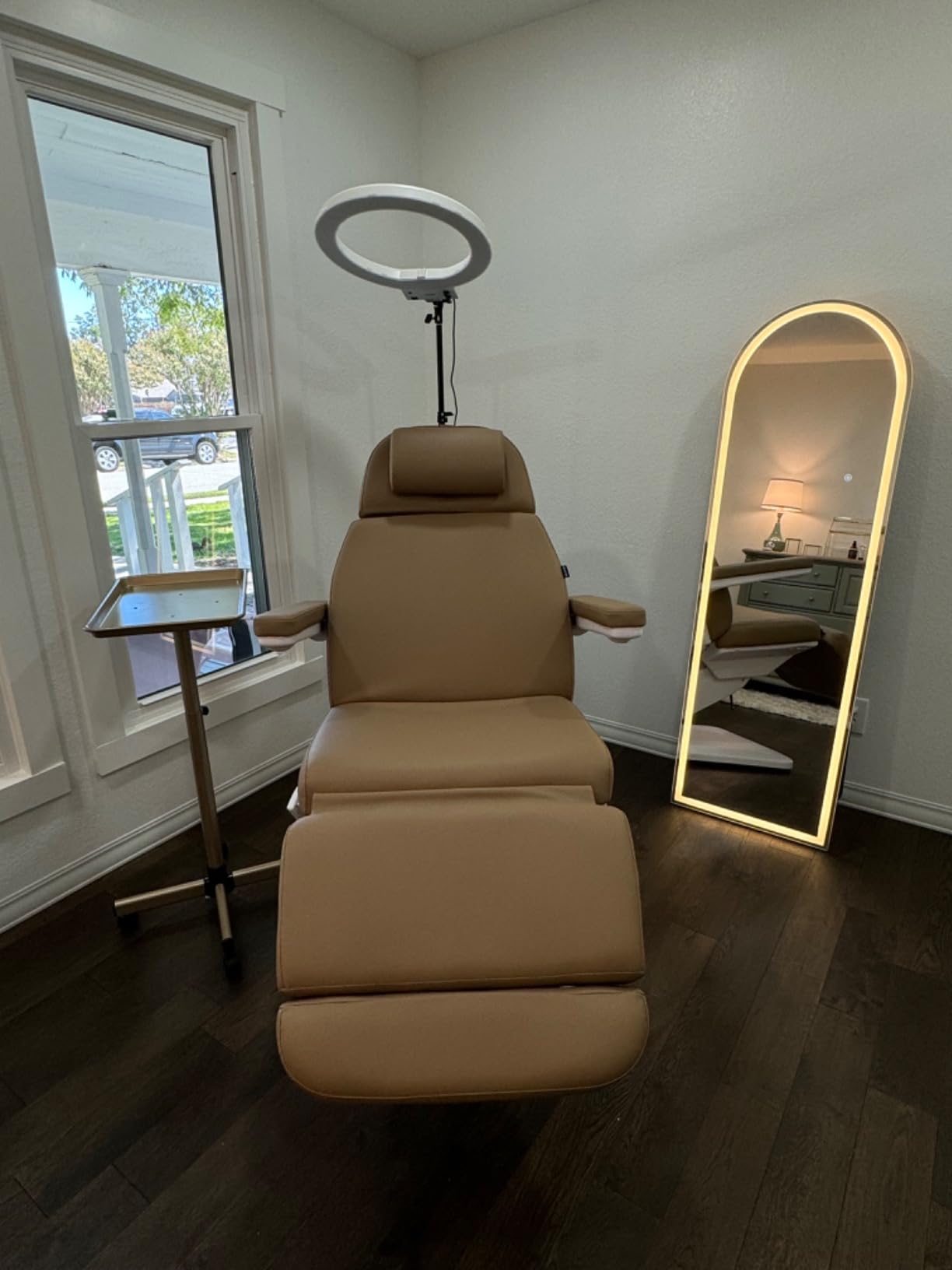
The Insight is the most medically positioned chair in this roundup, and the reason is the Trendelenburg function. A four-motor system drives the height, the seat inclination, the backrest and the leg section independently, and the seat can tilt up to 22 degrees at full height or 12 degrees at the low setting, which supports the head-down positioning used in minor procedures and dermatology work.
The backrest articulation is unusually good. It travels from 74 degrees upright to 22 degrees below horizontal, so a patient can be brought almost fully flat or sat upright without anyone physically lifting them. Owners in med spa and dermatology rooms say that range is what lets one chair cover a facial and a minor procedure.
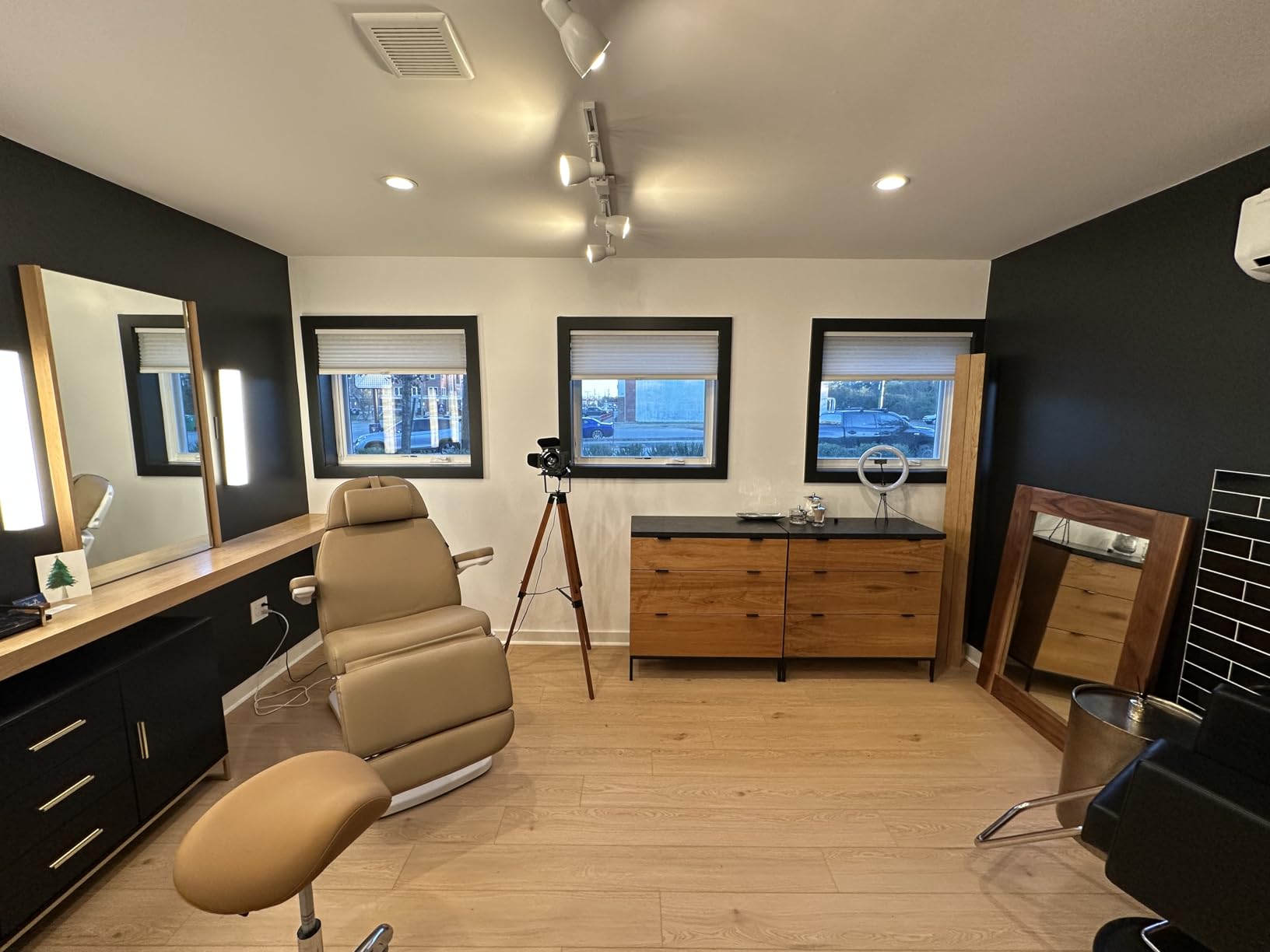
Details that show this was specified for clinical rather than purely cosmetic use include FDA listed and CE certified construction, a 440 lb working weight capacity, and a 2-year limited warranty specifically covering the motors and electronics. That last point is one several other entries here do not offer.
The adjustable headrest has a removable centre cushion that reveals a face hole, so a facial treatment does not need bolsters stacked under a patient’s head. Reversible armrests, a paper roll holder and a protective footrest cover come in the box, and the oil and water resistant polyurethane over 4 inch high-density foam is built for a room that gets wiped down many times a day.
Dimensions are 73 inches long with a 25 inch seat and 33 inches across the arms, and the electric height range is 25 to 34 inches. Note that the chair itself weighs 141 lb inside a package of roughly 170 lb, so plan a two-person move into the room.
Why clinics choose this model
Trendelenburg positioning is the reason, and almost nothing else in this price bracket offers it. If your clinic does anything that benefits from controlled head-down or head-up tilt, including aesthetic work, minor surgical procedures or dermatology, that capability alone justifies the four-motor design.
The 2-year warranty on motors and electronics is the second reason. Actuation is the first component to fail on any powered table, and having that covered for two years changes the cost of ownership calculation considerably.
Where it will let you down
The 25 inch low end is not a transfer height. A patient in a wheelchair cannot get onto this chair unaided from a standard 19 inch seat with a 25 inch surface, so it is a poor choice for a room whose primary purpose is assisted transfer access.
Partial assembly is required on arrival, and the two-star share of the review set is larger than for the alternatives, which points to a fit that works well for some clinics and not others. If you need gynaecological positioning, there are no stirrups here, so this is not a substitute for a dedicated gynae chair.
6. LuxMed SYMPO 4-Motor Chair for Compact Treatment Rooms
Spa Source LuxMed SYMPO 4 Motor Fully Automatic Exam Chair – ADA Friendly Electric Medical Treatment Table for Massage, Tattoo, Esthetician & Facial Beds – Hand Remote Included – Black
4 motors: height, back, legs, tilt
ADA compliant
73 x 23 x 32 in, 179 lb
450 lb capacity
Pros
- Four-motor full automation across height backrest leg rest and tilt
- ADA compliant design for accessible patient transfer
- 450 lb maximum load capacity
- Quiet smooth and precise motor movement
- Removable height-adjustable headrest with a face cradle hole
Cons
- Only a single review so there is very little long-term owner feedback
- No instruction manual in the package
- 23 inch stated body width is the narrowest figure in the roundup
The SYMPO is built for rooms where floor space is the constraint. At 73 by 23 inches it has the narrowest stated body width in this roundup, and the four-motor system still gives you independent control of height, backrest, leg rest and tilt. That combination, narrow footprint plus full articulation, is unusual.
It is listed as ADA compliant, and a clinic reviewer who used it called the accessibility a clear win for the practice. The 450 lb maximum load capacity sits in the middle of this group, higher than the 400 lb chairs and lower than the 600 lb Rover, which is a sensible middle for a general treatment room.
The reviewer described the motor movement as quiet, smooth and precise, and said it improved both patient comfort and their own posture across a full day of use. The removable, height-adjustable headrest includes a face cradle hole, and the polyurethane upholstery is easy-clean with a damp cloth.
Be careful how much weight you put on that single review. A 5.0 average from one owner is encouraging but it is not a consensus, and it tells you nothing about how the actuators hold up after three years of daily use. Treat the specification as the reason to buy and the review as a reason not to worry.
Why clinics choose this model
Two reasons, and both are practical. The first is a 23 inch body width, which lets the chair sit in a treatment room that a 25 to 27 inch unit would crowd, particularly in older buildings where exam rooms are genuinely small.
The second is full four-motor automation at a 450 lb rating, which means you get tilt, powered back and powered legs without dropping to a 400 lb frame. For a rehab or physical therapy room that cannot fit a wide table, that is the trade that works.
Where it will let you down
The narrow body works against you in one specific way. A 23 inch width gives less lateral room for a wider patient, and a practitioner working on a larger adult will be reaching further across the surface than they would on a 25 or 27 inch chair.
There is no instruction manual in the package, and the documentation burden falls on you. With a single review behind it, I would also want a clear written warranty term and a local service contact before committing a tight-fitting room to this unit.
7. SKINACT Rover Electric Treatment Table for Heavier Patients
SKINACT Rover Electric Treatment Table, Heavy-Duty Height Adjustable 600 lb Capacity, Gas-Assisted Backrest & Leg Rest, Locking Wheels, Removable Face Cut-Out, Gray
600 lb capacity on reinforced steel
22.5 to 36 in electric height
78 x 27 in surface, 245 lb
1-year warranty
Pros
- 600 lb capacity is the highest in this roundup on a reinforced steel base
- Gas-assisted backrest travels from flat to 79 degrees
- Quiet electric lift from 22.5 to 36 in with foot controls around the base
- No assembly required
- Locking rolling casters and an integrated paper roll holder
Cons
- Only three reviews so long-term durability is largely unverified
- 245 lb weight is the practical drawback of the 600 lb frame
- Height adjustment is a single motor so the backrest is not powered
The Rover is the load answer. A 600 lb working capacity on a reinforced steel base is the highest rating among the powered treatment tables in this roundup, and it is built on an alloy steel and plywood frame rather than a light tube structure. For a clinic that regularly sees larger patients, that number alone changes the shortlist.
The gas-assisted backrest travels from flat to 79 degrees, which gives a smooth assisted lift without a second motor and without the clinician taking the full weight of a reclined patient. The leg section has multiple incline and decline positions, which is what a physical therapy or rehab room actually needs for knee and hip work.
Height adjustment runs quietly from 22.5 to 36 inches, and the foot controls sit around the base so you can raise or lower the table from either side of the patient without walking around it. The 78 by 27 inch surface is one of the two longest flat treatment areas in this roundup.
Two practical benefits that get overlooked. It arrives with no assembly required, so it is usable in the room on delivery day rather than after a rebuild. And the locking rolling casters plus an integrated paper roll holder means the paper is always loaded and always in the right place.
The upholstery is super-fiber PU over high-density foam with a removable face cut-out cushion, so a face cradle is not a separate purchase. Care is a dry cloth wipe, which is quick between appointments.
At 245 lb the Rover is one of the heavier items in this roundup, and that weight is the direct trade-off for the 600 lb frame. Any room move needs a plan and more than one pair of hands, even with the casters.
Why clinics choose this model
Capacity, most simply. If your patient population includes people above 500 lb, most of the powered chairs in this roundup are not suitable, and a specialist bariatric table is a different purchase again. The Rover gives you real headroom above the usual 400 to 500 lb ceiling without moving up a category.
The gas-assisted backrest is the second reason. You get a powered-feeling backrest adjustment without a second motor, which keeps the mechanical complexity down while still protecting the clinician’s back when a heavier patient reclines.
Where it will let you down
Only three reviews exist, and they are thin on detail, so the 600 lb rating and the longevity of the lift mechanism rest largely on the manufacturer specification rather than verified owner reports. Ask for a written warranty term; the listing states one year, which is the shortest here.
It is a single-motor design. The backrest is gas-assisted and the leg section is manual, so if you need a powered drop section or a powered leg rest for repeat procedures, this is not that table. The 22.5 inch low point is also not a wheelchair transfer height.
8. SKINACT Palma 4-Motor Swivel Table for Tight Treatment Rooms
SKINACT Palma 4-Motor Electric Medical Spa Treatment Table, Adjustable Facial Chair with 240° Swivel, Height, Backrest, Seat Tilt & Leg Rest, 400 lb Capacity, White
240 degree swivel with locking base
4 motors: height, back, tilt, legs
400 lb capacity
210 lb unit weight
Pros
- Widest swivel in the roundup at 240 degrees with a locking base
- Four motors adjust height backrest seat tilt and leg rest independently
- Seam-free PU upholstery wipes clean and resists moisture oils and stains
- Adjustable armrests and a removable headrest with face opening
- A clinic buyer reports their doctor is happy with them
Cons
- One verified buyer reported mobility functions failing out of the box with no service response
- Assembly is required
- 400 lb capacity is below the Rover and Demixson tables
The Palma is the room-efficiency pick. A 240 degree swivel with a locking base means the chair can rotate to face a wall, a window or a piece of equipment when the room is not in use, which is how you make a single small treatment space work for a full appointment schedule.
Underneath, it is a proper four-motor unit. Height, backrest, seat tilt and leg rest all adjust independently and quietly, so the practitioner can set the patient up without leaving the chair or touching a manual release. The 400 lb capacity sits at the lower end of this group, which is the main compromise.
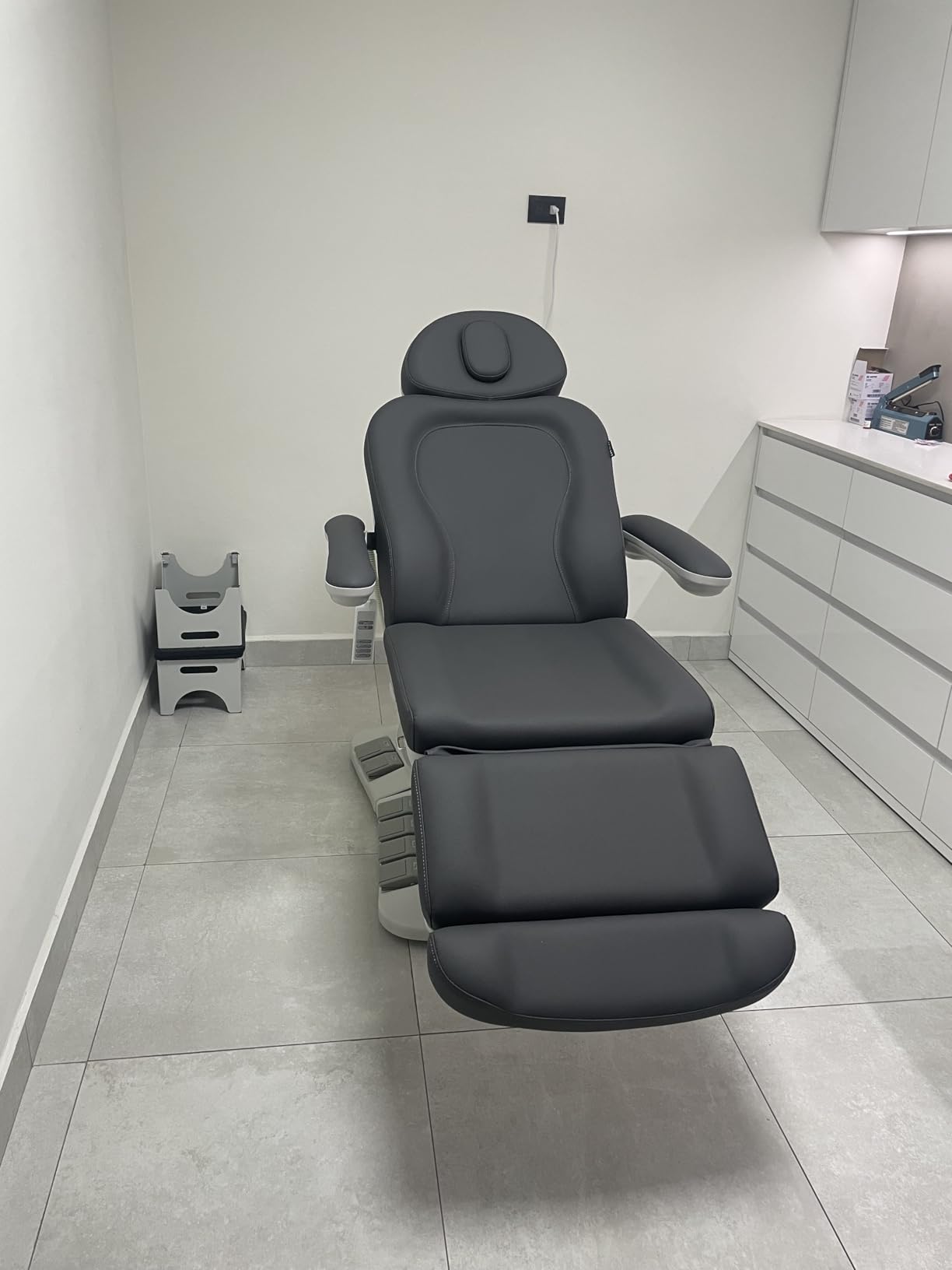
The upholstery is seamless PU over high-density foam, and owners specifically note that it wipes clean and holds up against moisture, oils and stains. That is the practical requirement in a treatment room where the surface gets contacted with product every day, and the absence of a seam means there is no channel for liquid to sit in.
Colour choice is broader than on most of the others, with black, white, grey and sand listed, which matters if the chair is going into a room where the furniture was picked to match a specific palette.
There is one serious negative I would not gloss over. A verified buyer reported that some powered movement functions did not work on arrival and that the seller was unresponsive to service requests, and that single failure accounts for the one-star share of the ratings. If you buy this, power it up fully and cycle every motor in the room before you accept delivery.
Why clinics choose this model
The 240 degree swivel is the reason, and no other table in this roundup matches it. In a single-practitioner treatment room where the same space is used for consultations, hands-on work and paperwork, being able to swing the chair away from the middle of the floor is worth real square footage.
The four-motor articulation follows close behind. Independent seat tilt and leg rest control is what a physical therapist or a bodywork practitioner uses constantly, and having it on a swivel base means you get it without a wider footprint.
Where it will let you down
The 400 lb rating is the first limit. If your practice sees bariatric patients regularly, this is not the right unit, and the step up to the Rover’s 600 lb is a meaningful clinical difference.
Assembly is required, so it is not an install-and-forget purchase. And the reported failure of powered functions on arrival is a service risk you should price in by confirming the local service arrangement in writing before you commit, not after something stops working.
9. SKINACT Kana 4-Motor Table with Stirrups for Gynaecology and Pelvic Health
SKINACT Kana Electric Spa Treatment Table with Swivel, Stirrups Included, 4-Motor Facial Bed & Treatment Chair, Electric Height, Backrest, Leg Rest & Seat Tilt, 400 lb Capacity, Gray
Stirrups and rails included
4 motors: height, back, tilt, legs
400 lb capacity
Height 21 to 33 in
Pros
- Only powered chair in this roundup that includes stirrups and rails
- Adding pelvic exam positioning out of the box
- Controls from both sides including foot pedals on each side
- Converts between chair and flat bed positions
- Dual-layer high-density memory foam cushioning
Cons
- Leg rest can tip forward if fully extended and loaded beyond about 50 lb
- Motors are noticeably slow compared with established clinic brands
- Sits at the upper end of this group on cost
- Only five reviews so the tipping report comes from a single buyer
Stirrups are the headline here. The Kana includes rails and stirrups in the box, which means a clinic adding a pelvic health service can set up that room without sourcing a separate accessory set and without paying for a dedicated gynaecology chair. Among the powered chairs in this roundup, nothing else includes them.
The mechanism underneath is a four-motor system driving height, backrest, leg rest and seat tilt independently, plus a 90 degree manual swivel that rotates 45 degrees in each direction. The chair converts between a seated chair position and a flat bed, so the same unit handles a consultation, an examination and a hands-on treatment.
Control placement is genuinely well thought out. There is a handheld remote, foot controls on both sides of the table, and separate backrest and leg rest controls, which means a practitioner working from either side can drive the chair without asking a colleague to help.
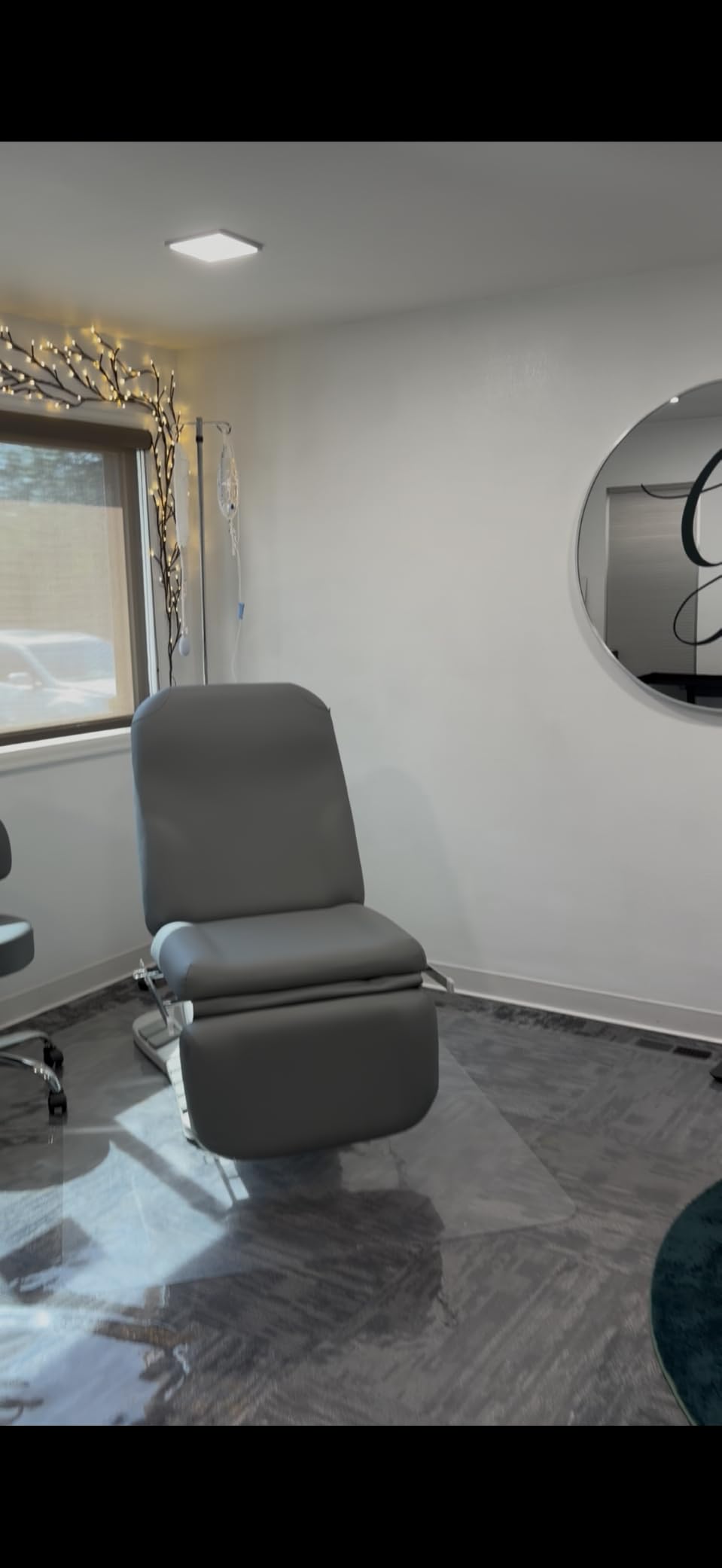
Cushioning is dual-layer high-density memory foam under PU leather, and owners describe the comfort as a clear step up from flatter treatment surfaces. Capacity is 400 lb on a steel frame and heavy-duty base, and the electric height range runs from approximately 21 to 33 inches.
Two engineering concerns came from the small review set, and both are worth weighing. One buyer reported that the leg rest can tip forward if it is fully extended and loaded with more than about 50 lb, which matters in a pelvic health room where leg support load is the whole point. Another reported that the motors are noticeably slow, taking roughly three times as long as Midmark or Ritter units to raise and lower.
Why clinics choose this model
It buys you capability rather than comfort. Stirrups and rails included means the accessory cost and the retrofitting time both disappear, and for a practice adding pelvic health or gynaecological services this is the shortest path to a usable room.
The dual-side foot controls matter in practice. A pelvic examination frequently needs the clinician to change position mid-procedure, and having controls on both sides removes the awkwardness of reaching across the patient to adjust the chair.
Where it will let you down
The leg rest tipping report is a genuine caution for the exact use case this table is best suited to. Before committing, test the leg section under load at the extension you intend to use, and treat the behaviour as something to confirm in writing with the supplier.
Slow motors are an operational issue in a high-volume room, since every height change eats appointment time. With five reviews, the evidence on both points is thin, so insist on a service agreement and a clear return process.
10. Heliovax 3-Section Electric Table for Physical Therapy and Rehab
Heliovax Electric Treatment Table Hi-Lo Adjustable,3-Section Physical Therapy Table, Ultra Comfortable Foot Control for Massage and Acupuncture, Dimensions 78″ L x 25.6″ W x 22.8″- 35.4″ H (Black)
Three-section table with independent adjustment
22.8 to 35.4 in electric height
78 x 25.6 in, 320 lb
550 lb capacity
Pros
- 78 inch treatment surface with three independently adjustable sections
- 550 lb capacity on a reinforced steel frame
- Quiet motor with an always-available foot pedal for hands-free height changes
- 2.4 inch high-density foam under medical-grade wipe-clean vinyl
- Lockable wheels plus adjustable levelling feet
- No assembly required
Cons
- Single review only so there is no meaningful owner feedback base
- Heaviest unit in the roundup at 320 lb which complicates room moves
- 22.8 inch low point is the highest in the group so it is not suitable for wheelchair-level transfers
The Heliovax is the physical therapy and rehab pick, and the reason is the three-section design. The head, back and leg sections adjust independently, so a therapist can put a patient into a knee extension, a prone position or a supported sit without repositioning them manually. That is the single most useful feature in a rehab room.
Capacity is 550 lb on a reinforced steel frame, which is among the higher ratings in this roundup and a clear step above the 400 to 450 lb chairs. The surface is 78 by 25.6 inches, a joint-longest flat treatment area here, with 2.4 inch high-density foam under medical-grade wipe-clean vinyl.
Height runs quietly from 22.8 to 35.4 inches, and the foot pedal is always available for hands-free changes without the clinician stepping away from the patient. Lockable wheels plus adjustable levelling feet handle uneven floors, and no assembly is required, so it is in use the day it arrives.
It is also the heaviest unit in the roundup at 320 lb. That is a deliberate consequence of the steel frame and the 550 lb rating, but it means any room move is a multi-person job, and you should confirm the route from the delivery point to the final position before you commit.
One review is not evidence of long-term reliability, and I would treat this table accordingly. The case for it rests on its stated design and specifications rather than on owner reports, so ask for a written warranty and a service contact before it goes into a clinical room.
Why clinics choose this model
Three independent sections is what separates a rehab table from a general exam table. For knee and hip mobilisation work, for postural assessment and for supported stretching, the ability to articulate the head, back and legs separately is the reason to buy this category at all.
The 550 lb capacity and the long surface also mean a larger patient can be worked on without a practitioner overreaching, which addresses both patient comfort and clinician ergonomics in the same purchase.
Where it will let you down
The 22.8 inch low point is the highest in the roundup, and that rules it out for wheelchair-level transfers. If your room serves patients who transfer from a chair or a wheelchair, this table cannot do that job regardless of how good the articulation is.
At 320 lb it is the hardest unit here to reposition, and with a single review behind it there is no owner history to reassure you about actuator longevity. I would pair it with a service agreement and an inspection schedule at the six-month mark.
How to Choose a Power Exam Table for Your Clinic
Power height only, power back, or full power
Start by deciding which sections need a motor, because this is the largest driver of cost and of long-term usefulness. A power-height-only table with a manual backrest is entirely adequate for a general examination room where the patient can climb on and lie down, and it is the cheapest way to get electric height into a room.
A power back is worth the upgrade in almost any clinic. It lets the clinician reposition a patient without walking around the table or asking for assistance, and it is the difference between an exam taking four minutes and taking six. Full power, adding powered leg section, seat tilt or trendelenburg, is justified where you do procedures, work in a head and neck specialty, or run a med spa and dermatology service.
Do not buy motors you will not use. A four-motor table in a room that only does standard physical exams is money spent on features that sit unused, while a two-motor table in a procedure room means manual work at exactly the moment you need both hands free.
Low seat height and wheelchair transfer
The single most important accessibility number on any powered table is its lowest height. Roughly 18 inches at the low end is the target that lets a patient transfer from a wheelchair without a transfer board or a second person. Among the tables in this roundup, only the Demixson at 17.7 inches and the Sierra Comfort at 16 inches reach that range.
Tables that bottom out between 21 and 25 inches are comfortable and good for seated exams, but they are not an assisted-transfer solution. Measure the seat height of the chairs and wheelchairs your patients actually arrive in before you choose, rather than relying on a brochure figure.
Weight capacity
Capacity is the fastest way to disqualify a table. Most powered chairs in this roundup sit between 400 and 450 lb, and a 400 lb rating leaves very little margin. If your practice sees bariatric patients, target at least 500 lb and check whether the rating applies to the whole unit or only to the top.
Above 600 lb you are into specialist bariatric equipment with a different price bracket, and it is worth a separate conversation rather than stretching a standard model. Never judge capacity by what looks rigid, check the published rating and make sure the frame, casters and actuator are all rated for it.
Foot control versus hand control
Foot controls keep the clinician’s hands on the patient, which is why most clinical users prefer them for height adjustment. Several tables in this roundup offer both, and the ones that do let you set the table up in a position and then leave the pedal in place for hands-free changes during the appointment.
Hand and handheld remotes matter more for chairs with multiple motors, where a single pedal cannot reach the backrest, the leg section and the tilt. The Kana is the clearest example in this roundup, with handheld, foot, backrest and leg rest controls covering both sides of the table.
Upholstery and cleaning
For clinic use, the surface needs to survive repeated contact with medical disinfectants, oils and lotions without cracking or absorbing liquid. Seamless or welded-seam polyurethane over high-density foam is the practical standard, because there is no stitched channel for fluid to sit in and the surface wipes clean in one pass.
Check the cleaning instructions against your own protocol, and confirm that the disinfectant you use is compatible. Some manufacturers specify mild soap and warm water only, which is gentler on the upholstery but a different process from a clinic that uses a hospital-grade disinfectant between every patient.
Foam density is the comfort variable. Three inch three-layer cushioning is what owners of the Ellora and the SC-3000 describe as the difference between a table you can leave a patient on for an hour and one you cannot. Thinner decks are fine for a quick physical exam and marginal for extended treatment work.
Room planning, outlets and clearances
Before ordering, measure the room and the route. Power tables range from about 65 lb to over 300 lb, and the heavy ones arrive in large crates that need a freight crew, a wide doorway and a clear path to the final position. Add clearance around the table for the clinician to work from both sides and for the swivel range on rotating models.
Outlet placement matters more than people expect. Several of the units here use foot pedals that run continuously to the stop point rather than to a set position, so a switched outlet within reach of the pedal is worth installing to protect the actuator. If you are laying out a room where the table may be repositioned, plan for a second outlet on a different wall. If your building is on a circuit where a trip would stop a whole wing, it is worth reading up on portable power stations for outages so at least the essential rooms keep running.
Room function also affects the choice of base. Locking casters let you move the table and put it where it is needed; levelling feet handle uneven floors in older buildings; a central locking brake is worth having if the table is wheeled while a patient is on it, though most clinical protocols involve locking the casters first.
Warranty, service and total cost of ownership
The actuator is the first thing that fails on a powered table, and it is the most expensive single component to replace. Warranty length on the motor and electronics matters more than the warranty on the upholstery, and the terms in this roundup range from one year on several models to a two-year term covering motors and electronics, plus one five-year frame warranty.
Ask three questions before signing anything. How long is the motor and electronics warranty, and does it cover the actuator specifically. Who services the table in my area, and what is the typical response time. And what are the parts availability expectations, because a table with no actuator for two years is effectively out of service.
Budget for a small annual maintenance item regardless of table: cleaning the lift column, checking casters and levelling feet, and cycling every motor monthly so a mechanism that has seized is discovered before a patient is on the table. If you are furnishing more than one room, a service agreement covering all units usually costs less than a single out-of-warranty actuator repair.
New, refurbished or used
New is the right answer for a table with an actuator, because the actuator is a wear item and a used one is a used wear item. Refurbished tables are reasonable when the seller supplies a written actuator warranty and documents the motor hours, and the load-bearing frame is a structure that rarely fatigues.
Used tables are a fit only for a secondary room with a manual backup plan. Check the actuator under load, cycle the motors, look for play in the lift column, and confirm that the control cable and foot switch are original rather than replaced. Treat a missing foot control or a third-party control box as a reason to move on.
By clinic type
For a family practice or primary care room, a power-height table with a low transfer point and cleanable upholstery covers almost everything, and the Sierra Comfort or the Demixson fit that brief. For an urgent care centre with higher patient volume, prioritise a quiet actuator, a foot control and a warranty with real service behind it.
For a physical therapy or rehab room, three-section articulation and a higher capacity matter more than powered backrest, which points to the Heliovax or the SKINACT Rover. For ENT, head and neck or dermatology work, independent seat tilt and Trendelenburg capability are the deciding features, and the Spa Luxe Insight is the strongest fit here.
For a med spa, the four-motor swivel models give you the articulation and the room flexibility, with the SKINACT Palma covering a tight room and the SYMPO covering a narrow one. For a pelvic health or gynaecology service, stirrups included makes the Kana the practical starting point. For a clinic whose defining need is assisted transfers, prioritise the lowest access height on the list and accept a narrower surface as the trade.
One more piece of the fit-out puzzle: if the practice also runs a staff or patient wellness area, the furniture there gets chosen on the same basis as the exam room, on weight, warranty and how long it survives daily use. We have covered that ground separately for foosball tables and for pool tables, which is useful if you are deciding how much of the budget goes outside the clinical space.
Frequently Asked Questions
Where can I find an exam table for my clinic?
Most clinics buy through a medical equipment dealer who specialises in exam and treatment furniture, because dealers can service the actuator on site and often carry the model you want in a colour that matches the room. National online retailers are the faster and cheaper route for powered treatment tables and powered exam chairs, and the right approach is to shortlist two or three models, then confirm the actuator warranty and the local service contact before you order. If you are fitting out more than one room, ask the dealer for a service agreement covering the whole set.
What material is best for exam tables?
Seamless or welded polyurethane over high-density foam is the best all-round choice for clinic use. It has no stitched channel for liquid to collect, it wipes clean in one pass, and it resists the oils and lotions that get onto an exam table every day. Vinyl is a close second and is easier to disinfect aggressively, while fabric-covered tables are more comfortable for long massage work but harder to keep to an infection-control standard. Whatever you choose, check that the disinfectant you use is compatible with the manufacturer’s care instructions.
Where can I find used medical exam tables for sale?
Used and refurbished exam tables are available through medical equipment dealers that trade in furniture, through equipment liquidators, and through general second-hand marketplaces. For a powered table, the actuator is the wear item to test: cycle the motor under load, listen for hesitation, and check the lift column for lateral play. Ask whether the foot control and the control cable are original, and insist on a written warranty on the motor before you commit. A used table makes sense in a secondary room, not as your only exam surface.
What is the ideal size for an exam room?
Aim for a floor area of roughly 120 square feet for a single-provider exam room, which allows the table, a sink with hand-washing access, a work surface, storage, and clear space on at least one side of the table for the clinician to work. Budget extra if the table is wide, heavy or swivels, and check the doorway width and the route from the entrance to the final position before you order, because powered tables arrive crated. Outlet placement and clearance for the foot pedal are easier to plan in advance than to retrofit.
What is the difference between a power and a manual exam table?
A manual exam table is adjusted by a hand crank, a lever or a foot pump, and it is cheaper and has nothing to fail electronically. A power exam table uses electric actuators, usually with a foot pedal, handheld remote, or both, so height and backrest changes happen without effort and the table can lower to an accessible transfer height for wheelchair users. For a clinic seeing elderly, disabled or bariatric patients, the power table is the one that makes safe independent transfers and standing-height clinical work possible.
Conclusion: Which Power Exam Table Fits Your Clinic
The best power exam tables for clinics are not one winner, they are three clear answers to three different questions. If you want the most capability per unit and the largest body of owner feedback, the Dir 8103 with its three motors and 4.8 star average across 563 reviews is the one to buy. If your work is hands-on and long, the EarthLite Ellora’s quiet actuator and three-layer cushioning is the one that holds up year after year. If you need assisted transfers handled properly, look at the low end of the height range before the feature list, because that is the number no marketing copy will talk about for you.
As we move into 2026, the practical advice has not changed. Measure your patient’s access needs, your capacity needs and your room before you read a single feature list, then buy the simplest table that meets all three. The actuator is the part that will fail, so protect it with a warranty that names it and a service contact you have actually spoken to.
Whichever table you settle on, cycle every motor on arrival before you accept delivery, and write down the model number and warranty terms on the day it is installed. Six months later, when something needs servicing, that note is worth more than the brochure it came in.