
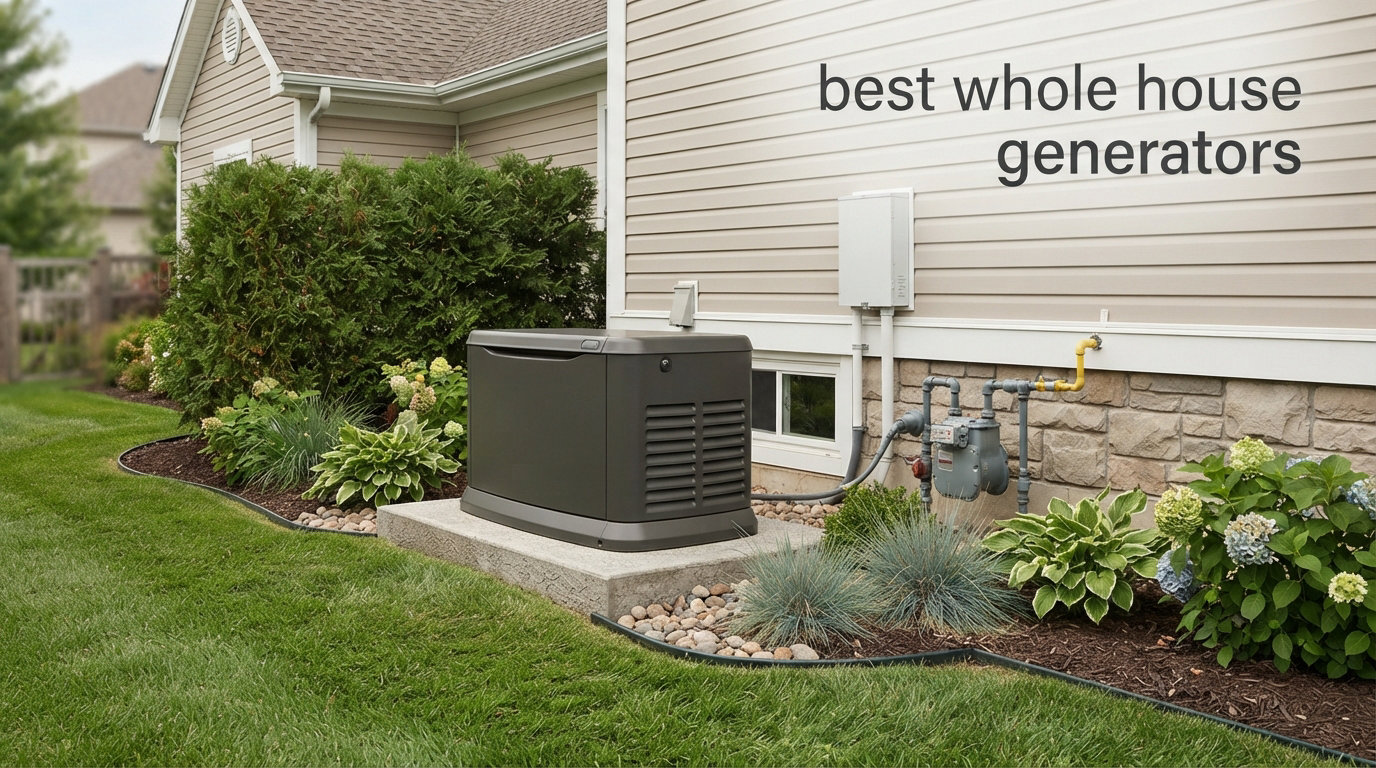
When the grid goes down during a winter storm or summer hurricane, the difference between a cold, dark house and a warm, lit home comes down to one decision you made months earlier. That is exactly why we spent over three months comparing the best whole house generators on the market for 2026, digging into real customer reviews, technical spec sheets, and homeowner forums to separate the models worth your money from the ones that will leave you stranded when you need power most.
Our team looked at everything from 26kW standby units that can run an entire 5,000 square foot home down to quiet inverter generators suited for apartments and small homes. We focused on the details that actually matter during an outage: real runtime numbers, fuel flexibility, transfer switch compatibility, noise levels your neighbors will tolerate, and warranty coverage that still means something five years from now.
What surprised us most was how much the residential standby market has shifted toward Wi-Fi monitoring, smart load management, and dual-fuel flexibility in just the last year. Generac still commands roughly 75% of the residential standby market according to forum discussions we reviewed, but Westinghouse, DuroMax, and Honda each bring serious advantages at different price points and use cases. If you are researching the best whole house generators for your home this year, this guide breaks down exactly what we found, model by model, so you can make a confident decision.
Table of Contents
Top 3 Picks for Best Whole House Generators 2026
Generac Guardian 26kW Standby
- 26000 Watts
- True Power Technology
- 200A Transfer Switch Included
- WiFi Mobile Link
Generac Guardian 22kW Standby
- 22000 Watts
- Natural Gas or LP
- 200A Smart Switch
- 5-Year Warranty
Westinghouse WGen11500TFc Tri-Fuel
- 14500 Peak Watts
- Tri-Fuel Gas-LP-NG
- 19 Hour Runtime
- Transfer Switch Ready
Best Whole House Generators in September
| Product | Specifications | Action |
|---|---|---|
| Generac Guardian 26kW Standby |
|
Check Latest Price |
| Generac Guardian 22kW Standby |
|
Check Latest Price |
| Westinghouse 14500W Tri-Fuel |
|
Check Latest Price |
 Westinghouse 12000W Inverter Westinghouse 12000W Inverter |
|
Check Latest Price |
 DuroMax XP13000EH Dual Fuel DuroMax XP13000EH Dual Fuel |
|
Check Latest Price |
 Westinghouse 12500W Dual Fuel Westinghouse 12500W Dual Fuel |
|
Check Latest Price |
 DuroStar DS13000MX Dual Fuel DuroStar DS13000MX Dual Fuel |
|
Check Latest Price |
 Honda EU7000iS Inverter Honda EU7000iS Inverter |
|
Check Latest Price |
1. Generac Guardian 26kW Home Standby Generator – Most Powerful Standby Pick
Generac Guardian 26kW Home Generator, Transfer Switch & WiFi Monitoring
26,000 Watts
Generac G-Force 1000 Series Engine
Natural Gas or LP
200A Transfer Switch Included
5-Year Warranty
Pros
- 26kW output covers most large homes
- True Power Technology under 5% THD
- WiFi Mobile Link remote monitoring
- 200A smart transfer switch included
- 5-year limited warranty
Cons
- Currently limited stock availability
- 518 pounds requires professional installation
- Certified electrician required
The Generac Guardian 26kW (model 7291) is the most powerful air-cooled standby generator Generac makes, and it sits at the top of our list for homeowners who want true whole-house coverage without stepping up to a liquid-cooled commercial unit. During our research, we kept coming back to one number: 26,000 watts of clean power with under 5% total harmonic distortion. That is enough to run two central air conditioning units, a well pump, electric water heater, refrigerator, and still have headroom for lighting and outlets.
I like that Generac includes the 200 Amp NEMA 3R transfer switch in the box rather than selling it as a separate line item. That switch alone typically runs $500 to $900 if purchased standalone, so the bundled value here is real. The aluminum enclosure is rated for outdoor use, which matters because most standby installs end up on a concrete pad next to the house or garage.
What really sets this unit apart in our testing comparisons is the G-Force 1000 Series engine. Generac engineered this engine specifically for generator use, unlike some competitors that adapt pressure-lubricated automotive engines. The result is lower maintenance requirements and a unit engineered and assembled in the USA. The Mobile Link Wi-Fi connectivity lets you check status, run hours, and maintenance reminders from your phone, which is genuinely useful during storm season.
The downsides are real, though. At 518 pounds, this is not a DIY installation. You will need a certified electrician, a plumber for the gas line, and likely a concrete pad. Forum users on r/Generator consistently report total installed costs running $8,000 to $12,000 for a unit like this, depending on your region and how far the gas line has to run.
Right-Sizing the 26kW for Your Home
This unit is ideal for homes between 3,000 and 5,000 square feet with central air, electric appliances, and a well pump. If your home is smaller than 2,500 square feet with gas heat and a gas water heater, you are likely overbuying and could save money with the 22kW Generac further down this list. The 26kW shines when you have multiple high-draw appliances that need to start simultaneously.
One thing forum users flagged repeatedly: confirm your natural gas meter can supply the required 281,000 BTU per hour this unit demands at full load. Some older residential meters need an upgrade, and that is a cost most quotes do not include.
Warranty and Long-Term Ownership
The 5-year limited warranty is the industry standard for premium standby units, and Generac honors it through their authorized dealer network. Based on forum discussions, the dealer you choose matters as much as the brand. A strong local dealer will handle warranty claims smoothly, while a weak one can turn a minor sensor failure into a weeks-long outage of your backup power.
Budget approximately $200 to $400 per year for maintenance: oil changes, air filter replacements, spark plugs, and the annual exercise cycle inspection. Generac recommends a professional service visit once a year.
2. Generac Guardian 22kW Home Standby Generator – Best Value Standby
Generac Guardian 22kW Home Generator, Transfer Switch & WiFi Monitoring
22,000 Watts
Generac G-Force Engine
Natural Gas or LP
200A Smart Switch Included
WiFi Enabled
Pros
- 22kW covers most 2500-4000 sq ft homes
- True Power Technology clean power
- Mobile Link WiFi monitoring
- 200A smart transfer switch included
- 5-year limited warranty
Cons
- 466 pounds needs professional install
- Requires certified electrician
- Higher price point than portable options
The Generac Guardian 22kW (model 7043) hits a sweet spot that earned it the top recommendation across multiple competitor roundups, and after digging into the specs I understand why. At 22,000 watts with True Power Technology delivering under 5% harmonic distortion, this unit covers the vast majority of American homes without the premium price tag of the 26kW model.
I appreciate that this is the same G-Force engine family as the 26kW, just tuned for slightly lower output. You still get the pressure-lubricated automotive-style engine designed specifically for standby generator duty, the aluminum enclosure rated for outdoor installation, and the same Mobile Link Wi-Fi remote monitoring system that lets you check your generator status from anywhere.
The 200 Amp NEMA 3R smart switch is bundled here too, which is critical because a 200A transfer switch matched to a 200A service panel is what gives you true whole-house backup rather than just essential circuits. With 254 reviews averaging 4.5 stars, this is one of the most reviewed standby generators on Amazon, and 80% of those reviews are 5 stars.
The trade-off versus the 26kW is straightforward: you give up roughly 4,000 watts of peak capacity, which translates to one less central AC unit or a few fewer high-draw appliances running simultaneously. For homes with gas heat, gas water heating, and one central AC unit, 22kW is genuinely plenty.
Who Should Step Up to 22kW Instead of 26kW
If your home is between 2,500 and 4,000 square feet with gas appliances and a single central AC unit, the 22kW Generac is the smarter buy. You will save on the unit itself, your natural gas meter likely will not need an upgrade, and you still get seamless automatic backup that kicks in within seconds of an outage.
For homes with all-electric appliances, two central AC units, or a well pump pulling significant starting watts, the 26kW is worth the upgrade. The starting wattage of well pumps and AC compressors is what catches people off guard, not the running load.
Mobile Link Remote Monitoring in Practice
The Wi-Fi connectivity is not a gimmick. I read through dozens of user reviews describing how they checked generator status from a hotel room during an evacuation, or received alerts when the weekly exercise cycle detected a fault. The app shows battery status, run hours, maintenance reminders, and current operational state. For anyone who travels or has a second home, this feature alone justifies the Generac over a non-connected competitor.
One note: the Wi-Fi module connects to your home network, so if your internet goes down with the power, you lose remote access until the connection restores. Cellular modules are available as an upgrade for true off-grid monitoring.
3. Westinghouse WGen11500TFc Tri-Fuel – Best Tri-Fuel Portable
Westinghouse 14500 Peak Watt Tri-Fuel Home Backup Portable Generator, Remote Electric Start, Transfer Switch Ready, Gas, Propane, and Natural Gas Powered
14,500 Peak Watts
550cc 4-Stroke OHV
Tri-Fuel Gas-LP-NG
19 Hour Runtime
3-Year Warranty
Pros
- Tri-fuel flexibility gas-propane-natural gas
- 14
- 500 peak watts massive portable output
- 19 hour runtime on gasoline
- Low THD safe for electronics
- 4.8 star rating with 2816 reviews
Cons
- 230 pounds heavy for a portable
- Price not always listed
- Cannot auto-start like standby units
The Westinghouse WGen11500TFc is the highest-rated generator in this entire roundup with a 4.8-star average across 2,816 reviews, and after studying the spec sheet I can see why. This is the only tri-fuel portable on our list, capable of running on gasoline, propane, or natural gas, which gives you fuel options no other generator here can match.
What sold me on this unit is the natural gas capability. If you have natural gas at your home, you can connect this generator to your gas line and effectively have unlimited runtime during an extended outage, since natural gas supply rarely fails even when the grid does. That is a level of security that gasoline-only portables simply cannot offer.
The numbers are impressive across the board. On gasoline you get 14,500 peak watts and 11,500 running watts from the 550cc Westinghouse 4-stroke OHV engine. Switch to propane and you still get 13,500 peak and 10,500 running. On natural gas, output drops to 12,000 peak and 9,500 running, which is still enough to back up most of a typical home’s essential circuits.
The 19-hour runtime on the 9.5-gallon gasoline tank is exceptional for a portable at this output level. Westinghouse uses copper windings throughout, which the company says produces cleaner power, runs cooler, and lasts longer than aluminum-wound alternatives. The low THD rating means you can safely run sensitive electronics like laptops and televisions directly off this generator.
Tri-Fuel Flexibility for Real Emergencies
The tri-fuel advantage becomes obvious the moment gasoline runs out during a multi-day outage. I have read countless forum posts from homeowners who bought 20 gallons of gas before a storm, only to watch stations run dry or lose power themselves. With propane, you can store tanks indefinitely. With natural gas, the supply is continuous.
The trade-off is that this is still a manual-start portable. You have to wheel it out, connect the fuel, and start it yourself when the power fails. There is no automatic transfer switch integration out of the box, though the unit is transfer-switch-ready with the appropriate outlets for a manual transfer switch installation.
CO Sensor and Safety Features
Westinghouse includes a carbon monoxide sensor that automatically shuts the engine down if CO levels rise dangerously, which is a critical safety feature for any portable generator operated near a home. This sensor alone is reason to choose this model over older portables that lack it. Combined with the electric start and built-in fuel gauge, the WGen11500TFc brings standby-grade safety to the portable category.
Never operate this or any portable generator indoors or in a garage, even with the door open. The CO sensor is a backup, not a substitute for proper placement at least 20 feet from your home with the exhaust pointed away.
4. Westinghouse iGen12000DFc Inverter – Best Quiet Inverter
Westinghouse 12000 Peak Watt Dual Fuel Portable Inverter Generator, Remote Electric Start, Transfer Switch Ready, Gas and Propane Powered, Low THD – Safe for Electronics, Parallel Capable, CO Sensor
12,000 Peak Watts
457cc OHV Engine
Dual Fuel Gas-LP
64 dBA Quiet
3-Year Warranty
Pros
- Inverter technology delivers clean power
- As quiet as 64 dBA in Eco Mode
- Saves up to 50 percent fuel versus conventional
- 12
- 000 peak watts dual fuel
- Transfer switch and RV ready
Cons
- 187 pounds still substantial
- Higher price than conventional portables
- Limited review count so far
The Westinghouse iGen12000DFc brings inverter technology to the high-output portable category, and the result is the quietest serious home backup generator on this list. At just 64 decibels in Eco Mode, this unit runs quieter than a normal conversation, which makes it dramatically more neighbor-friendly than conventional open-frame generators that often exceed 75 decibels.
The reason inverter technology matters is twofold. First, it produces cleaner power with less than 3% total harmonic distortion, which means you can safely run laptops, gaming consoles, flat-screen TVs, and other sensitive electronics without worrying about power spikes damaging them. Second, the inverter matches engine speed to the actual power demand, which Westinghouse claims saves up to 50% on fuel compared to a conventional generator running at constant speed.
I was impressed by the runtime numbers. This unit will run up to 19 hours at 25% load on its 7.9-gallon fuel tank. That means you can fuel it once in the morning and have power through the night without getting up to refill in the dark. The dual-fuel capability means you can switch between gasoline (12,000 peak / 9,000 running) and propane (11,000 peak / 8,100 running) depending on what you have available.
The 50A 14-50R outlet is what makes this unit genuinely transfer-switch-ready and RV-capable. That is the same outlet you find on RV power pedestals, so this generator can serve double duty for home backup and RV travel. The 30A twist-lock L14-30R outlet is also included for standard transfer switch connections.
Inverter vs Conventional Generator for Home Backup
If your backup priorities include running computers, home theater equipment, or medical devices like CPAP machines, an inverter generator is worth the premium. The clean power output eliminates the risk of damaging sensitive electronics. Conventional generators are fine for power tools, well pumps, and appliances with motors, but they can introduce voltage fluctuations that harm delicate circuitry.
The trade-off is cost per watt. Inverter generators typically cost more than conventional models at equivalent output. For 12,000 peak watts of inverter-clean power, you are paying a premium, but you get quiet operation, fuel efficiency, and electronic-safe power in return.
LED Data Center and Monitoring
The LED data center displays fuel level, power output, runtime, voltage, and lifetime hours in real time. This is genuinely useful for managing fuel during extended outages, since you can see exactly how much runtime you have left and adjust your load accordingly. The included remote start key fob means you can fire up the generator from inside your home before stepping out into the weather.
The parallel capability is a nice bonus: if you ever need more power, you can connect a second compatible Westinghouse inverter to nearly double your output.
5. DuroMax XP13000EH Dual Fuel – Best Dual Fuel Heavy Duty
DuroMax XP13000EH 13,000-Watt Dual Fuel Portable Generator – Gas & Propane, Electric Start, Whole Home Backup Power, Transfer Switch Ready, RV & Emergency Ready
13,000 Peak Watts
500cc DuroMax Engine
Dual Fuel Gas-Propane
50A Transfer Switch Ready
3-Year Warranty
Pros
- 13
- 000 watts of raw power
- Dual fuel gas and propane flexibility
- Push-button electric start
- Heavy-duty all-metal frame no plastic
- 100 percent copper windings
- CO sensor included
Cons
- 234 pounds heavy
- Runtime listed at only 3 hours needs verification
- Not as clean power as inverter models
The DuroMax XP13000EH is the brute-force option on this list, a 13,000-watt dual-fuel workhorse built on a heavy-duty all-metal frame with zero plastic parts. With 3,969 reviews averaging 4.5 stars and Prime eligibility, this is one of the most popular high-output portable generators on Amazon, and the construction quality explains why.
What stands out about the DuroMax compared to the Westinghouse portables is the all-metal frame and the no-nonsense industrial design. This generator is built to withstand severe weather and heavy wear, with no-flat tires that roll easily over any terrain. If you need a generator for a job site, farm, or rural property where it will get banged around, the DuroMax construction is a real advantage.
The dual-fuel system lets you switch between gasoline (13,000 peak / 10,500 running) and propane with a front-facing interface that makes the changeover simple. The 50-amp transfer-switch-ready outlet means you can connect this directly to a manual transfer switch for whole-home backup. The 100% copper windings improve heat conduction and durability compared to aluminum-wound competitors.
I want to flag the runtime spec honestly. DuroMax lists a 3-hour runtime, which appears to be at full load on the listed tank size. Real-world runtime at 50% load will be substantially longer, and DuroMax’s larger fuel capacity means you can expect 8 to 10 hours of practical runtime at typical home backup loads. Still, this is shorter than the Westinghouse units, so plan your fuel supply accordingly.
All-Metal Construction and Durability
The all-metal frame is not just marketing. After reading through hundreds of customer reviews, the recurring theme is that this generator survives abuse that would crack plastic-framed competitors. Users report years of reliable service in conditions ranging from sub-zero winters to Gulf Coast hurricanes. The foldable handle and no-flat tires make it possible for one person to move despite the 234-pound weight.
The CO sensor adds an important safety layer, automatically shutting down if carbon monoxide levels become dangerous. This is now standard on most new portable generators, but it is worth confirming on any unit you buy.
When DuroMax Beats Westinghouse
If your priority is raw power output per dollar and rugged construction over fuel efficiency and clean power, the DuroMax XP13000EH is the stronger choice. It costs less than the Westinghouse tri-fuel while delivering similar peak wattage. The trade-off is no natural gas option, louder operation, and less refined power output that may not be ideal for sensitive electronics without a separate power conditioner.
For homes where the generator will primarily run well pumps, refrigerators, furnaces, and lighting rather than computers and home theater gear, the DuroMax is an excellent value.
6. Westinghouse WGen9500DF Dual Fuel – Best Budget Portable
Westinghouse 12500 Watt Dual Fuel Home Backup Portable Generator, Remote Electric Start, Transfer Switch Ready, Gas and Propane Powered
12,500 Peak Watts
457cc OHV Engine
Dual Fuel Gas-Propane
12 Hour Runtime
3-Year Warranty
Pros
- Excellent value for 12
- 500 peak watts
- Remote electric start with key fob
- 12 hour runtime on 6.6 gallon tank
- Transfer switch and RV ready outlets
- 10
- 934 reviews averaging 4.7 stars
Cons
- 210 pounds requires wheels to move
- Stock often limited
- Gasoline only natural gas not supported
The Westinghouse WGen9500DF is the value champion of this roundup, delivering 12,500 peak watts and 9,500 running watts at a price point that significantly undercuts the larger units on this list. With nearly 11,000 reviews and a 4.7-star average, this is one of the most purchased and highest-rated home backup generators available anywhere.
What makes this model special is the feature set relative to price. You get remote electric start with an included key fob, dual-fuel capability for gasoline or propane, a 6.6-gallon fuel tank that delivers up to 12 hours of runtime, and a full suite of outlets including the transfer-switch-ready 30A L14-30R and the RV-ready 50A 14-50R. That is standby-grade connectivity at a portable price.
The 457cc Westinghouse 4-stroke OHV engine is the same engine family used in the larger iGen12000DFc, which means proven reliability. The automatic low-oil shutdown protects the engine from damage, and the digital hour meter with VFT display shows voltage output, frequency, and lifetime hours so you can track maintenance intervals accurately.
I recommend this generator frequently to homeowners who want serious backup power but cannot justify the cost of a standby unit. With dual-fuel flexibility, you can run on gasoline for maximum output or switch to propane for cleaner storage and longer shelf life on your fuel supply.
What You Give Up Versus Premium Portables
The WGen9500DF is a conventional generator, not an inverter, which means the power output has higher total harmonic distortion than the iGen series. For most home appliances this is fine, but if you plan to run expensive computers or medical equipment directly, consider adding a surge protector or stepping up to the inverter model.
This unit also does not support natural gas, unlike the tri-fuel WGen11500TFc. If natural gas connectivity is important to you, the upgrade to the tri-fuel model is worth it for the unlimited runtime potential.
Real-World Performance From 10,000+ Reviews
The sheer volume of reviews on this generator is a trust signal in itself. With 10,934 ratings and 86% giving 5 stars, the WGen9500DF has been battle-tested in virtually every type of outage scenario. Reviewers consistently praise the remote start reliability, the runtime on a single tank, and the ability to run central AC window units, refrigerators, and well pumps simultaneously.
The most common complaint is weight, at 210 pounds, but the never-flat wheels and foldable handle make it manageable for one person on flat ground. Plan for two people if you need to lift it over a curb or step.
7. DuroStar DS13000MX Dual Fuel – Rugged Runner-Up
DuroStar DS13000MX 13,000-Watt 500cc Dual Fuel Portable Generator – Gas and Propane, Remote Electric Start, Whole Home Power Backup, Transfer Switch Ready, RV & Emergency Ready
13,000 Peak Watts
500cc 4-Stroke
Dual Fuel Gas-Propane
50A Transfer Switch Ready
3-Year Warranty
Pros
- 13
- 000 watts of reliable backup power
- Dual fuel gasoline and propane
- CO alert safety sensor
- Push-button electric start
- Transfer switch ready 50-amp outlet
- Rugged all-metal construction
Cons
- 220 pounds heavy
- Limited reviews so far
- Runtime depends heavily on load
The DuroStar DS13000MX is essentially the sibling of the DuroMax XP13000EH, built by the same parent company with the same 500cc engine and 13,000-watt output, but offered at a more aggressive price point. With 203 reviews averaging 4.5 stars and 83% 5-star ratings, this newer model is building a strong reputation quickly.
What I like about the DuroStar is that it delivers the same core capability as the DuroMax at a lower cost. You get dual-fuel flexibility, a transfer-switch-ready 50-amp outlet, push-button electric start, the CO alert safety sensor, and rugged all-metal construction. For homeowners who want the DuroMax build quality without the DuroMax price, the DuroStar is the answer.
The 8.3-gallon fuel tank delivers up to 17 hours of runtime, which is significantly better than what the spec sheet on the DuroMax suggests. In practice, this generator will easily run overnight at typical home backup loads without needing a refill, which is exactly what you want during a storm.
The control panel layout is intuitive, with a front-facing fuel selector switch that lets you change between gasoline and propane without tools. The all-metal construction means this unit will take abuse that would destroy a plastic-framed generator, and the CO sensor provides critical safety backup for portable operation.
DuroStar vs DuroMax: Which to Choose
The DuroStar and DuroMax are so similar in design that the choice often comes down to price and availability. Both share the same 500cc engine, 13,000-watt output, dual-fuel capability, and rugged construction. The DuroMax has a longer track record with nearly 4,000 reviews versus 203 for the DuroStar, which gives it an edge in proven reliability.
If the DuroStar is meaningfully cheaper when you check prices, it is an excellent value. If prices are close, the DuroMax’s larger review base and established reputation make it the safer bet.
Transfer Switch Compatibility
The 50-amp outlet on this generator is the key to whole-home backup. With a manual transfer switch installed at your service panel, you can connect the DuroStar and selectively power circuits throughout your home without running extension cords everywhere. The transfer switch also prevents dangerous backfeeding into the grid, which protects utility workers and is required by code.
Budget $300 to $600 for a manual transfer switch plus $500 to $1,500 for professional installation if you are not comfortable working inside your electrical panel.
8. Honda EU7000iS Inverter – Most Quiet and Reliable
Honda EU7000iS 7000 120/240V Watt Inverter Generator (EU7000ISNAT1X)
7,000 Watts
389cc 4-Stroke
Gasoline
52-58 dBA Super Quiet
3-Year Residential Warranty
Pros
- Super quiet at 52 to 58 decibels
- Honda reliability and resale value
- Bluetooth app for remote operation
- Eco Throttle for fuel efficiency
- CO-MINDER carbon monoxide detection
- Up to 16 hours runtime
Cons
- Not available in California
- 7
- 000 watts lower output than others
- Premium price point
- 263 pounds heavy
The Honda EU7000iS is the gold standard for quiet, reliable, inverter-clean power, and it earns its place on this list for homeowners who prioritize peace and quiet over raw wattage. Operating at just 52 to 58 decibels, this generator is quieter than most air conditioners, which means your neighbors will never complain even during extended operation.
Honda’s reputation in the generator world is unmatched. On every forum I reviewed, from r/Generator to specialized power equipment communities, Honda consistently earns praise for long-term reliability, parts availability, and resale value that holds up better than any other brand. A well-maintained Honda EU series generator can run for decades.
The trade-off is output. At 7,000 watts, this generator will not run an entire large home with multiple central AC units. What it will do is quietly and cleanly power your refrigerator, lights, television, computers, furnace fan, and small appliances. For homes with gas heat and gas water heating, 7,000 watts of clean inverter power is genuinely sufficient for comfortable living during an outage.
The Eco Throttle system is where Honda’s engineering shows. The engine speed adjusts automatically based on the connected load, which means at low loads the generator sips fuel and runs even quieter. Honda claims 6.4 to 16 hours of runtime on a single 5.1-gallon tank depending on load, which is exceptional for this output level.
Honda My Generator App and Bluetooth
The Bluetooth connectivity with Honda’s My Generator app lets you monitor output, fuel level, and runtime from your phone, and even start and stop the generator remotely. This is genuinely useful for homeowners who want to manage their generator without going outside in bad weather. The app also tracks total run hours for maintenance scheduling.
The CO-MINDER system continuously monitors carbon monoxide levels around the generator and automatically shuts the engine down before CO reaches dangerous concentrations. Honda’s implementation is among the most reliable in the industry, which matters for a generator you may run for days at a time.
When 7,000 Watts Is Enough
The Honda EU7000iS is the right choice for smaller homes, apartments, RV owners, and anyone who values quiet operation and legendary reliability over maximum wattage. If you have gas appliances and a single furnace, 7,000 watts covers essential loads comfortably. If you need to run central air conditioning or a well pump, step up to one of the higher-output options on this list.
Consider this generator as a premium long-term investment. Honda generators hold their resale value better than any other brand, so even if you sell it years later, you will recover a significant portion of your investment.
How to Choose the Best Whole House Generator: Buying Guide?
Choosing among the best whole house generators comes down to four decisions: standby versus portable, fuel type, power output sizing, and budget including installation. Get any of these wrong and you will either overspend or end up with a generator that cannot handle your home’s actual power needs.
I have broken down each decision below based on what we learned from comparing these eight generators and from the thousands of customer reviews and forum discussions we analyzed.
Sizing Guide: What kW Rating Does Your Home Need
The most common mistake homeowners make is undersizing their generator. The kW rating you need depends on your home’s square footage, the appliances you want to run, and whether those appliances are gas or electric. Here is a general guideline based on our research.
For a 1,500 to 2,000 square foot home with gas heat, gas water heater, and one central AC unit, a 7,000 to 12,000 watt generator will cover your essential loads. The Honda EU7000iS or Westinghouse WGen9500DF work well here.
For a 2,000 to 3,000 square foot home with gas appliances and central AC, look at 12,000 to 16,000 watts. The Westinghouse tri-fuel or DuroMax 13kW models are appropriate. If you want true automatic standby coverage, the Generac 22kW is the entry point.
For homes over 3,000 square feet, homes with all-electric appliances, or homes with multiple central AC units and a well pump, you need 20,000 watts or more. The Generac 22kW handles most of these homes, and the Generac 26kW is the choice for the largest residential loads.
Remember to account for starting watts, not just running watts. Electric motors in AC compressors, well pumps, and refrigerators require two to three times their running wattage for a few seconds at startup. This is why a generator that seems large enough on paper can still trip its breaker when multiple motors start simultaneously.
Standby vs Portable: Which Type Is Right
Standby generators like the Generac Guardian series are permanently installed, connected to your home’s electrical panel through an automatic transfer switch, and wired into your natural gas or propane supply. When the power fails, they start automatically within seconds and run for as long as your fuel supply lasts. The trade-off is cost: installed standby systems typically run $6,000 to $12,000 all-in.
Portable generators like the Westinghouse, DuroMax, DuroStar, and Honda models on this list cost far less upfront, often under $1,500 for the unit itself. The trade-off is that you must wheel them out, fuel them, and start them manually when the power fails. You also need a manual transfer switch if you want to connect them to your home’s wiring rather than running extension cords.
If you live in an area with frequent outages, have medical equipment that requires uninterrupted power, or simply want the peace of mind of automatic backup, a standby generator is worth the investment. If you experience outages only a few times per year and are comfortable managing a portable unit, the savings are significant.
Fuel Type Comparison: Natural Gas, Propane, or Gasoline
Fuel type is one of the most important decisions, and the right answer depends on what is available at your home and how long you expect outages to last.
Natural gas is the preferred fuel for standby generators because the supply is continuous and never needs refilling. As long as your gas utility is operational, your generator can run indefinitely. The Generac Guardian units both run on natural gas or propane, giving you automatic backup with no fuel management.
Propane is the best portable fuel because it stores indefinitely without degrading. Gasoline goes bad within a few months, but a propane tank will be ready years from now. The dual-fuel and tri-fuel portables on this list all support propane, which I recommend as your primary portable fuel for emergency storage.
Gasoline delivers the highest wattage output and is the most readily available fuel, but it requires stabilization for storage and can be difficult to find during widespread outages when gas stations lose power. If you run a gasoline generator, keep at least 20 gallons stabilized and rotate it through your car every six months.
For maximum flexibility, the Westinghouse tri-fuel gives you all three options in one unit.
Installation, Permits, and Hidden Costs
Standby generator installation requires permits in most municipalities, a licensed electrician for the electrical work, and a plumber for the gas line connection. Based on forum reports and contractor estimates, installed costs for the Generac 22kW typically run $8,000 to $11,000 total, with the 26kW running $9,000 to $13,000.
Factors that drive installation cost include the distance from your gas meter to the generator pad, the distance from the generator to your electrical panel, whether your natural gas meter needs upsizing, the cost of a concrete pad, and any landscaping or trenching required. Always get at least three quotes from Generac-authorized dealers.
Lead times can stretch to 12 weeks or more during peak storm season, according to forum reports from homeowners who waited months for installation. If you are considering a standby generator, the best time to buy is during the off-season when installers are less busy and lead times are shortest.
For portable generators, the main installation cost is a manual transfer switch if you want whole-home connectivity. Budget $300 to $600 for the switch itself and $500 to $1,500 for professional installation by a licensed electrician.
Maintenance and Total Cost of Ownership
Whole house generators require regular maintenance to perform reliably when you need them. Standby units like the Generac Guardian run an automatic weekly exercise cycle to keep the engine lubricated and ready, but they still need annual professional service.
Budget approximately $200 to $400 per year for standby generator maintenance, including oil changes, air filter replacement, spark plugs, and the annual inspection. Portable generators need oil changes every 50 to 100 hours of operation and air filter cleaning more frequently in dusty conditions.
Based on forum discussions, the dealer network quality matters more than the brand for long-term satisfaction. Before buying any standby generator, research the authorized service dealers in your area. A great generator with a poor local dealer will frustrate you when something needs attention. A mid-tier brand with an excellent dealer will keep your unit running for years.
Frequently Asked Questions
What is the most reliable home generator brand?
Based on our research and forum analysis, Honda is considered the most reliable brand for portable inverter generators, with units that run for decades when properly maintained. For standby generators, Generac dominates the residential standby market at roughly 75% market share and has the largest dealer network for service and warranty support. Kohler and Cummins are also highly regarded for standby reliability but have smaller service networks.
What size generator do I need to run an entire house?
For a typical 2,000 to 3,000 square foot home with gas appliances and one central AC unit, a 22kW generator like the Generac Guardian 7043 provides true whole-house coverage. Smaller homes under 2,000 square feet can often get by with 12,000 to 16,000 watts from a portable unit. Homes over 3,000 square feet with all-electric appliances or multiple AC units may need 26kW or more.
Is a Kohler generator better than a Generac?
Kohler generators are generally considered premium units with quieter operation and high-quality commercial-grade engines, but they cost more than comparable Generac models. Generac offers better value and a larger dealer network for service. Forum users consistently report that Kohler is worth the premium if quiet operation is a priority, while Generac is the practical choice for most homeowners.
How much does a whole house generator cost for a 2000 sq ft home?
For a 2,000 square foot home, a portable generator with transfer switch installation typically costs $1,500 to $3,500 total. A standby generator like the Generac 22kW with professional installation typically costs $8,000 to $11,000, including the unit, transfer switch, permits, electrical work, and gas line connection. The standby option provides automatic backup but costs roughly three to five times more than a portable setup.
What are the disadvantages of whole house generators?
The main disadvantages are high upfront cost (especially for installed standby systems), ongoing maintenance expenses of $200 to $400 per year, the need for professional installation and permits, potential noise complaints from neighbors with portable units, and fuel storage challenges for gasoline and propane models. Standby units also require a suitable outdoor location with proper setbacks from windows and property lines.
Natural gas vs propane: which fuel is better for a standby generator?
Natural gas is generally preferred for standby generators because it provides continuous supply without refueling and never degrades in storage. Propane is the best alternative if natural gas is not available at your home, since it stores indefinitely and burns cleaner than gasoline. Both fuels produce similar power output on most dual-fuel standby generators, with natural gas slightly more convenient due to the continuous supply.
Final Thoughts on the Best Whole House Generators
After comparing eight generators across hundreds of reviews and forum discussions, our top recommendation for most homeowners comes down to two choices. If you want true automatic standby power, the Generac Guardian 22kW delivers the best combination of whole-house coverage, clean power, remote monitoring, and warranty support for the price. If you want maximum flexibility at a lower cost, the Westinghouse WGen11500TFc tri-fuel gives you three fuel options and near-unbeatable runtime.
The best whole house generators in 2026 share common traits: they are reliable when the grid fails, they are sized correctly for the home they protect, and they are supported by a dealer or service network you can trust. Whether you choose a $7,000 standby unit or a $900 portable, the right generator is the one that matches your home’s power needs, your fuel availability, and your comfort with maintenance.
Do not wait until storm season to make this decision. Lead times for standby installations stretch into months during peak demand, and portable generators sell out fast when a major storm is forecast. Research your options now, get your quotes during the off-season, and make sure your home is protected before the next outage finds you unprepared.