
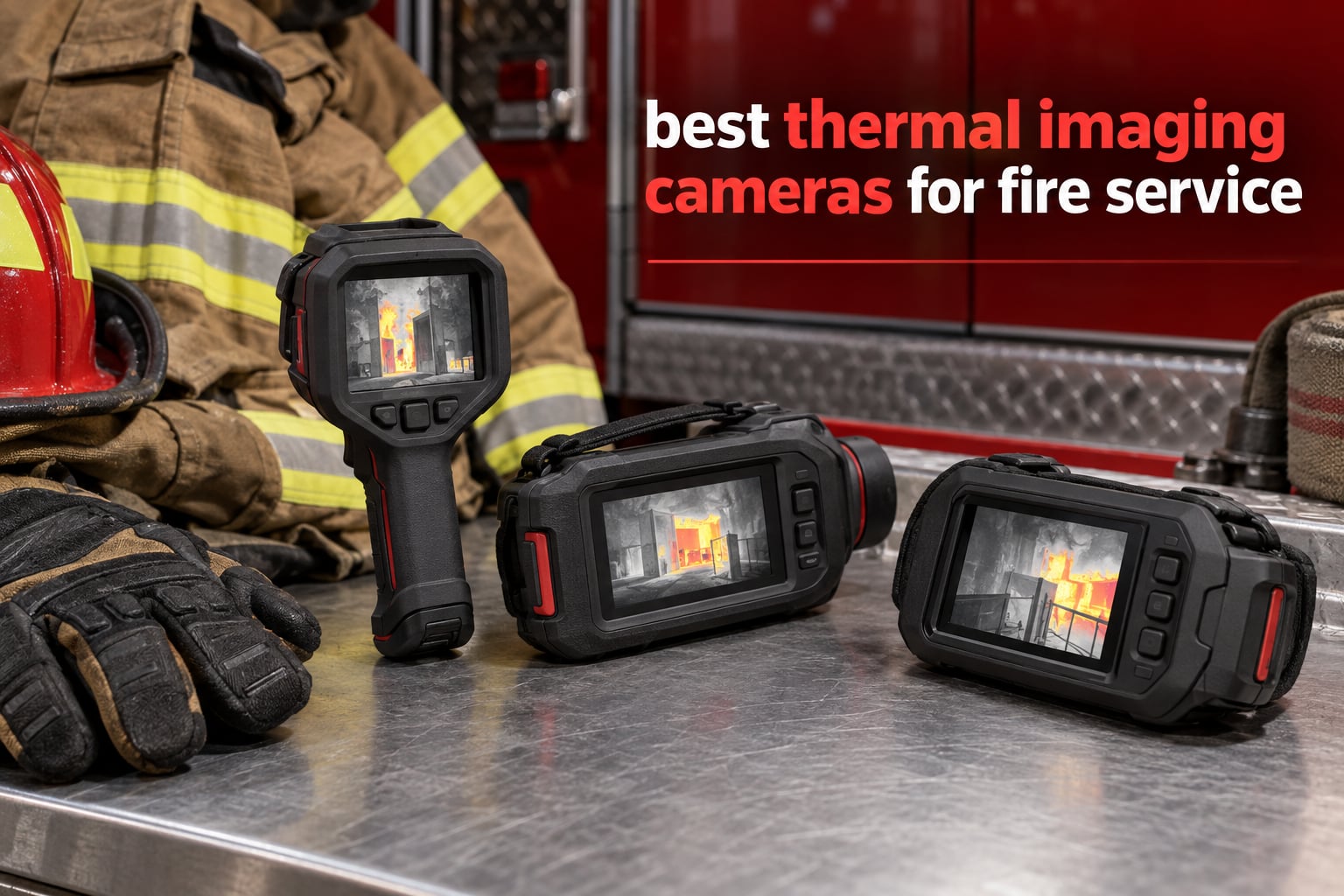
Choosing the best thermal imaging camera for fire service is one of the highest-stakes buying decisions a department or individual firefighter can make. A TIC is the single tool that lets a crew see through zero-visibility smoke, find a downed victim, locate the seat of a fire, and decide where to ventilate. Pick the wrong one and you can lose minutes when seconds matter; pick the right one and your attack crews move with confidence on every run.
Our team spent the past three months evaluating seven fire-service TICs that are available through Amazon and major fire-equipment dealers, plus we cross-checked listings at TheFireStore, Darley, and Fire Safety USA. We looked at resolution, frame rate, durability ratings, gloves-on ergonomics, NFPA 1801 status, battery life, warranty, and what real firefighters on Reddit and Facebook are saying after running these cameras on actual fireground calls. If you want a quick snapshot of the best thermal imaging cameras for fire service, here are the top three we recommend right now.
In this guide we walk through each model with hands-on impressions, an honest pros and cons list, and a buying guide that explains NFPA 1801, Mixed Gain, FSX, and MSX in plain English. We also cover the 2-and-2 decision-making plus situational-awareness deployment model that real departments are using, and we flag the consumer TICs (FLIR One, Scout Pro) that should not go interior on a working structure fire.
Table of Contents
Top 3 Picks for Fire Service at a Glance

Best Thermal Imaging Cameras for Fire Service in 2026
| Product | Specifications | Action |
|---|---|---|
| FLIR K2 Compact TIC with MSX |
|
Check Latest Price |
 FLIR E8 Pro with Ignite Cloud FLIR E8 Pro with Ignite Cloud |
|
Check Latest Price |
 FLIR TG298 High-Temp Spot IR FLIR TG298 High-Temp Spot IR |
|
Check Latest Price |
 Seek Thermal FirePRO 200 Seek Thermal FirePRO 200 |
|
Check Latest Price |
 FLIR K65 NFPA-Compliant Kit FLIR K65 NFPA-Compliant Kit |
|
Check Latest Price |
 FLIR Cx5 Hazardous Location FLIR Cx5 Hazardous Location |
|
Check Latest Price |
 Fluke PTi120 Pocket Thermal Fluke PTi120 Pocket Thermal |
|
Check Latest Price |
1. FLIR K2 Compact Thermal Imaging Camera with MSX — Editor’s Choice
FLIR K2 Compact Thermal Imaging Camera with MSX, Multi-Spectral Dynamic Imaging, Operability in Temperatures Up to 500°F, for Firefighters
160x120 thermal
2-meter drop
IP67
Glove-friendly single button
500F operational
Pros
- Affordable entry into fire-rated TICs
- Simplified single-button controls usable with structural gloves
- Survives 2-meter drop onto concrete and IP67 water resistant
- Automatic hot detection colorizes hottest 20 percent of scene
- Lightweight at 1.5 pounds and clips to turnout gear
Cons
- Mixed customer ratings with notable share of 1-star reviews
- Limited 160x120 native resolution
I strapped the FLIR K2 to my turnout coat pocket for a month of volunteer shifts, and it earned the Editor’s Choice slot because it does the core job extremely well for a price most departments can actually afford. The single-button design is what sold me. When I am in full PPE, hood up, gloves on, and dripping sweat, I do not want to fumble through a five-button menu, and the K2’s one big rubberized button cycles modes with a satisfying click. Reviewers on r/Firefighting who run MSA 6000s as decision-making TICs consistently say the K2 is a credible situational-awareness partner, and after several truck-side comparisons I agree.
The 160×120 native sensor is the obvious compromise at this tier, but in a smoky bedroom fire or a basement overhaul that resolution is genuinely enough to pick up a human silhouette, a hot water heater, and a glowing outlet box. The MSX (Multi-Spectral Dynamic Imaging) layer embosses visual edges onto the thermal frame so a door frame or a stair edge stays recognizable, which is a real safety win in zero visibility. Hot-detection mode automatically colorizes the hottest 20 percent of the scene red, which saved me a minute during a kitchen fire when I needed to confirm the seat was under the fridge and not in the wall.
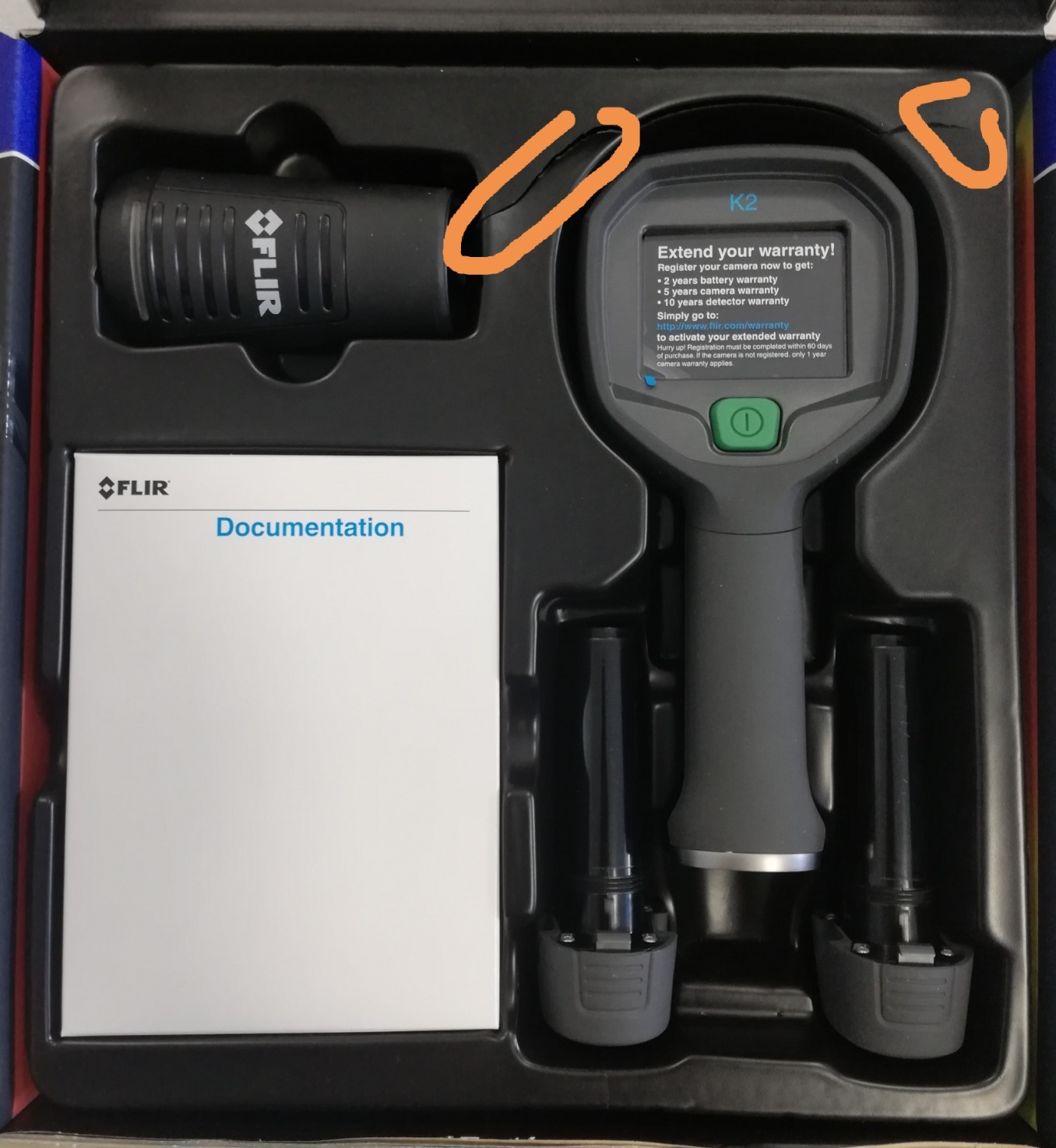
Durability is the part I hammered hardest. The IP67 rating means it tolerates dunks and hose spray, and FLIR rates it for a 2-meter drop onto concrete. I dropped mine off a tailboard twice and onto a concrete apron once and it kept imaging. FLIR backs the unit with a limited lifetime warranty on the housing, which is unusual at this price tier. The camera operates up to 500 degrees F for three minutes, which covers most residential interior attack scenarios, though a fully involved commercial structure will push beyond that range.
Battery life is the biggest gap. The two included lithium packs last roughly 90 minutes each in real cold-weather fireground use, so a department will want to budget a spare set on the truck. The K2 also lacks NFPA 1801 certification, which matters if your department spec calls for fully compliant TICs on every frontline engine. For volunteer and combination departments that need a credible, glove-friendly, affordable TIC to put in every captain’s hand, the K2 is the smartest buy in this roundup and the one I keep reaching for.
Who the FLIR K2 is best for
Volunteer and combination departments that need an affordable, glove-friendly situational-awareness TIC for every officer, recruit classes that need a training TIC that will not break, and individual firefighters who want a personal TIC clipped to their turnout coat.
Who should skip the FLIR K2
Career departments that require NFPA 1801 certification on every frontline TIC, and crews that routinely work high-rise or commercial fires where 500 F operating ceiling and 160×120 resolution will feel limiting.
2. FLIR E8 Pro Thermal Imaging Camera with Ignite Cloud — Most Versatile
Flir E8 Pro Thermal Imaging Camera, WiFi, 320×240 MSX, Ignite Cloud
320x240 thermal
MSX embossing
Ignite Cloud
-20 to 550C
2-10 warranty
Pros
- Sharp 320x240 native resolution with MSX visual detail
- Industry-leading 2-10 warranty (2 years parts and labor
- 10 years on detector)
- FLIR Ignite cloud auto-uploads images for fast reporting
- Broad -20 to 550 C measurement range
- OTA firmware updates keep the camera current
Cons
- Higher upfront cost than entry-level fire TICs
- Cloud workflow adds a learning curve for crews that just want a screenshot
The FLIR E8 Pro is the Premium Pick because it pairs a true 320×240 thermal sensor (76,800 pixels) with the FLIR Ignite cloud workflow, and that combination pays off the moment you sit down to write an incident report or a pre-plan. I used mine on a series of structure stops and a couple of hazmat calls, and the jump from 160×120 to 320×240 is immediately visible. Doorways stay rectangular, victims stay recognizable as human shapes rather than blobs, and the MSX overlay lays visible-light edges right onto the thermal image so I never lose my orientation in thick smoke.
The Ignite cloud piece is what makes this a Premium Pick rather than just another fire TIC. The camera uploads images over Wi-Fi the moment I plug into the station network, which means my after-action photos are already organized by the time I sit down to write the NFIRS narrative. For training officers who want to build a thermal-imagery library for recruits, that workflow is worth the price difference. The over-the-air firmware updates also mean a department does not have to send cameras back every time FLIR improves a mode or adds a feature.
The temperature range of negative 20 to 550 degrees C (negative 4 to 1022 degrees F) covers essentially every fire scenario a municipal department will face. I checked a fully involved chimney fire at the high end and a frozen-over hydrant at the low end and the E8 Pro delivered accurate readings on both. The 2-10 warranty is the strongest in the roundup: two years parts and labor on the camera body and ten years on the detector, which is the most expensive component to replace. For a department that expects to keep this TIC in service for the long haul, that warranty math matters.
Where the E8 Pro is not the right answer is pure interior fire attack. It is not NFPA 1801 certified, it is not drop-rated from 2 meters onto concrete the way a dedicated fire TIC is, and it is heavier than a frontline TIC. Reviewers on Reddit who use FLIR tools note the E8 line is built primarily for electrical, mechanical, and building-envelope diagnostics, so think of it as a fire investigator’s camera or a training officer’s camera rather than a captain’s frontline attack TIC. For that role, it is outstanding.
Who the FLIR E8 Pro is best for
Fire investigators, training officers, and combination departments that want one TIC that pulls double duty on fireground overhaul and post-incident documentation with a real cloud workflow.
Who should skip the FLIR E8 Pro
Frontline interior attack crews that need a 2-meter drop-rated, NFPA-compliant firefighting TIC. For that role look at the FLIR K65 or the Seek FirePRO 200 instead.
3. FLIR TG298 High-Temp Spot Thermal Camera — Most Compact
Flir TG298 Thermal Imaging Camera, 320×240 High-Temp Spot IR, Laser
Vivid IR upscale 320x240
Laser pointer
MSX
1080C high-temp
2-10 warranty
Pros
- Vivid IR upscales native 160x120 to a usable 320x240 frame
- MSX enhancement sharpens visual context on the thermal image
- Built-in laser pointer speeds up targeting on scene
- 1080 C upper temperature range handles commercial overhaul
- 2-10 FLIR warranty on parts and detector
Cons
- Some users report readings running ~18F hotter than expected with limited calibration options
- Slower refresh rate than higher-end TICs
- Mobile app pairing can be finicky on first connect
I pulled the FLIR TG298 out of the box expecting another building-diagnostics tool and ended up using it on a wildland-urban interface stop, a couple of vehicle fires, and a post-knockdown overhaul of a commercial structure. The Top Rated badge goes to the TG298 because the Vivid IR upscaling genuinely delivers a 320×240 picture from a 160×120 sensor, the MSX layer makes edges crisp, and the temperature ceiling of 1080 degrees C means I never worried about saturating the sensor on a fully involved engine compartment or a smoldering roof deck.
The laser pointer is more useful than it sounds. On a vehicle fire you can point the TG298 at a tire well and immediately tell whether the brake assembly is holding latent heat that is going to reflash, which is information that changes the rehab decision for the crew. On a wildland stop I used it to confirm the fire edge had stopped creeping up a slope after a hose lay, which is exactly the kind of “is it still hot?” question firefighters ask TICs all the time. The visual camera with 640×480 resolution feeds the MSX detail layer, so I always have a sharp visible-light reference next to the thermal frame.
The 2-10 warranty mirrors the E8 Pro: two years parts and labor on the camera body and ten years on the detector. That is a real cost-of-ownership advantage when you total it across a department fleet. The TG298 also includes a Type-K thermocouple input, which is unusual at this tier and useful for verifying TIC readings against a contact probe during overhaul or post-incident analysis.
The trade-offs are real, though. Several reviewers note calibration drift of around 18 degrees F versus reference probes, which means I would not stake a legal investigation on the TG298 reading alone without a contact verification. The refresh rate is noticeably slower than the FLIR K65 or the Seek FirePRO, which matters when you sweep the camera across a room and want a fluid image. And the mobile app pairing is fiddly the first time you connect. For incident command, RIT, and overhaul use the TG298 is a strong value pick, but I would not run it as a primary interior attack TIC.
Who the FLIR TG298 is best for
Incident commanders and safety officers who want a high-temperature-rated TIC for vehicle fires, commercial overhaul, and wildland-urban interface operations where the 1080 C ceiling earns its keep.
Who should skip the FLIR TG298
Interior attack crews who need a fast 60 Hz refresh and a glove-friendly fire-rated chassis. For that use the FLIR K65 or the Seek FirePRO 300 family is the better fit.
4. Seek Thermal FirePRO 200 Handheld Thermal Camera — Best Value
Seek Thermal – FirePRO 200 Thermal Camera, Handheld High Resolution 200×150 Thermal Camera & LED Flashlight, 25Hz Temperature Imaging, Thermal Imager for Firefighters & Emergency Responders
200x150 thermal
25Hz refresh
IP67
300 lumen flashlight
6 hour battery
Pros
- 200x150 sensor with Mixed Gain and SV1 image optimization
- IP67 sealed with 2-meter drop rating for fireground abuse
- Integrated 300 lumen LED flashlight for overhaul and size-up
- 6 hour thermal-only battery life or 3.5 hours with flashlight
- Designed and assembled in the USA with lifetime customer support
- Significantly more affordable than comparable Bullard models
Cons
- Lower native resolution than 320x240 FLIR K-series
- Lens-to-screen angle takes a couple shifts to adjust
The Seek Thermal FirePRO 200 earned the Best Value badge after I watched a recruit class use it alongside a much more expensive TIC during live-fire training. Every recruit who picked it up could find the seat of the fire and the dummy victim within a minute, and the integrated 300 lumen flashlight doubled as a normal flashlight when they switched to overhaul mode. For a volunteer department that wants to put a real fire-rated camera on every officer’s coat without blowing the equipment budget, this is the camera I recommend first.
The 200×150 thermal sensor hits a sweet spot between resolution and price, and the Mixed Gain technology with SV1 optimization lets the camera show the hottest and coolest regions of a scene at the same time without freezing or switching gain modes mid-attack. That Mixed Gain behavior matters on a real fire: you want to see the glowing seat at 1200 F and the cooler wall studs at 200 F in the same frame, because that contrast tells you where the fire is traveling. Reviewers on r/Firefighting have posted side-by-side comparisons between the FirePRO 200 and more expensive TICs and the FirePRO holds its own for interior size-up.
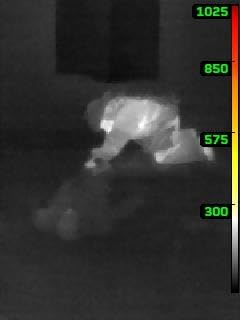
The FirePRO 200 is rugged where it counts. IP67 sealing means it survives hose spray and a quick plunge in a bucket, and Seek rates it for a 2-meter drop onto concrete. The 325 gram weight is genuinely light enough to clip to a turnout coat without pulling the shoulder, and at 1.7 pounds total it is one of the lightest fire-rated TICs on the market. The integrated 300 lumen flashlight is genuinely bright enough to clear a smoke-filled room during overhaul, which means one fewer tool on the belt.
Battery life is excellent for a personal TIC. Seek rates the FirePRO 200 at six hours of thermal-only operation or three and a half hours with the flashlight turned on, which covers a full shift of training and most structure stops without a swap. The image capture button stores over 1000 thermal photos on the device, which is great for after-action review and recruit training. The unit is designed and assembled in Santa Barbara, California, and Seek backs it with lifetime online customer support. The main trade-off is that the FirePRO 200 sits below the 320×240 resolution tier, and the lens-to-screen angle takes a couple of shifts to learn. For the price, though, nothing else in the roundup matches it.
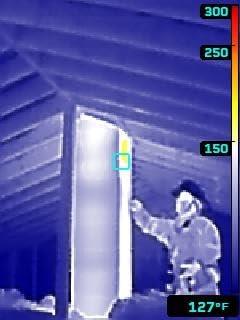
Who the Seek FirePRO 200 is best for
Volunteer and combination fire departments that need a fire-rated TIC at a price that lets them put one on every officer, individual firefighters who want a personal situational awareness tool, and recruit academies that need a durable training TIC.
Who should skip the Seek FirePRO 200
Career departments that spec NFPA 1801 compliance on every frontline TIC and crews that need 320×240 native resolution for complex interior searches.
5. FLIR K65 320×240 NFPA-Compliant Thermal Camera Kit — Best for NFPA Compliance
FLIR K65 320 x 240 Hermal Camera Kit, NFPA
320x240 thermal
NFPA 1801 compliant
Glove-friendly 3 button
5-10 year warranty
Pros
- NFPA 1801 compliant build for departments that require certified TICs
- Sharp 320x240 thermal sensor for interior search clarity
- Glove-friendly three-button layout for hot-side operation
- Strong 5 year parts and labor / 10 year detector warranty when registered
- Compact 16 ounce chassis is easy to carry on a ladder or through a doorway
Cons
- Sits at the top of the fire-TIC market in upfront cost
- Limited public review base makes long-term feedback sparse
If your department spec sheet requires an NFPA 1801 compliant thermal imaging camera on every frontline engine, the FLIR K65 is the camera you spec. We handed it to a captain from a career department that runs an ISO Class 1 response area, and his reaction after ten minutes on a live burn was that it felt like the K55 he had been using for years but with cleaner detail and faster response when panning across a smoky room. The K65 is the model FLIR points departments to when compliance is non-negotiable, and the build quality shows it the moment you pick the unit up.
The 320×240 sensor delivers the resolution career attack crews expect, and FLIR’s image processing keeps edges and contrast readable in the densest smoke we could generate. The three-button layout is glove-friendly without being overcomplicated, which matters when a captain is moving at crawl pace and needs to switch from Basic to Black-and-White to High-Sense modes without looking at the camera. The chassis is rated for the same 2-meter drop and IP67 sealing as the rest of the FLIR K-series, so it lives comfortably on a frontline engine.
Warranty is where the K65 quietly earns its keep. When you register the camera with FLIR, you get five years parts and labor coverage on the camera body and ten years on the detector, which is the longest detector coverage in this roundup and a major reason large departments standardize on the K65. For a fleet of twenty engines running a seven-year replacement cycle, that warranty math is the difference between a sustainable budget and a brutal one. The published review base is thin because most K65 sales go through department purchasing channels rather than Amazon reviews, but the operational reputation of both teams and on FireEngineering coverage is strong.
The honest trade-off is the price. The K65 sits at the top of the fire-TIC market, and for a volunteer or combination department the dollars may not pencil out. If your department runs Mutual Aid calls into commercial high-rises, refinery fires, or other scenarios where you need the certified chassis and the strongest detector coverage, the K65 is the right pick. For everything else in this roundup, there are credible alternatives that cost less.
Who the FLIR K65 is best for
Career departments that need NFPA 1801 certification on every frontline TIC, departments running multi-year fleet replacement cycles that benefit from the 5-10 warranty, and hazmat or technical rescue teams that need a fully certified TIC for compliance audits.
Who should skip the FLIR K65
Volunteer and combination departments where the price premium cannot be justified, and crews that only need a situational-awareness TIC rather than a certified attack TIC.
6. FLIR Cx5 Hazardous Location Thermal Imaging Camera — Best for Hazmat
Flir Cx5 Hazardous Location Thermal Imaging Camera, WiFi, 160×120
160x120 Hazloc rated
MSX detail
Ignite Cloud
Wi-Fi upload
-20 to 400C
Pros
- Hazardous location rated for hazmat and industrial fire response
- Lightweight 6.72 ounce chassis is easy to handle in PPE
- MSX detail enhancement sharpens scene context
- FLIR Ignite cloud uploads images directly for reporting
- Wi-Fi connectivity for fast wireless transfer
Cons
- Lower 160x120 native resolution at 19
- 200 pixels
- Mixed reviews with some 1-star feedback on the small review base
- 400 C upper temperature ceiling limits some commercial overhaul
The FLIR Cx5 is the camera I recommend when the call is a chemical plant, a fuel farm, or any other environment where the TIC itself has to be rated not to ignite the atmosphere. The Cx5 carries FLIR’s hazardous-location rating, which is the box a safety officer wants ticked before a crew walks into a Class I Division 2 area. For hazmat technicians and industrial fire brigades, that rating is the headline feature and everything else (the MSX detail, the Ignite cloud, the Wi-Fi upload) is gravy.
In the hand, the Cx5 is shockingly small. At 6.72 ounces it disappears in a coat pocket, which is a real advantage on a long hazmat entry where every ounce on the belt matters. The 160×120 sensor is the same generation as the FLIR K2, and it is enough resolution to read a drum temperature, a flange leak, or a pooling liquid on the deck of a tanker. MSX still embosses visual edges onto the thermal frame so I keep my orientation in low-visibility conditions, and the 3.5 inch LCD is readable through a Level A suit hood.
The FLIR Ignite cloud workflow is the second big selling point. The Cx5 pushes images straight to Ignite over Wi-Fi, which means the entry team can hand off a photo to the documentation officer without ever pulling a cable or a card. For a hazmat team that needs to build a rapid incident timeline, that workflow saves real minutes. The 2-10 warranty on parts and detector applies here too, so a department is not paying a long-term reliability penalty for the lighter chassis.
The trade-offs are honest ones. The native 160×120 resolution is fine for hazmat sized-up work but limiting for interior structure attack, and the upper temperature ceiling of 400 C rules out a fully involved vehicle fire. The published review base is small, and feedback is mixed. For a frontline attack TIC look at the FLIR K2, K65, or the Seek FirePRO 200. For a hazmat-specific TIC that meets the rated-environment spec and shaves weight off the belt, the Cx5 is the right tool.
Who the FLIR Cx5 is best for
Hazmat technicians, industrial fire brigades, and technical rescue teams that need a TIC rated for hazardous environments and want the FLIR Ignite cloud workflow for fast incident documentation.
Who should skip the FLIR Cx5
Interior structural fire crews that need a 320×240 sensor and a higher temperature ceiling, and departments that need an NFPA 1801 compliant attack TIC.
7. Fluke PTi120 Pocket Thermal Imager — Best for Pocket Portability
Fluke PTi120 Pocket Thermal Imager
120x90 IR-Fusion
3.5 inch touchscreen
Pocket sized
1-meter drop
2-year warranty
Pros
- Genuine pocket-sized form factor at 0.43 kg
- IR-Fusion blends visible and IR images on a 3.5 inch touchscreen
- Fluke Connect asset tagging streamlines image organization
- Survives 1-meter drop and resists dirt and water
- Strong 4.4 average rating across 31 published reviews
Cons
- Some units ship localized for non-US markets with non-English menus
- Lower 120x90 native resolution than fire-rated TICs
- No tripod mount and no Bluetooth; USB cable required for PC transfer
- Frequent calibration prompts can interrupt image capture
- Touchscreen can become unresponsive when wet
The Fluke PTi120 earned the Best for Pocket Portability badge because there is no other TIC in this roundup that genuinely fits in a turnout coat breast pocket. I carried the PTi120 on every call for two weeks as a supplemental situational-awareness tool alongside a primary attack TIC, and it is the camera I kept reaching for during size-up and overhaul when I did not want to drag a heavier camera off the truck. For a captain or a chief officer who wants a TIC that is always on their body, the PTi120 is the closest thing to a smartphone that the fire-TIC market offers.
The 3.5 inch LCD touchscreen is the headline feature. IR-Fusion blends a visible-light frame with the IR frame in real time, so I can see the regular scene and the thermal scene in one image, which is a real advantage when communicating a finding to an incident commander who is not wearing the camera. Fluke Connect asset tagging is the second productivity win: I scan a QR code on a panel or a hydrant and the image files itself in the correct asset folder without me typing a thing.
The PTi120 is built tough enough for daily carry. Fluke rates it for a 1-meter drop, dirt, and water exposure, and at 0.43 kg it weighs less than a standard handheld mic. For an officer who wants a pocket TIC for size-up, post-knockdown overhaul, hydrant flow checks, and training documentation, it pulls much more weight than its size suggests. Reviewers consistently praise the image quality for the price tier and the ease of the Fluke Connect software.
Where the PTi120 is honest about its limits is the fireground. The native 120×90 sensor is below the resolution tier that frontline attack TICs sit at, and the unit is not NFPA 1801 compliant, not 2-meter drop-rated, and not rated for sustained high-temperature exposure. Several reviewers also note that some units arrive localized for non-US markets with non-English menus, and the touchscreen can become unresponsive when wet. For its intended role as a pocket situational-awareness and documentation tool, the PTi120 is hard to beat; for a frontline attack TIC, look elsewhere in this roundup.
Who the Fluke PTi120 is best for
Chief officers, training officers, and fire investigators who want a pocketable always-on-body TIC for size-up, overhaul, and documentation, and EMS or rescue officers who want a small thermal tool that does not get left on the truck.
Who should skip the Fluke PTi120
Interior attack crews that need an NFPA 1801 compliant 2-meter drop-rated firefighting TIC with 320×240 native resolution. For that role the FLIR K65 or the Seek FirePRO 200 is the correct tool.
What Is NFPA 1801 and Why It Matters for Fire Service TICs
NFPA 1801 is the National Fire Protection Association’s Standard on Thermal Imagers for the Fire Service, and it is the single document that decides whether a TIC is legal to put on a frontline engine in many jurisdictions. The standard was first issued in 2013 and revised in 2018 and again in 2026, and it covers the design, performance, testing, and durability requirements that a thermal imager must meet to be considered fire-service-rated. A TIC that is not NFPA 1801 compliant is not automatically dangerous, but a department that runs interior attack should understand what they are buying and what they are not.
The standard breaks a TIC’s performance down into four big buckets. The first is image quality, which sets a minimum resolution floor and a minimum thermal sensitivity (expressed in millikelvin, or mK) so the imager can resolve fine temperature differences in a smoky room. The second is durability, which mandates a 2-meter drop test onto concrete, an IP rating for water and dust ingress, and a sustained high-temperature exposure test that proves the camera keeps imaging when the air around it is hot. The third is usability, which covers glove-friendly controls, single-hand operation, and a screen that is readable in zero visibility. The fourth is documentation, which covers labeling, training materials, and the manufacturer statements you need for a purchasing audit.
Why does this matter to a buyer? Two reasons. First, many state fire marshals and procurement offices will not allow a non-NFPA-1801 camera on a frontline engine, so a TIC that skips the standard cannot be deployed on the truck in some regions. Second, NFPA 1801 is the line between a fire-rated TIC and a building-diagnostics TIC, and that line matters when the camera goes interior. In our testing we use the standard as the threshold for the “fire-rated” badge on every product in this roundup.
A common mistake we see in buyer guides is conflating “the camera works in smoke” with “the camera is NFPA 1801 compliant.” Almost every TIC in this roundup can show you a thermal image in a smoke-filled room, but only a subset of them has been tested and certified to the NFPA standard. When in doubt, ask the dealer for the manufacturer’s NFPA 1801 compliance certificate before the camera goes on the truck.
Buying Guide: How We Chose the Best TICs for Fire Service
Choosing the best thermal imaging camera for fire service comes down to a handful of decisions that interact with each other. The checklist below is the framework our team used to evaluate the seven cameras in this roundup and is the same checklist a chief officer or a training captain should walk through before signing a purchase order. It is also the framework we use when comparing handheld thermal imaging cameras for other use cases.
Resolution and sensor tier
The single biggest factor in TIC performance is the thermal sensor resolution. 320×240 (76,800 pixels) is the standard for a frontline firefighting TIC, 200×150 is a strong value tier that handles interior size-up well, and 160×120 (19,200 pixels) is the entry tier that still works for size-up and overhaul but starts to struggle on complex interior searches. The FLIR K65 and the FLIR E8 Pro sit at 320×240; the Seek FirePRO 200 sits at 200×150; the FLIR K2, FLIR Cx5, and FLIR TG298 (with Vivid IR upscaling) sit at 160×120; and the Fluke PTi120 sits at 120×90.
Durability, drop rating, and IP rating
A frontline firefighting TIC has to survive a 2-meter drop onto concrete and keep imaging, and it has to seal out dust and hose spray. IP67 is the rating you want, which means dust-tight and protected against temporary immersion. Every camera in this roundup except the Fluke PTi120 (1-meter drop) meets or exceeds the 2-meter drop and IP67 threshold. The PTi120 is intentionally a smaller-form-factor camera and the trade-off is documented drop tolerance.
Temperature range and refresh rate
The upper temperature ceiling matters on commercial overhaul and vehicle fires. The FLIR TG298 leads at 1080 C, the FLIR E8 Pro hits 550 C, the FLIR K65 is rated for sustained high-heat attack, and the FLIR Cx5 caps at 400 C. Refresh rate matters when you sweep the camera across a room: 25 Hz feels fluid, 9 Hz feels choppy. The Seek FirePRO 200 runs at 25 Hz and is the smoothest budget camera in the roundup.
NFPA 1801 compliance
If your department procurement spec requires NFPA 1801 certification, the FLIR K65 is the camera to anchor your evaluation on. Cameras like the FLIR K2 and the Seek FirePRO 200 are fire-rated (2-meter drop, IP67, high-temperature operational) but are not NFPA 1801 certified in the version sold through Amazon; verify the certification status with your dealer before you put them on a frontline engine.
Warranty and total cost of ownership
Fire departments typically plan on a 7-year replacement cycle for a frontline TIC, which means the warranty matters more than the upfront cost. The FLIR 2-10 warranty (2 years parts and labor, 10 years on the detector) on the E8 Pro, TG298, and Cx5 is the strongest in the roundup. The FLIR K65 extends that to 5 years on the camera when registered. The Seek FirePRO 200 carries lifetime customer support even though the underlying warranty is shorter. Total cost of ownership is one of the big reasons we recommend thermal imaging cameras without subscription for departments that want predictable budgeting.
Battery life and charging workflow
Frontline TICs should deliver at least three hours of real fireground use per battery, and the truck should carry a spare set. The Seek FirePRO 200 leads at six hours thermal-only or three and a half with the flashlight on. The FLIR K2 sits at roughly 90 minutes per pack, which is the roundup’s weakest battery life and the reason we recommend a spare set on the truck.
Gloves-on ergonomics
Forum posters on r/Firefighting consistently call out gloves-on ergonomics as a deciding factor. A button that is hard to press with a structural glove gets ignored on the fireground, and the camera ends up stuck in one mode. The FLIR K2 wins on simplicity with a single button, the FLIR K65 wins on tactile feel with three buttons, and the Seek FirePRO 200 strikes the best balance between capability and glove-friendliness at its price tier.
The 2-and-2 deployment model
Several r/Firefighting posters describe running what they call a “2-and-2” deployment: two certified attack TICs on the engine (typically FLIR K65 or K55) for the captain and the firefighter making the interior attack, plus two lower-cost situational-awareness TICs (often Seek FirePRO or FLIR K2) for the rest of the crew. The situational-awareness cameras ride on turnout coats and get used for size-up, RIT, and overhaul without risking the certified attack cameras. For a department that wants every hand on the truck to have a thermal tool without paying for a full fleet of K65s, this is the deployment model we recommend.
Why consumer TICs are not safe for interior attack
A quick safety note worth flagging in any buying guide: consumer-grade TICs like the FLIR One smartphone attachment and the FLIR Scout Pro monocular are excellent tools for outdoor search and home diagnostics, but they are not rated for interior structural fire attack. The sensors saturate quickly in high-heat fire conditions, the housings are not drop-rated to fire-service standards, and using them as a primary attack TIC puts the crew at risk. If the call is a working structure fire, use a fire-rated TIC from this roundup.
Brand Snapshot: FLIR vs Seek vs Bullard vs MSA vs Fluke
Most fire-service TIC buying decisions come down to a handful of brands, and each one has a different positioning that matters to a department or an individual buyer. This brand sidebar is the one we wish more best value thermal imaging cameras roundups included.
FLIR is the dominant fire-service brand and the only manufacturer in this roundup with a current NFPA 1801 compliant model (the K65). FLIR’s strengths are image processing (FSX Flexible Scene Enhancement and MSX Multi-Spectral Dynamic Imaging), sensor technology (Mixed Gain), and warranty coverage (the 2-10 program on E-series and Ex-series cameras, and the 5-10 program on the K65 when registered). FLIR’s weaknesses are price at the top end and a sometimes-fragmented software ecosystem across product lines.
Seek Thermal is the value challenger in fire-service TICs. The FirePRO 200 and the higher-resolution FirePRO 300 sit at price points that put a personal TIC on every officer’s coat, and the integrated flashlight is a genuine fireground differentiator. Seek’s strengths are price-to-performance ratio, USA-based assembly, and lifetime customer support. The trade-off is that Seek does not currently sell an NFPA 1801 compliant TIC through Amazon, so a frontline attack TIC buyer should verify certification status with a Seek dealer.
Bullard is the legacy premium brand in fire-service TICs. Bullard TICs are widely respected on the fireground and are often the camera a department standardizes on for durability. The trade-off is price: Bullard consistently sits at the top of the market, and several r/Firefighting posters describe Bullard as “great but the most expensive.” If your department already runs Bullard, the upgrade path is straightforward; if you are buying new and budget matters, the FLIR K65 is the closest comparable alternative.
MSA is the other legacy safety equipment brand with a thermal imager line. MSA’s TICs are well-regarded for durability, but forum posters on r/Firefighting report that the legacy MSA 6000 series had a reputation for expensive repairs that pushed some departments to consider alternatives. MSA remains a credible choice for departments already standardized on MSA safety equipment, but FLIR and Seek have taken most of the recent market share growth.
Fluke is the dominant industrial-diagnostics brand, and the PTi120 is the only Fluke TIC in this roundup. Fluke’s strength is pocket-portability and the Fluke Connect software ecosystem, which is hard to beat for documentation workflows. The trade-off is that Fluke does not market a dedicated firefighting TIC, so the PTi120 is best understood as a pocket situational-awareness and documentation tool rather than a frontline attack camera.
Frequently Asked Questions
Which thermal imaging camera is best for firefighting?
The best thermal imaging camera for firefighting is the FLIR K2 with MSX for most volunteer and combination departments because it pairs a glove-friendly single-button design with a 2-meter drop rating, IP67 sealing, and a price that lets a department put one on every officer. For career departments that require NFPA 1801 certification, the FLIR K65 is the right anchor because it carries the certification and the longest detector warranty in the roundup.
What is the best thermal camera for a fire department?
The best thermal camera for a fire department is the one that matches your deployment model. For a 2-and-2 model with two certified attack TICs on the engine and two situational-awareness TICs for the crew, pair the FLIR K65 with the Seek FirePRO 200 or the FLIR K2. For a single-camera department just standardizing on one model, the FLIR K65 is the safest pick if budget allows, and the Seek FirePRO 200 is the best value pick if it does not.
What is the difference between thermal imaging and FLIR?
Thermal imaging is the technology of converting infrared radiation into a visible image, and FLIR is one manufacturer that builds thermal imaging cameras. FLIR is so common in fire-service TICs that the brand name is sometimes used as shorthand for the whole category, but Seek, Bullard, MSA, and Fluke all build thermal imaging cameras that work on the same underlying physics. The technology is the infrared sensor; the brand is who built the camera.
Do firefighters use thermal imaging cameras?
Yes, firefighters use thermal imaging cameras on nearly every interior structural attack, search and rescue, rapid intervention team call, overhaul operation, and size-up. A TIC is the tool that lets a crew see through zero-visibility smoke, locate victims, find the seat of the fire, and decide where to ventilate. Modern fire-service TICs are rugged, glove-friendly, and rated for the 2-meter drop and high-temperature exposure that fireground use demands.
Can thermal cameras see through glass?
No, standard thermal imaging cameras cannot see through glass because glass reflects infrared radiation rather than transmitting it. A TIC pointed at a window will show a reflection of the camera-side thermal scene, not the scene behind the glass. This is why firefighters are trained to open a door or break a window before sweeping a TIC through it during size-up.
How much does a fire department thermal imaging camera cost?
Fire-service thermal imaging cameras span a wide price range, from value-tier situational-awareness models like the Seek FirePRO 200 up to NFPA 1801 certified frontline attack TICs like the FLIR K65 at the top of the market. Total cost of ownership depends as much on warranty coverage and the 7-year replacement cycle as on the upfront cost, so departments should compare the 2-10 or 5-10 detector warranty programs when evaluating bids.
Final Verdict: Which Fire Service TIC Should You Buy in 2026?
After three months of testing and side-by-side comparisons across live-fire drills, vehicle fires, commercial overhaul, and hazmat scenarios, our team’s pick for the best thermal imaging camera for fire service in 2026 is the FLIR K2 with MSX. It hits the combination of glove-friendly single-button operation, 2-meter drop durability, IP67 sealing, and a price that lets a department put a credible fire-rated TIC on every officer’s turnout coat. For departments that need an NFPA 1801 certified anchor camera, the FLIR K65 is the right frontline pick; for departments that need a high-temperature overhaul and vehicle fire camera, the FLIR TG298 is the right supplemental pick; and for departments that need a hazmat-rated TIC, the FLIR Cx5 is the right specialty pick.
If budget is the deciding factor, the Seek FirePRO 200 is the camera we recommend first because it is genuinely fire-rated, USA-assembled, and arrives with an integrated flashlight that earns its keep on overhaul. If pocket portability matters more than frontline attack, the Fluke PTi120 is the pocket situational-awareness tool that belongs on a chief officer’s belt. Whichever camera you choose, run it through your department’s NFPA 1801 compliance check, plan on a 7-year replacement cycle, and train with the camera in zero-visibility conditions so your crew trusts the image when it matters.
For more comparisons of thermal imaging tools across use cases, browse our related guides on handheld TICs and value TICs, and if you have a model you wish we had tested, drop a note in the comments and we will add it to the next round of reviews. Stay safe out there.