
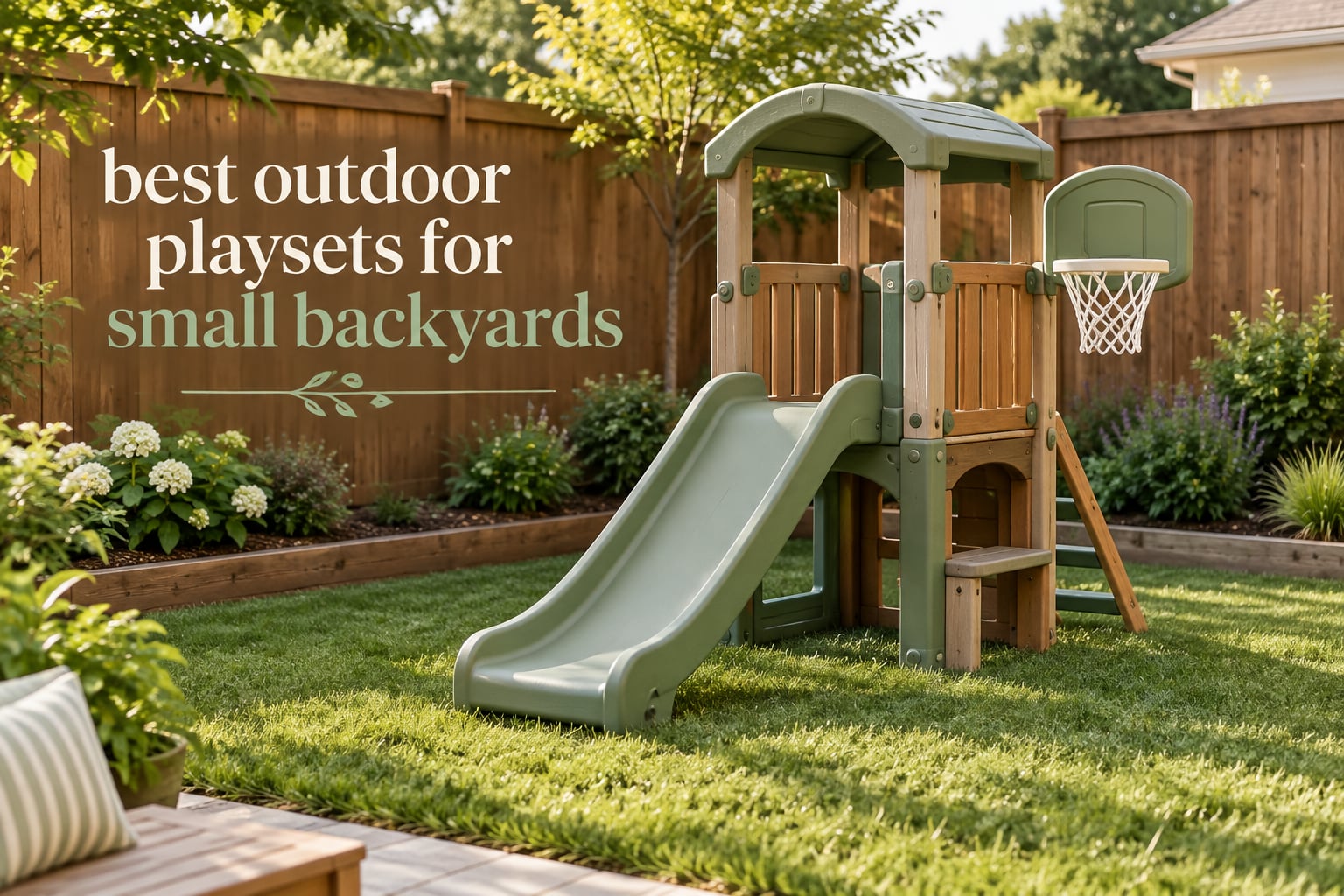
Most parents searching for the best outdoor playsets for small backyards are not really shopping for a playset. They are shopping for leftover yard. The photo in their head is a swing, a slide and a climbing surface tucked into a corner where nobody walks, and the whole thing disappears into the landscaping by dinnertime.
That picture is harder to buy than it looks. A set that measures 62 inches across still needs open ground on all sides for a child to run into, and a slide exit lane eats yard that never appears in the product photo. When we lined up everything in this roundup against a narrow suburban lot, the deciding number was never the feature list. It was the use zone: the structure’s own footprint plus roughly six feet of clear space on every side.
So before the picks, we set out how that measurement works, because once you can compute your own number, half of this list narrows itself. We also compared all 12 sets on material, safety spacing, assembly reality and ground surfacing, and pulled in owner reports from r/Westchester, r/HomeImprovement and r/landscaping where families had already made these same calls. If you are still building from scratch, our broader guide to playsets and swing sets for backyards covers the larger-footprint end of the market.
Table of Contents
Top 3 Picks for Small Backyards in 2026

Step2 Game Time Sports Climber
- 62 inch footprint
- 4.7 stars from 4059 owners
- ages 2-6
- double-wall plastic
Step2 All Around Playtime Patio
- 47.5 inch square footprint
- kitchen and sand table
- removable canopy

Swing-N-Slide PB 8360 Ranger
- Pre-stained cedar
- two belt swings plus trapeze
- 115 lb per seat
Three sets make the short list for different reasons, and the reasoning matters more than the ranking. The Step2 Game Time Sports Climber takes the top spot because it does the hardest thing in this category well: it gives a toddler a genuine play structure in a genuinely tiny footprint, and 4059 owners have confirmed it holds up. The All Around Playtime Patio wins the toddler category on imaginative play value rather than climbing, and it stores indoors when the season turns. The Ranger is the only wooden set here that fits a small yard without a tower, which makes it the pick for families who want wood without giving up the lawn.
Best Outdoor Playsets for Small Backyards (October 2026)
| Product | Specifications | Action |
|---|---|---|
| Step2 Game Time Sports Climber |
|
Check Latest Price |
| Step2 All Around Playtime Patio |
|
Check Latest Price |
| Swing-N-Slide PB 8360 Ranger |
|
Check Latest Price |
 Simplay3 Young Explorers Climber Simplay3 Young Explorers Climber |
|
Check Latest Price |
 Step2 Woodland Climber II Step2 Woodland Climber II |
|
Check Latest Price |
 Trekassy 440lb Metal Swing Set Trekassy 440lb Metal Swing Set |
|
Check Latest Price |
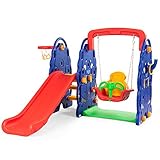 Costzon 4-in-1 Slide and Swing Costzon 4-in-1 Slide and Swing |
|
Check Latest Price |
 Hapfan 600lb Heavy Duty Set Hapfan 600lb Heavy Duty Set |
|
Check Latest Price |
 BIERUM 9-in-1 Toddler Slide BIERUM 9-in-1 Toddler Slide |
|
Check Latest Price |
 Sportspower Park Ridge Metal Set Sportspower Park Ridge Metal Set |
|
Check Latest Price |
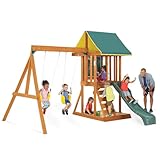 KidKraft Appleton Wooden Set KidKraft Appleton Wooden Set |
|
Check Latest Price |
 SIHANM 700lb 6-in-1 Metal Set SIHANM 700lb 6-in-1 Metal Set |
|
Check Latest Price |
Two things stand out in that grid before you read a single review. First, footprint varies far more than price does. The Simplay3 Young Explorers covers 13.9 square feet of ground; the Sportspower Park Ridge covers 95.7. That is a sevenfold difference in what each one takes out of your lawn.
Second, six of the twelve are plastic rather than wood or steel, and four of those six are aimed at children under six. That is not a weakness in the category. It reflects where small yards actually land: low decks, low fall heights and no tower to shade or dominate the space.
1. Step2 Game Time Sports Climber – Best Overall for Tight Yards
Step2 Game Time Sports Climber, Kids Indoor/Outdoor Playset, Backyard Playground Set, Slide, Climbing Wall, Basketball Hoop, Outside Jungle Gym, For Toddlers 2-6 Years Old
62L x 30.5W x 42.5H inches
Ages 2-6
Double-wall plastic
Max user weight 60 lbs
Pros
- Four sport activities in one small frame
- Sure-grip entry steps and rails
- Under-deck storage doubles as a hideaway
- Light enough to move indoors
Cons
- 62 inch footprint suits one or two children
- 60 lb ceiling limits use as kids grow
- Slide surface heats in direct sun
- Slide and step fittings can be stiff to seat
This is the set we keep coming back to for the smallest yards. At 62 by 30.5 inches it has the narrowest footprint of anything with a slide in this roundup, and at 42.5 inches tall the deck sits low enough that a two-year-old can get on it without help. For a lot that only offers 20 by 25 feet of open grass, that combination is the difference between a playset and a photo of one.
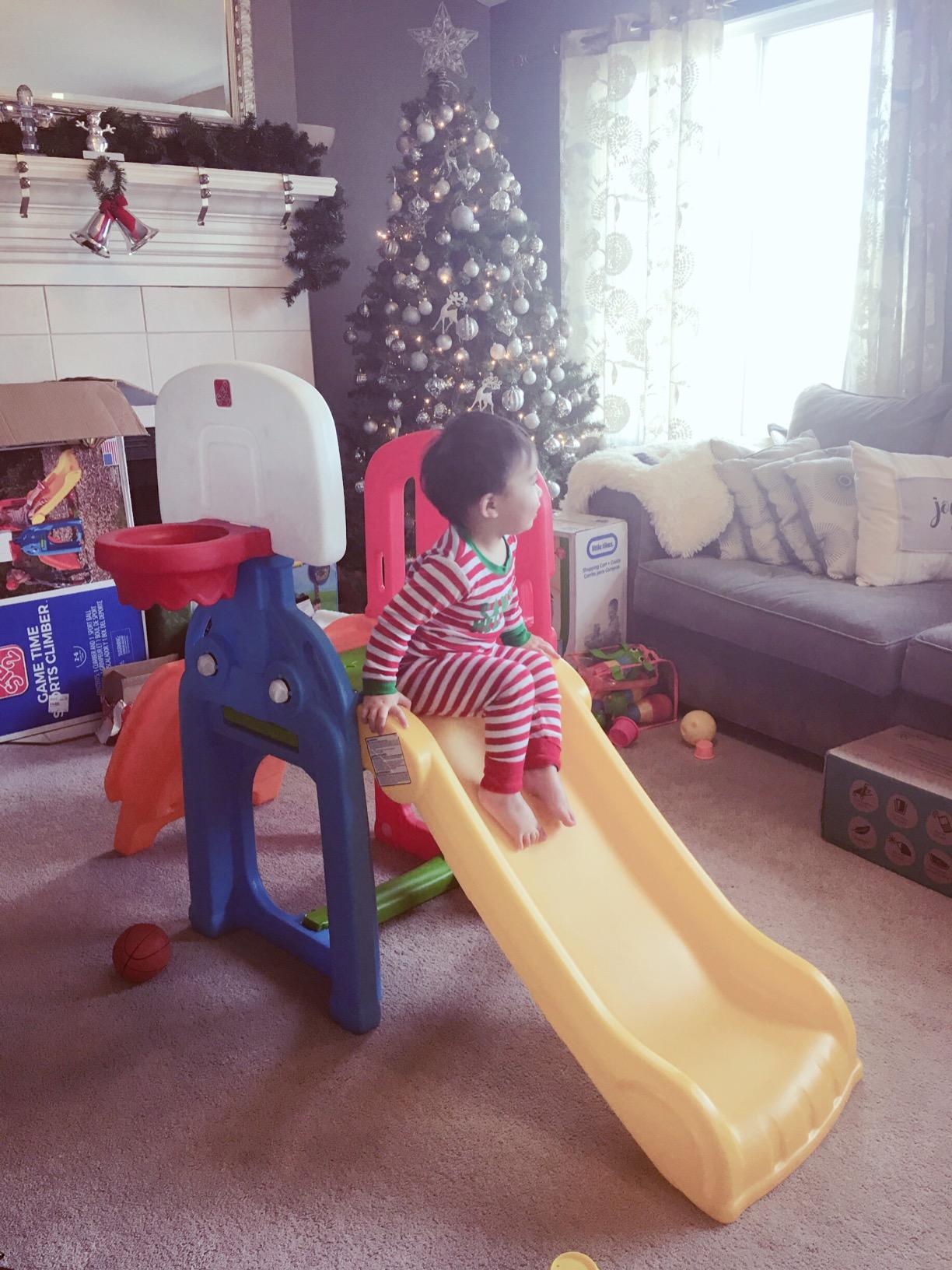
What it gives up is height and capacity. The manufacturer rates it for ages 2-6 with a 60-pound user limit, which is honest but means it is finished as a set roughly when a child enters kindergarten. The four activity zones are genuinely different from each other though: a basketball hoop, soccer goals, clickable score knobs and a slide, plus storage underneath that children immediately repurpose as a hideaway.
Construction is double-walled plastic with a 3-year limited warranty, and at 24.5 pounds the whole unit is light enough for one adult to carry through a door if the weather turns. We found no rust, rot or paint-failure complaints among the 4059 ratings, which is what you would expect from a material that has no seams for water to sit in.
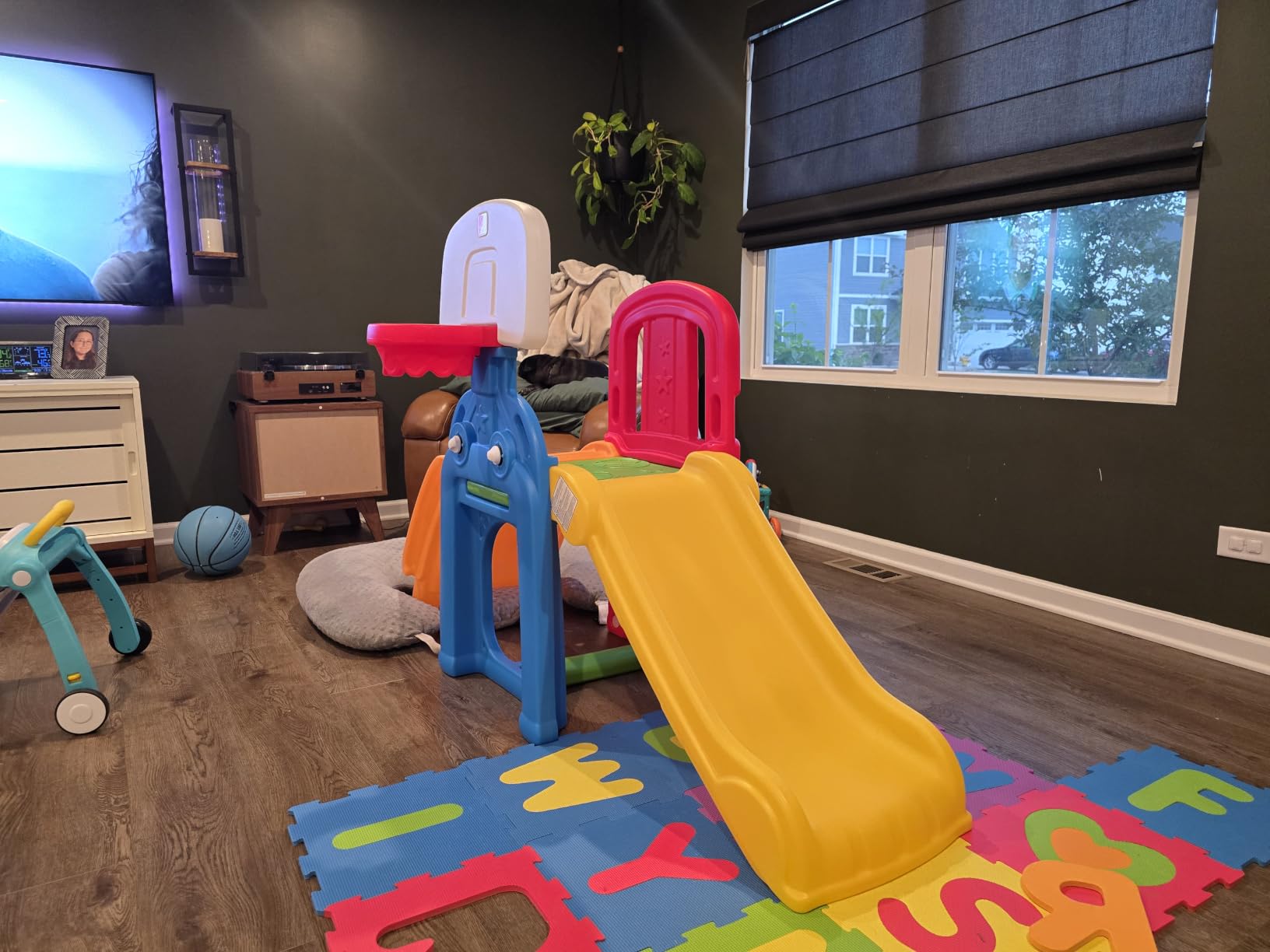
Check the width before you assume it fits
The 30.5-inch width is the number that decides this purchase, and it is narrower than most people picture. A child needs roughly 3 feet of clear run-out beside the slide, and the climb route needs landing space in front. Budget 6 feet off the long side and 6 feet off each short side and the total zone comes to about 14 by 18 feet.
If your open lawn is wider than that, this is the easiest set on this list to live with. If it is not, look at the Simplay3 Young Explorers at number 4, which is a similar idea at 70 by 28.5 inches with a crawl-through fort instead of sports stations.
Who should skip it
Skip it if you have two children who want to play at the same time and expect that often. Owners consistently describe it as a one-or-two-child set rather than a group structure, and 60 pounds is a real ceiling for the taller end of the age range. It is also a climber first and a playset second: there is no shade, no fort and no deck big enough to sit and watch.
One more practical note. The plastic slide surface runs hot in direct afternoon sun. Owners who placed the set under a tree or on the west side of the house report noticeably fewer complaints about heat and about the slide feeling slick after rain.
2. Step2 All Around Playtime Patio – Best for Imaginative Toddler Play
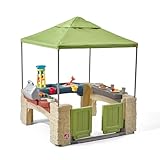
Step2 All Around Playtime Patio with Canopy Playset – Shaded Outdoor Playhouse for Kids with Realistic, Interactive Features, Room for Multiple Toddlers to Play – Dimensions: 60″ H x 47.5″ W x 47.5″ D
47.5W x 47.5D x 60H inches
Ages 24 months to 8 years
Plastic playhouse
Removable canopy
Pros
- Pretend grill
- countertop and water and sand table
- Sixteen piece toy kitchen set
- Four windows for shared play
- Wheelchair-accessible entry
- Removable canopy for indoor storage
Cons
- Adult assembly takes patience
- Wood-look panels weather and discolor
- Interior floor area fits only a few toddlers
A square 47.5 inches on each side makes this the most efficient use of ground area in the roundup. The canopy is what turns a playhouse into a playset: it gives shade in summer, and it unbolts in seconds so the unit moves under a roof for the winter. That dual life is why it holds 3707 ratings at 4.7.
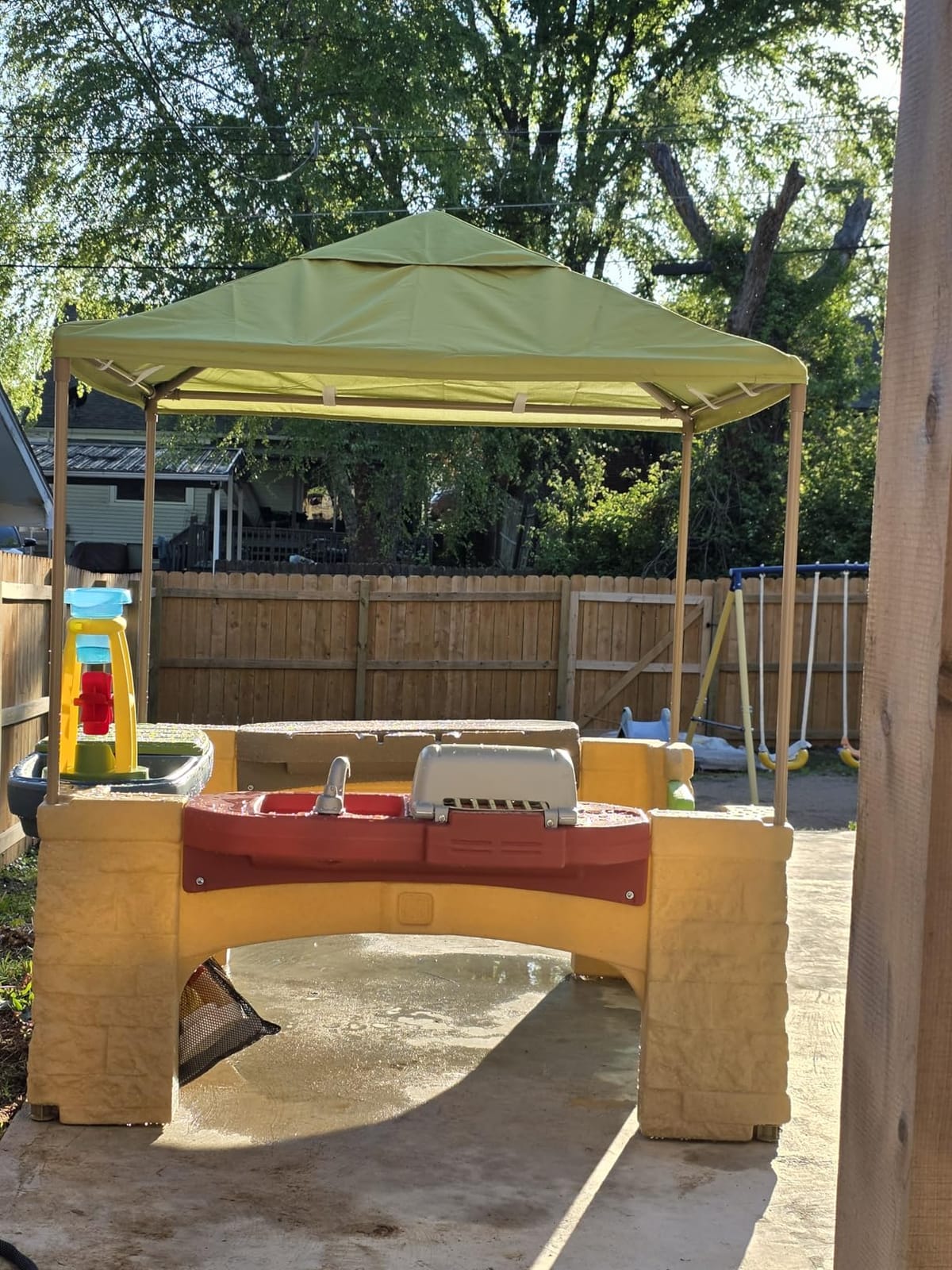
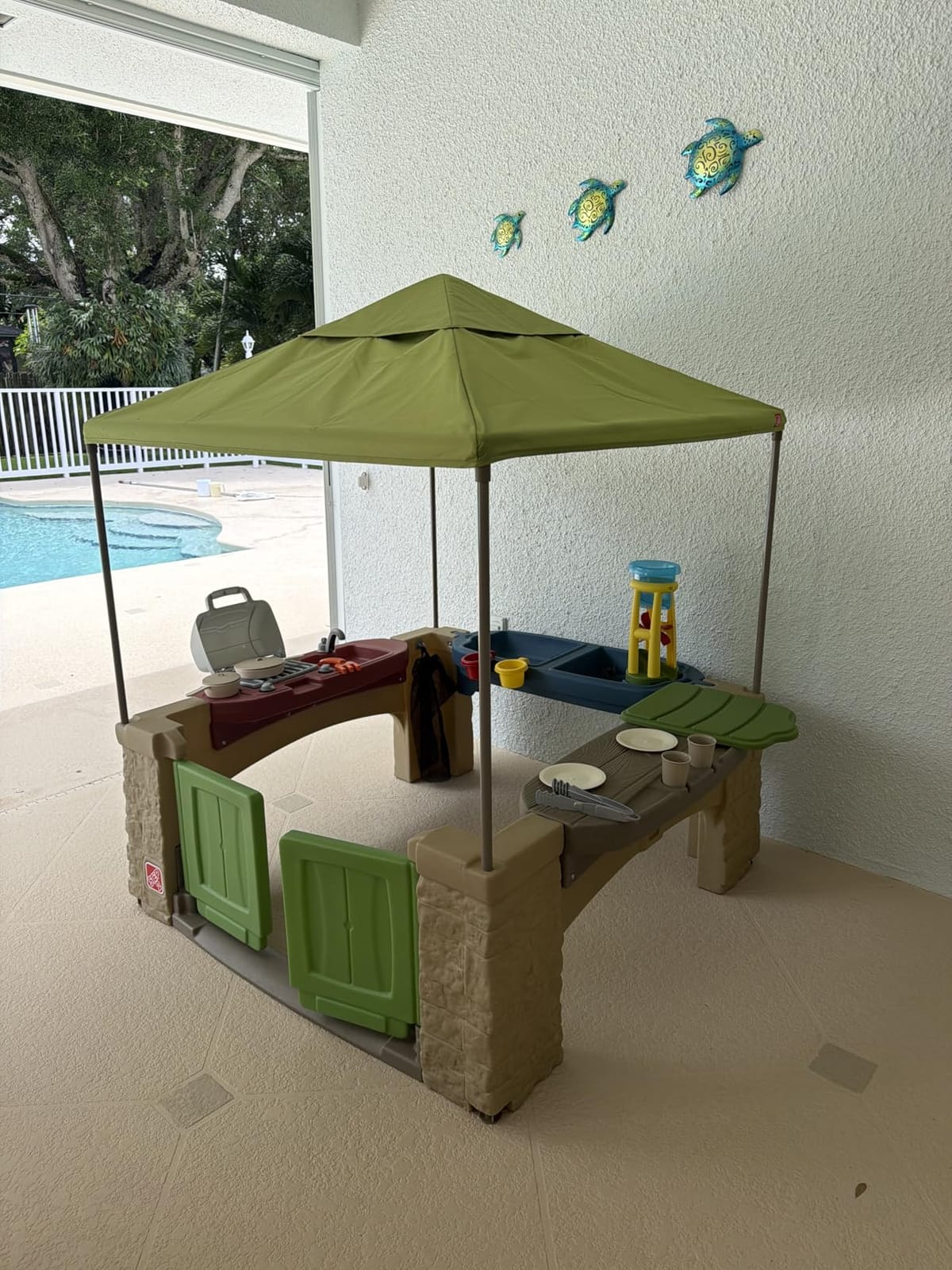
The feature density is the other argument. A pretend grill, a large countertop, a water and sand table, four windows and a 16-piece kitchen set give a two- to four-year-old more to do than a slide gives a six-year-old. The entry is wide enough for a wheelchair, which owners with mobility differences mention directly and positively.
It weighs 44.5 pounds, so it is a two-person lift once assembled, but the fact that it is the same piece of equipment indoors and out changes how much of your yard it occupies across a year.
What the square footprint does not tell you
This is a playhouse, not a climbing structure, so its 60-inch height is a wall rather than a fall height. There is no slide exit lane and no run-out requirement beyond the door approach, which makes the use zone roughly 12 by 12 feet including the six-foot clearance on all sides. That is smaller than the sports climber’s zone despite the two units looking similar in a photo.
Plan where the canopy shadow falls before you place it. A west-facing wall keeps the panels cooler and slows the cosmetic fading that owners mention after a couple of seasons in full sun.
Watch the interior floor area and the hardware
The most repeated limitation across reviews is how few children fit inside at once. Two toddlers comfortably, three if they are small. For a family with three or more under-fives running to the same corner of the yard, the woodland climber at number 5 spreads that play out over a longer footprint instead.
Assembly is adult work and owners describe it as needing patience rather than skill. The printed wood-grain panels are printed, and they fade unevenly with sun exposure, which is a cosmetic issue only. The 3-year limited warranty covers the structure.
3. Swing-N-Slide PB 8360 Ranger – Best Value Wooden Set
Swing-N-Slide PB 8360 Ranger Wooden Swing Set with Swings, Brown (Amazon Exclusive)
104L x 92W x 82H inches
Ages 3 months to 10 years
Pre-stained cedar
115 lb per swing seat
Pros
- Two belt seats plus a ring and trapeze combo
- Plastisol-coated chains stay cool and will not rust
- Single adult can finish in a morning
- Meets or exceeds ASTM residential standards
Cons
- Anchor stakes sit sharp above the soil
- Light enough to shift if not anchored
- Some shipments arrive missing bolts
- Bolt caps do not fully seat
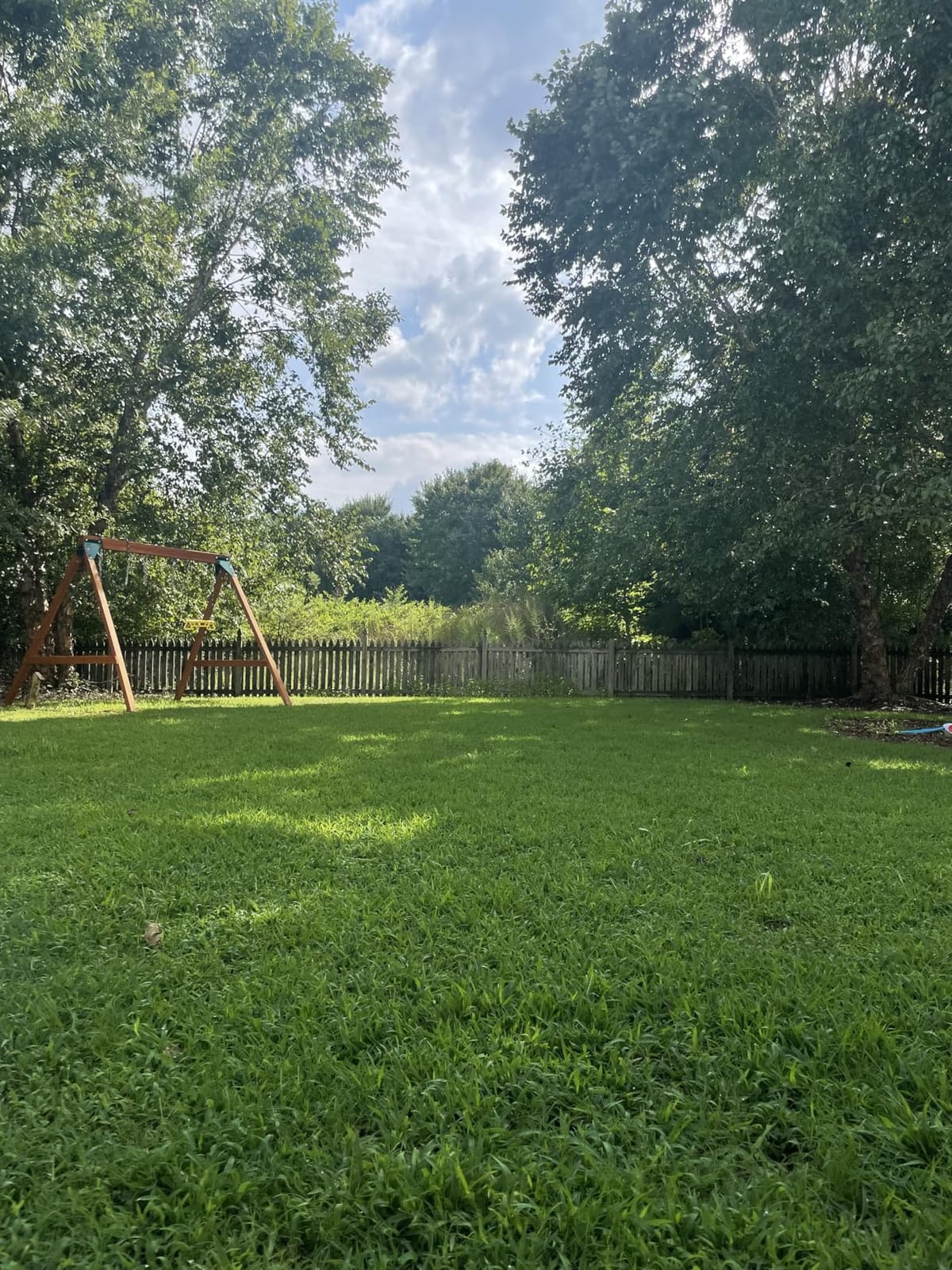
This is the only wooden set in the roundup that stays flat, and that is the entire reason it is here. At 104 by 92 inches with an 82-inch beam height, it gives you swinging and hanging without a deck, a slide or a tower footprint. Parents in r/Westchester asking for playset recommendations in dense New York lots repeatedly describe this shape as the one that works.
Three play positions come off a single beam: two belt seats and a ring and trapeze combination. Each seat is rated to 115 pounds, and the chains are plastisol-coated, which means they do not rust and do not burn small hands in July. That detail alone separates it from most wooden sets at this level.
Assembly is the quiet strength here. Owners report completing it in a morning with one adult, and the box includes all lumber, hardware and illustrated instructions. A 5-year limited manufacturer’s warranty is longer than most plastic products in this roundup, and the set meets or exceeds ASTM standards for residential use.
Budget a larger use zone than the footprint suggests
Unlike a playset tower, a swing set’s clearance is driven by the swing arc, not by a slide run-out. With swings at full extension, you need roughly 6 feet in front of and behind the beam and about 6 feet at each A-frame leg. That works out to a use zone near 16 by 20 feet, so measure the swing direction against the house and the fence before you commit.
The set is 90 pounds, which is light enough that a determined child or a stiff wind can shift it. Anchors are included but the stakes sit above the soil line, and owners describe them as sharp. Cover or trim them, and keep them out of a walking path.
Know what arrives in the box
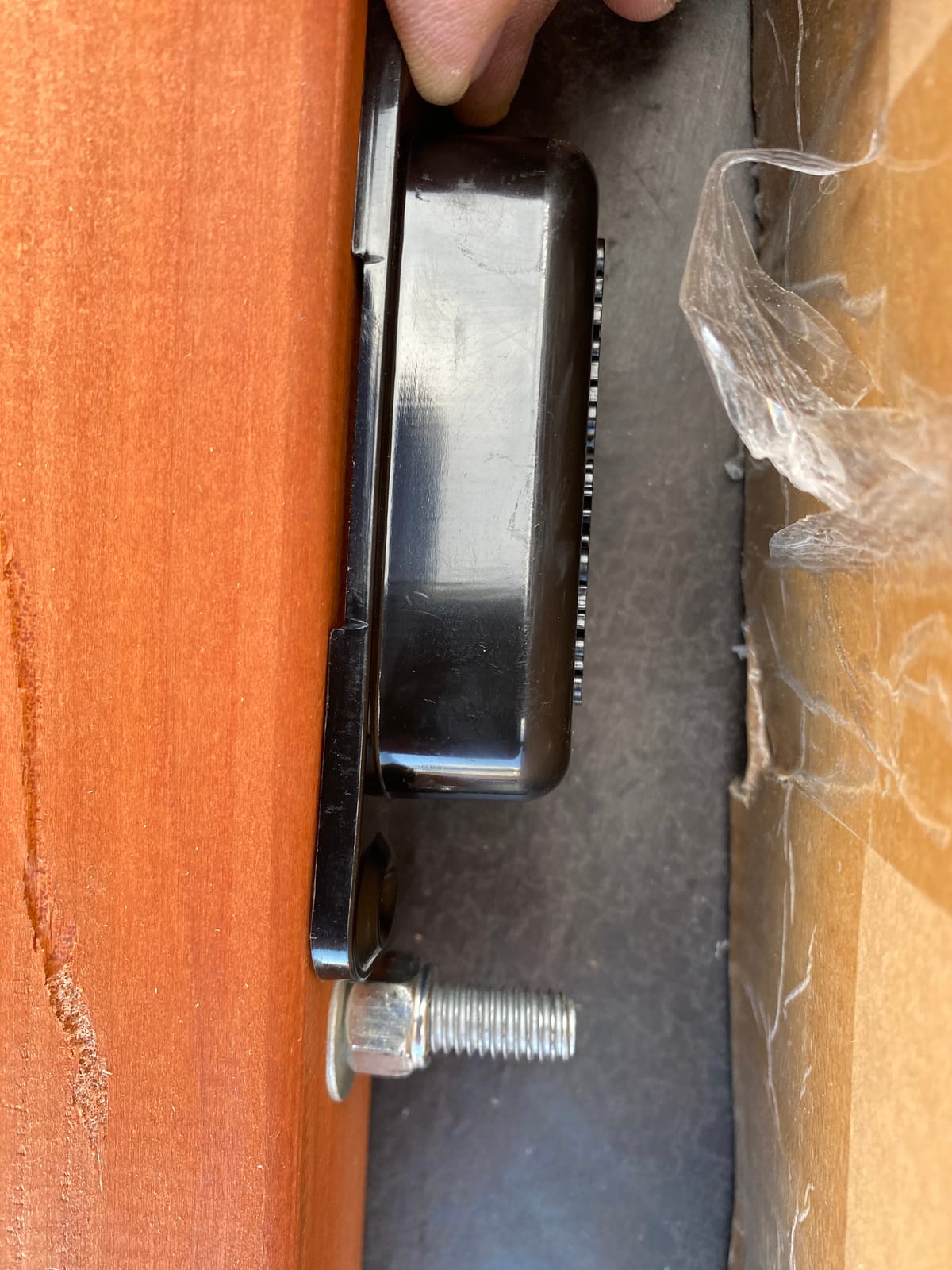
Missing bolts on delivery are the most common complaint, and the fix is simple: count hardware against the parts list before you break down the packaging, because sourcing a single bolt later is a slow afternoon. The plastic bolt caps on top of the frame do not always seat fully, which is cosmetic but looks unfinished from a window.
In wet or coastal climates, owners who resealed the cedar after the first season report better long-term results. The factory stain is a starting point, not a permanent seal.
4. Simplay3 Young Explorers Climber – Best for the Narrowest Side Yard
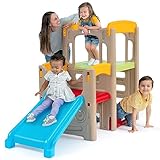
Simplay3 Young Explorers Adventure Climber and Slide – Indoor Outdoor Backyard Playset for Toddlers and Kids
70L x 28.5W x 49.5H inches
Ages 18 months to 6 years
28.5 inch width
Double-wall plastic
Pros
- Fits through a standard doorframe for indoor and outdoor use
- Wide slide surface with easy-grip side rails
- Ground-level crawl-through to a secret fort
- Two-tiered platform with multiple climb routes
Cons
- 28.5 inch width allows very limited shared use
- Slide and steps are fiddly to seat
- Plastic surface heats in sun and is slick when wet
- Fort area is tight for group play
At 28.5 inches wide, this is the narrowest structure in the roundup, and that single figure is why it earns a place on a side yard or a townhouse plot where nothing else will go. If your constraint is a corridor rather than a square, this is the answer.
That earns the second slot for a simple reason. Parents on r/Westchester and r/HomeImprovement describing playsets in dense lots keep saying the same thing: a narrow structure in the middle of a usable lawn beats a wider one jammed against a fence.
It weighs 52.4 pounds, which is the trade you make for width. Moving it through a standard doorframe is possible and owners do it, but it is a two-person job and not something a child will reposition alone.
Plan for one child at a time
The width sets the capacity. Owners are consistent on this: one child comfortably, a second waiting. The two-tiered platform and the crawl-through ground entry give routes up and down that keep a single child busy for a while, but the fort under the deck is not a space two children share.
Because it is low and mostly vertical, the use zone is about 12 by 18 feet including clearance. The slide exit still needs 3 feet of run-out beyond the slide mouth, so orient the long side along the widest available strip.
Assembly and surface conditions
Getting the slide and the steps to seat firmly is the part owners flag most, and the fix is a rubber mallet rather than force. Surface conditions matter more here than on the wider sets: plastic gets hot in direct sun and slippery when wet, so place it in partial shade if the yard allows.
This set also fits the middle of the age range unusually well, from 18 months to 6 years, which is a wider window than most compact climbers. Our broader list of outdoor playsets for kids covers taller structures for when this one is finished.
5. Step2 Woodland Climber II – Best for Climbing Variety
Step2 Woodland Climber II Kids Playset, Ages 2 –6 Years Old, Toddler Slide and Climbing Wall, Outdoor Playground for Backyard, Sturdy Plastic Frame, Easy Set Up
75 x 47 x 53.75 inches
Ages 2-6 years
Two climbing walls and a ladder
Two-child deck
Pros
- Two climbing walls plus a ladder give several routes up
- Deck and slide hold two children at once
- Under-deck hideout doubles as toy storage
- Earth-tone finish blends into a garden
Cons
- Assembly runs a couple of hours
- Slide and step attachment is the hardest part
- A drill makes assembly considerably easier
- Included wheels are difficult to spin
Where the sports climber packs activities onto one small frame, this one spends its budget on climbing. Two climbing walls and a ladder mean three routes to the deck, and two steering wheels give the top a purpose beyond sliding down it. For a child who has decided climbing is the activity, that is worth the extra 13 inches of width.
The earth-tone finish is a genuine small-yard feature. Most plastic playsets read as bright outdoor equipment from a window; this one was designed to blend into landscaping, and that matters more in a 20-foot-wide lot than in an open suburban one.
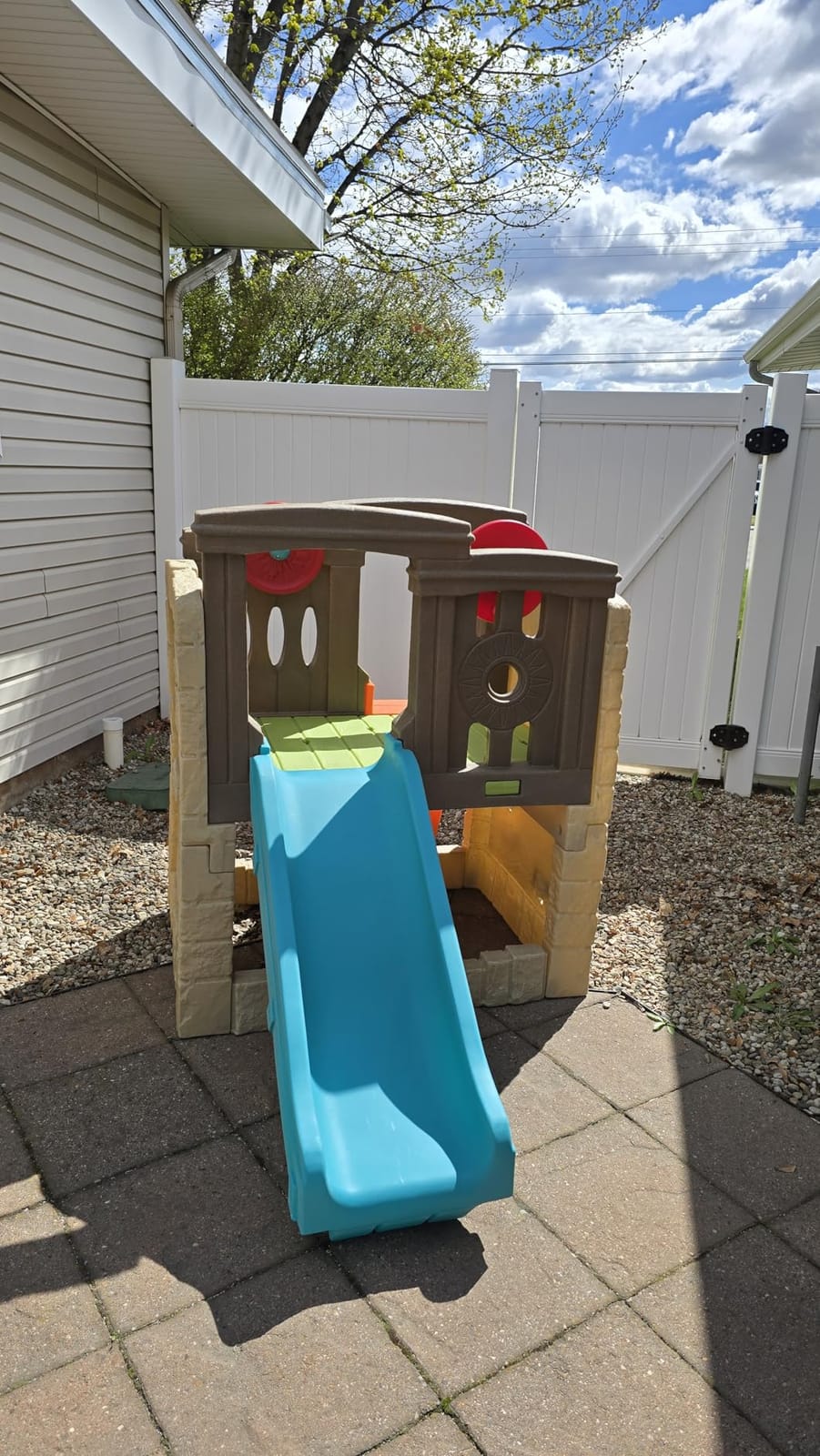
It is rated for two children, which makes it the most shareable plastic set in this list. The under-deck area works as a fort or as a place to stash outdoor toys between sessions, and the double-walled plastic rinses clean after a wet week.
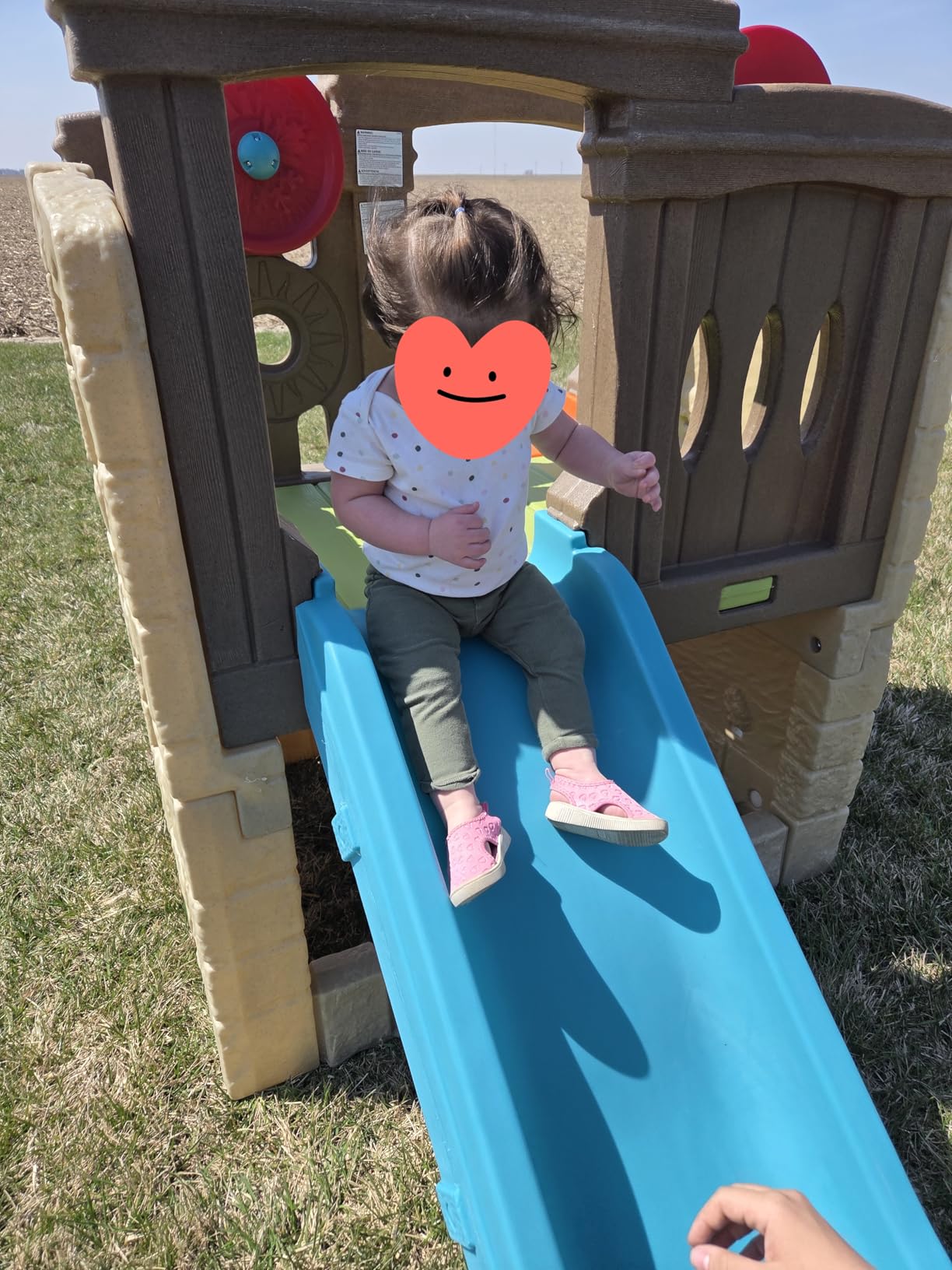
Decide on the drilling question early
Owners are split on one practical point. Without a drill, assembly runs a couple of hours and the slide and step attachment is genuinely frustrating. With a cordless drill on the pre-drilled pilot holes, the same assembly is straightforward. Decide before you start rather than discovering it halfway through.
The use zone here is about 14 by 19 feet with the six-foot clearance added. The slide needs a clear 3-foot run-out, and the under-deck hideout means children will sit behind the frame, so leave space there too rather than pushing the set tight against a fence.
Where it falls short
It is larger than most plastic toddler climbers, and that is deliberate, so it will not fit a genuinely narrow corridor. The included wheels are hard to spin, which limits the repositioning that a lighter set like the playhouse at number 2 allows. The 3-year limited warranty is standard for the material.
If your children are past climbing and into sliding, skip to the sports climber at number 1, which gives more activity variety in 13 fewer inches of width.
6. Trekassy 440lb Metal Swing Set – Budget Pick
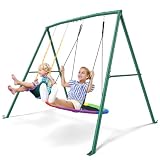
Trekassy 440lbs Swing Sets for Backyard, 2 Seat Saucer & Belt Swing – Green
86.61W x 64.57D x 66.93H inches
Powder-coated steel
440 lb capacity
32 inch saucer and belt swing
Pros
- Two swing types serve different ages at once
- Tool-free height adjustment as kids grow
- Anchors hold well in compacted ground
- Oxford fabric saucer seat wipes clean
Cons
- Smaller than expected
- best for toddlers and young children
- Must be anchored firmly or it lifts
- Stakes are hard to drive into hard soil
- Lower swing height limits air time
Steel gets a bad name in this category for one reason, and the Quora consensus about it is fair: an untreated metal swing set can show rust within a year. Powder coating is the answer, and this frame is powder-coated with zinc-plated chains on the belt seat. That is why we would put it in a small yard ahead of an unbranded bare-steel frame.
Two swing types off one frame is the smart part. A 32-inch saucer with adjustable rope takes a child who wants to lie down and lean, and the belt swing with an EVA seat handles a smaller child. Owners like that the seat height adjusts without tools, so the set does not have a fixed age ceiling in the way a fixed-height plastic frame does.
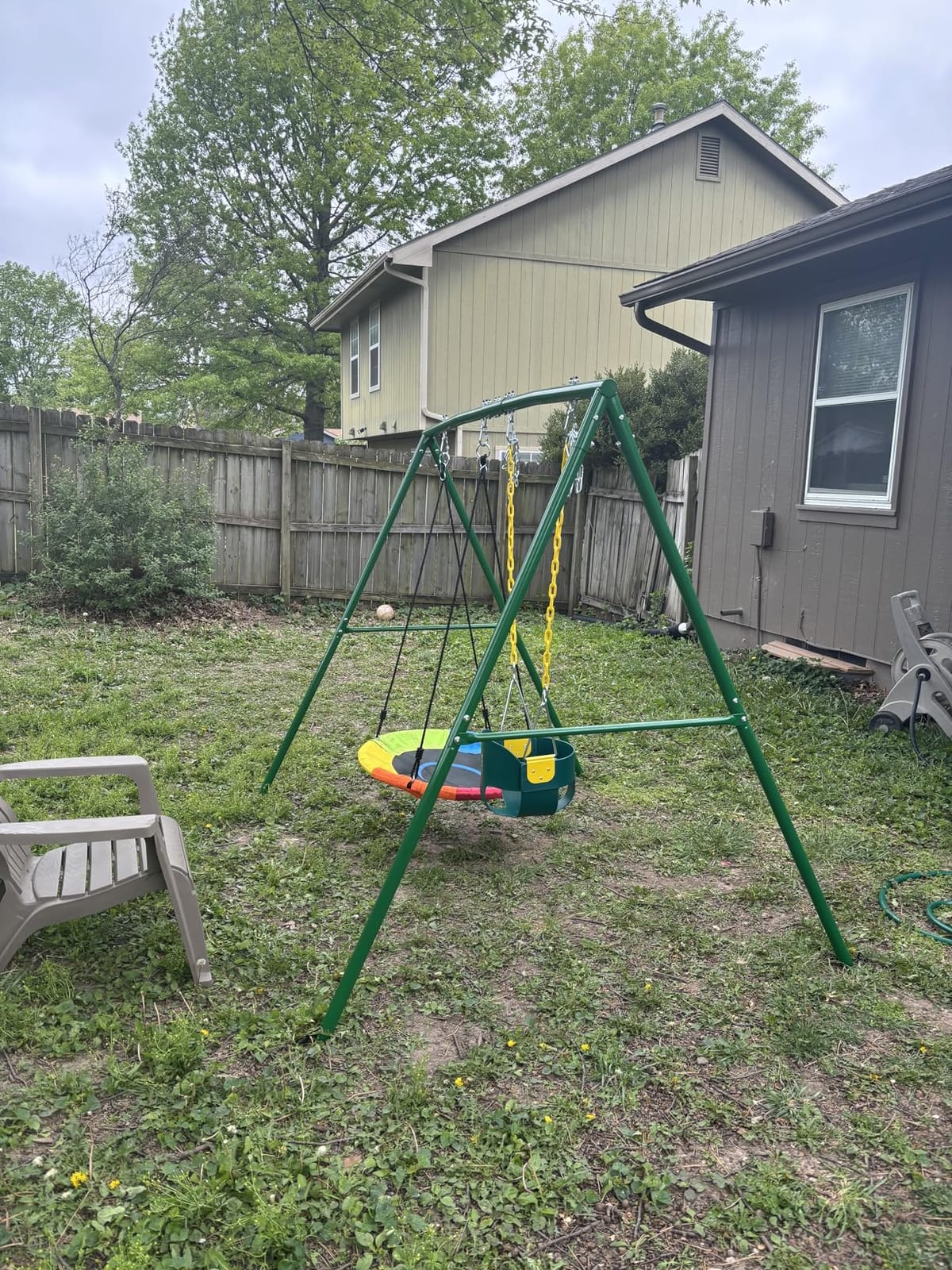
The A-frame footprint of 86.61 by 64.57 inches is smaller than most wooden A-frames because there is no deck and no slide. That is the entire appeal for a small yard: swinging without giving up a rectangle of lawn for a tower.
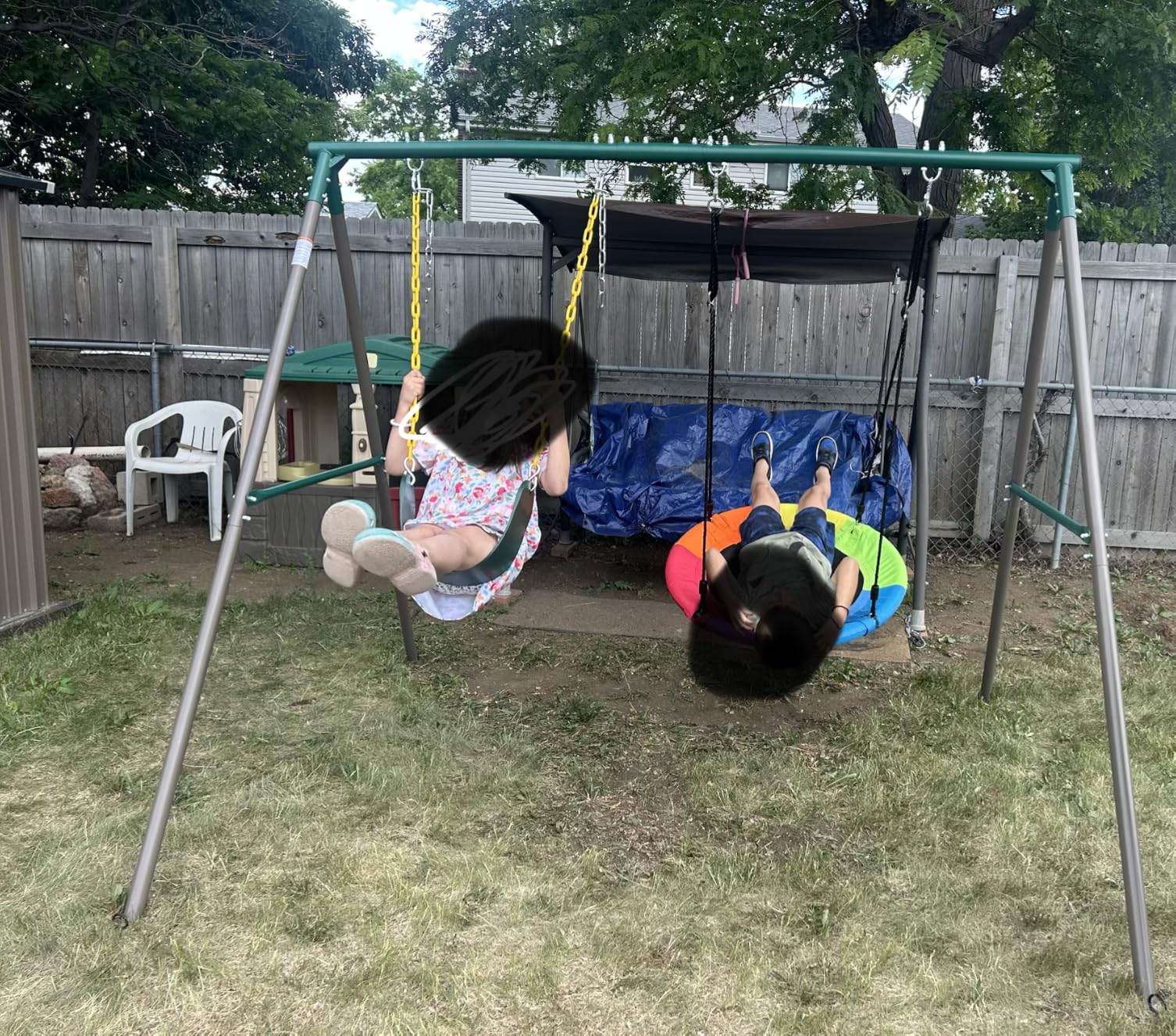
Measure for the swing arc, not the legs
On an A-frame, the swing travels along the length of the beam. You need roughly 6 feet beyond the seat at full extension in both directions and about 6 feet on each side. That produces a use zone near 16 by 16 feet, and it is the number that should decide the purchase rather than the 86-inch width in the listing.
Rotation is worth thinking about. If the clear strip runs north-south, the set can sit in it and leave the rest of the yard open. If it runs east-west, the swing arc points at something.
Ground conditions decide whether anchoring works
The included anchors are the difference between this set staying put and ending up in a neighbor’s yard. Owners are clear that the frame lifts if it is not anchored firmly. In compacted soil or over artificial turf the stakes hold; in rocky or hard ground, owners report difficulty driving them and recommend a different fixing method.
Size expectations matter. It is smaller than the photos suggest and skews toward toddlers and young children. The lower beam height gives less air time than a full-size set, which older kids notice within a season.
7. Costzon 4-in-1 Slide and Swing Set – Best Compact Four-in-One
Costzon Toddler Long Slide Set, 4-in-1 Large Climber Playset w/Basketball Hoop, Toss, Thickened Panel, Playground Swing for Indoor Outdoor Backyard 3-10 Gifts Presents
82L x 68.5W x 45.5H inches
Ages 24 months to 8 years
HDPE construction
Slide 110 lbs, swing 66 lbs
Pros
- Slide
- swing
- basketball hoop and toss game in one unit
- Smooth edgeless slide surface
- Thickened non-toxic HDPE panels
- Removable hoop lets you reconfigure the space
Cons
- Swing rated to only 66 lbs
- Slide rating of 110 lbs undercuts the stated age range
- Bright colors fade with prolonged sun
- Arrives in two separate packages
Four play zones in an 82 by 68.5 inch footprint is a good ratio, and the removable basketball hoop is the detail that makes it work in a small yard. Take the hoop off and the front of the unit becomes open floor, which is more useful for a three-year-old than the same four feet with a hoop still attached.
The slide is long and genuinely edgeless, and the climb route uses a gentle slope with easy steps. That combination is why the slide rating of 110 pounds covers most children through the early primary years, even though the stated age range runs wider.
Material is high-density polyethylene, which is the same family as the Step2 sets but with a thinner, brightly coloured panel style. It is 46 pounds and assembles with included hardware and no complex tools.
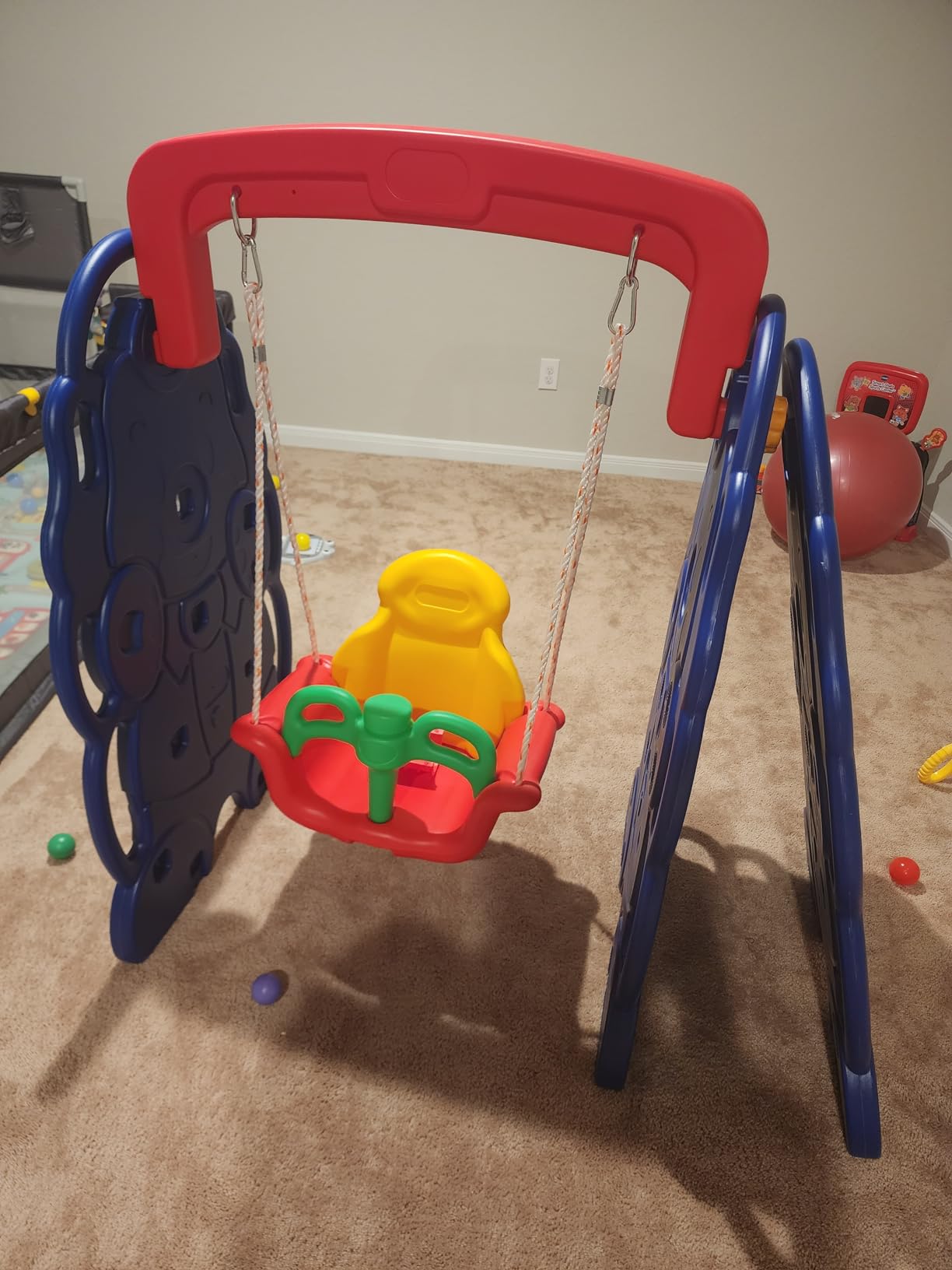
Check the swing rating before the age range
The swing holds 66 pounds and the slide holds 110. The listed age range of 24 months to 8 years is marketing shorthand, and the load limits are the real constraint. A child approaching 8 years old will outgrow the swing well before the slide, which is fine if you plan to swap the seat later but disappointing if you expected a decade of use.
Use zone is about 14 by 18 feet with clearance, and the slide run-out is the space to watch. Rotate the unit to point the slide away from a fence.
Two things to plan around
It arrives in two packages because of its size, so parts may come separately. In a small yard, unboxing logistics matter: choose an assembly spot with a clear path to the final location, because the assembled unit is awkward to move through a gate.
Colour fade on the bright plastic is the recurring cosmetic complaint after extended sun. The elephant-nose toss game and the hoop are the features children use least and mention most in reviews, so the real value is the slide and the swing.
8. Hapfan 600lb Heavy Duty Set – Best for Three Swings
Hapfan 600lb Heavy Duty Swing Set for Outdoor Backyard with 3 Swings Black
118W x 78D x 78H inches
Ages 0-12 years
45 inch platform plus two belt swings
Four anchor stakes included
Pros
- Rigid frame with no wobble under load
- Three positions cover toddlers through teens
- Adults can swing alongside a child
- Clear instructions and install video
Cons
- Advertised capacity appears overstated
- Beam sags under heavy loads
- Beam tubes deform if bolts are overtightened
- Seats sit close together
Three positions on a 6.5-foot frame is the configuration parents ask for most, because it serves a spread of ages without a second structure. A 45-inch platform swing sits in the middle with two belt swings on the ends, each rated to 200 pounds, and the beam sits at 78 inches across a 118-inch width.
For a family with a toddler and a pre-teen, the swap-compatible attachments are the real feature. Owners replace the platform with a baby seat or a trapeze bar as the youngest child grows, and the whole set keeps working.
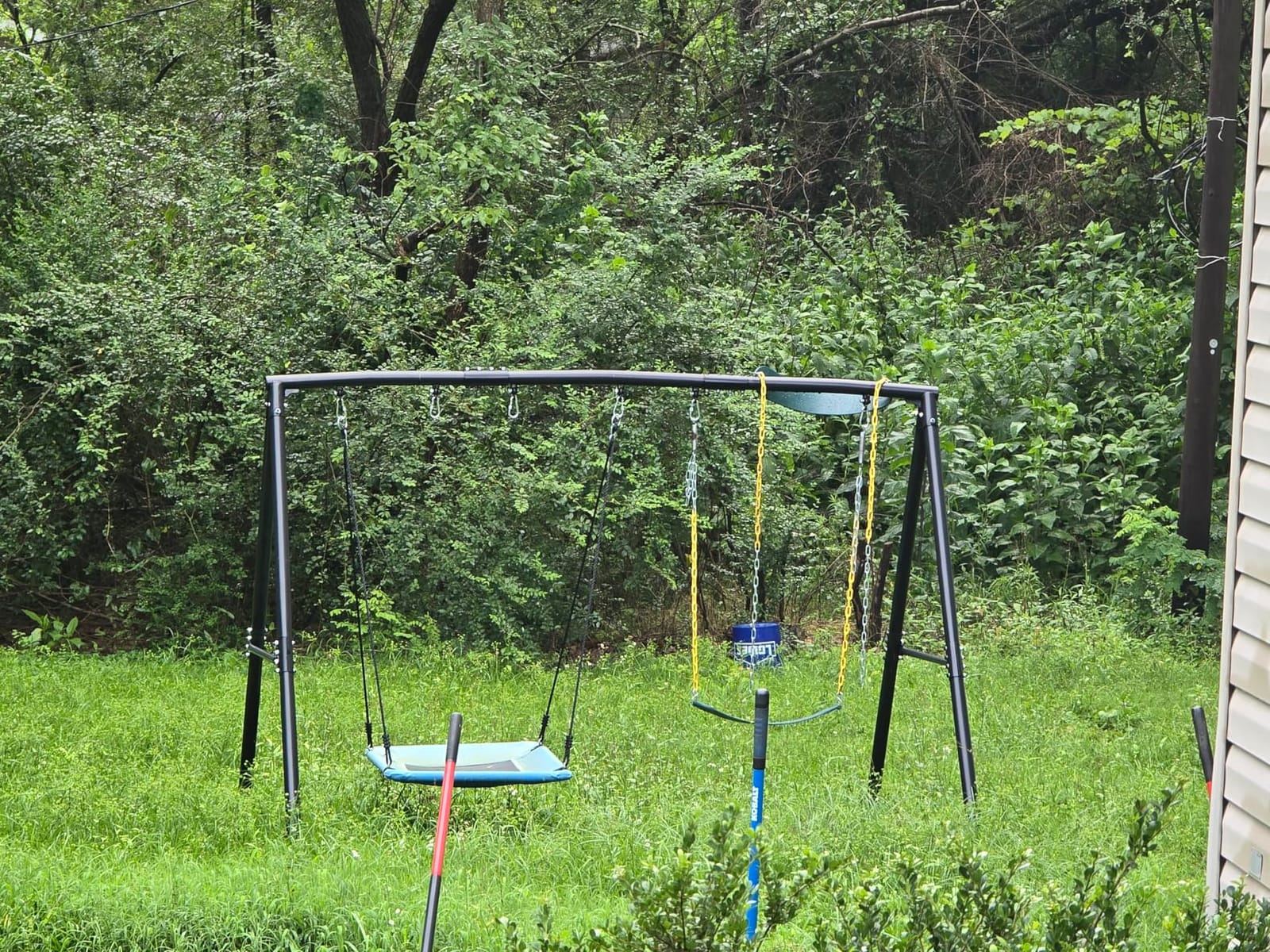
Sleeves over the joints matter more than the marketing suggests. They keep water out of the connection points on powder-coated steel, which is the failure point that turns a metal set into a rust problem. Most families finish assembly in under three hours with the included instructions and video.
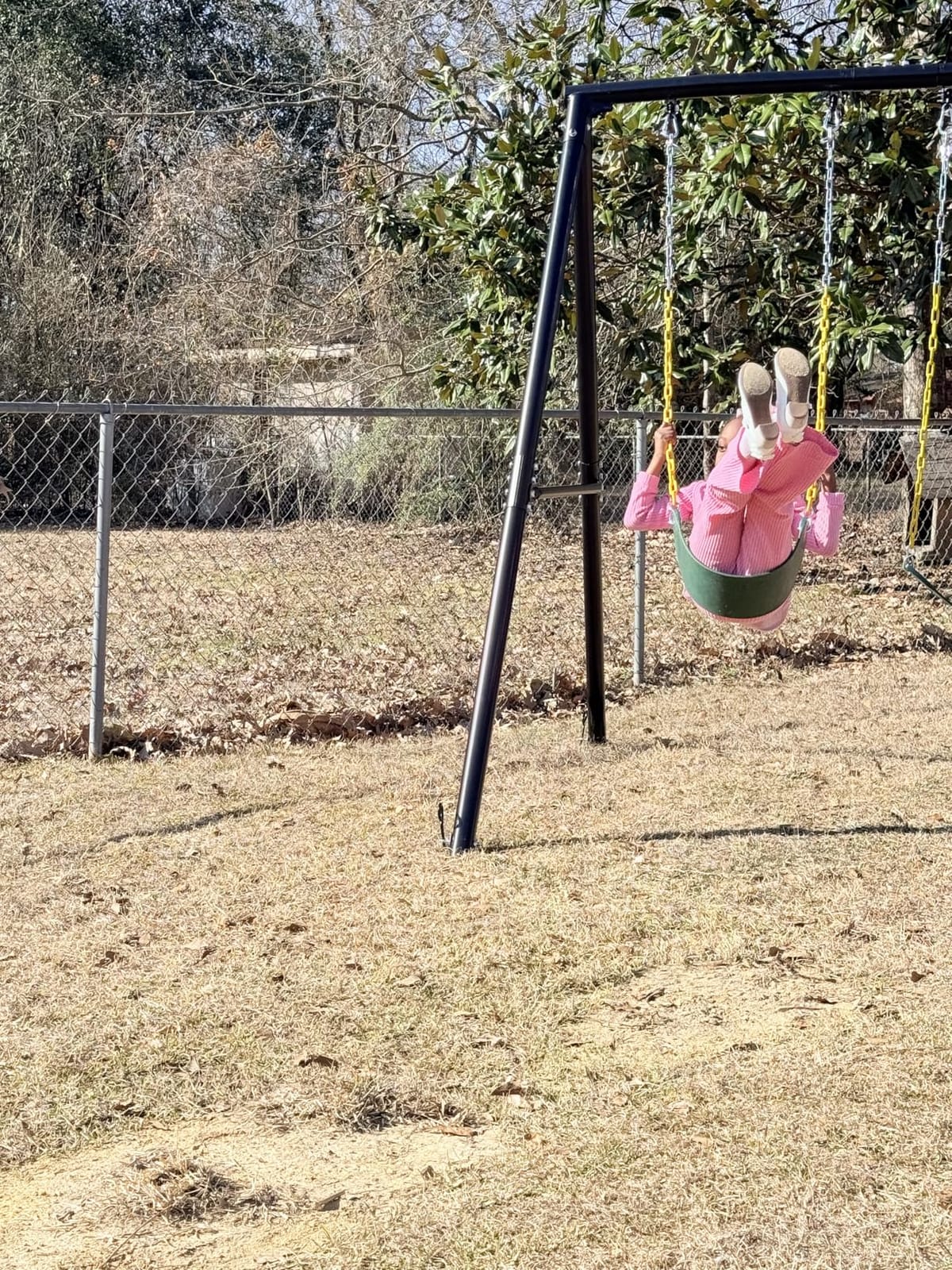
Read the capacity claim carefully
The 600-pound figure is a total across the frame, not a guarantee of rigidity at that load. Owners report visible beam sag under loads well below the claim, and the most common cause is a build error: overtightening bolts flattens the round beam tubes into ovals. Tighten to firm, not to maximum, and retighten after the first week of use.
Weight capacity per individual swing is not published, which is worth knowing before you let a heavier child use the beam end. The manufacturer lists 200 pounds per seat.
Does it fit a small yard
This is the largest swing-only set in the roundup at 118 by 78 inches, and the use zone is where that shows. With six feet of clearance on all sides, you need close to 20 by 20 feet of open ground. In a tight lot, the Trekassy A-frame at number 6 or the Ranger at number 3 is a much better fit.
Seats sit close together, so two children on adjacent swings can collide at full extension. If you have siblings of similar size who swing hard, plan on staggering them.
9. BIERUM 9-in-1 Toddler Slide – Best for Ages 1 to 3
BIERUM 9 in 1 Toddler Slide, Kids Slide for Toddlers Age 1-3 Indoor Outdoor
59.8L x 53.5W x 36.2H inches
Ages 0-3 years
Nine activity zones
Holds up to 154 lbs
Pros
- Nine zones in a compact frame
- Three-zone slide with a buffer landing area
- Anti-slip steps and dual handrails
- Tool-free assembly and disassembly
Cons
- Circular hole at the top of the slide is a head-trapping hazard
- Fasteners loosen with heavy jumping
- Most children outgrow it by age 3
At 36.2 inches tall with nine activity zones, this is the lowest and densest unit in the roundup, and it is built for the youngest children on this list. The slide is designed in three zones: acceleration, deceleration and a buffer landing area, which is a detail you usually only find described in commercial playground engineering.
It comes apart and goes back together without tools, and at 39.7 pounds it is light enough to bring indoors. For a family with a one-year-old, that indoor-outdoor flexibility is often more valuable than another outdoor feature.
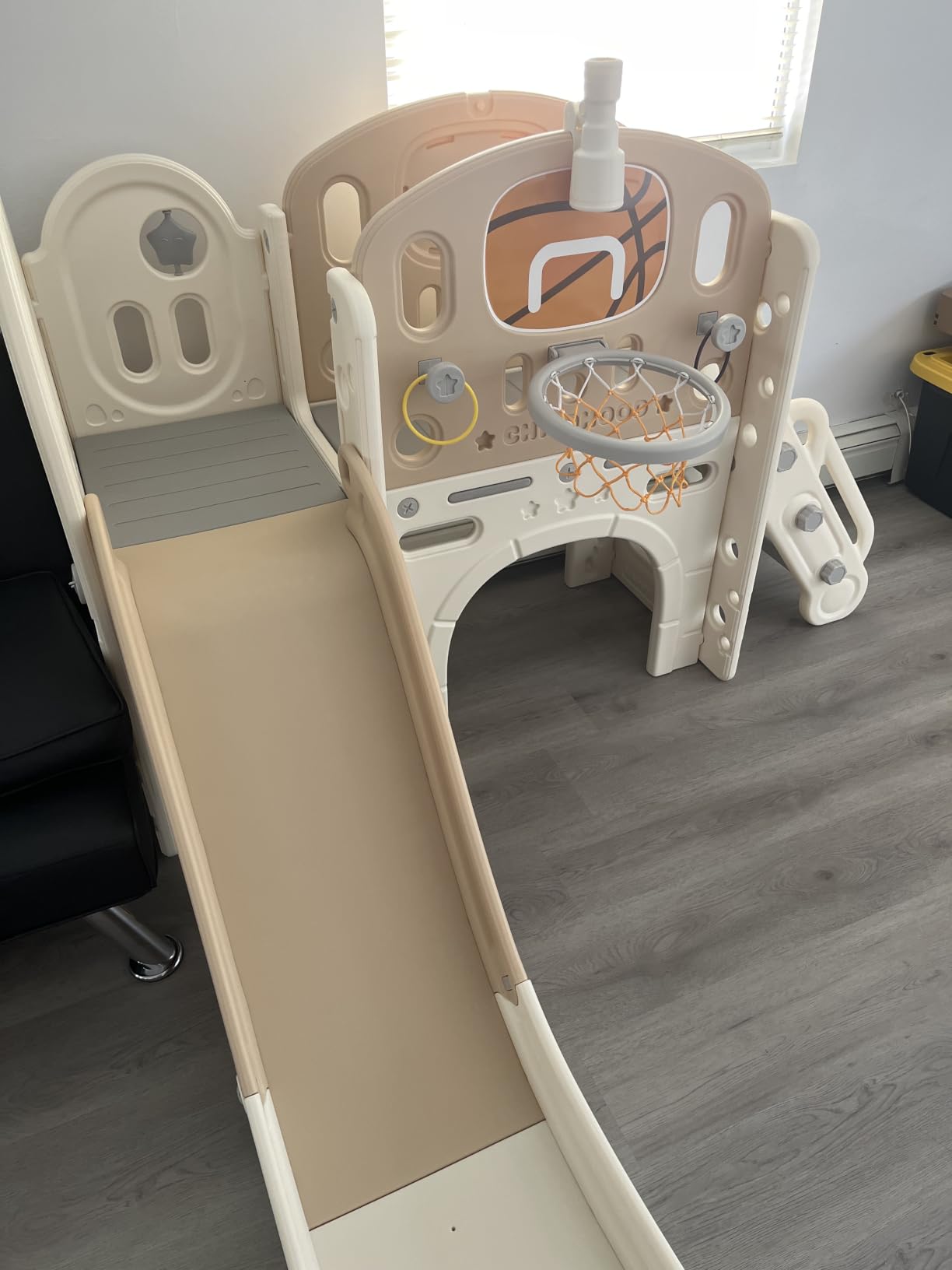
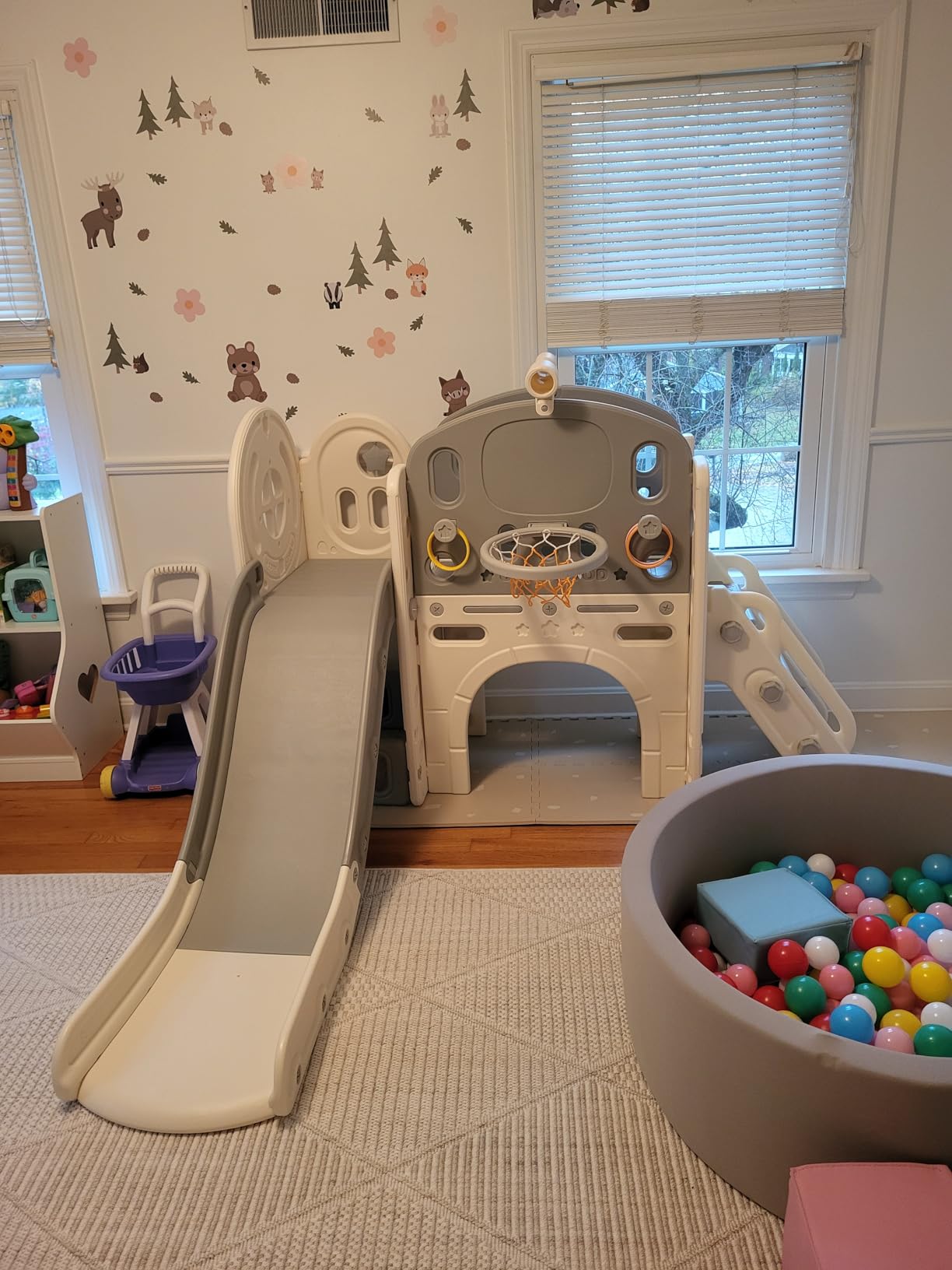
Colour options include pink, green and yellow, beige coffee, and white and grey. The neutral finishes are worth considering in a small yard, where a bright primary-coloured object is more visible from a window than a muted one.
One safety issue to know about
The most serious recurring concern in reviews is a circular opening at the top of the slide that toddlers have gotten their heads caught in. This appears in enough owner reports that we would not place it unsupervised in a yard used by children under two. If you buy it, position it where an adult can see the top of the slide from a kitchen window.
That concern is the deciding factor for us. A nine-zone activity center is genuinely useful, but a head-trapping opening is a different category of problem from a colour fading.
Age and fastener limits
It is rated 0-3 years and most children outgrow it by three, which is a short window. Plan on this being a two-season purchase unless you have a second child coming up behind.
Plastic fasteners loosen with heavy jumping and climbing and need checking every few weeks during active use. Some owners also report missing step risers at delivery and replacement parts that do not match. Check the parts list before assembly, and keep the manual.
10. Sportspower Park Ridge Metal Set – Most Features on Metal
Sportspower Park Ridge Metal Swing Set for Ages 3-8, 2 Swings, Standing Swing, Roman Glider, Teeter Totter, on 5ft Slide, 6.1ft Durable Steel Frame, Anchor Kit, 800lbs
159.45W x 90.55D x 72.83H inches
Ages 3-8 years
5 ft wavy slide
Roman glider, totter, two belt swings
Pros
- Slide
- teeter totter
- Roman glider
- standing swing and two belt swings
- PVC-covered chains protect small hands
- Foam-padded frame legs
- 5 ft slide carries a limited lifetime warranty
Cons
- Slide and teeter totter are smaller than expected
- Teeter totter can pinch small fingers
- Slide ladder steps have broken after light use
- Hardware can arrive already rusted
This is the largest footprint in the roundup at 159.45 by 90.55 inches, and we want to be direct about that: this set does not belong in a small backyard. It is here because it is the only unit that delivers a full playset experience on a metal frame, and families with a slightly larger lot or a patio area may find the feature list worth the ground it takes.
The feature count is genuinely high for a 6.1-foot steel frame: a 5-foot wavy slide, a two-person Roman glider, a standing and sitting swing, two belt swings and a teeter totter, with room for up to eight children at 100 pounds each. Chains are PVC-covered and the frame legs are foam-padded at ground level.
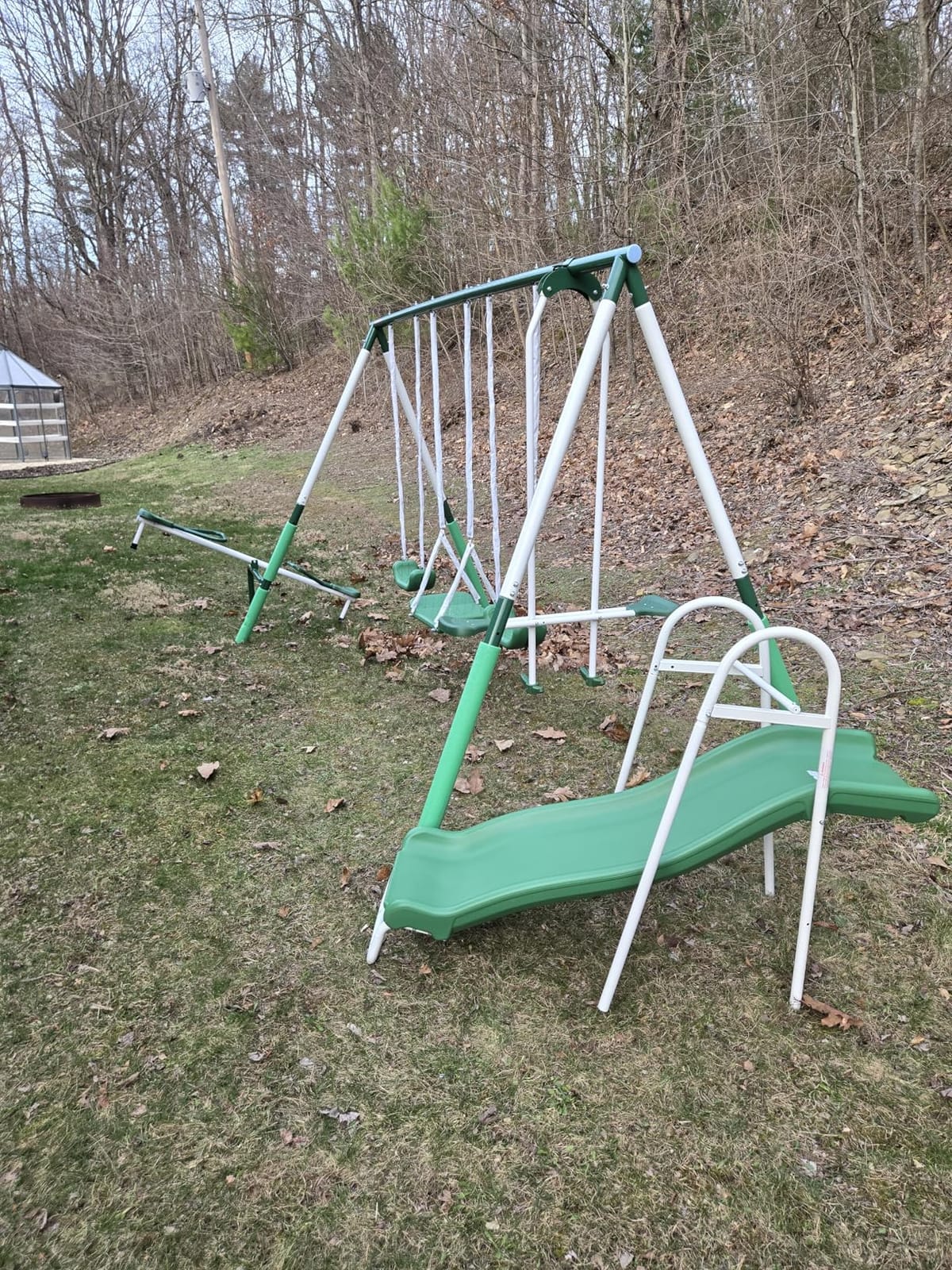
The 4-piece anchor kit is included, and the set meets or exceeds ASTM and CPSC standards. The slide carries a limited lifetime warranty, which is the strongest warranty language attached to any component in this roundup.
What owners actually report
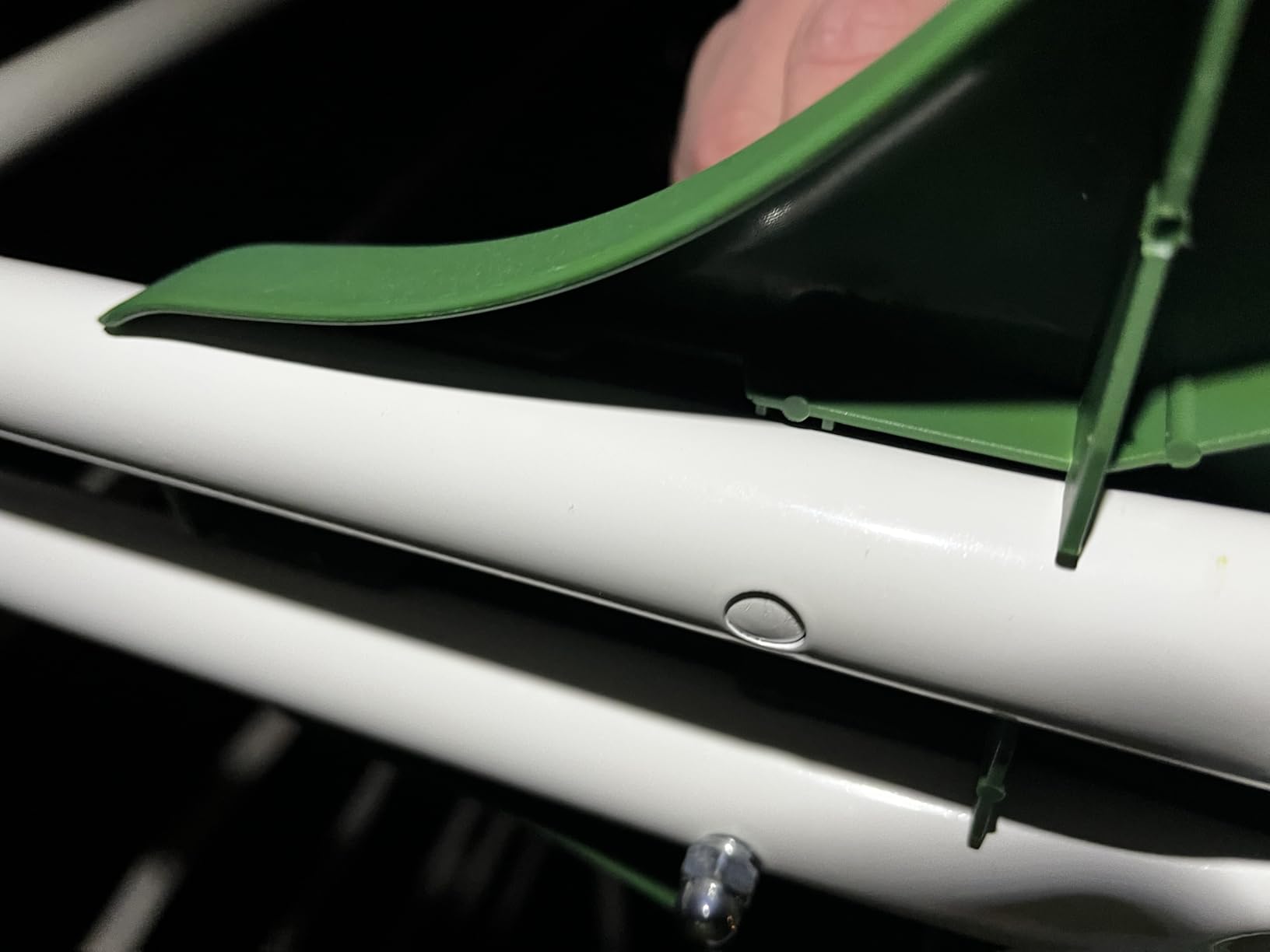
At 4.1 stars from 243 ratings, this is the lowest-rated product we included, and the reasons are consistent rather than random. The slide and teeter totter are smaller than the age range implies, the totter has a pinch point for small fingers, and the slide ladder steps have broken after light use in some households.
Hardware arriving already rusted is a packaging problem worth knowing about, and it is a reminder to check every tube and bolt on arrival. Assembly is genuinely difficult: parts are not pre-assembled, the printed labels are tiny, and washers have been mismatched.
Should you look elsewhere
Unless you have at least 24 by 20 feet of open ground, look elsewhere. The KidKraft Appleton at number 11 is a better use of constrained space because it stacks play vertically into a tower rather than spreading stations across a wide frame.
Our picks at numbers 3 and 6 cover the swinging half of what this set offers at a fraction of the footprint.
11. KidKraft Appleton Wooden Set – Premium Pick for a Full Playset
KidKraft Appleton Wooden Swing Set, (Amazon Exclusive)
123W x 108D x 95H inches
Ages 3-7 years
Cedar with rock wall
Sandbox area and vinyl canopy
Pros
- Roughly a third the cost of comparable tower sets
- Quality cedar with UV and mold protection
- Pre-cut and pre-drilled pieces with bagged hardware
- Rock wall
- wavy slide
- chalk wall and sandbox
Cons
- Assembly runs 4-8 hours with two people
- Soft cedar can split if overtightened
- 135 lb package is hard for one person to move
- Slide exit is fast
Of everything we tested against a small yard, the Appleton is the model most often described as the tower set that still fits. At 123 by 108 inches it is not a micro set, but it stacks the play vertically: rock wall on one side, wavy slide on the other, sandbox below, shaded deck above, two swings off the beam.
It is also the value case in the wooden category. Owners consistently describe it as roughly a third of the cost of comparable tower sets, and at 2214 ratings it is the second most-reviewed wooden product we looked at. The cedar arrives pre-cut, pre-drilled and pre-treated with a water-based stain carrying UV and mold protection, and all hardware is individually bagged and labeled.
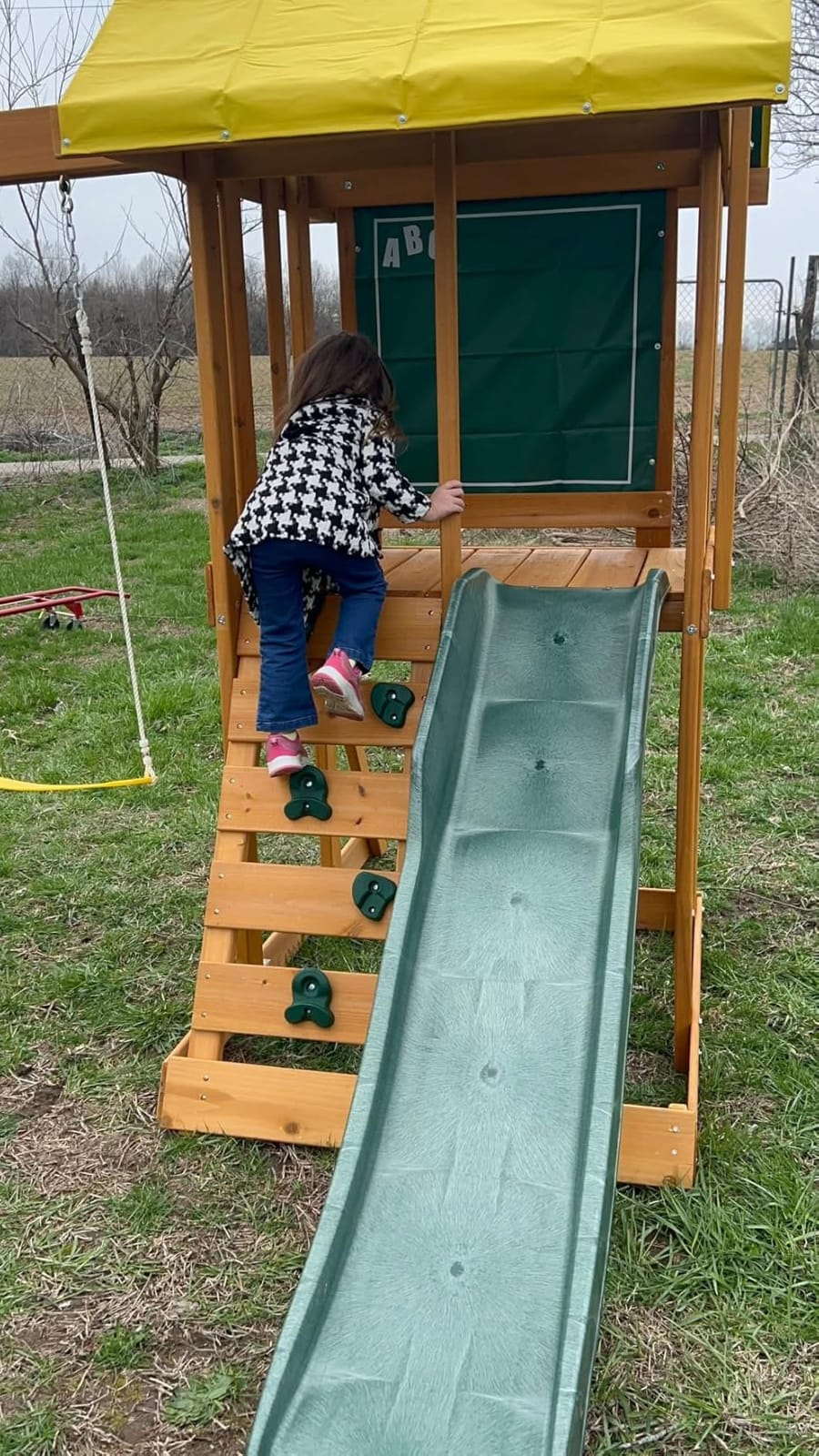
The chalk wall is a small feature that owners mention more than expected. It gives the deck side a purpose that does not require another accessory, and it works just as well for drawing as for a pretend menu.
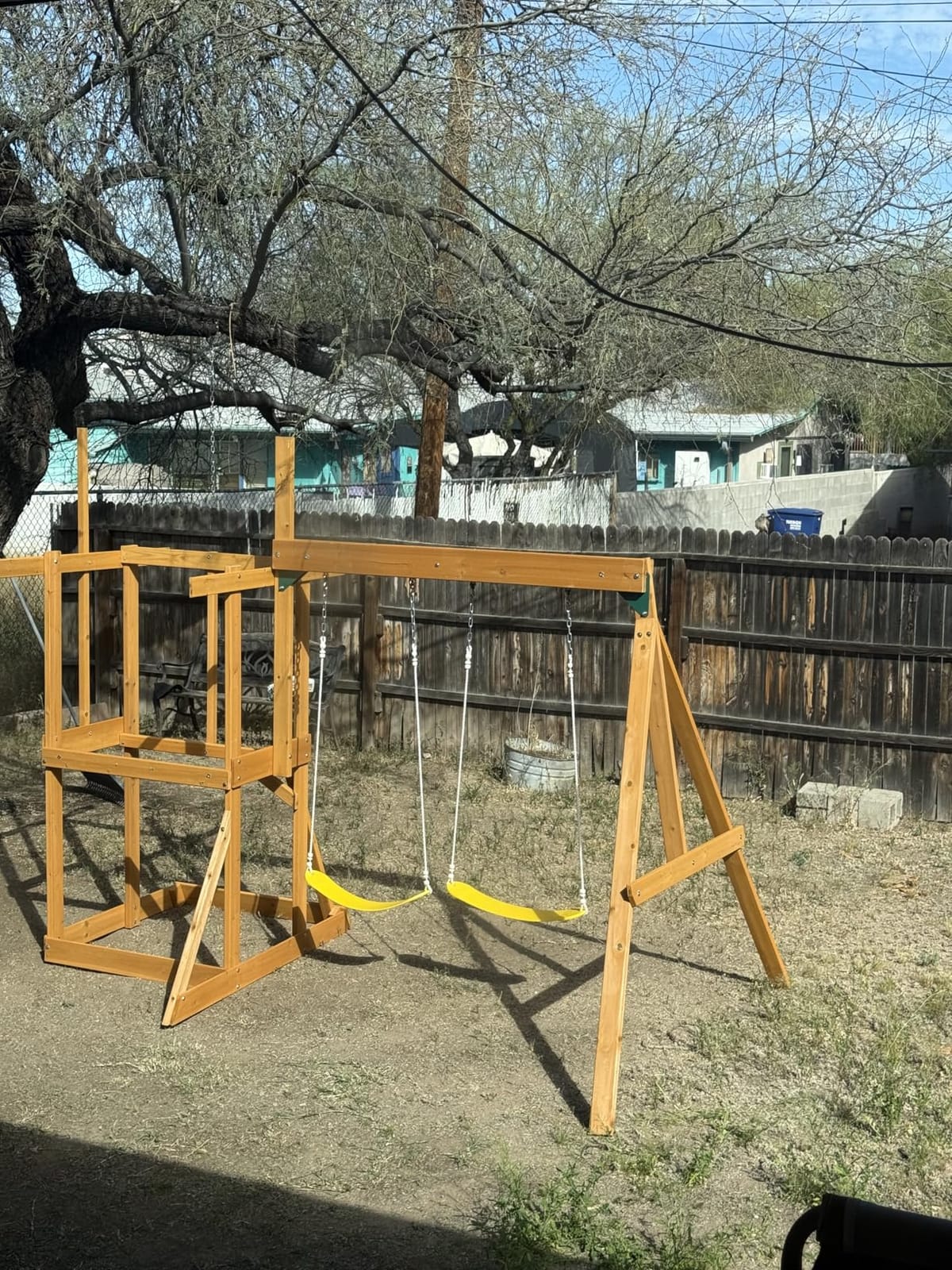
The use zone is where the real test happens
Add 6 feet of clearance on all sides and the Appleton needs close to 19 by 20 feet of clear ground, plus a slide run-out lane. In a lot with under 300 square feet of open lawn, that is the difference between a playset and a playset with a walkway around it. Measure before ordering, not after.
The common disappointment in small yards is exactly this. Parents in r/HomeImprovement describe buying sets with fewer features on the promise of a smaller footprint, then finding them surprisingly larger once assembled and anchored.
Assembly is the trade for the value
Budget two adults and 4 to 8 hours, plus a flat surface to lay the parts out on. The soft cedar can split if a bolt is overtightened, so snug is the target. The 135-pound package is genuinely difficult for one person to move, which matters if your gate or stairs are narrow.
Owners note the set runs small for its stated age range and that children outgrow it around five or six. Sand is not included for the sandbox area. Treat it as a strong five-year investment rather than a decade.
12. SIHANM 700lb 6-in-1 Metal Set – Best for Mixed Ages
Swing Sets for Backyard 700 lb – 6 in 1 Playground Sets with 3 Swings Seats
151.6W x 71D x 72.9H inches
Ages 0-12 years
Three height-adjustable swings
Climbing net, ladder and hoop
Pros
- Three height-adjustable swing types on one frame
- Climbing net and reinforced ladder
- 700 lb claimed capacity with double reinforcement
- Swings spaced widely to prevent collisions
Cons
- Metal gets hot in direct sun
- Anchor kit is recommended and sold separately
- Individual swing capacity is not specified
- Limited colour options
The swing configuration is what separates this from a plain A-frame. Three height-adjustable positions: a platform saucer swing, an EVA belt swing and a baby swing. That covers a one-year-old and a ten-year-old on the same structure, which is the mixed-age problem parents on daycare and parenting forums describe most often.
Adding a composite fibre climbing net, a reinforced climbing ladder and a basketball hoop makes it the most feature-dense metal set in this roundup short of the Sportspower, at a 151.6 by 71 inch footprint. That narrow 71-inch depth is what makes it viable in a yard where a wide A-frame would not fit.
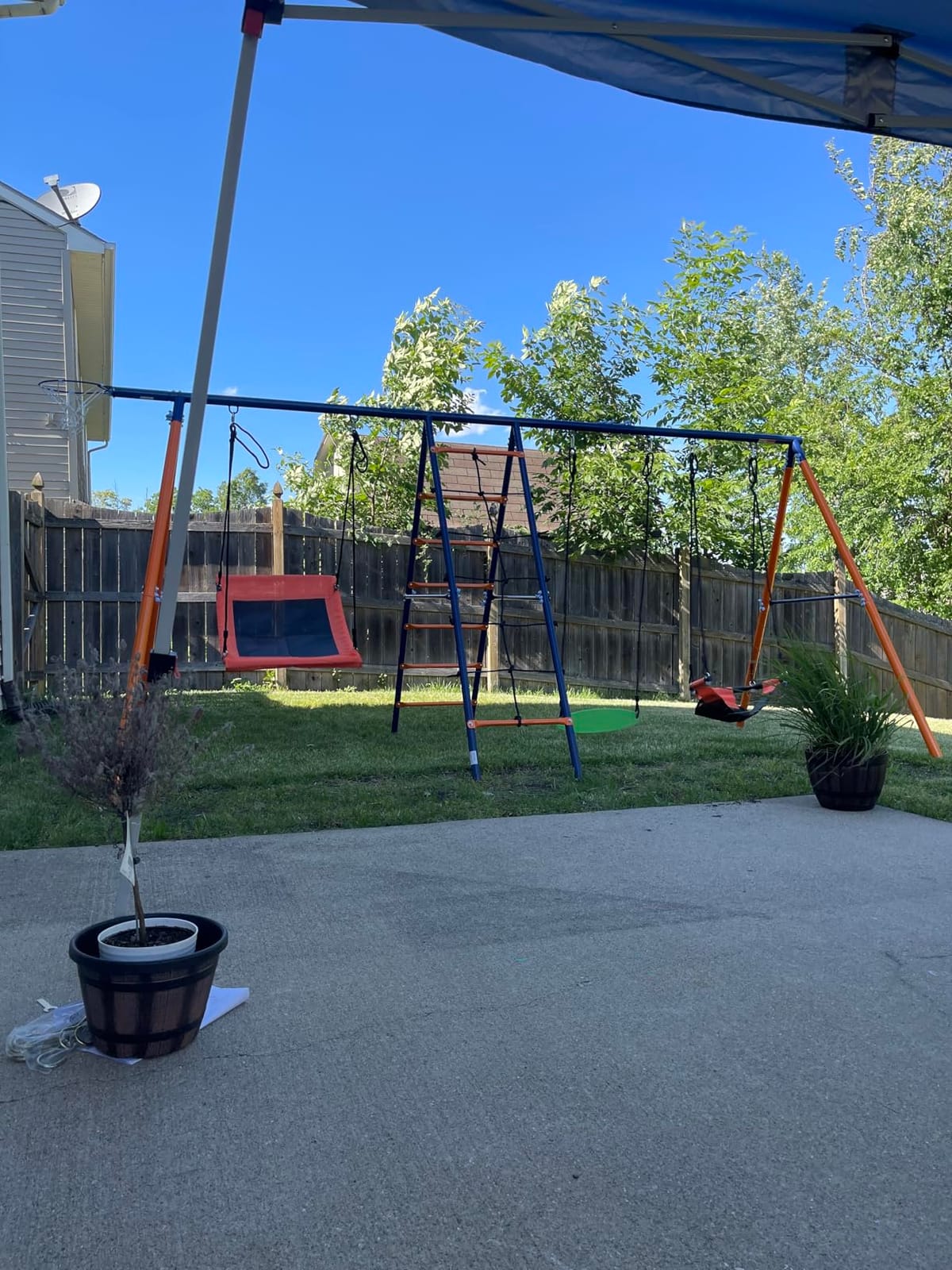
Construction is 2-inch thickened steel tube in an A-frame with double reinforcement at the force points, powder-coated paint and rust-resistant hardware. Wide spacing between seats is a detail that shows the designer thought about collisions rather than just capacity.
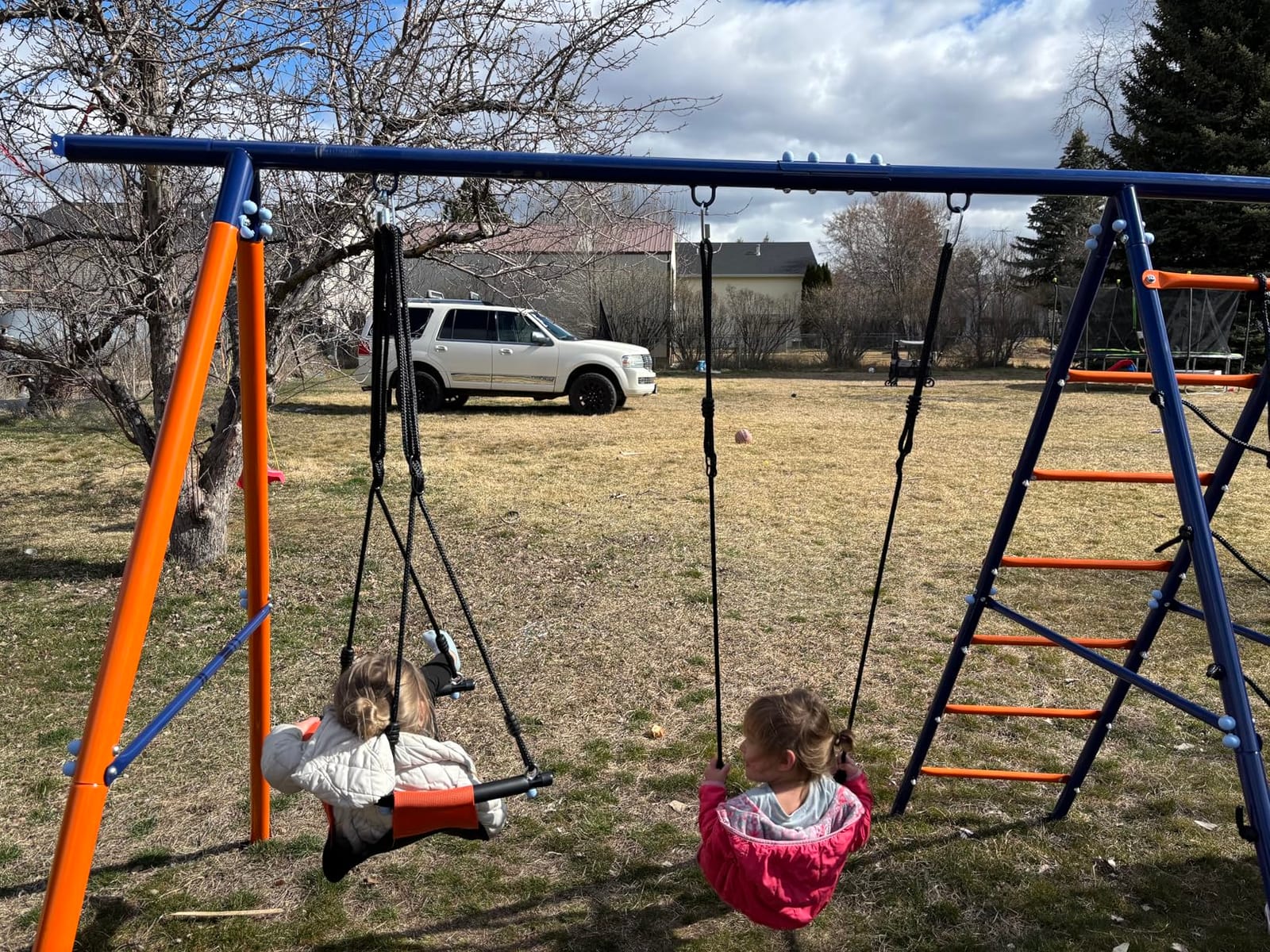
Get the anchors at the same time
The anchor kit is recommended but not included, and the manufacturer notes it does not require cement. Add it to the same order. A metal A-frame with three swing positions and no anchors is the setup most likely to move, and the swing arc at that length is where that becomes a problem.
Capacity is claimed at 700 pounds total for the frame. Individual swing ratings are not published, which is the main specification gap to be aware of.
Fit and heat
With 6 feet of clearance on all sides, the use zone comes to roughly 20 by 19 feet. That is larger than most yards in this article’s audience, so this is a pick for the upper end of small. The long, narrow shape suits a yard where the clear strip runs along a fence or a side boundary.
Owners flag that metal heats in direct sun, and the climbing net and slide run are the parts children touch most. Afternoon shade or a light-coloured ground surface underneath both help.
How to Size a Playset for a Small Backyard
Most sizing advice stops at the product’s listed dimensions, which is exactly where parents go wrong. The number on a listing is the structure. What you need to buy is the structure plus the ground a child needs to use it safely. Here is the method we used to rank everything above.
Step 1: Measure the open area, not the yard. Walk the space and mark every obstruction: fences, sheds, air conditioning units, garden beds, downspouts, vehicle paths, the neighbour’s tree canopy. Measure what remains.
Step 2: Subtract 6 feet from every edge. That gives you the use zone, the ground that must stay clear so a child can run, fall and get up again. If the space left is not rectangular, work from the tightest edge rather than the average.
Step 3: Read your number as a maximum footprint. Whatever square footage remains after step 2 is the largest structure you can buy. Add the slide run-out separately if the set has one, because a slide needs clear ground beyond its exit as well as beside the structure.
Step 4: Check the swing direction last. Swing arcs travel along the length of the beam. If your clear strip runs in the right direction, an A-frame fits; if it does not, rotate the plan rather than the set.
Step 5: Confirm level ground. Every manufacturer requires it, and a set on a slope needs shimming at multiple points or it will lean. A slight grade across the yard is workable; a drop of more than a foot is not.
Worked example for a common suburban lot. Open lawn measures 30 by 22 feet. Subtract 6 feet from each of the four edges and you have 18 by 10 feet, or 180 square feet of use zone. Any set whose footprint exceeds that is out, and any set needing a slide run-out alongside it is also out. The math eliminates four of the twelve products here before you read a single review.
That step-two number is also the honest test of whether a tower set belongs in your yard. A 123 by 108 inch structure is 92 square feet on its own, which leaves room inside a 180-square-foot use zone but leaves almost nothing to walk around it. Vertical stacking is the principle: a set that puts a slide, a wall and swings on top of one another buys more play per square foot than one that spreads stations across a wide frame.
Our wooden playhouse picks are worth a look if the step-two number comes out under 100 square feet, because a playhouse with a canopy covers the same ground as a full playset with far less of it.
Buying Guide: Materials, Safety, Surfacing and Build vs Buy
Wood or metal: the durability tradeoff
The consensus on Quora and in the parent forums we read is that neither material wins outright. Untreated metal rusts visibly within about a year, and untreated wood weathers, warps and rots at the joints. The variables are coating quality and maintenance, not the material itself.
Plastic-coated wood is the compromise most quality sets use. A plastic-poly layer wrapped around cedar or pine blocks moisture at the surface, which is where rot starts, and it also keeps paint from blistering. Swing-N-Slide’s Ranger uses pre-stained cedar; KidKraft’s Appleton uses a water-based stain with UV and mold protection. Both are sensible. Neither removes the need to reseal a wet-climate set after the first season.
Powder-coated steel is the metal equivalent. Trekassy and Hapfan both powder-coat their frames, and owners report joint sleeves as the detail that keeps water out of the connection points. The failure mode to watch is a bolt overtightened until the round tube flattens, which is a build error rather than a material defect.
Double-wall plastic has no seams for water to sit in and no fasteners to corrode, which is why six of the twelve picks here are plastic. What it does have is heat and UV exposure, and for children under six that trade is usually the right one.
Safety clearance and anchoring rules
The rule that appears on virtually every brand safety page, and that manufacturer guidance quotes directly, is a minimum of 6 feet from any structure, fence or obstruction, and level ground. Add 6 feet in front of every slide exit as a run-out lane, and keep the full forward and backward arc of every swing clear.
What to do when you cannot meet it. If a fence is closer than 6 feet, the workable options are to move the set, choose a design that points its slide and swings away from the fence, or reduce the swing height. A swing arc that runs into a fence is the risk that matters most, because fence boards are rigid at the exact height a swinging child reaches. A slide exit pointed at a fence is a lesser but real problem.
Anchoring is not optional on any set in this roundup. The Ranger, Trekassy, Hapfan and Sportspower all include stakes or an anchor kit, and owners consistently report that unanchored sets shift or lift. If your ground is hard or rocky, a ground screw anchor driven to depth works where a spike will not.
Ground surfacing: what goes under the set
Surfacing is the most commonly forgotten line in a playset budget, and it is routinely as expensive as the structure itself. A r/landscaping parent converted a 7 by 24 foot side yard into a play space using 3/8-inch Delaware stone, and noted explicitly that artificial turf would have run more than double the outlay.
Loose-fill options need topping up. Pea gravel and rubber mulch compact over time and need replenishment, and mulch transfers to clothing and gets tracked indoors. Sand is the most forgiving under a fall but needs a border to stay in place and is frequently excluded from playset specifications. Engineered wood fibre stays put better than mulch and stays warm, which is a factor in a shaded corner.
The decision rule is simple: match the surface depth to the fall height of the structure. Every set here is low-deck or swing-only, so fall heights are modest and the surfacing requirement is light. The sets with slides still benefit from a defined run-out area of loose fill rather than bare grass, both for comfort and because bare soil compacts into a hard surface over time.
Build vs buy: what a custom set really costs
A catalog set is a known total: the structure, plus delivery, plus an anchor kit, plus surfacing, plus assembly help if you need it. A custom build swaps a known price for an open one: lumber, hardware, surfacing, and build hours, with surfacing and hours usually being the two surprises.
For a very small yard, the custom route has one genuine advantage. A parent in r/landscaping built a play area around a power-washed recovered roller coaster as the main feature. It matches the space exactly and costs less than a catalog tower, and the disadvantage is obvious: there are no instructions, no warranty and no compliance testing.
Buying wins on assembly predictability. Every set in this roundup includes all hardware and illustrated instructions, and the assembly times owners report range from under three hours for the metal A-frames to 4 to 8 hours with two adults for the KidKraft tower. Budget the time before you choose, because an unstarted tower set in a driveway is how small yards lose their weekend.
Matching the set to your child’s age
Age bands are more useful as a starting point than as a rule. Bucket or baby swings serve roughly 1 to 3. Belt swings work from about 3 to 7 with a per-seat rating between 100 and 115 pounds. Trapeze bars and rope swings take over around 5. Rock walls, monkey-bar ladders and climbing nets start around 5 and stay useful into the early teens.
The sets here map cleanly onto those bands. The BIERUM and the All Around Playtime Patio serve the under-five group. The Step2 climbers and the Simplay3 cover 2 to 6. The Ranger, Trekassy, Hapfan and SIHANM sets cover the widest range because their swings swap or adjust.
What to do when they outgrow it in a small yard is the question parents on parenting forums ask most. In a yard that cannot hold a second structure, the answer is a modular addition to the existing frame: a trapeze or a rope swing onto an existing beam, or a second belt seat, rather than a larger tower. Swapping a seat is the cheapest upgrade in this category.
When a playset is the wrong answer in a small yard
Sometimes the honest recommendation is not a playset. If your step-two use zone comes out under about 80 square feet, a standalone swing beam, an A-frame, a monkey-bar climber unit, or a toddler bucket swing paired with a separate slide will use your ground far better than any compact tower.
A freestanding slide has a footprint of roughly 3 by 7 feet including clearance, against 92 square feet for the smallest tower set here. Pair one of those with an A-frame and you cover swinging and sliding in a small yard without a single deck to shade or dominate the view.
Also weigh the yard you want to keep. A full tower in a 20-foot-wide lot becomes the yard, and there is no way to hide it. If the lawn matters for how you use the space, a low structure in a corner is the better outcome even if it is less impressive in a product photo.
Frequently Asked Questions
What is a good small swing set for a backyard?
A good small swing set is one whose use zone, meaning the structure’s footprint plus roughly 6 feet of clearance on every side, fits inside your open lawn. Compact plastic climbers under 70 inches wide and cedar A-frames without a tower are the two profiles that reliably meet this. Measure your open area, subtract 6 feet from each edge, and buy only within the square footage that remains.
What size swing set fits in a small backyard?
Most compact fits come in under 100 square feet of footprint, and adding the 6-foot safety clearance on all sides means you need roughly 15 by 20 feet of open ground. Sets with a tower and slide, such as a 123 by 108 inch wooden playset, need closer to 19 by 20 feet of clear space once the slide run-out is included.
What is the best outdoor play equipment for small spaces?
For very small yards, a standalone A-frame swing set, a monkey-bar or climbing ladder unit, a freestanding slide, or a toddler bucket swing paired with a separate slide all use less ground than a tower playset. A freestanding slide needs about 3 by 7 feet including clearance, against roughly 92 square feet for the smallest tower set. Modular add-ons to an existing beam are the cheapest upgrade as children grow.
Are metal swing sets better than wood?
Neither material wins without treatment. Untreated metal frames can show rust within about a year, and untreated wood weathers and rots at the joints. Powder-coated steel resists rust well, and plastic-coated or stained cedar blocks moisture at the surface. For children under six in a small yard, double-wall plastic requires the least maintenance of the three.
Is it cheaper to build or buy a playset?
Buying gives a predictable total: the structure, delivery, an anchor kit, surfacing and assembly help. A custom build swaps that for lumber, hardware, surfacing and build hours, and the two least predictable costs are surfacing and time. A r/landscaping parent converted a 7 by 24 foot side yard with a few hundred dollars of stone, and noted artificial turf would have cost several times more, which shows how much surfacing alone can run.
What age do kids outgrow backyard swing sets?
Bucket and baby swings serve about ages 1 to 3, belt swings about 3 to 7 with per-seat ratings of 100 to 115 pounds, and trapeze bars, rock walls and climbing nets start around 5. Many compact sets are used hard by age 5 or 6 because the deck height, not the age label, is the limit. Swapping a seat for a trapeze or rope swing extends a set without a new structure.
Final Word on the Best Outdoor Playsets for Small Backyards
After putting all twelve through the same yard-sizing calculation, the Step2 Game Time Sports Climber is our pick for the best outdoor playsets for small backyards in 2026. It is the narrowest structure here with a slide attached, it is rated honestly for ages 2-6 with a stated 60-pound limit, and 4059 owners have confirmed that the double-wall plastic holds up season after season without rust, cracking or a repaint.
If your yard has a little more room and you want wood, the Swing-N-Slide Ranger gives you three swing positions in flat cedar with no tower footprint. If the children are under five and imaginative play matters more than climbing, the All Around Playtime Patio stores indoors when the season ends. And if the open space measures under about 100 square feet after your six-foot subtraction, skip the tower entirely and pair an A-frame with a freestanding slide.
Measure first, buy second. The footprint number on a product page is the easiest part of the decision, and it is the part that changes least once the set is in your yard.