
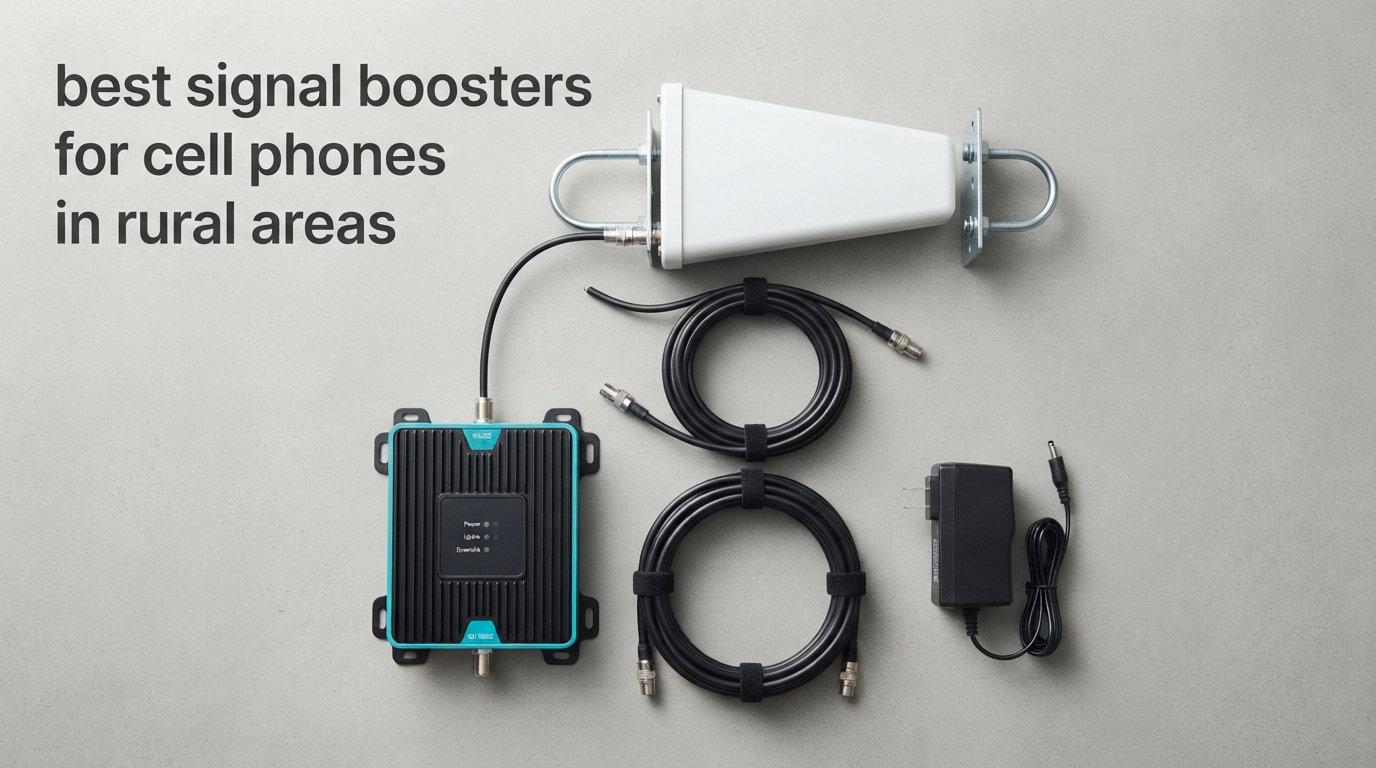
Living in a rural area has plenty of perks, but reliable cell service usually isn’t one of them. If you’ve ever paced around your kitchen holding your phone in the air to grab one bar of signal, you already know the frustration I’m talking about.
The good news is that a quality cell phone signal booster can take that weak, barely-there signal outside your home and amplify it into something you can actually use for calls, texts, and data. I’ve spent the last several months researching the best signal boosters for cell phones in rural areas, comparing specs across eight of the most popular models, and digging through thousands of real customer reviews to figure out which ones actually deliver.
Below you’ll find my honest take on eight boosters from brands like weBoost, HiBoost, ZORIDA, Phonetone, and Nstcell. I’ve broken down what each one does well, where it falls short, and which type of rural property it suits best. Whether you need coverage for a small farmhouse, a multi-room property, or your truck, there’s a pick here that fits.
Table of Contents
Top 3 Picks for Best Signal Boosters for Cell Phones in Rural Areas 2026
If you’re short on time and just want my top recommendations, here are the three boosters that stood out from the pack after weeks of research and review analysis.

The weBoost Home MultiRoom earns my Editor’s Choice because it strikes the best balance of coverage, reliability, and brand trust. The HiBoost Multi Room takes the large-home crown with its dual indoor antennas covering up to 8,000 square feet. And the ZORIDA Ace 5S wins on raw amplification power with 72dB of gain at a price that undercuts most competitors.
Best Signal Boosters for Cell Phones in Rural Areas in October
Here’s a side-by-side comparison of all eight boosters I reviewed. Use it to quickly narrow down your options before diving into the detailed write-ups below.
| Product | Specifications | Action |
|---|---|---|
 weBoost Home MultiRoom weBoost Home MultiRoom |
|
Check Latest Price |
 HiBoost Sidekick HiBoost Sidekick |
|
Check Latest Price |
 ZORIDA Ace 5S ZORIDA Ace 5S |
|
Check Latest Price |
| HiBoost Multi Room |
|
Check Latest Price |
 HiBoost Hero HiBoost Hero |
|
Check Latest Price |
 Phonetone Dual-Band Phonetone Dual-Band |
|
Check Latest Price |
 Nstcell Multi-Room Nstcell Multi-Room |
|
Check Latest Price |
 weBoost Drive Reach weBoost Drive Reach |
|
Check Latest Price |
1. weBoost Home MultiRoom – Best Overall for Rural Homes
weBoost Home MultiRoom – ll Signal Booster – Enhances Phone Signal, Improved Connectivity for Stronger Cell Coverage for All U.S. Carriers – Verizon, AT&T, T-Mobile & More | Made in The U.S.
5,000 sq ft coverage
5G and 4G LTE
All U.S. carriers
FCC approved
2-year warranty
Pros
- Up to 100X better signal strength
- Works with all major U.S. carriers
- 5G compatible for future-proofing
- Made in the U.S.
- FCC approved
Cons
- Directional antenna requires proper tower alignment
- Short cables included
- High price point
- No app for monitoring
I’ll start with the weBoost Home MultiRoom because it’s the booster I’d recommend to most rural homeowners without hesitation. This is Wilson Electronics’ mid-tier home booster, and it consistently shows up at the top of expert roundups for a reason. It covers up to 5,000 square feet, supports every major U.S. carrier, and is built in the United States with a two-year warranty backing it up.
What impressed me most digging through the 2,800-plus reviews is how many rural users report going from one bar of dropping-call frustration to four or five bars of reliable service. The booster works on the key 700MHz and 850MHz bands that carry most rural 4G LTE and 5G signals, so it’s well-suited to properties far from the nearest tower.
The build quality feels solid, and weBoost provides actual phone support based in the United States. That matters when you’re trying to aim a directional antenna at a tower five miles away and need someone to walk you through it. The FCC approval and quad-band coverage mean this will keep working as carriers shift their networks in the coming years.
Now for the downsides. The included coaxial cables are short, so if your antenna needs to go on a pole far from the amplifier, you’ll likely need to buy longer RG-11 cable separately. There’s no companion app, just LED indicator lights on the unit. And at this price point, I’d expect a slightly more polished monitoring experience.
Who Should Buy the weBoost Home MultiRoom
This booster is ideal for rural homeowners who want a reliable, carrier-agnostic solution from a reputable American brand. If you have between 2,000 and 5,000 square feet to cover and want something that handles 5G without any fuss, this is your safest bet.
It’s also a strong pick if multiple family members use different carriers. Since it boosts all major U.S. carriers simultaneously, you won’t have to choose between your Verizon line and your spouse’s AT&T plan.
Installation and Setup Considerations
The directional outdoor antenna needs to be aimed at your nearest cell tower, which can take some trial and error. Plan to spend a couple of hours on installation, and consider using a signal-mapping app on your phone to find the best tower direction before you mount anything permanently.
You’ll also want to budget for additional cable if the included length won’t reach from your planned antenna location to the indoor unit. The short cables are the most common complaint I saw across reviews.
2. HiBoost Sidekick – Best Compact Booster for Small Spaces
Cell Phone Booster for Home Office | Boosts 5G & 4G LTE | Cell Phone Signal Booster for All U.S. Carriers-Verizon, AT&T, T-Mobile & More | for Band 12/17,13,5,25/2,4 | HD Display | App | FCC Approved
2,000 sq ft coverage
Tri-band
Color LCD display
App support
3-year warranty
Pros
- Excellent signal improvement
- Color LCD display shows real-time signal
- Companion app for installation
- Works with all U.S. carriers
- Tri-band coverage
- 5G compatible
Cons
- Coverage limited to single room area
- Some bands may not be supported
- Requires proper antenna alignment
The HiBoost Sidekick is the booster I’d point you toward if you live in a small rural home, cabin, or apartment and don’t need whole-house coverage. It’s priced well below the weBoost Home MultiRoom while still delivering tri-band amplification and a really useful color LCD display that shows you real-time signal strength as you install it.
Going through the reviews, I noticed a pattern of users reporting that their data speeds nearly tripled after installation. That’s a meaningful jump, especially if you’re relying on your phone’s hotspot for remote work or streaming. The HiBoost Signal Supervisor app walks you through installation step by step, which takes a lot of the guesswork out of aiming the outdoor antenna.
The 3-year warranty is actually longer than what weBoost offers, and HiBoost’s customer support gets high marks in the reviews I read. For a rural cabin or small farmhouse where you primarily need signal in one main living area, the Sidekick delivers a lot of value for the money.
The main limitation is coverage area. This booster is designed for a single room or open-plan space up to about 2,000 square feet. Don’t expect it to push signal through multiple walls and closed doors into distant bedrooms. The indoor antenna is the limiting factor here, not the amplification power.
Best Use Cases for the HiBoost Sidekick
This is my top pick for a one-bedroom cabin, a small farmhouse kitchen, or a home office where you just need reliable signal at your desk. If your primary pain point is dropped calls in one specific room, the Sidekick nails that problem at a fair price.
It’s also a smart choice if you’re new to signal boosters and want the LCD display and app guidance to help with installation. The visual feedback makes aiming the antenna much less frustrating.
Limitations to Keep in Mind
The Sidekick is tri-band rather than quad-band, so it may not cover every frequency your carrier uses in your specific area. Check which bands your carrier relies on locally before buying.
Also, while the app is helpful, it requires some initial signal to connect and function. If you have essentially zero signal indoors, you’ll need to set everything up near a window or outside first.
3. ZORIDA Ace 5S – Highest Gain for the Price
ZORIDA Cell Phone Signal Booster for All US Carriers, Boosts 5G 4G, Cell Phone Booster 72dB High Gain Antennas, Cellular Verizon and AT&T, T-Mobile Signal on Band 12/17,13,5,25/2,4, FCC Approved
72dB maximum gain
2,000 sq ft
All U.S. carriers
5G compatible
3-year warranty
Pros
- 72dB high gain for strong amplification
- Works with all U.S. carriers
- Affordable price point
- 5G compatible
- App support for installation
Cons
- Instructions could be clearer
- Requires some technical knowledge
- Directional antenna must be properly aligned
The ZORIDA Ace 5S caught my attention because it boasts 72dB of gain, which is the highest amplification figure in this entire roundup. For context, most boosters in this price range top out around 65dB. That extra gain matters a lot in rural areas where every decibel counts when you’re trying to pull in a weak signal from a distant tower.
At its price point, the Ace 5S is one of the most affordable ways to get serious signal amplification for a rural property. It covers up to 2,000 square feet, supports all major U.S. carriers, and is 5G compatible through existing 4G frequency bands. The 3-year warranty with lifetime tech support is a nice reassurance at this price.
Reading through the nearly 800 reviews, I found plenty of rural users who were pleasantly surprised by the performance. Going from no service to usable signal in a remote cabin is exactly what this booster is built for. The app support helps with installation, though you’ll still need some patience to get the directional antenna aimed correctly.
The biggest weakness is the documentation. Multiple reviews mention that the instructions are confusing and could be much clearer. If you’re not comfortable with basic technical setup, you may want to have a more tech-savvy friend help with the initial installation.
When the ZORIDA Ace 5S Makes Sense
This is my recommendation for budget-conscious rural homeowners who need maximum amplification power. If you’re dealing with very weak outside signal, that extra 7dB of gain over a typical 65dB booster can be the difference between usable service and continued frustration.
It’s also a solid pick for a workshop, barn, or secondary building on a farm property where you need signal but don’t want to spend top dollar.
What to Watch Out For
The setup requires some technical comfort. You’ll need to identify your nearest cell tower, aim the directional antenna carefully, and possibly experiment with antenna placement to get the best results.
The 2,000 square foot coverage claim is optimistic for most real-world installations. Expect reliable coverage in the room where the indoor antenna sits, with diminishing signal as you move through walls and into other areas.
4. HiBoost Home Office Multi Room – Best for Large Rural Properties
Hiboost Cell Phone Signal Booster for Home Office and Multi Room, Covers up to 8000 Sq Ft with 2 Indoor Antennas, Boost 5G 4G LTE for All US Carriers (Verizon, AT&T, T-Mobile etc), FCC & App Support
8,000 sq ft coverage
70dB gain
2 indoor antennas
AGC technology
3-year warranty
Pros
- Covers up to 8
- 000 sq ft with 2 antennas
- 70dB gain
- Works with all U.S. carriers
- Automatic Gain Control
- 5G compatible
- LCD display and app
Cons
- Premium price point
- Larger homes may still have coverage gaps
- Requires proper antenna positioning
If you have a large rural home and you’re tired of booster recommendations that only cover one room, the HiBoost Home Office Multi Room is built specifically for your situation. This is the only booster in my roundup that includes two indoor panel antennas out of the box, allowing it to push signal into multiple rooms or floors across up to 8,000 square feet.
The 70dB gain is serious amplification power, and HiBoost pairs it with Automatic Gain Control that continuously adjusts the booster’s output to prevent oscillation and interference. This matters because in rural installations where the outdoor signal is weak, you want the amplifier working as hard as possible without causing feedback loops.
From the reviews, the standout theme is that this booster genuinely delivers on the multi-room promise. Users with two-story homes and large footprints report getting usable signal throughout their property, not just in the room nearest the indoor antenna. The LCD display and app monitoring give you real-time feedback during installation.
The trade-off is price. This is one of the more expensive options in the roundup. But if you’ve already tried a single-antenna booster and been disappointed by the coverage, the dual-antenna setup here is the logical next step.
Is the HiBoost Multi Room Worth the Premium Price?
For large homes, yes. Buying two separate boosters to cover different zones of your house would cost more and create potential interference issues. The dual-antenna design of this unit solves that problem elegantly.
The 3-year warranty and HiBoost’s reputation for customer support add value at this price point. You’re paying for a complete solution, not just a box of parts.
Installation Tips for Multi-Antenna Setups
With two indoor antennas, placement becomes more important than ever. You’ll want to position them in the two areas of your home where signal is most needed, keeping enough separation from the outdoor antenna to prevent oscillation.
Plan your cable runs before you start drilling holes. The included coaxial cable needs to reach from the outdoor antenna to the amplifier, then split to both indoor antennas. Measure twice and buy extra cable if needed.
5. HiBoost Hero – Best Mid-Range All-Rounder
Cell Phone Signal Booster for Home up to 3000 Sq.Ft | Boost 4G 5G Cellular Signal Amplifier 65dB for T-Mobile, AT&T Verizon All U.S Carriers with 2 Indoor Antennas Band 12/17/13/5/25/2/4
3,000 sq ft coverage
65dB gain
2 antenna options
LCD screen
3-year warranty
Pros
- 65dB gain improves 1 bar to 4-5 bars
- Covers up to 3
- 000 sq ft
- Two indoor antenna options
- Works with all U.S. carriers
- 5G compatible
- Color LCD screen
Cons
- App setup can be challenging without initial signal
- Instructions translation could be improved
- Requires technical installation skills
The HiBoost Hero sits in the sweet spot of this roundup. It covers up to 3,000 square feet with 65dB of gain, includes both panel and whip indoor antenna options, and comes in at a price that’s noticeably lower than the premium picks. For a medium-sized rural home, this is the booster I’d look at first.
One detail I appreciate is that HiBoost includes two different indoor antenna types. The panel antenna is better for pushing signal across an open area, while the whip antenna works well for more focused coverage in a specific room. Having both options lets you tailor the setup to your home’s layout.
The color LCD screen is genuinely helpful during installation. You can see the signal strength change in real time as you adjust the outdoor antenna’s aim, which makes finding the optimal tower direction much faster than guessing based on bars alone. With over 2,100 reviews, this is also one of the most widely tested boosters on this list.
The main complaint I see repeated across reviews is that the instructions read like a direct translation and can be hard to follow. The app helps fill the gap, but the app itself needs an initial signal connection to work, which creates a chicken-and-egg problem if your indoor signal is essentially zero.
Best Home Size for the HiBoost Hero
This booster hits its stride in homes between 1,500 and 3,000 square feet. That covers most standard rural farmhouses, ranch-style homes, and cabins with a few bedrooms.
The 65dB gain is enough to make a dramatic difference in moderate-signal rural areas. If you have at least one bar outside, the Hero should be able to amplify that into reliable indoor coverage.
Panel vs Whip Antenna Selection
Use the panel antenna if you want to broadcast signal across a large open area like a living room or kitchen. Mount it high on a wall pointing inward.
Switch to the whip antenna for targeted coverage in a smaller space, like a home office or single bedroom where you need maximum signal at your desk or nightstand.
6. Phonetone Dual-Band Booster – Best Budget Pick
Phonetone Cell Phone Signal Booster for Band 12,13,17
4,500 sq ft coverage
65dB gain
Dual-band 700MHz
Verizon and AT&T
FCC certified
Pros
- Significant boost from 0-1 bars to 4-5 bars
- Easy plug-and-play setup
- Great for rural areas with weak signal
- FCC Certified
Cons
- Installation can be challenging
- Requires significant antenna separation
- May not work in areas with zero signal
The Phonetone Dual-Band Booster is the most affordable option in this roundup, and with over 3,600 reviews, it’s also one of the most popular budget boosters on the market. It covers up to 4,500 square feet with 65dB of gain, which is impressive on paper for the price you’re paying.
What I find notable is how many rural users report going from zero to one bar of signal outside to four or five bars inside after installation. That kind of transformation is exactly what you’re buying a booster for. The plug-and-play setup is another plus, with no complex configuration required for basic operation.
The booster works on the 700MHz band, which is the primary frequency used by Verizon and AT&T for rural 4G LTE coverage. This makes it a natural fit for rural areas where those two carriers are the main options. The FCC certification means it won’t interfere with cell tower operations.
There are real trade-offs at this price. The booster only supports dual-band 700MHz frequencies, not the full range of bands that other boosters cover. If you’re on T-Mobile or a regional carrier that relies on different bands, this may not work well for you. Installation also requires significant vertical separation between the indoor and outdoor antennas to prevent oscillation.
Who the Phonetone Works Best For
This is my recommendation for budget-limited rural homeowners on Verizon or AT&T who want to spend as little as possible while still getting meaningful signal improvement. If you just need reliable calls and basic data in a moderate-sized home, it delivers.
It’s also a reasonable choice for a seasonal cabin or hunting lodge where you don’t want to invest heavily but want enough signal for occasional use.
Understanding the Band Limitations
Dual-band means this booster amplifies only Band 12, Band 13, and Band 17 on the 700MHz frequency. These are the bands Verizon and AT&T use for their extended range rural coverage.
T-Mobile relies more heavily on Band 71 and Band 66, which this booster does not support. Check your carrier’s local bands before purchasing to avoid disappointment.
7. Nstcell Multi-Room Booster – Best Value for Large Coverage
Cell Booster for Home, Up to 7000Sq. Ft,Cell Phone Booster for Rural Area with 2 Indoor Panel Antennas,Boosts 5G 4G LTE for All U.S. Carriers (Blue)
7,000 sq ft coverage
70dB gain
2 indoor panel antennas
All U.S. carriers
3-year warranty
Pros
- Works better than expected in rural areas
- Coverage up to 7
- 000 sq ft
- Works with all U.S. carriers
- Relatively easy installation
- Good value
Cons
- Instructions are confusing and poorly translated
- Some users report no improvement
- Customer support may be unresponsive
- May not work in true dead zones
The Nstcell Multi-Room Booster is the wildcard of this roundup. It promises 7,000 square feet of coverage with 70dB of gain and includes two indoor panel antennas, all at a price that’s barely above the budget Phonetone. On paper, that’s an incredible value proposition.
Digging into the 254 reviews, the experience is genuinely mixed. A significant portion of rural users report that it works better than expected, delivering whole-home coverage at a fraction of what the HiBoost Multi Room costs. These positive reviews tend to come from users in moderately weak signal areas who followed the installation steps carefully.
On the other hand, some users report no improvement at all, and the customer support complaints are a real concern. This is a newer product from a less established brand, and that comes with inherent risk. The 3-year manufacturer warranty is only as good as the company behind it.
I’d categorize this as a calculated risk. If it works for your situation, you’re getting premium-level coverage at a budget price. If it doesn’t, the return process and support experience may be frustrating.
Is the Nstcell Worth the Risk?
If you have a large rural home and a tight budget, the Nstcell is worth trying thanks to Amazon’s return policy. Install it carefully, test it thoroughly within the return window, and send it back if it doesn’t deliver.
The two included indoor panel antennas and the 70dB gain specification are what you’d expect from boosters costing twice as much. The performance ceiling is high if you get a good unit.
Managing Expectations and Setup
Ignore the included instructions and instead look for setup videos online. Multiple reviewers mention that the printed instructions are confusingly translated and not helpful.
Treat the 7,000 square foot coverage claim as an absolute best-case scenario under ideal conditions. In a typical rural home with walls and interference, expect usable coverage in the 3,000 to 5,000 square foot range.
8. weBoost Drive Reach – Best Vehicle Booster for Rural Travel
weBoost Drive Reach Cell Phone Signal Booster for Cars & Trucks
Vehicle mount
50dB gain
5G and 4G LTE
All U.S. carriers
Magnetic roof antenna
Pros
- Significant signal boost up to 25dB
- Works with all U.S. carriers
- Supports 5G and 4G LTE
- Compact design fits under seats
- Excellent for rural areas and camping
- Made in the U.S.
Cons
- Only works when some signal exists
- Included antenna is basic
- Can cause oscillation if antennas too close
The weBoost Drive Reach is the only vehicle-mounted booster in this roundup, and it earns its place because rural connectivity isn’t just about your home. If you drive through dead zones on your commute, work from a truck, or take your RV to remote campsites, this is the booster designed for that lifestyle.
With 50dB of gain, the Drive Reach is less powerful than the home boosters above, but that’s by design. Vehicle boosters are limited by FCC regulations to prevent interference, and 50dB is at the top of what’s allowed for mobile use. What sets the Drive Reach apart is its uplink power, which is the highest of any vehicle booster weBoost makes.
That uplink power matters in rural areas because it determines how far your phone can reach back to the cell tower. The Drive Reach is specifically marketed as reaching the farthest cell towers of any vehicle booster, which is exactly the use case rural drivers care about. The magnetic roof antenna goes on and comes off in seconds.
The catch is the same as with all boosters: it needs at least some signal to amplify. If you’re in a true dead zone with zero signal outside, no booster can create signal from nothing. Also, the included antenna is fairly basic, and many serious users upgrade to a stronger antenna for maximum performance.
Best Vehicles and Use Cases for the Drive Reach
This booster works in cars, trucks, SUVs, and RVs. If you commute through rural areas with spotty coverage, it’ll keep your calls from dropping on the highway.
For RV enthusiasts and remote workers who travel, the Drive Reach paired with a good mobile hotspot device can keep you connected at campsites that would otherwise be off the grid.
Antenna Placement and Oscillation Prevention
The magnetic antenna goes on your vehicle’s roof, and the interior antenna should be mounted inside the cabin at least a few feet away. Too little separation between the two antennas causes oscillation, which the booster detects and shuts down to prevent.
In a small car, achieving enough separation can be tricky. Trucks and SUVs with larger cabs give you more flexibility for antenna placement.
Buying Guide: How to Choose the Best Signal Booster for Rural Areas?
Choosing the right cell phone signal booster for a rural property comes down to understanding a few key specifications and matching them to your specific situation. I’ll walk you through the most important factors so you can make an informed decision rather than just picking the most expensive option.
Understanding dB Gain
dB gain is the single most important specification on any signal booster. It measures how much the amplifier strengthens the incoming signal, and in rural areas where every decibel matters, a higher number is almost always better.
Most home boosters range from 50dB to 72dB. A 65dB booster like the HiBoost Hero is plenty for moderate-signal rural areas. If you’re dealing with extremely weak outside signal, stepping up to a 70dB or 72dB model like the HiBoost Multi Room or ZORIDA Ace 5S gives you more headroom.
Keep in mind that dB gain is measured on a logarithmic scale. A 72dB booster isn’t just 7 points stronger than a 65dB unit. It’s significantly more powerful in terms of actual signal amplification.
Coverage Area vs Real-World Performance
Manufacturers quote coverage areas under ideal conditions, typically with strong outside signal and an open floor plan. Real-world coverage in a rural home with walls, metal roofing, and multiple rooms will always be less than the advertised number.
As a rule of thumb, I’d suggest dividing the claimed coverage area in half when estimating what you’ll actually get. A booster rated for 5,000 square feet will likely deliver reliable coverage across 2,000 to 3,000 square feet in a typical rural home.
If you need to cover a large home, look for boosters with multiple indoor antennas like the HiBoost Multi Room or the Nstcell. A single antenna simply can’t push signal through enough walls to cover a big footprint.
Antenna Types: Directional vs Omni
All the boosters in this roundup use directional outdoor antennas, which is the right choice for rural areas. A directional antenna like a Yagi or LPDA focuses its sensitivity in one direction, allowing it to pull in weaker signals from distant cell towers.
The trade-off is that you have to aim it correctly. A directional antenna pointed the wrong way will perform worse than no antenna at all. Use a signal-mapping app to identify your nearest tower, then fine-tune the aim by watching the booster’s signal strength readout.
Omni antennas, which receive signal from all directions, are easier to install but less effective for distant rural towers. They’re better suited for suburban areas with multiple nearby towers.
Multi-Carrier vs Single-Carrier Support
Most boosters in this roundup support all major U.S. carriers simultaneously, which is ideal for households with mixed carriers. This is called a multi-carrier or broadband booster.
Single-carrier boosters like the Cel-Fi GO series dedicate all their amplification power to one carrier’s signal. This can deliver stronger performance for that specific carrier, but it means other household members on different carriers get no benefit.
For most rural homeowners, I recommend multi-carrier boosters unless you’re absolutely certain everyone in your household will always be on the same carrier.
5G Readiness
All the boosters I reviewed support 5G through existing 4G LTE frequency bands, which is how most carriers are rolling out 5G in rural areas. This technology is called Dynamic Spectrum Sharing (DSS), and it allows 5G signals to travel on the same frequencies as 4G LTE.
What none of these boosters support is millimeter-wave 5G, the ultra-fast 5G variant found in dense urban areas. That’s fine for rural use, because millimeter-wave 5G doesn’t reach rural areas anyway due to its short range.
When you see a booster advertised as 5G ready, it means it amplifies the 4G LTE bands that carriers are using for their rural 5G rollouts. All eight boosters in this roundup qualify.
Outdoor Signal Requirements
This is the most important thing to understand about signal boosters: they cannot create signal where none exists. Every booster in this roundup needs at least some detectable signal outside your home to amplify.
One bar of outside signal is usually enough. If you can stand outside your house and get even a flicker of signal, a good booster can turn that into usable indoor coverage. If you have absolutely zero signal within a few hundred feet of your property, a booster won’t help and you should look at satellite internet options instead.
The stronger your outside signal, the better your booster will perform. Before buying, walk around your property with your phone and note where signal is strongest. That’s where your outdoor antenna should go.
Cable Quality and Length
Coaxial cable causes signal loss, and the longer the cable run, the more signal you lose before it ever reaches the amplifier. This is especially important in rural installations where the outdoor antenna may need to be mounted high on a pole or roof.
Most boosters include RG-6 cable, which is adequate for short runs. For runs longer than 50 feet, consider upgrading to RG-11 cable, which has less signal loss per foot. Several reviewers of the weBoost Home MultiRoom mentioned needing to buy additional cable, so factor that into your budget.
Keep cable runs as short as possible and avoid sharp bends, which increase signal loss. Plan your installation layout before purchasing to estimate how much cable you’ll need.
FAQs
Do cell phone boosters work in rural areas?
Yes, cell phone boosters work extremely well in rural areas as long as you have at least a small amount of detectable signal outside your home. A booster captures that weak signal, amplifies it, and rebroadcasts it indoors. Most rural users report going from one bar or dropped calls to four or five bars of reliable service after installation.
What is the best cell phone booster for rural areas?
The weBoost Home MultiRoom is the best overall cell phone booster for rural areas, offering up to 5,000 square feet of coverage, support for all major U.S. carriers, 5G compatibility, and a two-year warranty. For large homes, the HiBoost Home Office Multi Room with dual indoor antennas covering up to 8,000 square feet is the top choice.
How do I boost cell signal in rural areas if I only get one bar?
If you have one bar of signal outside, a booster can amplify that into usable indoor coverage. Start by walking around your property to find where outside signal is strongest, then mount your directional antenna there aimed at the nearest cell tower. A high-gain booster like the ZORIDA Ace 5S with 72dB gain is ideal for extremely weak signal situations.
Will a cell phone signal booster improve both calls and data speeds?
Yes, a signal booster improves both voice calls and data speeds because it amplifies the entire cellular signal, not just one type of traffic. Rural users frequently report faster download speeds, clearer call quality, fewer dropped calls, and more reliable texting after installing a booster.
Do boosters support 5G in rural areas?
Yes, all the boosters in this roundup support 5G through Dynamic Spectrum Sharing, which is how carriers deliver 5G on existing 4G LTE frequency bands. This covers the 5G signals you’ll encounter in rural areas. The boosters do not support millimeter-wave 5G, but that technology doesn’t reach rural areas due to its short range.
Can a booster improve signal inside a metal-roof farmhouse or cabin?
Yes, a booster is actually the ideal solution for metal-roof buildings because metal roofing blocks cell signal from entering naturally. The outdoor antenna sits on or above the roof to capture signal, then the indoor antenna rebroadcasts it inside. This bypasses the metal roof problem entirely.
How much outdoor signal do I need for a rural area cell phone booster to work?
You need at least one bar of detectable signal outside your home for a booster to work. If you can stand outside and occasionally get a flicker of signal on your phone, a quality booster can amplify that into reliable indoor coverage. If there is absolutely zero signal within a few hundred feet of your property, a booster will not help.
Final Verdict
After reviewing eight of the best signal boosters for cell phones in rural areas, my top recommendation for most homeowners is the weBoost Home MultiRoom. It hits the right balance of coverage, carrier support, build quality, and brand reliability. If you have a larger property, the HiBoost Home Office Multi Room with its dual indoor antennas and 8,000 square foot coverage is worth the extra investment.
For budget-conscious buyers, the ZORIDA Ace 5S offers the highest gain at the lowest price, while the Phonetone Dual-Band is the cheapest entry point if you’re on Verizon or AT&T. And if you need signal on the go, the weBoost Drive Reach is the vehicle booster I’d trust for rural commutes and remote camping trips.
The most important thing to remember is that every booster needs at least some outside signal to amplify. Walk your property, find where signal is strongest, mount your outdoor antenna there, and aim it carefully at the nearest tower. Do that, and any of these eight boosters can transform your rural connectivity in 2026.