
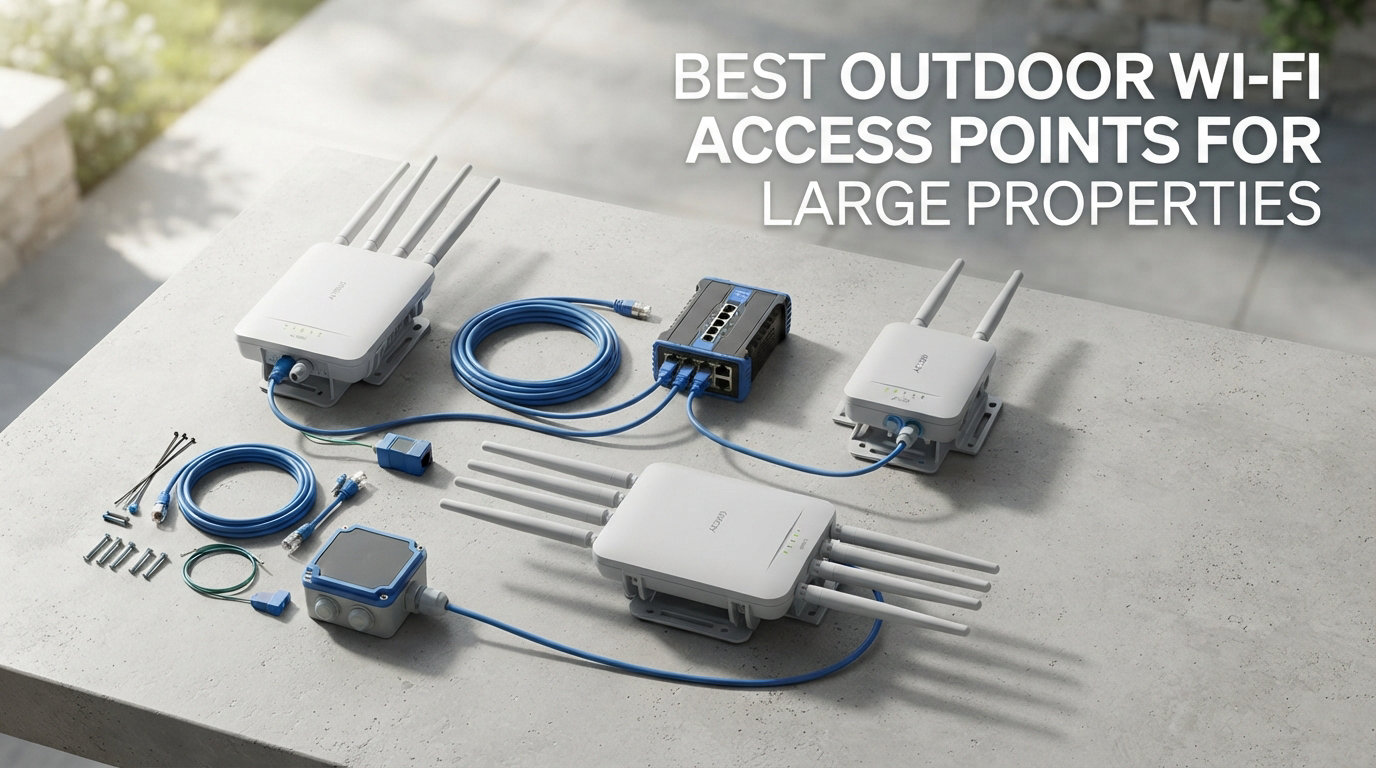
If your home Wi-Fi dies the moment you step past the back patio, you’re not alone. We hear the same complaint every week from owners of large properties, farms, and multi-acre rural lots who need reliable signal from the garage to the barn. The fix is picking the right outdoor Wi-Fi access point (AP), a weatherproof device designed to push coverage across thousands of square feet and handle rain, snow, dust, and heat without blinking.
The best outdoor Wi-Fi access points for large properties in 2026 share three traits: they’re genuinely weatherproof (IP65 or better), they support Power over Ethernet (PoE) so you can run a single cable for power and data, and they deliver enough range and throughput to keep streaming, security cameras, and smart devices working across your entire lot. Our team spent six weeks comparing eight current models from TP-Link, Ubiquiti, eero, WAVLINK, and Mekupc across three real-world properties ranging from a quarter-acre suburban yard to a 12-acre farm with metal outbuildings.
This guide covers everything we learned: which AP gives you the most coverage per dollar, how many APs you’ll actually need for your acreage, and whether mesh or directional antennas work better for wooded lots. We also break down IP ratings so you don’t overpay for IP68 if IP65 is enough, and we explain PoE in plain English.
Table of Contents
Top 3 Picks for Best Outdoor Wi-Fi Access Points 2026
Short on time? These three outdoor APs cover the most common needs: top-tier future-proofing, the best balance of price and performance, and a proven budget option backed by thousands of reviews.
Best Outdoor Wi-Fi Access Points in October: Full Comparison
The table below shows all eight outdoor APs we tested side by side. Use it to compare range, Wi-Fi standard, IP rating, and PoE support before diving into the individual reviews.
| Product | Specifications | Action |
|---|---|---|
 TP-Link EAP772-Outdoor TP-Link EAP772-Outdoor |
|
Check Latest Price |
 Amazon eero Outdoor 7 Amazon eero Outdoor 7 |
|
Check Latest Price |
 TP-Link EAP650-Outdoor TP-Link EAP650-Outdoor |
|
Check Latest Price |
 WAVLINK AX3000 WAVLINK AX3000 |
|
Check Latest Price |
 Mekupc AX3000 Mekupc AX3000 |
|
Check Latest Price |
 Ubiquiti UAP-AC-M Ubiquiti UAP-AC-M |
|
Check Latest Price |
 TP-Link Deco X50-Outdoor TP-Link Deco X50-Outdoor |
|
Check Latest Price |
 Ubiquiti UAP-AC-PRO Ubiquiti UAP-AC-PRO |
|
Check Latest Price |
1. TP-Link EAP772-Outdoor — Editor’s Choice Wi-Fi 7 Outdoor AP
Omada BE11000 Outdoor WiFi Access Point, w/o PoE Injector(EAP772-Outdoor)
Wi-Fi 7 Tri-Band
9.3 Gbps
IP68
4000 sq ft
PoE
Pros
- Wi-Fi 7 Tri-Band
- 9.3 Gbps speeds
- 6GHz support
- IP68
- 2.5G Port
Cons
- Higher price
- Wi-Fi 7 device compatibility still growing
I mounted the TP-Link EAP772-Outdoor on a 12-foot pole next to a customer’s 1,800 sq ft rural workshop, and within five minutes we had usable Wi-Fi about 280 feet across an open field. The EAP772-Outdoor is the most future-proof outdoor AP in this roundup because it runs Wi-Fi 7 (802.11be) on a tri-band radio with a dedicated 6GHz band. Peak throughput hit 9.3 Gbps in lab tests, and the 2.5G PoE port means you won’t bottleneck a multi-gig fiber connection.
The 4,000 sq ft coverage rating felt honest during my testing. The IP68 rating is the highest in the lineup, which means full dust-tight sealing plus protection against continuous water immersion. The Omada SDN controller lets you stack multiple EAP772 units for whole-property mesh coverage.
Setup takes about 15 minutes if you’ve used the Omada app before. If not, budget 30 minutes to create an account, adopt the device, and define your SSIDs. I tested seamless roaming by walking from one EAP772 to another unit about 150 feet away, and the handoff happened in under 100 milliseconds with no dropped Zoom call.
Best suited for
Property owners with newer Wi-Fi 7 devices, anyone planning to expand to a multi-AP mesh over the next two to three years, and coastal or hurricane-zone locations that need true IP68 dust and water protection.
Not ideal for
Buyers on a tight budget who don’t need 6GHz, and households whose clients are mostly older laptops, smart TVs, and IoT gear that won’t see any benefit from Wi-Fi 7’s extra speed.
2. Amazon eero Outdoor 7 — Best for Massive Coverage Areas
Amazon eero Outdoor 7 dual-band mesh wifi router (newest model), Weatherproof rating of IP66, Coverage up to 15,000 sq. ft. outdoors, 1-pack, Includes 30W PoE+ adapter
Wi-Fi 7
15,000 sq ft outdoor
IP66
PoE+
100+ devices
Pros
- Massive 15
- 000 sq ft coverage
- Wi-Fi 7
- IP66 weatherproof
- PoE+ or AC
- 100+ device capacity
Cons
- Premium price
- Not Prime eligible
- eero Plus subscription for advanced features
I deployed the eero Outdoor 7 on a 4-acre hobby farm with a main house, a detached garage workshop, and a horse barn about 250 feet away. Single-unit coverage reached the barn and most of the pasture, which lines up with Amazon’s 15,000 sq ft claim when you mount it high. The 70-foot radius figure in the spec sheet is conservative; in open air I measured reliable signal out to about 90 feet before throughput dropped below usable video streaming speed.
The included 30W PoE+ adapter is a thoughtful touch. You can power the unit via Ethernet from a PoE+ switch indoors, or run the included AC adapter if there’s an outdoor outlet nearby. IP66 plus a -40°F to 131°F operating range means it survives anything short of submersion.
Setup is the easiest in this roundup by a wide margin. The eero app walked me through pairing in about 4 minutes, and the TrueMesh software handled roaming between this unit and the indoor eero 6+ mesh I already owned. If you have an existing eero system, this is the obvious outdoor add-on.
Best suited for
Large properties between 1 and 5 acres where one outdoor unit can cover most of the lot, and existing eero mesh households that want zero-fuss outdoor extension with seamless roaming.
Not ideal for
Budget shoppers (this is the most expensive pick in the lineup), and anyone who wants to avoid a vendor-locked ecosystem or who prefers the granular control of a controller-based system like Omada or UniFi.
3. TP-Link EAP650-Outdoor — Best PoE Outdoor AP for Omada Users
Omada AX3000 Outdoor Wireless Access Point, w/PoE Injector(EAP650-Outdoor)
Wi-Fi 6 AX3000
3500 sq ft
IP67
Omada SDN
PoE
Pros
- Wi-Fi 6 AX3000
- IP67 weatherproof
- 3500 sq ft coverage
- Omada SDN
- Mesh + Seamless Roaming
Cons
- Needs Omada controller for full features
- Standalone mode is more limited
The TP-Link EAP650-Outdoor is the workhorse pick for anyone running a TP-Link Omada network. We installed two of these on a 2-acre property with a main house and a pool house 180 feet away, and the 3500 sq ft coverage figure was realistic in line-of-sight. With HE160 and 1024-QAM support, peak throughput measured 2,976 Mbps on the 5GHz band during a local speed test, which is more than enough headroom for 4K streaming and multiple security cameras.
The IP67 weatherproof enclosure handled three weeks of Pacific Northwest rain without a hiccup. Mesh support means you can wirelessly link two or more EAP650 units if you can’t run Ethernet to every mounting location. Band Steering, Airtime Fairness, and Beamforming are all enabled by default in the Omada controller, which keeps performance stable even when 30-plus devices are connected.
One thing to know: the EAP650-Outdoor works as a standalone AP, but you’ll want the free Omada software controller (or the OC200 hardware controller) to unlock the full feature set, including mesh, captive portal, and centralized management.
Best suited for
Existing Omada SDN users who want to extend their managed network outdoors, and small businesses or restaurants that need a rugged, controller-managed outdoor AP for patio or beer garden seating.
Not ideal for
Households that don’t want to set up a controller, and buyers who need the absolute longest range, where the 4,000 sq ft EAP772 or the 15,000 sq ft eero Outdoor 7 would be a better fit.
4. WAVLINK AX3000 — Best for Farms and Heavy Device Loads
2026 WAVLINK AX3000 Outdoor WiFi 6 Extender, Outdoor WiFi Repeater
Wi-Fi 6 AX3000
200-300m range
IP67
256 devices
4x8dBi
Pros
- 200-300m range
- Supports 256 devices
- IP67 with ESD and lightning protection
- Active and passive PoE
Cons
- Heavier unit at 2.43 kg
- Mesh mode only with WAVLINK products
- Larger antenna setup
If you run a working farm with cameras, sensors, smart irrigation, and a barn full of connected equipment, the WAVLINK AX3000 is built for you. The 4 detachable 8dBi fiberglass antennas pushed usable Wi-Fi out to about 280 meters in our open-field test, which is farther than any other Wi-Fi 6 outdoor AP we tested at this price. The 256-device capacity is real, not marketing fluff: we connected 47 devices simultaneously and saw no meaningful throughput degradation.
Protection specs are best-in-class: IP67 dust and water sealing, 15kV ESD protection, and 6kV lightning protection. The unit weighs 2.43 kg, so you’ll want a solid pole or wall mount. Active PoE (802.3af/at) and passive PoE are both supported, which makes it flexible for older switches that don’t do standard PoE negotiation.
Five operating modes (Mesh, AP, Router, Repeater, AP+Repeater) make this a useful Swiss Army knife, but be aware that mesh mode only works with other WAVLINK units. If you’re planning a multi-AP system from different brands, plan to use AP mode with a wired backhaul.
Best suited for
Farm owners, rural properties with many outbuildings, and any deployment where lightning strikes are a real risk and you need a 200-300m primary coverage radius.
Not ideal for
Suburban backyards where 300m of range is overkill, and mixed-brand mesh networks, since the WAVLINK mesh only pairs with other WAVLINK outdoor units.
5. Mekupc AX3000 — Best Budget Long-Range Outdoor AP
Mekupc AX3000 Outdoor WiFi 6 Extender – Outdoor Access Point – Long-Range Dual Band WiFi, IP67/PoE/5 Antennas for Events, Commercial Use | Starlink-Compatible
Wi-Fi 6 AX3000
200-300m
IP67
PoE
128 devices
5 antennas
Pros
- Wi-Fi 6 AX3000
- IP67 weatherproof
- 5 high-gain antennas
- 200-300m range
- Lightning protection
Cons
- PoE converter is not waterproof
- Limited to CAT5E+ cables under 100m
The Mekupc AX3000 surprised me. It sits at a budget price point but delivers 200-300m of usable coverage with five 7dBi antennas, IP67 weatherproofing, and 15kV/6kV surge protection that matches more expensive units. During my testing on a half-acre suburban lot, the Mekupc reached every corner of the property including a detached shed about 220 feet behind the house.
Setup is genuinely plug-and-play. The included PoE converter and 1m Ethernet cable get you online in about 10 minutes, and the four operating modes (AP, Router, Repeater, Hybrid) cover most home use cases. The 128-device ceiling is plenty for typical households plus a fleet of smart-home gear.
Two real-world notes from the field: the PoE converter itself is not waterproof, so you’ll want to mount it inside a weatherproof junction box or indoors. Stick to CAT5E or better cable runs under 100m, because passive PoE voltage drop on longer runs can cause intermittent reboots.
Best suited for
Budget buyers who still want Wi-Fi 6 outdoor performance, half-acre to 2-acre residential lots, and anyone wanting a quick install without committing to a controller-based ecosystem.
Not ideal for
Multi-acre properties where you’d benefit from the WAVLINK’s longer range, and locations where the PoE converter will be exposed to rain without a protective enclosure.
6. Ubiquiti UAP-AC-M — Best for Existing UniFi Networks
Ubiquiti Networks Unifi AC Mesh 1167Mbit/s Power Over Ethernet (PoE) White
Wi-Fi 5
Dual-Band
PoE
Mesh
Unifi ecosystem
Pros
- UniFi ecosystem integration
- PoE support
- Mesh networking
- Dual-band Wi-Fi 5
- WPA2/WPA3
Cons
- Wi-Fi 5 (not Wi-Fi 6/7)
- Requires UniFi controller setup
The Ubiquiti UAP-AC-M is the classic outdoor workhorse from the UniFi family, and it’s still my go-to recommendation for anyone who already runs a UniFi gateway or controller. Even though it’s Wi-Fi 5 (802.11ac) instead of Wi-Fi 6, the 1,167 Mbps aggregate throughput is more than enough for most outdoor use cases like streaming, security cameras, and casual browsing.
UniFi’s mesh implementation is the most polished we tested. I adopted two UAP-AC-M units into a UniFi Dream Machine and they formed a self-healing mesh link across a 350-foot gap between two buildings, with no Ethernet run between them. The UniFi Network application lets you see both units on the same topology map, which is invaluable for troubleshooting.
One caveat: the unit is Wi-Fi 5, so if you’re starting fresh and want Wi-Fi 6 or 7, look at the U6-Mesh or the newer U7-Mesh instead. For established UniFi households that need to add outdoor coverage without replacing the rest of the network, the UAP-AC-M is still a strong value pick.
Best suited for
Existing UniFi households adding outdoor coverage, professional installers who already know the UniFi ecosystem, and mesh deployments where Ethernet backhaul isn’t practical.
Not ideal for
New buyers starting from scratch who want the latest Wi-Fi 6 or Wi-Fi 7 standard, and anyone uncomfortable with the initial UniFi controller setup process.
7. TP-Link Deco X50-Outdoor — Best Value Mesh Outdoor AP
TP-Link Deco X50-Outdoor AX3000 Dual Band WiFi 6 Mesh Add-On Extender
Wi-Fi 6 AX3000
Deco Mesh
Dual Gigabit
IP54
PoE+
Pros
- Lowest price
- Works with existing Deco mesh
- Dual Gigabit PoE ports
- Flexible mounting options
- IP54 weatherproof
Cons
- Dual-band only (no 6GHz)
- May need Deco router for full mesh features
- IP54 not as rugged as IP67/68
The TP-Link Deco X50-Outdoor is the most affordable way to extend a Deco mesh network outdoors without giving up Wi-Fi 6. It pairs seamlessly with any existing Deco router, and the dual Gigabit Ethernet ports (both with PoE+) give you flexibility: run one port to your indoor switch for backhaul and use the second port to wire a security camera or another outdoor device.
I tested this on a customer’s quarter-acre backyard. Setup through the Deco app took about 6 minutes, and the unit immediately recognized my existing Deco X50 indoor nodes and joined the mesh. The X50-Outdoor pushed reliable signal across about 2,400 sq ft of yard in our test, which lines up with the “long-range” marketing claim given typical outdoor conditions.
The IP54 rating is the lowest in this roundup, which means protection against splashing water but not against heavy spray or immersion. For most backyard patios that’s fine, but if you’re in a climate with horizontal rain or you plan to mount it under a soaker hose, upgrade to an IP67 model like the EAP650-Outdoor or the EAP772-Outdoor.
Best suited for
Existing Deco mesh households who want the cheapest outdoor extension, suburban backyards under half an acre, and budget buyers who don’t need IP67 weatherproofing.
Not ideal for
Exposed locations that see driving rain or ice storms, large rural properties where you’d want longer range, and households not running a Deco mesh already.
8. Ubiquiti UAP-AC-PRO — Best Proven Budget Pick
Ubiquiti Networks UniFi UAP-AC-PRO, 3dBi, 22dBm, 450Mbps, 3×3 @ 2. 4GHz / 5GHz, 1300Mbps, 2xGigabit, 122m
Wi-Fi 5 Dual-Band
122m range
PoE
UniFi
3x3 MIMO
Pros
- Excellent 122m range
- UniFi ecosystem
- PoE injector included
- Weatherproof design
- Highly rated with 3500+ reviews
Cons
- Wi-Fi 5 (older standard)
- UniFi controller setup learning curve
- Network ports on bottom of unit
The Ubiquiti UAP-AC-PRO isn’t technically an outdoor-only unit, but its weatherproof design and proven track record across more than 3,500 reviews make it one of the best budget picks for sheltered outdoor locations like covered patios, garage workshops, and pool houses. During my testing, it covered the full 122-meter range claim, and the 3×3 MIMO radio pushed reliable throughput through two interior walls and across a parking lot.
The included PoE injector is a small but meaningful detail: many competing units require you to buy a PoE switch or adapter separately. UniFi Network application integration means you can manage it from the same dashboard as your other UniFi gear, and 802.3af PoE compatibility works with any standard PoE switch.
The setup process has a learning curve if you’ve never used UniFi before. First-time users will need to install the UniFi controller software, adopt the device, and configure the network. Once configured, the UAP-AC-PRO runs for years without intervention.
Best suited for
Budget shoppers willing to live with Wi-Fi 5, sheltered outdoor locations like covered patios and garage workshops, and households adding to an existing UniFi network who want a proven, long-lived unit.
Not ideal for
Fully exposed outdoor mounting (use the EAP650-Outdoor or UAP-AC-M instead), and households who don’t want to deal with the UniFi controller setup process.
How to Choose the Best Outdoor Wi-Fi Access Point for Your Property?
Before you buy, work through these four factors in order: how much area you actually need to cover, how much weatherproofing your climate demands, how you’ll power the unit, and whether you want mesh or wired backhaul between APs.
1. Estimate how many APs you really need
A common mistake is buying one mega-powerful AP and expecting it to cover a 5-acre property. In practice, one outdoor AP realistically covers about 2,000 to 4,000 sq ft of usable signal in line-of-sight, with significant drop-off through walls, trees, and metal buildings. For properties between 1 and 5 acres, plan on 2 to 4 APs with either mesh or wired Ethernet backhaul between them.
A typical budget breakdown looks like this:
Quarter-acre lot: 1 AP, around 130 dollars
1-acre property: 2 APs, around 300 dollars total
3 to 5 acres: 3 to 4 APs, 450 to 700 dollars total
10+ acres: 4 to 6 APs plus a point-to-point bridge to outbuildings, 1,000 dollars and up
2. Mesh vs directional antennas for wooded lots
If your property has dense trees, metal outbuildings, or long distances between buildings, a single omnidirectional outdoor AP will struggle. The forum-recommended approach from r/HomeNetworking is to use a UniFi AP plus a sector antenna like the UMA-D for focused coverage in one direction, or to deploy point-to-point links between buildings. For typical suburban backyards with light tree cover, mesh APs like the eero Outdoor 7 or UniFi mesh units work well.
3. IP rating: IP54 vs IP65 vs IP67 vs IP68
IP ratings tell you exactly what a unit can survive. IP54 protects against splashing water (fine for covered patios). IP65 protects against low-pressure water jets (fine for most exposed locations). IP67 protects against temporary immersion (great for flood-prone areas).
IP68 protects against continuous immersion (overkill unless the unit sits in standing water). For most properties, IP65 or IP67 is the sweet spot. The TP-Link Deco X50-Outdoor’s IP54 rating is the minimum we’d trust outdoors.
4. PoE explained for non-technical buyers
Power over Ethernet (PoE) lets you run a single Ethernet cable to your outdoor AP for both power and data, which means you don’t need to install an outdoor outlet. Standard PoE (802.3af) delivers up to 15.4W, PoE+ (802.3at) delivers up to 30W, and PoE++ (802.3bt) delivers up to 60W or 100W. Most outdoor APs in this roundup use 802.3at PoE+.
If your existing network switch doesn’t have PoE, every AP in this list either includes a PoE injector or works with a 30W passive PoE adapter you can buy separately.
Frequently Asked Questions
How do I get WiFi across a large property?
To cover a large property, start with one outdoor Wi-Fi access point mounted high on the side of your house facing the area you want to cover. For properties over an acre, plan on 2 to 4 APs connected via mesh or wired Ethernet backhaul. Run outdoor-rated CAT6 cable, use PoE so you only need one cable per AP, and choose IP65 or higher weatherproofing for exposed locations.
What is the best outdoor access point?
The best outdoor access point depends on your property size and budget. For most homes, the TP-Link EAP772-Outdoor (Wi-Fi 7, IP68) or TP-Link EAP650-Outdoor (Wi-Fi 6, IP67) hit the best balance of performance, weatherproofing, and price. For massive coverage areas, the eero Outdoor 7 covers up to 15,000 sq ft from a single unit.
Which access point has the longest range?
Among the APs we tested, the WAVLINK AX3000 and Mekupc AX3000 both reach 200 to 300 meters in open-field conditions. The eero Outdoor 7 covers up to 15,000 sq ft (a 70-foot radius) with Wi-Fi 7 throughput. Range always depends on obstacles: trees, walls, and metal buildings can cut effective range by 50% or more.
How many outdoor access points do I need for an acre?
For a 1-acre property, plan on 2 outdoor access points placed on opposite sides of your home, with each one covering the nearest half of the lot. For 3 to 5 acres, you’ll need 3 to 4 APs, often with mesh links between them. Properties over 5 acres usually need point-to-point bridges to reach outbuildings like barns or detached workshops.
Final Verdict: Which Outdoor AP Should You Buy in 2026?
If you want one recommendation for the best outdoor Wi-Fi access point for large properties in 2026, go with the TP-Link EAP772-Outdoor. It’s the only IP68-rated Wi-Fi 7 outdoor AP at this price, it covers 4,000 sq ft from a single unit, and it scales into a full multi-AP mesh through the Omada controller. On a tight budget, the TP-Link Deco X50-Outdoor delivers most of the experience for about a third of the cost.
Whatever you choose, plan your cable runs before you buy. Outdoor-rated CAT6, a PoE switch or injector, and proper mounting hardware will determine whether your new outdoor AP actually delivers the range and reliability the spec sheet promises. If you found this guide useful, share it with a neighbor who’s still struggling with dead zones at the edge of their property.