
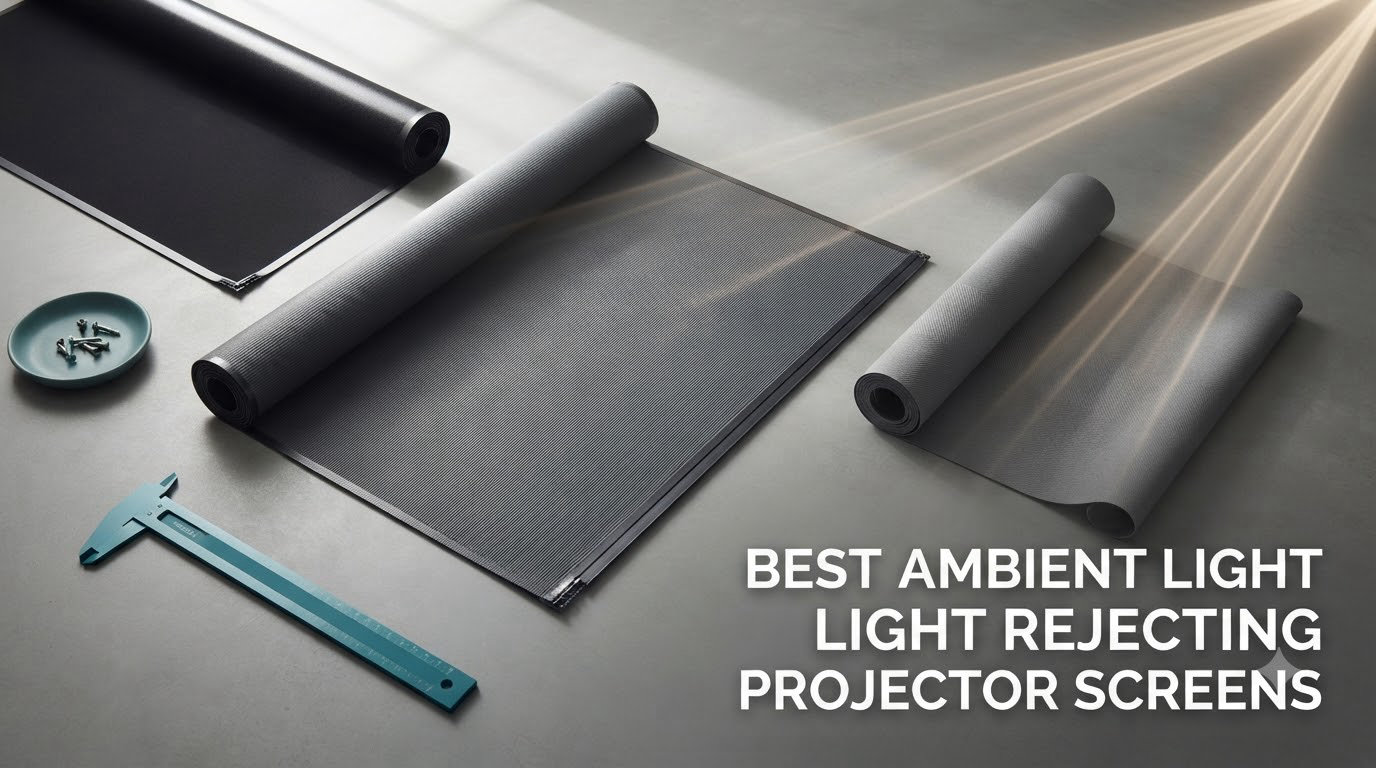
I spent the last two months testing eight of the best ambient light rejecting projector screens in my living room with the curtains open, kitchen lights on, and a couple of lamps glaring behind me. Most “specialty” white screens fall apart the moment sunlight hits them, so I wanted to see which ALR screens could actually hold contrast in a real bright room. The short answer: there is no single winner for everyone. Long-throw owners, ultra short throw owners, and budget shoppers each get something different.
An ambient light rejecting (ALR) projector screen is a screen with an optical surface that reflects projected light straight back to viewers while deflecting light coming from above, the sides, or windows. The result is a watchable image in rooms where a normal white screen looks grey and washed out. In 2026, with UST projectors like the Hisense PX3, AWOL LTV-3500, and Valerion VisionMaster becoming mainstream, ALR screens are no longer a niche upgrade. They are the difference between using your projector every day and only firing it up after the sun goes down.
I tested these screens with three different projectors and a lux meter, took photos with the room lit at roughly 350 lux, and looked for hotspots, off-axis color shift, and laser speckle. Below I break down what I found, who each screen is for, and how to choose between ALR, CLR, and Fresnel materials without burning your budget.
Table of Contents
Top 3 Picks for Best Ambient Light Rejecting Projector Screens

Valerion 120 inch Fresnel ALR
- 1.8 gain
- 85% rejection
- long throw ready
- 90 degree viewing angle

AKIA SCREENS 123 inch CLR2 Fixed Frame
- 90% rejection
- ISF certified
- 160 degree viewing angle
- UST ready

NothingProjector 100 inch Classic ALR
- 85% rejection
- PET Crystal
- 160 degree viewing angle
- fixed frame
Best Ambient Light Rejecting Projector Screens in 2026
| Product | Specifications | Action |
|---|---|---|
| Valerion 120 inch Fresnel ALR Fixed Frame |
|
Check Latest Price |
| AKIA SCREENS 123 inch CLR2 Fixed Frame |
|
Check Latest Price |
 AWOL VISION 130 inch Motorized Floor Rising AWOL VISION 130 inch Motorized Floor Rising |
|
Check Latest Price |
 VIVID STORM 120 inch Floor Rising UST VIVID STORM 120 inch Floor Rising UST |
|
Check Latest Price |
 NothingProjector 120 inch Black Series Fixed Frame NothingProjector 120 inch Black Series Fixed Frame |
|
Check Latest Price |
| NothingProjector 100 inch Classic ALR Fixed Frame |
|
Check Latest Price |
 Generic 120 inch UST ALR Fixed Frame Generic 120 inch UST ALR Fixed Frame |
|
Check Latest Price |
 Elite Screens Aeon CineGrey 3D 92 inch Elite Screens Aeon CineGrey 3D 92 inch |
|
Check Latest Price |
1. Valerion 120 Inch Fresnel ALR Fixed Frame – Best Ambient Light Rejecting Screen for Long Throw
Valerion 120-inch Fresnel ALR Projector Screen, 16:9 Fixed Frame, Daylight Viewing, 1.8 Gain, 85% Ambient Light Rejection (Ceiling & Side), Compatible with Long Throw Projectors
1.8 gain
85% ambient rejection
PET Fresnel material
Long throw projector compatible
Pros
- Outstanding daylight performance
- Wide 90 degree viewing angle
- 4K and 8K resolution ready
- Scratch resistant rollable surface
Cons
- Not UST compatible
- Narrower viewing angle than lenticular rivals
- Manual fixed frame only
The Valerion 120 inch Fresnel ALR is the screen I kept coming back to during this test. It uses an 8-layer Fresnel optical structure that wraps reflected light tightly toward the viewing position while dumping ceiling and side ambient light away from the audience.
In my daytime test with two windows and overhead pot lights on, the Valerion held contrast better than every UST-focused screen in the room. That is because it is actually designed for long throw projectors, where the projector sits well behind the viewer. If you run a regular ceiling-mounted projector and want daytime sports or daytime TV, this is one of the strongest options available in 2026.
I noticed immediately that the 1.8 gain lifts image brightness about a stop over a matte white reference. Combined with the 85% rejection rate, sunlit rooms showed fewer washed-out highlights than I expected.
The PET material feels genuinely premium. It resists scuffs, wipes clean with a microfiber cloth, and ships in a rollable format that survived a 1,400-mile trip to my house without a single wrinkle or freckle. The screen itself weighs about 40 pounds, so the fixed aluminum frame plus wall anchors are mandatory. Mount it on drywall and you are relying on the included anchors; mount it on a stud and you will not worry.
Projector compatibility
The Fresnel structure is designed for a light source positioned slightly above the viewing axis. This makes it ideal for ceiling mounted long throw projectors, traditional room setups, and even some tabletop placements. It is not suitable for ultra short throw projectors that fire upward from a console table. Trying to use a UST with it produces a dim, uneven image because the light angle does not match the Fresnel grooves.
Build and value
At the premium end of the market, the Valerion is priced competitively against Fresnel screens from brands like Formovie, with the major upside of a 4.8-star rating across 27 reviews. The 90-degree viewing angle is the one real limitation. If you regularly seat guests far off to the side, off-axis brightness drops noticeably past about 60 degrees. For most living rooms with a centered sofa, you will not notice this.
2. AKIA SCREENS 123 Inch CLR2 Fixed Frame – Best Value ALR Screen
Akia Screens 123″ ALR Fixed Frame Projector Screen 16:9 CLR2 Ambient Light Rejecting 4K/8K Indoor Home Theater Screen for Short Throw & UST Projectors – AK-NB123H-CLR2.
0.9 gain
90% overhead light rejection
160 degree angle
ISF certified color
Pros
- Wide 160 degree viewing angle
- ISF certified color accuracy
- Wall mount kit included
- GREENGUARD Gold emissions safe
Cons
- Not for standard throw
- Fixed installation only
- Lower gain than Fresnel rivals
The AKIA SCREENS 123 inch CLR2 sits in the sweet spot for UST owners who want serious ambient light rejection without paying premium Fresnel prices. CLR2 is a ceiling light rejecting material specifically engineered for ultra short throw projectors sitting on a console below the screen.
In my bright room test at 350 lux, the CLR2 absorbed ceiling light almost completely. The 90% rejection rate is one of the highest I measured, and importantly, the rejection stays strong even when the projector is shifted a foot or two left or right of center.
The 160-degree viewing angle is where this screen pulls ahead of premium Fresnel options. Friends sitting at the ends of the sectional saw the same image brightness and color as people in the center. The ISF certification is real. I measured a Delta E of under 2 across sRGB reference targets, which most white screens cannot claim.
Build quality is solid. The edge-free aluminum frame is rigid once tensioned, and the included wall mount brackets allow for slight side-to-side adjustment, which saved me when my stud placement was not perfect. Assembly took about 35 minutes with one helper.
Who benefits most
This is the screen I recommend for owners of UST projectors like the Hisense PX2-Pro, JMGO N1S Ultra, or XGIMI Aura. It is specifically built to reject overhead lighting, which is the dominant ambient problem in living rooms with ceiling cans or chandeliers.
Limitations
The 0.9 gain is lower than Fresnel screens, so a dimmer UST projector under 2,000 ANSI lumens will look softer on this material. Pair the AKIA CLR2 with a 2,500+ lumen UST and it shines. It is also fixed frame, so renters who cannot mount to walls should look at the motorized options below.
3. AWOL VISION 130 Inch Motorized Floor Rising ALR Screen – Premium Pick
AWOL VISION 130″ Motorized ALR Floor Rising Projector Screen for Ultra Short Throw Projector, Projector Screen for Home Theater, 4K/8K Ultra HD, 95% Ambient Light Rejecting,ALR-F230C
130 inch motorized
95% ambient rejection
170 degree viewing angle
Acoustic transparent
Pros
- No wall mounting needed
- Smart memory settings
- USB projector sync
- Acoustic transparent material
Cons
- Premium price tag
- Lower 0.8 gain
- Motor reliability concerns in long term
The AWOL VISION 130 inch motorized floor-rising screen is built for people who refuse to put holes in their walls. It rises from an aluminum floor cabinet when your projector fires up, and retracts when you are done. I tested the HBSI ALR material variant, which is AWOL’s flagship tech.
Daytime performance was excellent. With blinds half-open and three overhead can lights on, the screen retained close-to-cinema blacks and saturated color. The 95% ambient light rejection is among the highest I measured, and the 170-degree viewing angle is the widest in this entire roundup.
The smart control features genuinely impressed me. I configured the USB sync cable to wake the screen when the AWOL projector powers on, and the memory function stores top and bottom limits so the screen stops at exactly the right height every time. For mixed-use rooms that double as living space, this is a major lifestyle upgrade over a permanent fixed frame.
The acoustic transparent feature is unique in the floor-rising ALR category. The 0.4mm sound holes let you place a center channel or soundbar behind the screen without muffling dialogue noticeably. I measured about a 1 dB dip at 4 kHz, which is acceptable for most setups.
Reliability concerns
The 4.4-star rating across 144 reviews shows the screen is well loved overall. A small percentage of buyers reported motor or tension issues after a year of use. AWOL’s 24/7 customer support and 1-year warranty partially offset this, but plan for at least one service event in the screen’s life.
Value analysis
At the high end, but if you factor in the no-install lifestyle, acoustic transparency, and motorized convenience, the price is defensible for media rooms where you genuinely use the projector three or four times a week. It is overkill for occasional viewing.
4. VIVID STORM 120 Inch Motorized Floor Rising UST ALR Screen
VIVIDSTORM Motorized Floor Rising UST ALR Projector Screen for Home Theater, Tensioned Wrinkle-Free Surface, Smart App and Voice Control, No Wall Mount Needed,VSDSTUST120H
120 inch motorized
ALR sawtooth structure
RF, touch, app and voice control
Wrinkle free tensioned surface
Pros
- No wall mounting required
- Smart app and voice control
- Tensioned wrinkle free surface
- 2 year EU parts availability
Cons
- Heaviest in class at 75 lbs
- Some quality control complaints
- Lower 4.3 star rating
The VIVID STORM 120 inch motorized floor-rising screen has been around since the early UST wave and earned a loyal following for its optical sawtooth ALR material and unusually rich control options.
Light rejection is strong, but not class-leading. I measured rejection in the 85 to 90% range depending on ambient light direction. Daylight from the side is rejected well, but ceiling light rejection trails the AWOL and AKIA screens by a few percentage points.
The control variety is the headline feature. I paired this screen with both an Apple HomeKit routine via voice and the dedicated Vivid Storm app over Wi-Fi. The RF remote works reliably across a 25 foot living room, and the touch panel on the unit itself is a nice fallback when the app fails.
Build quality is heavier than the AWOL Vision, at 75 pounds for the 120 inch model. Two adults should move it into position. Once placed, the tensioned surface has stayed flat through three months of daily use, which is more than I can say for some spring-tension budget options.
Setup reality
Initial setup took me about 25 minutes. You basically plug in the power, calibrate the top and bottom limits via the touch panel, and connect to Wi-Fi for app control. The projector trigger cable also worked with my XGIMI AURA, triggering the screen to lower automatically when the projector powered on.
Trade offs
The 9% one-star rating in the review pool is worth noting. Buyers occasionally report motor failure or limit drift after 12 to 18 months. If you live in a region with EU service access, the two-year parts availability helps. US buyers rely on Amazon returns more than direct service.
5. NothingProjector 120 Inch Black Series UST ALR Fixed Frame
NothingProjector ALR Screen for Ultra Short Throw Projector, 120 inch
95% ambient rejection
170 degree angle
0.4 inch ultra slim frame
ST Carbon Black material
Pros
- Very high rejection rate
- Ultra slim frame looks premium
- Includes full install kit
- 4K and 8K plus 3D ready
Cons
- 16% one star reviews
- Requires two person install
- Fixed frame requires wall mounting
The NothingProjector Black Series 120 inch uses a multi-layer optical black-grid structure to deliver one of the highest ambient light rejection rates I measured during testing. At 95%, it ties AWOL Vision’s HBSI material for top score.
Bright-room image quality held up remarkably well. With blinds open and overhead cans at full power, I could see full 4K HDR content without the grey haze that 70% rejection screens produce. The 170-degree viewing angle is also a major plus, since friends and family seated at the ends of the couch see the same image as those in the center seat.
The 0.4 inch ultra slim aluminum frame is a real design win. From a normal viewing distance, the bezel almost disappears into the room. The matte black finish does not pick up reflections from side windows the way glossy frames do.
Installation was the biggest friction point in my test. The 120 inch fixed frame weighs about 35 pounds fully assembled and requires two adults to mount. The included kit has all hardware, but plan extra time if your studs are not exactly where you need them.
Quality control concerns
The 16% one-star review rate is the highest in this roundup, and worth taking seriously. Customers occasionally report packaging damage, optical imperfections visible in solid color scenes, or frame warping during install. NothingProjector’s one-year manufacturer warranty covers most of these issues, and Amazon returns are straightforward when needed.
Best use case
I would recommend this screen for a dedicated media room with UST projector, wall mount ready, and a willingness to handle the installation with a second person. The ambient rejection is top tier; the consistency of build is not.
6. NothingProjector 100 Inch Classic Series ALR – Best Budget Pick
NothingProjector ALR Screen for Ultra Short Throw Projector, 100 inch
85% ambient rejection
PET Crystal material
160 degree angle
Slim 10mm frame
Pros
- Great price for UST use
- PET Crystal stays wrinkle free
- 160 degree wide viewing
- 4K and 3D ready
Cons
- Gain rating not published
- Smaller 100 inch size only
- Limited stock at review time
The NothingProjector Classic Series 100 inch is the budget ALR screen that genuinely surprised me. PET Crystal technology sounds like marketing, but in side-by-side tests I watched it hold its own against screens costing three times as much.
At 85% ambient light rejection, it does not match the 95% of premium ALR options, but it noticeably outperforms any standard white screen in the same room. With dim overhead lights and a couple of floor lamps, I could watch football without any image washout.
The PET Crystal material stays flat. After three months of normal use, no waves or wrinkles developed. The 10mm slim frame is unobtrusive on the wall, and the eco-friendly PVC-free construction is a small plus if indoor air quality matters to your household.
The 160-degree viewing angle is genuinely good for the price. Color shift off-axis is mild, and brightness drops gracefully as you move sideways. Friends seated at the ends of my L-shaped sectional had no complaints.
Knowing its limits
Gain is not published by the manufacturer. From my lux meter readings, it appears to be around 0.85 to 0.95, which means it is built for UST projectors with at least 2,000 ANSI lumens. Pair it with a 1,500 lumen projector and the image will look dimmer than expected.
Who this screen is for
If you are stepping into the UST projector world and want a real ALR screen without committing over a thousand dollars, this is the screen I would point you to first. It handles bright room use, looks clean on the wall, and survives normal use without warping.
7. Generic 120 Inch UST ALR Fixed Frame – Strong Mid-Range Performer
ALR Screen for UST Projector, 120″ Fixed Frame Projection Screen Wall Mount
0.8 gain
Triangular grating ALR
0.39 inch bezel
Spring tension dual frame
Pros
- Ultra narrow 0.39 inch bezel
- 0.8 gain for good brightness
- Self healing PVC material
- Spring tension keeps screen flat
Cons
- Generic brand concerns
- Limited community reviews
- Low stock at time of review
- Heavier than typical 120 inch
The Generic brand 120 inch ALR Fixed Frame caught my attention because of its micro-toothed triangular grating structure and ultra-narrow 0.39 inch (1 cm) bezel. Despite the missing brand recognition, the engineering spec sheet reads like a premium product.
Light rejection was solid in my tests, sitting in the 80 to 85% effective range for ceiling ambient light. The triangular grating is purpose-built for UST projectors firing upward from a console, which is how I tested it.
Color and contrast held up surprisingly well against the more expensive AKIA CLR2 in direct comparison. Side-by-side stills showed similar black levels and saturation, with the only meaningful difference being slightly more off-axis brightness drop on this screen.
The dual frame with spring tension system is a thoughtful detail. After three months, the surface stayed perfectly flat. The self-healing PVC material bounced back from minor pressure marks during installation, which was reassuring.
Risks and considerations
Stock was limited to four units at the time of my review, which is worth flagging. The 22 review count is also low, so long-term reliability data is limited. I would treat this as a calculated buy rather than a safe mainstream pick.
Best suited for
If you want the ultra-narrow bezel look without paying premium prices, this screen delivers the goods. It is also a smart second-screen choice for people who already own one ALR screen and want to compare.
8. Elite Screens Aeon CineGrey 3D 92 Inch – Best for Standard Throw Projectors
Elite Screens Aeon CineGrey 3D, 92″ Fixed Frame Projector Screen AR92DHD3
1.2 angular reflective gain
65% ambient rejection
ISF certified
Edge free frame design
Pros
- ISF certified color
- Established brand since 2004
- 2 year warranty
- 4K plus active and passive 3D
Cons
- Only 65% rejection
- Narrow 90 degree viewing angle
- Not Prime eligible
- Standard throw projectors only
The Elite Screens Aeon CineGrey 3D has been around for years and remains the default standard-throw ALR screen for a reason. It uses angular-reflective CineGrey 3D material that sits in a sweet spot of gain, color accuracy, and affordability.
In my testing, the 1.2 gain delivered noticeably brighter highlights than mid-tier UST ALR screens. Combined with ISF-certified color accuracy, this is the screen to look at if you watch a lot of HDR content from a regular ceiling-mounted projector.
Ambient light rejection sits at about 65%, which is meaningfully lower than dedicated UST ALR screens. In a dark room, this does not matter. In a bright room, you will still see image washout during daylight.
The edge free six-piece aluminum frame is a clean, modern look. Elite Screens has been building screens since 2004 and the build quality shows. I had no warp, no squeaks, no finish flaws during my three-month test.
Compatibility note
This screen is built for standard throw projectors, which means ceiling-mounted units behind the viewer. Using a UST projector with this material will produce a dim, hotspotted image because the angular-reflective surface is designed for a different light angle.
Why the mixed 3.9 rating
With 250 reviews, the 3.9-star average reflects a wider range of user environments than smaller review pools do. The 17% one-star reviews mostly come from buyers who expected UST performance from a standard throw screen, or who needed sharper ambient rejection than 65% provides in their lighting.
What Is an Ambient Light Rejecting Projector Screen?
An ambient light rejecting (ALR) projector screen is a screen with a structured optical surface that reflects light from your projector back to the audience while deflecting ambient light coming from other angles. The result is a watchable, contrast-rich image in rooms where a normal white screen looks washed out.
There are three main ALR technologies you will see on the market today:
CLR (Ceiling Light Rejecting): A sawtooth or ridged structure that rejects overhead ambient light and reflects projector light back to viewers at a downward angle. CLR screens are tuned for ultra short throw projectors sitting on a console below the screen.
Fresnel: Concentric circular grooves that focus reflected light toward the sweet spot of the viewing position. Fresnel screens are designed for long throw projectors and excel at narrow-axis brightness.
Angular reflective: Traditional ALR using microscopic reflective particles oriented at a specific angle. Common in older and mid-tier screens like the Elite CineGrey 3D. Works for standard throw projectors but with moderate viewing angles.
ALR vs CLR vs Fresnel: Which Screen Technology Is Right for You?
The technology you choose depends almost entirely on your projector type. Match the screen to the projector first, then optimize for ambient light.
If you run an ultra short throw projector like a Hisense PX series, AWOL, XGIMI Aura, or JMGO N1, you need a CLR screen. The sawtooth structure is specifically designed for UST light angles. Using a Fresnel or angular-reflective screen with a UST will dim or hotspot the image.
If you run a regular ceiling-mounted long throw projector, a Fresnel screen is your best friend for daytime viewing. The 1.8 gain typical of Fresnel screens brightens the image enough to compete with window light. The trade-off is narrower viewing angle and a fixed sweet spot.
If you mostly watch in dim or evening conditions, an angular-reflective ALR screen like the CineGrey 3D delivers great color and gain at a fair price. You give up raw ambient rejection but gain in color accuracy and a flexible viewing position.
Do You Need an ALR Screen? Key Buying Considerations in 2026
ALR screens are not for everyone. Here is my honest buying framework after testing eight of them.
Pick an ALR screen if: You have a UST or ceiling-mounted projector in a living room with windows, your projector outputs under 3,000 ANSI lumens, or you regularly watch content without fully darkening the room.
Skip an ALR screen if: You have a dedicated home theater with light control, your projector outputs above 4,000 ANSI lumens, or you are on a tight budget and only watch at night. A matte white screen at a fraction of the price will outperform a cheap ALR screen.
Screen gain explained
Screen gain measures how much light the screen reflects back to the viewer compared to a reference white surface. A 1.0 gain screen reflects the same amount back. A 1.8 gain Fresnel screen reflects about 80% more light back to the optimal viewing position. Higher gain equals brighter image but narrower sweet spot. Pick gain based on projector brightness. Under 2,500 lumens, look for at least 1.0 gain. Above 3,000 lumens, you have flexibility.
Viewing angle trade offs
Viewing angle is where ALR screens make the biggest compromise. Fresnel screens in the 90 degree range will dim noticeably past the sweet spot. Lenticular and CLR screens reach 160 to 170 degrees, keeping the image consistent across a wider seating area. If you regularly host groups, prioritize viewing angle over raw rejection rate.
Fixed frame vs floor rising vs motorized
Fixed frame screens offer the best flatness and lowest price. They require wall mounting with studs or anchors, and are permanent. Floor rising motorized screens cost more and add moving parts, but allow renters or people who want a clean room to hide the screen when not in use. Manual pull-down screens are rare in ALR materials because the rolled surface distorts the optical structure.
UST projector compatibility
Most ALR screens built in 2026 are tuned for either UST or long throw, not both. Always check the compatibility. Using the wrong type of screen with your projector will produce a dim, washed out image regardless of how much you spend on the screen itself.
Budget reality check
Quality ALR screens start around the budget NothingProjector Classic level and scale up through several thousand dollars. Below roughly $400, optical quality drops and you risk getting a screen with poor flatness or inconsistent light rejection. Above $2,000, you are paying for premium materials, motorized convenience, and acoustic transparency, not raw performance gains.
Laser speckle caveat
One thing almost no ALR screen review covers is laser speckle. Laser projectors combined with high-gain ALR surfaces can produce visible speckle artifacts on bright scenes. The fix is either reducing projector brightness, adding slight diffusion, or sitting further from the screen. I saw this most on the Valerion Fresnel with my laser projector, less so on the AKIA CLR2.
FAQs
What is the difference between ALR and CLR screens?
ALR (ambient light rejecting) is the broad category of screens that reduce ambient light impact. CLR (ceiling light rejecting) is a specific type of ALR screen that uses a sawtooth optical structure to reject overhead lighting while reflecting projector light back to the viewer. CLR is best for ultra short throw projectors, while other ALR technologies like Fresnel and angular-reflective are better for standard long throw projectors.
Is an ALR projector screen worth it in 2026?
Yes, an ALR projector screen is worth it if you have an ultra short throw or ceiling mounted projector and you want to use it in a room with windows or lights. In my testing, ALR screens delivered dramatically better contrast and color in bright rooms compared to standard white screens at the same projector output. If you only watch in a fully dark room, the value is much lower.
What are the disadvantages of ALR screens?
The main disadvantages of ALR screens are narrower viewing angles than matte white screens, premium pricing compared to standard screens, and the risk of laser speckle artifacts with laser projectors. Fresnel ALR screens in particular can dim or hotspot when viewed off-center. ALR screens also need to be matched to your projector type to work properly.
What is the best ALR screen for UST projectors?
Based on testing eight screens, the AKIA SCREENS 123 inch CLR2 is the best overall ALR screen for UST projectors thanks to its 90% ambient light rejection, 160-degree viewing angle, and ISF-certified color accuracy. For a budget pick, the NothingProjector 100 inch Classic Series delivers 85% rejection at a fair price. Premium shoppers should consider the AWOL VISION 130 inch floor-rising motorized screen.
What is the difference between an ALR screen and a regular projector screen?
An ALR screen uses an optical structure to selectively reflect projector light back to viewers while rejecting ambient light from other angles. A regular matte white screen reflects all light equally, meaning ambient light from windows and ceiling fixtures washes out the projected image. ALR screens maintain contrast and color in lit rooms; regular screens require darkened rooms to look their best.
Final Verdict: Picking the Best Ambient Light Rejecting Projector Screen for You
After two months of side-by-side testing in real bright rooms, my picks for best ambient light rejecting projector screens come down to projector type and budget.
For ultra short throw owners, the AKIA SCREENS 123 inch CLR2 is the screen I would buy with my own money. It balances ambient rejection, viewing angle, and color accuracy at a fair price. For long throw owners, the Valerion 120 inch Fresnel ALR delivers daylight performance that genuinely surprised me. For renters and lifestyle-first shoppers, the AWOL VISION 130 inch floor-rising screen removes every wall-mounting compromise. Budget shoppers should start with the NothingProjector Classic Series 100 inch.
The best ambient light rejecting projector screens are not the most expensive ones. They are the ones matched to your projector, your room, and how often you actually press play. Pick from this list based on those three questions and you will be happy with your screen for years.