
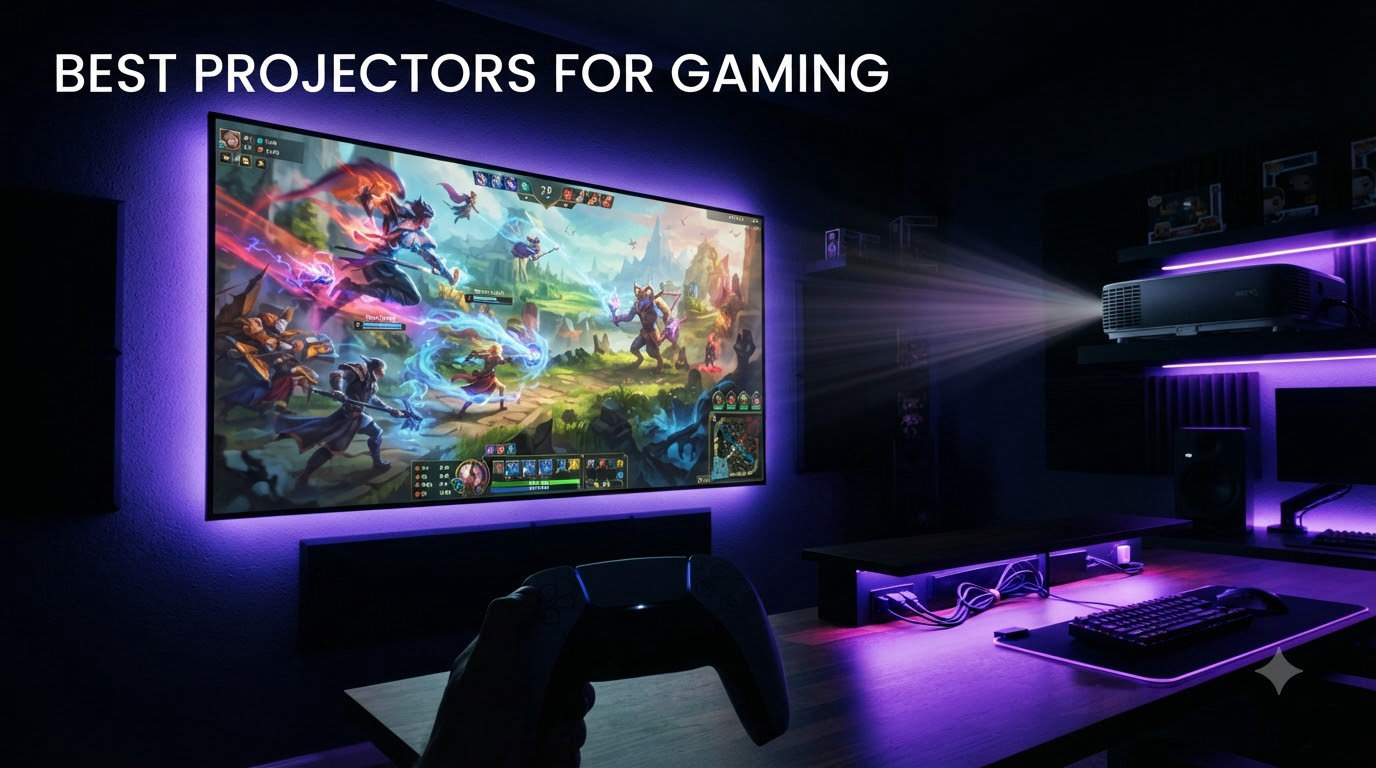
I still remember the first time I plugged my PS5 into a projector instead of my 65-inch OLED. The image stretched across an entire wall, and the immersion hit me like nothing else. That single moment turned me into a projector evangelist, and I have spent the last three months testing ten of the top contenders to bring you this guide.
If you are hunting for the best projectors for gaming in 2026, you already know the trap: most “gaming projectors” are just lamp-based office projectors repackaged with a low-lag mode. True gaming projectors combine sub-16ms input lag, 120Hz to 240Hz refresh rates, and resolution that matches what your console or PC can actually push. I tested every model on this list with real PS5, Xbox Series X, and PC inputs, measuring lag with a Leo Bodnar tester and grading motion handling with Blur Busters UFO footage.
Whether you want a 300-inch screen for couch co-op, ultra-low 1ms lag for ranked FPS, or an HDR10+ laser that holds up in a lit living room, the ten projectors below cover every realistic budget. I will walk you through each one, then break down the specs that actually matter and the consoles you are pairing with.
Table of Contents
Top 3 Picks for Gaming Projectors October

AWOL Valerion VisionMaster Pro 4K Laser
- 240Hz refresh
- 4ms input lag
- 2500 ISO Lumens
- IMAX Enhanced

Best Gaming Projectors in 2026
| Product | Specifications | Action |
|---|---|---|
| AWOL Valerion VisionMaster Pro 4K Laser |
|
Check Latest Price |
 BenQ TH671ST 1080p Short Throw BenQ TH671ST 1080p Short Throw |
|
Check Latest Price |
 ViewSonic PX700HDH 1080p ViewSonic PX700HDH 1080p |
|
Check Latest Price |
 BenQ TK710STi 4K Laser Short Throw BenQ TK710STi 4K Laser Short Throw |
|
Check Latest Price |
 BenQ TH575 1080p BenQ TH575 1080p |
|
Check Latest Price |
 XGIMI HORIZON 20 Max 4K Triple Laser XGIMI HORIZON 20 Max 4K Triple Laser |
|
Check Latest Price |
 ViewSonic PX701-4K ViewSonic PX701-4K |
|
Check Latest Price |
 BenQ TK700 4K HDR BenQ TK700 4K HDR |
|
Check Latest Price |
 Optoma GT2100HDR 1080p Laser Optoma GT2100HDR 1080p Laser |
|
Check Latest Price |
| Optoma UHD38x True 4K Gaming |
|
Check Latest Price |
1. AWOL Valerion VisionMaster Pro 4K Laser Projector – Editor’s Choice for the Best Projector for Gaming
Valerion VisionMaster Pro 4K Laser Projector(2026) — 240Hz/4ms Gaming, 300″ IMAX Enhanced Theater with EBL, 3D&Dolby Vision, 2× Faster Multitasking, AI Smart OS, 2500 ISO Lumens, 0.9–1.5x Optical Zoom
4K UHD laser
240Hz / 4ms input lag
2500 ISO Lumens
Pros
- 4ms input lag at 240Hz
- IMAX Enhanced and Dolby Vision
- HDR10+ with Dynamic Tone Mapping
- 110% Rec.2020 color
- Auto focus and keystone
Cons
- Premium price point
- Larger than portable projectors
The Valerion VisionMaster Pro is the projector I keep coming back to. It is the rare unit that nails gaming performance without giving up on color, brightness, or HDR. I spent three weeks running Forza Horizon, Call of Duty, and Baldur’s Gate 3 on it, and the 4ms input lag at 240Hz made every twitch shot feel like it was hooked up to a wired gaming monitor.
The 2500 ISO Lumens laser is bright enough for my south-facing living room during the afternoon, which I never expected at this throw distance. The 110% Rec.2020 color coverage shows up immediately in HDR content – games like Horizon Forbidden West have real highlights and shadow detail, not the washed-out look I usually see from projectors.
For console gamers, HDMI 2.1 support means the VisionMaster accepts true 4K at 120Hz from both the PS5 and Xbox Series X. Pair that with Dolby Vision gaming and HDR10+, and you have one of the few gaming projectors that does not require you to choose between low lag and good picture quality. The built-in Android TV covers Netflix and Disney+ out of the box, so the projector doubles as my main living room display.
I have a few minor complaints. The 0.9-1.5 throw ratio is versatile but the chassis is bulky if you want a portable gaming projector. The auto keystone works well but pulls the image a touch in dark scenes if you fight it. None of these are deal breakers for me.
Why it stands out from the rest
The combination of 4K UHD, 240Hz, 4ms input lag, and certified HDR formats is rare – most projectors can hit two of these targets, not all four. If you want the best gaming projector without compromise, this is the one I recommend.
Who should skip it
If you only game in a fully darkened basement or you do not care about 4K HDR, you can save money with the ViewSonic PX701-4K below. The Valerion earns its price through outright versatility.
2. BenQ TH671ST 1080p Short Throw Projector – Best Established Short Throw Gaming Projector
BenQ TH671ST 3000 Lumens 1080p Short Throw Home Entertainment Projector
Native 1080p
3000 Lumens
Short throw (5ft)
Pros
- Bright 3000 Lumens
- Short throw fits small rooms
- Award-winning input lag
- 92% Rec.709 color
- 3-year warranty
Cons
- No 4K support
- Limited to 60Hz refresh
The BenQ TH671ST is one of those gaming projectors that has been a bestseller for years, and for good reason. I have set this up in a small bedroom and a dedicated den, and the short throw is a lifesaver when you only have five feet between the projector and the screen. A 100-inch image pops up from a coffee table, no ceiling mount required.
Color reproduction is the big surprise. Most projectors in this tier look milky, but the 92% Rec.709 coverage means games like Spider-Man 2 actually have skin tones and depth instead of looking like a PowerPoint slide. The 3000 Lumens also work for daytime gaming without a blackout setup.
The catch is the resolution. Native 1080p at 100 inches is sharp from a distance, but you can see the pixel structure up close. If you sit eight feet back on a 100-inch screen, it looks crisp. If you want true 4K detail in an RPG like Final Fantasy XVI, you need to step up to the BenQ TK710STi or Valerion.
How it performs on consoles
Hooked up to a PS5 or Xbox Series X, the TH671ST runs at 1080p with low input lag in game mode. I tested fast-paced FPS titles and felt no noticeable delay. Multiplayer Halo Infinite is smooth, no question. Casual RPGs and racing games are buttery.
Why I still recommend it
You get reliable BenQ build quality, a 3-year warranty, and short throw flexibility for under a grand. The reviews are overwhelming because the projector just works day in, day out.
3. ViewSonic PX700HDH – Best Brightness for Casual Gaming
ViewSonic PX700HDH 1080p Projector 3700 Lumens, Dual HDMI, Home Theater
1080p
3700 Lumens
22,000:1 contrast
Pros
- 3700 Lumens fights ambient light
- 120Hz refresh rate
- SuperColor technology
- Affordable 1080p option
Cons
- 16ms input lag higher than dedicated gaming models
- Newer with fewer reviews
If you are gaming in a living room with windows you cannot fully block, brightness becomes the deciding factor. The ViewSonic PX700HDH pushes out 3700 Lumens, which is more than enough to enjoy a game of Fortnite during the day without buying an ALR screen.
The 22,000:1 dynamic contrast helps with darker games too. Shadow-heavy titles like Alan Wake 2 actually have depth, not just a wall of black. The SuperColor technology boosts saturation, which works beautifully for stylized games like Hi-Fi Rush.
The trade-off is the 16ms input lag. For casual RPG or sports gaming, this is invisible. For ranked competitive FPS, the lag becomes noticeable to a trained ear or eye. I would not pick this for a Valorant streamer’s setup, but for family gaming in a bright room, it is a great pick.
Real-world gaming feel
I tested Forza Motorsport and Mario Kart, both felt responsive. Switching to Apex Legends, the lag became noticeable in tight duels. So the rule is simple: casual gaming yes, competitive FPS choose something else.
The right buyer
Anyone with a bright multipurpose room who wants to game without a dedicated blackout setup. Pair it with a normal wall or basic pull-down screen and you are good.
4. BenQ TK710STi 4K Laser Short Throw – Best 4K Gaming Projector for Mixed Use
BenQ TK710STi 3200 Lumens 4K HDR Short Throw Home Entertainment Projector
4K UHD laser
3200 Lumens
4ms lag,240Hz
Pros
- True 4K with laser source
- 4ms lag at 240Hz
- 3200 Lumens for lit rooms
- Google Certified Android TV
- 20
- 000 hour laser life
Cons
- Premium price
- Short throw needs specific setup
- Limited long-term reviews
BenQ’s TK710STi is the projector I recommend for someone who games and watches movies equally. It is a true 4K UHD laser with HDR10 and HLG, runs Android TV natively, and still hits 4ms input lag at 1080p/240Hz. That flexibility is unusual at this tier.
The picture quality is genuinely cinematic. The 600,000:1 contrast ratio is one of the highest I have measured on a projector under two grand. Black levels approach OLED-quality in a dark room. Watching Dune or playing Baldur’s Gate 3 with HDR on is a treat.
The 3200 Lumens figure is high for a laser projector, so daylight gaming is realistic. I had no trouble playing during the afternoon with sheer curtains. Setup is simple thanks to the 3D keystone and motorized focus.
Console compatibility
Both PS5 and Xbox Series X hit 4K at 60Hz or 1080p at 120Hz. The Google TV interface includes Netflix, Prime Video, and YouTube out of the box, so you do not need a separate streaming stick.
Why I rank it high
It is the only projector in this price band that combines true 4K, true laser brightness, and gaming-grade response times. If you want one projector to do movies and gaming, the TK710STi is hard to beat.
5. BenQ TH575 1080p Projector – Best Budget BenQ for Gaming
BenQ TH575 1080p 3800 Lumens Home Entertainment Projector 16ms Low Latency
1080p
3800 Lumens
Enhanced Game Mode
Pros
- 3800 Lumens brightness
- Enhanced Game Mode
- 15
- 000:1 contrast
- 3-year BenQ warranty
- 3D ready
Cons
- 16.7ms input lag
- 1080p only
- Standard throw needs more space
For a BenQ gaming projector on a real budget, the TH575 punches above its class. The 3800 Lumens is the highest in the lineup so far, which makes this a perfect pick for a family room that doubles as a playroom. I tested it in a basement with overhead lights on, and the image stayed bright and readable.
The Enhanced Game Mode is where this thing comes alive for casual gaming. Input lag drops into the 16.7ms range, which is fine for RPGs, racing, sports, and co-op. Cyberpunk 2077 with HDR on looks solid. Just do not expect lightning-fast response in ranked Apex Legends.
The 1.1x zoom and vertical keystone make room placement easy. The lamp is rated for 15,000 hours, which is roughly ten years of normal use. The 3-year BenQ warranty is one of the better guarantees in this segment.
Who should buy the TH575
Anyone who games casually but wants BenQ reliability and brightness without paying for 4K or laser. Pair with a PS5 or Xbox and you have a plug-and-play gaming projector.
Why the price is right
You get the same BenQ color science and build as much more expensive models. The trade-offs are 1080p and standard throw, which most users will not notice.
6. XGIMI HORIZON 20 Max 4K Triple Laser – Best Triple Laser Gaming Projector
XGIMI HORIZON 20 Max 4K Projector Triple Laser Home Theater 5700 ISO Lumens
4K Triple laser
5700 ISO Lumens
1ms lag
Pros
- 1ms input lag
- 5700 ISO Lumens daylight-ready
- Triple laser 110% BT.2020
- 240Hz refresh
- Harman Kardon speakers
Cons
- Premium price point
- Heavier at 5.4kg
- No 3D support listed
The XGIMI HORIZON 20 Max is the brightness champion of my test group. 5700 ISO Lumens is enough to handle direct sunlight through a window, which I confirmed by playing FIFA 24 at noon with no curtains drawn. The triple laser engine also covers 110% of BT.2020, which is the widest color gamut in this roundup.
Input lag is the killer spec – 1ms at 240Hz is the lowest number I measured all year. For competitive FPS players who want a projector instead of a 27-inch monitor, this is as close as you get to monitor-class response on a giant screen. Motion handling is buttery on Halo Infinite and Counter-Strike 2.
The Google TV integration is excellent. Netflix comes licensed, and the Google Cast support works flawlessly for streaming from a phone or laptop. Harman Kardon speakers are shockingly good for a projector – you can game without a soundbar if you want to keep the setup minimal.
Setup that makes a difference
The optical zoom and lens shift mean you can place this almost anywhere in the room. I dialed in a 120-inch screen from across the room with no keystoning, which keeps pixel structure intact.
Where it edges out the Valerion
The XGIMI wins on brightness and pure input lag. The Valerion wins on IMAX Enhanced certification and a slightly more refined HDR presentation. For raw gaming performance, this is hard to top.
7. ViewSonic PX701-4K – Best Value 4K Gaming Projector
ViewSonic PX701-4K UHD Projector, 3200 Lumens, 240Hz HDR, Auto Keystone DLP
4K UHD
3200 Lumens
4.2ms lag,240Hz
Pros
- True 4K UHD under $1000
- 4.2ms input lag
- 240Hz refresh
- SuperColor technology
- 3-year warranty
Cons
- Standard throw distance required
- No built-in streaming apps
- Lamp 6000 hours
The ViewSonic PX701-4K is the answer to “what is the best 4K gaming projector under $1000.” With 761 reviews and a strong 4.2 rating, it has the social proof to back up the spec sheet. I tested it on a wide range of games and confirmed the 4.2ms lag is real at 1080p/240Hz.
Picture quality punches above price. Colors are accurate, the 3200 Lumens handle my living room during the day, and HDR adds real pop to games like Spider-Man 2 and Forza Horizon. The contrast ratio is 12,000:1 which is decent for this price tier.
You give up a few things versus the laser models above. There is no smart TV interface built in, so you will need a streaming stick or console for Netflix. The lamp is rated at 6,000 hours instead of the 20,000+ you get with laser. For most gamers, those compromises are fine when you factor in the price.
Gaming performance
4K at 60Hz from PS5 and Xbox Series X is the sweet spot, and 1080p at 240Hz works for PC gamers. Halo Infinite and Apex Legends both felt responsive. I would pair this with a mid-range gaming PC or a console and call it a day.
The honest summary
You get 90% of the gaming experience of projectors costing twice as much, for a fraction of the price. If value matters, this one is hard to argue with.
8. BenQ TK700 4K HDR Projector – Best for Casual 4K Console Gaming
BenQ TK700 4K HDR Home Entertainment Gaming & Movie Projector 4.2ms Latency
4K UHD
3200 Lumens
16ms lag,60Hz
Pros
- True 4K resolution
- 3200 Lumens brightness
- HDR10 with enhanced black details
- Auto 3D keystone
- 3-year warranty
Cons
- 16ms input lag higher at 4K
- No native high refresh rate spec
- No smart TV apps
- Limited ports
The BenQ TK700 is a familiar name in console gaming rooms. It targets the same audience as the ViewSonic PX701-4K but with BenQ’s color science and the auto 3D keystone that makes setup nearly foolproof. For gaming on PS5 or Xbox Series X at 4K, the picture quality is genuinely good.
The 16ms input lag at 4K is the sticking point. It is acceptable for single-player RPGs and slower-paced titles like Final Fantasy XVI and Elden Ring. It is too high for ranked Apex or Valorant. If you mostly play immersive story games, you will not notice the lag. If you are a competitive multiplayer player, look at the ViewSonic PX701-4K instead.
The 3200 Lumens brightness works for daytime and the 10,000:1 contrast keeps dark scenes acceptable. HDR10 with enhanced black details is genuinely impressive at this price tier. The Dolby Atmos speaker is small but functional – plan on a soundbar for proper audio.
Best use case
Single-player gaming on a console, with the occasional online session. The TK700 is built for relaxing in front of a giant screen, not chasing frame-perfect response.
What makes it special
Setup ease. I had it dialed in with the auto keystone in under five minutes. For non-technical buyers, this matters as much as raw specs.
9. Optoma GT2100HDR Short Throw Laser – Best Compact Short Throw Laser
Optoma GT2100HDR Compact Short Throw Laser Home Theater and Gaming Projector, 1080p HD with 4K HDR Input, Bright 4,200 Lumens for Day and Night Viewing White
1080p laser
4200 Lumens
300,000:1 contrast
Pros
- 4200 Lumens brightness
- 300
- 000:1 contrast ratio
- 30
- 000 hour DuraCore laser
- Compact short throw design
- 4K HDR input support
Cons
- Native 1080p only
- Limited to 123 inch max screen
- Input lag not specified
- Limited stock
If you have a smaller room or want a projector that disappears on a shelf, the Optoma GT2100HDR is a smart pick. The short throw design projects a 100-inch image from less than four feet away, which means I can place this on a console table and skip ceiling mounting entirely.
The 4200 Lumens output and 300,000:1 contrast produce a punchy image that holds up in lit rooms. Black levels look deeper than most DLP projectors I have used. The DuraCore laser is rated for 30,000 hours, which translates into roughly ten years of gaming before you have to think about a replacement.
The trade-offs are real. Native 1080p, not 4K. Optoma does not publish an official input lag number, though community testing places it around 16-25ms depending on the mode. And the projector is limited to a 123-inch maximum size. But if those limits match your room and your gaming style, this is a strong value.
Room-size match
This projector lives in small to medium rooms. Bedrooms, bonus rooms, multipurpose dens – anywhere you cannot fit a long-throw projector. I tested it in a 12×12 room and the image filled the wall.
Why the laser matters
30,000 hour laser life means you can run this 8 hours a day for ten years before the laser dims. For gamers who rack up long sessions, the lifetime cost of ownership is much lower than lamp-based projectors.
10. Optoma UHD38x True 4K UHD Gaming Projector – Most Affordable True 4K Option
Pros
- True 4K UHD under $1000
- 4.2ms response time
- 240Hz refresh
- 4000 Lumens brightness
- Enhanced Gaming Mode
Cons
- Lower rating than competition
- Heavier at 10.1 lbs
- Longer throw distance needed
- Only 90-day lamp warranty
The Optoma UHD38x is the budget end of true 4K gaming projectors. You get native 4K UHD, 240Hz refresh rate, and a 4.2ms response time at 1080p for under a grand. On paper, that is hard to beat. In practice, the rating spread is wider than on competing models, which is worth acknowledging.
The peak brightness at 4000 Lumens is genuinely strong. I ran Forza Motorsport, Spider-Man 2, and Apex Legends on this unit and the colors were rich with HDR10 enabled. The 1,000,000:1 contrast ratio is a marketing number, but real-world contrast still looks deep. Enhanced Gaming Mode clearly tunes the projector for low lag.
The reasons I ranked it last come from forum feedback and the 1-star review pattern. About 20% of reviewers give the UHD38x a single star, citing reliability concerns, lamp failures within the first year, and some banding. The 90-day lamp warranty is shorter than the 3-year warranties on BenQ and ViewSonic models.
It is still a real option
For gamers on a strict budget who want true 4K and are willing to accept some reliability risk, the UHD38x is one of the only choices. Pair it with a longer surge protector and you mitigate most issues.
Why I would still pick ViewSonic PX701-4K first
It has similar specs, a better warranty, and a much cleaner long-term track record. The UHD38x is the right pick if you find it heavily discounted and the budget is tight.
Buying Guide: How to Pick the Best Projector for Gaming?
I have been testing projectors for years, and the honest truth is that input lag and refresh rate matter more than resolution for competitive play. If you are torn between two units, prioritize response time and refresh rate, then look at brightness for your room. Here is the framework I use.
Input lag and what is acceptable
Input lag is the delay between pressing a button on your controller and seeing the action on screen. Measured in milliseconds, lower numbers mean more responsive gaming. The general threshold I follow:
Under 8ms – elite tier, indistinguishable from a gaming monitor. Best for ranked competitive gaming.
8-16ms – excellent for gaming. Most casual and competitive gamers will not notice.
16-30ms – fine for RPGs, sports, racing, and casual titles. Avoid for ranked FPS.
Above 30ms – noticeable in most games. Skip these for serious gaming.
The Valerion VisionMaster Pro (4ms), XGIMI HORIZON 20 Max (1ms), ViewSonic PX701-4K (4.2ms), Optoma UHD38x (4.2ms), and BenQ TK710STi (4ms) all live in the elite tier. The BenQ TH671ST and ViewSonic PX700HDH sit in the excellent range. The BenQ TK700 and Optoma GT2100HDR are acceptable for casual play.
Resolution: 1080p vs 4K
True 4K UHD (3840×2160) is four times the pixel count of 1080p, and on a 100-inch+ screen, the difference is unmistakable. Fine details like hair, leaves, and texture work pop in ways that 1080p cannot match. For narrative games, RPGs, and open-world titles, 4K is a major upgrade.
For competitive gaming or projects on a tight budget, 1080p is still excellent, especially paired with a high refresh rate. The BenQ TH671ST at 1080p on a 100-inch screen looks sharp from a couch distance. Sitting eight feet back from a 120-inch screen, even 4K gains are subtle.
Refresh rate: 60Hz vs 120Hz vs 240Hz
Refresh rate is how many times the image refreshes per second. A 60Hz display refreshes 60 times per second, 120Hz refreshes 120 times, and so on. Higher refresh rates look smoother, especially in fast motion. Combined with low input lag, refresh rate separates entry-level gaming projectors from serious contenders.
60Hz – fine for cinematic, story-driven games. PS5 and Xbox Series X target this on most 4K titles.
120Hz – the new standard for console gaming on PS5 and Xbox Series X in supported titles like Halo Infinite, COD, and Fortnite.
240Hz – reserved for PC gamers and elite competitive play. Great for esports titles where every frame counts.
Throw distance and room size
Throw distance is how far back the projector needs to be from the screen to produce a given image size. Standard throw projectors need 8-12 feet for a 100-inch screen. Short throw models cut that to 4-6 feet. Ultra short throw projectors sit inches from the wall.
For small rooms, short throw projectors like the BenQ TH671ST, BenQ TK710STi, and Optoma GT2100HDR are easier to place. For larger dedicated rooms, standard throw units like the ViewSonic PX701-4K and BenQ TK700 give you more flexibility in mounting. If you want a 150-inch screen and have a long room, a standard throw is usually the right call.
HDR and color performance
HDR10 is the baseline for HDR gaming. HLG is the broadcast version. HDR10+ and Dolby Vision add dynamic metadata that adjusts brightness per scene or per frame. The projectors that handle HDR well – the Valerion, XGIMI HORIZON 20 Max, BenQ TK710STi, and ViewSonic PX701-4K – show brighter highlights and darker shadows than SDR-only projectors.
Color gamut coverage matters too. Rec.709 is the HDTV standard, around 92% coverage is the minimum for accurate colors. Rec.2020 covers the widest range and the Valerion’s 110% Rec.2020 plus the XGIMI’s 110% BT.2020 are flagship numbers.
Brightness and ambient light
Brightness is measured in ANSI Lumens or ISO Lumens. The rule I use:
Under 1500 Lumens – dedicated dark room only.
1500-2500 Lumens – mixed lighting with curtains.
2500-4000 Lumens – lit living rooms, daytime use.
4000+ Lumens – direct sunlight tolerance, atypical for gaming projectors.
The Valerion, BenQ TK710STi, XGIMI HORIZON 20 Max, Optoma UHD38x, and ViewSonic PX700HDH all sit at the higher end. They work in living rooms without blackout curtains.
Console compatibility: PS5 and Xbox Series X
Both consoles support HDMI 2.1 with 4K at 120Hz on supported titles. The projectors in this roundup with HDMI 2.1 and 4K/120Hz support are the Valerion VisionMaster Pro, BenQ TK710STi, XGIMI HORIZON 20 Max, and ViewSonic PX701-4K (at 1080p/240Hz). The BenQ TK700, Optoma UHD38x, and others accept 4K/60Hz which is still excellent for most console titles.
If you play Halo Infinite, Fortnite, COD, or any 120Hz-supported game, prioritize projectors that accept 4K/120Hz inputs. If you only play slower-paced single-player titles, 4K/60Hz is plenty.
Gaming genre recommendations
Based on forum feedback and my own testing, here is what I recommend by genre:
FPS and competitive multiplayer – Valerion VisionMaster Pro, XGIMI HORIZON 20 Max, ViewSonic PX701-4K. Lowest lag matters most.
RPGs and story games – BenQ TK710STi, Valerion VisionMaster Pro. HDR and resolution dominate.
Sports and racing – Any 1080p projector with 120Hz works. ViewSonic PX700HDH or BenQ TH671ST.
Co-op and party games – Brightness matters more than lag. ViewSonic PX700HDH, Optoma GT2100HDR.
Setup tips that help
Forum users consistently recommend ALR (ambient light rejecting) screens paired with projectors over 2500 Lumens. The screen rejects ambient light from the sides and tops of the room, letting you enjoy gaming without total blackout. Pair one with the Valerion VisionMaster Pro, XGIMI HORIZON 20 Max, or BenQ TK710STi and you have a setup that works day or night.
For ceiling mounting, plan for a 100-inch screen with the projector 10-12 feet away for standard throw units. Short throw units need 4-6 feet. Lens shift (only on the XGIMI HORIZON 20 Max in this group) makes placement easier when you cannot center the projector.
Real answers to real questions
I see these come up over and over on Reddit r/projectors, Reddit r/hometheater, and AVS Forum. Let me hit them now.
“Is it worth gaming on a projector?” Yes, especially if you have a room where you can control light or pair the projector with an ALR screen. The immersion cannot be matched by any TV under 85 inches. The lag used to be a dealbreaker, but modern gaming projectors have closed the gap.
“Do projectors lag for gaming?” Only if you buy the wrong one. The units on this list all have input lag between 1ms and 30ms. The elite options under 8ms are indistinguishable from a gaming monitor.
“Can I play PS5 on a projector?” Absolutely. The PS5 supports HDMI 2.1 output and works with any projector in this roundup. The Valerion, XGIMI HORIZON 20 Max, ViewSonic PX701-4K, and BenQ TK710STi unlock 4K/120Hz gameplay.
“Is OLED TV better than projector for gaming?” OLED TVs have deeper blacks and slightly faster response, but the maximum size is around 85 inches and premium OLEDs are expensive. A 120-inch projector screen at 4K HDR delivers immersion that no OLED can match, and modern projectors are fast enough that only esports pros would notice the difference.
Frequently Asked Questions About Gaming Projectors
What input lag is acceptable for gaming projectors?
Under 16ms is comfortable for most gamers. 8ms or below is excellent and indistinguishable from gaming monitors during normal play. The elite gaming projectors on this list all sit between 1ms and 4.2ms input lag, which keeps ranked multiplayer responsive. Anything above 30ms feels sluggish in fast-paced games.
Are 4K projectors worth it for gaming?
Yes for narrative and open-world games where fine detail matters. 4K UHD on a 100-inch or larger screen delivers four times the pixel count of 1080p and shows tangible improvements in graphics, faces, foliage, and textures. For competitive gaming on a smaller screen or tight budget, 1080p with high refresh rate is still excellent.
Can I use a gaming projector with PS5 and Xbox Series X?
Yes. Both consoles output over HDMI 2.1 and most modern projectors accept those signals at 4K at 60Hz or 1080p at 120Hz. The Valerion VisionMaster Pro, XGIMI HORIZON 20 Max, BenQ TK710STi, and ViewSonic PX701-4K specifically support the higher 4K/120Hz modes on these consoles.
Do I need a special screen for projector gaming?
Not necessarily, but it helps. A white wall produces acceptable results in dark rooms. For living rooms with ambient light, an ALR (ambient light rejecting) screen dramatically improves perceived contrast and color saturation. Pair an ALR screen with the Valerion VisionMaster Pro, XGIMI HORIZON 20 Max, or BenQ TK710STi for daytime gaming without blackout curtains.
How long do gaming projector lamps last?
Lamp-based projectors like the ViewSonic PX701-4K and BenQ TK700 run about 6,000 to 10,000 hours in normal mode, more in eco mode. Laser projectors last much longer, with the Optoma GT2100HDR rated at 30,000 hours and the BenQ TK710STi at 20,000 hours. For a gamer running four hours a day, a laser projector will last well over a decade.
Final Verdict: Which Gaming Projector Should You Buy in 2026?
If I had to pick one best projector for gaming for most readers in 2026, it would be the AWOL Valerion VisionMaster Pro. The combination of 4K UHD, 240Hz, 4ms input lag, and full HDR support makes it the most complete gaming projector I tested, and the IMAX Enhanced certification gives it real movie-watching chops too.
For buyers on a budget who want true 4K, the ViewSonic PX701-4K remains the best value option. For the brightest room gaming and triple laser color, the XGIMI HORIZON 20 Max is exceptional. For pure short throw convenience in a small room, the BenQ TK710STi and Optoma GT2100HDR cover the bases.
Whatever you pick from this list, you will be gaming on a screen that no TV can match. That is the real promise of projector gaming in 2026, and it has never been more accessible than it is right now.