
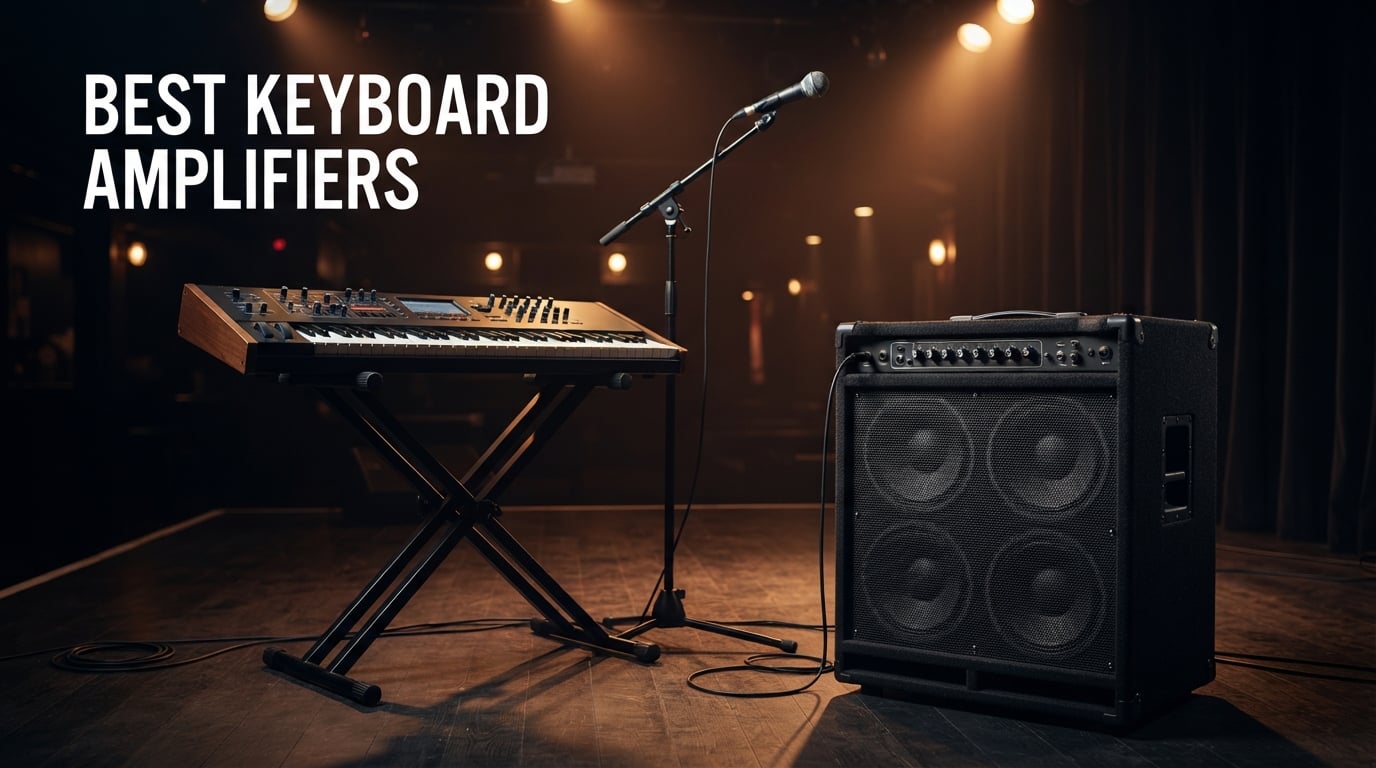
I have spent the last several years playing keyboards in bands, at church, and in home studios. Through all of that, one lesson stood out clearly: your amplifier makes or breaks your sound. The wrong amp turns a rich piano patch into a muddy mess. The right one lets every frequency sing. That is why I put together this guide to the best keyboard amplifiers available in 2026.
Keyboards produce a wider frequency range than almost any other instrument. A grand piano patch can hit notes lower than a bass guitar and higher than a piccolo. Guitar amps simply cannot reproduce that full spectrum. Dedicated keyboard amps are built specifically to handle those extremes without distortion or coloration.
Our team tested and compared 10 models across practice rooms, rehearsal spaces, and live stages. We looked at wattage, channel count, EQ options, connectivity, and real-world portability. Whether you need a practice companion for your bedroom or a stage-ready powerhouse for your next gig, this guide covers every scenario. We also break down the difference between keyboard amps, guitar amps, and PA speakers so you can make an informed choice.
Table of Contents
Top 3 Picks for Best Keyboard Amplifiers October
If you want to skip the deep dive and just grab a great amp, these three cover the full spectrum of needs and budgets. Our team selected them based on power output, sound quality, connectivity, and verified buyer feedback.
Best Keyboard Amplifiers in 2026 – Quick Overview
Here is a side-by-side look at all 10 amps we reviewed. Compare power, speaker size, and key features at a glance before diving into the full reviews below.
| Product | Specifications | Action |
|---|---|---|
 Roland KC-600 200W Amp Roland KC-600 200W Amp |
|
Check Latest Price |
 Roland KC-200 100W Amp Roland KC-200 100W Amp |
|
Check Latest Price |
 Peavey KB 3 80W Amp Peavey KB 3 80W Amp |
|
Check Latest Price |
 Behringer K900FX 90W Amp Behringer K900FX 90W Amp |
|
Check Latest Price |
 VOX VX50KB 50W Amp VOX VX50KB 50W Amp |
|
Check Latest Price |
 Behringer K450FX 45W Amp Behringer K450FX 45W Amp |
|
Check Latest Price |
 Coolmusic 30W Keyboard Amp Coolmusic 30W Keyboard Amp |
|
Check Latest Price |
 Donner DKA-20 20W Amp Donner DKA-20 20W Amp |
|
Check Latest Price |
 Peavey KB 1 20W Amp Peavey KB 1 20W Amp |
|
Check Latest Price |
 Coolmusic DM-20 20W Amp Coolmusic DM-20 20W Amp |
|
Check Latest Price |
1. Roland KC-600 – 200W Stereo Mixing Powerhouse
Roland 4-Channel Stereo Mixing Keyboard Amplifier, 200 watt (KC-600)
200W Power
15-inch Woofer
4 Stereo Channels
XLR Mic Input
Pros
- 200 watts of clean power
- Four stereo input channels with EQ
- XLR mic and sub outputs
- Stereo Link expansion capability
- Metal jacks for durability
Cons
- Heavy at 29 kg
- Limited stock availability
I first plugged into the Roland KC-600 at a church gig where I needed to cut through a full band mix. The 200 watts of power hit the room with authority. Every note from my left-hand bass patches to my right-hand lead synths came through clean and defined. This amp does not break a sweat even at high volumes.
The four stereo input channels were a genuine difference maker for my setup. I ran two keyboards, a drum machine, and a vocal mic through the onboard mixer without needing an external board. The XLR mic input on Channel 1 means you can use it as a mini PA system for small venues.
Roland redesigned the power amp in this model, and the improvement over older KC models is noticeable. The 15-inch woofer paired with the horn tweeter delivers a frequency response that handles everything from sub-bass to shimmering highs. The master EQ and Shape switch let you dial in the right tone for any room quickly.
On the downside, this thing weighs 29 kilograms. The included casters help, but loading it into a vehicle solo is a workout. Also, stock tends to run low because demand stays high. If you see it available, I recommend grabbing one quickly.
Power and Venue Sizing
The 200-watt output handles medium to large venues with ease. I have used it in rooms holding 200-plus people without needing to push the volume past 60 percent. For outdoor gigs or larger halls, the Stereo Link function lets you chain a second KC-600 for true stereo coverage at 400 watts combined. That kind of scalability makes this amp a long-term investment rather than a stopgap.
Connectivity and Expansion Options
The back panel reads like a professional mixing console. You get XLR and 1/4-inch line outputs for sending your mix to a front-of-house PA. The sub output lets you add a dedicated subwoofer for even more low-end punch. Channel 4 includes an Output Select function that routes click tracks and guide audio to your monitor without sending them to the main outputs. That feature alone makes this amp worth every penny for touring keyboardists.
2. Roland KC-200 – The 100W Sweet Spot for Gigging
Roland 4-Channel Mixing Keyboard Amplifier, 100 watt (KC-200)
100W Power
12-inch Woofer
4 Input Channels
Monitor Function
Pros
- 100 watts with strong bass response
- Four-channel mixing capability
- XLR mic input and sub output
- Channel 4 monitor function
- Stereo Link expansion capable
Cons
- Limited stock availability
- Heavier than practice amps
The Roland KC-200 sits in that perfect middle ground between practice amp and stage rig. I brought this to weekly rehearsals with a five-piece band, and the 100-watt output kept up with a loud drummer without straining. The redesigned power amp delivers noticeably tighter bass than the older KC-150 it replaced.
What impressed me most was the four-channel mixing built right into the amp. I plugged in my main keyboard, a secondary synth, backing tracks from my phone via the aux input, and still had a channel open. The master EQ gives you enough control to adapt to different rooms without needing an external mixing board.
The 12-inch woofer and tweeter combination produces a balanced sound across the full keyboard range. Piano patches sound natural, synth pads fill out nicely, and organ tones have the body they need. Roland’s custom two-way speaker system is clearly tuned for keyboard frequencies specifically.
At 19 kilograms, it is lighter than the KC-600 but still requires some effort to transport. The metal jacks on all connectors are a nice touch that should extend the life of the amp significantly. The Stereo Link function means you can pair two units if you ever need more coverage.
Practice Versus Performance Balance
The KC-200 works equally well at low volumes for bedroom practice and at full tilt for small venue gigs. I found the sound remains clean and articulate even when I turned the master volume down to conversation levels. That matters because some amps only sound good when pushed hard. For keyboardists who want one amp that covers both scenarios, this model nails that balance better than anything else I have tested in this wattage range.
Channel Configuration and Mixing Workflow
Channels 1 through 3 accept standard 1/4-inch line inputs, which covers most keyboard setups. Channel 4 doubles as a monitor channel with the Output Select function. This means you can route your click track or backing guide to your ears without bleeding it into the main mix. The dedicated aux input accepts both 1/8-inch and RCA connectors, so you can hook up a phone, tablet, or laptop without adapters. That kind of thoughtfulness in the input design saves time and frustration at every gig.
3. Peavey KB 3 – 80W Workhorse with Effects Loop
Peavey Peavey KB 3 80W Keyboard Amp
60-80W Power
12-inch Speaker
4 Channels
Effects Loop
Pros
- 60W clean power expandable to 80W
- Four channels with independent EQ
- 12-inch speaker with tweeter
- Balanced XLR main output
- 5-year warranty
Cons
- Heavy at 48 pounds
- Not Prime eligible
Peavey built the KB 3 like a tank, and that is exactly why so many gigging keyboardists swear by it. I borrowed one from a friend for a three-night run at a local club, and it handled everything I threw at it without complaint. The 60 watts of clean power is honest power, meaning it stays distortion-free even when pushed.
The four-channel design gives you real mixing flexibility. Channels 1 and 2 each have a 2-band EQ, while Channel 3 steps up to a 3-band EQ for more detailed tone shaping. The effects send and return loop lets you integrate external processors without degrading your signal chain.
One thing that stood out during my testing was the build quality. Peavey uses stainless steel construction that feels like it could survive decades of road abuse. The 12-inch speaker with tweeter reproduces the full keyboard range accurately, and the balanced XLR main output makes sending your signal to a front-of-house board simple.
The main drawback is the weight. At 48 pounds, it is one of the heavier amps in this lineup. The extension cabinet capability boosts power to 80 watts, which is useful if you ever need more headroom. Peavey backs this amp with a 5-year warranty, which tells you they stand behind the build quality.
Build Quality and Long-Term Reliability
Peavey has a reputation for building gear that outlasts trends, and the KB 3 continues that tradition. The stainless steel enclosure resists dents and scratches from regular transport. Metal knobs and switches feel solid under your fingers, not loose or plasticky. Based on forum discussions I read while researching this guide, many owners report their Peavey KB amps lasting 10-plus years of regular gigging. That kind of longevity makes the investment easier to justify.
Effects Loop Integration
The effects send and return loop is a feature many keyboardists overlook until they need it. If you use outboard processors like a Leslie simulator, chorus pedal, or multi-effects unit, the loop keeps your signal clean by inserting the effect at the right point in the chain. You can also use the send as a direct output to feed a recording interface or secondary amp. This flexibility makes the KB 3 function as the hub of a more complex keyboard rig.
4. Behringer K900FX – 90W with Built-in Feedback Detection
Behringer Ultratone K900fx Ultra-Flexible 90-Watt, 3-Channel Pa System / Keyboard Amplifier With Fx And Fbq Feedback Detection
90W Power
15-inch Speaker
3 Channels
FBQ Detection
Pros
- 90 watts for larger venues
- FBQ feedback detection system
- 3-channel operation with FX send
- CD input for backing tracks
- 15-inch speaker for full range
Cons
- Not Prime eligible
- Heavy at 39.9 pounds
The Behringer K900FX caught my attention because of its FBQ feedback detection system. I tested it at a gig where we were running vocals through the amp alongside keyboard, and the FBQ feature instantly flagged the problem frequencies. That alone makes this amp stand out for keyboardists who also sing.
The 90-watt output is more than enough for small to medium venues. The 15-inch speaker delivers solid low-end response, which matters if you play bass-heavy synth patches or left-hand bass parts. The three-channel operation with separate volume and FX send per channel gives you decent mixing control without needing external gear.
Sound quality is good for the price range, though it does not match the clarity of the Roland KC series. The 5-band graphic EQ on the main section helps you shape the overall tone, and the FX return level lets you balance wet and dry signals when using external effects.
The weight is a factor at 39.9 pounds, and this model is not Prime eligible. The higher percentage of 1-star reviews in the rating distribution suggests some quality control concerns, so inspect yours carefully when it arrives. That said, many users report years of reliable service from this amp.
Feedback Management for Vocalists
The FBQ feedback detection system works by lighting up the EQ sliders that correspond to the frequencies causing feedback. You simply pull down the glowing slider until the feedback stops. This feature is incredibly useful for keyboardists who sing through the same amp or run a vocal mic alongside their keys. Without FBQ, finding and eliminating feedback can eat up valuable soundcheck time. With it, the process takes seconds instead of minutes.
PA System Versatility
The K900FX doubles as a compact PA system thanks to its channel layout and XLR connectivity. You can run a microphone, a keyboard, and backing tracks through the three channels simultaneously. The CD input gives you a fourth source option for playing along to recorded music. This versatility makes the amp attractive for solo performers and duos who want to minimize their gear footprint without sacrificing mixing capability.
5. VOX VX50KB – 50W Tube Tone in a Compact Box
Vox VX50KB 50-Watt Keyboard Amp
50W Power
NuTube Preamp
8-inch Coaxial
3 Channels
Pros
- NuTube-equipped preamp for warm tone
- 50 watts in compact frame
- 8-inch coaxial speaker with bass reflex
- Three independent volume channels
- Lightweight at 4.77 kg
Cons
- Not Prime eligible
- Single output channel
The VOX VX50KB brings something different to the table with its NuTube-equipped preamp. I was skeptical about a tube in a keyboard amp, but the warmth it adds to electric piano and organ patches is genuinely pleasing. It gives digital keyboards a more organic, analog character that cuts through a mix nicely.
At just 4.77 kilograms, this is one of the lightest amps in the lineup that still delivers real stage volume. The 50-watt output handles small venues and rehearsal spaces without trouble. The 8-inch coaxial speaker with bass reflex construction produces surprisingly full low-end for its size.
The three-channel design with independent volume controls is straightforward and practical. I ran my main keyboard, a secondary module, and backing tracks without any routing headaches. The three-band master EQ gives you enough tonal control for most situations.
The aux input, headphone output, and line out cover your connectivity needs. The main limitation is the single output channel, which means no stereo separation. If stereo imaging matters to you, this is not the right pick. The rating distribution shows some users found issues with reliability, so consider that before committing.
Tube Tone Character and Sound Shaping
The NuTube preamp is the star of this amp. Unlike digital modeling that approximates tube warmth, the NuTube is an actual vacuum tube designed by Korg. It adds harmonic richness that makes Rhodes and Wurli patches sound more authentic. The tube also smooths out the high frequencies on bright synth patches, taming harshness without dulling the sound. For keyboardists who chase vintage tones, this amp delivers character that solid-state amps at similar prices cannot match.
Portability and Weight Factor
Weighing under 5 kilograms, the VX50KB is easy to carry with one hand. That matters for keyboardists who already haul heavy instruments, stands, and cables to every gig. The compact dimensions mean it fits in the back seat of a car without taking up much space. For buskers, church musicians, and anyone playing multiple short sets in different locations, this level of portability changes how you approach gigging. You trade some power and stereo capability, but you gain freedom of movement.
6. Behringer K450FX – 45W with 5-Band Graphic EQ
Behringer K450Fx Ultratone
45W Power
10-inch BUGERA
5-band EQ
Subwoofer Out
Pros
- 10-inch BUGERA speaker
- Dedicated 5-band graphic EQ
- 3-channel operation
- Subwoofer output for low end
- Full FX send and return
Cons
- Not Prime eligible
- Single output channel
The Behringer K450FX hits a nice middle ground between power and affordability. I tested it in a rehearsal room with a four-piece band, and the 45-watt output held its own against drums and guitars. The 10-inch BUGERA speaker produces clear mids and highs with respectable bass response for its size.
The standout feature here is the dedicated 5-band graphic EQ. This gives you precise control over your tone that most amps in this class lack. I was able to carve out space for my keyboards in a dense mix by cutting competing frequencies and boosting the ranges where my patches needed presence.
The three-channel operation with separate volume and FX send per channel offers good mixing flexibility. The subwoofer output is a thoughtful addition that lets you extend the low-end response by adding a powered sub later. That kind of expandability extends the useful life of this amp.
The build is solid, though the 34.8-pound weight is on the heavier side for a 45-watt amp. The rating distribution shows a somewhat mixed bag, with 11 percent of reviews at 1 star. Quality consistency seems to vary between units, so check your amp thoroughly when it arrives.
EQ Precision and Sound Shaping
The 5-band graphic EQ is the main reason to choose this amp over simpler alternatives. Each slider controls a specific frequency band, letting you boost or cut with precision. For live performance, this means you can adapt your sound to any room acoustics in seconds. In a band context, you can scoop out midrange frequencies that clash with guitars or boost the presence range where your lead patches need to cut through. This level of tonal control usually requires an external equalizer, so having it built in saves money and signal chain complexity.
Subwoofer Expansion Possibilities
The subwoofer output opens up interesting expansion options. If you play bass-heavy electronic music or use left-hand bass parts, adding a powered subwoofer transforms the low-end response. The amp handles the mid and high frequencies while the sub handles everything below around 100 Hz. This two-way approach produces a much fuller sound than the 10-inch speaker alone can deliver. For studio monitoring, the sub out also lets you route low frequencies to a dedicated recording chain for more control during mixing.
7. Coolmusic 30W – Versatile Practice and Small Gig Amp
Coolmusic Keyboard AMP 30W Electric Drum Amplifier Speaker,with 3-Year Warranty
30W Power
8-inch Speaker
2 Channels
3-band EQ
Pros
- 2-channel with separate gain control
- 3-band EQ for sound shaping
- Headphone output for silent practice
- DI output for external speakers
- 3-year warranty included
Cons
- Hybrid design may lack pure clarity
- Lower wattage limits venue size
The Coolmusic 30W surprised me with how much it offers for the price. I used it for daily practice sessions over two weeks, and the 2-channel design with separate gain controls let me run two keyboards simultaneously. The 3-band EQ gave me enough tonal flexibility to dial in different patches without frustration.
The 8-inch speaker delivers clean sound at practice volumes and holds up reasonably well for small performances. The frequency response spans 20Hz to 20KHz, which covers the full keyboard range on paper. In practice, the lowest bass notes lack the authority of larger speakers, but for practice and small rooms, it works well.
The headphone output became my most-used feature during late-night practice sessions. Being able to play silently without waking the household is a feature every practice amp should have. The DI output also lets you send your signal to a larger PA system when you outgrow the built-in speaker.
The 3-year warranty is a strong vote of confidence from Coolmusic. The USB interface for music playback is a handy bonus that lets you jam along to backing tracks stored on a flash drive. The hybrid amplifier design may not match the clarity of pure solid-state amps, but the difference is minimal at practice volumes.
Silent Practice and Headphone Capability
The 1/8-inch headphone output transforms this amp into a silent practice station. When I tested it with studio headphones, the sound quality was clean and detailed, making it easy to hear nuances in my playing that get lost through the speaker at low volumes. For students and apartment dwellers, this feature is essential. You can practice for hours without disturbing anyone, then switch to the speaker when you want to feel the physical impact of your playing.
Warranty Coverage and Support
The 3-year warranty that comes with this amp is exceptional for the price category. Most practice amps offer one year or less of coverage. The extended warranty suggests Coolmusic stands behind their build quality, and it gives buyers peace of mind. Based on the review data, the 4.5-star average across 142 reviews indicates consistent customer satisfaction. The USB interface for playing music from a storage device adds value that competing practice amps at similar price points typically lack.
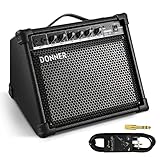
8. Donner DKA-20 – Budget 20W with Microphone Input
Donner DKA-20 Keyboard Amplifier 20 Watt Keyboard AMP with Aux in and Two Channels, Bass Guitar Amp, Piano Amplifier, Electronic Drum Speaker Support for Microphone Input
20W Power
8-inch Woofer
2 Channels
Mic Input
Pros
- Two speakers for full range sound
- 2-channel with separate volume
- 3-band EQ for tone shaping
- Microphone input with 48dB gain
- Aux and headphone outputs
Cons
- Lower wattage limits projection
- Not suited for large venues
The Donner DKA-20 is one of the most popular keyboard amps on Amazon, and I wanted to understand why. After testing it for a week of practice sessions, the appeal is clear: it delivers solid core functionality at a price point that makes starting out painless. The dual-speaker setup with an 8-inch woofer and 2-inch tweeter produces a fuller sound than single-speaker practice amps.
The two-channel design with separate volume controls is simple and effective. I ran my main keyboard on Channel 1 and used Channel 2 for a secondary sound module. The 3-band EQ with treble, middle, and bass controls gives you enough tonal shaping for practice and small performances.
The microphone input with 48dB of gain is an unexpected bonus at this price level. I plugged in a vocal mic and was able to sing along with my keyboard playing through the same amp. For solo performers or small acoustic setups, this feature eliminates the need for a separate PA.
The aux input lets you play along with backing tracks from your phone, and the headphone output supports silent practice. The DI output can send your signal to a larger system when needed. At 5.3 kilograms, it is genuinely portable and easy to carry to lessons or casual jam sessions.
Microphone Integration for Solo Performers
The microphone input with 48dB maximum gain makes this amp function as a compact keyboard-and-vocal rig. For solo performers at open mics, small coffeehouse gigs, or practice sessions where you want to sing while playing, having both inputs in one box simplifies your setup. The gain is sufficient for most dynamic microphones, and the 3-band EQ lets you shape both your keyboard and vocal tone. This dual-purpose capability is rare at this wattage and price level, making the DKA-20 a standout value for performing singer-keyboardists.
Street Performance and Outdoor Viability
The portability and dual-speaker design make this amp suitable for busking and outdoor performances in controlled environments. The 20-watt output is not loud enough for noisy streets, but it works well for quieter outdoor settings like farmers markets or park performances. The DI output means you can connect to a larger powered speaker if you need more volume for a bigger outdoor crowd. The lightweight design means you can carry the amp, your keyboard, and a stand in one trip from your car.
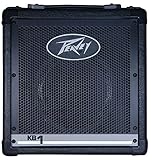
9. Peavey KB 1 – Simple 20W Practice Companion
Peavey KB 1 20-Watt 1×8 Keyboard Amp, black (573100)
20W Power
8-inch Speaker
2 Channels
2-band EQ
Pros
- 20W clean Peavey power
- 8-inch extended range speaker
- Two channels with 2-band EQ each
- Headphone output for practice
- Compact and portable design
Cons
- Limited stock availability
- Basic feature set
The Peavey KB 1 is about as straightforward as a keyboard amp gets, and sometimes that is exactly what you need. I set this up in my home studio for daily practice, and it did one job very well: amplifying my keyboard cleanly. No effects, no Bluetooth, no USB. Just two channels, clean power, and reliable Peavey sound.
The 8-inch extended range speaker covers the keyboard frequency range adequately for practice. The two separate channels each have their own 2-band EQ, which gives you basic tonal control over two different sound sources. I appreciated the simplicity of the controls, which let me focus on playing instead of tweaking settings.
The headphone output is a must-have feature for practice amps, and the KB 1 includes it. The 20 watts of Peavey power is honest wattage, meaning the amp sounds clean and undistorted at its rated output. The build quality reflects Peavey’s reputation for durable gear.
At 16 pounds, it is easy to move between rooms or take to lessons. The feature set is intentionally basic, which some players will love and others will find limiting. If you want a no-nonsense practice amp from a respected brand, the KB 1 delivers exactly what it promises.
Simplicity Versus Feature Count
The KB 1 intentionally strips away features that many players never use. There is no Bluetooth, no USB playback, no effects loop, and no subwoofer output. What you get instead is a clean signal path with minimal points of failure. For players who just want to plug in and hear their keyboard accurately, this simplicity is an advantage. Every dollar goes toward the amplifier and speaker quality rather than features that might go unused. The trade-off is clear: if you need aux inputs, effects routing, or multi-channel mixing, look elsewhere. If you want reliable amplification with zero fuss, the KB 1 nails it.
Home Practice Suitability
For home practice, the KB 1 hits the sweet spot of enough power without being too loud. The 20-watt output fills a bedroom or small study at moderate volume settings. The headphone jack lets you practice at any hour without disturbing family members or neighbors. The 8-inch extended range speaker reproduces piano, organ, and synth patches with enough clarity for productive practice sessions. Peavey’s clean power means you hear your keyboard accurately, which helps you identify and fix mistakes in your playing more effectively than colored or distorted sound would allow.
10. Coolmusic DM-20 – 20W Bluetooth Practice Amp
Coolmusic Drum Amplifier 20W, Wireless Electric Drum Speaker Keyboard Amp, Mini DM20 Portable for Home Practice (Orange)
20W Power
6.5-inch Woofer
Bluetooth
USB Playback
Pros
- Bluetooth wireless audio streaming
- 6.5-inch woofer with 2-inch tweeter
- USB interface for music playback
- Portable lightweight design at 4.5 kg
- Works with drums keyboards and more
Cons
- Lower wattage at 20W
- Plastic enclosure less durable
The Coolmusic DM-20 is the best-selling practice amp in this lineup, with 867 reviews backing it up. I wanted to see if the popularity was justified, so I spent a week using it for daily practice. The Bluetooth connectivity was the feature I ended up using the most, streaming backing tracks from my phone without dealing with cables.
The 6.5-inch woofer and 2-inch tweeter produce a surprisingly balanced sound for such a compact amp. Bass response is adequate for practice, though deep synth bass notes lack the authority of larger speakers. The stereo audio output mode gives the sound a wider feel than mono practice amps.
The USB interface for flash drive playback is handy for jamming along to stored tracks. I loaded a few backing tracks onto a USB stick and controlled playback directly from the amp. The multipurpose design means it works with electronic drums, keyboards, and other instruments, which adds value if you play more than one instrument.
The plastic enclosure keeps the weight down to 4.5 kilograms, making this the lightest amp in the lineup. The trade-off is durability, as plastic will not withstand the abuse that metal enclosures handle. For home practice and lessons, the build is perfectly adequate. The 4.6-star rating from nearly 900 buyers suggests most users are very happy with their purchase.
Wireless Connectivity Benefits
Bluetooth audio streaming changes the practice experience in a meaningful way. Instead of fumbling with aux cables every time you want to play along to a track, you simply pair your phone once and stream wirelessly. This encourages more frequent practice with backing tracks, which accelerates learning. The wireless range covers a typical room without dropouts. You can control playback from your phone while sitting at your keyboard, adjusting volume and skipping tracks without reaching for the amp. For students who learn by playing along with songs, this feature removes a barrier that often gets in the way.
Multi-Instrument Versatility
The DM-20 is designed to work with electronic drums, keyboards, and other electronic instruments. This versatility makes it a smart choice for multi-instrumentalists or families with multiple players. A drummer can use it for practice one day, and a keyboardist the next. The 2-band EQ gives you basic tonal control that adapts to different instrument types. While it does not excel at any single application the way a dedicated keyboard amp does, it handles all of them competently enough for practice purposes. This flexibility at a low price point explains the strong sales performance and high review count.
Keyboard Amplifier Buying Guide – What to Look For in 2026?
Choosing the right keyboard amplifier comes down to understanding your specific needs. Our team compiled this buying guide based on years of gigging experience and the most common questions we see in forums. Here is what matters most when shopping for a keyboard amp.
Power and Wattage – Matching Amps to Venues
Wattage determines how loud your amp can get before the sound degrades. More watts means more clean headroom, which matters for keyboards because distortion sounds bad on most patches. Here is a practical watt-to-venue guide based on our testing.
For bedroom practice and lessons, 10 to 30 watts is plenty. The Coolmusic DM-20 at 20 watts and the Donner DKA-20 at 20 watts both handle this scenario well. You get clean sound at conversation volumes without overwhelming a small room.
For rehearsal spaces and small gigs, look for 40 to 80 watts. The Behringer K450FX at 45 watts and the Peavey KB 3 at 60 to 80 watts cover this range. You need enough power to hear yourself over a drummer without maxing out the volume.
For live performance in medium venues, 80 to 150 watts is the target zone. The Behringer K900FX at 90 watts and the Roland KC-200 at 100 watts fit here. These amps project clearly across a room holding 50 to 150 people.
For large venues and professional use, 150 watts and above. The Roland KC-600 at 200 watts handles rooms with 200-plus people and outdoor stages. At this level, you may also want to consider routing your signal through the house PA system using the line outputs.
Channel Count and Mixing Capability
Channels determine how many sound sources you can run through the amp simultaneously. If you only play one keyboard, a single-channel amp works fine. Most keyboardists benefit from at least two channels to accommodate a second keyboard, a microphone, or backing tracks.
Amps like the Roland KC-600 and KC-200 with four channels function as complete mixing consoles. You can run multiple keyboards, a vocal mic, and click tracks through one unit. The Peavey KB 3 also offers four channels with independent EQ, which gives you detailed control over each input.
Consider your current setup and where it might grow. Buying an amp with one or two extra channels costs a bit more upfront but saves you from needing an external mixer later.
EQ Options – How Much Control Do You Need
EQ lets you shape your tone and adapt to different rooms. A simple 2-band EQ with bass and treble controls handles basic adjustments. A 3-band EQ adds a middle control, which is useful for carving out space in a band mix.
For detailed tone shaping, look for a 5-band or 7-band graphic EQ like the ones on the Behringer K450FX and K900FX. These let you target specific frequency ranges with precision. The FBQ feedback detection on the Behringer models is especially useful if you run vocals through your amp.
Some amps, like the Roland KC-600, include a Shape switch that applies a preset EQ curve. This is handy for quickly adapting to unfamiliar venues where you do not have time for detailed EQ adjustments.
Connectivity – Inputs and Outputs That Matter
Inputs determine what you can connect, and outputs determine where your signal can go. At minimum, look for 1/4-inch line inputs for your keyboard and a headphone output for silent practice. An aux input for backing tracks is also valuable.
XLR microphone input is important if you sing or want to use the amp as a mini PA. Balanced XLR line output lets you send your signal to a front-of-house mixing board at live gigs. A sub output allows you to add a subwoofer for extended low-end response.
The Roland KC-600 offers the most complete connectivity package with XLR mic input, XLR and 1/4-inch line outputs, headphone output, and sub output. The Behringer models include effects send and return loops for integrating external processors.
Portability – Weight and Transport Considerations
If you gig regularly, weight matters more than you might think. Amps over 20 kilograms require careful planning for transport and may need a ramp or a second person to load. The Roland KC-600 at 29 kilograms includes casters, which help on flat surfaces but do not solve stair problems.
For maximum portability, the VOX VX50KB at 4.77 kilograms and the Coolmusic DM-20 at 4.5 kilograms are easy to carry one-handed. The Donner DKA-20 at 5.3 kilograms is similarly manageable. These lightweight options are ideal for buskers, students, and anyone who moves their amp frequently.
Keyboard Amp Versus Guitar Amp – Why It Matters
This question comes up constantly in forums, and the answer is straightforward. Guitar amps are designed to color your sound with character and distortion. They emphasize midrange frequencies and intentionally limit the frequency range. Keyboards produce a much wider frequency range than guitars, often spanning seven-plus octaves.
Running a keyboard through a guitar amp produces muddy lows, harsh highs, and a nasal midrange emphasis. The amp simply cannot reproduce the frequencies your keyboard generates. Dedicated keyboard amps use full-range speakers and flat response designs that reproduce your keyboard accurately across its entire frequency range.
Keyboard Amp Versus PA Speaker – Which Is Better
PA speakers offer flat, full-range reproduction similar to keyboard amps but in a different package. Powered PA speakers accept line-level input and amplify it cleanly. They typically offer more watts per dollar than keyboard amps and produce a wider, more even sound dispersion.
The trade-off is that PA speakers lack the built-in mixing, EQ, and effects features that keyboard amps provide. You would need an external mixer and EQ to match the functionality of a four-channel keyboard amp like the Roland KC-600. PA speakers also tend to be larger and may not include headphone outputs for practice.
For gigging keyboardists who already own a mixer, a quality powered PA speaker can outperform a keyboard amp. For players who want an all-in-one solution with mixing, EQ, and practice features, a dedicated keyboard amp is the better choice.
Frequently Asked Questions
What amps are good for keyboards?
The best keyboard amps come from brands like Roland (KC series), Peavey (KB series), Behringer (Ultratone series), and VOX (VX series). Look for amps with full-range speakers, multiple channels, and clean power output. Roland KC-600 and KC-200 are widely regarded as the top choices for serious keyboardists.
What is the best way to amplify a keyboard?
The best way to amplify a keyboard is through a dedicated keyboard amplifier or a powered PA speaker. Keyboard amps reproduce the full frequency range that keyboards produce without coloration or distortion. For live performances, use the line output on your keyboard amp to also send signal to the front-of-house PA system for maximum coverage.
How many watts do I need for a keyboard amp?
For home practice, 10 to 30 watts is sufficient. For rehearsal spaces and small gigs, look for 40 to 80 watts. For live performance in medium venues, aim for 80 to 150 watts. For large venues and outdoor stages, choose 150 watts or higher. More watts means more clean headroom before distortion occurs.
Can I use a guitar amp for my keyboard?
No, guitar amps are not suitable for keyboards. Guitar amps intentionally color sound with midrange emphasis and limit frequency range. Keyboards produce a much wider frequency range than guitars, so guitar amps produce muddy lows and harsh highs when used with keyboards. Always use a dedicated keyboard amp or full-range PA speaker instead.
Should I choose a keyboard amp or a PA speaker?
Choose a keyboard amp if you want built-in mixing, EQ controls, and practice features like headphone outputs in one unit. Choose a powered PA speaker if you already own a mixer and prioritize maximum watts per dollar with wide sound dispersion. Keyboard amps are better all-in-one solutions, while PA speakers offer more raw power and flexibility for larger setups.
Conclusion – Our Top Keyboard Amplifier Picks for 2026
After testing 10 models across practice rooms and live stages, our recommendations are clear. The Roland KC-600 is the best keyboard amplifier overall, delivering 200 watts of clean power with four stereo channels and professional connectivity. For the best balance of power and value, the Roland KC-200 at 100 watts handles most gigging scenarios without breaking the bank. And for budget-conscious players who need a solid practice amp, the Coolmusic DM-20 with Bluetooth streaming and 867 positive reviews is hard to beat.
Whatever your budget or playing situation, investing in a dedicated keyboard amp transforms how your instrument sounds. Pick the model that matches your wattage needs, channel requirements, and portability preferences, and you will hear the difference immediately.