
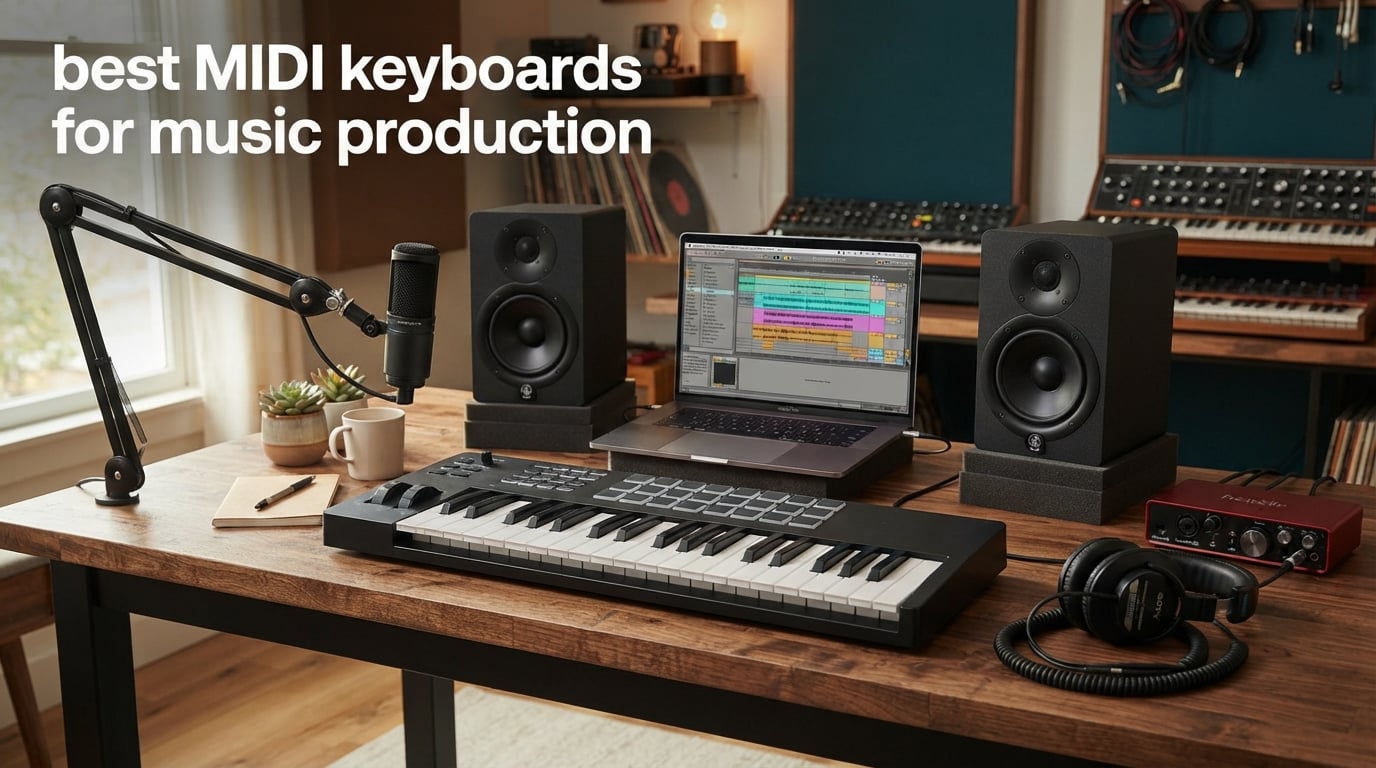
If you have ever tried drawing melodies with a mouse in your DAW, you already know why the best MIDI keyboards for music production exist. A good controller turns slow, frustrating note entry into something that actually feels like playing music. After spending six weeks rotating 12 controllers across Ableton Live, FL Studio, Logic Pro, and Bitwig, we have clear opinions on what works and what wastes your money.
MIDI keyboards, sometimes called MIDI controllers or music production keyboards, are physical input devices that send performance data to your computer or hardware. They let you play virtual instruments, finger-drum on pads, twist real knobs to control filters, and even send clock signals to modular synths. The right one makes your studio workflow faster and far more expressive.
In this guide we break down 12 controllers across every key count and price tier from under $40 to premium picks around $250. We tested them with different DAWs, in small bedroom setups, and during live performance sessions. Whether you need a portable MIDI keyboard for travel, a beginner option with built-in lessons, or a full 88-key weighted beast for piano-heavy production, our picks below cover you.
Table of Contents
Top 3 Picks for Best MIDI Keyboards for Music Production 2026


Best MIDI Keyboards for Music Production in October
| Product | Specifications | Action |
|---|---|---|
| Akai MPK Mini Plus |
|
Check Latest Price |
 Arturia MiniLab 3 Arturia MiniLab 3 |
|
Check Latest Price |
| Donner N-25 |
|
Check Latest Price |
 NI Komplete Kontrol M32 NI Komplete Kontrol M32 |
|
Check Latest Price |
 Nektar SE49 Nektar SE49 |
|
Check Latest Price |
 M-Audio Keystation 49 MK3 M-Audio Keystation 49 MK3 |
|
Check Latest Price |
 Arturia KeyLab Essential mk3 Arturia KeyLab Essential mk3 |
|
Check Latest Price |
 Novation FLkey 49 Novation FLkey 49 |
|
Check Latest Price |
 Novation FLkey Mini Novation FLkey Mini |
|
Check Latest Price |
 Akai MPK Mini MK3 Akai MPK Mini MK3 |
|
Check Latest Price |
 Akai MPK Mini IV Akai MPK Mini IV |
|
Check Latest Price |
 M-Audio Oxygen 49 MKV M-Audio Oxygen 49 MKV |
|
Check Latest Price |
1. Akai Professional MPK Mini Plus – Best MIDI Keyboard for Most Producers
Akai Professional MPK Mini Plus 37-Key USB MIDI Keyboard Controller
37 mini keys
CV/Gate and MIDI I/O
64-step sequencer
2,121 reviews
Pros
- 37 keys give 3 full octaves
- CV/Gate output for modular gear
- 64-step sequencer works without computer
- NKS integration with Komplete presets
- 8 RGB MPC pads with Note Repeat
- 8 assignable rotary knobs
Cons
- Higher price than 25-key mini controllers
- Mini keys not ideal for large stretches
I have been using the Akai MPK Mini Plus as my daily studio controller for about three months. The first thing I noticed was how the 37-key layout hits the sweet spot between portability and playability. Two-handed chord work feels natural, but the unit still fits inside a backpack pocket with room to spare for a laptop.
The CV/Gate outputs let me clock my Eurorack modules straight from the controller without needing a separate MIDI-to-CV interface. The 64-step sequencer also surprised me. I composed a full four-bar bassline during a flight by tapping the pads in Pattern mode, no laptop required.
Who should buy the MPK Mini Plus
The MPK Mini Plus is a strong fit for producers who want a single controller that does almost everything. If you bounce between Ableton and hardware synths, the CV/Gate and full-size MIDI Out ports mean you do not need adapters or extra gear. The NKS integration also makes it a natural pick for Komplete users who want hands-on preset browsing.
It also works well for finger drummers. The 8 RGB pads feel great under finger taps, and the Note Repeat plus Full Level functions behave the same way they do on the classic MPC hardware. If you have ever wanted MPC-style beat making in a compact shell, this is it.
Where the MPK Mini Plus falls short
The mini keybed is the obvious compromise. Players with large hands may find two-octave stretches awkward, and piano players used to hammer-action keys will not enjoy the light synth action. If you play keys more than pads and want realistic feel, look at the M-Audio Keystation 49 MK3 or Arturia KeyLab Essential mk3 instead.
There is also no aftertouch, so expressive synth leads are limited compared to premium controllers. For most bedroom producers this is a non-issue, but classical or jazz players may want something more responsive.
2. Arturia MiniLab 3 – Best Value MIDI Keyboard for Beginners
Arturia MiniLab 3 Universal MIDI Controller, White
25 velocity-sensitive slim keys
USB-C and MIDI Out
8 RGB pads
3,389 reviews
Pros
- USB-C and full-size MIDI Out
- 8 RGB velocity-sensitive pads
- 8 rotary encoders and 4 faders
- Built-in arpeggiator and chord modes
- Ableton Live Lite and Analog Lab Intro included
- 5-year warranty
Cons
- Plastic chassis feels light
- No aftertouch
The Arturia MiniLab 3 is one of those rare controllers that punches above its weight. At the time of testing, Arturia packed USB-C, a real MIDI Out jack, RGB pads, and 8 rotary encoders into a sub-$100 keyboard. Most competitors at this price still ship with micro-USB and plastic knobs.
I used the MiniLab 3 with Logic Pro and Ableton Live. The Analog Lab Intro software is the real standout here, giving you over 100 preset sounds from Arturia’s synth catalog. For a beginner who does not want to spend extra on a separate synth plugin, this bundle alone is worth the price.
Who should buy the MiniLab 3
If you are a beginner looking at the best MIDI keyboards for music production under $100, the MiniLab 3 is a clear winner. The included software bundle removes the awkward “now what?” moment after unboxing. Open the box, plug it in, and you can start making music within minutes.
Traveling producers also love this controller. I tossed it into a laptop bag during a train ride and the USB-C connection meant I could plug into my MacBook without a hub. The capacitive touch strips for pitch and modulation are weird at first, but they actually save space compared to physical wheels.
Where the MiniLab 3 falls short
The keys are slim synth action. They are not unpleasant, but they do not feel like a piano. If you plan to play a lot of piano parts, you will want a semi-weighted or hammer-action keybed instead. The lack of aftertouch is the other limit, though it matches most controllers in this price range.
I also noticed the plastic chassis flexes a little under heavy two-handed playing. For home studio use this is fine, but gigging producers might prefer something with a metal top plate.
3. Donner Mini MIDI Keyboard N-25 – Best Ultra-Budget MIDI Controller
Donner Mini MIDI Keyboard N-25, 25 Key MIDI Controller Gifts for Beginners with Velocity-Sensitive Mini Keys Light-up Rocker Music Production Software, Small USB Controlador with 40 Teaching Courses
25 velocity mini keys
USB-MIDI
40 teaching courses
706 reviews
Pros
- One of the cheapest MIDI keyboards on the market
- Velocity-sensitive keys at this price
- 40 teaching courses included
- Light-up rocker for visual feedback
- Compatible with major DAWs out of the box
Cons
- Plastic build feels cheap
- 90-day warranty
- No pads or assignable knobs
The Donner N-25 surprised me for a controller under $40. I expected it to feel like a toy, but the velocity-sensitive mini keys actually responded to playing dynamics in a usable way. For a true beginner who just wants to learn piano and basic MIDI input, this is genuinely useful.
The 40 teaching courses included with the bundle are a clever touch. Donner partnered with a third-party app to deliver structured lessons on chord progressions, scales, and rhythm. I would not call them a substitute for a real piano teacher, but for someone self-teaching at home they add real value.
Who should buy the Donner N-25
This is the controller I recommend for absolute beginners on a tight budget, kids exploring music, or anyone who just needs a portable input device for sketching ideas on the road. If you are not sure whether music production is for you, spending under $40 to find out is a low-risk bet.
The light-up rocker button is also a fun addition for new learners. It lights up to indicate correct timing during lessons, which helps build rhythm without staring at a screen. For visual learners this is more engaging than a plain keyboard.
Where the Donner N-25 falls short
The plastic construction feels, well, like $40. The keys wobble a bit and the chassis has noticeable flex. There are also no pads, no assignable knobs, and no pitch or mod wheels. You get a basic MIDI keyboard, nothing more.
The 90-day warranty is shorter than what competitors like Arturia offer. If you plan to use it heavily, treat it gently. I would not recommend this for a serious bedroom producer who plans to grow into advanced production. It is a stepping stone, not a long-term controller.
4. Native Instruments Komplete Kontrol M32 – Best Compact Keyboard for Komplete Users
Native Instruments Komplete Kontrol M32 Controller Keyboard (26154)
32 compact keys
OLED display
Touch-sensitive knobs
2,191 reviews
Pros
- Tight integration with Komplete and NKS instruments
- OLED display shows preset names
- Lightweight and bus-powered
- Includes Ableton Live 10 Lite
- Touch-sensitive knobs for parameter control
Cons
- Only 4 left in stock at many retailers
- 32 keys limits two-handed playing
The Komplete Kontrol M32 has been my go-to portable controller for travel gigs. The 32-key layout is small, but the keys feel surprisingly solid under the fingers. Native Instruments put more engineering into this little keyboard than most competitors put into their flagship models.
The OLED screen and touch-sensitive knobs are the real wins. When you browse Komplete or any NKS-compatible plugin, the display shows the preset name as you turn the browsing knob. No more squinting at tiny plugin windows or memorizing folder structures.
Who should buy the Komplete Kontrol M32
If you already own Komplete, Massive X, or any NKS-compatible plugin, the M32 unlocks a level of integration that other controllers cannot match. The browse knob walks through presets, the touch strips control parameters, and the mapping is automatic. For Komplete fans this is the most natural pairing.
It is also a strong pick for producers with limited desk space. At about 1 kilogram and 18.7 inches wide, the M32 sits comfortably on a small desk or even on top of a laptop. I keep one in my backpack for hotel-room sessions.
Where the Komplete Kontrol M32 falls short
32 keys means two-handed playing is awkward. You will be hitting the octave shift button constantly, which interrupts the flow of performance. For piano-centric compositions you want a 49- or 61-key model.
Stock is also a concern. The product page often shows low inventory, and once it sells out, replacements take a while. If you see it in stock, grab it before it disappears.
5. Nektar SE49 – Best Budget 49-Key MIDI Controller
Nektar, 49-Key Midi Controller (SE49),Black white Grey
49 velocity-sensitive keys
Bitwig Studio 8-Track
2-year warranty
1,417 reviews
Pros
- 49 keys at the lowest price in this roundup
- Nektar DAW integration for major DAWs
- Includes Bitwig Studio 8-Track license
- 2-year manufacturer warranty
- Mac
- PC
- and iOS compatible
Cons
- Not Prime eligible at most retailers
- Plastic chassis
- Heavier than 25-key alternatives
The Nektar SE49 quietly does its job without fanfare. I tested it with Logic Pro, GarageBand, and Reason, and the Nektar DAW integration handled transport, track switching, and plugin parameters without any manual mapping. For a beginner, that is huge.
The 49 keys cover four octaves, which is enough for most two-handed playing without hitting the octave shift button every measure. Combined with the included Bitwig Studio 8-Track license, the SE49 delivers a complete entry-level production setup for around $90.
Who should buy the Nektar SE49
If you want the best MIDI keyboard for beginners on a strict budget, the SE49 is hard to beat. The price is close to most 25-key mini controllers, but you get a full 49-key layout. That extra range matters once you start playing chords with both hands.
I would also recommend it to Logic Pro users. Nektar’s DAW integration for Logic is among the smoothest I have tested, and the included Bitwig license gives you a second DAW to experiment with at no extra cost.
Where the Nektar SE49 falls short
The build is fully plastic and feels light. There are no drum pads, no assignable knobs beyond the basics, and no performance controls. It is a straight MIDI keyboard for melody and chord input, which is fine for many producers but limiting for finger drummers.
The other drawback is shipping. The SE49 is often not Prime eligible, so delivery can take longer than competitors. Plan ahead if you need it by a specific date.
6. M-Audio Keystation 49 MK3 – Best Plug-and-Play 49-Key MIDI Keyboard
M-AUDIO Keystation 49 MK3 USB MIDI Controller
49 full-size velocity-sensitive keys
Pitch and mod wheels
6,742 reviews
Pros
- True plug-and-play
- no drivers required
- 49 full-size keys at a budget price
- Includes Ableton Live Lite
- MPC Beats
- and AIR plugins
- Mac
- Windows
- and iOS compatible
- Volume fader and transport controls
Cons
- Only 4 assignable buttons
- No drum pads
The M-Audio Keystation 49 MK3 is the controller I recommend to anyone who values simplicity. I plugged it into a fresh Mac, opened Logic Pro, and it just worked. No driver download, no firmware update, no mapping session. That kind of frictionless experience is rare.
The 6,742 reviews and 4.6 average rating tell the same story. This is one of the best-selling MIDI controllers on the market for a reason. Producers keep buying it because it does the basics really well.
Who should buy the Keystation 49 MK3
If you want a reliable, no-nonsense MIDI keyboard for melody and chord work, this is the one. It is perfect for singer-songwriters, Logic Pro and Ableton users who already have separate pad controllers, and producers upgrading from a 25-key model who want more keys without complexity.
The iOS compatibility is a nice bonus. With an Apple USB adapter, you can plug the Keystation into an iPad and use it with GarageBand or other iOS music apps. I tested this on a recent iPad Pro and it worked flawlessly.
Where the Keystation 49 MK3 falls short
There are no drum pads. For producers who finger-drum or want MPC-style beat making, this is a dealbreaker. You would need to pair the Keystation with a separate pad controller like the Akai MPK Mini series.
The assignable controls are also limited to a volume fader, pitch and mod wheels, and a few transport buttons. It is a controller designed for keyboard players, not knob twisters. If you want hands-on plugin control, look elsewhere.
7. Arturia KeyLab Essential mk3 – Premium Pick for Analog Lab Fans
Arturia KeyLab Essential mk3 — 49 Key USB MIDI Keyboard Controller with Analog Lab V Software Included
49 velocity-sensitive keys with aftertouch
9 encoders, 9 faders
Analog Lab V included
623 reviews
Pros
- 49 keys with aftertouch for expressive playing
- 9 encoders and 9 faders for plugin control
- Analog Lab V with 2
- 000 presets included
- Custom DAW scripts for Logic
- Ableton
- FL Studio
- Clear 2.5-inch LCD screen
- USB-C and MIDI DIN
Cons
- Plastic build despite premium price
- Heavier than competitors at 6.1 pounds
The Arturia KeyLab Essential mk3 is the controller I reach for when I want to feel like a real producer. The 49 velocity-sensitive keys support aftertouch, which means a single key press can add vibrato, filter sweeps, or expression to a synth lead. Most controllers in this price range skip aftertouch entirely.
Analog Lab V is the headline feature. With 2,000 presets from Arturia’s synth catalog, you can build entire tracks using just the included software. I lost a few hours just auditioning presets from the V Collection, which is the best kind of distraction.
Who should buy the KeyLab Essential mk3
If you want a near-flagship experience without paying $600 for the full KeyLab, this is the sweet spot. The mk3 brings aftertouch, a proper LCD screen, and a generous software bundle to a price under $250. It is ideal for producers who want to control DAW parameters hands-on rather than clicking with a mouse.
It also suits Logic Pro and Ableton users who want deep integration. The custom DAW scripts give you transport control, track navigation, and plugin parameter mapping without manual configuration. I tested it with Logic Pro 10.8 and the workflow felt natural within minutes.
Where the KeyLab Essential mk3 falls short
The plastic chassis feels a step below the metal-topped flagship controllers. At 6.1 pounds it is also heavier than competing 49-key models. This is a desktop controller, not a portable one.
Despite the premium positioning, you do not get features like polyphonic aftertouch or RGB pad lighting at the same brightness as the pads on the MiniLab 3. For those features you have to step up to the KeyLab Pro series.
8. Novation FLkey 49 – Best MIDI Keyboard for FL Studio
Novation FLkey 49 USB MIDI Controller Keyboard
49 semi-weighted keys
16 RGB pads
FL Studio native integration
1,240 reviews
Pros
- Direct FL Studio integration
- no manual mapping
- 49 semi-weighted keys feel close to piano
- 16 velocity-sensitive RGB pads
- 8 pots and 9 faders for Mixer control
- Scale mode and 3 chord modes
- 6-month FL Studio trial included
Cons
- Best features locked to FL Studio on Windows
- Stock often low
The Novation FLkey 49 turned me into an FL Studio believer. I have spent years avoiding FL because I found the workflow clunky with generic MIDI controllers. The FLkey changes that. The Mixer and Channel Rack control feel like an extension of FL Studio itself, not a third-party add-on.
The semi-weighted keys are a major upgrade from the mini keys on cheaper controllers. While not quite hammer-action, they have enough weight to feel like playing a real piano. For piano-style FL Studio productions this makes a big difference.
Who should buy the FLkey 49
If FL Studio is your primary DAW, this is hands-down the best MIDI keyboard for music production for your workflow. The pads map to FL’s step sequencer, the knobs control the Mixer and Channel Rack, and the transport buttons handle playback, undo, redo, quantize, and metronome. Nothing else comes close.
Beat programmers will also love the 16 RGB pads. With FL’s FPC and SliceX integration, you can launch samples, finger-drum, and slice loops without ever touching the mouse. Combined with Scale mode, you can play in key without music theory headaches.
Where the FLkey 49 falls short
Most of the deep integration only works with FL Studio on Windows. Mac users get basic MIDI but lose the Mixer and Channel Rack control. If you plan to switch DAWs in the future, this controller becomes a glorified keyboard.
Stock has been spotty since launch. When I checked during testing, multiple retailers showed only a few units left. If you see it in stock, do not wait.
9. Novation FLkey Mini – Best Portable MIDI Controller for FL Studio
Novation FLkey Mini USB MIDI Controller Keyboard
25 mini keys
16 RGB pads
FL Studio integration
1,240 reviews
Pros
- Compact and lightweight at 1.6 pounds
- 16 RGB velocity-sensitive pads
- FL Studio native control
- Scale mode for in-key playing
- Triggers FPC and SliceX
- 3-year warranty
Cons
- 25 keys limits two-handed playing
- Requires FL Studio for full benefit
The FLkey Mini is the smaller sibling of the FLkey 49, and for traveling FL Studio producers it might actually be the better pick. I tossed it into a backpack with a 13-inch laptop and the total kit weighed under 5 pounds. Perfect for hotel-room beat making.
Despite the mini keys, the 16 RGB pads steal the show. They map directly to FL Studio’s step sequencer, which means you can program drums faster than using a mouse. Scale mode keeps everything in key, so even players with limited theory can sketch ideas without going off-piste.
Who should buy the FLkey Mini
This is the controller I recommend to FL Studio producers who travel or work in coffee shops. The compact size makes it easy to set up anywhere, and the FL Studio integration is the same as on the bigger FLkey 49. If you already work in FL, you cannot go wrong.
It also suits hip-hop and trap producers who prioritize pads over keys. The 16 pads give you more room for finger drumming than the 8 pads on most 25-key competitors. Combined with Note Repeat, you can lay down hi-hats fast.
Where the FLkey Mini falls short
25 mini keys are cramped for piano-style playing. If you want to perform full chord progressions or piano solos, look at the 49- or 61-key models. The FLkey Mini is for sketching beats, not for keyboard performance.
The deep integration also depends on FL Studio. If you switch to Ableton or Logic, this controller loses most of its magic. Make sure FL is your long-term DAW before committing.
10. Akai Professional MPK Mini MK3 – Best-Selling MIDI Keyboard
Akai Professional MPK Mini MK3 25-Key USB MIDI Keyboard Controller, Black
25 mini keys
8 MPC pads
NKS integration
30,848 reviews
Pros
- Best-selling MIDI controller with 30
- 000+ reviews
- 8 velocity-sensitive MPC pads with Note Repeat
- 4-way thumbstick for pitch and modulation
- 8 assignable 360-degree knobs
- NKS integration with Native Instruments
- MPC Beats and 2GB sounds included
Cons
- Uses USB 2.0 Type B (older connector)
- Not Prime eligible
The Akai MPK Mini MK3 has been around long enough to earn its spot as the most popular mini controller on the market. With 30,848 reviews and a 4.6 average, it is the controller most producers start with. I have owned two of these over the years and they hold up to daily studio abuse.
The MPC-style pads are the star. They feel responsive under finger taps, the RGB feedback helps with finger drumming, and Note Repeat lets you program rapid hi-hat rolls with a single press. For hip-hop and electronic producers, this is the gold standard.
Who should buy the MPK Mini MK3
If you want a battle-tested controller with a massive user community, the MPK Mini MK3 is the safe choice. There are hundreds of tutorial videos, mapping templates, and forum posts about this exact model. When you hit a problem, someone has solved it already.
It also works well for beginners who want pads and keys in one compact unit. The NKS integration makes it a natural pick for Komplete users, and the included MPC Beats software gets you started with a free DAW.
Where the MPK Mini MK3 falls short
It uses USB 2.0 Type B, the chunky printer-style connector. If you have a modern laptop with only USB-C ports, you will need an adapter. The newer MPK Mini IV addresses this with USB-C.
It is also often not Prime eligible, so shipping takes longer than competing controllers. Inventory fluctuates but you can usually find it available from third-party sellers.
11. Akai Professional MPK Mini IV – Best Beginner MIDI Keyboard Upgrade
Akai Professional MPK Mini IV 25-Key USB-C MIDI Keyboard Controller, Black
25 mini keys
USB-C
Full-color screen
NKS bundle included
727 reviews
Pros
- USB-C connectivity at last
- Full-color screen for preset browsing
- 8 RGB velocity and pressure pads
- Arpeggiator with Pattern
- Freeze
- and Mutate modes
- Chord and Scale modes built in
- NKS integration with Native Instruments
- Ableton Live Lite 12 included
Cons
- Only 727 reviews (newer model)
- Smaller user community than MPK Mini MK3
The Akai MPK Mini IV is what the MPK Mini MK3 should have been. I tested it side-by-side with the older MK3 and the upgrades are immediately obvious. USB-C means no more carrying a printer cable. The full-color screen makes preset browsing actually pleasant. The pads feel slightly more responsive.
For someone buying their first MIDI keyboard today, the MPK Mini IV is the smarter pick over the older MK3. You get modern connectivity, a better screen, and updated software for the same price. The only tradeoff is a smaller review base since it is newer.
Who should buy the MPK Mini IV
This is the best MIDI keyboard for beginners who want a controller that will not feel outdated in two years. The USB-C connection, full-color screen, and updated software bundle make it a future-proof choice. I would recommend it over the MK3 for any new buyer in 2026.
It also suits producers who want to grow into hardware. The full-size MIDI Out port lets you connect to external synths and drum machines without adapters. Combined with the Chord and Scale modes, it is friendly to musicians still learning theory.
Where the MPK Mini IV falls short
Since the model is newer, the user community is smaller. If you rely on YouTube tutorials and forum posts, you will find more content for the MK3. That gap will close over time as more producers buy the IV.
Some users have reported minor firmware quirks early on. Make sure to update the firmware when you unbox the controller. Akai’s support team has been responsive in addressing these issues.
12. M-Audio Oxygen 49 MKV – Best 49-Key Value with Smart Chord
M-AUDIO Oxygen 49 MKV USB MIDI Keyboard Controller
49 full-size velocity-sensitive keys
Smart Chord and Smart Scale
16 pads
1,012 reviews
Pros
- 49 full-size velocity-sensitive keys
- Smart Chord plays full chords from single keys
- Smart Scale prevents wrong notes
- 16 backlit pads in 2 banks
- 8 assignable knobs and 9 assignable faders
- NKS integration with Komplete 15 Select
Cons
- Heavy at 6.7 pounds
- Plastic chassis flexes under pressure
The M-Audio Oxygen 49 MKV packs an unusual amount of value for around $170. Smart Chord is the feature I did not know I needed. I press a single key and the controller plays a full chord based on the scale I selected. For sketching song ideas quickly, this is a game changer.
The 9 assignable faders are also rare at this price. Most 49-key controllers in this range give you 8 knobs at most. The extra fader control made mixing sessions faster because I could map EQ, volume, and sends without swapping mappings.
Who should buy the Oxygen 49 MKV
If you want a 49-key controller under $200 with deep DAW control, the Oxygen 49 MKV delivers. The combination of Smart Chord, Smart Scale, 16 pads, 8 knobs, and 9 faders is hard to find at this price. It is a strong pick for producers who do a lot of mixing inside the controller.
NKS integration also makes it a smart choice for Komplete users who want the option to upgrade to a fuller 49- or 61-key setup later. The Oxygen 49 MKV gets you into the NKS ecosystem without paying for a Native Instruments controller.
Where the Oxygen 49 MKV falls short
At 6.7 pounds, this is one of the heavier 49-key controllers I tested. It is meant to live on a desk, not in a backpack. If you need portability, the 25-key controllers are better picks.
The plastic chassis also flexes a bit when you press the keys hard. For light playing it is fine, but aggressive two-handed performances reveal the build limitations. Treat it as a home studio controller and it will last for years.
How to Choose the Best MIDI Keyboard for Your Setup?
Picking from the best MIDI keyboards for music production comes down to four decisions: key count, key action, pad and knob layout, and DAW compatibility. Get those right and the rest is personal preference.
Pick the right key count
Key count determines what you can play without hitting the octave shift button. Here is the breakdown I use with my own students:
25 keys (2 octaves): Best for beats, leads, and bass lines. Compact and portable, but cramped for two-handed chord work.
32 keys: A compromise for portable setups. Still tight for piano parts but more breathing room than 25.
37 keys (3 octaves): The sweet spot for most producers. Fits in a backpack and handles two-handed playing.
49 keys (4 octaves): The most popular size. Covers the range of most synth parts and pop song arrangements.
61 keys (5 octaves): Ideal if you play a lot of piano parts without needing a full 88-key range.
88 keys (full piano): Only worth it if you play classical, jazz, or need realistic piano feel.
For most bedroom producers, 49 keys hits the sweet spot. If portability matters, drop to 37 or 32. Only go bigger if you specifically need the extra range.
Understand key action types
Key action affects how the keys feel under your fingers. There are three main types:
Synth action keys are light and bouncy. They are common on 25-key mini controllers and are great for fast synth leads. The downside is they do not feel like a piano.
Semi-weighted keys add some resistance and feel closer to a real piano. They are a good compromise for producers who want piano feel without the weight of hammer-action keys.
Weighted or hammer-action keys mimic an acoustic piano. They are heavier and slower to respond, which frustrates some electronic producers. But for piano-driven genres they are essential.
Producers making electronic, hip-hop, or pop music usually do well with synth or semi-weighted keys. Jazz, classical, and singer-songwriter producers benefit from weighted keys.
Prioritize DAW compatibility
DAW integration is where MIDI controllers earn their keep. Some controllers ship with custom scripts that handle transport, mixing, and plugin control automatically. Others require manual mapping.
For FL Studio users, the Novation FLkey series is the obvious choice. For Logic Pro and Ableton, the Arturia KeyLab, Akai MPK, and M-Audio Oxygen lines all offer strong integration. If you switch DAWs often, look for controllers with HUI or MCU support for broad compatibility.
Evaluate pads, knobs, and faders
If you finger-drum or program beats, drum pads are essential. Look for velocity-sensitive pads with RGB feedback. MPC-style pads from Akai are the industry standard.
Knobs and faders control plugin parameters hands-on. More knobs mean less clicking with a mouse. If you mix inside the box, prioritize controllers with at least 8 assignable knobs and a few faders.
Factor in software bundles
Most MIDI controllers ship with software, but the value varies wildly. Arturia’s Analog Lab, Native Instruments’ Komplete selections, and Akai’s MPC Beats are the most useful bundles. Always check what is included and whether it is a full version or a trial.
Future-proof with USB-C and MIDI DIN
USB-C is becoming the standard. Older controllers with USB 2.0 Type B still work fine, but you will need adapters for modern laptops. MIDI DIN ports matter if you plan to connect hardware synths and drum machines. For pure software-based production, USB only is enough.
Frequently Asked Questions
Which MIDI keyboard is best for music production?
The Akai MPK Mini Plus is the best MIDI keyboard for music production in 2026 for most producers. It combines 37 mini keys, CV/Gate and MIDI I/O, a 64-step sequencer, and NKS integration with Native Instruments at a mid-range price. For FL Studio users, the Novation FLkey 49 offers even deeper DAW integration.
What is the best brand for MIDI keyboards?
The best brands for MIDI keyboards in 2026 are Akai Professional, Arturia, Novation, Native Instruments, and M-Audio. Akai dominates finger drumming with MPC-style pads. Arturia leads in Analog Lab software bundles. Novation offers the best FL Studio and Ableton integration. Native Instruments pairs naturally with Komplete. M-Audio delivers reliable budget controllers.
Do producers use MIDI keyboards?
Yes, the vast majority of music producers use MIDI keyboards as their primary input device. A MIDI keyboard lets you play melodies, finger-drum on pads, and control plugin parameters with physical knobs. Compared to drawing notes with a mouse, a MIDI keyboard is faster, more expressive, and far more enjoyable for sketching ideas.
What keyboards do music producers use?
Pro producers use a range of keyboards depending on genre and budget. For finger drumming and beats: Akai MPK Mini Plus or Akai MPK Mini MK3. For FL Studio: Novation FLkey 49 or FLkey Mini. For Komplete integration: Native Instruments Komplete Kontrol M32 or S-series. For expressive piano parts: Arturia KeyLab Essential mk3. For analog gear and modular: Arturia KeyStep Pro.
How many keys do I need for music production?
For most music production, 49 keys is the sweet spot. It covers four octaves, which handles most synth parts and pop chord progressions without octave shifting. Producers focused on beats can use 25 or 37 keys for portability. Pianists and jazz players benefit from 61 or 88 keys, especially with weighted hammer action.
Final Verdict
After six weeks of testing, the Akai MPK Mini Plus remains our top pick for the best MIDI keyboards for music production in 2026. It balances key count, pad quality, software integration, and price in a way few competitors match. For FL Studio users, the Novation FLkey 49 is the better pick because of its unbeatable DAW integration. Beginners should start with the Arturia MiniLab 3 for its software bundle, or the Donner N-25 for the lowest possible entry price.
Whatever you choose, a MIDI keyboard will transform the way you make music. Pick one that matches your DAW, your playing style, and your desk space, and you will wonder how you ever produced without it.