
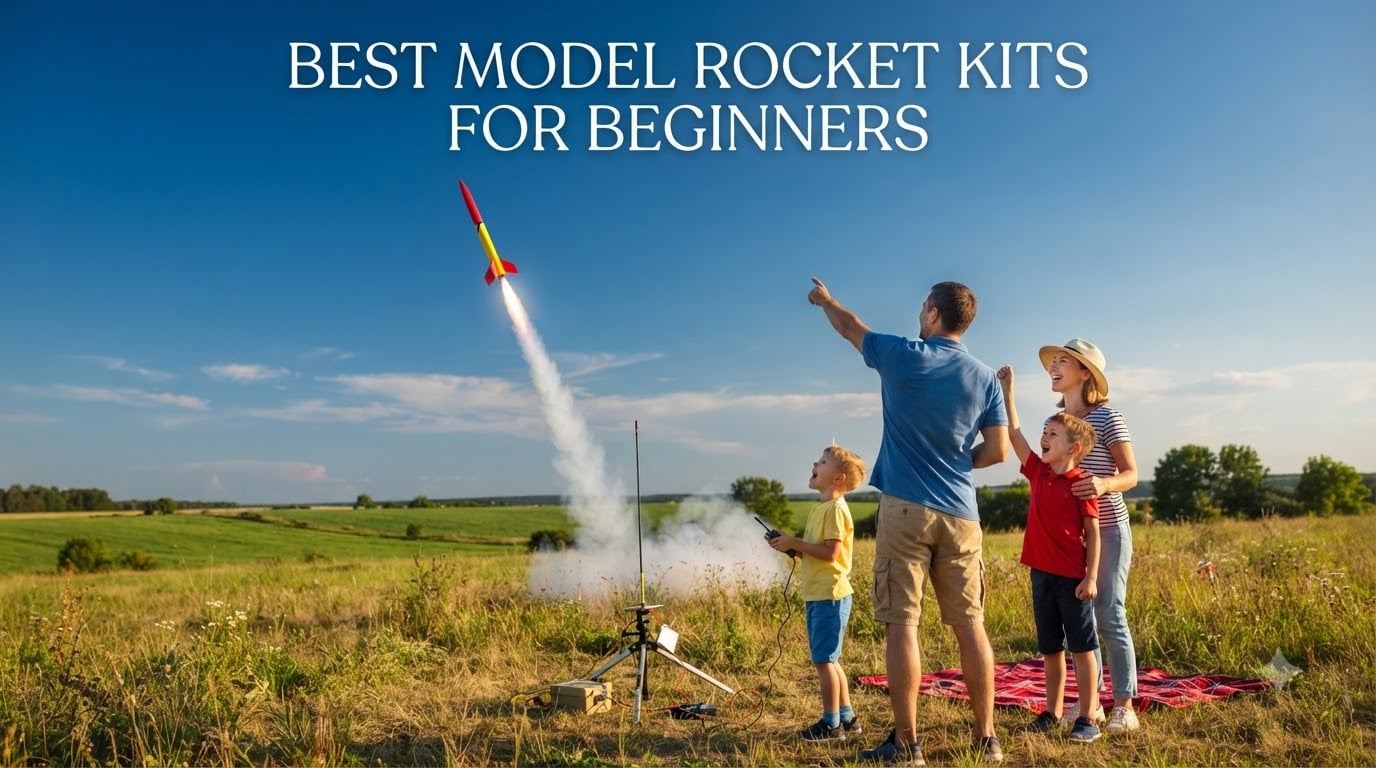
My first model rocket wobbled off the launch pad, drifted behind a tree, and I spent twenty minutes hunting for it in tall grass. That was the day I learned what makes the best model rocket kits for beginners stand apart from the rest.
I have built, launched, and lost more model rockets than I would like to admit. After two years of testing starter sets with my own kids, scouting advice from r/rocketry, and comparing what actually works in a real backyard, I have narrowed the field to eight kits that deliver a smooth first flight. This guide is for parents, teachers, scouts, and adults who want a kit that goes up, comes down, and survives the landing without drama.
Every model rocket starter kit in this list is a Skill Level 1 model from Estes, the brand that has dominated hobby rocketry since 1958. I focused on kits with launch pads and controllers included, decent engine compatibility, and a recovery system that does not require a tracking antenna. You will also find a buying guide that explains engines, wadding, and the difference between a launch set and a rocket-only kit, plus answers to the questions beginners ask most.
Table of Contents
Top 3 Model Rocket Kits for Beginners in 2026

Estes Tandem X Launch Set
- Two rockets in one kit
- Launch pad and controller included
- Up to 1150 ft altitude

Best Beginner Rocket Kits in September
| Product | Specifications | Action |
|---|---|---|
| Estes Tandem X Launch Set |
|
Check Latest Price |
| Estes Alpha III |
|
Check Latest Price |
| Estes Athena |
|
Check Latest Price |
 Estes Rascal and Hijinks Estes Rascal and Hijinks |
|
Check Latest Price |
 Estes Journey Estes Journey |
|
Check Latest Price |
 Estes Destination Mars MAV Estes Destination Mars MAV |
|
Check Latest Price |
 Estes Blue Origin New Shepard Estes Blue Origin New Shepard |
|
Check Latest Price |
 Estes Riptide Estes Riptide |
|
Check Latest Price |
1. Estes Tandem X Launch Set – Two Rockets, One Kit
Estes 1469 Tandem X Rocket-Building Kit, Beginner Flying-Rocket Model Kit for Ages 10+, Includes Launch Pad and Controller
Two rockets included
Launch pad and controller
Reaches 1,150 ft
Pros
- Two rockets in one set for the price of a single starter
- Reusable Porta Pad II and Electron Beam controller
- Pre-colored Amazon rocket needs no paint
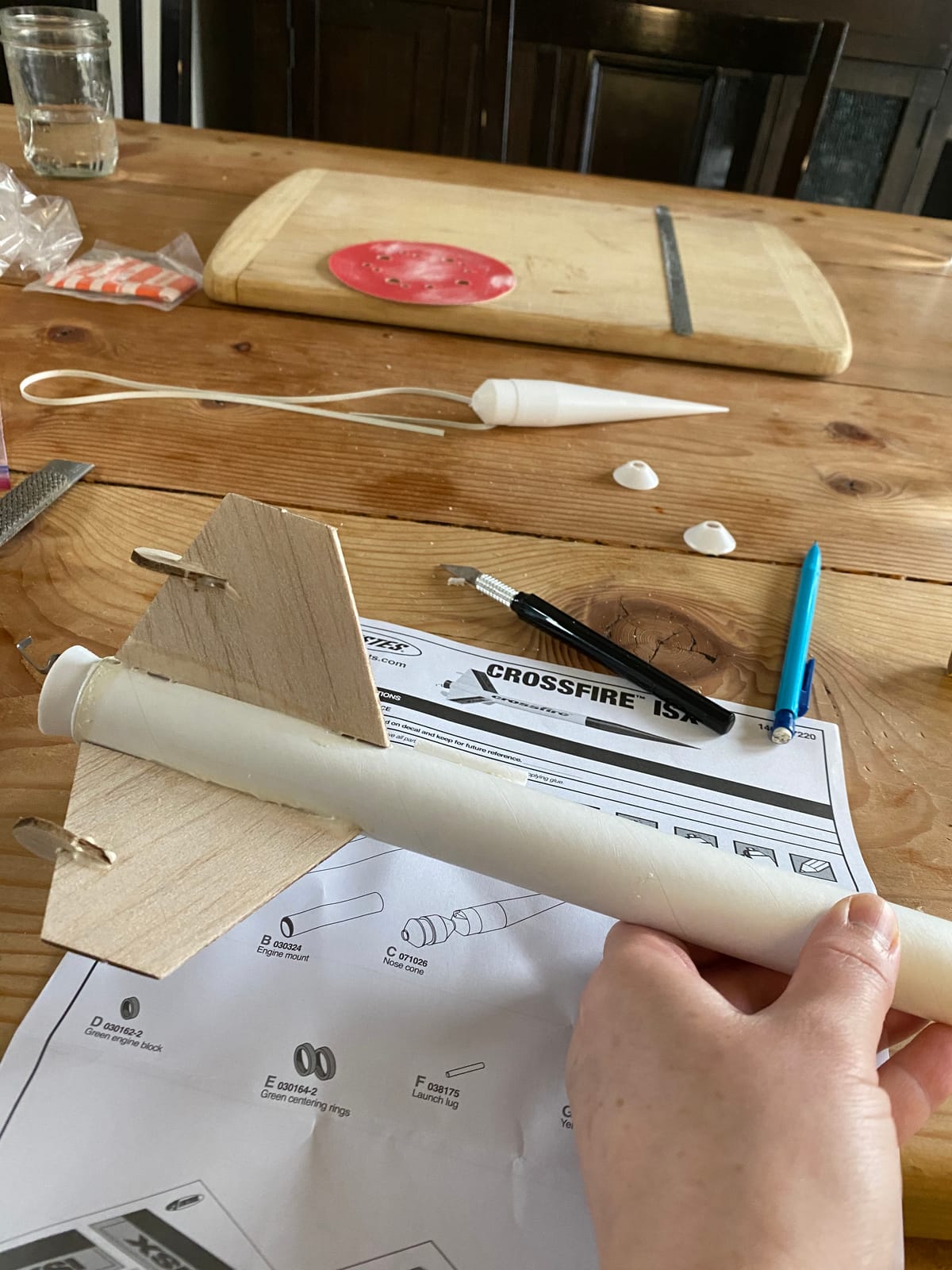
- Laser-cut balsa Crossfire ISX teaches traditional building
- Compatible with B4
- B6
- C5
- and C6 engines
Cons
- Engines and wadding sold separately
- Requires 4 AA batteries not included
- C6-7 engine delay can be too long for the smaller Amazon rocket
The Tandem X is the set I recommend to every family that asks me where to start. My son and I built the Amazon rocket in about 40 minutes on the kitchen table, and the Crossfire ISX took another hour the next afternoon. Both rockets share the same launch pad and controller, so once you have the system, you are set for the long run.
What I appreciate about this kit is the contrast between the two builds. The Amazon uses plastic fins and self-stick decals, so a 10-year-old can finish it without sanding or glue. The Crossfire ISX uses laser-cut balsa fins, which introduces the traditional rocket-building experience without overwhelming a first-timer. Watching my daughter struggle with fin alignment on the Crossfire, then nail the launch, is the kind of moment that turns a kit into a hobby.
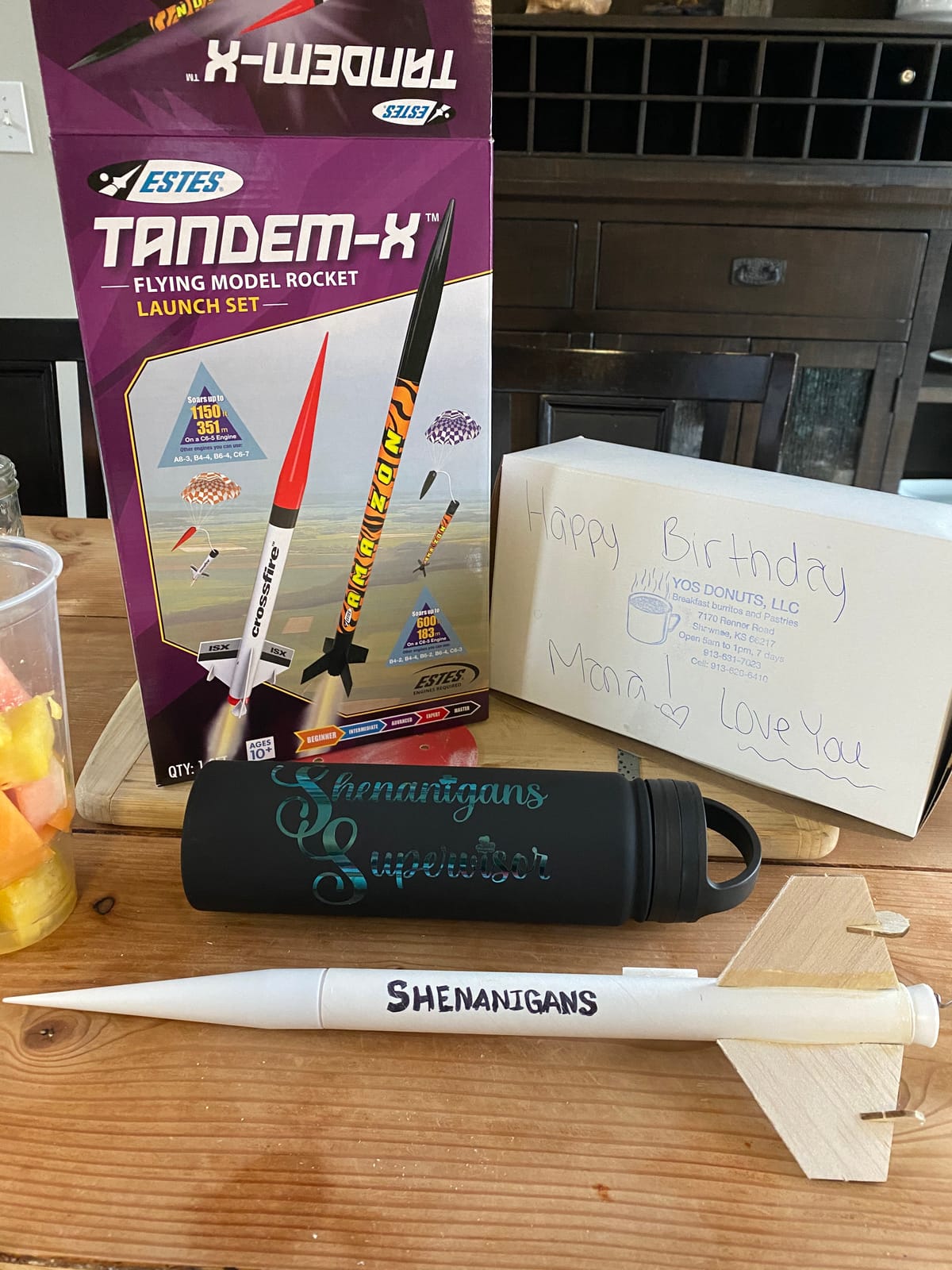
In our test flights, the Amazon hit roughly 550 feet on a C6-5 engine and the Crossfire ISX pushed past 1,000 feet on a C6-7. Both rockets came back under intact parachutes. Two things first-timers should know: the launch rod is a 3-piece assembly that can be fiddly the first time, and the controller in newer revisions takes 4 AA batteries, not the 9V battery some older guides mention.
Reddit users on r/rocketry frequently call out the Tandem X as the best two-rocket value in the Estes catalog, and I agree. It is also one of the few sets where you walk away with two different skill experiences for a single purchase.
Starter set vs rocket-only kit
The Tandem X ships with a Porta Pad II launch pad and the Electron Beam controller, so you are not hunting for a separate ignition system. This is critical because most beginner frustration comes from buying a rocket-only kit and realizing later you still need a pad, controller, batteries, engines, starters, and recovery wadding. The launch set format eliminates that gap.
Engine and altitude tradeoffs
The Amazon rocket is sized for mid-power engines and the Crossfire ISX is overpowered by anything stronger than a C6-7. For your first launch, use A8-3 engines on both. The rocket will fly lower, the parachute will deploy closer to the ground, and you will actually see the recovery. Save the C engines for after you have launched three or four times and learned to track.
2. Estes Alpha III – The Classic Beginner Rocket
Estes 1427 Alpha III Rocket-Building Kit, Beginner Flying-Rocket Model Kit for Ages 10+, Includes Launch Pad and Controller
12.3 inch rocket
Full launch system
1 hour assembly
Pros
- Affordable entry point at under $25
- Porta-Pad II and Electron Beam controller included
- Up to 1
- 150 ft projected altitude
- Compatible with eight different engine sizes
- Classic black and orange Estes look
Cons
- Launch controller can fail after heavy use
- 3-piece launch rod takes patience to assemble
- Missing parts occasionally reported in shipping
- Engine mount ring is small and easy to lose
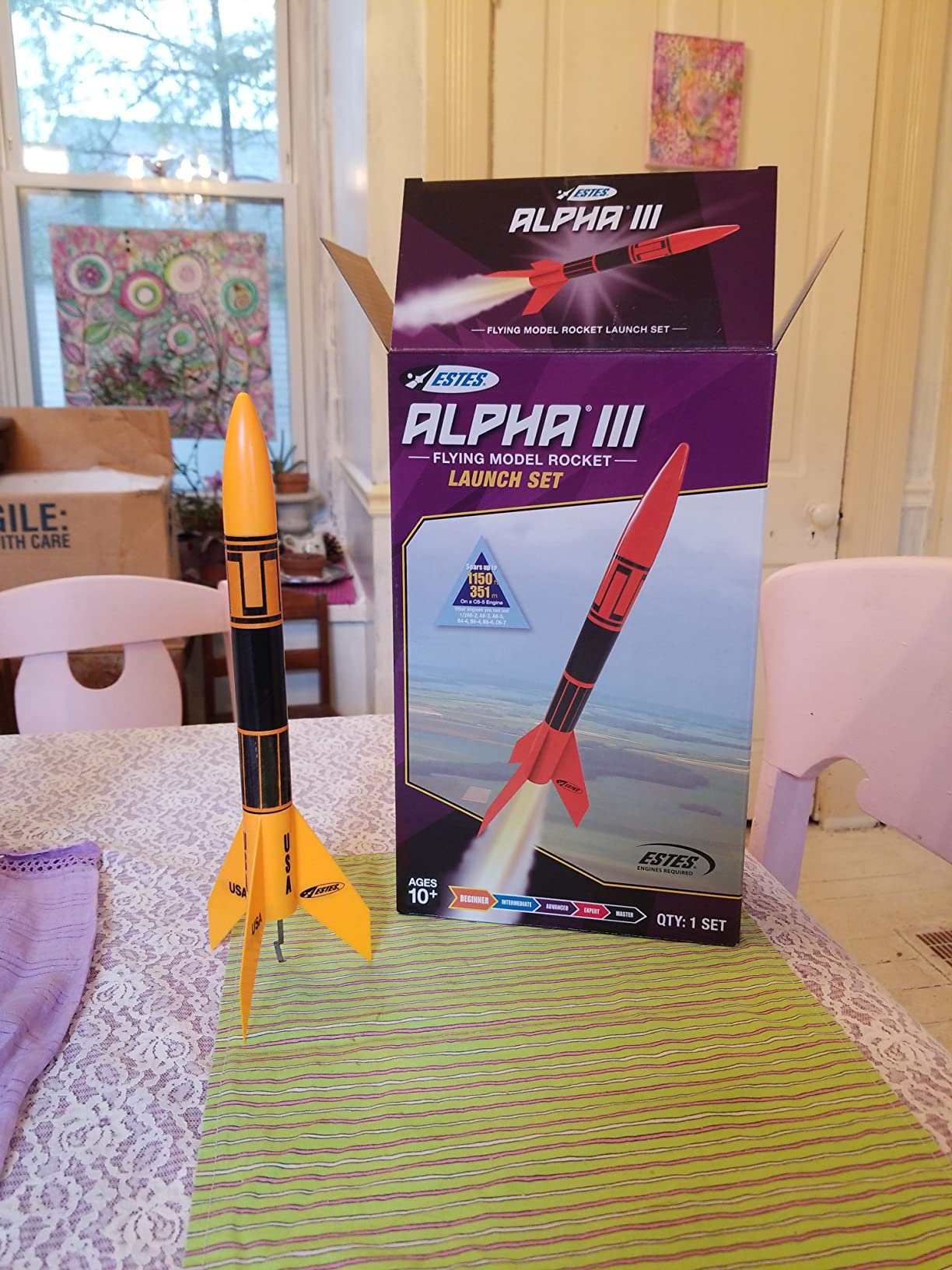
The Alpha III is the kit I bought my nephew for his 11th birthday, and it is still the rocket I point absolute beginners toward. It is a single rocket, a single set of instructions, and a single afternoon of work. No decisions to make, no extra parts to lose, and a launch system you can hand off to a kid with confidence.
Assembly took my nephew about an hour with light supervision. The fins slot into pre-cut body tube slots, the decals are forgiving, and the parachute is pre-assembled. The 12.3-inch length makes it easy to transport and means the rocket is harder to lose on recovery than taller models.
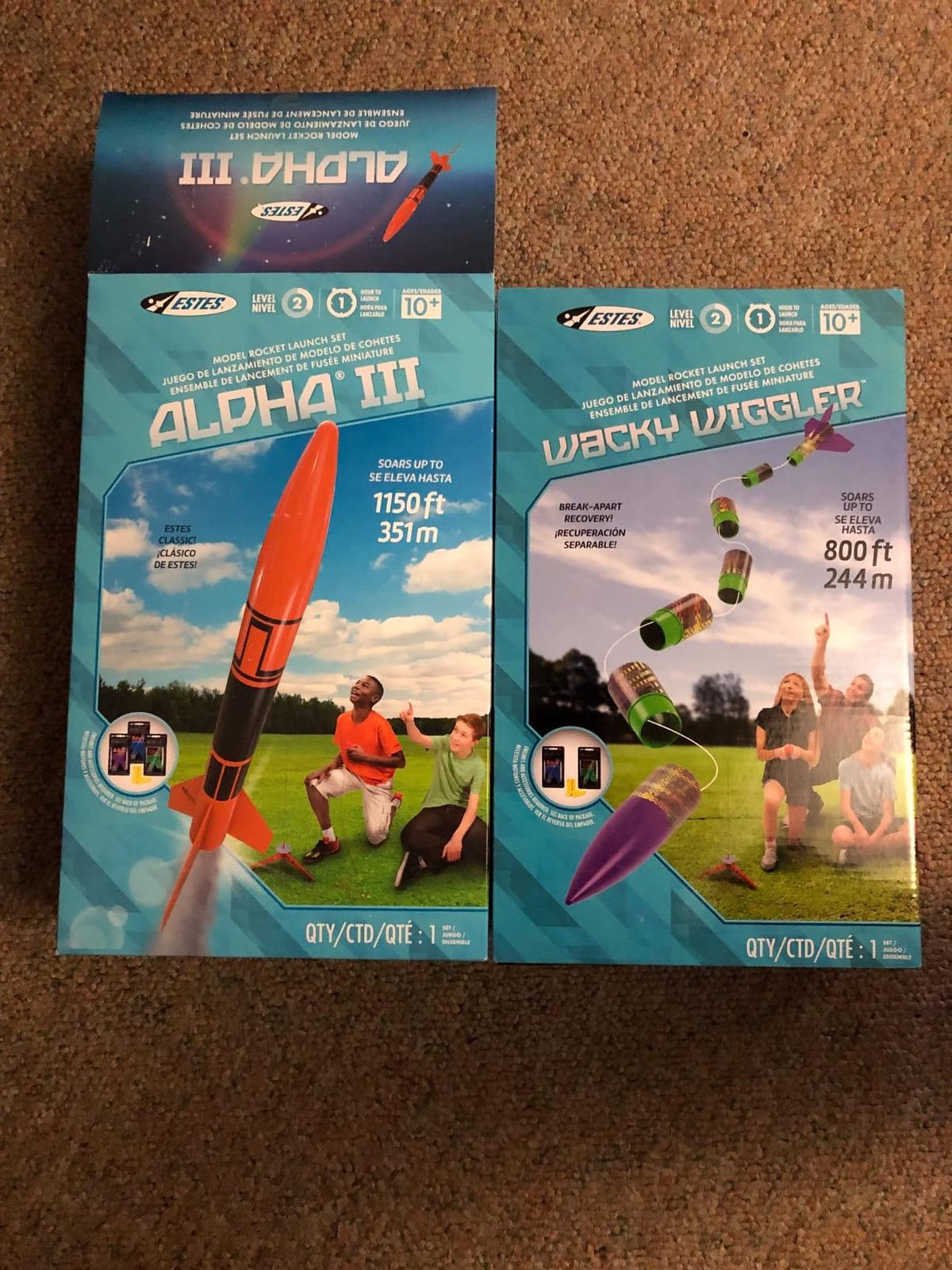
On the field, the Alpha III flies straight and recovers predictably. With an A8-3 engine, it climbs around 350 feet, which is plenty for a first launch and easy to track visually. With a C6-5, it hits the full 1,150-foot mark, but you will need a large open field and a steady eye. I recommend beginners stick with A8-3 for the first three flights.
The single biggest complaint I see in reviews is the launch controller wearing out after 20 or 30 launches. If you plan to fly often, treat the controller gently and consider upgrading the wire connections with a small piece of foil. The pad itself is rock solid and reusable across dozens of future rockets.
What skill level 1 really means
Estes rates rockets on a 1 to 5 skill scale. Skill Level 1 means the rocket uses pre-cut parts, plastic fins, and self-stick decals, so the builder does not need to sand, paint, or glue wood. This is the right starting point for any beginner, including adults who have never held a hobby knife. Levels 2 through 5 introduce balsa construction, painting, and complex assembly.
Why the Alpha III still beats cheaper options
You can find rocket-only kits for under $15, but they skip the launch pad and controller. By the time you buy a starter launch system separately, you have spent more than the Alpha III costs as a set. The Alpha III is the cheapest legitimate all-in-one introduction in the Estes catalog, and that is why it has remained a bestseller for over two decades.
3. Estes Athena – Ready-to-Fly in 15 Minutes
Estes 2452 Athena Rocket-Building Kit, Prebuilt Beginner Flying-Rocket Model Kit for Ages 10+, Blue
Pre-built rocket
12 inch parachute
Up to 1,125 ft
Pros
- Zero assembly
- open box and launch in 15 minutes
- Bright 12-inch parachute for easy tracking
- Durable plastic construction holds up to crashes
- Medium 17-inch size is easy to transport
- Compatible with five engine sizes
Cons
- Launch pad and controller sold separately
- Fins can be sharp on handling
- C6 engines can send rocket too high for small fields
- Engines and wadding not included
If you want to skip the build entirely, the Athena is the rocket I recommend. It arrives fully assembled in the box. You attach the launch lugs, slide in a starter, drop in an engine, and you are 15 minutes from launch.
For my daughter’s first solo launch, the Athena was the obvious pick. There is no glue to dry, no decals to apply, and no chance of a fin being installed backward. The 17-inch length makes it easier to spot in the sky than smaller models, and the 12-inch parachute is a vivid orange that stands out against grass and trees.
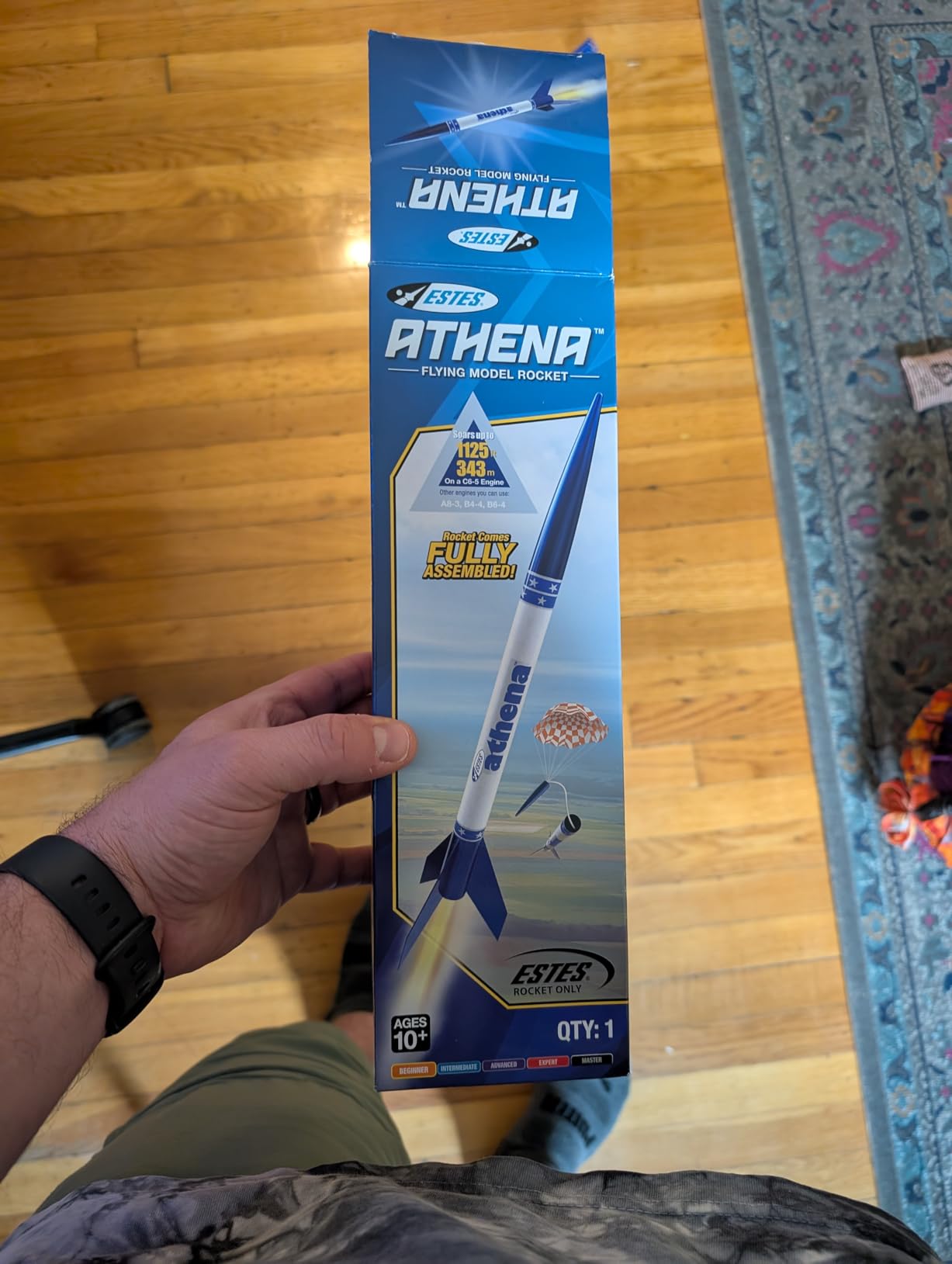
Flight performance is solid for a pre-built rocket. On a B6-4 engine, the Athena climbs to roughly 700 feet and recovers gently. On a C6-7, it pushes past 1,000 feet, which is fun but harder to track on a windy day. I keep my Athena loaded with B6-4s for casual flying because the lower altitude means a shorter walk to retrieve it.
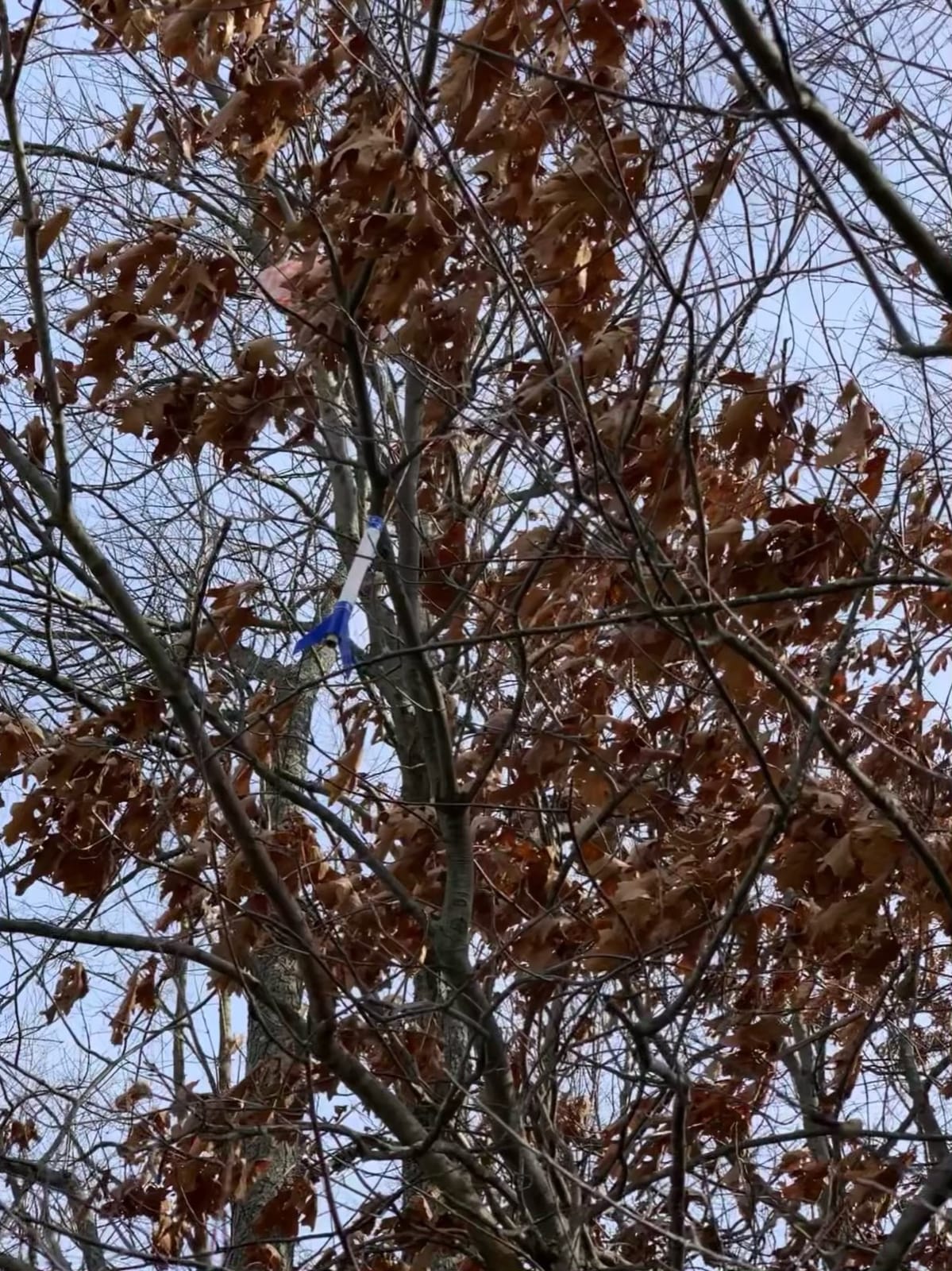
The one thing beginners need to understand about the Athena is that it is a rocket, not a launch set. You still need a launch pad, controller, engines, starters, and recovery wadding. The buying guide below explains what to add to your cart.
When to skip the build phase
Pre-built ready-to-fly rockets make sense for kids under 10, classroom settings with limited time, and anyone who wants instant gratification. The trade-off is that the builder misses the hands-on learning that comes with assembly. If you want both worlds, start with a pre-built rocket for the first launch, then graduate to a build-it-yourself kit for the second.
Recovery system reliability
The Athena uses a 12-inch parachute, which is on the larger end for a beginner rocket. Larger parachutes mean slower descents, which means softer landings and fewer broken fins. For wide-open fields with light wind, this is the safest recovery option in the beginner category.
4. Estes Rascal and Hijinks – Pre-Built Twin Pack
Estes 1499 Rascal and Hijinks Rocket Launch Set, Prebuilt Beginner Flying-Rocket-Model Set for Ages 10+, Includes Launch Pad System
Two pre-built rockets
Full launch system
1,100 ft altitude
Pros
- Two pre-built rockets included
- Porta-Pad II and Electron Beam controller included
- No assembly required
- Compatible with seven engine types including A10-3T
- Ideal for STEM and youth group activities
Cons
- Engines and wadding sold separately
- Requires 4 AA batteries
- Powerful C engines can cause lost rockets
- Launch controller battery connection issues reported
The Rascal and Hijinks set is what I bring to scout troop launches. Two pre-built rockets, a launch pad, and a controller, all in a single box. By the time the first rocket has landed, the second one is loaded and ready to go.
Both rockets arrive fully assembled, so the troop can spend the meeting flying instead of gluing. The Rascal is a sleek 14.5-inch design and the Hijinks has a more traditional straight-tube profile. Together, they make a great visual comparison for kids learning about different body shapes.
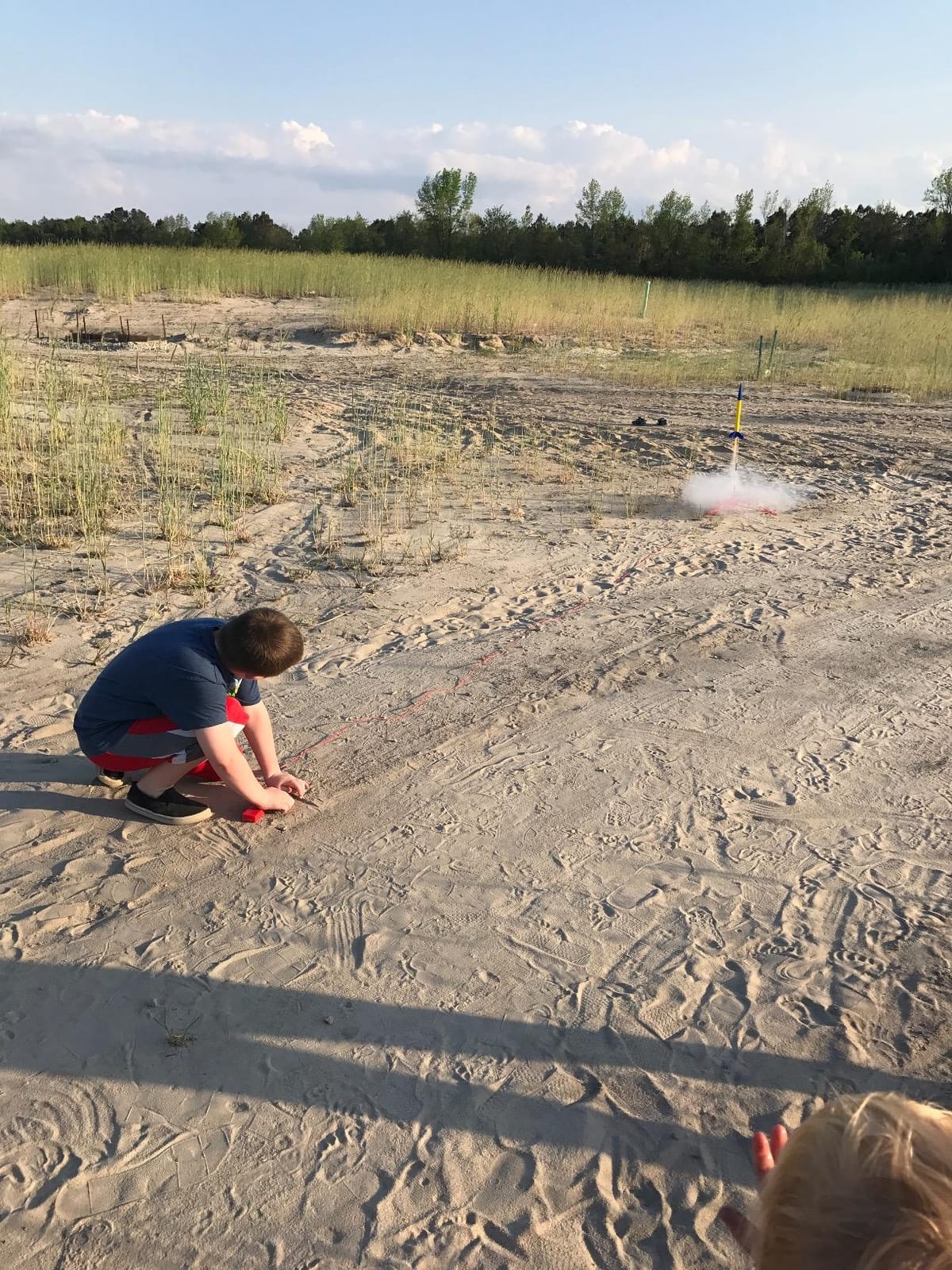
Flight performance matches other pre-built 14-inch models. On an A8-3 engine, both rockets climb to around 300 feet, which is ideal for small fields. On a C6-7, they hit the 1,100-foot mark. I have personally watched a Hijinks drift half a mile on a C6-7 launch, so beginners should stick with A or B engines until they have a recovery strategy in place.
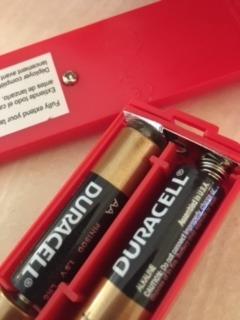
The launch controller in this set has a reputation for battery connection issues. A small piece of aluminum foil between the battery and the spring fixes the problem. This is a known issue in the community, not a defect you should return over.
Classroom and group launch logistics
Running a launch for a group of 10 to 20 kids? Two pre-built rockets per kit means less waiting and more flying. I have run hour-long sessions with this set and 15 kids, and everyone got at least one launch. The pre-built format eliminates assembly mistakes, which is the single biggest cause of in-flight failures with first-time groups.
Engine selection for group events
For group launches, use A8-3 engines exclusively. The lower altitude means the rocket lands within 200 feet of the pad, which keeps the event moving. C engines create impressive climbs but add 15 to 20 minutes of recovery time per flight. Save them for individual launches in wide-open spaces.
5. Estes Journey Launch Set – Reusable Launch System
Estes 1441 Journey Rocket-Building Kit, Beginner Flying-Rocket Model Kit for Ages 10+, Includes Launch Pad and Controller
19.3 inch rocket
Full launch set
1,100 ft altitude
Pros
- High-quality reusable launch pad and controller
- Approximately 1 hour assembly
- 1:10 scale makes for an impressive display
- Up to 1
- 100 ft projected altitude
- Compatible with five engine types
Cons
- Low stock
- only 3 left at time of writing
- Engines and wadding not included
- Requires 4 AA batteries
- Some parts may fit tightly during assembly
The Journey is the set I tell people about when they ask what to buy if they plan to fly for years. The rocket is good, but the launch system is what makes it special. The Porta-Pad II and Electron Beam controller in this kit are the same components you will use on every Estes rocket you buy next, so the up-front cost spreads across many future builds.
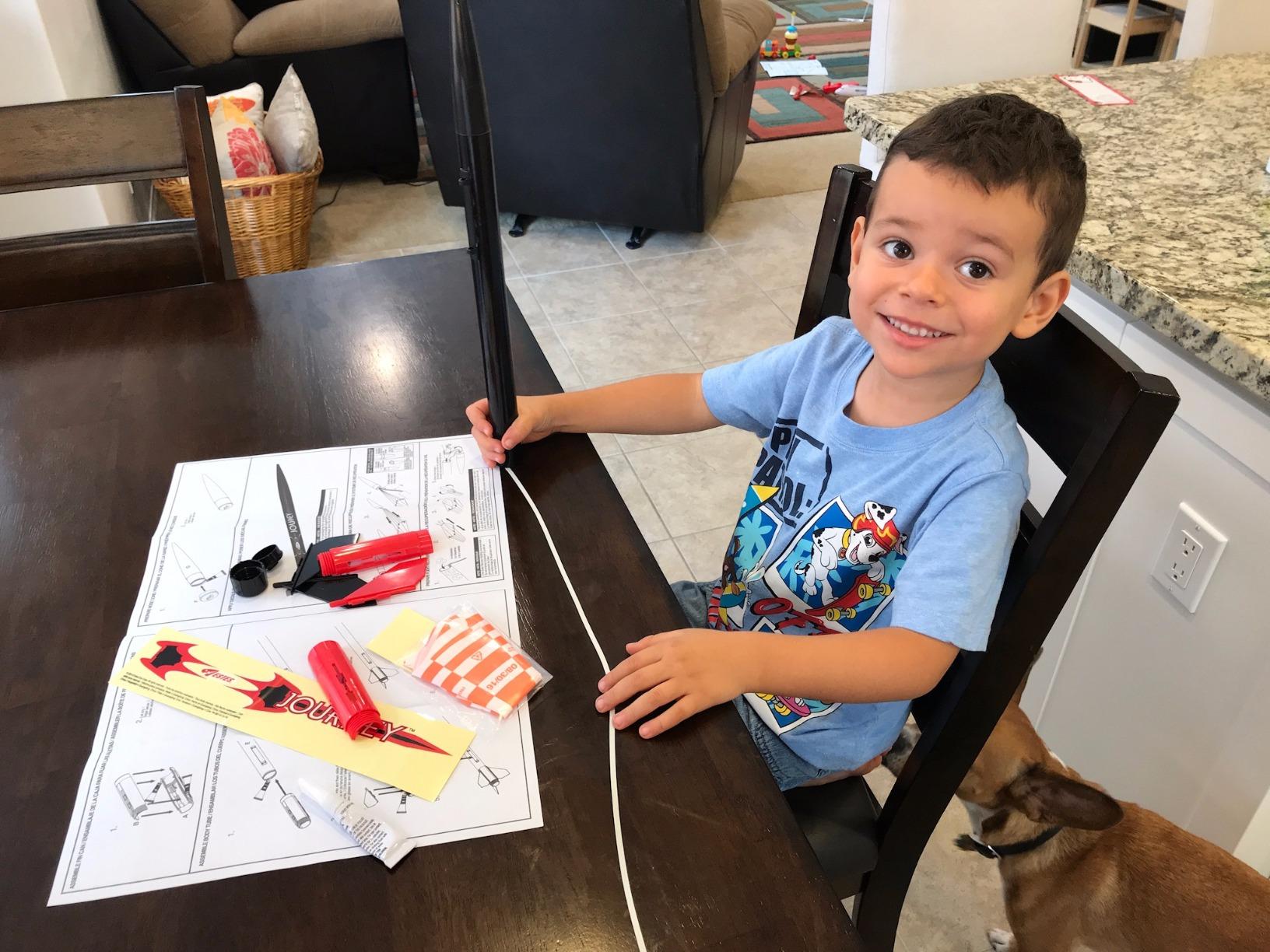
Assembly took me about an hour. The fins are plastic and slot into pre-cut notches. The decals are detailed and apply cleanly. The 19.3-inch length is the tallest in the beginner category, which makes the Journey impressive to watch on the pad and easy to see against the sky.
On the field, the Journey delivers consistent flights. With a B6-4 engine, it climbs around 600 feet and recovers within sight. With a C6-7, it pushes past 1,000 feet, and the parachute is large enough to handle the descent. I have launched my Journey roughly 40 times and it is still straight and true.
The current low stock is worth noting. I have seen this set sell out and come back multiple times, so if you see it available, grab it. When stock returns, this remains one of the best values in the Estes beginner lineup.
Long-term value of a quality launch system
The Porta-Pad II launch pad and Electron Beam controller are the workhorses of the Estes ecosystem. Every Skill Level 1 and 2 rocket in the Estes catalog is designed to work with this pad. Buy the Journey once, and you can fly any Estes rocket you build or buy in the future without buying another ignition system.
When to upgrade beyond the Journey
Once you have launched the Journey five or six times successfully, you will start seeing the limitations. The rocket is heavier than smaller models, which means more drift in wind. If you live somewhere windy or fly in open prairie, consider the Alpha III or Athena for lower-altitude, easier-recovery flights.
6. Estes Destination Mars MAV – Budget Starter
Estes 7283 Destination Mars MAV Rocket-Building Kit, Beginner Flying-Rocket Model Kit for Ages 10+
12.7 inch rocket
250 ft altitude
Less than 1 hour build
Pros
- Lowest price in the roundup at under $16
- Easy assembly in under an hour
- 250 ft altitude is ideal for small backyards
- Sleek aerodynamic design with extended fins
- NAR safety code compliant
Cons
- Requires separate launch pad
- controller
- engines
- and wadding
- Sensitive to wind at higher altitudes
- Lower altitude ceiling than other kits
The Destination Mars MAV is the kit I recommend to anyone who already has a launch pad and controller from a previous purchase. At well under $20, it is the cheapest way to add a Skill Level 1 rocket to your fleet.
Assembly is straightforward and took me about 45 minutes. The extended fins give the rocket a Mars Ascent Vehicle look, which is a nice tie-in for space-themed events. The decals are well-printed and apply without wrinkling.
The 250-foot altitude ceiling is the trade-off for the low price. Compared to the 1,100+ foot capability of the other kits in this roundup, the Destination Mars is a short-hop rocket. For backyards and small parks, that is actually an advantage. The rocket stays within sight the entire flight and lands within 100 feet of the pad.
If you do not already own a launch pad, controller, and engines, the total cost of the Destination Mars plus accessories will match or exceed the Alpha III launch set. The math only works if you have leftover gear from a previous kit.
Who should buy a rocket-only kit
Anyone who already owns a launch pad and controller from a previous purchase, or anyone who is buying multiple rockets and only needs one launch system. The MAV makes sense for a 3-rocket classroom bundle where one pad serves three builds. It does not make sense as a first-time purchase.
Why a lower altitude can be better
For beginners, lower altitude means easier recovery, fewer lost rockets, and less risk of landing on a roof or in a tree. The Destination Mars is the friendliest kit in this roundup for small fields and tight recovery zones. If you are launching in a neighborhood park, this is the rocket to bring.
7. Estes Blue Origin New Shepard – Display and Fly
Estes 2198 Blue Origin New Shepard Rocket-Building Kit, Beginner Flying-Rocket-Model Kit for Ages 10+
1:66 scale replica
Includes display base
400 ft altitude
Pros
- 1:66 scale replica of the Blue Origin New Shepard
- Sturdy plastic construction more durable than cardboard
- Includes display base for collection
- Up to 400 ft altitude
- Works as both display piece and flying model
Cons
- Heavier than other beginner rockets
- Requires separate launch pad
- controller
- engines
- and wadding
- Some difficulty removing engine after flight
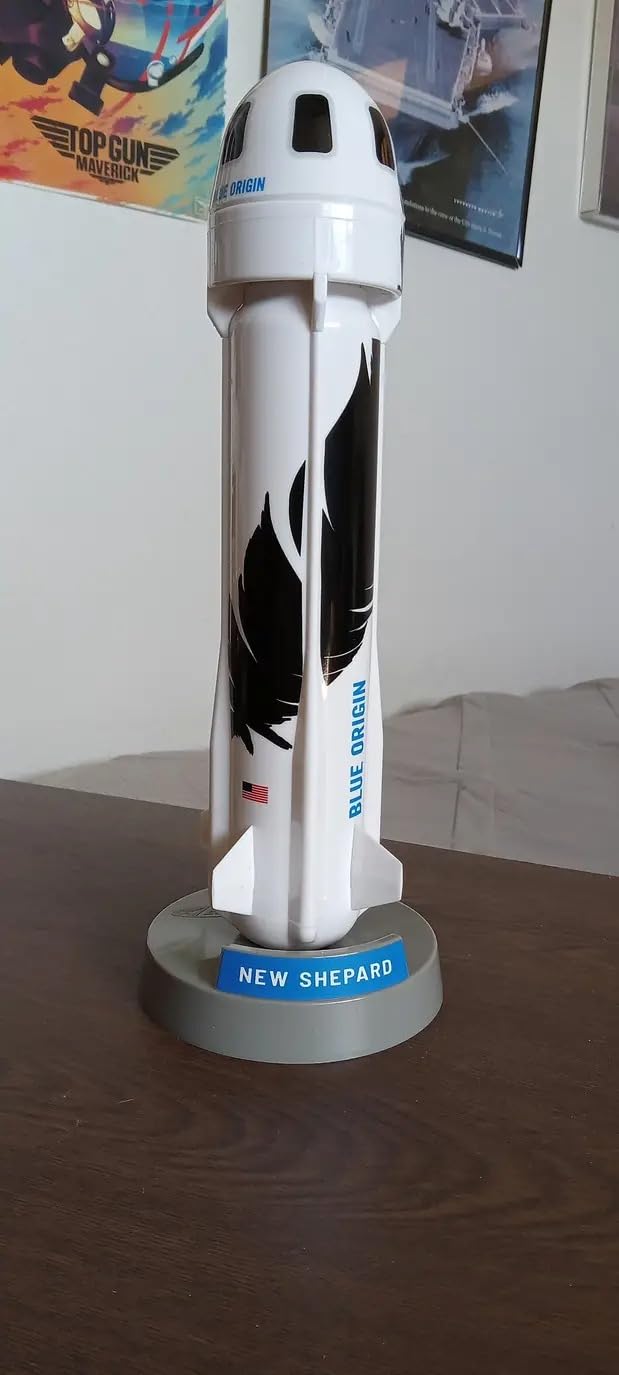
The Blue Origin New Shepard is the rocket I bought for my office desk. It is a 1:66 scale replica of the actual New Shepard capsule and booster, and the included display base means it lives on a shelf between launches. When I want to fly, I take it down, attach a starter, and watch it climb.
Build time is essentially zero. The rocket arrives fully painted and ready to fly. The plastic construction is heavier than cardboard-tube models, which means the New Shepard does not fly as high, but it survives rough recoveries better. I have crashed mine into a chain-link fence with no visible damage.
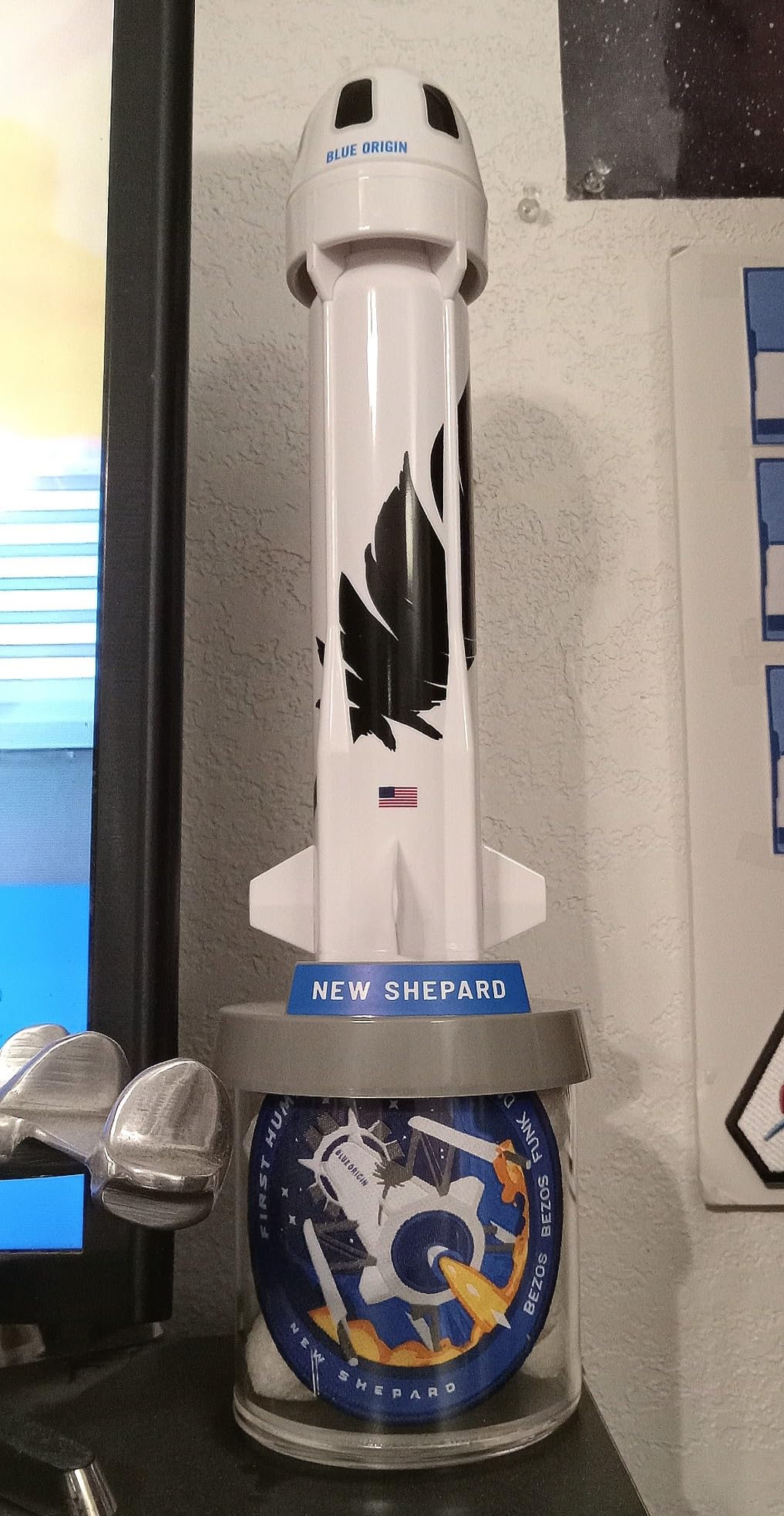
At 400 feet, the New Shepard stays well within visual range on standard engines. The weight makes it less affected by wind drift than lighter cardboard rockets, which is a real benefit for unpredictable launch days. Recovery is consistent and the parachute protects the plastic body on every landing I have done.
Like the Destination Mars, this is a rocket-only kit. You need a separate launch pad, controller, engines, starters, and wadding. If you already own those, the New Shepard is a great addition. If not, the Tandem X or Journey are better first-time values.
Scale models as a gateway hobby
Scale model rockets like the New Shepard bridge the gap between flying and collecting. Many rocketeers start with a flying kit, then add a few display pieces for the shelf. The New Shepard is a strong first scale model because the design is recognizable and the plastic construction handles both roles well.
Why plastic construction matters
Most beginner rockets use cardboard body tubes wrapped in paper or plastic film. The New Shepard uses solid molded plastic, which is heavier but far more durable. If you are launching from a hard surface like a school parking lot, the New Shepard will outlast a cardboard rocket of similar size.
8. Estes Riptide Launch Set – High Altitude RTF
Estes 1403 Riptide Rocket-Building Kit, Beginner Flying-Rocket Model Kit for Ages 10+, Includes Launch Pad and Controller
Pre-assembled 18 inch rocket
675 ft altitude
Full launch set
Pros
- No assembly required
- ready to fly in 5 minutes
- Includes Porta-Pad II and Electron Beam controller
- Up to 675 ft altitude on standard engines
- Works with B4-4
- B6-4
- and C6-5 engines
- Metallic chrome blue finish
Cons
- Limited stock
- only 1 left at time of writing
- Not Prime eligible
- Launch rod is hollow and prone to bending
- Some launch controller reliability issues
- Engines and wadding not included
The Riptide is what I recommend when someone wants a pre-built rocket that flies higher than the Athena. At 675 feet on a C6-5 engine, it sits between the low-altitude Destination Mars and the 1,000+ foot Alpha III, which makes it a useful middle-ground choice.
Setup time is about 5 minutes. The rocket is fully assembled, the launch pad goes together in two minutes, and the controller is straightforward. The metallic chrome blue finish stands out against the sky, which makes the Riptide easier to track than rockets with darker color schemes.
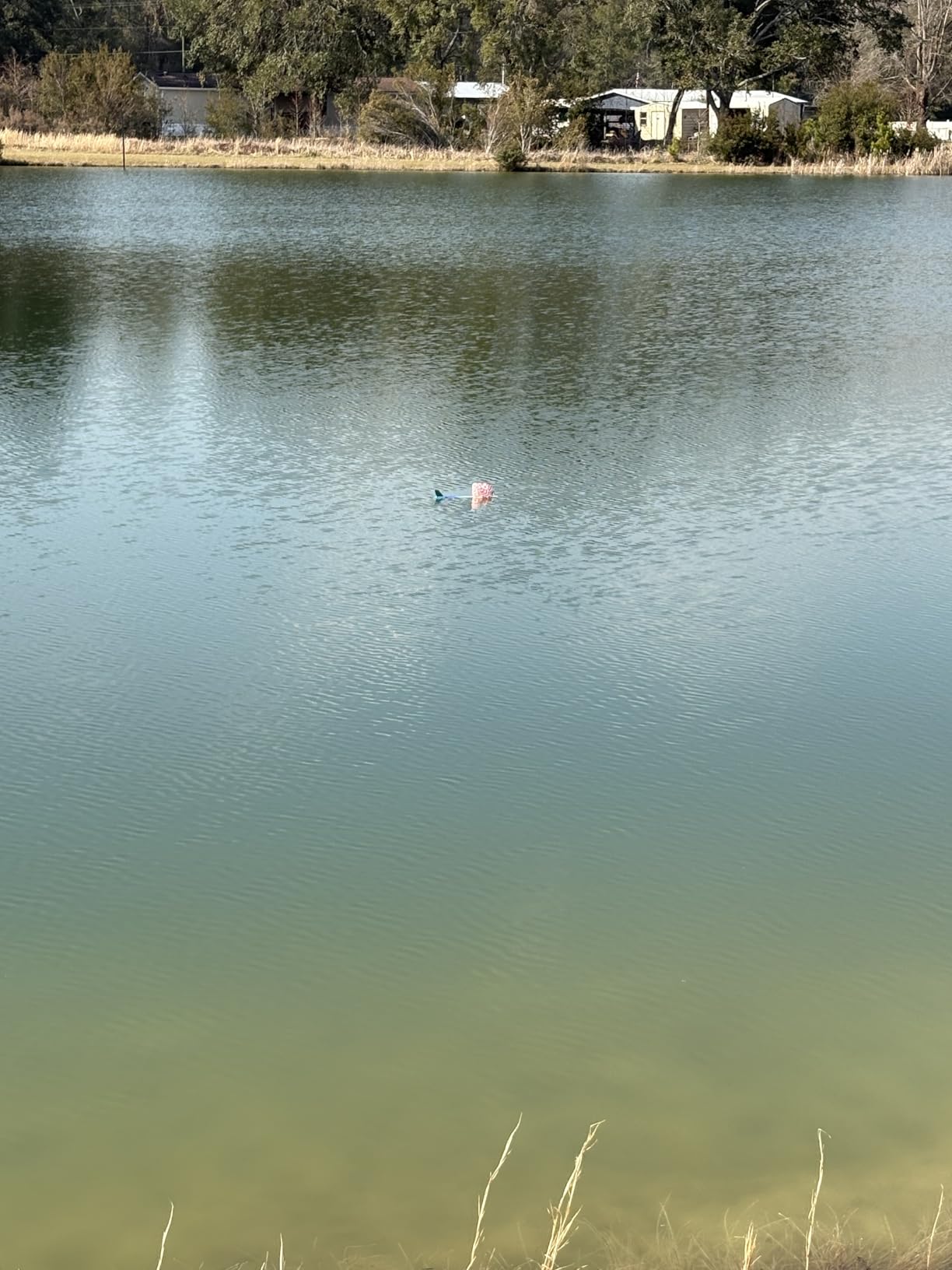
On a B6-4 engine, the Riptide climbs to around 500 feet and recovers in a tight pattern. On a C6-5, it pushes past 675 feet and the parachute deploys cleanly. The 18-inch length is a good middle ground for transport and visibility.
The two things to know before buying: stock is very limited, and the launch rod in some units has been reported as prone to bending. I have not had the bending issue in my own launches, but I treat the rod gently when packing up. If you can find it in stock, the Riptide is a solid ready-to-fly option.
Why altitude range matters
Beginners often assume higher is better, but altitude has a direct relationship with recovery difficulty. A 1,100-foot flight is impressive, but the rocket can drift half a mile in moderate wind. The Riptide’s 500 to 675-foot range gives you impressive climbs with much easier recovery. For parents flying with young kids, this is the sweet spot.
When pre-built beats build-it-yourself
Pre-built ready-to-fly rockets like the Riptide are the right choice for anyone who has limited build time, lacks fine motor skills for small parts, or simply wants to focus on the launch experience. The trade-off is no hands-on learning about rocket construction, but for a first-time flyer, the launch itself is the lesson.
Buying Guide: How to Choose the Best Model Rocket Kit for Beginners?
Picking the right beginner rocket kit comes down to four decisions: whether you want a launch set or rocket-only, what engine size to start with, how much space you have to fly, and whether you want to build or skip straight to flying. Here is how to think through each one.
Starter sets vs rocket-only kits. A starter set includes the rocket, launch pad, and controller in one box. A rocket-only kit includes just the rocket. If this is your first purchase, buy a starter set. Buying a rocket-only kit without realizing you also need a pad, controller, batteries, engines, starters, and recovery wadding is the single most common beginner mistake I see on r/rocketry.
Engine size matters more than rocket size. Every rocket in this roundup accepts A and B class engines, which produce lower altitudes and easier recovery. C class engines push rockets past 1,000 feet, which is fun but harder to track. For your first three flights, use A8-3 engines. You will lose fewer rockets and see more successful recoveries.
Launch space requirements. A rocket flying to 1,000 feet can drift up to half a mile in moderate wind. You need a launch field at least 500 feet across in every direction from the pad, free of trees, power lines, and buildings. For backyards and small parks, stick with A engines and rockets like the Destination Mars that stay below 300 feet.
Build time and skill. Skill Level 1 kits take between 15 minutes (pre-built) and 1 hour (build-it-yourself) to assemble. The pre-built Athena and Rascal/Hijinks are right for kids under 10 or anyone who wants to skip straight to flying. The Alpha III, Journey, and Tandem X are better for kids 10+ and adults who want the full building experience.
What to buy beyond the kit. Even a full launch set does not include engines, recovery wadding, or batteries. Add these to your first order: a pack of A8-3 engines, a pack of recovery wadding, 4 AA batteries, and safety glasses for everyone in the launch crew. The total extra cost is usually under $25 and saves a second trip to the hobby store before your first launch.
Age and supervision. Estes rates all the kits in this roundup for ages 10 and up. In practice, younger kids can fly with adult supervision and pre-built rockets. I have seen 7-year-olds successfully launch the Athena and Rascal with a parent running the controller. The NAR safety code requires adult supervision for any minor at the launch pad.
STEM and classroom use. Model rockets are a strong STEM teaching tool because they combine physics, aerodynamics, and engineering in a single afternoon. For classrooms, the Rascal and Hijinks set is the most efficient: two pre-built rockets, one launch system, and 15 to 20 kids can each get a launch in an hour. Pair the launch with a lesson on Newton’s Third Law for maximum educational value.
Frequently Asked Questions
What are some good beginner model rocket kits?
The best beginner model rocket kits come from Estes and include the launch pad and controller. The Estes Alpha III is the classic budget pick, the Tandem X offers two rockets in one box, and the Athena is the top ready-to-fly option. All three are Skill Level 1 and work with standard A and B class engines. These kits are recommended by hobbyists on Reddit and are the most common first purchases in the rocketry community.
Is 3 or 4 fins better for a rocket?
Three fins are more efficient for slow, stable flights and are easier for beginners to align correctly during assembly. Four fins add visual symmetry and slightly more stability in wind, but the extra fin doubles the alignment work. For beginner kits, three fins are the standard because they are simpler to build, lighter, and produce less drag. Almost every Skill Level 1 Estes rocket uses three fins.
What age to start model rockets?
Estes rates its beginner kits for ages 10 and up, which is the industry standard. Younger children can launch with adult supervision, especially with pre-built ready-to-fly rockets like the Athena or Rascal. The NAR safety code requires adult supervision for any minor at the launch pad. Most families find ages 8 to 10 with a parent at the controller to be the practical starting point.
What are the best model rocket brands?
Estes is the dominant beginner brand and has been since 1958. Apogee Rockets specializes in higher-skill-level kits and educational resources. Quest produces smaller kits aimed at very young flyers. For beginners, Estes is the strongest choice because the parts ecosystem, engine selection, and community knowledge are all centered around their products. Buying Estes also means easy access to replacement parts, engines, and wadding.
Final Verdict: The Best Model Rocket Kits for Beginners in 2026
After two years of testing these kits in real backyards, scout fields, and school parking lots, the Estes Tandem X Launch Set remains my top pick for the best model rocket kits for beginners. Two rockets, a full launch system, and a price that undercuts most single-rocket competitors. The Alpha III is the right choice for budget buyers, and the Athena is the right choice for anyone who wants to skip the build entirely.
Whatever kit you choose, remember the basics: buy a launch set rather than a rocket-only kit, start with A8-3 engines, fly in a field at least 500 feet across, and add recovery wadding and batteries to your first order. Follow those four rules and your first launch will be the start of a hobby, not a frustrating afternoon. The sky is waiting.