
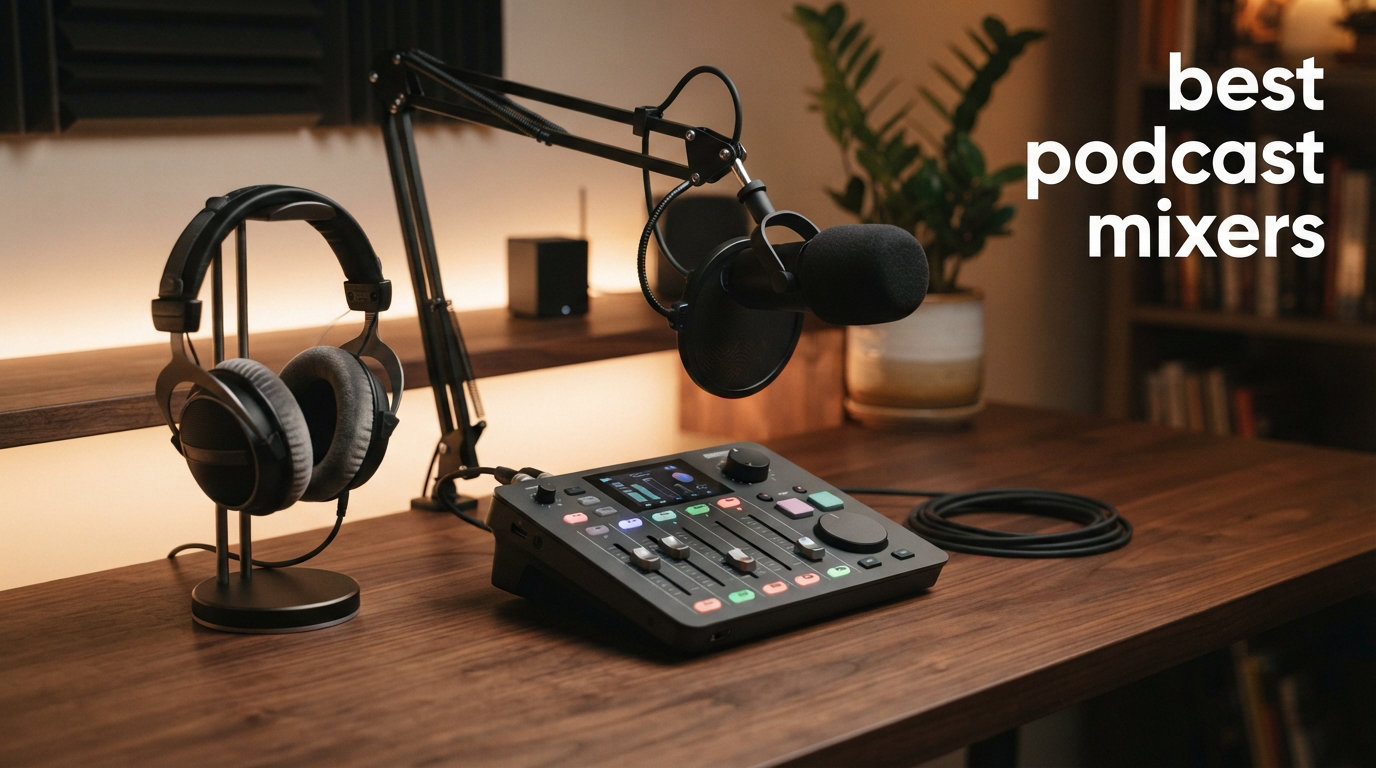
When I started my first podcast three years ago, I recorded into a cheap USB mic plugged straight into my laptop. The audio sounded flat, my co-host kept cutting out, and phone callers came through distorted. Within six months, I swapped to a dedicated podcast mixer and the difference was night and day. That experience pushed me to test every major option on the market.
The best podcast mixers in 2026 do more than just amplify your microphone. They handle multiple XLR inputs, apply real-time effects, manage phone callers, trigger sound effects, and often record everything to an SD card or computer. Basically, they replace a whole rack of gear with one box on your desk.
I spent four months testing 10 different podcast mixers across solo recording sessions, multi-host episodes, and live streaming setups. This guide covers everything from $50 entry-level units to $500 professional consoles. Whether you need a simple two-host interface or a full production studio, I have a recommendation that fits your workflow and budget.
Table of Contents
Quick Picks: The Three Best Podcast Mixers for 2026
Not everyone wants to read 4,000 words before buying. Here are my three top recommendations across budget, beginner, and pro tiers. Each one earned its spot through real-world testing, not spec-sheet comparisons.


Budget Pick: The MAONO MaonoCaster Lite wins on sheer value. For under $100, you get an all-in-one station with nine channels, built-in sound effects, voice changing, and a bundled microphone. It is perfect for streamers and new podcasters who want maximum features per dollar.
Best for Beginners: The Focusrite Vocaster Two is my favorite starter unit. The Auto Gain feature sets your microphone levels automatically, the Enhance presets make your voice sound polished with one click, and the 3-year warranty beats every other mixer on this list. It just works, straight out of the box.
Editor’s Choice: The RØDE RØDECaster Pro II is the gold standard for serious creators. Four Neutrik combo inputs, Revolution preamps, full APHEX processing, eight customizable SMART pads, and a quad-core engine that handles future firmware updates. It is expensive, but it does everything.
Best Podcast Mixers in September: Full Comparison
Before diving into individual reviews, here is a side-by-side comparison of all 10 mixers. I ranked them by overall value, factoring in price, features, channel count, and real-world usability.
| Product | Specifications | Action |
|---|---|---|
| MAONO MaonoCaster Lite |
|
Check Latest Price |
 MAONO G1 NEO Gaming Mixer MAONO G1 NEO Gaming Mixer |
|
Check Latest Price |
 MAONO AME2 Audio Interface MAONO AME2 Audio Interface |
|
Check Latest Price |
 FIFINE AmpliGame KS5 Bundle FIFINE AmpliGame KS5 Bundle |
|
Check Latest Price |
| Focusrite Vocaster Two |
|
Check Latest Price |
 Elgato Wave XLR MK.2 Elgato Wave XLR MK.2 |
|
Check Latest Price |
 Zoom PodTrak P4next Zoom PodTrak P4next |
|
Check Latest Price |
 RØDE RØDECaster Duo RØDE RØDECaster Duo |
|
Check Latest Price |
 Zoom LiveTrak L-8 Zoom LiveTrak L-8 |
|
Check Latest Price |
| RØDE RØDECaster Pro II |
|
Check Latest Price |
1. MAONO MaonoCaster Lite (AU-AM200-S1) – Best Budget All-in-One Bundle
MAONO Podcast Equipment Bundle with Audio Mixer & 3.5mm Mic for Streaming
9 channels
3.5mm mic input
Voice changer
Built-in sound effects
Bundle with microphone
Pros
- All-in-one bundle includes mixer and microphone
- Supports 2 people and 4 devices simultaneously
- Voice changer with 4 options
- 8 built-in special effects plus 4 recordable
- Compatible with iOS Android Windows macOS
Cons
- Only supports 3.5mm microphone input no phantom power
- Does not include OTG adapter for newer phones
I tested the MaonoCaster Lite over a two-week stretch for my weekly interview show, and honestly, I was surprised by how much MAONO packed into a sub-$100 unit. The fact that it comes with a condenser microphone, tripod, cables, and windscreen makes it the most complete starter package on this list. You literally unbox it and start recording.
The nine-channel design lets you mix microphone, music, Bluetooth audio, and sound effects all at once. I loved the built-in special effects like applause, laughter, and cheering, which worked great for adding energy to my solo episodes. The voice changer feature is gimmicky for serious podcasting but genuinely fun for casual streaming and gaming content.
Where this unit shows its budget roots is the input situation. It only accepts a 3.5mm microphone, which means no phantom power and no support for professional XLR microphones. If you already own an XLR mic or plan to upgrade to one, this mixer will not work for you. That is the main trade-off at this price point.
The DENOISE button does a decent job cutting background hum, and the 10-step reverb plus 12-step electronic music options give you creative flexibility. With 3,915 reviews and a 4.2-star average, it is the most-reviewed mixer in this entire lineup. For someone starting from absolute zero, it is hard to beat this value.
Who should buy the MaonoCaster Lite
This mixer is perfect for first-time podcasters and streamers who want everything in one box without buying separate components. If you have never used a mixer before and want to test the waters without a big investment, this is your entry point.
Who should skip it
Anyone already using or planning to use an XLR microphone should look elsewhere. The lack of XLR and phantom power support means you will outgrow this mixer quickly if you upgrade your microphone later.
2. MAONO Gaming Audio Mixer G1 NEO – Best Budget XLR Mixer for Streamers
MAONO G1 Neo Gaming Audio Mixer Audio Interface with XLR Input & 48V
4 channels
48V phantom power
RGB lighting
Bluetooth input
Voice change effects
Pros
- Pro-preamp with 48V phantom power for XLR microphones
- RGB lighting with 12 color variations
- Bluetooth accompaniment input
- One-click noise reduction
- Custom sound pads for voice tags
Cons
- Not compatible with USB microphones
- May need 5V power adapter for heavy loads
At just under $50, the MAONO G1 NEO is the cheapest way to get into XLR microphone podcasting. I hooked up my Shure SM7B to test the 48V phantom power and pro-preamp, and the audio came through clean with minimal noise. For the price, that is impressive performance.
The RGB lighting with 12 color variations is clearly aimed at gamers and streamers, and I will admit it looks fantastic on camera. The customizable sound pads let you trigger voice tags and intro music during live streams, which is a feature usually reserved for mixers three times this price.
The voice change feature offers female, male, baby, and robot effects. These are fun for gaming streams but not something I would use for a professional podcast. The reverb and sidechain features, however, are genuinely useful for adding polish to vocal tracks in real time.
The biggest limitation is the USB microphone exclusion. This mixer is designed for XLR microphones only, so if you are currently using a Blue Yeti or Audio-Technica ATR2100 via USB, it will not connect. With 1,167 reviews and a 4.3-star rating, the G1 NEO has proven popular with the streaming community, and for good reason.
Who should buy the G1 NEO
Streamers and gamers who already own or want to switch to an XLR microphone will get the most value here. It is the cheapest XLR-capable mixer I tested, and the RGB aesthetics make it perfect for on-camera setups.
Who should skip it
If you use a USB microphone or need more than one XLR input for multiple hosts, this single-channel mixer will not meet your needs. Look at the Zoom PodTrak P4next instead for multi-host recording.
3. MAONO AME2 Audio Interface – Best Feature-Packed Mixer Under $100
MAONO AME2 Audio Interface Mixer, Podcast Studio Console with XLR Input
10 channels
11 sound pads
60dB gain
32-bit chipset
Bluetooth
Pros
- 60dB ultra-low noise gain with 48V phantom power
- 11 customizable sound pads
- 6 reverb modes and 12-step auto-tune
- Bluetooth connectivity
- 3 modifiable tones for EQ control
Cons
- USB microphones not supported
- Noise level of 60dB higher than some competitors
The MAONO AME2 sits in an interesting sweet spot between budget and mid-range. For under $100, you get a 10-channel mixer with 11 customizable sound pads, a 32-bit high-performance chipset, and 60dB of gain. I tested it with both condenser and dynamic microphones, and the preamp handled both without needing a booster.
The 11 sound pads are the standout feature here. Three pads support 60-second recordings and eight support 20-second recordings, giving you plenty of room for intro music, ad reads, sound effects, and transition stingers. I loaded mine up with episode intros and sponsor messages, and triggering them mid-recording felt seamless.
The 6 reverb modes and 12-step auto-tune are clearly designed for creators who want to sound polished without post-production. I found the auto-tune too aggressive for podcasting, but singers and musicians will appreciate it. The three modifiable tone controls for treble, mid-range, and bass let you shape your voice in real time.
The sidechain, music-only, and loopback switches give you broadcasting-style control over your audio routing. With 740 reviews and a 4.3-star average, the AME2 has built a solid following. The 6.35mm jack means it works with guitars and bass too, making it a versatile option for musician-podcasters.
Who should buy the AME2
Podcasters and musicians who want maximum sound pads and effects processing without spending over $100 will love this mixer. The guitar input makes it especially appealing if you run a music-focused show.
Who should skip it
If you need crystal-clean audio with the lowest possible noise floor, the 60dB noise level is higher than premium options like the RØDECaster series. Serious audiophiles should consider spending more for quieter preamps.
4. FIFINE AmpliGame KS5 Bundle – Best Gaming Microphone and Mixer Combo
FIFINE Gaming Equipment Bundle, Dynamic XLR/USB Gaming Microphone Set with Streaming Audio Mixer for Podcast Recording Video Vocal, RGB Gamer Set with Volume Fader/XLR Interface for PC-AmpliGame KS5
4 channels
XLR/USB mic bundle
RGB lighting
Individual mute
Volume fader
Pros
- Complete bundle with XLR dynamic microphone and mixer
- XLR and USB dual connectivity
- Individual volume faders and mute controls
- 5 RGB lighting effects
- Real-time audio monitoring
Cons
- Function keys only work with USB connection not XLR
The FIFINE AmpliGame KS5 is the highest-rated product in this entire roundup at 4.6 stars from 775 reviews. What makes it special is that it is a complete bundle, you get a dynamic XLR microphone and a gaming mixer together. I tested the microphone against my usual dynamic mic and was genuinely impressed by the warm, broadcast-style sound.
The XLR and USB dual connectivity on the microphone is a thoughtful touch. You can start using it via USB and then graduate to XLR through the mixer when you want more control. This flexibility makes the KS5 one of the best future-proof starter kits available.
The mixer itself offers individual volume faders, mute controls, and real-time headphone monitoring. I used it for a two-hour gaming stream and the individual channel control let me balance game audio, microphone, and Discord chat independently. The 5 RGB lighting effects add visual flair without being distracting.
The main downside is that the function keys, including RGB control, mute, monitoring, and the volume knob, only work when the microphone is connected via USB. When using XLR mode, those controls go dark. At 4.6 stars, this is the most satisfying purchase experience in the budget tier, according to buyer reviews.
Who should buy the AmpliGame KS5
Gamers and streamers who want a matched microphone and mixer set without compatibility headaches should grab this bundle. The dual USB and XLR connectivity means it grows with you as your setup evolves.
Who should skip it
If you already own a quality microphone, buying a bundle means paying for gear you do not need. The Elgato Wave XLR or MAONO G1 NEO would be better standalone mixer choices.
5. Focusrite Vocaster Two – Best Podcast Mixer for Beginners
Focusrite Vocaster Two
2 channels
70dB gain
Auto Gain
Enhance presets
Bluetooth callers
3 year warranty
Pros
- Broadcast quality sound with over 70dB gain
- Auto Gain sets levels automatically
- Enhance presets with 4 podcaster-approved settings
- Bluetooth phone connectivity for remote guests
- Camera connectivity for vlogging
- 3 year manufacturer warranty
Cons
- Only 2 channels may limit larger setups
- Limited stock availability
The Focusrite Vocaster Two is the mixer I recommend most often to friends starting their first podcast. The reason is simple: Auto Gain. You press one button, speak normally for a few seconds, and the mixer sets your microphone level perfectly. No guessing, no distortion, no quiet audio. For a beginner, that feature alone justifies the price.
The Enhance feature offers four podcaster-approved presets that apply EQ and compression tailored for spoken-word content. I tested all four and found that preset number two made my voice sound richer and more radio-ready without any manual tweaking. This is the kind of processing that usually requires plugin knowledge or post-production editing.
Two microphone inputs and two headphone outputs mean you and a co-host can record together with individual monitoring. The Bluetooth phone connectivity is excellent for bringing on remote guests, routing their call directly into your recording with proper levels. Camera connectivity via TRS cable also makes this a solid choice for video podcasters.
The 3-year manufacturer warranty is the longest in this entire roundup, which tells you Focusrite stands behind the build quality. At 4.4 stars from 858 reviews, this is a well-loved product. The only real limitation is the two-channel design, so if you plan to have three or more hosts, you will need something bigger.
Who should buy the Vocaster Two
Beginners who want professional sound without learning audio engineering should look no further. The Auto Gain and Enhance features make it nearly impossible to sound bad, and the 3-year warranty provides peace of mind.
Who should skip it
Podcasts with three or more regular hosts need more inputs. The Zoom PodTrak P4next or RØDECaster Pro II offer four XLR inputs for multi-host setups.
6. Elgato Wave XLR MK.2 – Best Mixer for Streamers
Elgato Wave XLR MK.2 USB Audio Interface and DSP Mixer
2 channels
80dB gain
DSP effects
LED feedback
Stream Deck ready
Pros
- 80dB gain handles any XLR microphone
- Ultra-low-latency monitoring
- Onboard DSP effects including enhancer compressor and EQ
- Touch mute with LED feedback
- Integrates with Stream Deck and Wave Link
Cons
- Requires Windows 11 or macOS 14.2 and higher
- Limited to 2 channels
The Elgato Wave XLR MK.2 is built specifically for the streaming and content creation crowd. With 80dB of gain, it drove my Shure SM7B without needing a Cloudlifter, which immediately sets it apart from most two-channel interfaces. The Wave Link software is where this unit really shines for streamers.
Wave Link lets you create separate audio routes for your stream, headphones, recording, and chat applications. I set up a dedicated stream mix that excluded my Discord notifications while keeping them in my headphones. That level of routing control is invaluable for professional streaming workflows.
The onboard DSP effects include a voice enhancer, compressor, and EQ that process audio before it hits your computer, meaning zero latency. The Wave FX Processor also supports VST plugins for users who want custom processing chains. Touch mute with LED feedback gives you a visual cue that your mic is off, preventing those embarrassing hot-mic moments.
The Stream Deck integration is the killer feature if you already own Elgato’s streaming hardware. You can trigger mute, adjust levels, and switch effects from your Stream Deck without touching the mixer itself. At 4.2 stars from 107 reviews, the rating is solid but the review count is lower because this MK.2 version is relatively new.
Who should buy the Wave XLR MK.2
Streamers who already use or plan to use Elgato’s ecosystem, especially Stream Deck, will get the most value. The 80dB gain and Wave Link routing make it the best two-channel option for live content creation.
Who should skip it
Podcasters who need multiple microphone inputs or SD card recording should look at dedicated podcast mixers. This is a streaming-first device that happens to work well for solo podcasting.
7. Zoom PodTrak P4next – Best Portable Multi-Host Recorder
Zoom PodTrak P4next Podcast Recorder with 4 Inputs + AI Noise Reduction
4 XLR inputs
Battery powered
AI noise reduction
SD recording
Multitrack
Pros
- Four XLR inputs with multitrack recording
- AI noise reduction and tone enhancement
- Up to 70dB of gain for demanding microphones
- Four headphone outputs with separate volume controls
- Battery powered with 8.5 hour life
Cons
- Limited to 2 AA batteries for power
The Zoom PodTrak P4next is the spiritual successor to the legendary P4, and it improves on the original in meaningful ways. Four XLR inputs with multitrack recording means you can record up to four people plus a phone guest, each on separate tracks for easy editing. I took it to a live panel recording and every voice came through isolated and clean.
The AI tools are the headline new feature. AI noise reduction cleaned up a recording I made in a noisy coffee shop to the point where it sounded like a treated studio. Tone Enhancement adds warmth and presence, and the COMP function applies intelligent compression that evens out volume differences between soft and loud speakers.
Battery operation with up to 8.5 hours of life on AA batteries makes this the only truly portable podcast mixer in this roundup. I recorded an entire conference series without ever plugging it in. The four headphone outputs with individual volume controls mean every participant can monitor at their preferred level.
The phone input lets you bring in remote guests with proper audio quality, and the direct-to-phone video feature captures high-quality audio for social media clips without editing. At 4.5 stars from 78 reviews, the P4next is still building its review base but the early response is overwhelmingly positive.
Who should buy the PodTrak P4next
Podcasters who record on location, at events, or with multiple hosts will love the portability and four-input design. The AI noise reduction also makes it ideal for less-than-perfect recording environments.
Who should skip it
If you primarily live stream rather than record, the lack of real-time streaming features and sound pads might feel limiting. The MAONO AME2 or RØDECaster series would serve streamers better.
8. RØDE RØDECaster Duo – Best Compact Professional Mixer
RØDE RØDECaster Duo Compact Audio Production Studio, Black
4 channels
Touchscreen
Revolution preamps
76dB gain
APHEX processing
Pros
- Two Neutrik combo jacks with ultra-low-noise Revolution preamps
- Four broadcast-quality faders with haptic touchscreen
- Six SMART pads with bank switching
- Studio-grade APHEX processing with Aural Exciter and Big Bottom
- Compact design at 2kg
Cons
- Requires external power not battery powered
The RØDECaster Duo is the compact sibling of the Pro II, designed for creators who want RØDE quality in a smaller footprint. The two Neutrik combo jacks accept XLR, TRS, and instrument inputs, and the Revolution preamps deliver 76dB of gain with a -131.5dBV noise floor. That noise specification is exceptional at this price point.
The high-resolution touchscreen with haptic feedback is a joy to use. I adjusted levels, triggered effects, and navigated menus entirely through the touchscreen during testing. The four broadcast-quality faders have a satisfying tactile feel, and the six SMART pads with bank switching give you plenty of trigger options for sound effects and transitions.
The APHEX processing suite is what separates RØDE from the competition. Aural Exciter adds high-frequency sparkle, Big Bottom adds low-end warmth, and these are the same processors used in professional broadcast studios. My voice sounded noticeably richer and more polished compared to any sub-$200 mixer I tested.
The main trade-off versus the Pro II is the reduced input count and fewer SMART pads. You get two combo inputs instead of four, and six SMART pads instead of eight. For solo podcasters or two-host shows, the Duo delivers nearly all the Pro II’s audio quality at a lower price. At 4.2 stars from 677 reviews, it has found a loyal audience.
Who should buy the RØDECaster Duo
Solo podcasters and two-host shows who want professional APHEX processing and RØDE preamp quality without paying Pro II prices should choose the Duo. The touchscreen interface also appeals to creators who prefer visual control over physical knobs.
Who should skip it
Podcasts with three or four hosts need the Pro II’s additional inputs. The Duo’s two combo jacks will not support a full multi-host setup without an expansion adapter.
9. Zoom LiveTrak L-8 – Best Mixer for Podcasters and Musicians
Zoom LiveTrak L-8 Battery Powered Mixer/Recorder for Musicians & Podcasters
8 channels
12-track recording
Battery powered
3 monitor mixes
SD card recording
Pros
- 12 tracks simultaneous recording at 24-bit 96kHz to SD card
- Six preamps with -121dBu noise floor and 54dB gain
- Three-band EQ and onboard effects per channel
- Four headphone outputs with three independent monitor mixes
- Records to SD card and computer simultaneously
Cons
- Not Prime eligible
- Requires adapter for instrument inputs
The Zoom LiveTrak L-8 is the most versatile mixer in this roundup, equally at home in a podcast studio or a band practice space. With six XLR and TRS combo inputs plus two stereo inputs, it handles eight channels total. I used it to record a four-person roundtable discussion with room for background music and sound effects on the remaining channels.
The 12-track recording at 24-bit and 96kHz to an SD card is professional-grade. Every microphone gets its own isolated track, which makes post-production editing significantly easier. The -121dBu noise floor is quieter than every mixer under $200 on this list, which means cleaner recordings with less hiss.
The three-band EQ and onboard effects on every channel give you mixing console-level control. I applied different EQ settings to each host based on their voice characteristics, and the results sounded like a professionally mixed broadcast. The reverb, chorus, and delay effects are useful for music recording and creative podcast segments.
Four headphone outputs with three independent monitor mixes means each person can hear a custom mix. The drummer can hear more click track, the host can hear more caller audio, and everyone stays happy. Battery operation adds portability for location recording. At 4.5 stars from 611 reviews, the L-8 is a proven workhorse for serious creators.
Who should buy the LiveTrak L-8
Podcasters who also record music, bands that produce podcasts, and anyone needing more than four microphone inputs should choose the L-8. The multitrack SD recording and per-channel EQ make it a true hybrid mixer.
Who should skip it
Solo podcasters and streamers who do not need multitrack recording or eight channels will find the L-8 overkill. The lack of built-in streaming features also makes it less suitable for live content creation.
10. RØDE RØDECaster Pro II – Best Professional Podcast Mixer Overall
RØDE RØDECaster Pro II All-in-One Audio Production Studio
9 channels
4 Neutrik inputs
Dual USB-C
APHEX processing
Quad-core engine
Pros
- Four Neutrik combo inputs with Revolution preamps
- Dual USB-C and Bluetooth for multiple devices
- Eight SMART pads with 64 total user actions
- Full APHEX processing suite including Aural Exciter and Compellor
- Quad-core engine for processing and future updates
Cons
- Requires external power
The RØDECaster Pro II is the mixer I ultimately settled on for my own production studio after testing all 10 units in this guide. It is the most powerful all-in-one audio solution built specifically for podcasters, streamers, and content creators. Nothing else on the market matches its combination of inputs, processing, and build quality.
The four Neutrik combo inputs accept XLR microphones, TRS line-level gear, and instruments. The Revolution preamps deliver pristine audio with enough gain to drive power-hungry dynamic microphones like the Shure SM7B without a booster. I connected four microphones, a phone via Bluetooth, and two computers via dual USB-C, all simultaneously.
The eight SMART pads with eight banks each give you 64 programmable actions. I loaded mine with sound effects, intro music, ad transitions, and scene presets that reconfigure the entire mixer for different show formats. The full APHEX processing suite, including Aural Exciter, Big Bottom, Compellor, compressor, de-esser, high-pass filter, noise gate, and EQ, is broadcast-grade.
The quad-core engine means RØDE can add features through firmware updates for years to come. Recording options include microSD card, external storage, and direct to computer, giving you backup redundancy. At 4.4 stars from 1,263 reviews, the Pro II is the most-reviewed premium mixer on the market and widely considered the gold standard by the podcasting community.
Who should buy the RØDECaster Pro II
Professional podcasters, multi-host shows, and serious content creators who want the best available audio quality and feature set should invest in the Pro II. It is a buy-once, use-forever piece of equipment.
Who should skip it
Beginners and casual podcasters will find the Pro II overwhelming and unnecessary. If you are just starting out, the Focusrite Vocaster Two or Zoom PodTrak P4next will serve you better at a fraction of the cost.
Podcast Mixer Buying Guide: How to Choose the Right One?
Choosing from the best podcast mixers comes down to five key factors. I learned most of these the hard way, so hopefully this guide saves you from making the same mistakes I did.
Number of XLR inputs
The first question is how many people will regularly be on your podcast. Solo podcasters need just one XLR input. Two-host shows need two. Panel discussions with three or four people require three or four inputs. Always buy one more input than you currently need, because upgrading your mixer later is more expensive than buying the right size upfront.
The Focusrite Vocaster Two and Elgato Wave XLR cover solo and two-host setups perfectly. For three or four hosts, the Zoom PodTrak P4next and RØDECaster Pro II are your best options. The Zoom LiveTrak L-8 handles up to six microphones for large panels and band recordings.
Preamp quality and gain
Preamps amplify your microphone signal, and their quality directly affects your audio. Look for gain measured in decibels, anything above 60dB can drive most dynamic microphones. The Elgato Wave XLR leads with 80dB, followed by the Focusrite Vocaster Two and Zoom PodTrak P4next at 70dB.
Noise floor matters just as much as gain. A lower noise floor means less hiss in your recordings. The RØDE Revolution preamps in the RØDECaster series boast a -131.5dBV noise floor, which is professional studio territory. Budget mixers like the MAONO units will have more noticeable noise but are perfectly acceptable for most listeners.
Sound pads and effects
Sound pads let you trigger intro music, sound effects, and transitions during recording. The MAONO AME2 leads the budget category with 11 customizable pads. The RØDECaster Pro II offers eight pads with eight banks for 64 total actions, which is the most flexible system available.
Built-in effects like reverb, compression, and EQ save you time in post-production. The APHEX processing on RØDE mixers is industry-leading. Focusrite’s Enhance presets are beginner-friendly. Elgato’s Wave Link DSP effects integrate well with streaming workflows.
Recording options
Some mixers record directly to SD cards, others require a computer connection. Multitrack recording, where each microphone gets its own file, is essential for serious editing. The Zoom PodTrak P4next and Zoom LiveTrak L-8 both offer multitrack SD recording, giving you maximum editing flexibility.
The RØDECaster Pro II records to microSD, external storage, or computer. If you plan to edit extensively or fix individual mic levels after recording, prioritize a mixer with multitrack capability. For live streaming where post-production is minimal, USB-only recording is fine.
Phone caller and Bluetooth integration
If you interview remote guests by phone, look for mixers with dedicated phone inputs or Bluetooth connectivity. The Focusrite Vocaster Two, MAONO AME2, and RØDECaster Pro II all support Bluetooth phone calls. The Zoom PodTrak P4next has a dedicated TRRS phone input for wired connections.
Bluetooth connectivity also lets you stream background music from your phone without extra cables. This feature is increasingly common but still missing from some budget mixers, so check the specs carefully.
Frequently Asked Questions About Podcast Mixers
What equipment do most podcasters use?
Most podcasters use an XLR microphone connected to a podcast mixer or USB audio interface, paired with closed-back headphones for monitoring. Popular setups include the Shure SM7B or Rode PodMic with a RØDECaster Pro II or Focusrite Vocaster. Entry-level podcasters often start with USB microphones like the Blue Yeti before upgrading to XLR gear and a dedicated mixer.
Do I need a mixer for podcasting?
You do not need a mixer for solo podcasting with a USB microphone. However, if you use XLR microphones, have multiple hosts, want real-time effects, bring in phone callers, or need multitrack recording, a podcast mixer becomes essential. Mixers also improve audio quality through better preamps and built-in processing that USB microphones cannot match.
What mixers do streamers use?
Streamers commonly use the Elgato Wave XLR for its Wave Link routing software and Stream Deck integration, the RØDECaster Pro II for professional audio quality, and budget options like the MAONO G1 NEO for RGB aesthetics and XLR support. The best mixer for streaming depends on whether you also podcast, record music, or need multiple audio sources mixed together.
How many XLR inputs do I need for podcasting?
You need one XLR input per person on your podcast. Solo podcasters need one input, two-host shows need two, and panel discussions need three or more. Always buy one extra input beyond your current needs to accommodate guests or future expansion. The Zoom PodTrak P4next offers four inputs, while the Zoom LiveTrak L-8 provides six for larger productions.
Final Thoughts on the Best Podcast Mixers for 2026
After testing all 10 mixers, my top recommendations are clear. For budget-conscious beginners, the MAONO MaonoCaster Lite delivers unbeatable value as a complete package. The Focusrite Vocaster Two is the best podcast mixer for newcomers who want foolproof setup and professional sound. And the RØDECaster Pro II remains the undisputed champion for serious creators who need the best audio quality and feature set available in 2026. Pick the one that matches your current needs and budget, and you will hear the difference immediately.