
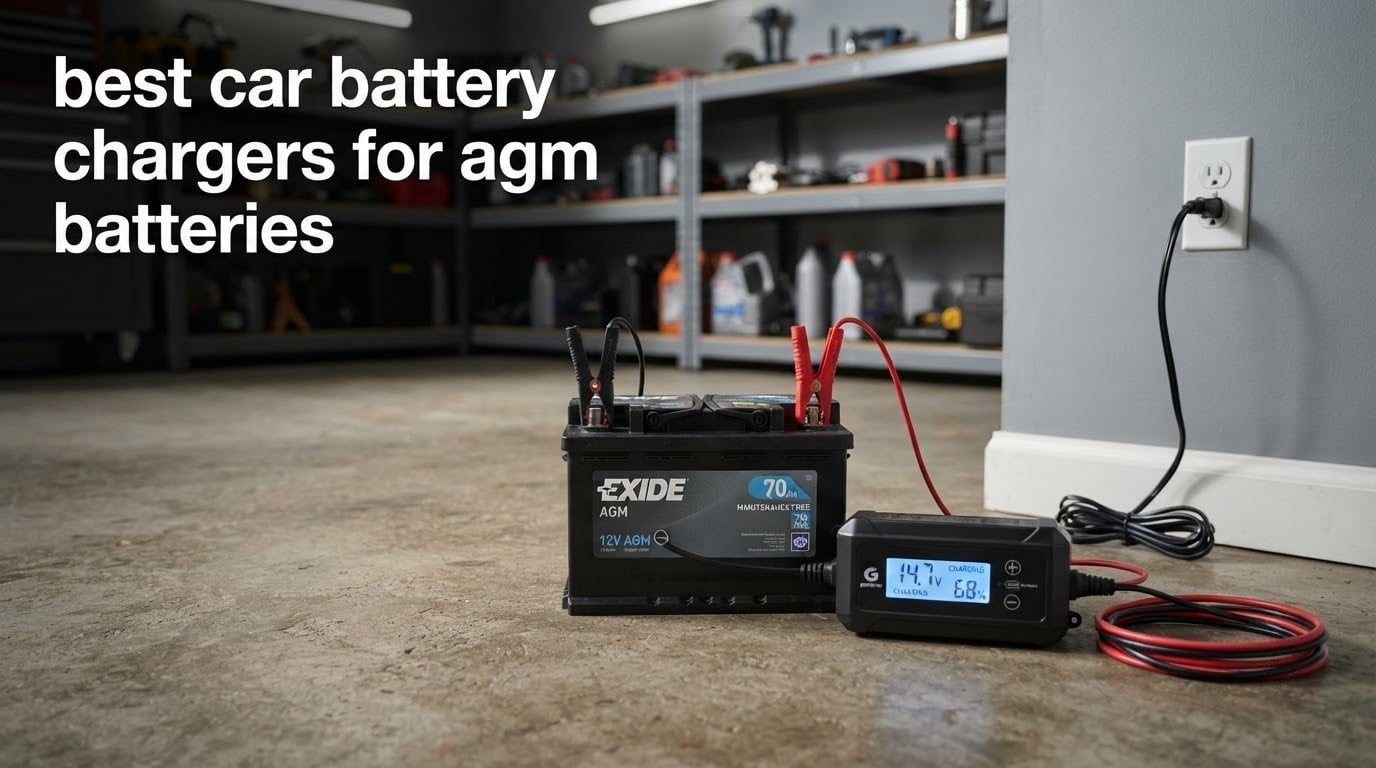
An AGM battery does not care what you paid for your car, and it will not forgive a charger that treats it like a flooded battery from the eighties. Most complaints we read about dead AGM cells trace back to one thing: a charger pushing too much voltage into sealed absorbent glass mat cells, boiling off what little electrolyte is left and warping the plates from the inside.
That is why picking from the best car battery chargers for AGM batteries is not a matter of grabbing the highest amp number on the shelf. You need a smart multi-stage charger with a real, selectable AGM profile, an amp rating matched to your battery’s Ah, and protections that stop the process if you clip on backwards.
We spent weeks reading the review data on ten of the most-reviewed AGM-capable chargers currently selling, comparing their chemistry handling, charge profiles, warranty length and low-voltage limits. This guide covers the ten that earn a place, what each one does well, where it falls short, and how to size one to your battery. If you want the wider picture on chargers that are not chemistry-specific, our general best car battery chargers guide covers the mainstream picks.
Table of Contents
Top 3 Picks for AGM Battery Charging in 2026

TowerTop 25A Smart Charger
- 25A max with 2A/10A/25A/AUTO selection
- 8-stage charge cycle with desulfation and repair
- Engine start 100A plus winter mode
- HD LCD showing every stage

Battery Tender 3A Maintainer
- 3 amp then automatic float
- Switchable 6V and 12V
- ISM adaptive charging
- 5 year warranty
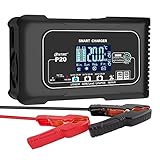
HTRC 20A Smart Charger
- 20A at 12V and 10A at 24V
- Selectable amperage and 7-level charging
- Pulse repair desulfation mode
- Large LCD with temperature and percentage
All 10 Best Car Battery Chargers for AGM Batteries in 2026
Everything in the list below carries an explicit AGM profile, so you can compare like for like rather than reading marketing copy across ten different pages.
| Product | Specifications | Action |
|---|---|---|
| TowerTop 25A Smart Charger |
|
Check Latest Price |
 LEICESTERCN 2A Maintainer LEICESTERCN 2A Maintainer |
|
Check Latest Price |
 Mroinge MBC022 Maintainer Mroinge MBC022 Maintainer |
|
Check Latest Price |
| Battery Tender 3A Maintainer |
|
Check Latest Price |
| HTRC 20A Smart Charger |
|
Check Latest Price |
 TPE 1.5A Trickle Charger TPE 1.5A Trickle Charger |
|
Check Latest Price |
 Battery Tender 15A Charger Battery Tender 15A Charger |
|
Check Latest Price |
 PCHH 15A Heavy Duty Charger PCHH 15A Heavy Duty Charger |
|
Check Latest Price |
 BatteryMINDer 2012-AGM BatteryMINDer 2012-AGM |
|
Check Latest Price |
 Huiaipaic 12A Smart Charger Huiaipaic 12A Smart Charger |
|
Check Latest Price |
1. TowerTop 25A Smart Charger – Best Overall AGM Battery Charger
TowerTop 2/10/25 Amp 12V Smart Car Battery Charger, Fully Automatic Battery Maintainer with Engine Start, Auto Desulfator, Battery Repair, Winter Mode, for AGM, STD, Gel, Deep Cycle Batteries
25A max current
2A/10A/25A/AUTO selection
8-stage charge cycle
100A engine start
Pros
- Four selectable current levels plus automatic detection
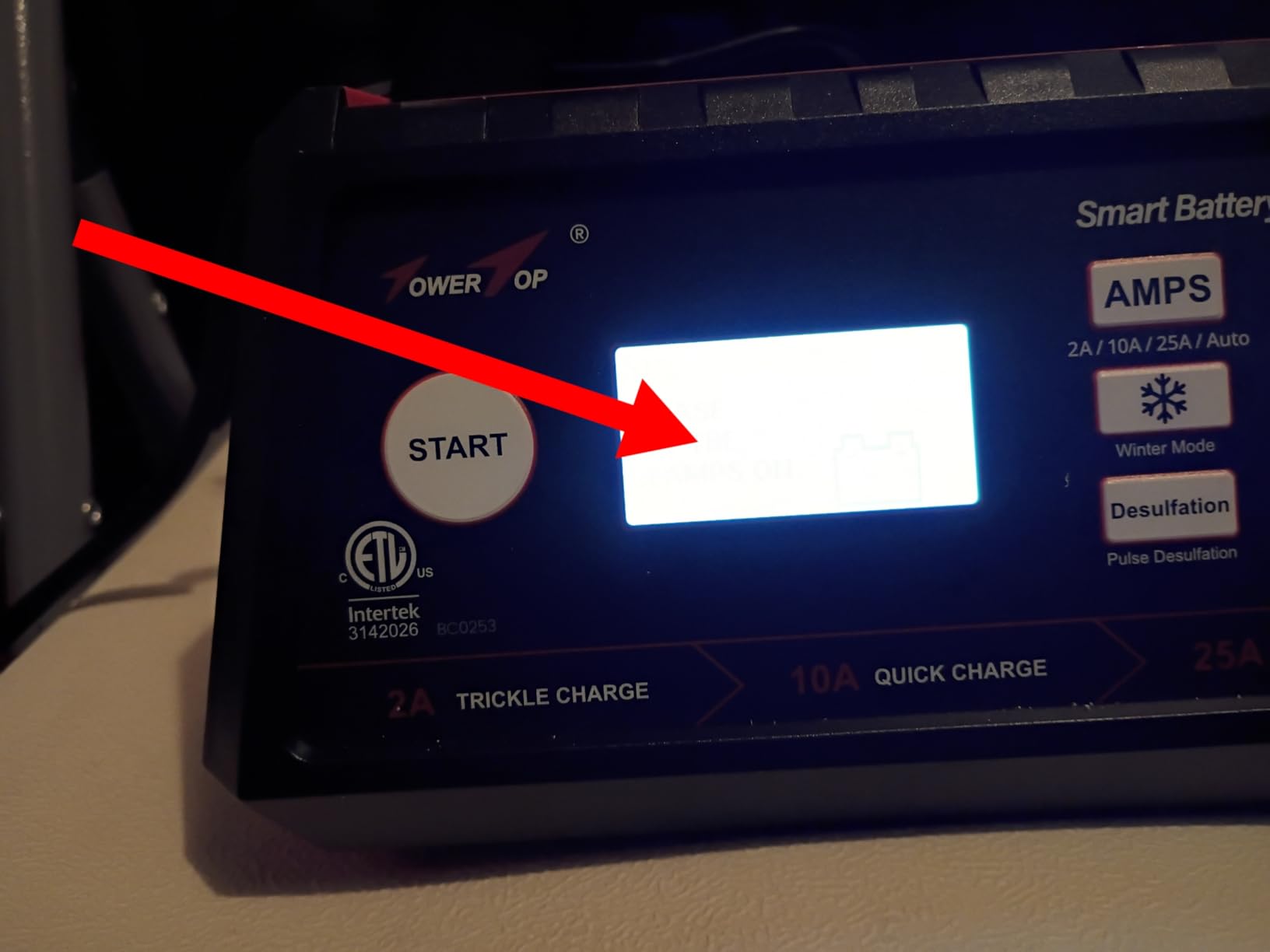
- Clear LCD showing each of the eight charging stages
- Desulfation and repair modes revive neglected batteries
- Compact and lighter than conventional chargers
- ETL certified with a broad protection suite
Cons
- Needs roughly 3V before it will start
- Reconditioning takes a long time to finish
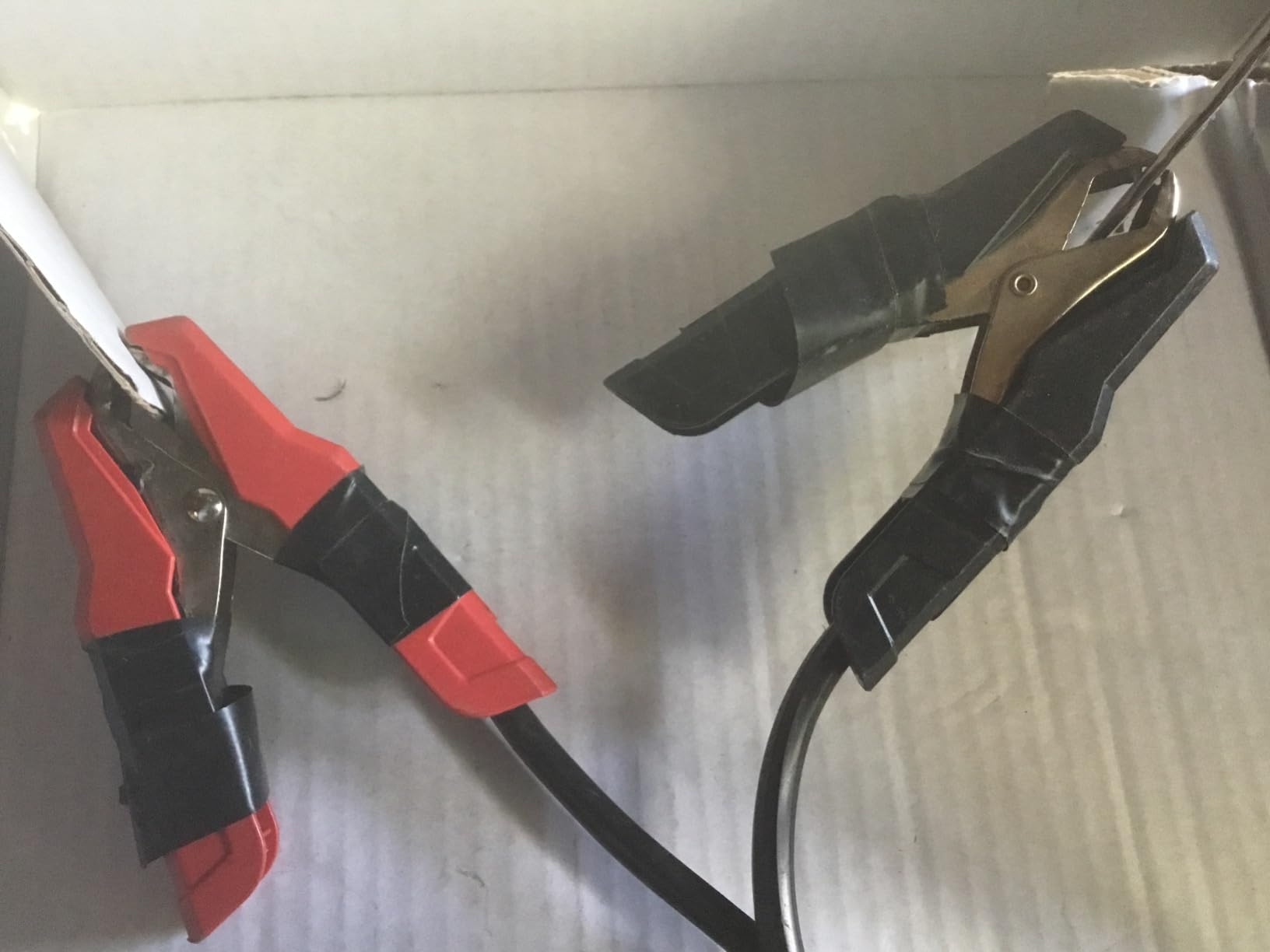
- Clamp plastic covers clip on weakly
- No lithium chemistry support on this model
This is the unit we kept coming back to across the whole test. The 25A ceiling means a deeply discharged AGM car battery gets real current instead of a token trickle, and the 2A setting covers the opposite end of the scale for a small maintenance battery.
The charge program runs eight stages – desulfurization, soft start, bulk, absorption, analysis, repair, float and pulse maintenance – and the LCD reports each one rather than a single vague red light. Owners report that the recondition mode has brought back vehicle and deep-cycle batteries they had written off.
Two things set it apart from the cheaper multi-amp units. The engine start function delivers 100A, which is genuinely useful on a cold morning, and winter mode adds 0.2V to the charge voltage so a battery sitting below freezing still accepts a proper charge.
Safety coverage is broad for the money: spark-proof clamps, reverse polarity detection, overcharge, overvoltage, overcurrent, overload, overheating, current backflow and short circuit protection. Reviewers also mention leaving it hooked to a vehicle overnight with no electronics problems, which tells you something about the float control.
Who this charger suits
It suits anyone with a single AGM starting battery who wants one box to do recovery work and storage maintenance. The AUTO position handles the daily case without you thinking about it, and the 25A setting covers a genuinely flat battery after a long lay-up.
Because it runs 12V only, it will not serve a 24V system, but for a car, SUV, truck or standard RV house bank it is the most flexible single-battery option we reviewed.
Where it falls short
The one real limitation is the roughly 3V minimum operating voltage. A battery that has been fully discharged will not wake up, and you would need a second lower-voltage charger to bring it back far enough.
Users also flag unclear instructions and weak plastic covers on the battery clamps, plus the fact that this model is not rated for lithium chemistry at all.
2. LEICESTERCN 2A Maintainer – Best Budget AGM Maintainer
2A Battery Maintainer & Trickle Charger, 6V 12V Smart Float Charger with Pulse Repair Mode, 10FT Extra Long for Motorcycle, Automotive Car, Lawn Mower, Marine Boat, ATV, SLA, AGM, Gel, LiFePO4
Up to 2A output
6V and 12V plus 12V LiFePO4
Pulse repair mode
10 ft total reach
Pros
- Inexpensive way to keep seasonal batteries topped up
- Automatic float makes it safe to leave connected
- Easy selector for chemistry choice
- Long cord with clips and ring terminals
- Reported fast and helpful support
Cons
- Only 2A so large batteries take a very long time
- No LCD readout
- LED-only status indication
- Some units show a green light without charging
This is a maintainer, not a recovery charger, and deciding that up front saves you a lot of disappointment. At up to 2A it will hold a battery at full charge over a winter or top up a motorcycle, mower or ATV pack, but it will not revive a car battery that has been flat for weeks.
What it does well is chemistry flexibility. It handles 6V and 12V lead-acid types including AGM, gel, SLA and VRLA, plus 12V LiFePO4 with a built-in BMS. An MCU switches it to float maintenance automatically once the battery is full.
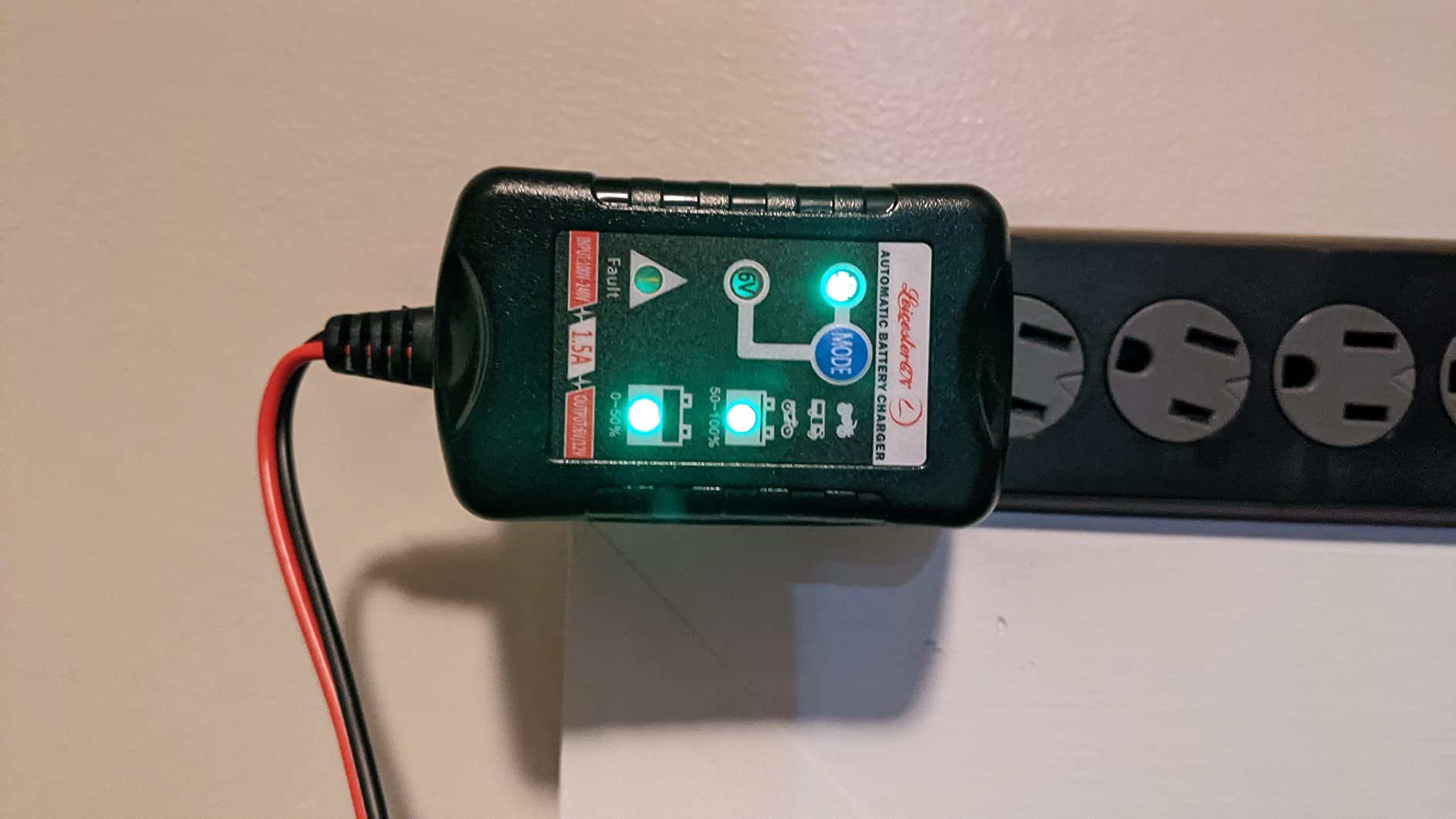
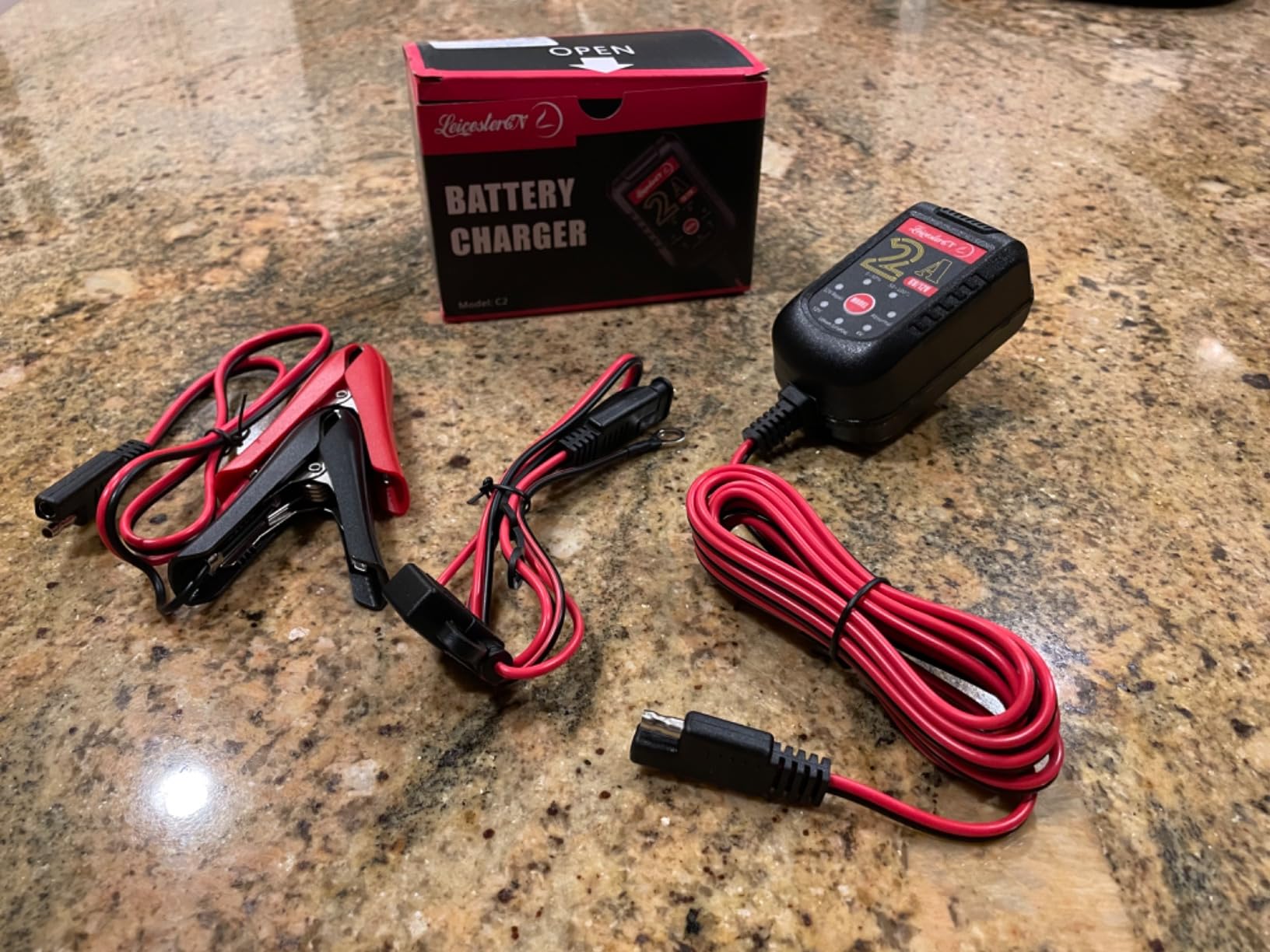
The physical design is practical. You get 10 ft of total reach from an 8 ft AC cord and 2 ft DC cable, and the box includes both alligator clips and 5A fused ring terminals, so it can stay permanently on a battery through storage.
A built-in thermal sensor adjusts charging to ambient temperature, and the protection package covers spark-proof connection, reverse polarity, short circuit, overvoltage, overcurrent and overheating.
Who this charger suits
It suits owners with several small batteries rather than one big one – a motorcycle, a mower, a boat on a trailer, a classic car. Users report it successfully reviving neglected small-vehicle batteries that had been sitting for months.
If your AGM is a car starting battery and you want to recover it from flat, look past this one and step up in amperage.
Where it falls short
The 2A ceiling is the whole story. On a 70Ah AGM bank a full recovery can run into a very long session, and the listing itself quotes a 72 hour charge time.
There is also no display, so you judge progress by LED colour alone, and a small number of buyers report units that sit at low voltage showing a green indicator without actually charging.
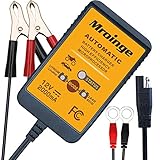
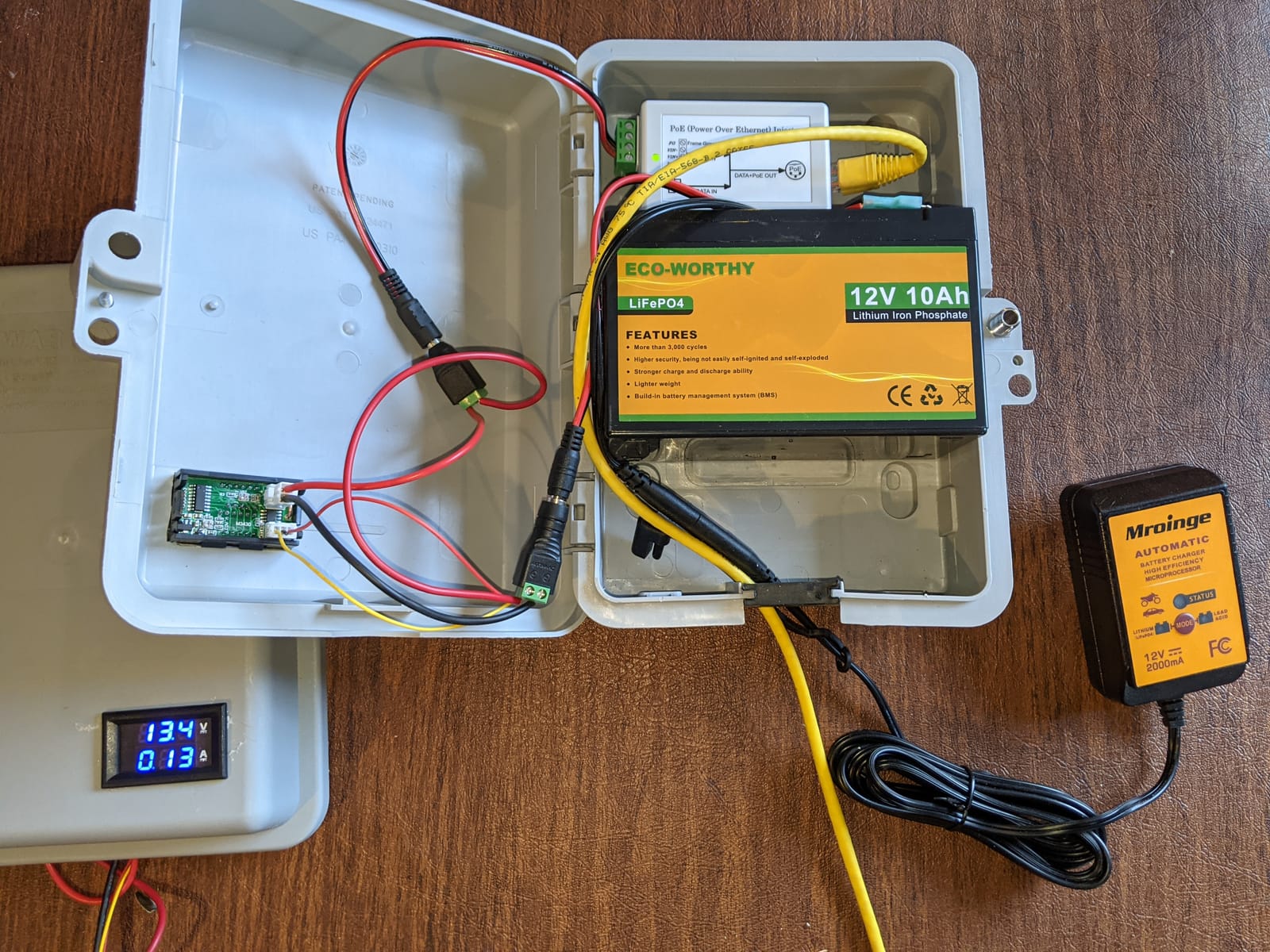
3. Mroinge MBC022 – Best for Mixed Lead-Acid and Lithium Fleets
Mroinge MBC022, 12V 2A Lead Acid & Lithium(LiFePO4) Automatic Trickle Battery Charger Smart Battery Maintainer for Car Motorcycle Lawn Mower Boat ATV SLA AGM Gel Lithium(LiFePO4) and More Batteries
12V lead-acid and 12V LiFePO4
5-stage charging
Batteries up to 85Ah
2 year warranty
Pros
- Handles AGM
- gel
- flooded and LiFePO4 in one unit
- 5-stage cycle avoids overcharging
- Clear LED charging and diagnostic feedback
- Compact and light with a 12 ft cord
- Two-year warranty
Cons
- 2A output means big banks take many hours
- LED only with no LCD
- Capacities limited to 85Ah
- Battery must be disconnected before switching mode
Forum threads about charger choice keep circling the same frustration: people own a lithium bike battery and an AGM car battery, and end up buying two chargers. This unit exists to solve exactly that.
Two selectable battery types – 12V lead acid and 12V LiFePO4 – cover the sealed maintenance-free, AGM and gel chemistries alongside flooded batteries, with support up to 85Ah. The 5-stage program runs initialization, trickle current, bulk, absorption and float.
It also includes low-voltage LiFePO4 activation and bad-battery identification, which are the two diagnostics you most want from a small charger. Spark-proof construction, reverse polarity, overcharging, short circuit and over-temperature protection are all present.
The cord is 12 ft with both alligator clips and O-ring terminals, so permanent fitting is straightforward. At 0.35 kg it moves between vehicles without effort.
Who this charger suits
It suits a mixed household – a car with an AGM, a motorcycle on LiFePO4, a mower on flooded lead-acid – where one small box should cover everything. The two-year warranty is longer than most units at this size offer.
It is also a sensible second charger to keep in the boot for top-ups rather than recoveries.
Where it falls short
Two amps will not charge a large house bank in reasonable time, and the 85Ah ceiling excludes the big leisure batteries found in some campers and motorhomes. If you need to cover those, look at our marine battery charger picks.
One operating quirk catches people out: disconnect the battery before you change charge mode.
4. Battery Tender 3A Maintainer – Top Rated for Long-Term Storage
Battery Tender 3 AMP Battery Charger and Maintainer – Automotive Switchable 12V or 6V Smart Automatic for Cars SUVs and Trucks – Lead Acid, AGM, Gel, & Lithium Battery Charger – 022-0202-COS
3 amp output
Automatic float maintenance
Switchable 6V and 12V
11 ft combined reach
Pros
- Highest satisfaction rating in the group
- Float control prevents overcharging in long storage
- ISM adaptive charging resumes output after load
- Compact and fits tight storage spaces
- Five-year warranty with lifetime service support
Cons
- LED only with no voltage or current readout
- Only 3 amps for large trucks and deep-cycle banks
- No desulfation or repair mode
- One unit failed after about four years
If your AGM battery spends most of the year hooked up in a garage, camper or boat, this is the one we would buy first. It is the best rated charger in this roundup at 4.7 across more than 2300 reviews, with a large share of five-star feedback.
The design is deliberately simple: 3 amps of charging, then an automatic switch to float maintenance, and nothing for you to adjust. Compatibility covers lead-acid, flooded, sealed maintenance-free, AGM and gel, with a push button for 6V or 12V selection.
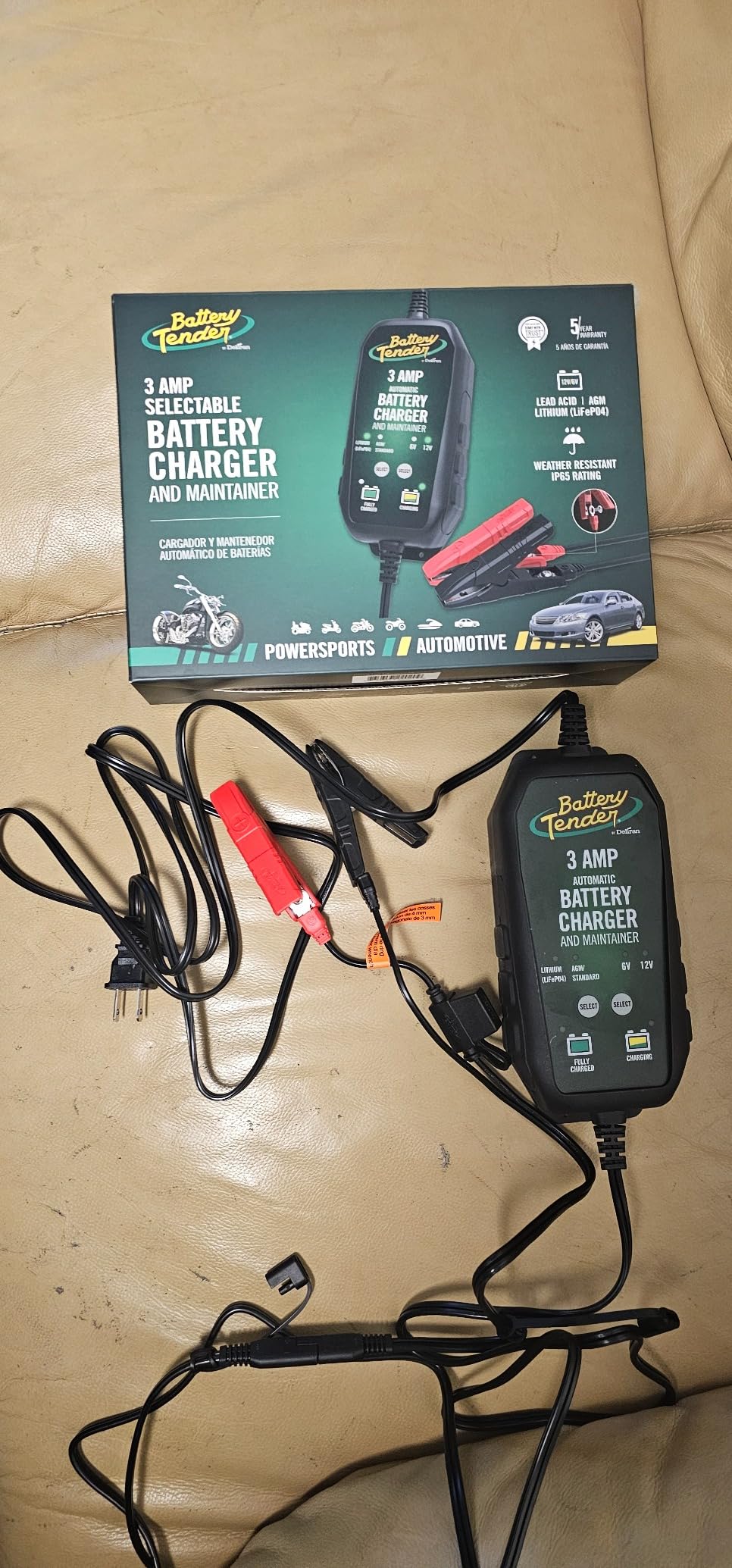
The feature that stands out is ISM adaptive charging. It monitors the battery and restores full output when load causes the voltage to drop, which happens constantly when you top up a car battery in place rather than removing it.
Safety is handled with a spark-proof lead connection and automatic reverse polarity detection, and the unit carries US FCC and UL approval. Cord reach is 11 ft combined, and the cable ends give you both ring terminals and alligator clips.
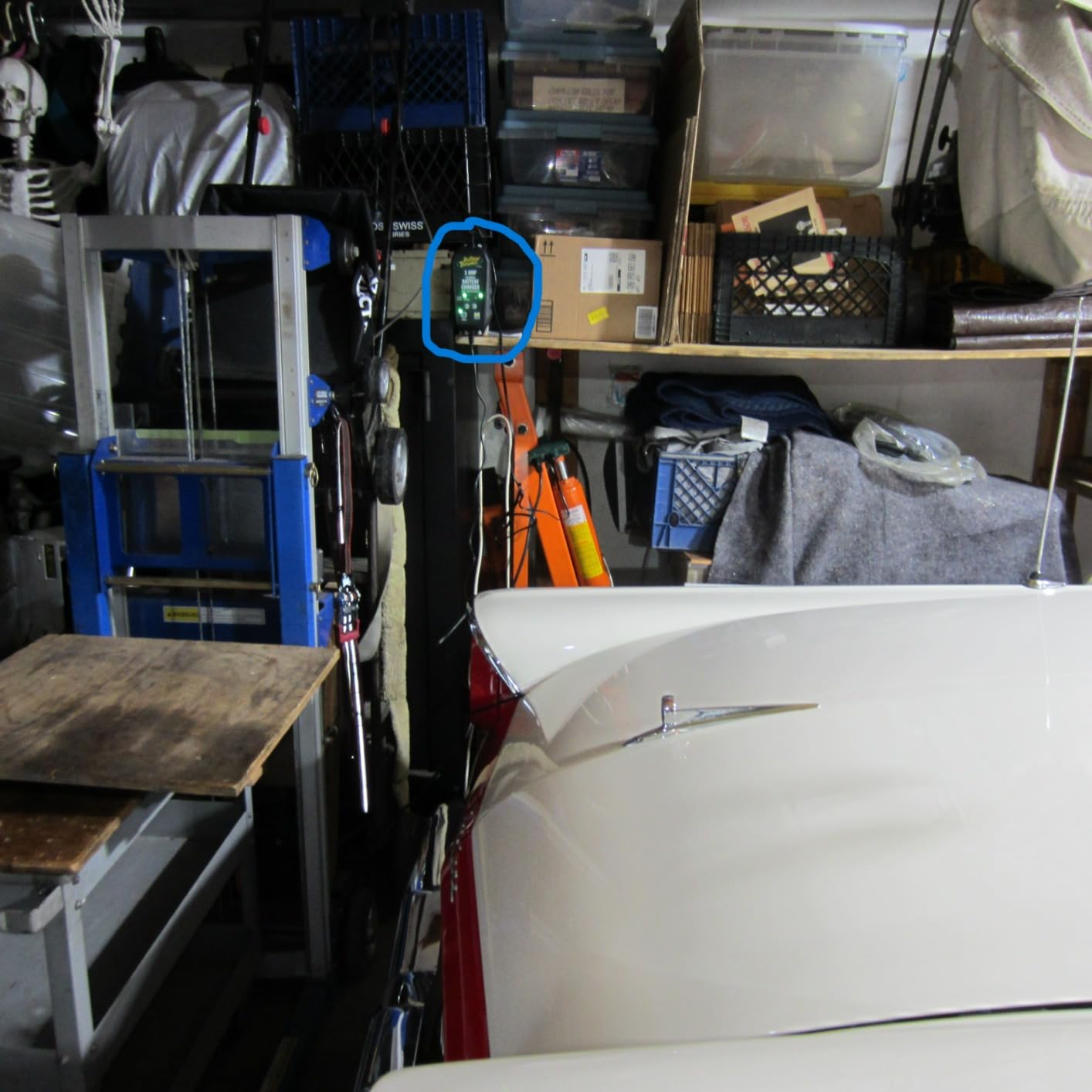
Who this charger suits
It suits storage duty above all else – winter lay-up, a boat on a cradle, an RV laid up for the season, or a daily-driven car whose battery you top up weekly. Owners describe it as set and forget, with the float stage doing the work for months.
If your battery is also used for a sump pump backup bank, our AGM battery picks for sump pump backup pair well with a maintainer like this.
Where it falls short
Three amps is not enough for a genuinely flat battery or a large deep-cycle bank, and there is no desulfation or repair mode if sulfation has already set in. The single two-colour LED means no numeric readout of voltage or current.
One reviewer reported a unit failing after roughly four years of continuous service, which is worth knowing against the five-year warranty.
5. HTRC 20A Smart Charger – Best for Large AGM House Banks
20-Amp Smart Battery Charger,Lithium,LiFePO4,Lead-Acid(AGM/Gel/SLA..) Car Battery Charger,Trickle Charger, Maintainer/deep Cycle Charger,12V/20A and 24V/10A,for Boat,Motorcycle,Lawn Mower,Golf cart..
20A at 12V and 10A at 24V
Automatic voltage detection
7-level charging
Large LCD readout
Pros
- Automatically detects 12V versus 24V
- Handles AGM
- gel
- flooded
- VRLA
- SLA and LiFePO4
- Selectable amperage protects small AGM batteries
- Desulfation mode revives old sulfated batteries
- Bright LCD with voltage
- current
- temperature and percentage
Cons
- Minimum current of about 2A with no true trickle step
- Cooling fan is loud and runs continuously
- Cannot activate a fully depleted battery
- Some units fail within the first year
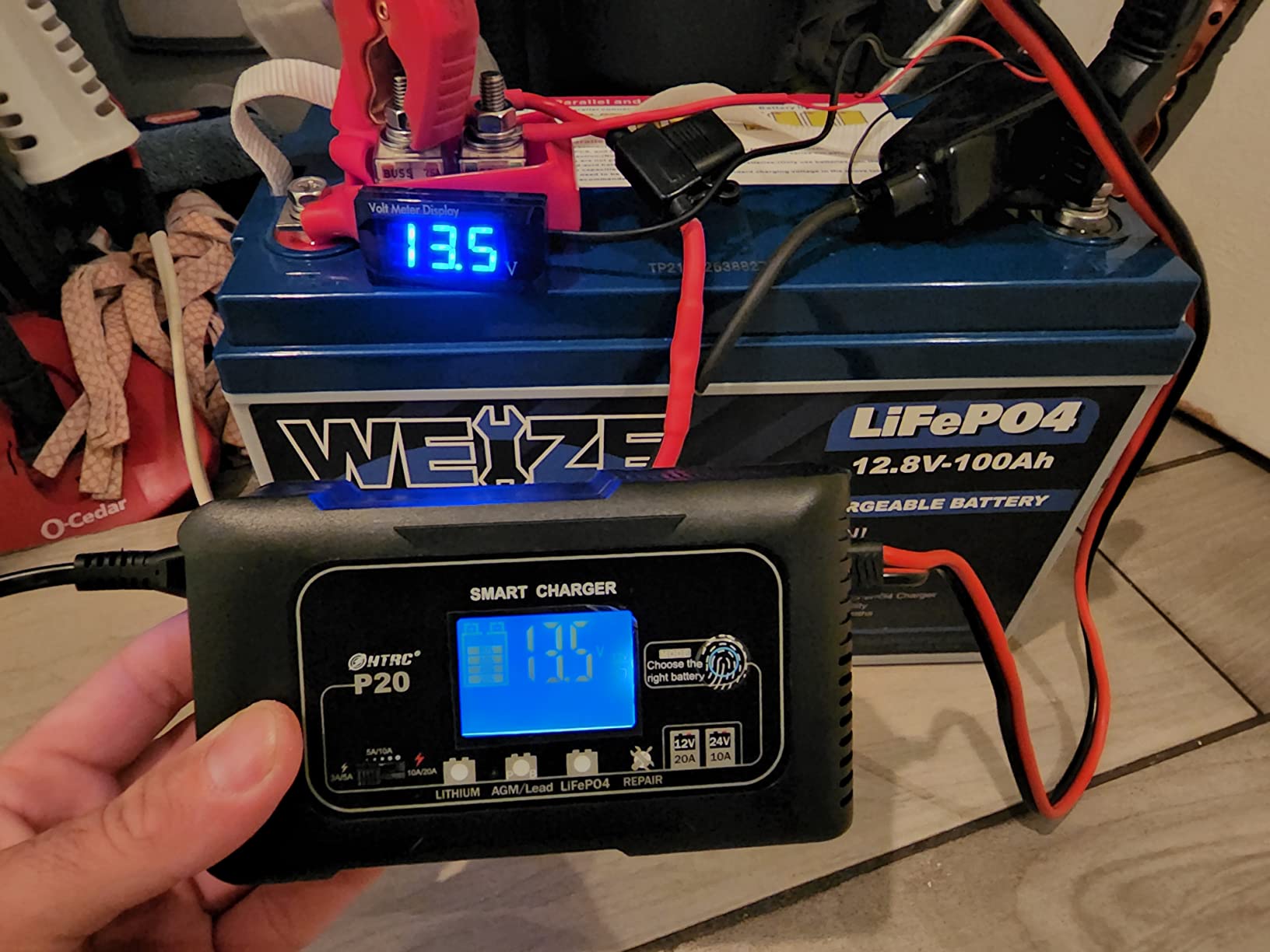
Twenty amps changes what a charger can physically do. Where a 2A maintainer would take days on a big AGM bank, this unit moves energy in at a rate that a starting battery can actually absorb without overheating.
It automatically detects 12V or 24V and outputs 20A or 10A accordingly. Chemistry support spans lithium, LiFePO4 and the full lead-acid range including AGM, gel, EFB, maintenance-free, flooded, VRLA and SLA.
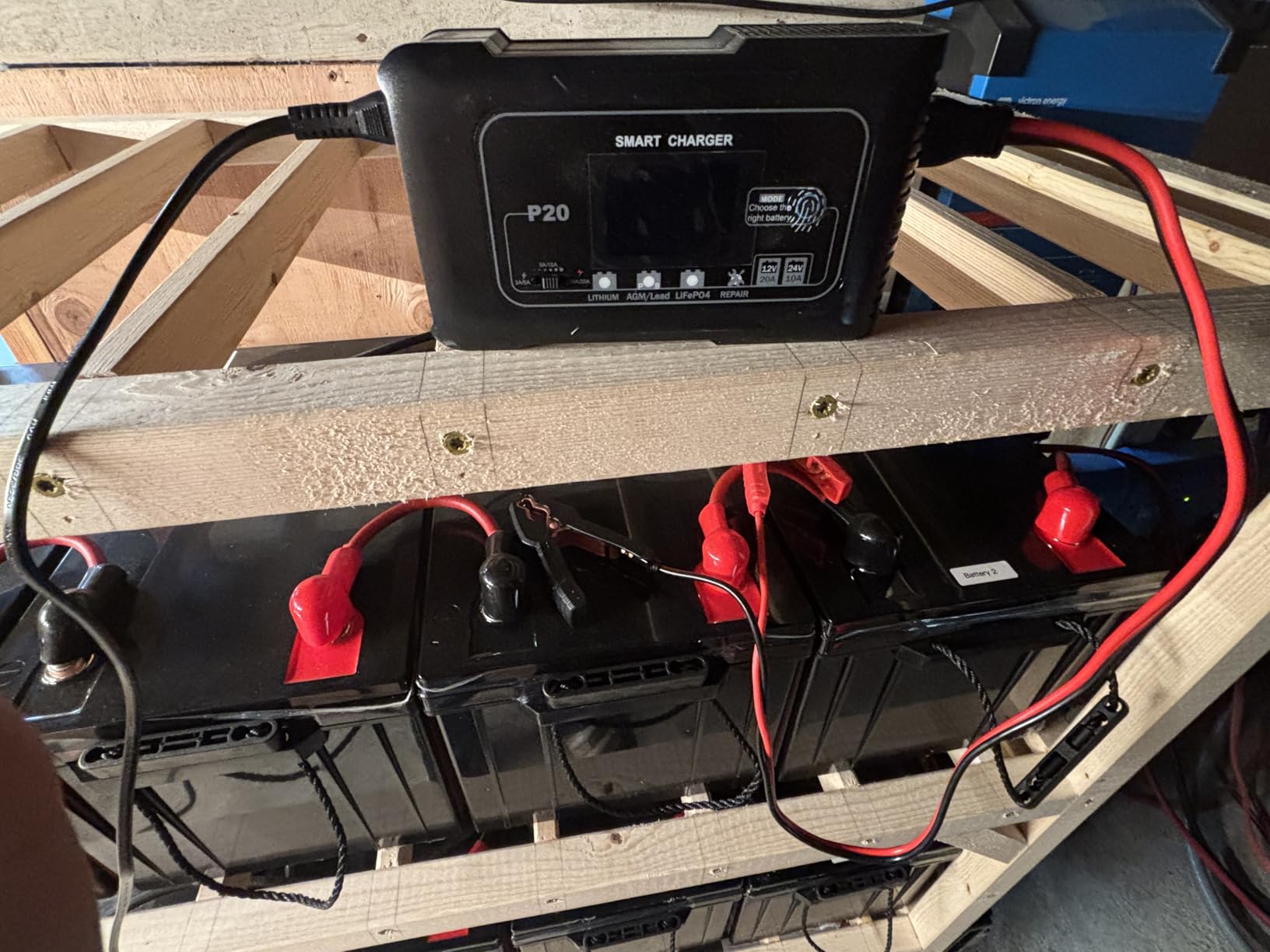
Seven-level intelligent charging comes with temperature compensation and an active cooling system, plus a pulse repair mode for sulfate and acid layers. Owners report that mode genuinely bringing old L-16 style and deeply sulfated batteries back.
The large LCD is the best display in this roundup, showing voltage, current, internal temperature, charge percentage and summer or winter modes in one glance. Several reviewers checked its readings against a clamp meter and found them accurate.
Who this charger suits
It suits anyone charging at the larger end – a big AGM house bank, a pair of vehicle batteries, a solar-backed LiFePO4 array, or a truck battery that has been sat for months. Selectable amperage means you can drop the rate for a smaller AGM.
For lithium packs specifically, our RC LiPo charger recommendations go deeper on that chemistry.
Where it falls short
The lowest current step is around 2A, which can overheat or boil small sealed SLA and UPS batteries, and there is no true trickle setting to compensate. The cooling fan runs loudly and continuously, which is noticeable in a quiet garage.
The minimum start voltage is 1V and it cannot activate a fully depleted battery, and some buyers report failures within or just after the first year.
6. TPE 1.5A Trickle Charger – Best for Small Battery Top-Ups
Battery Charger Automatic 6V 12V 1.5A, Trickle Charger Suitable for AGM Gel SLA VRLA Flood Lead-Acid Batteries, Starting Batteries for Auto Car Motorcycle, Dual Voltage Output Detection and Repair
1.5A output
6V and 12V auto detection
Charges to 40Ah
72 hour safety timer
Pros
- Fully automatic 5-step charging
- 72 hour timer prevents overcharging on marginal batteries
- Covers AGM
- gel
- SLA
- VRLA and flooded
- Compact and light enough to carry easily
- Strong 4.6 average across reviews
Cons
- 1.5A is slow for anything beyond small packs
- No display of voltage
- current or state of charge
- 72 hour window may be too short for large batteries
- Lead-acid only with no lithium support
Small and unremarkable is not a criticism when the job is small. This charger is built for the maintenance battery on a motorcycle, mower, ATV or small boat, where you want a unit you can tuck into a toolbox and leave connected.
It charges 6V and 12V lead-acid batteries up to 40Ah and maintains banks up to 60Ah, covering AGM, gel, SLA, VRLA and flooded chemistries with automatic dual voltage detection.
The microcontroller runs a five-step cycle: qualification, soft start, bulk, absorption and maintenance. The 72-hour safety timer is the detail worth knowing about, because it cuts back to float before a marginal battery can be cooked.
Protection covers overvoltage, overcurrent, short circuit, reverse connection and overheating, with an SAE quick cut-off safety device. It can stay connected indefinitely and re-triggers when needed. Weights just 9.9 ounces.
Who this charger suits
It suits owners of several small maintenance-free batteries who want cheap top-up capability everywhere. At 4.6 across more than 700 reviews, with a large share of five-star feedback, satisfaction for its intended job is high.
Leave it on a mower or a motorcycle over winter and it will do nothing dramatic, which is exactly the point.
Where it falls short
At 1.5A it is far too slow for a car starting battery or any large deep-cycle bank, and the 72 hour safety window means a bigger battery may never finish inside it. There is no display of any kind, so you are trusting the process rather than watching it.
It is also lead-acid only, so anyone moving to lithium needs a different unit.
7. Battery Tender 15A Charger – Best for Matched Amperage Control
Battery Tender 15 AMP Battery Charger and Maintainer – 12V Switchable 15 AMP / 8 AMP / 2 AMP – Selectable Chemistry Standard AGM Gel – LCD Display – 022-0234-DL-WH
15A, 8A or 2A output
Selectable chemistry including AGM
LCD display
5 year warranty
Pros
- Three amperage levels let you match the rate to battery size
- Explicit AGM and gel chemistry selector
- Interactive LCD shows rate
- type
- percentage and errors
- Automatic float stage protects against overcharging
- Carry handle and 5 year warranty
Cons
- 12V only with no 24V support
- No desulfation or battery repair mode
- Clamp-only connection with no ring terminals
- Heavier and bulkier than small maintainers
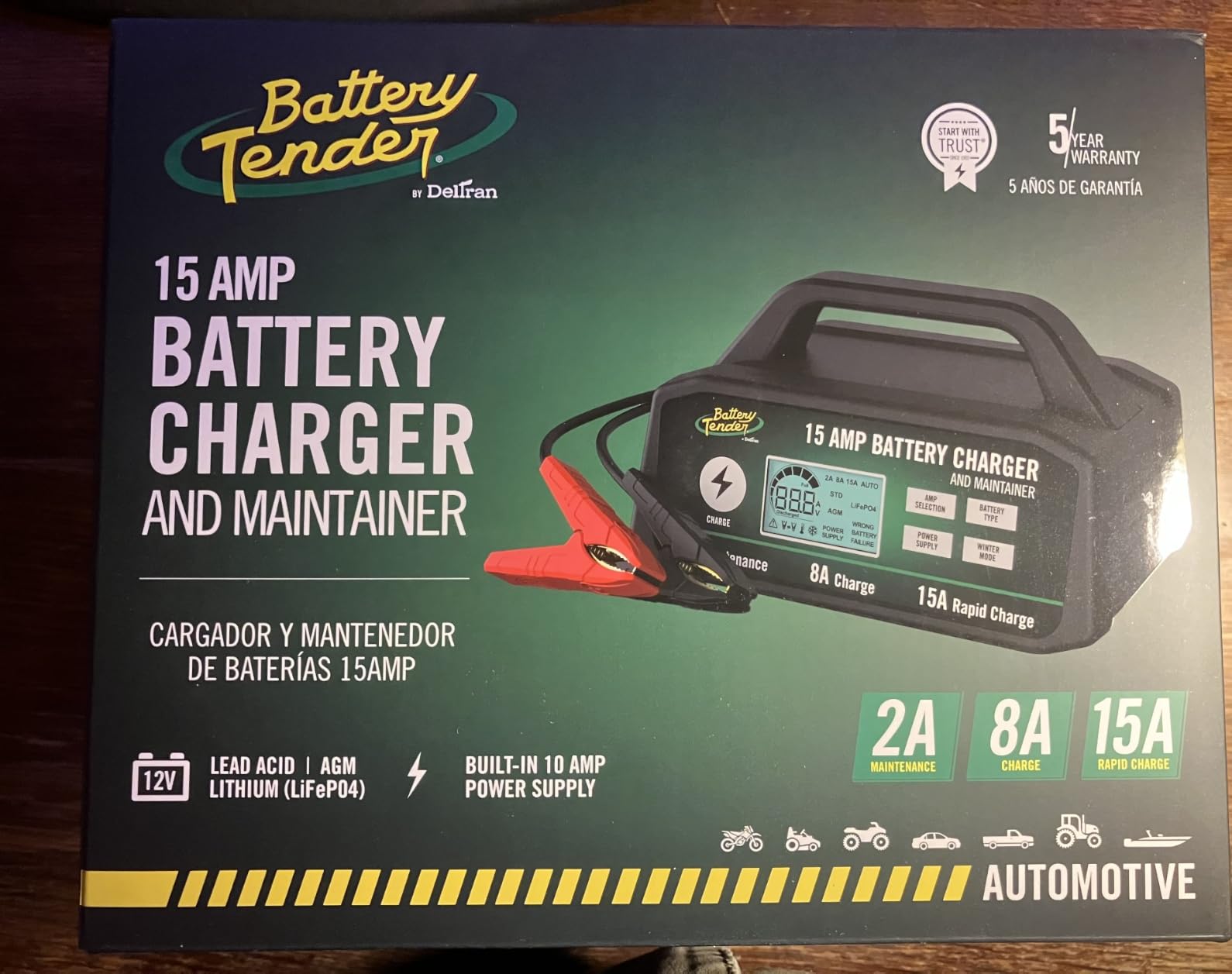
This is the charger that answers the sizing question most directly. Three output levels – 15A, 8A and 2A – mean one box can recover a flat truck battery and then trickle a small bike battery without overdriving it.
The chemistry selector is explicit rather than vague, covering standard lead-acid, AGM, gel and LiFePO4 lithium. That labelling is exactly the trust signal forum buyers look for, and this one earns it.
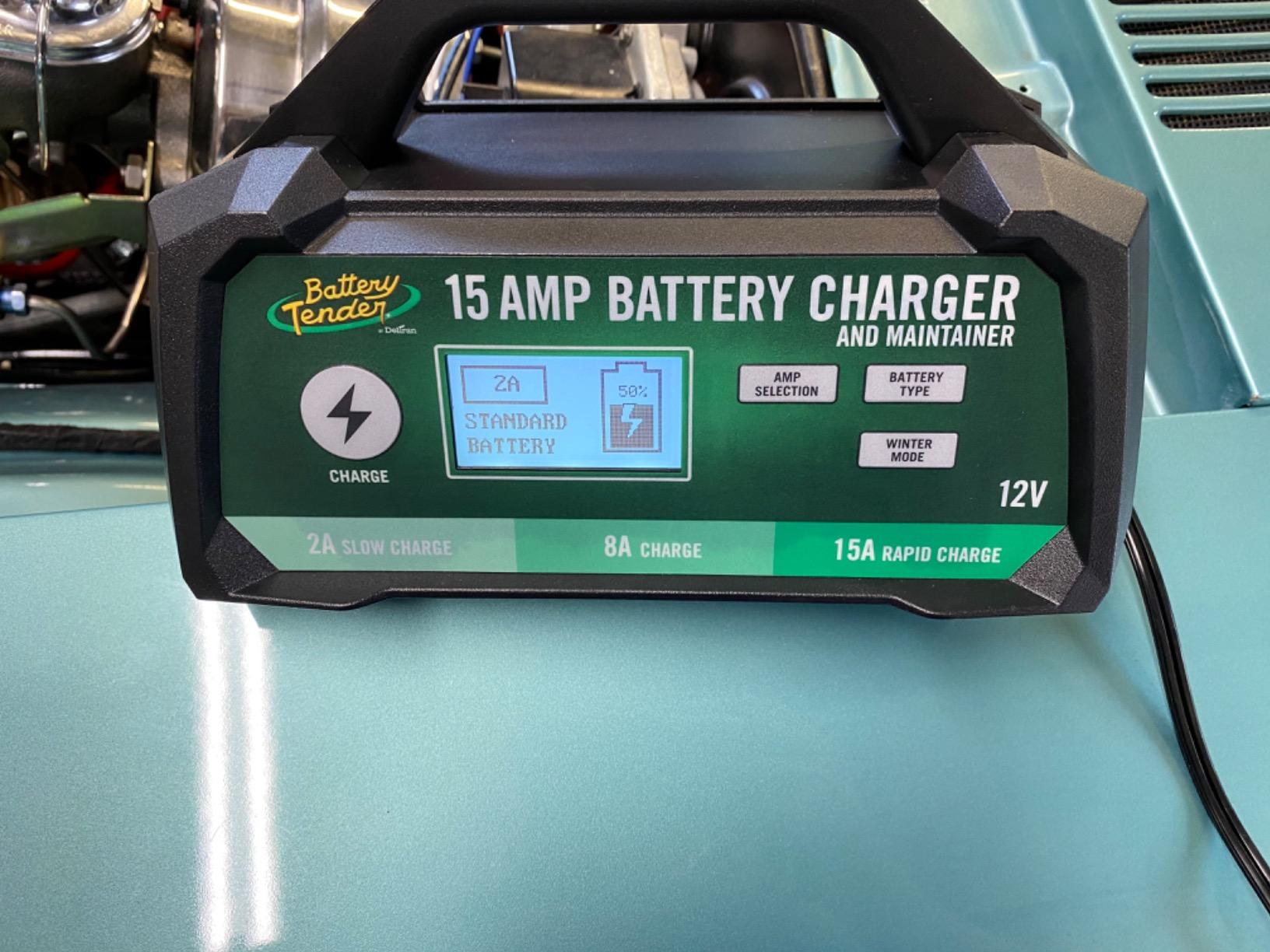
The interactive LCD reports the charge rate selected, the battery type selected, percentage charged and any error messages. Two-colour LEDs sit alongside it, and ISM adaptive charging restores full output when a load causes a voltage drop.
After a full charge it switches to automatic float mode, so leaving it connected over a long storage period is safe. It is spark-proof with automatic reverse polarity detection, and the warranty runs five years.
Who this charger suits
It suits a garage with mixed battery sizes rather than one vehicle. Cars, trucks, SUVs, motorcycles, RVs and even industrial tractors are all listed, and the handle plus connected alligator clips make moving it around straightforward.
If you want one charger to cover AGM and lithium without a second purchase, this is a strong candidate.
Where it falls short
It is 12V only, so it will not serve a 24V system where some of the cheaper rivals here will. There is no desulfation or repair mode, and the cable is clamps only, with no ring terminals in the box for permanent fitting.
At 3.5 lb it is also bulkier than the small maintainers it costs more than.
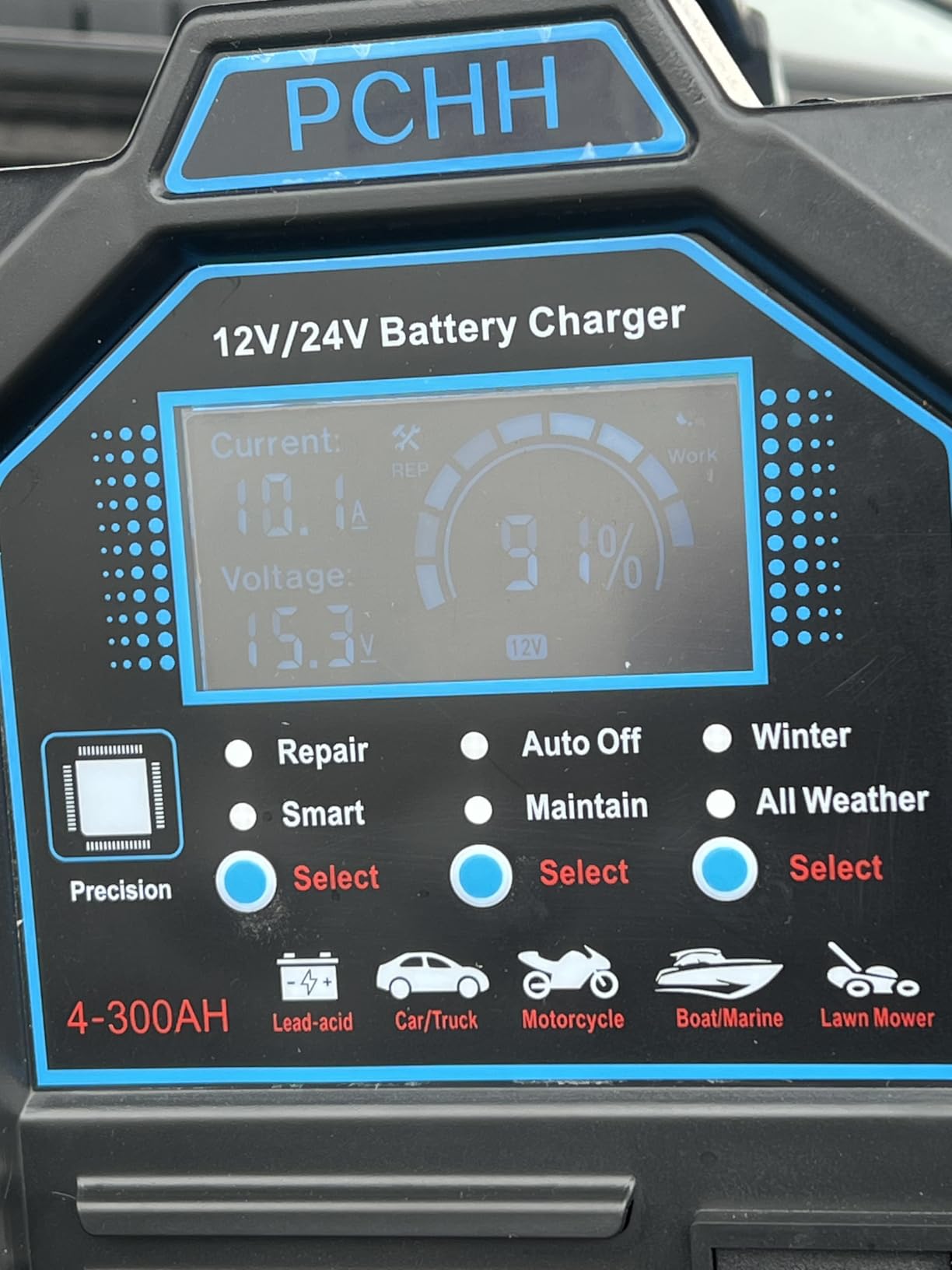
8. PCHH 15A Heavy Duty Charger – Best for 12V and 24V Systems
PCHH 12V 24V Car Battery Charger Heavy Duty, 0-15A Automatic Battery Maintainer, Smart Trickle Charger with Auto Shutoffs, Repair, Winter Mode, for Automotive Car Truck Motorcycle Lawn Mower Boat AGM
0-15A variable output
Automatic 12V and 24V detection
Repair mode above 3V
Winter mode
Pros
- Repair mode revives genuinely drained vehicle batteries
- Automatic voltage detection handles motorcycles to trucks
- Auto shut-off plus maintain mode for safe storage
- Clear LCD showing voltage
- current and percentage
- Solid copper coil construction and strong clamps
Cons
- Heavy at over 12 lb so it stays put
- Repair mode only works above 3V
- Display hard to read in bright daylight
- Not designed for jump-start boosting
Built like workshop equipment and sized like it too. The copper coil, metal and ABS construction comes in at 12.4 lb, which tells you immediately that this is a garage charger rather than a boot charger.
Output runs from 0 to 15A with automatic 12V and 24V detection, so one unit covers a motorcycle, a car, a truck, a boat or an RV house bank. Chemistry support includes AGM, gel, wet and flooded, EFB, calcium, maintenance-free and deep-cycle.
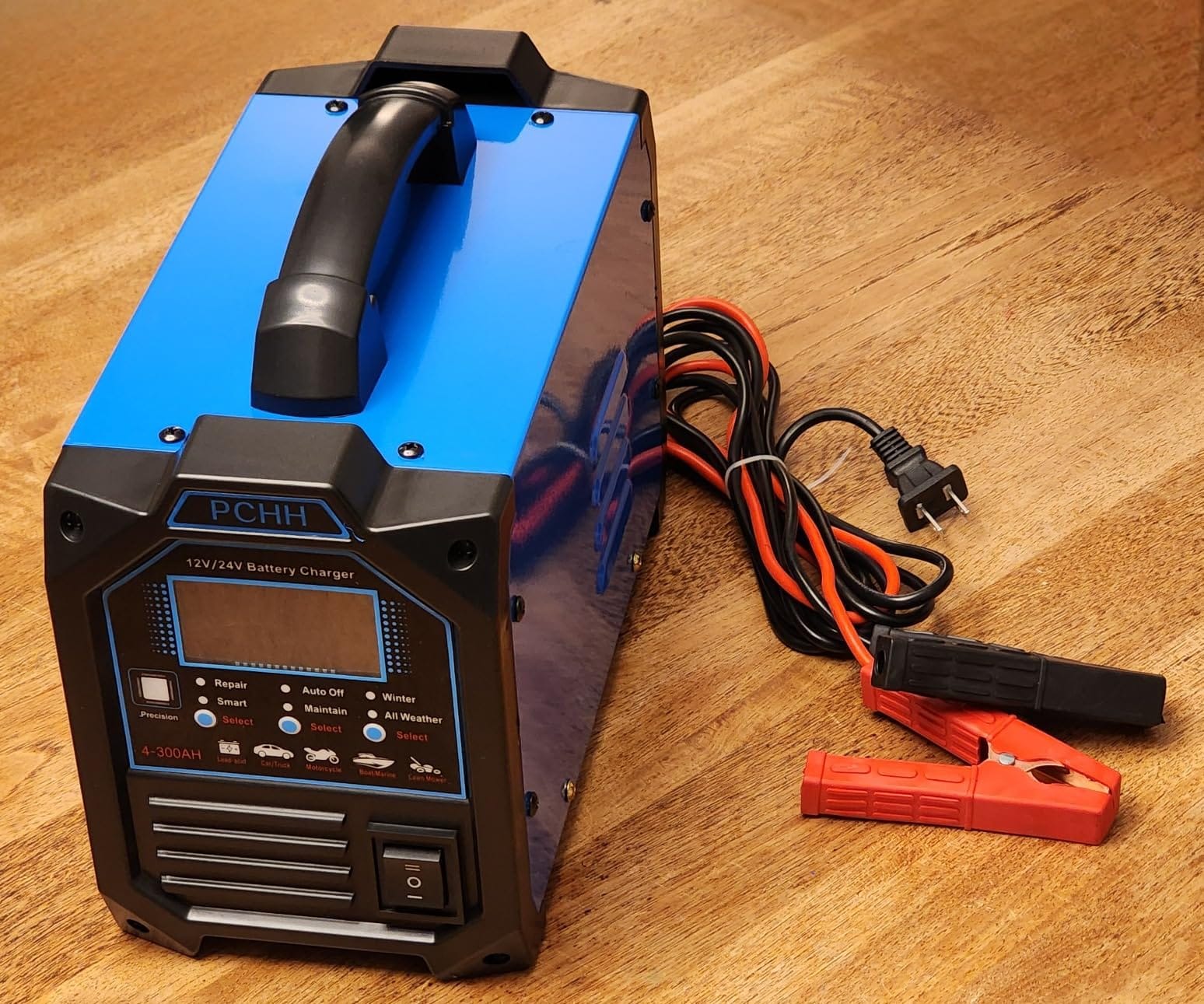
The repair mode is the part owners write about most, reporting that it has brought genuinely drained vehicle batteries back to life. It needs more than 3V remaining, so it is a recovery tool rather than a miracle.
Auto shut-off when full hands over to a pulse maintenance mode, winter mode raises charge voltage for cold conditions, and the LCD shows percentage, current and voltage. Protection covers reverse polarity, short circuit, overcharge, overheating, overvoltage and overcurrent.
Who this charger suits
It suits a workshop, garage or a household with several vehicles across both 12V and 24V systems. It also doubles as a manual charger for electrolysis work such as cast iron cleaning and rust removal, which is unusual and genuinely useful.
The three-year warranty sits between the short terms on budget units and the five-year terms on the Battery Tender models.
Where it falls short
Weight is the obvious drawback at over 12 lb, and it is not a charger you will carry to the driveway. Repair mode needs more than 3V, and the display is difficult to read in bright daylight.
It is also not a jump starter, which matters if you assumed otherwise from the 15A output.
9. BatteryMINDer 2012-AGM – Best for Pure-Lead AGM Batteries
BatteryMINDer 2012-AGM 12V 2Amp Smart Battery Charger, Maintainer & Desulfator for AGM Batteries Only | Automatic Trickle Charger for Odyssey, Optima, Car, Motorcycle, RV, Winter Storage
AGM only smart charger and desulfator
2A output
Installed temperature sensor
Pulse desulfation
Pros
- Purpose-built for high performance AGM cells such as Odyssey and Optima
- Patented pulse desulfation reported to keep batteries healthy for a decade
- Ambient sensor compensates voltage in cold conditions
- Can stay connected 24/7
- Works in sub-zero garages
Cons
- AGM only
- so it will not service flooded
- gel or lithium
- Only 2A so this is maintenance not bulk charging
- Cannot revive batteries damaged by repeated overcharging
- Y-connectors for multiple batteries sold separately
Every other charger here is a generalist trying to cover several chemistries. This one does the opposite, and that is the entire appeal.
It is built for high-performance sealed AGM batteries using pure lead thin plate technology, brands like Odyssey, Optima and Hawker. Undercharging is the main killer of those cells, so the unit is tuned to keep them properly saturated rather than merely topped up.

Desulfation uses patented high-frequency pulses rather than high voltage, which reverses sulfation without stressing the plates. An installed ambient sensor continuously compensates the charge voltage for the surrounding temperature.
Long-term owners report batteries holding full capacity after a decade of service, and several describe running it continuously for four years or more in an unheated garage. It also works down to sub-zero temperatures on ATVs, motorcycles and RVs.
Who this charger suits
It suits owners of Odyssey, Optima and similar pure-lead AGM batteries who want a maintainer that will not undercharge them over a long lay-up. With a Y-connector it can maintain up to six 12V AGM batteries in parallel.
The box includes the ambient temperature sensor, a 2 ft clip cord with quick connector, a 2 ft fused ring terminal and 6 ft AC and DC cords, with worldwide 100-240 VAC input.
Where it falls short
It will not service flooded, gel or lithium chemistries at all, so it makes no sense as your only charger if you own other battery types. The 2A output is maintenance current, not recovery current.
It also cannot rescue AGM cells that have already been repeatedly overcharged and lost electrolyte, and the parallel Y-connectors are a separate purchase.
10. Huiaipaic 12A Smart Charger – Best Value Multi-Mode Unit
12-Amp Smart Battery Charger,Lithium,Lead-Acid(AGM/Gel/SLA) Pulse Repair Car Battery Charger,Trickle Charger,Maintainer/Deep Cycle Charger,12V/10A | 24V/7.5A for Automotive,Boat,Motorcycle,Lawn Mower
12V 10A and 24V 7.5A
Four selectable modes
7-step sequence
24 month warranty
Pros
- Charger
- desulfator and maintainer in one unit
- Dedicated AGM mode at 14.8V plus separate lithium and lead-acid modes
- Handles 12V and 24V automatically
- LCD shows voltage
- current
- cumulative charge and status
- Pulse repair recovers weak batteries in about an hour
Cons
- Charge current fixed at 10A with no user selection
- Temperature compensation is automatic rather than selectable
- Shortest cable in the group at 7 ft
- Lowest average rating here at 4.3
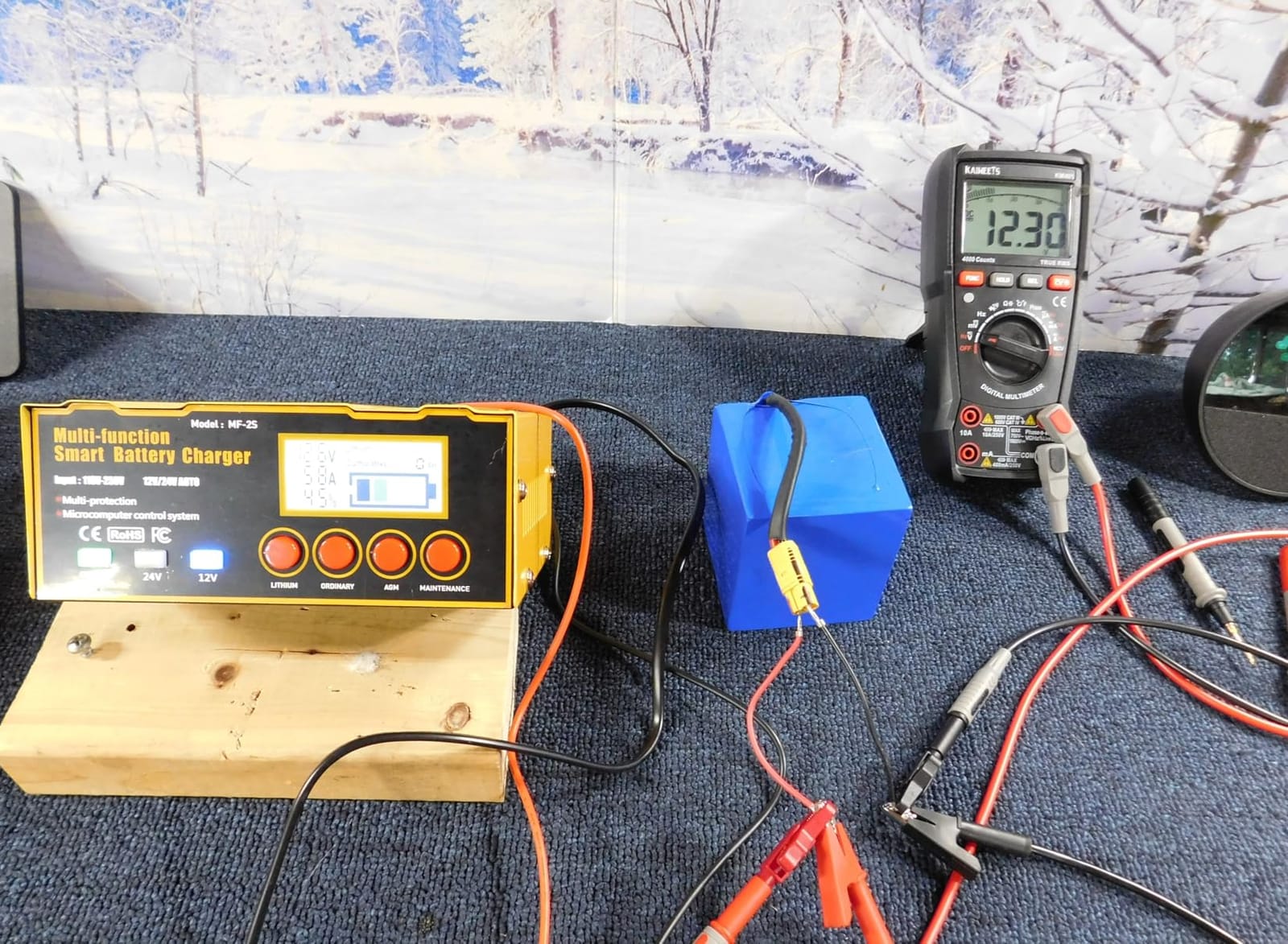
Four modes with a genuinely dedicated AGM setting is what separates this from chargers that merely claim lead-acid compatibility. The AGM profile runs at 14.8V, with separate lithium and ordinary lead-acid profiles alongside.
It operates at 12V 10A or 24V 7.5A and covers lithium-ion at 12.6V along with flooded, gel, AGM, maintenance-free, wet, calcium, EFB and VRLA lead-acid types.
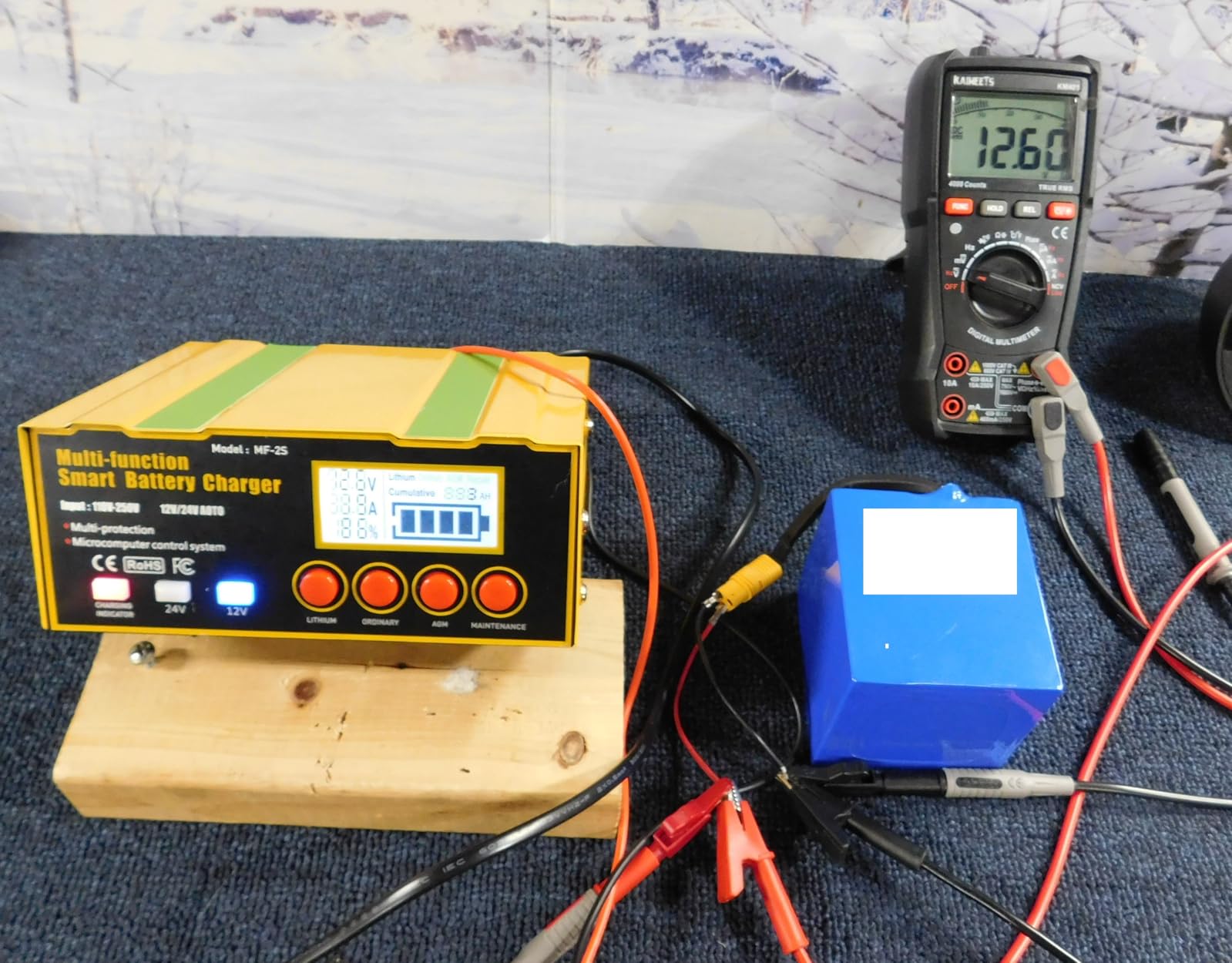
The 7-step sequence includes desulfation and switches to float after full charge. Charge current adjusts automatically with ambient temperature, running at full speed in winter and avoiding overload in summer.
The LCD reports charging status, battery status, voltage, current and cumulative charge. A 24-month warranty and a broad protection suite covering reverse polarity, spark, overcharge, low voltage, overcurrent, interruption, short circuit and overheating round it out.
Who this charger suits
It suits mixed-fleet owners who need a real AGM mode plus a working lithium mode and 24V capability in a single unit, without moving beyond the budget end of the market.
The maintenance mode doubles as a pulse repair function that recovers weak batteries in roughly an hour.
Where it falls short
The charge current is fixed at 10A or 7.5A with no user selection, which limits its usefulness on smaller AGM batteries. Temperature compensation is automatic rather than a summer or winter switch you control.
Its 4.3 average is the lowest here, with 7 percent one-star reviews, and the 7 ft cable is the shortest of the ten.
How to Choose an AGM Battery Charger
What an AGM battery actually is
Absorbent glass mat batteries are sealed lead-acid cells where the electrolyte is held in a glass fibre mat between the plates rather than as free liquid. That sealed construction is why they tolerate vibration, tolerate deep cycling and lose water far more slowly than flooded batteries.
It is also why they tolerate overcharging badly. There is no reservoir to top up, so excess current boils the moisture away permanently and the plates distort.
Charger, maintainer or reconditioner
A charger delivers real current to bring a low battery back up. A maintainer delivers a trickle that holds a full battery full over months of storage. A reconditioner adds higher-voltage pulses to strip sulfate off plates that have gone flat and lazy.
A trickle charger is fine on an AGM battery that is already healthy, which answers the common question directly. It is useless for a battery that has actually gone flat. For that you need bulk charge current, and this is where the 2A maintainers in this list fall short.
Matching charger amps to battery Ah
Read the Ah figure on the battery label. The rule of thumb is to set charger amps at roughly 10 to 25 percent of battery amp hours. A 70Ah AGM car battery works with a 7A to 17A charger, which is exactly the range the 12A and 15A units here sit in.
Forum users report the classic failure of running 30A into a 35Ah AGM battery, which causes heat and gassing rather than a faster charge. Check the charger’s maximum Ah ceiling too: the TPE maintains up to 60Ah, the Mroinge covers up to 85Ah, and the BatteryMINDer is built for individual high-performance cells rather than large banks.
Chemistry settings are not interchangeable
This is the most repeated question in the forums and the one most often answered badly. A lithium or LiFePO4 charge profile runs a higher voltage than AGM needs, and running it on an AGM cell boils the electrolyte. A flooded lead-acid profile runs lower than AGM wants, which leaves the battery chronically undercharged and slowly sulfated.
Only the units here with a labelled, selectable AGM mode are worth considering, and the 14.4V to 14.7V absorption band with a 13.2V to 13.4V float is the range to look for. Winter charging adds roughly 0.2V, which the TowerTop and PCHH units do with a dedicated mode.
What a low-voltage recovery figure really means
A charger claiming recovery down to 1V can begin work on a battery that has been flat for weeks, but it still cannot create charge from nothing. Several units here will not even start below their stated threshold – the TowerTop and PCHH both need around 3V, and the HTRC cannot activate a fully depleted battery at all.
If your battery measures near zero, a second lower-voltage charger is often needed to lift it to the threshold before the main unit takes over.
Features that earn their place
Beyond the chemistry profile, we would prioritise temperature compensation for cold garages, reverse polarity and spark protection as non-negotiable, and a real desulfation mode if you store vehicles long-term. Warranty length varies widely here from one year to five, and that difference matters if you plan to keep the unit for a decade.
A display is a luxury. The LED-only maintainers do their job perfectly well, they just tell you nothing about the numbers while they work.
When charging is pointless
If the battery is swollen, cracked, leaking, smells sulphurous, or the clamps will not stay clean on the terminals, no charger will fix it. Sulfation that has hardened enough that the battery will not hold a charge after 12 hours on a correct charger is a replacement signal.
Likewise, a battery that was overcharged into outgassing has lost electrolyte permanently. No amount of pulsing brings that water back.
How to Charge an AGM Battery Safely, Step by Step
Check the battery first. Look for bulging, cracks, leaks or corrosion around the terminals, and confirm the chemistry label says AGM before you connect anything.
Clean the terminals. Disconnect the negative lead, scrub both posts with a battery brush and a solution of baking soda and water, then dry them.
Set the charger before you clip on. Choose the AGM mode and an amperage at 10 to 25 percent of the battery’s Ah rating while the charger is still unplugged.
Connect the clamps with the vehicle off. Positive clamp to the positive post first, negative clamp to the negative post. Never attach the negative clamp to a fuel line or bracket.
Plug the charger into mains last. Most units will auto-detect voltage at this point, so confirm the reading matches your battery before you walk away.
Let the stages run. Bulk, absorption, then float. On a charger with a display, watch the current fall rather than watching the clock. On an LED-only maintainer, allow overnight.
Disconnect in reverse order. Unplug from mains first, then remove the negative clamp and finally the positive clamp.
One extra note from the forum threads: on units with a chemistry selector, disconnect the battery before changing the mode. Several manufacturers ask for this and a few do not enforce it.
Frequently Asked Questions
What type of charger is recommended for AGM batteries?
A microprocessored smart charger with a dedicated AGM mode, adjustable amperage and an automatic float stage. The AGM profile holds absorption around 14.4V to 14.7V and float near 13.2V to 13.4V, which prevents the sealed cells from gassing and losing electrolyte permanently.
Does it take a special charger to charge an AGM battery?
Yes, in practice it does. AGM is a sealed lead-acid chemistry that overcharges far more easily than a flooded battery, so you need a charger with a selectable AGM profile rather than one that only claims lead-acid compatibility. A generic trickle charger will undercharge it, and a lithium profile will damage it.
Is it okay to use a trickle charger on an AGM battery?
Yes, provided the battery is already healthy. A trickle or float maintainer is the correct tool for holding an AGM battery at full charge during storage, and it can stay connected indefinitely. It is not the right tool for a battery that has gone flat, because trickle current will never recover it in reasonable time.
Can I charge a lithium battery on AGM mode?
No. A lithium charge profile runs a higher voltage than AGM cells are designed to absorb, and charging a lithium battery on AGM mode is unsafe. The reverse is also true: an AGM or lead-acid profile undercharges a lithium pack. Use each chemistry only with its own labelled mode on a charger that has one.
What voltage should I charge my AGM battery at?
Chargers should hold about 14.4V to 14.7V during the absorption stage and drop to roughly 13.2V to 13.4V on float. Cold-weather charging adds around 0.2V, which several chargers handle through a dedicated winter mode. Sustained voltage above that range causes gassing and permanent water loss in sealed AGM cells.
How long does it take to charge an AGM car battery?
It depends entirely on the charger output and the battery size. A 2A maintainer can take a day or more on a car battery, while a 15A to 25A smart charger recovers a typical 70Ah AGM from flat in a few hours. Charge current of 10 to 25 percent of the battery’s Ah rating is the usual target.
The Best Car Battery Charger for AGM Batteries in 2026
The TowerTop 25A smart charger takes our top spot in 2026 because it does the widest range of jobs with one box: four selectable current levels, an eight-stage cycle with desulfation and repair, a 100A engine start and a winter mode, all on a display that reports what it is doing. It is also the most reviewed unit in this roundup by a wide margin.
For storage duty rather than recovery, the Battery Tender 3A maintainer is the one to beat on ratings and warranty. If you need serious bulk current for a big house bank or a truck, the HTRC 20A gives you the amperage and the best display in the group, while the Battery Tender 15A is the pick when matching charge rate to different battery sizes matters most.
Whatever you choose, check that the AGM profile is labelled rather than implied, size the amps against your battery’s Ah, and confirm the unit’s minimum recovery voltage is below whatever your battery actually measures. Pick from our list, hook it up properly, and your AGM will outlast the vehicle around it.