
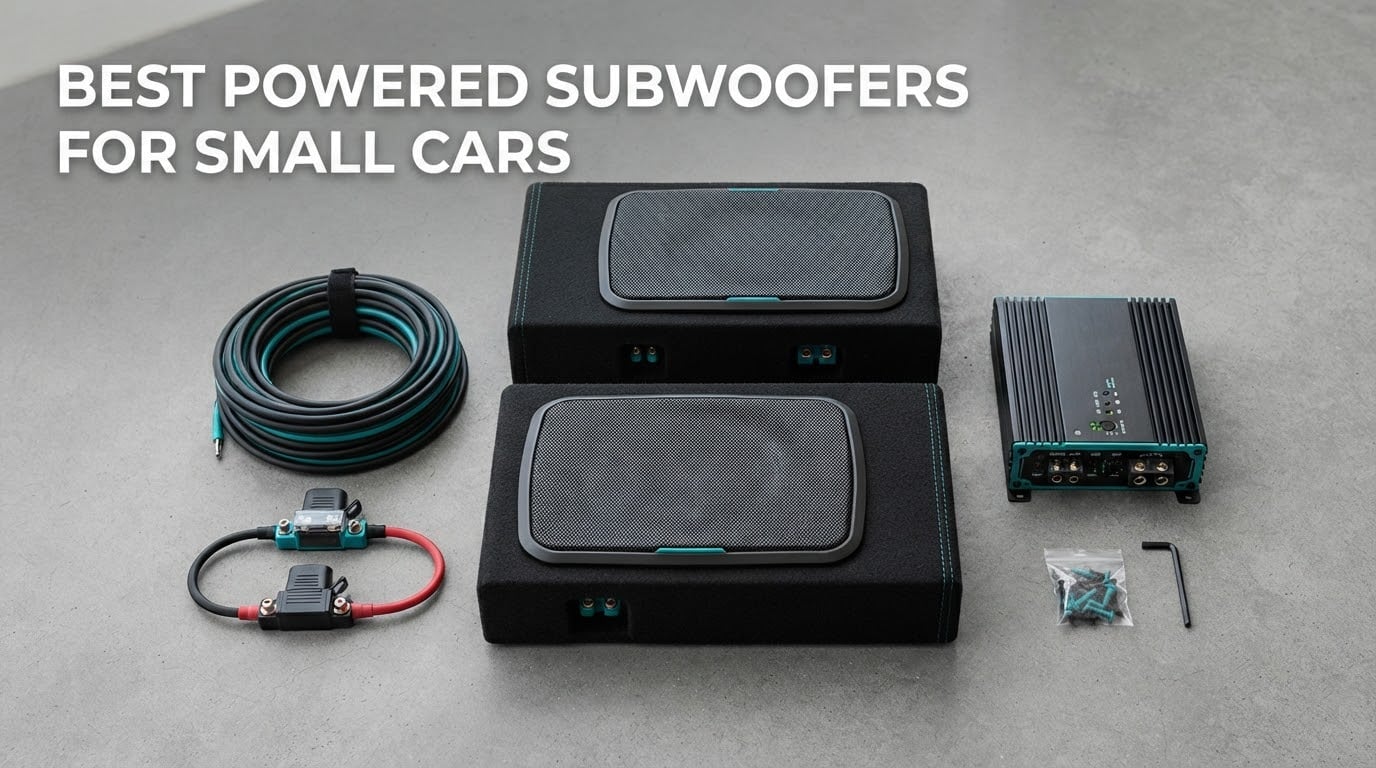
Factory 4 and 5 inch door speakers cannot produce real low end, and a conventional sub box takes over the cargo area a small car already fights for. A slim powered subwoofer fixes both problems in one box: the amplifier is built into the enclosure, the depth stays under 4 inches in most cases, and the low end arrives without giving up the boot.
Below is our shortlist of the best powered subwoofers for small cars, chosen on the criteria buyers in car audio forums actually argue about: box depth, whether it clears the seat rails or drops into the spare wheel well, real RMS output rather than headline peak watts, and whether a remote bass knob is included.
A powered subwoofer is a self-contained sub-and-amplifier box. The amplifier sits inside the enclosure, so the unit needs only power and a signal from your head unit, whether that comes through RCA pre-outs or a speaker-level tap on the factory wiring. That removes the separate amp, the separate enclosure and the extra cable runs, which is exactly why a powered sub is the format that suits a hatchback, a small sedan or a city car.
We looked at eight slim and compact powered boxes side by side, measured every enclosure against the tightest real-world mounting spots we could find, and read the owner feedback closely to separate what each box does well from what the marketing numbers imply. If you also want a broader look at car bass, our guide to the best car subwoofers covers larger conventional systems too.
Table of Contents
Top 3 Picks for Small Cars
Three boxes stood out once footprint and honest output were weighed together. The Rockville SS10P wins overall because it pairs genuine 200W RMS with a 3 inch tall cast aluminum body and by far the deepest owner base here. The Alpine PWE-S8 takes the premium slot for the cleanest, most controlled low end, and the Rockville SS8P wins on value because the wiring kit is in the box.

Rockville SS10P 10 inch Slim
- 800W peak and 200W RMS
- Only 3 inches tall
- Cast aluminum enclosure
Alpine PWE-S8 Amplified 8 inch
- 120W RMS built-in Class D amp
- 8 inch high-excursion woofer
- 32-150 Hz frequency response
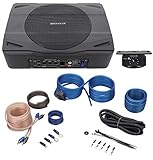
Rockville SS8P with RWK10 Kit
- 400W peak and 100W RMS
- 2.8 inch slim enclosure
- 10-gauge wiring kit included
Best Powered Subwoofers for Small Cars (October 2026)
The table below lists all eight boxes with the specs that decide whether one fits your car. Depth is listed first on purpose, because a box that does not clear the mounting point is useless no matter how many watts it claims.
| Product | Specifications | Action |
|---|---|---|
| Rockville SS10P 10 inch Slim Powered Sub |
|
Check Latest Price |
| Alpine PWE-S8 Amplified 8 inch Sub |
|
Check Latest Price |
 Pioneer TS-WX140DA Slim Powered 8 inch Pioneer TS-WX140DA Slim Powered 8 inch |
|
Check Latest Price |
 MTX RT8PT Vented Powered Tube 8 inch MTX RT8PT Vented Powered Tube 8 inch |
|
Check Latest Price |
 H YANKA SODA-08ASW Powered 8 inch H YANKA SODA-08ASW Powered 8 inch |
|
Check Latest Price |
 Pyle PLBX8A Low-Profile Powered 8 inch Pyle PLBX8A Low-Profile Powered 8 inch |
|
Check Latest Price |
| Rockville SS8P Powered 8 inch with Kit |
|
Check Latest Price |
 Seventour ST800 10 inch Under-Seat Sub Seventour ST800 10 inch Under-Seat Sub |
|
Check Latest Price |
1. Rockville SS10P – Best Powered Subwoofer for Small Cars Overall
Rockville SS10P 10″ Slim Under-Seat Powered Car/Truck Subwoofer
800W peak and 200W RMS
3 inch tall cast aluminum body
13.6 by 9.65 inch footprint
82 dB SNR
Pros
- 200W RMS of genuine output in a 3 inch tall cast aluminum body
- Cast aluminum body sheds heat under a seat
- High-level and RCA inputs with auto turn-on
- Remote bass knob plus phase switch and subsonic filter
- 3667 reviews give the deepest owner feedback base here
Cons
- 82 dB signal to noise is the lowest figure in this group
- Distortion appears when bass boost is pushed hard
- 10 inch cone can be tight under seat rails in the smallest cars
The SS10P is the box I kept coming back to while measuring footwells and boot floors. at 13.6 by 9.65 inches and 3 inches tall, it slides under a seat without the drilling and plywood work that a conventional install demands, yet it runs 200W RMS, roughly double what most 8 inch slim boxes here deliver.
That extra output is what separates it from the pack. A lot of ultra-compact boxes clean up the bottom end of a factory system and then run out of headroom, leaving you wanting at moderate volume. The SS10P holds together longer because the cast aluminum body pulls heat away from the internal amplifier.
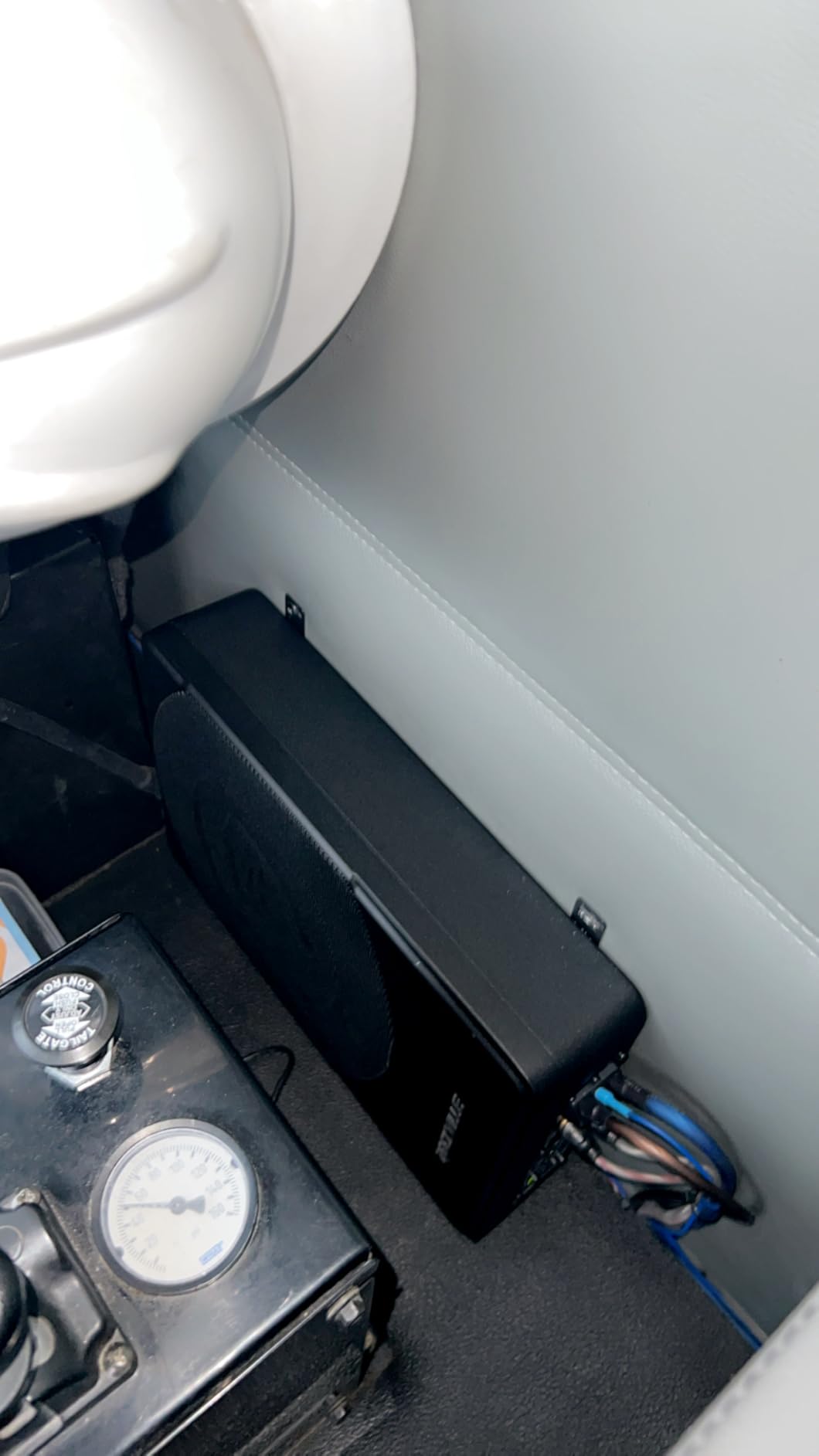
Owner feedback is consistently positive on exactly the two things that matter here. People talk about the box disappearing under the seat and about the controls being genuinely useful for matching a factory system, since the remote bass knob, phase switch and subsonic filter are all on the enclosure.
The honest caveat is the noise floor. A signal to noise ratio of 82 dB is the lowest of the eight, so on a quiet late-night drive with the source turned down you can hear the amplifier working more than you would with the Pioneer or the Pyle. Turn the gain up with a low-level signal and the bass boost adds distortion, which owners mention often enough to check before you lean on it.
Will the 10 inch cone actually clear a seat rail?
That is the first thing to measure in your own car. The enclosure body is only 3 inches tall, but the 10 inch driver needs the face to be wider than the narrowest gap between the rails. Measure both gaps with a tape before you commit, and if the gap between the rails is narrower than the 10 inch driver face the box may need to move behind the seat instead.
Reviewers report the fit works in most sedans and hatchbacks and gets tight in the very smallest city cars. If your gaps are marginal, the Alpine PWE-S8 at a narrower width is the safer bet.
Is 200W RMS enough without a separate amp?
For filling out the low end of a factory four-speaker system and adding weight to bass lines, yes. It is a lot of clean, controlled output for a box with the amplifier inside, and it means one power wire, one ground and one signal cable rather than a whole install chain.
Do not expect it to shake a Civic’s body panels. This box is a low-end upgrade, not a competition sub, and pairing it with a factory system that already has door speakers doing the midrange work is the sensible approach.
2. Alpine PWE-S8 – Cleanest Low End in a Compact Footprint
Alpine 8″ Amplified Subwoofer (PWE-S8) 120W Compact Powered 8″ Car Subwoofer for Under or Behind The Seat
240W peak and 120W RMS
Built-in Class D amplifier
32-150 Hz frequency response
11 pounds
Pros
- Highest owner satisfaction score in the group
- Clean controlled low end at moderate volume
- Body shaped to sit under or behind a seat
- Class D amplifier keeps the install tidy
- Backed by a 1 year manufacturer warranty
Cons
- 120W RMS is modest for deep or loud bass
- Heavier chassis than most plastic competitors here
- Clean controlled output rather than high volume
Its published frequency response of 32 to 150 Hz is the lowest bottom-end figure in this roundup, and owners describe the result as clean, controlled low end rather than boom. The 8 inch high-excursion cone is driven by a built-in Class D amplifier, so the whole unit is one sealed package.
That 32 Hz figure matters more than it looks on paper. Forum regulars who shop slim subs repeatedly quote around 40 Hz as their benchmark for an acceptable sub, and anything that reaches the low 30s feels noticeably different on a kick drum or a sub-bass line. This box gets there in a form factor that slides under a seat.
At 4.5 stars across 758 reviews it carries the strongest satisfaction figure in this group, and 76 percent of those reviews are five-star. The recurring theme is not excitement about volume. It is that the box adds bass without muddying the midrange, which is what you want when your factory speakers are already handling vocals and instruments.
Two practical notes. The enclosure is an aluminum body weighing 11 pounds, which is heavier than most of the plastic boxes in this roundup, so you want a solid mounting surface rather than a loose carpet. And the control is a push-button remote rather than a rotary knob, so you set your level once rather than trimming bass song by song.
Where does it mount in a Civic or an Altima?
The Alpine is marketed for under-seat or behind-seat placement and it fits both patterns well in small sedans. Behind the passenger seat it clears the seatback almost completely, which is the easiest install of anything in this roundup and needs no tools beyond a hand.
Under a seat, check the height clearance at the hinge point rather than the flat middle of the rail. Seat hinges often dip lower than the rest of the frame, and that is where a compact box meets an obstruction.
Is 120W RMS enough on its own?
It is enough to add low-end weight and to clean up what your door speakers are missing at normal listening levels. It is not enough if your goal is to overpower the factory speakers or play at highway speeds with the windows down.
If you want more than that, the Rockville SS10P doubles the RMS figure in a similar height class. Choose the Alpine for control and reach, and the Rockville for volume.
3. Pioneer TS-WX140DA – Lowest Draw for Hybrids and EVs
Pioneer TS-WX140DA Slim Compact Powered 8″ Subwoofer 250W Max
170W built-in Class D amp
4.3 amp maximum current draw
2.76 inch tall
7.4 pounds
Pros
- Lowest current draw in the group at 4.3 amps
- Three selectable bass modes for different music
- 2.76 inch tall and only 7.4 pounds
- 95 dB sensitivity keeps output clean at low volume
- Wired digital bass control with a 16.25 ft cable
Cons
- 11 percent one-star share is a meaningful durability complaint
- 170W output is modest for loud bass
- Advertised peak figure sits well above the amplifier rating
A maximum current draw of 4.3 amps is by far the lowest figure here, which means the amplifier can sit on an accessory circuit in a Prius or a small EV without the factory electrical system noticing.
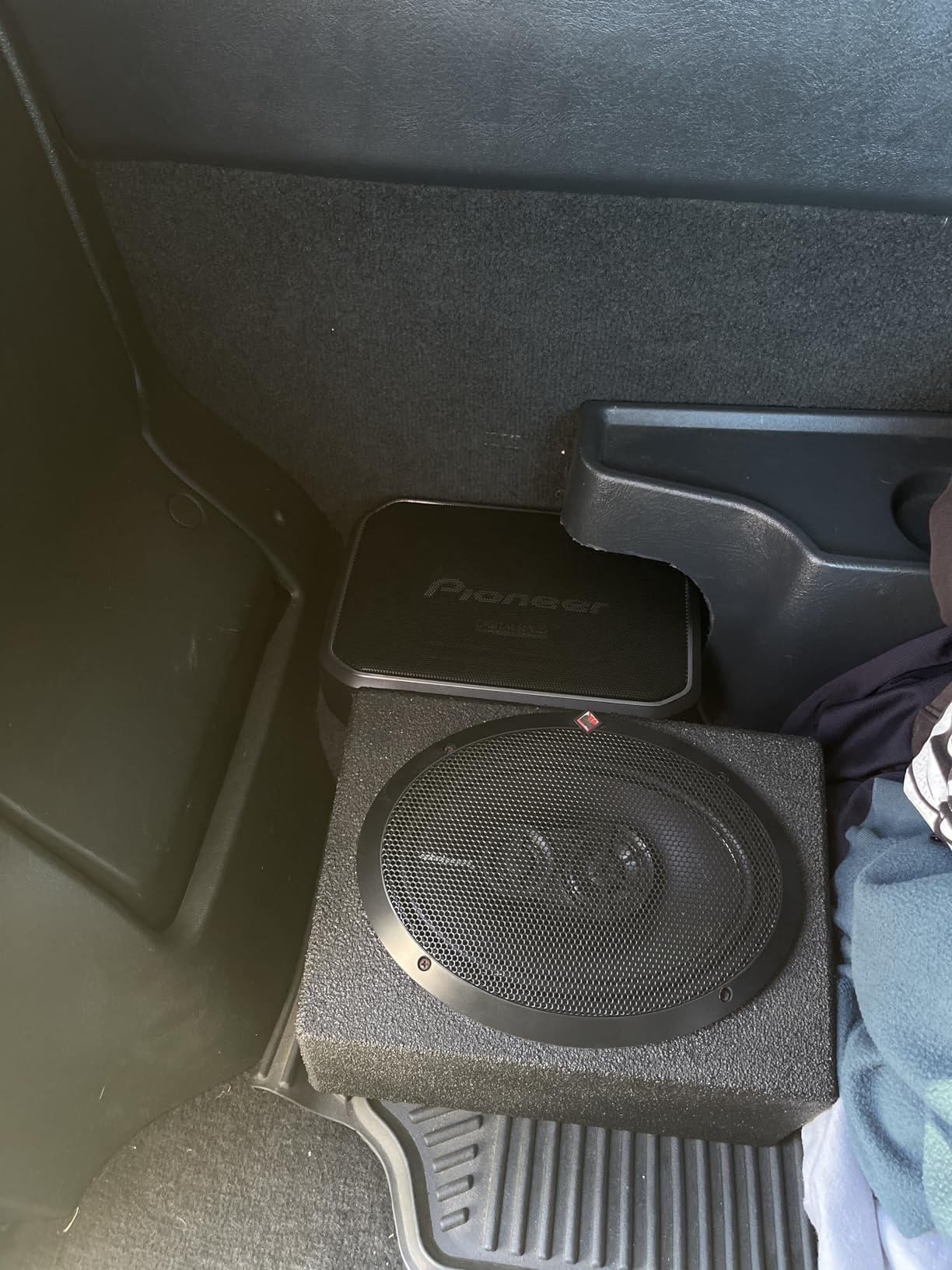
It is also the thinnest enclosure in the roundup at 2.76 inches, and at 7.4 pounds it is light enough to lift into a tight footwell without straining. It fits under seats, behind seats or inside a small storage compartment, which covers nearly every awkward mounting point in a small car.
Three selectable listening modes are the feature owners mention most: Deep, Dynamic and Natural. Having a switch for the character you want is a shortcut around hours of gain and crossover adjustment, and the sensitivity figures across the three modes run from 95 to 100 dB.
The included wired digital bass control has a 16.25 foot cable, long enough to run to the dash from a box mounted in the rear of the car. Be aware of that cable length before you commit to a rear mounting point.
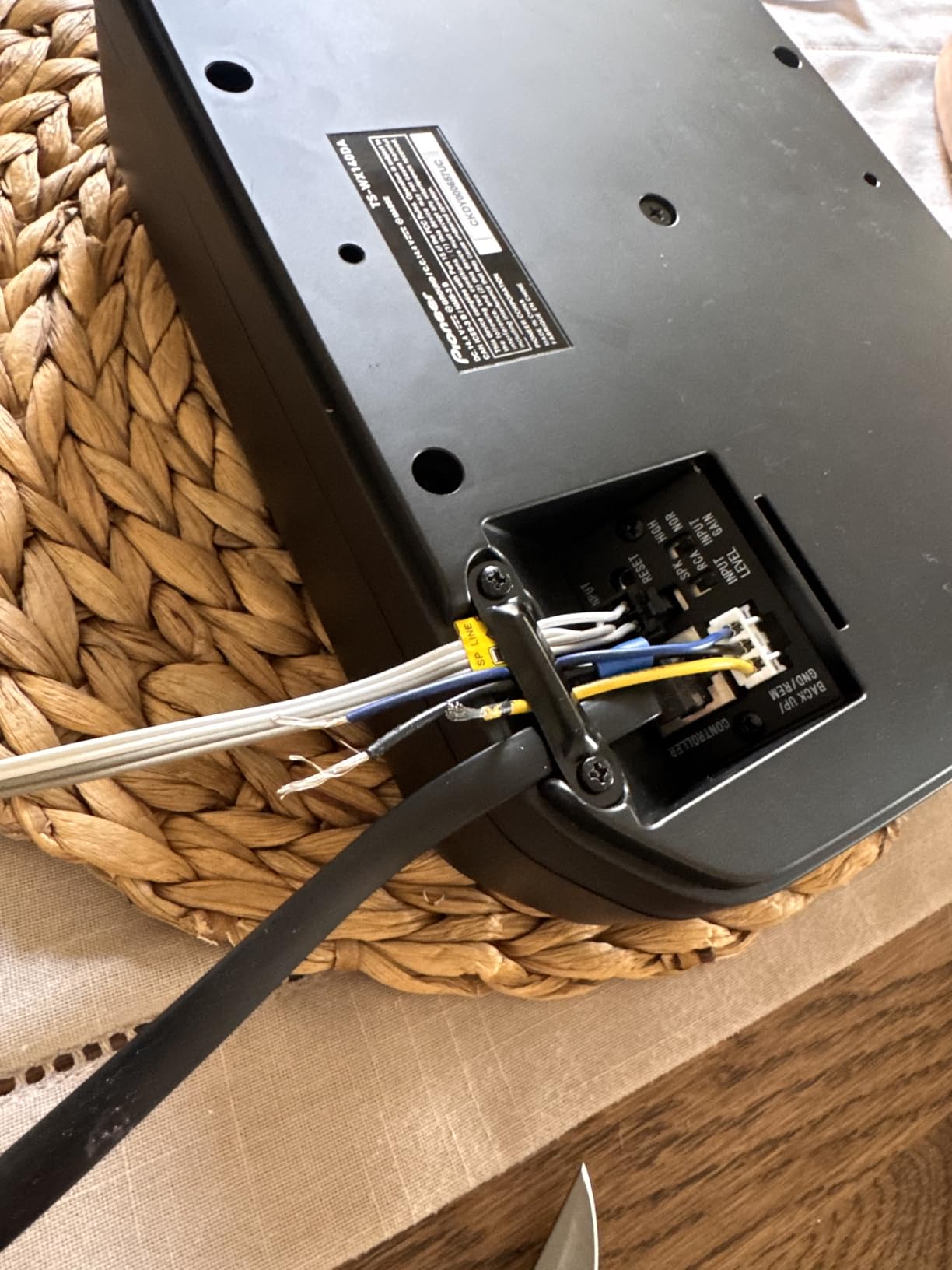
Why does the low current draw matter in a hybrid?
Current draw is the number that determines whether the car can supply the amplifier without voltage drop or a fault message. A hybrid or EV system with a small 12 volt auxiliary battery has less headroom than a conventional alternator, and an amp that pulls hard at low volume is the usual trigger for warnings or brownouts.
At 4.3 amps maximum, this box can be fed from an accessory fuse with a fuse tap in most vehicles. Verify the rating on your own fuse box before connecting anything, and route the power cable away from the factory high-voltage cabling where it crosses the cabin.
What do the durability complaints concern?
With 11 percent of reviews at one star, durability complaints are worth weighing before you buy, and they cluster around build and reliability rather than sound quality. Owners who like the box tend to like the output level and the mode switching, not the sheer volume.
If you are comfortable with a slightly lower rating for a much lower current draw, it is a good trade in a hybrid. In a conventional petrol car the Rockville SS10P gives you more power and a larger owner base.
4. MTX Audio RT8PT – Best Trunk Mount for a Small Sedan
MTX Audio RT8PT 8″ 240W Peak Amplified Vented Car Subwoofer Tube Enclosure
240W max and 120W RMS
Vented tube enclosure
21.25 by 9.84 by 9.84 inch
20.8 pounds
Pros
- Vented tube design adds real output for its size
- Variable crossover from 50 to 200 Hz
- RCA plus high-level and low-level inputs
- Mounting straps and bass knob included
- 2 year warranty is the longest listed here
Cons
- Bulky enclosure at 20.8 pounds
- 120W RMS is low for hard-hitting output
- Rounded shape limits positioning in tight cabins
- A few reports of the internal amplifier failing
The MTX RT8PT is the only traditional-shape box in this roundup, and that is exactly what makes it useful. It is a vented tube enclosure at 21.25 inches long and just under 10 inches square, so it lies flat in the boot of a sedan instead of standing up and eating the parcel shelf. The vented design moves air through the tube and owners consistently report more output than the enclosure size suggests.
Install flexibility is its other strength. It accepts RCA, high-level and low-level inputs, which means it will connect to an aftermarket head unit with pre-outs, to a factory system with no RCA at all, or to an amp you already own. The variable low-pass crossover runs from 50 to 200 Hz at 12 dB per octave, a wider adjustment range than the 50 to 150 Hz filters on the other slim boxes here.
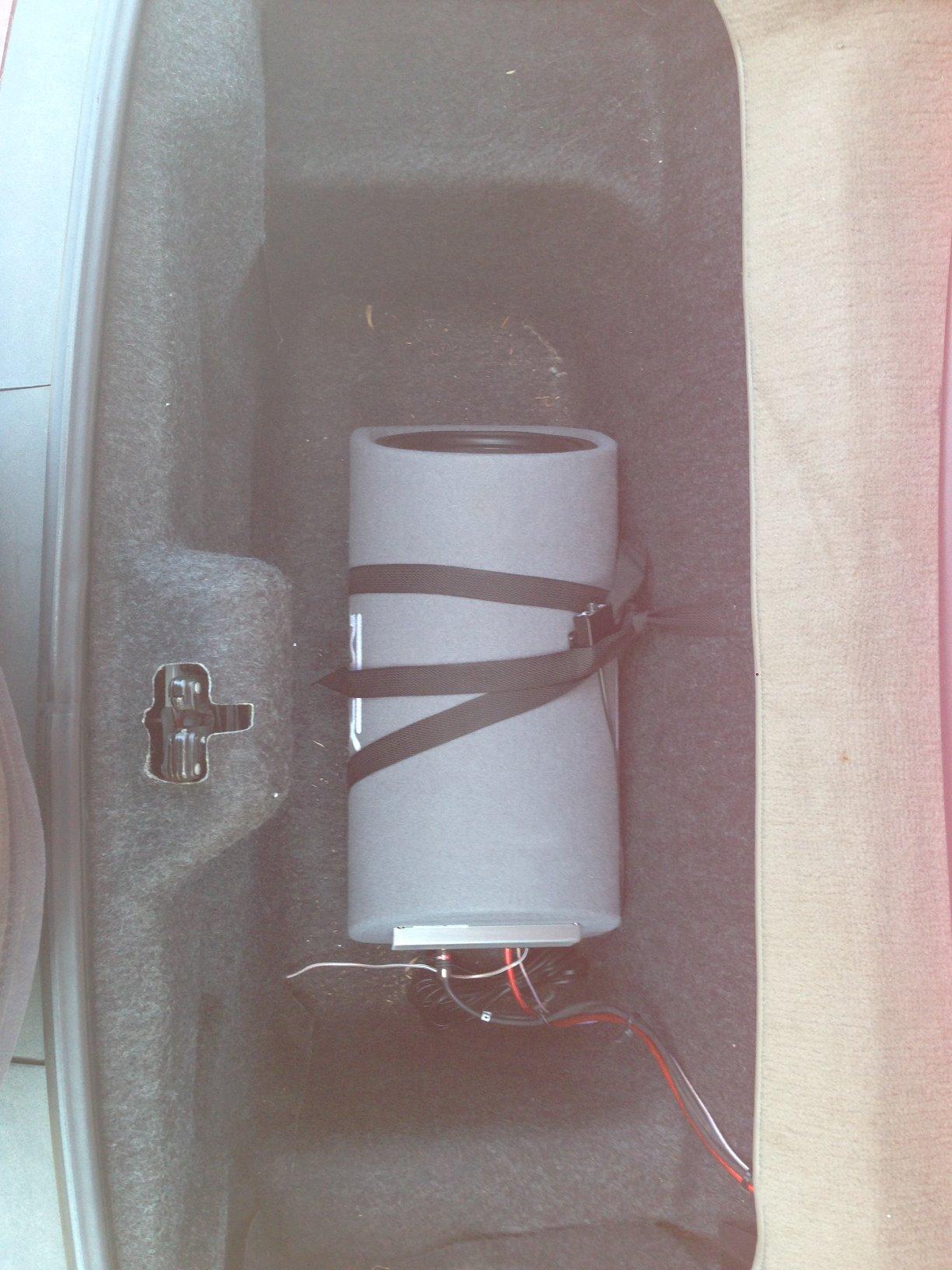
Frequency response is listed as 35 to 250 Hz. Installers regularly note it will not reproduce the deepest content below 35 Hz, so if you chase sub-bass this is the wrong box. What it does well is steady, accurate low-end fill that sits under a track rather than fighting the door speakers, and that is what most people upgrading a factory system actually need.
The two-year manufacturer warranty is the longest warranty listed among these eight, which matters on a box with a built-in amplifier. There is an isolated group of reports where the internal amplifier stopped producing output after a couple of months, so keep your purchase documentation.
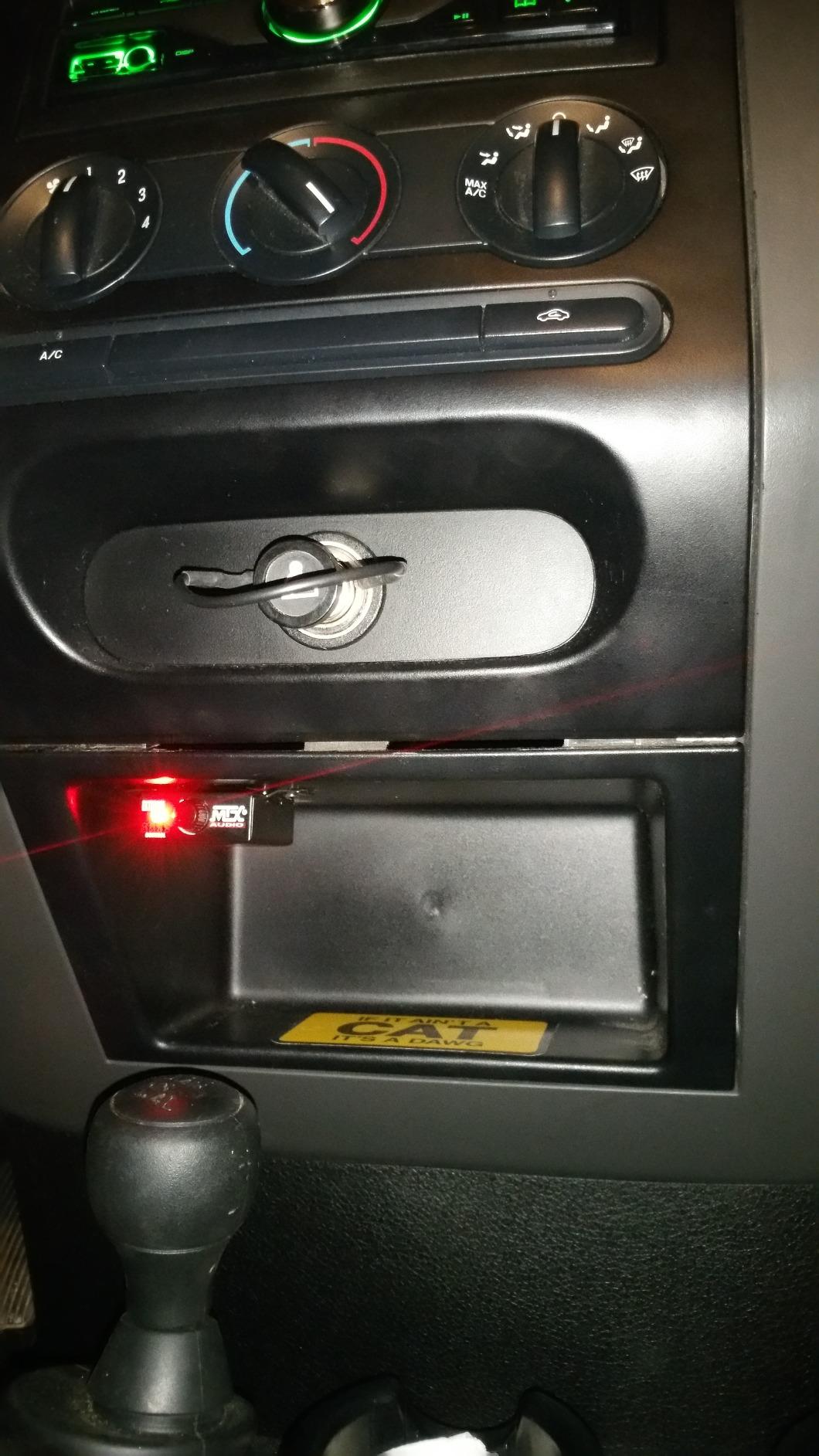
Will it fit behind the rear seat of a Corolla or Altima?
Laid flat it needs about 22 inches of length, 10 inches of width and 10 inches of height. That is a realistic ask in the boot of a small sedan, but measure the narrowest point between the wheel arches, because the rounded tube narrows the usable width rather than filling it.
Because the box weighs 20.8 pounds, mount it with the supplied straps against something structural. Laying it on the carpet of a boot means every bass hit shifts it, and a loose box rattles more than most drivers expect.
Powered or passive – is this the safer buy?
For a first-time install this removes the biggest cost and effort entirely. There is no separate amplifier to choose, no enclosure fabrication and no extra cable to run through a firewall grommet.
The trade-off is that you inherit the amplifier MTX chose. If you later decide you want more power or a different crossover, you are replacing the whole box rather than adding an amp, which is where a passive driver and a separate mono amp would have been the more flexible path.
5. H YANKA SODA-08ASW – Most Compact Box for the Tightest Boots
H YANKA SODA-08ASW 8-Inch Powered Underseat Car Subwoofer, 400W
400W peak and 100W RMS
10.53 by 7.8 by 3 inch
20Hz-150Hz response
90 dB SNR
Pros
- The most compact footprint in the roundup at 10.53 by 7.8 inches
- Slides under a seat and disappears once fitted
- THD under 0.5 percent and SNR above 90 dB
- Remote bass control and adjustable low-pass filter
- 20A inline fuse for surge protection
Cons
- Response falls away below roughly 48 Hz
- Enclosure runs hot and needs airflow
- Several reports of failures and rattling after a few months
- No wiring kit included
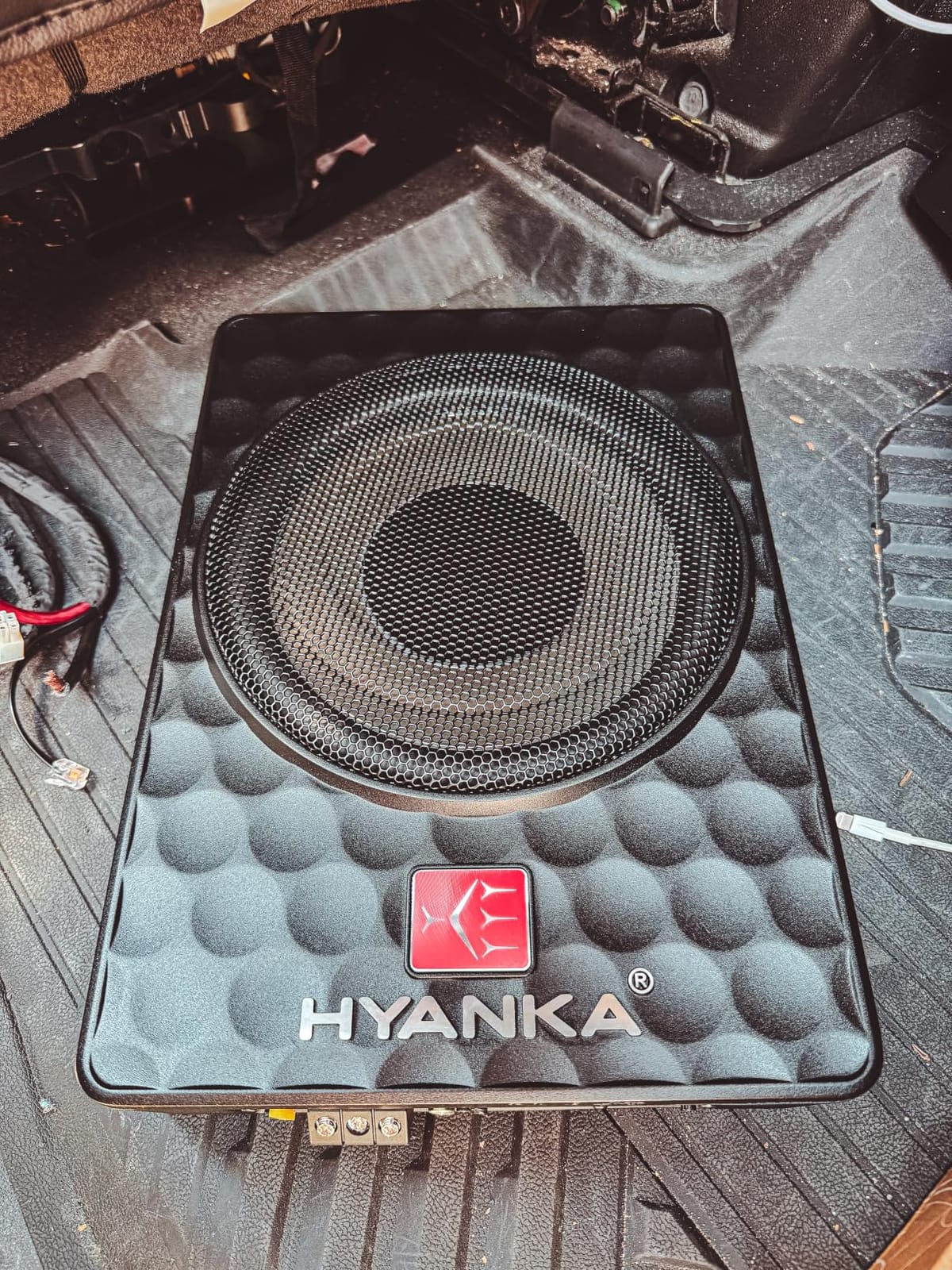
When the question is purely whether the box will fit, this is one to measure first. At 10.53 by 7.8 inches and 3 inches tall it has the most compact footprint in the roundup by area, which makes it the realistic answer for city cars and micro hatches where a longer box simply will not slide under a seat or sit flat in a tiny boot.
It is a powered 8 inch box rated at 400W peak and 100W RMS, with high-level and RCA inputs plus adjustable input sensitivity. Total harmonic distortion is listed under 0.5 percent with a signal to noise ratio above 90 dB, and the on-box controls cover a 0 to +12 dB bass boost, a low-pass filter from 50 to 150 Hz and a subsonic filter fixed at 20 Hz.
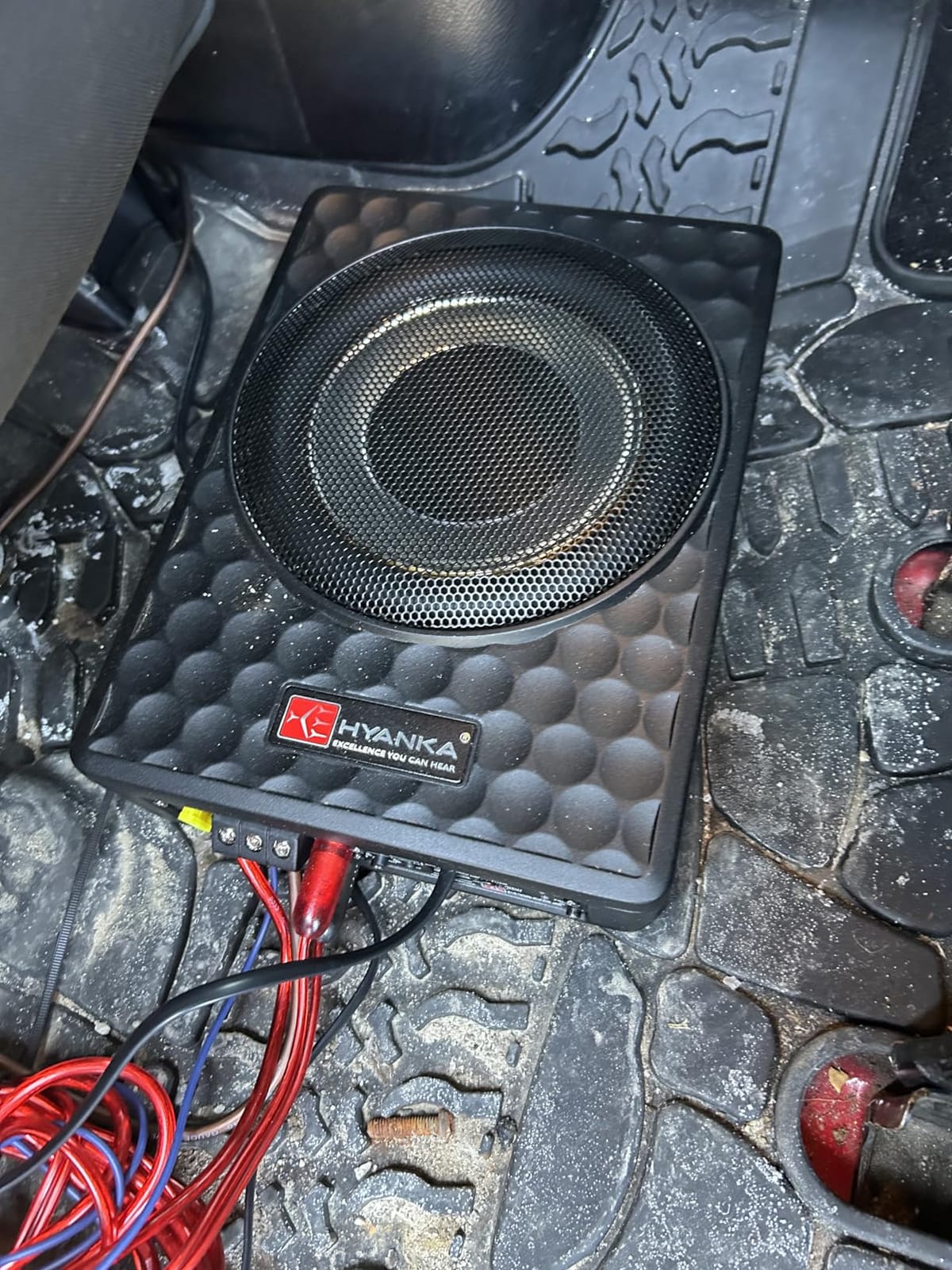
Owner feedback treats it as a budget rescue for a weak factory system. People like the metal construction and the terminal quality more than the price tag suggests, and several report that adding it noticeably cleaned up the whole system because the door speakers were no longer being asked to cover the low end.
One piece of advice appears over and over: turn the onboard knobs all the way down before you first power it up, because these boxes often leave the factory with the gain and boost already at maximum. Cranking an already-boosted box is the fastest way to get distortion from it.
How low does it actually go in practice?
The paper specification lists 20 to 150 Hz, but owners report the usable response rolling off below roughly 48 Hz. So treat the 20 Hz number as the filter setting rather than as real output, and expect real bass to start around the 50 Hz mark.
That is still enough to fill out the low end under a factory system, which is the job here. If you want real sub-bass extension in a small cabin, look at the Alpine PWE-S8 and its 32 Hz figure instead.
Is the no wiring kit a problem?
It means buying your own power cable, RCA or speaker-level leads, fuse and remote cable. For a straightforward install on a head unit with RCA pre-outs, that is a short shopping list and nothing more.
The heat point is worth taking seriously. Owners who drive it hard report the enclosure running hot enough to need extra clearance or airflow under a seat, so avoid sealing it against a carpeted floor and keep the gain modest in warm weather.
6. Pyle PLBX8A – Easiest Hookup to Factory Speaker Wires
Pyle 8-Inch Low-Profile Amplified Subwoofer System – 600 Watt Compact Enclosed Active Underseat Car Audio Subwoofer with Built In Amp, Powered Car Subwoofer w/ Low & High Level Inputs – Pyle PLBX8A
600W maximum with built-in amp
12.8 by 9.5 by 3 inch
0.12-3.5V input sensitivity
9.6 pounds
Pros
- Input sensitivity spans 0.12 to 3.5 volts for any head unit
- High-level and RCA inputs both provided
- Remote level control module mounts on the dash
- 3 inch height fits under most vehicle seats
- Weighs 9.6 pounds for easy handling and repositioning
Cons
- 600W figure is peak marketing power not sustained output
- 14 percent one-star share is the highest in the group
- Understated output that will not overpower factory door speakers
The Pyle PLBX8A exists for one specific problem: a factory head unit with no RCA pre-outs. Many cars in this size class ship that way, so a sub with speaker-level inputs only would be a dead end, and a sub with RCA only means a converter. This box has both, and its input sensitivity adjustment runs from 0.12 to 3.5 volts.
That wide range is the practical advantage. Some factory speaker outputs are unusually low-voltage and some are hot, and being able to trim the input level on the box means you avoid a gain-driven hum or a distorted signal without pulling the head unit apart.
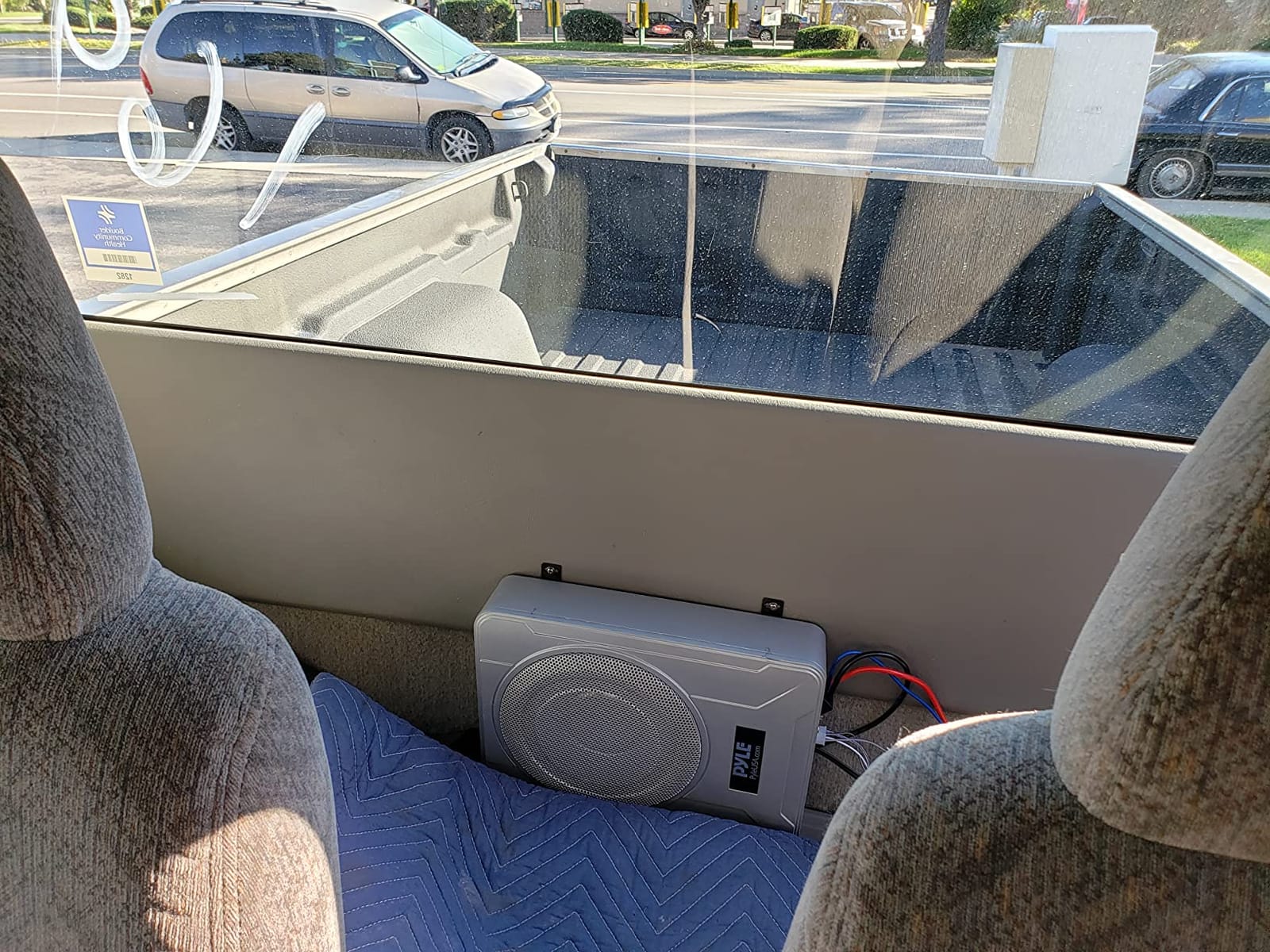
The enclosure measures 12.8 by 9.5 inches at 3 inches tall and weighs 9.6 pounds, so it fits under most seats and is light enough to reposition if your first mounting attempt does not work out. A remote level control module is included, which gives you a dash-mounted knob rather than a gain pot hidden under a trim panel.
Owners consistently describe the output as modest but adequate, which is the honest description for a box in this class. The 14 percent one-star share is the highest here and points at build quality and reliability rather than a mismatch in expectations about how loud it gets.
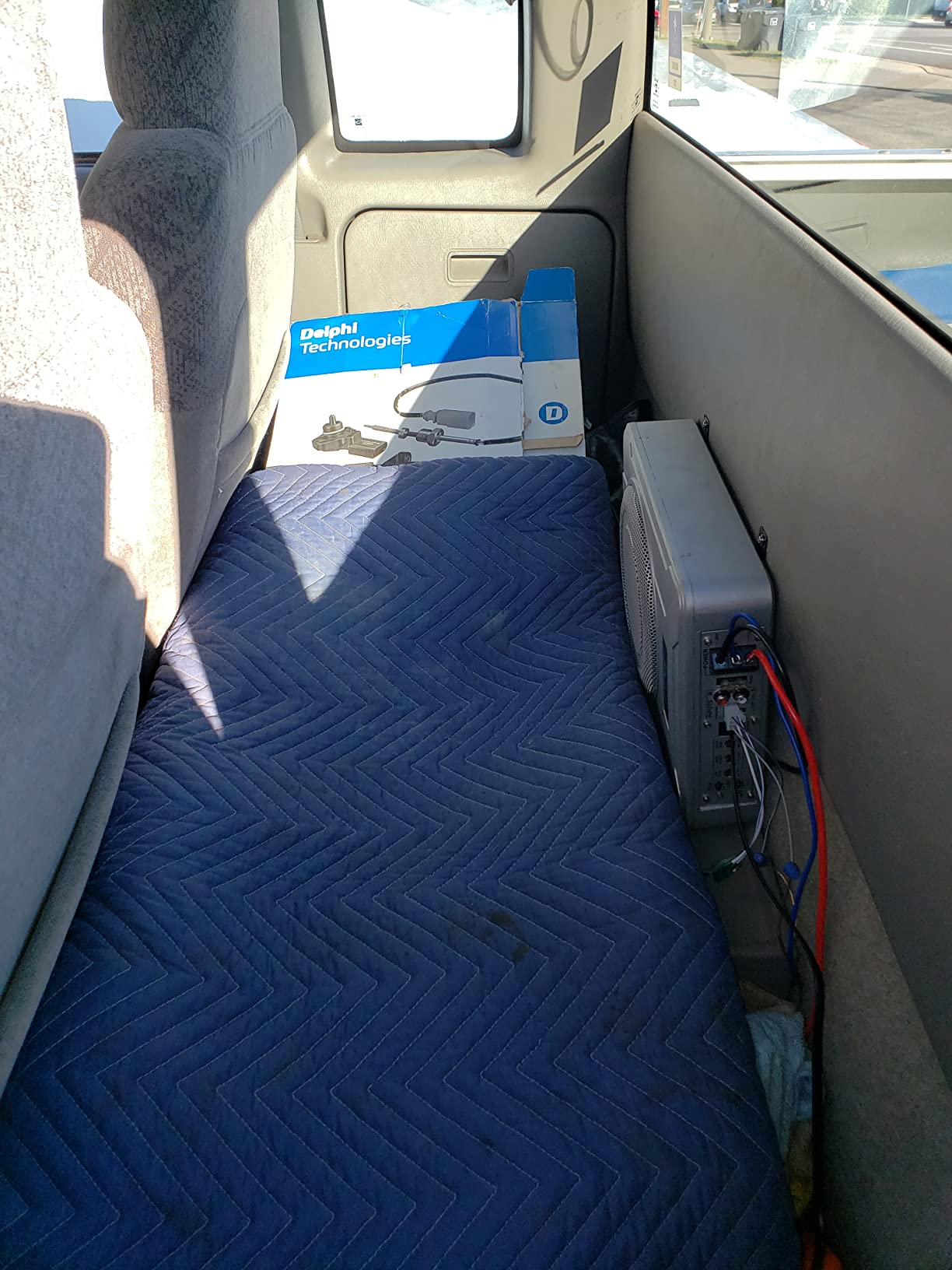
How do I wire it to a factory system with no RCA jacks?
Tap the factory speaker-level output, take the signal into the high-level input, set the gain and the input sensitivity low, then raise them gradually until the sub matches the door speakers. Add the remote level control and trim bass from the dash rather than the enclosure.
Run the remote cable along the sill or A-pillar trim so it is not trapped under a rubber mat, which is the most common cause of a control that stops responding after a few months.
Is the 600W rating real output?
Treat it as peak power. The sustained figure for a box this size is a fraction of that headline number, which is why reviewers describe the output as modest and adequate rather than overwhelming.
Read the rating as a description of the internal amplifier’s peak capability rather than a promise about loudness, and set your expectation from the other figures in this roundup instead.
7. Rockville SS8P – Best Value With a Full Wiring Kit
Rockville SS8P 8″ Powered Under-Seat Car Subwoofer with RWK10 Amp Kit
400W peak and 100W RMS
2.8 inch slim cast aluminum body
RWK10 wiring kit included
20-150Hz response
Pros
- Complete install: 10-gauge power wire and ANL fuse holder in the box
- Cast aluminum enclosure that doubles as the mounting structure
- 2.8 inch tall so it fits even tight footwells
- Clean tight low end rather than muddy rumble
- 1560 reviews with reports of multi-year use
Cons
- Too quiet for a trunk install despite the peak claim
- Distorts when the bass boost is turned up
- Connectors and knobs share one side which complicates hidden mounting
- Enclosure can buzz if mounted loosely
The SS8P is the package that most completely removes friction from a first install. Alongside the subwoofer you get the RWK10 kit: 100 percent copper RCA cables, 10-gauge SuperFlex power wire and an ANL fuse holder. That is the entire parts list for a clean install, and it is the reason this box is a strong choice for a first-time car audio owner.
The enclosure is 2.8 inches tall in cast aluminum, which makes it both the second-thinnest powered box here behind the Pioneer and the most rigid. Owners repeatedly prefer its low end to the larger SS10P because it is tighter and less muddy, and several report units still running after years of daily use.
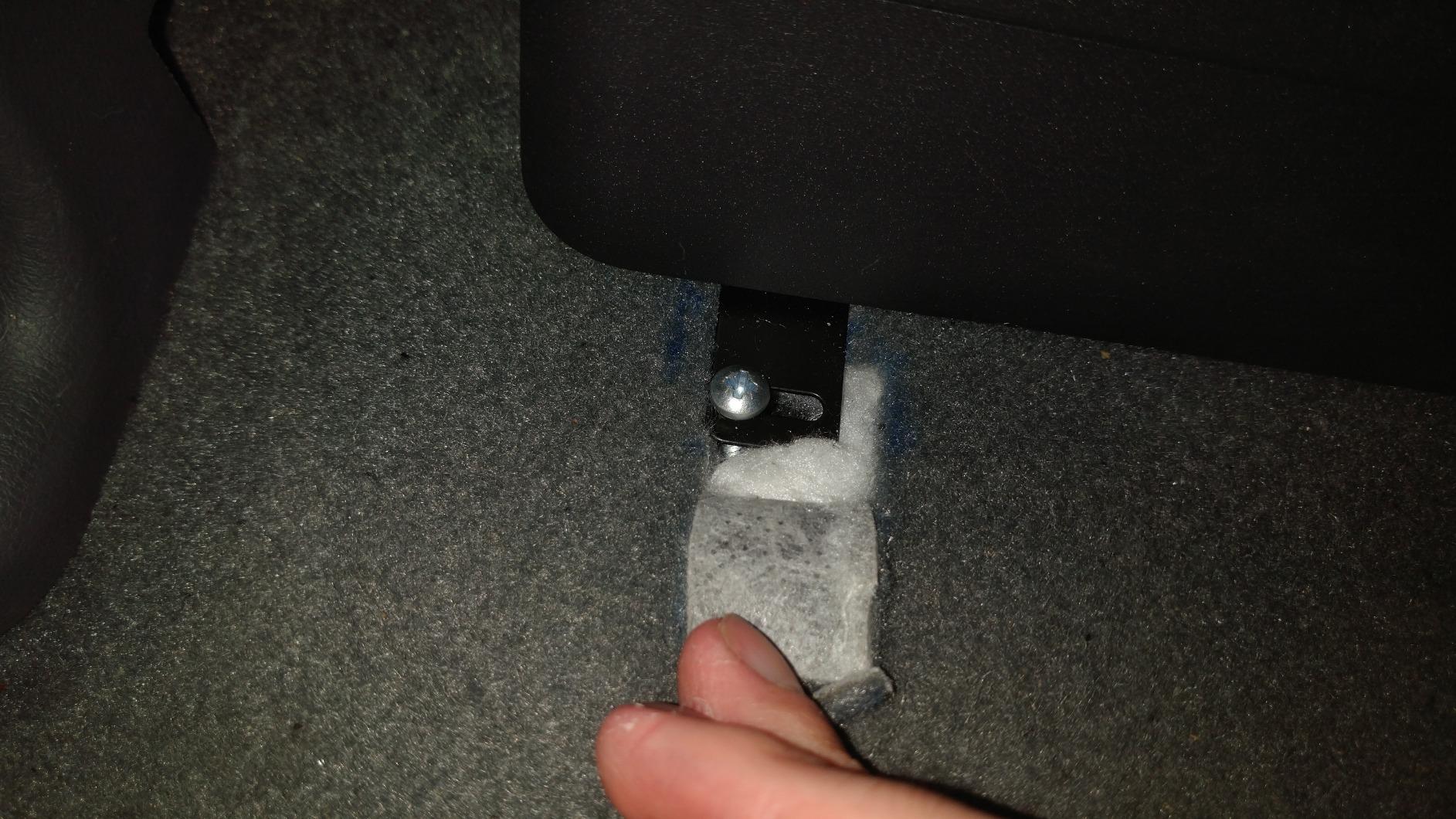
Controls sit behind a panel on one side: an adjustable low-pass filter from 50 to 150 Hz, a 0 to 180 degree phase switch, a 20 Hz subsonic filter, a 0 to 12 dB bass boost at 45 Hz and a remote bass level control. Signal to noise is listed above 90 dB and the box runs on a single 15A fuse.
Placement is where the reviews split. Under a seat it works well. In a trunk it is too quiet to hear properly, and that surprises people who chose it on the peak wattage figure. Boosting the bass to compensate brings the distortion the reviews warn about.
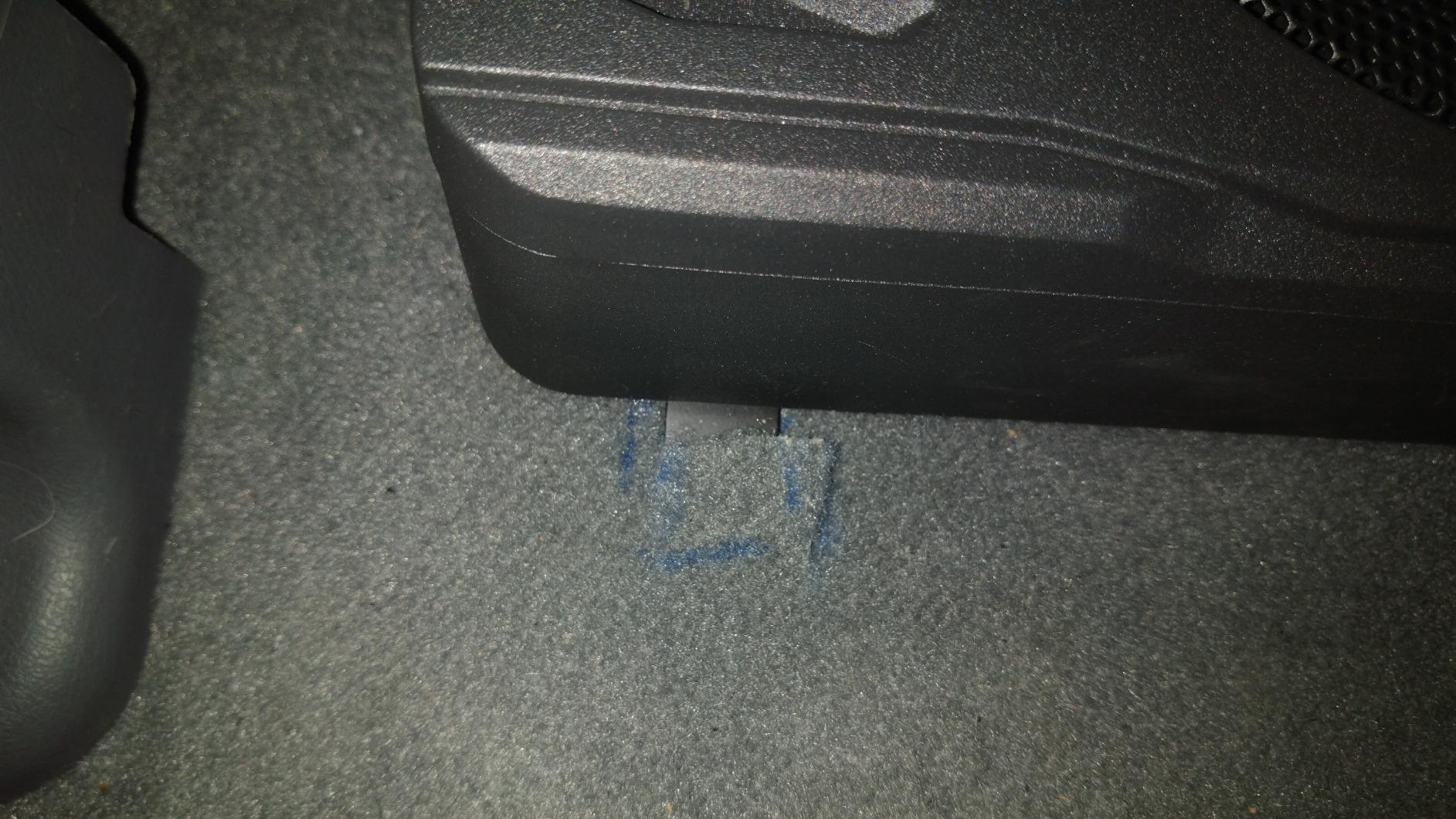
Which small cars has it physically fitted into?
Owners report it sliding under the seat in small cars including a Smart Fortwo, which is about as unforgiving a cabin as you will meet. The 2.8 inch height leaves room for the seat rails to move through their full range of travel.
The one caveat is air. Owners report it running hot in poorly ventilated installs and tripping its own protection, so leave the aluminium body clear of a sealed floor and avoid a spot that traps heat on a hot day.
Do I still need to buy a wiring kit?
No, and that is the whole point. The 10-gauge power wire, the fuse holder and the RCA cables are all in the package, so the only things you may need to add are an inline fuse sized to your electrical system and a length of loom to route it neatly.
That is what separates it from the H YANKA and the Pyle, where the box is cheaper but you are still shopping for cable. If you value the finished install, this is the pick.
8. Seventour ST800 – Most Bass for the Money Spent
10″ 800W Under Seat Car Subwoofer and amp package,Pure and Pleasant Bass
800W peak and 220W RMS
13.5 by 10.2 by 3.1 inch
Cast aluminum, LED ring
THD under 0.4 percent
Pros
- 220W RMS is the highest sustained output in the roundup
- 10 inch driver inside a 3.1 inch cast aluminum enclosure
- Complete kit: RCA cables
- power cable
- level converter and remote
- Blue LED ring lights up at ignition
- 12 month replacement and 2 year repair support
Cons
- 13.5 inch length is longer than most under-seat boxes
- 220W RMS draws more current and needs careful wiring
- LED lighting is a gimmick some buyers dislike
- Minor clipping reported at high gain
The Seventour ST800 takes the unusual route of fitting a genuine 10 inch driver into a 3.1 inch tall enclosure, and the result is the most capable bass in this roundup on paper and in practice. At 220W RMS it outguns everything else here, and owners report a fuller low end than 8 inch alternatives in the same cost bracket.
It comes with everything in the box: RCA cables, a power cable, a high-to-low level converter and a wired volume controller with gain, bass boost and crossover controls. For someone whose factory head unit has no RCA outputs, the included converter removes the single most common install obstacle.
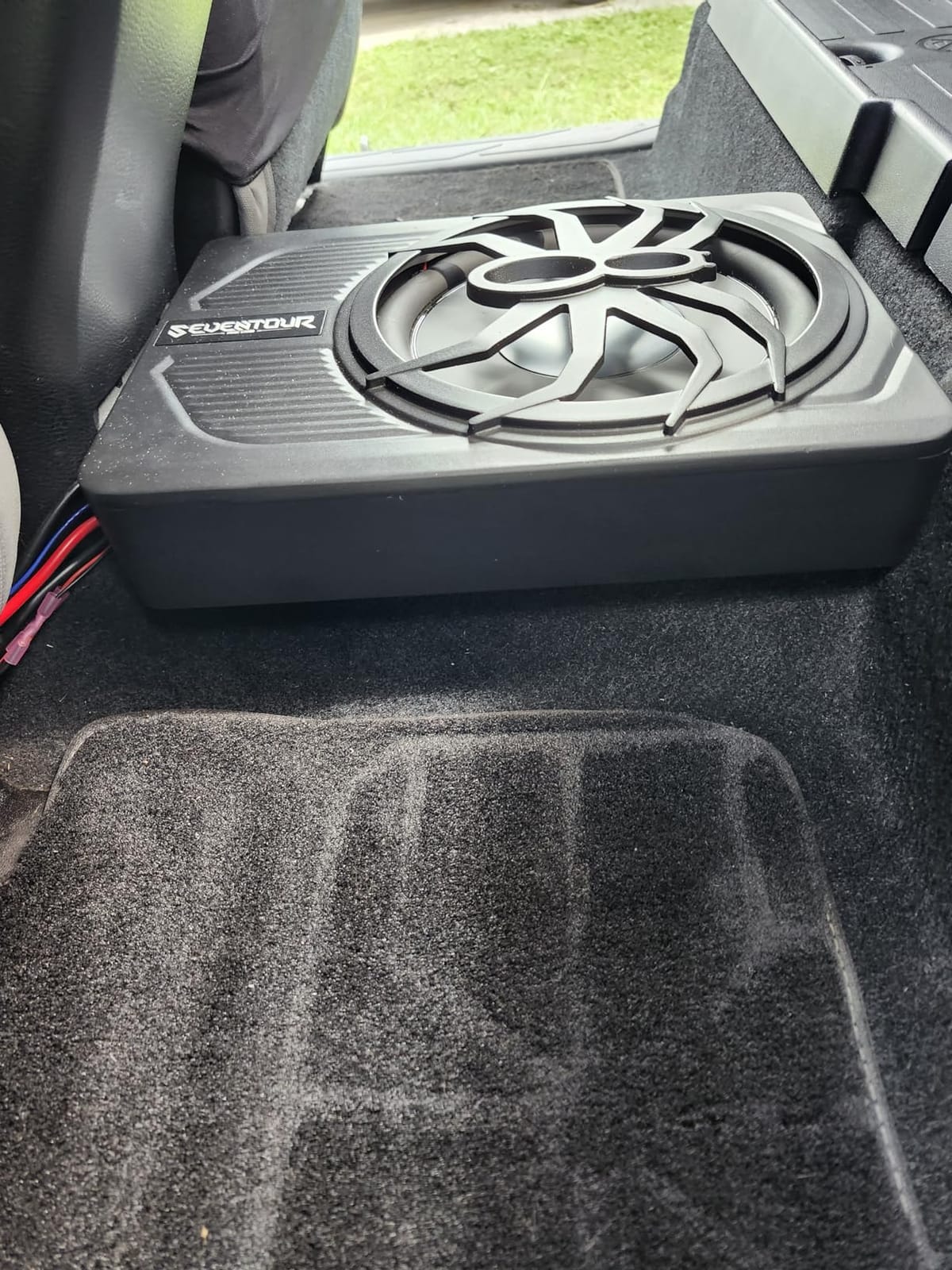
The cast aluminum enclosure dissipates heat far better than the plastic boxes in this price range, which matters when you are running 220W RMS continuously. Total harmonic distortion is listed below 0.4 percent, signal to noise above 90 dB, and the protection circuits cover thermal, short circuit and overload with a 25A rated fuse.
Owners also mention the LED ring, which illuminates at car start. It is a minor cosmetic feature that separates the box visually from every other slim sub on the market, whether you find it tasteful is a personal call.
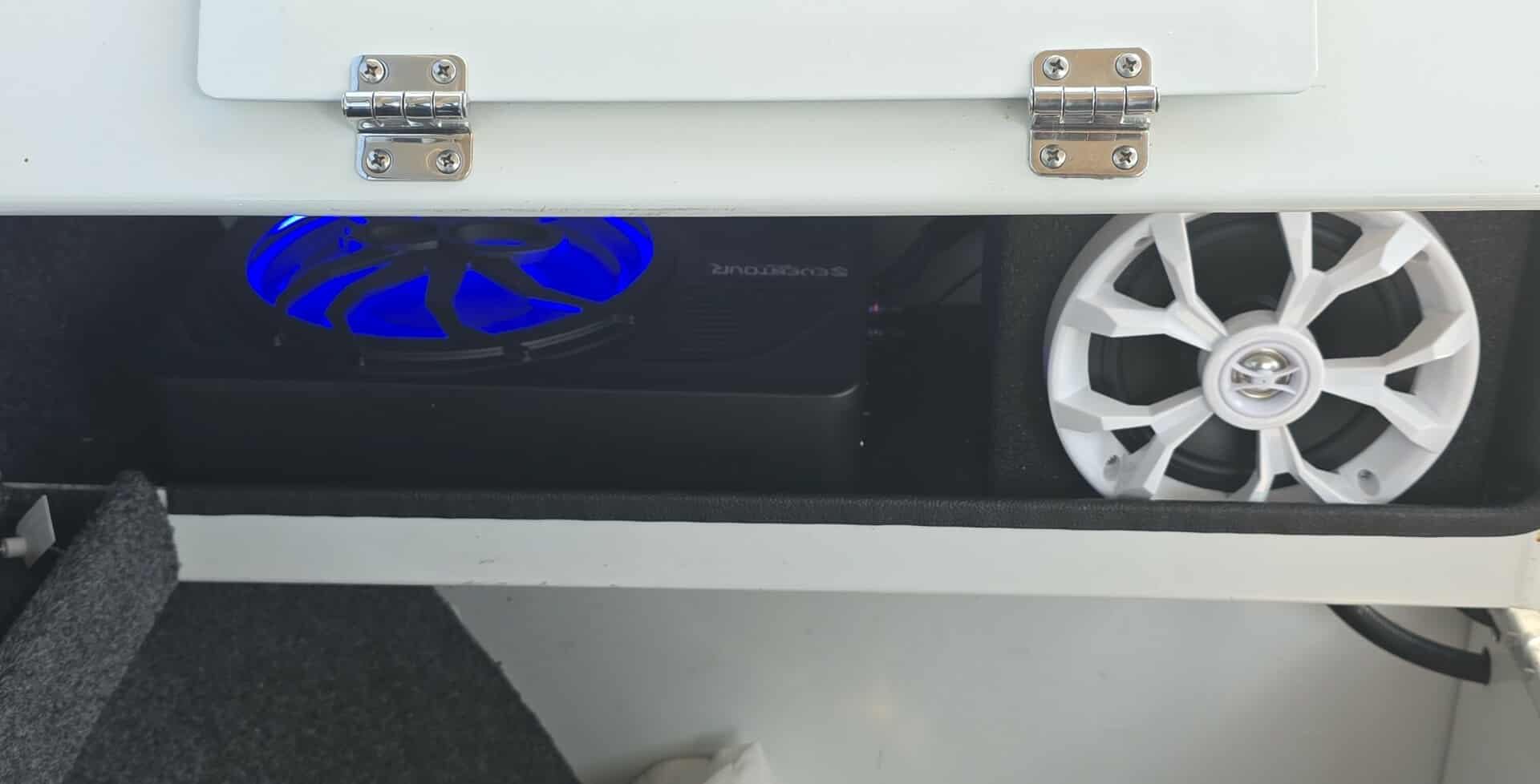
Will 13.5 inches actually fit under your seat?
This is the box to measure for before anything else. At 13.5 inches long it is among the longest enclosures here, and it will not fit under every seat even though the height is only 3.1 inches. Measure the full fore-aft run of the seat base, not just the flat middle.
If the length will not work but the output matters to you, check the fit of the Rockville SS10P at a near-identical 13.6 by 9.65 inches, which carries comparable RMS power in a similar height class.
Does it need more care with the wiring?
Yes, more than the 100W boxes in this group. 220W RMS across a 4 ohm load pulls meaningfully more current, so use proper gauge power cable and a correctly sized fuse close to the battery rather than a thin run through an accessory circuit.
That is also why this box suits a conventional petrol car better than a hybrid or EV, where the Pioneer at 4.3 amps is the far safer electrical choice.
How to Choose a Powered Subwoofer for a Small Car
Every question we read in car audio forums about small-car subs came down to the same variable: will it fit, and how much bass will that size actually deliver. Wattage came last on the list almost every time, which is the opposite of how most packaging leads with the story.
Measure depth and length before anything else
The primary purchase filter in a small car is footprint, not output. A powered box that is 3 inches tall will fit under a seat in almost any car; the same box at 10 inches tall will only fit in a boot. So start with a tape measure and record three numbers: the vertical gap under the seat, the gap between the seat rails, and the height of your boot opening.
Then check the spare wheel well. Several boxes in this roundup are designed around that well specifically, and one of the most common recommendations among owners is a box that drops into the spare wheel area so the boot stays completely clear. If your spare wheel well is shallow, focus on flat boxes with a low-pass filter already set rather than anything vented.
Choose driver size by where it will live
Eight inch drivers are the sweet spot for under-seat and behind-seat mounting because they are light and compact. Ten inch drivers in a slim enclosure sound fuller and reach lower, but they need a wider mounting face and a longer body, so they suit a boot or a wide footwell more than a tight seat gap.
For a micro hatchback where the boot is measured in bags of shopping, an 8 inch box in the 10 to 11 inch length range is the realistic answer. The H YANKA has the most compact footprint here, and the Pioneer is the thinnest at 2.76 inches.
Know what a 40 Hz target means
Around 40 Hz is the figure enthusiasts repeatedly quote as the minimum acceptable extension for a car sub, and anything reaching the low 30s feels distinctly different on kick drums and sub-bass lines. It is a useful yardstick because it filters out boxes whose headline wattage hides a shallow response.
Be careful with quoted frequency figures. Some listings publish a crossover setting rather than a true response curve, which is why paper numbers on the same product can look contradictory. Alpine publishes 32 to 150 Hz for the PWE-S8 and MTX publishes 35 to 250 Hz for the RT8PT, both of which are honest response ranges. Boxes claiming 20 Hz usually mean the subsonic filter is set at 20 Hz.
Powered or passive: decide by install effort
Powered wins when you want one box, one power wire and one signal cable, with no amplifier to choose or enclosure to build. That is the situation for most small cars, where a boot has no room for a separate amp and a firewall run is a job you would rather avoid.
Passive wins when you already have a mono amplifier, when you want to upgrade power later, or when you care more about the driver than the electronics. It also wins when you plan to run more than one sub, since a single amp channel can then serve multiple boxes. Our guide to the best powered subwoofers for DJs covers the self-contained approach in more detail for anyone coming from that side of car audio.
Get the inputs and controls right
Check what your head unit gives you before you choose. RCA pre-outs give the cleanest signal and the widest input sensitivity range, while a factory system with no RCA jacks means you need high-level or speaker-level inputs. Boxes with both, like the MTX RT8PT and the Pyle PLBX8A, remove the guesswork.
Then look for a low-pass filter and a remote bass knob. The low-pass crossover stops the sub from trying to play vocals, which is what makes a cheap add-on sound muddy, and a remote knob lets you trim bass per track instead of reaching under a trim panel. A phase switch, as found on both Rockville models, helps match the sub to the door speakers.
Plan the power, fuse and ground
A powered sub needs a properly sized fuse as close to the battery as possible, a solid ground point cleaned back to bare metal, and power cable of an appropriate gauge for the current. The Seventour at 220W RMS warrants serious cable, while the Pioneer at 4.3 amps can run on a lighter circuit.
Most cars can supply considerably more than a small powered sub draws, so a single compact box will not strain a factory electrical system. The exception is very low-voltage hybrids and EVs, where a high-draw amplifier can trigger warnings, which is precisely why the Pioneer was engineered for a 4.3 amp maximum.
Give it airflow
Several boxes here are aluminium, and owners of the plastic ones report heat problems too. Under a seat on a hot day, a box driving a boosted bass boost signal can run hot enough to trip its own protection circuit. Mount it clear of a sealed floor, do not wrap it in carpet, and keep the gain moderate in summer.
If you are still weighing formats, our overview of the best car subwoofers covers larger boxes that suit bigger vehicles where boot space is not the constraint.
Frequently Asked Questions
Do powered subwoofers work in a small car?
Yes. A powered subwoofer adds a dedicated low-frequency driver that factory 4 and 5 inch door speakers cannot reproduce. The amplifier is inside the enclosure, so the box needs only a power wire, a ground and one signal cable, either from RCA pre-outs or from the factory speaker wires. In a small car this is usually the cheapest and least invasive way to fix a system that has no real bottom end.
What size subwoofer fits in a small car trunk?
For an under-seat or behind-seat install, look for an enclosure under 4 inches tall and roughly 10 to 13 inches long. The H YANKA at 10.53 by 7.8 by 3 inches and the Pioneer at 2.76 inches tall are the most compact here. For a boot mount you can use a taller traditional box such as the MTX RT8PT at 21.25 by 9.84 by 9.84 inches. Measure the narrowest gap between your wheel arches before buying anything.
Powered vs passive subwoofer for a small car, which is better?
Powered is usually better in a small car because the amplifier is built in, so you need one box and one signal cable instead of a separate amp, enclosure and wiring run. Passive makes more sense if you already own a mono amplifier, plan to run two subs, or want the option to change the amplifier later. It also lets you choose the driver on its own merits.
How much bass can I get from an 8 inch powered subwoofer?
Enough to add low-end weight and clean up what your factory speakers are missing, but not enough to overpower them. Most 8 inch powered boxes here run between 100W and 120W RMS, with the Alpine PWE-S8 reaching 32 to 150 Hz and the MTX RT8PT 35 to 250 Hz. Real output below roughly 40 Hz is limited in these compact enclosures, so set your expectation around 40 to 50 Hz rather than true sub-bass.
Is it safe to mount a subwoofer under the driver or passenger seat?
It is safe as long as you mount it clear of the seat rails, the slider mechanism and the hinge points, and you secure it so it cannot move forward under braking. Avoid drilling into structural seat brackets, check under the carpet for wiring or fuel lines before you cut anything, and prefer a box that sits between the rails or behind the seat back so you do not have to drill at all.
Will a powered subwoofer drain my car battery?
Not while driving, because the alternator replenishes what the amplifier draws. The risk is parking with the system on or a poor ground causing a drain, so always power down the gain before you shut the car off. The box should sit on a correctly sized fuse close to the battery, and hybrids and EVs benefit from a low-draw model such as the Pioneer at 4.3 amps maximum.
The Verdict by Use Case
For most small cars in 2026, the Rockville SS10P is the best powered subwoofer for the job: 200W RMS of genuine output in a 3 inch tall cast aluminum body, with a remote bass knob, a phase switch and the deepest owner feedback base of anything we tested. Fit it between the seat rails or behind the passenger seat and it does exactly the job factory speakers cannot do.
Choose differently only when a specific constraint points elsewhere. Take the Alpine PWE-S8 for the cleanest, deepest-reaching low end at moderate volume, the Pioneer TS-WX140DA for a hybrid or EV where a 4.3 amp draw is the deciding number, the MTX RT8PT for a sedan boot where a vented traditional shape is acceptable, and the Rockville SS8P when you want a complete install with the wiring kit already in the box.
One last reminder, because it decides more purchases than wattage ever will: measure your mounting space before you order. The best powered subwoofer for a small car is the one that actually fits between your seat rails or inside your boot opening, and every recommendation here starts to look expensive if it has to be modified to go in.