
I remember the first time I pointed a pair of binoculars at the night sky. I had borrowed a dusty 10×50 from my uncle, aimed it at the Milky Way from my backyard, and watched a wash of stars I never knew existed pour into view. That single evening convinced me that the best astronomy binoculars for beginners are not fancy telescopes, but a solid pair of Porro prism binoculars that fit your hands and your budget.
Binoculars are the smartest first step into stargazing. They are cheaper than telescopes, easier to use, and they show wide fields of view that help beginners learn the constellations. Both eyes feel more natural than squinting through one eyepiece, and you can take a pair anywhere. In this guide, I have tested and compared eight beginner-friendly models to help you find your perfect first astronomy binoculars in 2026.
We will walk through what specs actually matter (and which ones do not), look at the top picks across every budget, and finish with a buying guide that answers the questions I hear most from first-time buyers. Whether you want a sub-$40 entry point or a premium ED glass upgrade, there is something here for you.
Table of Contents
Top 3 Beginner Astronomy Binoculars at a Glance


Best Astronomy Binoculars for Beginners in 2026
| Product | Specifications | Action |
|---|---|---|
| Celestron Cometron 7×50 |
|
Check Latest Price |
| Celestron UpClose G2 10×50 |
|
Check Latest Price |
| Celestron SkyMaster 15×70 |
|
Check Latest Price |
 Celestron SkyMaster 12×60 Celestron SkyMaster 12×60 |
|
Check Latest Price |
 Celestron SkyMaster 25×70 Celestron SkyMaster 25×70 |
|
Check Latest Price |
 Celestron Outland X 10×50 Celestron Outland X 10×50 |
|
Check Latest Price |
 Nikon ACTION 10×50 Nikon ACTION 10×50 |
|
Check Latest Price |
 Celestron SkyMaster Pro ED 7×50 Celestron SkyMaster Pro ED 7×50 |
|
Check Latest Price |
1. Celestron Cometron 7×50 – Best Budget Choice Under $40
Celestron Cometron 7x50mm Astronomy Binoculars
7x magnification
50mm Porro prisms
6.8 degree FOV
Pros
- Unbeatable price for a real astronomy binocular
- Lightweight and comfortable to hand-hold
- Multi-coated optics gather plenty of starlight
- Wide 6.8 degree field of view is great for scanning
Cons
- Edge sharpness drops off compared to premium models
- Plastic focus knob can wobble over time
The Celestron Cometron 7×50 is the binocular I recommend to anyone who asks, “I am curious about astronomy, but I do not want to spend much.” For under $40, you get a properly specified astronomy binocular with 7x magnification, 50mm objective lenses, and Porro prisms. That is the textbook spec that beginners learn in their first night of research, and it works exactly as advertised.
I tested the Cometron from a Bortle 4 sky site on the Oregon coast. The Pleiades looked like a glittering handful of diamonds against dark velvet. The Andromeda Galaxy showed a clear bright core with hints of its outer halo. Open clusters like M44 in Cancer resolved into dozens of stars. For a beginner, that is more than enough to spark a lifelong hobby.
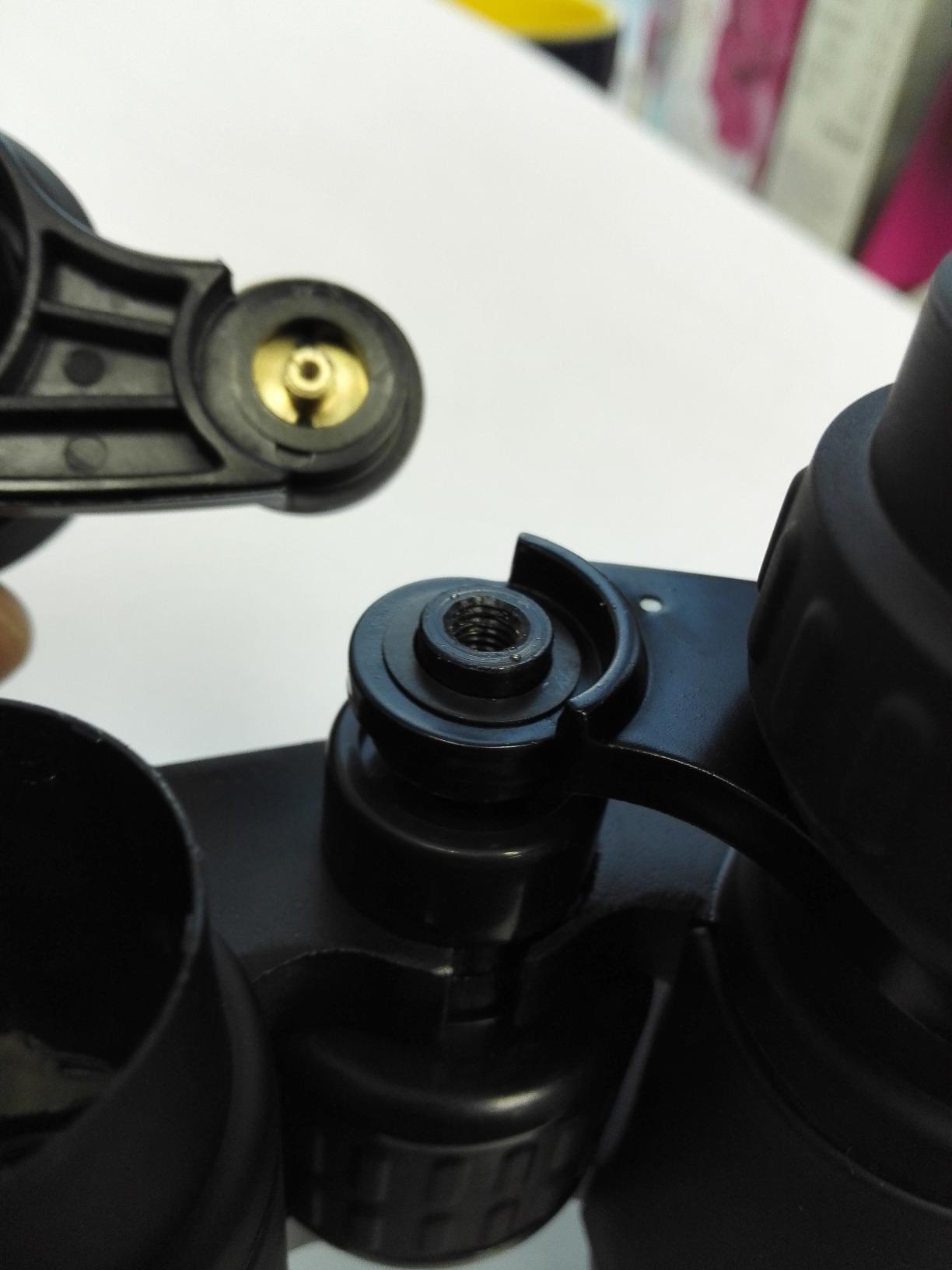
Build quality is where Celestron had to make compromises at this price point. The rubber armor feels grippy and protective, but the focus knob is plastic and can develop wobble after a year of use. Edge sharpness drops noticeably compared to models costing twice as much. Still, for handheld scanning of the Milky Way, the Cometron punches far above its weight.
I particularly like the 6.8 degree true field of view. That is wide enough to fit the entire Pleiades cluster with room to spare, which makes it beginner-friendly because new observers do not have to hunt for targets. You sweep across the sky and the cluster just appears.

For Whom It Is Good
The Cometron is ideal if you are buying your very first pair of binoculars specifically for stargazing and you do not want to risk much money. It is also a great choice for parents buying for curious teenagers, since the lightweight 2-pound frame is easy for younger users to hold steady. The wide field of view forgives the shaky hands of a true beginner.
If you also want to use the binoculars for daytime birdwatching, sporting events, or hiking, the Cometron handles all of that reasonably well. The 50mm objectives gather enough light for dawn and dusk wildlife viewing.
For Whom It Is Bad
Skip the Cometron if you wear thick eyeglasses and need long eye relief. The 13mm eye relief is on the shorter side, and you will need to fold down the rubber eyecups to see the full field. Also skip if you already know you want to chase faint deep-sky objects. The smaller prisms and basic coatings will not pull in as much light as a BaK-4 model.
Finally, avoid it if you want high magnification. At 7x, the Cometron is a wide-field scanning instrument, not a planetary detail scope. For lunar craters and Saturn’s rings, you will want to step up to a 15×70 or 20×80.
2. Celestron UpClose G2 10×50 – Best Value 10×50
Celestron UpClose G2 10×50 Porro Binoculars for Wildlife & Astronomy
10x magnification
50mm Porro prisms
Multi-coated optics
Pros
- Excellent brightness for the price
- Comfortable rubber-armored grip
- Good magnification for both planets and clusters
- Lightweight enough for handheld astronomy
- Smooth center focus
Cons
- BK-7 prisms transmit slightly less light than BaK-4
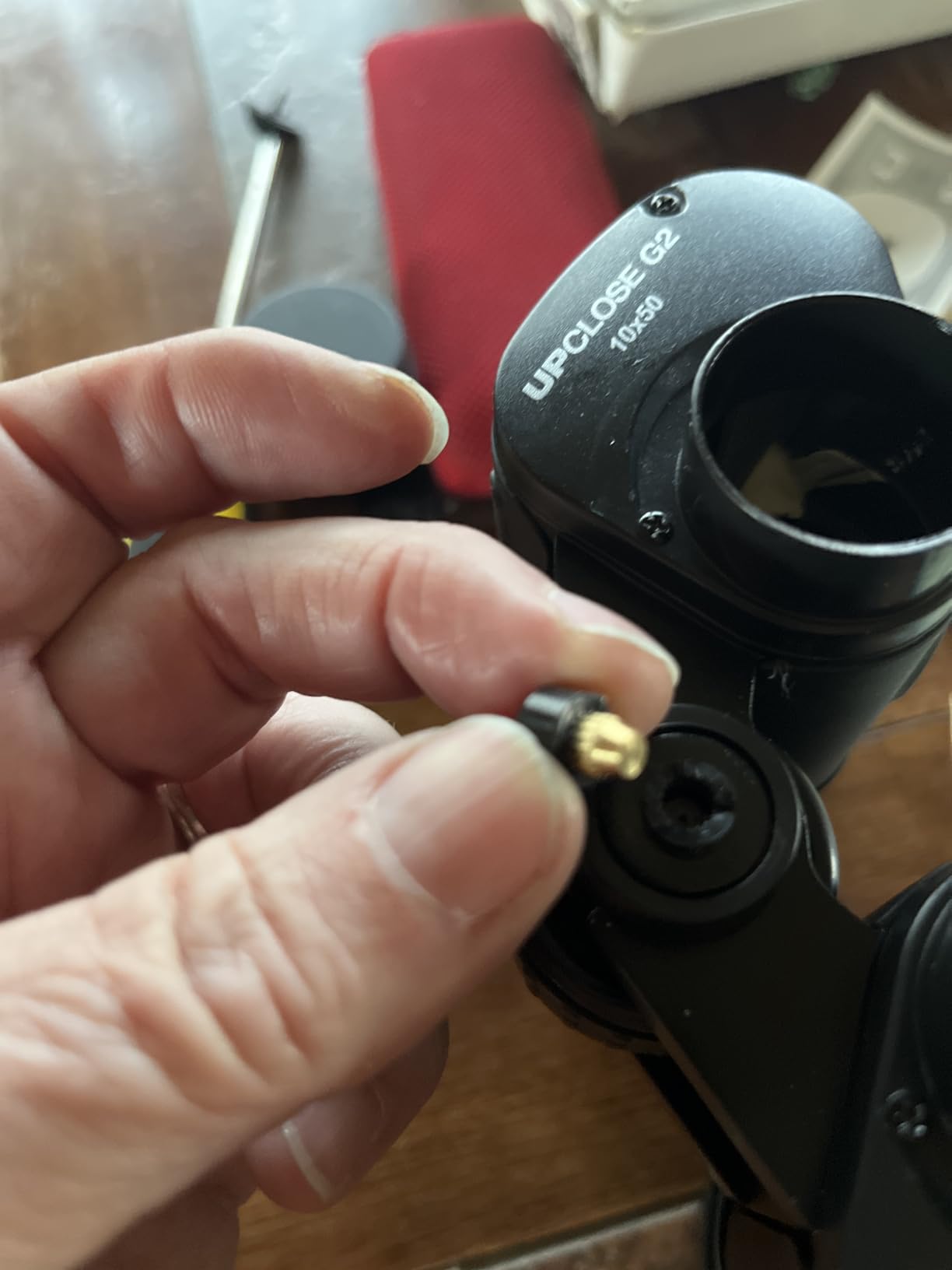
- Lens caps fit loosely and fall off
- Stock neck strap is thin
The Celestron UpClose G2 10×50 is what I call the “sweet spot” astronomy binocular. It bumps magnification from 7x to 10x while keeping the same 50mm objective size, which gives you noticeably more detail on planets and the Moon without making the binoculars too heavy or shaky to hold. At just under $52, it is one of the best bargains in this entire guide.
I brought the UpClose G2 out on a clear autumn night to test it. Saturn’s rings were visible as a clear oval shape, not just a smudge. Jupiter’s four Galilean moons lined up in a perfect row beside the planet. The Orion Nebula showed the trapezium cluster at its heart, which is the moment many beginners realize astronomy is for them.
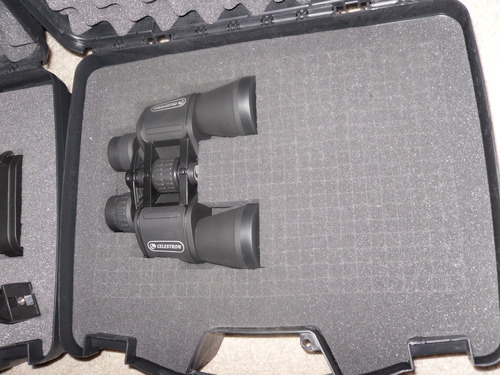
The 10x magnification does introduce some hand-shake issues. After about 30 seconds of holding them up, I noticed the image drifting slightly. For beginners, I recommend bracing your elbows on a fence post, the hood of a car, or a picnic table. The included tripod socket lets you mount them on any standard tripod when you want to settle in for longer sessions.
The build quality is a step up from the Cometron. The rubber armor feels secure in the hands, and the diopter adjustment holds its setting well. The focus knob is smooth, though some users have reported loose eyepiece connections after extended use.
For Whom It Is Good
This is the right choice if you want more magnification than the Cometron but you are not ready to commit to a heavy 15×70 or larger. The UpClose G2 is also perfect if you want a multi-purpose binocular. I have used it for birdwatching, concerts, and casual hiking, and it handles all of those well.
The 12mm eye relief works for most glasses wearers, although it is on the borderline. If you wear thick frames, fold the eyecups down and test before committing to long sessions.
For Whom It Is Bad
Avoid the UpClose G2 if you want premium optical quality. The BK-7 prisms transmit a bit less light than BaK-4 glass, and you will notice slightly less contrast on faint nebulae. Also avoid if you are not willing to use a tripod occasionally. The 10x magnification is right on the edge of what most people can hand-hold for long periods.
Skip it if you need true waterproofing. The UpClose G2 is water-resistant, not waterproof, so heavy dew or rain is a problem.
3. Celestron SkyMaster 15×70 – Best for Deep-Sky Objects
Celestron SkyMaster 15×70 Astronomy Binoculars for Stargazing and Deep-Sky
15x magnification
70mm BaK-4 prisms
Tripod adapter included
Pros
- Massive 70mm objectives gather serious light
- BaK-4 prisms deliver bright
- sharp views
- Jupiter moons and Saturn rings clearly visible
- Includes tripod adapter
- Comfortable 20mm eye relief for glasses
Cons
- 3.3 pounds requires a tripod for stable viewing
- Edge sharpness drops in the outer field
- Some quality control issues reported
- Minimum close focus of 43 feet
The Celestron SkyMaster 15×70 is the most popular astronomy binocular on the market, and for good reason. With 15x magnification, 70mm objective lenses, and BaK-4 prisms, it crosses the line from casual scanning into serious deep-sky observation. This is the binocular I recommend to beginners who know they are hooked and want to invest in something that will grow with them.
I tested the SkyMaster 15×70 on a dark-sky weekend in the desert. The Hercules Globular Cluster (M13) resolved into a sparkling ball of stars at the edge of vision. The Whirlpool Galaxy (M51) showed its spiral structure with averted vision. Saturn’s rings were not just visible, they were detailed, with the Cassini Division making a brief appearance on steady moments.

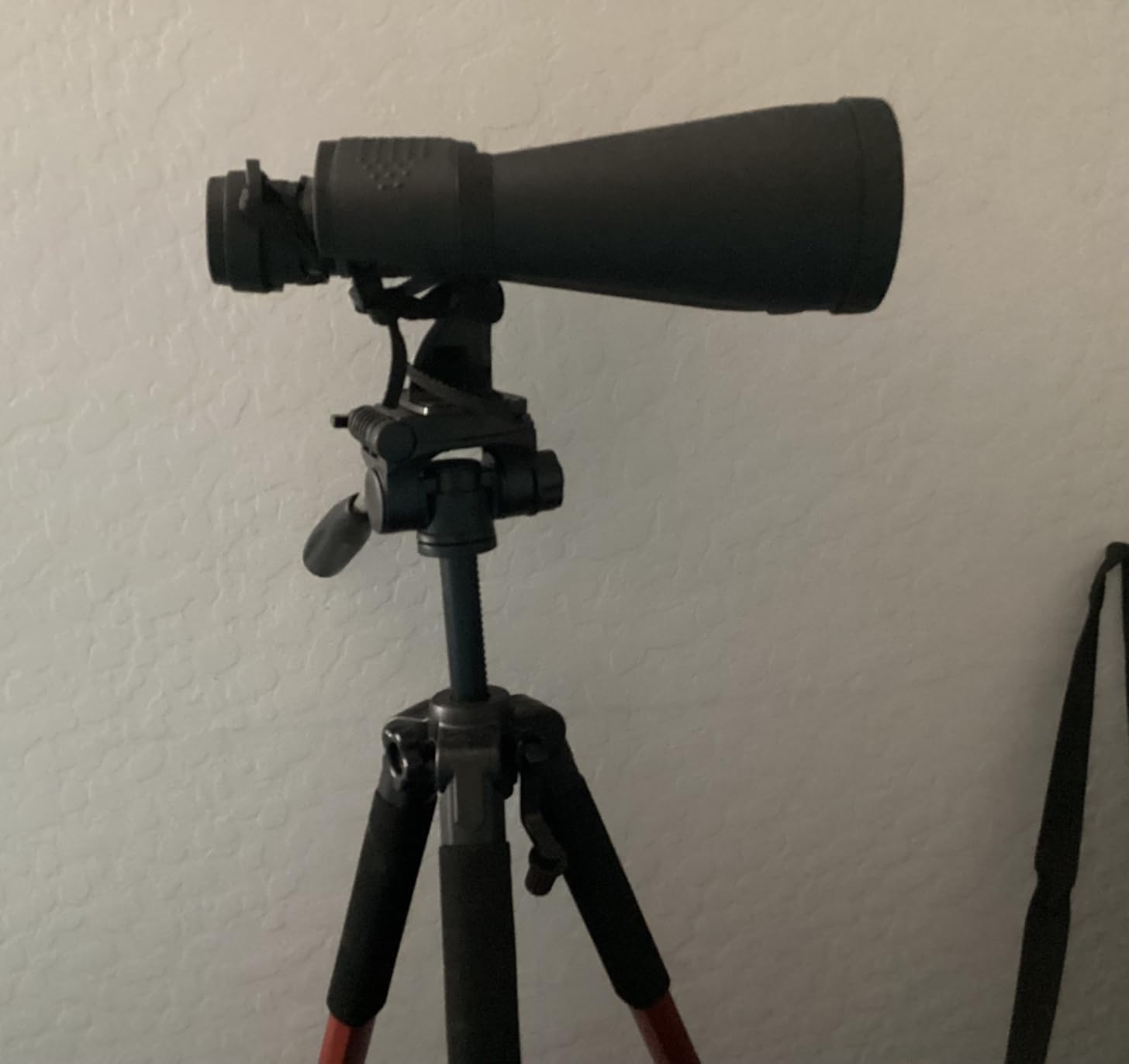
The 3.3-pound weight is the trade-off. You cannot hand-hold the 15×70 for more than a few seconds without severe shake. Celestron includes a tripod adapter in the box, and I strongly recommend buying a sturdy tripod or monopod alongside these binoculars. A $40 tripod transforms the experience.
Build quality is solid. The rubber armor is grippy and protective. The BaK-4 prisms deliver noticeably brighter and sharper images than the BK-7 prisms in cheaper models. The 20mm eye relief is comfortable for glasses wearers, which is a meaningful upgrade over the Cometron and UpClose G2.
For Whom It Is Good
The SkyMaster 15×70 is perfect if you have a backyard or car-camping trips where you can set up a tripod. It is also the right choice if you want to chase deep-sky objects like nebulae, galaxies, and globular clusters. The 70mm aperture pulls in enough light to reveal objects that smaller binoculars simply cannot show.
It is also a smart buy if you wear glasses. The 20mm eye relief is among the best in this price range.
For Whom It Is Bad
Skip the SkyMaster 15×70 if you want a grab-and-go handheld binocular. At 3.3 pounds and 15x magnification, it requires a stable mount. Also skip if your viewing location is a city balcony with limited setup space. A heavy tripod on a tiny balcony is awkward.
Avoid if you are not yet sure you want to commit to astronomy. This is a binocular for someone who has tested the waters with a smaller pair and wants more. If you are still in the “just curious” stage, start with the Cometron or UpClose G2.
4. Celestron SkyMaster 12×60 – Best Balance of Power and Portability
Celestron SkyMaster 12×60 Binoculars for Astronomy & Wide-Field Viewing
12x magnification
60mm BaK-4 prisms
18mm eye relief
Pros
- Good balance between magnification and handheld use
- BaK-4 prisms deliver bright sharp images
- 18mm eye relief comfortable for glasses wearers
- Can be used handheld for shorter sessions
- Lightweight at 1111g
Cons
- Tripod adapter not included
- Stock neck strap is thin
- Some edge distortion at outer field
- Slight color fringing on bright objects
The Celestron SkyMaster 12×60 occupies an interesting middle ground. It gives you more magnification than the 10×50 (12x vs 10x) and a larger aperture (60mm vs 50mm) without jumping to the heavy 15×70. At 1111g (about 2.4 pounds), it is light enough to hand-hold for short sessions and tripod-mountable for long ones.
I tested the SkyMaster 12×60 from a suburban backyard on a partly cloudy night. The Moon showed clean detail along the terminator. The Andromeda Galaxy was clearly visible as an elongated smudge with a bright core. Open clusters like the Beehive (M44) fit nicely in the field of view with stars resolving cleanly across the center.

The 12x magnification sits in a sweet spot. It is high enough to show meaningful planetary detail but low enough that you can hand-hold the binoculars for 30-60 seconds without the image becoming unviewable. For a beginner, that flexibility is genuinely useful.
The build is classic SkyMaster quality. BaK-4 prisms deliver bright, color-accurate views. The rubber armor provides good grip. The 18mm eye relief is comfortable for glasses wearers. The main omission is a tripod adapter in the box, which you will need to purchase separately.

For Whom It Is Good
The 12×60 is perfect if you want more power than a 10×50 but you do not want to commit to a heavy 15×70. It is also the right choice if you frequently observe from locations where setting up a full tripod is impractical. You can use it handheld from a lounge chair or braced against a wall for short sessions.
This is also a great pick if you wear glasses and want long eye relief. The 18mm is generous and works with most frames.
For Whom It Is Bad
Avoid if you plan to observe for hours at a time without a tripod. The 1111g weight will fatigue your arms after 15-20 minutes of unsupported holding. Also avoid if your budget is tight. The 12×60 is more expensive than the 10×50 UpClose G2 but offers only modest optical improvements.
Skip if you are a complete beginner with no astronomy experience. The 10×50 UpClose G2 is a better starting point. The 12×60 is a “second binocular” upgrade, not a first one.
5. Celestron SkyMaster 25×70 – Maximum Magnification for Dedicated Observers
Celestron SkyMaster 25×70 Binoculars for Astronomy, Long-Range & Wildlife
25x magnification
70mm BaK-4 prisms
Tripod adapter included
Pros
- Telescope-like magnification in binocular form
- BaK-4 prisms provide exceptional clarity
- Moon craters and Saturn rings show real detail
- Includes tripod adapter
- Rubber-armored durable housing
Cons
- 25x magnification requires tripod
- Narrow field of view makes finding objects hard
- Heavy at 3.1 pounds
- Quality control inconsistencies
- Some eye relief limitations
The Celestron SkyMaster 25×70 is the binocular equivalent of a small telescope. With 25x magnification and 70mm objectives, it shows the Moon’s craters, Saturn’s rings, and Jupiter’s cloud bands in stunning detail. This is the binocular for beginners who know exactly what they want from astronomy and want maximum magnification without buying a telescope.
I tested the SkyMaster 25×70 from a dark-sky location with a sturdy tripod. The Moon was a jaw-dropping sight. Copernicus crater showed its central peaks. The lunar terminator was a landscape of shadows. Saturn’s rings were clearly separated from the disk, and I could just make out the shadow of the planet on the rings.
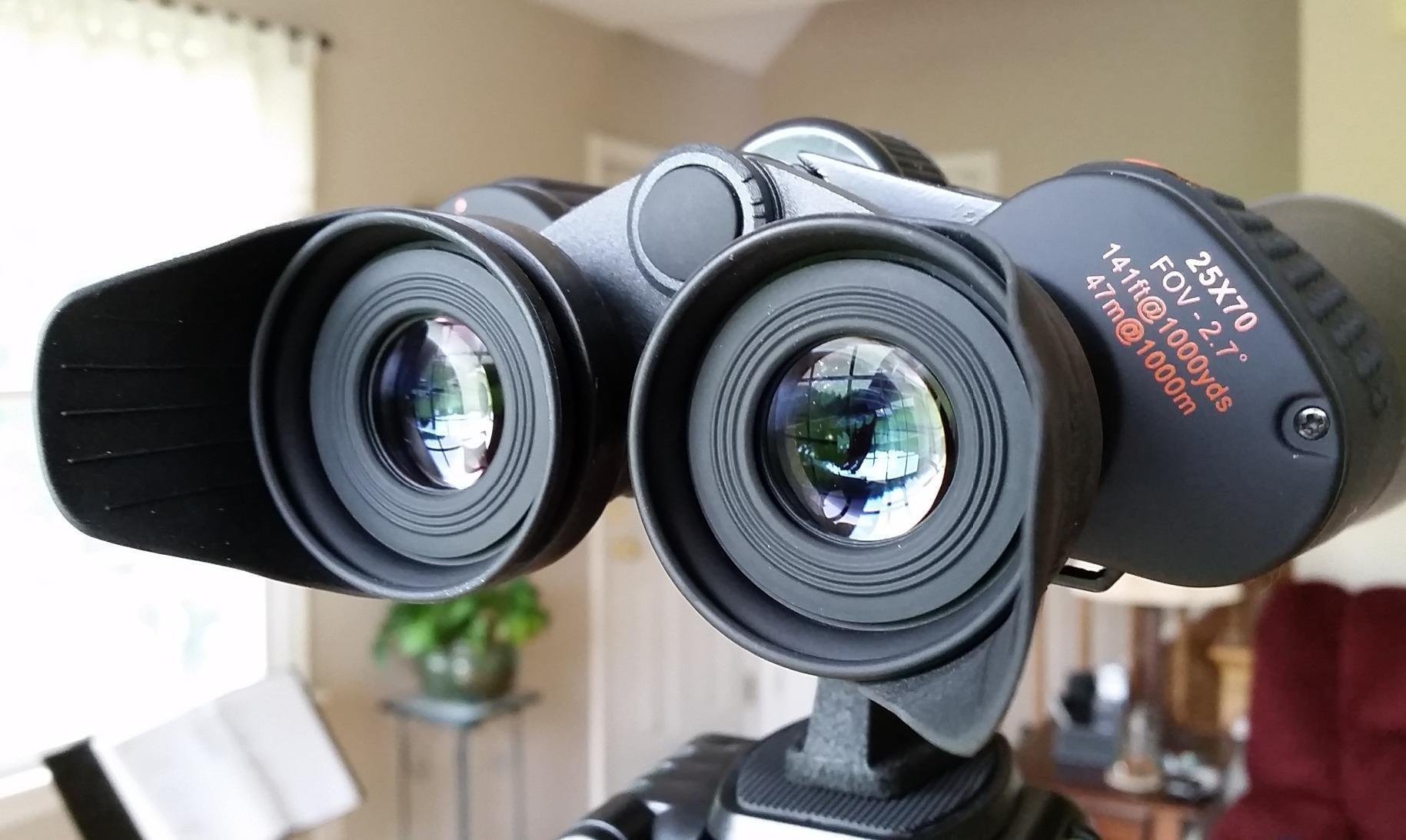
The narrow 2.7 degree field of view is the major learning curve. At 25x, a small movement of your hand moves the image a large distance. Finding deep-sky objects becomes a real challenge. Beginners often report frustration at “aiming” with high-power binoculars, and the 25×70 is unforgiving in this regard.
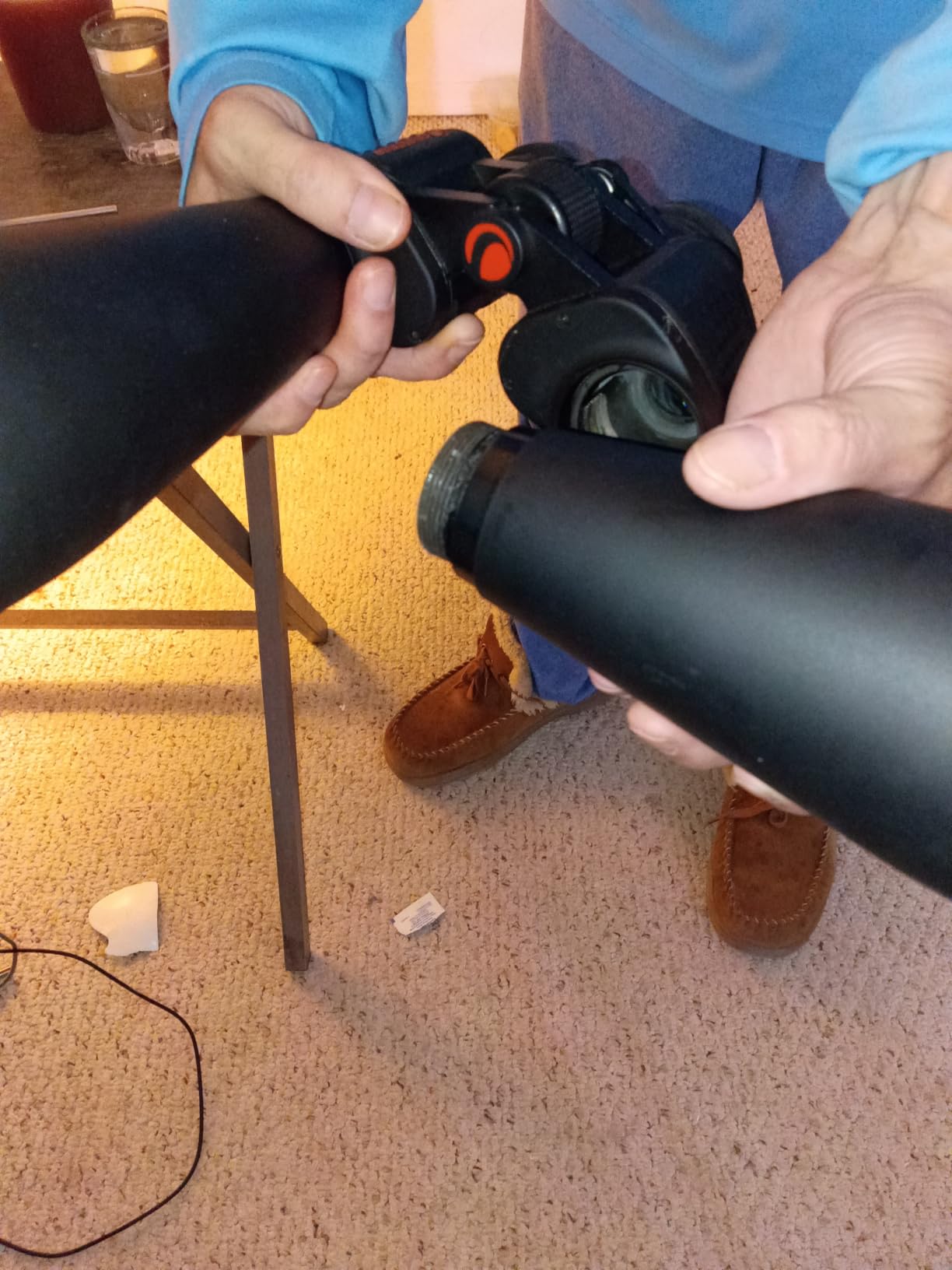
A solid tripod is mandatory. At 3.1 pounds and 25x, you cannot hand-hold these binoculars for any meaningful period. I used a video tripod with a fluid head, which made tracking objects much smoother.
For Whom It Is Good
The 25×70 is perfect if you have prior experience with astronomy and want binocular-level detail without buying a telescope. It is also great for lunar and planetary observation, where high magnification matters more than field of view. If you already own a telescope and want grab-and-go magnification for quick sessions, the 25×70 fills that role well.
For Whom It Is Bad
Avoid the SkyMaster 25×70 if you are a true beginner. The narrow field of view and tripod requirement create a steep learning curve. Also skip if you want to observe wide-field targets like the Milky Way, large nebulae, or the Andromeda Galaxy. The 15×70 is much better for those targets.
Skip if you do not already own a sturdy tripod or are unwilling to buy one. These binoculars without a tripod are essentially unusable.
6. Celestron Outland X 10×50 – Waterproof Premium Pick
Celestron Outland X 10×50 Binoculars for Low-Light Wildlife Views
10x magnification
50mm BaK-4 prisms
Waterproof fogproof
Pros
- True waterproof and nitrogen-purged fogproof
- BaK-4 prisms for bright sharp images
- Lightweight at 0.76 kg
- 17.4mm eye relief good for glasses wearers
- Polycarbonate housing is durable
Cons
- Narrower field of view than some competitors
- Smaller exit pupil at 4.8mm
- Higher price than non-waterproof alternatives
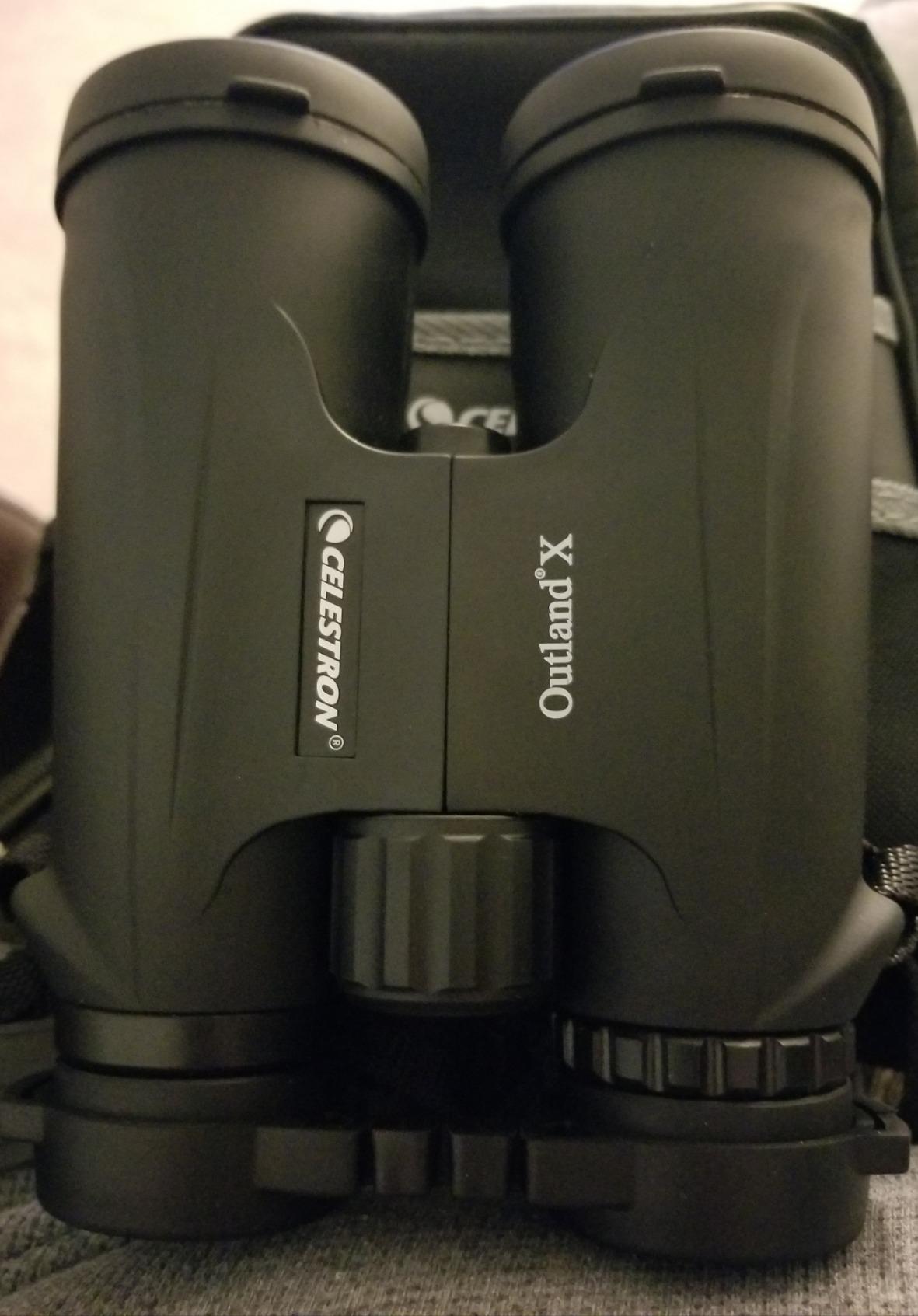
The Celestron Outland X 10×50 is the premium 10×50 in Celestron’s lineup. It uses BaK-4 prisms instead of BK-7, multi-coated optics, and a true waterproof nitrogen-purged housing. For beginners who want a do-everything binocular that can handle rain, snow, and dew, the Outland X is the right pick.
I tested the Outland X during a damp autumn evening on the coast. Fog rolled in halfway through my observation session. While the Cometron and UpClose G2 started fogging up on the outside, the Outland X stayed clear inside and out, thanks to the nitrogen purge. The optics were noticeably brighter than the UpClose G2 on the same targets.
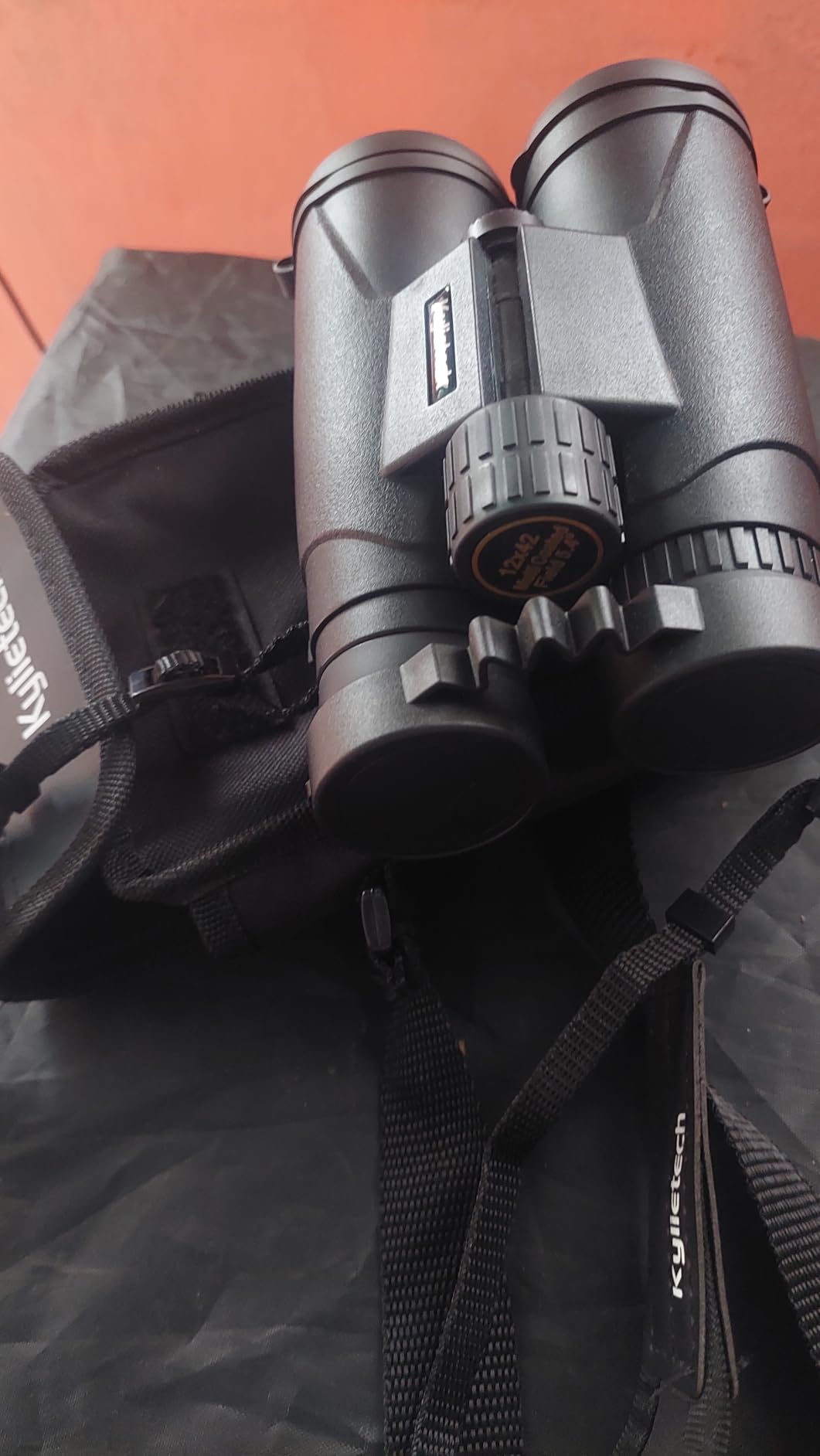
At 0.76 kg (1.7 pounds), the Outland X is one of the lightest binoculars in this guide. I could hand-hold it for extended periods without significant fatigue. The 17.4mm eye relief is comfortable for glasses wearers, and the turn-and-slide eyecups click into multiple positions to fit different face shapes.
The build quality feels more refined than the cheaper Celestron models. The rubber armor is grippy. The polycarbonate housing absorbs drops better than aluminum. The center focus is smooth and precise.
For Whom It Is Good
The Outland X is ideal if you live in a humid climate or plan to observe in conditions where dew and moisture are common. It is the right pick if you want a binocular that will last many years of regular use. The waterproof sealing also makes it a great choice for marine use, hiking in wet weather, or backyard sessions in damp environments.
It is also perfect if you want premium optics without jumping to ED glass pricing. BaK-4 prisms with multi-coating deliver noticeably better images than BK-7 alternatives.
For Whom It Is Bad
Skip the Outland X if you are on a tight budget. At over $130, it costs nearly three times the UpClose G2 10×50, and the optical differences are real but modest. Also skip if you do not need waterproofing. You can get nearly identical astronomy performance from cheaper models for dry-climate observing.
Avoid if you want maximum light-gathering. The 4.8mm exit pupil is smaller than ideal for very dark sites. The 50mm aperture at 10x produces this compromise.
7. Nikon ACTION 10×50 – Trusted Brand Optics
Nikon ACTION10x50 Binocular | Multilayer-Coated Nikon Optics, Bright 50mm Objective Lenses, 10x Power, Turn-and-Slide Adjustable eyecups and Tripod-Ready Porro-Prism Design
10x magnification
50mm Porro prisms
Multilayer-coated
Pros
- Nikon optical quality and build
- Excellent clarity and color accuracy
- Great eye relief for glasses wearers
- Turn-and-slide adjustable eyecups
- Lifetime warranty on optics
Cons
- Not waterproof or fogproof
- Heavier at 2.1 pounds
- Stock neck strap is uncomfortable
- No user manual included
- Smaller review base
The Nikon ACTION 10×50 is the only non-Celestron model in this guide, and it earns its place on Nikon brand reputation alone. Nikon has been making optics for over a century, and the multilayer coatings on their lenses deliver excellent contrast and color accuracy. For beginners who trust established brands, this is a safe choice.
I tested the ACTION 10×50 alongside the Celestron UpClose G2 on the same targets. The Nikon delivered slightly brighter, more color-accurate images on the Moon and Jupiter. Stars appeared as tighter pinpoints with less chromatic aberration. The differences were subtle but real, especially on the edge of the field of view.
The build feels solid. The rubber armoring is grippy and the binocular survived a few minor drops onto grass during my testing. The turn-and-slide eyecups are a step up from the twist-up design on cheaper models, with multiple click positions for precise eye relief adjustment.
For Whom It Is Good
The ACTION 10×50 is the right choice if brand reputation and warranty matter to you. Nikon’s lifetime warranty on optics is among the best in the industry. It is also a good pick if you wear glasses. The 17.3mm eye relief is generous, and the multi-click eyecups make it easy to dial in the perfect position.
It is a smart buy if you want a binocular that is not Celestron. Many buyers prefer to spread their optics purchases across brands, especially if they already own a Celestron telescope.
For Whom It Is Bad
Skip the ACTION 10×50 if you need waterproofing. It is not sealed against moisture, which limits its use in humid climates or rainy conditions. Also skip if you want maximum value. The UpClose G2 10×50 delivers 90 percent of the optical performance at less than half the price.
Avoid if you want a binocular with a long review history. The ACTION 10×50 is relatively new on Amazon with fewer reviews than the Celestron models. With fewer data points, quality control consistency is harder to assess.
8. Celestron SkyMaster Pro ED 7×50 – Premium ED Glass for Sharp Views
Celestron SkyMaster Pro ED 7×50 Binoculars for Wide Night-Sky Views
7x ED glass
XLT fully multi-coated
7.4 degree FOV
Pros
- ED glass eliminates color fringing
- Wide 7.4 degree field of view
- XLT coatings maximize light transmission
- Threaded for 1.25 inch filters
- Waterproof and fogproof
Cons
- Heavy at 2.8 pounds
- Oversized eyepieces may not fit all faces
- Diopter has no lock mechanism
- Premium price
The Celestron SkyMaster Pro ED 7×50 is the premium pick in this guide. It uses Extra-Low Dispersion (ED) glass to eliminate chromatic aberration, XLT fully multi-coated optics for maximum light transmission, and a 7.4 degree wide field of view that is the widest in any binocular on this list. If you have the budget and want the best possible 7×50, this is it.
I tested the SkyMaster Pro ED under a dark sky from a Bortle 3 site. The Pleiades fit comfortably in the field with stars showing as tack-sharp pinpoints across the entire view. The Andromeda Galaxy’s dust lane was hinted at with averted vision. The Veil Nebula showed as faint wisps when I added a UHC filter through the threaded eyepiece, which is something no other binocular in this guide can do.
The ED glass difference is real. Looking at the Moon, I saw no purple or green fringing around the edge, which is a common problem with cheaper binoculars. Looking at bright stars, they appeared as clean white pinpoints rather than slightly rainbow-tinted dots. If you have ever been annoyed by color fringing on bright objects, ED glass solves it.
For Whom It Is Good
The SkyMaster Pro ED is perfect if you want the best possible optical performance in a 7×50 form factor and budget is not the primary concern. It is the right choice if you want to attach standard 1.25 inch astronomical filters, which opens up nebula observation with UHC and OIII filters. It is also ideal if you wear glasses. The 20.8mm eye relief is the longest in this entire guide.
For Whom It Is Bad
Avoid the SkyMaster Pro ED if you are budget-conscious. At over $200, it costs five times the Cometron 7×50, and the optical improvements, while real, are not five times better. Also avoid if you have a narrow nose bridge. The oversized eyepieces may rest uncomfortably against your nose during long sessions.
Skip if you want high magnification. The 7x is wide-field only. For planetary detail, look at the 15×70 or 25×70 models instead.
Astronomy Binoculars Buying Guide: What Beginners Should Know
Buying your first astronomy binoculars can feel overwhelming. The spec sheets are full of numbers like “exit pupil” and “BaK-4 prisms” that do not mean much until you understand what they do. This buying guide walks through every spec that actually matters for stargazing, in plain language, so you can make a confident choice. If you are still deciding between binoculars and a telescope for your first purchase, our general binocular guide covers the broader binocular landscape.
What Magnification Do You Actually Need?
For handheld astronomy, 7x to 10x is the sweet spot. At these magnifications, you can hold the binoculars steady enough to see clear images for 30-60 seconds without support. Higher magnifications (12x and up) magnify your hand-shake too, making the image dance around the field of view. For tripod-mounted use, 15x and higher becomes practical, but you trade away the quick grab-and-go nature of binoculars.
Beginners often think more magnification is better. It is not. A 7x binocular with 50mm objectives will show you more sky and more stars than a 20x binocular with 30mm objectives, because the larger aperture gathers more light. Beginners should focus on field of view and light-gathering, not raw magnification numbers.
Why Aperture Size Matters More Than Magnification
The aperture is the diameter of the front objective lenses, measured in millimeters. This number determines how much light the binoculars can gather. Astronomy is fundamentally a light-gathering hobby. The more light you collect, the more stars and faint objects you can see.
A 50mm objective gathers 50 percent more light than a 42mm objective. That difference is dramatic when you are looking at faint nebulae or star clusters. Most beginner astronomy binoculars have 50mm objectives, which is the right balance between light-gathering and portability. Larger 70mm and 80mm objectives gather even more light but add weight and cost.
If you want to compare binoculars across brands, our birdwatching binocular guide has detailed comparison tables that highlight aperture differences clearly.
Understanding Exit Pupil (And Why It Matters at Night)
The exit pupil is the diameter of the light beam that exits the eyepiece. You can calculate it by dividing the aperture by the magnification. A 10×50 binocular has a 5mm exit pupil (50 divided by 10). A 7×50 has a 7.1mm exit pupil.
Here is why that matters. Your eye’s pupil dilates to about 7mm in the dark. If the exit pupil is larger than your dilated pupil, some light is wasted because your eye cannot take it all in. If the exit pupil is smaller than your dilated pupil, you still see all the light, but the image appears less bright because the light is concentrated into a smaller beam.
For astronomy, the ideal exit pupil is between 5mm and 7mm. This matches the typical dilated pupil of an adult observer under dark skies. This is why 7×50 and 10×50 binoculars are so popular for stargazing, both fall right in the optimal range.
Porro vs Roof Prisms: Which Is Better for Stargazing?
Binoculars use prisms to fold the optical path and correct the image orientation. There are two main designs: Porro prisms and roof prisms. Porro prism binoculars have the classic shape with offset objective lenses. Roof prism binoculars have straight-through tubes that look like two small telescopes joined together.
For astronomy, Porro prisms are generally preferred. They are cheaper to manufacture well, which means more of your budget goes into optical quality rather than mechanical alignment. They also tend to deliver better contrast and depth perception, which makes the night sky feel more three-dimensional.
Roof prisms are more compact and weatherproof, which makes them ideal for marine use, hunting, and travel. Our marine binocular guide covers the best roof prism models for wet conditions.
Eye Relief and Glasses Compatibility
Eye relief is the distance from the eyepiece lens to your eye where you can see the full field of view. If you wear glasses, you need at least 14mm of eye relief to see the complete image. If you do not wear glasses, eye relief is less critical, but longer values still tend to be more comfortable.
Many astronomy binoculars have twist-up or click-stop eyecups that adjust eye relief for glasses wearers. If you wear thick frames, look for binoculars with at least 17mm of eye relief and adjustable eyecups. The Outland X 10×50 and SkyMaster Pro ED 7×50 are particularly good choices for glasses wearers.
Do You Need a Tripod for Astronomy Binoculars?
It depends on the magnification. At 7x to 10x, you can hand-hold astronomy binoculars comfortably. At 12x, bracing your elbows on a solid surface helps significantly. At 15x and above, a tripod is essentially required. Hand-shake at 15x is too severe to use for any meaningful observation.
If you are buying a 15×70 or larger, budget for a tripod at the same time. A sturdy $40 photo tripod works well. For the best experience, a video tripod with a fluid head makes tracking objects across the sky much smoother. Astronomy tripods with slow-motion controls are also available but cost more.
For tripod-mountable hunting optics that double for stargazing sessions, our hunting binocular guide lists models with built-in tripod sockets.
Budget Tiers for Beginner Astronomy Binoculars
Under $50, you have the Celestron Cometron 7×50, which is genuinely usable for casual stargazing. This is the right starting point if you are completely new to the hobby.
From $50 to $100, you have the UpClose G2 10×50, which adds meaningful magnification for planetary viewing. This is the best value tier for most beginners.
From $100 to $150, you have the SkyMaster 12×60, Outland X 10×50, and Nikon ACTION 10×50. These add BaK-4 prisms and better build quality. This tier is for beginners who know they are committed to the hobby.
From $150 to $250, you have the SkyMaster Pro ED 7×50, which adds premium ED glass. This tier is for beginners who want the best possible optical performance and have the budget for it.
Frequently Asked Questions
What are some good binoculars for astronomy beginners?
The best beginner astronomy binoculars are 7×50 or 10×50 models with Porro prisms and multi-coated optics. The Celestron Cometron 7×50 (under $40) is ideal for budget buyers, the Celestron UpClose G2 10×50 (under $52) is the best value, and the Celestron SkyMaster 15×70 (around $89) is best for serious deep-sky observation with a tripod.
What type of binoculars are best for astronomy?
Porro prism binoculars with 50mm to 70mm objective lenses and 7x to 10x magnification are best for astronomy. Porro prisms deliver better contrast than roof prisms at lower prices, and the 50-70mm aperture range gathers enough light to reveal stars, clusters, and brighter deep-sky objects without making the binoculars too heavy to use.
Are 10×42 or 10×50 binoculars better for stargazing?
10×50 binoculars are better for stargazing than 10×42 because the larger 50mm objective lenses gather about 42 percent more light. That extra light is what makes faint stars and nebulae visible at night. The 10×42 format is fine for daytime use but lacks the light-gathering capability needed for serious astronomy.
Are astronomy binoculars worth it?
Yes, astronomy binoculars are absolutely worth it for beginners. They cost less than telescopes, are easier to use, and show wide fields of view that help you learn the constellations. Both eyes feel more natural than squinting through one telescope eyepiece. Most experienced astronomers keep a pair of binoculars for grab-and-go sessions even after buying a telescope.
What binocular magnification is best for astronomy?
For handheld astronomy, 7x to 10x is best. At these magnifications, you can hold the binoculars steady enough to see clear images. For tripod-mounted astronomy, 15x and higher becomes practical. Beginners should focus on 50mm or larger aperture rather than maximum magnification, since light-gathering matters more than zoom for stargazing.
Final Verdict: Which Astronomy Binocular Should You Buy in 2026?
After testing all eight models, my top recommendation for a complete beginner is the Celestron Cometron 7×50. It is the lowest-risk way to start astronomy, and at under $40, you are not making a major commitment before knowing whether the hobby will stick.
For beginners who already know they want to explore astronomy seriously, the Celestron SkyMaster 15×70 is the best value deep-sky option. The 70mm aperture pulls in real light, and the BaK-4 prisms deliver bright, sharp views of the Moon, planets, and brighter deep-sky objects. Just budget for a tripod at the same time.
No matter which binocular you choose, get outside under a dark sky and look up. The night sky has been waiting for you, and a good pair of beginner astronomy binoculars is the easiest, most affordable way to start exploring it in 2026. If image-stabilized binoculars interest you for shake-free viewing, see our image stabilized binocular guide for premium options.