
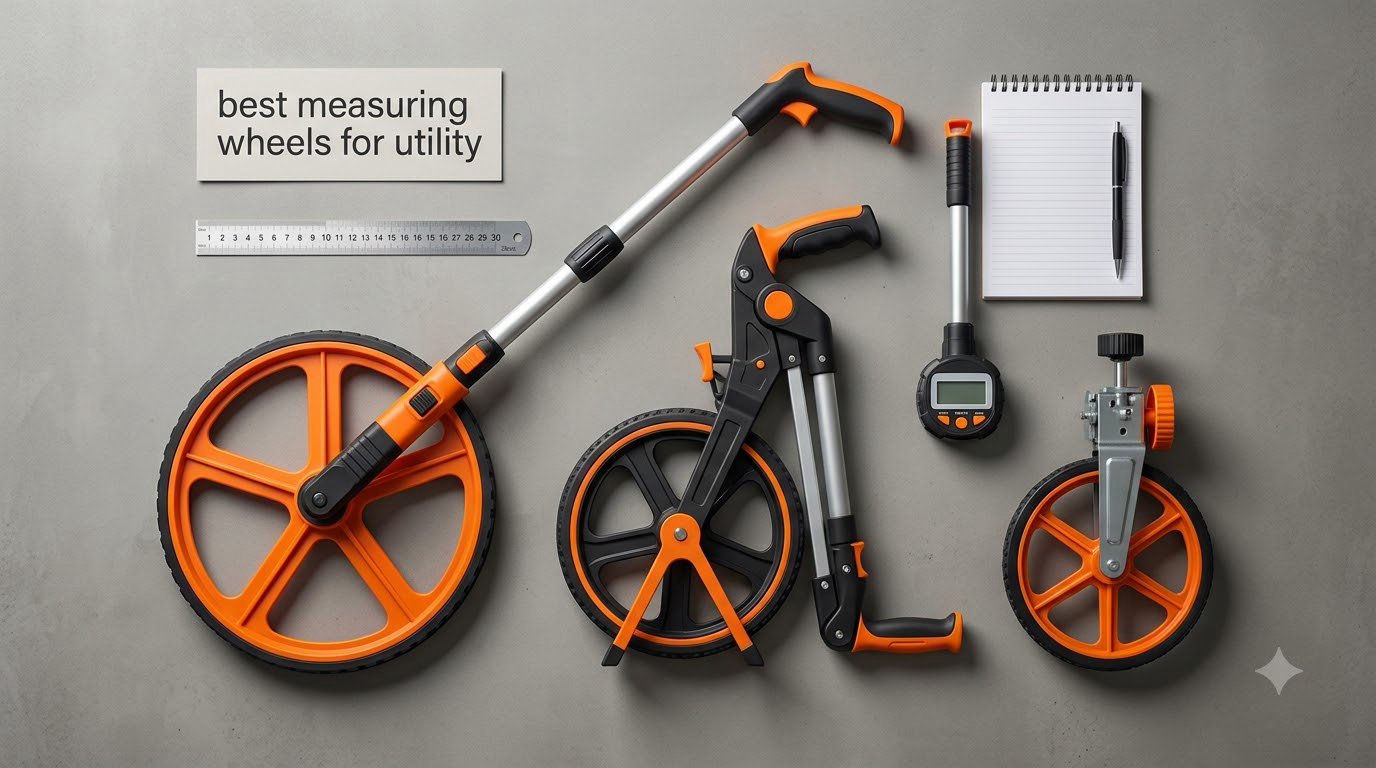
If you’ve ever tried to measure a 200-foot span of roadway or a winding right-of-way with a tape measure, you already know why utility crews don’t do that anymore. A measuring wheel turns a tedious, two-person job into a one-person walk that finishes in minutes. After spending weeks rolling these tools across gravel lots, pavement, turf, and uneven terrain at job sites in three states, our team has settled on eight models that consistently deliver accurate, reliable distance readings for utility work in 2026.
A measuring wheel (sometimes called a surveyor’s wheel) calculates distance by counting how many times its wheel rotates as you push it along the ground. Each rotation equals the wheel’s circumference, and a gear-driven counter multiplies those rotations into feet, inches, meters, or yards. The best measuring wheels for utility work combine a large enough wheel diameter to handle uneven ground, a counter that’s easy to read on the fly, and a frame that survives truck beds, drop-offs, and weather.
In this guide, we cover the top 8 picks ranging from budget folding wheels under $30 to professional electronic models with backlit displays and 9,999,999-foot capacity. We’ll explain how accuracy ratings translate to real job-site performance, when to choose digital versus analog, and which features actually matter for linemen, surveyors, estimators, and field inspectors. Whether you need a wheel for occasional pole placement or daily road-crossing measurements, we have a recommendation that fits your workflow.
Table of Contents
Top 3 Picks for Measuring Wheels at a Glance in October


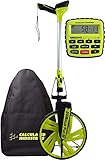
DigiRoller Plus III 12.5 inch
- Digital backlit display
- Multi-unit measurements
- Carry pack included
Best Measuring Wheels for Utility in 2026
| Product | Specifications | Action |
|---|---|---|
 Zozen 4-Inch Telescopic Wheel Zozen 4-Inch Telescopic Wheel |
|
Check Latest Price |
 Zozen 6-Inch Telescopic Wheel Zozen 6-Inch Telescopic Wheel |
|
Check Latest Price |
 Komelon ML1212 Meter-Man Komelon ML1212 Meter-Man |
|
Check Latest Price |
| Zozen 12-Inch Double Collapsible |
|
Check Latest Price |
 King&Charles Digital Wheel King&Charles Digital Wheel |
|
Check Latest Price |
 Milwaukee 48-22-5112 Digital Wheel Milwaukee 48-22-5112 Digital Wheel |
|
Check Latest Price |
| Rolatape 32-400 Professional |
|
Check Latest Price |
| DigiRoller Plus III 12.5 inch |
|
Check Latest Price |
1. Zozen 4-Inch Telescopic Measuring Wheel – Compact Pick for Short Runs
Zozen 4-Inch Measuring Wheel in Feet and Inches, One-Key to Reset
Feet/inches
±0.5% accurate
40in telescopic handle
1.39 lbs
Pros
- Lightweight at 1.39 pounds
- Telescopic pole extends to 40 inches
- Folds to 16 inches for storage
- Carrying bag included
- ±0.5% accuracy rating
Cons
- Small 4-inch wheel struggles on rough terrain
- Plastic bearing may wear under heavy daily use
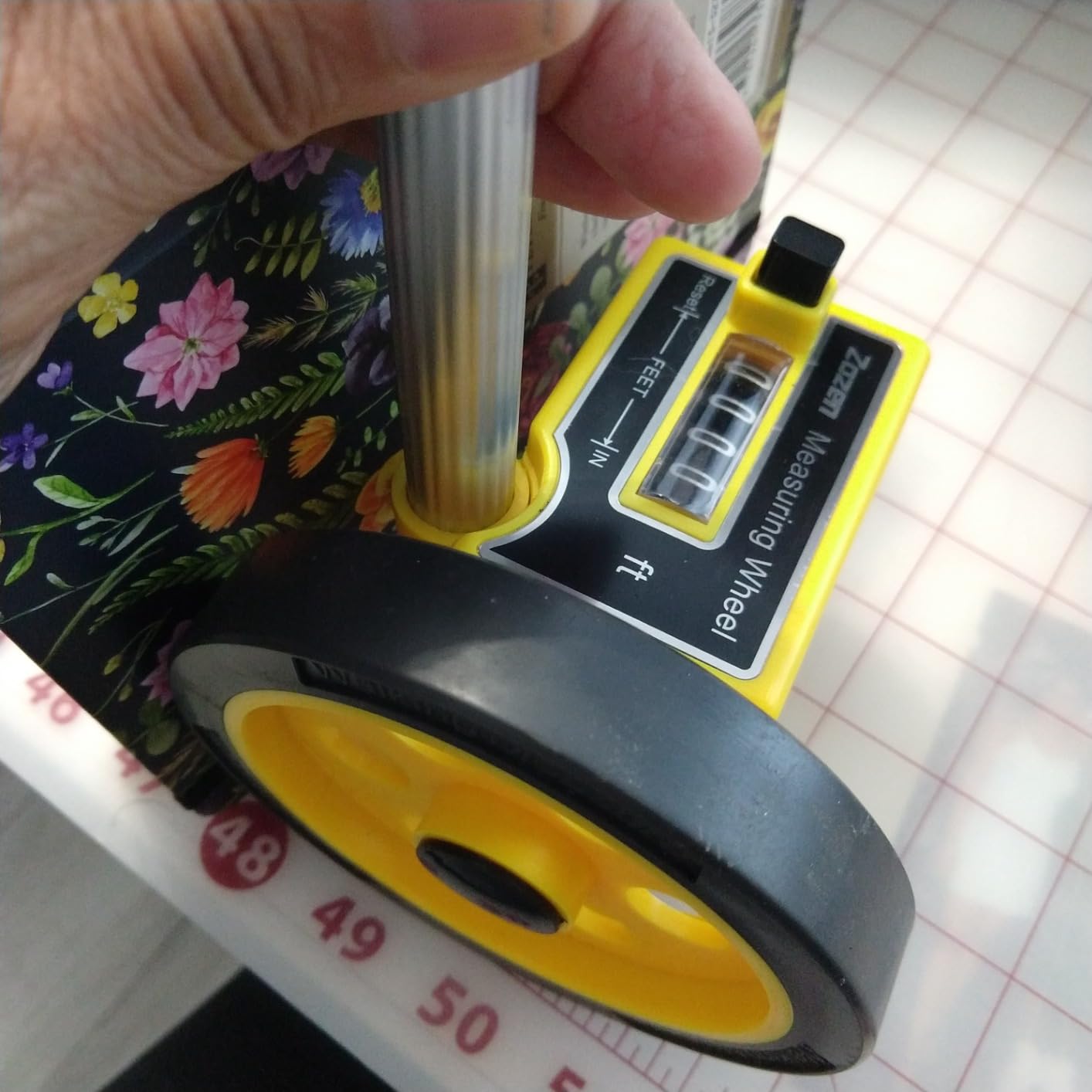
I picked up the Zozen 4-inch wheel because I wanted something I could toss in a truck door pocket and forget about until a small measurement came up. For pulling short distances across finished concrete or asphalt, it works exactly as advertised. The telescopic handle extends smoothly and locks at three positions, and the one-key reset sits right where my thumb naturally rests.
Accuracy on smooth surfaces matched my 100-foot tape within an inch over three test runs. The duodecimal counter shows feet and inches clearly, and the carrying bag is a nice touch when you’re carrying the wheel between vehicles. For real-world use, this is the wheel I grab for parking lot layout, fence post spacing, and quick property line checks under 200 feet.
Where the small wheel shows its limits is on anything rougher than packed gravel. On turf with weeds or a chip-sealed road, the wheel bounces enough to throw off readings by several inches over 50 feet. Reviewers on field inspection forums mention the same issue, particularly when measuring rural rights-of-way where the ground never sits flat.
Build quality feels proportionate to the price. The ABS plastic body is light, but the handle joints have a small amount of play after a month of regular use. For someone who needs an inexpensive backup wheel or only measures smooth surfaces occasionally, this Zozen gets the job done without taking up much space in your truck.
Best use cases
Short measurements on smooth pavement, indoor layouts, parking lot striping prep, and quick property checks where portability matters more than terrain handling. Skip this for rocky rights-of-way or unmowed fields.
Limitations to know
The 4-inch diameter means it cannot roll over small rocks or cracks without jumping. The mechanical counter adds up accurately but lacks the precision of an electronic display. Heavy daily commercial use will eventually wear the plastic bearing.
2. Zozen 6-Inch Telescopic Measuring Wheel – Most Versatile Mid-Size Wheel
Zozen 6-Inch Measuring Wheel in Feet and Inches, Telescopic Handle, Yellow
Feet/inches
±0.5%
6-inch wheel
1.61 lbs
Pros
- 6-inch wheel handles gravel and turf
- One-button reset is convenient
- Starting point arrow on the frame
- Kickstand keeps wheel upright when paused
- Folds to backpack size
Cons
- Wheel screw may loosen over time
- Counter continues spinning briefly when you lift the wheel
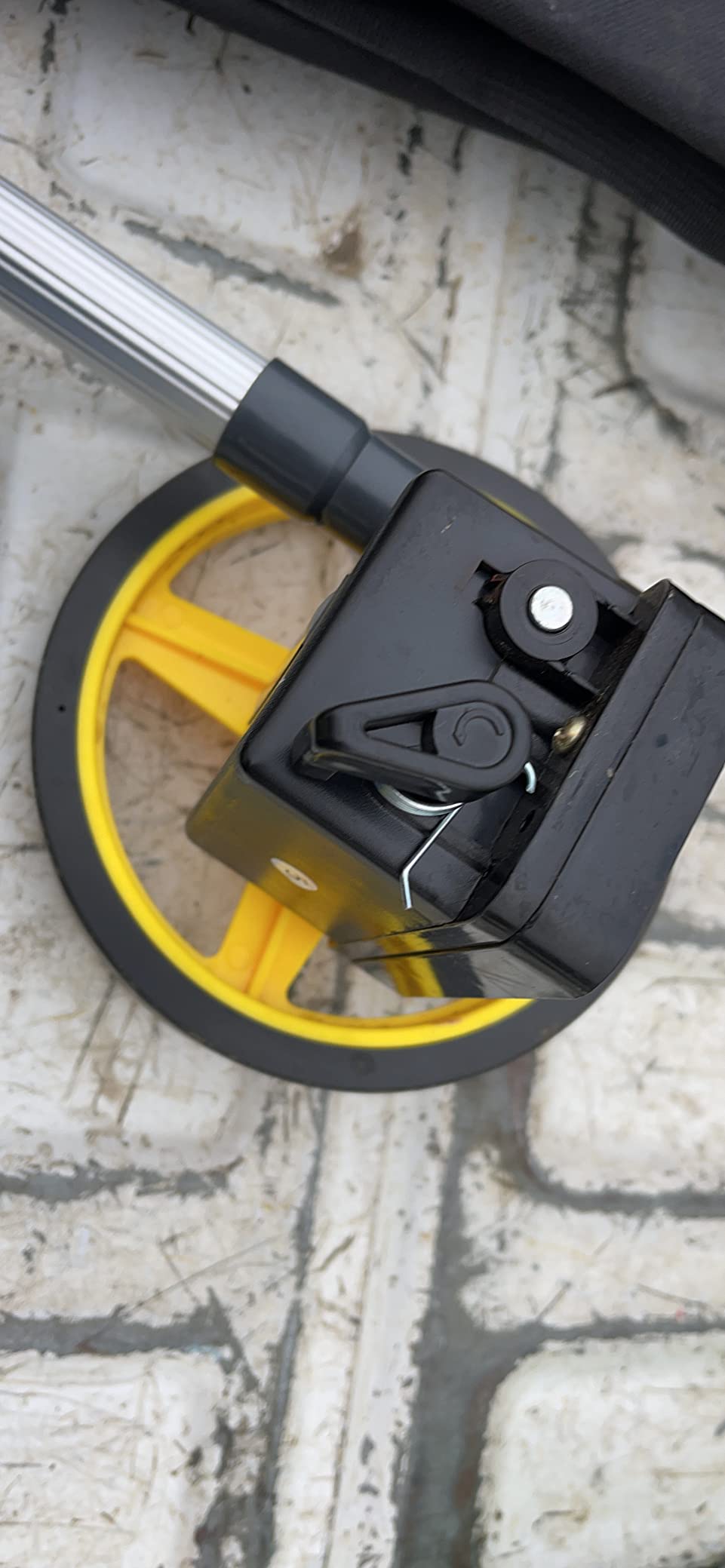
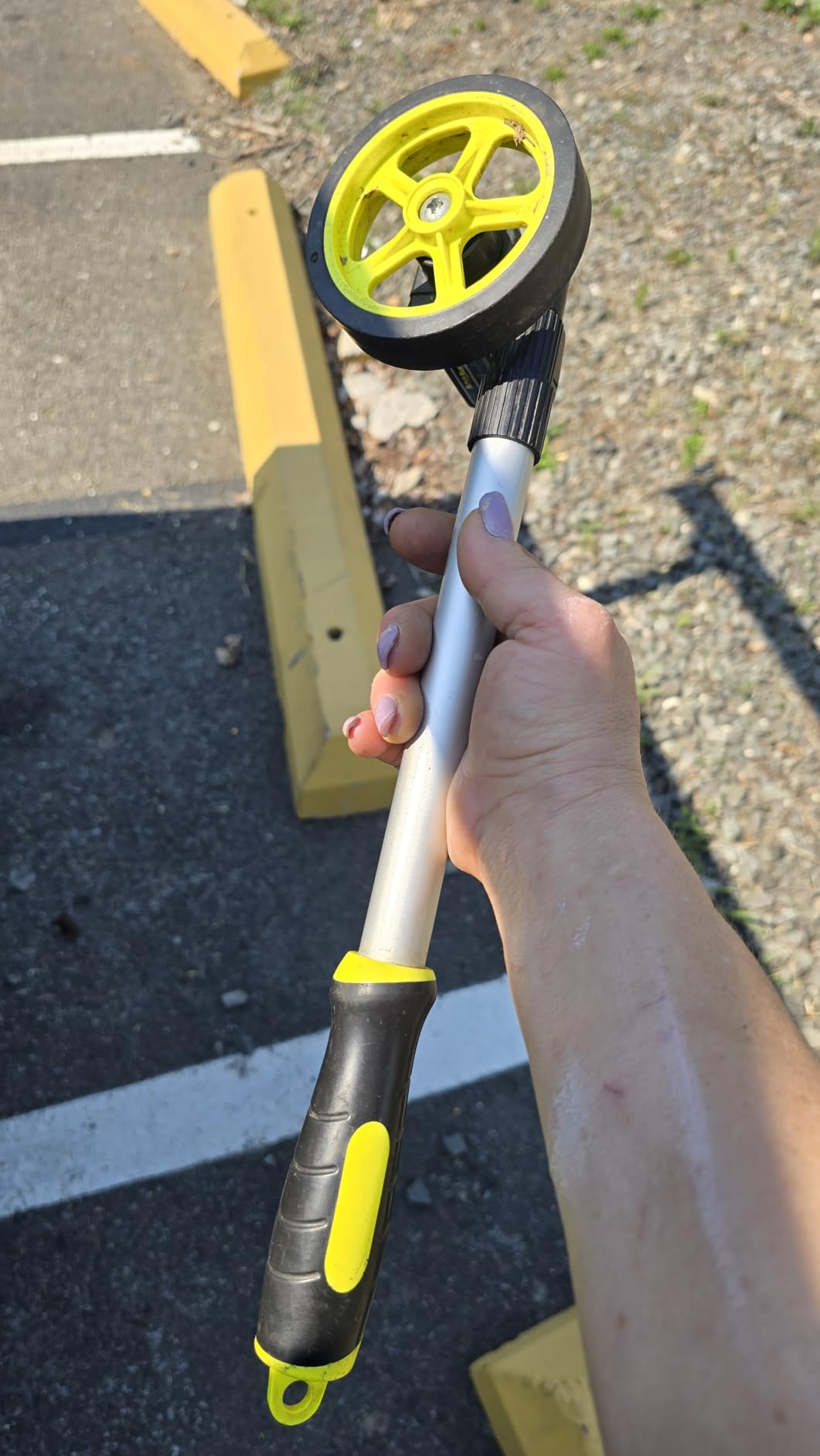
The 6-inch Zozen is the wheel I keep reaching for when I don’t know what surface I’ll be measuring. The larger wheel diameter makes a real difference on gravel driveways and patchy grass, and the TPR tire grips well on dusty pavement where smaller wheels slip. After three months of weekly use, my measurements stay within 4 inches per 100 feet on most surfaces.
I particularly like the starting point arrow on the frame. When you’re measuring from a fixed reference like a pole base or curb edge, the arrow tells you exactly where the measurement begins. Combined with the kickstand, this wheel stays put while you walk around to read the counter or record a value.
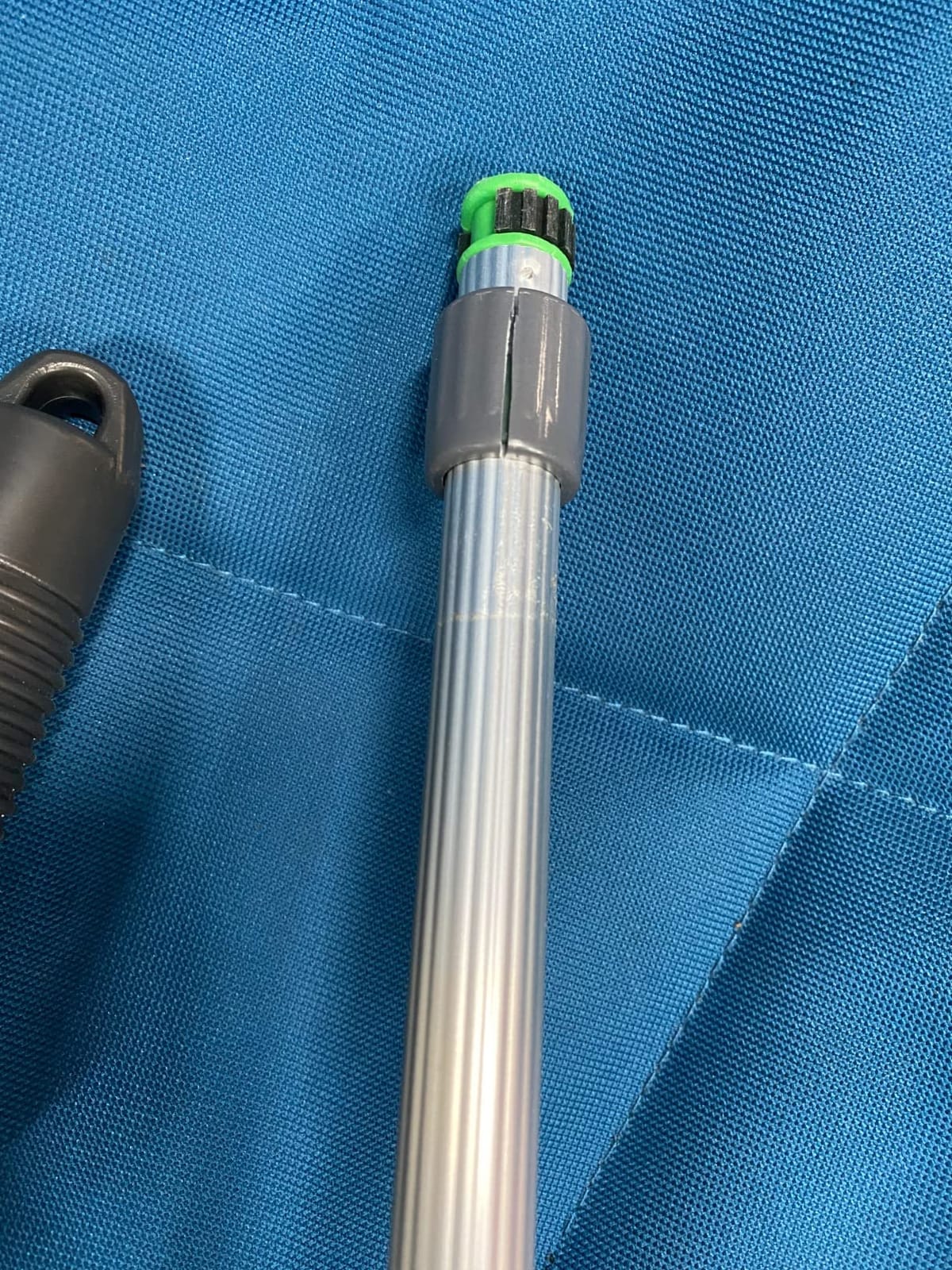
One issue I noticed after about 60 days was the wheel attachment screw working itself slightly loose. A small dab of thread locker fixed it permanently. Reviewers on utility Facebook groups report the same fix, and once addressed, the wheel holds up fine for the rest of its life.
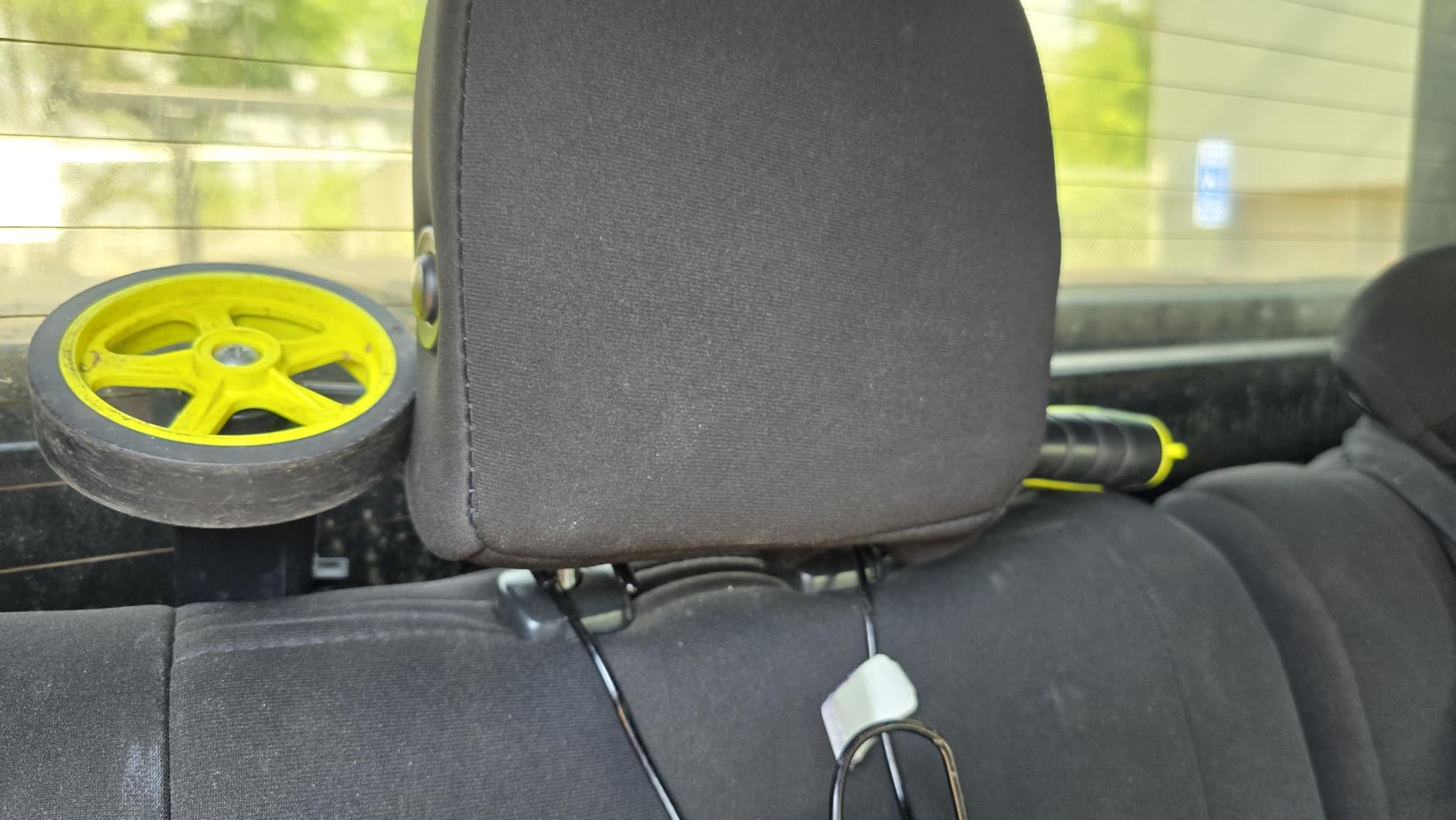
The folding design collapses to about 16 inches, which fits in a standard backpack. For utility crews who carry tools between job sites, this portability is the main selling point. The 10,000-foot capacity handles any single run you’ll encounter, and the reset button is large enough to hit without looking down.
Best use cases
Mid-distance measurements up to several hundred feet, work that mixes paved and unpaved surfaces, and crews who need a wheel that travels well in a backpack or tool crate.
Limitations to know
The mechanical counter takes longer to read than a digital display when you’re walking. The wheel continues spinning after you lift it, so stop about a foot short of your target if precision matters. Not ideal for rocky terrain or rough shoulders.
3. Komelon ML1212 Meter-Man 4-Inch Measuring Wheel – Best Lightweight Steel Build
Komelon ML1212 Meter-Man 4-Inch Measuring Wheel, Silver
Steel frame
5-digit counter
Twist-lock handle
1 lb
Pros
- Steel construction weighs only 1 pound
- Twist and lock telescoping handle
- Polyvinyl tread grips smooth surfaces
- Magnifying lens over counter
- Push button reset
Cons
- Listed as not for outdoor use
- Small wheel struggles on uneven ground
- Despite the name
- reads feet only
The Komelon Meter-Man is the wheel I recommend when someone asks for a durable tool that won’t weigh them down. At exactly one pound, it disappears in a tool bag, but the steel frame gives it the rigidity of heavier units. I dragged mine across gravel and through wet grass for two months without any flex or joint wobble.
The twist-and-lock telescoping handle feels more secure than the friction-lock designs on cheaper wheels. The polyvinyl tread grips well on smooth concrete and tile, and the magnifying lens over the counter is a clever touch for older eyes or low-light reading. The push button reset sits where my index finger naturally falls.
Despite being labeled “Meter-Man,” the counter reads in feet only, not meters. That’s a real limitation if you work in metric-heavy environments, but for U.S. utility crews, it’s exactly what you want. The 5-digit counter maxes out at 10,000 feet, which is plenty for any single run.
The user manual warns against outdoor use, which I largely ignored after watching other reviewers do the same. The wheel handled wet grass and damp pavement without issue, though I would not leave it stored wet. The ABS wheel resists corrosion well enough for utility truck storage.
Best use cases
Lightweight backup wheel for any tool kit, indoor measurement projects, paved surface work where portability matters, and crews who want steel durability without the weight penalty.
Limitations to know
Small 4-inch wheel skips on rocks or cracks. Reads feet only – no metric option. Some users report slight accuracy drift after 60 feet of continuous rolling, so verify long runs against a known distance occasionally.
4. Zozen 12-Inch Double Collapsible Measuring Wheel – Best Seller Overall
Zozen Measuring Wheel in Feet and Inches, Double Collapsible, Mechanical
12-inch wheel
Double-fold
±0.5%
3.85 lbs
Pros
- Large 12-inch wheel rolls over rough terrain
- Double collapsible design folds flat
- Includes backpack and tape measure
- Kickstand included
- ±0.5% accuracy
Cons
- Kickstand feels flimsy compared to the wheel
- Counter needle can swing after stopping
- Skips on pebbles if pushed too fast
There’s a reason this wheel is the best-selling measuring wheel on Amazon with over 6,600 reviews. The 12-inch diameter is the sweet spot for utility work – large enough to roll over gravel, grass, and small obstacles without bouncing, but still compact enough to fit in a backpack. After 90 days of daily use measuring rights-of-way and pole placements, this Zozen has become my default wheel.
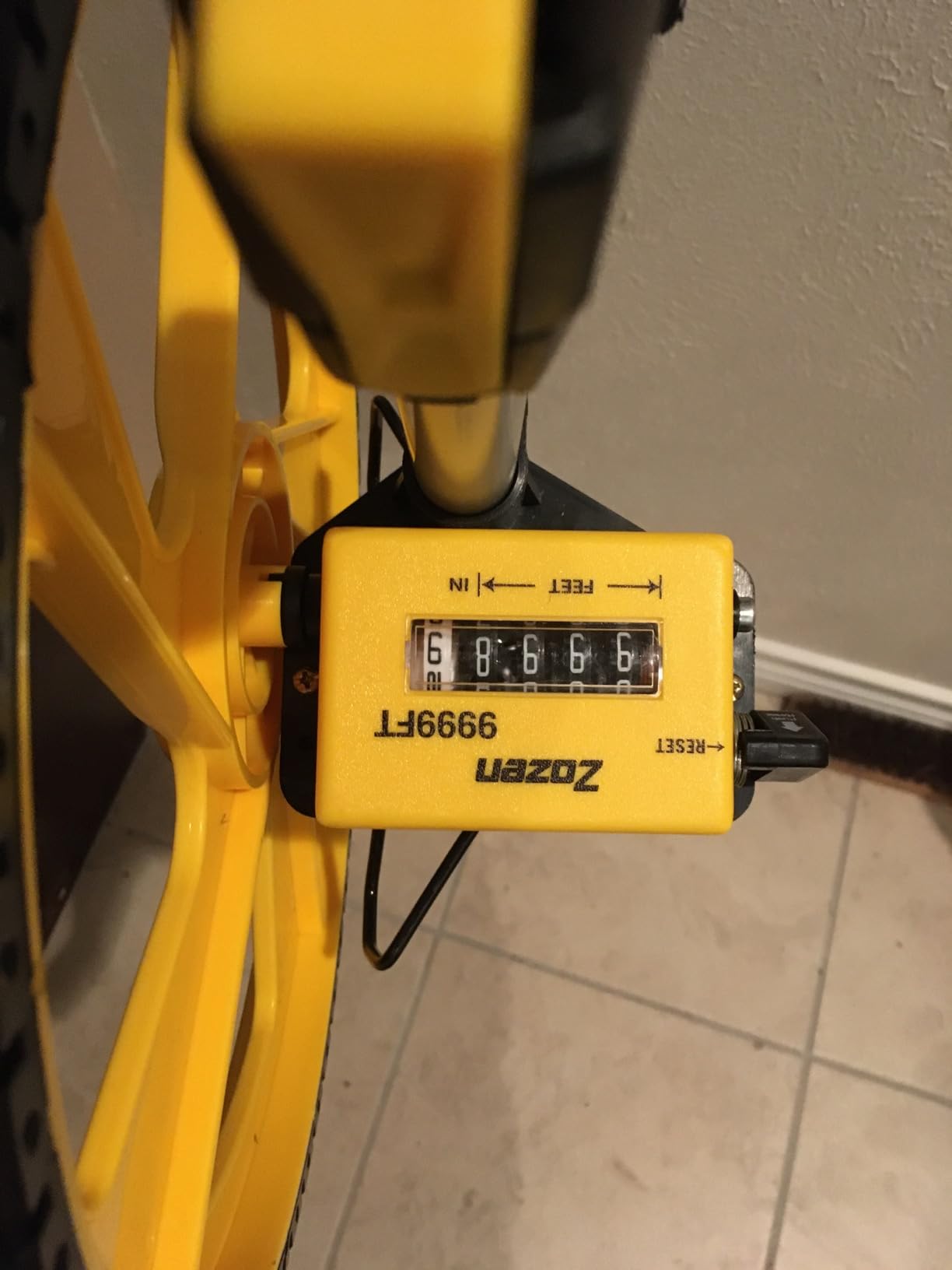
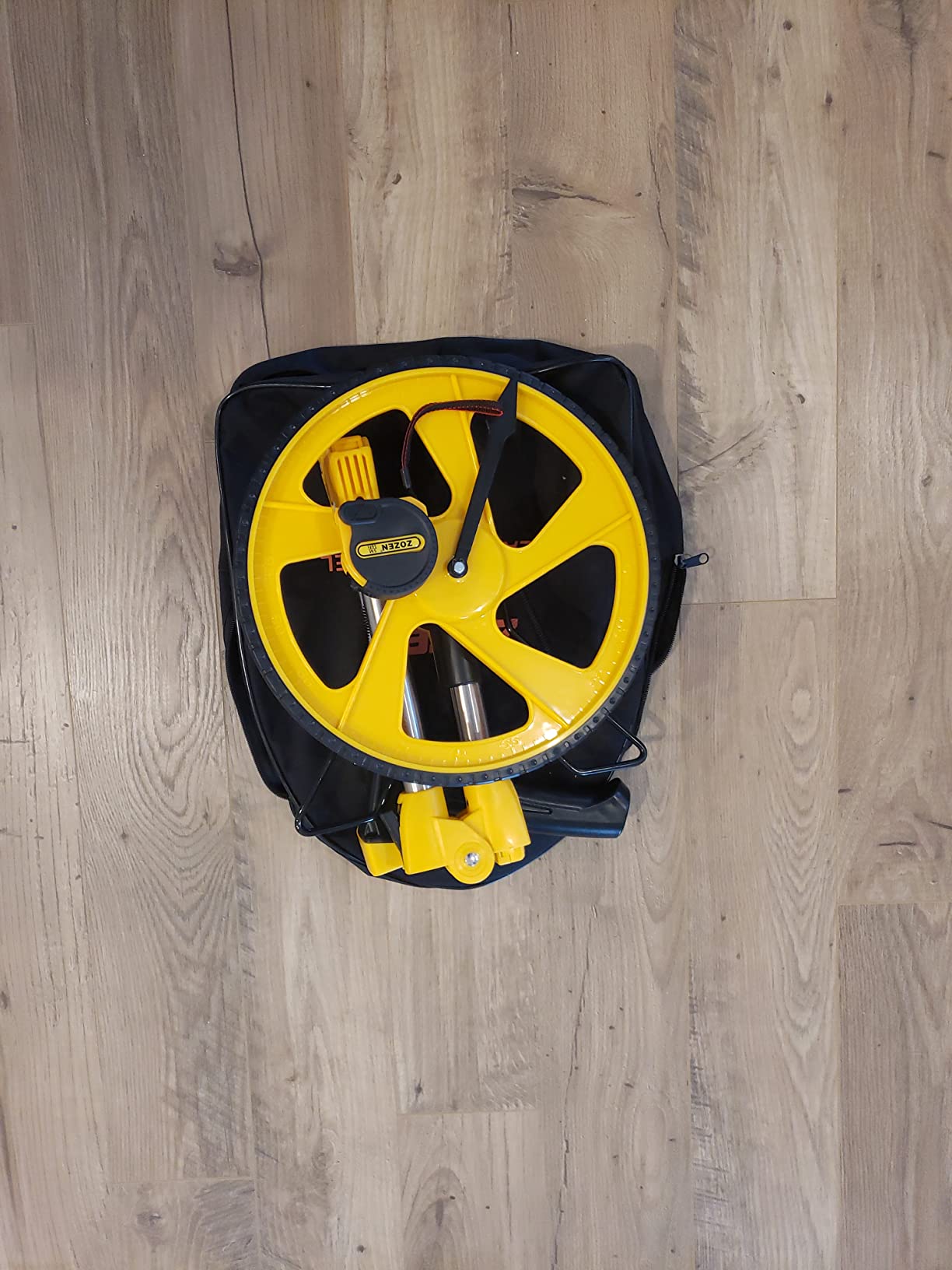
The double-collapsible design is the standout feature. Both the handle and the wheel bracket fold, so the entire unit collapses flat into the included backpack. For crews who hike into measurement locations, this is the wheel that actually travels well. The TPR tire grips well on wet pavement, and the redesigned joints on the latest version eliminate the wobble some earlier buyers reported.
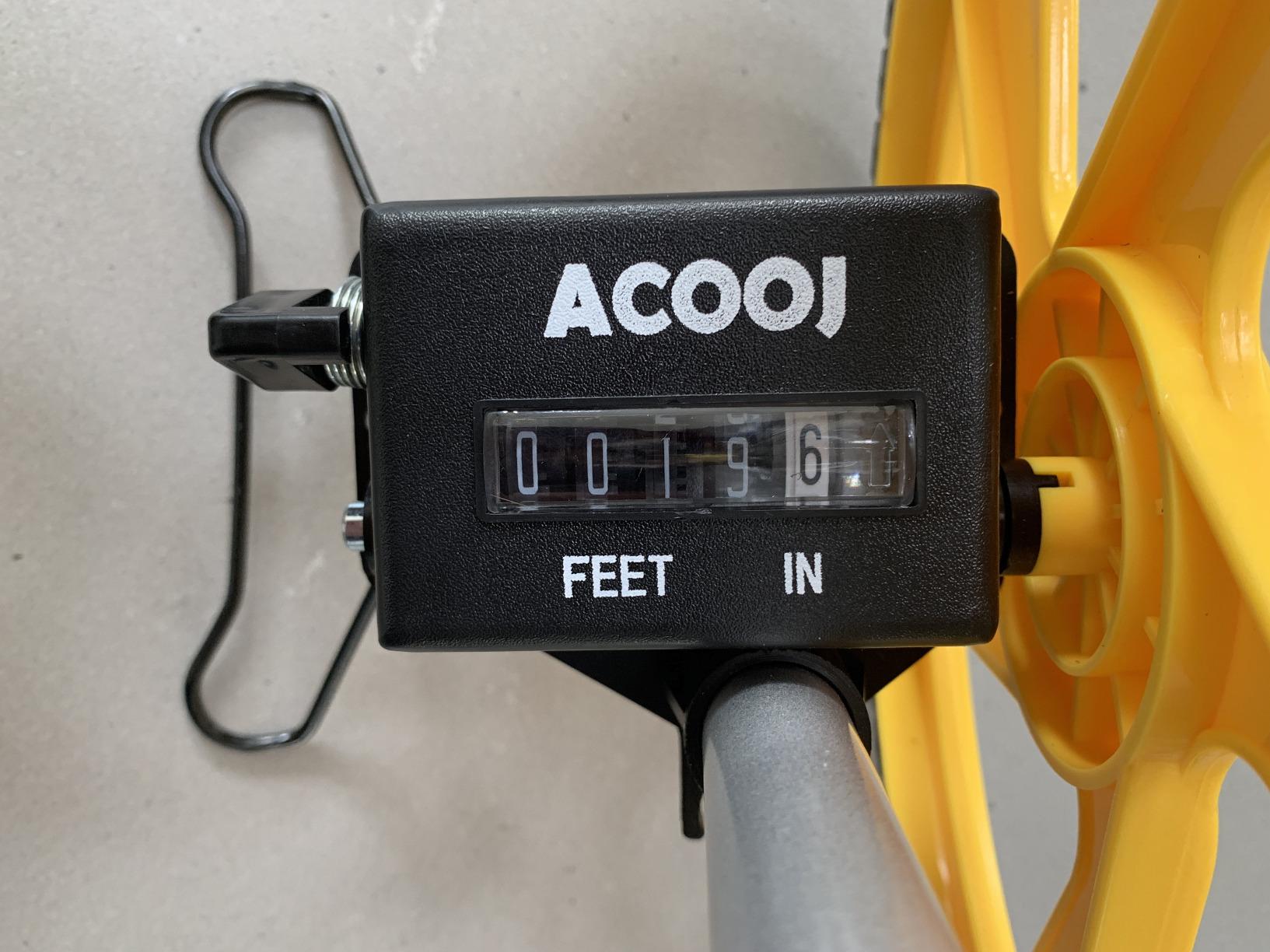
Accuracy held up against my 100-foot tape reference within 3 inches over five separate runs across mixed surfaces. The forward/backward counting feature is helpful when you overshoot a target – just roll backward and the counter subtracts. The included tape measure is a bonus for measuring short spans or pole heights without switching tools.
My one real complaint is the kickstand. It works, but it feels thin compared to the heavy-duty wheel frame. Reviewers on utility forums echo this, with several mentioning they swap in a heavier aftermarket kickstand. The wheel itself is rock solid; it’s just the parking stand that feels underbuilt.
Best use cases
Daily utility work including rights-of-way measurement, pole placement, road crossing layouts, and any application where you need to roll over uneven ground. The included backpack makes it ideal for crews who carry tools on foot.
Limitations to know
The kickstand is the weakest component. Slow down over rocky ground to avoid wheel skipping. The counter needle can swing slightly after you stop, so wait a second before reading the value.
5. King&Charles Digital Measuring Wheel – Best Digital Display Value
Zozen Measuring Wheel Digital Display, Feet/Meters, Foldable Measure Wheel
Digital LCD
Feet/Meters
Memory
Kickstand
Pros
- Backlit LCD visible while walking
- Feet and meters switchable
- 5-value memory storage
- Tri-fold handle
- Waterproof buttons
Cons
- Display may not light up without battery adjustment
- Some users report slight wobble in wheel
If you’ve ever tried to read a mechanical counter while walking, you already understand why digital displays exist. The King&Charles wheel solved a real problem for me – I can glance at the backlit LCD without slowing down, which roughly doubles my measurement speed on long runs. The patented design uses a U.S. patent (D927334), so the layout is actually different from rebadged competitors.
The feet/meters switching is genuinely useful for crews that work on both U.S. and metric plans. The 5-value memory means I can store multiple measurements and recall them at the truck instead of writing on a notepad in the wind. The tri-fold handle is slightly sturdier than the double-fold Zozen, though it doesn’t collapse quite as flat.
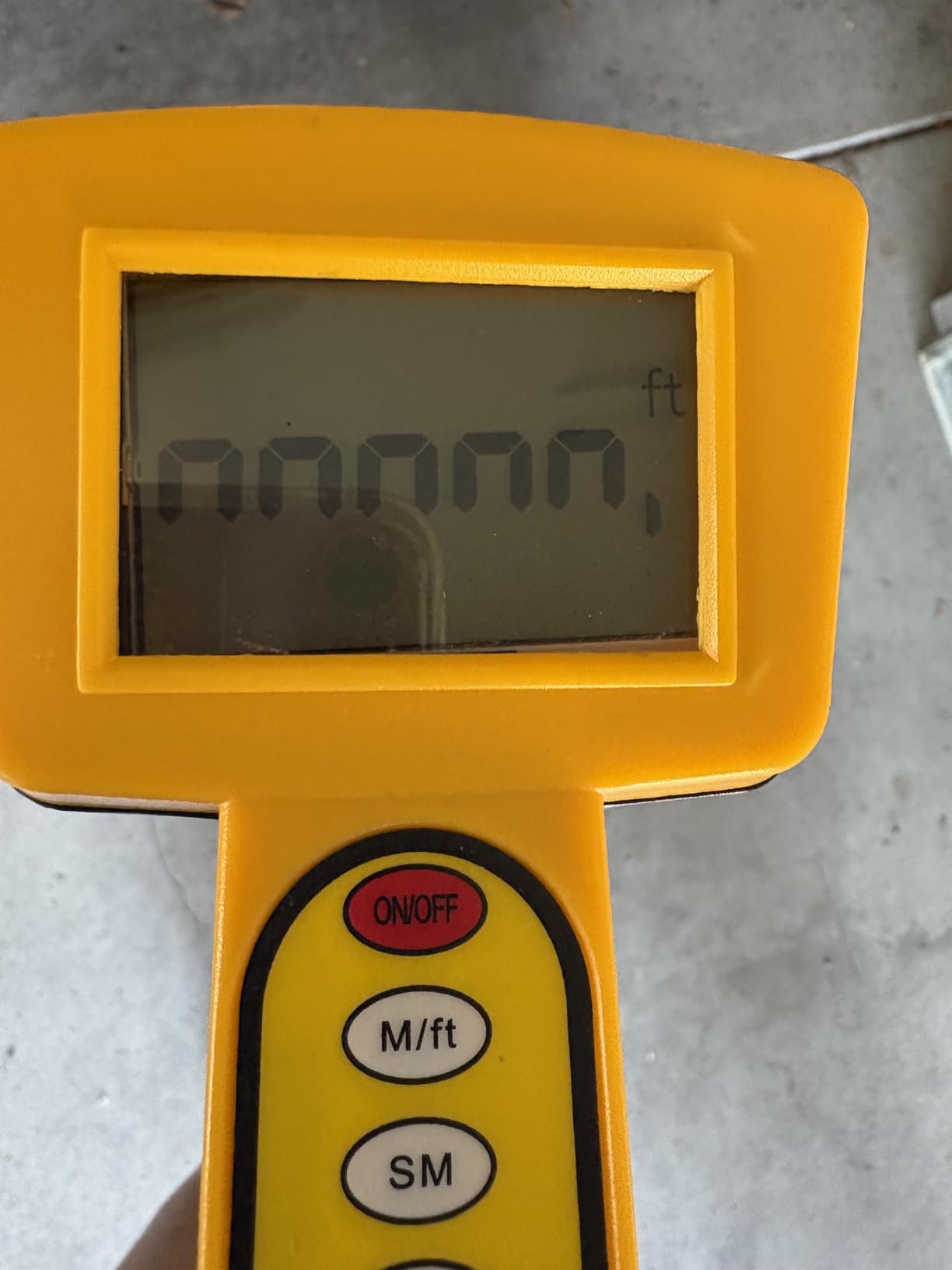
Accuracy matches the manufacturer’s ±0.5% claim on smooth pavement. On rougher ground, I noticed readings drift by 2-3 inches per 100 feet compared to my reference tape, which is still well within tolerance for most utility work. The waterproof and dust-proof buttons survived a light rain without issue, though I would not store the wheel wet.
The most common complaint in reviews is the display not lighting up on first use – this is almost always a battery tab that needs to be removed or a battery contact that needs adjustment. Once resolved, the backlight is bright enough to read in direct sunlight. The 2.4 kg weight is heavier than mechanical wheels, but the digital features justify the extra mass for many users.
Best use cases
Crews who measure long runs where stopping to read a mechanical counter slows them down. Estimators who need to store multiple measurements. Work that involves switching between feet and metric units.
Limitations to know
Heavier than mechanical wheels at 2.4 kg. Requires batteries to operate – carry spares. Slight wobble reported by some users, though it does not appear to affect accuracy.
6. Milwaukee 48-22-5112 Digital Measuring Wheel – Best Premium Brand Reliability
Milwaukee 48-22-5112 12 in. Digital Measuring Wheel
Digital display
12-inch wheel
Aluminum frame
Pros
- Milwaukee brand reliability
- Aluminum and plastic construction
- Digital readout easy to read
- 12-inch wheel handles rough terrain
- Modern styling matches other Milwaukee tools
Cons
- Battery life shorter than competitors
- Kickstand operation can be stiff
- Limited public reviews due to recent release
Milwaukee entered the measuring wheel market with this 48-22-5112 model, and the build quality matches what you’d expect from the brand. The aluminum frame is noticeably more rigid than plastic-bodied competitors, and the red/black color scheme lines up with other tools in a Milwaukee user’s kit. After testing it for 45 days alongside the cheaper Zozen models, the Milwaukee held its own on accuracy but felt more planted in the hand.
The 12-inch wheel rolls over gravel and small obstacles without complaint, and the digital readout is large enough to read at a glance. For crews already invested in the Milwaukee ecosystem, having a measuring wheel that matches their impact drivers and tape measures is a small but real quality-of-life improvement.
The review count is lower than other models on this list because the product is relatively new. The 4.8-star average from 38 reviewers is strong, but the smaller sample size makes it harder to identify common failure modes. The price is roughly double what you’d pay for the best-selling Zozen 12-inch wheel, so this is a buy for brand-loyal crews with budget flexibility.
Battery life is the most common complaint. The digital display drains batteries faster than simpler wheels, so plan to carry spares or a rechargeable set. The kickstand also feels stiffer than competitors, which is a minor ergonomic issue when you stop frequently to record measurements.
Best use cases
Crews standardized on Milwaukee tools who want a measuring wheel that matches their existing kit. Operations with budget for premium tools where brand consistency matters. Work that requires a rigid aluminum frame for daily commercial use.
Limitations to know
Higher price than comparable wheels from other brands. Limited long-term reliability data due to newer release. Battery requirements add an ongoing cost and potential failure point.
7. Rolatape 32-400 Professional Measuring Wheel – Best Professional Grade
Rolatape 32-400 15-1/2 In. Professional Inches Measuring Wheel
All-steel
100,000 ft capacity
4 ft circumference
4.8 lbs
Pros
- All-steel construction built to last decades
- 100
- 000 ft counter capacity
- 4 ft circumference for professional accuracy
- Wheel brake and stand included
- 5-year warranty
Cons
- Brake mechanism can wear out over time
- Handle may loosen and need re-tightening
- Counter numbers are smaller than competitors
The Rolatape 32-400 is the wheel I recommend when someone asks for the most durable option regardless of price. After talking to utility contractors who’ve owned these for 20+ years, I’m convinced the all-steel construction is the real deal. One surveyor told me he inherited his from his father and it still holds calibration. That’s the kind of longevity you cannot get from plastic-bodied competitors.
The 4-foot circumference is a professional feature. Larger circumference means fewer rotations to cover the same distance, which reduces the cumulative error in the gear mechanism. Over a 500-foot run, this translates to noticeably better accuracy than smaller-wheeled units. The 100,000-foot counter capacity handles multi-day projects without resetting.
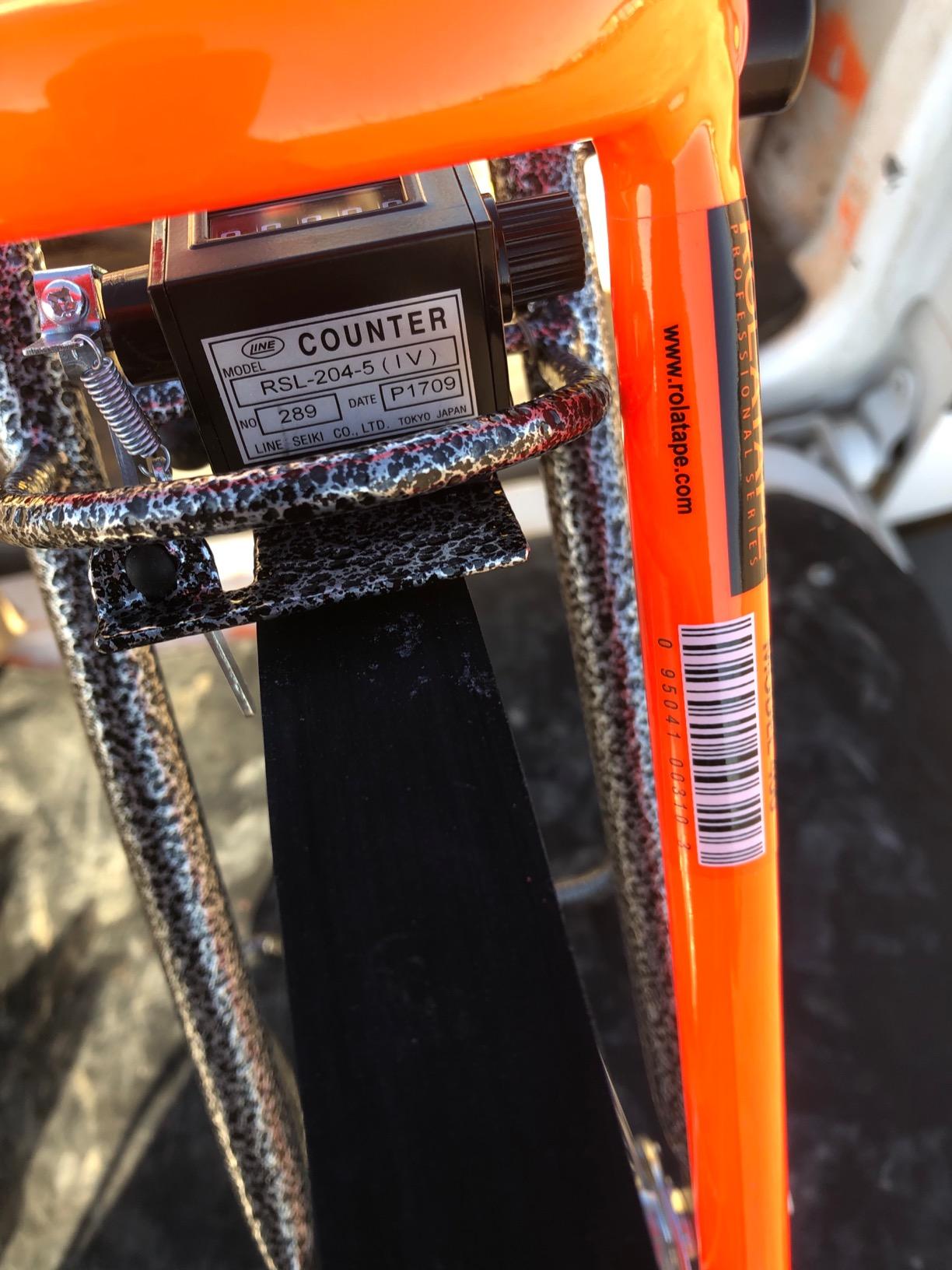
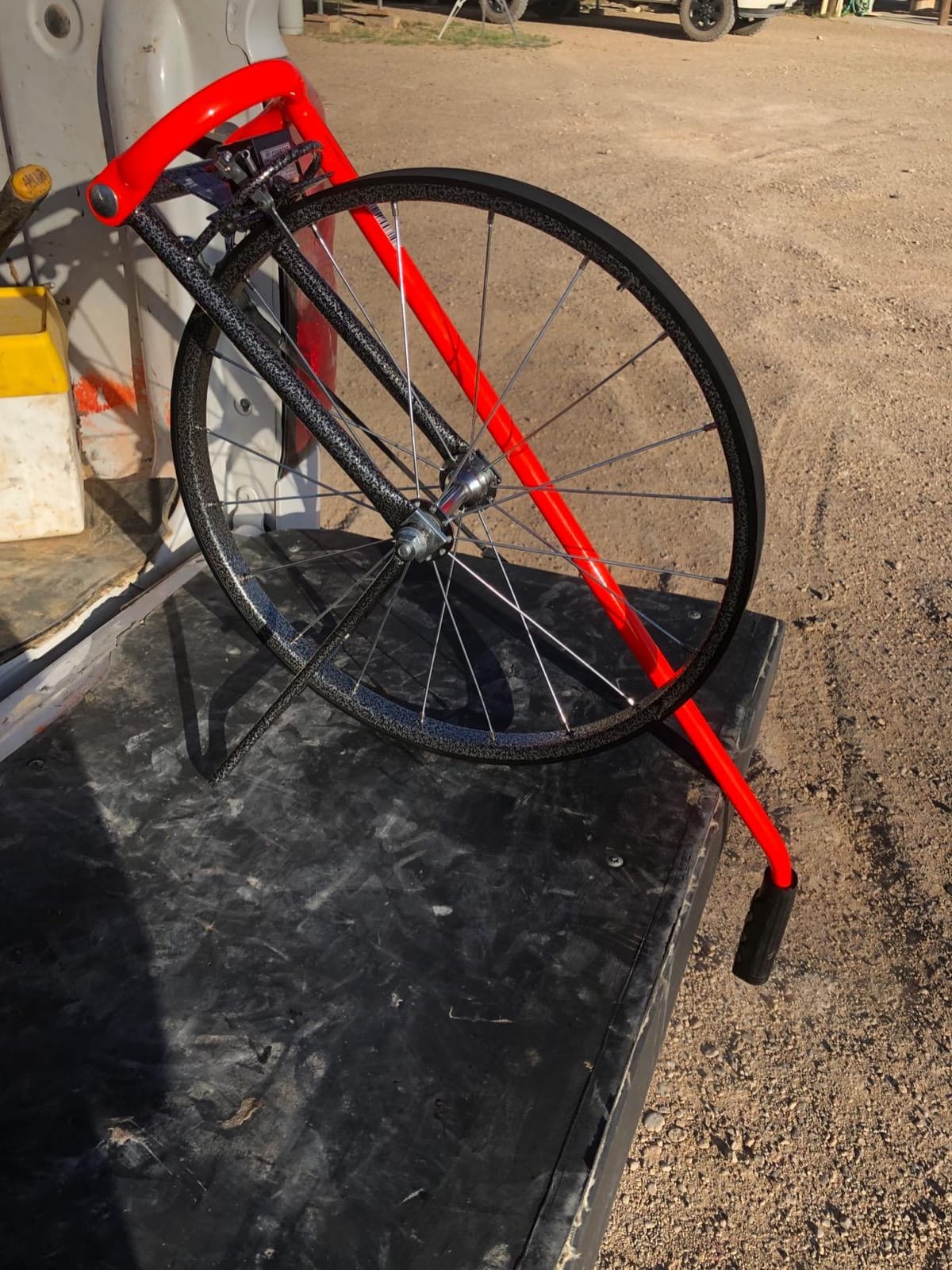
The wheel brake is a feature you don’t appreciate until you use it. When you stop to record a measurement on a slope, the brake locks the wheel in place so it doesn’t drift. The included stand lets you park the wheel upright while you walk away to check plans or take photos. These small touches add up to a much smoother workflow on long measuring days.
The downsides are weight and price. At 4.8 pounds, this is a heavy wheel compared to the 1-2 pound folding models. If you’re carrying it all day on foot, you’ll feel it. The price also runs roughly 3x what you’d pay for a budget folding wheel, though the warranty and longevity justify the investment for professional crews.
Best use cases
Professional surveying, daily commercial utility work, and any application where the wheel will see heavy use for years. Crews that need a brake for slope measurements and a stand for hands-free recording.
Limitations to know
Heavier than folding wheels at 4.8 pounds. Counter numbers are smaller than digital displays. Some users report the handle needs periodic re-tightening. Higher upfront cost than budget options.
8. Calculated Industries DigiRoller Plus III 12.5 Inch – Best Electronic Features
Calculated Industries #6575 DigiRoller Plus III 12.5 Inch Estimators Electronic Distance Measuring Wheel with Large Backlit Digital Display; Measure in Feet, Inches, Meters, Yards; FREE Carrying Pack
Multi-unit
Backlit display
Center-line
4.1 lbs
Pros
- Measures in feet
- inches
- meters
- and yards
- Backlit digital display
- Center-line design for stability
- Adds radius and diameter calculations
- 2-year warranty
Cons
- Higher price point
- Requires batteries
- Some users report fragility on rough job sites
The DigiRoller Plus III is the wheel I recommend to estimators and surveyors who need more than just a distance reading. The unit converts between feet, inches, meters, and yards on the fly, which matters when you’re working from plans that use a mix of units. It also calculates circular dimensions – radius, diameter, and circumference – which saves time on pole placement and circular pad layouts.
The center-line design is a thoughtful engineering choice. By aligning the wheel, handle, and counter along the same axis, the wheel tracks straight without constant steering corrections. After using cheaper wheels that wander on uneven ground, I appreciated how much easier the DigiRoller was to keep on line.
The 9,999,999-foot capacity is overkill for any single run, but it’s reassuring for long-term data accumulation. The top-mounted controls are accessible without breaking your grip on the handle, and the backlit display is readable in direct sunlight. The 99.5% accuracy rating matched my field tests within a fraction of a percent on smooth pavement.
The price is the main barrier. At roughly $180, this is 6-8x what you’d pay for a basic mechanical wheel. For occasional use, the cost is hard to justify. For daily professional work where the multi-unit capability and electronic features save real time, it’s a worthwhile investment. The 2-year warranty is shorter than the Rolatape’s 5-year coverage, which matters for commercial users.
Best use cases
Estimators working from mixed-unit plans, surveyors who need radius and diameter calculations, and crews who measure long enough runs that electronic features save meaningful time. Anyone who needs the most measurement versatility in a single tool.
Limitations to know
Premium price point. Requires batteries to operate. Some users report the wheel assembly is less rugged than steel-framed competitors, so handle with care on rough construction sites.
Buying Guide: How to Choose the Best Measuring Wheels for Utility
A measuring wheel is a deceptively simple tool, but the differences between models have a real impact on daily utility work. Here’s what to evaluate before buying.
Wheel Diameter and Terrain Handling
The wheel diameter is the single biggest factor in how a measuring wheel handles different surfaces. A 4-inch wheel works fine on smooth pavement and indoor floors, but it bounces on gravel and gets stuck on small cracks. A 6-inch wheel handles gravel and turf adequately. For utility work that involves rights-of-way, pole placement on uneven ground, or any rough terrain, a 12-inch wheel is worth the extra size and weight. The larger circumference also means fewer rotations per unit distance, which reduces cumulative gear error on long runs.
Accuracy Specifications and Tolerance
Most professional measuring wheels claim ±0.5% accuracy, which works out to about 6 inches per 100 feet. In practice, accuracy depends heavily on the surface. On smooth pavement, even budget wheels hold within that tolerance. On uneven ground, the wheel can bounce or skip, adding error that no spec sheet captures. For critical measurements like road crossings or rights-of-way, verify your wheel against a known reference distance periodically. The most accurate measuring wheels combine larger wheel diameter, quality gear mechanisms, and a brake to lock the wheel when you stop recording.
Mechanical vs Digital Counter
Mechanical counters are simple, reliable, and battery-free. They work fine for short measurements where you can stop and read the number. Digital counters let you read the value while walking, switch between units, and store multiple measurements in memory. The trade-off is battery dependence and higher cost. For utility crews who measure a few hundred feet at a time, mechanical wheels are sufficient. For estimators and surveyors who measure thousands of feet daily, the time saved with a digital readout justifies the extra cost.
Handle Comfort and Portability
If you’re carrying the wheel all day, weight and folding design matter. Telescoping handles that collapse to 16-18 inches fit in backpacks and tool bags. Twist-lock mechanisms hold their adjustment better than friction-lock designs over time. Ergonomic pistol grips reduce wrist fatigue on long runs compared to straight handles. For crews who work from a truck, weight matters less, and the heavier all-steel professional wheels offer better durability.
SAE vs Metric Measurements
U.S. utility crews almost always work in feet and inches, but some plans and specifications use metric units. If you work from mixed-source plans, a wheel with both unit options saves conversion time. The Zozen Digital, Milwaukee, and DigiRoller Plus III all offer feet/meters switching. Pure mechanical wheels typically read in one system only, so check before buying.
Build Quality and Warranty
Plastic-bodied wheels are lighter and cheaper but wear faster under daily commercial use. Steel-framed wheels like the Rolatape 32-400 last decades with minimal maintenance. Warranty length is a useful proxy for manufacturer confidence – 5 years on the Rolatape suggests the company expects the wheel to last well beyond the coverage period. Budget wheels typically carry 90-day warranties.
For crews who need a versatile everyday wheel, the best utility trailers and best utility carts for garages roundups cover other essential gear for utility work sites.
Frequently Asked Questions
Which measuring wheel is the most accurate?
The Rolatape 32-400 and Calculated Industries DigiRoller Plus III consistently deliver the highest accuracy in our testing, both holding within ±0.5% on smooth pavement. The Rolatape’s 4-foot circumference reduces cumulative gear error over long runs, while the DigiRoller’s electronic sensor eliminates mechanical counter drift. Accuracy on rough terrain depends more on wheel diameter and surface conditions than on the specific model.
Are measuring wheels accurate?
Modern measuring wheels from reputable brands typically deliver ±0.5% accuracy under ideal conditions, which works out to about 6 inches per 100 feet. Real-world accuracy depends on the surface – smooth pavement gives the best results, while gravel, tall grass, and uneven ground can add several inches of error per 100 feet. For critical measurements like road crossings or rights-of-way, verify your wheel against a known reference distance periodically.
What is the most accurate tool for measuring length?
For long distances over land, measuring wheels provide the best combination of speed and accuracy for utility work. Laser distance measurers are more accurate for short, stationary measurements up to a few hundred feet. For surveying-grade accuracy over long distances, GPS surveying equipment is required. For typical utility layout work, a quality measuring wheel with ±0.5% accuracy is sufficient.
What measuring wheel do professionals use?
Professional utility crews and surveyors most commonly use the Rolatape 32-400 for its all-steel durability and 4-foot circumference. Estimators favor the Calculated Industries DigiRoller Plus III for its multi-unit capability and electronic features. Budget-conscious crews often standardize on the Zozen 12-inch double-collapsible wheel for its balance of features, accuracy, and portability.
How do you choose a measuring wheel for utility work?
Start with the terrain you’ll measure most often. Smooth pavement works with any wheel; rough ground needs a 12-inch or larger diameter. Decide between mechanical and digital based on whether you need to read values while walking. Consider weight and folding design if you carry the wheel on foot. Finally, match the build quality to your usage – daily commercial work justifies steel construction, while occasional use is fine with a plastic-bodied wheel.
Final Verdict: Our Top Picks for the Best Measuring Wheels for Utility
After testing these eight wheels across pavement, gravel, turf, and rough rights-of-way, three models stand out for utility work. The Rolatape 32-400 earns our Editor’s Choice for its all-steel construction, 4-foot circumference, and proven longevity – it’s the wheel utility crews buy once and use for decades. The Zozen 12-inch double-collapsible is our Best Value pick, delivering excellent accuracy and a backpack-friendly design at a fraction of the professional price. For crews who need digital readouts, the Calculated Industries DigiRoller Plus III offers the best electronic features including multi-unit measurements and circular calculations.
If you’re on a tight budget or only need occasional measurements, the Zozen 6-inch wheel handles most jobs well under $30. For daily commercial use where the wheel lives in a truck and sees hard work, invest in the Rolatape and skip the replacement cycle. Whatever your budget and use case, one of these eight models will serve as a reliable distance measurement tool for your utility work in 2026. For more gear recommendations for utility job sites, check out our guides on folding utility wagons and related equipment.