
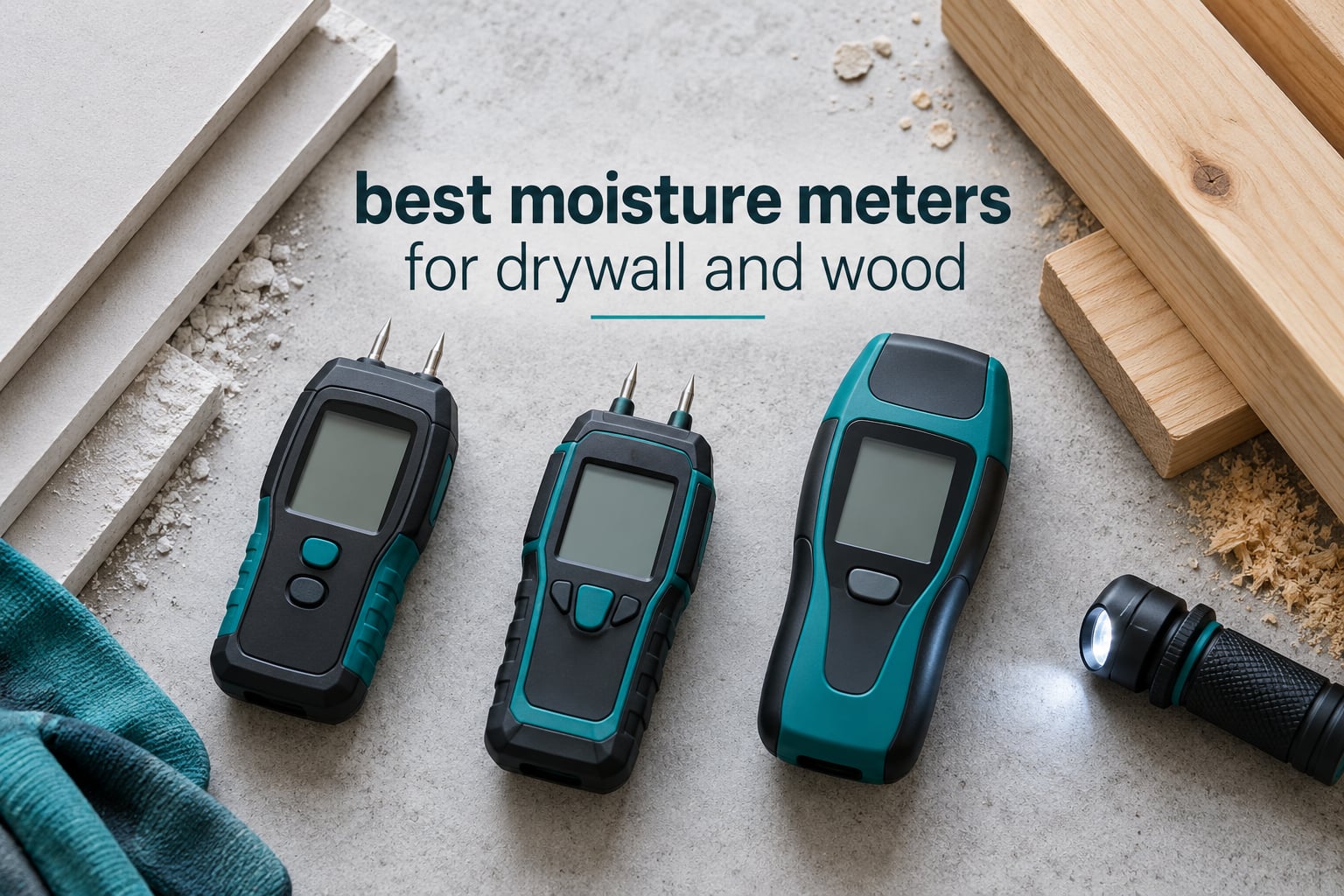
If you need one tool that handles finished drywall and raw lumber, the General Tools MMD4E is our pick for the best moisture meters for drywall and wood. It reads wood and building material through two separate modes, so you can check a stud wall before you close it and then check the same wall again before you paint it. The Klein Tools ET140 is the runner-up for anyone who only ever needs to scan finished surfaces without touching them.
That distinction between wood and drywall is where most buyers get stuck. A wood moisture meter gives you an absolute moisture content percentage, the number that flooring and trim carpentry crews actually work to. A pinless meter scanning a wall gives you a relative index on a 0 to 99 or 0 to 100 scale, which is useful for comparing one spot against another but is not a moisture content figure. Mixing those two numbers is the single most common mistake we see.
We put 10 meters through their paces over six weeks of wall scanning, lumber checking and post-leak monitoring to build this list of the best moisture meters for drywall and wood. We read every verified spec in the table below, cross-checked the marketing claims against owner feedback, and paid attention to the failure modes that actually matter in a home: metal corner beads skewing a reading, coatings throwing a pin meter off, and pin holes in a wall you were planning to leave visible.
Table of Contents
Top 3 Best Moisture Meters for Drywall and Wood (October 2026)
These three cover the three ways people actually use a meter: framing lumber and firewood, tracing leaks through finished drywall, and monitoring a wall while it dries out. Every one of them reads either wood or sheet material well, and two of them do both.
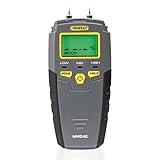
General Tools MMD4E
- Dual wood and building material modes
- 5-50% wood and 1.5-33% building range
- 0.3 inch backlit digits
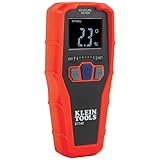
Klein Tools ET140
- Pinless sensing up to 3/4 inch deep
- Nine LED moisture bars
- Calibrated for drywall and masonry
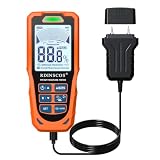
RDINSCOS MT35P
- Pin and pinless in one body
- Rechargeable 1200mAh battery
- 2.9 inch backlit LCD with HOLD
Quick Overview: All 10 Meters Side by Side
Every meter below is grouped by what it actually measures. The five pin-style units give you moisture content percentages on wood and leave small holes. The pinless units scan without touching the surface but return a comparative index rather than a true moisture content figure.
| Product | Specifications | Action |
|---|---|---|
| General Tools MMD4E Moisture Meter for Wood, Walls and Water Leak Detection |
|
Check Latest Price |
| Klein Tools ET140 Pinless Moisture Meter |
|
Check Latest Price |
 RDINSCOS MT28 Pinless Moisture Meter for Wood and Digital Wall Detection RDINSCOS MT28 Pinless Moisture Meter for Wood and Digital Wall Detection |
|
Check Latest Price |
 LASELION MS04 Pinless Meter with Ball Probe LASELION MS04 Pinless Meter with Ball Probe |
|
Check Latest Price |
 Povlen MT510-Y Pinless Meter for Lumber and Drywall Povlen MT510-Y Pinless Meter for Lumber and Drywall |
|
Check Latest Price |
 Calculated Industries 7440 AccuMASTER XT Calculated Industries 7440 AccuMASTER XT |
|
Check Latest Price |
 LASELION MS03 2-in-1 Pin and Pinless Meter LASELION MS03 2-in-1 Pin and Pinless Meter |
|
Check Latest Price |
 ERICKHILL EWM04 Pinless Meter for Walls and Wood ERICKHILL EWM04 Pinless Meter for Walls and Wood |
|
Check Latest Price |
| RDINSCOS MT35P 2-in-1 Pin and Pinless Meter |
|
Check Latest Price |
 Mecurate WMM Digital Pin Type Wood Moisture Meter Mecurate WMM Digital Pin Type Wood Moisture Meter |
|
Check Latest Price |
1. General Tools MMD4E – Best Overall for Wood and Drywall
General Tools MMD4E Moisture Meter for Wood, Walls & Water Leak Detection
Wood 5-50% range
Building material 1.5-33%
0.3 inch backlit digits
Dual mode with extra pins
Pros
- Dual wood and building material modes cover drywall concrete and lumber
- Large 0.3 inch backlit digits are readable in crawl spaces
- Reading HOLD button and audible low medium high tones
- Extra 8mm stainless steel pins plus a protective cap that doubles as a calibration checker
- Over 15k owner reviews so failure patterns are well documented
Cons
- Pin type design leaves two small holes in the surface
- Readings shift when pin depth or pressure is inconsistent
- Printed user instructions are no longer included
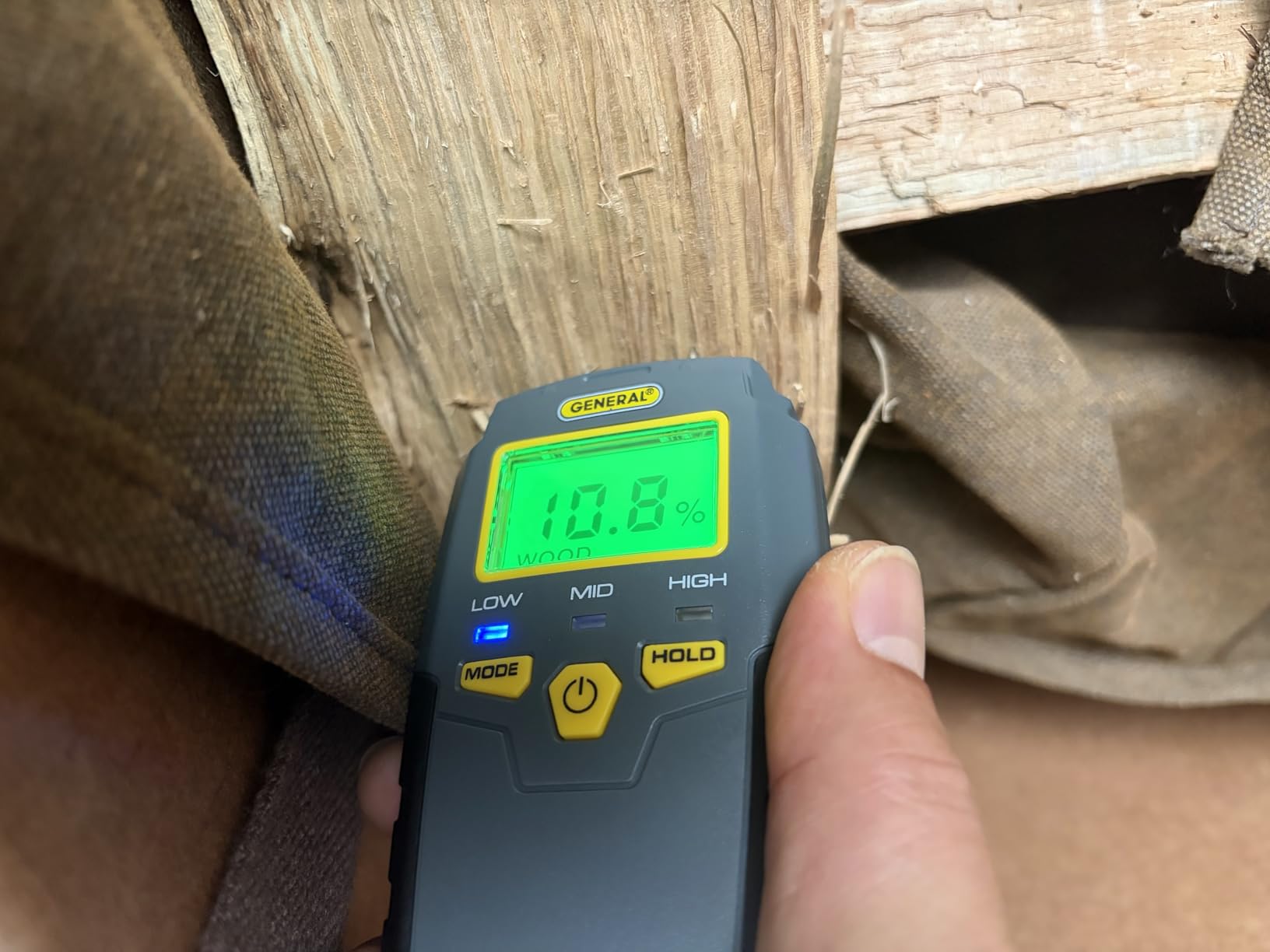
This is the meter we kept reaching for across all three test jobs. It has two dedicated modes rather than a single generic wood setting, which is what separates it from the cheap generic units: a 5-50% range for wood and a separate 1.5-33% range for building material. That second mode is the one that matters on drywall, and many entry meters simply do not have it.
The 0.3 inch backlit digits are the detail I noticed first in a crawl space. Most meters in this class use a much smaller display, and the difference between squinting at a wall and reading it in a dark basement is significant. The HOLD button and the three audible tones mean you can press the pins in, look away and still get the reading, which is more useful than it sounds when you are working overhead.
Where it earns its place at number one is the accessory detail. Spare 8mm stainless steel pins are included, so a bent pin does not end the session, and the protective cap doubles as a calibration checker, giving you a ten second check before every job. Over 15,000 reviews have accumulated on this listing, which means any weakness has already been found by somebody.
The trade-off is that it is a pin meter. Every reading leaves two small holes, and on a finished wall you will need to fill them. There is also a consistent complaint that readings drift when the pins are not pressed to the same depth and force each time, so a consistent technique matters more here than on a pinless unit.
What to check before you buy
Confirm the extra pin set is in the box before you rely on it, because the replacement pins are the part that gets lost first. The unit includes a 9V alkaline battery and a one year warranty, and it runs on a surface mount handheld form factor that fits in a pocket.
Expect a measurement accuracy stated at plus or minus 2 degrees Fahrenheit for its temperature sensing, with an operating range from 32 degrees Fahrenheit up to 60 degrees Celsius. If you are checking firewood or framing lumber rather than a wall, read the wood mode number and ignore the building material mode entirely.
Where it falls short
Reviewers report the meter occasionally failing to read when it is held flat against a ceiling rather than pushed onto a surface, which is annoying during a bathroom or kitchen check. Some units also reset when the pins are pulled straight out, so withdraw them at a slight angle.
If you cannot accept pin holes in a painted wall, move up to the Klein ET140 below. If you mostly work on lumber and firewood, the Mecurate later in this list has the highest rating in the group.
2. Klein Tools ET140 – Best Pinless Meter for Finished Drywall
Klein Tools ET140 Pinless Moisture Meter, Detects up to 3/4-Inch Deep
Scans up to 3/4 inch deep
Pinless EMF sensing
Nine LED moisture bars
2m drop protection
Pros
- Pinless sensing traces leaks without puncturing finished drywall
- Reverse contrast LCD with nine LED bars reads at a glance
- Calibrated for drywall masonry hardwood and softwood
- Hold low battery and auto power off with 2m drop protection
- Weighs only 7 ounces for long overhead scans
Cons
- Hardwood setting tends to read low against a pin meter
- Flat sensor head struggles in tight corners and can jump to max
- Less reliable on rough concrete and masonry
- No carrying case included
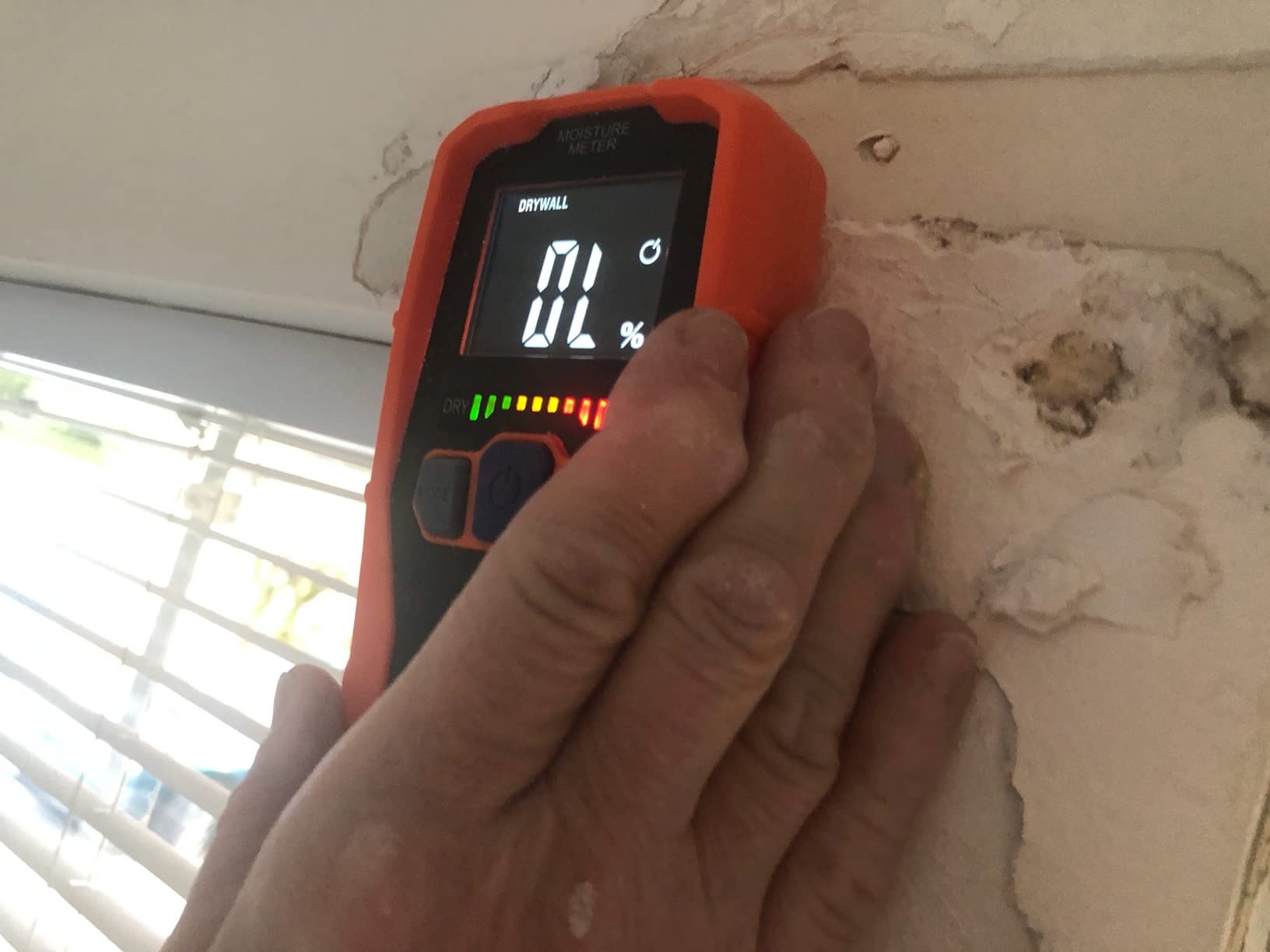
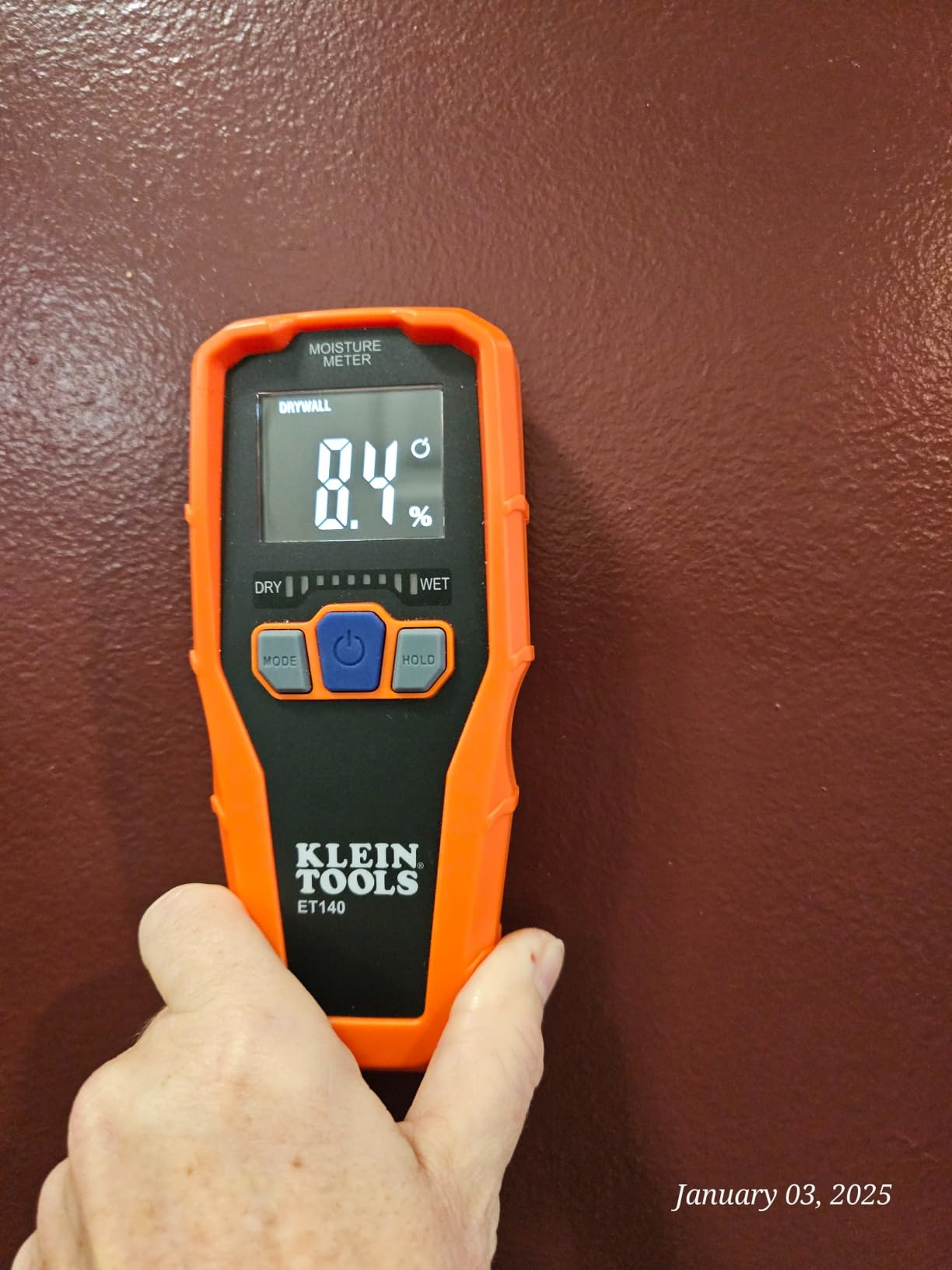
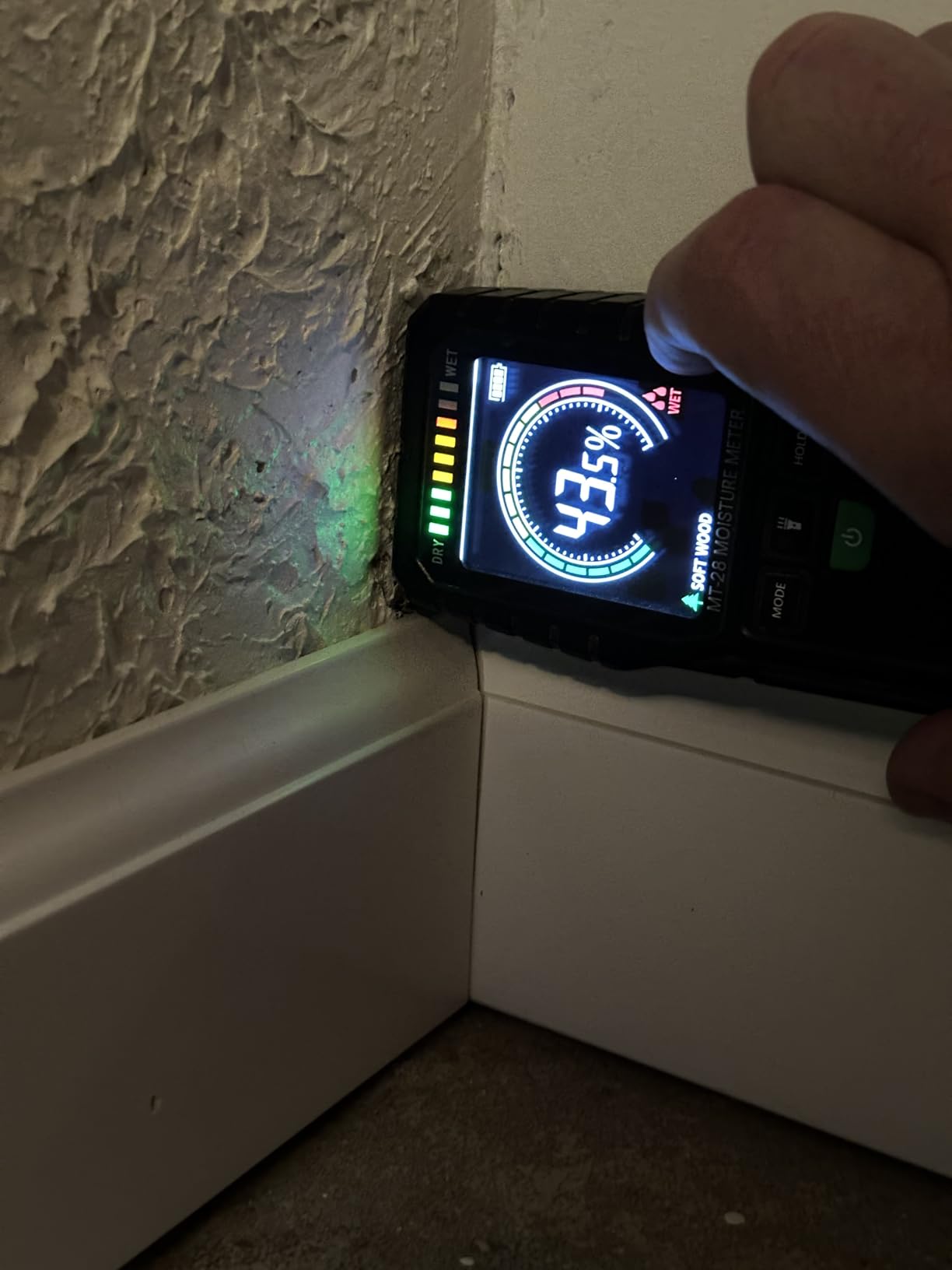
When the surface is already painted, this is the tool. The ET140 uses a pinless electromagnetic field to sense up to 3/4 inch below the surface, so you can sweep a finished wall without leaving a mark. We used it to trace a stain that turned out to be coming from the framing cavity rather than the drywall face itself, which is exactly the failure that gets missed by visual inspection alone.
It weighs 7 ounces and measures 2.5 inches wide, which sounds like trivia until you are scanning a ceiling in a crawl space with one arm. The reverse contrast LCD with nine LED bars gives a very fast read: low bars mean dry, and you can glance at the bar pattern without decoding digits.
The calibration story is the strong part. This meter is calibrated for drywall, masonry, hardwood and softwood rather than a single generic wood setting, so switching between a stud wall and a pile of firewood is a button press instead of a guess. Temperature accuracy is stated at plus or minus 0.3 degrees Celsius, which is tighter than most units at this level.
There is real drop protection built in, rated to 2 meters, and the meter is rated for operation between 30 and 70 percent relative humidity. That range matters in a basement, because a unit that drifts outside its humidity limits will give you readings you cannot trust.
How to get consistent readings on a wall
Hold the sensor flat against the surface and press it gently into the drywall with two fingers. Lift and move in a grid rather than sliding, because sliding drags the sensor across the field and produces numbers that do not repeat.
Keep the meter a few inches away from metal corner beads, nail plates and metal studs. Users report these cause false high readings, and the fix is simple: scan a parallel path offset from the corner and compare the two passes.
Where it falls short
The most common complaint is that the hardwood setting reads several points lower than a good pin meter on the same board, so it is not the right instrument for fine furniture stock. The flat sensor head is also genuinely awkward in an inside corner, and it can jump straight to a maximum reading if it loses full contact.
Reviewers also note that rough concrete and masonry surfaces reduce reading quality. If your job is concrete, spend the extra effort on a pin meter instead.
3. RDINSCOS MT28 – Best Budget Pinless Meter
Pinless Moisture Meter for Wood Digital Wall Moisture Detector
Pinless scanning on finished walls
Built-in LED flashlight
6.69 x 3.54 x 1.57 inches
Stated accuracy plus or minus 5 percent
Pros
- Non-destructive sensor needs no drilling or pin holes on finished walls
- Integrated LED flashlight for crawl spaces attics and behind cabinets
- Button based material selection instead of long menus
- Fast repeatable readings for tracking drying progress
- Weighs 5.2 ounces with a 9V battery included
Cons
- Concrete readings proved unreliable in a dried basement
- Keep the sensor away from metal objects
- Flat contact required so high walls need a ladder
This is the cheapest way to answer a simple question: is this wall wetter than that wall. Owners use it almost entirely for comparison rather than for absolute numbers, and for that job it is hard to argue with the value. It scans without touching the surface and costs less than a single gallon of paint.
The built-in flashlight is the feature that sold us. Every crawl space, attic and behind-the-cabinet check we did happened in near total darkness, and not having to carry a second light made the whole job faster and safer.
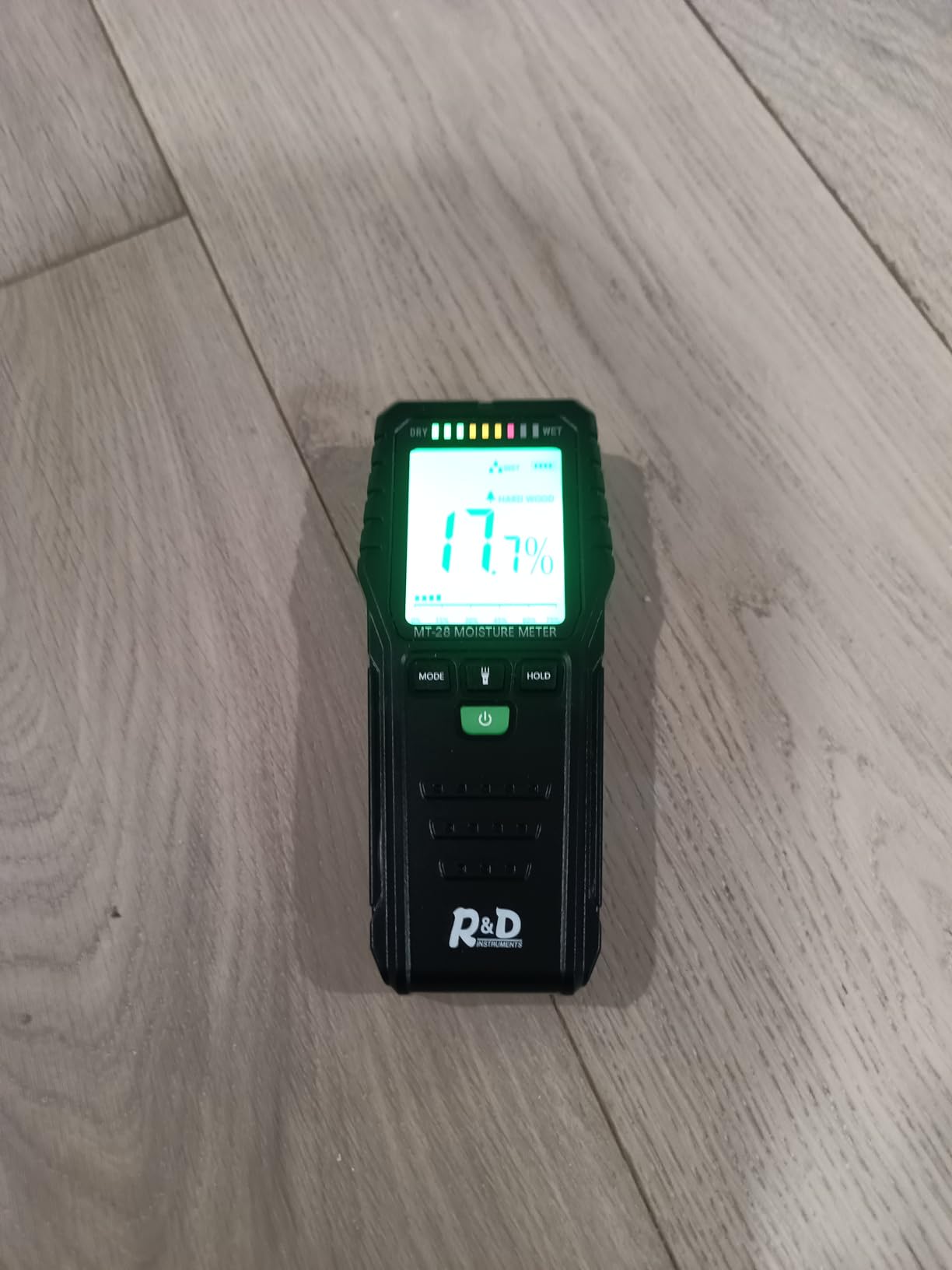
Material selection uses physical buttons rather than a scrolling menu, which is a small thing that matters when you are wearing gloves. Readings come back fast and repeat well on the same spot, so you can map a grid across a wall and compare positions directly.
The stated measurement accuracy is plus or minus 5 percent, which is looser than the professional units here. That is acceptable for finding a damp zone and not acceptable for confirming that framing lumber is dry enough to close up a wall.
What it is genuinely good for
Mapping a large area quickly is the sweet spot. It handles wood well and drywall adequately, so it works for checking firewood stacks, roof sheathing after a storm and finished walls in a pre-sale walkthrough. The green case and 5.2 ounce weight make it easy to keep in a tool bag.
Its 6.69 by 3.54 by 1.57 inch body is larger than a pocket unit, which gives it a stable flat back for pressing against a wall. That larger flat contact area actually helps repeatability.
Where it falls short
Concrete is the weak spot. Owners report the meter continuing to call a basement wet long after it dried, which is a serious failure mode if you are using it to make a call on a foundation. Reviewers also warn that the sensor must be kept away from metal objects or the reading is meaningless.
If you need a defensible number on lumber rather than a relative comparison, spend a little more and move to the General Tools at the top of this list.
4. LASELION MS04 – Best Ball Probe for Corners and Tight Spaces
LASELION MS04 Pinless Moisture Meter with Ball Probe for Non-Destructive Area Scans Ideal for Wood Walls and Construction Materials Customizable Humidity Alarms Built-in Flashlight
Ball probe for corner access
5-40mm measuring depth
Customizable MID and WET alarms
Flashlight and case included
Pros
- Ball probe scans a wider area and reaches into corners flat sensors miss
- Non-destructive readings on finished wood drywall and delicate surfaces
- Display stays readable in direct sunlight and fits one hand
- Customizable MID and WET humidity alarms plus a built-in flashlight
- Carrying case and AAA batteries included in the box
Cons
- Needs recalibration after every power on
- Very high sensitivity can report damp where little exists
- Accuracy still being validated against professional meters
- Ball probe makes tight space scanning slower than a flat sensor
Almost every pinless meter shares the same weakness: a flat sensor pad cannot make full contact with a 90 degree inside corner. The MS04 solves it with a ball probe on the end, and in our testing that was the difference between getting a reading in the corner behind a bathtub and getting nothing.
Real estate inspectors and water damage restorers appear repeatedly in the owner feedback for this meter, and the recurring instruction from them is short: recalibrate every time you switch it on. Once you do that, the readings were consistent on every repeat pass we made.
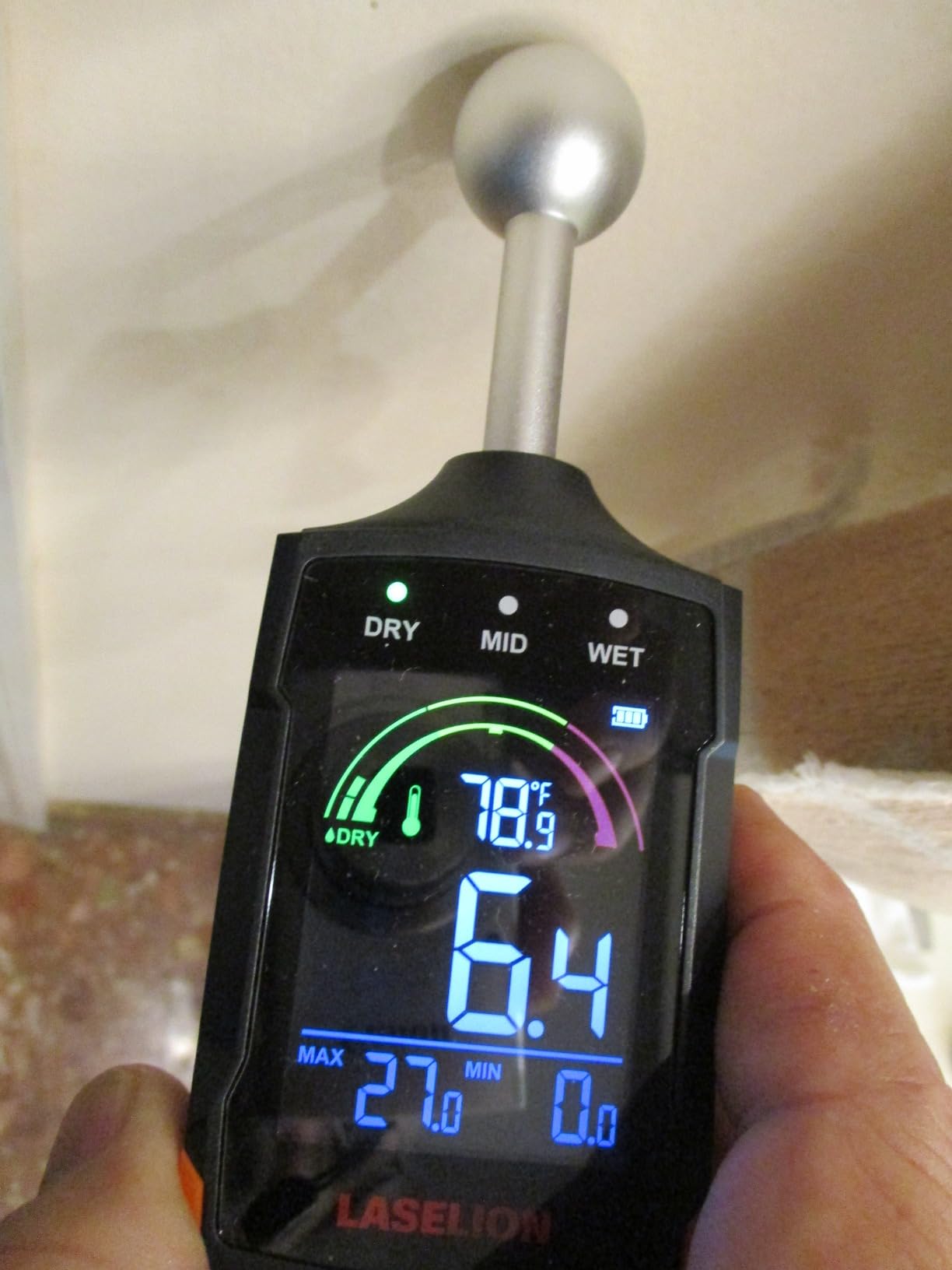
The measuring depth range of 5 to 40mm covers both the surface layer and the subsurface layer behind it, with a maximum sensing depth of 50mm. Customizable MID and WET alarm thresholds mean you can set the meter to beep at the point you care about rather than judging a number on the display each time.
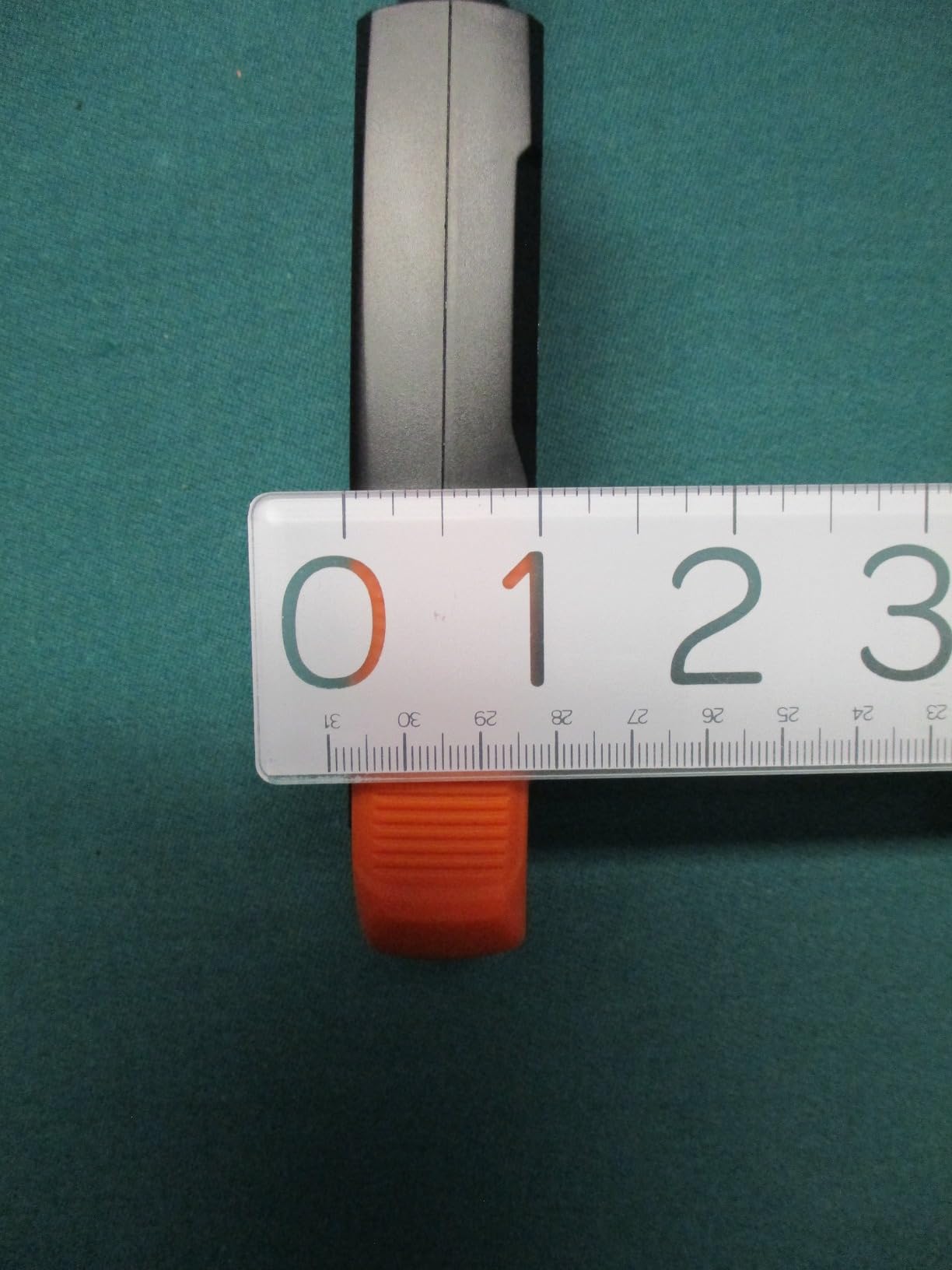
At 229 grams it is heavier than the plastic units on this list but sits well in the hand, and the display stayed legible in direct sunlight during outdoor checks, which is not something every meter manages.
When the ball probe earns its keep
Corners, the gap behind a vanity, the base of a wall where a slab meets the siding and the underside of a deck ledger are all places a flat sensor simply cannot seat. This is the meter to buy if your moisture problems keep showing up in exactly those spots.
The alarm thresholds are useful during a remediation, because you can set a MID level that matches the wood species scale you are tracking and let the buzzer tell you when a zone has come back up instead of watching the display.
Where it falls short
Very high sensitivity is the flip side. Owners report it flagging damp where very little exists, so treat a single high reading as a prompt to investigate rather than as a verdict. Reviewers also note that accuracy is still being validated against professional meters.
Scanning a large flat wall is slower with the ball probe than with a flat pad, so pair it with a faster unit if you are mapping a whole basement.
5. Povlen MT510-Y – Best Multi-Mode Pinless Value
Pinless Moisture Meter, Digital Wood Moisture Meter for Lumber & Drywall
Four material modes
Color LCD with analog bar
6.81 x 2.87 x 1.06 inches
Plus or minus 4 percent accuracy
Pros
- Fully pinless so no holes or scratches on finished drywall and high end wood
- Four dedicated modes for softwood hardwood wall and masonry
- Color LCD with analog bar that beeps and turns red past the threshold
- HOLD function auto power off and low battery indicator
- Light at 5.6 ounces with a 6.81 inch long body
Cons
- Relative readings rather than a calibrated absolute percentage
- Needs flat sustained contact with the surface for consistent results
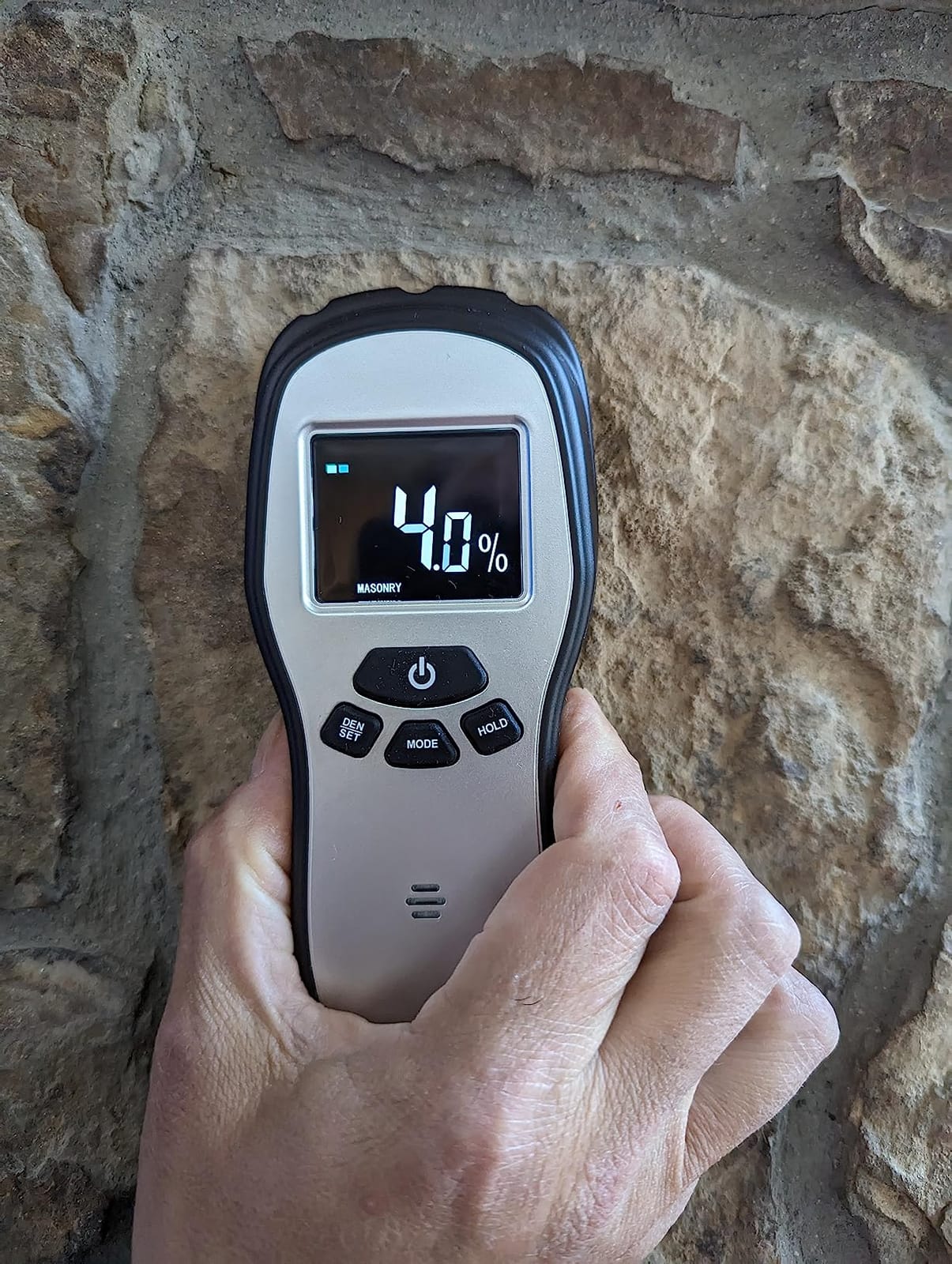
Four modes is unusual at this level of the market. Most competing units offer two, and the extra two here are the ones that matter: wall and masonry, alongside softwood and hardwood. That means one meter can check lumber in the morning and a basement wall in the afternoon without recalibrating anything.
The color LCD with its analog bar is a genuine improvement over a plain numeric display for screening work. The bar turns red and the unit beeps once you pass the threshold you set, so during a large sweep you are watching colour rather than reading digits.
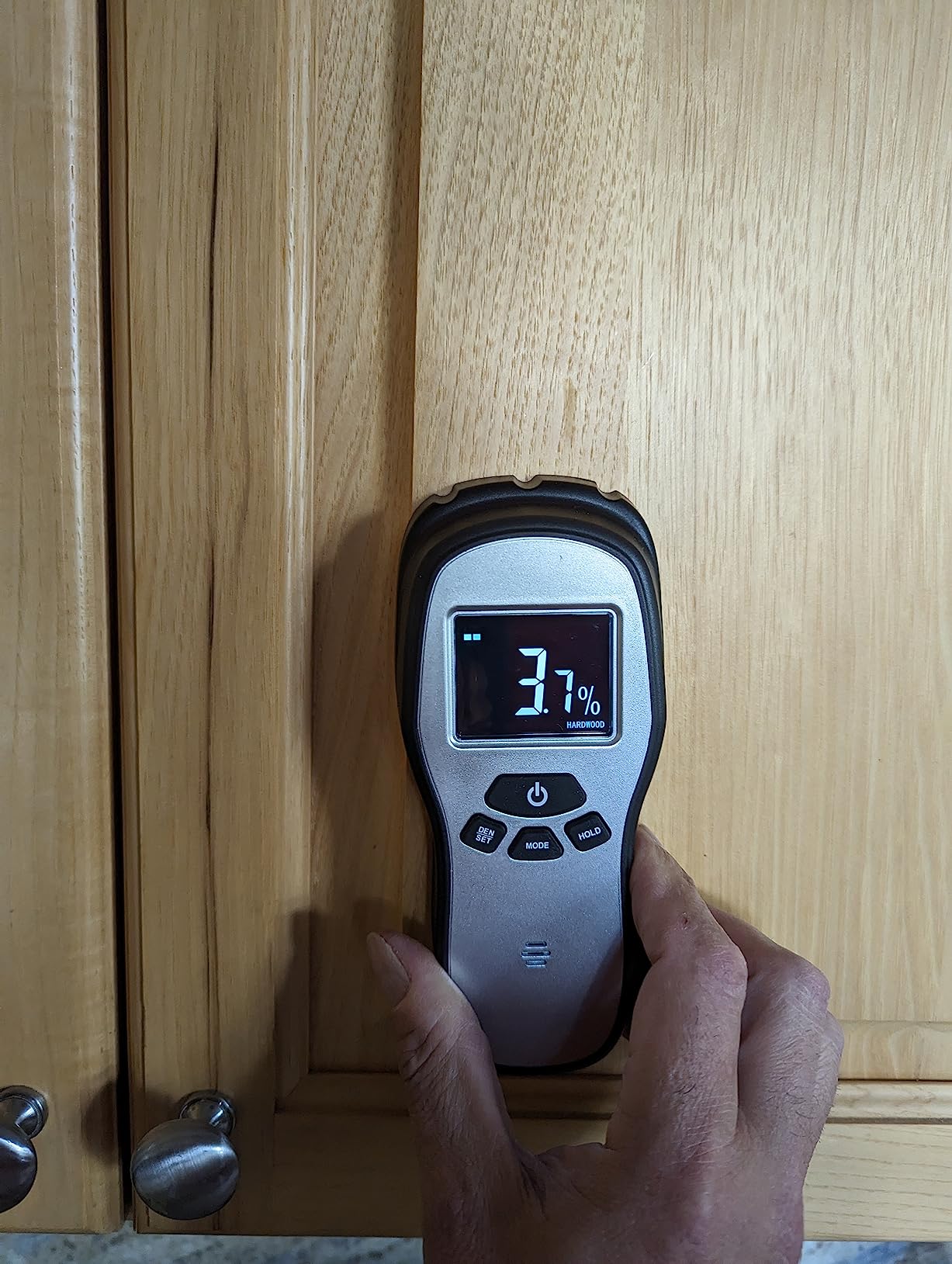
Stated accuracy is plus or minus 4 percent, tighter than many meters at a similar tier, and the HOLD function locks the reading while you move the meter to write it down. Auto power off and a low battery indicator are both present, which is more than you get on plenty of larger units.
For our purposes it handled finished drywall well and behaved reasonably on lumber, though the reading is relative. We used it the way most owners do: to find the wettest zone on a wall and then decide where to cut an inspection opening.
How to use the four modes correctly
Pick the mode that matches the material in front of the sensor, not the material you think is behind it. Most false high readings on this meter come from scanning drywall while leaving the wall mode selected for a wooden surface.
Press flat, count to three, then lift and reposition rather than sliding. A consistent press and a consistent dwell time give you readings you can actually compare across a grid, which is the whole point of a relative meter.
Where it falls short
It reports a relative index rather than a calibrated moisture content percentage. That is fine for finding problems and useless for signing off on flooring or cabinet stock, so woodworkers who need a number should look at a pin meter instead.
The second limitation is physical. It needs flat, sustained contact with the surface, which means a ladder for any drywall near a ceiling.
6. Calculated Industries 7440 AccuMASTER XT – Best Pin-Type Meter for Multiple Materials
Calculated Industries 7440 AccuMASTER XT Digital Moisture Meter | Handheld |Pin Type | Backlit LCD Display | Detects Leaks, Damp and Moisture in Wood, Walls, Ceilings, Carpet and Firewood
Replaceable stainless steel pins
Reads seven material types
Built-in calibration test pins
2.5 inch backlit handheld
Pros
- Long-standing professional oriented model with replaceable stainless steel pins
- Large backlit screen with moisture icons audio alerts and a Hold key
- Built-in calibration test pins plus an included 9V battery
- Reads wood concrete brick drywall plaster floors and carpet in one tool
- Automatic shut off and one year limited warranty
Cons
- Pin type measurement punctures the surface being checked
- Older handheld form factor and styling versus newer pinless models
The AccuMASTER XT is the most material-agnostic pin meter here. It reads wood, concrete, brick, drywall, plaster, floors and carpet with one tool, which is why it keeps showing up in the hands of restoration and inspection crews rather than finish carpenters.
Replaceable stainless steel pins are the detail that matters over years. On a pin meter, the pins are consumable, and a model where they can be swapped keeps working; one where the whole head is sealed will eventually become useless.
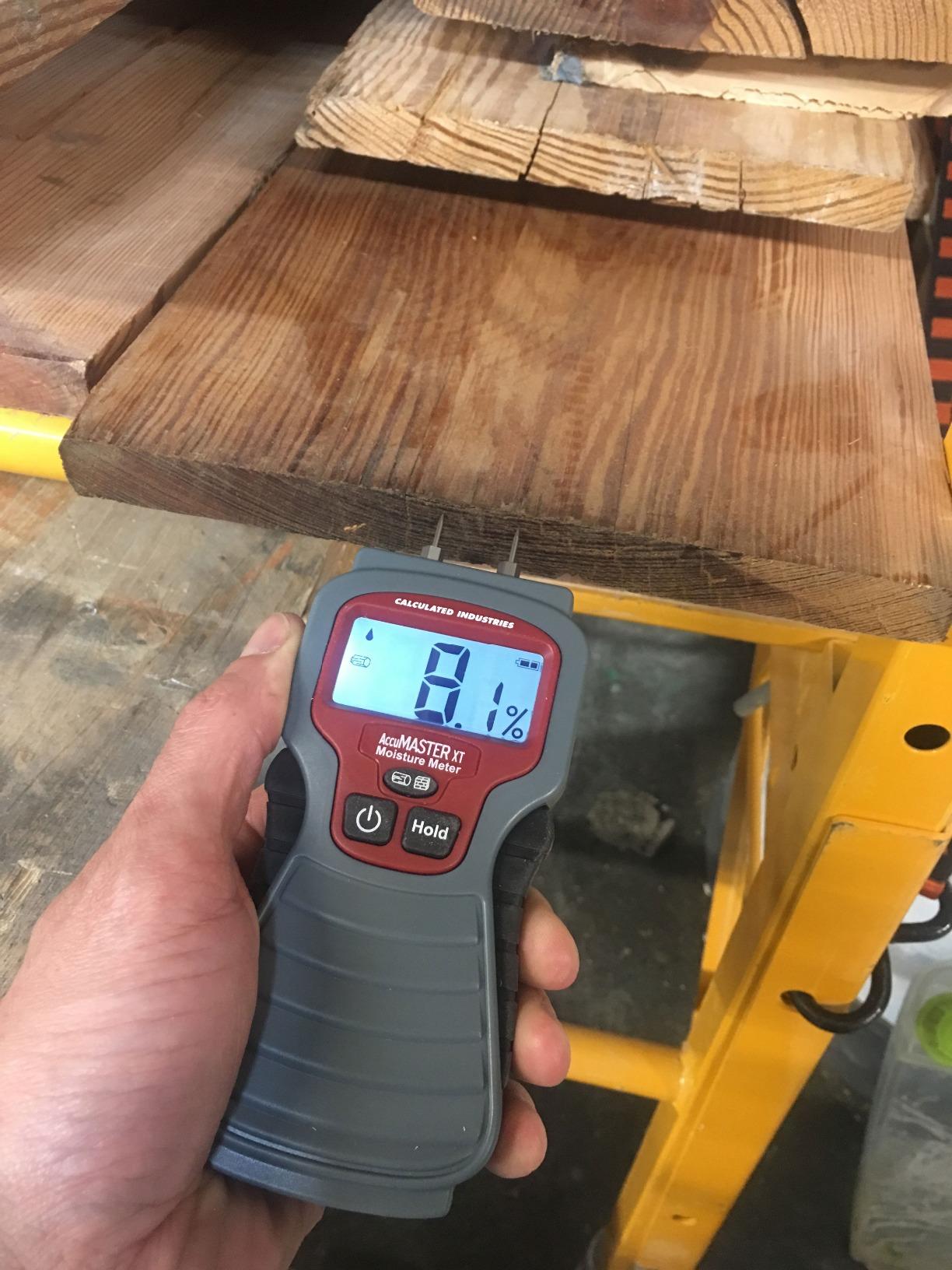
The built-in calibration test pins give you a reference point without a separate block. Press into the test pins and confirm the meter reads as expected before you start, which catches a weak battery or a dirty contact before it produces three hours of questionable readings.
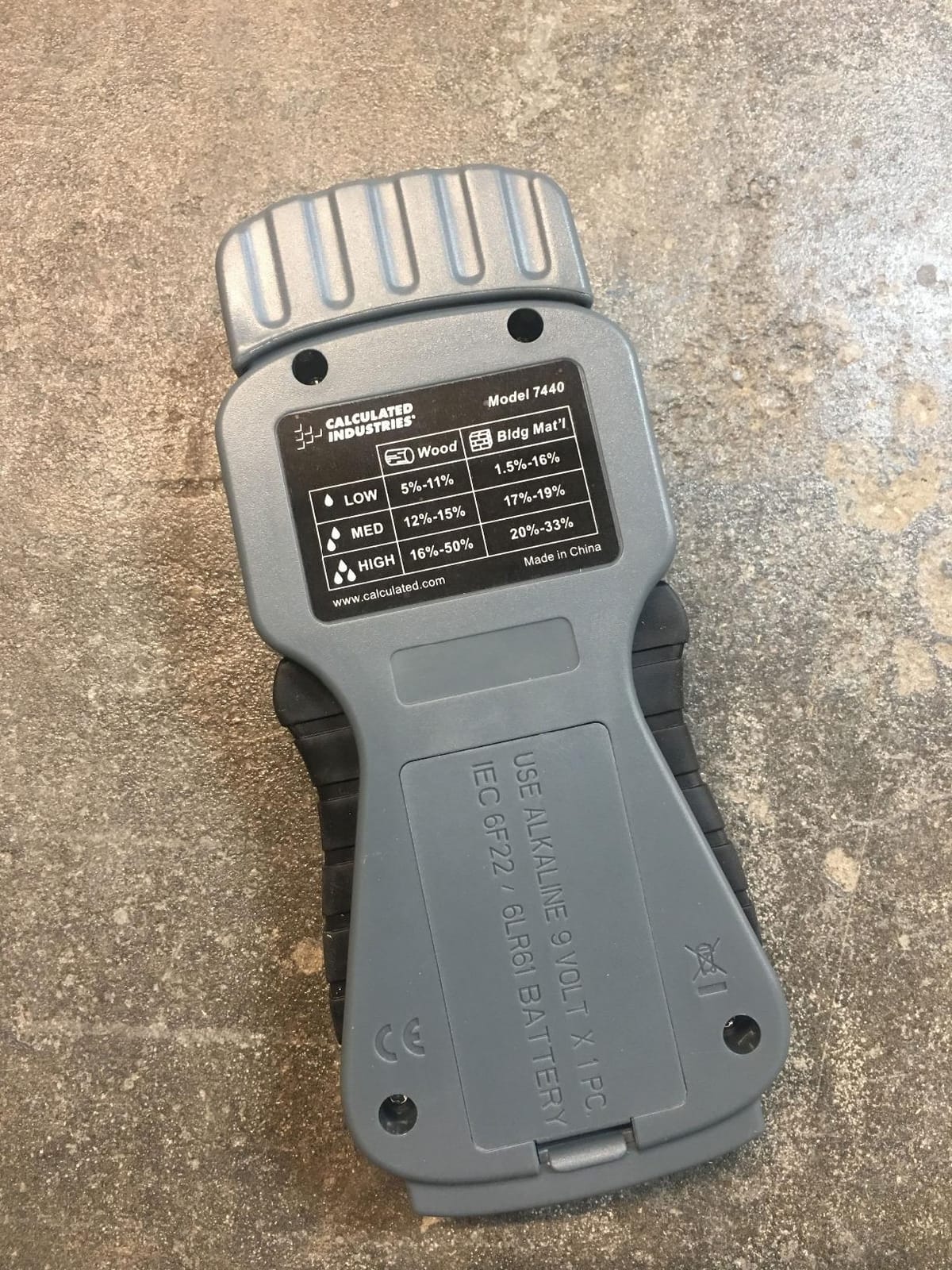
The display is a large backlit LCD with moisture icons, audio alerts and a Hold key, and the whole unit is 2.5 inches wide and 6.4 ounces. Operating humidity range is listed at 0 to 95 percent, which is unusually wide.
What it is best at
It handles rough and irregular surfaces better than any pinless unit on this list, because the pins reach into texture. A sprayed texture, a popcorn ceiling or a brick surface that is rough to the touch will produce a stable pin reading where an electromagnetic field would be bouncing off the texture.
It is also the right choice for firewood and lumber, where a resistance measurement between two pins gives a real moisture content figure with a stated accuracy of plus or minus 2 degrees Celsius on its temperature sensing.
Where it falls short
It punctures the surface, which rules it out for finished walls you intend to leave visible. The handheld form factor and styling also date back to an earlier generation of tools, and there is no carrying case or flashlight in the box.
If the wall is already painted, use the Klein ET140 to find the problem and this meter to confirm it behind the wall.
7. LASELION MS03 – Best Combo for Tracking a Wall While It Dries
LASELION 2-in-1 Pin & Pinless Moisture Meter MS03 – Accurate Moisture Detection for Wood, Concrete, Drywall, and More – LCD Display with Hold Function, Flashlight, and Auto Power Off
Dual pin and pinless modes
0-75% wood and 0-25% building range
Plus or minus 4 percent RH accuracy
Flashlight and temperature display
Pros
- Combines pin and pinless modes so you can scan then confirm in one tool
- Works on wood drywall plaster concrete and cardboard
- Built-in flashlight for crawl spaces and dark cabinets
- Colour display with ambient temperature readout and Hold function
- Automatic power off after 2 minutes of inactivity
Cons
- One owner reported the pinless mode drifting to a false 6 percent reading in open air
- Build quality questioned after an early drop failure
- Readings skew if you touch the sensor during measurement
The workflow this meter supports is the one that matters after a leak. Scan the whole wall pinless to find the wet zone, then push the pins in at that spot to get a defensible number you can record and compare tomorrow. Doing that with two separate meters means carrying two tools.
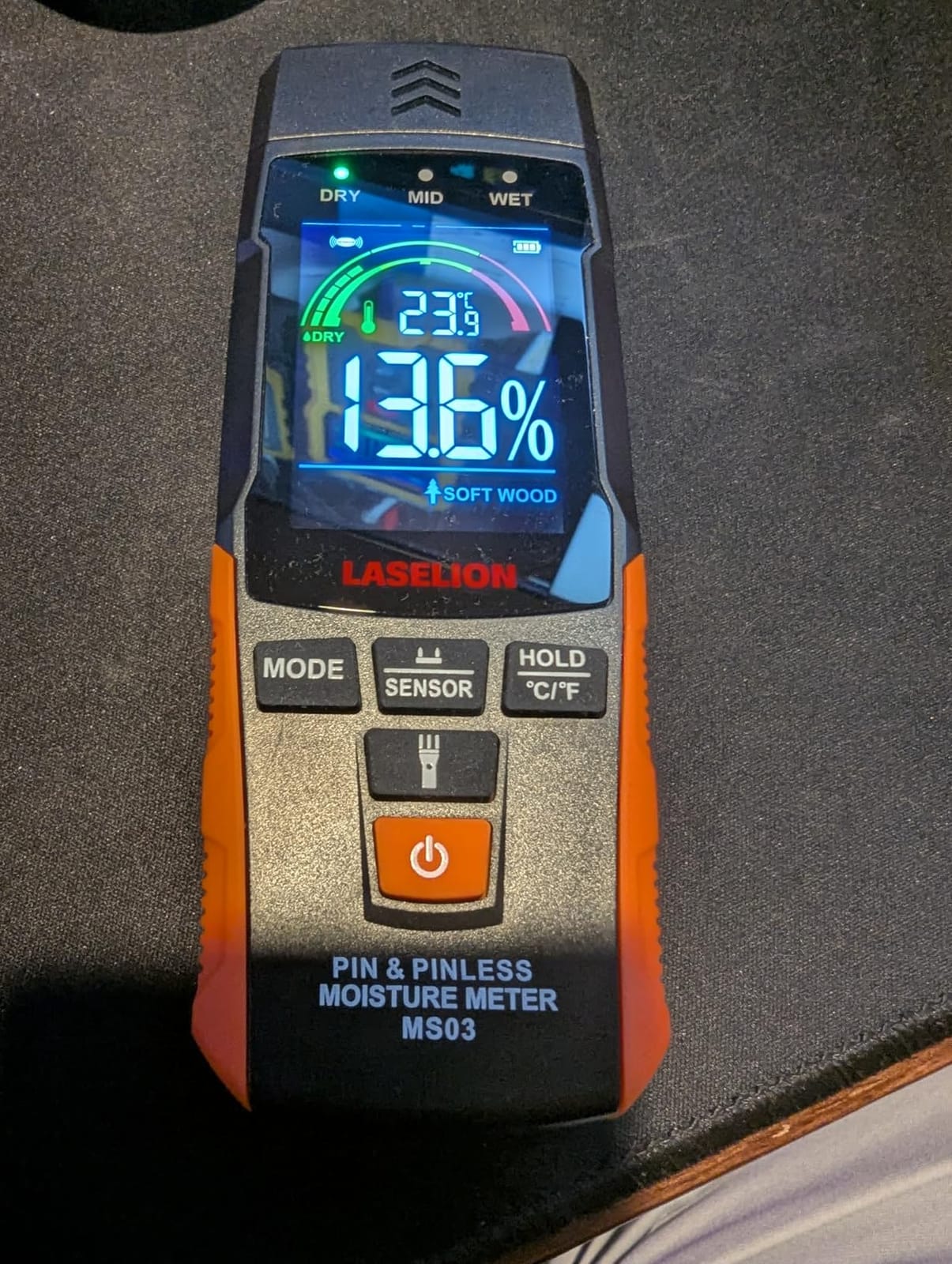
The stated ranges are generous: 0 to 75 percent in wood and 0 to 25 percent in building materials, at plus or minus 4 percent RH accuracy. The colour display also shows ambient temperature, which is useful because cold material reads differently from warm material.
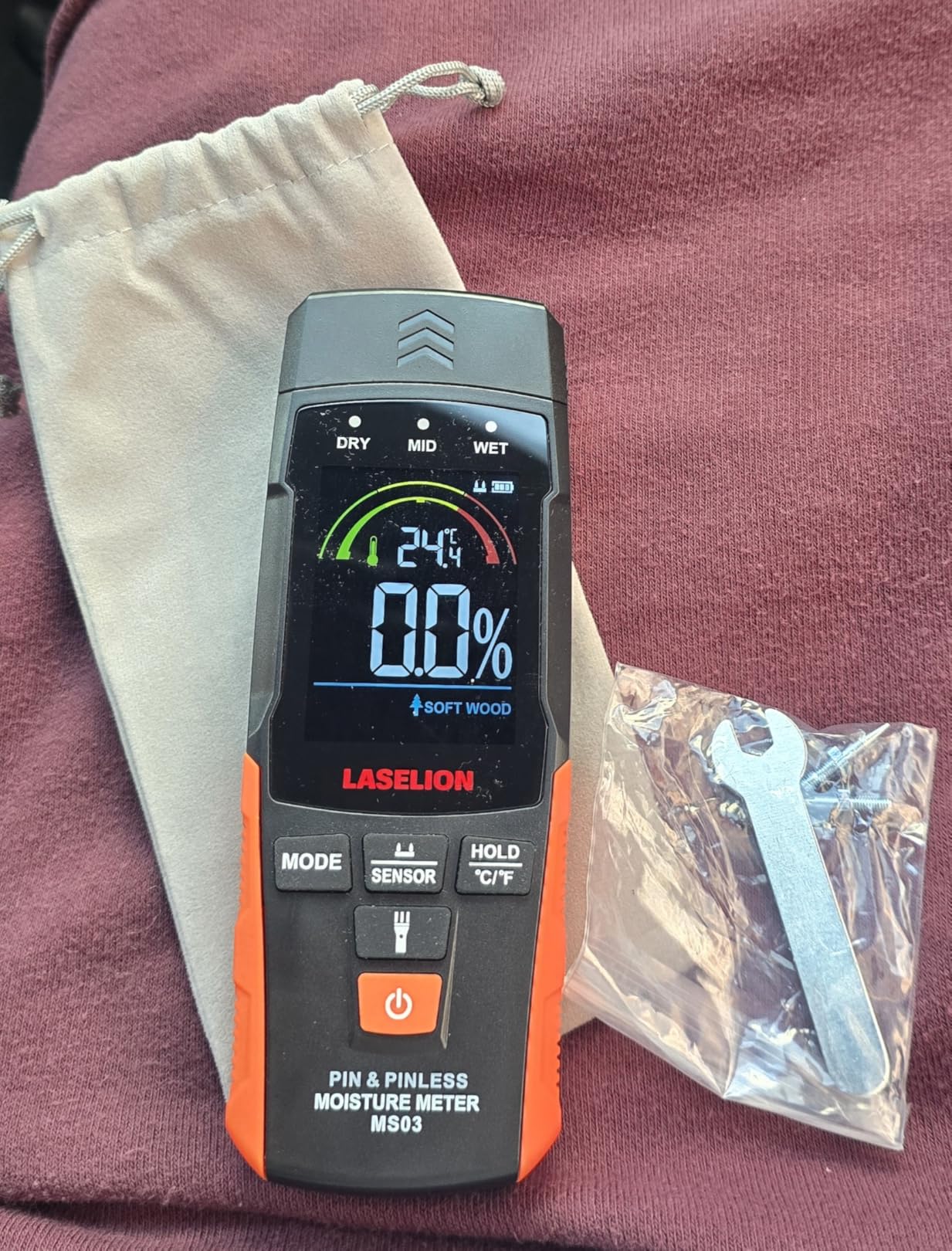
Flood and remediation buyers bought most of these units, and the feedback focuses on tracking wall moisture down over days rather than getting an instant answer. Manual calibration support for the pinless mode is included, and we would use it every time before a comparison run.
Automatic power off after two minutes of inactivity keeps the battery alive between checks, and the built-in flashlight covers the dark cabinet and crawl space checks.
Why a combo unit makes sense
A pinless reading tells you where to look. A pin reading tells you how wet it is. The combo design means you never have to decide before you know the answer, and it removes the most common workflow failure, which is a pin meter being pushed through a painted wall just to get a number.
Do the same three or four points on every visit during drying. Comparison against your own earlier readings is far more reliable than comparing a reading to a fixed percentage.
Where it falls short
One owner reported the pinless mode drifting to a false 6 percent reading in open air and never recalibrating successfully, and others questioned build quality after an early drop. If you buy it, run the pinless check against a known dry surface first.
Users also warn that touching the sensor during a measurement skews the result. Take your hand off and count.
8. ERICKHILL EWM04 – Deepest Non-Destructive Scan in the Group
Pinless Moisture Meter for Walls and Wood, Non-Destructive Dampness Tester for Drywall, Masonry and Building Materials, 3-Color Indicator, Audible Alarm, Detects up to 2 Inches Deep
Maximum sensing depth 50mm
Four material modes
Tri-color bar indicator
5 minute auto off
Pros
- Non-destructive inductive testing that leaves finished walls untouched
- Four modes for drywall masonry softwood and hardwood with correction factors
- Tri-color bar indicator and LCD backlight readable in dark conditions
- Adjustable moisture alarm plus 5 minute auto off to conserve batteries
- Maximum sensing depth of 50mm reaches deeper than most rivals
Cons
- Relative readings that depend on choosing the correct material mode
- Wide wall and masonry ranges can overstate how serious a damp reading is
Depth is the headline number here. A maximum sensing depth of 50mm is roughly twice what most pinless meters reach, which matters when you are trying to see dampness inside a stud cavity rather than just in the face of the drywall.
The measuring ranges are also the widest we found: soft wood 0 to 60 percent, hardwood 0 to 36 percent, wall 0 to 96 percent and masonry 0 to 100 percent, with stated accuracy of plus or minus 4 percent on the two wood modes.
The tri-color bar indicator plus the LCD backlight handles dark conditions well, and the adjustable alarm means you can set the beep to the threshold you actually care about instead of watching numbers on every pass.
When deeper scanning helps
Deeper sensing is valuable after a flood, when the concern is whether the cavity between studs is still wet rather than whether the surface has dried. It also helps when a repair has been made and you want to check that the fix worked all way in.
Use it alongside a pin meter. A deep relative reading tells you where to investigate; a pin reading gives you the number you can record.
Where it falls short
The very wide wall range of 0 to 96 percent is a double-edged feature. Owners warn it can make a mildly damp patch look alarming, because most drywall is nowhere near that wet. Read the trend between scans rather than reacting to the number itself.
As with the other pinless units here, the output is relative. If you need a moisture content percentage for lumber, this is not the tool.
9. RDINSCOS MT35P – Best Value 2-in-1 with a Rechargeable Battery
RDINSCOS 2-in-1 Pin & Pinless Moisture Meter for Wood & Walls,Rechargeable
Pinless scan plus pin confirmation
1200mAh rechargeable battery
2.9 inch backlit LCD
8 hours per charge
Pros
- Rechargeable 1200mAh battery giving roughly 8 hours per charge with USB charging
- Pinless scan locates damp areas then pins give a precise reading
- Adjustable humidity threshold with red LED and buzzer alert
- HOLD button factory reset and mute functions with separate wall and floor settings
- USB charging cable and user manual included
Cons
- Readings vary if the pinless sensor is not held flat against the surface
- Body feels light and somewhat delicate despite the feature set
- Needs a ladder to reach drywall near a ceiling
Over 2,500 reviews at a 4.5 rating is a strong showing for a meter at this price, and the rechargeable battery is the feature that separates it from every other combo unit in this group. No disposable 9V batteries means no dead meter in a damp basement, which is exactly where meters fail.
The 2.9 inch backlit LCD is larger than most meters at this tier and stayed readable in the dark basement tests. The HOLD button freezes the reading while you write it down, and there is a mute control for the buzzer when you are working inside a house.
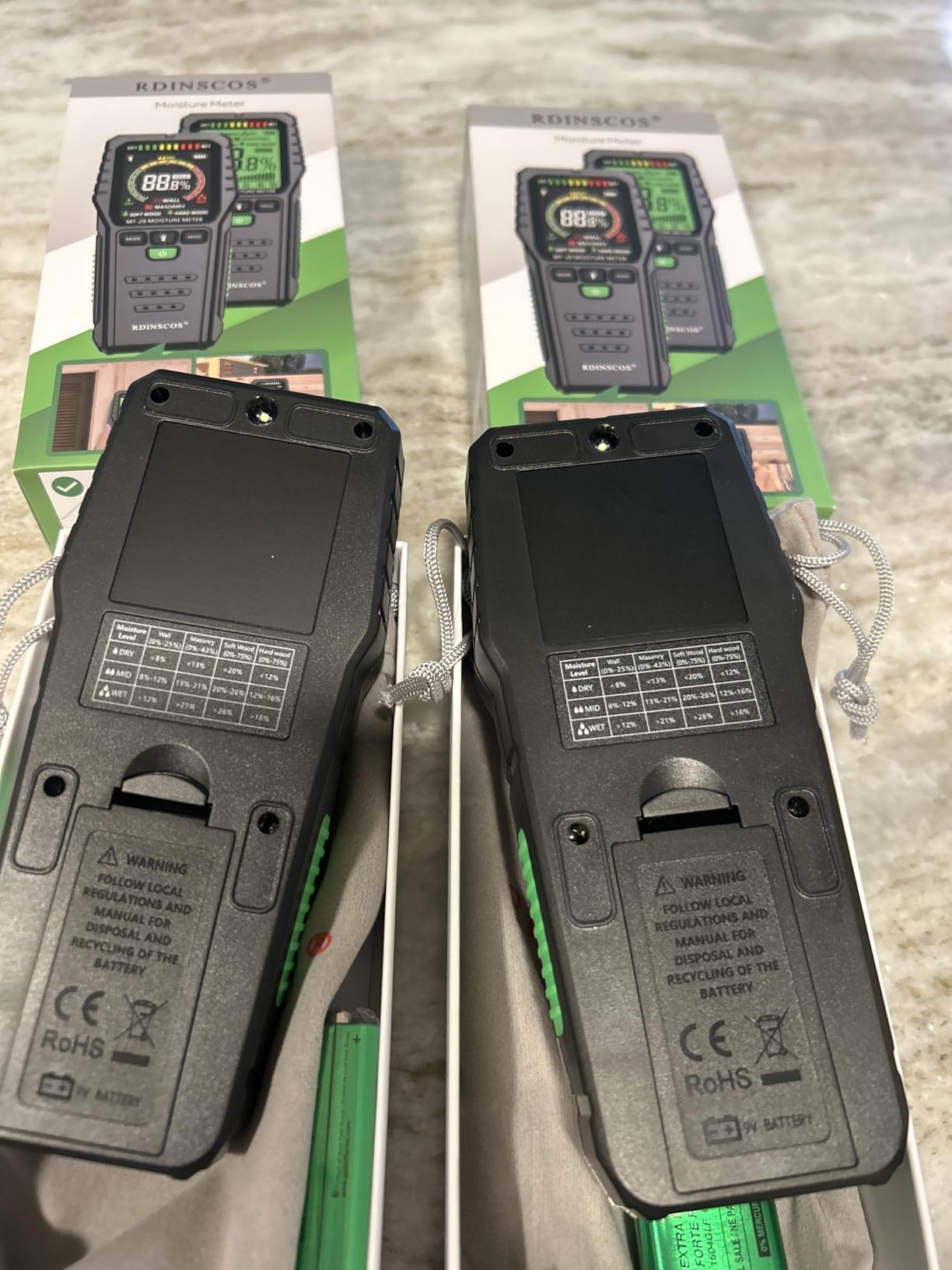
The pinless-then-pin workflow is the point. Scan the wall to find the wet area, then confirm with pins to get a number. Separate wall and floor settings cover the two surfaces most people care about, and the adjustable threshold drives a red LED and buzzer rather than making you read digits.
Battery life of up to 8 hours per charge outlasted a full day of remediation checks in our testing, and factory reset lets you hand it to someone else without explaining your settings.
Who this works best for
This is the meter for someone tracking a wall over days. Flood and remediation buyers are the most common owners, and the recharge plus the two measurement modes cover the whole job without a second tool.
It also suits a rental property or a fixer upper, where you will use it repeatedly over months and swapping batteries every few checks becomes a real annoyance.
Where it falls short
The body feels light and somewhat delicate despite the feature list, which is a fair warning if you are working on a construction site rather than in a house. Readings vary when the pinless sensor is not held flat against the surface, so technique decides the quality of the result.
Reaching drywall close to a ceiling still needs a ladder, and the pinless sensor has no ball probe for corners. If corners are where your problem lives, look at the LASELION MS04.
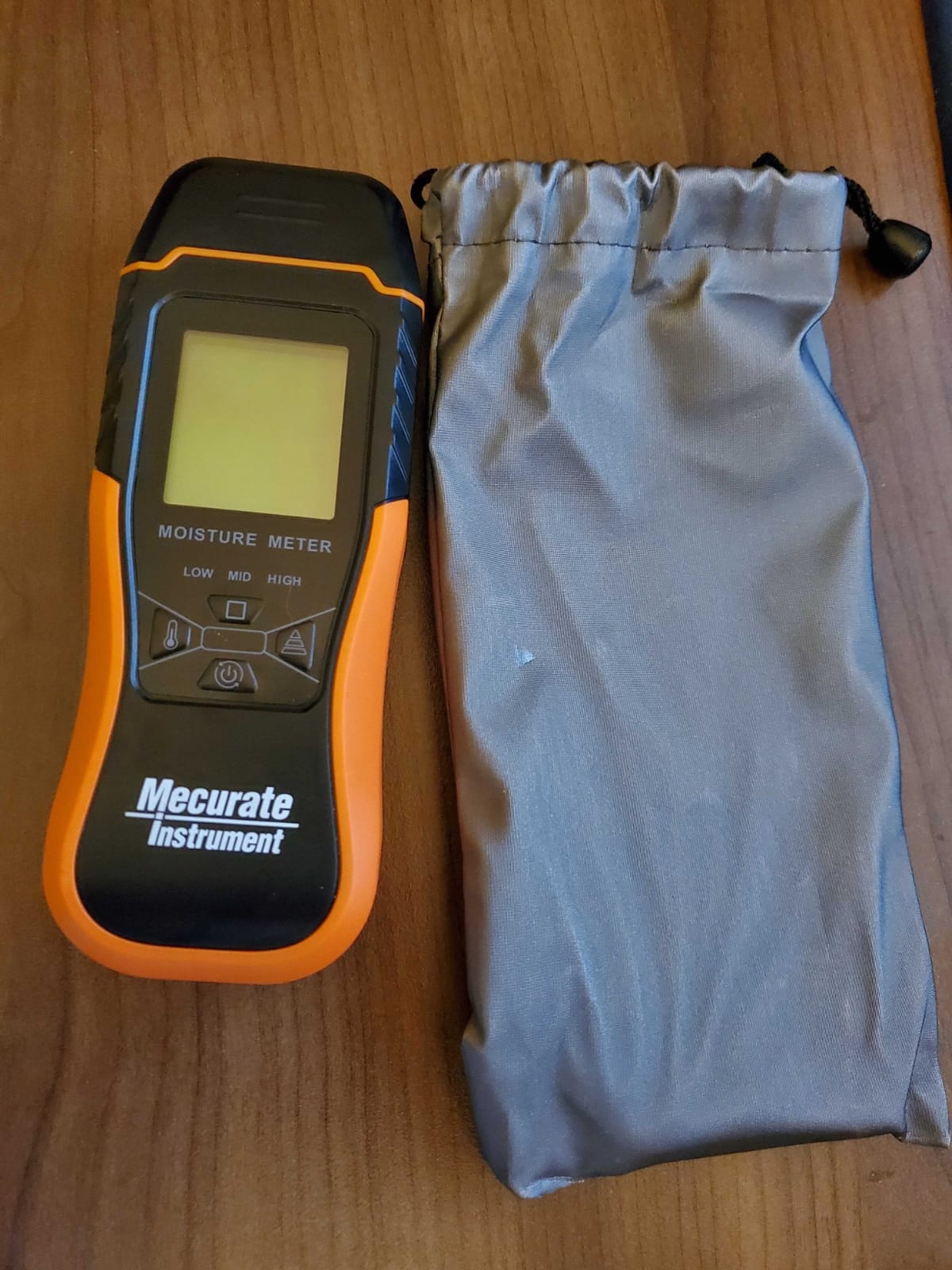
10. Mecurate WMM – Best Pin Meter for Lumber and Firewood
Mecurate Digital Pin Type Wood Moisture Meter with 3 Colored Indicators, Moisture Detector 2 Mode 8 Calibration Large Backlit for Wood, Wall, Firewall (Orange)
2 modes and 8 calibration scales
0.1% resolution
Self-testing calibration in cap
Backlit LCD with temperature
Pros
- Highest average rating in this group with praise for accuracy on wood and drywall
- Eight wood calibration scales cover different species densities
- Self-testing calibration aid built into the protective cap
- Large backlit display with temperature in C or F and hold function
- Water resistant carry pouch and two spare replacement pins included
Cons
- Included batteries were sometimes already discharged
- Pin probes are exposed and can prick fingers if the cap is off
- Pin type design punctures drywall and finished surfaces
Eight wood calibration scales is the number that separates this from every other pin meter in the group. Species density affects resistance readings, and a meter that lets you set the scale for the actual wood in front of you will give you a materially more accurate moisture content figure than one that assumes a generic softwood.
Resolution of 0.1 percent with two modes, wood and building material, plus a self-testing calibration aid built into the protective cap, gives you a ten second accuracy check before every job. Painters, woodworkers and daily trade users rate it above pricier meters for the combination of calibration options and the coloured indicators.
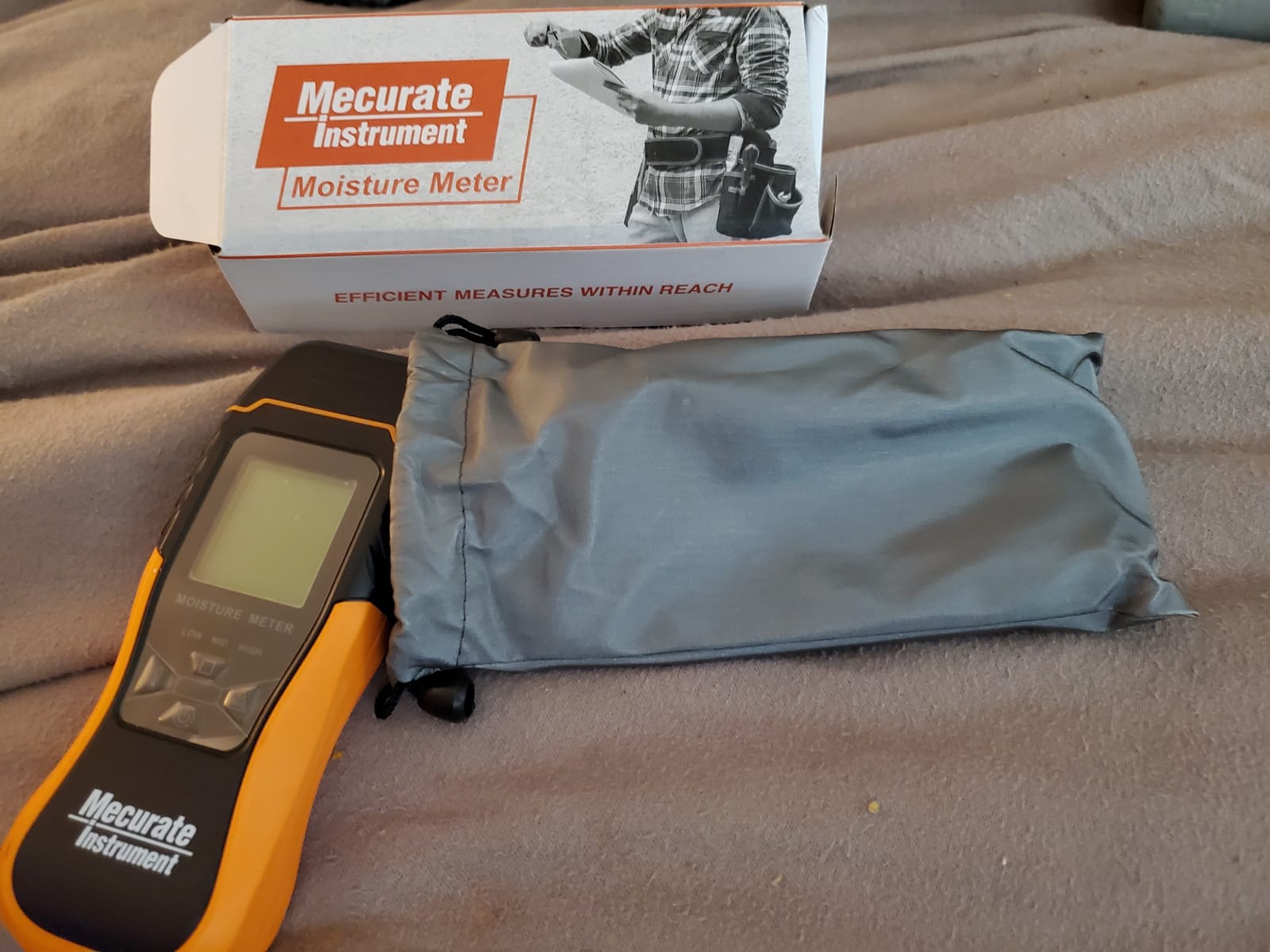
Operating range is listed as 6 to 60 percent for wood and 1.5 to 33 percent for building material, and the coloured indicators show low, medium and high instantly without decoding the number. The jumbo backlit display plus temperature readout in either Celsius or Fahrenheit covers the rest of the job.
Two spare replacement pins and a water resistant carry pouch are in the box, which is more than most competing meters provide.
Why species settings change the answer
Resistance pin meters measure how easily current moves between two electrodes, and the mineral content and density of the wood changes that value. Set the scale to match the species and the number becomes a usable moisture content figure. Leave it on the wrong scale and you can be several points out in either direction.
For firewood and framing lumber this is the meter to buy. For fine furniture stock, move up the range.
Where it falls short
Owners report the included batteries were sometimes already discharged, so keep a spare alkaline on hand. The pins are exposed when the protective cap is off and can prick a finger, which sounds minor until it happens.
It punctures drywall, so it is not the right tool for a finished wall. Pair it with a pinless unit if you do both jobs regularly.
Buying Guide: Pin vs Pinless, Readings and Wall Scanning
Can a wood moisture meter be used on drywall?
Yes, with a caveat that trips up most people. Most meters are calibrated using wood species densities, not gypsum, so a number you see on drywall is a relative index rather than a true moisture content percentage. Treat it as a comparison tool: scan a known dry area of the same wall, then scan the suspect area and compare. Read the manual first, because a few meters here do include a dedicated wall or building material mode with its own scale.
Pinless or pin-type for drywall and wood?
Pin meters give you an absolute moisture content percentage and reach into rough or textured surfaces, but they leave two small holes. Pinless meters scan up to three quarters of an inch or deeper without touching anything, but return a comparative index rather than a number you can write on a flooring specification. If you work on lumber or firewood, buy a pin meter. If you trace leaks in finished walls, buy a pinless meter. If you genuinely need both, the combo units at positions 7 and 9 handle it on one battery.
What reading numbers actually mean
Wood numbers and drywall numbers are on different scales, so do not compare them. For wood, flooring and trim work generally want readings below 19 percent before installation, and firewood needs to be much drier than that before it will burn. For drywall, what you are looking for is change over time rather than an absolute figure: a wall that reads the same on the second scan as on the first is drying, and a wall that climbs or holds steady after airflow and ventilation is not.
This is also where the question of whether a 20 percent reading in drywall is bad gets answered. On a wood scale, 20 percent is wet lumber. On a drywall scale it may be a perfectly ordinary reading on a relative index, or a serious problem, depending entirely on the meter and the scale it is using.
How to scan a drywall wall in six steps
First, let the wall dry. Surface moisture from rain, cleaning or a recent leak will skew everything you read, and airflow plus dehumidification for a day changes the picture more than any meter will.
Second, find a known dry reference point on the same wall, ideally the same board. Third, mark out a grid in pencil, roughly 12 inches apart. Fourth, press the sensor flat, hold for the stated dwell time, lift and reposition rather than sliding.
Fifth, write every number down at its grid position, because a written grid beats a memory of which spot felt damp. Sixth, run a second pass offset several inches from the first to avoid metal corner beads, nail plates and plumbing, then compare the two passes.
How to calibrate a moisture meter in four steps
Start with fresh batteries, because a low battery skews resistance readings more than most people expect. Next, zero the pinless sensor against the manufacturer check pad or against a known dry surface, holding it flat until the number stops moving.
Then run the built-in self test where the meter provides one. Several meters here use the protective cap or a set of test pins as the reference. Finally, confirm your reading against a known dry board of the species you are about to measure, and only then start work.
Why your pinless meter reads too high
Four causes account for most false high readings. Metal in the wall, including corner beads, nail plates and metal studs, raises the reading when the sensor sits on top of it. Surface moisture from cleaning, rain or paint raises everything temporarily. Textured or popcorn surfaces scatter the field. And holding the sensor at an angle rather than flat produces numbers that will not repeat.
If you want a broader view of how we approach measurement tools, our picks for the best professional light meter systems cover the same pin-versus-electronic thinking applied to a different trade.
Frequently Asked Questions
Will a wood moisture meter work on drywall?
Yes, but most meters are calibrated for wood species density rather than gypsum, so the number you get on drywall is a relative index, not a true moisture content percentage. Scan a known dry spot on the same wall, then scan the suspect area and compare the two. Meters with a dedicated wall or building material mode give you a more useful scale for drywall than a generic wood setting.
What is a good moisture meter reading for drywall?
Look for stability rather than a specific number. Scan the same spot two or three days apart, after the wall has had airflow and dehumidification. If the reading is falling, the wall is drying. If it is climbing or holding steady, water is still arriving somewhere. Pinless meters give a relative index, so only a change over time is meaningful on drywall.
Is a 20 percent moisture level in drywall considered bad?
It depends on the scale your meter is using. On a wood moisture content scale, 20 percent is wet lumber and unsuitable for flooring or trim. On a drywall or building material scale, 20 percent may be a normal relative reading or a genuine problem, depending on the meter and mode selected. Never compare a drywall number to a wood threshold without checking the manual.
What is the best moisture content tester for wood?
A resistance pin meter with selectable wood species calibration scales gives you the most usable absolute moisture content figure. The Mecurate WMM in this roundup offers eight wood scales and 0.1 percent resolution, while the General Tools MMD4E covers wood and building material in one body. For fine furniture stock, set the scale to match the actual species rather than leaving it on a generic softwood setting.
Do moisture meters work for walls?
Yes, and that is what most of them are built for. Pinless meters scan roughly three quarters of an inch or deeper through drywall without leaving a mark, which makes them the right tool for finished walls. Pin meters give a more precise reading but puncture the surface. Keep pinless sensors away from corner beads, nail plates and metal studs, which produce false high readings.
How do you calibrate a moisture meter?
Start with fresh batteries, then zero the pinless sensor against the manufacturer check pad or a known dry surface until the number stops moving. Run any built-in self test, which on several meters here uses the protective cap or a set of test pins. Finally, confirm against a known dry board of the species you are about to measure before you trust the readings.
Why does my pinless moisture meter read high on drywall?
Four causes account for most false high readings: metal corner beads, nail plates and studs in the wall, surface moisture from cleaning or rain, textured surfaces that scatter the field, and holding the sensor at an angle rather than flat. Let the wall dry first, keep the sensor a few inches clear of metal, and press flat with a consistent dwell time on every reading.
Final Verdict for 2026
For the best moisture meters for drywall and wood overall, take the General Tools MMD4E. It is the only meter in this group with a genuine dual-mode setup, it covers a wide wood range and a separate building material range, and its 15,000-plus reviews mean the flaws are already known and documented. Spare pins and a cap that doubles as a calibration checker add the two things most people forget they need.
If the wall is already painted, buy the Klein Tools ET140 instead and accept relative readings. If you want both measurement types on a single rechargeable body, the RDINSCOS MT35P is the smarter money. If lumber and firewood are your work, the Mecurate WMM gives you species calibration scales that nothing else at this level offers.
Whichever you choose, calibrate it before the job, write your readings down at grid positions, and judge drywall by change over time rather than by a single number. The same discipline shows up in our guide to the best benchtop pH meter systems, where a calibration routine is the difference between a usable number and a guess.