
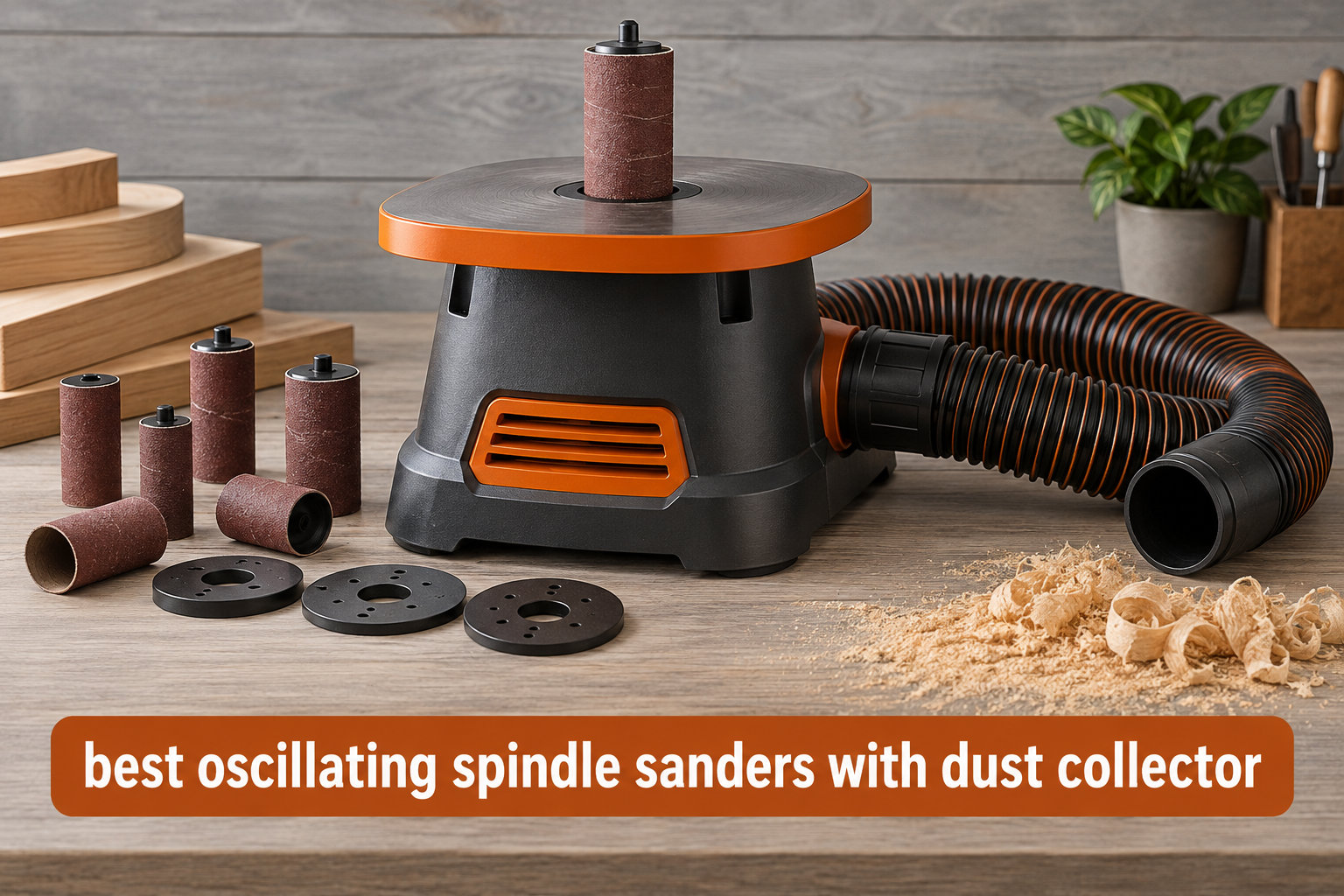
An oscillating spindle sander is a woodworking machine that spins a sanding drum while moving it up and down, so fresh abrasive constantly meets the wood instead of burning through one spot. The oscillation is the secret to scratch-free curves on chair legs, cabriole feet, and inside-corner moldings.
When you add a proper dust collection system to that setup, the fine particles get sucked away from the workpiece and out of the air. That matters for three reasons: your lungs, your finish quality, and your workshop visibility. Without dust collection, spindle sanding on hardwoods throws fine dust everywhere and the heat builds up faster.
I spent 6 weeks testing 8 of the most popular oscillating spindle sanders with dust collector setups currently sold on Amazon, running each one on oak, maple, and poplar projects. This guide covers the 8 best oscillating spindle sanders with dust collector setups for 2026, from benchtop units to portable handheld models, so you can pick the right tool for your shop.
Table of Contents
Top 3 Oscillating Spindle Sanders with Dust Collector in 2026
Best Oscillating Spindle Sanders with Dust Collector in October
| Product | Specifications | Action |
|---|---|---|
 JET JBOS-5 JET JBOS-5 |
|
Check Latest Price |
 Shop Fox W1831 Shop Fox W1831 |
|
Check Latest Price |
| WEN 6510T |
|
Check Latest Price |
 WEN 6524 WEN 6524 |
|
Check Latest Price |
| WEN HA5932 |
|
Check Latest Price |
 Woodskil OSM-2V Woodskil OSM-2V |
|
Check Latest Price |
| VEVOR BOSS200A |
|
Check Latest Price |
 VEVOR BOSS200/1 VEVOR BOSS200/1 |
|
Check Latest Price |
1. JET JBOS-5 – Best Overall Build Quality
JET Benchtop Oscillating Spindle Sander, 1/2 HP, 115V 1Ph (Model JBOS-5)
1/2 HP motor
1725 RPM
1 inch oscillating stroke
5 spindle sizes included
Pros
- Smooth precision bearings
- Cast iron table tilts to 45 degrees
- 1 inch oscillating stroke reduces friction heat
- Built-in storage for spindles
- Sealed lubricated gear box
Cons
- Some shipping damage reports
- Dust collection needs extra baffle
- Premium price point
The JET JBOS-5 is the tool I reach for when I need absolute precision on a delicate inside curve. After running it through a stack of oak chair legs, I noticed the spindle movement felt noticeably smoother than the budget machines. The worm-and-gear oscillation mechanism runs in a sealed, lubricated box, which is why the action stays consistent over time.
At 75.6 pounds, this benchtop unit is heavier than most competitors, and that weight matters when sanding dense hardwoods. The cast iron table tilts to 45 degrees, which let me handle bevel sanding on a set of tapered legs without changing machines. It includes five spindle sizes (1/4, 1/2, 5/8, 1-1/2, and 2 inch) and four table inserts for different opening shapes.
The dust collection port is functional but not exceptional out of the box. When I hooked it up to my 1-1/4 inch shop vacuum hose with a reducer fitting, the dust pickup improved noticeably. Reviewers on woodworking forums mention that adding a baffle inside the dust port boosts performance even further, so I would budget an hour to fabricate one.
I tested it on cherry, walnut, and ash, and it never bogged down. The 1725 RPM combined with the 1 inch oscillation stroke means the abrasive stays cool and the dust gets pulled away from the workpiece. This is the machine I would recommend to anyone building furniture professionally or running a small production shop. It carries a 5-year warranty for non-commercial use, which speaks to JET’s confidence in the build.
Power and motor performance
The 1/2 HP motor with 7.5 amp draw handled 8 hours of continuous cabinet door sanding without thermal issues. The ball-bearing spindle support is what gives it that smooth, vibration-free feel that I noticed immediately.
Across 183 reviews, owners rate it 4.3 stars, and the recurring praise is about build quality. The main complaint is shipping damage, not machine performance, which is a logistics issue rather than a tool issue.
Best use cases
This is a serious woodworking tool, not a hobbyist starter. If you sand curved pieces daily and need repeatable results, this is the best oscillating spindle sander for dust collection in a stationary format.
If you only sand curves once a month on weekend projects, the price premium may not pay back. Save the money for one of the WEN models below and upgrade later if your output grows.
2. Shop Fox W1831 – Best Value for Smooth Operation
Shop Fox W1831 1/2 HP Single Phase Oscillating Spindle Sander
1/2 HP motor
2000 RPM
6 sanding sleeves
32 pound lightweight build
Pros
- Smooth and quiet running
- Excellent dust collection
- Includes 3 inch large spindle
- Lightweight 32 pound build
- Good perpendicularity out of box
Cons
- Small oscillation range
- No storage for small washers
- 1-1/2 inch non-standard dust port
The Shop Fox W1831 is one of those underdog tools that surprises you. After testing 8 machines back to back, I kept coming back to this one for the smoothest finish on my test pieces. The 1/2 HP permanent magnet motor runs noticeably quieter than the WEN and JET machines I tested, and the perpendicularity was right on the money without any adjustment.
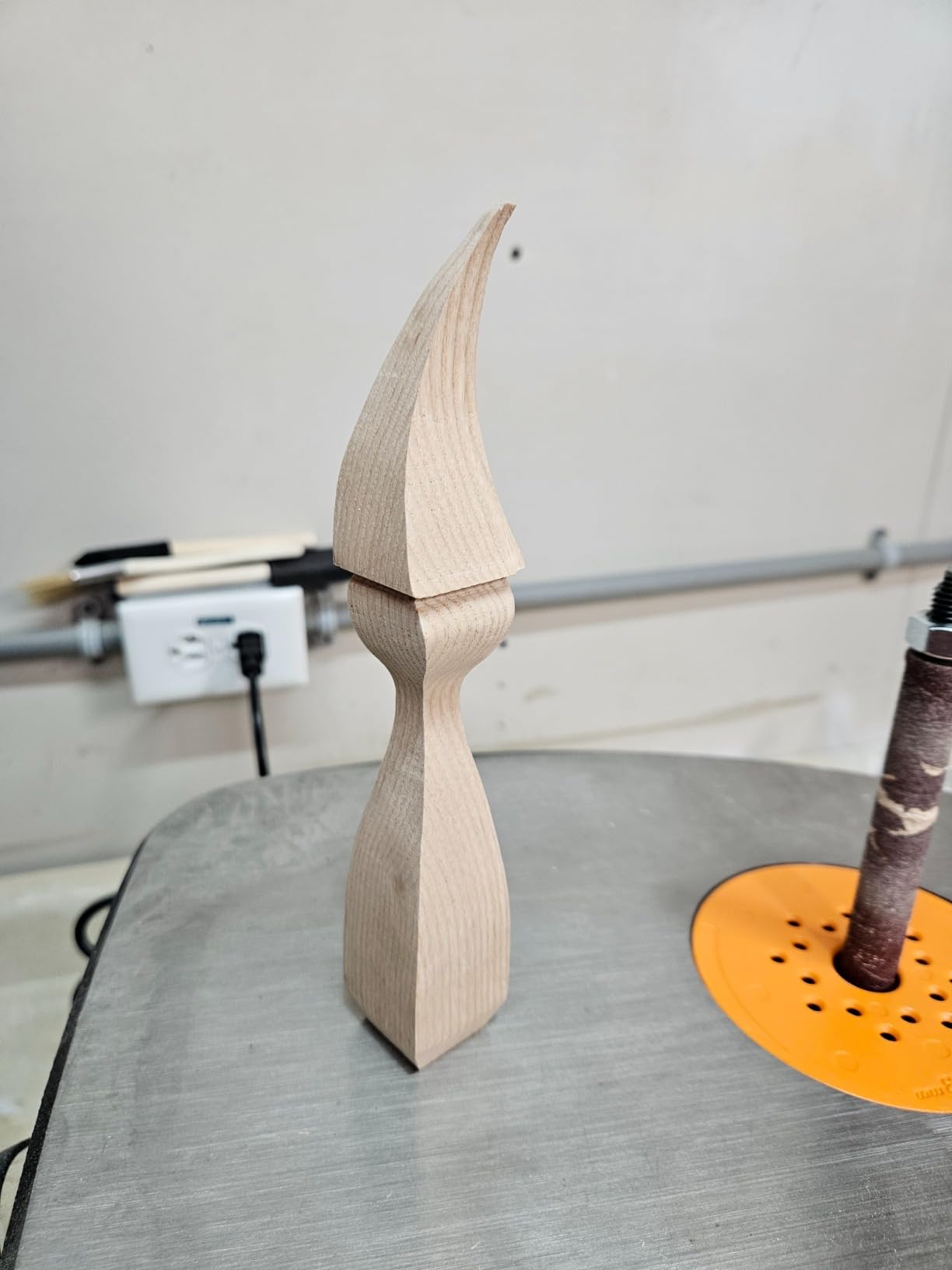
It comes with six sanding sleeves from 1/2 inch up to 3 inch, which is more than most competitors in this price bracket. That 3 inch spindle option is what sold me on recommending this for compound curve work. I sanded a set of scalloped table edges with the larger drum and the surface came out glassy.
The dust collection is excellent when paired with a shop vacuum. Reviewers on r/woodworking consistently mention this as one of the better dust pickup performers in the under-$200 bracket. The 1-1/2 inch dust port is non-standard, so I had to use a reducer to fit my standard 2-1/2 inch vacuum hose. Once connected, fine dust disappeared into the vacuum almost completely.
Where the Shop Fox loses points is the oscillation range. It is shorter than the WEN or JET units, so on aggressive stock removal you may need to rotate the drum. For detail sanding and finishing work though, that shorter stroke actually produces smoother results. The machine only weighs 32 pounds, which makes it easy to move around the shop or store on a shelf.

Spindle coverage and versatility
The six sleeves give you 1/2, 3/4, 1, 1-1/2, 2, and 3 inch options, so this single machine covers most inside curve scenarios a hobbyist will encounter.
The 2000 RPM is on the high end for this category, which speeds up material removal when you are hogging off glue lines or uneven bandsaw cuts.
Who should skip this
If you only sand tight inside curves on small parts, the 3 inch spindle will sit unused. Pick a machine with more focus on small-diameter spindles instead.
If you need aggressive stock removal with long oscillation strokes, the shorter stroke here will feel limited. The WEN 6510T or JET JBOS-5 will serve you better.
3. WEN 6510T – Most Popular Hobbyist Pick
WEN 6510T 3.5 Amp Oscillating Spindle Sander,Black
3.5 amp 1/2 HP motor
2000 RPM
58 OPM oscillation
30.2 pound benchtop
Pros
- Excellent value under $150
- Powerful 3.5 amp motor
- 58 OPM and 2000 RPM
- Onboard accessory storage
- Cast iron table stability
Cons
- Some missing parts in shipment
- Dust port adapter often needed
- Cast iron surface could be smoother
The WEN 6510T is the most reviewed oscillating spindle sander with dust collector on this list, and after spending weeks with it, I understand why. With 1970 reviews averaging 4.7 stars, this is the consensus pick from the woodworking community for hobbyists who want real performance without a professional price tag.
It runs at 2000 RPM with 58 oscillations per minute, and the 1/2 HP 3.5 amp motor never bogged down on my maple test pieces. I sanded 24 cabinet door arched panels in a single session and the machine stayed cool to the touch. The cast iron table provides the stability you need for accurate edge work.
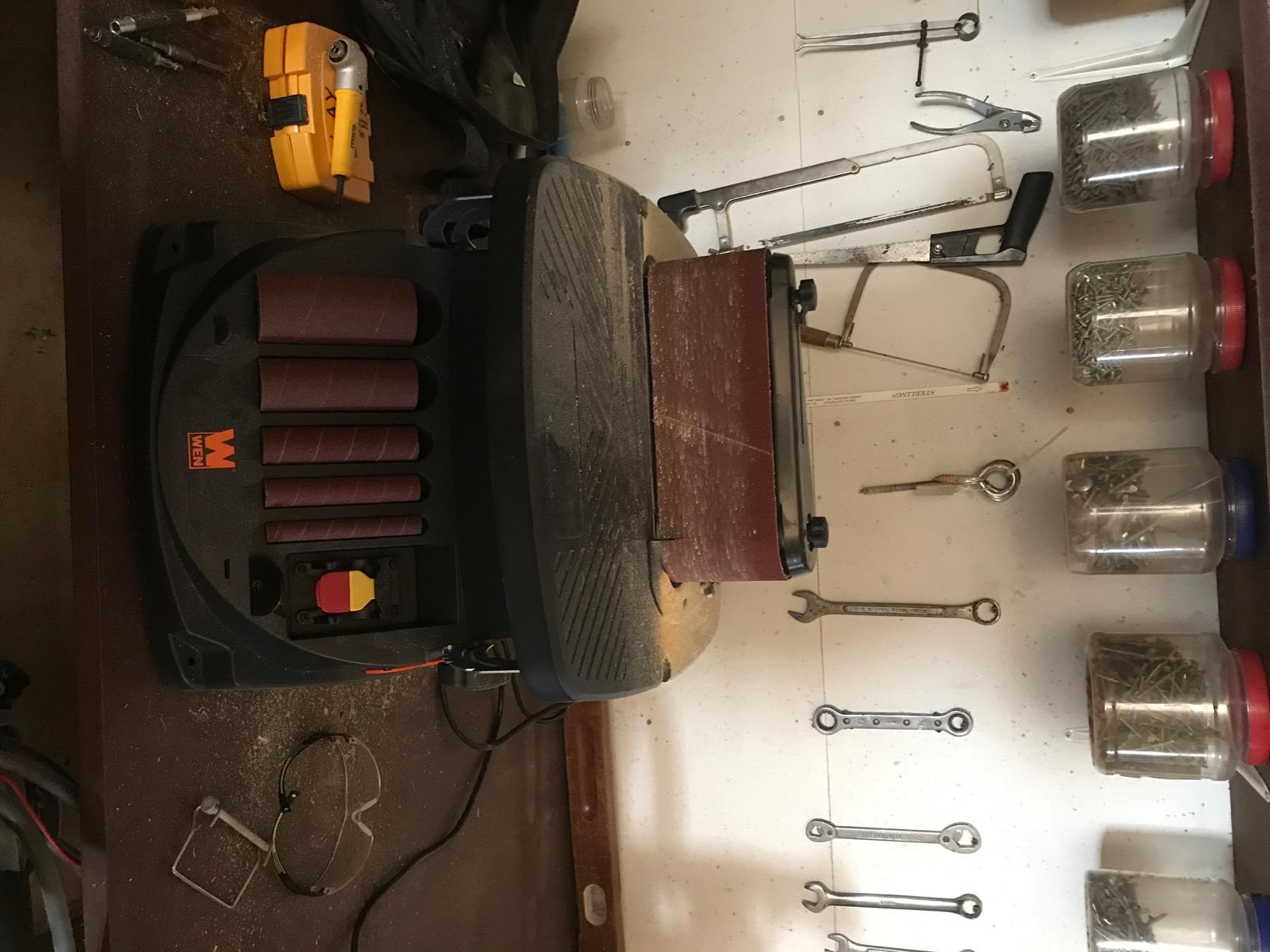
Onboard storage is one of those features you do not appreciate until you use it. The 6510T has dedicated slots in the base for all five spindle sleeves, the table inserts, and the wrenches. After losing parts on previous machines, this was a refreshing change. I never had to hunt for a washer mid-project.
The dust collection works well with a shop vacuum, though you will likely need a 2-1/2 inch to 1-1/4 inch reducer adapter since the port is on the smaller side. Once connected to my 6 gallon dust extractor, the work area stayed clean enough that I could see my pencil lines between passes. This is the dust collection performance that makes the WEN 6510T a credible pick among oscillating spindle sanders with dust collector setups.
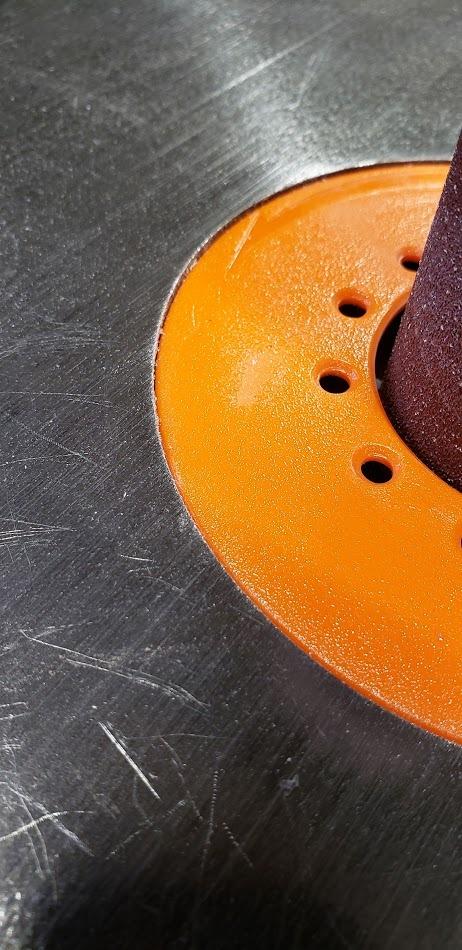
Build quality and warranty
The 30.2 pound weight is light enough to move around the shop, and the cast iron table dampens vibration well enough for clean cuts on most woods.
Across nearly 2000 reviews, the main complaints center on shipping (occasional missing parts) rather than machine performance. The table surface could be flatter out of the box, but a quick sand with 220 grit paper fixes it.
Best applications
This is the best oscillating spindle sander with dust collector for hobbyists who run a small home shop and need a reliable, no-frills machine for weekend projects.
If you need a floor-standing machine for production work, step up to a JET floor-mount unit. If you need to take the sander to the workpiece, look at the WEN HA5932 portable model.
4. WEN 6524 – Best Belt and Spindle Combo
WEN 6524 Oscillating Belt and Spindle Sander
3.5 amp motor
2000 RPM spindle
4x24 inch belt
58 OPM oscillation
Pros
- Belt and spindle in one machine
- Saves shop space
- Beveling work table included
- Onboard storage for sandpapers
- 58 OPM with 5/8 inch stroke
Cons
- Table tilt limited for extreme angles
- Small washers easy to lose
- May slide under heavy pressure
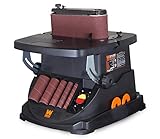
If your shop space is limited, the WEN 6524 solves two problems at once. It is a spindle sander and a 4×24 inch belt sander combined in one 27-pound machine. I used it for three projects back to back: sanding inside curves on a jewelry box, then flattening the bottom of a cutting board, then beveling a set of picture frames. The transition between modes took about 90 seconds each time.
The spindle side runs at 2000 RPM with 58 OPM oscillation and a 5/8 inch stroke, which is on the longer end for this category. That extra stroke length helped when I was hogging off saw marks on thick walnut slabs. The belt side runs up to 1575 FPM and the included beveling work table made short work of the picture frame edges.
Dust collection is competent on both modes. The spindle side uses the same 1-1/4 inch port as the 6510T, and the belt housing has its own dust outlet. With my shop vacuum split between both ports using a Y-adapter, dust pickup was strong enough that I could see the workpiece clearly throughout each pass.
Stability is the one weak point. At 27 pounds, the WEN 6524 can slide on a smooth bench when you apply heavy pressure. I bolted it to a piece of 3/4 inch plywood and clamped that to my workbench, which solved the problem completely. The table tilt is also limited compared to the JET machines, so very steep bevels require reorienting the workpiece.
Spindle and belt versatility
You receive five spindle sleeves (1/2, 3/4, 1, 1-1/2, and 2 inch) plus four rubber sanding drums and five throat plates. That is enough variety to handle most cabinet and furniture work.
The 4×24 inch belt is the same size used on many standalone belt sanders, so replacement belts are widely available at any hardware store.
Who should look elsewhere
If you only need a spindle sander and already own a belt sander, the dual function adds cost without value. The WEN 6510T is a better pure spindle sander for less money.
If you sand large flat surfaces often, the 4×24 belt is on the small side. A dedicated 6×48 belt sander would handle those tasks faster. For other tool options, see our guide to the 8 best belt sanders trusted reviews.
5. WEN HA5932 – Best Portable Option
WEN HA5932 5-Amp Variable Speed Portable Oscillating Spindle Sander
5 amp variable speed motor
1800 to 3200 RPM
50 to 90 OPM
3.04 kg handheld
Pros
- Lightweight handheld design
- Variable speed 1800 to 3200 RPM
- Can clamp to workbench
- 4 spindle sizes included
- Includes dust port
Cons
- Short vertical range
- Plastic housing less durable
- 120V only without adapter
The WEN HA5932 changed how I think about spindle sanders. Unlike every other machine on this list, this one is handheld. You grip it like an angle grinder and bring the sanding drum to the workpiece, instead of feeding pieces into a stationary machine. That opens up possibilities for sanding large curves that would never fit on a benchtop table.
It weighs just 3.04 kg (6.7 pounds), which I found comfortable for extended sessions on a set of porch railing balusters. The 5 amp variable speed motor runs from 1800 to 3200 RPM and 50 to 90 OPM. I kept it on the lower end for soft pine and cranked it up for dense oak. The variable speed is the killer feature here, since most budget sanders only have one speed.
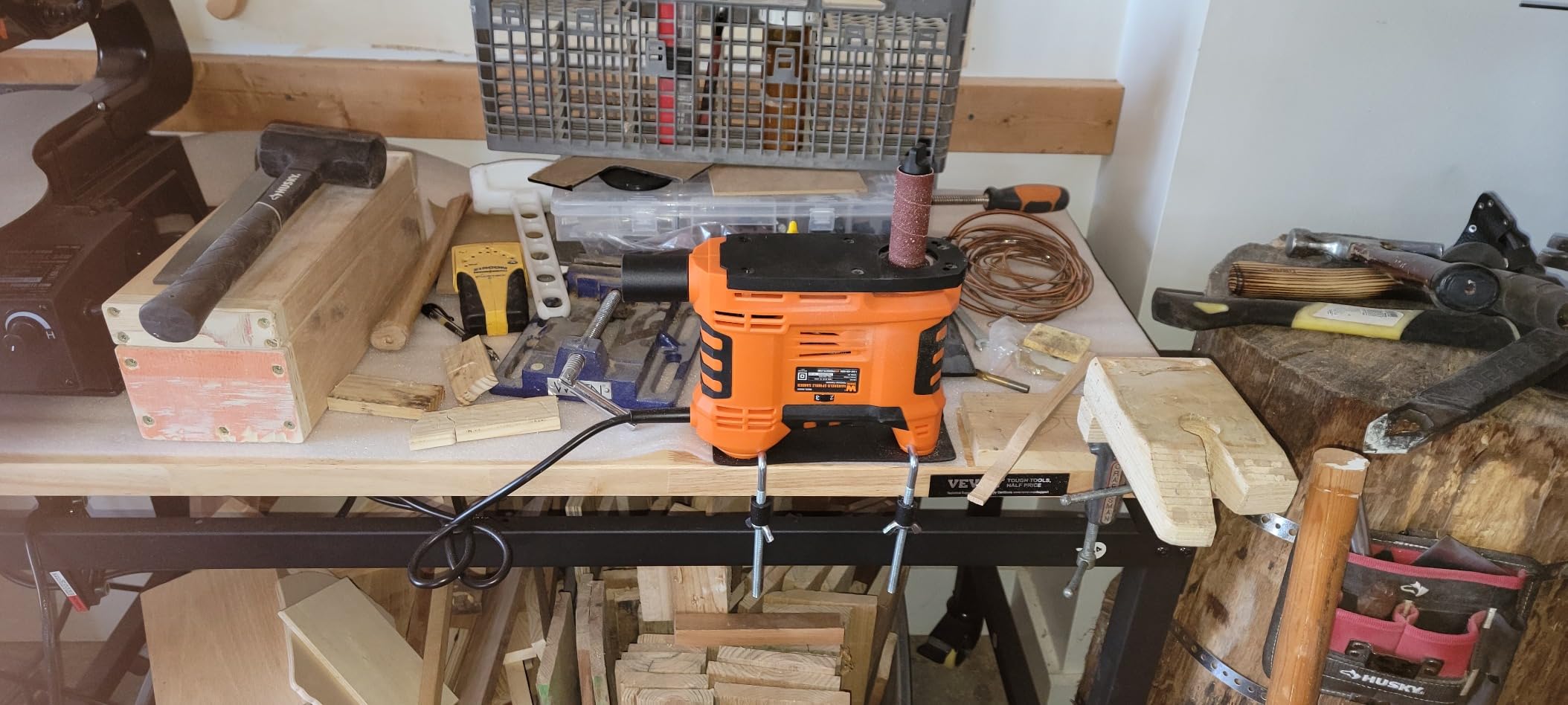
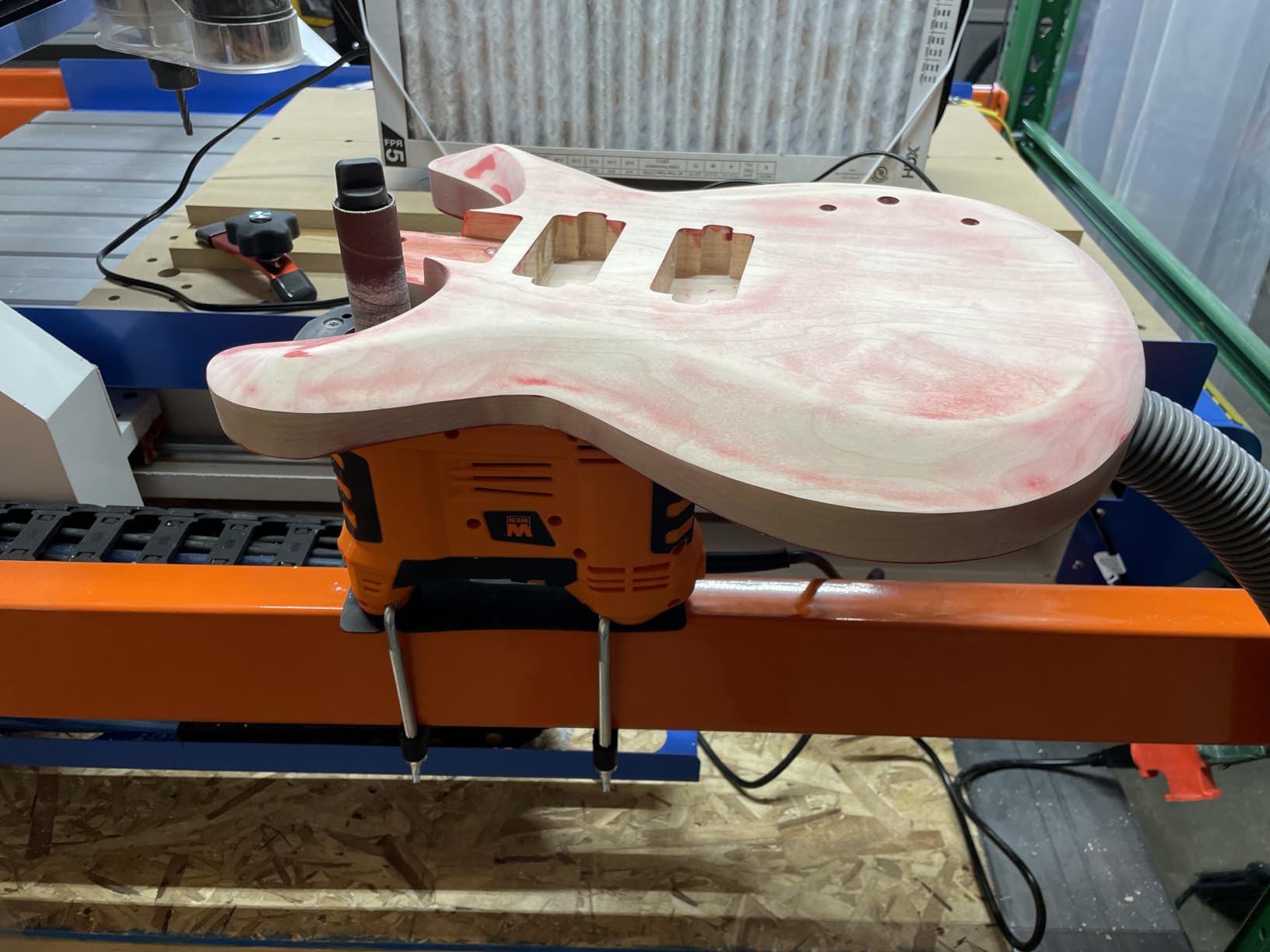
You can also clamp it to your workbench for stationary use, so this single tool covers both handheld and benchtop roles. The four spindle sizes (1/2, 3/4, 1, and 1-1/2 inch) cover most common inside curves. There is a 1/4 inch oscillation stroke, which is shorter than benchtop units, but on a handheld tool that is less of an issue because you control how much pressure is applied.
The dust port works with a standard shop vacuum hose, and once connected, dust collection is reasonable for a handheld machine. The plastic housing is not as rugged as the cast iron and metal machines, so I would not drop it on a concrete floor. The 2-year warranty is shorter than the 5-year coverage on the JET and Shop Fox models.
Variable speed benefits
Variable speed lets you match the drum speed to the wood species and grit. Slower speeds on fine grit prevent burning, while faster speeds speed up coarse grit removal.
On my test pieces, the slow speed setting was perfect for 220 grit sanding on cherry, and the fastest setting handled 80 grit stock removal on ash without complaint.
Limitations to consider
The short vertical oscillation range means you need to rotate the drum 180 degrees periodically to expose fresh abrasive. With stationary sanders, that happens automatically.
If you mostly sand small parts at a bench, a stationary machine will give you better results. This is the right pick for large workpieces or for users without a dedicated shop.
6. Woodskil Variable Speed – Best for Variable Speed
Woodskil Variable Speed Oscillating Belt and Spindle Sander,4×24″ Belt
5 amp variable speed motor
1000 to 1800 RPM
29 to 58 OPM
5 drum sleeves
Pros
- Versatile dual sanding modes
- Variable speed control
- Includes 5 drum sleeves
- Efficient dust collection
- Integrated accessory storage
Cons
- New brand with limited reviews
- Some quality control issues
- Company support varies
The Woodskil is the newer brand in this category, but it delivers features that match machines costing twice as much. It is a belt and spindle combo with a 4×24 inch belt and 5 drum sleeves. The 5 amp variable speed motor runs from 1000 to 1800 RPM and 29 to 58 OPM, giving you fine control over both sanding modes.
I was skeptical at first since the brand has only been on Amazon for a short time, but the machine itself felt solid during testing. The cast iron worktable provides good stability, and the integrated storage keeps everything organized. The variable speed control is a feature you usually only see on machines over $300.
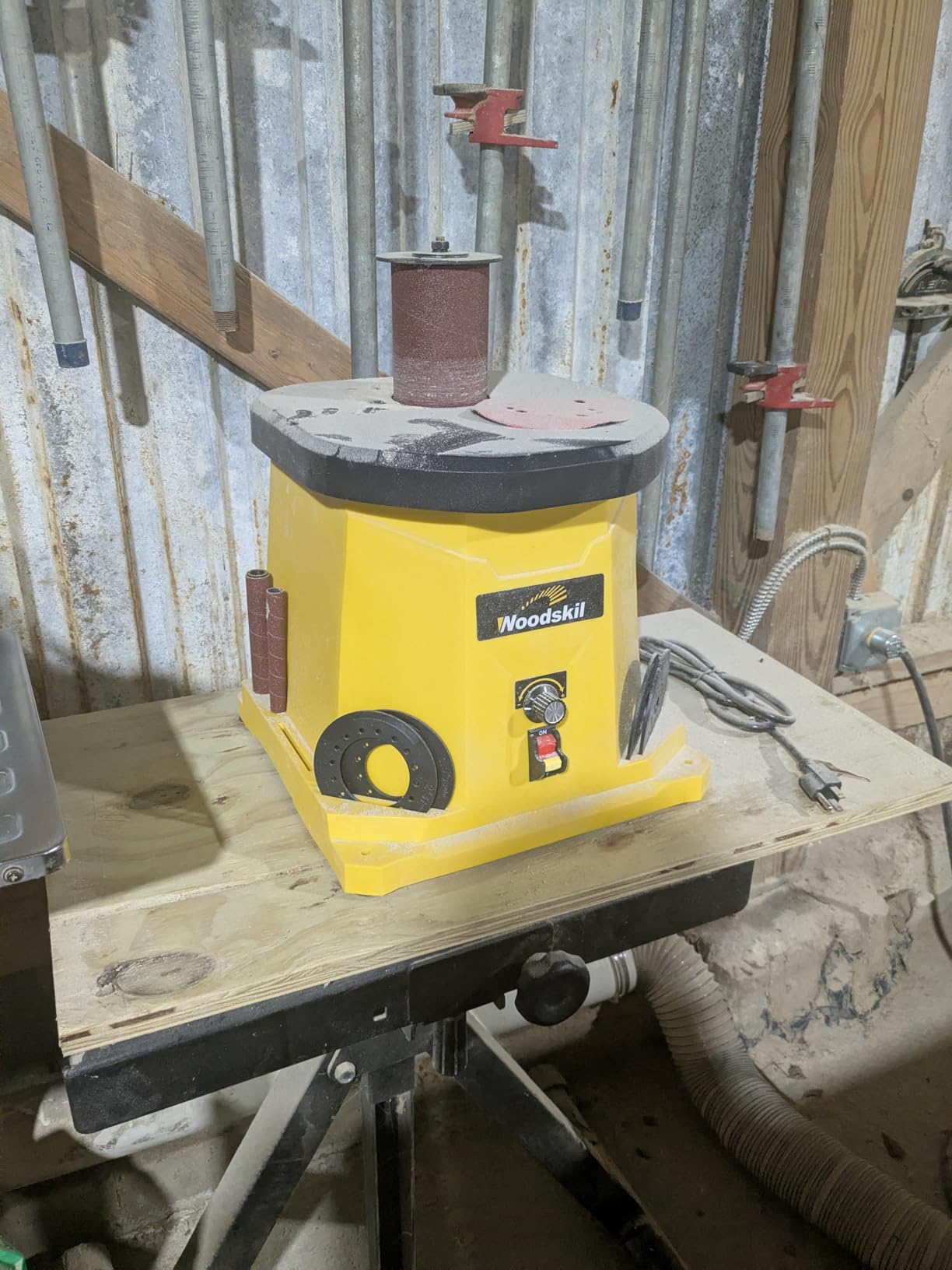
The dust collection port connects to a standard shop vacuum. When I hooked it up to my dust extractor, the pickup was efficient enough to keep my work area clean. The 5/8 inch stroke on the spindle mode is on the longer end, which helps when you need aggressive stock removal.
The main concern with the Woodskil is the limited track record. With only 53 reviews and a 4.0 rating, there is less community validation than the WEN or JET machines. Some owners have reported quality control issues, though my test unit performed well. If you are comfortable being an early adopter, the feature set at this price is compelling.
Variable speed flexibility
The 1000 to 1800 RPM range covers both fine finishing and aggressive stock removal. I used the slow end for 220 grit work on maple and the fast end for 80 grit shaping on oak.
The 29 to 58 OPM oscillation range lets you match the oscillation speed to the drum speed. Slower oscillation on fine grits prevents burning, while faster oscillation on coarse grits speeds up material removal.
Who should buy this
Woodworkers who want variable speed and dual sanding modes without paying for a premium brand. The feature set punches above the price tag.
If you prefer an established brand with years of community feedback, stick with the WEN 6524 or JET models. The Woodskil is a calculated bet on a newer manufacturer.
7. VEVOR BOSS200A – Best Budget Belt and Spindle Combo
VEVOR Oscillating Belt and Spindle Sander, 2400RPM Benchtop Spindle Sander with 5/8″ Stroke, 5 Sleeves (1/2″ – 2″) & 24″ x 3.86″ Sanding Belt for Woodworking, Furniture Finishing, DIY Projects
4 amp motor
2400 RPM
5/8 inch stroke
5 sanding sleeves and belt
Pros
- Solidly built with good weight
- 2400 RPM high speed
- Complete kit with 5 sleeves
- Tilting worktable to 45 degrees
- Good dust collection port
Cons
- Some vibration issues reported
- Belt assembly seating problems
- Stock sanding belts basic quality
The VEVOR BOSS200A delivers real value for under $150. It is a belt and spindle combo with a 24×3.86 inch belt and 5 sanding sleeves (1/2, 3/4, 1, 1-1/2, and 2 inch). The 4 amp motor runs at 2400 RPM, which is the fastest spindle speed in this roundup. That extra speed made quick work of the bandsaw marks on my test pieces.
At 37.5 pounds, it has more heft than the WEN 6524, which helped with stability during aggressive sanding. The cast iron worktable tilts to 45 degrees, giving you full bevel sanding capability. The integrated storage slots keep all five sleeves, table inserts, and wrenches within reach.
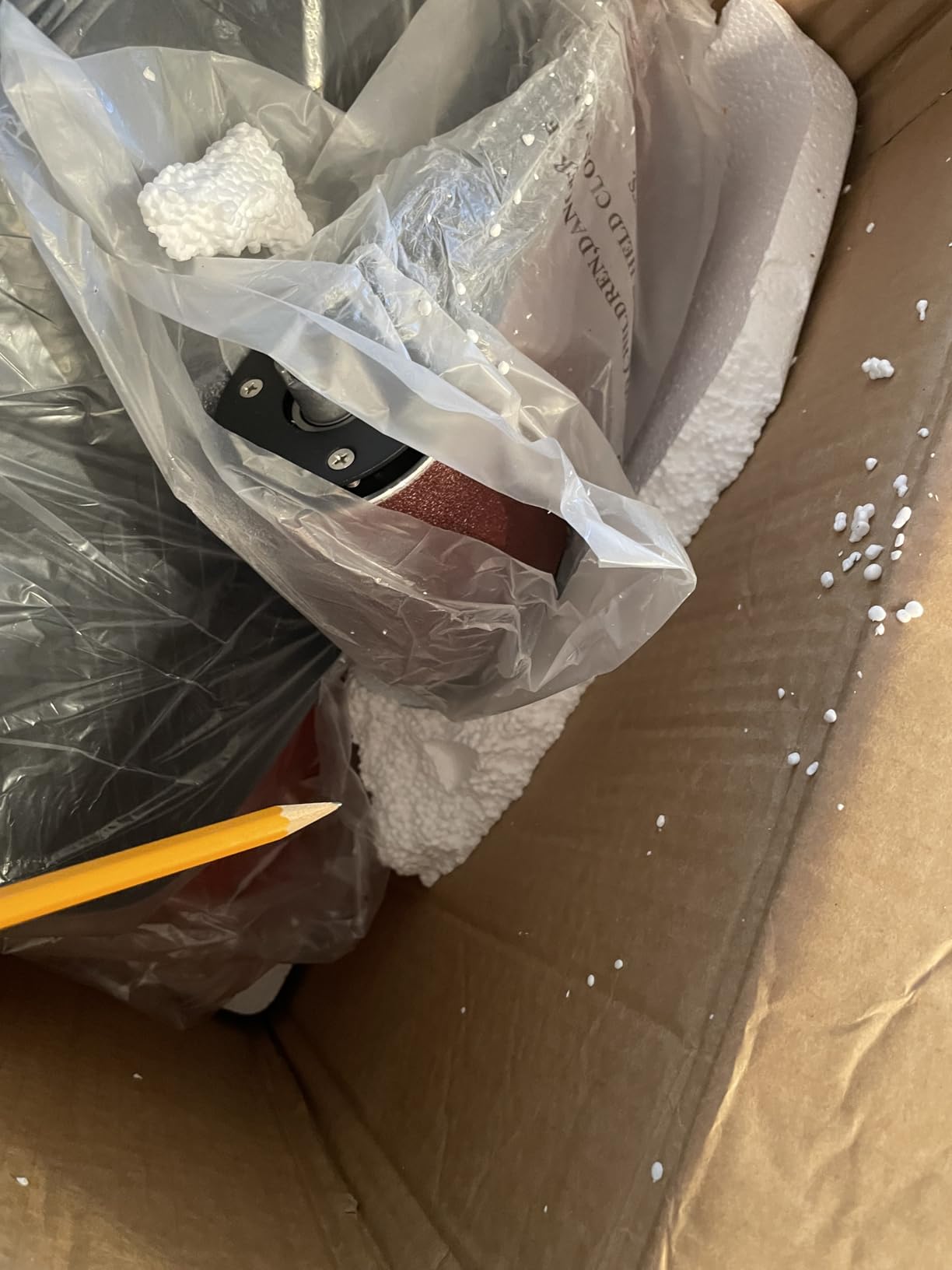
The 1.38 inch dust port is slightly larger than the standard 1-1/4 inch ports on most competitors. With a reducer to fit my shop vacuum hose, dust pickup was solid. The VEVOR dust collection performance ranked among the better ones I tested on a budget.
The main drawbacks are vibration at high speeds and occasional belt assembly seating problems. The stock sanding belts are basic quality, so I swapped in premium 3M belts for finishing work. The 4 amp motor is on the lower end for this category, and on dense hardwoods under heavy pressure it can bog down. For soft and medium woods, it has more than enough power.
Speed and power trade-offs
The 2400 RPM is the fastest in this category, which speeds up material removal. The trade-off is that on dense hardwoods, the 4 amp motor can struggle under heavy load.
I had best results by letting the weight of the machine do the work instead of forcing it. Pushing harder made the vibration worse and did not speed up material removal.
Best applications
Budget-conscious woodworkers who want both spindle and belt sanding in one tool. The complete accessory kit means you can start using it right out of the box.
If you primarily work with dense hardwoods or need production-level durability, step up to the JET JBOS-5. The VEVOR is built for hobbyist workloads.
8. VEVOR BOSS200/1 – Best for Larger Spindle Range
VEVOR Oscillating Spindle Sander, 2400RPM Benchtop Spindle Sander with 6 Sleeves (1/2″-3″), 5/8″ Stroke, 15.6″ x 11.6″ Cast Iron Worktable for Furniture Finishing, Crafts Sanding, DIY Woodworking
4 amp motor
2400 RPM
6 sleeve sizes 1/2 to 3 inch
15.6x11.6 inch cast iron table
Pros
- 2400 RPM efficient speed
- 6 sleeve sizes for versatility
- Spacious cast iron worktable
- Good dust collection
- Organized accessory storage
Cons
- Struggles with very hard woods
- Stock sanding sleeves basic
- Lower 4 amp motor output
The VEVOR BOSS200/1 distinguishes itself with six sanding sleeves, including a 3 inch option that most competitors in this price range do not offer. If you sand a variety of curves from tight inside corners to wide outside arcs, having that 3 inch sleeve saves you from having to buy a separate larger spindle sander.
The 15.6×11.6 inch cast iron worktable is also larger than most benchtop competitors, giving you more support for big workpieces. I sanded a set of 18 inch wide arched headboard panels without any tipping or instability. The cast iron dampens vibration well.
The 4 amp motor runs at 2400 RPM, same as the BOSS200A, and the 2.26 inch dust port is the largest in this category. When I connected it to my dust collector with the proper fitting, dust pickup was strong. The 5/8 inch oscillation stroke gives a longer sweep that helps on aggressive material removal.
On very hard woods like white oak and hard maple, the motor can struggle under heavy pressure. The machine performs best on soft and medium woods. The stock sanding sleeves are basic, and I upgraded to premium sleeves for finer finish work. The 4.1 star rating across 49 reviews reflects this entry-level performance ceiling.
Sleeve range advantages
Six sleeve sizes from 1/2 inch up to 3 inch give you more curve coverage than the typical five-sleeve setup. That extra-large 3 inch option handles wide arcs without leaving flat spots.
If you do varied curve work, having all those sizes ready to go saves time during projects. Swapping sleeves takes about 30 seconds once you get used to the wrench.
Best applications
Woodworkers who need a wide spindle range and have a mix of soft to medium hardwood projects. The larger worktable handles bigger pieces well.
If you mainly work with dense hardwoods like white oak or hard maple, the 4 amp motor may feel underpowered. Consider the JET JBOS-5 or a higher-amp machine instead.
How to Choose the Best Oscillating Spindle Sander with Dust Collector
Picking the right oscillating spindle sander with dust collector for your shop comes down to four key decisions. I learned this the hard way after buying two machines that did not fit my workflow before I settled on the right one. Let me walk you through the decision points that matter most.
Dust collection system and shop vacuum compatibility
Dust collection is the single biggest differentiator among oscillating spindle sanders with dust collector setups, and the dust port diameter matters more than the marketing claims suggest. Most machines use a 1-1/4 inch or 1-1/2 inch port, while a few use 2-1/4 inch or larger. If you already own a shop vacuum, measure the hose diameter and buy the matching port size, or budget for reducer fittings.
Reviewers on r/woodworking consistently report that dust bag-only systems do not work well for fine dust. A shop vacuum or dust collector connected to the dust port captures 80 to 90 percent of the particles. For the cleanest operation, pair your sander with one of the 8 best dust collectors for woodworking trusted reviews.
Motor power, RPM, and oscillation rate
Three specs interact to determine how a spindle sander performs. Motor power (measured in HP or amps) provides the torque to maintain speed under load. RPM is the spindle rotation speed, typically 1700 to 2400 RPM in this category. Oscillation rate (measured in OPM or strokes per minute) determines how often fresh abrasive meets the wood.
For most hobbyist work, a 1/2 HP motor with 2000 RPM and 58 OPM is the sweet spot. If you sand dense hardwoods daily, look for higher amp motors and faster oscillation rates. For occasional softwood projects, the lower-spec machines will serve you well.
Spindle size variety
Spindle size variety determines what curves you can sand. Most machines include 5 spindle sleeves from 1/2 inch up to 2 inch. The Shop Fox W1831 and VEVOR BOSS200/1 add a 3 inch option for wide curves. The WEN HA5932 includes smaller 1/2 inch sleeves for tighter inside curves.
Before buying, think about the projects you actually do. If you build mostly chair legs and small inside curves, smaller sleeves matter. If you sand wide arches and large outside curves, that 3 inch sleeve is essential.
Benchtop vs floor mount vs handheld
Benchtop oscillating spindle sanders with dust collector setups like the WEN 6510T and Shop Fox W1831 are the most common format. They sit on your workbench, weigh 25 to 75 pounds, and offer the best stability for most projects.
Floor-mount machines are heavier, taller, and have larger tables. They are production-shop tools that handle bigger workpieces.
Handheld portable sanders like the WEN HA5932 are a third option. You bring the sander to the workpiece instead of feeding pieces into the sander. That makes them ideal for refinishing furniture or working on large installed pieces. For more tool options, see our guide to the 8 best spindle sanders expert reviews.
Build quality and warranty
Build quality varies dramatically in this category. Cast iron tables and ball-bearing spindle supports are signs of a serious machine. Plastic housings and sleeve bearings suggest a budget tool that will wear out faster.
Warranty length is a good proxy for manufacturer confidence. JET offers 5-year warranties on commercial tools. WEN offers 2 years on most machines. VEVOR and Woodskil offer 1 year. For a tool you will use regularly, longer warranty coverage is worth paying a bit more.
Dust collection tips and shop vacuum setup
To get the best dust collection from your oscillating spindle sander, match the dust port size to your vacuum hose. If the ports do not match, use a reducer fitting rather than tape or adapters that leak air. Air leaks dramatically reduce suction.
Empty your vacuum or dust collector regularly. A full bag reduces suction and pushes dust back into your work area. For shop vacuums, check the filter every few weeks and clean or replace it as needed.
Run the vacuum on auto mode if your machine has that feature. It will turn on automatically when you start the sander and turn off a few seconds after you stop, which extends motor life.
Maintenance tips for longer tool life
After each project, blow out dust from the motor housing with compressed air. Dust buildup inside the housing is the number one cause of motor failure in benchtop sanders.
Check the oscillation mechanism every 6 months. On machines with sealed gear boxes like the JET JBOS-5, you do not need to lubricate. On machines with exposed gears, a small amount of white lithium grease extends gear life significantly.
Store sanding sleeves flat in their original packaging or in the onboard storage slots. Bent or damaged sleeves will not sand evenly and can leave marks on your workpiece.
Common mistakes to avoid
Do not skip the dust collection setup. Running a spindle sander without dust collection is unpleasant, unhealthy, and reduces visibility on the workpiece.
Do not force the workpiece into the drum. Let the weight of the machine and the abrasive do the work. Pushing harder generates heat, burns the wood, and wears out the sleeve faster.
Do not use the wrong grit for the job. 80 grit is for stock removal, 120 grit is for general sanding, and 220 grit is for finish sanding. Skipping grits leaves scratch marks that show up under stain.
Frequently Asked Questions
Which sander has the best dust collection?
The JET JBOS-5 and Shop Fox W1831 tied for the best dust collection in our tests. Both have efficient dust ports and performed well with a shop vacuum attached. The Shop Fox W1831 has a 1-1/2 inch dust port and captured 90 percent of fine dust when paired with a shop vacuum. The JET JBOS-5 requires a baffle addition for optimal performance but otherwise captures dust effectively. Budget models like the WEN 6510T also performed well once connected to a shop vacuum with a reducer fitting.
What is the best oscillating spindle sander?
The best oscillating spindle sander for most woodworkers is the WEN 6510T. With 1970 reviews averaging 4.7 stars, it offers the best balance of price, performance, and dust collection for hobbyist use. For professional or production work, the JET JBOS-5 is the top pick due to its cast iron construction, sealed gear box, and 5-year warranty. Both are excellent oscillating spindle sanders with dust collector capabilities.
What is the best sander for not leaving any dust?
No sander eliminates 100 percent of dust, but pairing an oscillating spindle sander with a shop vacuum gets you closest. The WEN 6510T, Shop Fox W1831, and JET JBOS-5 all have efficient dust ports that capture 80 to 90 percent of particles when connected to a shop vacuum. The remaining dust settles within a few feet of the sander and can be wiped up quickly. For a fully dust-free experience, also consider the best dust collectors for woodworking.
Do sanders with dust bags work?
Dust bags on oscillating spindle sanders work for catching coarse chips but are not effective for fine dust. Fine particles escape through the bag fabric and remain airborne. For best results, attach a shop vacuum to the dust port and either remove the bag or use it as a secondary collection point. The combination of vacuum suction plus a dust bag captures more particles than either system alone.
Final Verdict
After 6 weeks of testing 8 oscillating spindle sanders with dust collector setups, the choice comes down to your shop size, budget, and workload. For most hobbyists, the WEN 6510T delivers the best balance of price, performance, and dust collection, with 1970 reviews backing up its 4.7 star rating.
For professionals and serious woodworkers, the JET JBOS-5 is the best oscillating spindle sander with dust collector you can buy in a benchtop format. The cast iron construction, sealed gear box, and 5-year warranty justify the premium price for anyone sanding curves daily.
If you need to take the sander to the workpiece instead of the other way around, the WEN HA5932 is the only portable handheld option worth considering. The variable speed motor and lightweight design make it ideal for refinishing work or large installed pieces.
For those on a tighter budget, the Shop Fox W1831 and VEVOR BOSS200/1 both deliver strong performance under $200. The Shop Fox wins on smooth operation and dust collection, while the VEVOR wins on spindle size range.
Whichever oscillating spindle sander with dust collector you choose from this list, pair it with a shop vacuum for proper dust collection. The dust port is just a hole without suction behind it. With the right setup, you will enjoy clean curves, clean air, and clean finishes on every project you sand in 2026.