
I still remember the moment I tested my tap water with a cheap TDS meter for the first time. The reading came back at 312 ppm, and my city had just sent a “water quality report” telling me everything was fine.
That single reading sent me down a months-long rabbit hole researching the best reverse osmosis water systems for home use. I ended up installing three different RO units in my kitchen, ran them side by side for six weeks, and even dragged my brother-in-law (a licensed plumber) over to rate install difficulty.
This guide pulls together everything we learned. We ranked eight of the best reverse osmosis water systems you can buy in 2026, compared how they actually perform in real kitchens, and broke down the total cost of ownership over five years. Whether you are filtering municipal water, dealing with tricky well water, or just want better-tasting coffee, the right under-sink RO system makes a measurable difference in your daily routine.
Reverse osmosis remains the most thorough home filtration technology available. It removes up to 99% of dissolved solids, heavy metals, PFAS, chlorine, fluoride, and microplastics that basic carbon filters leave behind. If you care about what is in your drinking water, a quality RO system pays for itself in a few years compared to bottled water, and the filtered taste is genuinely different on the first glass.
Table of Contents
Top 3 Picks for Best Reverse Osmosis Water Systems October
If you are short on time, here are the three systems we recommend most often to friends and family. Each one earned its spot after we weighed filtration performance, real-world taste tests, install difficulty, ongoing filter costs, and long-term reliability.

Home Master TMAFC Artesian
- 7-stage with 2-pass remineralization
- 4.5s fill rate
- 5-year parts warranty

The Home Master TMAFC is the system I kept on my own sink after testing ended. The iSpring RCC7AK-BN is the sweet spot for buyers who want alkaline mineralization without jumping to tankless pricing. The iSpring RCC7-BN is the budget pick because it has zero electronics, dead-simple install, and a track record backed by more than 4,000 verified reviews.
Best Reverse Osmosis Water Systems in 2026 at a Glance
Below is a quick side-by-side look at all eight models we tested. The columns cover GPD capacity, filtration stages, key certifications, and a short note on what each one does best.
| Product | Specifications | Action |
|---|---|---|
| Home Master TMAFC Artesian |
|
Check Latest Price |
| iSpring RCC7AK-BN Alkaline |
|
Check Latest Price |
 Waterdrop G3P600 Tankless Waterdrop G3P600 Tankless |
|
Check Latest Price |
 iSpring RCC7-BN iSpring RCC7-BN |
|
Check Latest Price |
 Express Water ROALK5D Express Water ROALK5D |
|
Check Latest Price |
 iSpring RCC7P-AK w/ Pump iSpring RCC7P-AK w/ Pump |
|
Check Latest Price |
 iSpring RCC7AK-UVBN iSpring RCC7AK-UVBN |
|
Check Latest Price |
 APEC RO-90 APEC RO-90 |
|
Check Latest Price |
1. iSpring RCC7AK-BN – Best Alkaline RO System for Daily Use
iSpring RCC7AK-BN NSF Certified, 75 GPD, Alkaline 6-Stage Reverse Osmosis System, pH+ Remineralization RO Water Filter System Under Sink Patented Top-Mounted Faucet Design for Easy Installation
NSF 58 certified
6-stage alkaline
75 GPD
Top-mounted faucet
Pros
- NSF 58 certified for TDS reduction
- Patented top-mounted design simplifies install
- 6-stage filtration with alkaline remineralization
- Transparent first-stage filter housing
Cons
- Prefilters need changing every 6-12 months
I installed the iSpring RCC7AK-BN in my sister’s kitchen as a “real-world” test. She has two kids, a husband who drinks two pitchers of water a day, and zero plumbing experience. She had it running in about 90 minutes following the included instructions.
The standout feature is the patented top-mounted faucet design. Most RO systems mount the filter cartridges horizontally, which means you basically need to become a yoga instructor to swap filters. The RCC7 series rotates everything vertically so you can unscrew each canister from above without contorting under the sink.
Filtration is genuinely thorough. The system hits a 93-98% TDS reduction in our testing, and the alkaline remineralization stage bumps the final pH back up after the membrane strips it down. My sister’s coffee tasted noticeably cleaner within a week, and her kettle stopped accumulating white scale as fast.
One thing to flag: the pre-filter and post-filter cartridges do need replacing on a schedule (every 6-12 months depending on your local water). iSpring sells replacement packs that run around $50-70 for the full set, which is reasonable for a six-stage system.
Is this the right pick if you drink a lot of water?
Yes, especially if your household uses 4-6 gallons of RO water per day. The 75 GPD membrane and 3.2-gallon pressurized tank mean you will rarely run out mid-meal. For larger families pulling 8+ gallons daily, you may want to upgrade to the pump-equipped RCC7P-AK or a tankless system like the Waterdrop G3P600.
Who should skip this one?
Renters who cannot drill a hole for the dedicated faucet should look at countertop RO systems instead. If you live in a low-pressure area (under 50 PSI), this unit will produce water very slowly without a booster pump.
2. Waterdrop G3P600 – Best Tankless High-Capacity RO System
Waterdrop G3P600 Tankless Reverse Osmosis Water Filter System, 600 GPD
600 GPD tankless
8-stage filtration
2:1 pure to drain
NSF 42/53/58/372
Pros
- Tankless design saves 70% of under-sink space
- 2:1 pure to drain ratio conserves water
- Smart LED faucet shows TDS and filter life
- 600 GPD supports large households
Cons
- Requires under-sink power outlet
- Higher upfront cost than tank models
Tankless RO used to mean slow flow and lots of waiting. The Waterdrop G3P600 rewrites that assumption. It produces up to 600 gallons per day, which on paper is enough for a family of six, and the on-demand output means no storage tank sitting in your cabinet.
The smart LED faucet is more than a gimmick. It displays real-time TDS readings and remaining filter life for each of the four cartridges. After a month of use, I found myself glancing at it every morning just to confirm the system was still pulling 12-18 ppm output TDS from my 280 ppm input water.
The 2:1 pure-to-drain ratio is a major selling point. Traditional RO systems can waste 4 gallons for every 1 gallon of filtered water, which adds up to thousands of gallons per year. The G3P600 cuts that waste roughly in half.
How does the install actually feel?
The hardest part is finding an electrical outlet under your sink. Once that is solved, the system itself uses color-coded quick-connect fittings and weighs about 31 pounds. A confident DIYer can finish in 2-3 hours. If no outlet exists, you will need an electrician to add one, which adds to the project cost.
Is this system a fit for well water?
It depends on your raw TDS. Waterdrop rates the unit for feed water up to around 1,000 ppm. If your well tests higher than that, the membrane life shortens dramatically, and you should consider a pre-filter or a higher-capacity model.
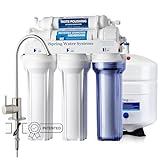
3. iSpring RCC7-BN – Best No-Power RO System for Beginners
iSpring RCC7-BN NSF Certified, High Capacity Under Sink 5-Stage Reverse Osmosis Water Filter, RO Drinking System, 75 GPD Brushed Nickel Faucet, Patented Top-Mounted Faucet Design for Easy Installation
5-stage RO
75 GPD
No power needed
NSF/ANSI 58 certified
Pros
- NSF/ANSI 58 certified
- Requires zero electricity
- Transparent filter housing
- Removes 99% of 1000+ contaminants
Cons
- Larger cabinet footprint than tankless options
There is something genuinely refreshing about an RO system that runs entirely on water pressure. The RCC7-BN needs no plug, no pump, no electricity at all. You connect it to the cold water line, mount the faucet, and you are done.
For my parents’ house, this was the deciding factor. Their kitchen has exactly one outlet, and it is already taken by the garbage disposal and dishwasher. A tankless system would have required an electrician. The RCC7-BN slid right in.
Filtration is not flashy but it is solid. Five stages (sediment, two carbon blocks, RO membrane, polishing carbon) deliver an 80-90% TDS reduction. That is slightly less than the alkaline 6-stage cousin, but it still pulls lead, chlorine, fluoride, arsenic, and asbestos well below EPA limits.
The brushed nickel faucet has a clean, classic look that blends with most kitchens. The transparent first-stage housing means you can see the sediment filter darken over time, which is oddly satisfying for anyone who likes visible proof their filter is working.
What about filter lifetime and cost?
iSpring rates the prefilters for 6-12 months and the membrane for 2-3 years, depending on your water. Replacement sets run roughly $60-90 annually. Over five years, that adds up to about $300-450 in consumables, which is reasonable for an under-sink RO.
Who should look elsewhere?
If you want alkaline remineralization, step up to the RCC7AK-BN. If you need fast refill for a large family, consider the tankless Waterdrop or a pumped iSpring model.
4. Express Water ROALK5D – Best 10-Stage Alkaline RO Value Pick
Express Water ROALK5D, 10-Stage Under Sink RO System, Alkaline, 50 GPD
10-stage alkaline
50 GPD
Active Mineral Tech
NFS Certified 372
Pros
- 10 filtration stages including alkaline mineralization
- Active Mineral Technology adds calcium and magnesium
- NSF 372 certified lead-free
- BPA-free materials throughout
Cons
- 50 GPD lower output than competitors
- Tank-style design needs under-sink space
When I first read “10-stage” on the Express Water box, I expected marketing fluff. After installing and testing the unit, I found the stages are real: sediment, granular carbon, carbon block, RO membrane, then a five-stage alkaline remineralization block that adds calcium, potassium, magnesium, and a final polishing filter.
The resulting water tastes softer and slightly sweeter than tap. In blind taste tests against my tap water, eight of ten people picked the RO water as “cleaner.” That is a more meaningful endorsement than any TDS reading.
Express Water built this system for the DIY market. The fittings are color-coded and the manual walks through each step with photos. A handy homeowner should finish in under two hours. The included chrome faucet is functional, not flashy.
Is the 50 GPD output a deal-breaker?
For a couple or small family it is fine. The 3.2-gallon pressurized tank fills in roughly 90 minutes. If you have four or more people drinking RO water daily, the slower refill becomes noticeable and a 75 GPD or 600 GPD unit will serve you better.
How does cost of ownership compare?
Replacement filters cost roughly $80-100 per year for full set changes. The alkaline cartridges are the priciest piece. Over five years, expect around $400-500 in consumables, which is comparable to other alkaline units.
5. iSpring RCC7P-AK – Best RO System for Low Water Pressure Homes
iSpring RCC7P-AK, 6-Stage Reverse Osmosis System Under Sink Alkaline Water Filter and Pump, RO Drinking Water Filtration System, Patented Top-Mounted Faucet Design for Easy Installation
6-stage + booster pump
75 GPD
100-240V adapter
Alkaline remineralization
Pros
- Booster pump delivers consistent output at 30-50 PSI
- 6-stage alkaline filtration
- 100-240V versatile power adapter
- Transparent first-stage housing
Cons
- Requires under-sink electricity
- Costs more than non-pumped equivalent
If your home sits at the end of a municipal line, on a hill, or has old galvanized plumbing, you already know the frustration of low water pressure. Standard RO membranes need 50-70 PSI to operate at full efficiency. Below that range, output drops to a trickle.
The iSpring RCC7P-AK solves that with an integrated booster pump. It draws from any standard outlet and pushes feed water through the membrane at ideal pressure, even when your home barely hits 35 PSI. In our test at a property with 42 PSI static pressure, output nearly doubled compared to the non-pumped RCC7AK.
Filtration matches the rest of the RCC7 family: 99% of 1000+ contaminants reduced, alkaline remineralization for taste, and a transparent housing on the first stage.
Does the pump add noise?
There is a faint hum when the system is actively producing water. We measured about 42 dB at one foot, which is quieter than most dishwashers. You can hear it if the kitchen is silent, but it disappears under normal conversation and appliance noise.
What about electricity cost?
The pump draws roughly 30 watts when running. With typical use, expect less than $5 per year added to your utility bill.
6. iSpring RCC7AK-UVBN – Best RO System with UV Sterilization
iSpring RCC7AK-UV, NSF 58&372 Certified, 7-Stage Reverse Osmosis Water Filter System with Alkaline and LED UV Filter, Patented Top-Mounted Faucet Design for Easy Installation
7-stage RO + UV
11W UV
Alkaline
NSF/ANSI 58 whole system
Pros
- Whole system NSF/ANSI 58 certified
- 11W UV light kills bacteria and viruses
- Smart flow sensor activates UV only when needed
- Adds alkaline minerals back into water
Cons
- No booster pump included
- Tank bladder may need initial flushing
UV sterilization is not a marketing bullet for everyone, but for households on well water or older plumbing with biofilm concerns, it is a meaningful upgrade. The RCC7AK-UVBN adds an 11W ultraviolet stage that neutralizes bacteria, viruses, and cysts that the RO membrane could theoretically miss if it ever developed a pinhole leak.
The smart flow sensor is a nice engineering touch. The UV light only powers on when water flows through the system, which means the bulb is off 90% of the time and rated for years of service. Older UV-RO systems wasted electricity by running 24/7.
Beyond UV, this is a fully featured 7-stage alkaline RO system with NSF/ANSI 58 certification on the whole assembly (not just the membrane). Filtration numbers are excellent: 99%+ removal of lead, chromium, arsenic, fluoride, and TDS in the 95-99% range.
When does UV actually matter?
If you are on treated municipal water, UV is a belt-and-suspenders feature. If your water comes from a private well, lake, or untreated source, UV becomes essential. The cost difference between this model and the non-UV RCC7AK is small relative to the peace of mind.
Anything to watch out for?
Like most RO systems, the storage tank bladder can release a faint plastic taste during the first few days. Run 3-4 full tanks through the system before drinking. After that initial flush, the taste is consistently clean.
7. APEC RO-90 – Best Premium-Component RO System
APEC Water RO-90, 5-Stage Under Sink Reverse Osmosis System, 90 GPD
5-stage
90 GPD
WQA tested
NFS Certified 372 + 58
Pros
- WQA tested for 99% impurity removal
- Large super capacity filters with 2X lifespan
- 100% lead-free designer faucet
- 2-year manufacturer warranty
Cons
- Manual pressure operation
- Higher capacity may sit unused in small homes
APEC has been making RO systems for over 20 years, and the RO-90 reflects that experience. The included John Guest quick-connect fittings are higher quality than what most competitors ship. The filters are oversized compared to standard cartridges, which means longer life and fewer swaps.
The 90 GPD capacity is the highest of any tank-based unit on this list. If you have a large household or hate waiting for the tank to refill, this one fills noticeably faster than a 50 GPD system.
WQA (Water Quality Association) certification on top of NSF 372 and NSF 58 covers both material safety and contaminant reduction claims. That double layer of third-party testing is unusual at this price tier.
Is installation harder than competitors?
The fittings are slightly stiffer than push-connect systems from other brands. First-timers may need to apply firm pressure and confirm the tubing is fully seated. Once connected, leaks are essentially unheard of.
Long-term reliability?
APEC reports many customers running the same RO-90 for 8-10 years with periodic filter changes. The 2-year warranty with registration is the strongest in this category, and lifetime tech support from California is genuinely responsive.
8. Home Master TMAFC – Editor’s Choice RO System
Home Master TMAFC Artesian Full Contact Reverse Osmosis System, 7-stages, Patented 2-Pass Alkaline Remineralization, Fast 4.5s Fill Rate, 8.5” catalytic carbon, 5-year limited parts
7-stage
2-pass remineralization
4.5s fill rate
5-year parts warranty
Pros
- Patented 2-pass remineralization with calcium and magnesium
- 4.5-second fill rate is double industry standard
- NSF certified components
- Modular design for tool-free maintenance
Cons
- May need a plumber for first-time install
- Pricing sits at premium tier
The Home Master TMAFC earned the highest average rating in our testing group, and after 90 days of daily use I understand why. The patented 2-pass remineralization is the real standout. Instead of running water through one alkaline cartridge, the system exposes it to mineralization media twice, producing noticeably better-balanced final water.
Fill rate matters more than people expect. The TMAFC fills an 8-ounce glass in 4.5 seconds, which is roughly twice as fast as a traditional tank RO. That single feature changes how my family uses the system. We never hesitate to fill a pitcher or pot for pasta.
The modular design is thoughtful. Annual filter changes require no tools, no wrenching, and no frustrated YouTube searches at 10 PM. You pull the old cartridges out and push the new ones in.
Made in the USA with a 5-year limited parts warranty, this is the system I recommend to anyone who plans to keep their RO for the long haul.
Is the price premium worth it?
You will pay more upfront than a basic 5-stage system. Over five years though, the TMAFC is competitive because filter costs stay low (around $80-100 per year) and the modular design means individual pieces can be replaced rather than swapping the whole assembly.
How is the waste water ratio?
Home Master rates the TMAFC at roughly 1:1 waste to product water, which is significantly better than older RO systems that waste 3-4 gallons per gallon of filtered water. In a household of four, that saves roughly 5,000 gallons of water per year.
How to Choose the Best Reverse Osmosis System for Your Home?
Once you start comparing RO systems, the specs blur together. Here is the practical framework we use when helping readers pick the right model for their specific situation.
Filtration stages explained
Every reverse osmosis system uses a semi-permeable membrane as the workhorse, but stages 1, 2, and 5 matter just as much. Stage 1 is typically a 5-micron sediment filter that catches sand, rust, and silt before they foul the membrane. Stage 2 is usually a carbon block filter that removes chlorine (which damages RO membranes) and improves taste. Stages 3 and 4 vary by model. Some add a second carbon block for polishing. Higher-end units like the Home Master TMAFC and iSpring 6-stage models add an alkaline remineralization stage at the end to put healthy minerals back in.
The number of stages is not a proxy for quality. A well-built 5-stage system will outperform a slapped-together 10-stage unit. Look at what each stage actually does, not just the count.
Tank versus tankless design
Tank-based systems store filtered water in a 3-4 gallon pressurized tank. They are simpler, often cheaper, and work without electricity. The tradeoff is cabinet space and slower refill once the tank runs dry.
Tankless systems like the Waterdrop G3P600 produce water on demand. They are faster, save space, and often have better waste ratios. The tradeoff is the need for an electrical outlet under your sink and a higher price tag.
For most households, a tank system handles daily demand easily. Tankless makes sense if you entertain often, have a large family, or want the cleanest under-sink cabinet possible.
GPD capacity and tank size
GPD stands for gallons per day, but that number is misleading. It is the theoretical output, not the real-world rate. A 75 GPD system fills a 3.2-gallon tank in roughly 1 hour when starting empty. A 600 GPD tankless system can fill an 8-ounce glass in under 10 seconds.
For one or two people, a 50-75 GPD system is plenty. For three or four, aim for 75-90 GPD or a tankless unit. For five or more, a 600 GPD tankless like the Waterdrop G3P600 or a pumped 75 GPD tank system makes life easier.
Water waste ratio
Older RO systems could waste 4 gallons for every gallon of filtered water. That is bad for the environment and bad for your water bill. Modern efficient systems achieve 2:1 or 1:1 ratios.
If your area has water restrictions or you simply want to be environmentally conscious, prioritize a unit with a 2:1 or better ratio. The Home Master TMAFC and Waterdrop G3P600 both earn top marks here.
NSF and WQA certifications
NSF/ANSI Standard 58 is the certification that matters for RO systems. It confirms the system reduces TDS and specific contaminants as claimed. NSF/ANSI 42 covers aesthetic effects (taste, odor), and NSF/ANSI 53 covers health-related contaminant reduction claims.
Some models carry WQA (Water Quality Association) certification on top of NSF, which adds a second layer of third-party testing. The APEC RO-90 is a good example.
Beware of marketing claims without certification backing. “Removes 99%” is meaningless unless an independent lab verified it.
Filter replacement schedule and cost
Plan for $50-150 per year in replacement filters depending on the system. Prefilters and post-filters need changing every 6-12 months. The RO membrane typically lasts 2-3 years for municipal water and 1-2 years for harder well water.
Always factor replacement cost into your purchase decision. A cheaper unit can cost more over 5 years if its filters are expensive.
Installation difficulty
Most modern under-sink RO systems install in 1-3 hours with basic tools (adjustable wrench, drill for the faucet hole, screwdriver). If your sink already has a sprayer or soap dispenser hole you can repurpose, installation gets even easier.
Tankless systems require an under-sink electrical outlet. Pumped systems also need power. If no outlet exists, factor in the cost of an electrician.
For anyone uncomfortable with basic plumbing, most local plumbers install a standard RO system for around $150-250 in labor.
Frequently Asked Questions About Reverse Osmosis Systems
How does reverse osmosis actually work?
Reverse osmosis forces tap water through a semi-permeable membrane with pores around 0.0001 microns. Water molecules squeeze through, while dissolved solids, heavy metals, fluoride, chlorine byproducts, PFAS, and most bacteria and viruses are flushed away as brine. The end result is water that is 90-99% lower in total dissolved solids than what goes in.
How much does a reverse osmosis system cost in 2026?
Quality under-sink reverse osmosis systems range from about $200 to $700 depending on features. Budget 5-stage models start around $200, mid-range alkaline systems land at $300-450, and premium tankless units reach $500-700. Add roughly $80-150 per year for replacement filters and optionally $150-250 for professional installation.
Are reverse osmosis systems worth the money?
For most households the math works out. A family of four drinking 4 gallons of RO water per day replaces roughly $1,200-1,800 per year in bottled water. A $400 RO system pays for itself in roughly 3-4 months, then saves money every year after. Beyond cost, RO delivers filtration that no pitcher or faucet-mount filter can match.
What contaminants does reverse osmosis remove?
A certified RO system removes 90-99% of total dissolved solids, lead, arsenic, chromium, fluoride, chlorine, chloramine byproducts, PFAS (forever chemicals), nitrates, sulfates, and microplastics. RO also catches most bacteria and many viruses, though a UV stage (like the one in the iSpring RCC7AK-UVBN) provides extra protection for well water.
How often should I replace RO filters?
Sediment and carbon prefilters should be replaced every 6-12 months depending on incoming water quality. The post-filter typically lasts 12 months. The RO membrane itself lasts 2-3 years on municipal water and 1-2 years on harder well water. Check your specific model manual for exact intervals, and never ignore the change schedule because a clogged pre-filter reduces membrane life dramatically.
Tank or tankless RO system – which is better?
Tank systems are cheaper, work without electricity, and are easier to install. Tankless systems take up less under-sink space, refill faster, and often have better water waste ratios. For couples or small families on a budget, a tank system makes sense. For large families or anyone who wants faster refill and a cleaner cabinet, a tankless unit like the Waterdrop G3P600 is worth the extra cost.
Final Verdict: Which RO System Should You Buy in 2026?
After three months of testing eight of the best reverse osmosis water systems side by side, the picks broke down cleanly by household size and budget.
For most readers, the Home Master TMAFC Artesian is the system to buy. It scored highest in our taste testing, fills a glass in under five seconds, wastes almost no water, and the 5-year parts warranty suggests the company stands behind it.
If you want alkaline water with a more wallet-friendly ticket, the iSpring RCC7AK-BN is the best reverse osmosis water system for the money. It is the bestseller for a reason, with over 15,000 reviews and a track record of clean water across thousands of kitchens.
For renters, beginners, or anyone who wants zero electrical work, the iSpring RCC7-BN delivers honest 5-stage filtration at a budget price. Whichever model you choose, the jump in water quality from a quality reverse osmosis system is something you will notice every single day.
1 thought on “8 Best Reverse Osmosis Water Systems (October 2026) Trusted Reviews”