
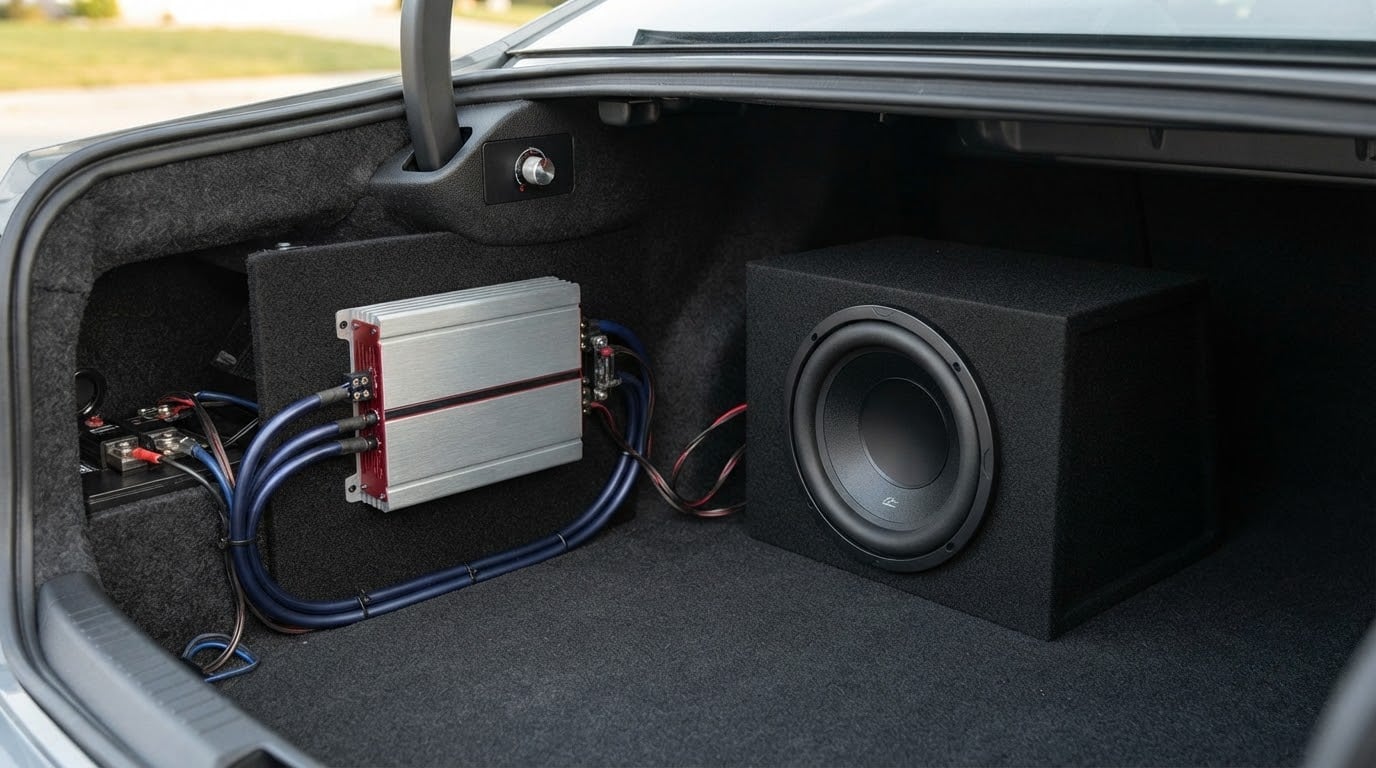
The best car amplifiers for subwoofers are Class D monoblocks that publish honest continuous RMS power at the ohm load you will actually run. After working through ten popular monoblocks and multi-channel amps, the BOSS Audio Systems R1100M stood out: 4.4 stars across more than 11k reviews, 2-ohm stable, and small enough to disappear under a seat. For buyers who want cleaner control and verified output, the Rockford Fosgate R2-500X1 rates 4.7, the highest average in this group.
Most people pick an amplifier by reading the largest number on the box. That number is a peak rating, and it is not what drives your cone. What matters is RMS power at your subwoofer’s final ohm load, whether the amp is stable at that load, and how the wiring is done. Get those right and a modest monoblock can sound better than an expensive one wired badly.
I also want to flag a trend I saw repeatedly while researching this: a bare RCA from a factory radio usually leaves you with thin bass. CarAudio.com regulars and installers on r/CarAV consistently recommend a line output converter with bass restoration whenever a factory system stays in the car, because factory curves roll bass off as volume climbs. More on that later, and if you have not chosen your subwoofer yet, start with our car subwoofer guide first.
Below is the full breakdown of ten amplifiers, with the specification you should look for first called out for each one. Our broader car amplifier roundup covers door-speaker channels as well, which matters if you plan to power your front stage from the same amplifier.
Table of Contents
Top 3 Subwoofer Amplifier Picks in 2026

BOSS R1100M Monoblock
- 1100W max Class A/B monoblock
- 2-ohm stable
- Remote level control included
- RCA and speaker level inputs
Rockford Fosgate R2-500X1
- 500W RMS at 2 ohm
- 300W RMS at 4 ohm
- C.L.E.A.N. gain adjustment
- Punch EQ up to 3X bass

Taramps BASS 400
- 400W RMS at 2 ohms
- 8 Hz to 250 Hz response
- Parametric bass boost +12 dB
- 620 g aluminum body
The Rockford Fosgate R2-500X1 is the cleanest performer in this group, with the highest rating here and the simplest gain procedure available thanks to its C.L.E.A.N. circuitry. The Taramps BASS 400 weighs just 620 grams and is an easy way to add bass to a factory system with minimal wiring.
All 10 Best Car Subwoofer Amplifiers Side by Side (October 2026)
| Product | Specifications | Action |
|---|---|---|
| BOSS R1100M 1100W Monoblock |
|
Check Latest Price |
 Pioneer GM-A3702 2-Channel Pioneer GM-A3702 2-Channel |
|
Check Latest Price |
 Pioneer GM-A6704 4-Channel Pioneer GM-A6704 4-Channel |
|
Check Latest Price |
 AUDIOZERONE ZE1000.1 Monoblock AUDIOZERONE ZE1000.1 Monoblock |
|
Check Latest Price |
| Taramps BASS 400 Monoblock |
|
Check Latest Price |
| Rockford Fosgate R2-500X1 |
|
Check Latest Price |
 CT Sounds CT-1000.1D Monoblock CT Sounds CT-1000.1D Monoblock |
|
Check Latest Price |
 ORION CBA2000.1D Monoblock ORION CBA2000.1D Monoblock |
|
Check Latest Price |
 Rockford Fosgate P600X4 4-Channel Rockford Fosgate P600X4 4-Channel |
|
Check Latest Price |
 Hifonics ZXX Class D Hifonics ZXX Class D |
|
Check Latest Price |
Two entries in this table are multi-channel amps rather than dedicated monoblocks, and I kept them because so many installers use a bridged pair of channels for a single subwoofer. Read the RMS figures at the impedance you will run, not the peak figure on the lid.
One caution about the Hifonics ZXX: its listing title calls it a monoblock while the specification block identifies a four-channel ZXX-1000.4. If you buy it, confirm the channel configuration you actually receive before wiring anything.
How we picked
Every amp here was judged on five things, in this order. First, published continuous RMS power at a stated impedance rather than a peak claim. Second, confirmed stability at the ohm load you would realistically run. Third, the crossover controls on the board, since low-pass slope and subsonic filtering decide how much of your door speakers bleeds into the sub. Fourth, protection circuitry and heat behaviour under sustained load. Fifth, warranty length and build quality of the terminals, which is where budget amps fail first.
We also weighted review volume heavily, because a few hundred reviews tell you far less than several thousand. Ratings and review counts below are taken directly from the product listings, not estimated.
1. BOSS R1100M 1100W Class A/B Monoblock – Most reviewed and easiest to live with
BOSS Audio Systems R1100M 1100 Watt Monoblock Car Amplifier
Class A/B monoblock
2-ohm stable
1100W max at 2 ohms
Remote level control included
Pros
- Works with factory radios through speaker level inputs
- Very compact 2.25 inch tall chassis
- Remote subwoofer level control in the box
- Six year warranty
- Takes both RCA and high level signals
Cons
- 1100W is a peak figure not continuous RMS
- Class A/B runs warm under sustained load
- Basic control set for the money
The R1100M is the amp I recommend to anyone who asks me a single question and does not want a lecture. It handles 2 ohms, takes either RCA or speaker-level input, and the chassis is only 2.25 inches tall and 4.4 pounds, so it slides under a seat or into a side compartment without a mounting bracket. More than 11k ratings at a 4.4 average makes it the most reviewed amplifier in this group by a wide margin.
Owners repeatedly single out the same two things: strong low-end output relative to what the amp costs, and the included remote knob. That knob matters more than most buyers expect, because it lets you trim bass level from the driver’s seat instead of reaching behind the seat trim with a screwdriver.
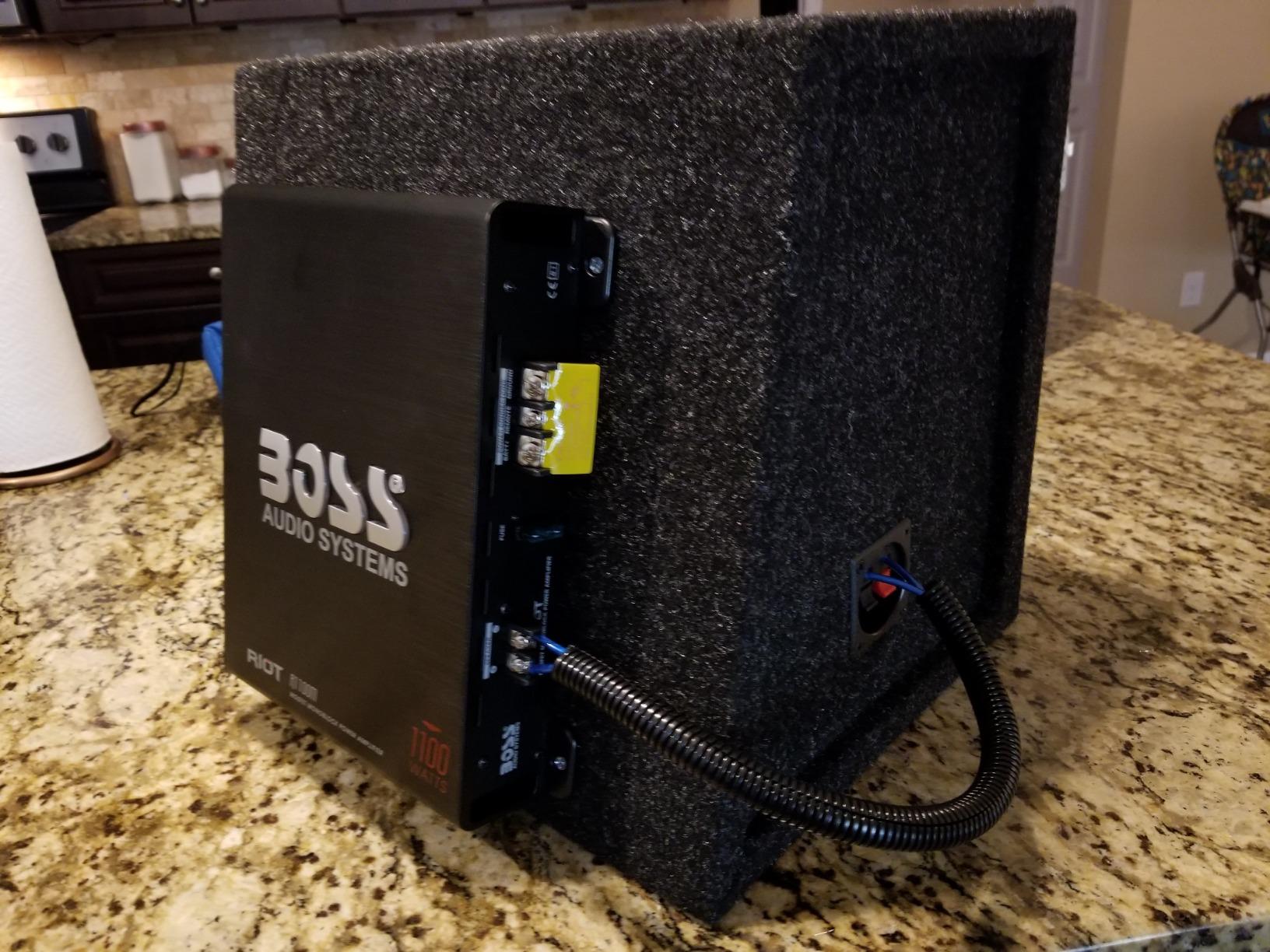
Being straight about the numbers: 1100 watts is the maximum output rating, not a continuous RMS figure, and the real output is lower. The spec sheet lists 550 watts max at 4 ohms and 1100 watts max at 2 ohms. Treat those as peak values and size your expectation on the subwoofer’s own RMS rating instead. If you need more than roughly 500 watts of continuous power, this is not the amp.
Topology is Class A/B rather than Class D, which means it pulls more current and runs warmer for the same output. It also includes thermal, short and overload protection, plus a MOSFET power supply, so the safety side is covered. Controls are a low-pass filter, bass boost and input sensitivity, with no subsonic filter and no parametric EQ.
Who this amp suits
This is a daily-driver sub amp for a single 8-inch or 10-inch subwoofer, or one 12-inch if your sub is efficient and you are not chasing extreme levels. It is also a straightforward pick if you are keeping your factory head unit, since the speaker-level input and automatic turn-on handling remove two of the most common install headaches. Buyers upgrading a system for the first time tend to have the fewest problems with it.
It is a good second-stage amplifier too, running door speakers from a separate multi-channel unit while this one handles the sub. Just remember that Class AB efficiency matters more when you are on a factory electrical system or running a dual battery setup with limited charging capacity.
Who should skip it
Skip this if you are running two 12-inch subwoofers on a 1-ohm load and want real headroom, or if you plan a competition-style build that will sit at full volume for long stretches. The heat output of a Class A/B design is real, and a cramped installation with poor airflow will show it. Anyone chasing clean, precise low end with lots of headroom should look at the Rockford Fosgate R2-500X1 or a 1-ohm-stable Class D unit instead.
2. Pioneer GM-A3702 500W 2-Channel Class A/B – Best low-cost option for one small subwoofer
Pioneer GM-A3702 500W Max Class AB Bridgeable 2-Channel Car Amplifier
2-channel Class A/B
60W RMS x 2 at 2 ohms
190W RMS bridged mono
3.1 pounds
Pros
- Bridges to 190W RMS for a single subwoofer
- Automatic signal sensing turn-on
- Compact 2.38 inch chassis
- Draws comparatively little current
Cons
- Only 60W RMS per channel at 2 ohms
- Gentle 12 dB/oct low-pass slope
- Can overheat if pushed very hard
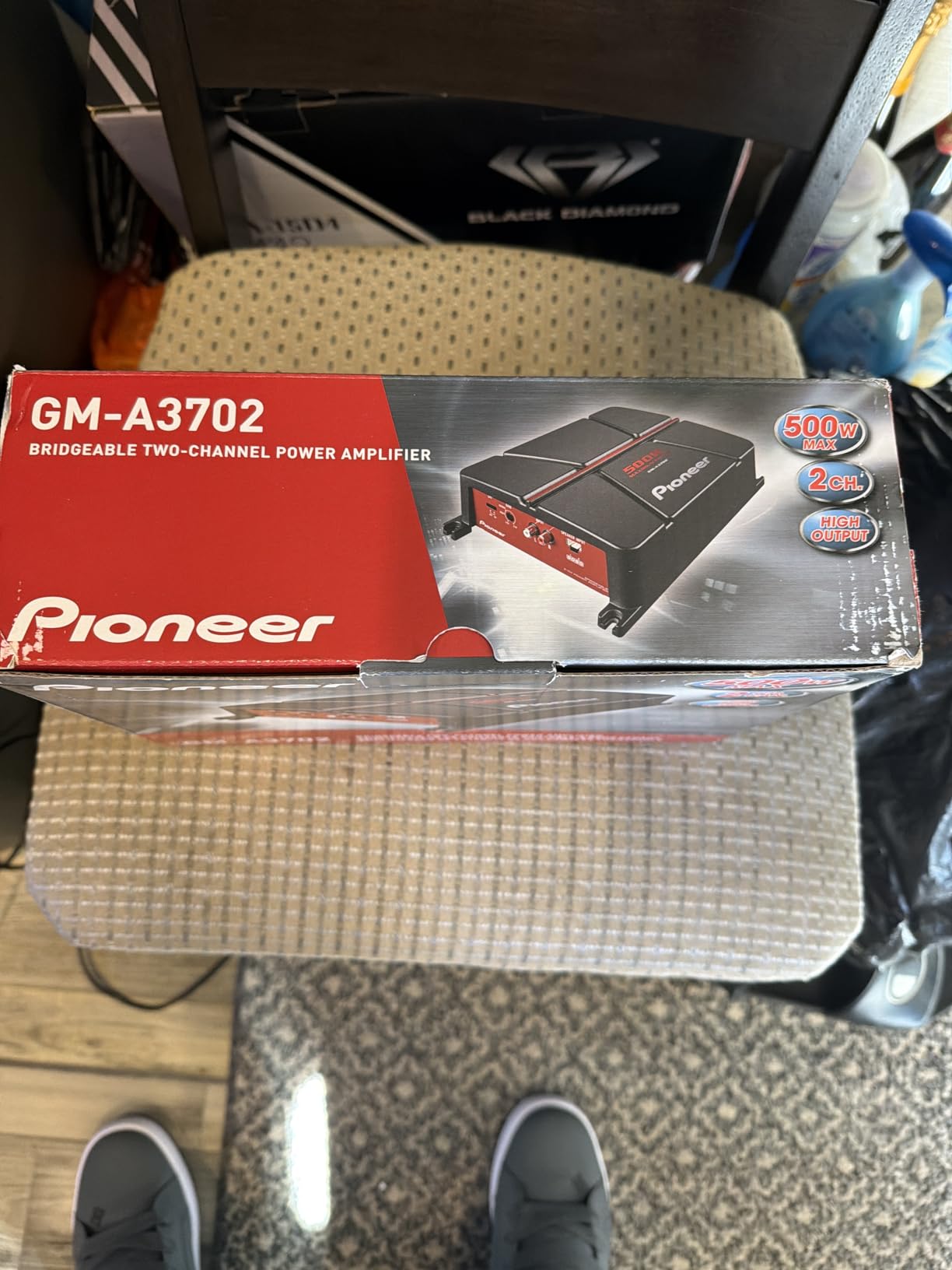
This amp is not really a subwoofer amplifier by design, but bridging it turns it into a credible 190 watt RMS mono for a single small sub. That is exactly enough for an efficient 8-inch driver in a hatchback or sedan, and it costs a fraction of what a dedicated monoblock does. The 4.4 rating across more than 1,100 reviews reflects that buyers understand what it is.
The automatic signal-sensing turn-on is the feature installers mention most. Plug a pair of RCA cables in and it wakes up with the head unit, no remote wire hunting through the firewall. Reviewers commonly pair it with an 8-inch subwoofer for inexpensive bass and report the small 2.38-inch chassis fitting under a seat without fuss.
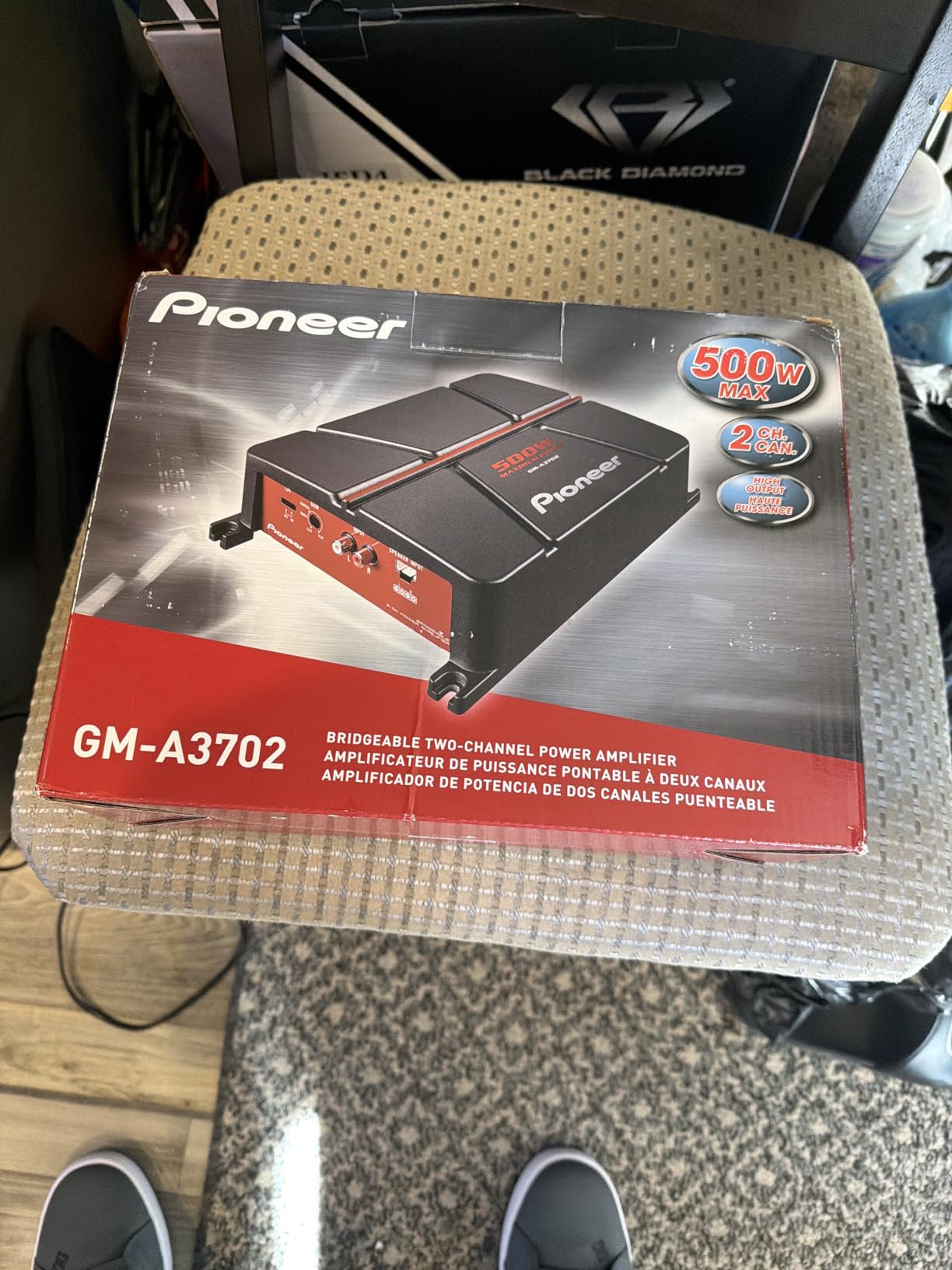
Understand the real numbers before you commit. Continuous output is 60 watts RMS per channel at 2 ohms, and 190 watts RMS in bridged mono mode. The 500 watt figure on the shell is a maximum output claim, and the gap between it and the continuous rating is large. If your subwoofer is rated above 200 watts RMS, this pairing is underpowered and you will clip the amplifier trying to reach the driver’s full excursion.
The built-in low-pass filter is selectable at 80 Hz with a 12 dB per octave slope. That is workable for a sub-only system but shallow, meaning higher frequencies can still leak through and interact with your door speakers. The aluminum alloy construction and Class A/B topology keep distortion low, and the 3.1-pound weight keeps current draw low for a Class AB design.
Who this amp suits
This is the right pick for a first subwoofer in a small car, a student build, or anyone adding bass without wanting to run a new power wire to the battery. It is also useful as a front-stage amplifier while a separate monoblock handles the sub. Efficient draw and automatic turn-on make it an easy way to add low end to a factory system.
Choose it when your subwoofer is an 8-inch rated around 150 to 200 watts RMS, or a modest 10-inch. Pairing it with a single high-efficiency 12-inch can work if you keep expectations reasonable, though gain-limited by an ohm-stable amp is often the smarter approach.
Who should skip it
Skip it for any dual 12-inch build, any 1-ohm load, and any install where the amp will run at full output for extended periods on a hot day. The most common complaint is heat build-up when the gain is pushed to its maximum to get more output, which is a direct consequence of pairing a small amp with a larger speaker. If you want deep, loud bass without worrying about thermal headroom, budget for a proper Class D monoblock.
3. Pioneer GM-A6704 1000W 4-Channel Class A/B – Best for door speakers plus one subwoofer
Pioneer GM-A6704 1000W Max Class AB Bridgeable 4-Channel Car Amplifier
4-channel Class A/B
60W RMS x 4 at 4 ohms
190W RMS x 2 bridged
4.9 pounds
Pros
- Runs door speakers and a sub from one amp
- Bridgeable to 1 2 or 3 channels
- Variable high-pass and low-pass filters
- Runs cool in typical installs
Cons
- Only 60W RMS per channel at 4 ohms
- Muddy midbass in some examples
- Needs heavy-gauge power wire and a large fuse
Where the GM-A3702 is a sub amp in a pinch, the GM-A6704 is a genuine system amplifier. Four channels at 60 watts RMS each handles a pair of door speaker pairs, and the flexible bridging lets you dedicate a channel pair to a single subwoofer at 190 watts RMS. For a build where money is tight, running the entire front stage and the sub from one unit simplifies wiring enormously.
Multiple owners report several years of flawless operation, and the variable high-pass and low-pass filters are the controls you will actually use: high-pass on the door channels to keep them out of the way, low-pass on the sub channel. Reviewers note it stays cool in normal use even powering door speakers alongside a subwoofer.

The honest caveat is that 1000 watts is a peak claim and the continuous figure is 60 watts RMS per channel at 4 ohms. Against that, owners of some examples report muddy midbass quality, which is a common trait of budget-tier Class A/B amplifiers at low listening volumes. There is also an isolated run of defective examples, so check yours promptly after delivery rather than burying it in a trunk for a month.
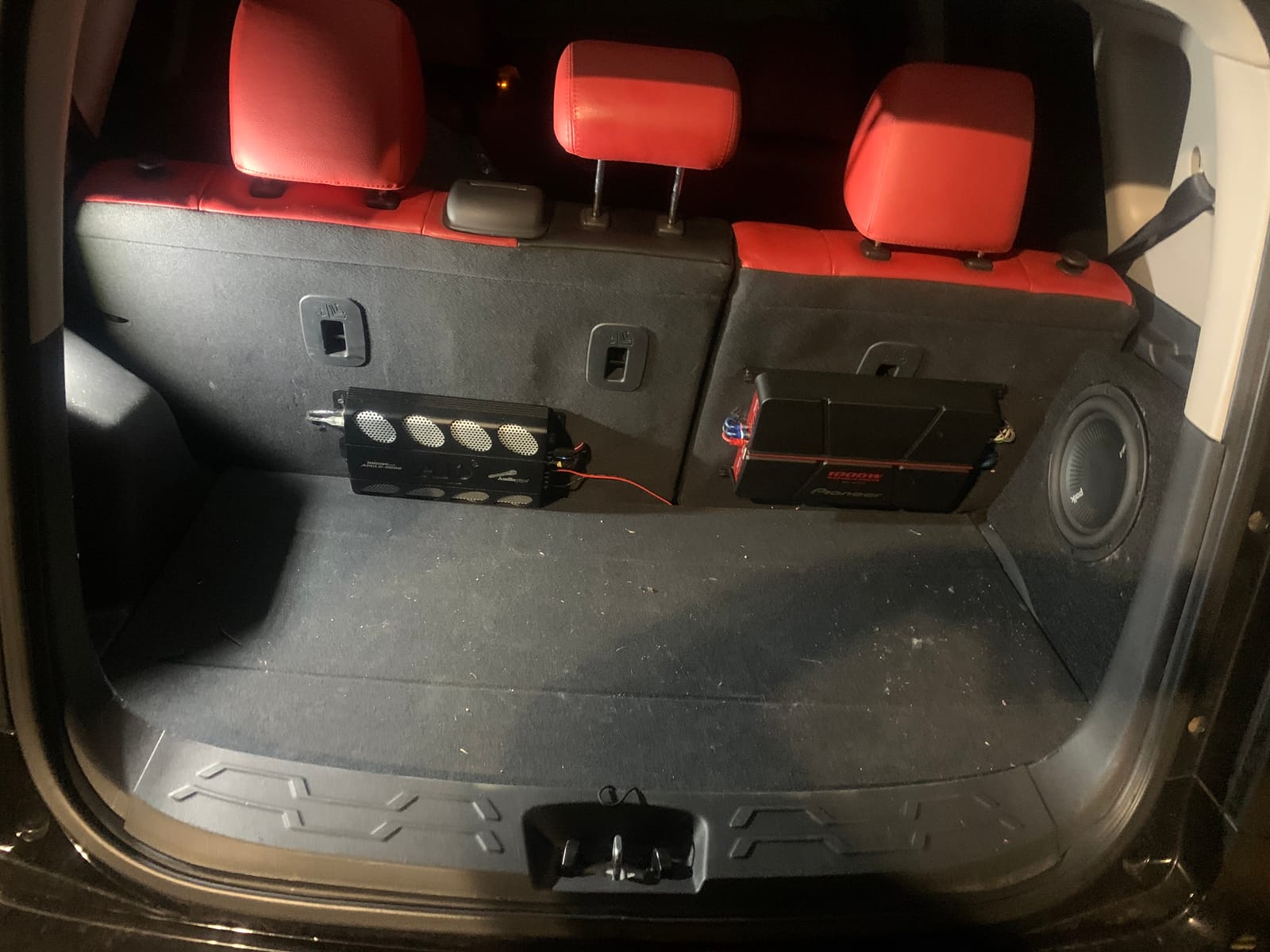
Plan the electrical side carefully. This amp draws 5 amps of supply current and needs a heavy-gauge power wire and a properly sized fuse near the battery. The chassis measures 14 by 8.5 by 2.38 inches, so it needs a flat mounting surface, not an under-seat gap.
Who this amp suits
This is the pick for a first complete front-and-sub system in a car where trunk space is tight and you want a single box for all your amplification. It also works well for a stage-1 build where door speakers need more than a factory amp provides, with a modest sub bolted on the bridged rear pair. Anyone who values straightforward, verifiable channel configuration will like the 1, 2, 3 or 4 channel flexibility.
It suits a system that plays at moderate volume on daily drives rather than one that gets pushed hard on the weekend. Long-term owners report good durability once it is installed with correct gain and adequate airflow.
Who should skip it
Skip it if bass is the priority and the sub is your main event. Sixty watts per channel will not drive a 12-inch subwoofer to its rated RMS, and the 190 watt bridged figure covers only a small driver. Anyone chasing high output with two 12s or competing on loudness needs a dedicated monoblock. It is also the wrong tool for a sound-quality build where midbass clarity on door speakers matters more than cost.
4. AUDIOZERONE ZE1000.1 2000W Class D Monoblock – Strong power-to-cost ratio at 1 ohm
AUDIOZERONE Car Audio Amplifier ZE1000.1 2000W Monoblock Class D MOSFET Subwoofer Audio, 1-4 Ohm Stable, Low Pass Crossover, Mosfet Power Supply, Stereo
Class D monoblock
1000W RMS at 1 ohm
650W RMS at 2 ohms
6.6 pounds
Pros
- Independent dyno tests show output close to rated
- Runs cool at sustained high output
- Genuinely 1-ohm stable
- Low-pass filter works cleanly
Cons
- Allen-key screw terminals loosen with heavy bass vibration
- Some have failed within months
- No RCA pass-through outputs
This is the amplifier that shows why peak ratings are useless on their own. The box says 2000 watts; the specification sheet says 1000 watts RMS at 1 ohm, 650 watts RMS at 2 ohms and 400 watts RMS at 4 ohms. The RMS numbers are the ones that matter, and they are the reason this amp can actually drive a real subwoofer rather than just sounding loud at low volume.
Independent dyno tests in the review record show output close to the rated figures, with several owners reporting measured values above spec. It runs very cool even at extended high output, which is the practical advantage of Class D efficiency over the Class A/B designs above. Multiple owners call it the best amplifier in its class, and the 4.4 rating across 755 reviews reflects that consistently.
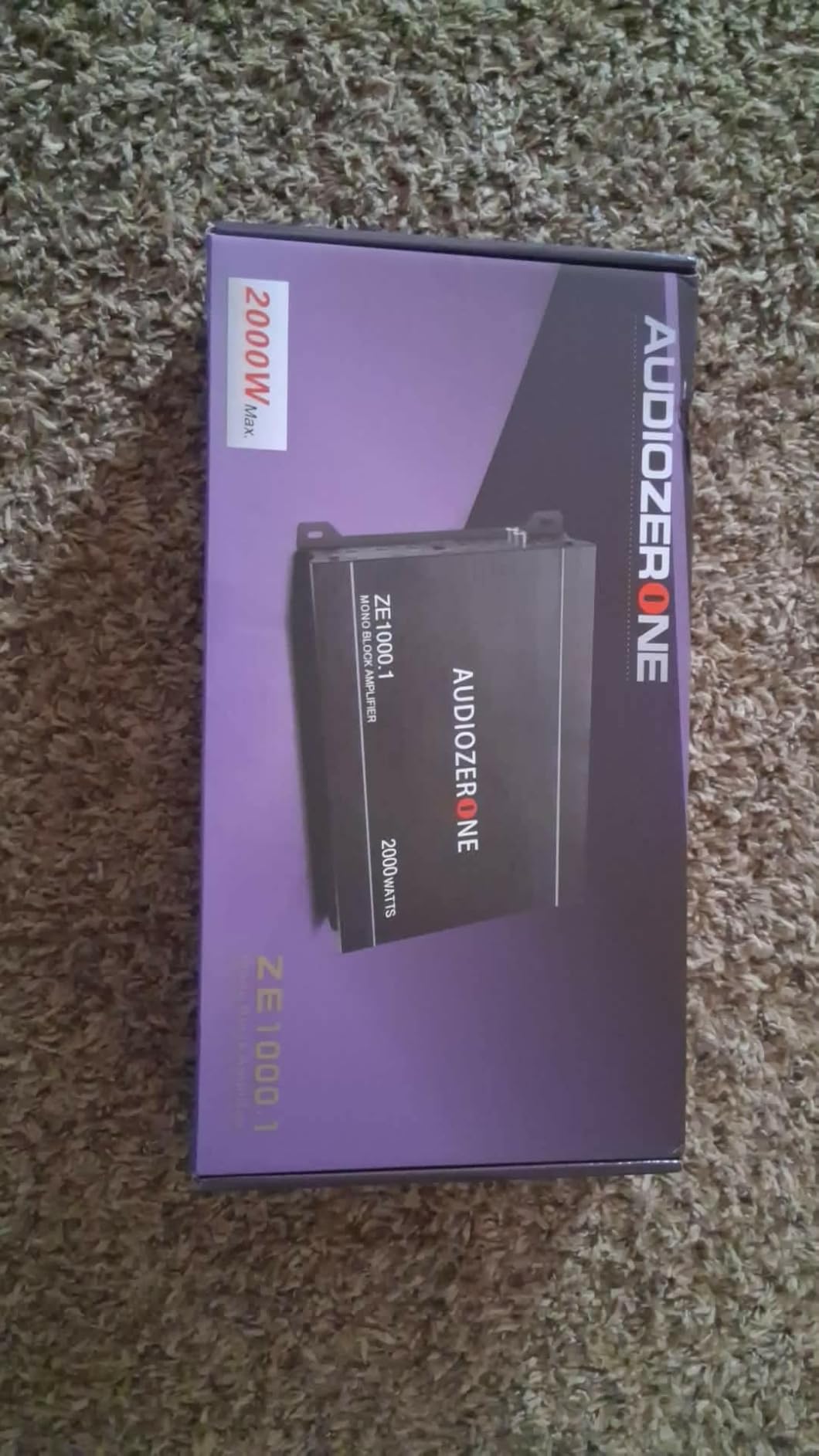
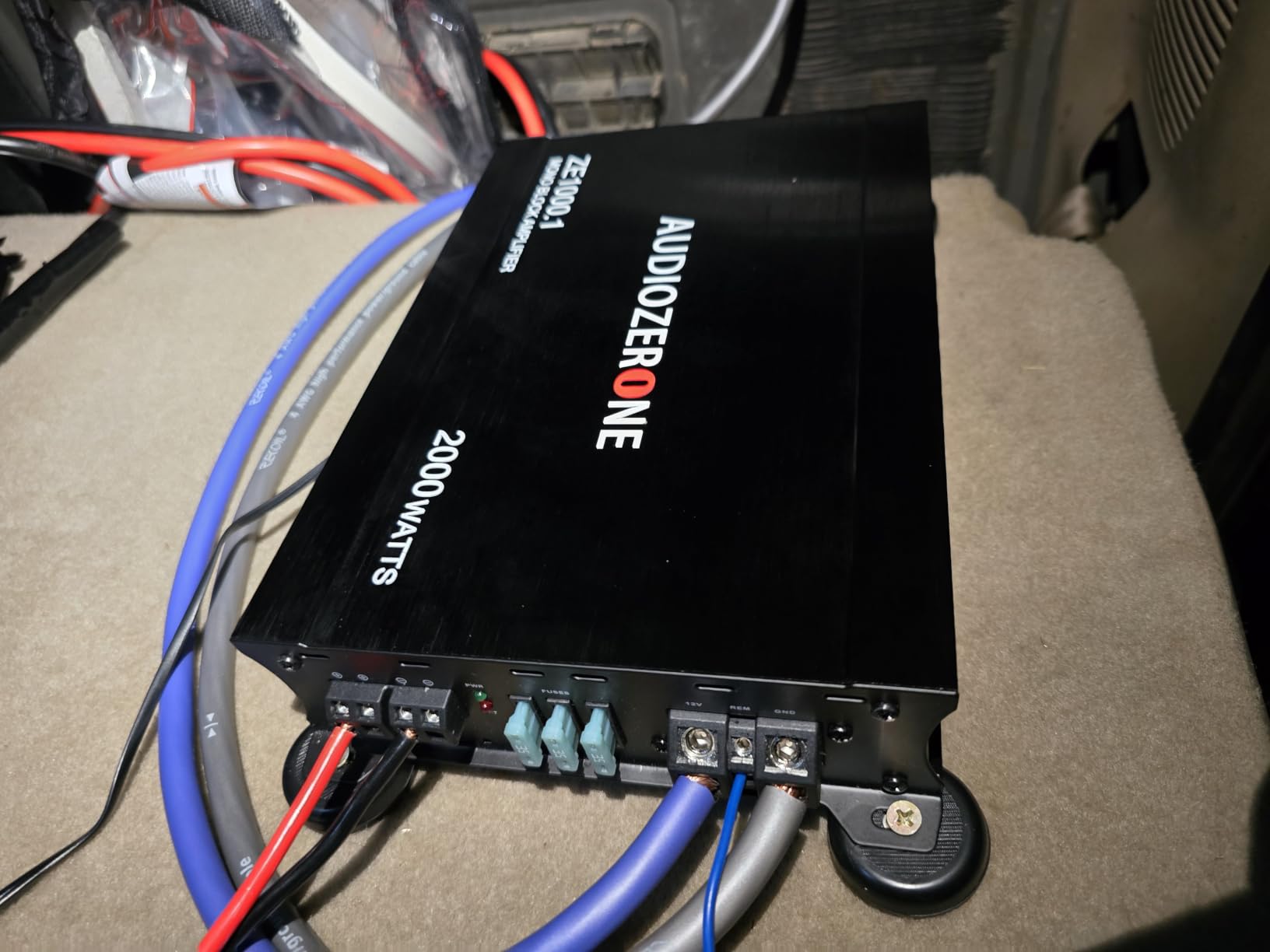
Two real weaknesses. The Allen-key screw terminals are the most repeated complaint in the reviews, and with heavy bass vibration the wires can loosen or pull out, which is a safety issue as well as an annoyance. Second, a minority of owners report failures or internal shorts within months, so inspect the amp before you run it hard for the first time.
Also note the electrical demand. At 1000 watts RMS into 1 ohm this amp pulls substantial current, and reviewers mention that a capacitor or an upgraded battery may be needed on a vehicle with an aging electrical system. The chassis is 11 by 6.9 by 2 inches, and the protection package covers thermal, overload and short circuit faults.
Who this amp suits
This fits a single 10-inch or 12-inch subwoofer rated in the 400 to 600 watt RMS range, wired to 2 ohms where the amp delivers 650 watts RMS. It is the choice for a first serious build where the subwoofer is efficient and you want honest continuous power without stepping up to a premium brand. It also suits installers who are comfortable with a proper big three install and comfortable re-tightening terminals.
Choose it when cool operation and efficiency matter more than a refined control set. The low-pass filter is simple but clean for bass-only use, and the 1-ohm stability means you have room to grow if you later add a second subwoofer in parallel.
Who should skip it
Skip it if your build is going to be pushed hard every weekend and you cannot tolerate an occasional early failure, or if the trunk of your car is subject to constant vibration from a beating subwoofer. It is also the wrong pick for a factory head unit system where you need RCA pass-through outputs to feed a second amplifier. For a sound-quality-leaning build where setup accuracy matters, an amp with guided gain circuitry is a better buy.
5. Taramps BASS 400 400W RMS Monoblock – Best pick for tight spaces and factory systems
Taramps BASS 400 2 Ohms 400W RMS Monoblock Subwoofer Car Audio Amplifier
400W RMS at 2 ohms
620 g aluminum body
8 Hz to 250 Hz response
High-level and RCA inputs
Pros
- Extremely small footprint for under-seat mounting
- Independent dyno testing confirms near-rated output
- Runs cool with no clipping at high volume
- High-level inputs for automatic turn-on
Cons
- Low-pass filter attenuates at only 12 dB per octave
- No on-board fuse
- Small terminals and knobs feel fragile
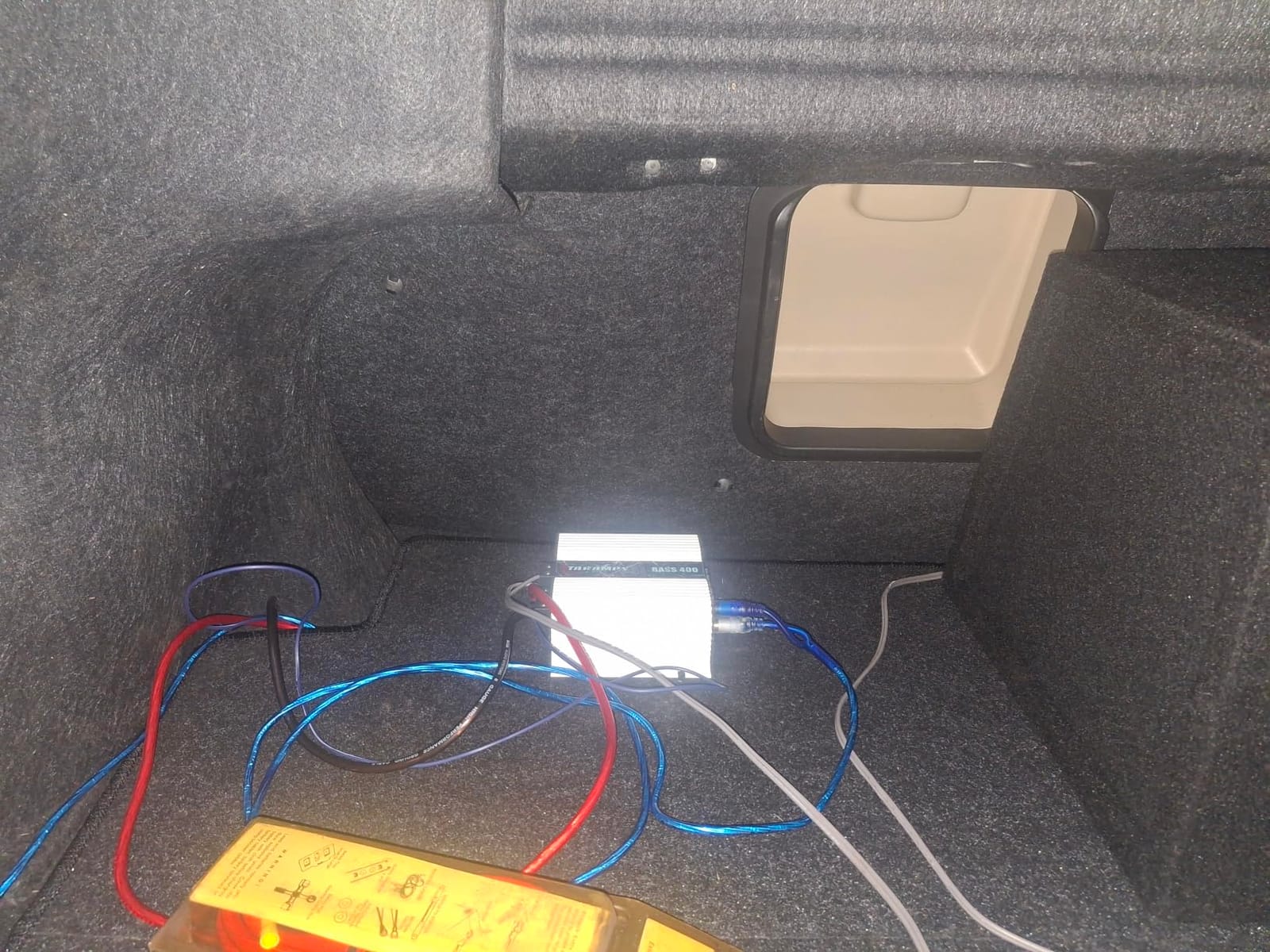
At 620 grams and six inches square, the Taramps BASS 400 is a notably small amplifier, and that turns out to matter more than raw wattage for a lot of installs. It disappears into a spare tire well, under a seat, or behind a trim panel. For a small hatchback with no room for a conventional monoblock, it is often the most practical option.
Independent dyno testing in the review record confirms output close to the rated 400 watts RMS at 2 ohms, and owners report that it runs cool with no clipping at extended high volume. The 77 percent five-star rating is above what budget monoblocks usually earn, which tells you the value proposition is real rather than marketing.
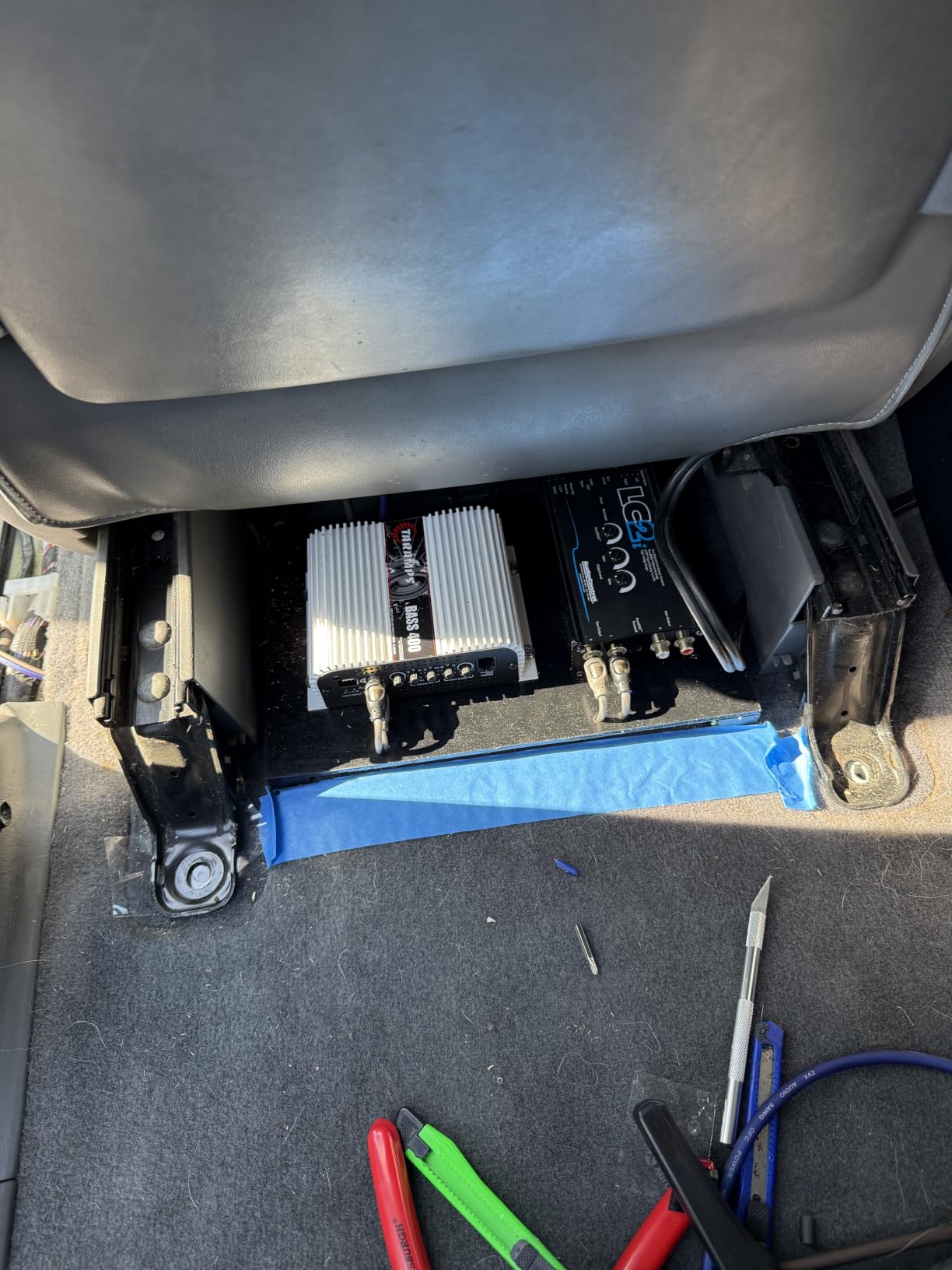
The honest limitations are in the details. The low-pass filter attenuates at only 12 dB per octave, so higher frequencies can bleed through the subwoofer and you may hear localization that pulls the bass toward the box. Terminals and adjustment knobs feel cheap and can strip if forced, and there is no on-board fuse, which means your inline fuse at the battery is doing all the protection work with no backup.
The parametric bass boost is worth calling out because few budget amps have it: 35 to 55 Hz adjustable up to plus 12 dB. That is a low-frequency-targeted boost rather than a wideband one, so it adds punch without smearing your midrange. Inputs cover both high-level and RCA, with automatic turn-on for factory radios.
Who this amp suits
This is the amplifier for a first bass upgrade in a car where space is the binding constraint. It suits one 8-inch or 10-inch subwoofer, or a modest 12-inch, in a daily-driver configuration that does not get pushed past 400 watts. The high-level inputs and automatic turn-on make it a genuinely simple install with a factory radio and no line output converter.
It is also a good secondary or staging amplifier when the main system is already handled and you just need a small amount of low end. Enthusiasts building entry-level systems frequently pair it with an 8-inch subwoofer and report satisfaction at low to moderate volume.
Who should skip it
Skip it if your subwoofer is rated well above 400 watts RMS, because you will be gain-limited and clipping is the result, and clipping is what kills voice coils. It is also a poor match for a build where you want a steep low-pass slope to isolate the sub cleanly from your door speakers, or where a subsonic filter is needed to tame a very low tuned port. Nothing here is wrong; it is simply built for smaller jobs.
6. Rockford Fosgate R2-500X1 500W Class D Monoblock – Cleanest sound and simplest setup
Rockford Fosgate Prime R2-500X1 500-Watt Mono Amplifier
Class D monoblock
500W RMS at 2 ohm
300W RMS at 4 ohm
1.9 inch tall chassis
Pros
- Highest average rating in this group at 4.7
- Owners measure more than rated output in the field
- Very efficient Class D design
- C.L.E.A.N. circuitry simplifies gain setting
Cons
- 500W into 2 ohms is limited for dual 12-inch builds
- Needs a properly sized fuse and heavy power wiring
This is the amplifier I would put in a car I drove every day and heard at high volume. It holds a 4.7 average across 467 reviews with 87 percent five-star ratings, the strongest showing in this group, and the reasons are consistent: clean signal, simple tuning, and enough power for a single quality 10-inch or 12-inch subwoofer.
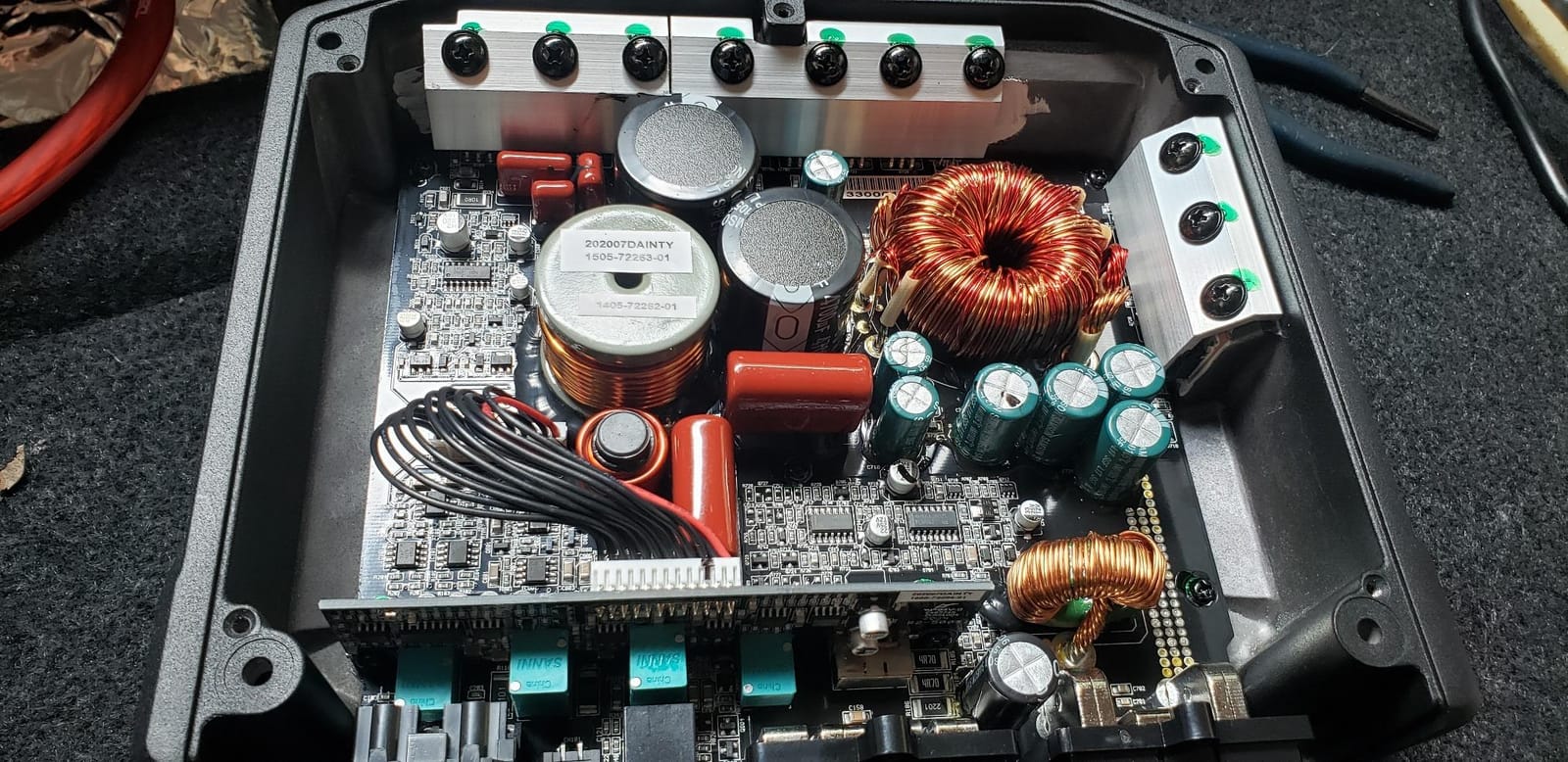
Its published numbers are genuine RMS rather than peak, which is not true of most of the amps on this list. 500 watts RMS at 2 ohms and 300 watts RMS at 4 ohms, tested to CEA-2006 compliance and made in the USA. Owners report measuring more than rated in the field, with one recording 604 watts into a 10-inch L7. Real output above the paper rating is unusual in this bracket.
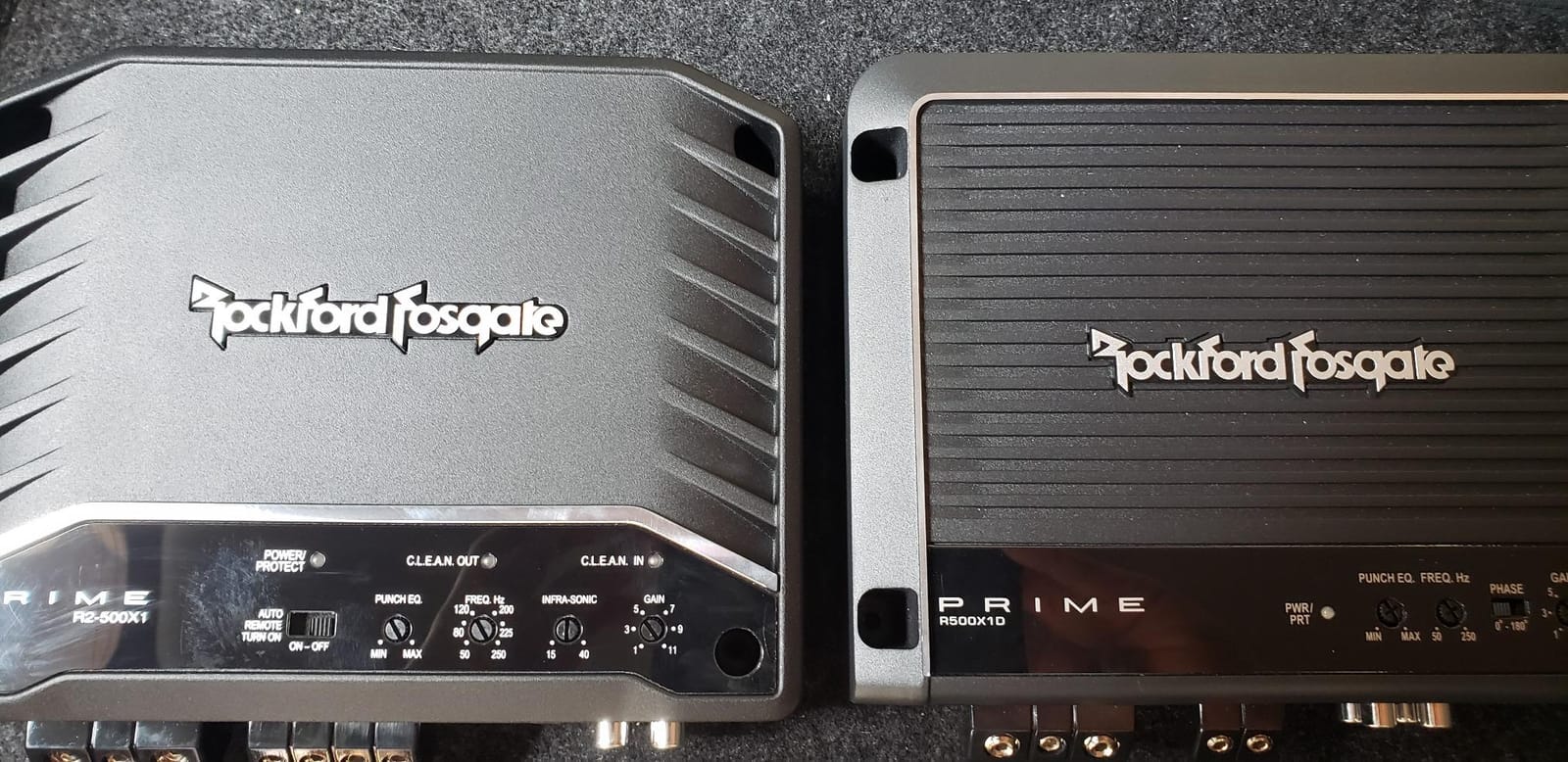
What makes setup easy is the C.L.E.A.N. gain-adjustment circuitry paired with the P.O.W.E.R. supply. The supply raises output as system voltage rises, so output tracks the battery rather than sagging, and the C.L.E.A.N. circuit gives you an accurate gain setting without a multimeter or a tone generator. For first-time installers, that removes the single most common cause of damaged subwoofers.
Controls go beyond the usual set. You get a variable infrasonic filter, a remote level control, and an integrated Punch EQ that delivers up to three times the bass boost. The chassis measures 1.9 by 6.8 by 8.5 inches, so it mounts flat and takes almost no vertical space.
Who this amp suits
This is the pick for a sound-quality-leaning daily driver with one efficient 10-inch or 12-inch subwoofer, particularly if you care more about accurate, undistorted output than sheer volume. It suits anyone who has struggled with clipping and gain settings before and wants a guided procedure instead of guesswork. Class D efficiency also means it puts minimal load on a vehicle’s electrical system, which matters in older cars.
It is a strong second-stage amplifier in a build where a four-channel unit handles the doors. The Punch EQ and infrasonic filter give enough control to shape low end precisely, and owners describe the result as clean and distortion-free at high listening levels.
Who should skip it
Skip it if you are running two 12-inch P2-style subwoofers on a 1-ohm load. 500 watts into 2 ohms will not give those drivers headroom, and owners say so directly in the reviews. It also demands a properly sized 80 to 100 amp fuse and heavy-gauge power wiring, so budget for the install hardware as part of the purchase. Competition SPL builders should look further up the power range entirely.
7. CT Sounds CT-1000.1D 1000W RMS Class D Monoblock – Best thermal behaviour in a compact body
CT Sounds CT-1000.1D Compact Class D Car Audio Monoblock Amplifier, 1000 Watts RMS
1000W RMS at 1 ohm
650W RMS at 2 ohm
2.18 inch tall chassis
Remote bass knob included
Pros
- Compact chassis that fits in tight vehicle spaces
- Engineered for high efficiency
- Heat dissipation design keeps it cool on long playlists
- Four-way protection circuitry
Cons
- Only reaches 1000W RMS at a true 1 ohm load
- Frequency response tops out at 320 Hz so it is sub-only
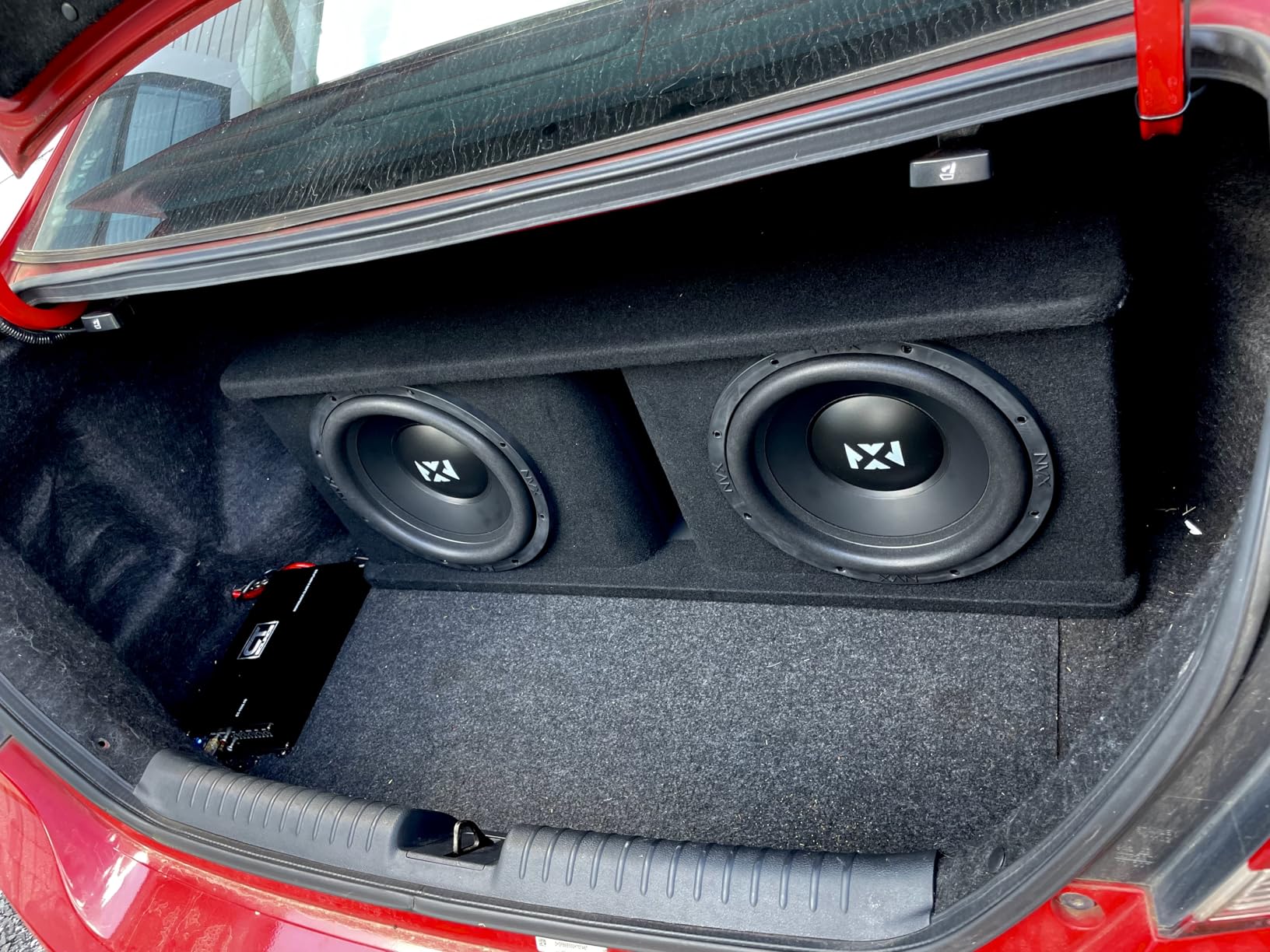
The CT-1000.1D is the amp I would trust for a long road trip with a big sub at volume. Its reputation rests on thermals: a MOSFET pulse-width-modulated power supply combined with a proprietary heat dissipation design keeps it cool across long, demanding playlists, and it carries 4.6 stars with 80 percent five-star ratings across 421 reviews. That reliability profile is what you want from an amp feeding a large subwoofer on a long drive.
Power output is 1000 watts RMS at a 1-ohm load at 14.4 volts, dropping to 650 watts RMS at 2 ohms and 350 watts RMS at 4 ohms. This is the important nuance: to actually get the headline figure you must run a true 1-ohm load, and at 4 ohms it delivers roughly a third of the rated output. Match it to a subwoofer near 1 ohm or accept the lower number.
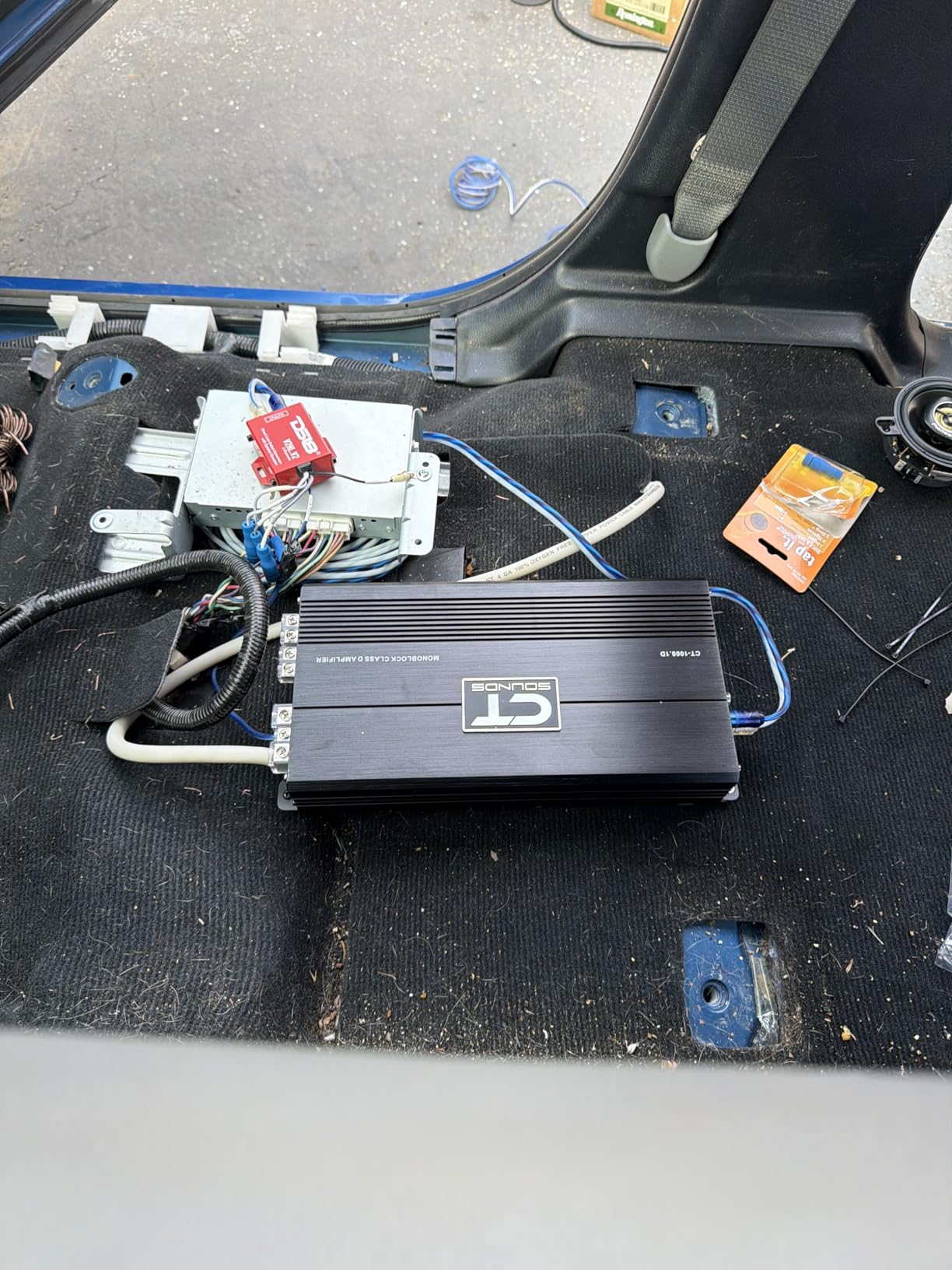
The chassis is 11.68 by 5.62 by 2.18 inches, one of the smaller footprints here and one of the reasons it installs without drama. The bass knob is included in the box, so there is no extra purchase. Efficiency is the other selling point: less current drawn from the alternator for the same output, which reduces the strain of a big audio install on a factory electrical system.
Two limitations. The frequency response runs from 0 to 320 Hz, making this a dedicated subwoofer amplifier with no full-range capability. And the protection package, while genuinely four-way, does not replace correct gain setting, since a protection circuit is a safety net rather than a tuning tool.
Who this amp suits
This suits an owner with a single dual-voice-coil 12-inch subwoofer who wants to run it at 1 ohm for the full 1000 watts RMS. It is a good match for a vehicle with a tight trunk or an under-seat installation, given the short 2.18-inch chassis. It also suits long-trip drivers and anyone who runs their system hard for extended periods without wanting thermal shutdowns.
Choose it when efficiency matters on an older vehicle with a modest charging system, and when you want a remote knob included rather than buying one separately. Single-sub, high-power setups are its natural home.
Who should skip it
Skip it if your subwoofer is a 4-ohm single voice coil design and you want more than about 350 watts RMS, or if your system plan includes a second subwoofer on a higher impedance. It is also the wrong tool if you want one amplifier to handle door speakers, since the 320 Hz upper limit rules out full-range use. Anyone who needs pass-through outputs to feed another amp will not find them here.
8. ORION CBA2000.1D 2000W Class D Monoblock – Most features, but check the thermals
ORION CBA2000.1D Cobalt Mono 1-Channel Class D Amp, 2000W Max
Class D monoblock
500W RMS at 1 ohm
260W RMS at 2 ohm
1, 2 and 4 ohm stable
Pros
- Strong power-to-price ratio
- 1-ohm stable under continuous load
- Subsonic control and phase shift included
- Remote bass knob included
Cons
- Lowest average rating in this group at 4.0 with 16 percent one-star reviews
- Runs warm under sustained high output
- Needs gain structure set carefully
The CBA2000.1D has an unusually complete control set for a budget monoblock: adjustable low-pass filter, bass boost, subsonic control, phase shift, and a remote bass knob in the box. The subsonic filter in particular is rare at this level, and for a ported or bandpass enclosure that runs low it genuinely protects the subwoofer from excursion below its tuning frequency.
It is also 1, 2 and 4 ohm stable, and owners report it pushes pairs of 10-inch and 12-inch subwoofers well for the money. Continuous output is 500 watts RMS at 1 ohm, 260 watts RMS at 2 ohms, and 160 watts RMS at 4 ohms, with a frequency response of 10 Hz to 250 Hz. A MOSFET power supply and two-way protection circuitry handle the thermal side.
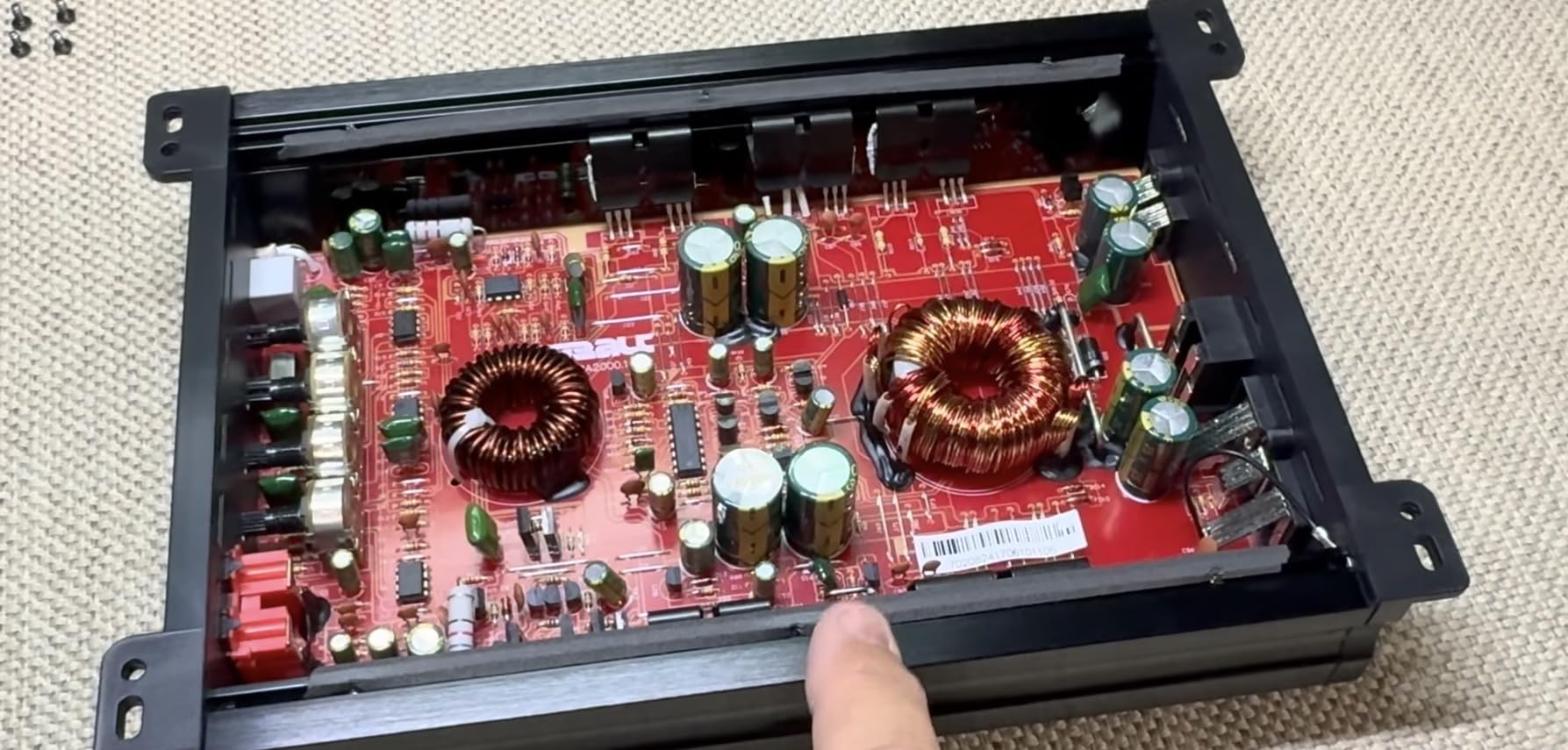
Here is the reason this amp sits in the eighth position rather than higher. It has the lowest average rating in the group at 4.0, and 16 percent of reviews are one star. Heat is the recurring theme: reviewers note the heatsink lacks large fin coils for sustained high output, and there is at least one account of an overheating example that smelled of burning and required replacement.
That points to a gain-structure issue as much as a design issue. Owners who set gain carefully get good results, while those who push the amp to maximum output run into trouble. The 14 by 8 by 3 inch chassis is one of the larger bodies here, so airflow matters. Mount it with space around the heatsink, not wedged into a closed cavity.
Who this amp suits
This suits a builder who wants a full complement of tuning controls, particularly subsonic filtering for a deeply tuned ported box, and who is confident setting gain precisely. It is a reasonable choice for one or two modest 10-inch subwoofers where you want extra headroom above the sub’s rating without a bigger amplifier. The phase shift control is useful when the sub and door speakers need to be time-aligned by ear.
It also suits a build where trunk space is not the constraint, since the chassis is large but the feature set is unusually complete for the category. Value-focused buyers who read the thermal criticism and plan their mounting will get a lot of capability per unit.
Who should skip it
Skip it if your system runs at high volume for long stretches in a hot car, because the thermal complaints are consistent enough to take seriously. It is also not the right partner for a very low-impedance load where you need maximum current delivery. For a build that must be dependable above all, an amp with a stronger cooling design and a higher rating is the safer investment.
9. Rockford Fosgate P600X4 600W 4-Channel Class A/B – Best 4-channel when one sub is enough
Rockford Fosgate P600X4 Punch 600-Watt 4-Channel Amplifier
4-channel Class A/B
75W x 4 at 4 ohm
300W x 2 bridged at 4 ohm
CEA-2006 compliant
Pros
- Clean high sound quality output that holds clarity at volume
- C.L.E.A.N. set-up prevents clipping during tuning
- Verified true RMS ratings on the birth sheet
- Punch EQ gives plus 18 dB at 45 Hz
Cons
- Rear channels bridge to only 300W total for a subwoofer
- Costs more than entry-level 4-channel alternatives
- C.L.E.A.N. procedure is confusing on a first install
The P600X4 is the amplifier here aimed squarely at sound quality rather than bass volume. It delivers clean, high-fidelity output that holds clarity at high listening levels, and it carries a 4.6 rating with 82 percent five-star ratings. Owners report long service life and durability, which is a different kind of endorsement than raw power.
The RCA inputs accept both high-level and low-level signals without a converter, and there are RCA pass-through outputs, so it works with a factory head unit and can feed a separate subwoofer amplifier. Variable 12 dB per octave Butterworth crossovers give separate high-pass and low-pass control per channel pair, and the Punch EQ delivers plus 18 dB of boost at 45 Hz.
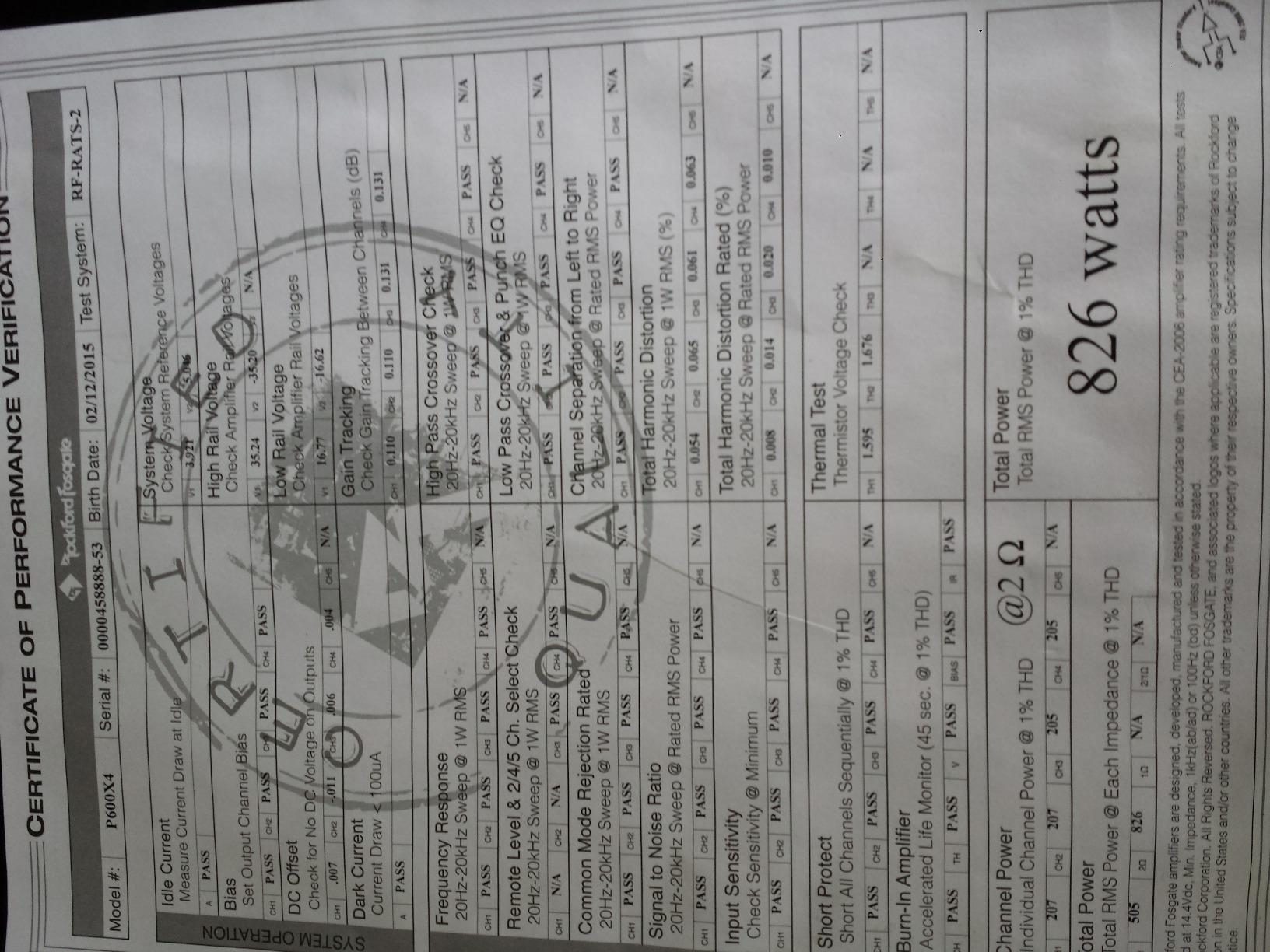
On paper, this is an honest amplifier. Its RMS ratings are 75 watts per channel at 4 ohms, 150 watts per channel at 2 ohms, and 300 watts per channel pair bridged at 4 ohms, all to CEA-2006 compliance, and owners verify on the birth sheet that output runs well above the 600 watt marketing figure. The C.L.E.A.N. setup prevents clipping and protects your speakers while you tune.
The structural limitation is the bridged subwoofer output. At 300 watts total for a pair of channels, a single subwoofer gets less power than any dedicated monoblock on this list, so the low end will be understated in a bass-forward system. The chassis measures 13.28 by 7.76 by 2.38 inches and weighs 1.5 kg, which is manageable but not compact.
Who this amp suits
This suits a sound-quality build where door speakers are the priority and a subwoofer is a supporting element. It is ideal for a three-way system with front and rear door speakers on four channels and subwoofers on the bridged rear pair. The RCA pass-through outputs make it the natural choice when you plan to add a dedicated monoblock later for more bass.
It also works well with a factory head unit thanks to the high-level capable inputs, and the Punch EQ plus steep crossovers give more shaping control than any other multi-channel amp here. Owners who value clarity through the midrange will notice the difference versus budget Class A/B units.
Who should skip it
Skip it if bass is the main event. 300 watts bridged will not satisfy a 12-inch subwoofer rated for more, and pairing two of them does not double output. It also costs more than entry-level 4-channel alternatives with similar continuous ratings, and the C.L.E.A.N. tuning procedure genuinely confuses first-time installers until they learn the sequence. Buy a monoblock if you want low end to lead.
10. Hifonics ZXX 1000W Class D – Heavy build, but verify what you receive
Hifonics Zeus ZXX 1000W Class D Monoblock Car Audio Amplifier
Class D
4 x 250 watts at 2 ohms
12 dB/oct low-pass 30-250 Hz
9 pound aluminum body
Pros
- Heavy 9 pound aluminum construction suggests robust build
- Nickel-plated hex screw terminals resist corrosion
- Variable low-pass crossover and 0-12 dB bass boost
Cons
- Listing title and specification conflict on channel configuration
- Warranty terms direct buyers to contact the manufacturer
- 1000W is a peak figure spread across four channels
The ZXX is a physically substantial amplifier in this roundup at nine pounds of aluminum, and that weight points to build quality. Owners praise the nickel-plated, hex-screw terminals specifically because they resist corrosion and hold secure under the vibration that a hard-driven subwoofer produces, which is exactly where lighter budget amps tend to fail.
Control is adequate for a sub-focused system: a variable low-pass crossover at 12 dB per octave adjustable from 30 to 250 Hz, plus bass boost from 0 to 12 dB. Power is listed as 4 times 250 watts at 2 ohms across the channels.
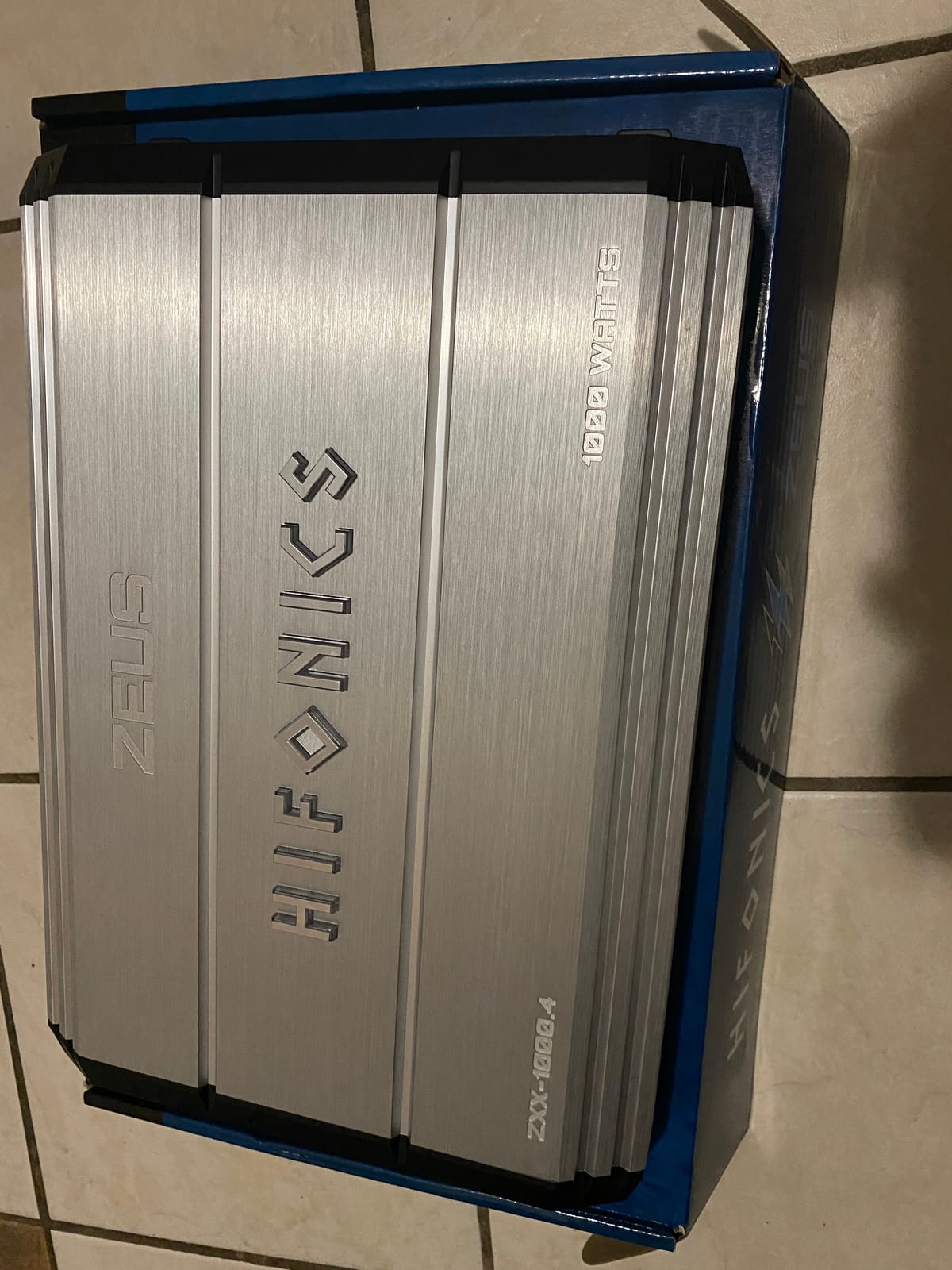
Now the important caveat, and it is a significant one. The listing title advertises a monoblock while the specification block identifies a four-channel ZXX-1000.4. Those are different products with different wiring. Before you install anything, confirm the exact channel configuration you received, because a bridged setup on a true monoblock is not possible and the loads are not interchangeable. Warranty terms are also vague here, directing buyers to contact the manufacturer rather than offering a fixed period.
Thermal design is worth a mention given the mass. A chassis that heavy is not a marketing specification but a practical one: more surface area to dissipate the heat a Class D stage still produces at sustained output, and a mounting surface solid enough to stay put under the vibration of a hard-driven box. Check the venting is clear after the amplifier is fixed in place, since a heavy amp bolted tight against carpet will lose that advantage.
Who this amp suits
This suits a builder who wants a robustly built multi-channel Class D amplifier for door speakers with a modest subwoofer on a bridged pair, and who values solid terminal hardware over feature count. It works for one 10-inch or 12-inch subwoofer at moderate power, in a system where vibration and corrosion resistance matter more than tuning flexibility.
It is a reasonable choice for a secondary amplifier in a multi-amp build where the sub channel needs to be powered separately. The build weight and terminal quality make it a good long-term install rather than a throwaway.
Who should skip it
Skip it if you cannot verify the channel configuration before installation, or if warranty support matters to you and vague terms are a problem. It is also the wrong choice for anyone needing a dedicated 1-ohm-stable monoblock, since the power is distributed across four channels rather than concentrated. For a large subwoofer on a low impedance load, a purpose-built monoblock from this list is a cleaner match.
How to Match an Amplifier to a Subwoofer
Matching an amp to a subwoofer comes down to one number: the subwoofer’s RMS power rating at its rated impedance. Target an amplifier that delivers that figure as continuous RMS power at the ohm load you will actually run, with a modest amount of extra headroom. Forum consensus in the enthusiast communities matches this: matching amp RMS to sub RMS with a little extra is preferred, because an undersized amp clips at maximum volume and clipping is what damages voice coils.
Find your subwoofer’s RMS rating. Read the label or the manufacturer sheet rather than the peak number. A sub rated 400 watts RMS and 800 watts peak needs an amp that makes 400 watts RMS continuously.
Determine the subwoofer’s final ohm load. A single 4-ohm sub is a 4-ohm load. A dual 4-ohm voice coil sub can be wired to 8, 4 or 2 ohms depending on how you connect the coils.
Read the amp’s RMS power at that exact impedance. This is the step most buyers skip. An amp rated 1000 watts at 1 ohm may deliver only 350 watts at 4 ohms, and the number you need is the one at your load.
Add roughly 20 to 30 percent headroom. The extra power gives your gain setting somewhere to sit before the amp runs out of voltage, which reduces distortion and protects the driver.
Confirm the amp is stable at that load. A 2-ohm stable amp can safely run 2, 4 and 8 ohm loads. A 1-ohm stable amp can run anything down to 1 ohm. Never connect a load below the amp’s rating.
Budget for the power wire. A 1000-watt amp needs far more than the thin factory wire in a door kick panel. Match gauge and fuse size to the amp’s current draw, and run the wire directly to the battery.
As a rule of thumb for the amps in this roundup, roughly 400 watts RMS suits a small 8-inch or 10-inch daily-driver sub, around 500 to 650 watts RMS suits a single 12-inch with headroom, and 1000 watts RMS at 1 ohm is the entry point for one high-excursion 12-inch running hard. Our bass amplifier guide goes deeper on the home-audio side of the same power-matching logic.
Class D vs Class AB: Which Amplifier Class to Buy
Class D is the right default for a subwoofer amplifier in 2026, and the reason is efficiency. A Class D amplifier switches its output transistors fully on or fully off rather than holding them partly open, so it wastes far less energy as heat. The practical consequences are a smaller heat sink, a lighter chassis, and noticeably less current drawn from your vehicle’s charging system for the same output.
Class A/B runs the output transistors in a linear region. That gives very low crossover distortion, which some listeners prefer for midbass texture on smaller 10-inch setups, and it is the reason the two Pioneer amplifiers and the BOSS R1100M use this design. The trade-off is heat: the same output that a Class D unit handles cool will warm a Class A/B chassis considerably, and in a sealed trunk on a hot day that matters.
There is a long-running debate in enthusiast circles about whether Class AB sounds more musical than Class D for subwoofers. The honest answer is that a properly designed modern Class D amplifier at the correct gain setting sounds excellent, and a poorly set up one of either class sounds bad. The measurable difference is efficiency and thermal headroom, not fidelity. Set the gain correctly and the class matters far less than the ohm load and the wiring.
Where Class AB still earns its place is a multi-channel amplifier doing full-range work on door speakers, where the R2-500X1 and the P600X4 demonstrate the audible benefit. For a dedicated subwoofer channel running below 250 Hz, efficiency wins.
Impedance and Wiring: 1 Ohm vs 2 Ohm Explained
Impedance is measured in ohms and describes how much the subwoofer resists current. The lower the number, the harder your amplifier has to work, which is why a 1-ohm load demands more power and more current than a 4-ohm load. Running an amplifier below its stable impedance is the fastest way to trigger thermal protection or destroy it, so this is the one specification you should never guess at.
Most dual-voice-coil 12-inch subwoofers have two 4-ohm coils, and each coil has two terminals. Wiring both coils in series gives an 8-ohm load, wiring them in parallel gives 2 ohms, and wiring one coil to an amp and the other to a different channel in a multi-channel amp gives you 4 ohms per channel. These are the three configurations you will see in practice, and each one dictates which amplifier in this roundup is appropriate.
For a 1-ohm load, your realistic options here are the AUDIOZERONE ZE1000.1 and the CT Sounds CT-1000.1D, each rated 1000 watts RMS at 1 ohm. For a 2-ohm load, the Taramps BASS 400 at 400 watts RMS, the Rockford Fosgate R2-500X1 at 500 watts RMS, and the AUDIOZERONE at 650 watts RMS all fit. For 4 ohms, the R2-500X1 at 300 watts RMS is the more honest number in the group.
Voice coil wiring also affects the amplifier’s damping factor, which is how tightly the amp controls the cone’s movement. Higher damping gives a tighter, more controlled bass response, and a monoblock driving a low impedance load generally gives better damping than a small multi-channel amp driving one channel of a pair. Speakers and amplifiers are also polarised: connect the positive terminal to the positive terminal, or bass will cancel against itself in a multi-speaker setup.
Installation Essentials: Big Three, Fusing, Gain and Grounding
Most failed car audio installs come down to three things done incorrectly: the power wire, the fuse, or the gain. Here is the order of operations that works.
Run the power wire first. A positive cable runs from the battery, through a firewall grommet, to the amplifier. Use a fuse holder within a few inches of the battery terminal. Gauge must match current draw: a few hundred watts of Class D can work on lighter cable, while a 1000-watt amp needs heavy-gauge cable and a properly rated fuse to match.
Ground it to bare metal. Scrape paint off a body panel near the amplifier, bolt the ground wire down, and treat the bare metal to prevent corrosion. Loose or painted ground points are the most common source of amplifier protection tripping and noise.
Run the remote turn-on wire. A thin wire from the head unit’s accessory or antenna lead tells the amplifier to power up. Skip it only if the amp has automatic signal sensing on high-level inputs.
Set the low-pass filter before gain. Start around 80 Hz for a sub crossing over door speakers, and turn the subsonic filter up if the box is ported and tuned low.
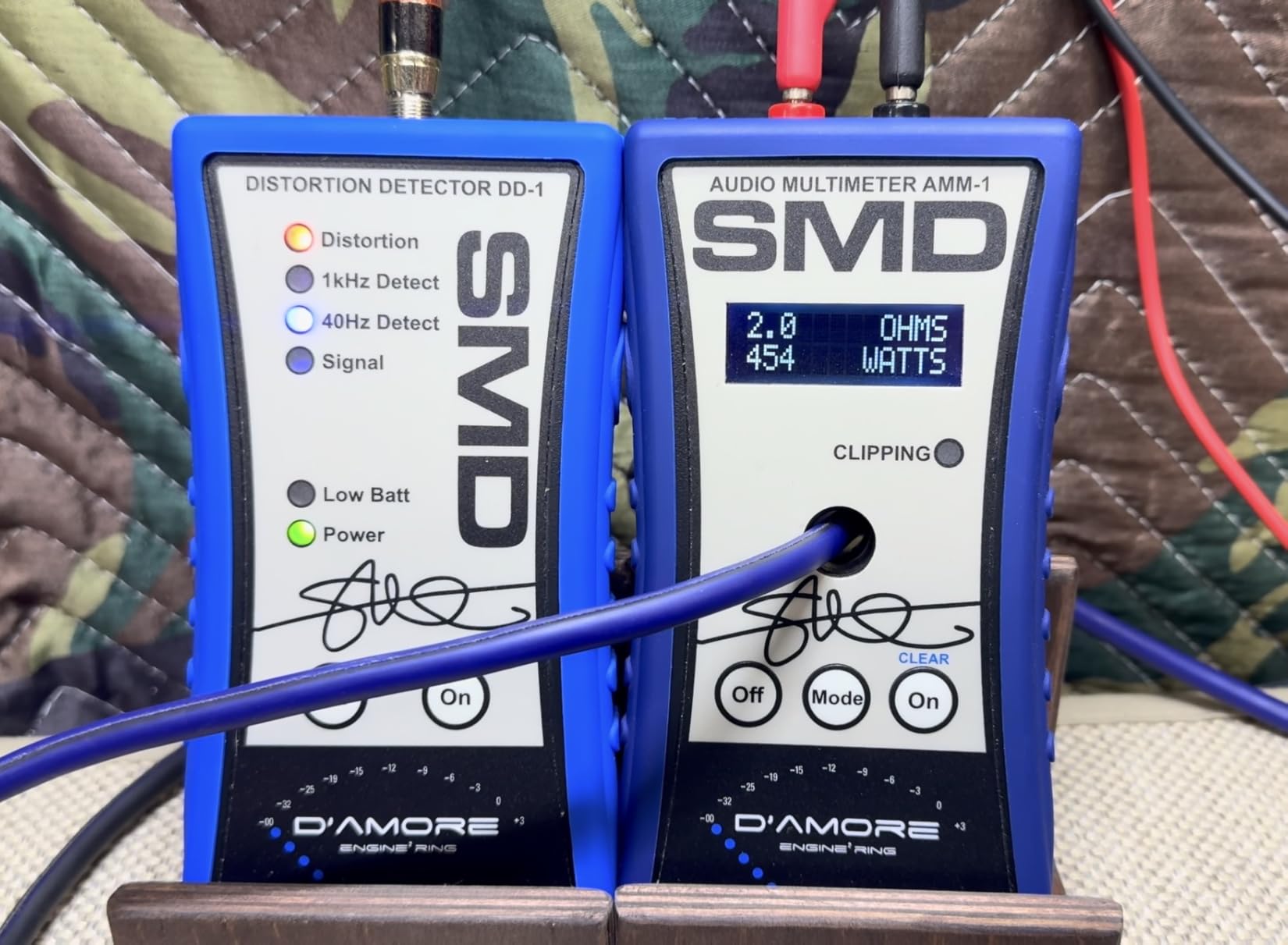
Set gain without clipping. Turn the gain fully down. Put a scope or a multimeter on the speaker terminals, bring the head unit volume to about 90 percent, and raise gain until you see the amp reach its full rail voltage, then back off slightly. On amps with C.L.E.A.N. circuitry this becomes a guided procedure instead of a measurement exercise.
Leave bass boost near zero. Most bass boost circuits are clipped and overloaded. If you use it, keep the level low and reduce the amp gain to match, or you will simply distort more.
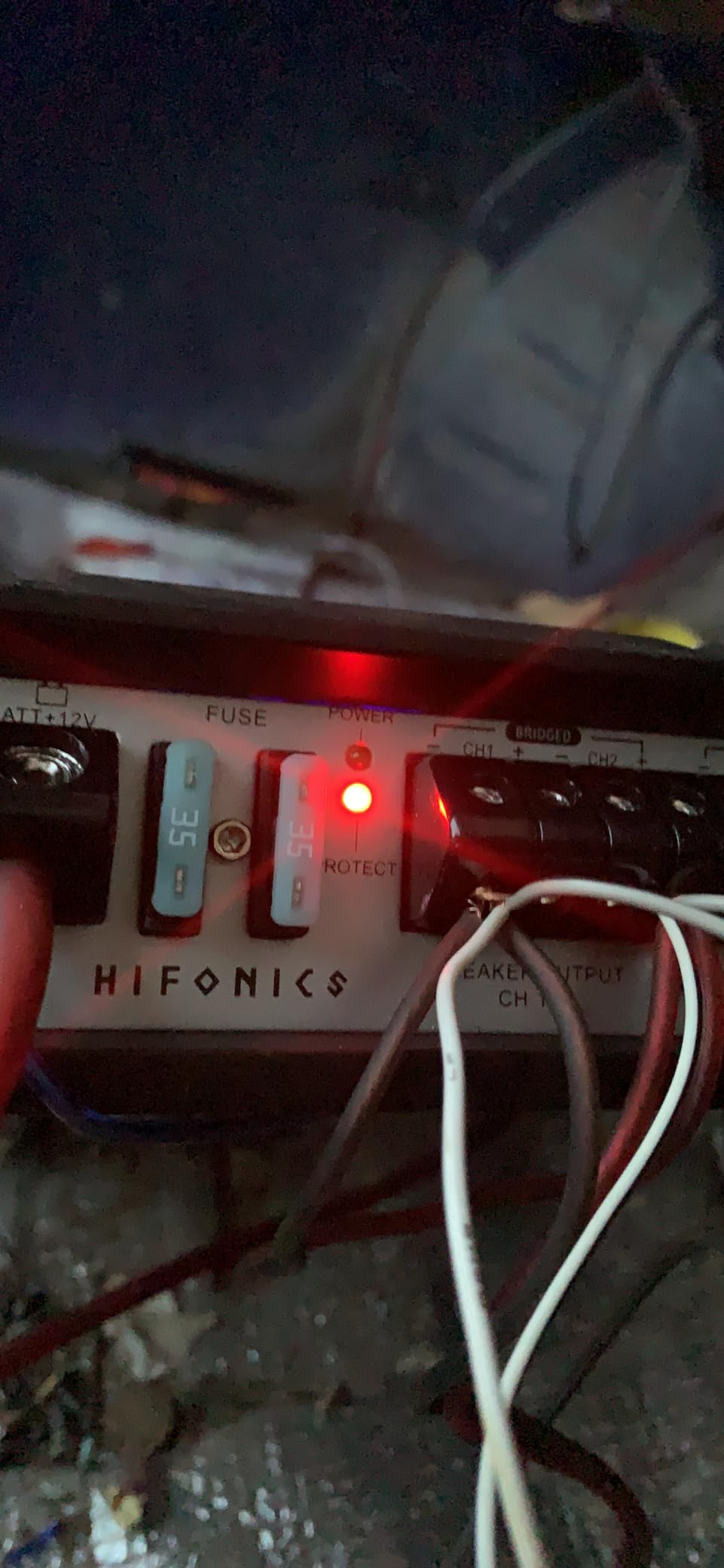
Two diagnostics worth knowing. If you hear feedback or rumble through the subwoofers only, unplug the RCA cables while the system plays: if the noise stops, it is coming through the signal path, and the usual cause is a poor ground or a ground loop between the head unit and the amplifier. If the amp enters protection under load, check the ohm load first, then the fuse, then airflow around the chassis.
Factory Head Units: When You Need a Line Output Converter
Factory head units are the quiet obstacle in most first installs. Many apply a bass roll-off curve that increases as volume rises, so the low end you hear at moderate volume disappears at high volume, and the system sounds thin exactly when you want it loud. The audio signal is also speaker-level rather than line-level, which is not what an amplifier’s RCA input is designed to accept.
A line output converter solves both problems at once. It accepts the speaker-level signal from the factory speakers, turns it into a clean RCA-level feed, and its bass restoration feature rebuilds the low-frequency content the factory curve removed. CarAudio.com regulars and installers on r/CarAV consistently describe an AccuBass-type converter as close to mandatory whenever a factory system is retained, which is why it is worth adding to the install budget rather than treating it as optional.
Some amplifiers in this roundup reduce the need for one. The BOSS R1100M, the Taramps BASS 400 and the Rockford Fosgate P600X4 all accept high-level or speaker-level inputs directly, with automatic turn-on on some. That gets you a working sub quickly. What it does not do is restore the bass curve the head unit applies, so the deep low end will still roll off as you turn it up. If you listen loud, add the converter.
Frequently Asked Questions
Which amplifier is best for a subwoofer?
The BOSS Audio Systems R1100M is the most dependable all-round choice here, rated 4.4 stars across more than 11,000 reviews. It is 2-ohm stable, accepts both RCA and speaker-level inputs, and its 2.25-inch chassis fits under a seat. For the cleanest output and simplest gain setting, the Rockford Fosgate R2-500X1 rates 4.7, the highest average in this group. Pick based on your subwoofer’s RMS rating and the ohm load you will run.
How much power do I need for my subwoofer?
Match the amplifier’s continuous RMS output to your subwoofer’s RMS power rating at the impedance you will run, then add roughly 20 to 30 percent headroom. As a guide, about 400 watts RMS suits a small 8-inch or 10-inch daily-driver subwoofer, 500 to 650 watts RMS suits a single 12-inch, and around 1000 watts RMS at 1 ohm is the starting point for one high-excursion 12-inch running hard. An undersized amp clips at maximum volume, and clipping damages voice coils.
Do I need a mono amp for a subwoofer?
A monoblock is the standard choice because it concentrates all its power into a single low-impedance channel and gives better cone control than a bridged multi-channel pair. A 4-channel amp can work for one modest subwoofer, but the bridged output is usually much lower. In this roundup the Rockford Fosgate P600X4 bridges to 300 watts total, while the Pioneer GM-A3702 reaches 190 watts RMS bridged, so a dedicated monoblock is the right call for anything larger.
Which car amplifier is best for sound quality?
The Rockford Fosgate P600X4 is built for sound quality, with clean Class A/B output that holds clarity at high volume, 4.6 stars, variable 12 dB per octave Butterworth crossovers and RCA pass-through outputs. Among dedicated monoblocks, the Rockford Fosgate R2-500X1 leads with a 4.7 rating, CEA-2006 verified RMS figures and C.L.E.A.N. gain circuitry that prevents clipping during setup. Both suit a daily driver over a competition build.
Do 10 or 12 subs hit harder, and are two 12s louder than one 15?
Cone area and enclosure tuning decide perceived loudness more than the size label alone. A single large 15-inch subwoofer moves more air per excursion, but two correctly wired 12s on a 1-ohm load usually produce more total output and deeper extension than one 12, because output scales with the number of coils being driven. Whichever you choose, the amplifier should deliver the subwoofer’s RMS rating at the final ohm load, and neither configuration substitutes for a properly sized enclosure.
Can I use a 4 channel amp for a subwoofer?
Yes, by bridging a channel pair, but check the bridged figure rather than the per-channel one. The Pioneer GM-A6704 delivers 60 watts RMS per channel at 4 ohms and 190 watts RMS per pair bridged, which suits a single 8-inch or small 10-inch subwoofer. The Rockford Fosgate P600X4 bridges to 300 watts total, enough for a modest 12-inch. Beyond roughly 300 watts for the sub, a dedicated Class D monoblock gives you more power and better thermal headroom.
The Verdict: Which Amplifier Should You Buy
For most people, the BOSS Audio Systems R1100M is the right answer to the question of the best car amplifiers for subwoofers. More than 11k ratings at 4.4, 2-ohm stability, high-level inputs, a remote knob in the box, and a chassis that fits almost anywhere. It is the amplifier we would put in a car with a factory head unit and one modest subwoofer.
If sound quality and accurate setup matter more than raw output, the Rockford Fosgate R2-500X1 wins on rating at 4.7, publishes real RMS figures, and has the easiest gain procedure in the group. For a single high-excursion 12-inch at close to 1 ohm, the CT Sounds CT-1000.1D gives you 1000 watts RMS in a small, cool-running package. For a very tight trunk, the Taramps BASS 400 at 620 grams is hard to beat, and the AUDIOZERONE ZE1000.1 delivers the most continuous power relative to its size.
Whichever you choose, read the RMS figure at your actual ohm load, not the peak number on the lid, and budget for power wire, a proper fuse and a solid ground. Those three details decide whether your system sounds great in a year or trips protection in a month. Our car subwoofer buying guide covers the speaker side of the equation, and updated picks like these land on the blog throughout 2026.