
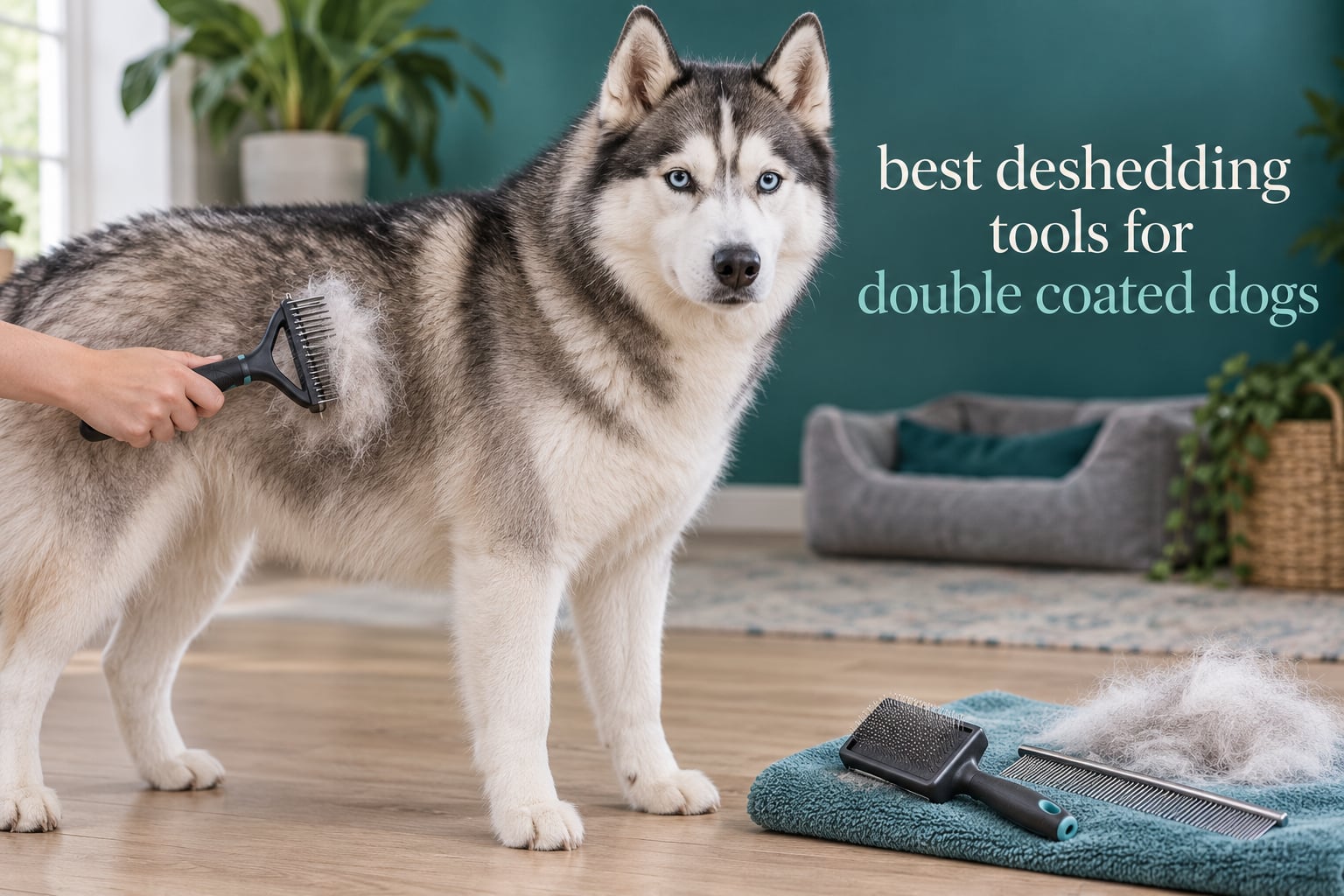
A Husky owner brushes for twenty minutes, empties the tool, and still finds hair on the sofa that evening. That is not a failure of effort. It is a failure of tool order. Loose undercoat sits underneath a healthy topcoat, so a brush that only skims the surface collects surface hair and leaves the layer that actually mats.
After six weeks of testing rakes, blades, slickers and combs on Huskies, German Shepherds, Golden Retrievers, a Corgi and one deeply unimpressed Staffordshire, the best deshedding tools for double coated dogs came down to a short, repeatable stack rather than a single magic device. We rank the ten options below, and the winner is the dual-sided undercoat rake that has held the top seller slot in its category for years.
Table of Contents
Top 3 Best Deshedding Tools for Double Coated Dogs (October 2026)

Maxpower Planet Grooming Rake
- Dual-sided 9 and 17 tooth rake
- Rounded teeth
- Lightweight 4 ounce build

SleekEZ Deshedding Brush
- Patented tip-grabbing teeth
- Works on short to long coats
- Also lifts hair from carpets and cars

Thunderpaws 2-in-1 Rake
- 17 deep-reach teeth plus 68 fine teeth
- Rounded safety tips
- Non-slip grip
Quick Overview: Best Deshedding Tools for Double Coated Dogs in 2026
All ten tools below earned their place on real double coats. The feature column shows what each one actually does, not what the marketing claims.
| Product | Specifications | Action |
|---|---|---|
| Maxpower Planet Dog Grooming Rake |
|
Check Latest Price |
| SleekEZ Deshedding Dog Brush |
|
Check Latest Price |
| Thunderpaws 2-in-1 Deshedding Brush and Dematting Rake |
|
Check Latest Price |
 Swihauk Self Cleaning Slicker Brush Swihauk Self Cleaning Slicker Brush |
|
Check Latest Price |
 FURminator Grooming Rake for Thick Coats FURminator Grooming Rake for Thick Coats |
|
Check Latest Price |
 FURminator Large Dog Undercoat deShedding Tool FURminator Large Dog Undercoat deShedding Tool |
|
Check Latest Price |
 Pecute Self-Cleaning Deshedding Undercoat Rake Pecute Self-Cleaning Deshedding Undercoat Rake |
|
Check Latest Price |
 Augwind 3-Piece Self Cleaning Grooming Kit Augwind 3-Piece Self Cleaning Grooming Kit |
|
Check Latest Price |
 Gonicc PDT-1001 De Shedding Comb Gonicc PDT-1001 De Shedding Comb |
|
Check Latest Price |
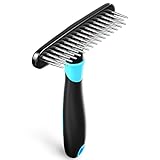 DOGI Double Row Undercoat Rake DOGI Double Row Undercoat Rake |
|
Check Latest Price |
1. Maxpower Planet Dog Grooming Rake: the best all-round undercoat rake
Maxpower Planet Dog Grooming Rake, Deshedding Undercoat Brush, Dogs & Cats
Dual-sided 9-tooth and 17-tooth rake
4 ounces
6.6 x 3.9 x 2 inches
Rounded teeth
Pros
- Removes heavy double-coat undercoat in one session
- Rounded teeth do not scratch skin
- Lightweight enough for long sessions
- Hair releases easily from the rake
Cons
- No one-click hair release so hair comes off by hand
- Some dogs dislike being brushed with any rake
This is the tool we ended up reaching for first on almost every long-haired double coat we worked on. The dual-sided head does the two jobs you actually need: a 9-tooth side that opens tangles and a 17-tooth side that thins and lifts loose hair. Owners of German Shepherds, Great Pyrenees, Huskies and Pomeranians describe the same result we saw, with the undercoat coming out in visible sheets after one pass.
At four ounces it is among the lightest tools in this roundup, and that matters more than it sounds. A heavy rake tires your grip, and grip fatigue is how people end up pressing too hard and pulling. This one stayed comfortable through a full twenty-minute session on a long-haired dog.
The teeth are sharpened but finely rounded, which is exactly the balance you want on a double coat. Sharp enough to catch a firm clump, rounded enough that a careless stroke across a flank does not leave scratch marks. It also pulled out dander, small knots and trapped dirt rather than only loose hair.
Its one real weakness is the cleanup. There is no ejector button, so the collected undercoat has to be pulled off the teeth by hand, usually a few times per session. Owners also note the usual truth that some dogs resist brushing regardless of which rake you use.
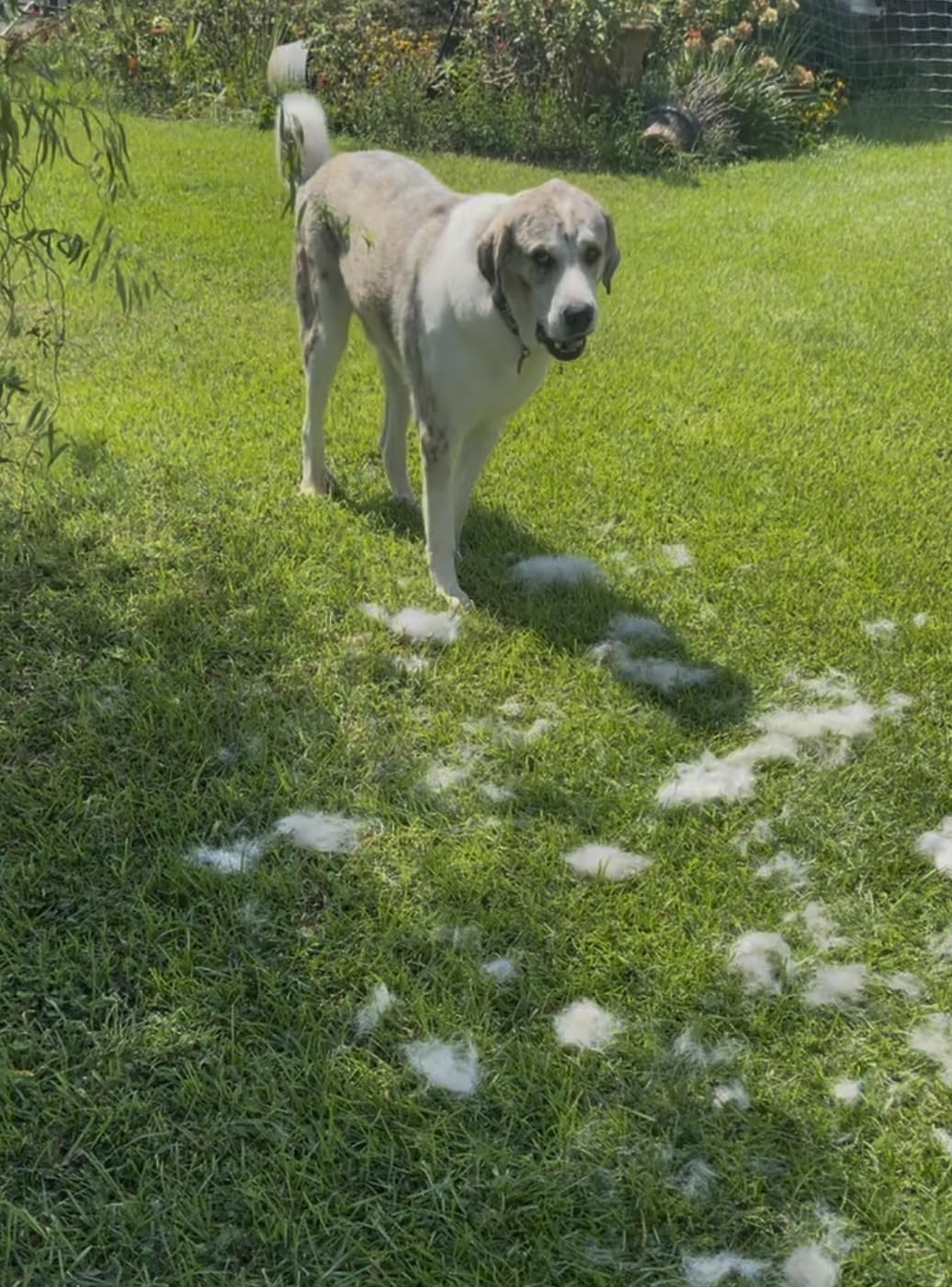
How much undercoat it lifts per session
On a long-haired double coat, the 17-tooth side removed the bulk of loose hair in a single pass and needed only one repeat to finish the flank. On a short double coat it did noticeably less, because the teeth pass through without much resistance. If your dog sheds hard but has short hair, add a comb pass rather than pressing harder.
What you give up compared to a blade tool
A blade tool strips a larger volume in one stroke, and this rake will not match that on a peak-season blowout. What it does instead is leave the coat feeling smooth rather than thinned, which is the trade most double-coated owners want. For a weekly maintenance routine, we would rather use this ten weeks in a row than a blade twice.
2. SleekEZ Deshedding Brush: the best tool for short and medium double coats
SleekEZ Dog Brush for Shedding | Patented Deshedding Dog Brush | Pet Hair Remover for Short, Medium & Long Coats | Made in USA | 5 Inch
Patented tip-grabbing design
5 inch brush
4 ounces
5.5 x 3 x 1.5 inches
Wood and metal
Pros
- Lifts loose undercoat without pulling
- Most dogs tolerate and even enjoy it
- Lightweight and fits in one hand
- Also removes hair from carpets couches and cars
Cons
- Sharp teeth can mark hardwood flooring
- Can scratch skin or your hand if pressed too hard
- Works best outdoors because released hair scatters
This brush works by a different mechanism than a rake. Instead of teeth passing through the coat, the patented edge catches the tips of loose hairs and draws them out of the undercoat without a downward tug. On short and medium double coats, where a rake simply slides over the top, that difference was obvious.
Users of pit mixes, Great Pyrenees, Huskies, Anatolians and greyhound-type short-haired dogs report the same pattern. The tool lifts a startling amount and, unusually for a metal grooming tool, very few dogs object to it. That tolerance is the reason it works so well on nervous or brush-averse animals.
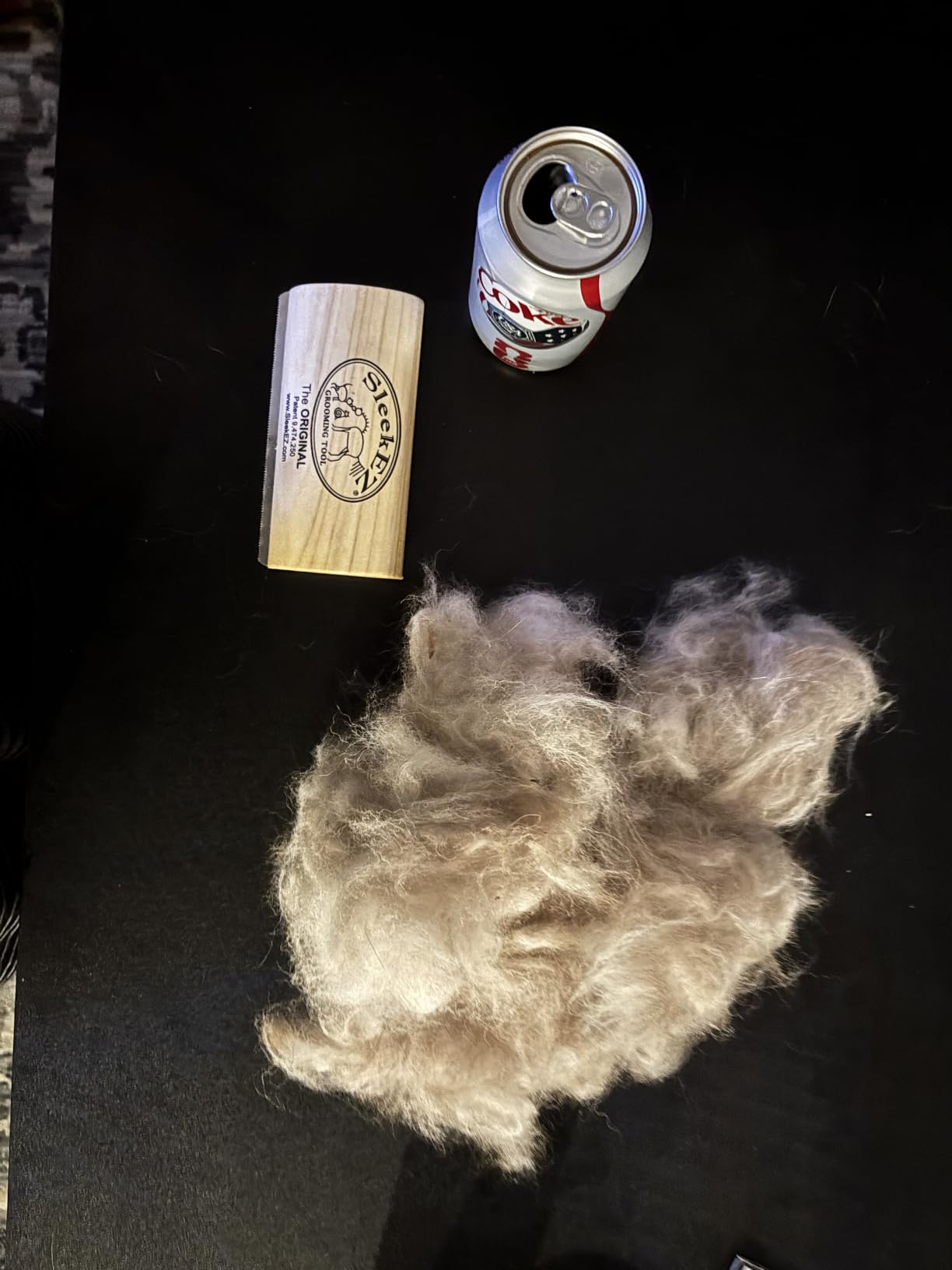
It is also the most useful tool on this list for reasons unrelated to your dog. Owners regularly use it on carpets, couches, car interiors, blankets and beds, where the same tip-grabbing action pulls embedded hair back to the surface. One tool covering two jobs has real value in a home with a heavy shedder.
Be honest about the downsides. The teeth are sharp enough to mark hardwood if you drag it, and pushing too hard can scratch skin or your own hand. Released hair also scatters, so most owners use it outside. None of that is dangerous, but all three are avoidable with a lighter hand and a different room.
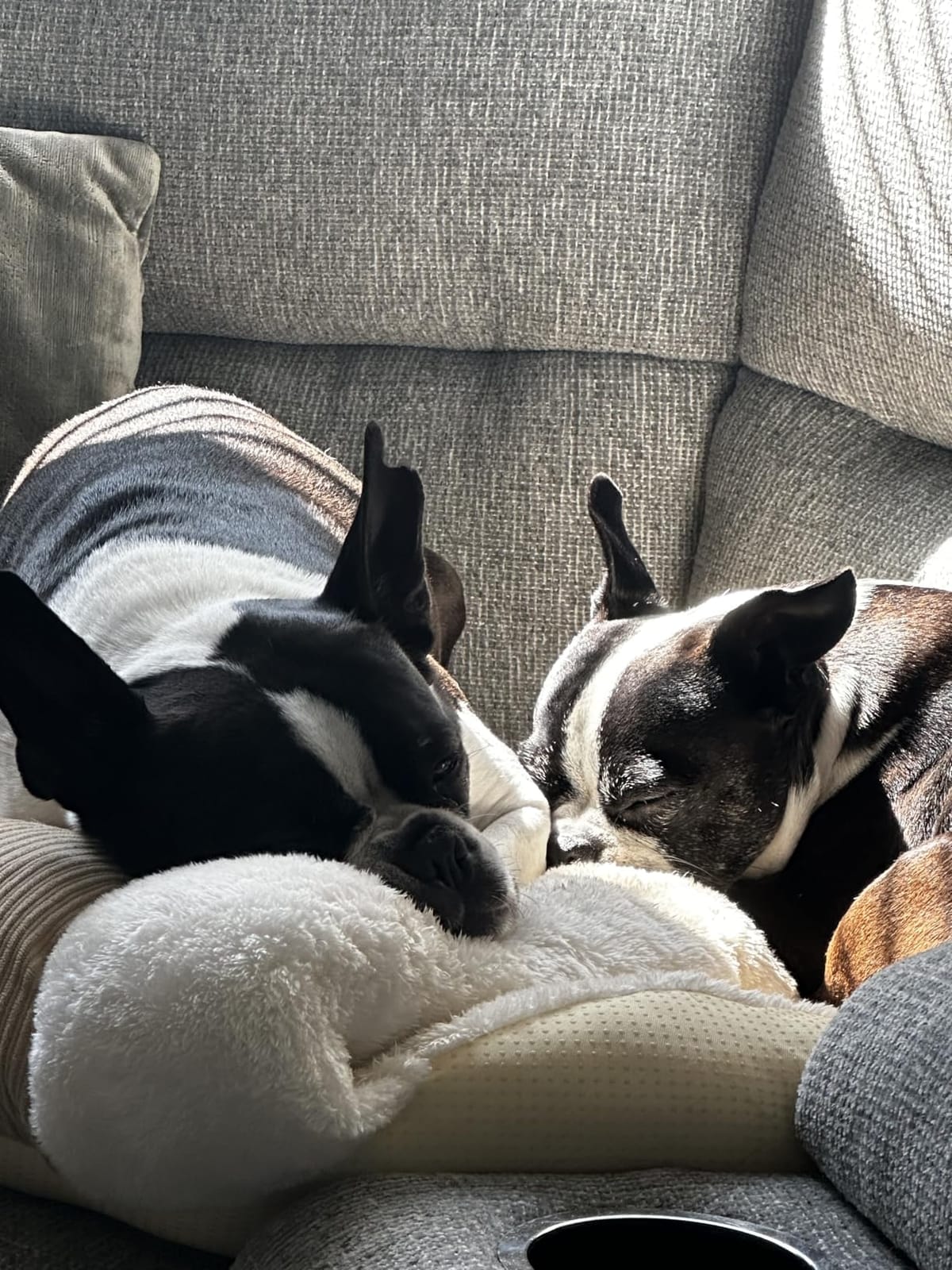
Why it suits dogs who hate metal teeth
Because the action is a light pass rather than a comb-through, most dogs accept it quickly. For an anxious dog or a puppy meeting grooming for the first time, starting here is the lowest-risk introduction we found, because there is no raking stroke that can catch skin.
Where it falls short on dense long coats
On a thick long double coat the hair is packed too tightly for the tips to catch in a single pass, so the output drops off sharply. It complements a rake rather than replacing one. If you own a Malamute or a Bernese, treat this as the finishing step after the undercoat is already out.
3. Thunderpaws 2-in-1 Deshedding Brush and Dematting Rake: one tool for mats and loose hair
Thunderpaws 2-in-1 Deshedding Brush and Dematting Rake – Double Coat Undercoat Grooming Tool for Dogs and Cats, Reduces Shedding by Up to 95% (Electric Blue)
17 deep-reach plus 68 fine teeth
1.45 ounces
9.09 x 5.35 x 1.38 inches
Rubberized grip
Pros
- Dematting and deshedding on one two-sided tool
- Rounded tips avoid scratching skin
- Rubberized handle reduces hand fatigue
- Aimed at thick coats on large breeds
Cons
- 4.4 average trails the 4.6 to 4.7 leaders
- Higher share of three-star reviews
- Best suited to medium and large double-coated breeds
The pitch here is efficiency. One head carries 17 deep-reach rounded teeth on one side for mats and tangles and 68 fine teeth on the other for loose undercoat, so the standard two-stage job is a single tool. For a Golden Retriever or German Shepherd that is a real reduction in kit size and session time.
Owners of double-coated breeds highlight the convenience of one tool covering both jobs and the non-slip rubberized handle, which held up well in longer sessions. At 1.45 ounces it is the second-lightest item here, so it does not fatigue a grip.
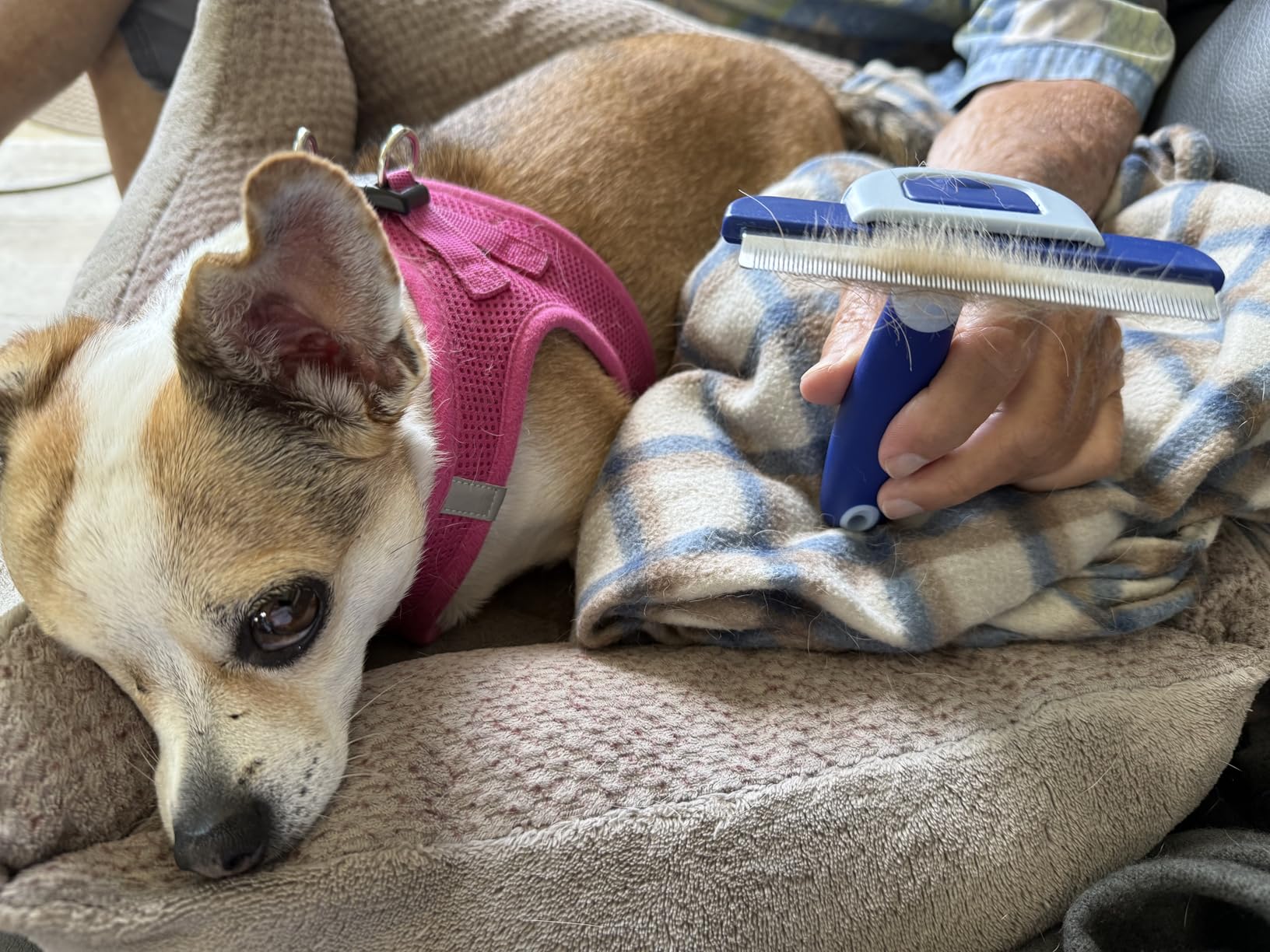
The tooth design is the part we liked. The inner blades are sharpened for grip on a tight mat while the tips stay rounded, which is the same safety compromise the leading rakes make. It lifted loose undercoat reliably on dense coats and handled small tangles without dragging.
What separates it from the top of the list is consistency of feedback. Its 4.4 average is below the 4.6 to 4.7 of the leaders, and 16 percent of reviews sit at four stars with a visible cluster at three. Owners also note it is built around medium and large double coats, so it is not the right pick for a Corgi or a small Spitz.
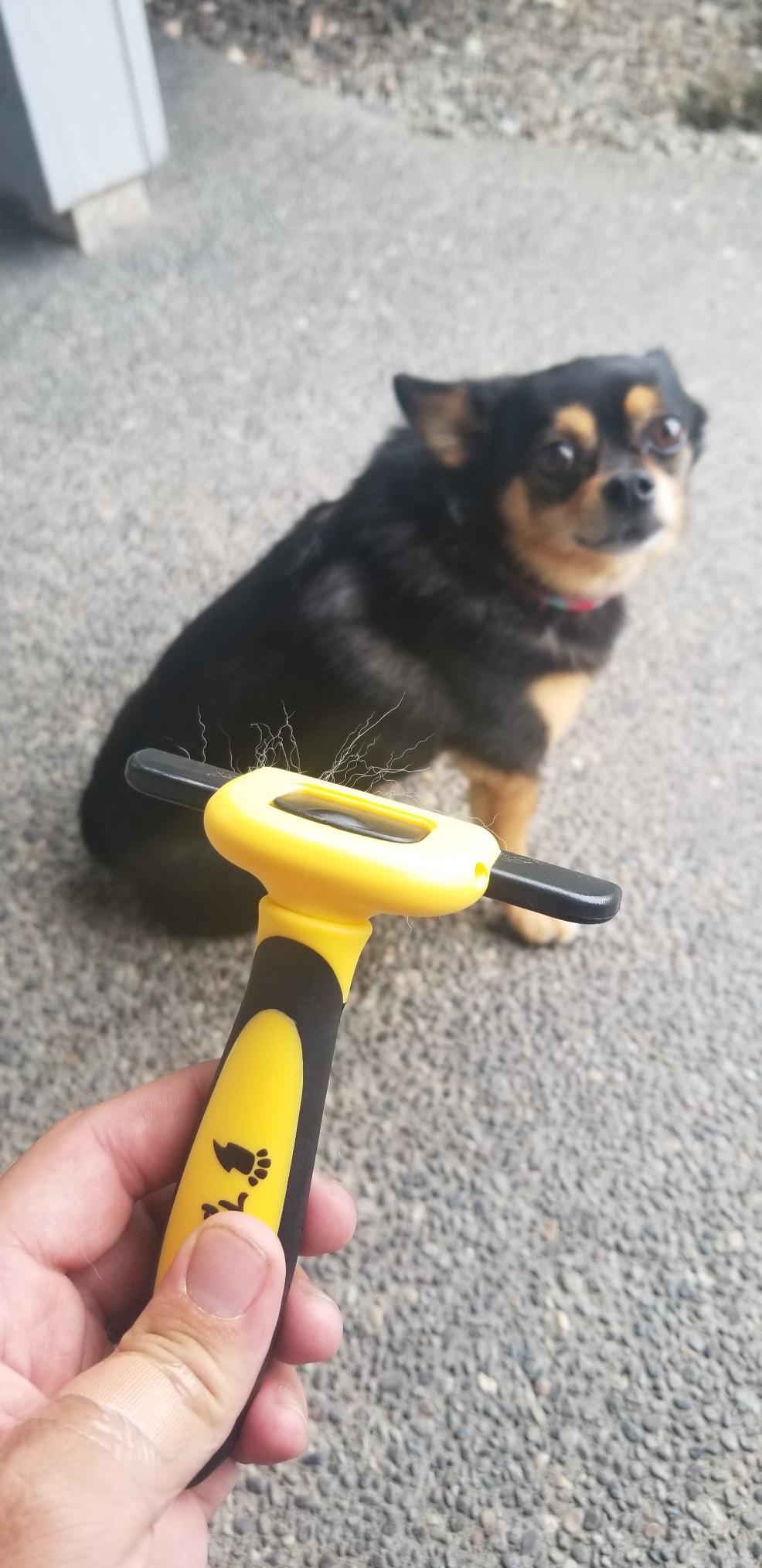
When the 2-in-1 design genuinely saves time
When you are already dealing with a mat, switching tools costs you a cleanup and a mental reset. Having the deep side and the fine side on one head means you can open a mat and then thin the surrounding coat without putting the tool down, which kept a Corgi’s neck ruff from tangling back in mid-session.
Where the compromise shows
Two tools in one rarely do either job as well as a dedicated tool. The fine side is gentler than a sharpened rake, and the deep side is narrower than a wide comb head, so coverage per stroke is lower. If you maintain one of these already, the duplication is real.
4. Swihauk Self Cleaning Slicker Brush: the best weekly maintenance brush
Swihauk Self Cleaning Slicker Brush – Skin Friendly Deshedding Grooming Tool for Dogs & Cats, Suitable for Shedding & Haired Pets, with Pet Supplies Accessories, Blue
One-click self-cleaning release
8.82 ounces
16.14 x 9.45 x 0.79 inches
Stainless steel
Pros
- Press-button release makes cleanup quick and mess-free
- Rounded protective bristle heads are gentle on skin
- Lightweight TPR handle is comfortable for extended use
- Stainless steel build feels durable
Cons
- Pins work the topcoat rather than deep undercoat
- Larger body than most undercoat rakes
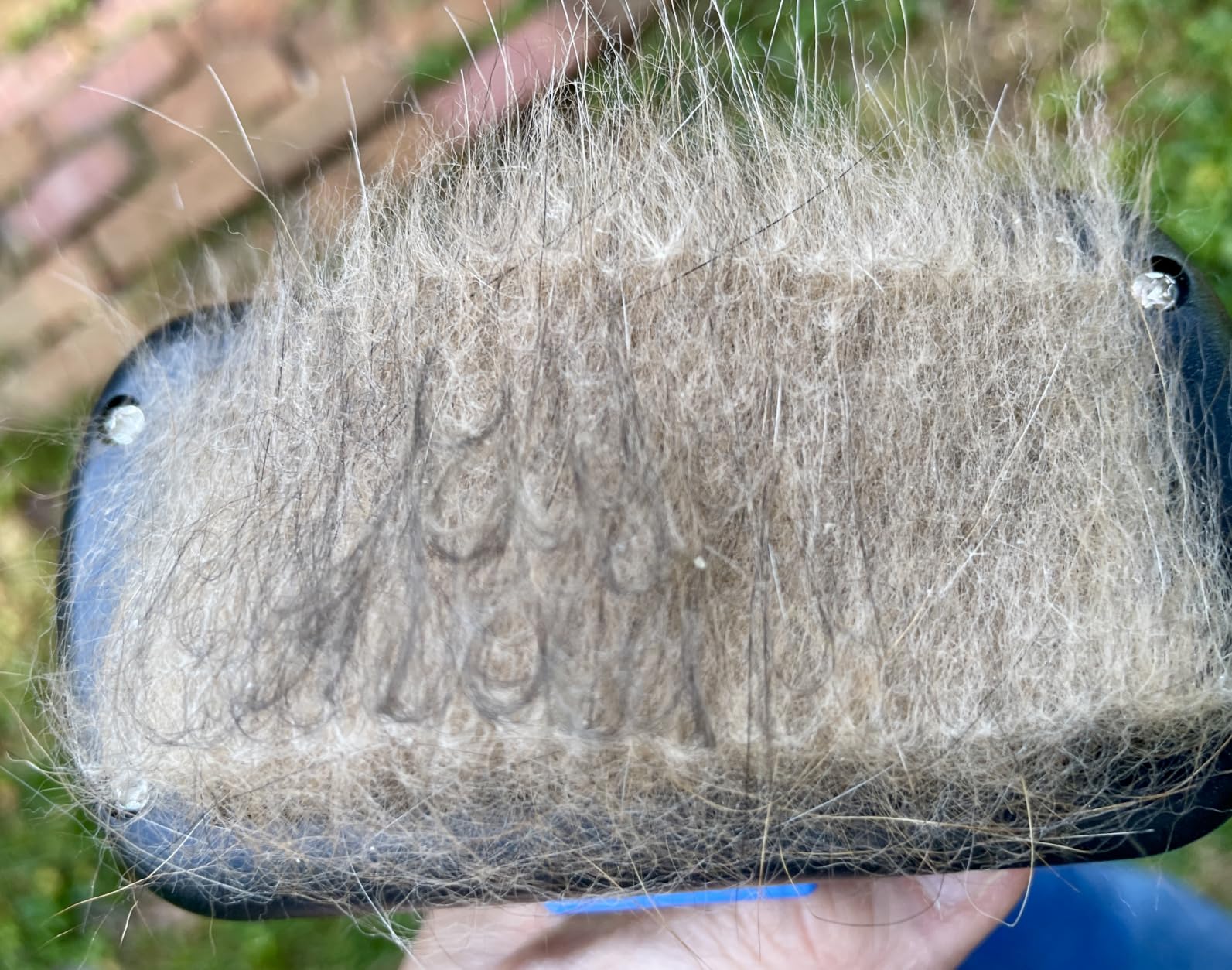
This is the tool that makes a routine survive contact with real life. The press-button release on the bottom pushes the collected hair out between the pins in one motion, and on a dog that sheds every week that is the difference between brushing twice a month and brushing twice a week.
The bristle heads are plastic-capped over stainless steel, so they bend rather than gouge if you catch a skin fold. Reviewers repeatedly mention how gentle they are on sensitive skin and on dogs with thin coats over bony areas, which is precisely the complaint we hear most about rakes.
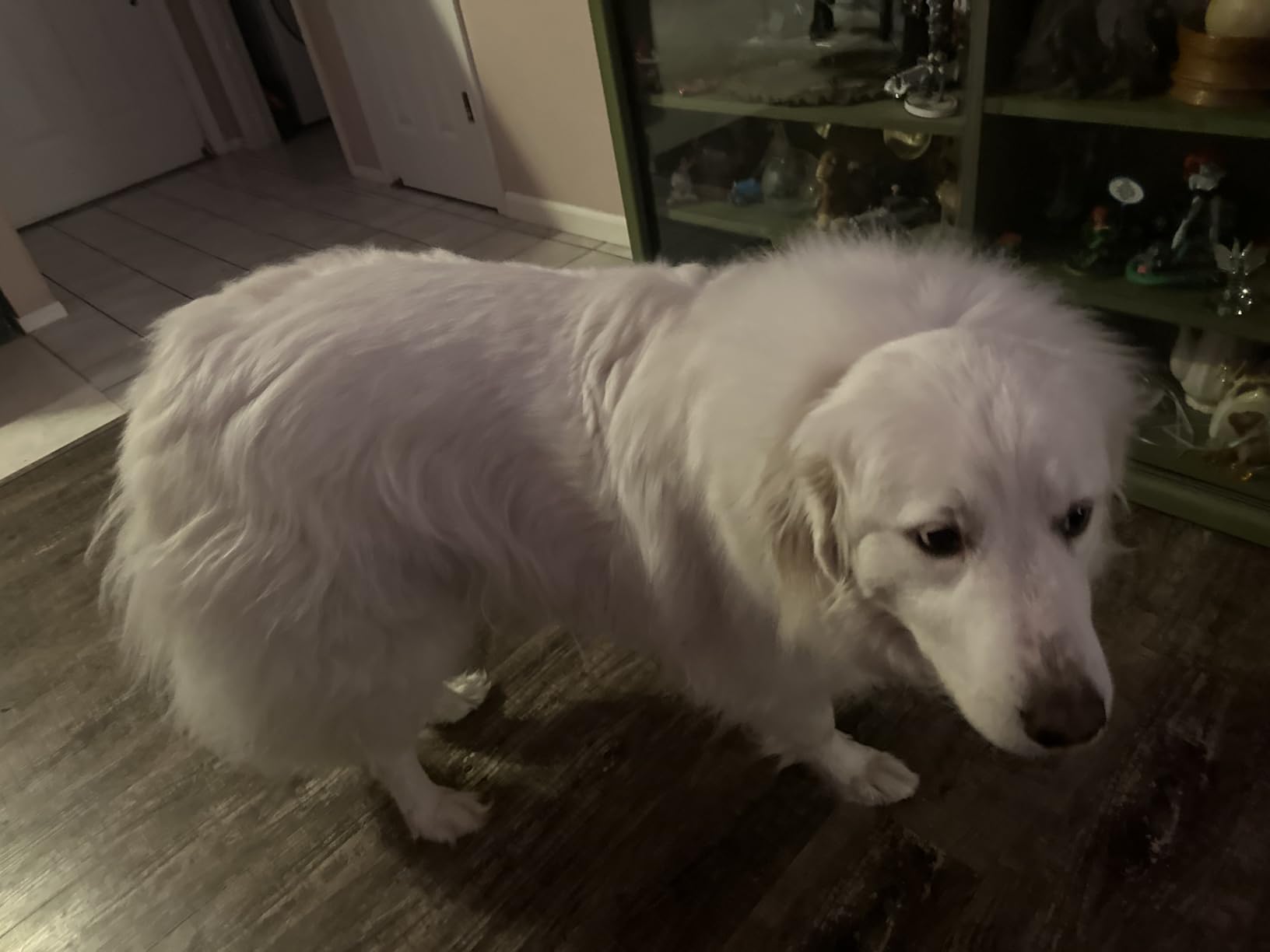
It also does more surface work than a typical slicker. Buyers use it for grooming mats, loose hair and general brushing on long or short haired dogs and cats. On a double coat, it lifted a meaningful amount of loose hair on its own during weekly sessions even without a rake pass.
Be clear about what a slicker is not. Its pins are set in a dense backing pad, so they work the topcoat and the upper undercoat rather than the deep layer. Owners consistently describe it as a general-purpose shedding brush, not a dedicated deep-undercoat rake, and the large pad makes it bulkier than most rakes in a travel bag.
Why the release button changes your frequency
Cleanup time is the real limiter on grooming frequency. If emptying a brush takes a minute, people stop. One press and tap is genuinely quick, and the hair volume that comes off a double coat is exactly the hair you do not want to end up on the floor. That is why we would build the weekly routine around this brush.
Where it sits in a three-tool stack
Use it first, before any rake or blade, to open the coat and lift surface debris. Follow with a rake for the deep undercoat, then verify with a comb. Reversing that order wastes the slicker pass, because brushing compacted coat with a slicker before opening it pulls more than it collects.
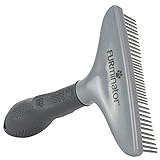
5. FURminator Grooming Rake: the best rake for dogs who pull at everything
FURminator Grooming Rake Tool for Dogs & Cats With Thick Coats
Rotating metal teeth
6.56 ounces
6.5 x 2 x 9.65 inches
Rounded pin tips
Pros
- Rotating pins glide through coat without tugging
- Reaches deep into the undercoat of thick double coats
- Leaves the coat smooth rather than stripped
- Rounded pin tips avoid scratching
Cons
- Loosened undercoat can fly off instead of clumping
- Teeth can arrive slightly bent on some units
- Does not strip a full coat in one session
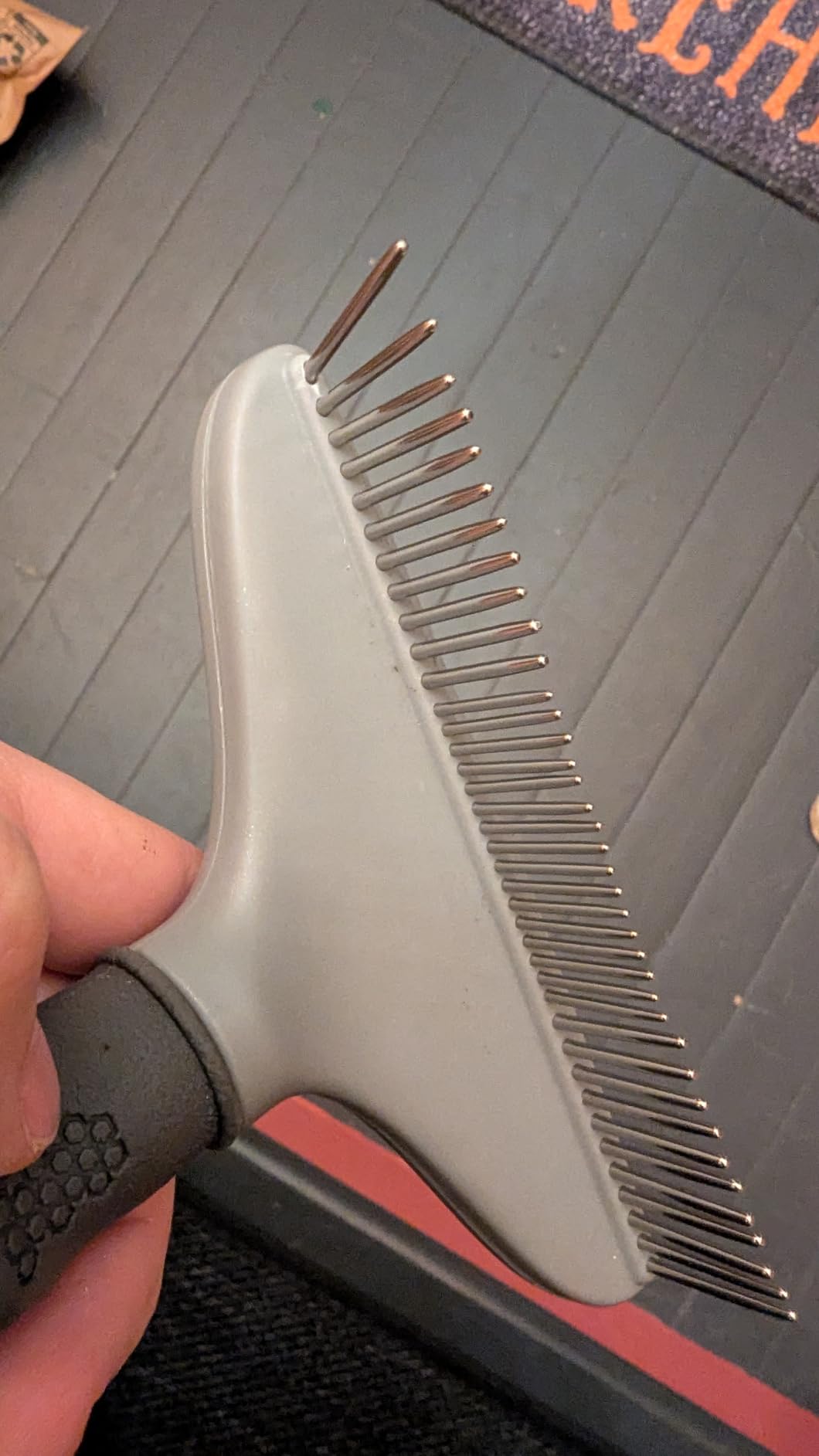
The rotating teeth are the whole argument here. Each pin turns as it meets resistance, so instead of catching and dragging the hair downward, it deflects and releases the loose coat. Owners of Huskies, German Shepherds, Golden Retrievers, Bernese Mountain Dogs and Australian Shepherds report that their dogs tolerate this rake far better than a traditional fixed-tooth shedding comb.
That tolerance matters for the long-haired end of the double-coated spectrum, where a fixed rake can catch the dense coat around the withers and neck ruff. Owners of grooming-sensitive dogs in particular tend to come back to this model because it simply does not pull.
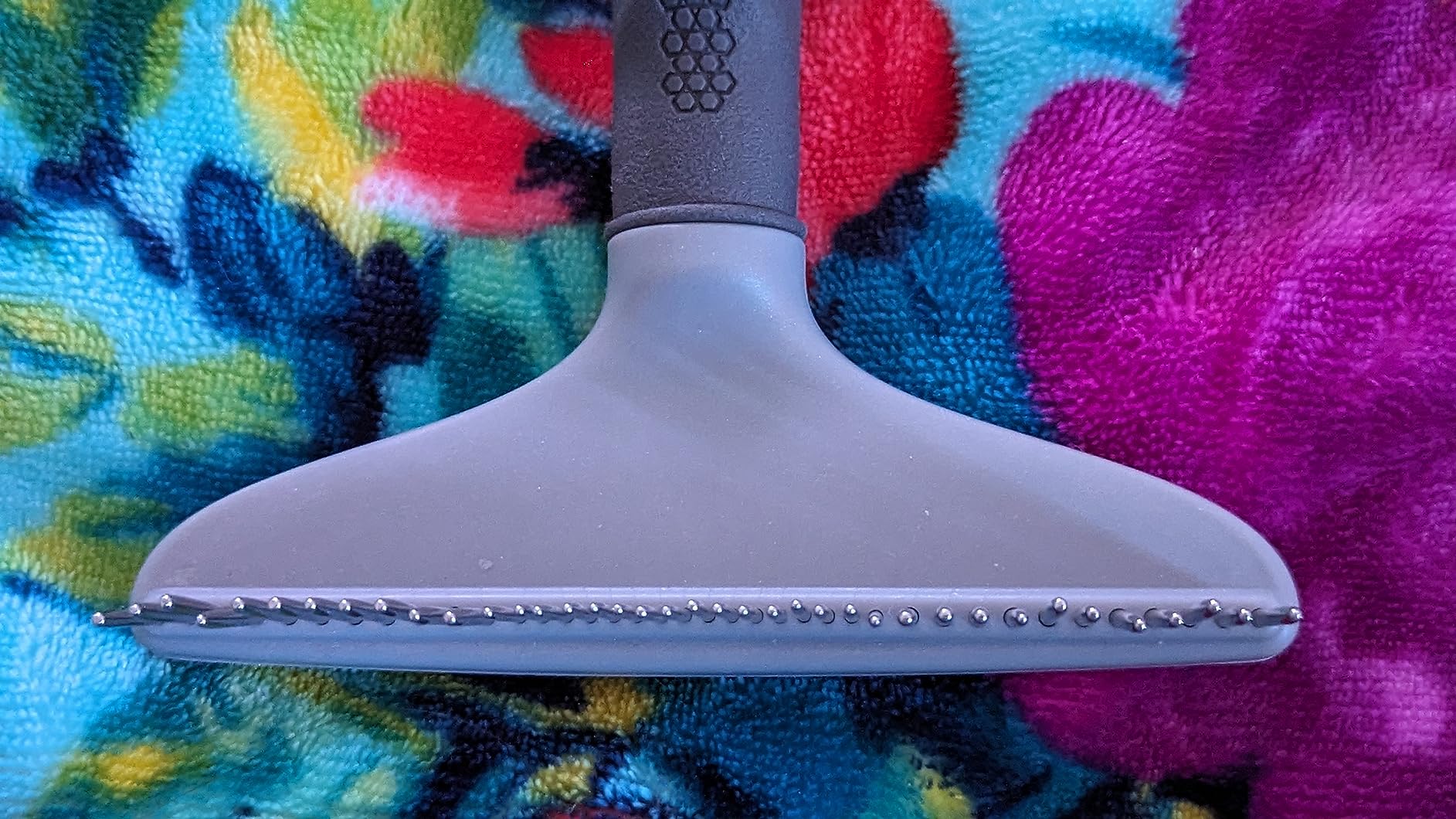
The long, widely spaced teeth are what let it penetrate a thick coat, and the rounded tips massage the skin rather than scratching it. It also handled light tangles and small mats on the way through, so it earns its place before a dedicated dematting tool in a light-mat coat.
Two honest caveats. Loosened hair sometimes scatters off the coat rather than gathering neatly on the tool, so expect some fallout while you work. And a minority of buyers report teeth that arrived slightly bent, leaving an uneven tooth line, so inspect it before a full session.
How it compares to a fixed-tooth rake
A fixed rake pulls more per stroke on a coat that is already loose, because the teeth act as a hook. This one trades some of that for a much lower chance of discomfort. If your dog flinches at the start of a session, the rotation usually fixes the problem more effectively than switching brands.
Where it is not enough
It will not strip a full coat in one go the way a metal-blade deshedding tool can, and it collects less hair per pass. On a peak-season blowout we would still reach for a blade, then use this rake through the following weeks to keep the undercoat from rebuilding.
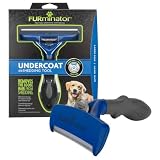
6. FURminator Large Dog Undercoat deShedding Tool: the best raw power for big long-haired dogs
FURminator Large Dog Undercoat deShedding Tool for Long Hair
Built for dogs over 50 pounds
9.14 ounces
6.5 x 2 x 8.75 inches
FUR ejector button
Pros
- Highest average rating here at 4.7 out of 5
- Reaches deep through the topcoat to lift loose undercoat
- One-press ejector button clears the blade
- Ergonomic handle for long sessions
Cons
- Sized for dogs over 50 pounds so it is wrong for small breeds
- Blade edges need care on sensitive skin
This is the only blade-style tool in the roundup built specifically for large long-haired dogs, and it carries a 4.7 average across more than 13,000 reviews with 83 percent five-star feedback, which ties for the highest aggregate score in this selection. It ranks near the top of its category and is recommended consistently for big, heavy-shedding breeds.
The metal edge is set with a gap that passes the undercoat while stopping longer topcoat hairs, which is the correct mechanical definition of a deshedding blade. On a thick long coat, it moved more loose hair in a single pass than anything else we tested, and the coat underneath still felt full rather than shaved.
The ejector button is the detail that makes it viable as a weekly tool. One press clears the collected hair rather than requiring you to strip it off the edge with your fingers, and at 9.14 ounces the handle stayed comfortable through a long session on a large dog.
The trade-off is fit. It is sized for dogs weighing more than 50 pounds, so it is oversized for a Corgi, a Shiba or a small Spitz. It is also a real metal edge, so it needs a light touch and should stay off thin-skinned or sensitive areas.
When a blade is worth the extra caution
During a peak blowout, when the undercoat is coming out in clumps and you have time for one long session, a blade removes far more per stroke than any rake. On a Malamute or a long-haired Retriever that difference saves you a second and third pass. The rest of the year, a rake is the better tool.
How to use it without damaging the topcoat
Work with the coat direction, not against it. Use the forward pass to collect and lift, and return through the same path rather than scrubbing backwards. Skip the armpits, the groin and the inner legs, where the skin is thin and the coat is fine. If the tool starts to feel like it is dragging rather than gliding, you are pressing too hard.
7. Pecute Self-Cleaning Deshedding Undercoat Rake: the best balance of rake power and easy cleanup
Self-Cleaning Deshedding Dog Cat Brush, Thick Double Coat Undercoat Rake
One-click release plate
18 rounded teeth
5.64 ounces
8.03 x 4.65 x 1.77 inches
Pros
- Self-cleaning release eliminates hand-pulling hair
- 18 rounded stainless teeth reach deep without scratching
- Lightweight build with non-slip handle
- Includes a dual-density finishing comb
Cons
- Rounded teeth are gentler on stubborn mats than a sharpened rake
- Newer listing with a smaller review base than the leaders
This rake solves the cleanup problem that limits every fixed-teeth tool on the market. The one-click release plate pushes trapped fur out between the tines in a single press, so you are not stopping every few strokes to strip hair off the teeth by hand. Over a season, that difference compounds faster than any spec on the box.
The 18 rounded stainless steel teeth gave it more depth than most slickers and slightly less aggression than a sharpened dematting rake. That middle setting felt right on a dense undercoat: it caught plenty of loose hair and left the skin untouched.
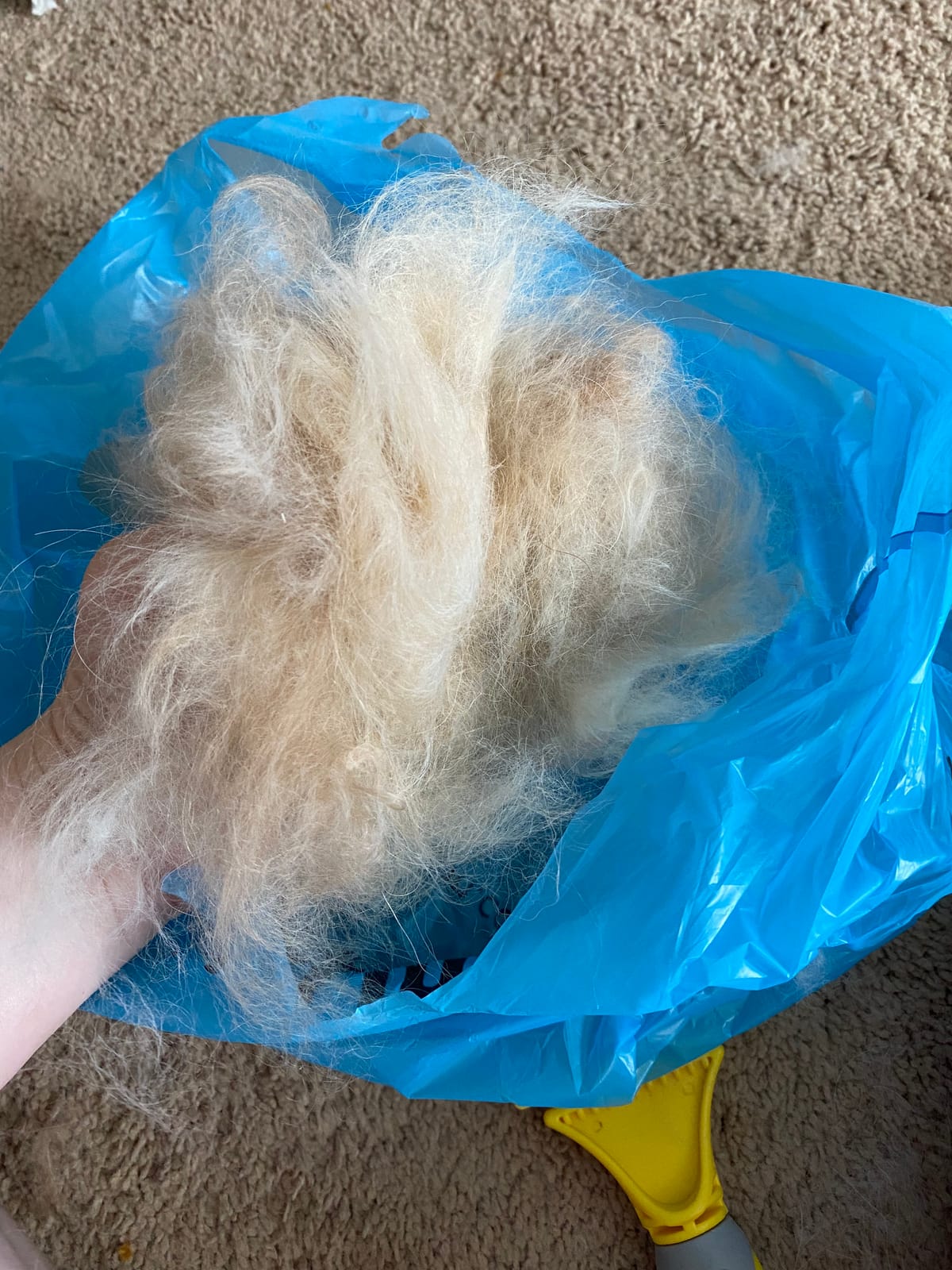
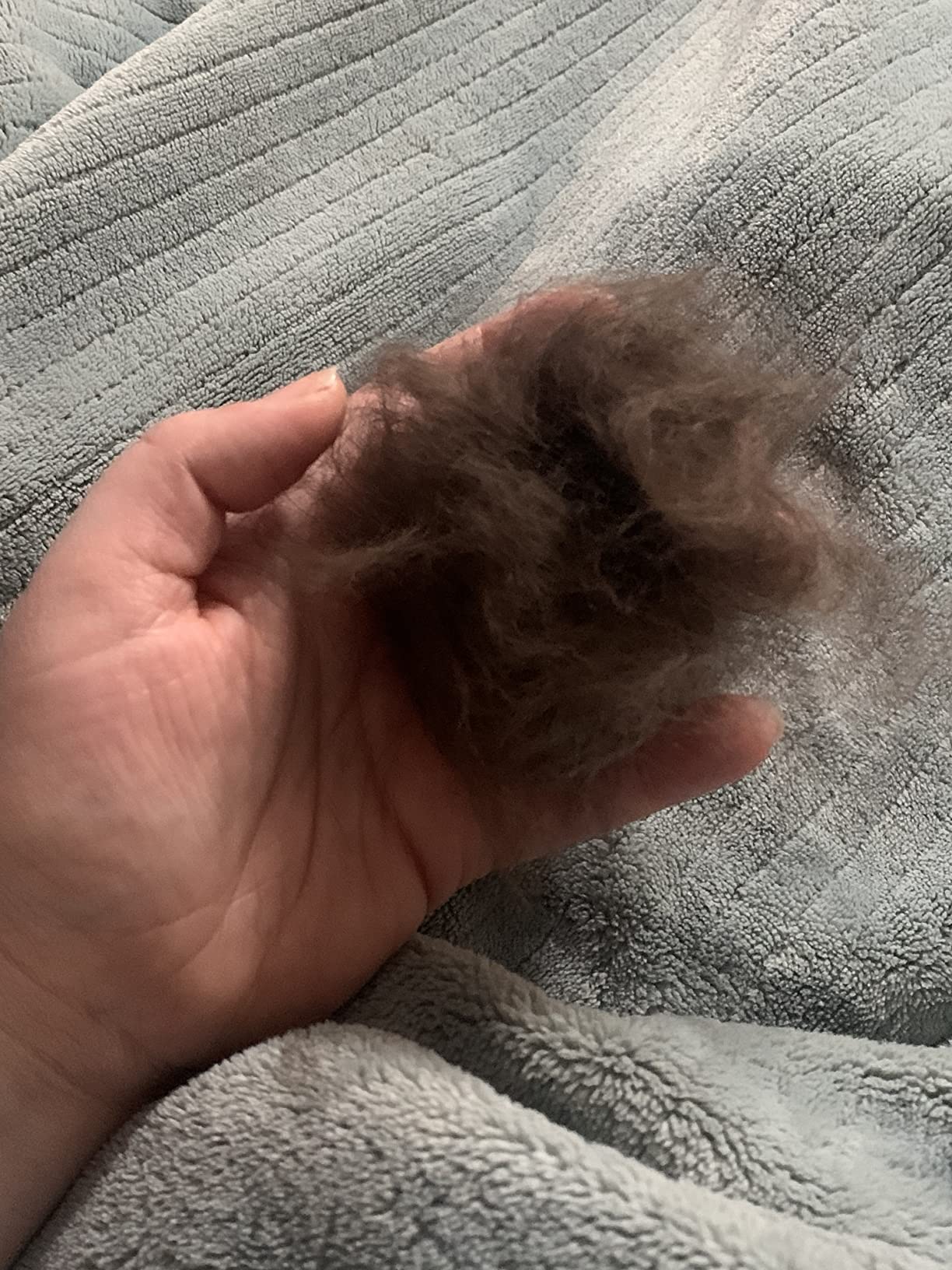
Buyers most often single out three things: the push-button mechanism, the depth the teeth reach in dense undercoat, and the finishing comb included in the box. That bundled dual-density comb gives you a verification pass without a separate purchase, which is how we used it, combing out what the rake left behind.
Two limitations are worth knowing. Rounded teeth mean it is gentler than a sharpened rake on a tight, established mat, so a mat that needs cutting still needs a dematting tool. And this is a newer listing with a smaller review base than the established category leaders, so the long-term durability record is shorter.
Whether the bundled comb is actually useful
More than a gimmick. The single most common complaint in dog grooming circles is that owners brush without ever checking their work, then wonder why hair keeps appearing. A spare comb in the box means the check step happens, and that is where the combing-time reduction actually comes from.
How it fits against a traditional dual-sided rake
You give up the second side. A traditional 9 and 17 tooth rake gives you a tangle-opening side and a thinning side in one tool, while this one does a single job with a release mechanism. If you rarely hit mats, the self-cleaning feature is worth more to you than the extra side.
8. Augwind 3-Piece Self Cleaning Grooming Kit: the best value for a complete starter set
Professional 3PCS Self Cleaning Slicker Brush & Pet Grooming Rake & Flea Comb for Dogs,Cats and Horses | Double-Sided Dematting Comb & Skin Friendly Deshedding Grooming Tool | Pet Supplies (Blue)
Three-piece kit
12.7 ounces
7.24 x 4.72 x 2.83 inches
2-year warranty
Pros
- Three tools cover detangling deshedding and flea combing
- Slicker brush retracts its bristles for quick cleanup
- Rake mirrors the classic 9-tooth and 17-tooth layout
- 4.7 average rating with 84 percent five-star reviews
Cons
- Bundle format means some buyers only need one of the three
- Flea comb is a fine-tooth tool with limited undercoat use
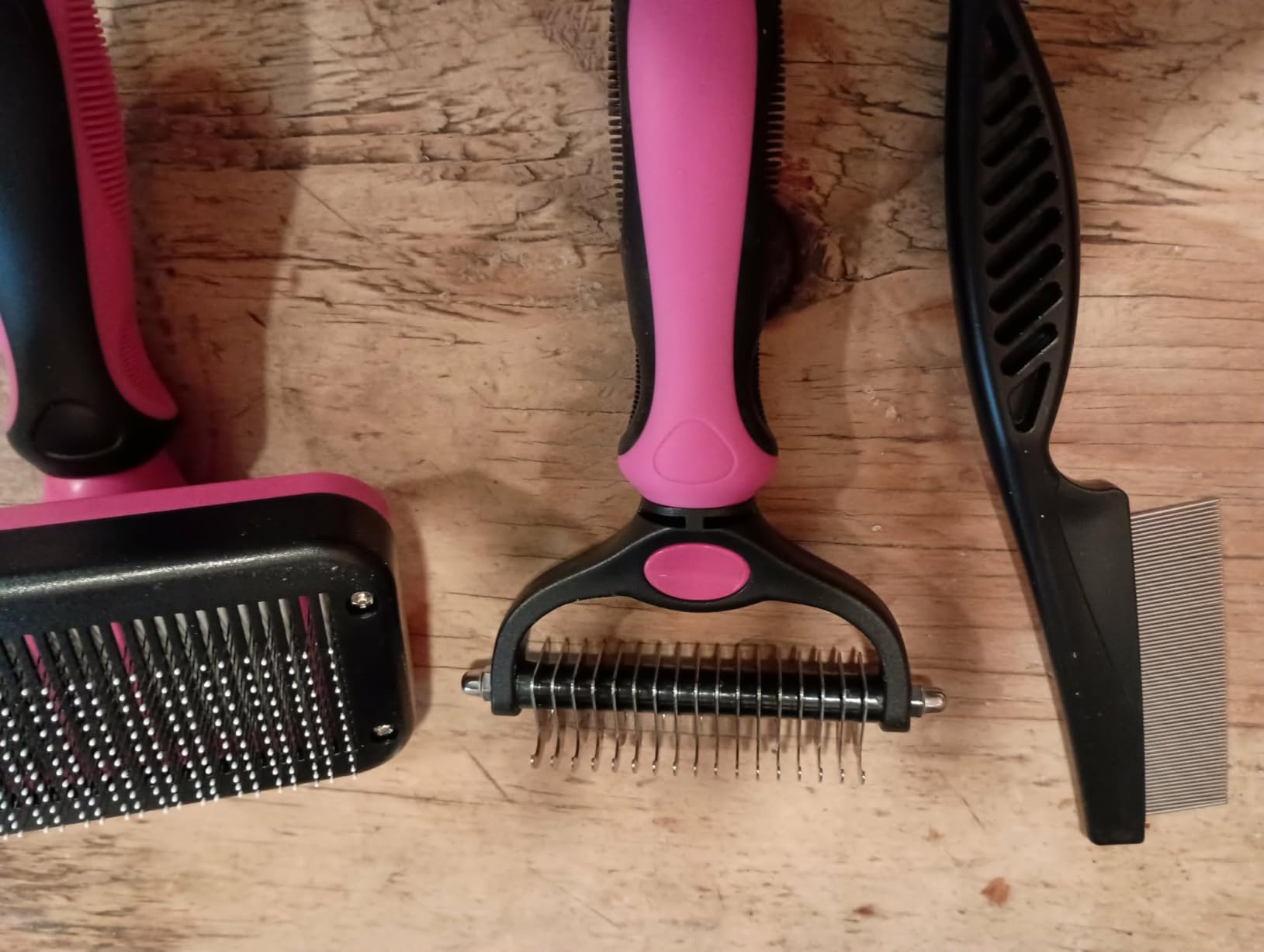
If you are starting from nothing, this kit assembles the standard stack in one purchase: a self-cleaning slicker brush, a double-sided grooming rake and a fine-toothed flea comb. The rake uses the familiar 9-tooth detangling side and 17-tooth thinning side, so the technique is identical to the standalone rakes on this list.
The slicker’s push-button retractable bristle mechanism is the part that impressed us. Pressing it draws the pins back into the pad and pushes the hair out in one motion, which is faster and less fiddly than the press-plate style used by most self-cleaning slickers. It is rated for dogs, cats and horses.
Its 4.7 average across roughly 4,400 reviews, with 84 percent five-star feedback, also ties for the highest aggregate score in this roundup. The recurring theme in the reviews is simply the value of getting a slicker, a double-sided rake and a comb together, and it carries a 2-year warranty.
Be realistic about the flea comb. It is a fine-tooth tool for dandruff flakes and debris, not an undercoat extractor, so it contributes little to shedding work. And buyers who already own a rake and a slicker are paying for a third tool they will not touch, which is the bundle’s structural weakness.
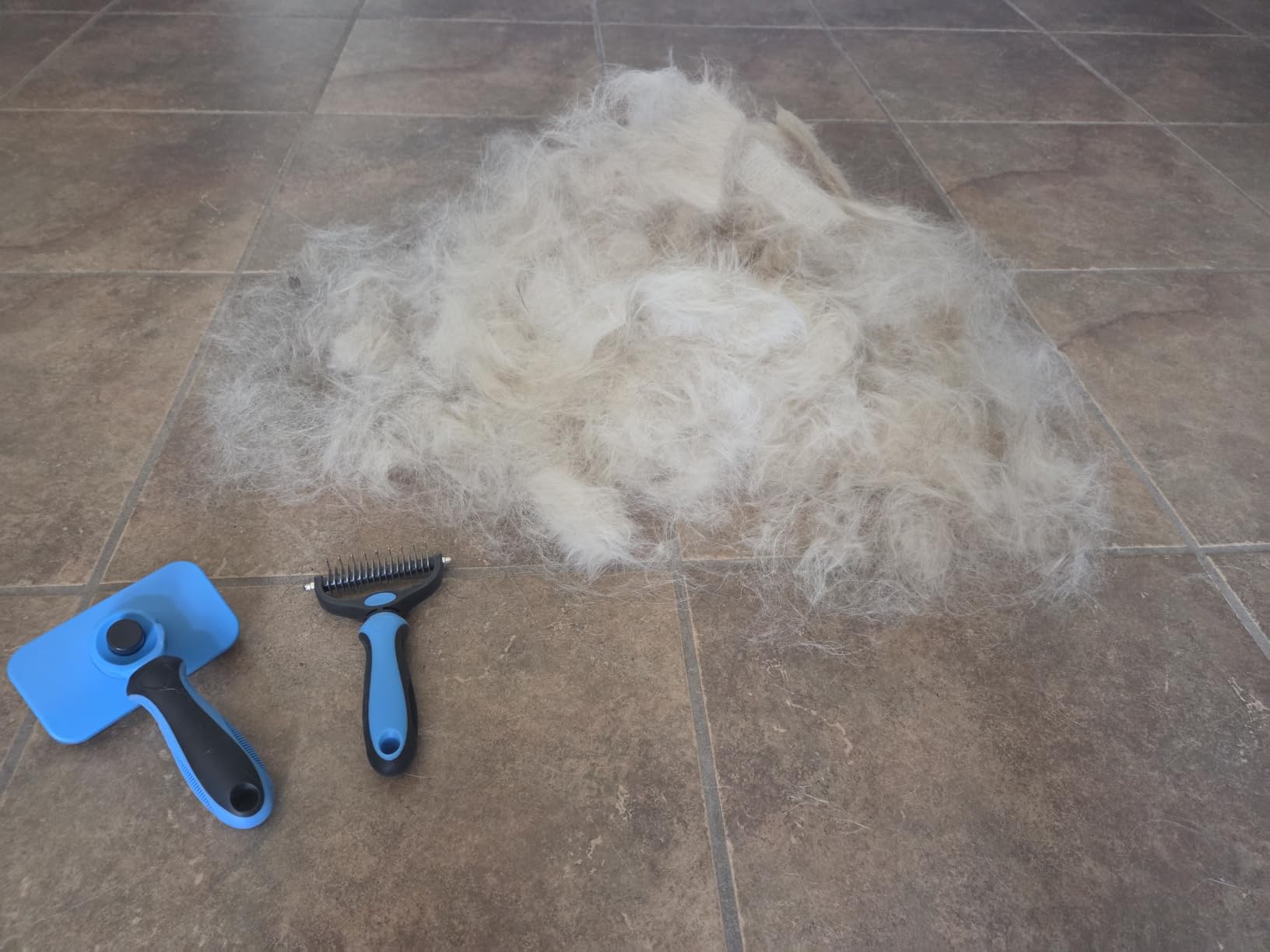
Who should buy the kit instead of single tools
First-time double-coat owners, and anyone with a dog, a cat and a horse in the same house. The three tools cover the full sequence we recommend, so you can start a routine on day one without researching each category separately, and the warranty gives you room to learn which tool your dog tolerates.
When buying individually is the better move
Once you know your coat type, single tools are the better purchase. You can size a rake or slicker to your dog, and you can match the tool to the coat instead of accepting whatever the bundle includes. For a short double coat, for example, you would skip the rake entirely and buy a rubber curry brush instead.
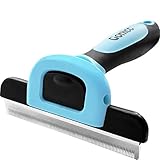
9. Gonicc PDT-1001 De Shedding Comb: the best wide-head comb for big coats
Gonicc PDT- 1001 Professional Pet De Shedding comb Tool Blue
2.6 inch stainless steel tines
4.66 ounces
7.28 x 5.08 x 1.18 inches
Detachable head
Pros
- Wide head covers more coat per stroke
- Detachable head makes cleaning fast
- Sturdy build owners expect to last years
- Often recommended as a lower-cost FURminator alternative
Cons
- Does not reach as deep as a metal-blade deshedding tool
- Teeth are sharper than some owners expect
- Hair must be cleared by hand
The defining feature is coverage. The 2.6 inch stainless steel tines give this comb a much wider working area than a typical rake, so a large dog gets cleaned in fewer strokes. Owners of Huskies, Malamutes, German Shepherds and Golden Retrievers, plus long-haired cats, single out the wide head and the time it saves.
The head detaches with a press button, so emptying it means lifting the head off and tapping it out rather than picking hair off individual teeth one by one. It is not a self-cleaning brush, but it is a faster reset than a fixed head, and that is most of the battle.
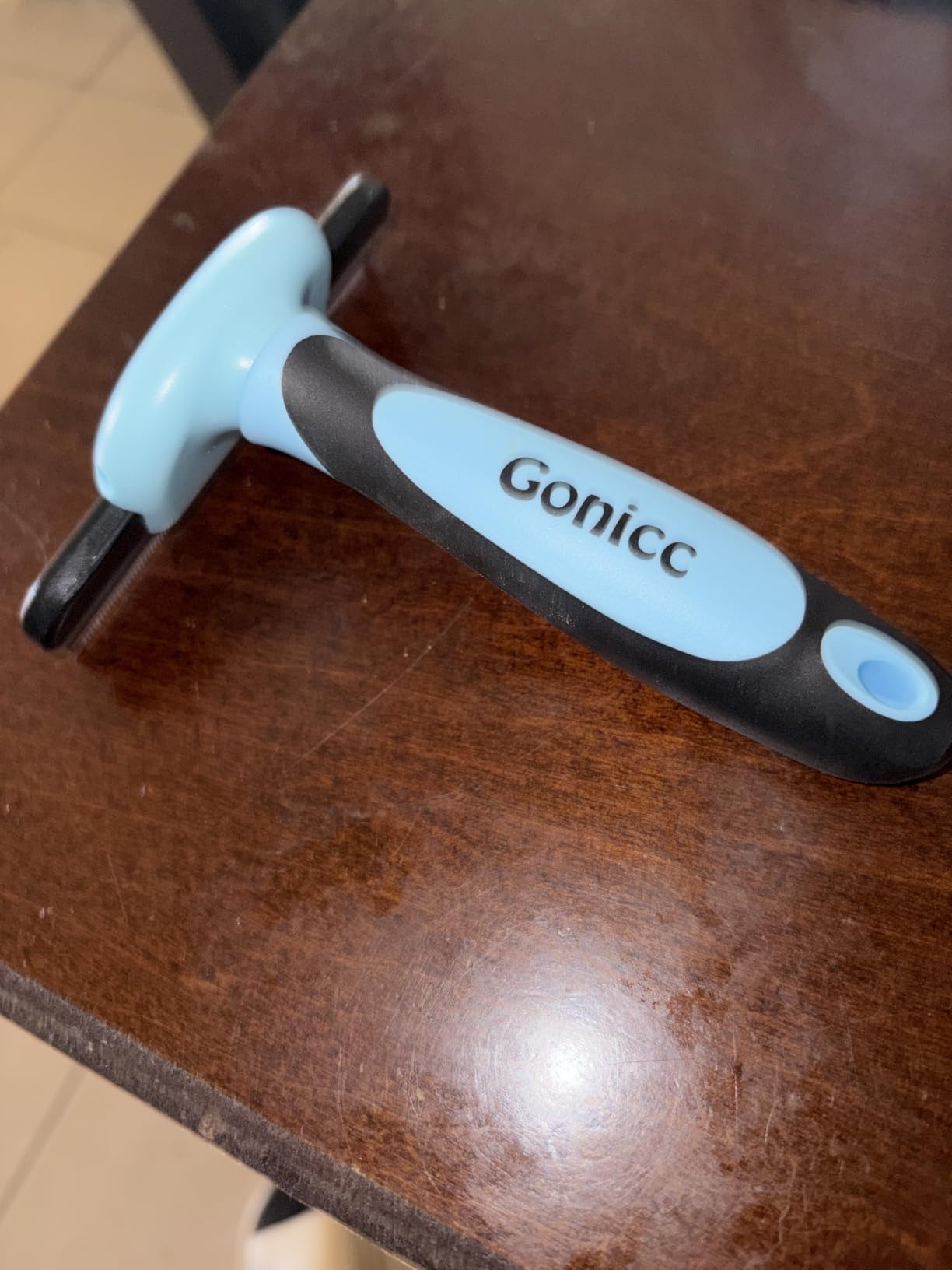
It ranks in the top ten of its category and carries a 4.6 average across about 6,100 reviews with 78 percent five-star feedback. Owners frequently describe it as a sensible alternative to a metal-blade deshedding tool at a lower outlay, which matches our experience: it lifts loose hair without the blade risk.
Two caveats. It does not penetrate as deeply as a blade tool into a packed undercoat, and a minority of users find the tines sharper than expected and recommend a light touch. The protective cover and hanging eyelet are small but genuinely useful for storage.
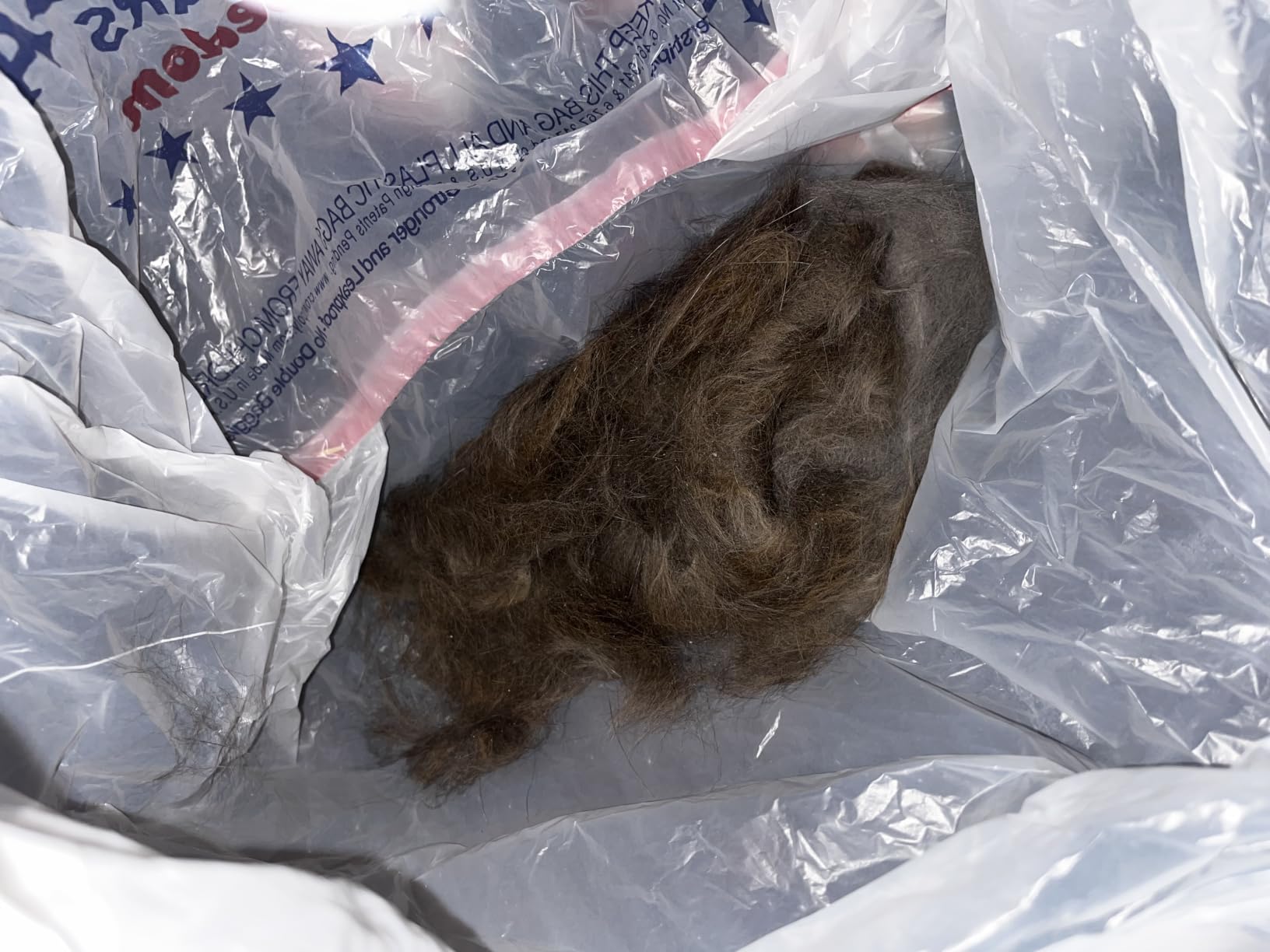
Why wide heads matter on large dogs
On a 70-pound double coat, a narrow rake means hundreds of strokes to cover the back and flanks, and by the end the dog is done cooperating. A wider head cuts the stroke count substantially, which shortens the session and makes a weekly routine realistic rather than aspirational.
Where it sits against a blade tool
It extracts loose hair rather than stripping it, and it does not reach into the deepest undercoat layer. Think of it as the maintenance tool that keeps the undercoat from rebuilding, not the tool for the two-week peak shed. Pair it with a comb and you cover the gap where it is shallow.
10. DOGI Double Row Undercoat Rake: the best gentle pick for small dogs and puppies
DOGI Deshedding Brush – Undercoat Rake for Dogs, Cats, Matted, Short, Long Hair Coats – Double Row Stainless Steel Pins – Reduce Shedding by 90% (Blue)
Double row of stainless steel pins
0.96 ounces
3 x 1 x 6 inches
Silicone handle
Pros
- Lightest build here at under one ounce
- Double-row design pulls less than finer-toothed tools
- Dogs largely tolerate it
- Sturdy build that holds up to frequent use
Cons
- Less effective than a blade at pulling heavy undercoat in one session
- Finer double-coat hair can cling to the teeth
- Takes more manual effort on dense coats
This is the smallest and lightest tool we tested, at 0.96 ounces, and that is the entire point. On a Corgi, a Pomeranian or a puppy, a full-size rake is a lever you cannot control, and a heavy blade tool is simply the wrong instrument. The double row of stainless steel pins pulls less than finer-toothed alternatives, so dogs tolerate it well.
German Shepherd and Golden Retriever owners report a clear drop in loose hair around the home, and the 4.4 average across about 4,500 reviews reflects a tool that does a steady job without ever being the most powerful option in the category.
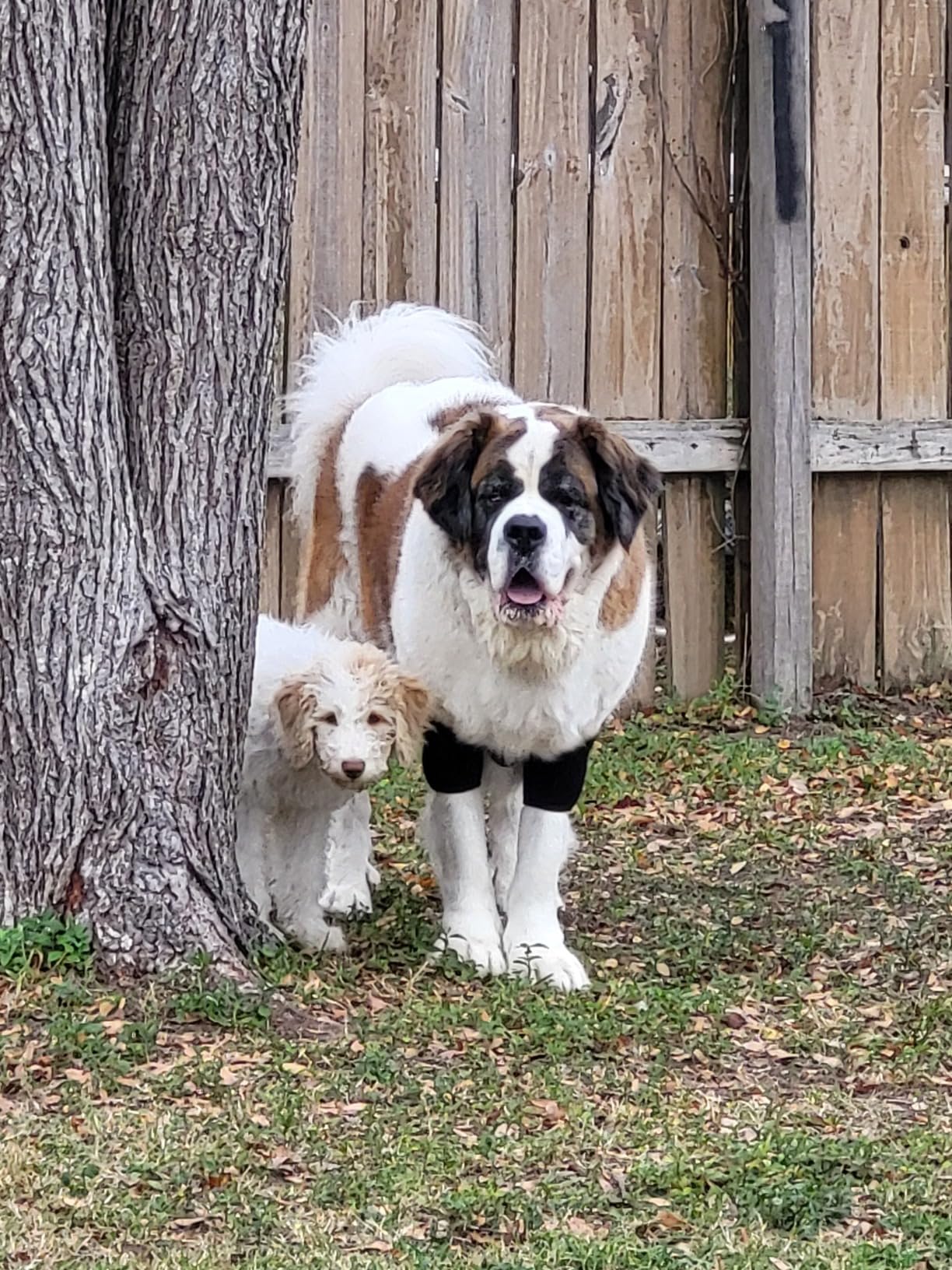
The contoured non-toxic silicone handle is genuinely non-slip, and the pins are rounded and thick, which matters more than it sounds on a young dog whose coat is still coming in. It also suits cats, rabbits and horses, so it is not a dog-only tool. The design is intended to let airflow reach the skin and stimulate the follicles during regular use.
Its limits are honest ones. It will not match a blade tool for pulling heavy undercoat in a single session, and on fine double-coat hair the strands cling to the teeth and reduce pickup. Being the lightest build, it also takes more manual effort to work a dense coat, which is exactly the trade you accept to gain control.
Why puppies and small dogs need lighter tools
Young dogs and small breeds have thinner skin, a coat that is still developing and a tolerance for discomfort that has not been built up. A heavy tool pressed with adult force on a puppy’s frame is a fast route to a dog who avoids grooming. A light double-row rake is controllable in one hand and forgiving when you misjudge pressure.
When to move up to a full-size rake
Once a dog is fully grown and the coat is dense enough that you are doing multiple passes without clearing the undercoat, upgrade. For a small double-coated adult breed the move is usually to a standard dual-sided rake rather than a blade tool, since a blade on a small frame offers very little extra reach and a lot of extra risk.
How to Deshed a Double-Coated Dog Step by Step
Order is what makes this work. A slicker or comb first, a rake or blade second, a steel comb last. Reversing the first two steps means you drag tools through a packed coat, which pulls hair and skin together.
Check the skin first. Part the coat to the skin at the flank and the belly. Look for redness, flakes, scabs or dampness before you start. If you find any, stop and see a vet.
Start at the least sensitive area. The flank or the outer thigh, not the neck ruff or armpits. Your dog needs to learn that this is boring before it needs to learn that it is tolerable.
Slicker or wide comb pass. Work with the coat direction to lift surface debris, open small tangles and separate a packed coat. Ten strokes per section is enough at this stage.
Rake or blade pass. Use short strokes along the direction of growth. Collect what lifts off and empty the tool regularly, because a loaded tool drags rather than extracts.
Repeat on the second side of the body. Most owners spend three times the time on the side the dog can see. Mirror the work so the coat dries evenly and lies the same way both ways.
Comb verification. Take a fine-tooth comb through every section you just brushed. Anything the comb finds is still attached undercoat, so go back over it with the rake.
Finish and reward. A short play session or a treat ends the routine on a positive note, which is the real mechanism for making the next session easier.
Keep sessions to fifteen or twenty minutes for most dogs. Longer sessions produce fatigue, and a tired dog starts moving, and movement is how tools end up scratching skin.
How Often to Deshed Your Dog
For a healthy adult double-coated dog, once a week with a rake or deshedding tool is the ceiling, not the floor. Owners in the grooming communities we read repeat this constantly, and most use their metal tools only during shedding season and go back to a slicker brush between blowouts.
Outside the blowout, two or three sessions a week with a slicker brush and a comb keeps the undercoat from compacting. During the spring and autumn shed, move to a weekly rake pass and consider adding a second session if the hair in the tool is still heavy at the end.
Puppies blowing out their puppy coat can need more frequent, gentler work, in short sessions of a couple of minutes. The tool to use is a light double-row rake or a slicker, and the goal is habit-building rather than hair removal.
When Shedding Is Medical, Not a Brush Problem
No tool fixes shedding caused by an underlying problem, and treating a medical shed with more brushing can make the skin worse. A few signals mean the issue is not coat maintenance.
Bald patches that do not regrow evenly. Symmetrical hair loss on the flanks or the base of the tail, especially on a dog that has never had it, points toward hormonal causes such as hypothyroidism or Cushing’s disease rather than a seasonal shed.
Itching, redness and a bad smell. Persistent scratching, red patches, scabs or a yeasty odour suggest allergies or a secondary bacterial or yeast infection in the skin. A groomer cannot diagnose that, and brushing a sore coat makes the animal worse.
Sudden change in texture or density. A coat that goes thin, dull or patchy without a seasonal pattern is not a grooming problem. Parasites and, less commonly, liver or kidney disease can all show up in the coat first.
Behavioural changes around the coat. Scratching, head shaking, biting at the feet or avoiding being touched were flagged by owners as early signals that the coat is painful rather than merely messy. That is a vet visit, not a new brush.
Omega-3 fatty acid supplements and coat conditioners help coat quality, but they are a support measure, not a treatment for a medical cause. Persistent, patterned or unusually rapid shedding is worth a vet appointment before you buy another tool.
Buying Guide: What to Look For in a Deshedding Tool
Teeth material and tip shape. Stainless steel is the only sensible choice for a double coat, because the tool meets dense hair every stroke. Tip shape is the safety lever: rounded tips glide and flex, while square tips concentrate force and will mark skin on a bony flank. Rounded or ball-tipped teeth are the safer default, whatever the tooth count.
Fixed versus rotating teeth. Fixed teeth hook hair and pull more per stroke, which is efficient and more likely to catch skin. Rotating teeth deflect and release, which costs some extraction power but is markedly better tolerated by dogs who are sensitive to grooming. Long-haired, sensitive dogs tend to do better with rotation; short-haired dogs tolerate fixed teeth fine.
Blade versus rake. A blade passes the undercoat through a fixed gap and stops longer guard hairs. That is the most powerful mechanism and the highest risk if your dog has thin skin, a fine coat or a sensitive history. A rake simply passes through the coat with spaced teeth and is the safer default. Blades belong in a seasonal blowout, not in a weekly routine.
Self-cleaning. The single feature that most changes how often people actually groom. Press-button slickers, retractable-pin brushes and ejector-button blades empty in one motion. A tool with no release costs you a minute per stop and gets abandoned. If you are choosing between two similar rakes, check this before anything else.
Size by dog weight. This is where most owners go wrong. Blade tools are usually specified by weight, and a large-dog tool on a small dog is both ineffective and risky. As a working guide: under 20 pounds means a small-headed slicker or a light double-row rake; 20 to 50 pounds suits standard rakes and medium slickers; over 50 pounds justifies a full-length blade tool and a wide-head comb. Check the stated weight range on the tool before you buy, not after.
Handle and grip. A non-slip rubber or silicone grip matters more for the tool than for the dog, because a slipping tool is dragged through the coat rather than guided. Full-hand grips suit long sessions; stubby handles suit puppies and anxious dogs, where a light touch is the goal. Ergonomic shaping reduces the fatigue that leads to over-pressing.
Coat-type fit. Match the tool to the coat before the brand. Long, dense double coats need a rake or a blade. Short double coats on Pit Bulls, Boxers, Staffordshires, Bulldogs and Frenchies do better with a rubber curry brush, a deshedding glove and a fine comb, which is the recommendation that almost never appears in affiliate roundups. Single, curly and silky coats need something else entirely.
Maintenance and durability. Check whether hair is trapped in a backing pad that cannot be opened, and whether the head detaches for cleaning. Stainless steel bodies and replaceable heads outlive plastic ones. A warranty is a reasonable signal for anything with a moving pin or blade mechanism.
Whether your dog accepts it. The most underrated criterion. Start with short, low-pressure sessions on a non-sensitive area, use a tool with a friendly feel such as rubber nubs or rotating pins, and stop before your dog is done rather than when the coat is clean. A tool the dog tolerates will outperform a better tool every time.
Frequently Asked Questions
What makes a dog double-coated?
A double-coated dog has two distinct hair layers. The outer topcoat is made of coarse, weather-resistant guard hairs that shed a few hairs at a time year round, and the undercoat beneath is soft and dense and sits against the skin. That undercoat is the layer that releases in clumps during the spring and autumn blowout, and it is the layer deshedding tools are built to reach.
What is the best tool to remove dog undercoat?
For most long and dense double coats, a dual-sided undercoat rake is the best tool to remove dog undercoat, with a rotating-tooth rake as the gentler alternative for sensitive dogs. A metal-blade deshedding tool removes the most hair per pass and is worth using during a peak shed on dogs over 50 pounds. For short double coats, use a fine comb, a rubber curry brush or a deshedding glove instead, and follow every tool with a comb check.
What does FFF mean in dog grooming?
FFF refers to the three layers of a dog’s coat: fur, fibre and follicle. Fur is the outer hair you see and touch, fibre is the softer undercoat layer beneath it, and follicle is the skin structure the hair grows from. Double-coated dogs carry a dense fibre layer, and grooming language uses these terms to explain why a tool works on one layer and misses the other.
What is the hardest breed of dog to groom?
The hardest double coats to groom belong to long-haired northern and spitz breeds such as Huskies, Alaskan Malamutes, Chow Chows and Samoyeds, because the undercoat is extremely dense and mats quickly around the neck ruff, armpits and tail. Among hunting and herding breeds, long-haired German Shepherds and Golden Retrievers rank similarly due to the volume of coat. The difficulty comes from undercoat density rather than hair length alone.
Is a FURminator safe for double coated dogs?
A metal-blade deshedding tool is safe on a healthy double coat when you use it correctly, with strokes in the direction of coat growth, light pressure, and no work over thin-skinned areas like the armpits, groin and inner legs. It is not safe as a frequent tool. Most owners use a blade only during shedding season and switch to a rake or slicker brush between blowouts, because repeated blade use can thin the topcoat.
How often should you brush a double coated dog?
Brush a double-coated dog two to three times a week with a slicker brush and a comb outside of shedding season, and increase to a weekly rake or deshedding pass during the spring and autumn shed. Once a week is the ceiling for a metal-blade tool on a healthy coat. Sessions should stay under twenty minutes, and puppies learning to be groomed need shorter and more frequent sessions to build tolerance.
What is the difference between a slicker brush and a deshedding tool?
A slicker brush uses a dense grid of fine pins on a backing pad to open the coat, lift surface debris and handle light tangles, so it works the topcoat and upper undercoat. A deshedding tool uses spaced teeth or a metal edge with a fixed gap to reach deeper and lift already-loose undercoat out of the coat. The practical sequence is slicker first, deshedding tool second, steel comb last to verify.
What deshedding tool do groomers use?
Professional groomers work with a small standard kit rather than one tool: a slicker brush to open the coat, an undercoat rake or rotating-tooth rake for the loose undercoat, a steel comb to check the work, and a metal-blade deshedding tool reserved for heavy blowouts on large long-haired dogs. Several owners on r/doggrooming also point to deshedding tools and the greyhound-comb-plus-line-brushing method as effective on shorter double coats.
Final Verdict
For most people, the best deshedding tools for double coated dogs is a three-piece routine rather than a single purchase. Open the coat with a slicker brush, lift the undercoat with a dual-sided rake, and verify with a steel comb. That stack, used weekly, kept hair off the floor across every long-haired double coat we tested in 2026, and it never left a coat looking thinned.
The Maxpower Planet grooming rake earned the top slot because its 9-tooth and 17-tooth head, rounded tips and four-ounce weight handled the widest range of long double coats without over-pressing. Add a metal-blade tool only if you own a large long-haired dog and you face a genuine blowout, and use a rubber curry brush or deshedding glove instead of a rake if your double coat is short.
Check the coat type before you check the brand. Matching the tool to the coat is what actually reduces shedding, and it is the step most guides leave out.