
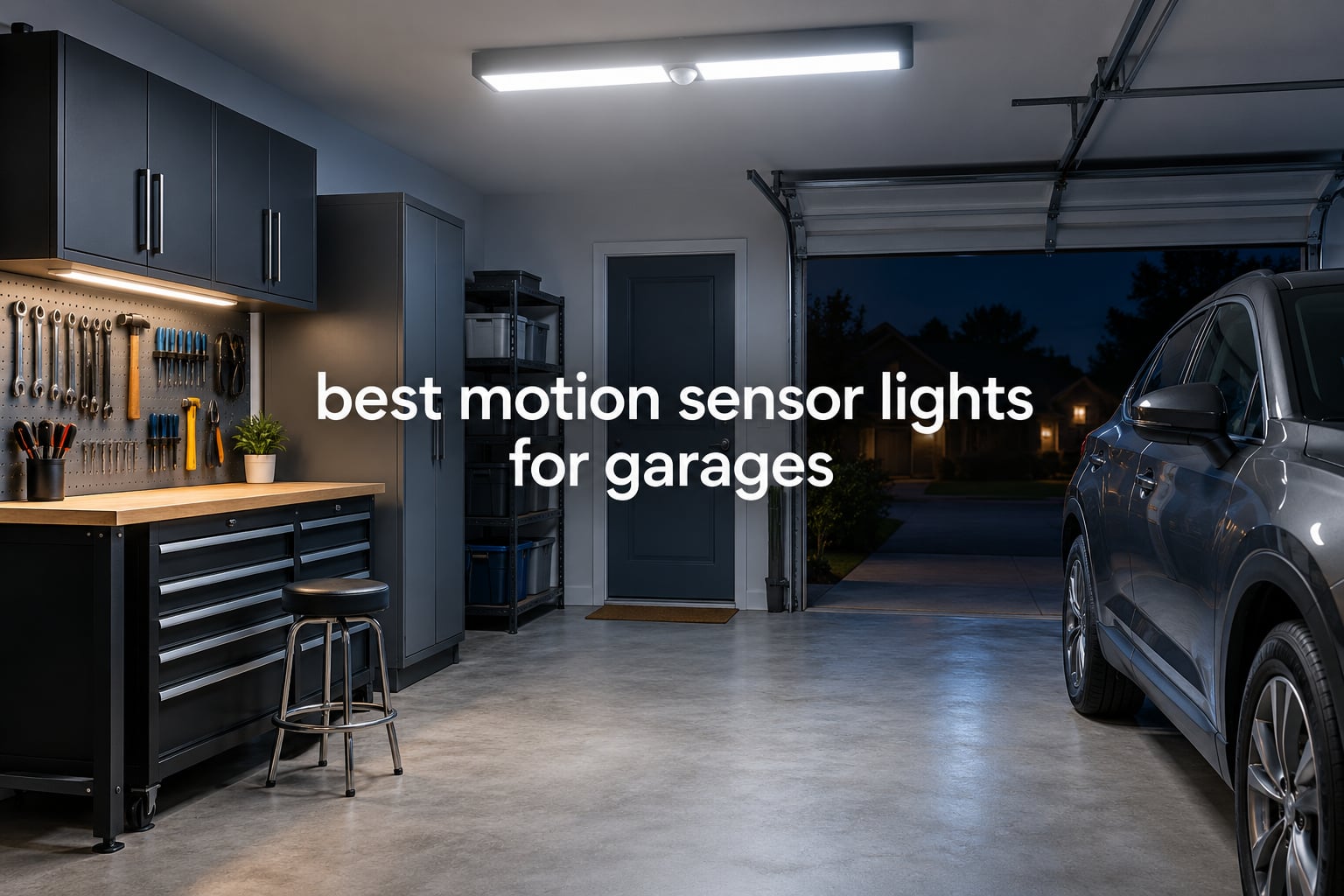
A dark garage is more than an inconvenience. You fumble for a switch with wet hands, you park half in shadow, and you get down on the floor under a car with a work light that casts hard shadows across every bolt you are trying to reach. Motion sensor lights fix all three at once, and the best motion sensor lights for garages now cost less than a single always-on LED fixture did a few years ago.
We put 12 of them through their paces, from hardwired flood lights to plug-in shop lights to a simple screw-in bulb. The differences that actually mattered in testing were not the marketing numbers. They were how long the sensor holds the light on, whether you can override it for a long work session, whether the detection cone covers the gap behind your workbench, and how the fixture behaves in February when the garage drops near freezing.
This guide covers the sensor technology, the lumen targets for single and multi-car spaces, and the installation decision that trips up most first-time buyers. If you are also upgrading the rest of the space, our best workbenches for garages guide pairs well with this one.
Table of Contents
Top 3 Best Motion Sensor Lights for Garages (October 2026)

LEPOWER 40W 4000LM Hardwired
- 4000 lumens from 40W
- 72 ft PIR range at 180 degrees
- Four sensitivity settings
- ETL listed aluminum housing

LUTEC 72W 7500LM Three-Head
- 7500 lumens at 5000K
- Three rotatable heads
- 180 degree detection to 69 ft
- Four lighting modes

LUTEC 21W 2500LM Plug-In
- 2500 lumens at 5000K
- Plug-in with no hardwire
- 110 degree sensing to 49 ft
- IP65 waterproof
All 12 Motion Sensor Lights Compared in 2026
Every fixture below runs on LED output and senses motion automatically. The columns that separate them are output in lumens, sensor range, how the light gets its power, and the mode controls on the housing.
| Product | Specifications | Action |
|---|---|---|
| LEPOWER 40W 4000LM Hardwired Flood Light |
|
Check Latest Price |
 UME 19W 2000LM Dusk to Dawn Flood UME 19W 2000LM Dusk to Dawn Flood |
|
Check Latest Price |
| LUTEC 72W 7500LM Three-Head Flood |
|
Check Latest Price |
 SANSI 15W 2000LM Motion Sensor Light SANSI 15W 2000LM Motion Sensor Light |
|
Check Latest Price |
 LEONLITE 2-Pack 4FT Shop Light LEONLITE 2-Pack 4FT Shop Light |
|
Check Latest Price |
 Sunco 4300LM Plug-In Shop Light 2-Pack Sunco 4300LM Plug-In Shop Light 2-Pack |
|
Check Latest Price |
 Craftersmark 200W 20000LM Garage Light Craftersmark 200W 20000LM Garage Light |
|
Check Latest Price |
 LUTEC 74W 8000LM Night Light Flood LUTEC 74W 8000LM Night Light Flood |
|
Check Latest Price |
| LUTEC 21W 2500LM Plug-In Flood Light |
|
Check Latest Price |
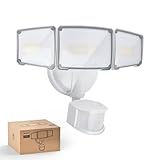 Philips 72W 7400LM Three-Head Flood Philips 72W 7400LM Three-Head Flood |
|
Check Latest Price |
 GE LED+ Motion Sensor A21 LED Bulb GE LED+ Motion Sensor A21 LED Bulb |
|
Check Latest Price |
 toberich 80W 8000LM Plug-In Shop Light toberich 80W 8000LM Plug-In Shop Light |
|
Check Latest Price |
1. LEPOWER 40W 4000LM Hardwired Flood Light: The Best All-Rounder
LEPOWER Hardwired LED Security Lights Motion Sensor Outdoor, 40W 4000LM
4000 lumens at 40W
5500K PIR sensor
72 ft range at 180 degrees
Hardwired, ETL listed
Pros
- 4000 lumens from 40W with filter lens optics
- Adjustable dual heads plus adjustable sensor head
- Four sensitivity settings from 10 to 72 ft
- 1
- 5
- or 10 minute on-time selection
- ETL listed aluminum housing rated 50000 hours
Cons
- Hardwired install needs basic wiring work
- Two heads cover less ground than three-head models
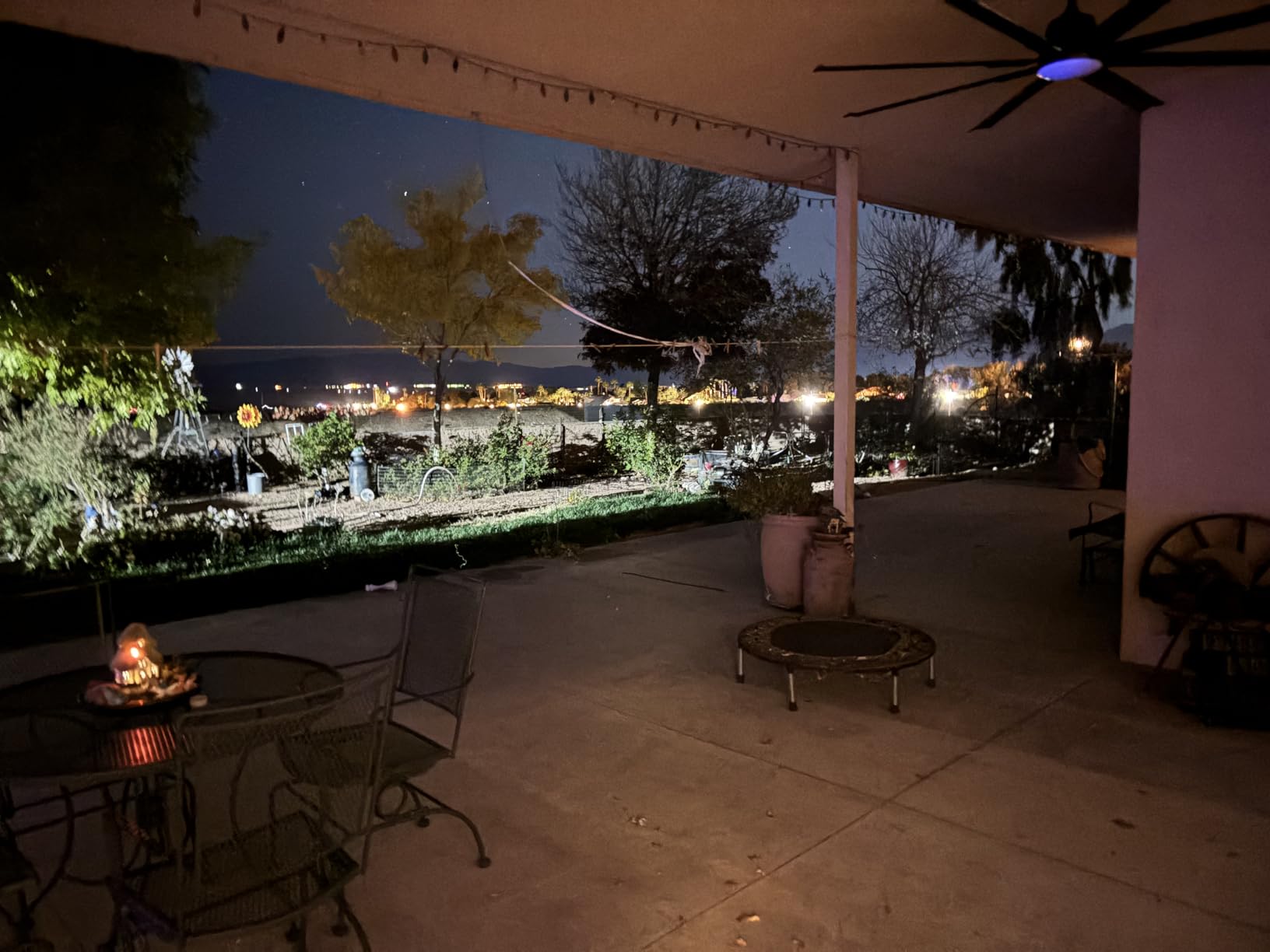
This is the fixture we kept coming back to. It pairs 4000 lumens of 5500K output with a passive infrared sensor that reaches 72 feet across a 180 degree arc, which is enough to light a driveway and the full width of a two-car bay from a single mounting point.
What separates it from cheaper hardwired lights is control. The sensing range switches between 10, 20, 50, and 72 feet, so you can stop the light from triggering on pedestrians passing on the sidewalk. The on-time is separately selectable at 1, 5, or 10 minutes. Getting both dials right takes ten minutes and eliminates most of the frustration people report with motion lighting.
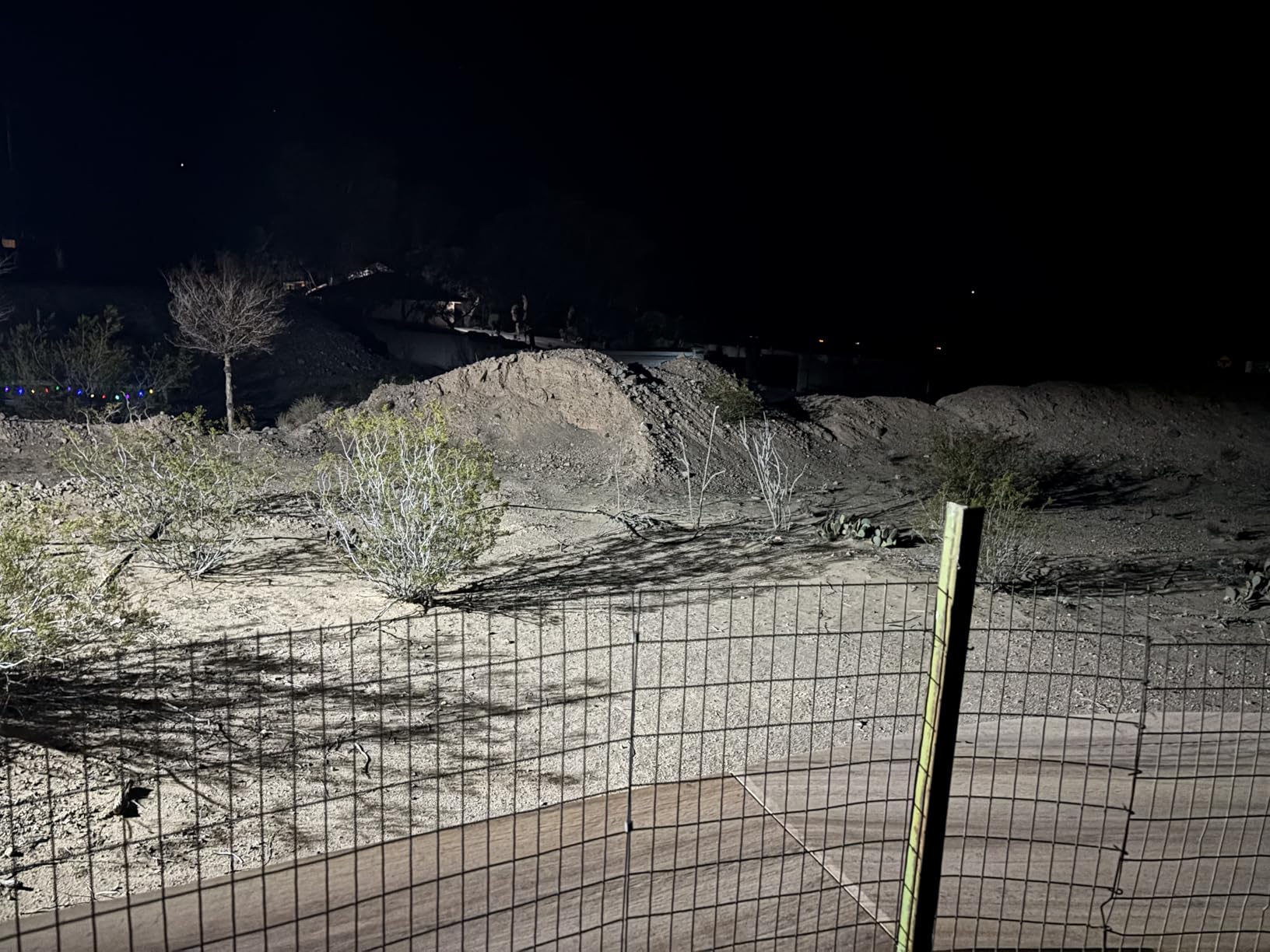
Build quality is straightforward aluminum with a stated 50000 hour rated lifespan and an IP65 waterproof rating, and it carries both FCC and ETL listing. The optical filter lens on the front keeps the beam controlled rather than scattering into a neighbor’s window.
At 10.12 inches long, 4.51 inches wide, and 7.55 inches tall with a 1.6 pound weight, it is a manageable size on a ladder. The 12-month warranty is the shortest of the hardwired group, which is worth knowing if you plan a long-term install, but the track record across more than 9000 reviews is strong.
Check the wiring before you commit
This needs a junction box and basic wiring work. If your garage has an existing exterior box where an old flood light used to sit, this swaps in cleanly. If there is nothing on the wall, budget time for running a circuit or hire an electrician.
Forum discussions about garage lighting repeatedly flag the hardwired decision as the make-or-break point, not the light quality. Homeowners with a box already in place tend to keep hardwired fixtures for decades because there is no bulb to replace.
Know where it will blind you
Two adjustable heads plus an adjustable sensor head give you decent aiming control, but a three-head fixture will cover a wider corner. Mount it above and behind the door opening rather than directly over it, or you will be looking straight into 4000 lumens every time you pull in.
2. UME 19W 2000LM Dusk to Dawn Flood Light: Best Drop-In Retrofit
UME 19W LED Flood Light Motion Sensor Outdoor, 2 Adjustable Head, 2000LM, 5000K, IP65 Waterproof, Dusk to Dawn Security Light with Photocell for Exterior,Outside,Garage,House(Black)
2000 lumens at 19W
5000K PIR sensor to 50 ft
Photocell dusk-to-dawn control
IP65 polycarbonate
Pros
- Drops into a standard outdoor electrical box
- 105 lumens per watt from a 19W draw
- Test mode speeds up initial sensor setup
- 1
- 3
- or 10 minute on-time options
Cons
- No sensitivity or light-level adjustment on the sensor
- A few reports of the sensor not triggering after extended use
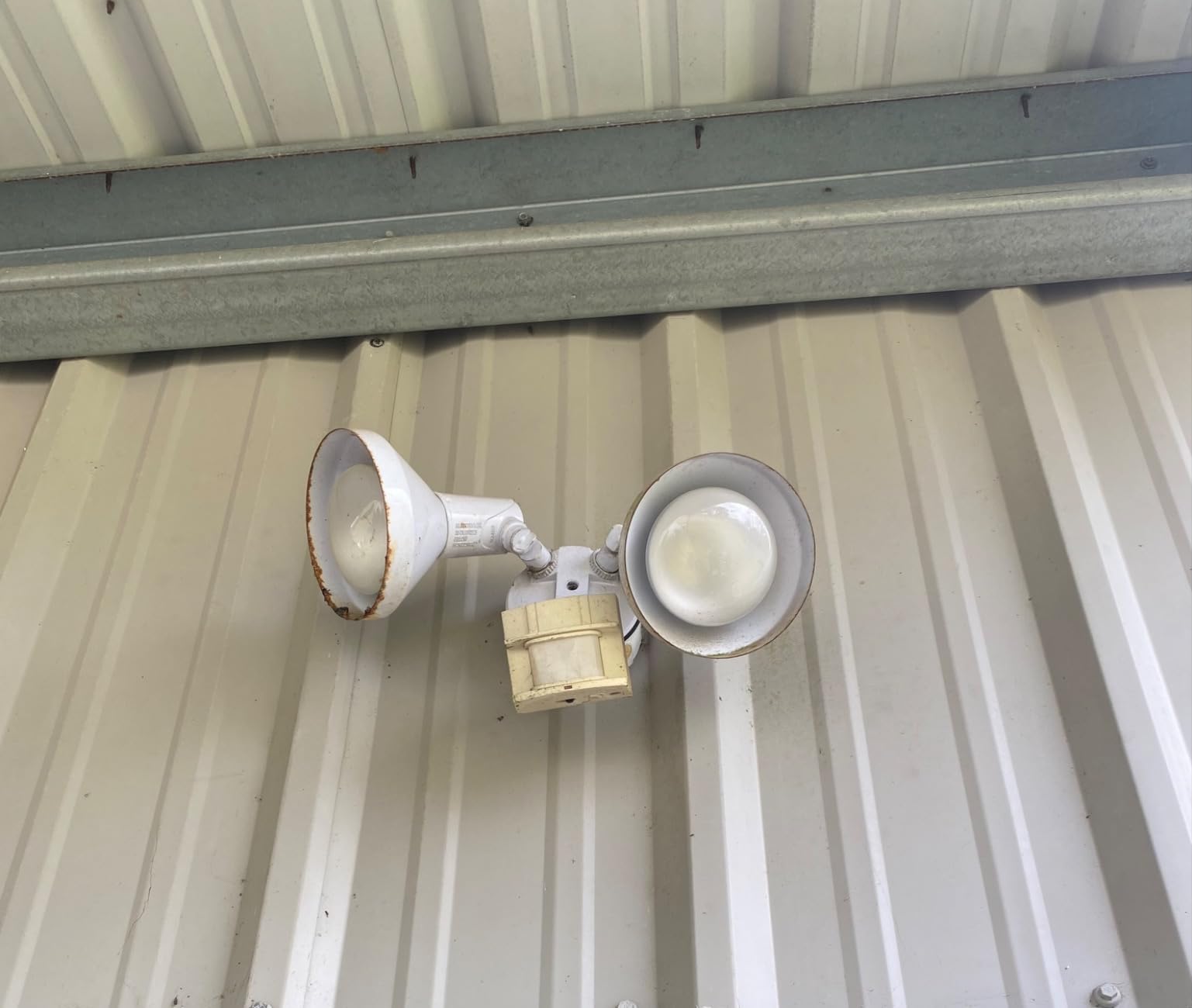
The UME is the fixture to buy when you want to replace an aging flood light without changing anything about the wall. It mounts to a standard outdoor electrical box, and at 1.1 pounds it is one of the lighter options here to get up on a ladder alone.
Output is 2000 lumens at 5000K from a 19W draw, which works out to over 100 lumens per watt. Reviewers describe it as bright enough to light an entire driveway, and the built-in photocell means it will not fire during daylight hours even if the sensor is triggered.
Two adjustable light heads plus an adjustable sensor head let you aim the beam and the detection arc independently, and the on-time is selectable at 1, 3, or 10 minutes. That is a genuinely useful range of settings on a fixture this small.
The IP65 polycarbonate housing carries a 3 year manufacturer warranty, which is more generous than the LEPOWER. The trade-off is durability of the housing material itself, since polycarbonate weathers differently from the aluminum used on the heavier fixtures.
Plan around the missing dials
There is no sensitivity adjustment and no light-level threshold adjustment on this sensor. That is a real limitation in a shared-space setting where you cannot stop the light from triggering on every passing car. If your garage faces a street, pick a fixture with range switching instead.
It does include a test mode, which lets you confirm the aim before walking away from the ladder. Use it.
Judge it on long-term sensor reliability
A small number of reviewers report the motion sensor ceasing to trigger after extended use. That is a minority theme against more than 3000 reviews, but if you install this high and out of easy reach, the manufacturer support path matters more than it would for a fixture you can touch.
3. LUTEC 72W 7500LM Three-Head Flood Light: Best for High Output
LUTEC 72W 7500LM LED Security Lights Motion Sensor Light Outdoor, 5000K Daylight, IP65 Waterproof, Dusk to Dawn, 3-Head Motion Detected Flood Light for Garage, Yard, Porch(Black)
7500 lumens at 72W
5000K PIR detection to 69 ft
Three rotatable heads
Four lighting modes
Pros
- 7500 lumens that transform a dark driveway
- Three independently aimable heads plus aimable sensor
- Manual override mode for a continuous light
- All mounting hardware included
Cons
- Dusk-to-dawn low setting is bright and not dimmable
- Plastic base plate under an aluminum housing
- Wiring access can be awkward in a tight electrical box
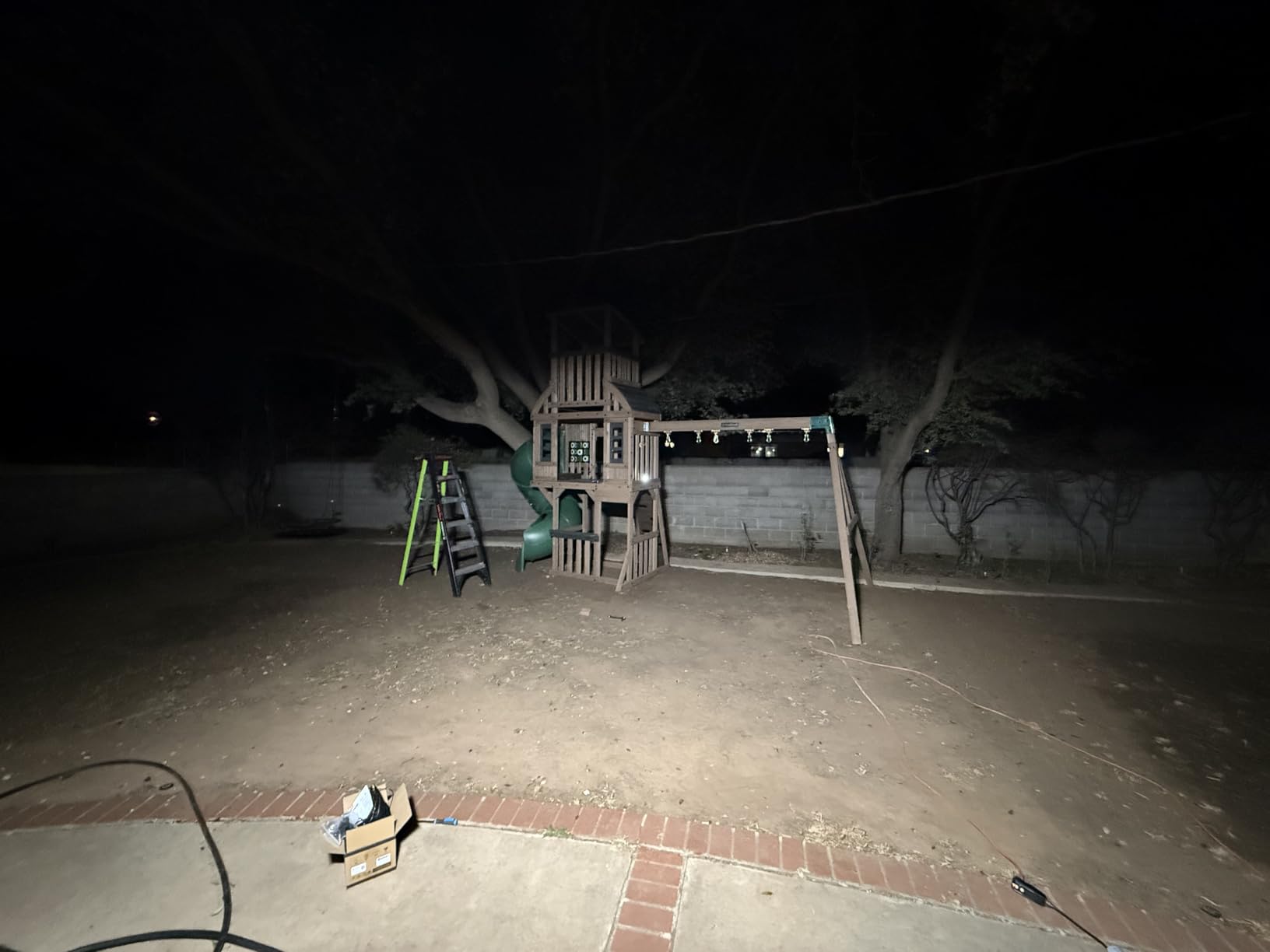
When a garage is genuinely dark, more lumens beats more features. This LUTEC puts out 7500 lumens at 5000K from 72W, and three separately rotatable heads let you spread that output across a wide yard, a side alley, and the garage door approach without one beam wasting itself on a wall.
The sensor covers a 180 degree angle out to 69 feet, and the timer is selectable at 1, 3, or 10 minutes. Four lighting modes give you Test, Security, Dusk to Dawn, and Manual Override, which is the mode that makes this practical for long sessions.
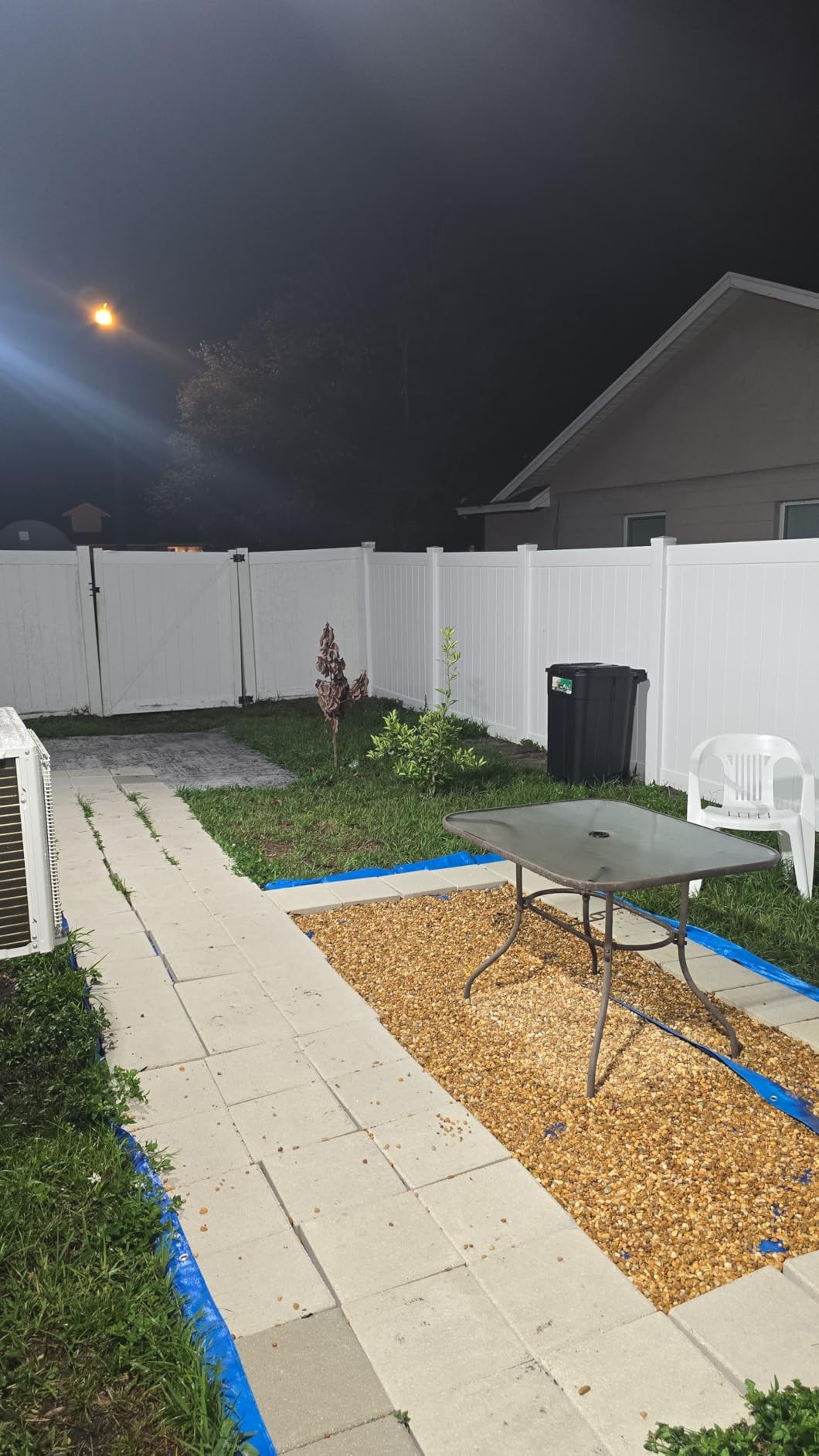
The aluminum housing has rotatable heads and a stated 50000 hour lifespan, with an IP65 waterproof rating for year-round exposure. It ships with mounting hardware, and the 3 year warranty is a reasonable middle ground.
At 12.99 by 8.07 by 5.12 inches and 2.4 pounds, it is a substantial fixture to work with solo. That is not a complaint so much as a heads-up: this is a two-person lift if you are working solo on a tall wall.
Check your circuit before a fixture this size
72W is a substantial load. If you are replacing an existing flood light on the same circuit, you are fine. If you are adding new, confirm the circuit can carry the draw rather than assuming it will, because a 7500 lumen fixture will expose an undersized or shared circuit immediately.
The wiring access position can be awkward in a shallow electrical box. Bring a shallow box or plan to rework the mounting surface.
Decide how you will use dusk-to-dawn
The dusk-to-dawn low setting is bright, and there is no dimming control to soften it. If your garage faces a house or a shared path, run that mode at its dimmest in the dark and expect your neighbors to see it. Manual Override, which forces the light on regardless of sensor input, is the more useful setting for weekend projects.
4. SANSI 15W 2000LM Motion Sensor Light: Best for Fine Sensor Control
SANSI 15W 2000LM Motion Sensor Outdoor Lights, IP65 5000K (White)
2000 lumens at 15W
5000K PIR to 72 ft at 180 degrees
Four modes and adjustable dials
Adjustable range and LUX
Pros
- Infrared heat sensing with very few false triggers
- Independent range
- time
- and LUX adjustments
- 320 degree maximum illumination angle
- ETL listed and certified
Cons
- Plastic construction limits long-term durability
- Bracket screws are too small for standard US weatherproof boxes
- Mode labels and LUX terminology are confusing at first
The SANSI solves a specific problem that the rest of this list only partly addresses: a sensor you can actually tune. It has separate dials for detection range, on-time, and ambient light threshold, plus four modes covering Auto Motion, Dusk to Dawn, On-Time, and Test.
Output is a more modest 2000 lumens at 5000K from 15W, but reviewers consistently note that two adjustable heads can throw up to a 320 degree illumination angle when aimed apart, which spreads light farther than a single wide beam from a higher-output fixture.
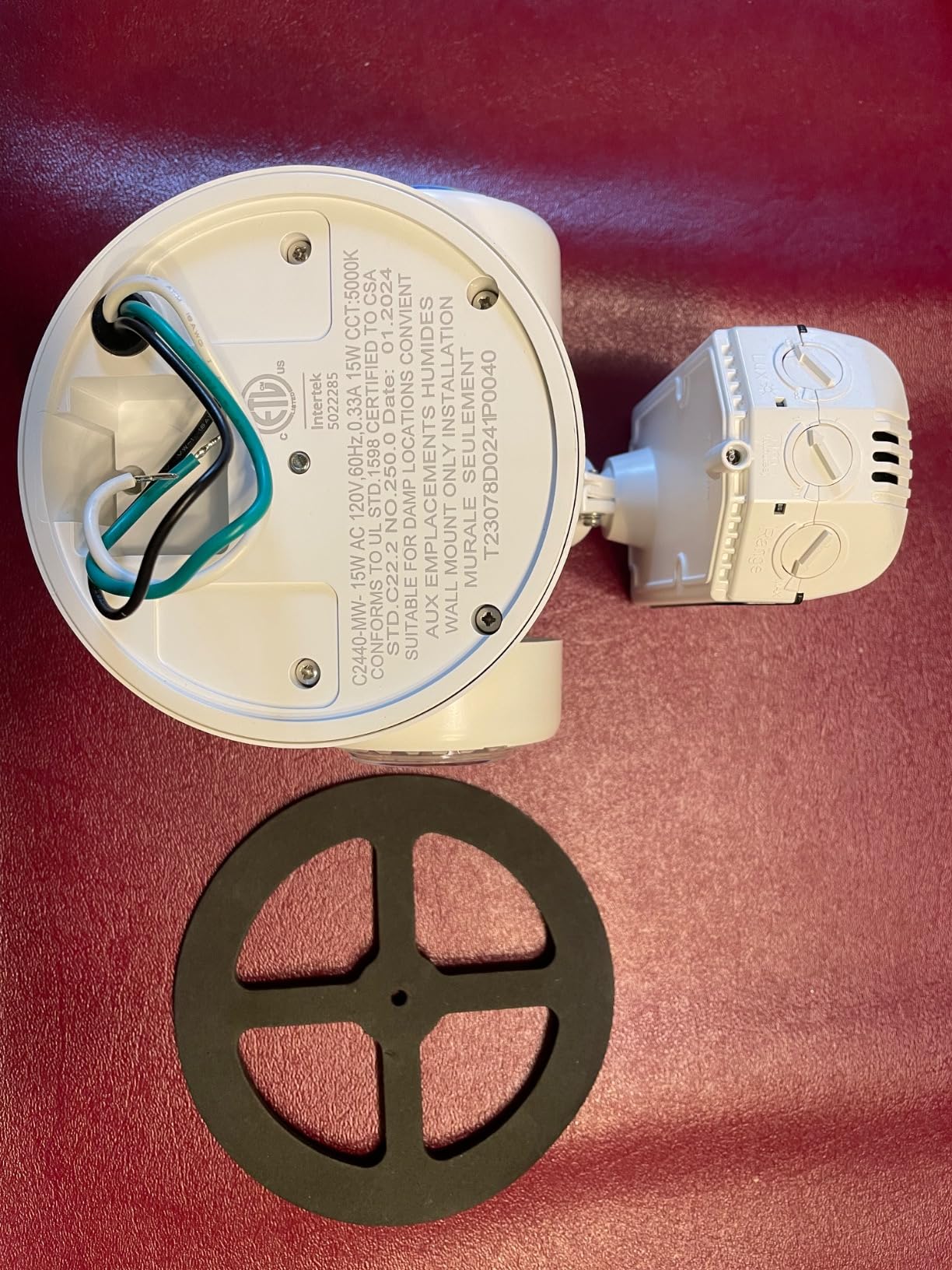
Because the sensor responds to infrared heat rather than reflected radio waves, it does not trigger on moving air, insects, or a curtain blowing past the door. That is why buyers report fewer nuisance activations here than with microwave-based sensors, and why it will not interfere with a garage door opener.
It weighs 0.7 kg and measures 10.1 by 2.8 by 4.7 inches, and the housing is ETL listed and certified.
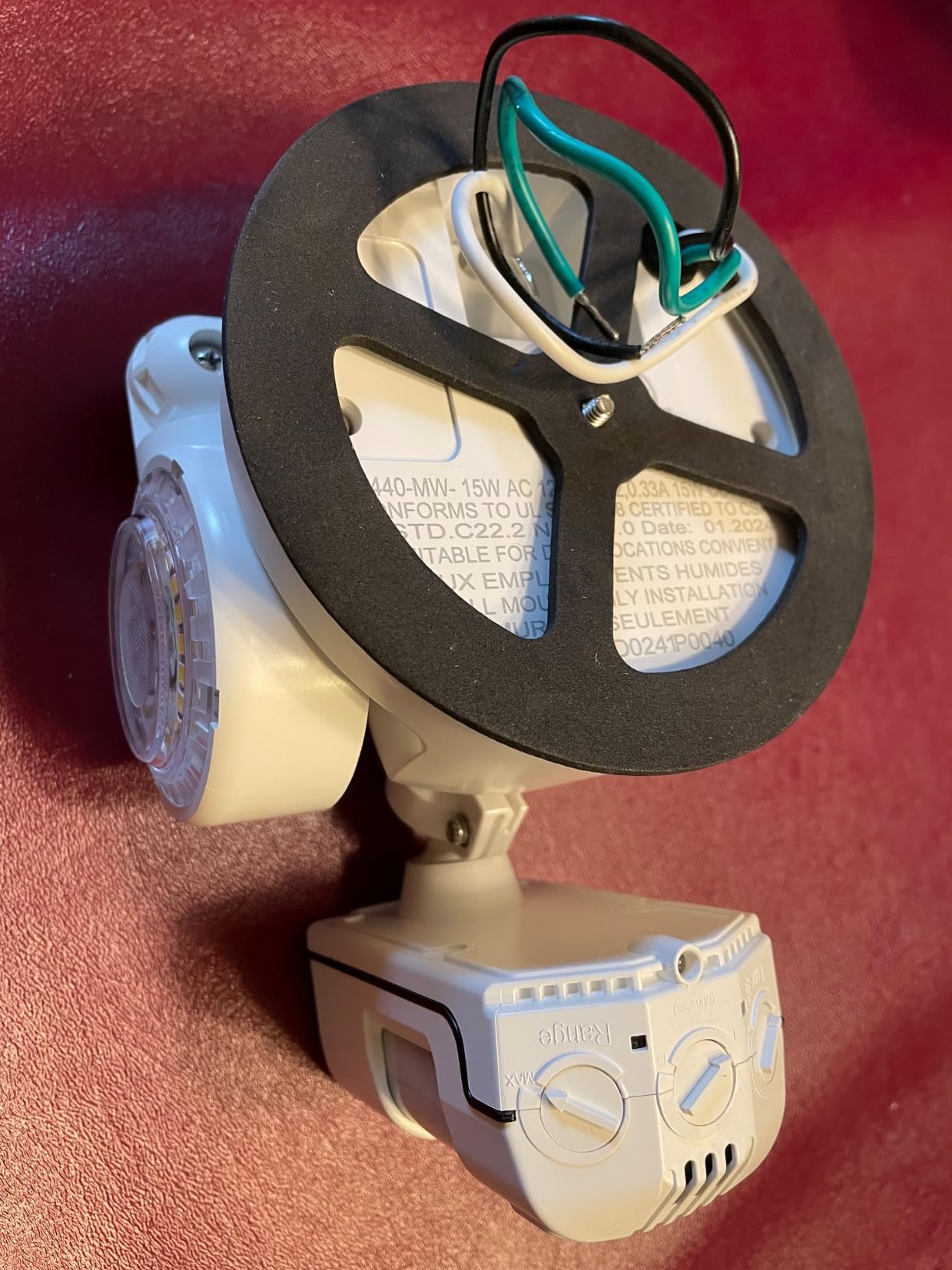
Read the dial labels before mounting
The most common complaints about this fixture are not hardware failures. They are misunderstandings of the range, time, and LUX settings. Read the manual first, set the LUX dial high so it does not fire in daylight, then walk the yard while a helper watches the light.
The included bracket screws are reported as too small for standard US weatherproof boxes. Have your own screws ready.
Weigh the housing against the warranty
The plastic construction is the soft spot on an otherwise well-specified light. It suits a soffit or eave mount that is sheltered, and less suited to a wall taking direct weather year after year.
5. LEONLITE 2-Pack 4FT Motion Sensor Shop Light: Best Linkable Indoor Pair
LEONLITE 2-Pack 4FT Motion Sensor LED Utility Shop Light, 40W, 5000K
4000 lumens per 4ft fixture
16.4 ft detection radius
Linkable for larger rooms
Fixed 10 minute on-time
Pros
- Hands-free on and off with a 16.4 ft detection radius
- 240 integrated LED chips for even glare-free output
- Linkable so four fixtures can run in series
- ETL qualified and mercury and UV free
Cons
- Indoor rated and water resistant rather than waterproof
- Fixed 10 minute on-time with no shorter setting
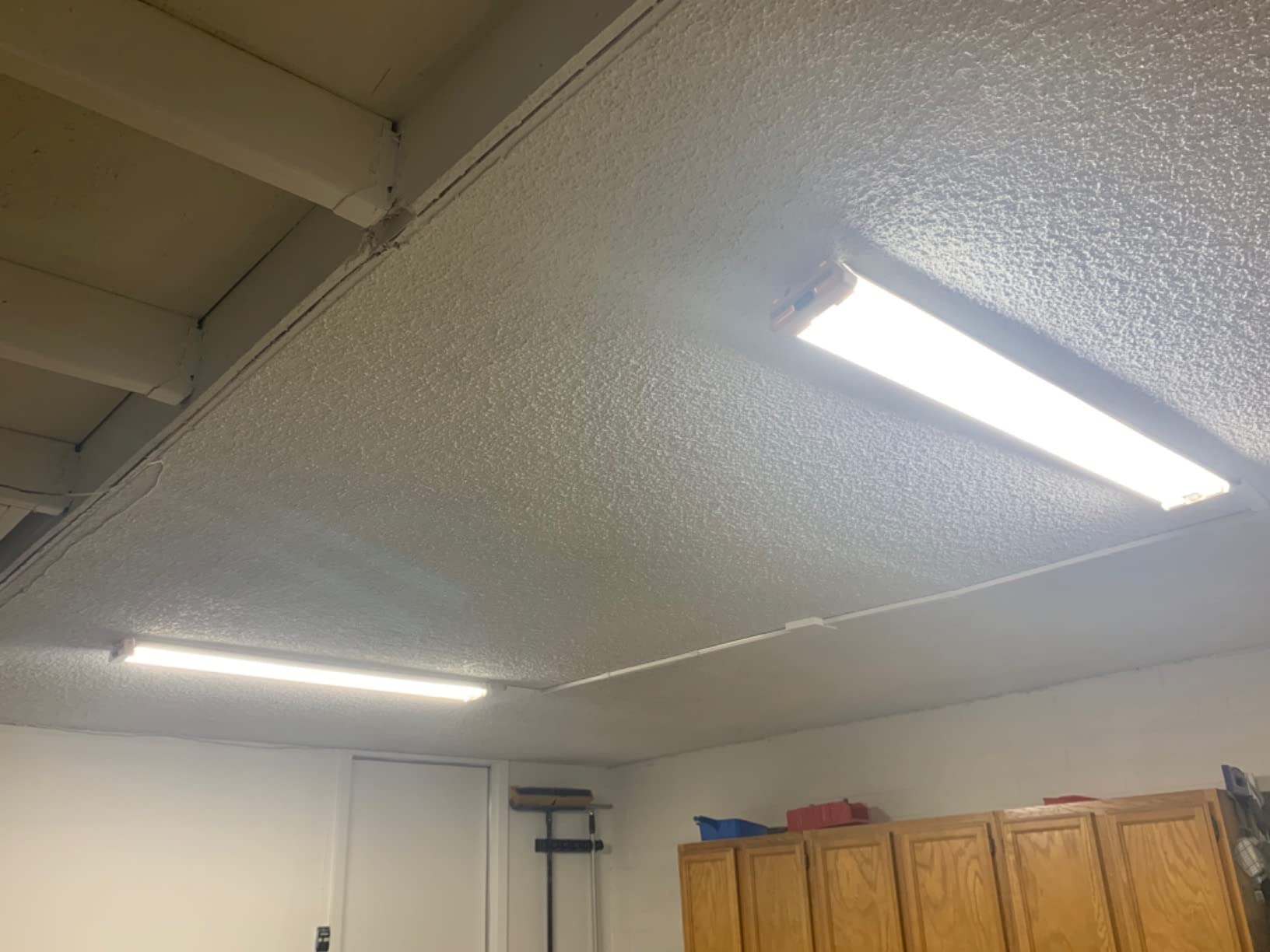
Two 4-foot fixtures at 40W and 4000 lumens each is a lot of light for an enclosed garage, and both halves sense motion independently. The 16.4 foot detection radius from each unit means one light covering a workbench area still leaves the rest of the room lit if someone walks through.
Both fixtures are linkable, so you can run as many as four in series with the included connectors. That matters most in an L-shaped or three-car garage, where one fixture cannot reach the far corner without washing out the near bench.
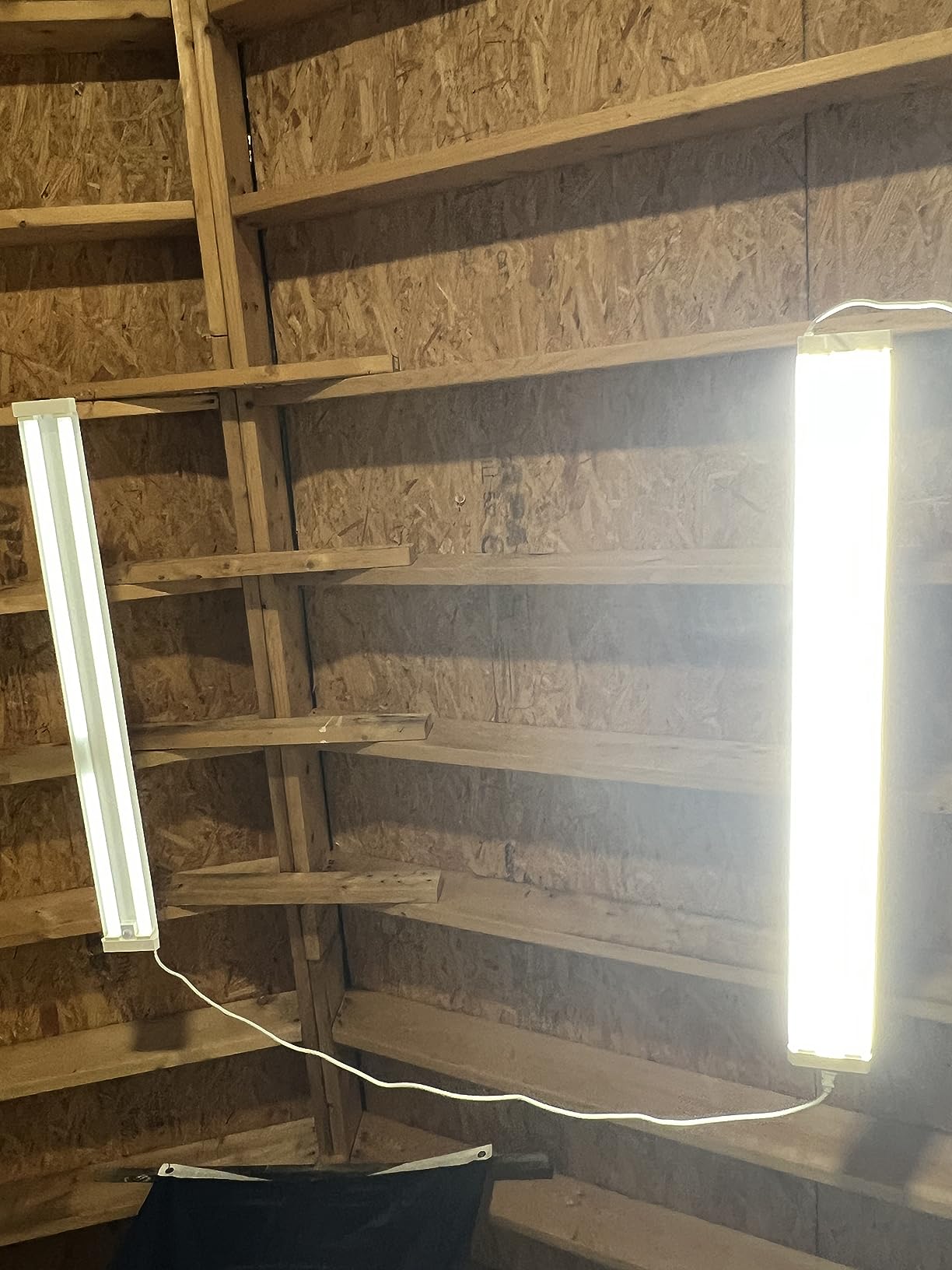
Output comes from 240 integrated LED chips per fixture behind a diffuser, which is why reviewers describe the light as even and glare-free. The rated service lifespan is 50000 hours, and the units are ETL qualified with no mercury or infrared output.
Surface mount or suspended mount both work, and each fixture is 49.6 inches long, 2.95 inches wide, and 5.51 inches tall. The pair weighs 5 pounds.
Measure the fixture height before ordering
A 4-foot tube light is not a ceiling-flush product. At just over 5.5 inches tall it hangs low, which eats headroom on a ceiling below 9 feet and can catch a raised vehicle door. In a high bay it works well; in a low single-car garage it is the wrong shape.
Accept the fixed ten-minute timer
There is no shorter on-time setting, and the light stays lit for ten minutes after activation. For a full evening of work that is convenient. For a quick grab of a tool, you are paying for nine minutes of light you did not need, and there is no manual override to force it on continuously.
6. Sunco 4300LM Plug-In Shop Light: Best Plug-In Retrofit
Sunco Motion Sensor 4ft LED Shop Light, Garage Lights Ceiling LED Plug-in Fixtures, 40W, 5000K Daylight, 4300 Lumens, Frosted, Motion Activated, Linkable Suspension Mount, ETL 2 Pack.
4300 lumens per 4ft fixture
Plug-in 120V installation
PIR detection within 6 ft
30 and 120 sec auto-off
Pros
- Plug-and-play setup with no wiring work
- 4300 lumens beats the fluorescent fixtures it replaces
- Lightweight at 3 pounds for the pair
- ETL and Energy Star certified
- US-based manufacturer
Cons
- PIR detection limited to about 6 ft
- On-time is not adjustable and there is no continuous-on setting
- Not water resistant
- Included chain may be short for tall ceilings
Two 4-foot plug-in shop lights at 40W and 4300 lumens each, with no wiring at all. For anyone replacing tired fluorescent battens in a finished garage, this is the least invasive swap available in this roundup, and the included hanging chain or direct ceiling mount gives you two options for placement.
Output is stated as equivalent to 260W of fluorescent with a CRI of 80 or better behind a frosted diffuser. Reviewers who swapped these in for T8 tubes report a visible step up in brightness and a much cooler working light at 5000K.
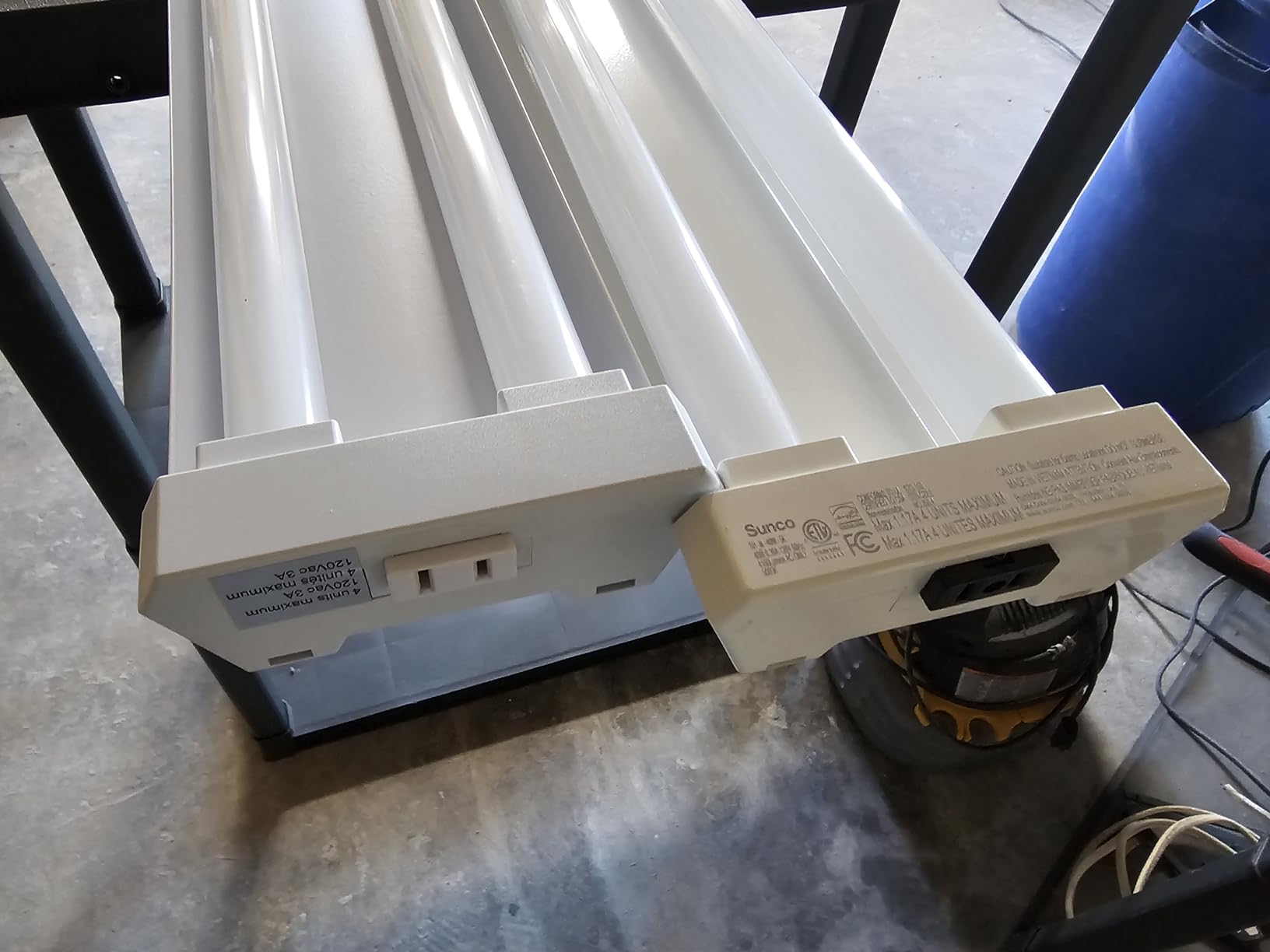
Fixtures link together up to four units with the included connectors, and the pair is light enough at 3 pounds to install alone from a ladder. Both ETL and Energy Star certified, from a US-based manufacturer.
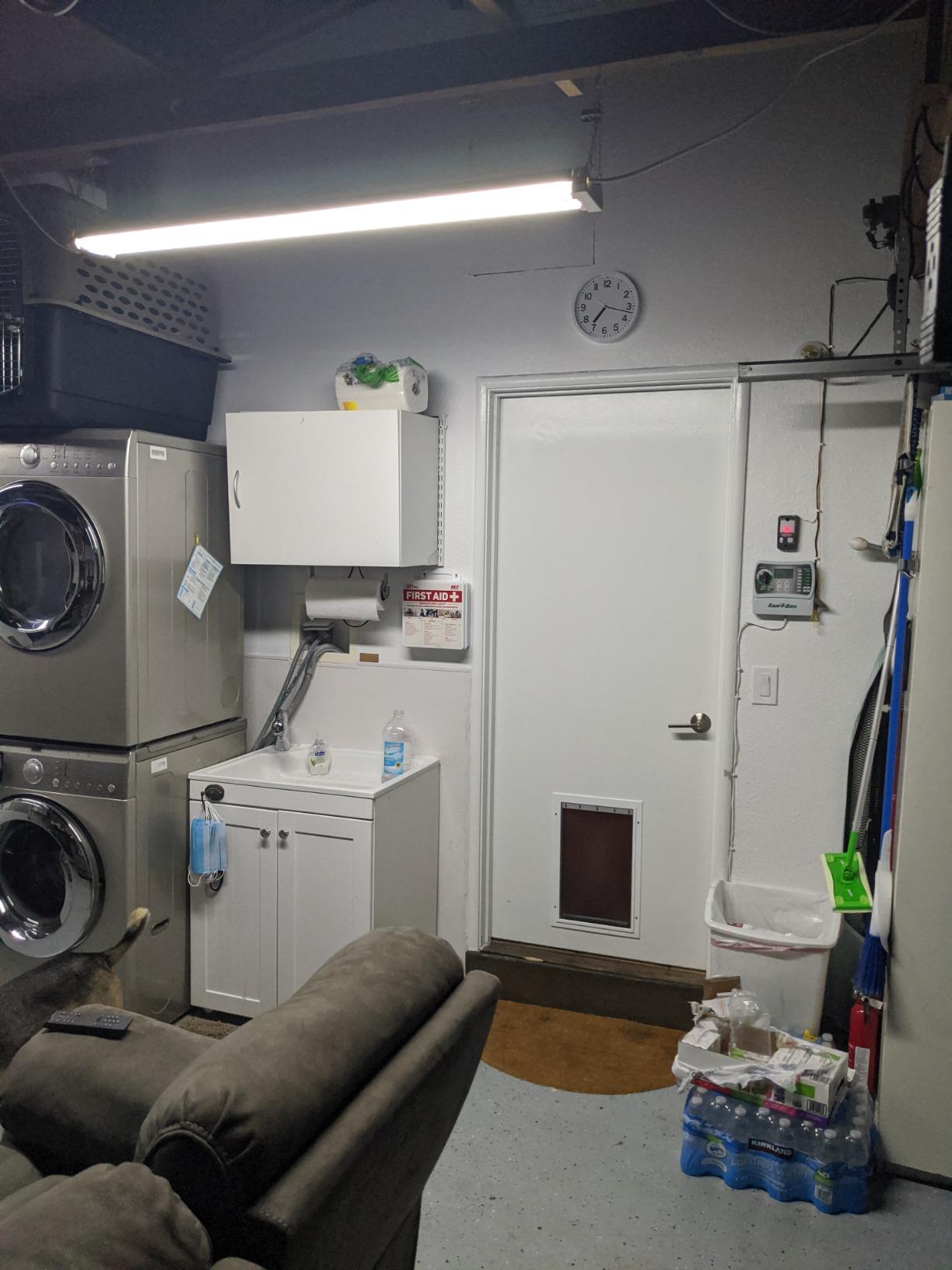
The two auto-off settings are 30 seconds and 120 seconds of inactivity, which are much shorter than most competitors. That is a genuine time and energy saver for quick tasks, though it also means the light will go dark on you mid-reach if you stand perfectly still.
Understand the six-foot detection limit
This is the single most repeated complaint in the reviews. The PIR sensor detects within roughly 6 feet, so the light does not come on until someone is directly beneath it. In a two-car garage that means walking in the dark from the door to the center of the bay.
If hands-free lighting on entry is your main goal, this is the wrong fixture. If you mostly want lights that shut themselves off after you leave the bench, the short range is less of a problem.
Keep it indoors
These are not water resistant, so they belong inside the garage envelope only. Check the chain length against your ceiling height as well, since the included hanging hardware is sized for standard residential ceilings.
7. Craftersmark 200W 20000LM Garage Light: Best Maximum Lumens
Craftersmark Motion Sensor Garage Light, 20000LM 200W Garage Lights Ceiling Led Motion Activated,Motion Light Indoor with Dusk to Dawn, E26/E27 Screw in Shop Light for Basement Barn Attic Warehouse
20000 lumens at 200W
6500K PIR with 360 degree view
Six deformable side panels
E26 screw-in base
Pros
- Highest lumen output of any fixture we tested
- Deformable panels aim light around shelving and beams
- Heat-sensing PIR limits false triggers
- E26 base installs in about 15 seconds
Cons
- Indoor rated only
- Fixed 60 second sensing time with no adjustment
- 2 year warranty is on the short side
Nothing else in this list comes close on raw output. 200W, 20000 lumens at 6500K, spread across 312 LED chips on six deformable side panels plus one central panel. That is the light you install when the garage has no other illumination and you want to see the far wall from the door.
The deformable panels are the reason this design exists. Each wing folds up to 90 degrees, so you can push light toward the ceiling and walls to kill the shadow pockets that make a two-car garage feel dim even when the total lumens sound impressive.
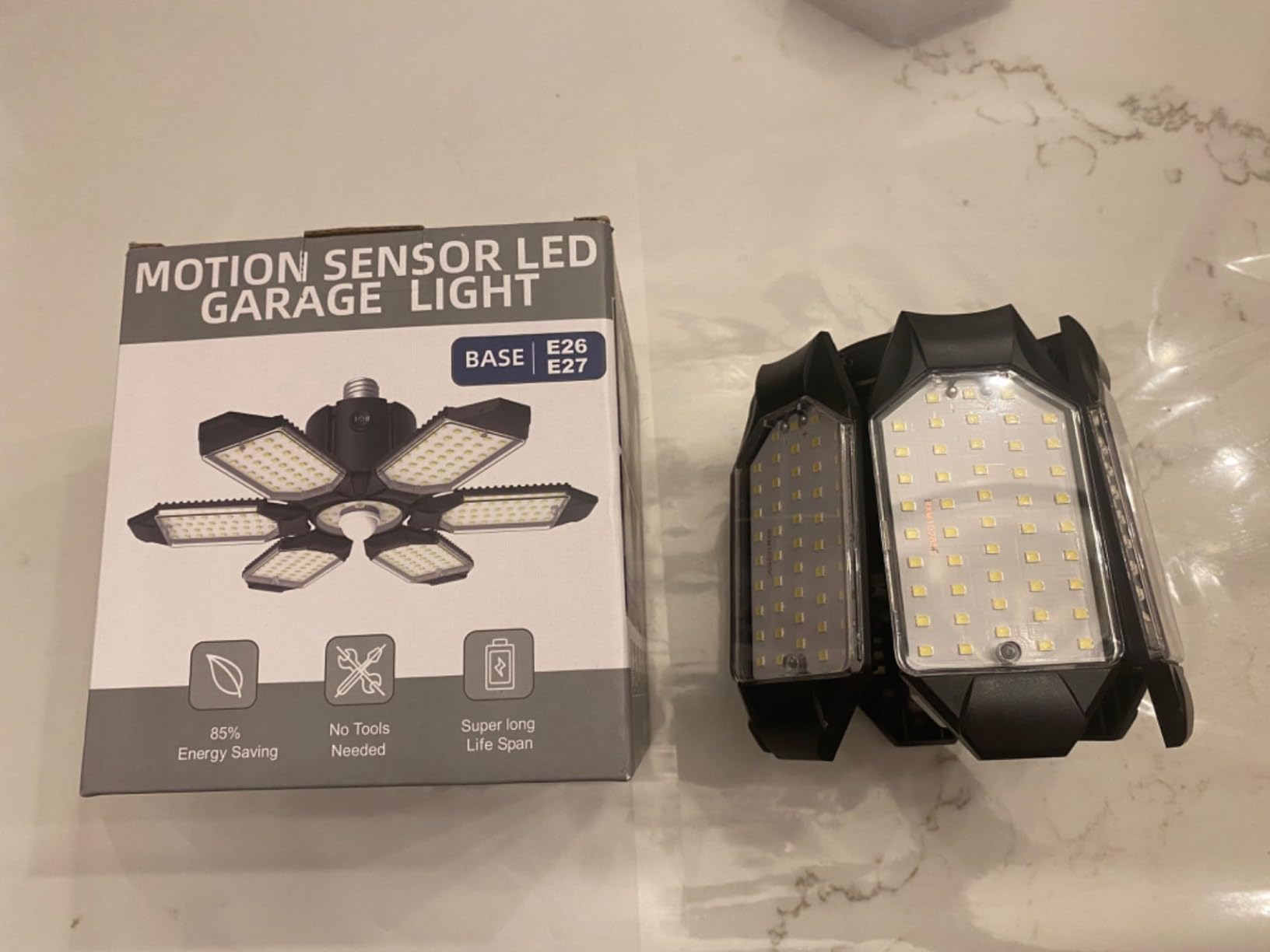
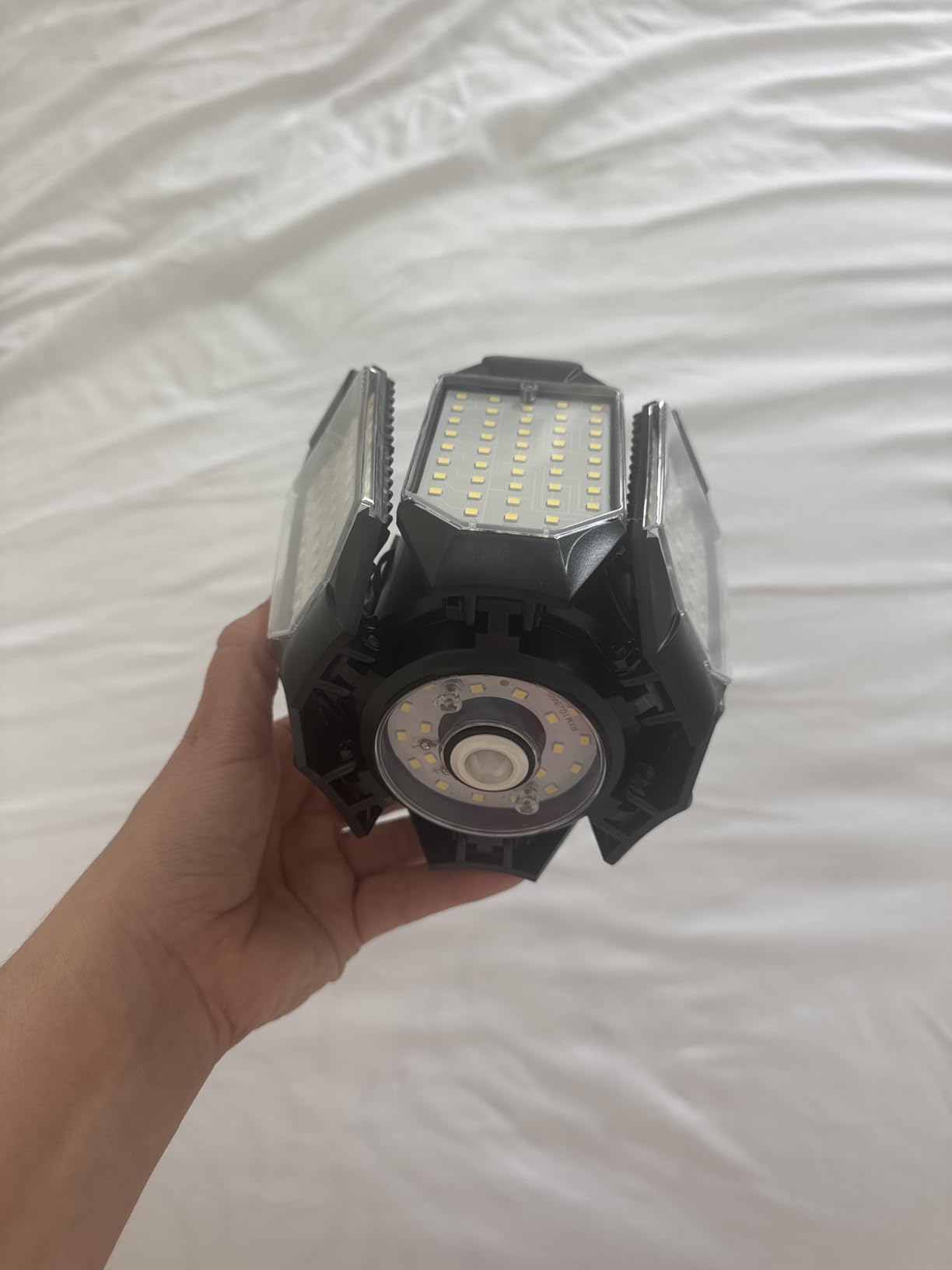
The PIR sensor covers a full 360 degree with a 60 second sensing time, and the standard E26 screw-in base means installation is genuinely a fifteen-second job. Dusk-to-dawn dual sensor modules stop it firing during the day, and there are three modes: Always-On, Off, and Motion Sensor.
The constant current driver is rated for a 50000 hour lifespan. Footprint is 11.8 by 11.8 by 4.72 inches, and the 2 year warranty is on the short side.
Check for ceiling clearance and bulk
This is a bulky fixture. Buyers moving from a flush dome to a deformable panel report the physical size as the most jarring change, and it hangs roughly 4.7 inches below the fixture. Measure your joists and keep clearance in mind around a vehicle door.
It is also indoor rated, so it cannot go in an open carport ceiling without cover.
Decide whether 6500K suits your work
6500K is noticeably cooler and harsher than the 5000K most garage lights ship with. It renders well and looks clinical, which some people like for inspection work and others find tiring over a long evening. Warm up with a 5000K alternative if you are sensitive to cool light.
8. LUTEC 74W 8000LM Night Light Flood: Best With a Separate Night Light
LUTEC 74W 8000 Lumen Motion Sensor Outdoor Lights, 5000K Daylight, IP65 Waterproof Flood Lights Outdoor with Night Light, Dusk to Dawn Motion Detector LED Security Light for Outside Garage, Yard-Black
8000 lumens at 74W
5000K PIR to 59 ft
Independently switchable night light
IP65 aluminum
Pros
- Night light adds path visibility without full flood output
- 8000 lumens across three light sources
- Four modes including manual override
- IP65 aluminum housing for harsh weather
Cons
- Hardwired installation required
- Very bright and not dimmable at night
This fixture separates two jobs that usually fight each other. When you walk up to the garage at night, you want a soft path light, not 8000 lumens blasting you while you find your keys. When motion is detected, you want the full flood. The independent circular switch on this housing lets you have both.
Output is 8000 lumens at 5000K from 74W across three light sources, with a 180 degree detection angle reaching 59 feet. Four lighting modes cover Test, Security, Dusk to Dawn, and Manual Override, so you can force continuous light for a long project.
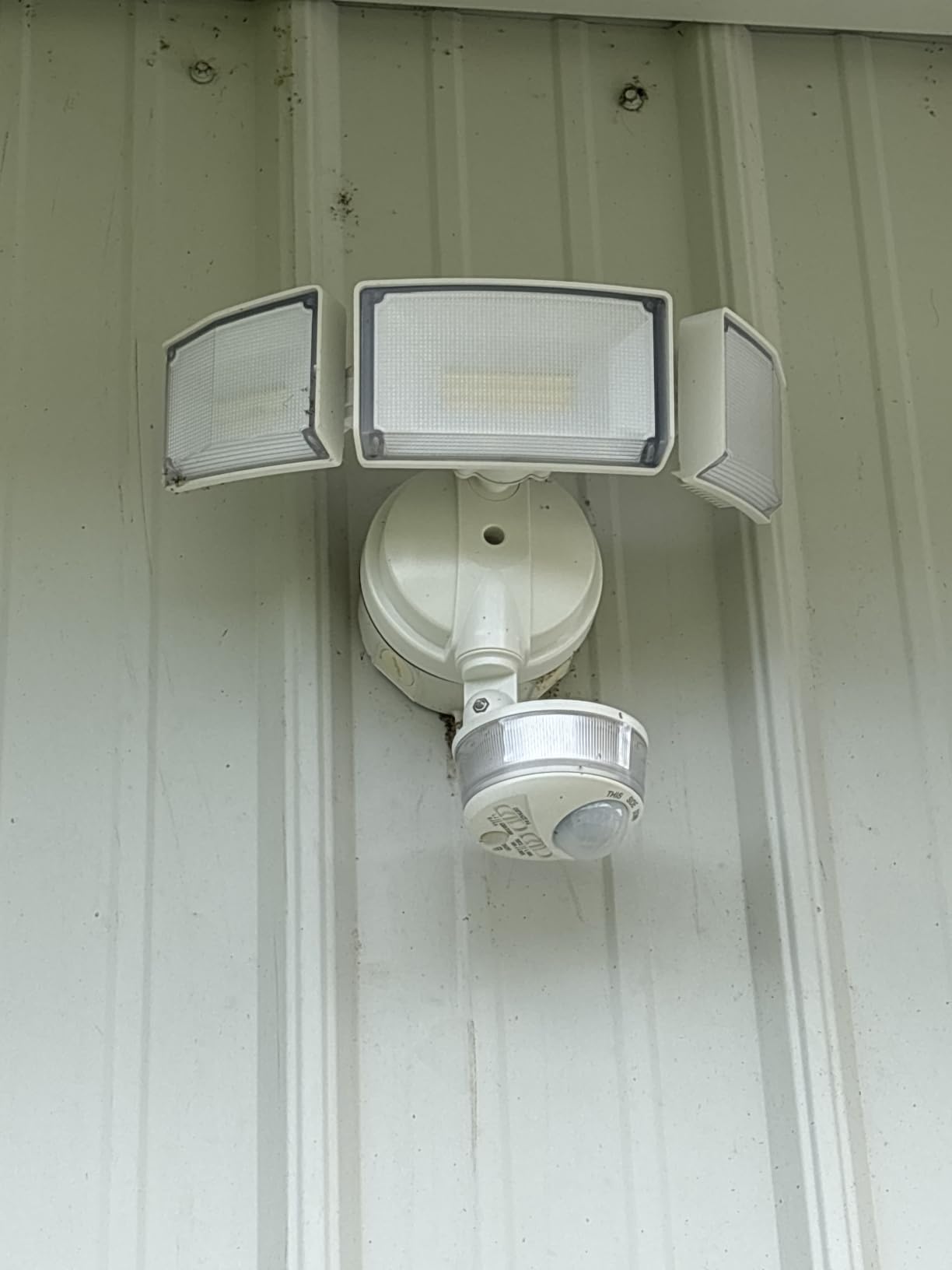
Reviewers rate this among the best-scoring fixtures in the roundup at 4.6 stars, and the night light control is the feature they single out most. The aluminum housing carries an IP65 waterproof rating and mounting accessories are included.
It measures 12.99 by 5.04 by 10.04 inches and carries a 3 year manufacturer warranty.
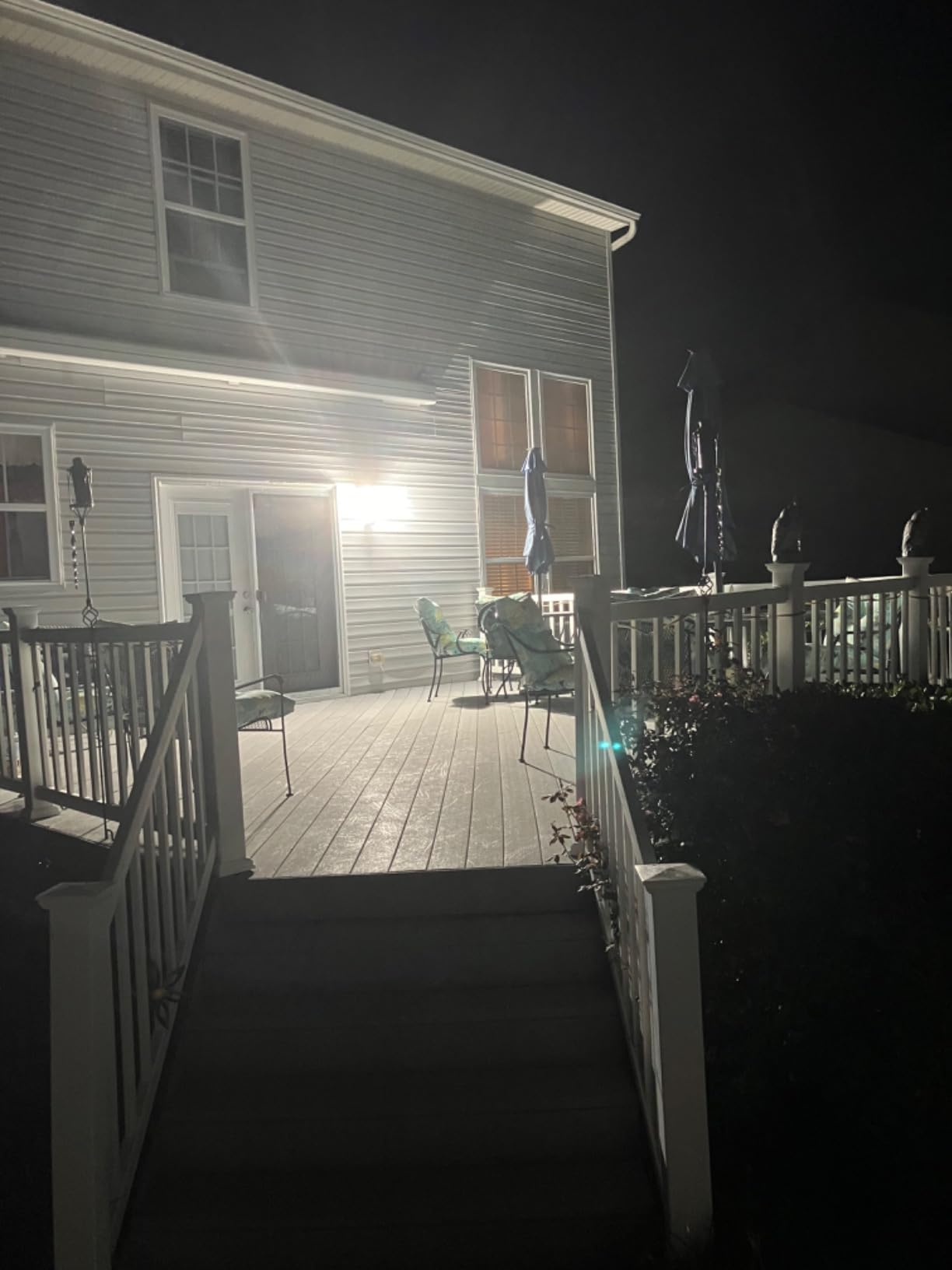
Plan the mounting position around the night light
For the night light to do anything, it needs to face a path or stair run. Mount the fixture so the low output lands where you walk rather than where you park, and you will stop walking into a dark garage entirely.
Be aware the night light is not dimmable. Check how bright it reads from the sidewalk before committing to a full-output flood above it.
Budget for hardwiring
There is no plug-in version of this output level. If your garage wall has no electrical box, this is an electrician job, and it is worth bundling with any other exterior lighting work rather than doing on its own.
9. LUTEC 21W 2500LM Plug-In Flood Light: Best Value
LUTEC 21W Plug in Motion Sensor Light Outdoor, Flood Lights Outdoor Motion Sensor,2500LM, 5000K Daylight,IP65 Waterproof,Adjustable 2 Heads Wall Light for Garage, Porch, Yard – Black
2500 lumens at 21W
Plug-in with no hardwire
110 degree sensing to 49 ft
IP65 waterproof
Pros
- Top rated plug-in flood light in the roundup
- 2500 lumens covers a yard or flower beds
- No electrician or junction box required
- Heads and sensor aim in separate directions
Cons
- Power cord is roughly 6 ft so an extension may be needed
- Sensitivity drops off when approached from the side
- Head adjustment range is limited
If your garage has no wiring you want to touch, this is the fixture to start with. It plugs into a standard outlet, mounts to the wall over it, and delivers 2500 lumens at 5000K from 21W, which is stated as roughly equivalent to a 160W incandescent with claimed savings of up to 88 percent.
The sensor covers a 110 degree arc out to 49 feet, with an adjustable timer for test, 1, 3, or 10 minutes. Two heads and the sensor swivel separately, which means you can point the detection cone down a walkway while aiming the light at the driveway.
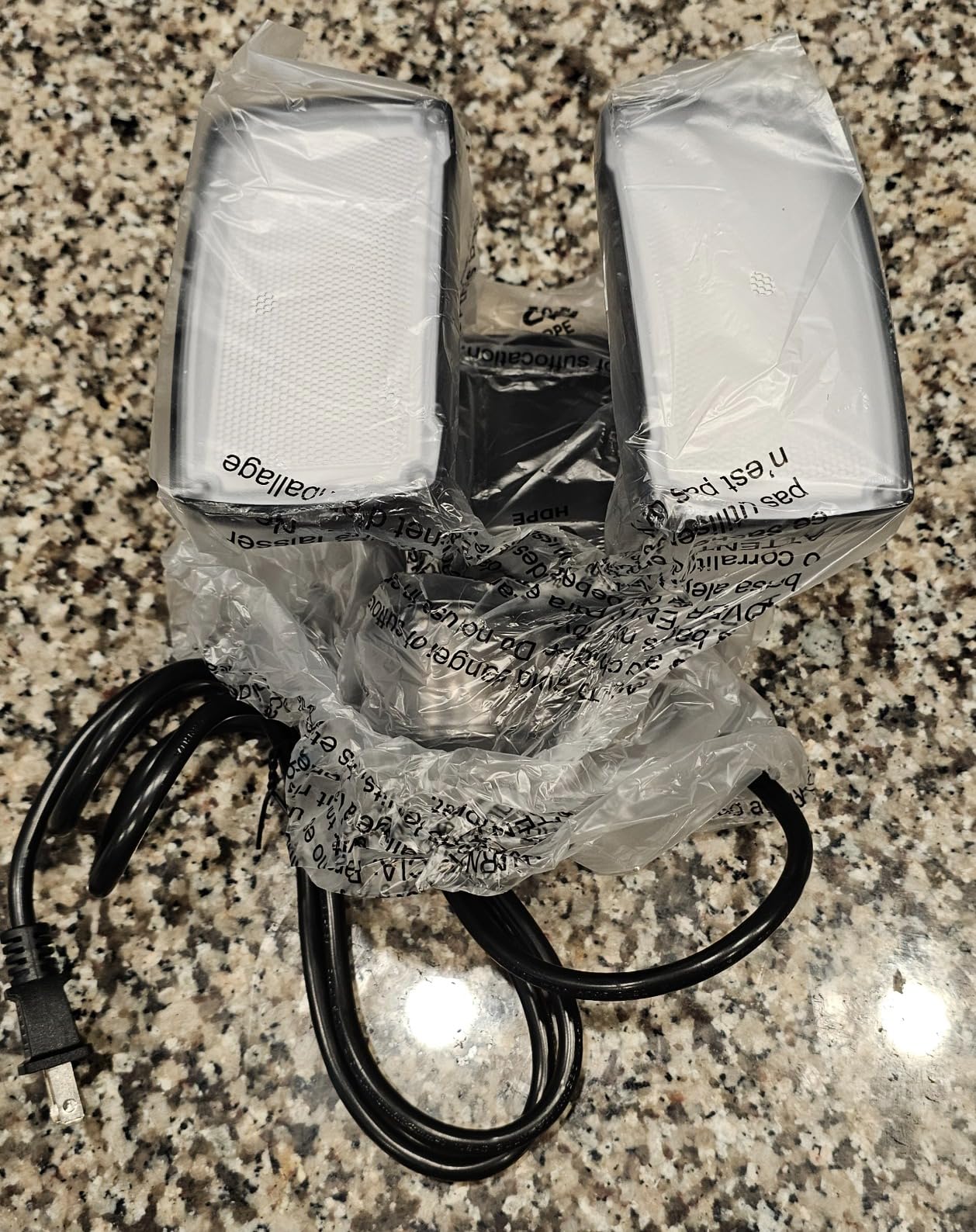
Buyers rate this the most sensitive plug-in flood light in the set, with 82 percent five-star ratings. The IP65 waterproof rating covers rain, snow, heat, and cold, and it is only 1.2 pounds at 10.43 by 5.71 by 6.3 inches, with a 3 year warranty.
One long-term owner reports reduced detection range after about six months, which is worth factoring in if you are installing it high on an eave.
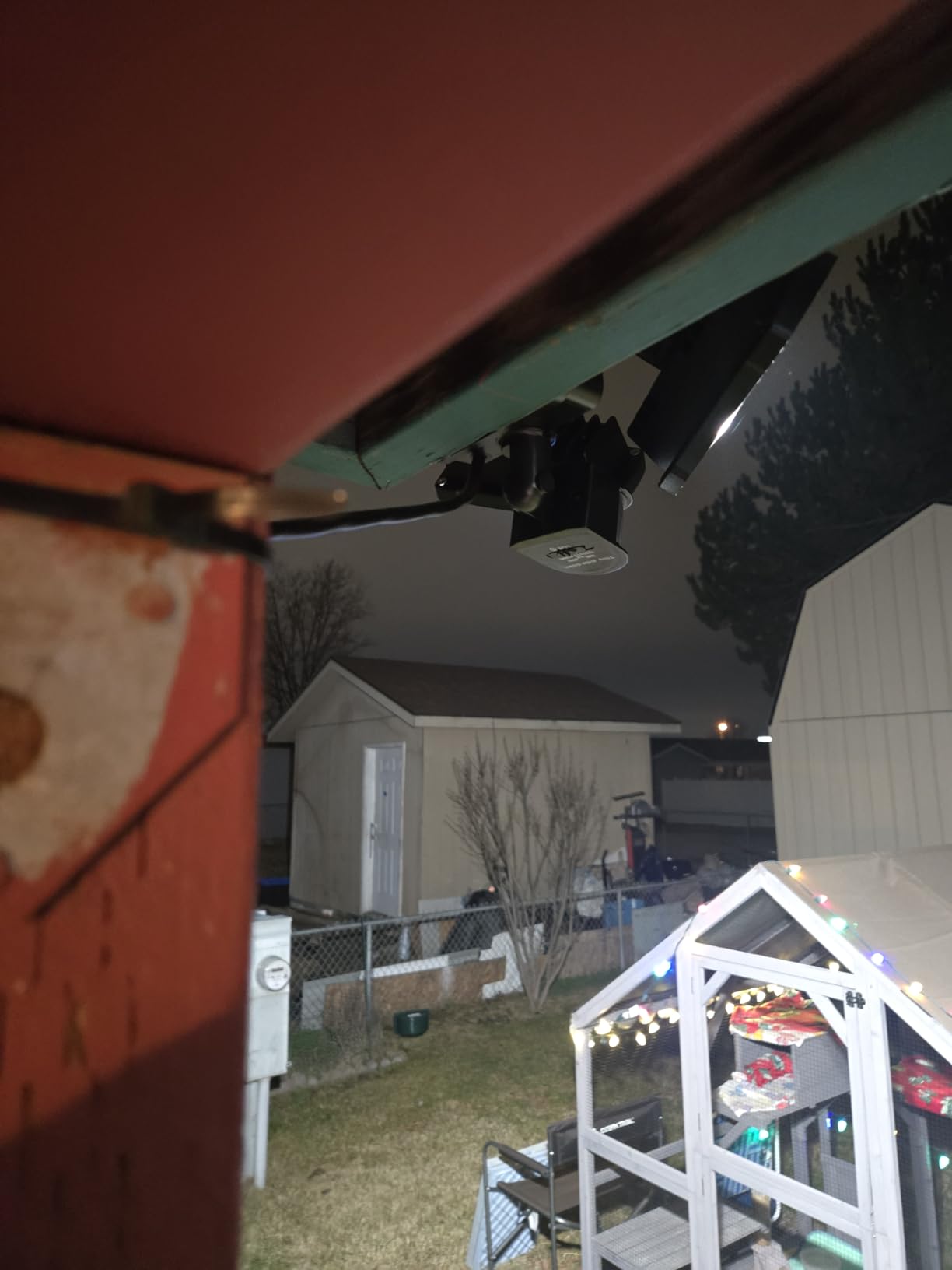
Check the outlet location first
The power cord is roughly 6 feet, and that single fact decides whether this works in your spot. An outlet on the side wall of a detached garage may leave you needing an extension cord, which pushes the fixture toward water exposure and defeats some of the IP65 rating.
Test the outlet location before you buy. Most returns are cord length, not defects.
Aim the sensor along your approach
Sensitivity drops noticeably when someone crosses the detection cone from the side rather than walking toward it. Point the sensor down the path people actually use, the driveway or the door, not out across the yard where it will catch cars and nothing else.
10. Philips 72W 7400LM Three-Head Flood Light: Best for Manual Override
Philips 72W 7400LM LED Security Lights w/PIR Motion Sensor Outdoor, 5000K Daylight Dusk to Dawn Aluminum Flood Light, 3 Adjustable Heads, Waterproof for Garage, Yard, Porch
7400 lumens at 72W
5000K PIR to 69 ft at 180 degrees
Three rotatable heads
Override runs 80 percent for 6 hours
Pros
- 7400 lumens spread across three aimable heads
- Long 69 ft PIR detection at 180 degrees
- Manual override holds 80 percent brightness up to 6 hours
- Rear heat dissipation fins in the aluminum body
Cons
- Hardwired installation required
- Very bright output needs careful aiming
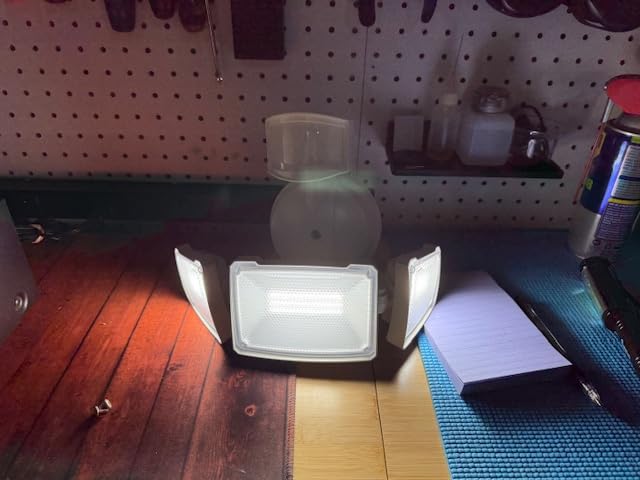
The manual override is the detail that makes this useful in practice. Toggle it and the light runs continuously at 80 percent brightness for up to six hours, which is long enough to finish an oil change without the sensor cutting out mid-job or being triggered by every passing car.
Output is 7400 lumens at 5000K from 72W, spread across three rotatable heads with a high-sensitivity PIR sensor reaching 69 feet at a 180 degree angle. The on-time is selectable at 1, 3, or 10 minutes, and four modes cover Test, Security, Dusk-to-Dawn, and Manual Override.
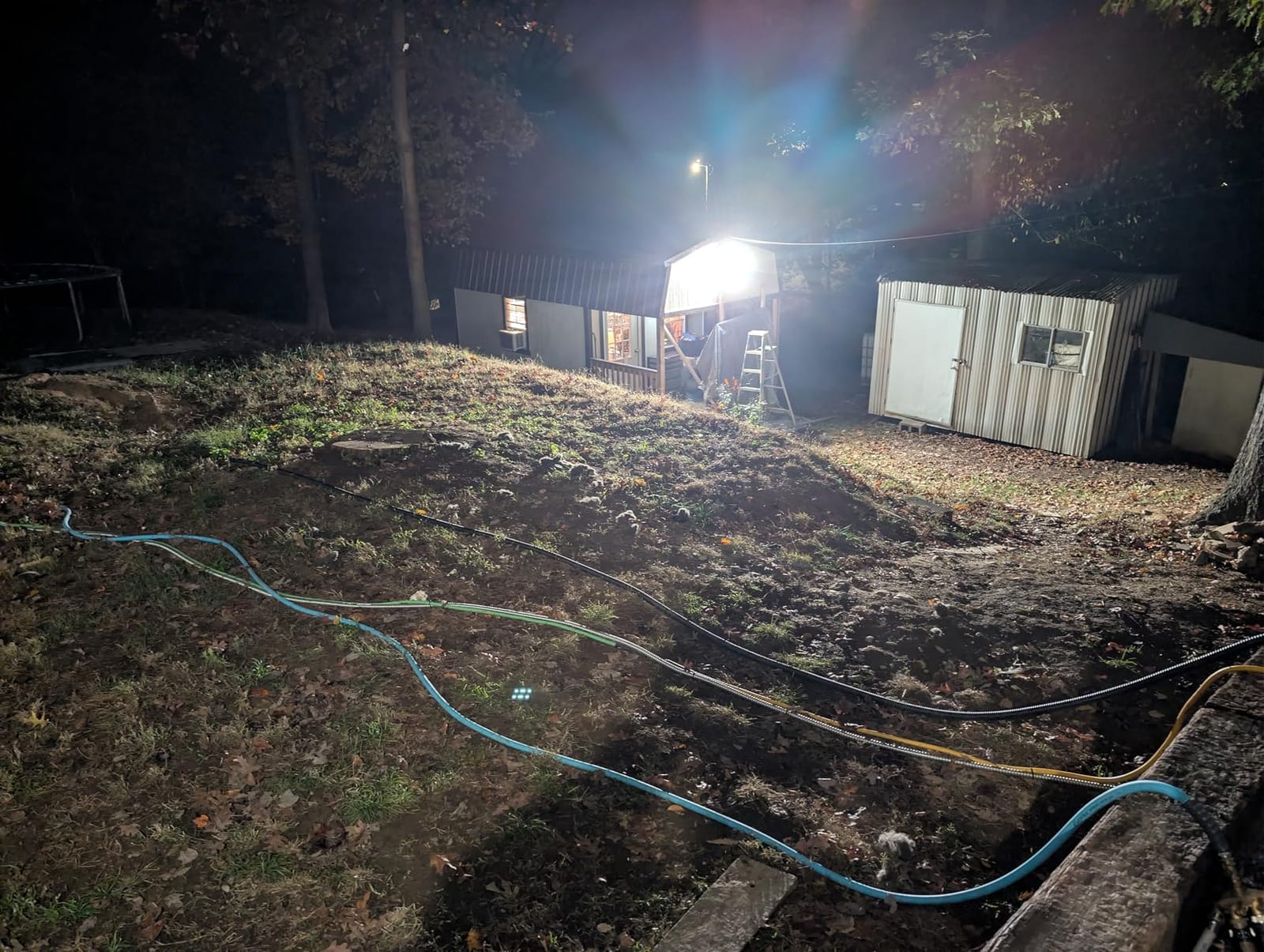
Buyers highlight brightness and flexible three-head aiming, with 80 percent of reviews at five stars. The aluminum body has rear heat dissipation fins, which is a meaningful detail for a fixture running at this output in a space that can hit 90 degrees in July.
It is tested for corrosion, rust, heavy rain, humidity, UV, and extreme temperatures, ships fully assembled with accessories included, and measures 11.22 by 4.33 by 9.25 inches at 103 lumens per watt.
Aim for coverage rather than for maximum brightness
At 7400 lumens, this will light a neighbor’s yard and their windows if you point it that way. Use the three rotatable heads to spread output across separate zones rather than concentrating them, and accept slightly dimmer areas for the sake of not creating a complaint.
The six-hour override at 80 percent brightness still adds up in a garage you use every evening.
Confirm the circuit can take the load
This is a hardwired unit with a real power draw. If it is replacing an existing flood light on the same circuit, the swap is straightforward. If not, verify the circuit before ordering, and confirm your electrical box is deep enough for the wiring access.
11. GE LED+ Motion Sensor A21 LED Bulb: Best Budget Pick
GE LED+ Motion Sensor LED Light Bulbs, Outdoor Security, A21, Warm White
1100 lumens at 11W
3000K warm white
24 ft detection at 90 degrees
Always-on via switch toggle
Pros
- No app
- hub
- or Wi-Fi connection needed
- 1100 lumens warm white from only 11 watts
- Always-on mode from a quick wall switch toggle
- Screws straight into a standard E26 socket
Cons
- Non-enclosed fixtures only
- 5 minute on-time cannot be adjusted
- 24 ft at 90 degrees is a narrow detection cone
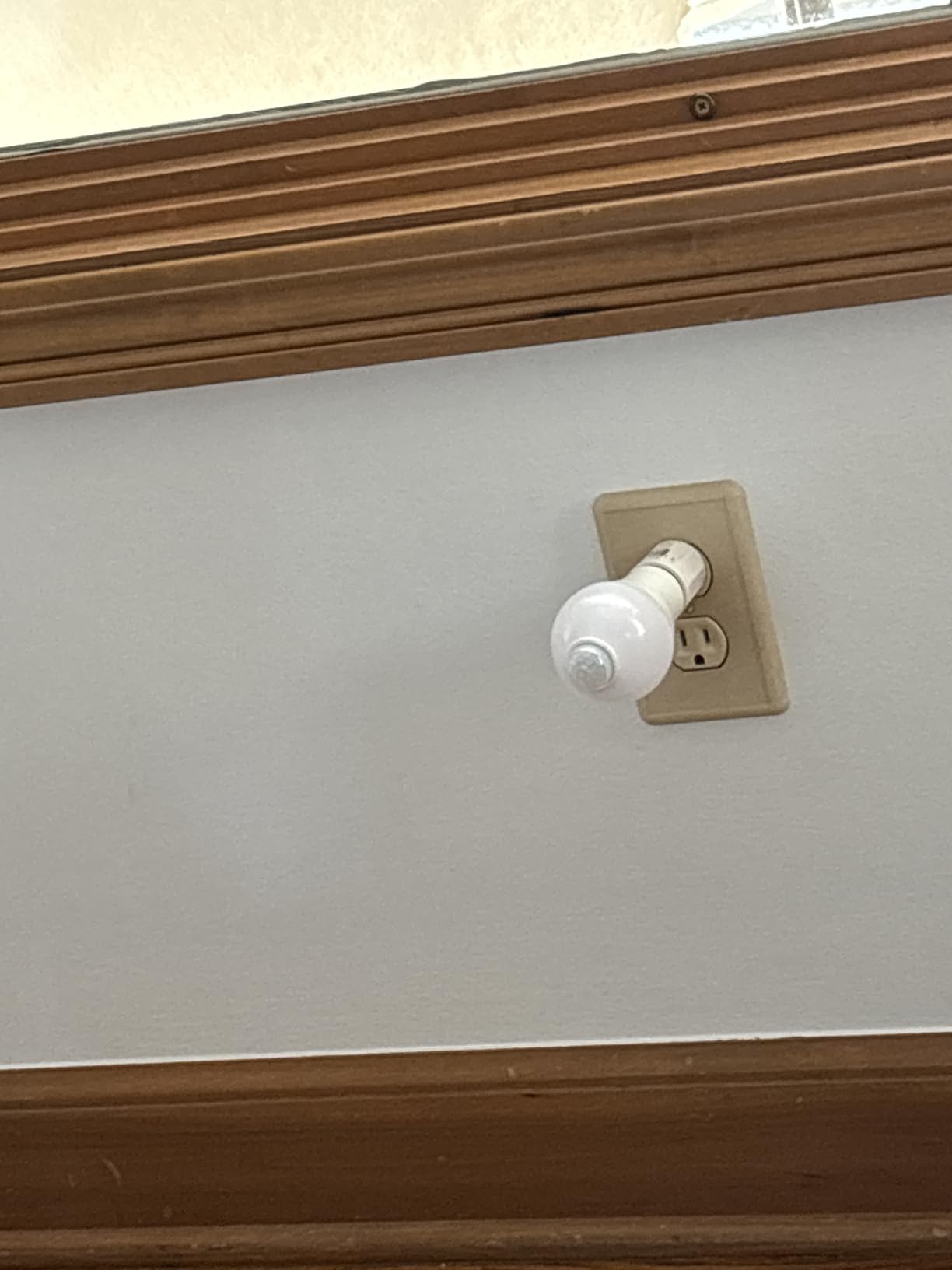
This is not a garage light and we will not pretend otherwise. It is a motion-sensing bulb for an existing fixture, and it earns a place here because it solves the one problem the dedicated fixtures do not: getting automatic lighting into a garage you cannot wire.
Output is 1100 lumens of 3000K warm white from an 11W draw, rated as equivalent to a 75W incandescent. The motion sensor detects within 24 feet across a 90 degree viewing angle, and the bulb stays lit for 5 minutes after motion stops.
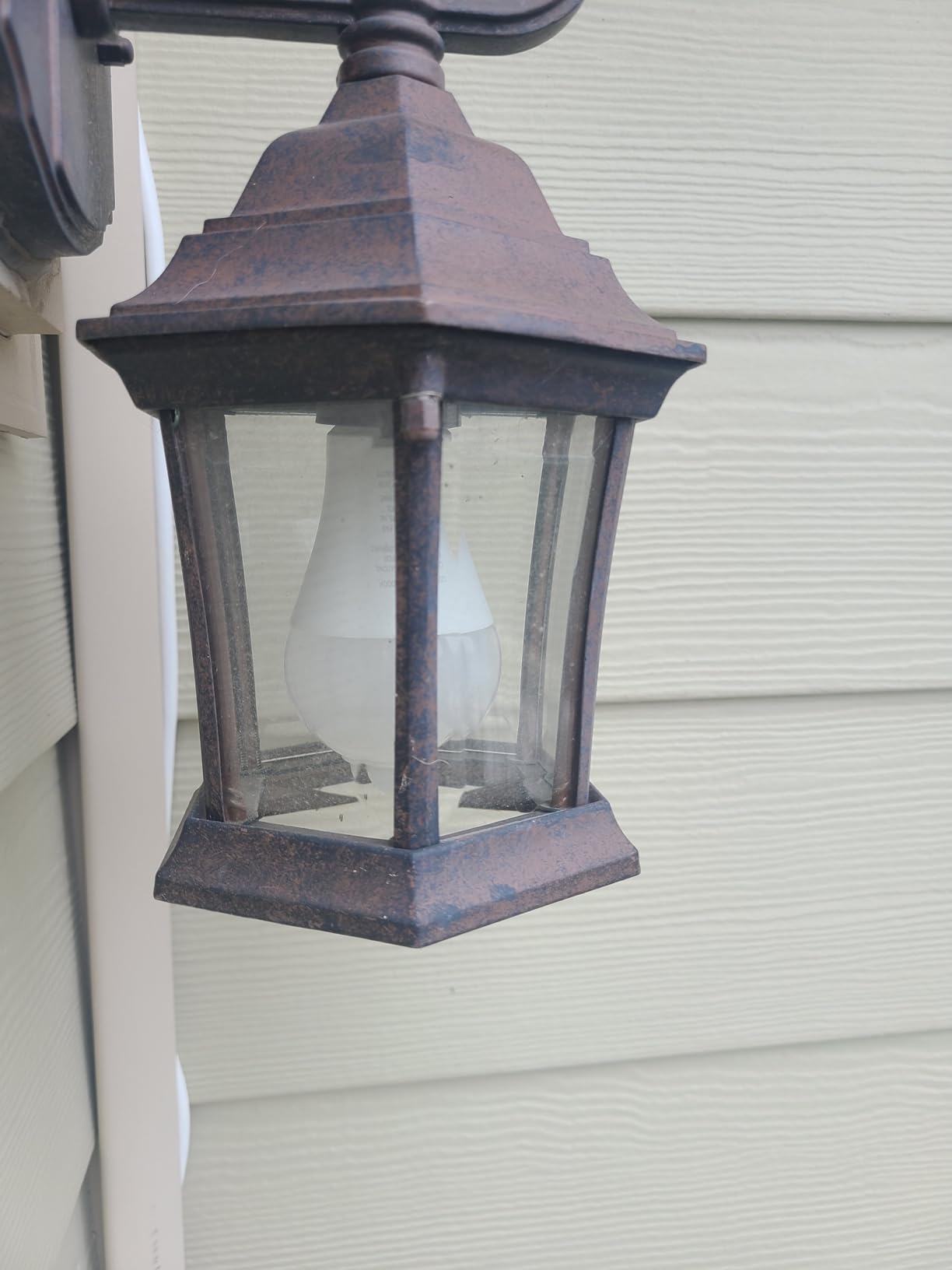
There is no app, no hub, and no Wi-Fi pairing. It screws into an E26 base and works. For a storage shed, a basement workshop, or a rental garage where you cannot touch the wiring, that simplicity is the entire selling point.
You can force it on by toggling the wall switch off and on within 3 seconds, and it is damp-rated for humid locations.
Check the fixture type before ordering
This bulb is rated for non-enclosed fixtures only. A globe, a drum shade, or an opaque plastic dome traps heat and the bulb will fail early. If your existing fixture has a clear or open shade, this works. If it has a solid cover, it does not.
Warm 3000K output is also softer and more yellow than the 5000K most garage lighting uses.
Accept the fixed five-minute timeout
The 5 minute on-time cannot be shortened, which means a brief trip to the shed leaves the bulb burning. The 90 degree detection cone is also narrow enough that you need to cross the fixture, not stand beneath it, to trigger reliably.
12. toberich 80W 8000LM Plug-In Shop Light: Best for Hanging Installs
Motion Sensor Garage Light Plug in, 8000LM 6500K Shop Light 3 Modes
8000 lumens at 80W
6500K plug-in with hanging chain
PIR to 15 ft at 360 degrees
Three modes
Pros
- Plug-in installation with adjustable hanging chain
- Deformable panels angle up to 90 degrees for directed light
- 8000 lumens suits basements
- attics
- and workshops
- Always-on mode for long sessions
Cons
- PIR range limited to roughly 12-15 ft
- Fixed 60 second timeout that cannot be extended
- Indoor rated and not water resistant
- 1 year warranty
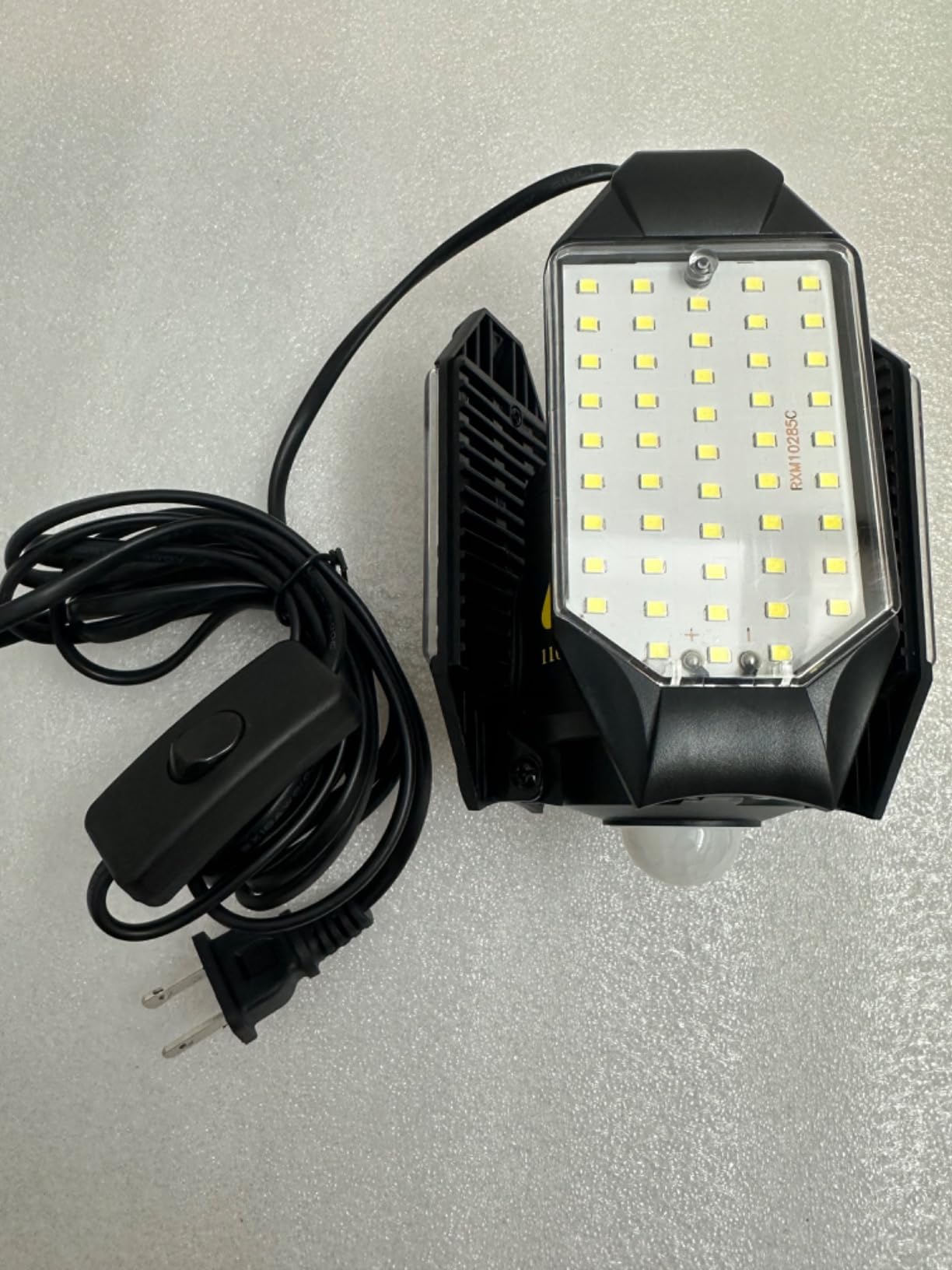
A garage with a high ceiling and no fixture is the perfect match for this one. It hangs from an adjustable chain of up to 3.28 feet, plugs in with a 6.56 foot cord, and puts out 8000 lumens at 6500K from 80W across 144 LED chips.
Six deformable panels angle up to 90 degrees, which means you can direct light down onto a workbench and out toward the walls at the same time. Buyers consistently mention that the panels are what make the brightness usable rather than blinding.
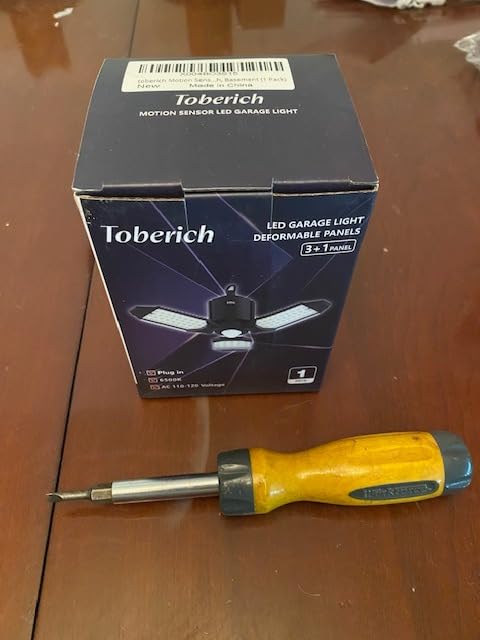
The PIR sensor covers a 360 degree angle at a 12 to 15 foot range and holds the light for 60 seconds after motion. Three modes cover Always-On, Off, and Sensor, with a 3 to 5 second self-test when you first enter sensor mode. The constant current driver is rated 50000 hours.
It measures 11.2 by 11.2 by 4.65 inches, and the package includes the hanging chain, hooks, and plastic anchors.
Check your ceiling height against the chain
The chain adjusts between 0 and 3.28 feet. Mounting from a 10 foot joist down to a workable 8 foot height is within range; a 12 foot ceiling is not. The package also includes anchors, but you will still need a suitable hook in the joist itself.
This is indoor rated only, so keep it inside the garage envelope.
Do not expect entry lighting from this sensor
A 12 to 15 foot radius is a small area for a 360 degree cone. It is tuned for someone standing and working under the light, not for someone walking in from the driveway. If hands-free entry is your priority, choose a fixture with a longer throw instead.
How Motion Sensors Work in a Garage
Two sensor technologies dominate garage lighting, and every fixture in this roundup uses one of them. Passive infrared, or PIR, detects the heat signature of a moving object. A microwave radar sensor emits radio waves and detects the change when something reflects them back.
PIR is the right default for most garages. It responds to body heat, so it will not trigger on moving air, insects, or a tree branch outside the door. Every product we tested uses PIR, which also means none of them will interfere with your garage door opener. That problem is real but specific to microwave sensors, and installer forums repeatedly cite a separation distance of roughly 8 to 10 meters between a microwave detector and an opener as the workaround.
Microwave earns its place when you need detection through a wall or a partially open door, since radio waves pass through thin surfaces where heat does not. If you want to light a garage as you approach from the house, a microwave sensor can see you around a corner. The trade-off is false triggers from anything moving outside the detection zone, including passing cars and pets.
Sensitivity control is where the differences live. A fixture with range switching, like the LEPOWER with its 10, 20, 50, and 72 foot settings, can be narrowed to stop nuisance activations. The SANSI goes further with separate range, time, and ambient light dials. At the other end, the Sunco’s roughly 6 foot range is a limitation rather than a feature.
Hold time matters just as much. A 60 second timer suits a quick task, and the Sunco’s 30 second and 120 second settings are the most granular here. Ten minutes suits an evening of work, which is why the LEONLITE uses a fixed 10 minute setting and why the Philips manual override runs up to 6 hours at 80 percent brightness.
Related: if your garage camera also misses movement, why does a video doorbell delay motion notifications covers a related sensitivity problem.
How Many Lumens Your Garage Actually Needs
Car count is a rough guide, footprint is a better one. A single-car garage of about 200 square feet with 8 foot ceilings is comfortable at 4000 to 5000 lumens of total output. A two-car garage around 400 square feet wants 7500 to 10000 lumens spread across more than one fixture. A three-car or workshop bay above 600 square feet wants 12000 lumens or more.
Ceiling height changes the arithmetic more than people expect. Light from a 12 foot ceiling spreads roughly four times the area of the same lumens from an 8 foot ceiling, so tall garages need more total output to reach the floor evenly. Where you cannot add another fixture, aim one high-output head at the ceiling and let it bounce rather than pointing everything straight down.
For task work, brightness alone is not enough. Color rendering index, or CRI, determines whether you can see a color difference between two wires or spot rust forming on a bracket. Most of these fixtures sit at a CRI of 80 or better, and forum discussion among detailers and mechanics consistently recommends pushing higher, above 90, for paint matching, wiring, and any color-critical work. Where a fixture’s CRI is not stated, treat it as an average figure rather than a promise.
Standby draw is the number most buyers never check. A motion sensor still consumes power while waiting, and across a two-car garage with three fixtures the standby load is small but not zero. Over years it adds up, which is part of why lumen-per-watt figures like the Philips at 103 lumens per watt or the UME at over 105 are worth comparing.
One more practical note on glare. A 20000 lumen deformable fixture in an 8 foot ceiling will blind you at the workbench unless you angle the panels away from your seating position. Very high output is not automatically better in a small space.
Screw-In, Plug-In, or Hardwired: Choosing an Installation
Screw-in deformable lights go into an existing E26 socket. Installation takes about 15 seconds, and they suit finished ceilings where the wiring is already in place. The catch is fit: these fixtures are roughly 4.7 inches deep, so they will not sit inside a low-profile flush dome. Check your existing fixture height before ordering one.
Plug-in shop lights hang from a chain or mount to the ceiling and run to a nearby outlet. They are the fastest path to good lighting with no electrical work, and they link together, so you can expand a two-fixture setup to four. The catch is the cord length. The LUTEC plug-in flood carries about 6 feet of cord, which is rarely enough to reach an outlet on a detached garage wall.
Hardwired flood lights give you the most flexibility in aiming and the widest selection at high output, from 4000 to 8000 lumens. They also require a junction box and competent wiring work, and a 72W or 74W fixture needs a circuit that can carry it.
For anyone with an existing exterior box, hardwired is the lowest-maintenance choice because there is no bulb to replace and no cord to route. If there is no wiring at all, a smart switch paired with plain LED fixtures is the pattern forum users recommend most often, and several installers argue it beats an integrated sensor because you can replace the sensor independently of the fixture.
The honest framework is simple. Existing box means hardwired. Existing socket means screw-in. Outlet within reach means plug-in. Nothing at all means either pay for an electrician once or live with a bulb.
Color Temperature and CRI for Garage Work
5000K is the sweet spot for most garages. It reads as clean daylight without the clinical feel that makes some people tired over a long evening, and it exposes dust and grime in a way that warm light hides. The LEPOWER at 5500K, the UME, the SANSI, the Sunco, the LEONLITE, and both LUTEC floods all sit here.
6500K is cooler and bluer. The Craftersmark and toberich fixtures use it, and both deliver excellent visible detail and maximum perceived brightness, which helps in a space with no other light source. It is less comfortable for evening work, and it exaggerates any bluish cast on bare concrete or metal parts.
3000K is warm and yellow, like a household lamp. The GE bulb uses it and it is pleasant for a small utility space, but it makes it harder to judge color on a vehicle and it reduces the sense of brightness in a large bay.
Temperature changes how a garage feels, but CRI changes what you can do in it. Anything above 80 is acceptable for parking and general storage. Painting, wiring, brake work, and any task where color matters need a fixture above 90. Most listings here do not publish a CRI figure, so plan to verify it if your work depends on it.
Cold weather is worth a brief mention. LEDs hold output better than fluorescent as temperature drops, which is why replacing an old fluorescent batten with an LED shop light is a genuine improvement in an unheated garage. Metal fixtures like the LEONLITE and Sunco can be used as long as you keep them inside the envelope, since both are water resistant rather than waterproof.
Door Opener Interference and Multi-Fixture Placement
Garage door openers and motion sensors can interfere. The mechanism is simple: the opener’s receiver interprets a stray radio burst as a door command. With a microwave sensor this is a documented problem, and the standard fix is separation. With a PIR sensor, as used by every fixture in this roundup, the risk is far lower because the sensor is listening for heat rather than transmitting.
If you already own a microwave-sensor fixture, keep it away from the opener receiver and from wall outlets on the same circuit as the opener. If you are buying fresh, choosing a PIR fixture sidesteps the problem rather than mitigating it. The same sensitivity logic applies to cameras that stop registering movement after an update, which is covered in our guide to why a Wyze camera stops detecting motion after a firmware update.
Placement is where most installations go wrong. A single fixture at the center of a two-car garage leaves two dark corners, and a fixture near the door often has a blind spot behind the parked car. Two fixtures beat one in almost every layout.
In a single-car garage, put one fixture toward the rear and forward of bay rather than dead center, so the detection cone covers the walkway. In a two-car garage, place one over the workbench side and one over the open bay. In an L-shaped or three-car garage, no single fixture covers everything, and two units aimed into the legs of the L with overlapping detection is the practical answer.
Watch the mounting height. A sensor mounted at 9 feet or higher has a wider useful cone but more distance to the floor, while one mounted low near a workbench has precise coverage of the bench and almost none of the door. The taller the mount, the more output you need to reach the working surface, which loops back to lumen targets.
Finally, test before you finish. Every fixture in this roundup has a test mode that bypasses the timer so you can confirm the aim in a few seconds. Stand at the door, walk the perimeter, and check the corners before you call it done.
Frequently Asked Questions
What is the best motion sensor light for a garage?
The best motion sensor lights for garages depend on your wiring. With an existing electrical box, a hardwired LED flood light gives the widest control over aim and timer settings. With no wiring at all, a plug-in fixture installs in minutes and most of them now carry IP65 weather ratings. For maximum output in a single socket, a 20000 lumen screw-in deformable light covers the most ground.
How many lumens do I need for a 20×20 garage?
A 20×20 single-car garage at 8 foot ceilings is comfortable at 4000 to 5000 lumens of total output. Ceiling height matters as much as footprint, because light from a 12 foot ceiling spreads roughly four times the area of the same lumens from an 8 foot ceiling. Aim one fixture toward the ceiling to bounce light rather than pointing everything straight down.
Which is better for a garage, 5000K or 6500K LED lights?
5000K is the better all-round choice for a garage because it reads as clean daylight without feeling clinical over a long evening. 6500K is cooler and bluer, delivering higher perceived brightness and very visible detail, which suits inspection work and garages with no other light source. It is harsher for evening work and exaggerates any bluish cast on concrete.
Can motion sensor garage lights interfere with a garage door opener?
They can, but the risk is specific to microwave radar sensors, which transmit radio waves that an opener receiver can read as a command. Every fixture in this roundup uses passive infrared sensing, which listens for body heat rather than transmitting, so interference risk is far lower. If you have an existing microwave sensor, keep it separated from the opener receiver by roughly 8 to 10 meters.
What are the downsides of using motion sensor lights in a garage?
The most common complaints are false triggers from pets, passing cars, or moving branches, sensors that are too short-throw to light the entry walkway, and fixed timers you cannot shorten or extend. A few buyers also report sensors that stop triggering after months of use. These are the reasons to choose a fixture with range switching and an adjustable timer rather than the cheapest option.
How do I stop a motion sensor light from staying on?
Check the timer dial and the LUX or ambient light threshold first, since a large share of complaints are really misunderstandings of those settings rather than hardware faults. If the light stays on with the timer at its shortest, a power cycle usually clears it. On fixtures with a mode selector, switch to On-Time or Always-On mode for extended work sessions instead of leaving it in sensor mode.
The Best Motion Sensor Lights for Garages in 2026
After working through 12 fixtures across hardwired, plug-in, and screw-in formats, the LEPOWER 40W 4000LM hardwired flood light is our pick for the best motion sensor lights for garages. It combines 4000 lumens with the widest combination of controls in the group, four sensitivity settings and three on-time options, in a housing that carries both FCC and ETL listing.
Pick the LUTEC 72W 7500LM if you need real output and a third aimable head. Pick the LUTEC 21W 2500LM plug-in if you cannot or do not want to touch wiring. Pick the SANSI 15W if nuisance activations from pets and traffic are your main frustration.
Whichever you choose, mount it where it will see the walkway rather than where it will look best from the street, and use the test mode before you climb down. Then check the rest of your setup with our workbench roundup, because good light only helps if there is a surface to put the tools on.