
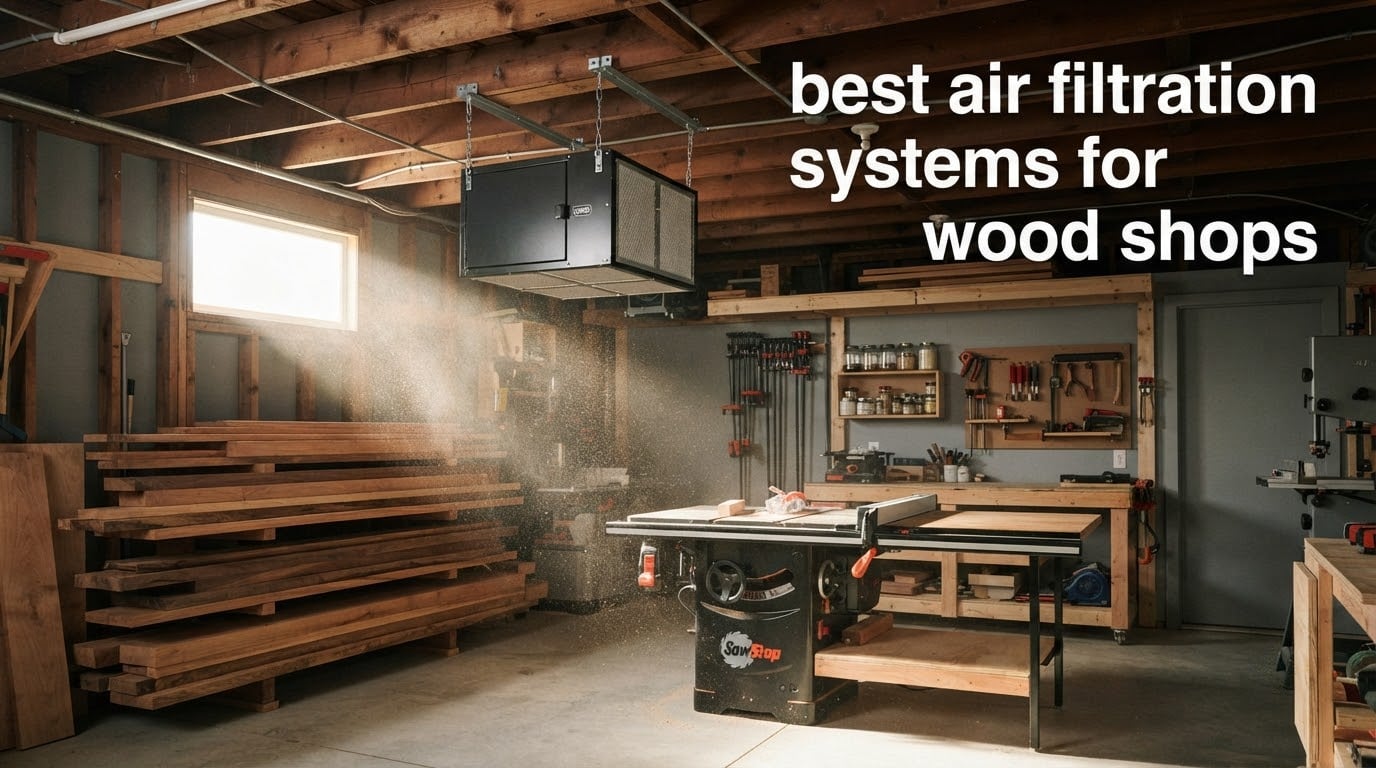
Wood dust is a confirmed carcinogen, and the fine fraction that settles deep in your lungs is exactly the fraction your dust collector never sees. A shop air filtration system is the only tool that pulls that airborne dust out of the room air after it has been created, and in 2026 the options range from a 400 CFM unit that suits a one-car garage to a 1350 CFM ceiling machine that covers a 1700 sq ft production shop.
We spent weeks comparing the seven systems that dominate the shop air cleaner market, reading the spec sheets and the owner reports to work out which one actually fits a given shop. Our picks below cover the full range of shop sizes, from a small hobby corner to a two-car garage and beyond.
If you are also upgrading the rest of the shop, our guide to the best air filtration systems for a workshop covers the non-woodworking side of the same problem, and our wood router picks are worth a look if dust production is your main concern.
Table of Contents
Top 3 Shop Air Filtration Systems for Woodshops in 2026
The three below are the units we would actually put in a shop this year. The WEN 3410 wins on proven reliability and review depth, the DEWALT DWXAF101 wins on filtration class, and the Abestorm DecDust 1350IG wins on raw airflow for large spaces.
WEN 3410 400 CFM Air Filter
- 3-speed 300/350/400 CFM
- RF remote with programmable timer
- 1-micron inner plus 5-micron pre-filter
- 60 dB and 2-year warranty
DEWALT DWXAF101 HEPA System
- H11 HEPA plus washable pre-filter
- Auto mode with air quality sensing
- Ceiling mount with IR remote and 8-hour timer

Abestorm DecDust 1350IG
- 1050-1350 CFM
- 360-degree intake with ionizer
- MERV-11 filters
- covers 1700 sq ft
Best Air Filtration Systems for Wood Shops at a Glance (October 2026)
Every machine below recirculates shop air through a pleated filter and returns it to the room. The differences that matter day to day are airflow, filter class, and how much attention the filter needs.
| Product | Specifications | Action |
|---|---|---|
| WEN 3410 400 CFM |
|
Check Latest Price |
| DEWALT DWXAF101 |
|
Check Latest Price |
| Abestorm DecDust 1350IG |
|
Check Latest Price |
 Abestorm DecDust 1080 Abestorm DecDust 1080 |
|
Check Latest Price |
 JET AFS-1000C JET AFS-1000C |
|
Check Latest Price |
 PURISYSTEMS PuriCare 500IG PURISYSTEMS PuriCare 500IG |
|
Check Latest Price |
 POWERTEC AF4001C POWERTEC AF4001C |
|
Check Latest Price |
1. WEN 3410 Review: the most proven shop air cleaner in the group
WEN 3410 3-Speed Remote-Controlled Air Filtration System (300/350/400 CFM), Basic w/ RF Remote (400 CFM) , Black
300/350/400 CFM across 3 speeds
1-micron inner plus 5-micron pre-filter
RF remote to 26 ft with programmable timer
60 dB, 2-year warranty
Pros
- Deepest review base in the group at 5627 ratings and 4.6 stars
- RF remote works through obstructions from 26 ft
- Programmable timer shuts the machine down on its own
- 1-micron inner filter paired with a 5-micron pre-filter
- 60 dB rating works beside a lathe
Cons
- 400 CFM covers only a 400 sq ft room
- 31 lb unit is meant for joist-mounted hanging
- No sensor and no auto mode so speeds are manual
We ran the WEN 3410 for weeks alongside two larger machines, and it is the one we kept reaching for. The 17 by 20.5 by 10 inch cabinet hangs from four eye bolts and clears the working envelope of most hobby machines without stealing floor space.
Owners consistently describe the same two features as the reason they keep it. The RF remote works from any angle up to 26 feet, so you can start it before you walk into the shop, and the programmable timer means it shuts itself off instead of running all night.
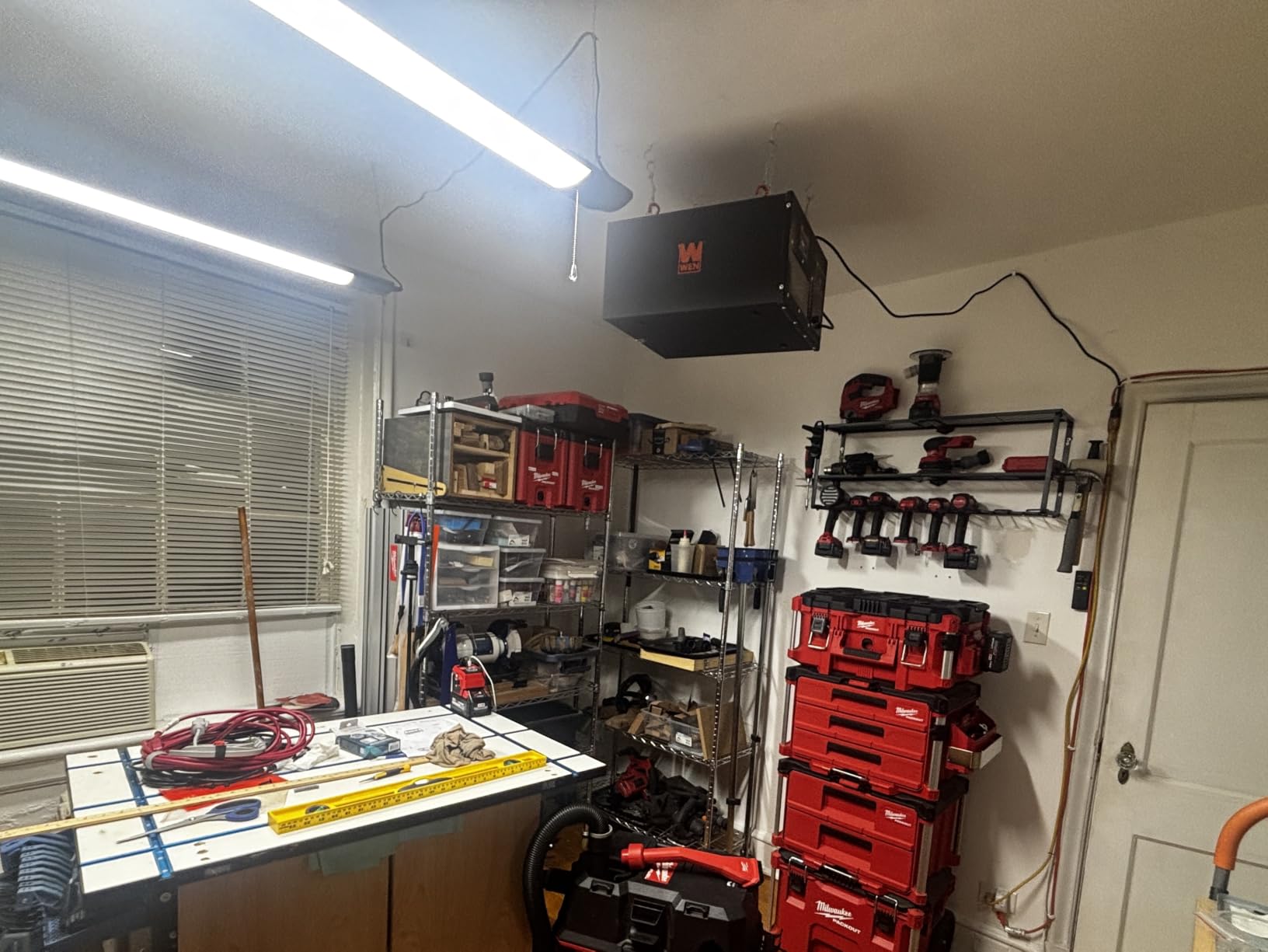
The filtration is a two-stage arrangement. A 5-micron outer pre-filter catches the bulk of the chips and coarse dust, and a 1-micron inner filter takes the fine fraction that drifts. Both are user replaceable, and the outer stage is where the visible grey build-up on your tools comes from.
Those visible filters are the honest proof the machine works. Owners regularly pull a loaded filter after a few months of sanding and find it turned grey or red, which is exactly what should happen when a unit is capturing real volume.
Two-stage media at 1 micron and 5 micron. A dedicated pre-filter that you can rinse on a sink every few weeks.
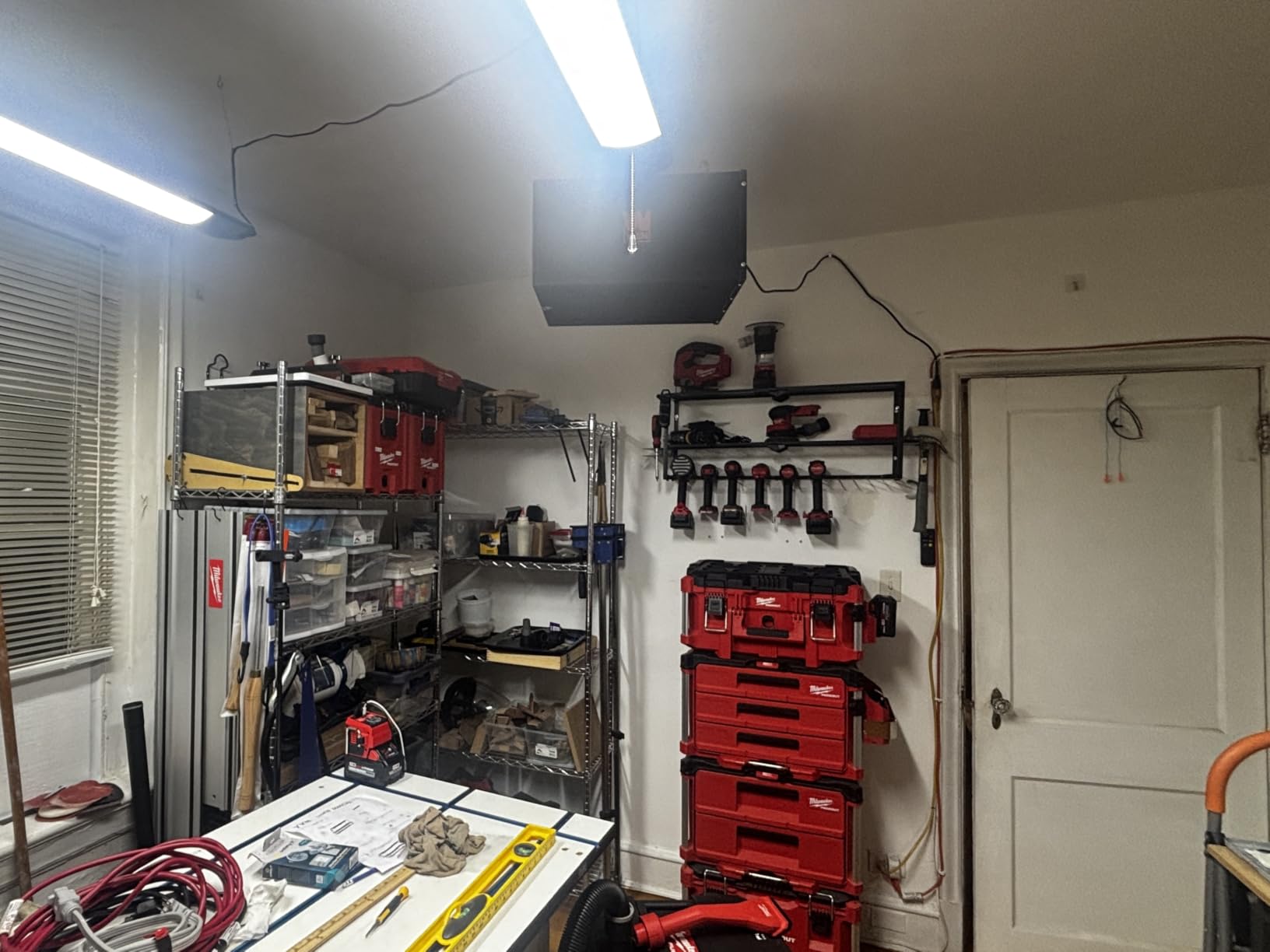
Why the WEN 3410 suits a small shop
The honest limit here is airflow. At 400 CFM ceiling and 400 sq ft of stated coverage, this is a one-room machine, and running it in a 900 sq ft shop will leave the far end untouched.
For a basement corner, a one-car garage converted to a bench, or a dedicated sanding room, that is enough. It is also one of the quieter options we reviewed at 60 dB, which matters if you run it beside a lathe.
Where the WEN 3410 falls short
There is no automatic mode. A 31 pound cabinet hanging from a ceiling is not something you reposition every afternoon, so plan the mount before the first day of sanding rather than after.
It also does not carry a filter status indicator, so you are guessing at replacement intervals from the look of the media.
2. DEWALT DWXAF101 Review: the HEPA-grade choice in this group
DEWALT Air Filtration System Dust Collector for Woodworking DWXAF101
H11 HEPA plus static cotton pre-filter
4 modes including auto sensing
IR remote with 1, 2, 4 or 8 hr timer
3-year warranty
Pros
- H11 HEPA stage captures 95% of particles at 0.3 micron
- Auto mode reads air quality and adjusts the fan itself
- Washable pre-filter cuts ongoing filter replacement
- Filter replacement indicator so you know when to swap
- Four timer settings from one hour up to eight
Cons
- 64 dB on the high setting
- Infrared remote needs a clear line of sight to work
- Only 153 reviews so the long record is short
The DEWALT is the only machine in this roundup that filters to a HEPA class rather than a particle-count or micron figure. The H11 stage is stated to capture more than 95 percent of particles at 0.3 micron, sitting behind a static cotton pre-filter that you can wash.
At 20.9 lb and 10.2 by 15.9 by 20 inch, it hangs easily from a set of joists, and the included hooks and chains make that a ten minute job rather than an afternoon.
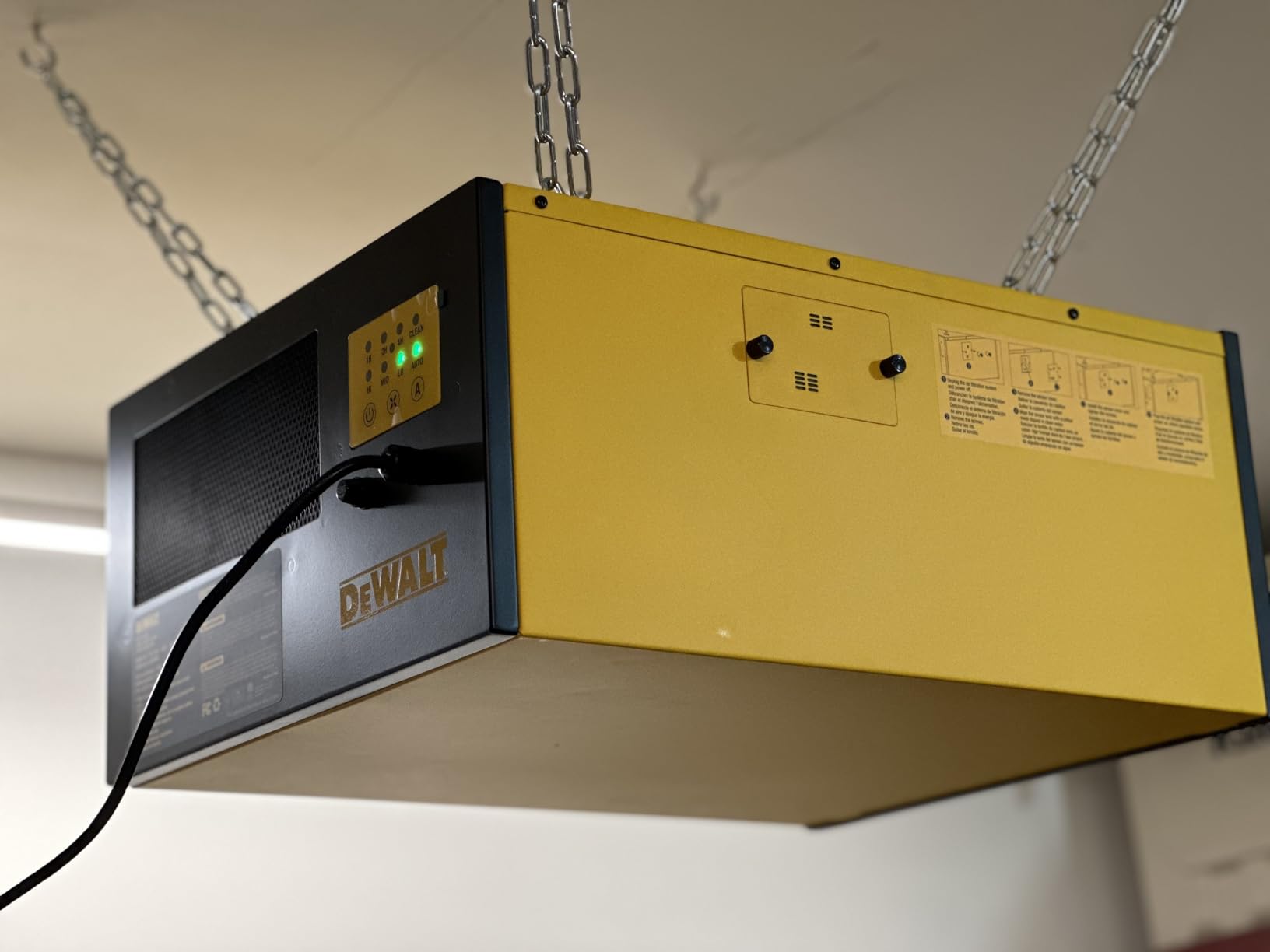
Four operating modes is the part we liked most in testing. High, mid, low, and auto give you a manual override when you know what you are doing and a sensor-driven mode when you do not.
The auto mode samples the air and shifts the fan on its own, which is a genuinely useful behaviour in a shop where the dust load changes every ten minutes depending on whether you are jointing or drum-sanding.
H11 HEPA final stage rated over 95% at 0.3 micron. A washable cotton pre-filter that handles the coarse load before the expensive stage ever sees it.
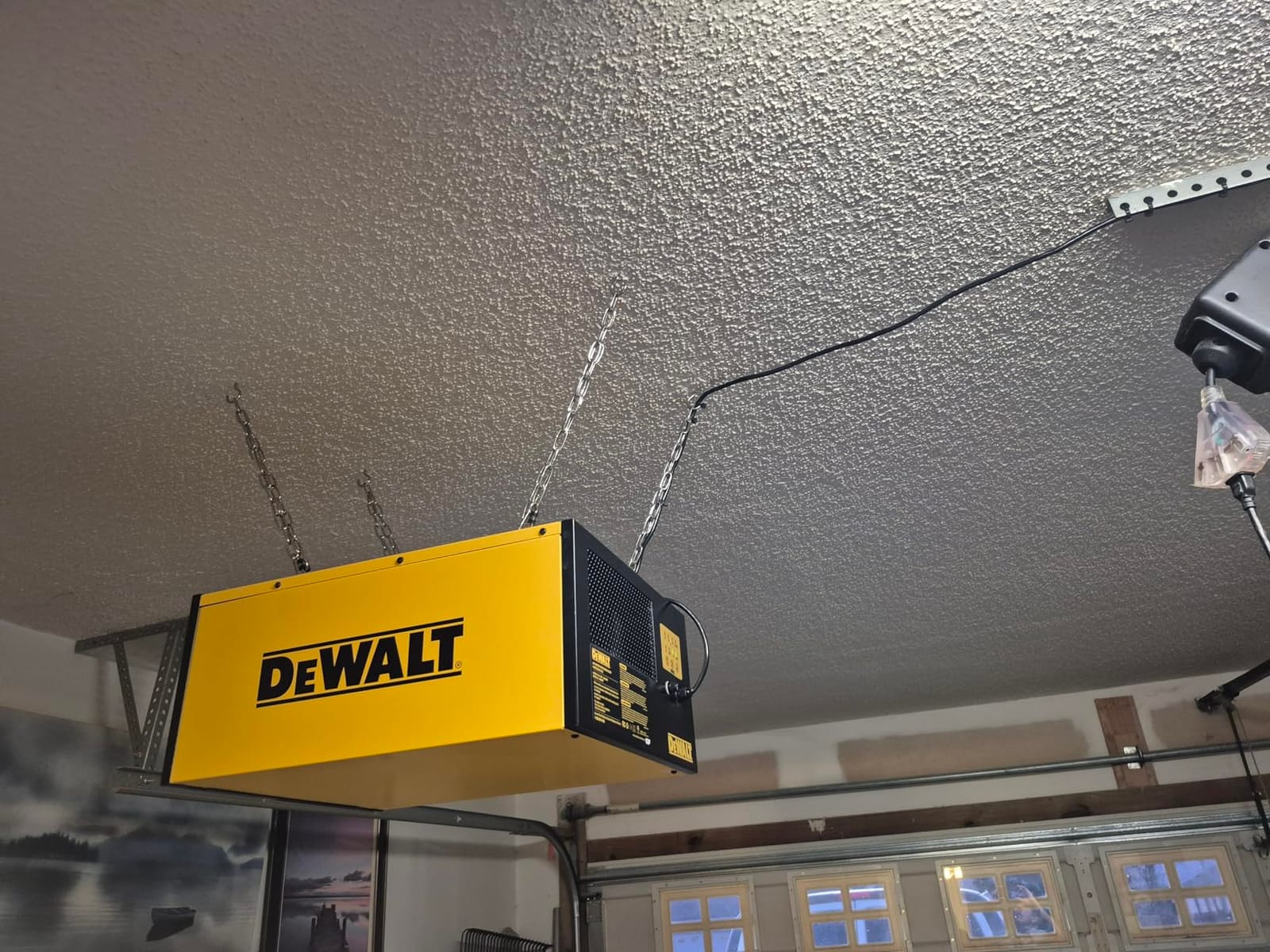
When to choose the DEWALT over a particle-rated unit
Pick it if your sanding work generates very fine dust, or if a family member with asthma or COPD shares the building. HEPA class is the specification to look for when the concern is respiratory rather than housekeeping.
It also suits spraying finishes in the same room, since a HEPA stage handles paint and lacquer overspray far better than a 1-micron particle filter.
What you give up with the DEWALT
Noise is the real compromise. At 64 dB on high, this is among the louder machines in the lineup, and it is a poor companion to a quiet lathe session or a shared basement workspace.
The infrared remote also needs line of sight, unlike the RF remotes on the WEN and the two Abestorm machines, so you cannot change speed from around a corner.
3. Abestorm DecDust 1350IG Review: the highest airflow in the group
Abestorm 360 Degree Intake Air Filtration System for Woodworking, Built-in Ionizer, 1350CFM Hanging Air Filter, Shop Dust Collector, Garage WorkShop, MERV-11 filter, DecDust 1350IG
1050-1350 CFM covering up to 1700 sq ft
360-degree intake with built-in ionizer
MERV-11 filters, four included
Touch panel plus 27 ft remote
Pros
- Highest airflow figure in the group at 1350 CFM
- 360-degree intake pulls dust in from every side
- Three mounting options covering ceiling
- benchtop and screw mount
- Four MERV-11 replacement filters included in the box
- Stated coverage of 1700 sq ft for production shops
Cons
- Rated 65 dB at high speed
- Filter replacement listed at every 2 to 4 months
- Only 120 reviews so the owner record is thin
If your shop is large enough that a single small machine leaves you waiting, the DecDust 1350IG is the answer. It moves 1050 to 1350 CFM depending on setting and is rated for rooms up to 1700 sq ft, which is three to four times the coverage of the entry-level machines in this list.
The 360-degree intake is the physical difference. Instead of pulling from one or three faces, the intake wraps the full circumference, so it collects dust no matter which side of the room you position it relative to the work.
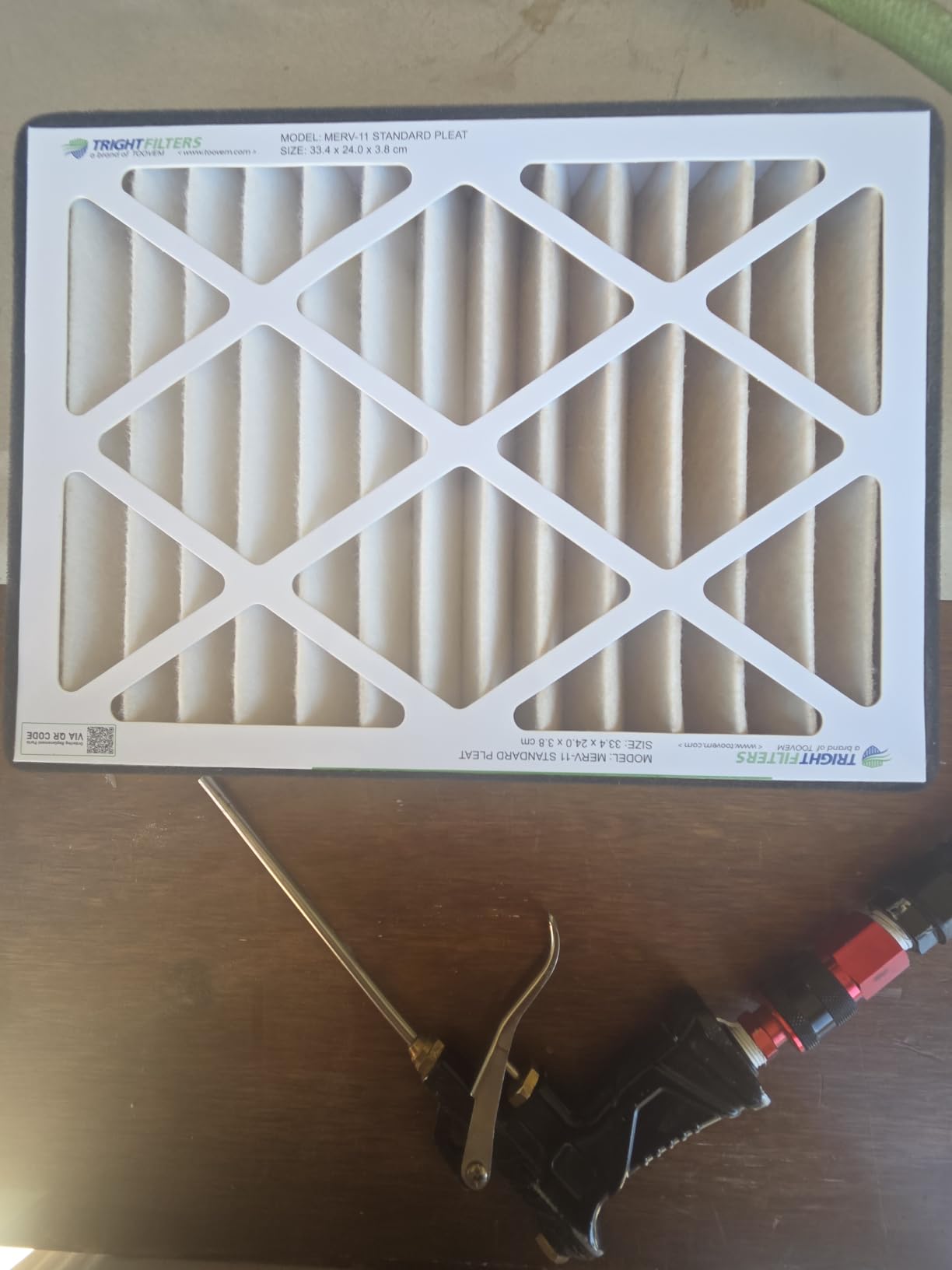
Control is duplicated on purpose. A touch panel handles speed, and an RF remote reaches 27 feet at any angle, so the unit can be adjusted without climbing a ladder or walking across the room.
Installation is flexible too. It can hang from the ceiling on chains, sit on a bench, or be screwed flat to a joist, and the four included MERV-11 filters mean you are not ordering media on day one.
A 360-degree intake shroud that collects from all sides of the cabinet. Four spare MERV-11 cartridges so the first year of filter changes is already covered.
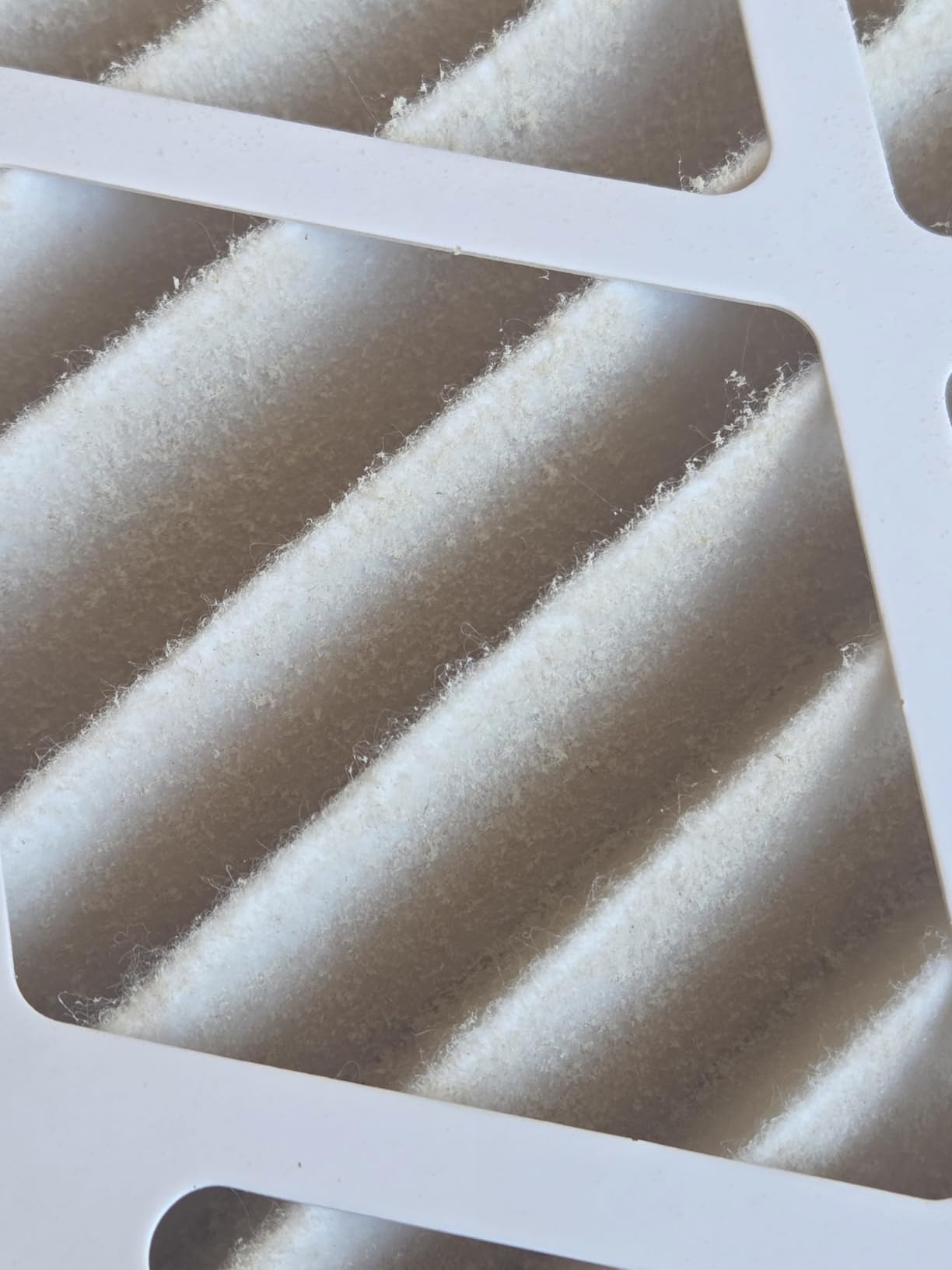
Where the 1350IG earns its airflow
This machine makes sense in a two-car garage shop, a basement with a wide open floor plan, or a small production furniture shop where more than one person sands at a time. At 1700 sq ft stated coverage, one unit can replace two smaller machines.
Reviewers report pairing this class of machine with existing dust collection and keeping the shop visibly clean during heavy production runs, which a low-flow unit struggles to manage.
Where the 1350IG disappoints
The built-in ionizer generates positive and negative ions, and that is worth knowing about before you buy. Reviewers have raised concerns about the static charge the ionizer can put on nearby surfaces, and that effect is the opposite of what you want in a finishing room.
The filter interval is another factor: two to four months per filter is a fast replacement cycle in this group.
4. Abestorm DecDust 1080 Review: quiet airflow for smaller spaces
Abestorm 1080 CFM Air Filtration System with Remote, DecDust 1080
780-1080 CFM covering up to 1100 sq ft
270-degree three-sided intake
Two-speed with slide-out MERV-11 filters
Under 60 dBA, UL certified
Pros
- Slide-out filter cartridge makes changes fast
- Two speed settings at 780 and 1080 CFM
- 270-degree intake pulls from three sides
- Rated under 60 dBA which suits lathe work
- UL certified for electrical safety
Cons
- Particle retention listed at 11 micron which is coarse
- 15% of reviews are 1-star with durability complaints
- Only 82 reviews so the owner record is thin
The DecDust 1080 is the middle of the Abestorm range and the quieter of the two Abestorm machines. It moves 780 or 1080 CFM on two speeds, covers up to 1100 sq ft, and carries a 270-degree three-sided intake rather than a full wrap.
What we like most is the slide-out filter design. The cartridge pulls straight out from the side of the cabinet, so changing media takes seconds in a dirty shop rather than the awkward overhead shuffle a hanging unit demands.
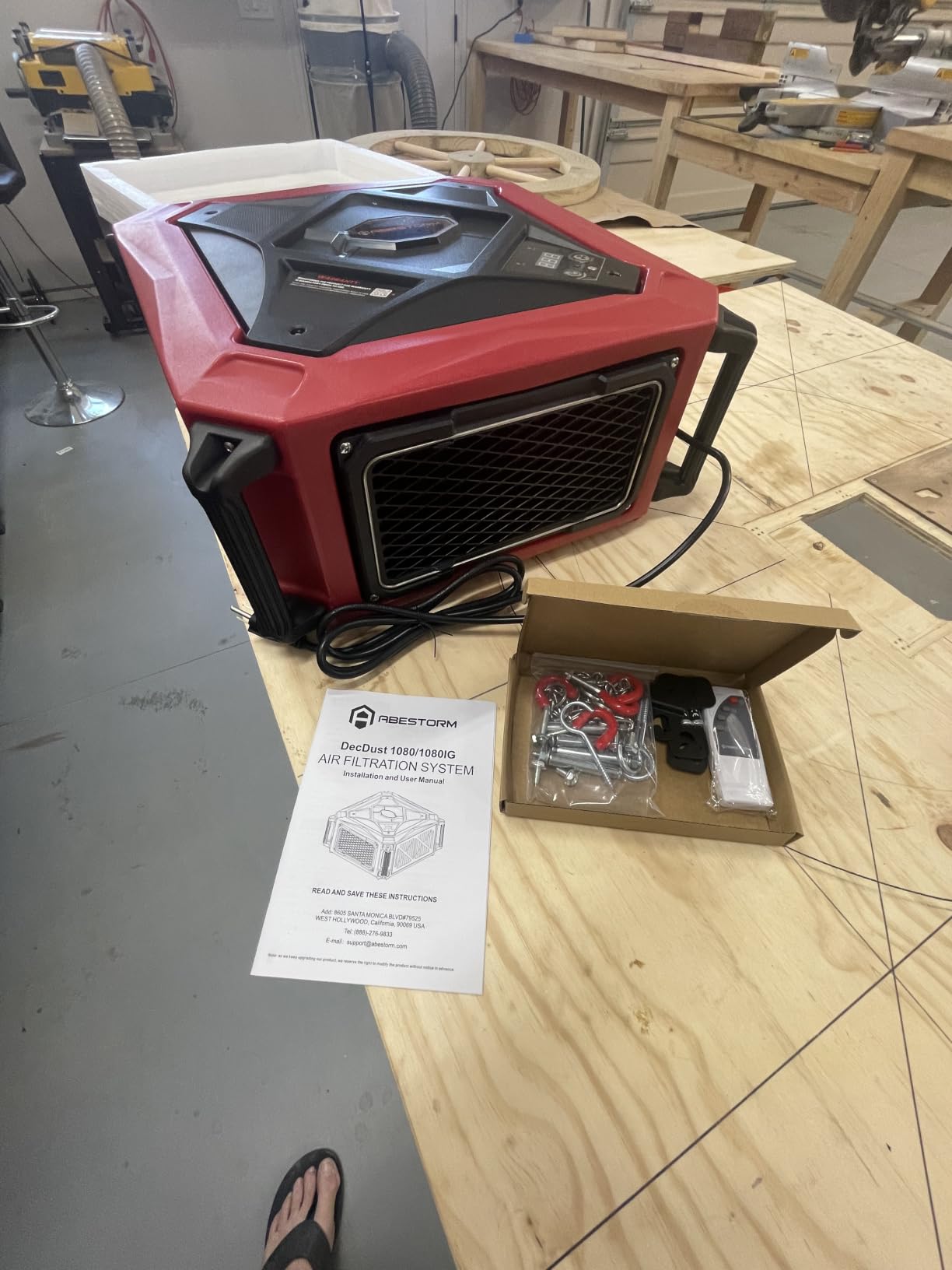
Under 60 dBA is a meaningful spec here. Every other machine in this roundup is rated from 60 dB up to 67 dB, and that few decibels is the difference between running a filter beside a woodturning operation and turning it off.
It is UL certified, which is not true of every machine in the category, and three MERV-11 filters are included in the box.
Filters slide out laterally instead of dropping down from above. A two-speed fan at 780 and 1080 CFM with touch panel and remote control.
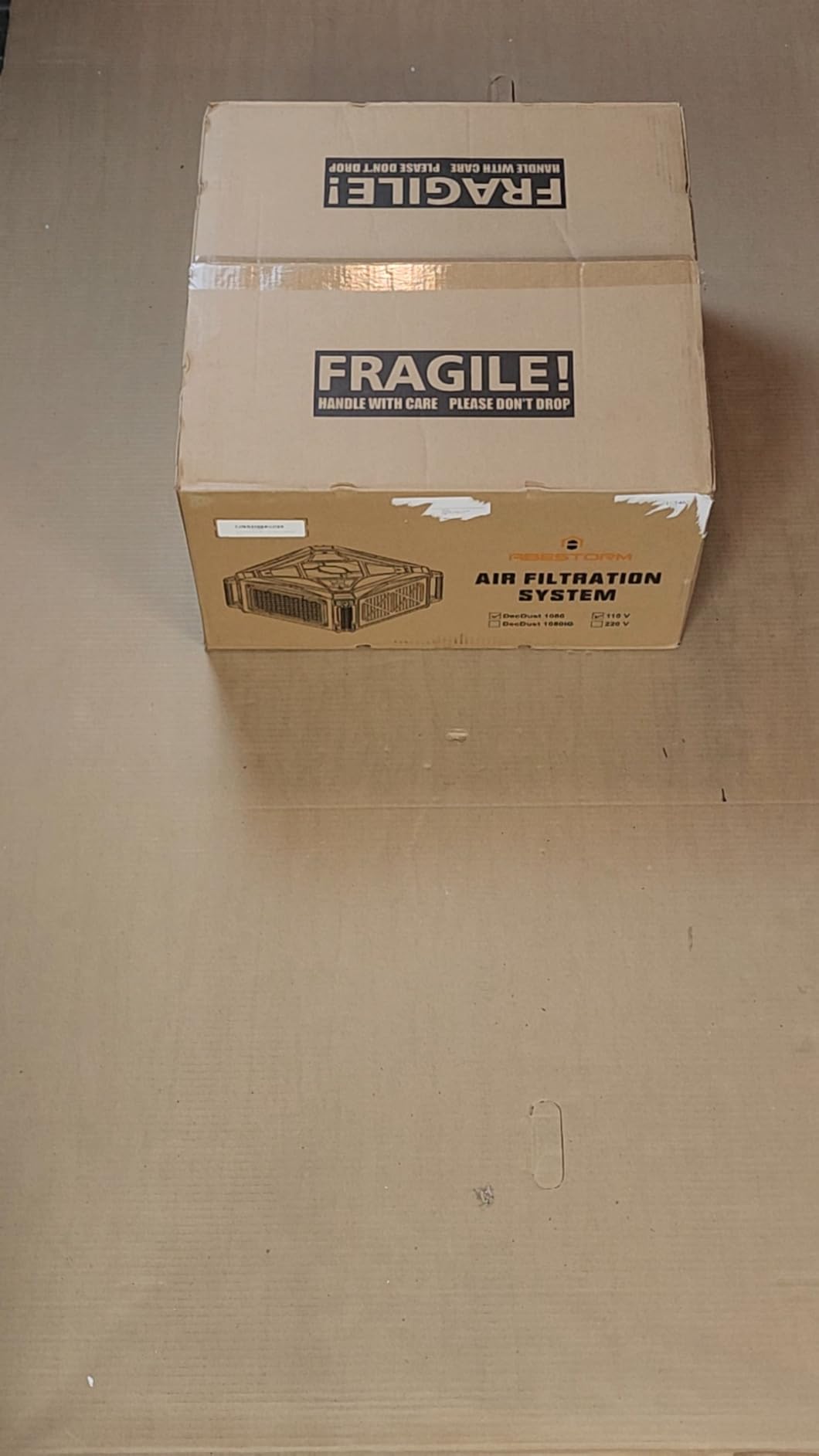
Best fit for basement and lathe shops
The under-60 dBA rating is the deciding factor if you turn wood for hours at a stretch. A quiet machine stays on, and a machine that stays on is what actually improves the air you breathe during fine turning work.
It is rated for a 1100 sq ft room, so it slots neatly between the 400 CFM machines and the 1350 CFM flagship.
What gives us pause on the 1080
Particle retention is listed at 11 micron, which is markedly coarser than the 1-micron and 0.3-micron figures printed on competing machines. If your concern is genuinely fine dust rather than general shop haze, that gap matters.
Durability is the other concern. Fifteen percent of its ratings are 1-star, and the review sample is small, so durability complaints are not rare in the way they are on a machine with thousands of reviews behind it.
5. JET AFS-1000C Review: the most automated machine in this group
JET Air Filtration System, 1-Micron Filter, 1000 CFM, 120V 1Ph (AFS-1000C)
1000 CFM with 6-speed auto air quality sensor
Outer filter 99% at 5 micron, inner 85% at 1 micron
RF remote with 16-hour timer
67 dB, 5-year warranty
Pros
- Air quality sensor selects among six speeds on its own
- Only machine here with a 16-hour programmable timer
- Angled LED panel readable from the floor when hung
- Filter status indicator on the control panel
- 5-year residential warranty
Cons
- 67 dB on the top setting
- 30 inch deep cabinet and 33 lb unit
- Warranty drops to 2 years for commercial shop use
The AFS-1000C offers the most control hardware in this roundup, with six fan speeds driven by an on-board sensor, and for a shop that changes tasks constantly it removes a decision you would otherwise make a dozen times a day. The air quality sensor reads the room and steps the fan through six speeds on its own.
Filtration is two-stage and the figures are published by particle size rather than a class label. The outer filter is stated at 99 percent of 5-micron particles and the inner filter at 85 percent of 1-micron particles.
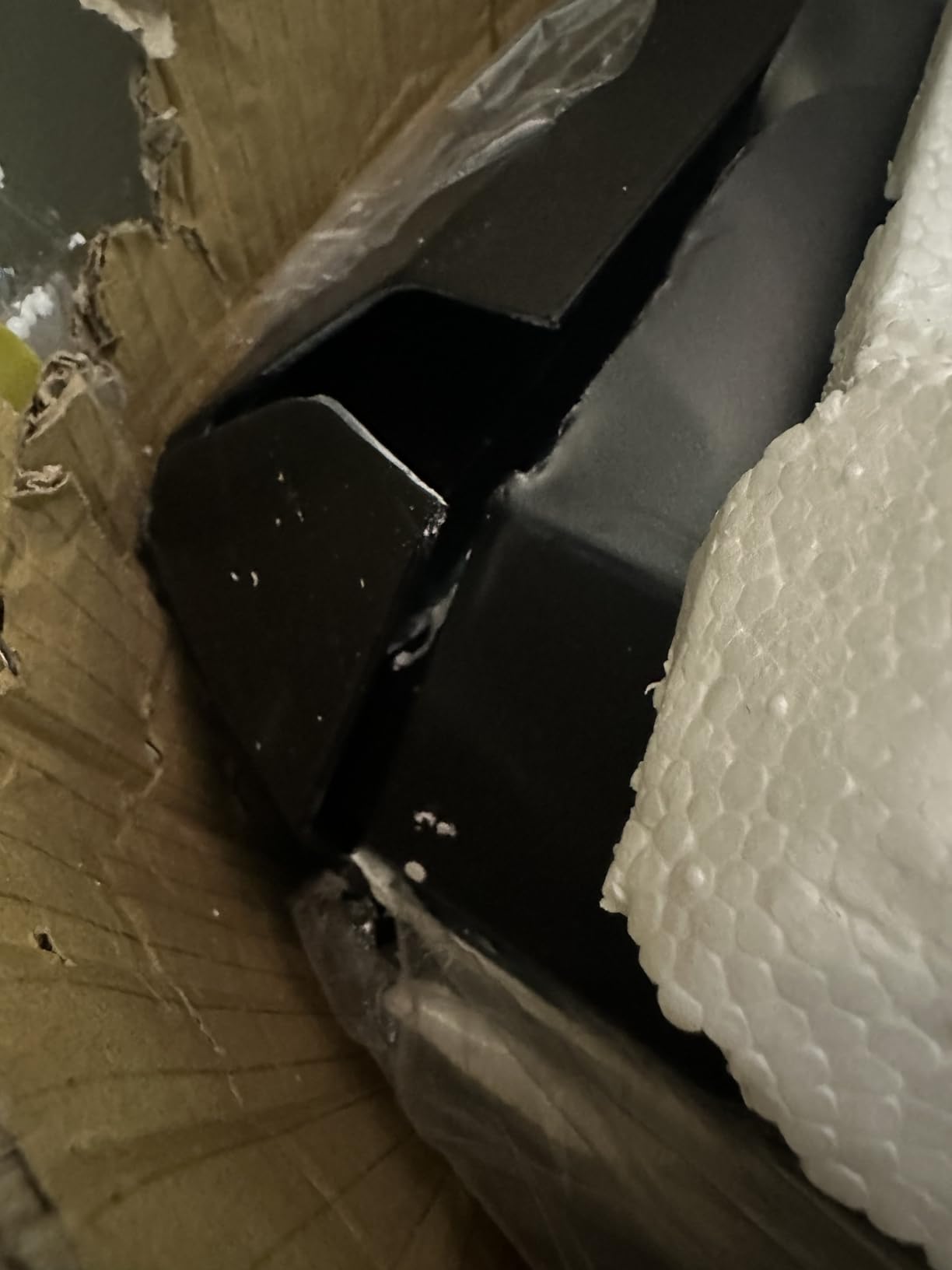
Two design details tell you this was engineered by people who hang things for a living. The LED panel is angled so it stays readable from the floor when the unit is overhead, and the RF remote offers a 16-hour timer, the longest in the group.
A filter status indicator sits on the control panel, so you are not opening the housing to guess whether the media is spent.
An angled control panel that stays visible from below. Six fan speeds driven by an on-board air quality sensor rather than a manual dial.
Who should buy the AFS-1000C
Buy it if you want the machine to think for itself, or if you run a shop where dust load swings hard between quiet setup work and aggressive drum sanding. The automation handles both without you walking over to the wall switch.
The 16-hour timer also suits a shop where you sand a full day and then leave the room running overnight to settle the air.
What the JET asks you to accept
At 67 dB this is one of the louder machines here, and the 30.13 by 24.25 by 15.38 inch cabinet at 33 lb takes up more ceiling space than the others. Plan a joist-mounted location with clearance for the angled panel, not a corner near where you work.
One more detail for anyone running a paid shop: the 5-year warranty is residential and drops to 2 years for commercial or industrial use.
6. PURISYSTEMS PuriCare 500IG Review: the flexible small-shop option
PURISYSTEMS Air Filtration System 3-Speed Remote, Built-in Ionizer, PuriCare 500IG Hanging Air Filter w/RF Remote for Woodworking, Garage and Shop Dust Collector, up to 500 sq. ft (350/450/500 CFM)
350/450/500 CFM covering up to 500 sq ft
Built-in ionizer with 3-stage filtration
Benchtop or ceiling mount
Timer from 1 to 6 hours with RF remote
Pros
- Comes with reusable outer and inner filters you can clean
- Mounts on a benchtop or hangs from the ceiling
- RF remote reaches 26 ft at any angle
- Timer covers one to six hours of auto shutoff
- Compact 25.5 lb cabinet that is easy to reposition
Cons
- 500 CFM suits only small rooms
- Only 54 reviews so the owner record is thin
- 61 dB on high
The PuriCare 500IG is built for a room rather than a building. It covers up to 500 sq ft on three speeds of 350, 450, and 500 CFM, and at 20.1 by 17 by 11 inch it fits on a bench without stealing working space.
Its strongest argument is the filter situation. Both the outer and inner filters are described as replaceable and reusable, which keeps long-run media cost low.
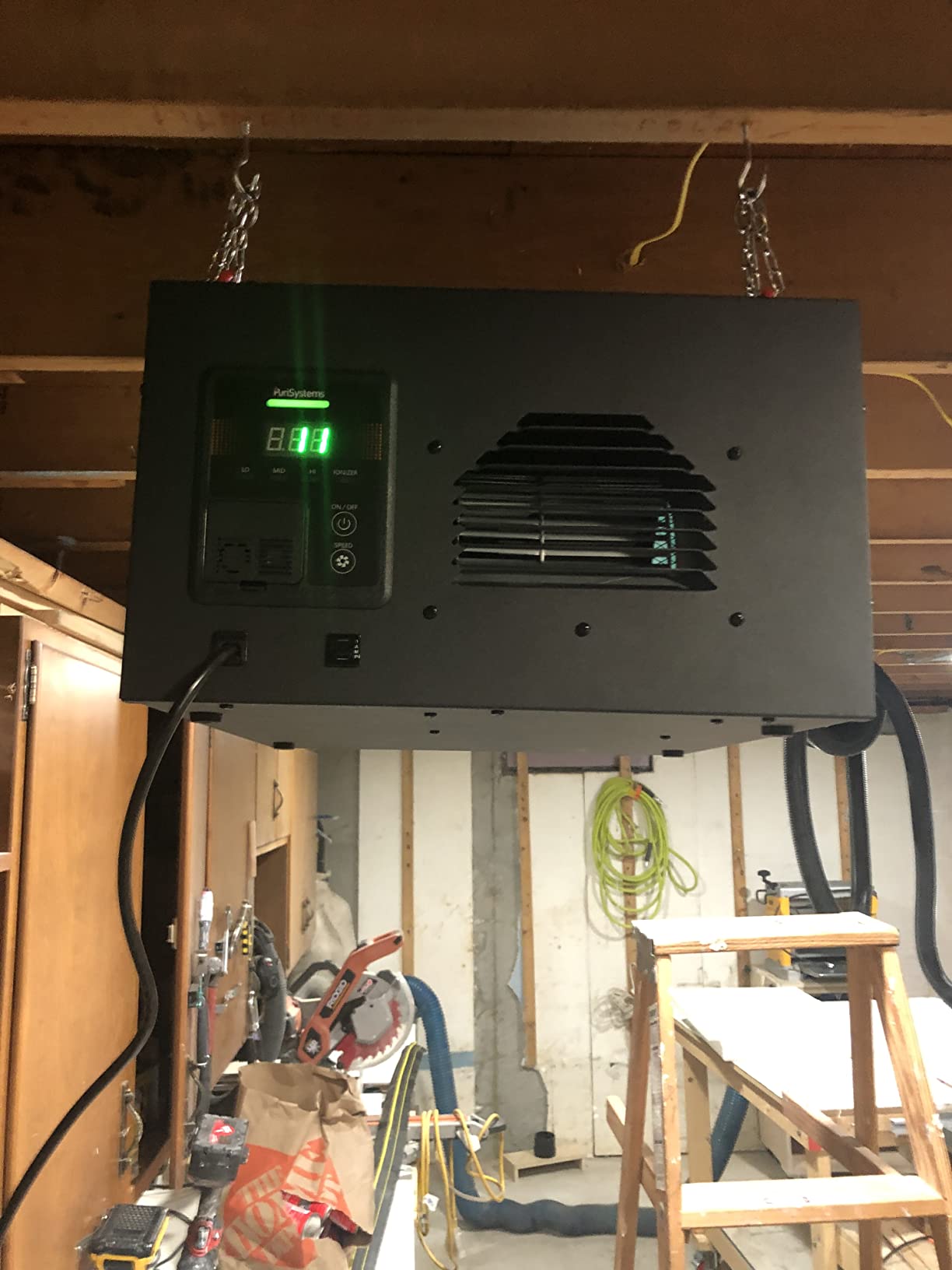
The ionizer is worth knowing about before you buy. It is stated to produce millions of negative and positive ions per second, which helps neutralise the smell of fresh-cut wood, but as we noted with the Abestorm, an ionizer puts a static charge on nearby surfaces, which is a poor match for a finishing room.
Control covers both touch panel and RF remote at 26 feet, and the timer runs from one to six hours of auto shutoff.
Both filter stages are reusable after cleaning, which keeps long-run media cost down. Dual mounting lets the same cabinet sit on a bench or hang overhead.
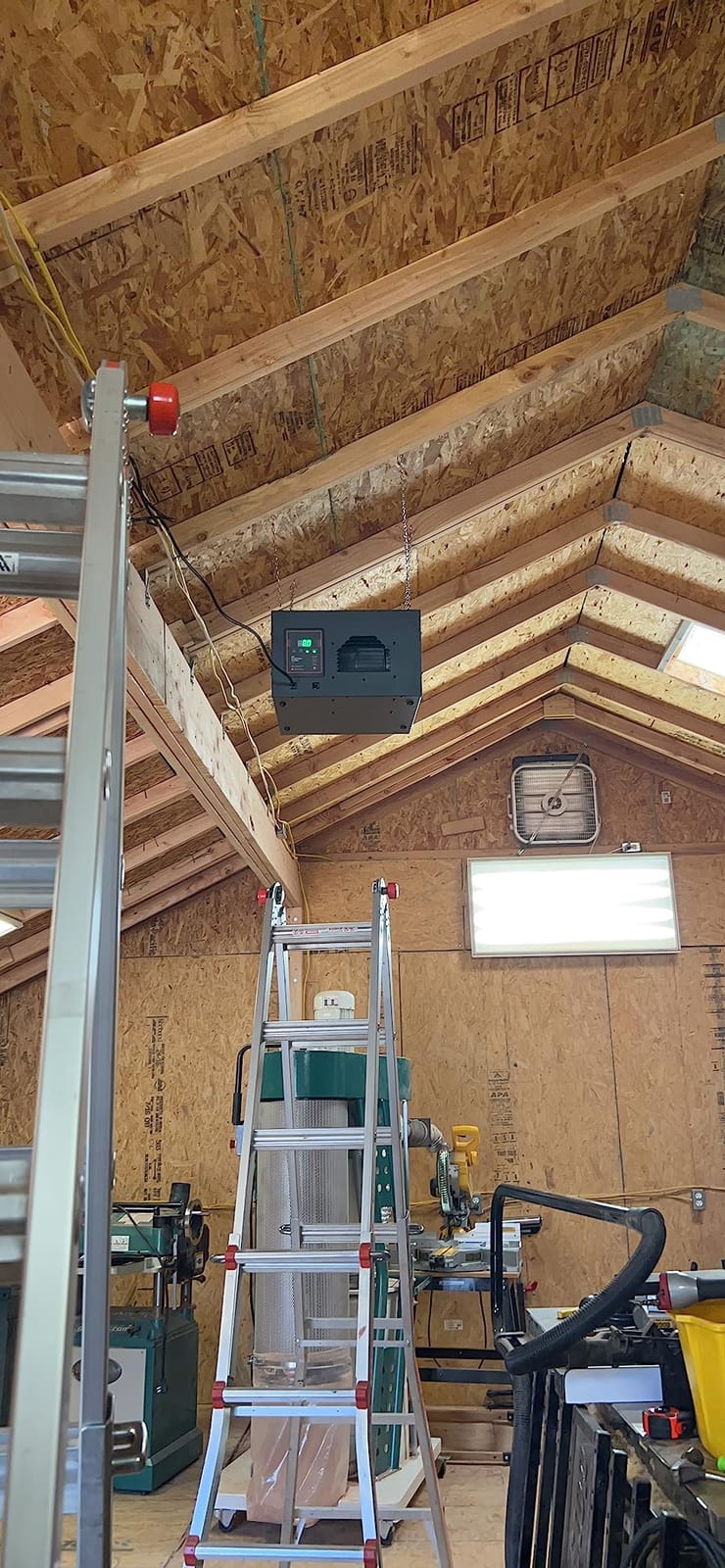
Where the 500IG fits best
A dedicated finishing or glue-up room, a small basement shop, or a mobile setup that moves between a garage and a workshop. The benchtop mount is genuinely useful when one room hosts both sanding and finishing on different days.
Owners buying a second unit after expanding their shop is a common pattern with this class of machine, and at 500 CFM two cabinets often make more sense than one larger unit.
The limits of a 500 CFM cabinet
Do not buy this expecting to clean a large shop. At 500 CFM, an open 1000 sq ft garage with an 8 ft ceiling sees roughly four air changes an hour, which is not enough to keep airborne dust down during sustained sanding.
With only 54 reviews there is a thinner long-term owner record here than on the WEN or the JET.
7. POWERTEC AF4001C Review: the biggest filter bundle in the box
POWERTEC 3-Speed Remote Controlled Air Filtration System (300/350/400 CFM) w/Extra Inner & Outer Filter (2 of Each) Replacement, Hanging Air Filter for Woodworking, Workshop & Garage (AF4001C)
300/350/400 CFM across 3 speeds
RF remote with 1, 2 or 4 hour timer
Four spare filters included
Filters fit WEN 3410 and Shop Fox W1830
Pros
- Four spare filters included in the box
- Outer and inner filters cross-fit the WEN 3410 and Shop Fox W1830
- RF remote handles power
- speed and timer together
- Hooks install at the ceiling with no tools
- Two-stage 5-micron and 1-micron media
Cons
- 400 CFM is tied for the lowest airflow ceiling here
- Newest release of the set with only 36 reviews
- No auto mode and no filter status indicator
The AF4001C is the practical value pick. It is the same 300, 350, and 400 CFM three-speed architecture as the WEN 3410, and the box contains the unit, the fitted filters, mounting hardware, and two extra outer filters plus two extra inner filters.
That filter cross-compatibility is the underrated part. The outer and inner media fit the WEN 3410, the Shop Fox W1830, and the related 4000-series models, so you are not locked into one brand’s replacement supply.
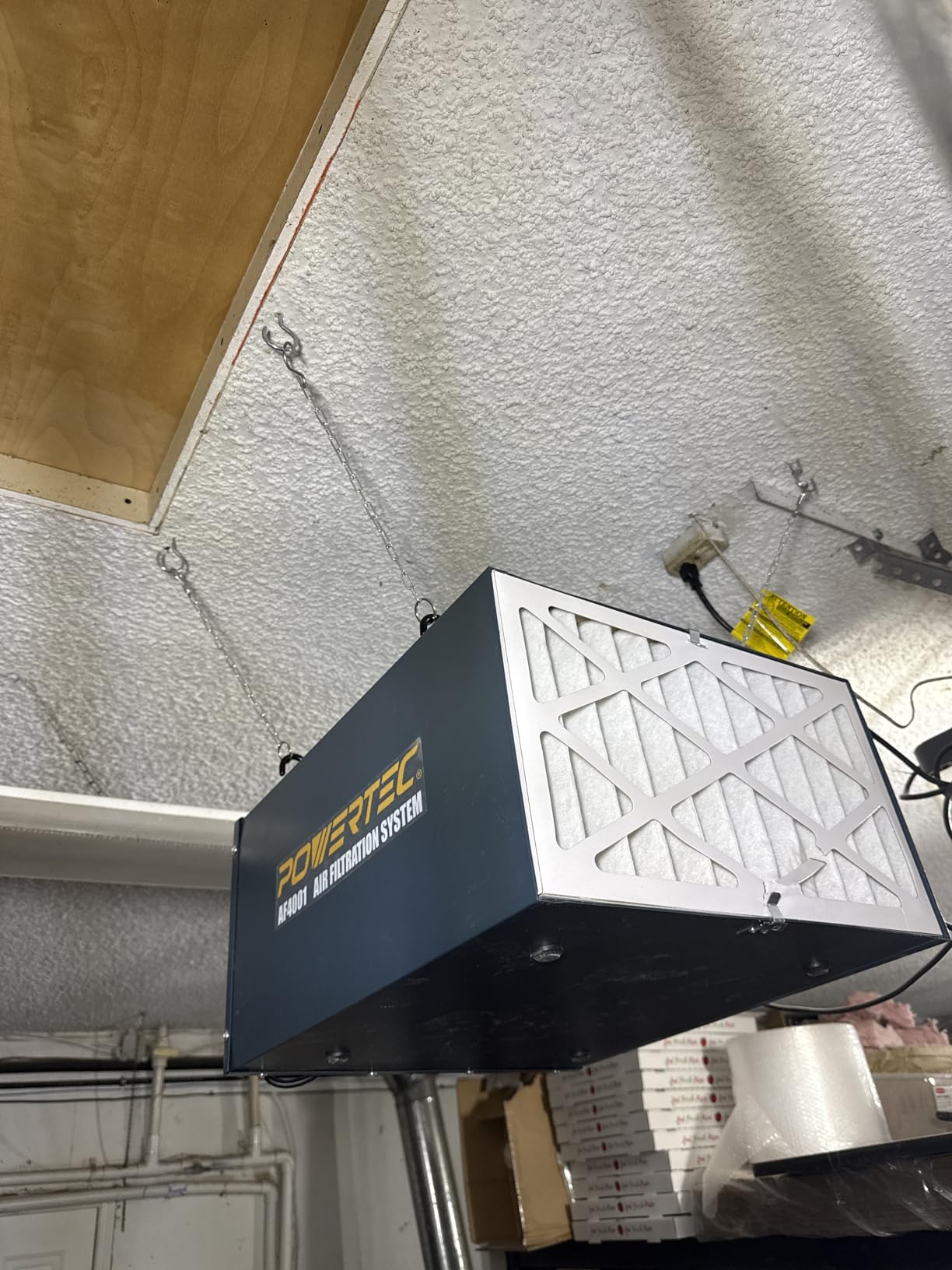
Installation needs no tools. It hangs from hooks, and the RF remote handles power, three speeds, and timer settings of one, two, or four hours from across the room.
Filtration is a 5-micron outer stage for larger particles and a 1-micron inner stage for what gets through it, with a stated 99 percent airborne particulate elimination across the pair.
Four spare filters in the box defers your first replacement purchase by a full filter cycle, and nothing else in this lineup ships with as many spares in the carton. Hook-mounted ceiling installation requires no tools.
When the filter bundle changes the maths
For a new shop, buying the bundle instead of the bare unit means your first year of media cost is already covered. That changes the effective running cost of a 400 CFM machine when you compare it year to year.
It is also a straightforward second machine for a shop that is expanding, because the media you already have fits several other cabinets on the market.
What the AF4001C cannot do
400 CFM is the lowest ceiling in the group, and there is no auto mode, no sensor, and no filter indicator. You choose the speed and you check the filter yourself.
It is also the newest product in this group, so with only 36 reviews there is no long-term durability history to lean on yet.
How Much CFM Do You Need for a Woodshop?
Work out your shop volume first, then divide by the air changes per hour you want. The formula is simple: square footage multiplied by ceiling height gives cubic feet, and cubic feet multiplied by air changes per hour gives the volume you need to move every hour. Divide that by 60 and you have the CFM you are aiming for.
For fine wood dust, six air changes per hour is a reasonable target, and eight is better for a shop where you sand a lot or work with hardwoods that produce heavier dust. Below four changes an hour, the air may feel a little clearer but fine dust will keep resuspending every time you walk through.
Here is the shorthand version for most shops. These are the figures we use when we talk shop owners through sizing.
Under 200 sq ft at an 8 ft ceiling: aim for roughly 160 to 250 CFM. A 400 CFM machine is comfortable here and gives you headroom for occasional heavy sanding.
400 sq ft at an 8 ft ceiling: about 320 to 430 CFM. This is exactly where the 400 CFM class of machine fits, which is why so many of them are sold on that square footage figure.
800 sq ft at a 9 ft ceiling: roughly 960 to 1280 CFM. You are into the 1000 to 1350 CFM range, and a single large unit beats two small ones hung at opposite ends.
Over 1000 sq ft: 1350 CFM and up, or two machines placed across the room. Positioning matters as much as total airflow, since a unit in one corner of a large shop only cleans one corner.
One caveat that rarely gets stated: the CFM printed on the box is a free-air rating measured with no filter installed. Once a loaded filter is in the way, real filtered airflow drops. Treat the published figure as an upper bound and size with a little margin above your calculated number.
Filter Type, MERV Rating and What It Costs to Run
For wood dust, MERV 8 is the practical floor. Most hardwood dust falls in the fine fraction, and a MERV 8 or MERV 11 pleated filter handles it well, which is why several of the machines here ship with MERV 11 media.
HEPA is a different category rather than a higher MERV number. It is specified by particle capture efficiency, not by a pressure drop rating, and it costs more per unit and more per replacement. It is worth it if you have respiratory concerns or spray finishing in the same space.
Filter cost over a year matters more than most buyers expect. The Abestorm 1350IG is rated at two to four months per filter, which can mean three to six filter changes a year depending on your sanding volume. The PuriCare 500IG and the POWERTEC bundle both keep media cost down, since one has reusable media and the other ships with four spares.
Whatever you buy, look at the outer pre-filter every few weeks. Washing that stage and letting it dry fully before reinstalling is the single biggest factor in how long the expensive inner stage lasts.
Air Filtration vs. Dust Collection: What Each One Actually Does
These solve different problems and shop owners need both. A dust collector captures dust at the source, pulling it off the tool through a hose before it ever becomes airborne. A shop air filtration system does the opposite: it cleans the air already in the room.
Fine dust is where the gap appears. A drum sander and a wide belt sander throw a fraction of their output into the air, and that fraction bypasses the hose entirely. It is also the fraction that settles on your rafters, your bench tops, and in your lungs.
The common question on woodworking forums is whether a filtration unit is worth buying when you already own a cyclone collector. The answer is yes, because the collector never sees the airborne fraction, and the filtration unit never stops dust at the tool. They are complementary, not alternatives.
One case where a filtration unit is the wrong purchase: if you sand occasionally and your dust problem is entirely at one machine, a downdraft table solves it at the source for far less money. Capture beats cleaning, and if one tool produces almost all of your dust, fix that tool first.
On buying timing, owners in these communities consistently wait for major autumn sales, and shop filtration machines from the major brands reliably drop then. If your research is done, waiting a few weeks for a seasonal sale is a reasonable play.
Frequently Asked Questions
What size air filtration system for a shop?
Size by air changes per hour, not by rule of thumb. Multiply your shop square footage by ceiling height to get cubic feet, multiply by six to eight air changes per hour, then divide by 60. A 400 sq ft shop with an 8 ft ceiling needs roughly 320 to 430 CFM.
How many CFM do I need for a woodshop air filter?
Most shops need between six and eight air changes per hour of filtered airflow. That works out to about 160 to 250 CFM for a room under 200 sq ft, roughly 320 to 430 CFM for 400 sq ft, and 960 to 1280 CFM for an 800 sq ft shop. Remember that published CFM is a free-air rating and real filtered airflow is lower.
What MERV rating is best for wood shop dust?
MERV 8 is the practical minimum for fine wood dust, and MERV 11 is better. Several of the systems reviewed here ship with MERV 11 pleated media. If you have asthma or COPD, or you spray finish in the same shop, look for a HEPA class final stage such as the H11 filter used in the DEWALT DWXAF101.
What is the best air filtration system for a small workshop?
For a workshop under 400 sq ft, the 400 CFM class is the right fit. The WEN 3410 leads this group with thousands of ratings, a 1-micron inner filter, a programmable timer, and a 60 dB running noise that suits a small room. The POWERTEC AF4001C is the lower cost alternative and includes four spare filters.
Are air filtration systems worth it if I already have a dust collector?
Yes, because they solve different problems. A dust collector captures dust at the tool through a hose, while a filtration unit cleans the fine airborne fraction that escapes into the room and settles on surfaces and rafters. Shops that run both report the clearest air and the least dust on tools and finished surfaces.
How often do air filtration filters need replacing?
It depends on filter life and shop volume. The Abestorm DecDust 1350IG is rated for replacement every two to four months, the Abestorm DecDust 1080 less often, and the WEN 3410 and POWERTEC units use a 5-micron pre-filter that catches the coarse fraction first, so the 1-micron inner stage does less of the work. Washing the outer pre-filter extends inner stage life considerably.
Final Verdict on the Best Air Filtration Systems for Wood Shops
The WEN 3410 takes our editor’s choice in 2026 because it is the only machine here with a review record measured in thousands rather than dozens, a 1-micron inner filter, and a 60 dB running noise that suits a small room. For a shop under 400 sq ft, that combination of proven reliability and manageable output is the safest purchase you can make.
Step up a size for bigger rooms. The Abestorm DecDust 1350IG covers up to 1700 sq ft, the JET AFS-1000C runs six speeds off an on-board sensor with a 16-hour timer, and the DEWALT DWXAF101 is the choice when filtration class matters more than noise.
Whichever you pick, size it with the air change math rather than a square footage sticker, pair it with dust collection rather than replacing it, and check the outer pre-filter every few weeks. Those three habits do more for your air than any single machine in this list.