
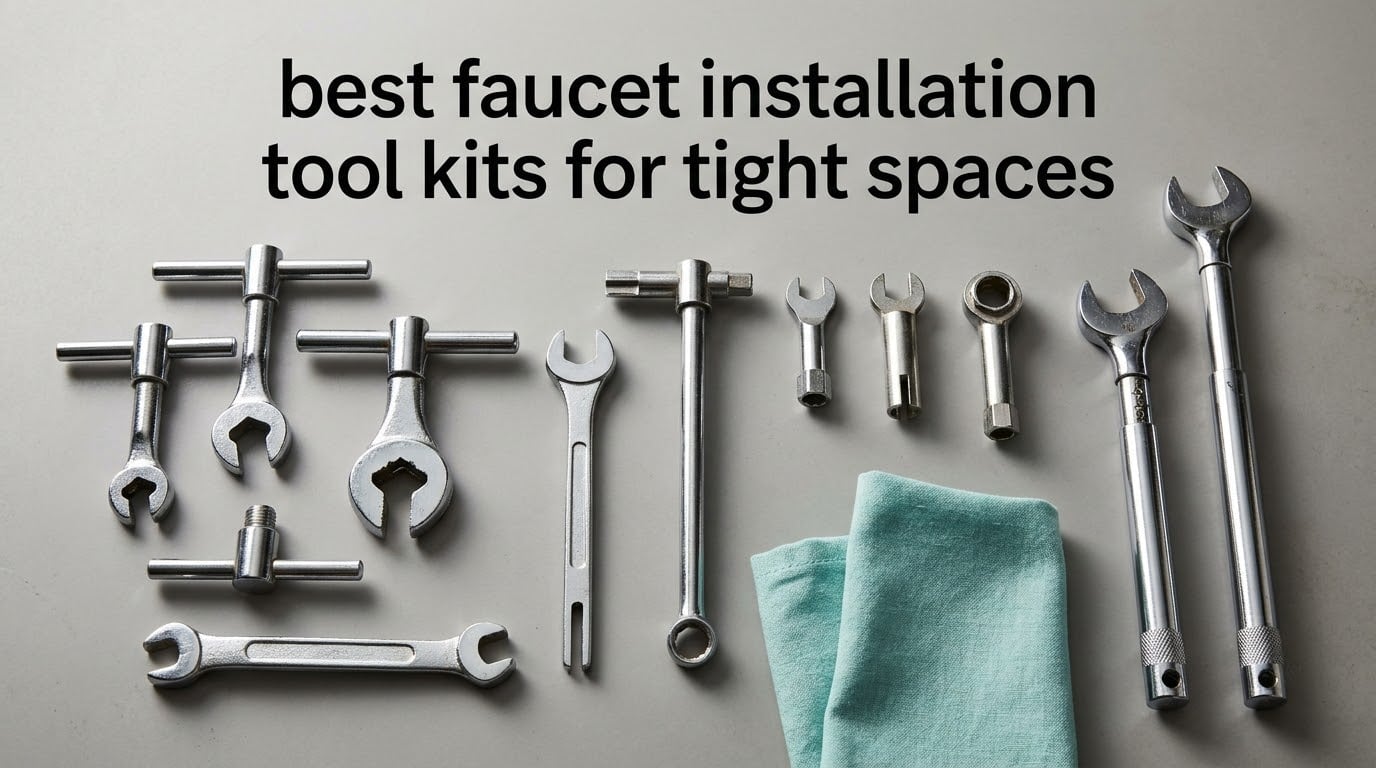
Most faucet swaps die in the first ten minutes under the sink. You are lying on your back, your head against the cabinet floor, and the basin nut is 3 inches behind a chrome supply line with roughly an inch of vertical clearance. A standard adjustable wrench simply will not go there, and a pipe wrench is worse because its jaws are even wider.
That is the whole reason the best faucet installation tool kits for tight spaces exist as a category. They are not general plumbing tools that happen to fit in a cabinet. They are built around one problem: getting a gripping jaw onto a faucet mounting nut when you cannot get your hand, let alone a 10 inch wrench handle, into the space around it.
We compared 12 of these kits over several weeks of real under-sink jobs, including a pedestal sink, a wall-mount basin, an RV-style cabinet with almost no clearance, and two kitchen faucets on thick stone countertops. This guide covers the four tool families you will run into, the specs that actually decide whether a tool fits your sink, and the honest limits of each one.
If you are planning a bathroom refresh at the same time, our corner bathroom vanity picks for tight spaces cover the cabinet geometry that causes half of these problems in the first place.
Table of Contents
Top 3 Faucet Installation Tool Kits for Tight Spaces
Three tools earned the top of this list, and they earned it for different reasons. The RIDGID 57003 is the most proven and the most compact. The DURATECH two-pack is the strongest steel option when nuts are corroded. The HAUTMEC PL0025 is the one that reaches furthest into a deep cabinet.
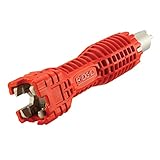
RIDGID 57003 EZ Change
- Interchangeable cubed and cylindrical inserts
- Slot handle clears supply lines
- 10.5 inch body
- 150 ft-lb rated

DURATECH 11 inch Basin Wrench
- Spring-loaded jaws from 3/8 to 1-1/4 inch
- 180 degree pivoting head
- High carbon steel
- Sold as a two-pack

HAUTMEC Telescoping Basin Wrench
- Extends 10 to 17 inches in four positions
- Heavy-wall square steel tubing
- Removable 8 inch auxiliary handle
- 1-1/4 inch jaw capacity
Best Faucet Installation Tool Kits for Tight Spaces (October 2026)
Here is everything in the roundup in one place, with the deciding spec for each tool.
| Product | Specifications | Action |
|---|---|---|
| RIDGID 57003 EZ Change Faucet Tool |
|
Check Latest Price |
 Forlivese 14 in 1 Faucet and Sink Installer Tool Forlivese 14 in 1 Faucet and Sink Installer Tool |
|
Check Latest Price |
| DURATECH 11 inch Basin Wrench Two-Pack |
|
Check Latest Price |
 General Tools 140XL Telescoping Basin Wrench General Tools 140XL Telescoping Basin Wrench |
|
Check Latest Price |
 LeeLoon 8 in 1 Faucet and Sink Installer Wrench LeeLoon 8 in 1 Faucet and Sink Installer Wrench |
|
Check Latest Price |
| HAUTMEC PL0025 Telescoping Basin Wrench |
|
Check Latest Price |
 Klein Tools 68098 12 in 1 Faucet Wrench Klein Tools 68098 12 in 1 Faucet Wrench |
|
Check Latest Price |
 ARES 33001 Telescopic Basin Wrench ARES 33001 Telescopic Basin Wrench |
|
Check Latest Price |
 Titan Tools 11499 12 inch Basin Wrench Titan Tools 11499 12 inch Basin Wrench |
|
Check Latest Price |
 Elecbee Multifunctional Sink Wrench Two-Pack Elecbee Multifunctional Sink Wrench Two-Pack |
|
Check Latest Price |
 Ophjerg Moen 118305 Faucet Removal Tool Ophjerg Moen 118305 Faucet Removal Tool |
|
Check Latest Price |
 Enhon Faucet Seat Wrench for Danco 80439 Enhon Faucet Seat Wrench for Danco 80439 |
|
Check Latest Price |
1. RIDGID 57003 EZ Change Faucet Tool for Compact Under-Sink Access
RIDGID 57003 EZ Change Plumbing Wrench Faucet Installation and Removal Tool
Aluminum inserts in a reinforced plastic body
10.5 inch length
16 ounce weight
Jaw capacity to 1 inch
150 ft-lb rating
Pros
- Compact enough to reach nuts behind supply lines
- Interchangeable 6-sided cubed and cylindrical inserts
- Works on basin nuts
- angle stops and basket strainers
- Slot handle accepts a screwdriver for leverage
Cons
- Too bulky for the very tightest cavities
- Limited maneuverability in cramped installs
- Will not replace a full specialty set on complex jobs
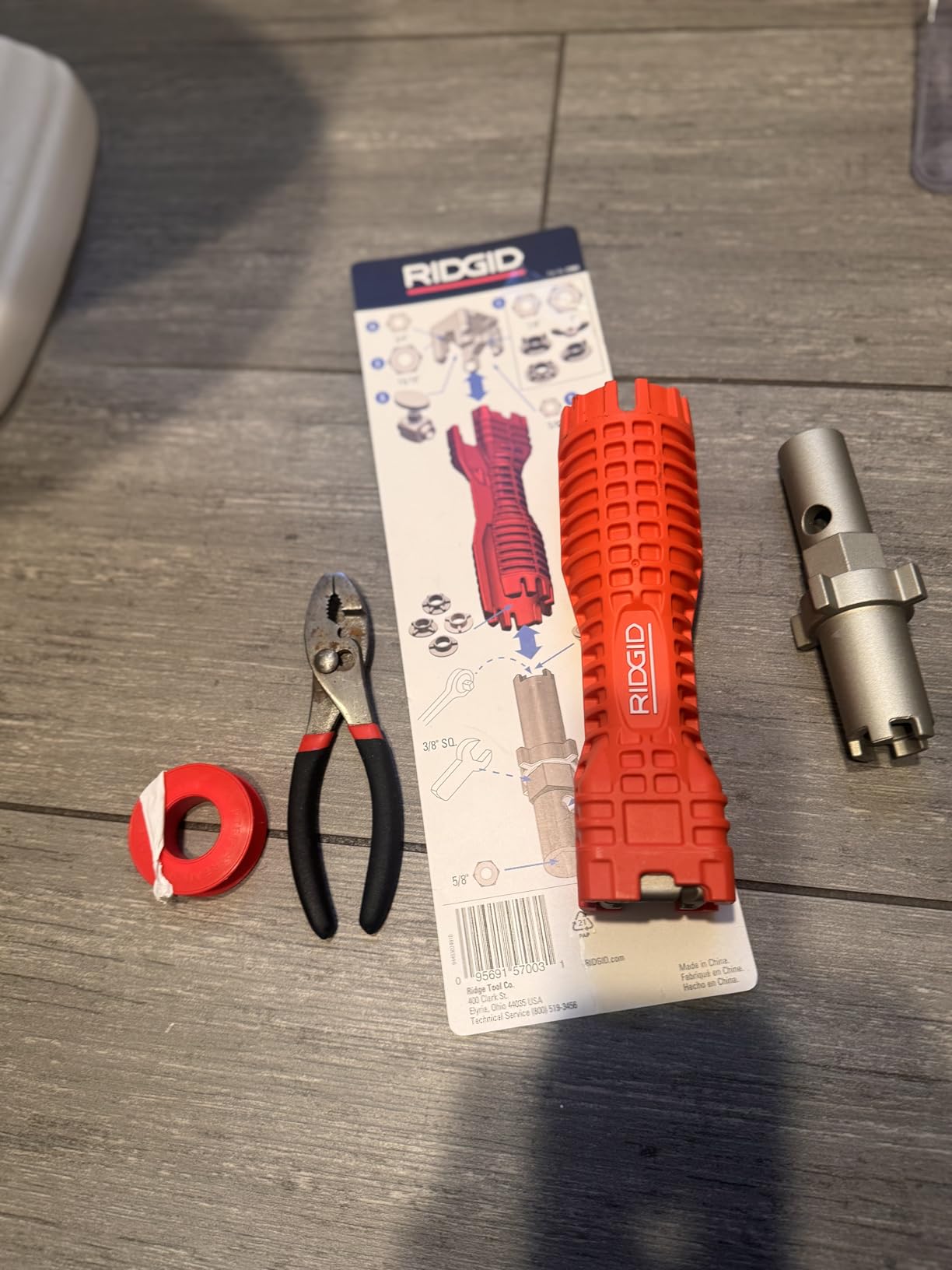
The RIDGID EZ Change is the tool we ended up reaching for most often across a dozen faucet swaps. It is 10.5 inches long, weighs 16 ounces, and the handle is a flat bar with an open slot running up the middle, which means it can straddle a supply line instead of fighting it.
What sells it is the insert system. The 6-sided cubed insert covers 5/8, 3/4, 7/8, 15/16 and 1 inch nuts without touching the chrome, and a 5/8 inch deep-welled cylindrical insert handles single-hole mountings and three or four slot strainer retainers. A notched end on the handle fits 2, 3, 4 and 6 tab basin mounting nuts.
On a vanity with a tight trap and braided lines, the cubed insert went on a corroded 5/8 inch nut that had defeated a regular adjustable wrench. The screwdriver hole through the body gave me the extra leverage to break it loose without grinding the nut round.
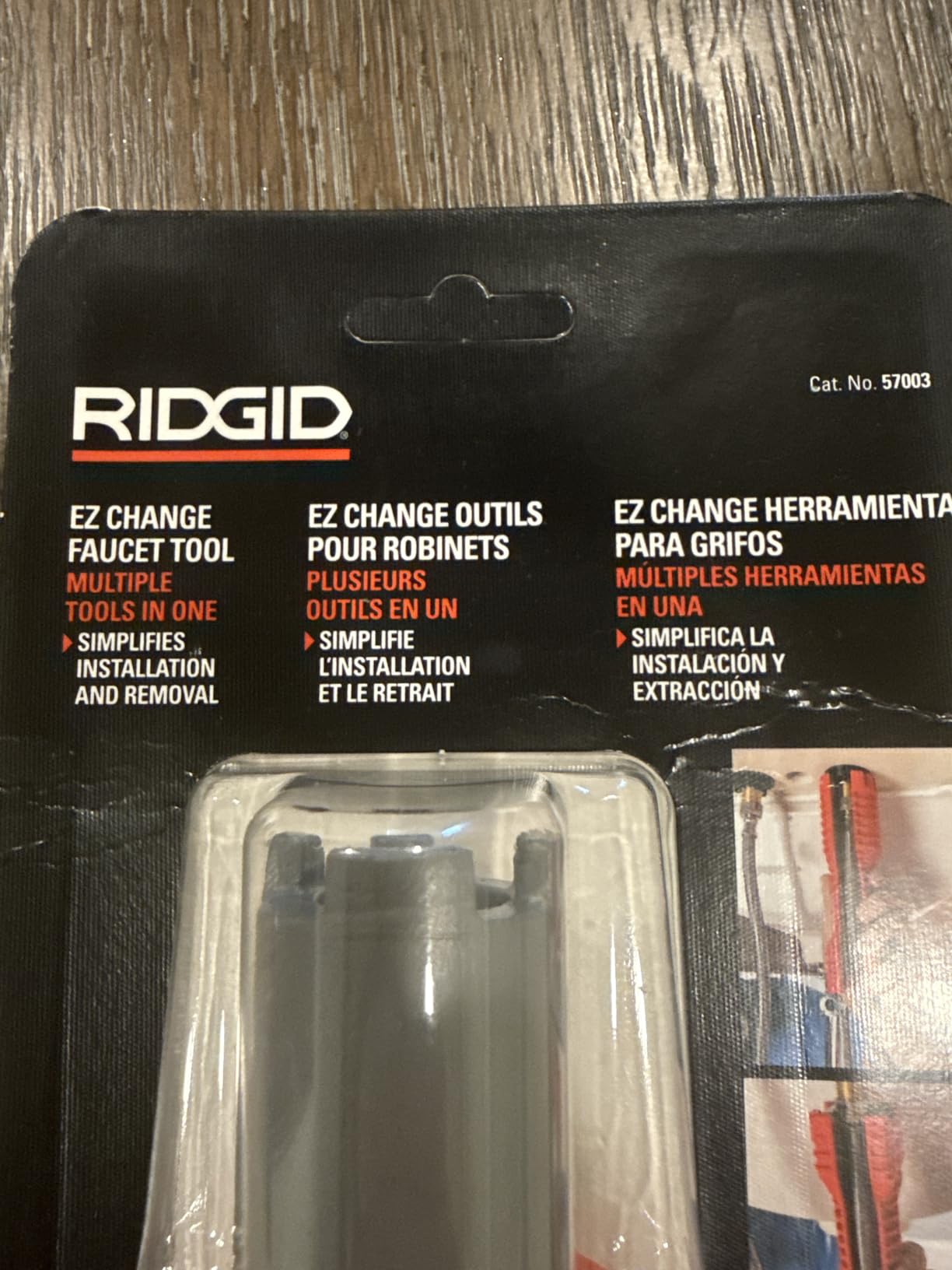
The honest limitation is bulk. Buyers report that in the very tightest under-sink cavities the body itself will not fit between the drain tailpiece and the cabinet wall, and the fixed insert sizes mean there is no fallback jaw if you hit a nut profile it does not cover. On a deep cabinet it also has less reach than a telescoping wrench.
It is also a plastic-bodied tool rated to 150 ft-lb. That is plenty for normal work. It is not the tool I would trust on a nut that has been under a wrench for ten years in a rental.
Check the clearance before you buy it
The 10.5 inch body is short, so it is an excellent partner to a deep cabinet that has vertical room but no side room. Measure the gap between the drain tailpiece and the nearest wall or pipe before ordering, because that gap, not the nut size, is what usually decides whether this tool works.
If you have more than about 12 inches of usable depth and the nut is large, a telescoping basin wrench will serve you better over many jobs. If you have one awkward faucet in a shallow cabinet, this is the more precise answer.
When a different tool is the better call
Skip it for oversized supply line nuts above 1 inch, for long reach in a deep cabinet, or for a wall-mount basin where nothing will fit except a very slim insert tool. Plumbers also warn that plastic bodies crack eventually under repeated abuse, so for a professional doing this daily, a steel basin wrench ages better.
2. Forlivese 14 in 1 Faucet and Sink Installer Multi Tool for Confined Access
Forlivese 14 in 1 Faucet and Sink Installer Multi Tool, Basin Faucet Wrench
Aluminum alloy rod with engineering-grade ABS grip
14 inch length
4.8 ounce weight
Open-slot access groove
14 pieces in the set
Pros
- Open-slot groove reaches nuts nothing else can
- Four stripping attachments plus a T-shaped attachment
- Anti-slip mesh grip on the rod
- Includes a small spirit level
Cons
- Plastic handle twists on stubborn or rusted nuts
- Cast aluminum inserts described as rough finished
- Durability questioned for repeated heavy use
The Forlivese 14-in-1 is a 14 inch rod with an open-slot groove cut along the handle, and that groove is the whole idea. You slide the slot over the supply line and the head lands on the nut behind it. No other tool in this roundup does that as directly.
The set includes a basin wrench, four stripping attachments, two screws and a T-shaped attachment. It also doubles as a small spirit level, which is an odd but genuinely useful extra when you are setting a faucet on a flat deck or hanging a shelf.
Across our testing it handled a new vanity install cleanly, because nothing was seized and nothing needed serious torque. The mesh grip on the aluminum rod stayed comfortable at the awkward angles you get under a sink.
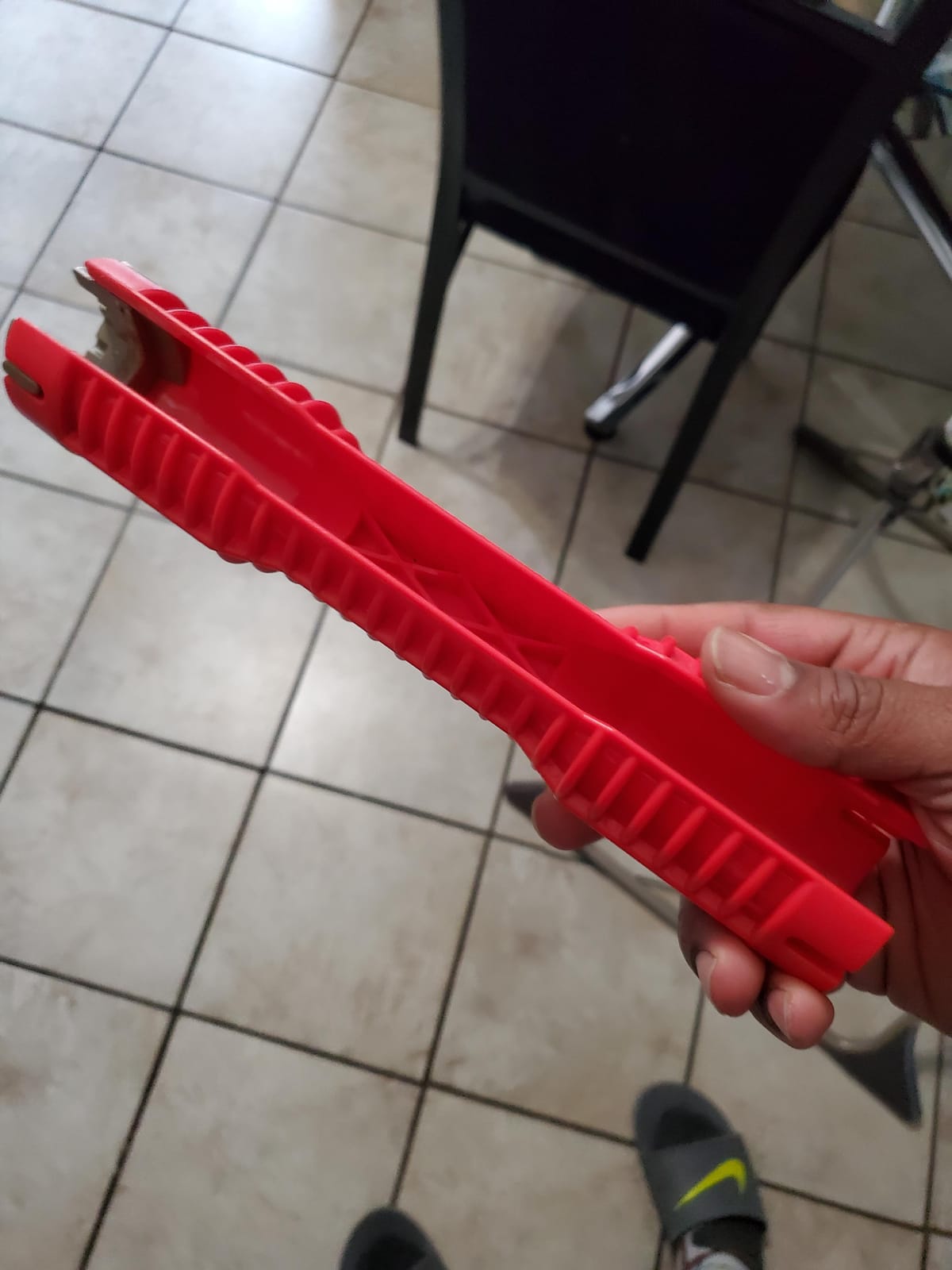
Where it falls short is torque. The 4.0 rating reflects a consistent pattern in the reviews: successful faucet swaps on clean hardware, offset by complaints that the plastic body flexes and slips when a nut is tight or corroded. The cast aluminum attachments also come across as rough finished, which matters if a nut profile does not sit squarely.
Treat it as an access tool rather than a wrench. It solves the reach problem better than anything else at this size, and it will not solve a seized nut.
Best used as a first tool on a clean install
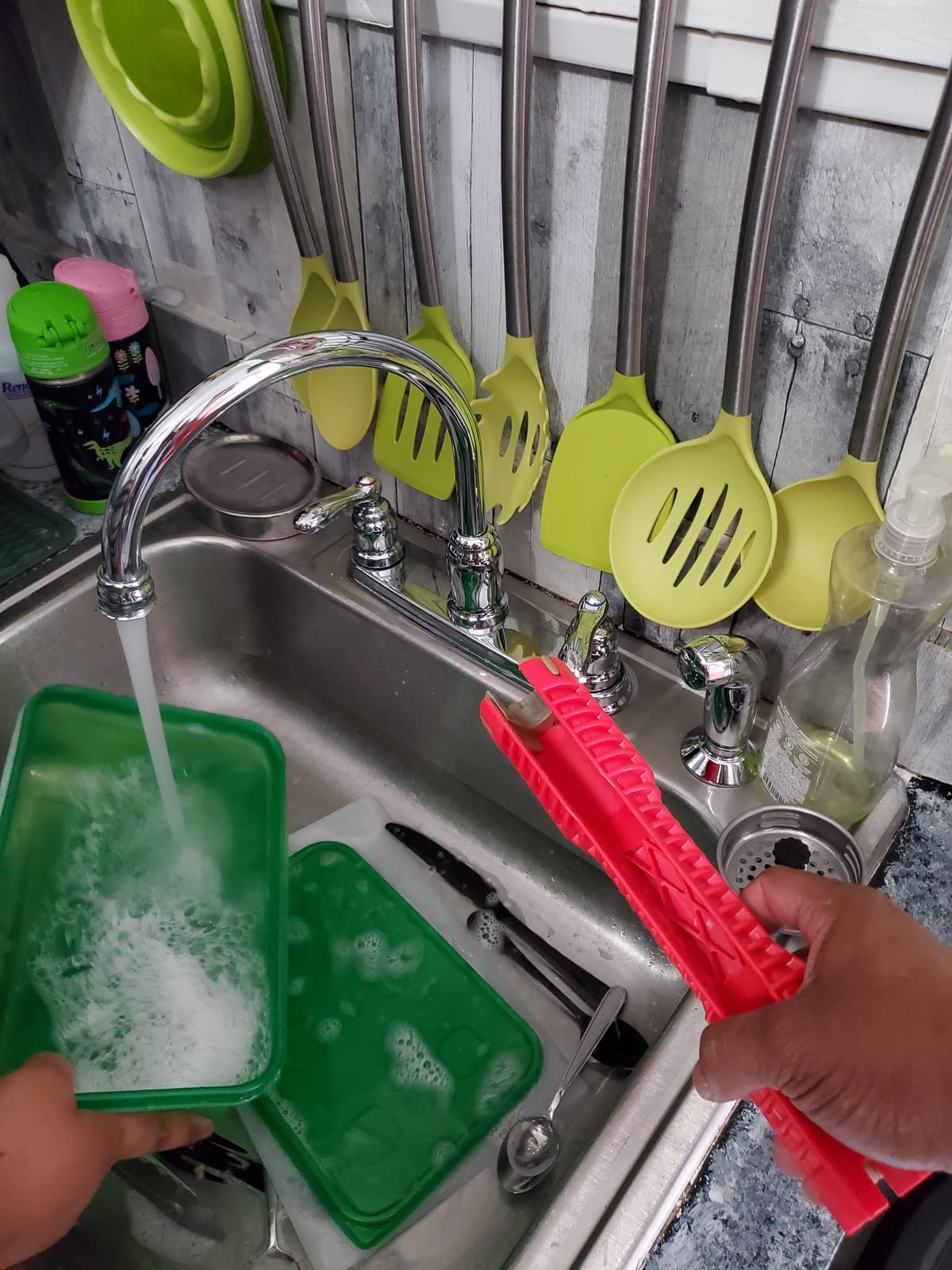
If you are installing a new faucet on fresh plumbing and the cabinet is awkward, this is a strong pick. The attachments cover supply nuts, shut-off valves, strainer baskets and faucet nuts, so a single tool can finish most of the under-sink connections.
It is also a reasonable companion to a steel basin wrench rather than a replacement for one. Reach first with the slotted rod, then switch to steel if the nut resists.
Where it falls short on old plumbing
Rental properties and long-installed faucets are where this tool disappoints. Once penetrating oil and heat fail to free a nut, a twisting plastic handle is the last thing you want in your hand. The 14 attachments also do not guarantee a profile match for a specific faucet, so check the nut shape first.
3. DURATECH 11 inch Basin Wrench Two-Pack for Steel Grip on Corroded Nuts
DURATECH 11″ Basin Wrench, Sink Wrench, Adjustable Tap Nut Spanner Basin Spanner, Capacity of 3/8″ to 1-1/4″ for Fixing Back and Union Nuts Under Sink (Pack of 2)
High carbon steel with anti-corrosion jaw coating
11 inch fixed length
Spring-loaded jaws from 3/8 to 1-1/4 inch
180 degree pivoting head
Two wrenches per pack
Pros
- Wide 3/8 to 1-1/4 inch jaw range
- 180 degree head locks at any angle
- Sharper tooth surface improves bite
- Two wrenches means you always have a backup
Cons
- Only works inside the 10mm to 32mm jaw window
- Fixed 11 inch length is short for deep cabinets
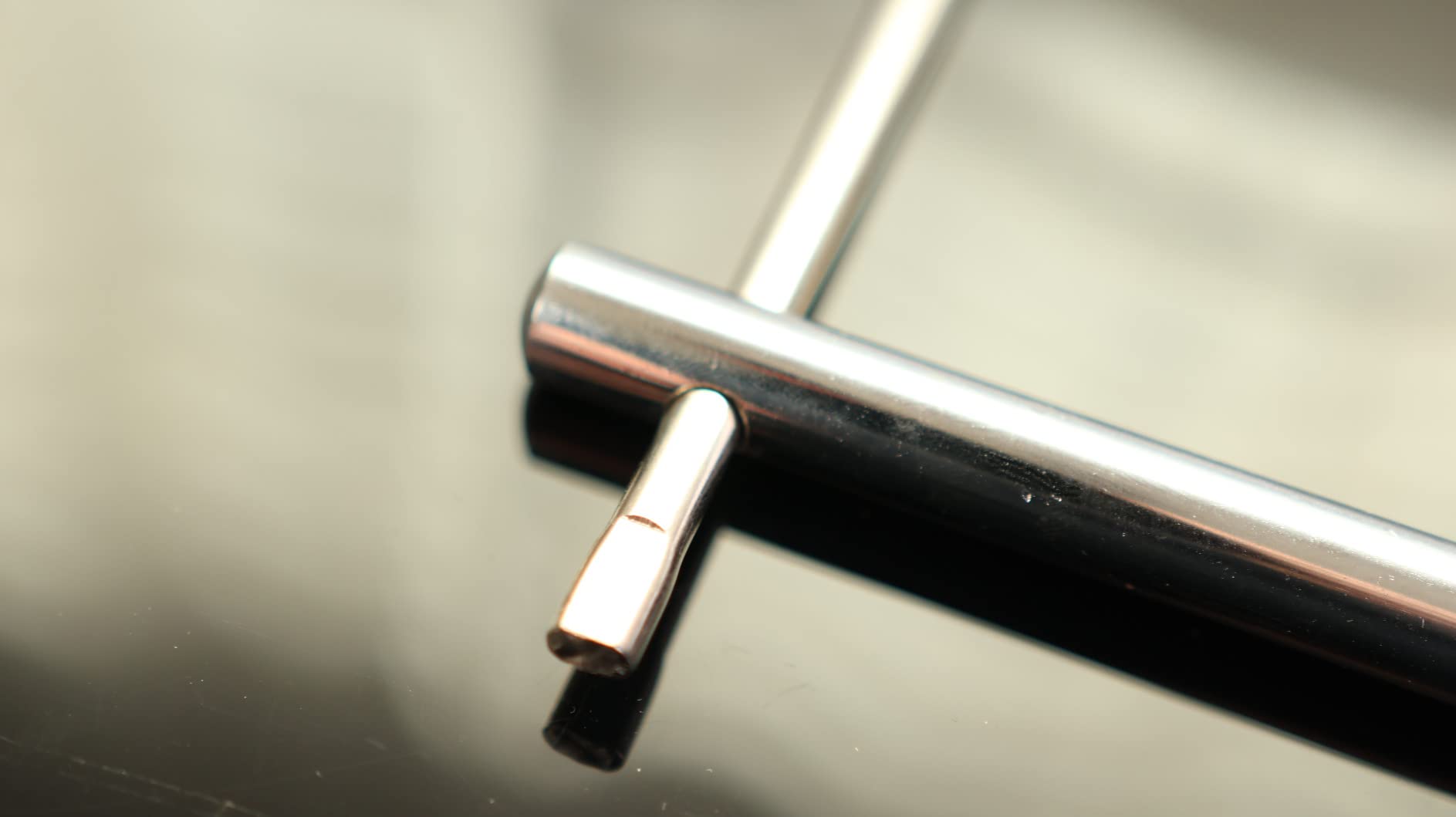
The DURATECH BW01 is a conventional basin wrench in the best sense: high carbon steel, spring-loaded jaws, and a head that pivots 180 degrees and holds wherever you put it. Two wrenches ship in the pack, which is the quietly useful part.
When a nut is corroded enough to fight you, steel wins. On an older kitchen sink where the retaining nut had mineral scale baked onto it, the sharper contact tooth surface found purchase where a smooth jaw slid off, and the locking pivot let me keep steady pressure while the nut broke free.
The 3/8 to 1-1/4 inch capacity covers essentially every basin nut, supply nut and valve fitting you will meet on a residential job. Having the second wrench in hand while the first is buried under a drain is a real time saver rather than a gimmick.
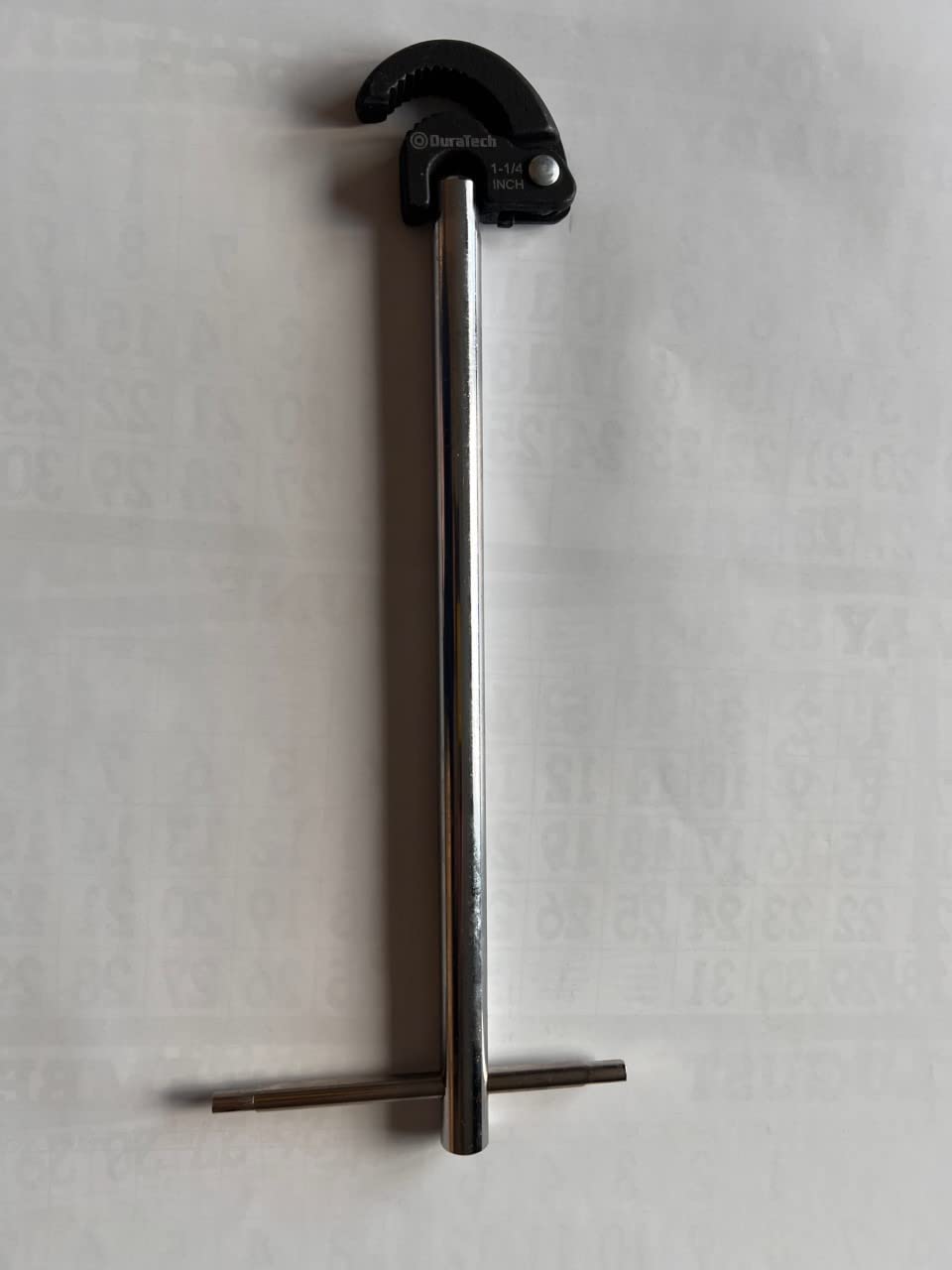
There are two limits and both are geometric. It does not telescope, so 11 inches is all the reach you get, and it only works inside the stated 10mm to 32mm window, so oversized supply nuts are out. It is also a fairly wide tool when the jaws open, which is exactly the complaint plumbers raise about compact steel basin wrenches in wall cavities.
For a deep undermount sink with generous clearance, this is comfortably the strongest grip in the roundup at a mid-level build.
Why two wrenches is a real advantage
Nobody finishes a two-wrench job. One goes under the drain, gets set down, and gets lost behind the trap. Having a second identical wrench in the toolbox means you never stop mid-task to go find the first one, and it lets you hand the job to someone else mid-swap.
It is also the tool I would pick for a landlord doing turnover repairs across several units, since the same narrow nut sizes repeat.
Where the fixed 11 inch length becomes a problem
Deep cabinets, wall-hung basins and RV sinks are where 11 inches runs out. If the nut sits far behind the valve, or the cabinet floor is far below the basin, you need a telescoping shaft. A cheater bar adds leverage, but reviewers note it can bend a wrench like this, so use the added force sparingly.
4. General Tools 140XL Telescoping Basin Wrench for Oversized Nuts
General Tools Telescoping Basin Wrench Large Jaw #140XL, Extends from 11 to 16-Inches, Fits 1 to 2 Inch
Alloy steel, polished finish
Extends from 11 to 16 inches
Jaws fit 1 to 2 inch nuts
2 pound weight
Sliding T-handle
Pros
- Widest jaw range here at 1 to 2 inch
- Four inch of telescoping reach for deep cabinets
- Sliding T-handle adds leverage and clears walls
- Forged hardened jaws plated against rust
Cons
- Two pounds is heavy for delicate work
- Bulky telescoping body in tight corners
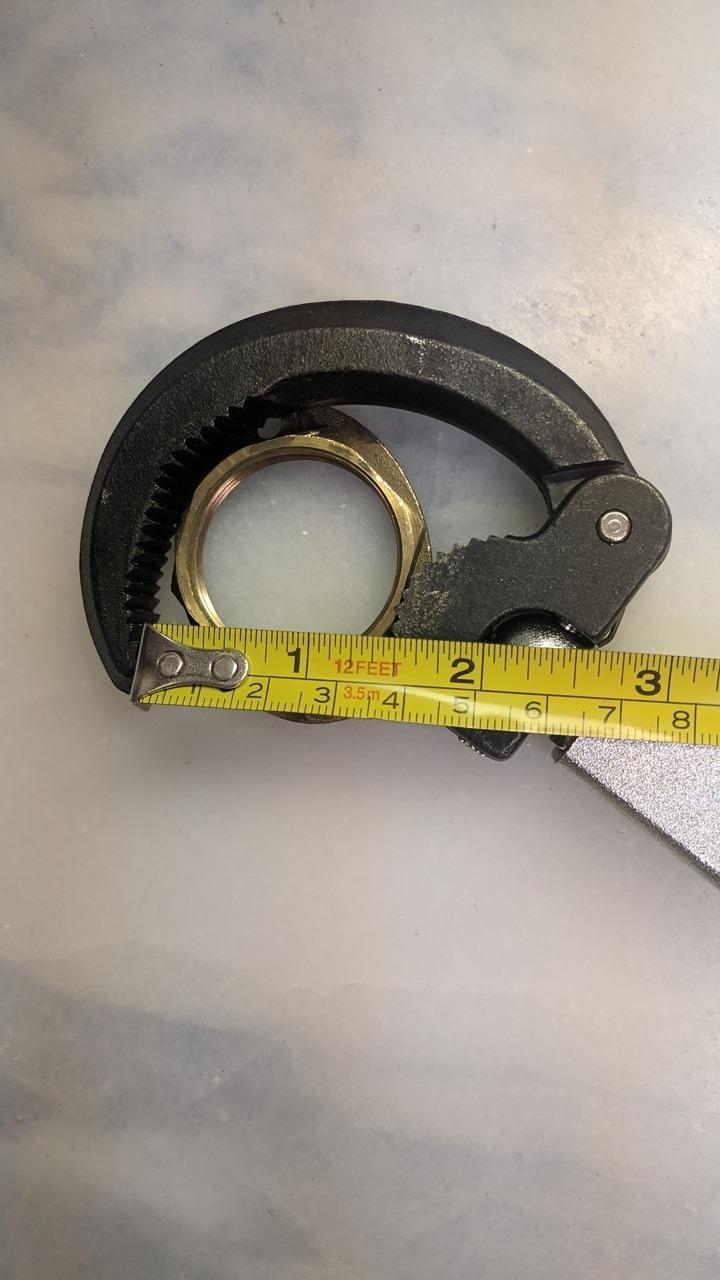
The General Tools 140XL is the reach-and-capacity answer in this group. It telescopes from 11 to 16 inches, and its jaws open to 2 inches, which is far larger than anything else we tested. For a large supply line nut or an oversized basin nut on a deep cabinet, nothing else here simply fits.
The spring-loaded jaws ratchet continuously, so you can reposition your hand without taking the wrench off the nut, and the sliding T-handle gives you a second grip that also keeps the handle from fouling cabinet walls.
On a thick stone countertop installation where the supply nuts sit deep behind the cabinet wall, the extra four inches of reach made the difference between fitting the wrench and not fitting it at all.
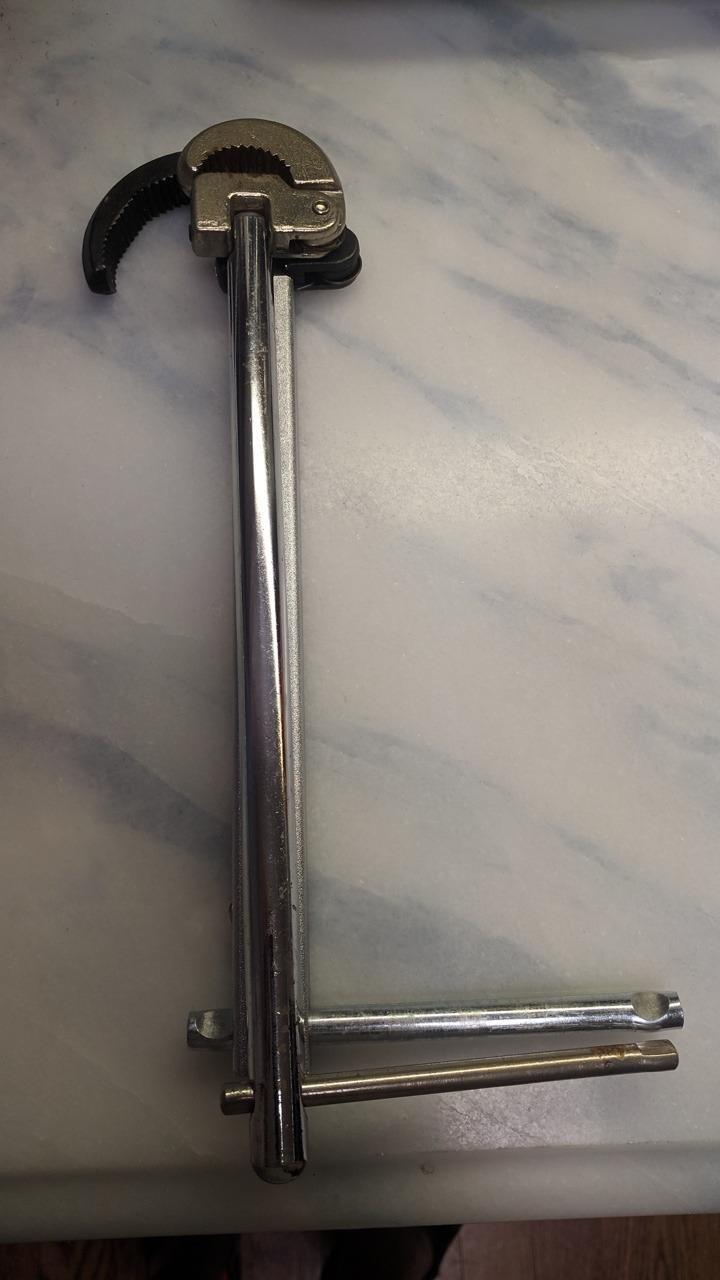
The tradeoff is weight and bulk. At two pounds this is a hand tool you notice at the end of a long install, and when the jaws open to grab a small nut, the head geometry gets wide. In a narrow gap the same wide opening that handles a 2 inch nut becomes the reason it will not go in.
The 4.3 average with 1347 reviews reflects a long-running, well-liked tool that people reach for when they know the nut is big rather than by default.
Best for deep cabinets and oversized fittings
This is the pick when the nut is the problem, not the space. Very large supply line nuts, older commercial-style fittings and deep wall-mount basins are where the 1 to 2 inch jaw pays for itself immediately.
The telescoping range also makes it a good general-purpose under-sink tool if you do occasional work and want one basin wrench that covers most residential nut sizes above one inch.
Where the weight and size hurt
It is too heavy and too wide for the cramped space behind a pedestal sink, and reviewers specifically flag the open jaw as a problem in tight corners. If your situation is restricted clearance rather than a large nut, choose a slimmer fixed-length or telescoping tool instead.
5. LeeLoon 8 in 1 Faucet and Sink Installer Wrench for a Complete Kit
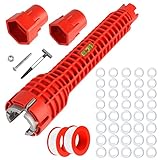
LeeLoon 8-in-1 Faucet & Sink Installer Wrench – Red, Plastic, Ratchet, Plumbing Tool – Includes 2 Replaceable Heads (34mm & 40mm), 40 Washer Gaskets, 2 Thread Seal Tape – Plumbing Wrench
Plastic body, powder coated finish
8 inch length
290 gram weight
Two replaceable heads at 34mm and 40mm
Bundles 40 gaskets and seal tape
Pros
- Bundles gaskets and thread seal tape with the tool
- Two replaceable heads cover a good size range
- Short 8 inch body reaches cramped nuts
- Non-slip textured grip
Cons
- Plastic cannot match steel on seized nuts
- Manufacturer advises not exceeding moderate force
- Limited torque on high-torque nuts
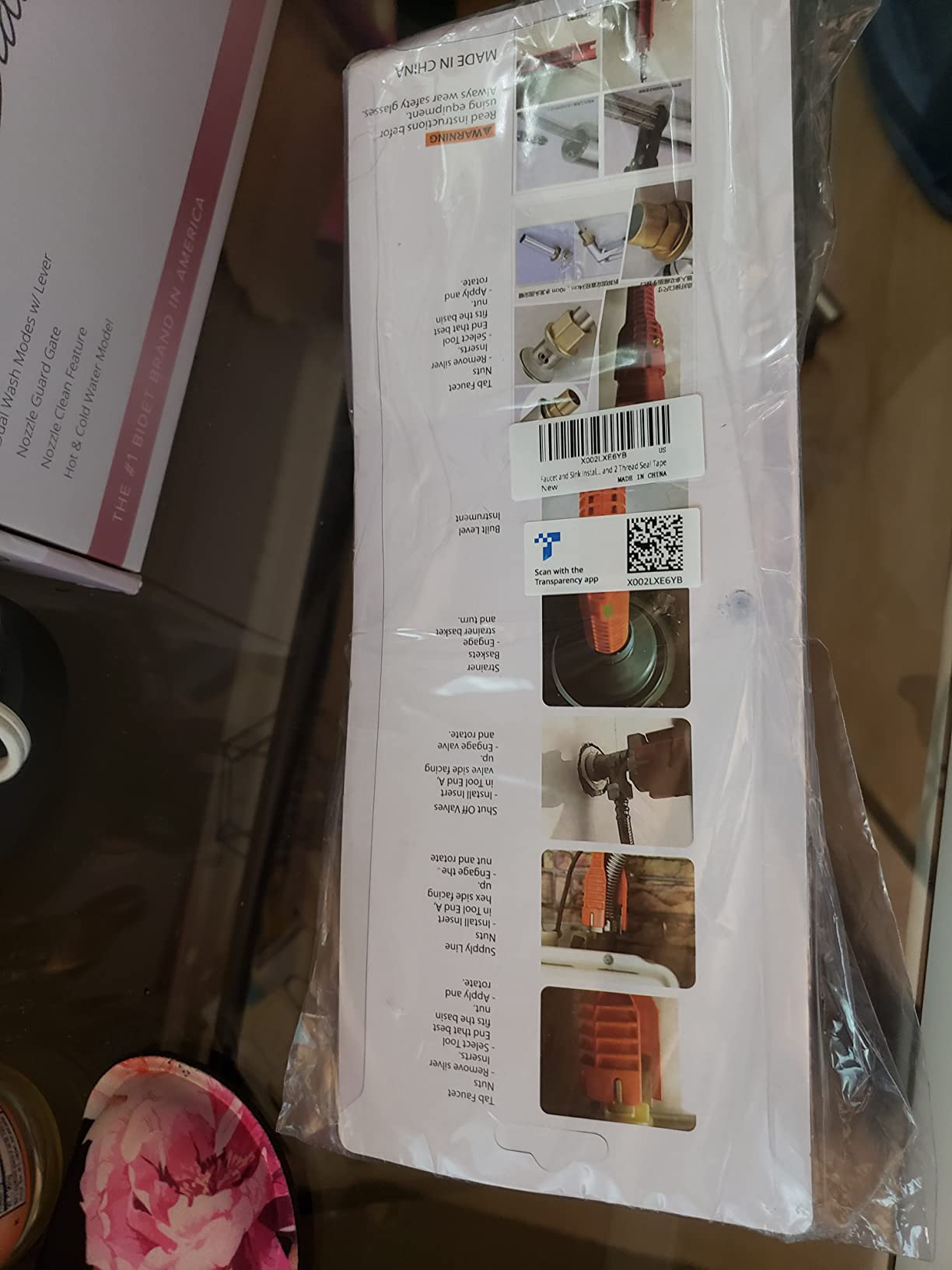
The LeeLoon 8-in-1 is the only tool here that arrives with the sealing supplies attached to the purchase. You get 40 silicone washer gaskets in two sizes and two rolls of PTFE thread seal tape, so a complete supply line swap does not need a separate hardware run.
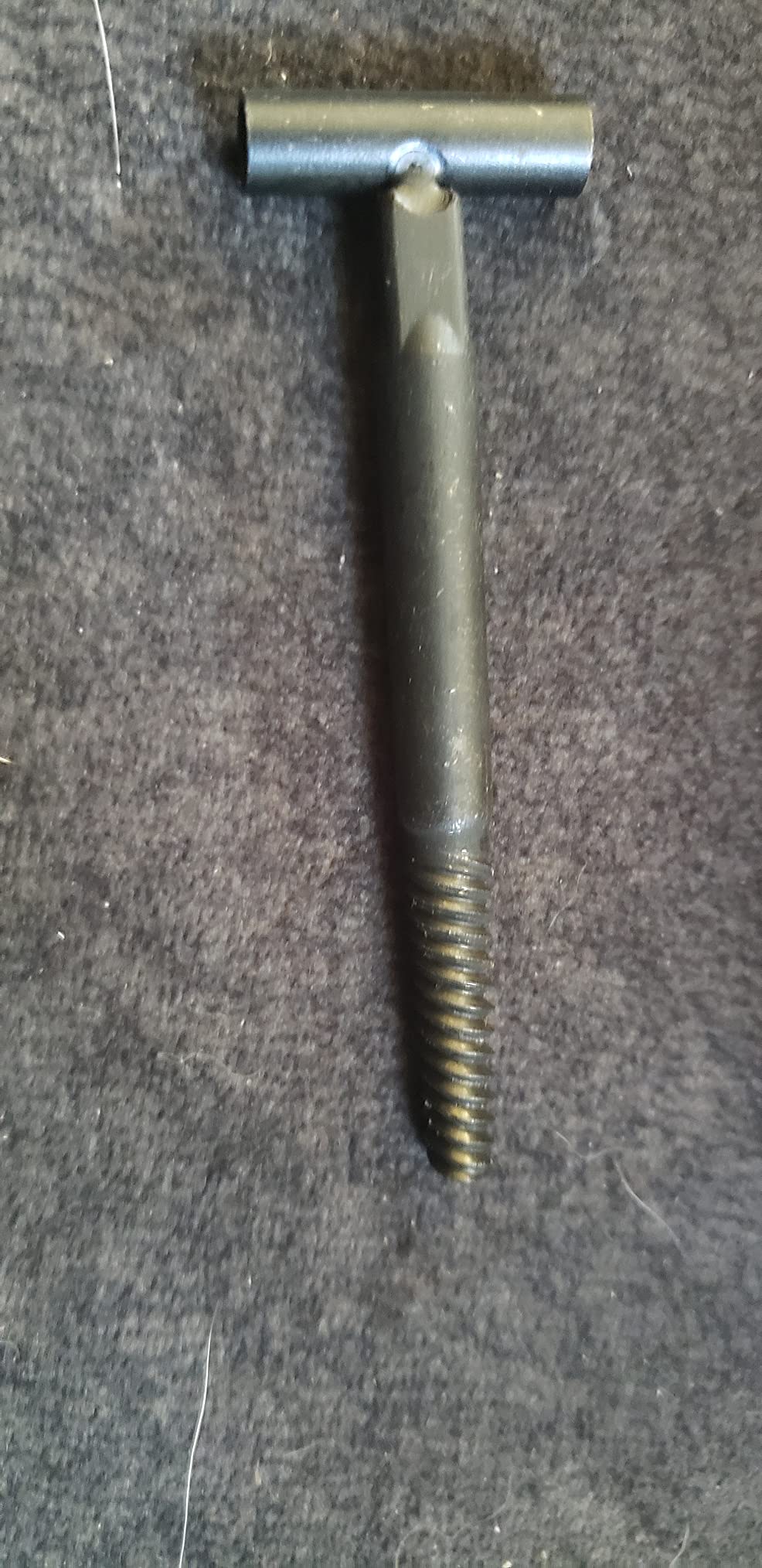
The tool itself is a short 8 inch plastic body with an open slot and two replaceable heads at 34mm and 40mm inner diameter. It covers supply nuts, shut-off valves, strainer baskets and faucet mounting nuts, and the short length is genuinely useful behind a sink where nothing else will sit straight.
For a first-time DIY install on a modern faucet, the 4.1 average is a fair reflection. It does the job cleanly, the heads swap without tools, and the gaskets mean a slow drip from a reused washer is less likely.
What you give up is hardness. Reviews are consistent on this point: engineering plastic will not match steel once a nut is corroded or over-tightened, and the manufacturer itself advises staying under moderate force to avoid handle flex. The ratcheting action is limited by the same plastic body.
It is a kit for a clean, modern installation. It is not a wrench for a 1994 rental property.
Why the bundled gaskets are worth more than they look
Most under-sink leaks are a reused rubber washer, not a bad connection. Forty fresh gaskets and two rolls of tape mean you can replace every washer on the job, which removes the single most common reason a new faucet starts dripping within a month.
For a bathroom vanity swap where you are also replacing supply lines, this is a tidy one-package solution.
Where it will not hold up
Any seized, painted or heavily corroded nut is outside its envelope. The 8 inch length also means it cannot reach a nut set far back in a deep cabinet, so it works best where the problem is horizontal tightness, not depth. Two people online forums note that buying the cheap kit first and a steel wrench later is a common and avoidable pattern.
6. HAUTMEC PL0025 Telescoping Basin Wrench for the Deepest Reach
HAUTMEC Telescoping Basin Wrench, Sink Wrench, 3/8″ to 1-1/4″ Jaw Capacity, 10″ to 17″ Extendable Handle, Steel Sink Faucet Remover PL0025
Chrome-plated steel, polished finish
Extends 10 to 17 inches in four positions
1.7 pound weight
1-1/4 inch jaw capacity
Removable 8 inch auxiliary handle
Pros
- Longest reach here at 17 inches
- Heavy-wall square tubing resists torque
- 180 degree head holds position
- Removable auxiliary handle and sliding T-bar
Cons
- Weaker on tight stuck or rusted nuts
- Spring clamp hard to engage in confined spaces
- Heavier than expected for a hand tool
The HAUTMEC PL0025 extends from 10 to 17 inches in four positions, which makes it the deepest-reaching basin wrench in this roundup. That range matters most when the trap is in the way and the nut sits low and far back under a deep basin.
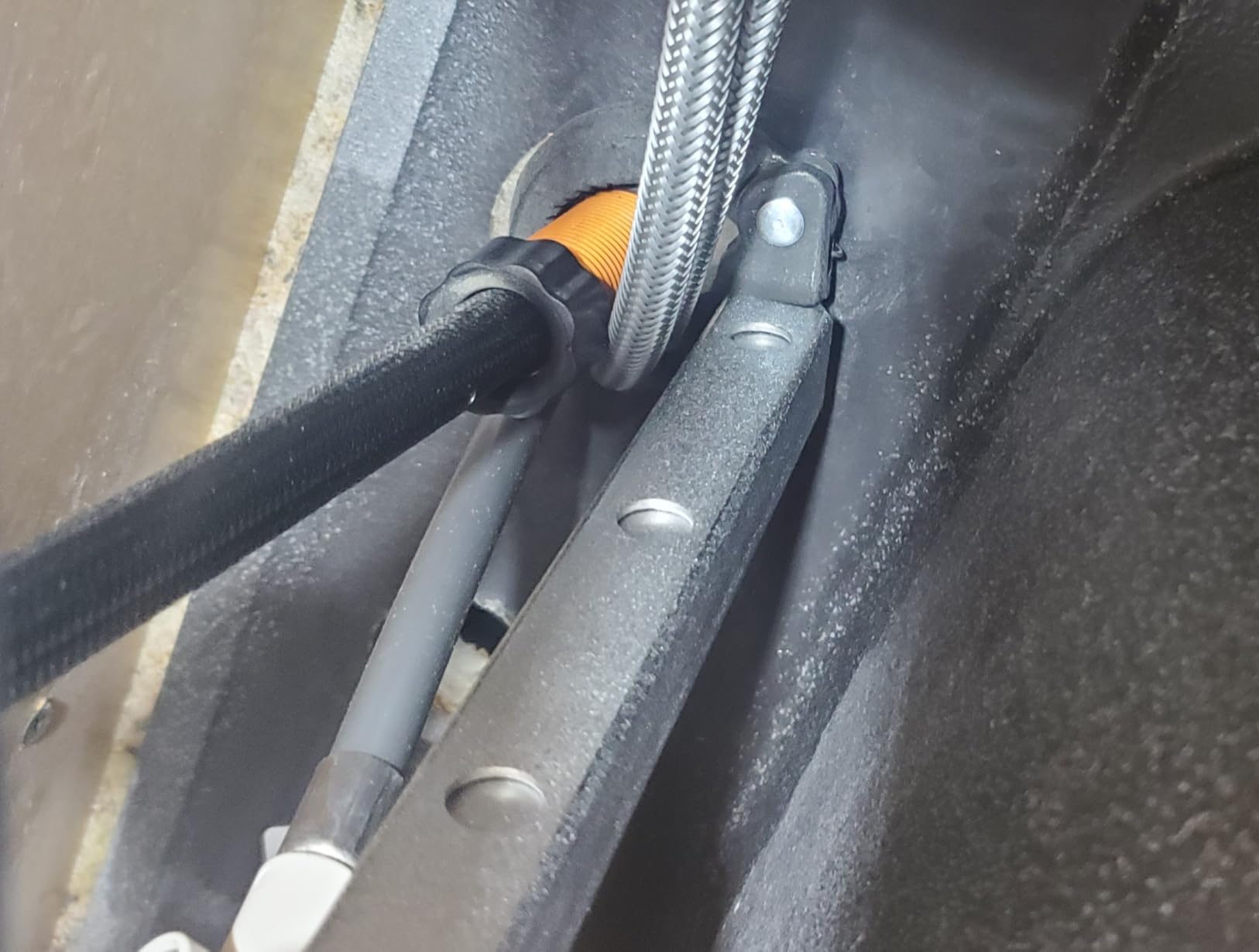
Reviewers single out the shaft construction. It is heavy-wall square steel tubing rather than thin round tube, which means you can clamp a crescent wrench onto it for extra torque without worrying about crushing the shaft. The chrome plating resists the damp cabinet environment that ruins bare steel.
During a pedestal sink job the four-position telescoping shaft let the T-handle drop below the bottom of the basin itself, which is the specific trick that makes this geometry work when the basin is in the way.
The 4.5 rating on 378 reviews is strong, and the reservations are consistent. Several owners note the square head and spring are fiddly to engage in a truly confined space behind a bath, and the 1.7 pound weight is more than you expect for a hand tool. A few also mention the plastic hanging handle in the box can snap in transit.
For leverage on a nut that is merely stubborn rather than seized, the removable 8 inch auxiliary handle gives you options that most fixed-handle wrenches do not.
What the four-position shaft actually buys you
It lets you collapse the tool to 10 inches for tight entry and extend it only as far as the nut demands. That is not just convenience: a shorter shaft swings easier around a trap, and a longer shaft adds leverage, so you match the tool to the problem instead of working around one fixed length.
It also has a rear hanging hole, which matters if you want it on a tool board rather than loose in a bucket.
Where the leverage still runs out
On genuinely rusted or seized nuts, reviewers report it is less effective than a heavier fixed wrench, and the engagement point for the spring is small. For severe corrosion, plan on the combination approach: penetrating oil, heat, and a second tool with more mass behind the handle.
7. Klein Tools 68098 12 in 1 Faucet Wrench for Professional Multi-Tool Work
Klein Tools 68098 Faucet Wrench, 12-in-1 Plumbing Multi Tool for Sink, Toilet, and Faucet Installations and Repairs
Nylon body, painted finish
Extends to 14-1/2 inches
1.1 pound weight
3/8 inch square drive passthrough
Detachable four-slot strainer piece
Pros
- Rigid build rather than thin plastic
- Extends to 14-1/2 inches for tight spots
- Covers tabs
- hex nuts
- angle stops and strainers
- 3/8 inch square drive adds real leverage
Cons
- Handle feels clunky to maneuver
- Fixed design leaves no alternative if one size fails
The Klein Tools 68098 is a 12-in-1 that behaves less like a gadget and more like a shop tool. Reviewers repeatedly note that it is not thin plastic, and at a 4.5 rating it has the highest share of top marks among the multi-function style tools here.
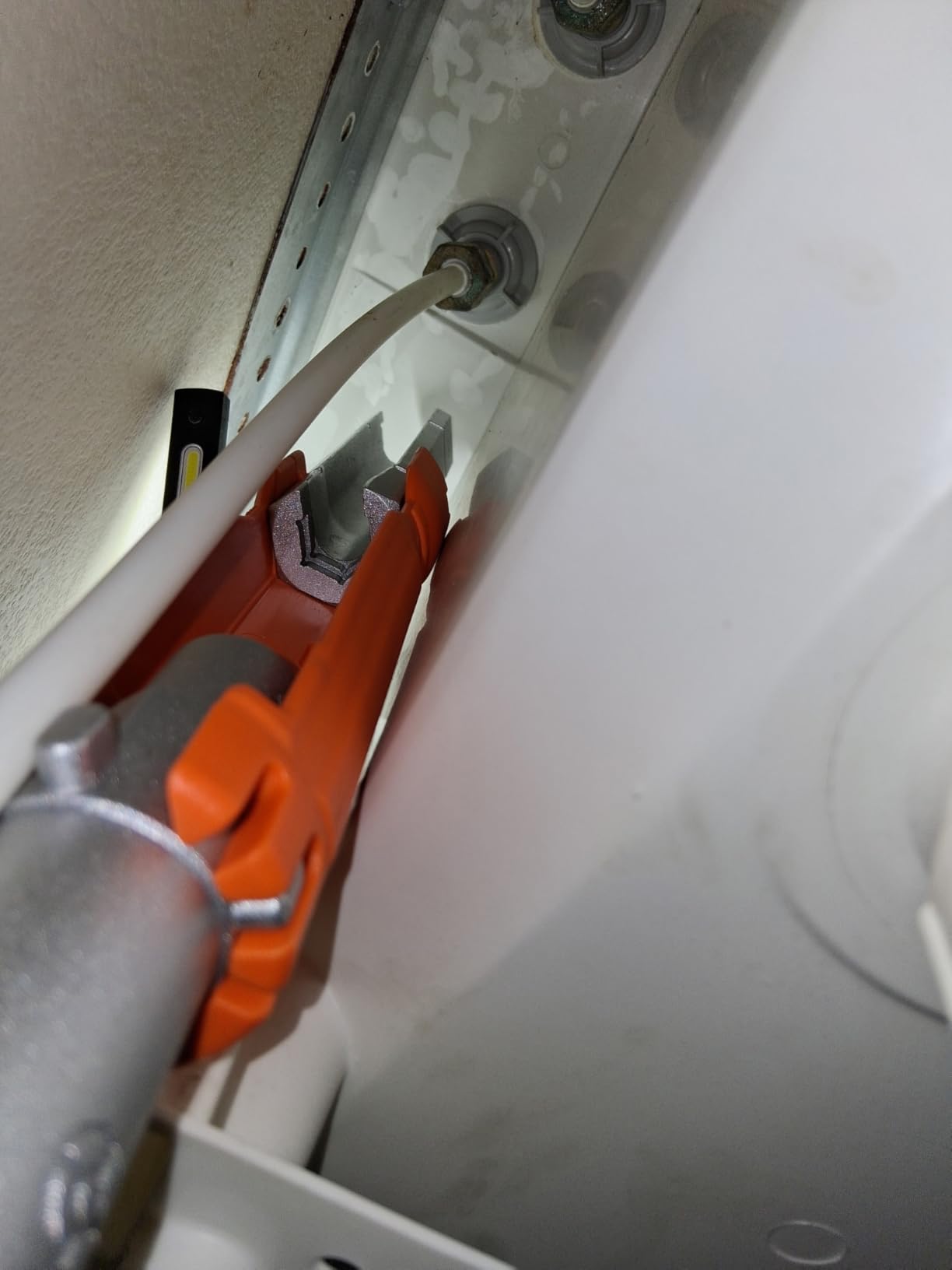
Coverage is genuinely wide. The handle end fits 2, 3, 4 and 6 tab basin mounting nuts, the open hex end fits 5/8, 3/4, 7/8 and 15/16 inch hex nuts, and a detachable piece carries a four-slot strainer wrench and a junior aerator wrench. It extends to 14-1/2 inches for reach.
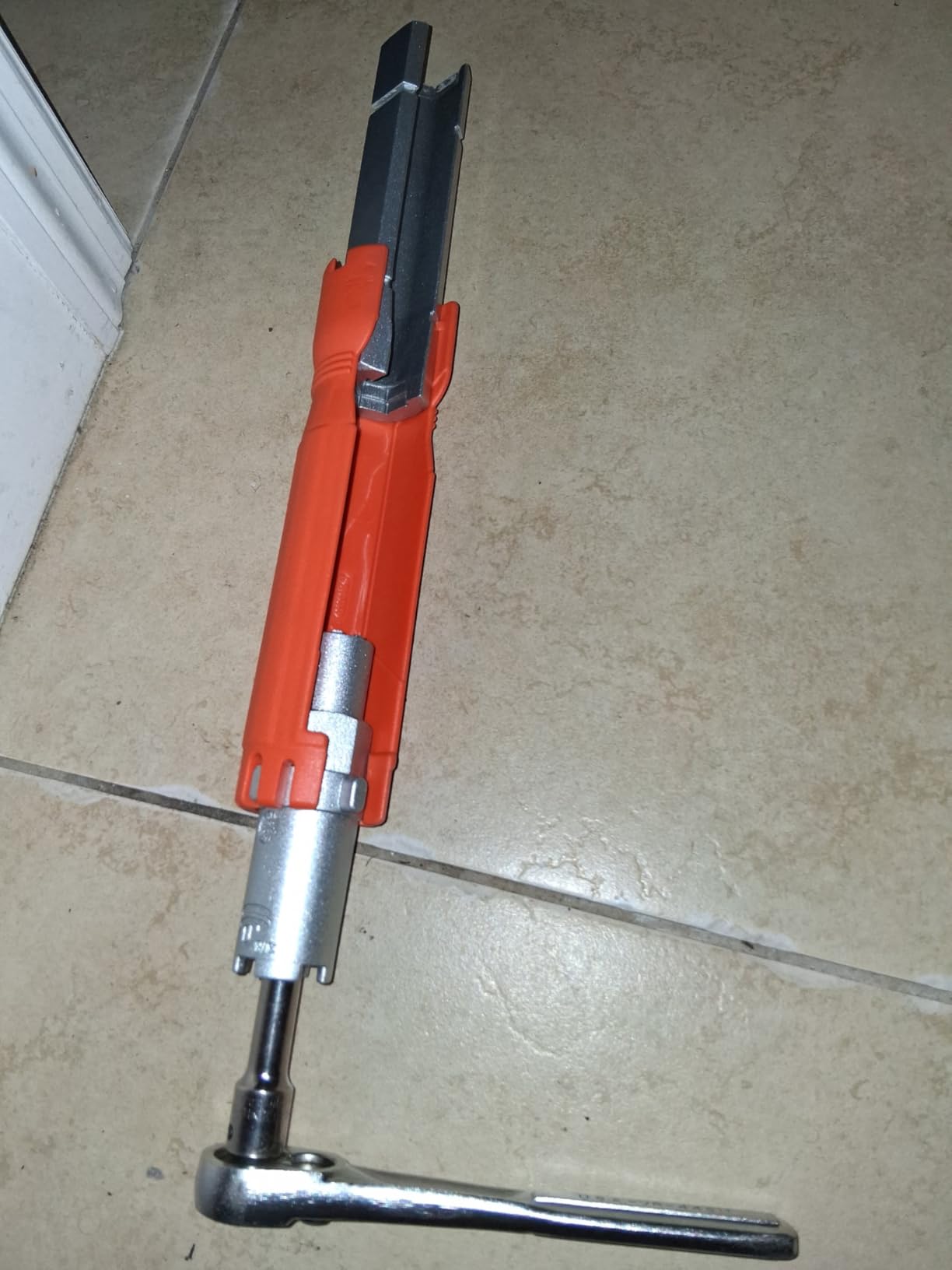
The feature that changed how I worked was the 3/8 inch square drive passthrough. Fitting a breaker bar or ratchet handle through it gave far more torque than a hand alone on a 5/8 inch nut, and it saved me from leaning on the tool body and slipping.
Two complaints come up repeatedly and neither is serious. The handle is described as clunky to maneuver in very tight spots, and because the sizes are fixed into the tool, a nut profile that does not match one of the heads leaves you with no fallback jaw on the same tool.
At 1.1 pounds it is not a lightweight carry-around, but it replaces several individual tools, which is the trade that matters.
Where the square drive changes the outcome
Torque is the difference between a nut that comes loose and one that gets rounded. A 3/8 inch drive lets you add a ratchet, breaker bar or screwdriver handle in line with the nut, applying force down the axis rather than tangentially at the jaws.
For seized hardware, the honest sequence is still penetrating oil first, then heat, then mechanical advantage. The square drive is the third step, not a substitute for the first two.
Where the fixed multi-tool design limits you
A one-tool-fits-all approach has an inherent ceiling. If your faucet uses an unusual nut profile, you are carrying a tool with several of its heads wasted. And the larger body of a 12-in-1 needs a little more swing room than a slim basin wrench, so for the single tightest gap on a job, a dedicated basin wrench is still the better instrument.
8. ARES 33001 Telescopic Basin Wrench for the Widest Jaw Capacity
ARES 33001 11-16-In Telescopic Basin Wrench – Adjustable 1-3/8-In Jaw
Chrome vanadium steel shaft with forged steel jaw
Powder coated finish
11 to 16 inches in four positions
Jaw capacity to 1-3/8 inches
0.81 kg weight
Pros
- Largest jaw capacity here at 1-3/8 inch
- Chrome vanadium shaft with forged jaw
- Continuous one-handed ratcheting
- Button-push four position telescoping
- Limited lifetime warranty
Cons
- Longer body needs room to swing
- Limited independent review history on the pivot lock under heavy load
The ARES 33001 pairs a forged steel jaw with a chrome vanadium steel shaft, and that material combination is the point. Chrome vanadium is the same family of alloy used on serious pipe wrenches, so this is a telescoping basin wrench built for load rather than for lightness.
Jaw capacity runs to 1-3/8 inch, the widest of the telescoping group here, and the shaft locks in four positions between 11 and 16 inches with a button push. The head pivots 180 degrees and holds position, and the jaws ratchet continuously so you can work one-handed in a confined space.
A removable handle lets it collapse for storage, which is more useful than it sounds when a telescoping tool lives in a service van rather than a garage wall. The limited lifetime warranty also separates it from most of the field.
Why the shaft material matters on a seized nut
Aluminum shafts flex, and a flexing shaft bleeds torque. Chrome vanadium holds, which means when you add a cheater bar or a breaker bar for a nut that has not moved in years, the force goes into the jaw rather than into bending the handle.
The forged jaw is the other half of that equation. It is the part that actually bites, and a forged profile holds its tooth geometry longer than a cast one.
Where it needs more room than you have
The 224 reviews are positive but a smaller pool, and they note the longer telescoping body needs clear space to swing. If the nut is in a narrow slot rather than an open cavity, the 1-3/8 inch jaw is a liability because the open head is wide. Behind a pedestal or inside a wall cavity, a slimmer tool reaches places this one cannot.
9. Titan Tools 11499 12 inch Basin Wrench for Wall Cavities
Titan Tools 11499 12″ Basin Wrench
Alloy steel, powder coated finish
12 inch overall length
About 9 inch working length from jaws to handle
1.1 pound weight
Nuts up to roughly 1 inch
Pros
- Rugged alloy steel handle
- Swivel head stays locked at the set angle
- Compact enough for behind-sink and wall cavity work
- Often far cheaper than an oversize socket
Cons
- About 9 inch working length is short for deep cabinets
- Head can be too wide once the jaws open for smaller nuts
- Jaw capacity tops out near 1 inch
The Titan 11499 is a 12 inch alloy steel basin wrench with roughly 9 inches of working length from the jaws to the handle. That short, stocky geometry is exactly what makes it work behind a wall-hung basin where a longer wrench simply cannot be manoeuvred into position.
The spring-loaded swivel jaws hold wherever you set the angle, and they work nuts up to about 1 inch, which covers the standard range of residential faucet mounting nuts and supply fittings.
It is a plain, unglamorous tool with a 4.3 rating across 159 reviews. The praise is consistent and unglamorous too: a handle that feels solid and a head that does not drift once you set it.
When the short geometry is the advantage
Between a wall-mount basin and a deep vanity cabinet, length is a genuine liability. A long handle needs somewhere to swing, and behind a pedestal or inside a wall cavity there is nowhere. This wrench fits the gap precisely because it is short.
It is also the tool to reach for when you would otherwise be trying to fit an oversize socket onto a nut, since the cost difference is large and the result is the same.
Where the geometry works against you
The most common criticism is not quality but fit. When the jaws open to grip a smaller nut, the head becomes wide enough to be the problem instead of the solution in a tight void. Reviewers also note the working length is short for deep cabinets, and capacity stops near 1 inch, so large supply nuts are out of range.
10. Elecbee Multifunctional Sink Wrench Set for Small Nut Ranges
2Pcs Multifunctional Sink Wrench Set, 7 Sizes Basin Wrench Faucet Wrench, Under Sink Wrench Faucet Tool, Faucet Hose Spanner Sink Basin Wrench Four-Jaw Hex Wrench for Kitchen Bathroom Screws & Threads
Alloy steel construction
8 inch length
Two wrenches covering 7 nut sizes
Four-jaw hex head
360 degree rotating design
Pros
- Two tools covering 7 standard nut sizes
- Alloy steel without excessive weight
- 360 degree rotation reduces wrist strain
- Compact 8 inch length stores easily
Cons
- 8 inch length is short for deep nuts
- Not suited to heavy duty plumbing work
- Nut coverage may not match a specific faucet
The Elecbee set is two compact 8 inch wrenches between them covering seven standard nut sizes, using a four-jaw hex head for grip. The 360 degree rotation is the detail that gets noticed in use, because it cuts the constant wrist twisting that under-sink work otherwise demands.
It is a good drawer-filler for a homeowner who swaps a faucet every few years. Reviewers confirm it solves the reach problem under sinks, and the 4.1 rating reflects a tool that does its job without pretending to be a professional instrument.
At 73 reviews this is the thinnest evidence base in the roundup, so treat the fitment claims as indicative rather than proven.
What the four-jaw hex head does well
A four-jaw design bites on the flats of a hex or square nut rather than on the corners, which spreads the load and reduces both slipping and stripping. On plastic basin nuts that you do not want to chew, that gentler, more even contact is worth more than raw torque.
Two tools also means two different lengths in effect, since you can use the shorter one where depth is not the problem.
Where the limits show up quickly
Eight inches is short, and several buyers specifically report it as too short to reach deep nuts. The torque ceiling is also low enough that this is not a heavy-duty tool, and reviewers mention occasional weld imperfections that need filing. Check that one of the seven sizes matches your actual nut before committing.
11. Ophjerg Moen 118305 Removal Tool for Moen Faucet Nuts
Ophjerg 118305 Kitchen Faucet Removal Tool for Moen Sink Faucet, Faucet Wrench Tool Help Removal and Install Faucet Mounting Hardware, Faucet Replacement Parts Repairing Plumbing Fixtures
ABS plastic, powder coated finish
7.71 inch length
13.61 gram weight
Flat head style
Built for Moen 118305 hex nuts
Pros
- Very light and easy to move under a sink
- Slim extended body reaches hidden mounting nuts
- Supply hose runs through the tool body
- Screwdriver hole adds leverage
Cons
- Only fits Moen 118305 style hex nuts
- Will not work on other brands or nut profiles
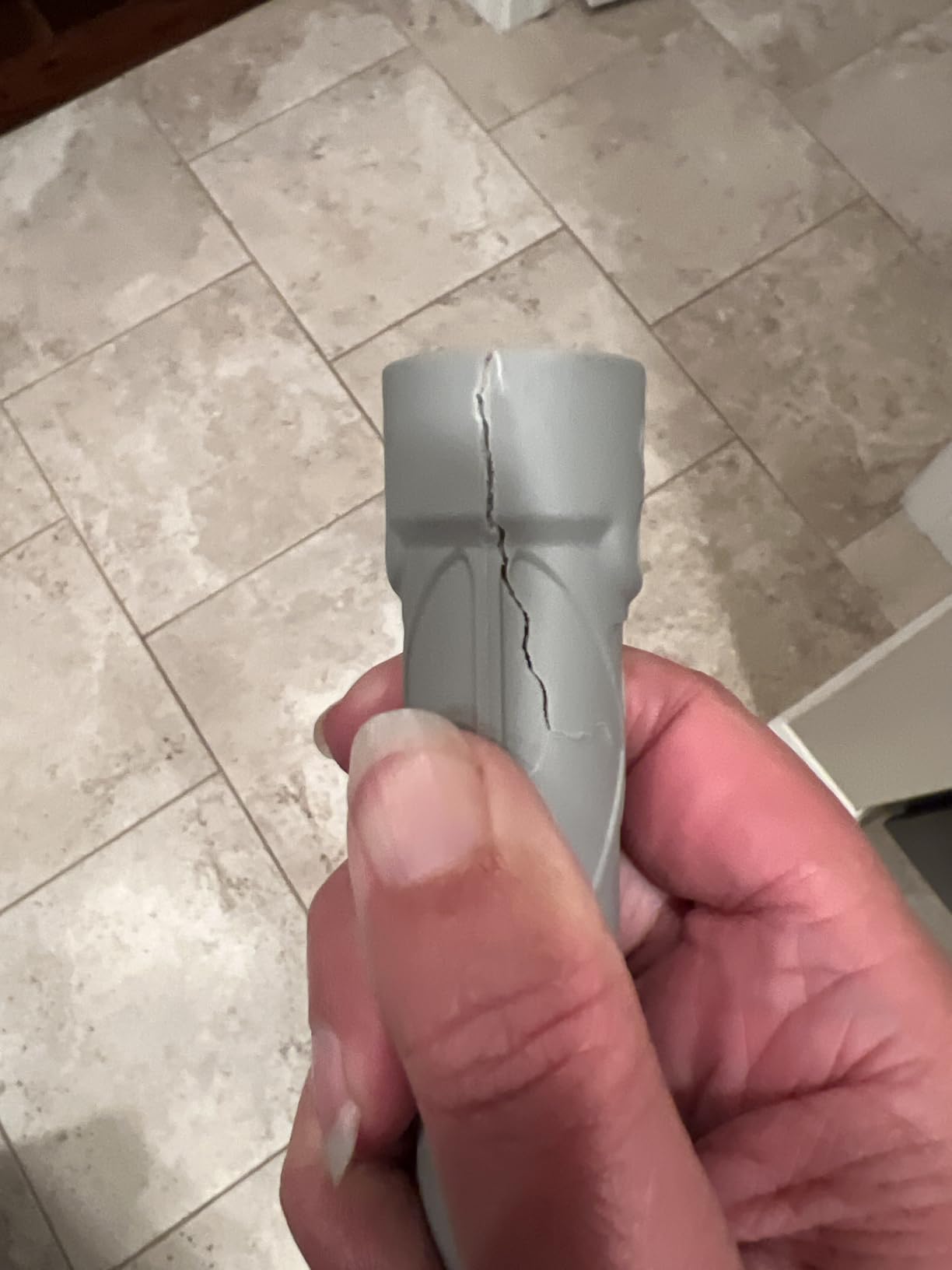
- Thin plastic limits torque on corroded nuts
The Ophjerg tool does exactly one job, and it is a job almost nobody else in this roundup does well: reaching the hex mounting nuts used on Moen 118305 kitchen faucets. At 7.71 inches and under an ounce, it is the most nimble tool here, and the supply hose runs straight through the tool body so nothing has to be re-angled.
That through-the-body hose routing is the real trick. Instead of fighting the line to get the wrench behind it, the line passes through the tool, which is why it works where a conventional basin wrench stalls.
With a 4.4 average, reviewers confirm it performs precisely the task it was designed for. The screwdriver passthrough hole adds leverage when the nut resists.
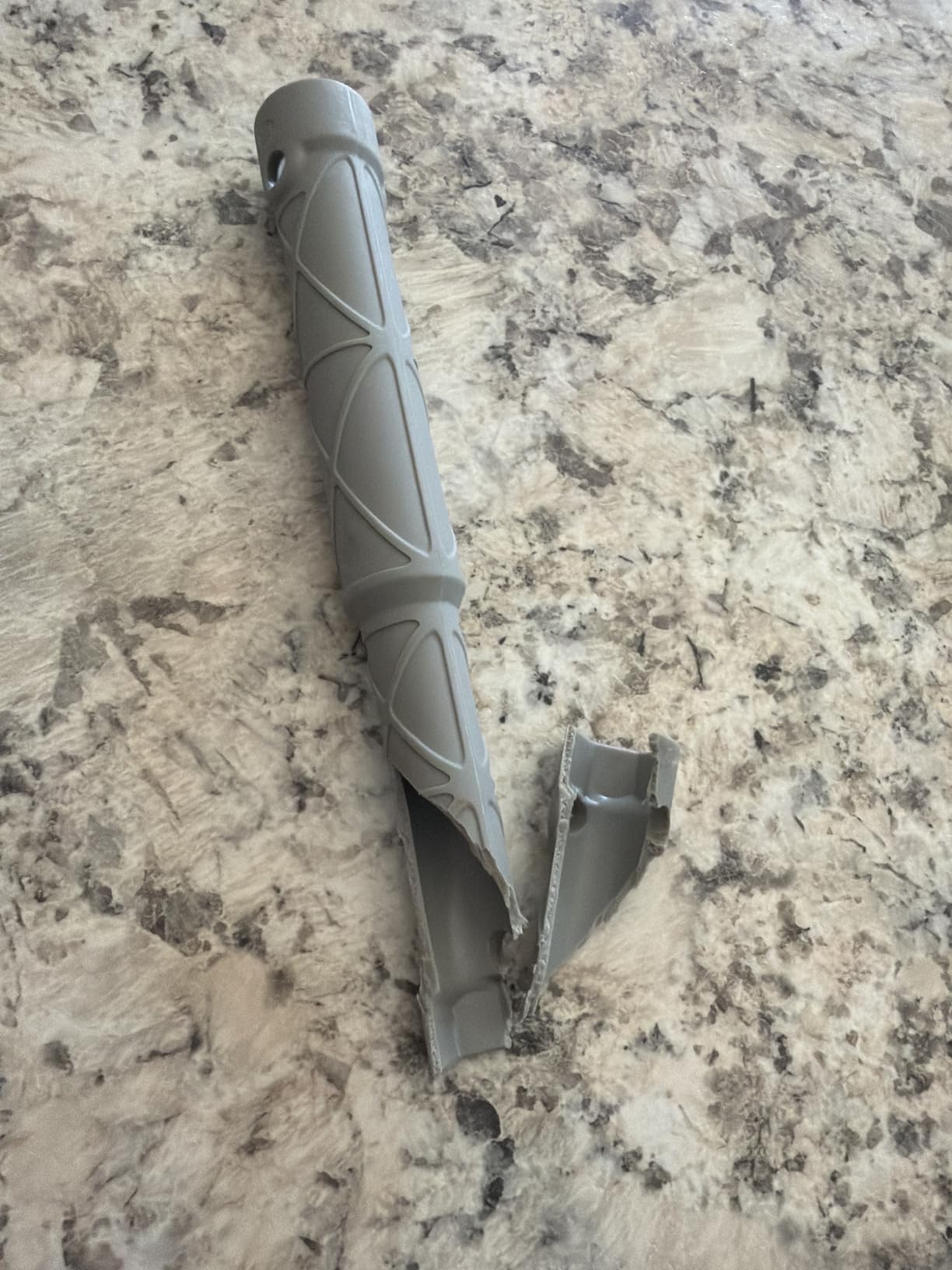
The fitment is narrow by design, and that is the buying decision. It will not fit other faucet brands, and it will not engage non-hexagonal nut profiles. The thin plastic body also means it is the wrong tool for a heavily corroded Moen nut.
Identify your part number before you order. If your faucet is not a Moen 118305, this is not a general-purpose wrench, it is a wrong purchase.
Confirm the part number first
Every advantage of this tool comes from being engineered around one hardware profile. Check the faucet model number, confirm the mounting nuts are the hex style it wraps, and check that they sit in the awkward position where a normal wrench will not reach.
If all three are true, this lightweight plastic tool beats far heavier options because it simply gets into places they cannot.
Where a universal tool is the safer bet
If you own more than one faucet, or you are planning future replacements, a brand-specific tool is a narrow investment. The RIDGID EZ Change or a telescoping basin wrench covers the same reach problem across brands and across the tab, hex and cylinder nut profiles you are likely to meet next.
12. Enhon Faucet Seat Wrench for Compression Seat Repairs
Enhon Faucet Seat Wrench, Compatible with Danco 80439 Faucet Removal Tool
Alloy steel, powder coated finish
9.1 ounce weight
Fixed square head style
6.22 by 6.1 by 0.63 inches
Compatible with the Danco 80439
Pros
- Steel that resists deforming or breaking
- Two sided square and hex configuration
- Universal across many compression seat brands
- Useful for repair and maintenance
Cons
- Only works on compression seats
- not cartridge faucets
- Needs an existing recessed seat to engage the drive
- Not a general installation wrench
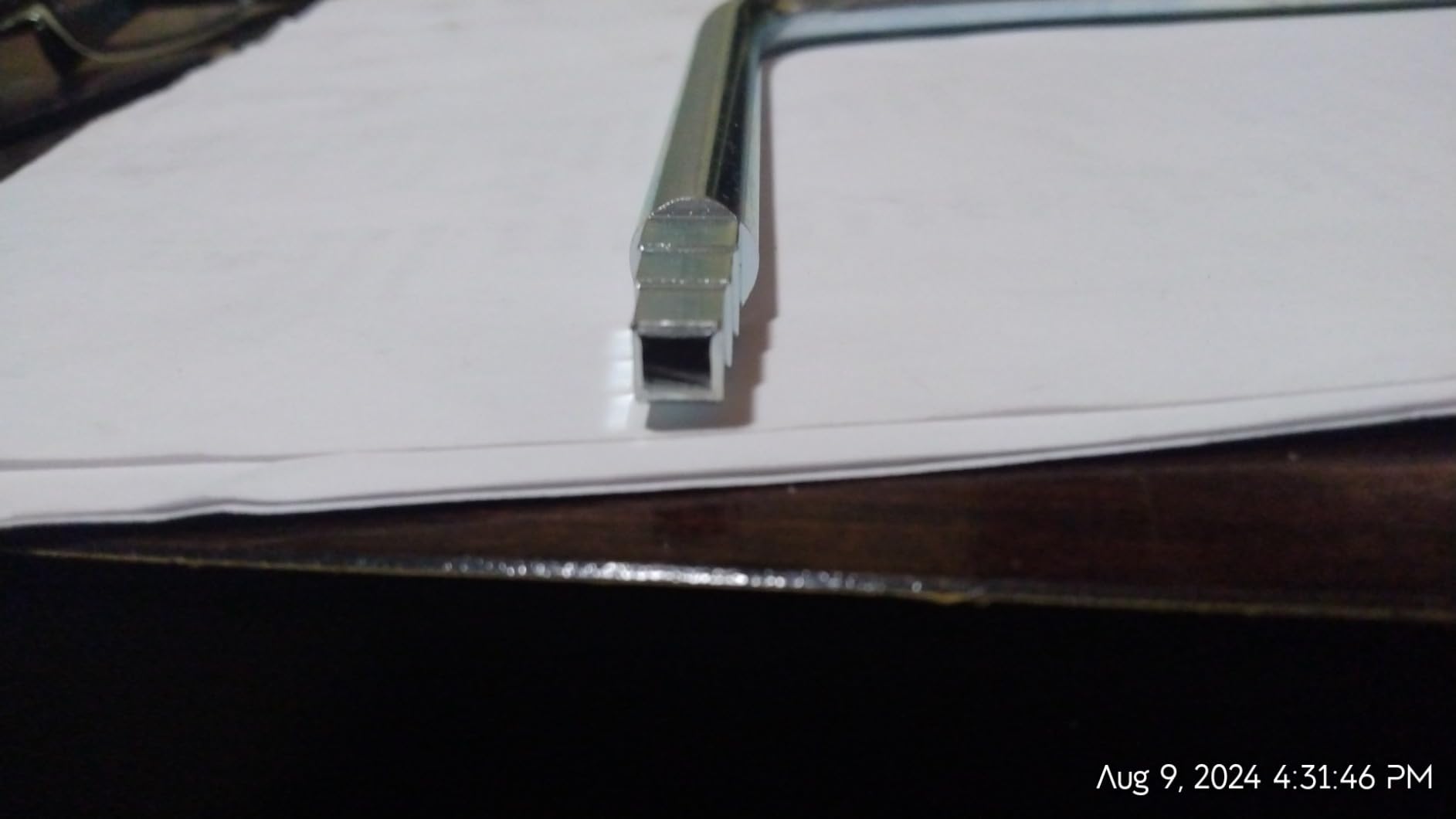
The Enhon seat wrench is not a faucet installation tool and we include it deliberately, because when a single-handle faucet drips after a cartridge swap, this is often the missing part in a homeowner kit. It replaces the Danco 80439 and fits most compression faucet seats.
The two-sided square and hex configuration lets you drive into whichever recess style the seat uses, and the steel build is what makes it useful on a worn seat that has been gummed up with mineral deposit. At 9.1 ounces it is small enough to work in a narrow cabinet.
Reviewers consistently value it as a cheap replacement for an original OEM tool that has gone missing, and the cross-brand fit means one covers seats from many manufacturers.
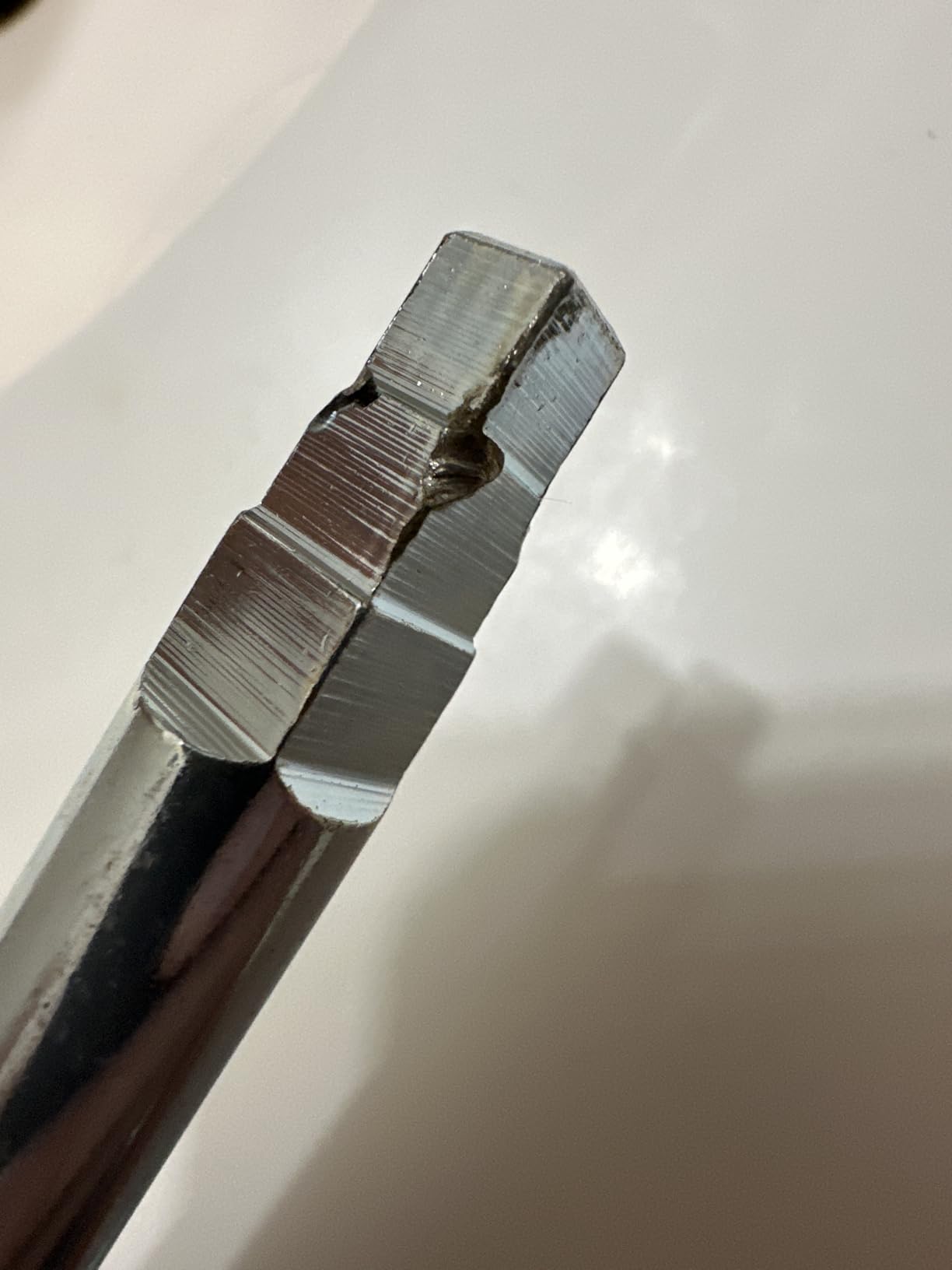
It has a narrow job by definition. It only works on compression-style seats, not cartridge faucets, and it needs an existing recessed seat to engage the square or hex drive, so it is useless as a general-purpose wrench. If you are installing a faucet rather than repairing a leak, skip it.
We rate it 4.3 across 147 reviews, and that is a fair score for a small specialty part that does precisely what it claims.
When a dripping faucet calls for this instead of a basin wrench
A basin wrench loosens mounting nuts. A seat wrench removes the worn rubber seat inside the valve body. They are different problems, and confusing them is why some leaks persist after a cartridge replacement.
If water still drips with the cartridge new, the seat is the next suspect, and this is the tool that reaches it. Pair it with a seat assortment and a small basin of silicone grease.
Where it is the wrong purchase
Do not buy it for a faucet install, and do not expect it to help with a stuck supply nut or a basket strainer. It also will not help on modern cartridge faucets where the drip is caused by a failed O-ring rather than a worn seat.
How to Choose a Faucet Installation Tool Kit for Tight Spaces
Most wrong purchases in this category come from buying for nut size and ignoring space. Here is the order to think in, based on the failure patterns we saw across the jobs above.
1. Measure the clearance before the nut size
Get under the sink with a tape measure and note two numbers. First, the vertical gap between the underside of the basin and the cabinet floor, which decides how much reach you need. Second, the horizontal gap between the drain tailpiece and the nearest wall, which decides how wide a tool head you can use.
Less than about 2 inches of vertical clearance and a tailpiece you have to work around means you want a compact slotted handle or a short insert tool. More than 12 inches of depth means a telescoping shaft is worth paying for.
2. Match the tool family to the nut profile
Basin mounting nuts come in four common shapes, and no single tool covers all of them reliably. Tab-style nuts have two, three, four or six tabs and are best matched by a notched handle end. Hex nuts are covered by a cubed insert or a hex jaw. Cylindrical nuts on single-hole mountings need a deep-welled insert. Rounded or oversized fittings need a wide spring-loaded jaw.
That is the entire argument for owning a multi-function tool alongside a basin wrench. Plumbers report consistently that no one tool works for all faucet brands, and that buying three tools before finding one that works is a common and avoidable pattern.
3. Choose material based on nut condition
Steel for old, corroded or over-tightened nuts, and reinforced plastic or nylon for clean modern installs and for reach. A plastic-bodied tool that reaches the nut easily is more valuable than a steel tool that cannot get there, and a steel tool that grips properly is more valuable than a plastic one that slips.
Add a cheater bar only when the shaft is heavy-wall steel. Cheater bars bend aluminum shafts, and forum advice consistently warns against using one on a plastic body at all.
4. Use the head angle and drive to your advantage
A head that pivots and locks lets you approach a nut from any angle without reorienting the whole tool, which is most of the battle in a cramped cabinet. A square drive or screwdriver passthrough lets you add in-line mechanical advantage when the nut is the last thing standing between you and a finished job.
Continuous ratcheting jaws are worth a premium if you plan more than one job, because they let you reposition your grip without removing the wrench from the nut.
5. Know when to stop fighting the sink
Removing a sink is often faster than a tool search when the cabinet is deep, the trap is awkward and the nut is corroded. Plumbers regularly report that taking the basin out converts an impossible angle into an ordinary one, and for a pedestal sink it can be the only practical approach.
The point at which we stop trying is simple: once you have tried penetrating oil, heat and two different tools, and the nut still has not moved, the removal cost is lower than the damage you are about to do with more force.
Common mistakes that cost people the most time
Using an adjustable pliers on a chrome supply line instead of the nut, which gouges the plating and leaks later. Reaching for a pipe wrench where a basin wrench belongs, since the pipe wrench jaw is wide and will slip or crush plastic nuts. Forcing a plastic-bodied tool past its rated force and snapping the handle mid-job. And over-tightening plastic basin nuts on reassembly, which cracks the flange and leaves you with a leak you did not have before.
If you are also planning a broader tool purchase, our cordless power tool combo kit picks cover the drilling and cutting side of sink swaps, and our prefinished hardwood flooring guide is useful if the cabinet project runs on into adjacent rooms.
Frequently Asked Questions
What is the best tool for tightening faucets?
For most tight-space faucet installs the answer is a telescoping basin wrench with a spring-loaded, pivoting jaw, or a compact slotted faucet tool such as the RIDGID EZ Change. The telescoping type gives you reach and a wide jaw range, while the compact slotted type reaches nuts that sit directly behind a supply line. Match the tool to the nut shape: tab nuts, hex nuts and cylindrical nuts each need a different head.
What is the best special plumbing wrench for tight spaces?
A telescoping basin wrench is the standard answer because it extends to 10 to 17 inches with a spring-loaded pivoting head. For extremely tight cabinets where even the handle will not fit, a slim slotted faucet tool or a brand-specific insert wrench does better. Wall-hung and pedestal sinks suit short fixed-length wrenches instead, since long handles cannot swing in a confined void.
What tools do I need to install a faucet?
You need a basin wrench or faucet installation tool, an adjustable wrench for the supply line connections, a set of nut drivers or sockets, plumber tape, and fresh rubber washers for every connection. A basin wrench handles the mounting nuts behind the sink, the adjustable wrench handles supply nuts, and the washers prevent the most common cause of a new leak. Add a headlamp or work light, because you will be working in shadow.
Do I need a basin wrench to change a faucet?
In most cases yes. Basin mounting nuts sit directly behind the drain and supply lines, where a normal adjustable wrench has no room to turn. Without a basin wrench you risk rounding the nut, damaging a chrome supply line, or removing the whole sink to reach it. If your faucet uses hex nuts on a brand-specific design, a matching insert tool can do the same job more precisely.
Can you use an adjustable wrench instead of a basin wrench?
Sometimes, and only when there is enough room. An adjustable wrench works if you can slide it onto the nut straight without touching the supply lines or the tailpiece. It slips on chrome and damages plastic nuts, so it is a poor substitute in a genuinely tight cabinet. Basin wrenches and slotted faucet tools grip the nut on its flats and are designed for exactly this access problem.
What can I use instead of a basin wrench?
A faucet swap-out style tool with interchangeable sockets works well because the socket slides over the supply line and lands on the nut behind it. A multi-function faucet kit covers several nut profiles in one handle, and a screwdriver through a square drive passthrough can add leverage. A strap wrench or a pair of groove-joint pliers on an insert also works, but removing the sink gives you the easiest access of all.
Final Verdict on the Best Faucet Installation Tool Kits for Tight Spaces
The RIDGID 57003 EZ Change is our pick for the best faucet installation tool kits for tight spaces. Its slotted handle clears supply lines, its interchangeable inserts cover the most common nut profiles without marking chrome, and across 5629 reviews the only recurring complaint is that it is bulky in the very tightest cavities, which is a problem you can measure before buying.
Buy the DURATECH two-pack if the hardware is old and corroded and you want steel bite, and buy the HAUTMEC PL0025 if your cabinet is deep and reach matters more than absolute compactness. For a single awkward faucet on clean plumbing, the Forlivese 14-in-1 or the LeeLoon 8-in-1 will finish the job and cost you less in frustration than you would in a return.
Measure your clearance, identify your nut shape, then pick the tool that matches both.