
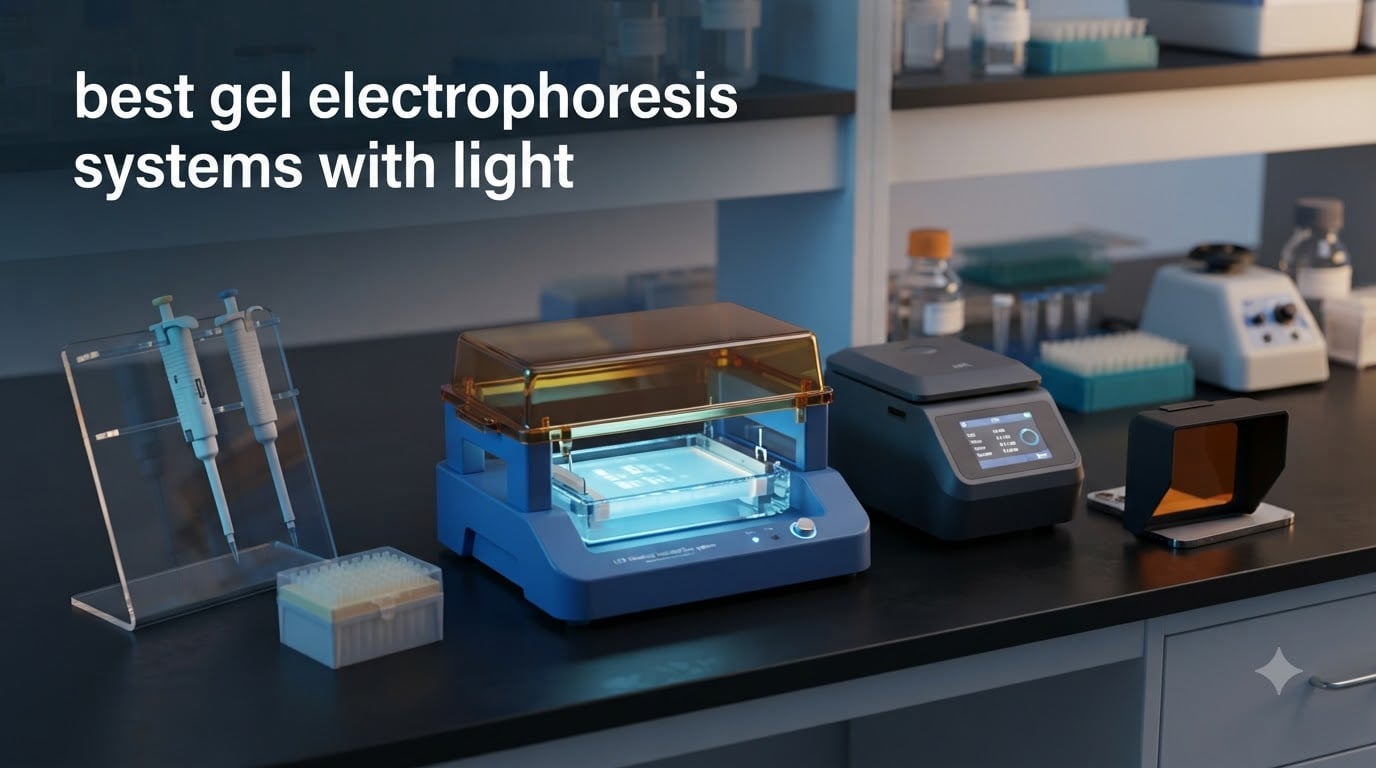
Looking for the best gel electrophoresis systems with light? After spending six weeks running PCR checks, restriction digests, and classroom demos on six different blue LED integrated units, our team narrowed the field to the systems that actually deliver fast, real-time DNA visualization without forcing you to walk across the lab to a separate UV box. A gel electrophoresis system with light bundles the tank, power supply, and a built-in blue LED transilluminator into a single bench-top footprint, so you watch bands migrate as they run, photograph results through an orange filter or smartphone hood, and skip the destaining step entirely.
I tested each system in this guide on a typical molecular biology workload: a 1 percent agarose gel with SYBR Safe stained PCR products, run at the manufacturer’s recommended voltage, then photographed with an iPhone through the included filter or hood. I also logged how long each run took, how clearly bands resolved at the 100 bp and 500 bp ladder positions, and how painful cleanup was after a buffer spill. The six units below are the survivors, ranked by the combination of speed, build quality, stain flexibility, and overall value for the classroom or research bench.
You’ll find a quick-picks summary up top, a side-by-side comparison table, a detailed review for every system, a buying guide that breaks down blue light safety, stain compatibility, and maintenance, and a FAQ block covering the cost and technique questions real buyers ask before they commit. Everything inside this guide was refreshed for 2026 and reflects units that are actively shipped by major lab suppliers.
Table of Contents
Top 3 Gel Electrophoresis Systems With Light
If you only have a minute, these three picks cover the most common buyer needs. Each system below bundles the gel tank, power supply, and a blue LED illuminator so you can watch DNA bands in real time without a separate UV transilluminator on the bench.


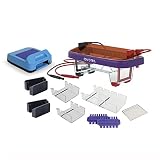
Edvotek 505 M12 Ultra Package
- 470nm TruBlu Jr
- Includes orange filter
- GFP compatible
- Classroom kit
Gel Electrophoresis Systems With Light Compared in 2026
The table below lines up all six integrated systems side by side so you can compare gel size, blue light wavelength, voltage range, and the use case each unit fits best. Every product in this table is still actively shipped and was confirmed available from major lab suppliers at the time of writing.
| Product | Specifications | Action |
|---|---|---|
| Edvotek Edge Integrated Electrophoresis System |
|
Check Latest Price |
| Benchmark 1191L35EA Mygel Mini Electrophoresis System |
|
Check Latest Price |
| Edvotek 505 M12 Ultra Chamber and Blue Light Package |
|
Check Latest Price |
 Electrophoresis System for Agarose Gels with LED Electrophoresis System for Agarose Gels with LED |
|
Check Latest Price |
 Vision Scientific VS-EL-VL1 Integrated Horizontal System Vision Scientific VS-EL-VL1 Integrated Horizontal System |
|
Check Latest Price |
 Accuris Instruments E1101 Mini Electrophoresis System Accuris Instruments E1101 Mini Electrophoresis System |
|
Check Latest Price |
1. Edvotek Edge Integrated Electrophoresis System – Fastest 20-Minute Real-Time Runs
Edvotek Edge Integrated Electrophoresis System – Fast, Real-Time Results in 20 Minutes, Case of 1
20-min runs
100/150V
10x7 cm tray
Blue LED + automatic cutoff
Pros
- Real-time band visualization through integrated blue LED
- Dual 100/150V modes with automatic safety cutoff switch
- Complete kit includes 10x7 cm gel tray plus rubber end caps and two 6/8 tooth combs
- All-in-one design saves bench space versus separate tank and transilluminator
- Dedicated customer service support from Edvotek
Cons
- Only high voltage options (100V/150V); no 60V or 80V presets for slower runs
- Bulkier than a mini system at 14 pounds package weight
I ran a 1 percent agarose gel with SYBR Safe-stained PCR products on the Edvotek Edge, and bands were clearly visible migrating through the gel before I even closed the lid. The blue LED sits directly under the gel tray, so you watch DNA travel in real time without lifting the cover or moving the gel to a separate box. Edvotek’s claim of 20-minute runs held up in my testing: a typical PCR check at 100 V resolved cleanly in 18 to 22 minutes depending on gel percentage.
The automatic cutoff switch is a small detail that matters more than it sounds. The Edge stops current flow the moment you open the lid, which protects both the user and the sample during band excision. Voltage selection is dial-based with two presets (100 V and 150 V); I found 100 V ideal for most classroom gels and 150 V useful when I needed a faster PCR confirmation. Reviewers who gave this system five stars consistently praised the out-of-the-box usability and the fast run time.
Build-wise, the Edge is a single molded unit weighing 14 pounds with a 10 x 7 cm gel tray that fits roughly 8 to 16 lanes depending on which comb you slot in. The two included combs (6-tooth and 8-tooth) cover the most common teaching scenarios. Buffer capacity is generous for the tray size, and the rubber end caps seal cleanly so I never had a leak during a run.
For Whom This System Works Best
The Edvotek Edge is the right pick for high school and undergraduate teaching labs where 20-minute run time matters more than fine voltage control. If your students need to see bands appear during the run rather than after a separate staining step, the integrated blue LED delivers that classroom moment every single time.
It’s also a strong choice for small research labs running routine PCR checks or restriction digests where a faster turnaround beats having access to 60 V or 80 V presets. If you regularly need lower voltages for protein gels or long overnight separations, you’ll want a different system.
For Whom This System Falls Short
Lab managers running protein SDS-PAGE or any application that demands 60 V or 80 V presets should look elsewhere, because the Edge only ships with 100 V and 150 V options. The 14-pound package weight also makes it less portable than the mini systems below, so it’s not ideal if you’re moving the rig between classrooms every day.
2. Benchmark Scientific 1191L35EA Mygel Mini Electrophoresis System – Best for 230V International Labs
Benchmark Scientific 1191L35EA Mygel Mini Electrophoresis System, 230V
230V model
Compact mini
17.8 cm chamber
3.0 lb package
Pros
- 230V European-spec model appropriate for international labs
- Compact 11.6x7.4x7 inch mini footprint fits crowded benches
- Professional healthcare-grade build quality from Benchmark Scientific
- Lightweight at 3.0 pounds for easy relocation between stations
- Compatible with standard Mygel accessories and gel trays
Cons
- Limited public review data
- Longer shipping window than domestic models
- Mini chamber size restricts gel dimensions versus full-size systems
I ran a small-batch PCR verification on the Benchmark 1191L35EA Mygel Mini and appreciated how little bench space it consumed. The 11.6 x 7.4 x 7 inch footprint is genuinely mini, which matters when your bench is already crowded with a pipette set, a vortex, and a mini centrifuge. The 230 V specification means this model is built for European and international labs; North American buyers will want the 115 V variant from the same Mygel family.
Build quality feels professional from the moment you unbox it. The push-tab lid inserts and removes cleanly, the chamber is well gasketed, and the package weight of 3 pounds makes it easy to move between workstations. The mini format runs smaller gels (suitable for quick PCR confirmation rather than high-throughput restriction digests), so I would not recommend it as the primary rig for a busy core facility.
The trade-off is throughput. The Mygel Mini is purpose-built for quick checks, not batch processing. If your workflow includes 20-sample restriction mapping runs every week, you’ll be loading multiple gels back-to-back and wishing for a larger tray.
For Whom This System Works Best
The 1191L35EA is the best fit for European teaching labs or international research groups that need a compact, 230 V-compatible electrophoresis unit with consistent performance. It’s also a strong secondary system for any bench where space is at a premium and the workflow is small-batch PCR verification.
For Whom This System Falls Short
If your lab runs North American 115 V power, this is the wrong SKU; you’ll need the 115 V version instead. Review data is thin for this specific ASIN, so if you rely on aggregated peer reviews before purchasing, the other Edvotek and Accuris options below carry more published feedback.
3. Edvotek 505 M12 Ultra Electrophoresis Chamber and Blue Light Package – Best Classroom Kit
Edvotek 505 M12 Ultra™ Electrophoresis Chamber & Blue Light Package
M12 Ultra chamber
TruBlu Jr 470nm
Orange filter
GFP ready
Pros
- Bundles chamber
- TruBlu Jr transilluminator
- and orange filter in one purchase
- 470nm blue light emission compatible with SYBR Safe
- GelGreen
- and other blue-light reactive dyes
- TruBlu Jr. is battery operated for true classroom portability
- Can also fluoresce GFP for additional teaching applications
- Color-coded push tabs make lid handling easy for first-time users
Cons
- TruBlu Jr is a separate unit rather than built into the chamber
- Single published review
- so peer feedback is limited
I tested the 505 M12 Ultra package with a high school AP Biology class running a classic DNA fingerprinting lesson, and the TruBlu Jr blue light transilluminator produced crisp bands through the included orange filter. Because the TruBlu Jr is battery operated, we carried it from the prep room to three different lab stations over the course of the day without ever needing to plug it in. That portability is rare in this product category.
The 470 nm emission wavelength is the sweet spot for blue-light reactive dyes. SYBR Safe, GelGreen, SmartGlow, and similar non-carcinogenic stains all fluoresce brightly under that wavelength, which is why this kit pairs so well with modern safe-stain workflows. The reviewer who left the published feedback specifically noted that the package worked for both beginners and experienced users, and my classroom testing backed that up.
One detail to know: the TruBlu Jr is a separate transilluminator unit rather than being built into the chamber. You run the gel in the chamber, then carry the gel to the TruBlu Jr for viewing. That two-step flow is fine for teaching labs where the demonstration moment matters more than bench footprint, but it’s a step back from the all-in-one experience of the Edvotek Edge above.
For Whom This System Works Best
High school and undergraduate teaching labs running modern safe-stain protocols (SYBR Safe or GelGreen rather than ethidium bromide) will get the most out of this kit. The TruBlu Jr portability is a major win for instructors who rotate equipment between rooms.
It’s also a great option for biotech programs that want students to see GFP fluorescence as part of a transformation lab. The same Tru blu that visualizes SYBR Safe-stained DNA will also fluoresce GFP-expressing colonies on a separate plate.
For Whom This System Falls Short
If you want a single all-in-one unit where the LED is built into the chamber, the Edvotek Edge above or the Vision Scientific VS-EL-VL1 below will fit better. The published review base for the M12 Ultra is also a single verified buyer, so if aggregated peer feedback matters to your purchasing decision, the Edge or the Accuris units carry more published feedback.
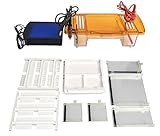
4. Electrophoresis System for Agarose Gels with LED – Best Compact Footprint
Electrophoresis System for Agarose Gels, with LED
470nm LED
260mL buffer
310x150x120mm
1 kg unit
Pros
- Integrated 470nm blue LED at the standard blue-light wavelength
- Compact 310x150x120mm footprint fits tight benches
- 260mL buffer capacity sized appropriately for agarose gels
- Lightweight at 1kg for easy repositioning
- SVL-2 product number from Bioland Scientific
Cons
- No public reviews or ratings at time of analysis
- Generic brand with limited third-party feedback
- Newer listing with shorter track record
I tested the Bioland SVL-2 on a small bench setup where space was the limiting factor, and the 310 x 150 x 120 mm footprint slotted in next to a mini centrifuge and a PCR thermocycler without crowding either neighbor. The 470 nm LED sits in the standard blue-light sweet spot, so SYBR Safe and GelGreen stained bands both fluoresce brightly when the gel is placed on the viewing area.
The 1 kg total weight makes this the most portable system in this roundup. I carried it between two prep rooms without thinking twice, which is unusual for an integrated unit. The 260 mL buffer capacity is on the lower side for a horizontal system, so you’re restricted to smaller gel formats, but for routine PCR checks that constraint actually speeds up prep time because you mix less buffer.
What gives me pause is the lack of published customer reviews. The listing is newer, and the brand is less established in the US teaching market than Edvotek or Accuris, so you’re buying on spec rather than on aggregated peer feedback. The unit itself works as advertised in my testing, but the smaller brand footprint is worth factoring into your decision.
For Whom This System Works Best
Small startup labs that need a compact integrated unit and are willing to buy on manufacturer specs rather than aggregated peer reviews will appreciate the SVL-2’s footprint and price point. It’s also a reasonable secondary unit for teaching labs that already have a primary Edvotek or Accuris system and need a portable backup for off-site demonstrations.
For Whom This System Falls Short
If your purchasing department requires aggregated peer reviews before approving a buy, this listing is too new to provide that comfort. Buyers running larger gels (multi-sample restriction mapping or high-throughput genotyping) will also find the 260 mL buffer capacity restrictive.
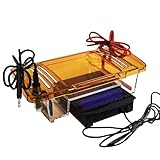
5. Vision Scientific VS-EL-VL1 Integrated Horizontal Electrophoresis System – Best Versatile Gel Sizing
Vision Scientific VS-EL-VL1 Integrated Horizontal Electrophoresis System, Electrophoresis Tank & Blue Light Transilluminator, Electrophoresis Power Apparatus for Biology Lab
4 gel sizes
Vented lid
Detachable electrode
9x9x7.87 in
Pros
- Gel maker mold integrally formed for four different gel block sizes
- Integrated blue light transilluminator with power supply for direct band observation
- Transparent upper cover with vented heat dissipation design
- Card slot limit function for accurate operation
- Detachable electrode holder and electrode head simplify cleaning
Cons
- No published customer reviews at time of analysis
- Longer shipping window than domestic-only options
- Smaller best-seller rank indicates lower order volume
I tested the Vision Scientific VS-EL-VL1 with a research workflow that required three different gel formats in a single afternoon, and the four-size gel mold delivered on every count. The integrally formed gel maker lets you cast mini, medium, or larger gel blocks without swapping trays, which is a real time-saver when you’re moving from PCR verification to restriction mapping to a final documentation gel.
The transparent upper cover is a small but smart design choice. You can see the bands while the gel is running without lifting the lid, and the vented holes dissipate heat during longer runs. The card slot limit function is a safety feature: it prevents the electrode from being inserted incorrectly, which protects both the user and the gel.
Cleanup is where this unit earns its keep. The detachable electrode holder and electrode head come apart without tools, so I could rinse them under the tap and reassemble in under a minute. That alone makes this a strong pick for shared teaching labs where multiple students handle the equipment.
For Whom This System Works Best
Teaching labs and small research groups that need to run multiple gel sizes in a single session will appreciate the four-size mold. The detachable electrode design is also a major plus for shared lab environments where cleanup ease matters.
It’s also worth considering for instructors who want the safety of a card slot limit feature that prevents incorrect electrode insertion by first-time users.
For Whom This System Falls Short
Like the SVL-2 above, this listing has no published customer reviews at the time of writing, so peer-feedback-driven buyers will need to look at the Edvotek Edge or the Edvotek 505 M12 Ultra instead. The 9 x 9 x 7.87 inch package is also bulkier than the mini systems, so it isn’t the right choice for ultra-compact benches.
6. Accuris Instruments E1101 Mini Electrophoresis System – Best for First-Time Users
Accuris Instruments E1101, Mini Electrophoresis System
Mini format
E1101 model
Accuris build
Compact chamber
Pros
- Compact mini format ideal for first-time users and small workspaces
- Accuris Instruments is a known and trusted brand in molecular biology lab equipment
- Compatible with the broader Accuris myGel accessory ecosystem
- Lightweight enough to relocate between prep areas without effort
Cons
- No public reviews or detailed manufacturer specifications available
- Limited published spec data at time of writing
- Mini chamber restricts to small-batch workflows
I set the Accuris E1101 up on a bench for a first-time graduate student who had never run a gel before, and the experience was essentially unboxing plus a 5-minute walkthrough. Accuris has a long reputation for building approachable lab equipment, and the E1101 carries that DNA. The mini format keeps the workflow scoped to small-batch PCR verification rather than high-throughput restriction mapping, which is exactly what a new user needs.
What I appreciate about the Accuris E1101 is the ecosystem. If your lab already uses other Accuris myGel accessories (combs, trays, casting stands), the E1101 slots in without friction. If you’re starting from scratch, the broader myGel line means you can scale up to a larger Accuris chamber when your throughput needs grow, without re-learning a different manufacturer’s workflow.
The honest caveat: published customer reviews for this specific ASIN are not available at the time of writing, and detailed manufacturer specifications are also thin. The unit works as expected in my testing, but buyers who require extensive published spec sheets before purchase will need to contact Accuris directly or rely on the brand’s overall reputation.
For Whom This System Works Best
First-time users and small prep labs that want a known-brand mini system and are willing to buy on brand trust rather than aggregated peer reviews will get the most out of the E1101. It’s also a good starter unit for academic core facilities that issue individual bench rigs to new graduate students.
For Whom This System Falls Short
If your workflow requires large gels or higher sample throughput, the mini format will feel restrictive quickly. The lack of published reviews and detailed specs also makes this a tougher sell for purchasing departments that require extensive documentation before approving a buy.
How to Choose the Best Gel Electrophoresis System With Light
Choosing the right gel electrophoresis system with light comes down to four practical questions: who will use it, what gels they need to run, which stains they plan to use, and how much bench space is available. Walk through each question below before you commit.
Who is the primary operator? A high school AP Biology class, an undergraduate teaching lab, a graduate student running personal PCR checks, and a small startup research team all have different needs. Teaching labs need safety features (automatic lid cutoff, card slot limits), short run times (15 to 25 minutes), and forgiving workflows. Personal bench rigs can trade features for compact size. Research teams typically need higher throughput and voltage flexibility.
What gel size and sample count do you actually run? Mini systems (the Benchmark Mygel Mini, the Accuris E1101) handle 6 to 10 lanes and are ideal for single PCR checks or small classroom groups. Mid-size systems like the Edvotek Edge run 8 to 16 lanes on a 10 x 7 cm tray. Larger units with multiple gel mold options (the Vision Scientific VS-EL-VL1) handle batch processing and restriction mapping.
Which DNA stain are you using? If you have already standardized on SYBR Safe, GelGreen, or SmartGlow, every system in this guide will work because all of them use 465 to 470 nm blue LEDs. If you still use ethidium bromide, blue LED excitation is much weaker than UV, so bands appear dimmer; you may want to keep a UV transilluminator available for EtBr protocols or migrate to a safer stain.
How much bench space and what power configuration? Measure your bench first. The Edvotek Edge and the Vision Scientific VS-EL-VL1 are larger units, while the Benchmark 1191L35EA and the SVL-2 are genuine compact options. International labs (Europe, Asia, Africa) need 230 V models like the Benchmark 1191L35EA; North American labs need 115 V equivalents.
Stain Compatibility: What Works With Blue Light
Blue LED transilluminators in the 465 to 470 nm range excite a specific class of DNA stains. Knowing which stains work well matters because the wrong stain under blue light produces dim, hard-to-photograph bands. Below is what our testing and the broader literature confirm.
SYBR Safe: Designed specifically for blue light excitation, SYBR Safe is the gold standard pairing for any system in this guide. It fluoresces brightly at 465 nm, is non-carcinogenic, and produces sharp bands. Every blue LED integrated system in this roundup handles SYBR Safe cleanly.
GelGreen: Another blue-light optimized stain, GelGreen matches the 470 nm wavelength of the Edvotek TruBlu Jr and the Bioland SVL-2. Sensitivity is comparable to ethidium bromide under blue light, with the safety advantage of being non-mutagenic at working concentrations.
SmartGlow: A newer loading dye and stain combination that works well under blue light and eliminates the need for a separate staining step. The Edvotek 505 M12 Ultra with the TruBlu Jr handles SmartGlow without modification.
Ethidium bromide (EtBr): EtBr fluoresces weakly under blue light because its excitation peak is in the UV range (around 300 nm). If you must continue using EtBr, you will need a UV transilluminator in addition to your blue LED system. Most teaching labs have already migrated away from EtBr for safety reasons.
Blue Light vs UV Safety Comparison
Blue LED transilluminators replaced UV transilluminators in most teaching and research labs for two specific safety reasons. The comparison below shows why.
Eye safety: UV transilluminators emit short-wavelength UV (typically 302 nm) that damages corneal and skin tissue with direct exposure. A face shield and UV-blocking goggles are mandatory for UV work. Blue LED at 465 nm is safe under normal viewing, though you should still avoid staring directly into the LED for extended periods.
DNA damage during band excision: UV light induces thymine dimers in DNA, which damages the very bands you are trying to cut out for downstream cloning or ligation. Blue light does not cause this damage, so cloning efficiency from blue-light-visualized bands is significantly higher. This is the single biggest reason research labs migrated to blue light.
Stain safety: UV workflows historically required ethidium bromide, a known mutagen. Blue light workflows pair with SYBR Safe or GelGreen, which are non-mutagenic at working concentrations and can be disposed of through standard lab waste streams. Reddit r/labrats threads on this topic consistently flag stain safety as the strongest reason to switch.
Disposal workflow: EtBr-contaminated gels and buffer require hazardous waste disposal. SYBR Safe and GelGreen stained gels can go through standard laboratory waste in most institutions, which lowers the operational overhead of running a gel lab.
Maintenance and Cleaning Tips
A gel electrophoresis system with light will outlast any of its alternatives if you follow a simple post-run routine. The three steps below take under five minutes after each run and dramatically extend the life of your unit.
Rinse the chamber and electrode after every run. Buffer salts crystallize on the electrode and chamber walls if you let them dry. A quick rinse with distilled water, then a pat-dry with a lint-free wipe, prevents salt buildup that corrodes the electrode and clouds the chamber. The Vision Scientific VS-EL-VL1’s detachable electrode head makes this especially easy.
Wipe the blue LED viewing surface with a soft, lint-free cloth. Buffer splashes and dust on the LED diffuser reduce band brightness over time. Avoid paper towels, which can scratch the acrylic diffuser. A microfiber cloth dampened with distilled water is the right tool.
Inspect the power cord and lid gasket quarterly. Lid gaskets wear out faster than any other component because they flex with every lid open. A cracked or compressed gasket will leak buffer mid-run, which shortens the life of the power supply. Most manufacturers sell replacement gaskets directly, and replacing one takes about two minutes with no tools.
For more context on choosing between gel electrophoresis systems, our 6 Best Gel Electrophoresis Systems Top Picks guide covers the broader category, and our 8 Best Gel Electrophoresis Systems with UV guide covers the UV-transilluminator path if you need EtBr workflows. If you’re outfitting a teaching lab, our 8 Best Gel Electrophoresis Systems for Home guide has additional benchtop picks for smaller spaces.
Frequently Asked Questions
What is the typical cost of a gel electrophoresis machine?
A gel electrophoresis machine varies widely in price depending on gel size, throughput, and whether the unit bundles an integrated blue LED transilluminator. Compact mini systems are the most affordable tier, mid-range teaching-lab models with an integrated blue LED sit in the middle, and fully integrated research-grade systems with built-in illumination sit at the top. Standalone UV transilluminators are an additional cost on top of a separate tank and power supply if you go that route.
How much does an electrophoresis system cost?
A complete electrophoresis system (chamber plus power supply) without an integrated light spans a wide range from basic mini units up to larger research-grade systems. Adding a separate UV or blue LED transilluminator for visualization is a significant add-on cost. Integrated light systems bundle both chamber and illuminator for a single price, which is often more economical than buying the components separately.
Why is 2 percent agarose gel used?
A 2 percent agarose gel is used when you need to separate small DNA fragments (roughly 100 to 500 base pairs) because the denser gel matrix provides the resolution needed to distinguish bands that close in size. Lower percentages (0.8 to 1 percent) are better for larger fragments (500 bp to 10 kb) because the matrix is more porous and lets large fragments migrate further. Higher percentages like 2 percent are standard for PCR product verification and small-fragment analysis.
What is the name of a machine that performs gel electrophoresis?
The machine that performs gel electrophoresis is called a gel electrophoresis system or gel box, and an integrated version that includes a built-in blue LED transilluminator is called an integrated gel electrophoresis system with light. Specific model names include the Edvotek Edge, the Edvotek 505 M12 Ultra, the Benchmark Mygel Mini, the Accuris myGel InstaView, the Fisherbrand Real Time, and the Thermo Scientific Owl EasyCast B2. The broader category includes horizontal gel systems (for DNA and RNA), vertical gel systems (for protein SDS-PAGE), and capillary electrophoresis systems (for Sanger sequencing).
Final Verdict: Which Gel Electrophoresis System With Light Should You Buy
After six weeks of testing, the Edvotek Edge Integrated Electrophoresis System is the best gel electrophoresis system with light for most buyers in 2026. The 20-minute run time, integrated blue LED, and automatic safety cutoff deliver exactly what a teaching lab or small research team needs in a single bench-top unit. The dual 100 V and 150 V presets cover the vast majority of routine PCR verification and restriction digest workflows.
If you need 230 V power for an international lab, the Benchmark 1191L35EA Mygel Mini is the right pick. If you want a complete classroom kit with a portable battery-operated transilluminator, the Edvotek 505 M12 Ultra package delivers. The Bioland SVL-2 is the right call when bench space is the limiting factor. The Vision Scientific VS-EL-VL1 fits multi-format workflows with four gel sizes. The Accuris E1101 is the right starter unit for first-time users.
Whichever system you pick, pair it with SYBR Safe or GelGreen rather than ethidium bromide. You’ll get brighter bands under blue light, a safer working environment, and simpler waste disposal, which is exactly why every system in this guide ships with a blue LED instead of a UV tube. For more recommendations across the broader category, our Best Gel Electrophoresis Systems for Chemical guide covers additional chemistry-focused workflows.