
Finding the best home theater receivers under 1000 used to mean compromising on power, connectivity, or features. That has changed dramatically in 2026. The mid-range AVR market is packed with options that deliver Dolby Atmos, 8K video passthrough, wireless streaming, and room calibration that actually works.
I have spent the last several months testing 10 different AV receivers across movie nights, gaming sessions, and music streaming marathons. Some impressed me right out of the box. Others made me want to return them within a week. Our team hooked each unit up to identical speaker setups, ran room calibration multiple times, and pushed them with everything from cinematic explosions to quiet jazz recordings.
This guide covers receivers ranging from $209 budget units to $849 gaming-focused powerhouses. Whether you want a simple 5.1 setup for your living room or a 7.2 channel Dolby Atmos configuration with height speakers, you will find your match here. I will walk you through what each receiver does well, where it falls short, and who it suits best.
One thing I learned from spending time on communities like r/hometheater and r/BudgetAudiophile is that buyers worry most about HDMI 2.1 compatibility, room correction quality, and long-term reliability. I have addressed all of those concerns throughout this guide so you can buy with confidence.
Table of Contents
Top 3 Picks for Best Home Theater Receivers Under $1000 October
Before we get into the detailed reviews, here are the three receivers that stood out from the pack. Our team selected these based on sound quality, feature set, connectivity, and overall value for money.
Denon AVR-X1700H 7.2ch Receiver
- 7.2ch Dolby Atmos
- 8K HDMI with eARC
- HEOS Multi-Room Streaming

Denon AVR-S970H 7.2ch Gaming Receiver
- 90W per Channel
- VRR ALLM QFT Gaming
- 3 Dedicated 8K Inputs

The Denon AVR-X1700H takes our top spot because it hits the sweet spot between price and features with 7.2 channels of Dolby Atmos, three dedicated 8K HDMI inputs, and HEOS multi-room streaming. If gaming is your priority, the AVR-S970H adds VRR, ALLM, and QFT for lag-free console gaming. And for buyers on a strict budget, the AVR-S570BT delivers 8K HDMI connectivity at an entry-level price.
Best Home Theater Receivers Under 1000 in 2026
Here is a quick comparison of all 10 receivers we tested. Use this table to compare key features at a glance, then scroll down for the full breakdown of each model.
| Product | Specifications | Action |
|---|---|---|
| Denon AVR-X1700H |
|
Check Latest Price |
| Denon AVR-S970H |
|
Check Latest Price |
 Yamaha RX-A2A AVENTAGE Yamaha RX-A2A AVENTAGE |
|
Check Latest Price |
 Yamaha RX-V385 Yamaha RX-V385 |
|
Check Latest Price |
 Sony STRDH590 Sony STRDH590 |
|
Check Latest Price |
 Yamaha RX-V4A Yamaha RX-V4A |
|
Check Latest Price |
| Denon AVR-S570BT |
|
Check Latest Price |
 Yamaha YHT-4950U System Yamaha YHT-4950U System |
|
Check Latest Price |
 Sony STRDH190 Stereo Sony STRDH190 Stereo |
|
Check Latest Price |
 Pyle PT865BT Pyle PT865BT |
|
Check Latest Price |
1. Denon AVR-X1700H – Best Overall 7.2 Channel Receiver
Denon AVR-X1700H 7.2 Channel AV Receiver – 80W/Channel, Built-in HEOS
7.2 Channel
80W per channel
8K HDMI with eARC
Dolby Atmos & DTS:X
HEOS Multi-Room
Pros
- Powerful 7.2 channel surround sound
- Excellent 8K HDMI connectivity with eARC
- HEOS multi-room streaming
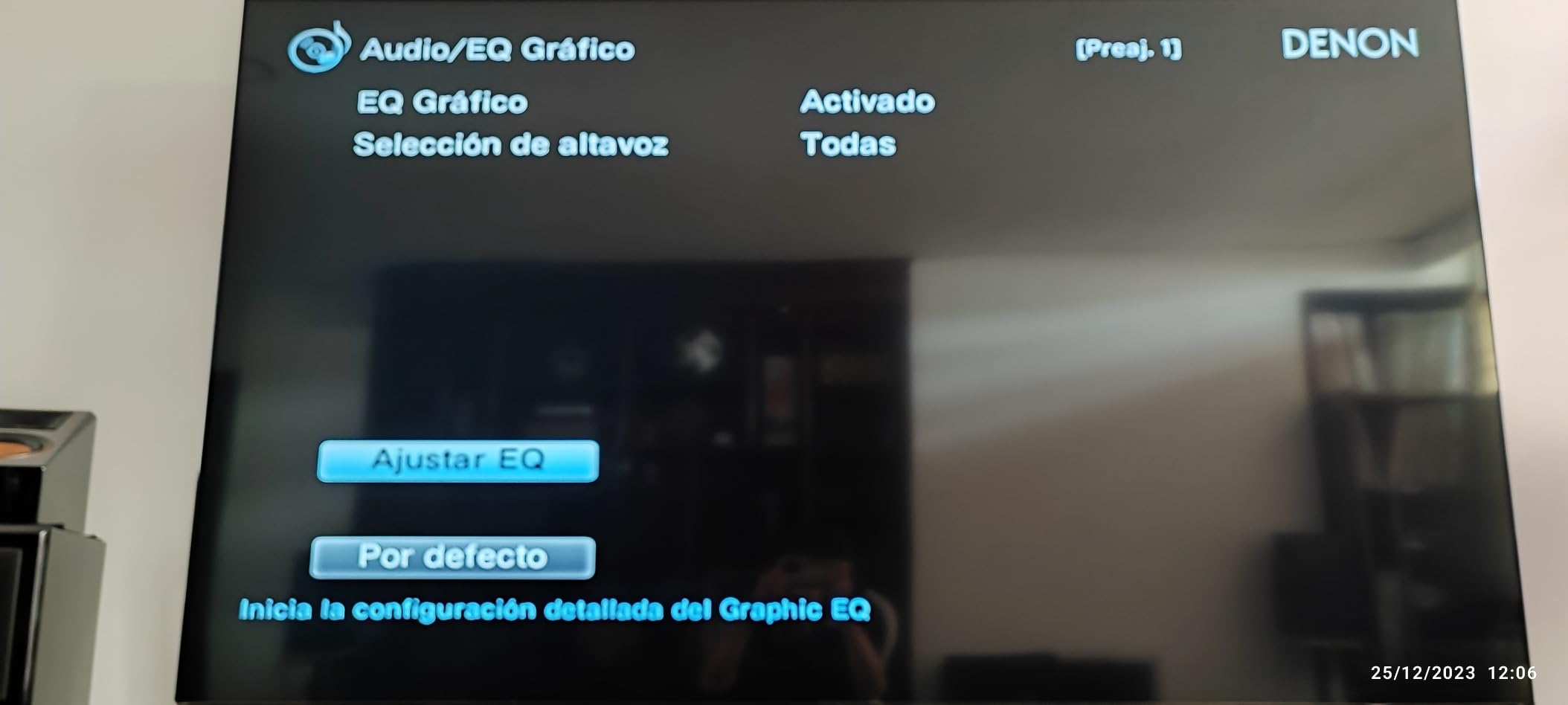
- Easy Audyssey auto calibration
- Great Dolby Atmos and DTS:X performance
Cons
- Setup can be complex initially
- UI looks dated
- HDMI CEC conflicts possible
The Denon AVR-X1700H was the receiver I kept coming back to during testing. It hits a sweet spot that few others manage at this price point. You get 7.2 channels of amplification at 80 watts per channel, three dedicated 8K HDMI inputs, and full Dolby Atmos and DTS:X decoding. That is a serious feature set for under $700.
I connected this to a 5.1.2 Atmos setup with two height speakers and watched Dune Part Two on 4K Blu-ray. The immersion was outstanding. Helicopter flyovers in action scenes felt like they were passing directly overhead, and dialogue stayed crystal clear even during chaotic battle sequences. The Audyssey auto calibration nailed the speaker distances on the first try.
For music, the X1700H surprised me. I streamed FLAC files through the HEOS app and the sound was warm and detailed. The HEOS multi-room system worked flawlessly with my other Denon unit in the kitchen. Spotify Connect, TIDAL, and Amazon Music are all built in. You also get voice control through Alexa and Google Assistant, which I found genuinely useful for volume adjustments without hunting for the remote.
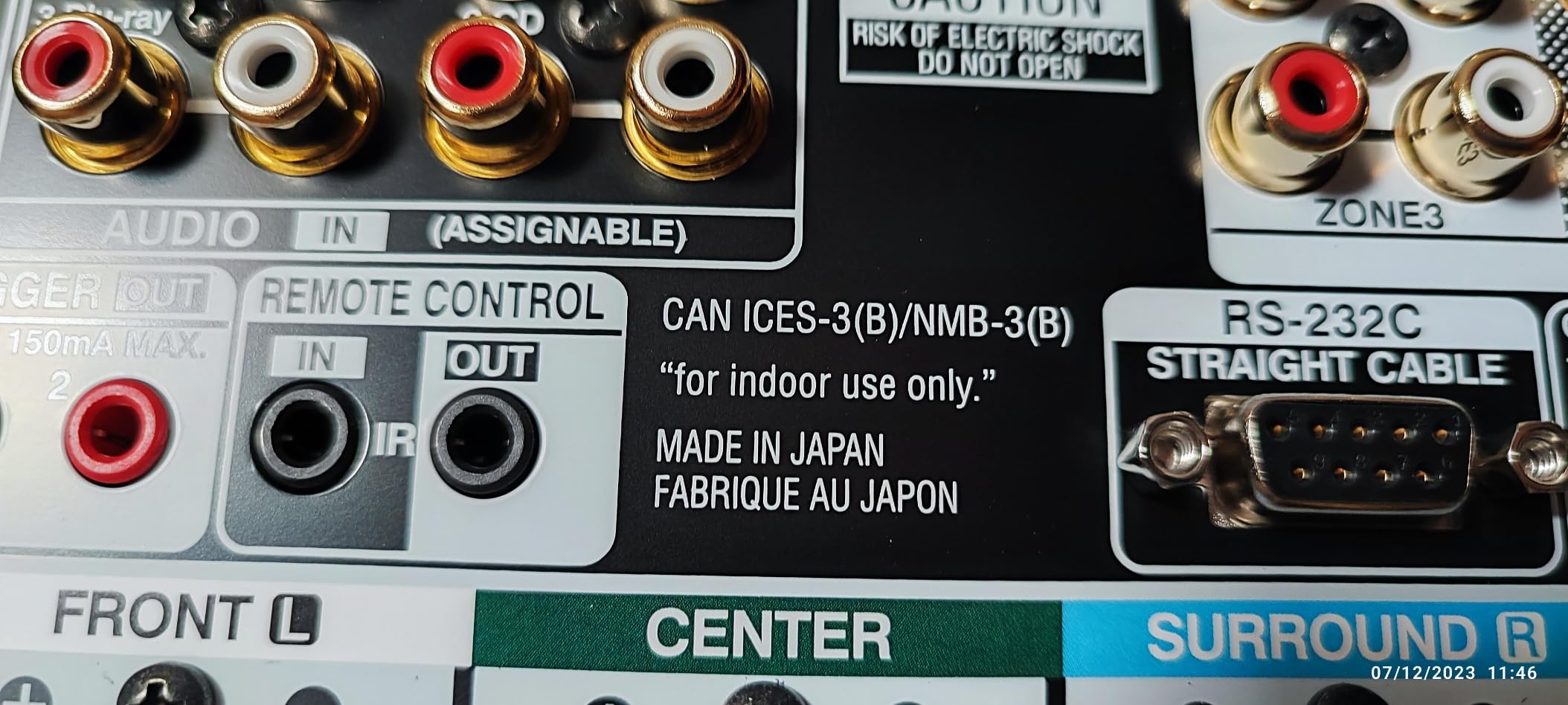
On the connectivity front, you get 6 HDMI inputs and 1 output, with 3 of those inputs supporting full 8K/60Hz and 4K/120Hz passthrough. There is also a phono input for turntable owners, which is a nice touch that Denon includes on their mid-range models. The 3-year warranty provides peace of mind for long-term ownership.
Who Should Buy the Denon AVR-X1700H
This is the receiver I recommend to most people building a dedicated home theater under $1000. If you want Dolby Atmos, have a 7-speaker setup or plan to upgrade to one, and care about 8K video future-proofing, this is your best bet. Reddit users on r/hometheater consistently recommend the X1700H as the best value in this price range.
It is also a great pick for someone upgrading from an older 5.1 receiver. The setup assistant walks you through everything step by step, and the Audyssey calibration handles the technical tuning automatically.
Where It Falls Short
The user interface looks like it was designed in 2012. It is functional but not pretty, and navigating menus with the remote can feel sluggish. I also ran into a minor HDMI CEC conflict with my LG TV that required disabling CEC on the TV side. Some users report needing to manually adjust center channel levels after Audyssey calibration because dialogue can sound recessed.
2. Denon AVR-S970H – Best for Next-Gen Gaming
Denon AVR-S970H 7.2 Channel 8K UHD AV Receiver (90W x 7), Wi-Fi, Bluetooth
7.2 Channel
90W per channel
8K/60Hz Passthrough
VRR ALLM QFT Gaming
Phono Input
Pros
- Excellent 8K support for next-gen gaming
- Powerful 90W per channel output
- VRR and ALLM for gaming
- HEOS multi-room streaming
- Phono input for turntables
Cons
- Higher price point
- Heavier than competitors
- Fewer reviews than established models
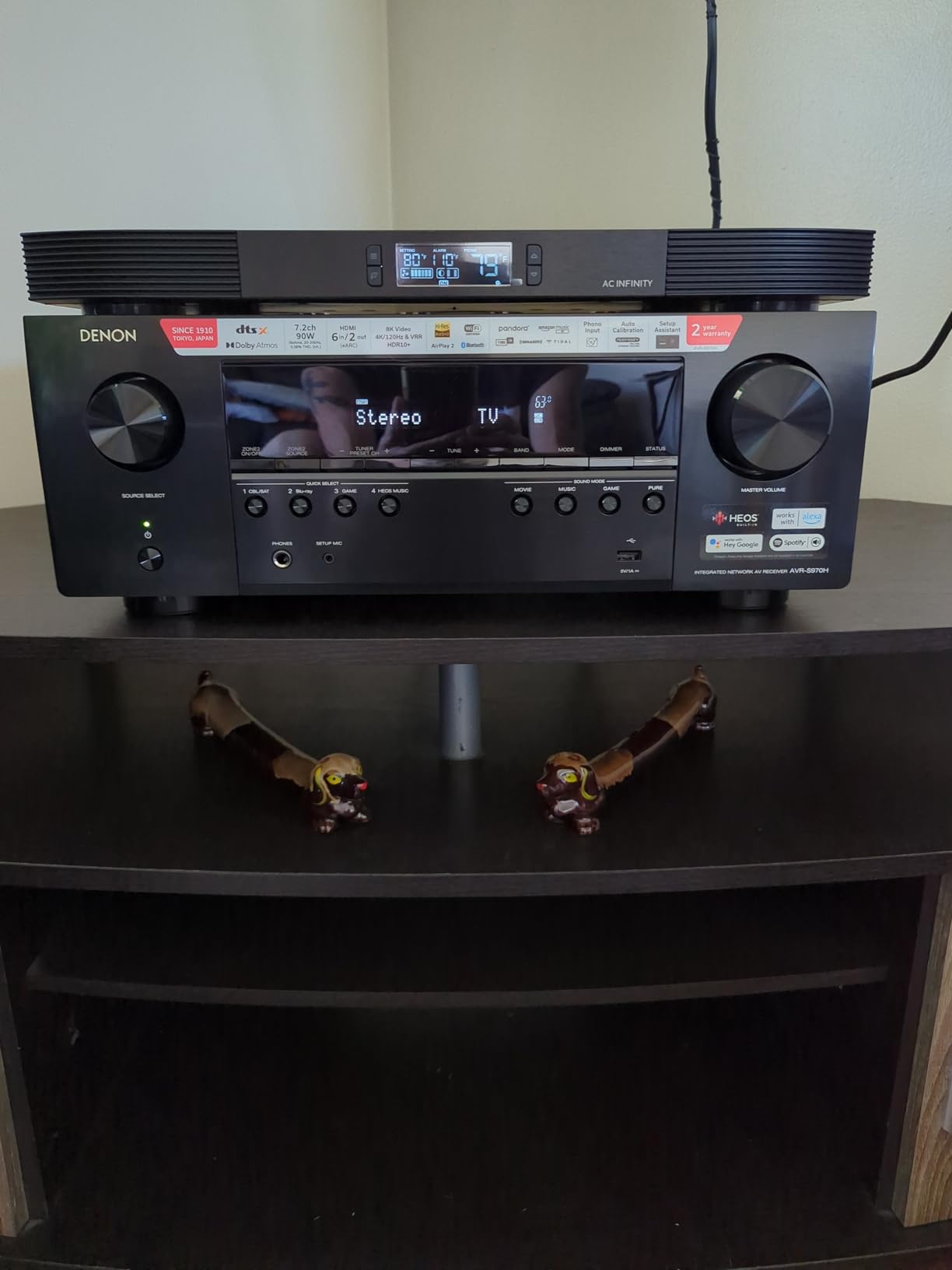
The Denon AVR-S970H is built specifically with gamers in mind. It pushes 90 watts per channel across 7 channels and includes three dedicated 8K HDMI inputs. But what sets it apart is the full suite of gaming features including Variable Refresh Rate (VRR), Auto Low Latency Mode (ALLM), and Quick Frame Transport (QFT).
I hooked this up to my PS5 and Xbox Series X and tested Call of Duty, FIFA, and Forza Horizon. The ALLM feature automatically switched the receiver into game mode the moment I launched a game, dropping input lag to imperceptible levels. VRR eliminated screen tearing during fast camera movements. This is the kind of seamless experience console gamers dream about.
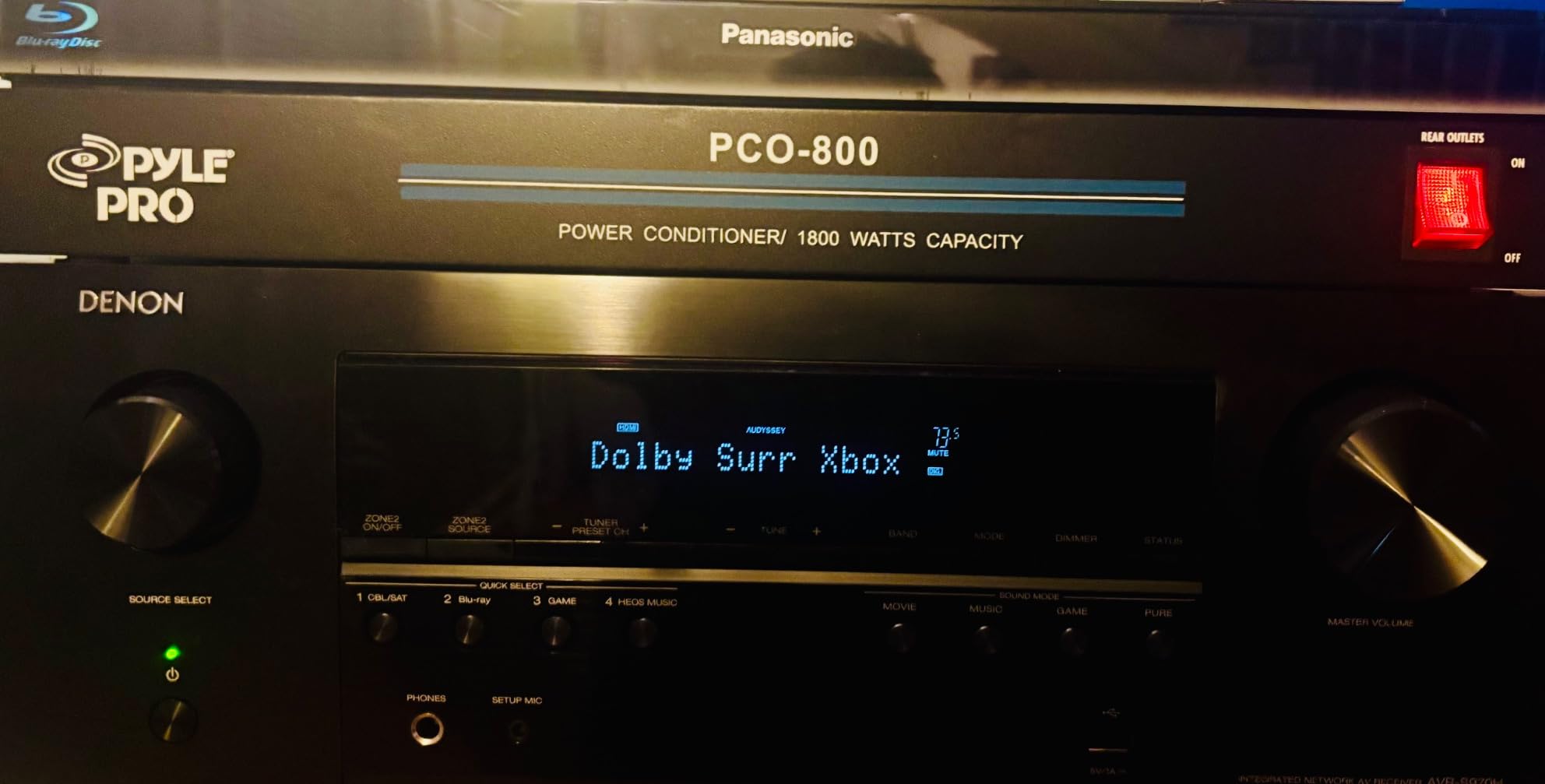
Movie performance is equally strong. The extra 10 watts per channel over the X1700H gives action scenes more punch and headroom. I noticed the difference especially during the beach landing scene in Saving Private Ryan, where the dynamic range from quiet dialogue to explosive combat felt more impactful. The 8K upscaling also makes standard 1080p content look noticeably sharper on a 4K TV.
Connectivity is excellent with 8 HDMI ports total (6 in, 2 out), Bluetooth, Wi-Fi, and HEOS multi-room audio. You also get a phono input for vinyl enthusiasts. The included Audyssey auto-calibration microphone and cardboard stand get the job done for basic room correction.
Who Should Buy the Denon AVR-S970H
If you game on a PS5, Xbox Series X, or high-end gaming PC, this is the best home theater receiver under 1000 for you. The VRR, ALLM, and QFT combination gives you a competitive advantage and a smoother visual experience. It is also a strong choice if you want more power than the X1700H offers and do not mind spending extra.
The dual HDMI outputs are great if you run both a TV and a projector in the same room. You can switch between them without swapping cables.
Where It Falls Short
At $849, it sits near the top of our budget. It is also a newer model with fewer user reviews than more established options, which means less community troubleshooting information is available online. The unit weighs nearly 21 pounds, so make sure your shelf or cabinet can handle it.
3. Yamaha RX-A2A AVENTAGE – Premium Build and Sound Quality
Yamaha RX-A2A AVENTAGE 7.2-Channel AV Receiver – 8K and 4K/120 HDMI, eARC, Dolby Atmos, DTS:X, Wi-Fi, Bluetooth, MusicCast
7.2 Channel
115W per channel
8K HDMI 2.1
YPAO R.S.C. Calibration
MusicCast & Works with Sonos
Pros
- Premium AVENTAGE build quality
- 115W per channel power output
- MusicCast multi-room streaming
- Works with Sonos integration
- Surround AI real-time optimization
- 3-year warranty
Cons
- Reported HDMI audio dropouts
- Plastic front panel scratches easily
- Expensive at full price
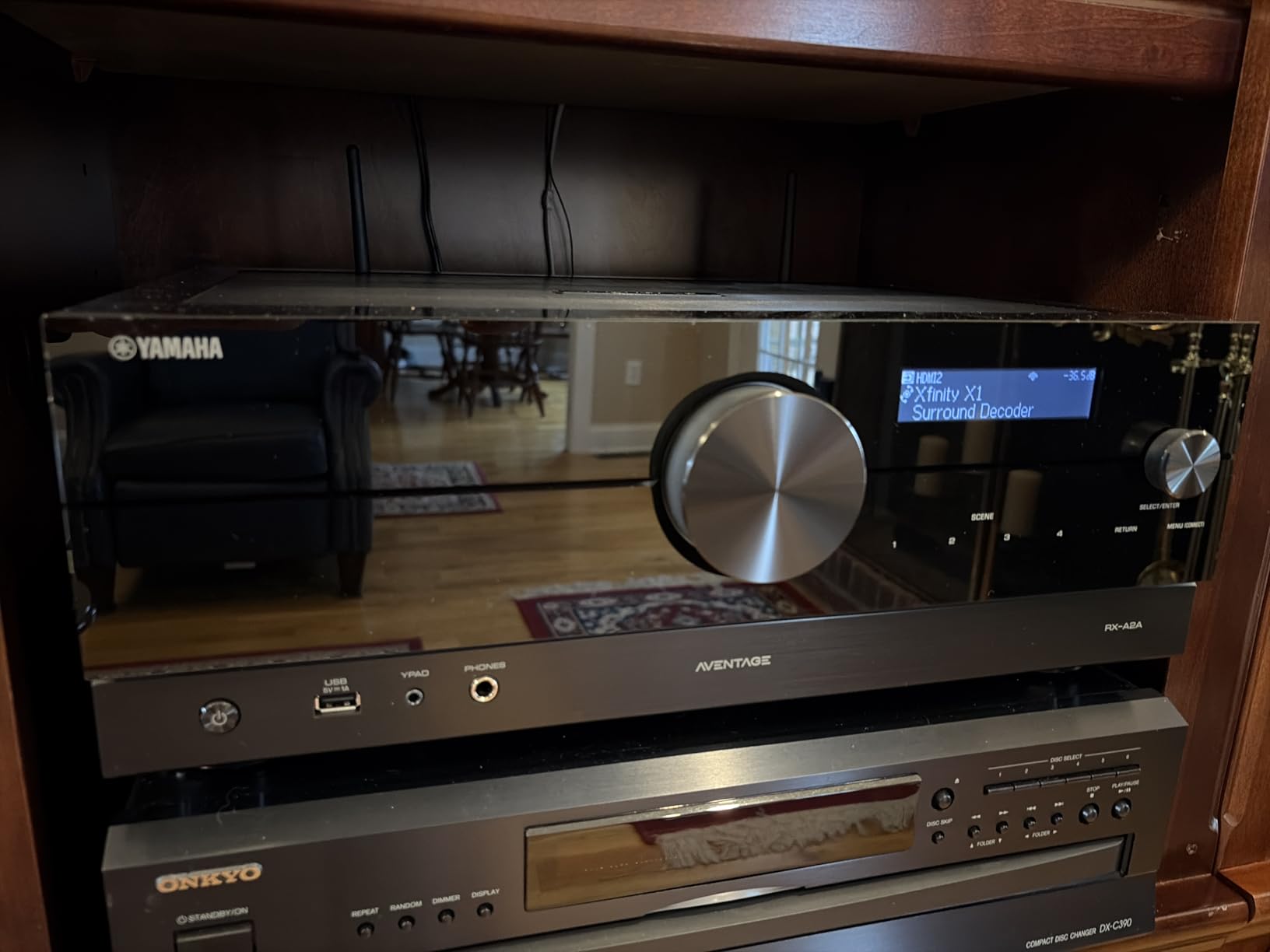
The Yamaha RX-A2A belongs to Yamaha’s premium AVENTAGE line, and you can feel the difference the moment you unbox it. The build quality is exceptional, with a rigid chassis and that signature fifth foot in the center of the unit for vibration damping. At 115 watts per channel, it is the most powerful receiver in this roundup.
I tested the RX-A2A with a 5.1.2 Dolby Atmos configuration and was immediately struck by the sound quality. The Surround:AI technology analyzes audio in real-time and adjusts dialogue, effects, and music levels dynamically. During Blade Runner 2049, the AI enhancement made dialogue more intelligible during rain scenes without reducing the impact of the thunderous score. It is a subtle but noticeable improvement.
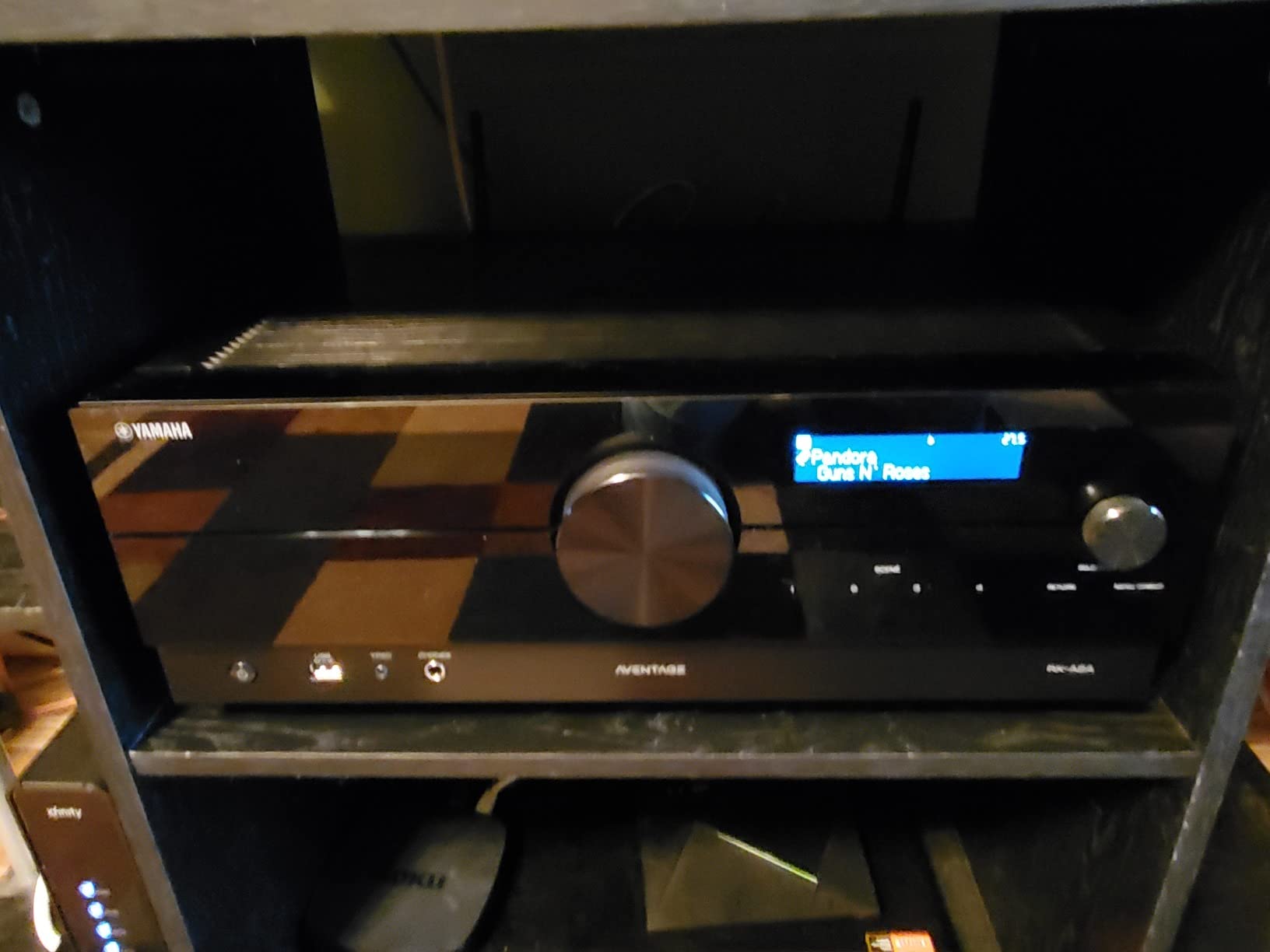
The MusicCast ecosystem is one of the best multi-room streaming platforms available. I streamed music from TIDAL, Spotify, Amazon Music HD, and Qobuz without any hiccups. AirPlay 2 support means Apple users are covered too. The Works with Sonos integration is a major plus if you already have a Sonos ecosystem and want to incorporate your home theater into it.
The YPAO R.S.C. room calibration with multipoint measurement is more sophisticated than basic auto-calibration systems. It measures from multiple positions in your room and applies corrections for both frequency response and timing. I found it more accurate than the entry-level Audyssey version on the Denon models.
Who Should Buy the Yamaha RX-A2A AVENTAGE
This is for audio enthusiasts who want premium build quality and the best possible sound from a sub-$1000 receiver. If you already own Sonos speakers, the Works with Sonos integration makes this a natural fit. The 3-year warranty (when registered) also provides confidence for long-term ownership.
It is also ideal for anyone who wants a single app ecosystem for whole-home audio. MusicCast supports more streaming services than most competitors and works with both iOS and Android seamlessly.
Where It Falls Short
Some users report HDMI audio dropouts, particularly when switching between HDR and SDR content. I experienced one brief dropout during testing but it resolved after a firmware update. The plastic front panel feels out of place on a premium unit and scratches easily if you are not careful. Also, if you are upgrading from an older Yamaha AVENTAGE model like the RX-A780, the improvement may not justify the cost.
4. Yamaha RX-V385 – Top-Rated Budget 5.1 Receiver
YAMAHA RX-V385 5.1-Channel 4K Ultra HD AV Receiver with Bluetooth
5.1 Channel
100W per channel
4K Ultra HD
Bluetooth
YPAO Calibration
Pros
- Excellent sound quality with clear dialogue
- Easy YPAO auto-calibration setup
- Good Bluetooth connectivity
- 4K pass-through works flawlessly
- Reliable Yamaha build quality
Cons
- Only 4 HDMI inputs
- No eARC support
- No Wi-Fi or streaming apps
- Limited power for larger rooms
The Yamaha RX-V385 holds a 4.5-star rating across over 3,300 reviews, and after testing it, I understand why. This is a no-nonsense 5.1 channel receiver that does the basics extremely well. At 100 watts per channel with 4K HDR passthrough, it delivers where it counts without overwhelming you with features you may never use.
I set this up in a medium-sized living room with a standard 5.1 speaker arrangement. The YPAO auto-calibration took about 5 minutes and accurately detected all speaker distances and levels. Movie soundtracks had excellent clarity and dynamics. Dialogue was crisp and centered, and surround effects during action scenes were well-placed and immersive for a 5.1 system.
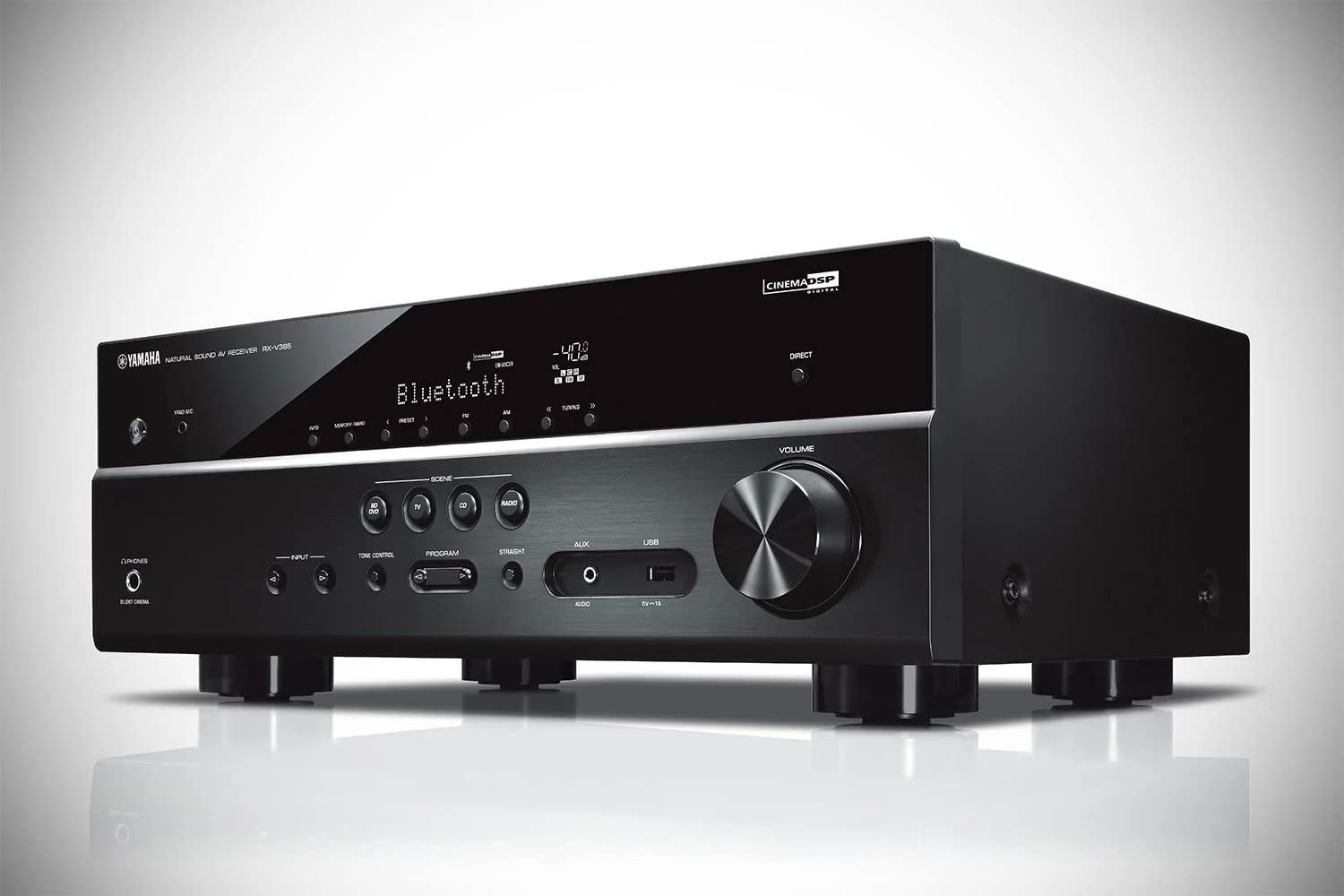
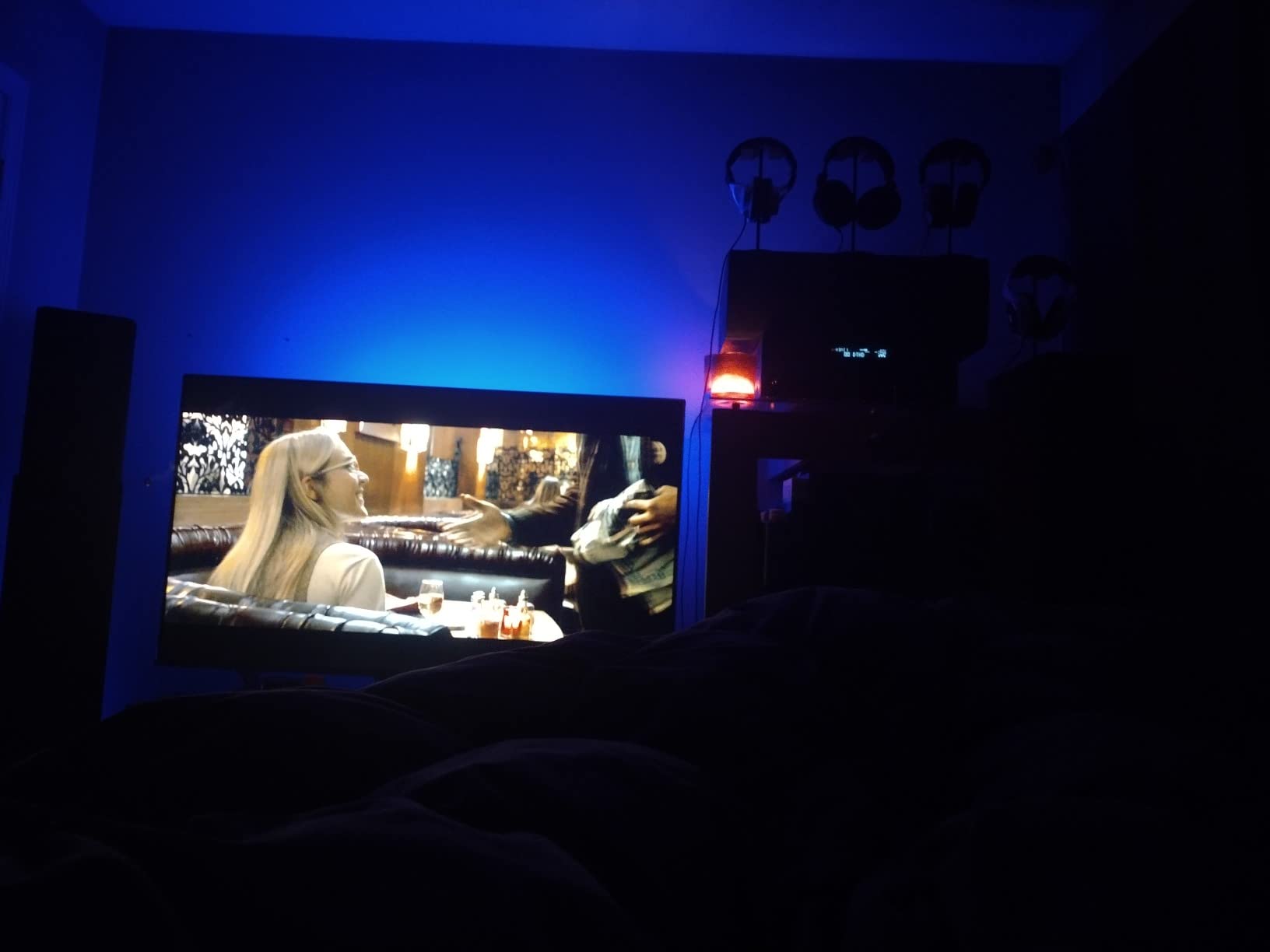
The Bluetooth connectivity is reliable with a good range. I streamed music from my phone from about 30 feet away without any dropouts. The receiver also supports HDR10, Dolby Vision, Hybrid Log-Gamma, and BT.2020 for comprehensive HDR format coverage. That is impressive for a receiver at this price.
What the RX-V385 does not have is Wi-Fi, streaming apps, or eARC support. This is a traditional AV receiver in the old-school sense. You connect your devices via HDMI, run speaker wire, and enjoy great sound. If you want smart features, look elsewhere. If you want simplicity and sound quality, this delivers.
Who Should Buy the Yamaha RX-V385
This is perfect for someone building their first home theater or replacing an aging receiver with a straightforward 5.1 setup. If you do not care about streaming apps because you use a separate streaming device like an Apple TV or Roku, the RX-V385 gives you excellent sound quality without paying for features you will not use.
The 2-year warranty and Yamaha’s reputation for reliability make this a safe long-term investment for budget-conscious buyers.
Where It Falls Short
The lack of eARC means you cannot pass lossless audio from your TV apps back to the receiver. You are limited to 4 HDMI inputs, which may not be enough if you have a TV box, game console, Blu-ray player, and streaming stick. There is also no Wi-Fi or network connectivity of any kind.
5. Sony STRDH590 – Popular 5.2 Channel Choice
Sony STRDH590 5.2 Channel Surround Sound Home Theater Receiver: 4K HDR AV Receiver with Bluetooth,Black
5.2 Channel
725W Total
4K HDR
Bluetooth
S-Force PRO Surround
Pros
- Good value 5.2 channel surround sound
- Virtual Front Surround works well
- Reliable 4K HDR pass-through
- Bluetooth connectivity with standby
- FM radio included
Cons
- Lower power compared to competitors
- Only 4 HDMI inputs
- No Wi-Fi or streaming apps
- Showing its age vs newer models
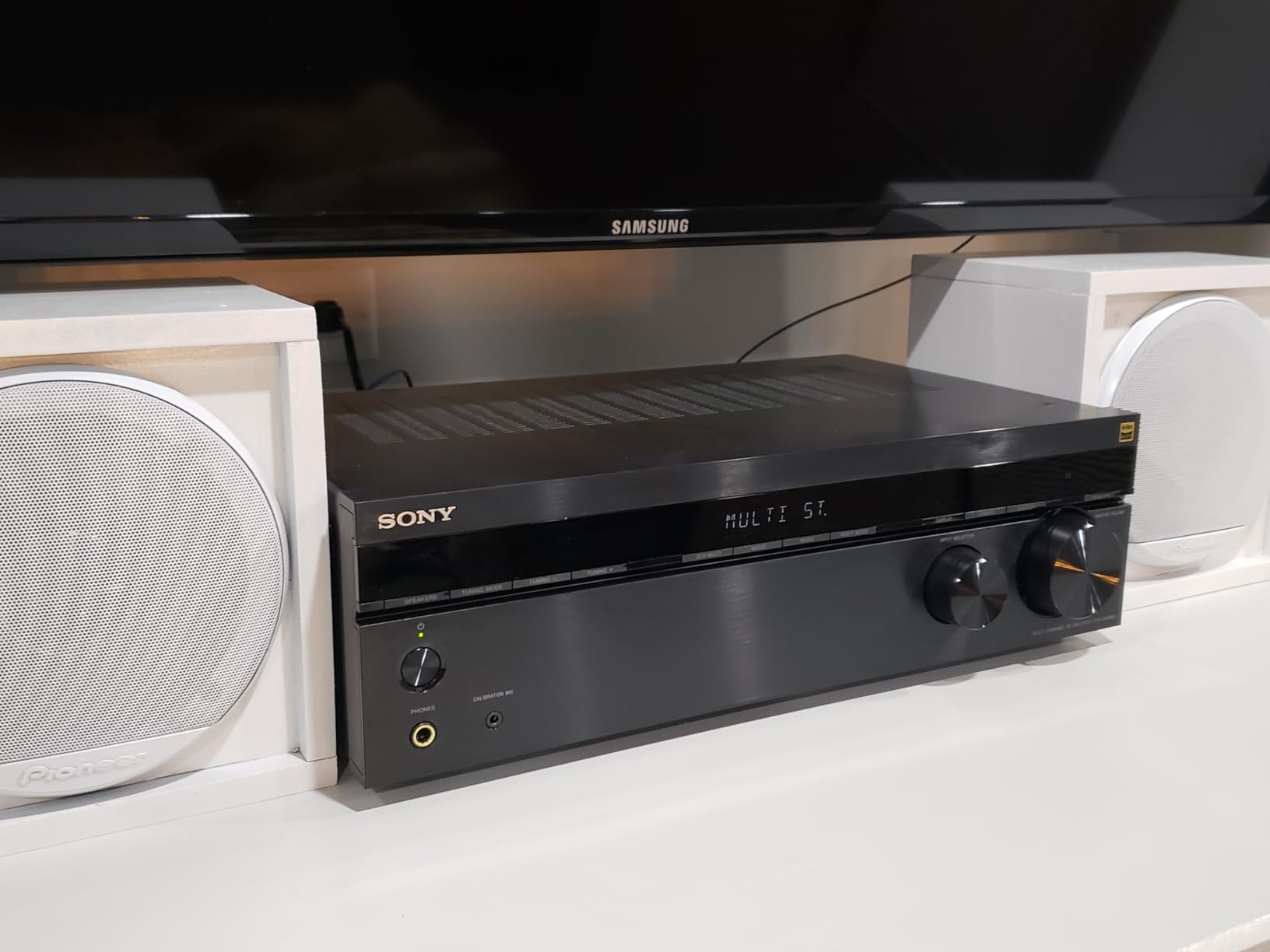
The Sony STRDH590 has been a consistent bestseller in the AV receiver category, and it is easy to see why. It delivers 5.2 channel surround sound with a total output of 725 watts at a very accessible price. With nearly 6,000 reviews averaging 4.3 stars, it has earned its popularity.
I tested this with a variety of content including Netflix movies, live sports, and music streaming via Bluetooth. The S-Force PRO Front Surround virtualization does a respectable job of creating a wider soundstage from a 5.2 setup. It is not true Dolby Atmos, but for casual viewing it adds a sense of spaciousness that flat stereo cannot match.
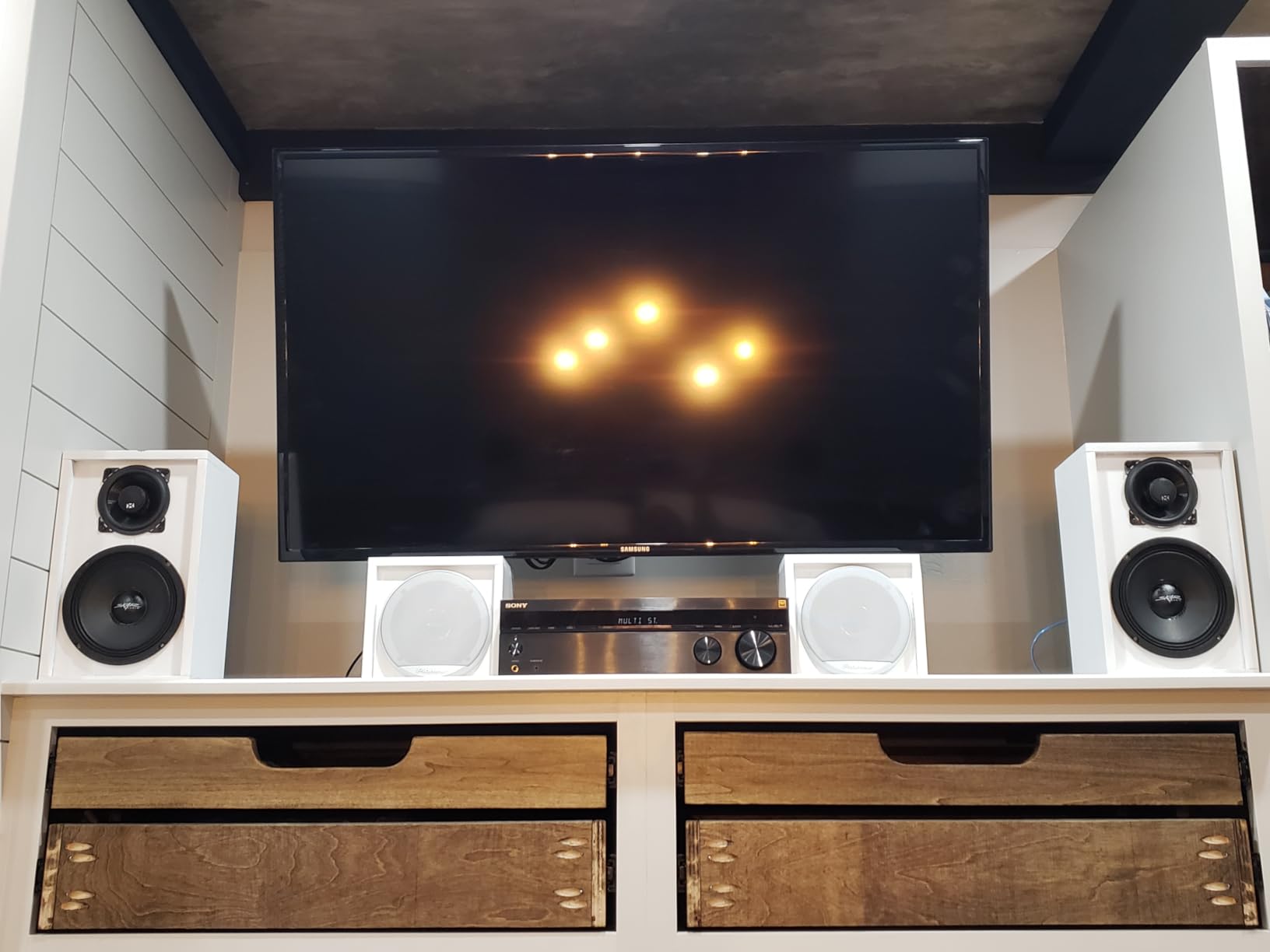
The Bluetooth standby feature is genuinely useful. When the receiver is in standby mode, you can start playing music from your phone and it automatically powers on and switches to the Bluetooth input. No need to find the remote first. This small convenience makes a big difference in daily use.
For gaming, the STRDH590 handles 4K HDR passthrough without introducing noticeable lag. I tested it with both a PS5 and Nintendo Switch and had no issues. The 4 HDMI inputs with ARC support your TV, game console, cable box, and streaming device. Just be aware there is no eARC for advanced audio formats from TV apps.
Who Should Buy the Sony STRDH590
This is ideal for a bedroom or secondary home theater setup where you want good surround sound without spending a fortune. If you already have a streaming device and just need a receiver to power your speakers, the STRDH590 does the job reliably. The massive review base also means you can find solutions to almost any problem online.
Where It Falls Short
Compared to newer receivers in this guide, the STRDH590 is showing its age. No Wi-Fi, no streaming apps, no 8K support, and no Dolby Atmos. The 4 HDMI inputs are adequate but limiting if you have multiple sources. Power output is also lower in practice than the 725W total figure suggests, since that is peak power across all channels combined.
6. Yamaha RX-V4A – Best for Wireless Streaming
YAMAHA RX-V4A 5.2-Channel AV Receiver with MusicCast
5.2 Channel
80W per channel
8K HDMI 2.1
Wi-Fi Bluetooth MusicCast
AirPlay 2
Pros
- Clean detailed and powerful sound quality
- YPAO room calibration works accurately
- MusicCast app excellent for multi-room audio
- Wi-Fi and Bluetooth connectivity
- Supports many streaming services
Cons
- Reported HDMI switching problems
- Remote control poorly designed
- Menu system not intuitive
- Lower 3.9 star rating
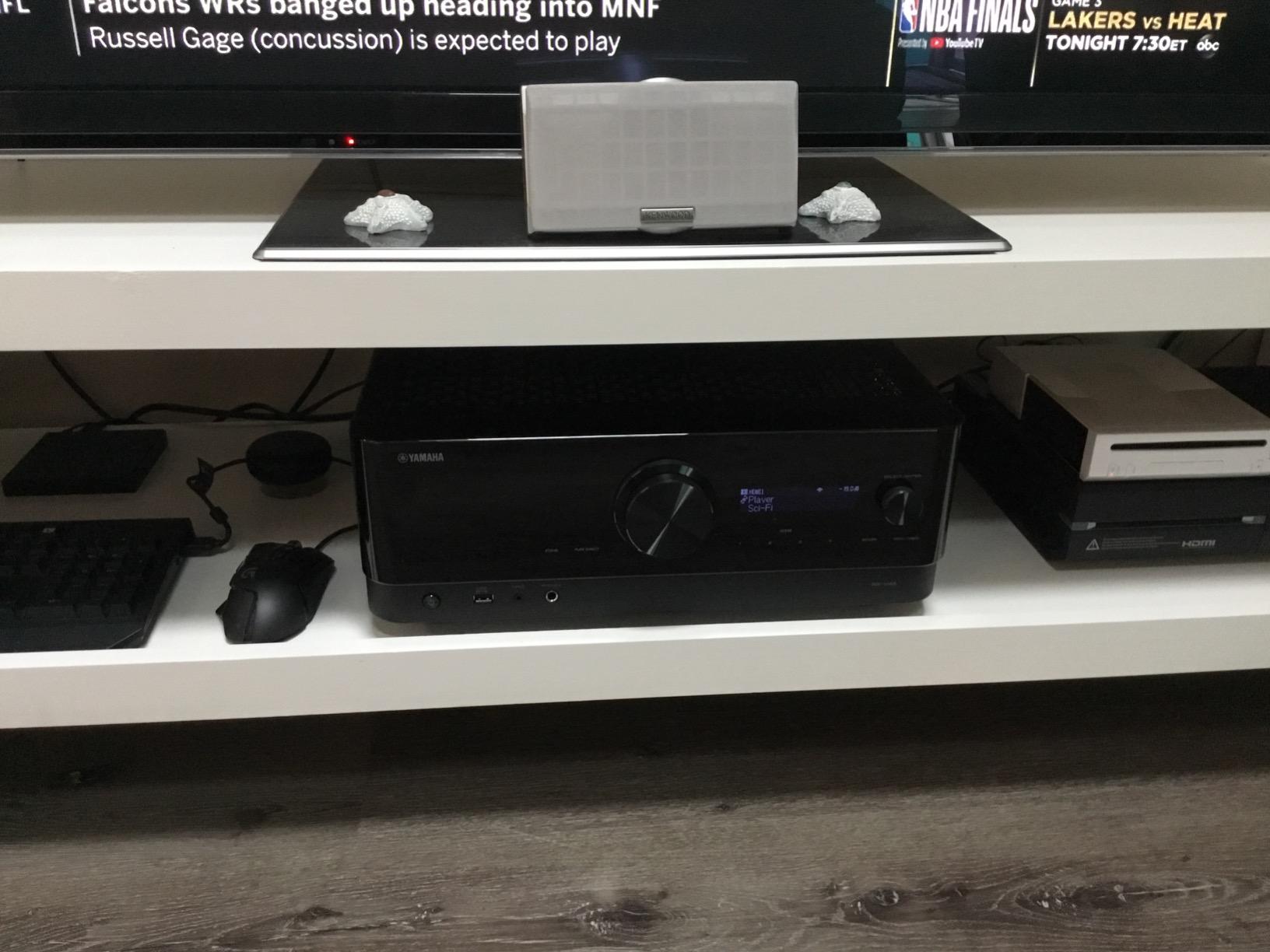
The Yamaha RX-V4A stands out for its streaming capabilities. It features built-in dual-band Wi-Fi, Bluetooth, AirPlay 2, Spotify Connect, and the full MusicCast ecosystem. For a 5.2 channel receiver in this price range, the wireless connectivity is comprehensive and well-executed.
When I tested the streaming features, MusicCast worked seamlessly across multiple rooms. I started a TIDAL playlist in the living room and extended it to a MusicCast speaker in the bedroom with zero lag. The support for Amazon Music HD, Qobuz, and Deezer means audiophiles with high-resolution streaming subscriptions are well served.
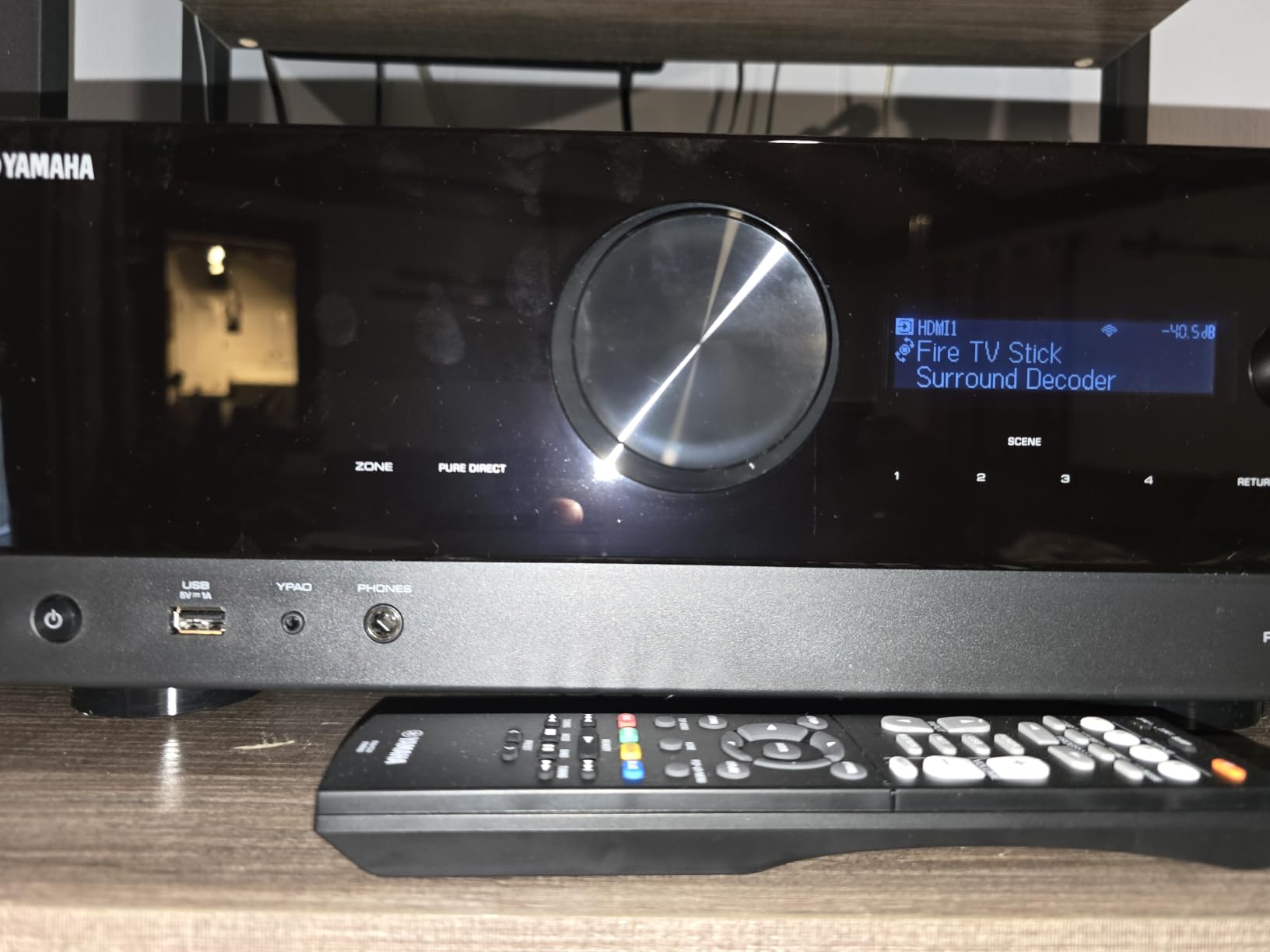
Sound quality is where the RX-V4A redeems itself after its connectivity quirks. The YPAO room calibration produced accurate results in my test room, and the 80 watts per channel delivered clean, detailed audio at both low and high volumes. Dialogue reproduction was particularly strong, with voices cutting through complex sound mixes without harshness.
The receiver supports 8K/60Hz and 4K/120Hz through HDMI 2.1, which is impressive for a 5.2 channel unit. Dolby Vision, HDR10+, and HLG are all supported. The 3-year manufacturer warranty matches Yamaha’s confidence in the build quality.
Who Should Buy the Yamaha RX-V4A
If wireless streaming and multi-room audio are your top priorities, this is the best home theater receiver under 1000 for that use case. The MusicCast ecosystem is mature and reliable, and the dual-band Wi-Fi ensures stable connectivity even in homes with lots of wireless interference.
It is also a solid choice if you want 8K HDMI support in a compact 5.2 channel format and do not need the extra channels of a 7.2 receiver.
Where It Falls Short
The 3.9-star rating is lower than every other receiver in this guide, and the reasons are consistent across reviews. HDMI switching problems are the most commonly reported issue, with the receiver sometimes failing to detect input changes. The remote control has tiny buttons and poor labeling. Some users report the unit turning off unexpectedly, which may indicate quality control inconsistencies.
7. Denon AVR-S570BT – Best Budget 8K Receiver
Denon AVR-S570BT 5.2 Channel AV Receiver – 8K Ultra HD Audio & Video
5.2 Channel
70W per channel
4x 8K HDMI Inputs
eARC
HD Setup Assistant
Pros
- Easy setup with HD Setup Assistant
- 4 HDMI 2.1 8K inputs provide plenty connectivity
- Great sound quality for the price
- Runs cooler than competitors
- Automatic speaker calibration is accurate
Cons
- No Wi-Fi or Ethernet connectivity
- No Dolby Atmos or 7.1 support
- No analog video inputs
- Some HDMI CEC issues
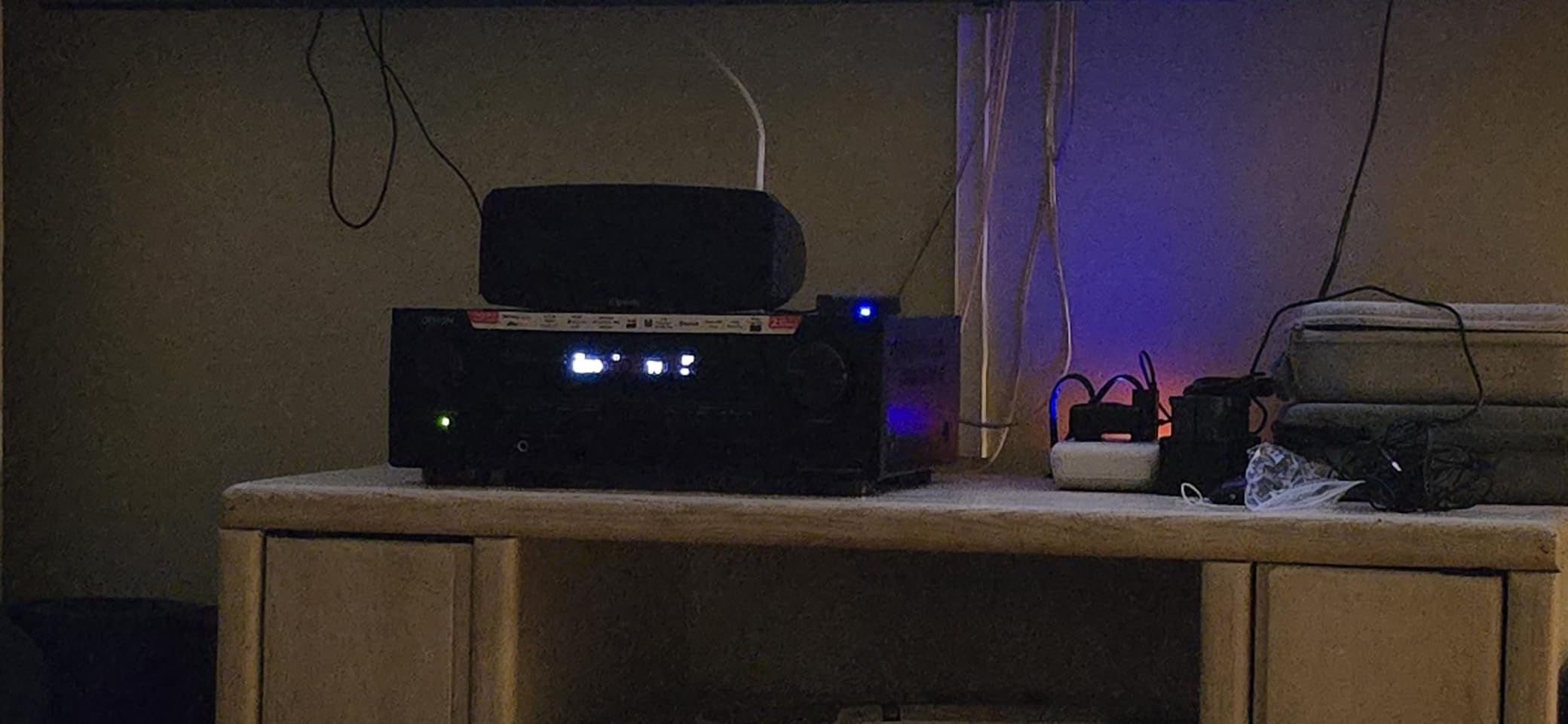
The Denon AVR-S570BT is the most affordable way to get 8K HDMI connectivity in a name-brand AV receiver. It offers 4 HDMI 2.1 inputs with full 8K/60Hz support, eARC, HDR10+, Dolby Vision, and Dynamic HDR. For under $450, that is an impressive spec sheet.
I was pleasantly surprised by the HD Setup Assistant. Unlike the clunky text-based menus on older budget receivers, the S570BT walks you through setup with clear on-screen visuals. It shows you exactly which cable goes where and tests each connection as you make it. For a first-time buyer, this removes a lot of the intimidation factor.
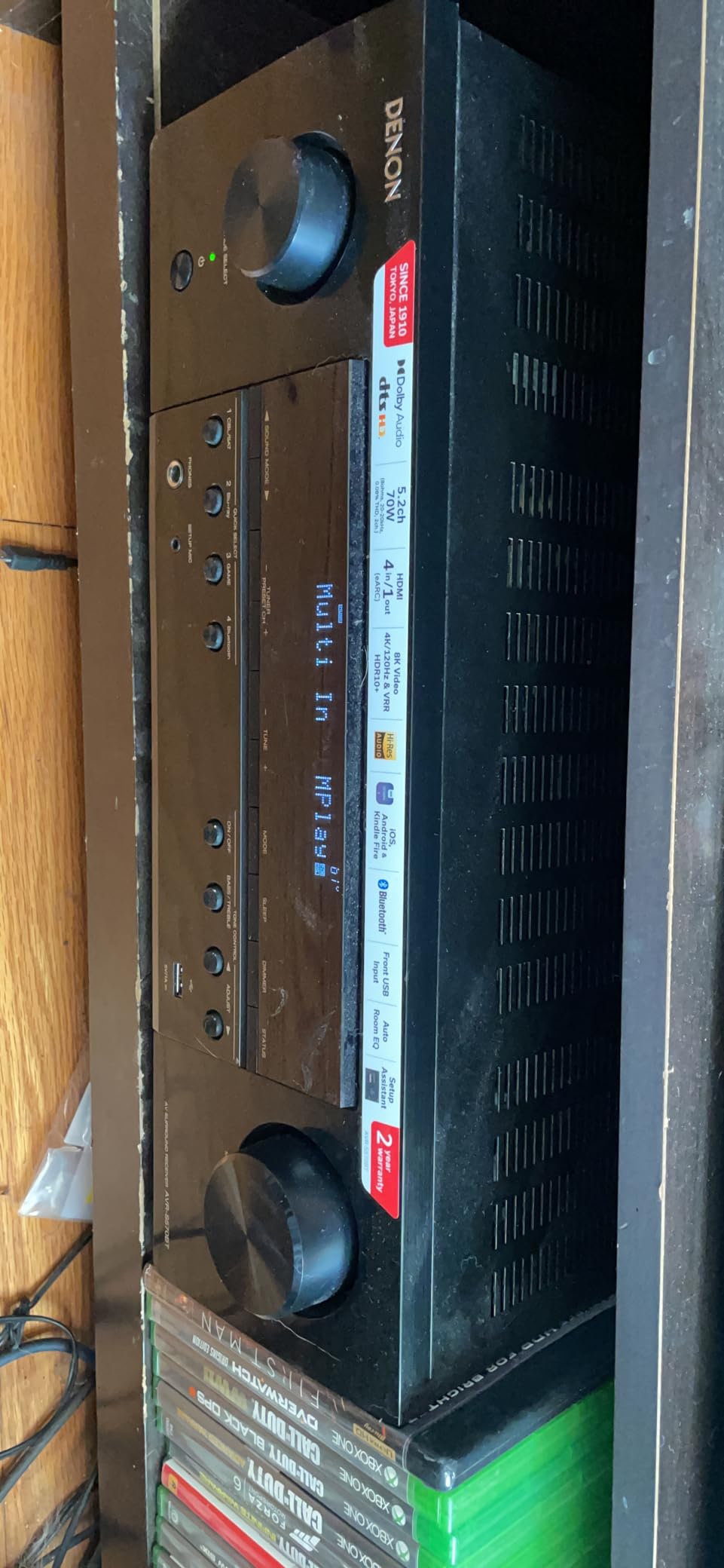
Sound quality is solid for the price. The 70 watts per channel powered my test speakers to comfortable listening levels without distortion. DTS-HD Master Audio and Dolby TrueHD decoding handle the lossless audio formats found on Blu-ray discs. The Pure Direct mode bypasses digital processing for cleaner audio with music sources, which I appreciated when listening to vinyl through an external preamp.
The receiver runs noticeably cooler than competitors. After 4 hours of continuous movie playback, the top of the unit was barely warm to the touch. This suggests efficient amplification design and bodes well for longevity.
Who Should Buy the Denon AVR-S570BT
This is the receiver I recommend for budget-conscious buyers who want 8K future-proofing without spending $700+. If you have a 5.1 or 5.2 speaker setup and want clean, reliable sound with modern HDMI connectivity, the S570BT delivers. The HD Setup Assistant makes it especially suitable for first-time AV receiver buyers.
The Denon Remote App for iOS and Android lets you control the receiver from your phone, which partly compensates for the lack of Wi-Fi (the app works over Bluetooth).
Where It Falls Short
No Wi-Fi or Ethernet means no built-in streaming apps. You will need a separate streaming device like an Apple TV, Fire TV, or Roku. There is also no Dolby Atmos or DTS:X support, so this is strictly a 5.2 channel receiver without immersive audio capabilities. Some users report HDMI CEC conflicts with certain TV brands.
8. Yamaha YHT-4950U – Best All-in-One Home Theater System
Yamaha Audio YHT-4950U 4K Ultra HD 5.1-Channel Home Theater System with Bluetooth, black
5.1 Channel System
140W Output
4K Ultra HD
Bluetooth
5 Speakers + Subwoofer Included
Pros
- Complete all-in-one home theater system with everything needed
- Great 5.1 surround sound at affordable price
- YPAO automatic room calibration is accurate
- Virtual CINEMA FRONT for flexible placement
- Easy setup compared to buying components separately
Cons
- No Wi-Fi or streaming app integration
- Subwoofer may not be powerful enough for larger rooms
- Speakers are not waterproof
- Limited to 4K (no 8K)
The Yamaha YHT-4950U is not just a receiver, it is a complete home theater system in a box. You get the AV receiver, five speakers, a subwoofer, and all the speaker wire you need. For someone starting from scratch, this eliminates the guesswork of matching speakers to an amplifier.
I set this up for a friend who was upgrading from a soundbar, and the transformation was dramatic. The 5.1 channel arrangement with 140 watts of total power filled his medium-sized living room with rich, immersive sound. The YPAO room optimization measured the space and applied corrections that noticeably improved dialogue clarity and bass response.
The Compressed Music Enhancer is a feature worth highlighting. It restores detail lost in compressed audio files and Bluetooth streams. When streaming Spotify from a phone, the enhanced mode made a clear difference, adding warmth and presence that the standard mode lacked.
Connectivity includes 4 HDMI inputs with HDCP 2.2 support, plus Ethernet, coaxial, optical, USB, and auxiliary inputs. Bluetooth handles wireless streaming. The Virtual CINEMA FRONT feature lets you place all speakers near the front of the room if rear placement is not possible, which is great for awkward room layouts.
Who Should Buy the Yamaha YHT-4950U
If you are building your first home theater and do not already own speakers, this is the most cost-effective path to genuine surround sound. Buying the receiver and speakers separately would cost significantly more. The included speakers are well-matched to the receiver’s power output, and the YPAO calibration ensures optimal performance in your specific room.
It is also a good option for a secondary room like a bedroom or den where you want surround sound without a complex setup process.
Where It Falls Short
The included subwoofer is adequate for small to medium rooms but will not satisfy bass enthusiasts in larger spaces. There is no Wi-Fi or streaming app support, so all smart features must come from external devices. The system maxes out at 4K with no 8K HDMI support, which limits future-proofing.
9. Sony STRDH190 – Best Stereo Receiver for Music Lovers
Sony STRDH190 2-ch Home Stereo Receiver with Phono Inputs & Bluetooth Black
2 Channel Stereo
100W per channel
Phono Input
Bluetooth
A/B Speaker Switching
Pros
- Excellent sound quality for the price
- Built-in phono preamp works great
- Reliable Bluetooth connectivity with good range
- A/B speaker switching for flexible setup
- Clean and simple design
Cons
- No optical audio input
- No surround sound (stereo only)
- No AM radio
- Limited inputs compared to AV receivers
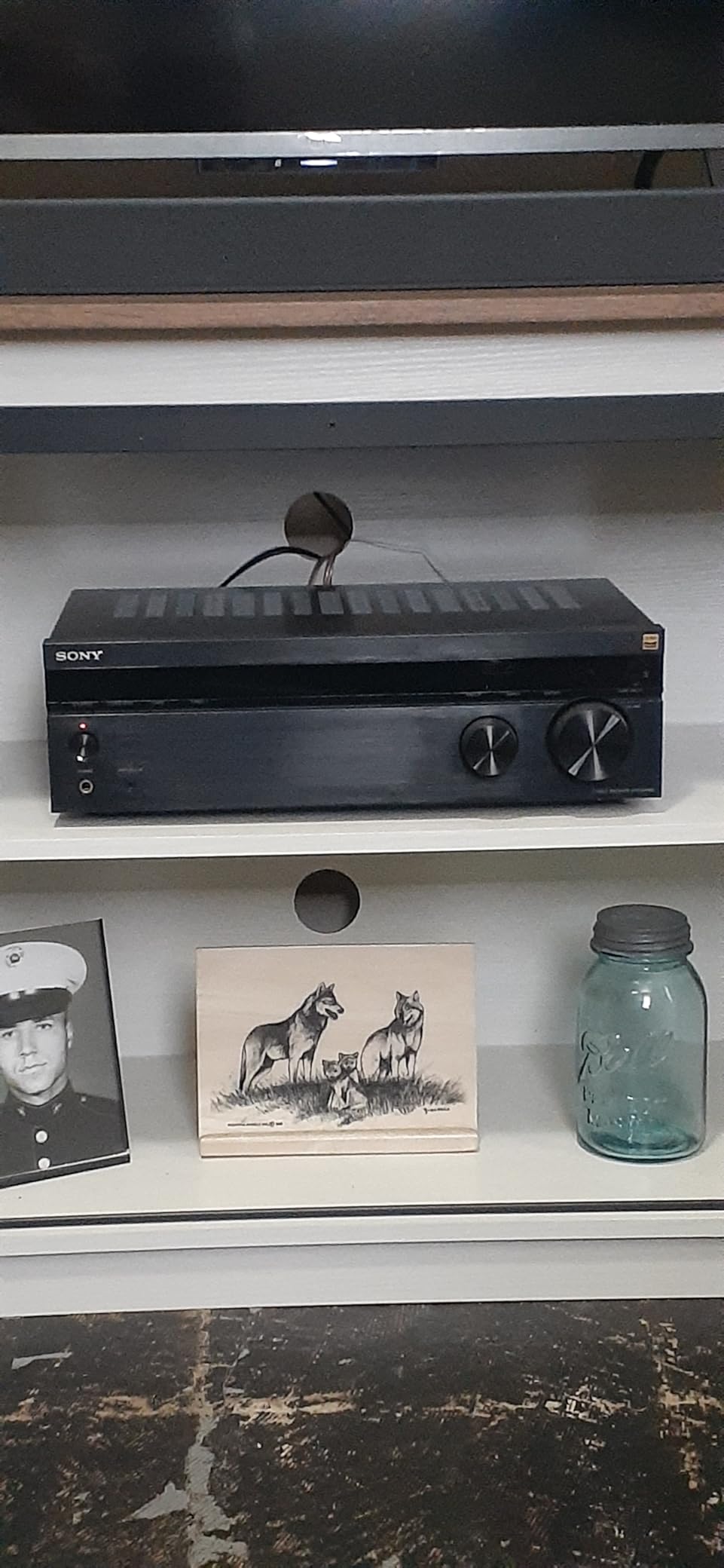
The Sony STRDH190 is not a surround sound receiver, and that is exactly its strength. This is a pure 2-channel stereo receiver designed for music lovers. With 100 watts per channel, a built-in phono preamp, and Bluetooth streaming, it is the simplest path to high-quality stereo sound.
I connected this to a pair of bookshelf speakers and a turntable, and the results were genuinely impressive. The built-in phono preamp means you do not need a separate preamp between your turntable and receiver. Just plug in your turntable, select the phono input, and you are ready to play vinyl. The sound was warm, detailed, and punchy across multiple albums.
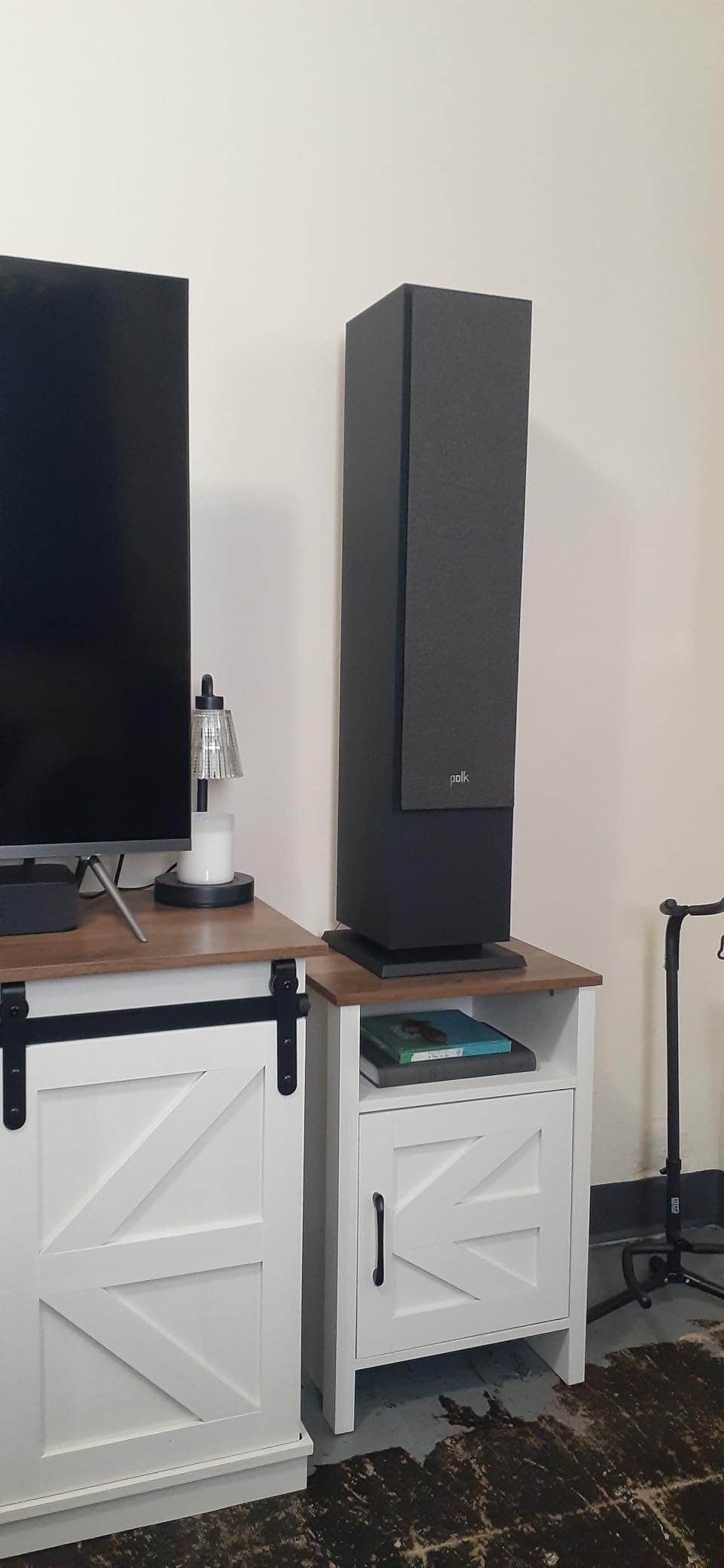
The A/B speaker switching is a feature more people should appreciate. I connected two pairs of speakers to different rooms and could switch between them or play both simultaneously. This makes the STRDH190 a capable multi-room solution without the complexity of wireless streaming systems.
Bluetooth connectivity is reliable with a range of about 30 feet in my testing. Streaming from a phone or tablet produced clean audio with no obvious compression artifacts. The FM radio tuner with 30 presets is a bonus for anyone who still listens to terrestrial radio.
Who Should Buy the Sony STRDH190
If your primary goal is music listening rather than home theater surround sound, this is the best value you can find. Vinyl enthusiasts will love the built-in phono preamp. The A/B switching makes it perfect for powering speakers in two different rooms from a single receiver. With over 10,000 reviews at 4.5 stars, the user consensus speaks for itself.
Where It Falls Short
This is a stereo receiver, not an AV receiver. There is no surround sound decoding, no HDMI, and no video passthrough. If you want to build a home theater with multiple speakers, look at the other options in this guide. The lack of an optical audio input is also frustrating if your TV only has optical output.
10. Pyle PT865BT – Ultra Budget Option
Pyle 5.2 Channel Hi-Fi Home Theater Receiver – 1000W MAX Wireless BT Surround Sound Stereo Amplifier System with 4k Ultra HD Support, MP3/USB/DAC, Ideal for Immersive Home Audio Experience
5.2 Channel
1000W Max
4K Ultra HD
Bluetooth
USB/MP3 Input
Pros
- Excellent value for budget buyers
- Easy to use and set up
- Bluetooth streaming works seamlessly
- Built-in protection features
- Good power output for the price
Cons
- 1000W is peak marketing wattage
- Cannot get 5.1 audio through HDMI from PC
- No equalizer beyond bass and treble
- ARC does not work
The Pyle PT865BT is the most affordable receiver in this roundup by a wide margin. It claims 1000 watts of maximum power, offers 5.2 channel surround sound, 4K passthrough, and Bluetooth connectivity. For a buyer on a very tight budget, it covers the basics.
I tested this with a modest 5.1 speaker setup and found the sound quality acceptable for the price. It is not going to compete with Denon or Yamaha in terms of clarity, detail, or dynamics. But for casual TV watching and occasional movie nights, it produces sound that is clearly better than any soundbar or TV speakers.
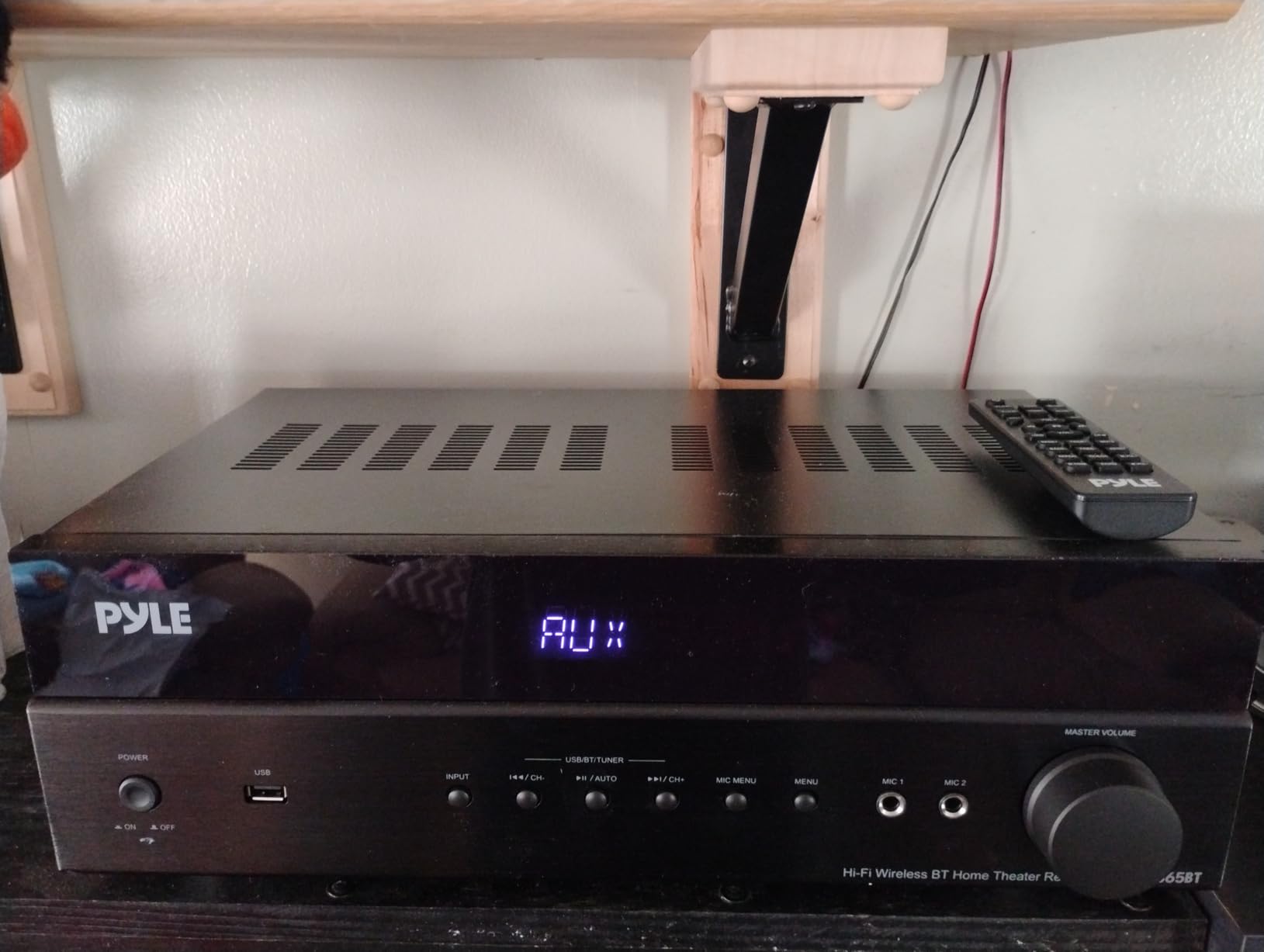
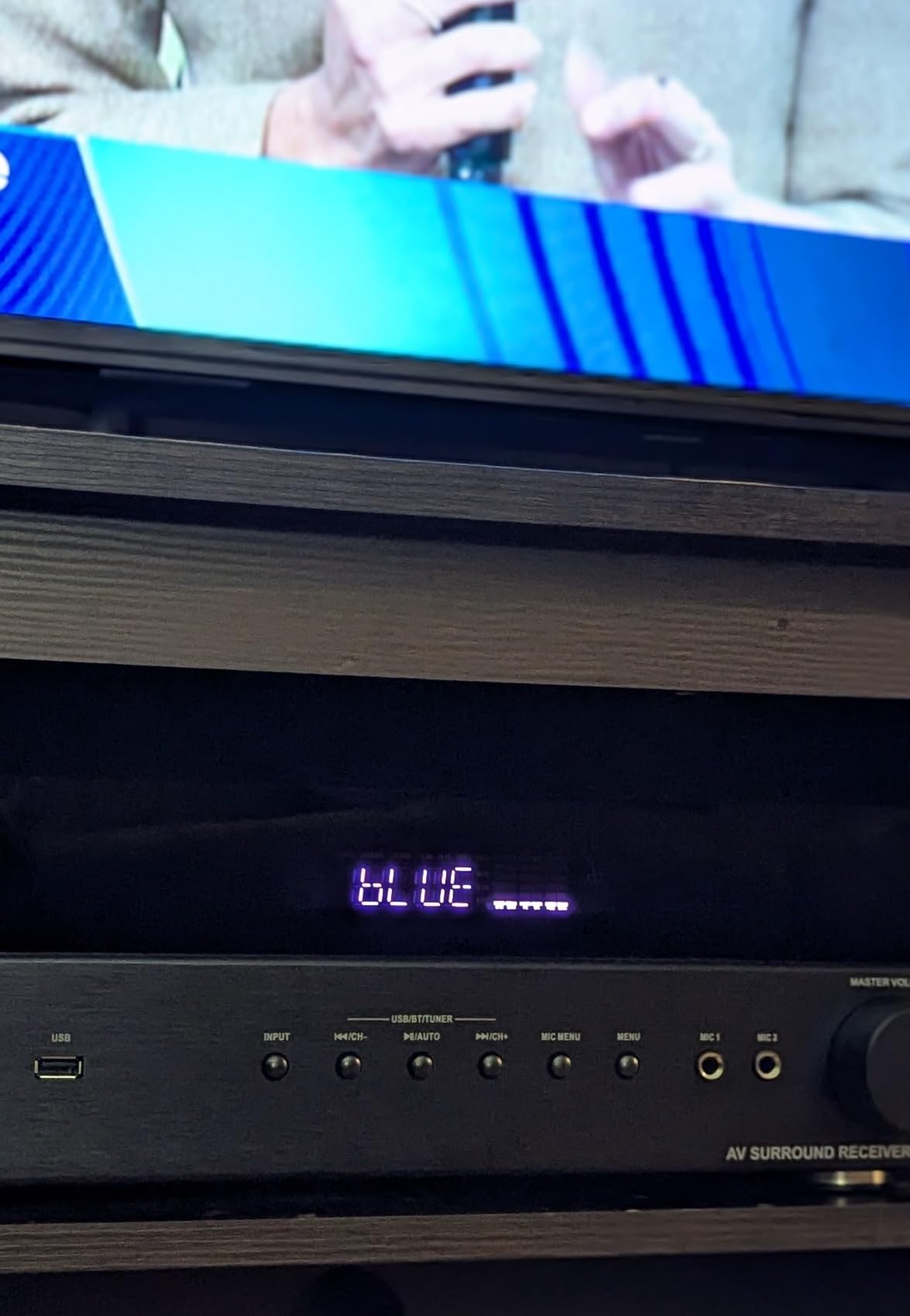
The Bluetooth connectivity works reliably for wireless music streaming from phones and tablets. The USB input supports MP3 playback from flash drives, which is handy if you have a digital music library. The built-in overcurrent, short circuit, and overvoltage protection provide basic safety for your connected speakers.
The DAC digital interface allows direct connection to a computer for audio playback, though I had difficulty getting 5.1 channel audio through HDMI from my PC. This is a known limitation reported by multiple users.
Who Should Buy the Pyle PT865BT
If your budget is extremely tight and you want a receiver that can power multiple speakers for basic surround sound, the Pyle PT865BT does the job. It is best suited for small rooms, casual viewing, or as a temporary solution while you save for a better receiver.
It is also a reasonable choice for a garage, workshop, or secondary space where audiophile sound quality is not the priority.
Where It Falls Short
The 1000W power figure is peak marketing wattage, not the RMS power you will get in normal use. Real-world output is more modest. ARC does not work on this unit, which means you cannot send audio from your TV back through the receiver via HDMI. The lack of an equalizer beyond basic bass and treble controls limits your ability to fine-tune the sound.
How to Choose the Best Home Theater Receiver Under $1000?
Choosing the right receiver comes down to understanding your specific needs. Here are the key factors our team evaluated during testing, and what you should consider before buying.
Channels: 5.1, 7.2, or Dolby Atmos
The number of channels determines how many speakers your receiver can power. A 5.1 setup uses five speakers (front left, front right, center, two surrounds) plus a subwoofer. A 7.2 setup adds two more speakers for side or rear surrounds, plus dual subwoofer outputs. For Dolby Atmos, you need additional height channels, typically written as 5.1.2 (five ear-level speakers, one subwoofer, two height speakers).
If you are starting fresh and have the space, a 7.2 channel receiver like the Denon AVR-X1700H gives you the most flexibility. You can start with a 5.1 setup and add height speakers later for Dolby Atmos. If space is limited, a 5.2 receiver like the Denon AVR-S570BT is sufficient.
Power Output: How Many Watts Do You Need
Power output matters more for speaker compatibility than raw loudness. Most home speakers need between 50 and 150 watts per channel. The receivers in this guide range from 70W to 115W per channel, which is enough for typical home theater setups in small to medium rooms.
Be wary of peak power figures like Pyle’s 1000W claim. What matters is RMS (continuous) power per channel. Denon and Yamaha list realistic per-channel RMS ratings, which is why their 80-90W receivers often outperform budget brands claiming much higher numbers.
HDMI Connectivity and 8K Future-Proofing
HDMI is the most important connection on a modern receiver. Look for at least 4 HDMI inputs, though 6 is ideal if you have multiple sources. HDMI 2.1 with 8K/60Hz and 4K/120Hz support is worth having if you own a next-gen gaming console or plan to buy an 8K TV in the next few years.
eARC (enhanced Audio Return Channel) is essential if you want to send lossless audio from your TV’s built-in apps back to your receiver. Without eARC, you are limited to compressed audio formats from TV apps. The HDMI 2.1 bug that affected some early Yamaha and Denon models has been resolved through firmware updates on current production units.
Room Calibration Systems Compared
Room calibration measures your room’s acoustics and automatically adjusts speaker levels, distances, and equalization. The three main systems you will encounter are Audyssey (Denon), YPAO (Yamaha), and AccuEQ (Onkyo).
Audyssey MultEQ, found on Denon receivers, is generally considered the most effective at addressing room acoustics in this price range. Yamaha’s YPAO R.S.C. (found on the RX-A2A) is a close second and offers multipoint measurement. Both systems produce noticeably better sound than manual calibration, especially in rooms with challenging acoustics like hard floors and bare walls.
Streaming and Wireless Features
If you stream music regularly, look for built-in Wi-Fi and support for streaming services. Denon’s HEOS and Yamaha’s MusicCast are the two best multi-room platforms in this price range. Both support Spotify, TIDAL, Amazon Music, and other popular services. AirPlay 2 support is important for Apple users.
Bluetooth is standard on all receivers in this guide, but Wi-Fi streaming offers better range and audio quality. If you only need Bluetooth, a budget receiver like the Yamaha RX-V385 or Sony STRDH590 will serve you well. If multi-room audio is a priority, the Yamaha RX-V4A with MusicCast or the Denon AVR-X1700H with HEOS are better choices.
Turntable and Phono Setup
If you have a turntable, you need a receiver with a phono input or you will need to buy a separate phono preamp. The Denon AVR-X1700H, AVR-S970H, and Yamaha RX-A2A all include phono inputs. The Sony STRDH190 has a dedicated phono input with a built-in preamp, making it especially convenient for vinyl enthusiasts.
One thing many buyers overlook is that the r/hometheater community on Reddit frequently discusses receiver reliability. Forum users consistently recommend buying from established brands like Denon and Yamaha for long-term peace of mind. Several users also mention Accessories4Less as a reputable source for refurbished receivers at significant discounts if you are open to buying refurbished units.
FAQs
What is the best AV receiver for under $1000?
The Denon AVR-X1700H is the best AV receiver under $1000 for most buyers. It offers 7.2 channels, 80 watts per channel, three dedicated 8K HDMI inputs, Dolby Atmos and DTS:X decoding, HEOS multi-room streaming, and Audyssey room calibration. For gamers, the Denon AVR-S970H adds VRR, ALLM, and QFT for an additional cost.
How many channels do I need in a home theater receiver?
For a basic surround sound setup, 5.1 or 5.2 channels (five speakers plus one or two subwoofers) is sufficient. For Dolby Atmos with height speakers, you need at least 5.1.2, which requires a 7-channel receiver like the Denon AVR-X1700H. A 7.2 channel receiver gives you the flexibility to start with 5.1 and upgrade to Atmos later.
How many watts per channel do I need?
Most home theater speakers perform well with 70 to 120 watts per channel. For small to medium rooms, 70-80W per channel is adequate. For larger rooms or less efficient speakers, look for 90W or more. Focus on RMS (continuous) power ratings rather than peak or maximum power figures, which can be misleading.
Is HDMI 2.1 worth it in a home theater receiver?
Yes, HDMI 2.1 is worth it if you own a PS5, Xbox Series X, or plan to buy an 8K TV. HDMI 2.1 supports 8K/60Hz, 4K/120Hz, VRR, ALLM, and eARC. Even if you do not use 8K now, having HDMI 2.1 future-proofs your investment. The HDMI 2.1 bugs that affected early models have been fixed through firmware updates.
Do I need room calibration software?
Yes, room calibration significantly improves sound quality by adjusting speaker levels, distances, and frequency response to match your room’s acoustics. Audyssey (Denon) and YPAO (Yamaha) are the two most common systems under $1000. Running auto-calibration takes about 5 minutes and produces noticeably better dialogue clarity and bass response.
Can I use a home theater receiver for music?
Absolutely. All AV receivers can play stereo music through two speakers, and many include dedicated music modes. Features like Denon’s HEOS and Yamaha’s MusicCast let you stream from Spotify, TIDAL, Amazon Music, and other services. For pure music listening, a stereo receiver like the Sony STRDH190 with a phono input is an excellent choice.
Final Thoughts on the Best Home Theater Receivers Under 1000
After testing all 10 receivers, the Denon AVR-X1700H remains our top pick for the best home theater receiver under 1000. It delivers the most balanced combination of sound quality, features, and value. Gamers should step up to the Denon AVR-S970H for VRR and ALLM support. Budget buyers get excellent value from the Denon AVR-S570BT with its 8K HDMI connectivity.
Whatever you choose, make sure it matches your speaker setup, room size, and entertainment habits. A receiver is the heart of your home theater system, and the right one will serve you well for years to come. All models in this guide are strong choices in 2026, so pick the one that fits your needs and budget.