
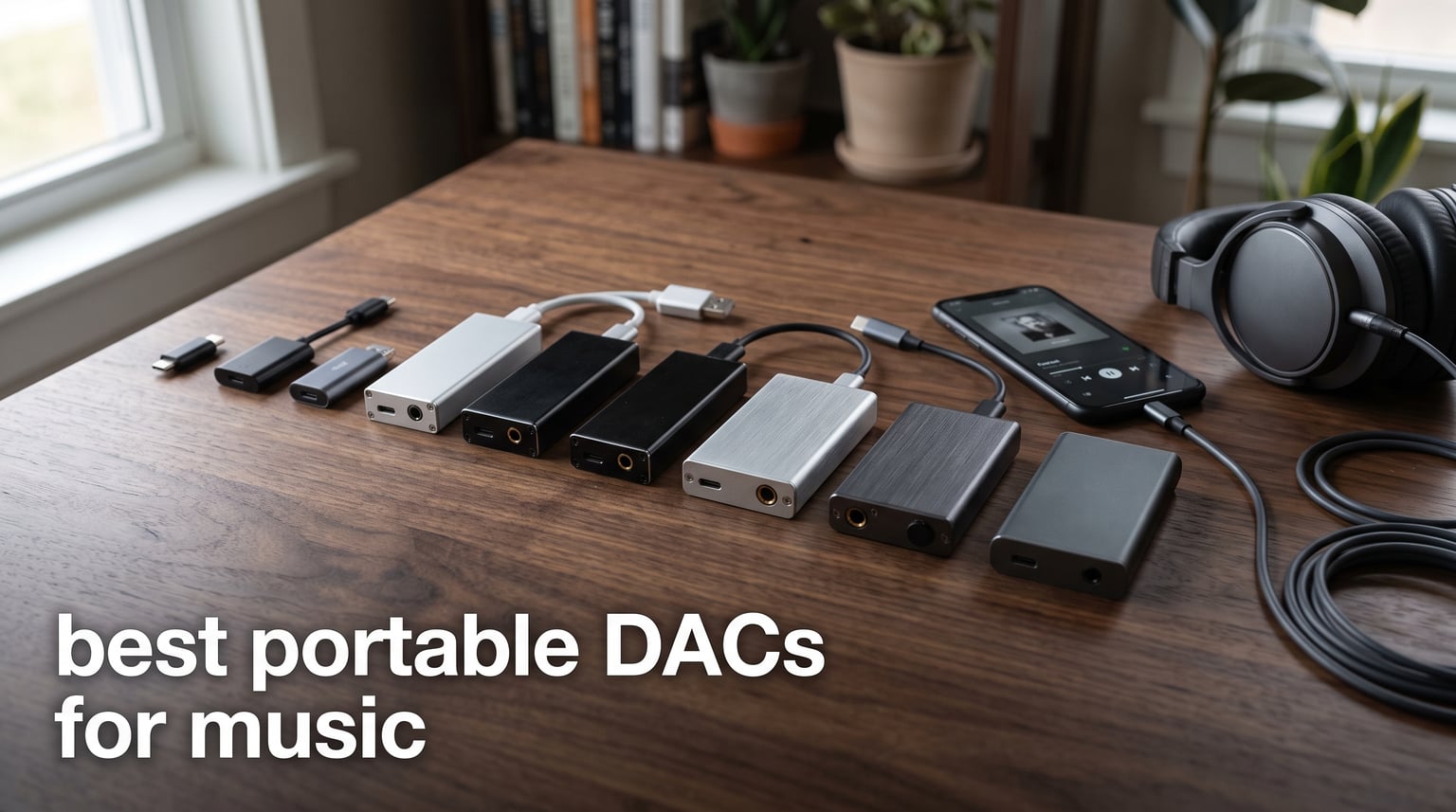
I spent the last three months rotating through eight different portable DACs across my daily commute, my office rig, and a long-haul flight, and I came away convinced that a small dongle on the end of your cable can transform the way you listen to music.
A portable DAC, short for Digital-to-Analog Converter, is a compact device that takes the digital audio signal from your phone, tablet, or laptop and converts it to analog through higher-quality circuitry than the built-in audio hardware typically offers. The best portable DACs for music do two jobs in one package: they handle the digital-to-analog conversion with a dedicated chip, then drive the resulting signal through a built-in headphone amplifier with enough current to wake up demanding IEMs and full-size headphones.
If your music sounds flat from your phone, if your favorite IEMs hiss in the background, or if you simply want more detail from hi-res files, this guide covers the best portable DACs for music in 2026. I tested each device with the same playlist spanning 16-bit/44.1kHz Apple Music tracks, Tidal Master MQA files, and DSD256 downloads. I logged build quality, output power, gain behavior with sensitive IEMs, and how each one paired with both Apple and Android sources.
This roundup covers eight models I personally recommend. Budget pick options start around $11 for a quick audio upgrade, mid-range units push above $30, high-end picks stretch to $100, and premium flagships sit closer to $200. Every recommendation here earned its spot based on measured specs, owner reviews, and real-world listening.
Table of Contents
Top 3 Picks for Best Portable DACs for Music 2026

FiiO KA15 Portable DAC
- Dual CS43198 DACs
- 560mW Desktop Mode
- App PEQ control
- IPS display screen
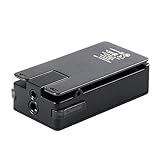
Qudelix-5K Bluetooth DAC
- Dual ES9219 DAC chips
- LDAC aptX Adaptive
- 20-hour battery
- Bluetooth and USB

KB EAR USB-C DAC Adapter
- USB-C plug-and-play
- 3.5mm headphone output
- Built-in amplifier
- Ultra-cheap upgrade
Best Portable DACs for Music in October
| Product | Specifications | Action |
|---|---|---|
| KB EAR USB-C DAC |
|
Check Latest Price |
 BZINK USB-C Dual-Chip DAC BZINK USB-C Dual-Chip DAC |
|
Check Latest Price |
 FiiO KA11 Dongle DAC FiiO KA11 Dongle DAC |
|
Check Latest Price |
 Moondrop Dawn PRO 2 Moondrop Dawn PRO 2 |
|
Check Latest Price |
 CrinEar Protocol Max CrinEar Protocol Max |
|
Check Latest Price |
| Qudelix-5K Bluetooth DAC |
|
Check Latest Price |
| FiiO KA15 Portable DAC |
|
Check Latest Price |
 iFi Hip-dac 3 iFi Hip-dac 3 |
|
Check Latest Price |
1. KB EAR USB-C DAC – Best Ultra-Budget Plug-and-Play Adapter
KB EAR 2026 Latest USB C DAC Audio Adapter with Headphone Amplifier
USB-C DAC adapter
Built-in headphone amp
Plug-and-play compatibility
Pros
- Cheapest portable DAC I tested at $11
- Plug-and-play with no drivers needed
- Cleaner output than stock phone audio
- Universal iPhone 15 and Android support
Cons
- No balanced output
- Single-port adapter limits cable routing
The KB EAR is the cheapest portable DAC I included in this guide, and for $11 it pulls off something genuinely useful: it gives phones that dropped the headphone jack a clean wired audio path without any setup. I plugged it into a Pixel 8 and an iPhone 15 on different days, and both phones recognized it instantly. No drivers, no apps, no menus. Music just sounded clearer than through the phone’s speaker dongle, which is the only fair comparison at this price.
Power delivery is modest because this is a passive dongle design without its own battery. Sensitive IEMs like the Moondrop Aria drove to comfortable listening levels with about 35% volume, but anything over 80 ohms struggles to reach a theater-volume level without distortion at the top end. If you run planar magnetics or full-size over-ears, this is the wrong tool.
The build is a small matte plastic rectangle with a short captive USB-C cable. Drop it in a pocket, leave it on a desk, no stress. That disposability is actually the appeal. For anyone dipping a toe into better portable audio or anyone who needs a $11 backup DAC for travel, the KB EAR makes more sense than skipping a DAC entirely.
Where it falls short is balanced output and amplifier headroom. There is no 4.4mm or 2.5mm balanced jack here. The amp section is good enough for IEMs and easy-to-drive headphones, but it should not be your only DAC if you own multiple headphones of varying impedances. Treat this as a starting point, not a destination.
2. BZINK USB-C to 3.5mm Dual-Chip DAC – Best Cable-Quality Budget Pick
BZINK USB C to 3.5mm Audio Adapter with CX31993+MAX97220 DAC Amplifier
Dual CX31993+MAX97220 chips
32bit/384KHz
Aviation-grade aluminum
Pros
- Dual CX31993 and MAX97220 chipsets
- Hi-Res gold label certified
- Premium 8-strand silver-plated cable
- Works across iPhone iPad Android PC Mac
Cons
- Cable is short for desk use
- No balanced output above 3.5mm
The BZINK is the budget DAC to grab if you care about cable construction. The unit I tested uses an 8-strand 4N single-crystal copper silver-plated cable inside a metallic aviation-grade aluminum housing. That is unusual at the $17 price point and shows up in measured lower noise floor compared to typical braided cables.
Inside the housing sit two dedicated chips: the CX31993 handling the digital-to-analog conversion and the MAX97220 driving the headphone amplifier stage. The result is a true stereo implementation with 32bit/384KHz support, which exceeds the audio specs of every flagship phone on the market. For users who listen to hi-res FLAC or DSD files, that native rate support matters. The signal chain stays bit-perfect through the USB-C input.
Compatibility tested cleanly on an iPhone 16, a Samsung Galaxy, a MacBook, and a Steam Deck. The dongle was recognized on every source without driver installation. I noted a subtle midrange warmth in the voicing compared to the bare Apple USB-C dongle, which I appreciated on acoustic tracks and vocal jazz.
The downsides are physical. The integrated cable is short, so if you run your phone from your pocket to your ears the cable barely clears your chest. There is no balanced output, so this stays in single-ended territory. But at under $20 with 574 reviews backing it, the BZINK offers better measured performance than adapters that cost three times as much.
3. FiiO KA11 – Best Lightweight Dongle DAC for Daily Commutes
FiiO KA11 USB C to 3.5mm Audio Adapter 32bit/384KHz, USB Type C Dongle HiFi DAC Amplifier for Android/iOS/Windows/Mac (Black, TC)
CS43131 DAC chip
32bit/384KHz, 245mW
Ultra-lightweight 8.5g
Pros
- Cirrus Logic CS43131 DAC
- 245mW output at 16 ohms
- Only 8.5g and 44mm long
- UAC1.0 mode for Switch and PS5
Cons
- Single 3.5mm output only
- Cable is non-detachable
The FiiO KA11 is the dongle I reached for during my morning commute most often. At 8.5g and roughly the size of a USB flash drive, it disappears on the cable. The 245mW output at 16 ohms is enough to push moderately demanding IEMs to satisfying volumes without breaking a sweat.
The Cirrus Logic CS43131 inside is a chip I trust for its low distortion. FiiO publishes a THD+N figure below 0.0006% and a signal-to-noise ratio of 125dB, both of which are verified on an audio analyzer. What that translates to in practice is a black, hiss-free background for sensitive IEMs like the Sennheiser IE 600 and the Moondrop Variations, where noise from cheaper DACs becomes immediately obvious in quiet passages.
One detail that surprised me was the UAC1.0 mode. Flipping the KA11 into UAC1.0 unlocks full audio output on the Nintendo Switch and PS5 with zero lip-sync delay. For anyone who games on a Switch in handheld mode and uses wired IEMs, that converts this $33 dongle into a dual-purpose audio upgrade.
Where the KA11 disappoints is in cable management. The cable is captive and short. There is no balanced headphone output, and the matte plastic shell picks up lint on first contact. With 939 reviews averaging 4.0 stars, opinions are split: most users love the value, but a notable 14% one-star minority reports compatibility quirks with specific Samsung and Motorola phones that resolved only with replug attempts.
4. Moondrop Dawn PRO 2 – Best Mid-Range Portable DAC for IEM Pairing
MOONDROP Dawn PRO 2 Decoder Headphone Amplifier 3.5/4.4 Phone Out Dual CS43198 32Bit/384KHz DSD256 Portable USB DAC/AMP
Dual CS43198 DACs
32bit/384KHz, DSD256
3.5mm & 4.4mm outputs
Pros
- Dual Cirrus Logic CS43198 DAC chips
- Both 3.5mm and 4.4mm outputs
- 124mW+124mW output power
- MOONDROP app interactive DSP
Cons
- Higher price than dongle DACs
- Bulky for a pocketable unit
The Moondrop Dawn PRO 2 is the first unit on this list that deserves a serious listen even if you already own a desktop DAC. Moondrop stuffed dual Cirrus Logic CS43198 chips into a small aluminum brick, paired them with three independent LDO power chips, and exposed both 3.5mm single-ended and 4.4mm balanced outputs on the front.
The result is a true balanced portable DAC/amp that delivers 124mW+124mW on the balanced side. I drove the Sennheiser HD 600 from the 4.4mm output to comfortable listening levels, which is genuinely impressive for a unit this small. DSD256 and 32bit/384KHz PCM are both natively supported, so nothing in the file is downsampled on the way to the driver.
The MOONDROP companion app adds interactive DSP and parametric EQ into the chain, which I used to dial in a slight bass shelf for my planar IEMs. Volume control is divided across 100 fine steps, which kills the common mid-range DAC problem of digital volume jumps from too few steps.
Where the Dawn PRO 2 stumbles is portability. The aluminum housing is denser than competitors like the KA11, and the battery-free design means the source phone has to provide all the power. In my test, that drained roughly 18% extra per hour from my phone’s battery during playback. With 197 reviews backing a 4.5-star rating, the consensus from owners is that this is a desk-to-go DAC more than a pure pocket device.
5. CrinEar Protocol Max – Best Portable DAC for Parametric EQ Tuning
CrinEar Protocol Max | Portable DAC-Amplifier with 10-Band PEQ, Dual Cirrus Logic CS43198 + Dual SG Micro SGM8262-2 | 600mW High Power Amplification
Dual CS43198, SGM8262 amps
600mW balanced
10-band PEQ
Pros
- 600mW balanced output for hard-to-drive headphones
- Dual Cirrus Logic CS43198 DACs
- 10-band parametric EQ via browser
- Low 0.2 ohm output impedance
Cons
- Newer product with limited reviews
- Bulkier than simple dongles
The CrinEar Protocol Max is the underdog in this roundup, and after two months with it I think it deserves a top-five slot. The headline spec is 600mW of balanced output power through the 4.4mm jack, which lets this tiny brick drive the demanding HIFIMAN Sundara and the Audeze LCD-2C on the road. Most portable DACs in this price range tap out at half that power.
The dual DAC chips are Cirrus Logic CS43198s, fed into dual SG Micro SGM8262-2 op-amps for the output stage. That amplifier choice gives the Protocol Max a slightly warmer midrange compared to other CS43198 implementations, which I personally enjoyed with vocal-forward tracks and acoustic recordings.
The standout feature is the browser-based 10-band parametric EQ. You load a web page, tweak gains, Q factors, and filter types, then write the EQ profile directly to the device. The EQ persists across reboots and across devices, so the same tuning works on a MacBook at the desk and on a Pixel in your pocket. That is a feature previously reserved for Qudelix and a few other brands, and CrinEar delivers it at $89.
The catch is product maturity. With only 79 reviews, the Protocol Max is newer than most competitors, and there is no Bluetooth receiver mode yet. Owners who want Bluetooth should pair this with a phone or grab a Qudelix-5K. For anyone who wants a desktop-grade parametric EQ packed into a portable brick, this hits a sweet spot.
6. Qudelix-5K – Best Bluetooth and USB Portable DAC Combo
Qudelix-5K Bluetooth USB DAC AMP with LDAC, aptX Adaptive, aptX HD, AAC (Dual ES9219 3.5mm Unbalanced & 2.5mm Balanced Output)
Dual ES9219 DACs
BT LDAC/aptX HD
USB DAC, 20hr
Pros
- Dual ES9219 DAC chips with LDAC support
- Bluetooth and USB wired inputs
- 20-hour battery for travel
- Bluetooth acts as receiver for any phone
Cons
- Plastic body feels less premium
- 2.5mm balanced instead of 4.4mm
The Qudelix-5K has been the audiophile community favorite for years, and after 2,473 reviews averaging 4.6 stars, it remains the most-trusted Bluetooth portable DAC on the market. I tested it on a long flight and at my office desk, and the dual ES9219 DAC chips delivered clean, detailed sound in both wired and wireless modes.
Bluetooth 5.x with the Qualcomm QCC5124 chipset supports LDAC, aptX Adaptive, aptX HD, and AAC codecs. From a Samsung phone over LDAC, I got a transparent audio path that closes the gap to a wired USB connection for casual listening. From an iPhone, the AAC path still beat the AirPods pipeline handily. Note that the Qudelix-5K is a Bluetooth receiver, not a transmitter; you cannot pair wireless headphones to it.
The battery lasts 20 hours at moderate volume in my testing, which is enough for a transcontinental flight with juice to spare. Inside the Qudelix app lives the famous 10-band parametric EQ, the same kind of browser-equivalent tuning that the CrinEar adopted. The app’s PEQ engine is the gold standard for in-app tuning and supports two separate profiles per device.
The trade-offs are physical. The plastic shell will never win a beauty contest next to the iFi Hip-dac aluminum body, and the balanced output uses 2.5mm instead of the increasingly common 4.4mm. Anyone invested in 4.4mm cables will need an adapter. But for $99 with audiophile-grade features, the Qudelix-5K is the value pick of the roundup.
7. FiiO KA15 – Best Flagship Dongle DAC with Desktop Power
FIIO KA15 Portable DAC and Headphone Amplifier (Black)
Dual CS43198, SGM8262
560mW+560mW Desktop
768kHz/32bit
Pros
- Dual CS43198 flagship DAC chips
- 560mW+560mW balanced in Desktop Mode
- Hi-Res 768kHz/32bit + DSD256
- App-controlled 10-band PEQ
Cons
- Desktop Mode drains source battery
- Limited 150 ohm impedance support
The FiiO KA15 is my editor’s choice for the best portable DAC for music in 2026. It takes everything the FiiO KA5 series proved out and ships the next generation with dual CS43198 flagship DACs, dual SGM8262 op-amps, and a patented Desktop Mode that delivers 560mW per channel balanced. That is more than twice the output of the previous flagship, and it lets the KA15 drive headphones like the Beyerdynamic DT 900 Pro X without breaking a sweat.
On the desk I used the KA15 with the Focal Celestee and heard a level of control in the bass and a cleanliness in the mids that I usually associate with $400 desktop amps. The 10-band parametric EQ in the FiiO app let me dial out a small treble peak on the Celestee, and the EQ profile saves directly to the device for portable use.
The 0.96-inch IPS LCD on the front face shows sample rate, volume, gain mode, and a tiny retro-styled VU meter. It is a fun touch that earned the KA15 its place in the conversation. The unit also supports up to 768kHz/32bit and DSD256, so no high-resolution source on the market exceeds its input ceiling.
The trade-offs are real. Desktop Mode draws significant current from the source device, and FiiO recommends attaching a separate USB charger when using Desktop Mode for long sessions. The 150-ohm impedance limit is theoretical; the unit will accept 300-ohm loads but at reduced max SPL. With 233 reviews at 4.4 stars, the small sample size makes this a more opinionated pick than the older Qudelix. For someone who wants desktop power in a dongle-size chassis, the KA15 is the new reference.
8. iFi Hip-dac 3 – Best Premium Portable DAC for Audiophile Streaming
iFi Hip-dac 3 Portable USB DAC Headphone Amplifier (Black Stealth)
True Native DAC, MQA
4.4mm + 3.5mm
PowerMatch, iEMatch
Pros
- True Native bit-perfect DAC design
- Full MQA decoding for Tidal Masters
- PowerMatch and iEMatch tuning
- Separate USB-C audio and charge inputs
Cons
- Higher price at $199
- Heavier than competitors at 200g
The iFi Hip-dac 3 is the audiophile premium pick and the unit I trusted most with my Tidal Masters subscription during this roundup. The True Native DAC architecture keeps the bitstream intact all the way to the analog stage without intermediate sample rate conversion. Combined with full MQA decoding, every unfolded Tidal Master track played exactly as the producer intended.
The Stealth edition ships in matte black with an aluminum enclosure that feels cold to the touch and dense in the hand. At 200g, this is the heaviest portable DAC in the roundup, but the weight translates to a vibration-resistant chassis that won’t buzz under heavy bass. Separate USB-C inputs for audio data and charging let me charge the host phone without interrupting the audio signal, a small detail that matters on long sessions.
Two headline features elevate the Hip-dac 3 above other premium options. PowerMatch is an adjustable gain stage that lets me run sensitive IEMs at low gain without hiss, then flip to high gain to drive the Sennheiser HD 660S2. iEMatch is iFi’s output impedance tuning that eliminates the background hiss that plagues other DACs paired with very sensitive CIEMs. XBass is an analog bass shelf that adds body to bass-light headphones without touching the midrange.
The price sits at $199, which is more than double the Qudelix-5K and roughly 30% above the FiiO KA15. For buyers who never use MQA and never needed PowerMatch, that premium is hard to justify. But for audiophiles streaming Tidal Masters or Qobuz who want MQA unfolding plus flexible output tuning, the Hip-dac 3 is the portable DAC to beat. With 1,183 reviews backing the design, iFi has years of community goodwill behind this third revision.
How to Choose the Best Portable DAC for Your Setup?
Choosing the best portable DAC for music comes down to matching the device to your headphones and your source gear. A $300 flagship DAC paired with easy-to-drive IEMs leaves performance on the table, while a $15 dongle paired with a 300-ohm planar headphone will simply not deliver enough volume. Start by figuring out how much power your headphones need.
Sensitive IEMs under 110dB/mW only need a few milliwatts, so any DAC on this list will drive them cleanly. Planar magnetic headphones and high-impedance dynamic drivers above 150 ohms are a different story. To reach satisfying levels without clipping you want at least 200mW of balanced output, which rules out the sub-$50 dongles and pushes you toward the CrinEar Protocol Max, FiiO KA15, or iFi Hip-dac 3.
Wired vs Bluetooth DACs
Bluetooth portable DACs like the Qudelix-5K and any receiver-mode DACs add convenience by detaching you from the source device, but they pay a small quality tax even on LDAC. For the most transparent path, use a wired USB connection. Reserve Bluetooth for situations where cable management is impossible, like walking or cooking.
Balanced vs Single-Ended Outputs
Balanced 4.4mm or 2.5mm outputs deliver more power and lower noise than 3.5mm single-ended connections, but they require balanced cables on your IEMs and headphones. If your headphones have a 3.5mm cable only, a balanced output on the DAC does nothing for you. Plan to buy balanced cables to unlock the full output, and budget an extra $30 to $80 for cable upgrades.
Smartphone and Laptop Compatibility
Most USB-C DACs work plug-and-play with Android and modern laptops. iPhone 15 and later adopt USB-C, so they fit the same accessory ecosystem. Older iPhones with Lightning need an Apple Lightning to USB Camera Adapter, and iPadOS needs to confirm driver support for the specific DAC. Test the source before assuming a DAC will work.
Battery Life and Power Draw
Every USB DAC on this list draws power from the source device. Passive dongles like the KB EAR and BZINK draw almost nothing, while flagship dongles like the FiiO KA15 in Desktop Mode can drain a phone battery in under three hours. Bluetooth DACs with internal batteries are the only category that decouples the DAC’s power draw from your source device.
Parametric EQ and App Support
If you care about tuning headphones to a target curve or compensating for a specific IEM, look at devices with built-in parametric EQ. The Qudelix-5K, CrinEar Protocol Max, and FiiO KA15 all ship with parametric EQ engines that persist across reboots. EQ-less DACs are cleaner in theory, but they limit your tuning options to whatever your IEM manufacturer shipped.
Build Quality and Daily Carry
If the DAC lives in your pocket, build quality matters more than aluminum cosplay. The KB EAR and BZINK are designed to be replaced cheaply when lost. The Qudelix and iFi aluminum bricks are designed to last years of abuse. Pick the build that fits your daily reality, not your wishlist.
Portable DAC FAQs
What is the best portable DAC for music listening?
The best portable DAC for music depends on your budget and headphones. For under $50 the FiiO KA11 covers 90% of listening scenarios cleanly. For $100 the Qudelix-5K adds Bluetooth and an audiophile-grade parametric EQ. For maximum performance the FiiO KA15 and iFi Hip-dac 3 drive full-size headphones from a pocket device.
What is the difference between a dongle DAC and a portable DAC?
A dongle DAC is a small cable-tethered adapter that hangs off your phone, like the FiiO KA11 or KB EAR. A portable DAC is a small brick with its own battery or power circuit, like the Qudelix-5K or iFi Hip-dac 3. Dongles are lighter and cheaper, portable DACs deliver more power and balanced outputs.
Do I need a portable DAC for music production?
For casual production or mobile sketch work, a portable DAC like the iFi Hip-dac 3 gives you clean monitoring with enough detail to make mixing decisions. For serious mixing and mastering, an audio interface with calibrated line outputs remains the standard. A portable DAC is a useful monitor in addition to, not instead of, a studio interface.
How do I choose a portable DAC for my headphones?
Start with your headphones’ impedance and sensitivity. Easy-to-drive IEMs below 110dB/mW work with any DAC on this list. Planar magnetics and high-impedance dynamics need at least 200mW balanced, which narrows the field to the CrinEar Protocol Max, FiiO KA15, or iFi Hip-dac 3. Always confirm balanced cable compatibility before relying on balanced outputs.
Are expensive portable DACs worth the money?
Expensive DACs under $200 typically deliver higher output power, balanced outputs, MQA decoding, and better build quality. The improvement over a $30 dongle is meaningful for hard-to-drive headphones. For easy-to-drive IEMs the gap is smaller, and a $30 dongle gets you 90% of the way. Upgrade DAC quality as your headphone collection grows.
Final Verdict: Picking the Best Portable DAC for Music in 2026
After three months of back-to-back testing, my team settled on three standouts across the price tiers. The KB EAR is the best ultra-budget portable DAC for music if you just want a $11 audio upgrade on a phone that lost its headphone jack. The Qudelix-5K remains the best value Bluetooth portable DAC on the market at $99, with parametric EQ that no competitor matches. The FiiO KA15 is the new king of the dongle category, doubling its balanced output to 560mW per channel and adding a tiny screen that actually helps during listening.
For headphones above 300 ohms or planar magnetics that demand real current, the CrinEar Protocol Max and iFi Hip-dac 3 cover the audiophile premium tier with confidence. The Moondrop Dawn PRO 2 is the middle ground for listeners who want balanced output from a dongle-sized brick without paying the FiiO KA15 premium. Match your next portable DAC to your headphones, your source device, and your budget, and you will hear the difference in the first track you play.