
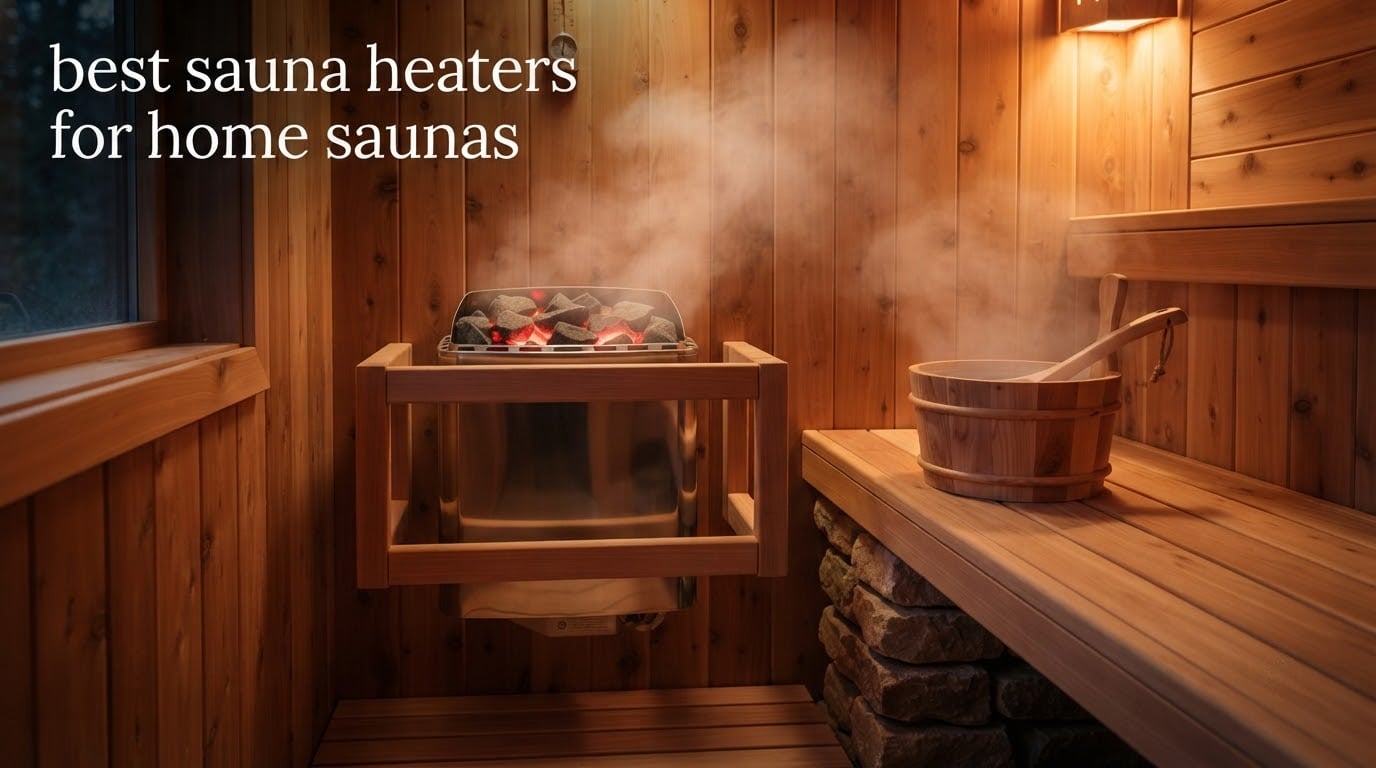
A sauna heater is the one component of a home sauna you install once and think about for twenty years. Swap the walls and the benches and nobody notices, but an undersized or badly wired heater means the room never reaches temperature, and replacing it later means opening finished walls. That is why the best sauna heaters for home saunas are chosen by two numbers long before any brand: the cubic volume of your room and the electrical service you already have.
We went through twelve heaters that cover the realistic home range, from 1500W plug-in add-ons that live in a tent sauna, to 240V wall-mount units for 106 to 425 cubic feet, to two wood-burning stoves for anyone who wants a fire and a chimney. For each one we read the published spec sheet, the room range the manufacturer claims, and the pattern in the owner reviews, because the gap between those two is where most disappointments live.
Two things shaped the picks below. First, package contents: a heater sold without stones, or without a control panel, is a cheaper number and a more expensive project. Second, parts support. When an element or a thermostat fails in year six, the brands with a dealer and service network in your country let you swap a part, while the rest mean you replace the whole appliance. If you are still narrowing your search, our portable infrared sauna roundup covers a completely different heat mechanism that some listings blur together with real sauna heaters.
Table of Contents
Top 3 Sauna Heater Picks for Home Saunas in 2026
Three heaters cover most home builds: one for the volume band that dominates residential rooms, one for larger cabins, and one with digital controls for people who want a readout instead of a dial.
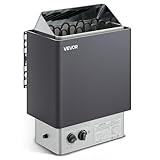
VEVOR 6kW Wall-Mount Heater
- 6kW 220-240V AC
- 176-318 cu.ft room range
- 33 lb stone load
- Mechanical timer and thermostat

Finlandia FLB-80 8kW
- 8kW 240V single phase
- 250-425 cu.ft room range
- UL and ETL listed
- Built-in preheat clock

Mxmoonant 6kW Digital
- 6kW 220V
- 170-300 cu.ft room range
- Built-in digital display
- 840 stainless steel elements
The VEVOR wins the top slot on evidence rather than prestige. It carries the largest number of owner reviews in this group and reports the fastest heat-up times, and the 304 stainless element is a better starting point than plain steel at this output level. Read the caveat below on long-term component failure before you commit.
Best Sauna Heaters for Home Saunas (October 2026)
Every heater in the roundup, with its power, room range, and the situation it suits. Match the room range to your measured volume first; everything else is a preference.
| Product | Specifications | Action |
|---|---|---|
| VEVOR 6kW Wall-Mount Sauna Heater |
|
Check Latest Price |
| Finlandia FLB-80 8kW |
|
Check Latest Price |
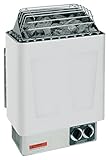 Harvia KIP 4.5kW Harvia KIP 4.5kW |
|
Check Latest Price |
 ZONEMEL 1500W 120V Dry Heater ZONEMEL 1500W 120V Dry Heater |
|
Check Latest Price |
 Harvia M3 Wood-Burning Stove Harvia M3 Wood-Burning Stove |
|
Check Latest Price |
| Mxmoonant 6kW Digital |
|
Check Latest Price |
 HUUM Hive Wood 13kW HUUM Hive Wood 13kW |
|
Check Latest Price |
 Woanger 350W Infrared Panel Woanger 350W Infrared Panel |
|
Check Latest Price |
 Harvia The Wall 8kW Harvia The Wall 8kW |
|
Check Latest Price |
 iTHERAU 1500W 120V Dry Heater iTHERAU 1500W 120V Dry Heater |
|
Check Latest Price |
 GoldenWave 2000W 110V GoldenWave 2000W 110V |
|
Check Latest Price |
 HUUM Drop 6kW Kit with UKU Control HUUM Drop 6kW Kit with UKU Control |
|
Check Latest Price |
1. VEVOR 6kW Wall-Mount Sauna Heater – Best Overall Value for Mid-Size Rooms
VEVOR Sauna Heater,220V Electric Sauna Stove, Steam Bath Sauna Heate 3h Timer and Adjustable Temp for Max. 176-318 Cubic Feet, Home Hotel Spa Shower Use (6KW) FCC Certification
6kW
220-240V AC
176-318 cu.ft
33 lb stones not included
230F max
Pros
- Fast heat-up with 25 minutes reported in a large room
- 304 stainless steel heating element
- Simple mechanical timer and temperature knobs
- Pre-drilled wall bracket
Cons
- Component failure reported around the one-year mark
- Timer and internal breaker are the recurring weak points
- Stones and wiring guidance not included
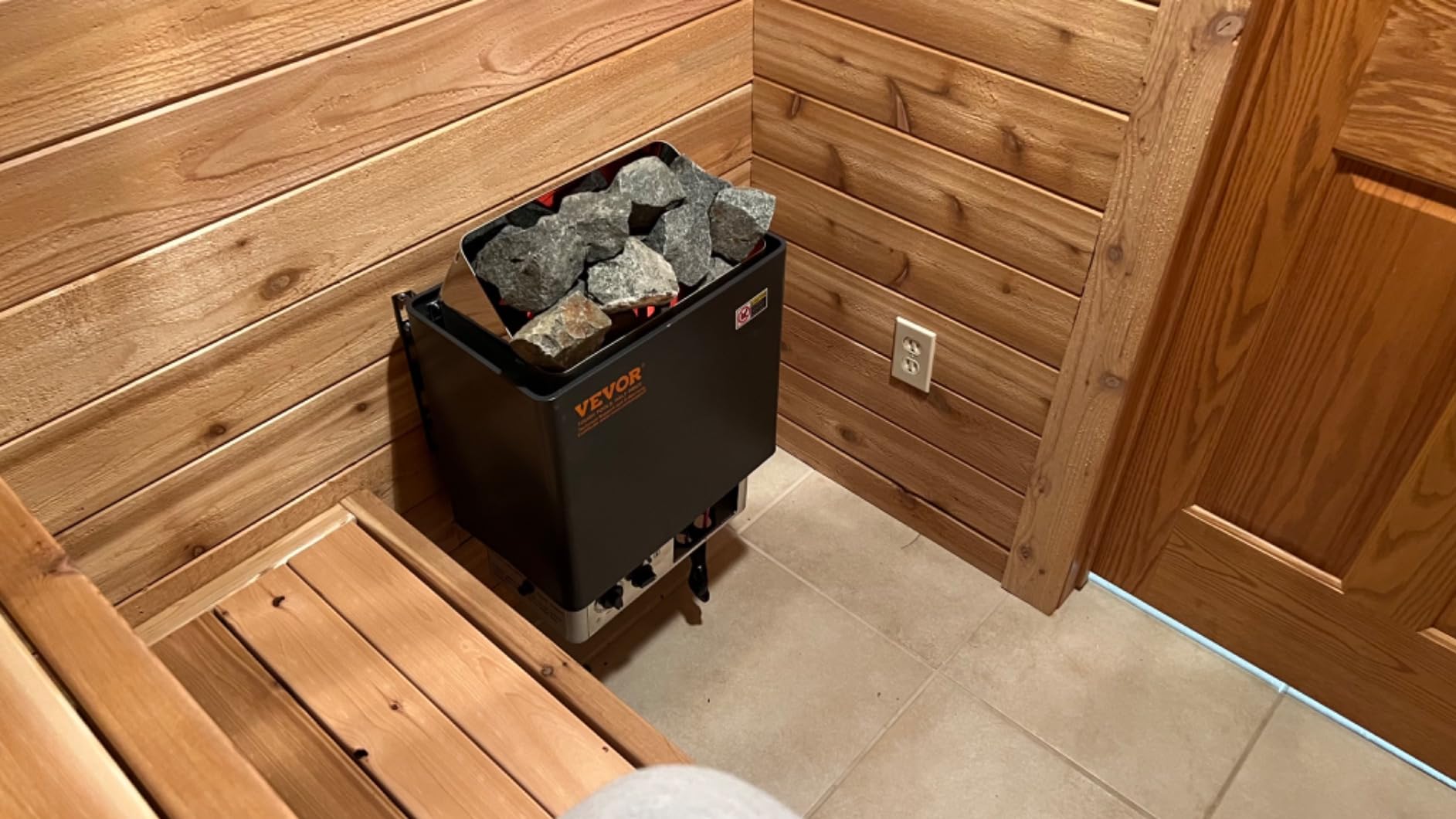
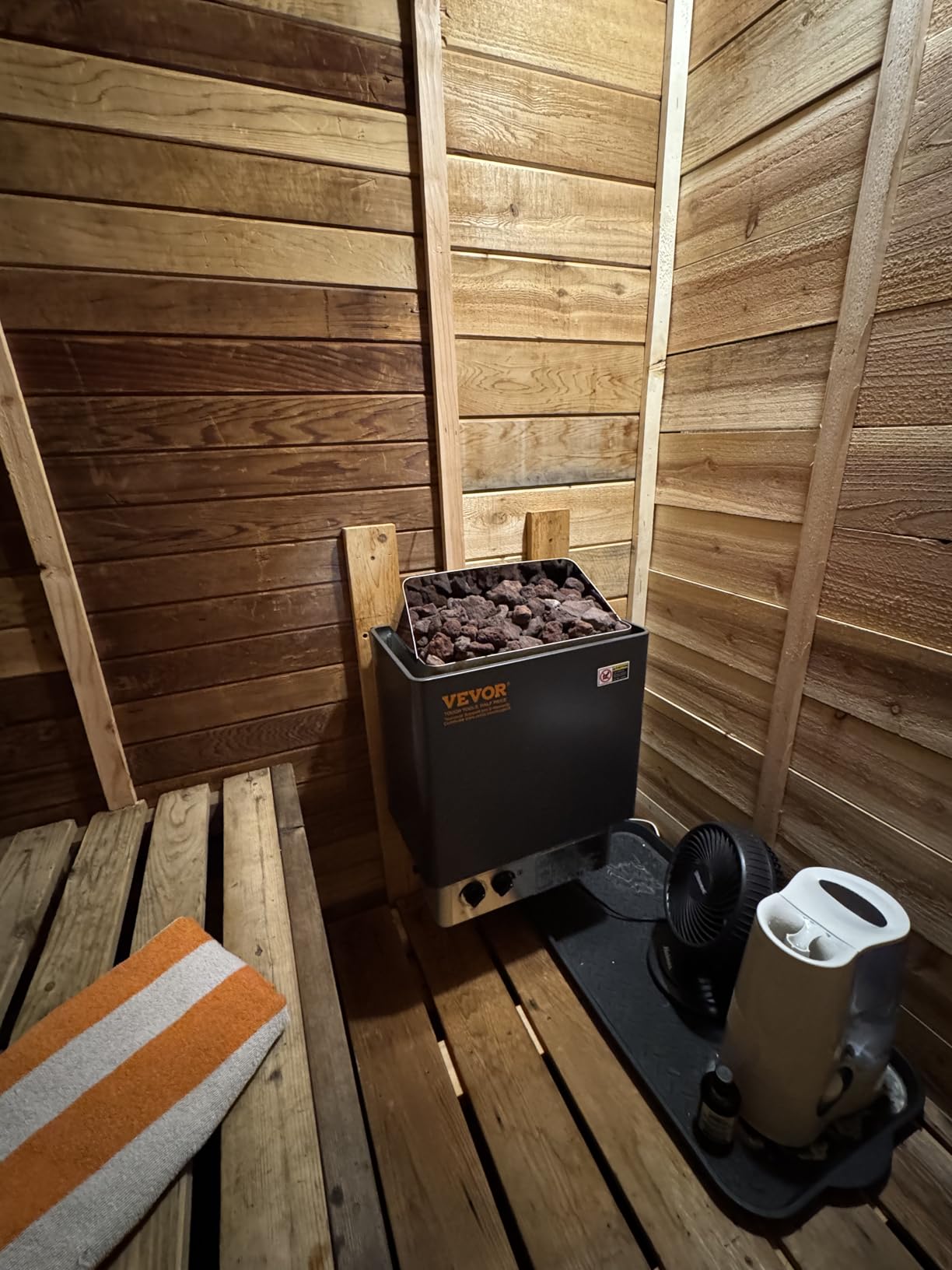
Our first pick is not the most famous name on the list, and that is the point. The VEVOR SCA-60NS puts out 6kW on 220-240V AC and is rated for 176 to 318 cubic feet, a band that lands almost exactly on a typical 8 by 8 foot residential cabin with a seven foot ceiling. Owners report reaching heat in about 25 minutes in a room at the top of that range, which is faster than most heaters in this group.
The build is more serious than the shell suggests. The heating element is 304 stainless steel rather than plain steel, and the shell is aluminized zinc for corrosion resistance, both sensible choices for a unit that lives in a wet room for decades. The 230F ceiling gives you headroom above the traditional 190F working temperature, and the mechanical knobs mean there is no control board to fail.
The honest drawback is durability data. Across the 87 reviews, the pattern in longer-term ownership is component failure around the one-year mark, and the parts most often named are the internal breaker and the timer. That is the reason this heater carries our top badge on volume of evidence and heat-up performance rather than on a clean reliability record, and it is why we would not fit it in a rental cabin you cannot easily get back into.
Two practical notes before you order. The 33 pounds of stones are not in the box, and stone choice is a genuine quality lever rather than a consumable, so budget for a proper igneous stone set. Several owners also found the wiring terminal positions non-obvious without guidance, which is another reason to have an electrician do the connection even if you are comfortable with the rest of the job.
Who the VEVOR 6kW suits best
This is the heater for a single-family sauna in the 176 to 318 cubic foot band, particularly if you are building new and want mechanical controls that cannot go wrong in software. It also works well as a second heater in a larger room, which is a common way to extend a sauna you have already outgrown.
Who should buy something else
If your sauna is a rental property, a business, or anywhere you cannot reopen walls after install, the one-year failure pattern argues for a model with a deeper parts and service network instead. Anyone without a 240V circuit available should not start here at all; this is a hardwired 6kW appliance with no plug.
2. Finlandia FLB-80 8kW – Best for Large Rooms and Long Ownership
Finlandia/Harvia FLB-80/KIP-80B Sauna Heater, 8kw 240v/1ph, Maximum 425 cubic feet
8kW
240V single phase
250-425 cu.ft
UL and ETL listed
49.2 lb
Pros
- Direct rock-to-element contact for soft even heat
- UL and ETL listed with serviceable stainless elements
- Built-in thermostat and 1-8 hour preheat clock
- Controls can be side-mounted after delivery
Cons
- Needs 240V single-phase wiring and circuit planning
- Covers only large rooms at 250-425 cu.ft
- Heavy at 49.2 pounds
The FLB-80 is the pick for a cabin in the 250 to 425 cubic foot range, and it is the one we would trust for a fifteen-year ownership horizon. It runs 8kW on 240V single phase and carries both UL and ETL listing, which matters more in practice than most buyers expect because it determines whether an inspector signs off and whether your electrician is comfortable with the install.
Its distinguishing feature is the exceptional rock capacity with direct contact between stones and elements. That arrangement is what produces soft, even heat rather than a hot spot at the front, and it is the difference you feel when you ladle water for löyly. The elements are industrial-grade stainless steel and are individually serviceable, which is the single best thing about this heater over its life.
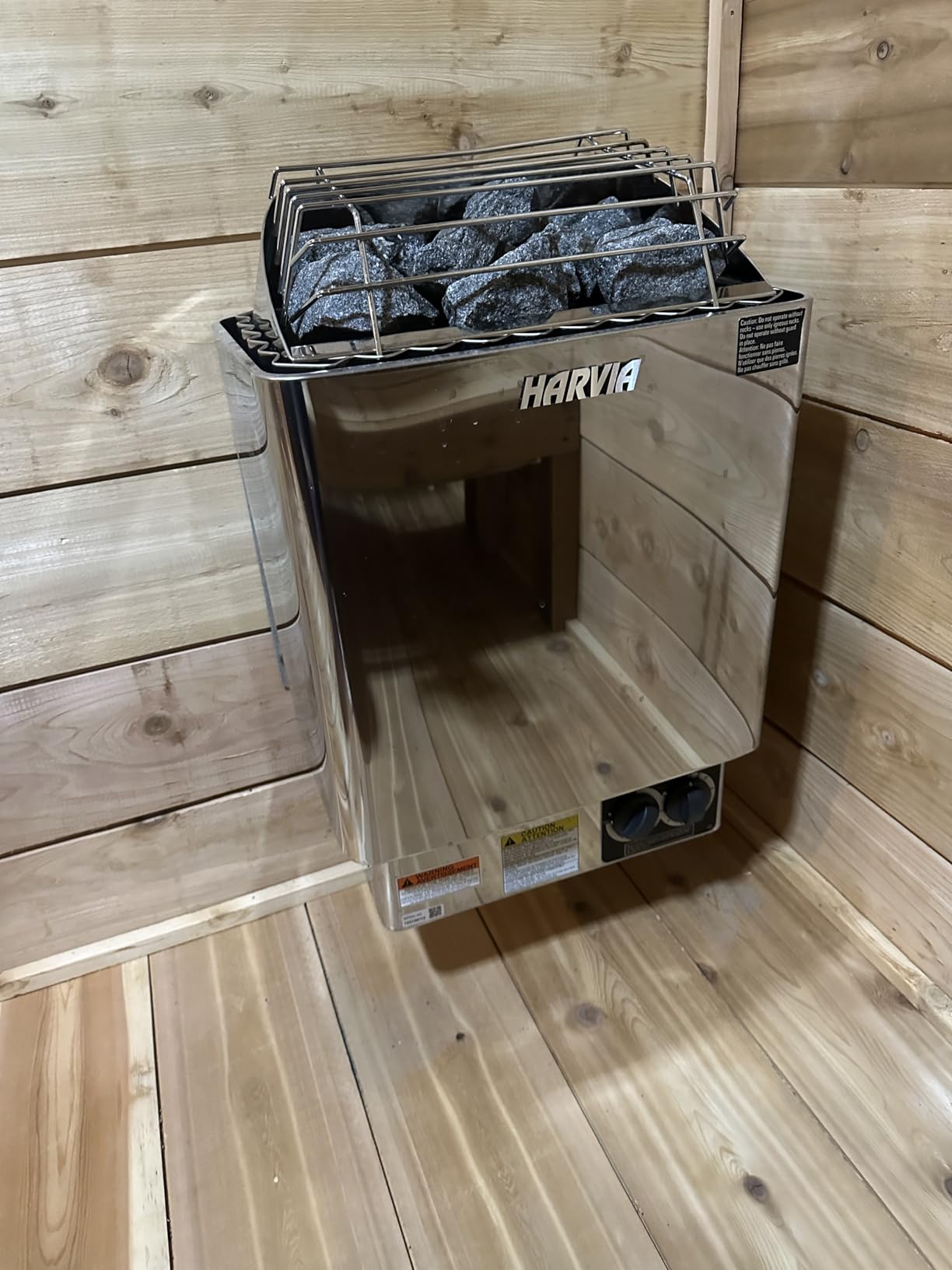
Controls are built in, with a silent 60-minute timer and thermostat for the session plus a programmable 1 to 8 hour clock for preheating, so you can start the sauna from the cabin and walk in to it already hot. If your wall layout does not suit the control position, they can be side-mounted in the field.
Be realistic about the two constraints. This is a large heater for large rooms, so a 150 cubic foot sauna will be cooked badly by it. And 49.2 pounds of stainless steel going up a wall, with a 240V single phase feed, is a two-person job with planning attached.
When the FLB-80 earns its price
It makes sense when your measured volume sits between 250 and 425 cubic feet, when you want a wet sauna with real löyly rather than a dry heat room, and when you plan to heat the same cabin for a decade. The preheat clock also makes it a good fit for a guest cabin where nobody is there to hit a button.
When it is the wrong pick
Skip it for small rooms, for any build where the 240V service is undecided, and for buyers who want a compact wall unit with a small stone load. If you want app-based remote starting instead of a preheat clock, look at the digital control pick further down.
3. Harvia KIP 4.5kW – Best for Small Residential Saunas
Harvia KIP 4.5KW, 240V-1PH Electric Sauna Heater With Built In Controls (Includes Sauna Stones)
4.5kW
240V single phase
18.8 amps
106-212 cu.ft
Stones included
Pros
- Sauna stones included in the box
- Compact 16 by 11 by 24 inch footprint
- Built-in controls keep wiring simple
- Stainless steel body made for residential use
Cons
- Smallest room range in the Harvia electric range
- Lowest average rating among the Harvia electric models here
- Curbside delivery means third-party placement
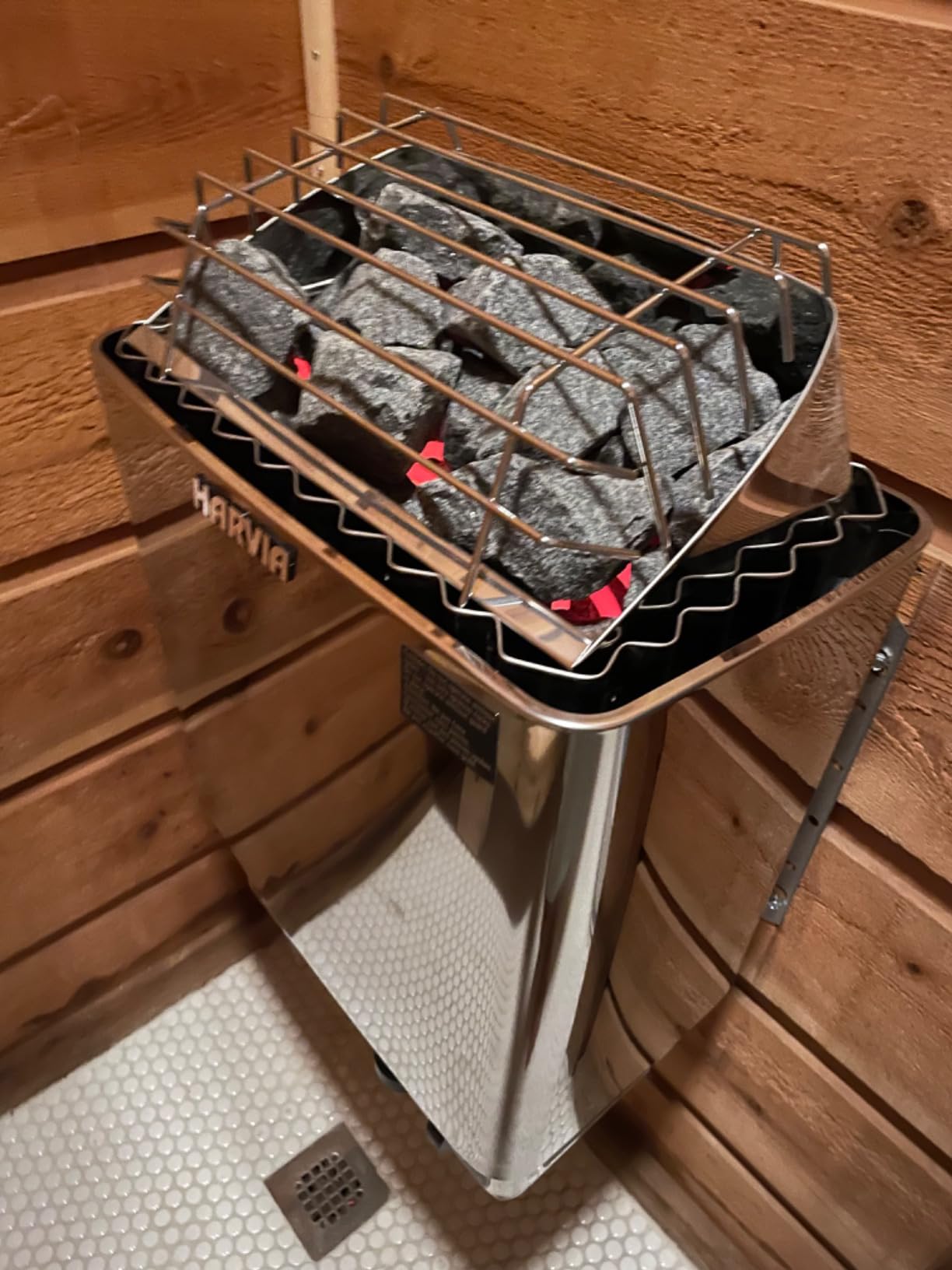
The Harvia KIP at 4.5kW is the compact residential unit, rated for 106 to 212 cubic feet and drawing 18.8 amps on 240V single phase. At that amperage it is the pick with the least demanding electrical requirement of the wall-mount group, which makes it a sensible first heater for a room where panel capacity is the real question.
Two things stand out for a first-time buyer. The sauna stones ship in the box, which removes one whole line item and one afternoon. The body is stainless steel and the controls are built in, so there is no separate control panel to position, wire, or program before the sauna will switch on.
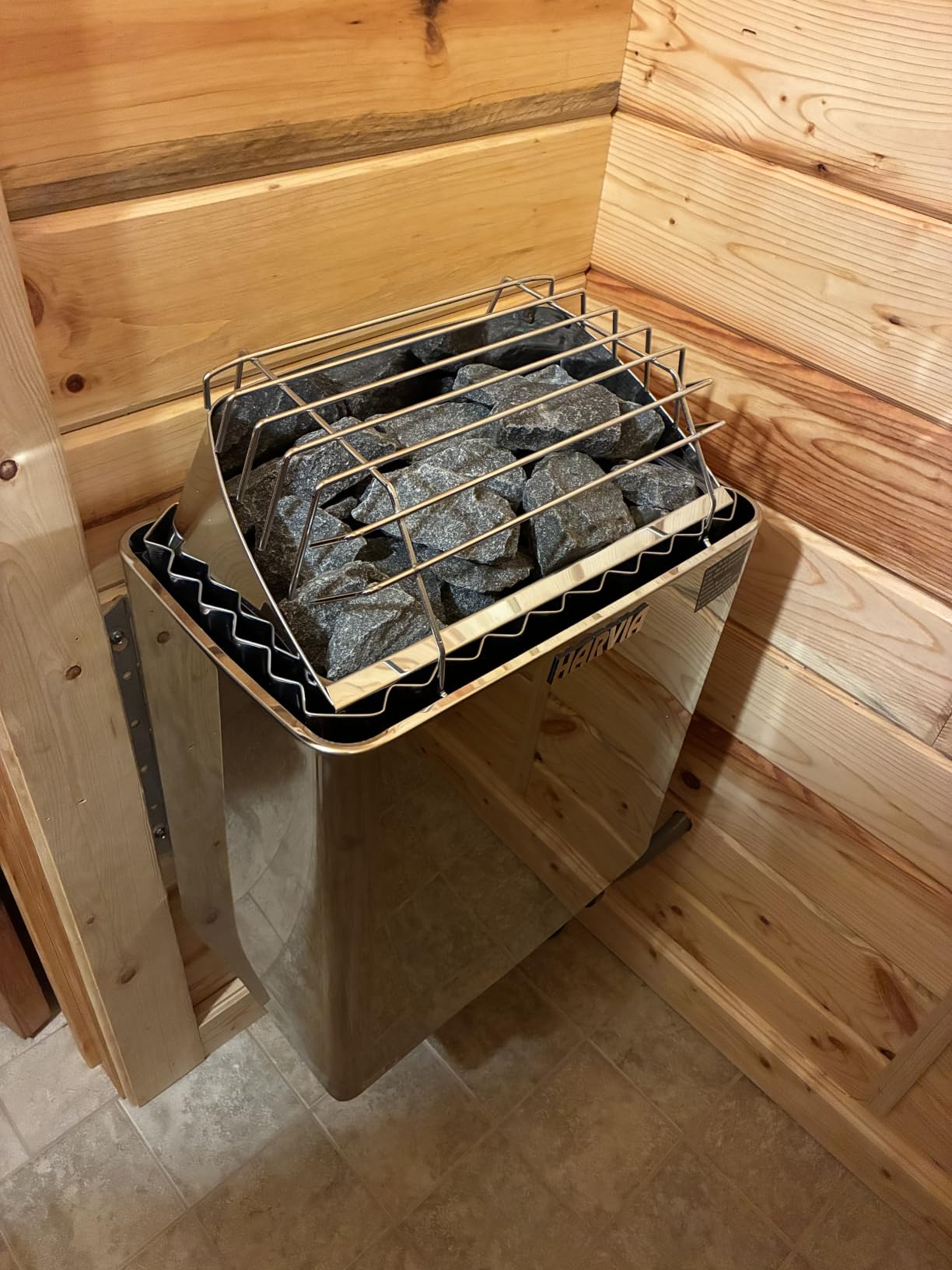
The rating is the weakest of the Harvia electric models in this roundup, and the review base is small at 30 with a noticeable share of one-star feedback. Sentiment is generally positive on build quality and the included stones, but the sample is thin enough that we would treat this as a room-and-budget pick rather than a long-term confidence pick.
One delivery detail catches people out. This unit arrives curbside, and moving it from the street to its position on your property is on you, so plan for a second person or a dolly before the truck arrives.
Where the KIP 4.5kW works
A 106 to 212 cubic foot room is a two-person cabin, a small garden build, or an existing shed lined out properly. If you are working in a house with a modest panel and a short breaker run, the 18.8 amp draw keeps the electrical conversation much simpler than an 8kW unit.
Where it falls short
It will not heat a 300 cubic foot room to temperature in reasonable time, and the stone load is modest compared with the Finlandia, so löyly will be lighter per ladle. Buyers chasing the biggest stone mass per kilowatt in a small room should look up the list rather than settle here.
4. ZONEMEL 1500W 120V Dry Heater – Best Plug-In Add-On for Tent Saunas
Portable Dry Hot Air Heater, 1500W Electric Dry Heater for Portable Sauna
1500W
120V plug-in
Up to 158F
2.86 lb
Dry air no stones
Pros
- Plugs into a 120V outlet with no wiring at all
- Weighs 2.86 pounds so it moves between rooms
- Fahrenheit and Celsius toggle on the display
- Adds useful heat to a tent or box sauna
Cons
- Cycles through brief cool-down periods before reheating
- Real-world temperatures reported near 147-158F
- Not a heater for a built cabin
This is not a sauna heater and we want to be clear about that before anyone buys it by mistake. The ZONEMEL is a 1500W 120V dry air heater built for portable tent and box saunas, and its job is to add a few degrees to a soft enclosure that already has some insulation. It reaches up to 158F, and owners report real readings nearer 147 to 158F inside the tent.
What it does well is convenience. At 2.86 pounds and 7.9 by 6.7 by 6.3 inches it is genuinely portable, and it runs from an ordinary household outlet with no circuit work. Several owners use it as a supplementary unit alongside whatever the tent shipped with, where its small size and low draw are the whole point.
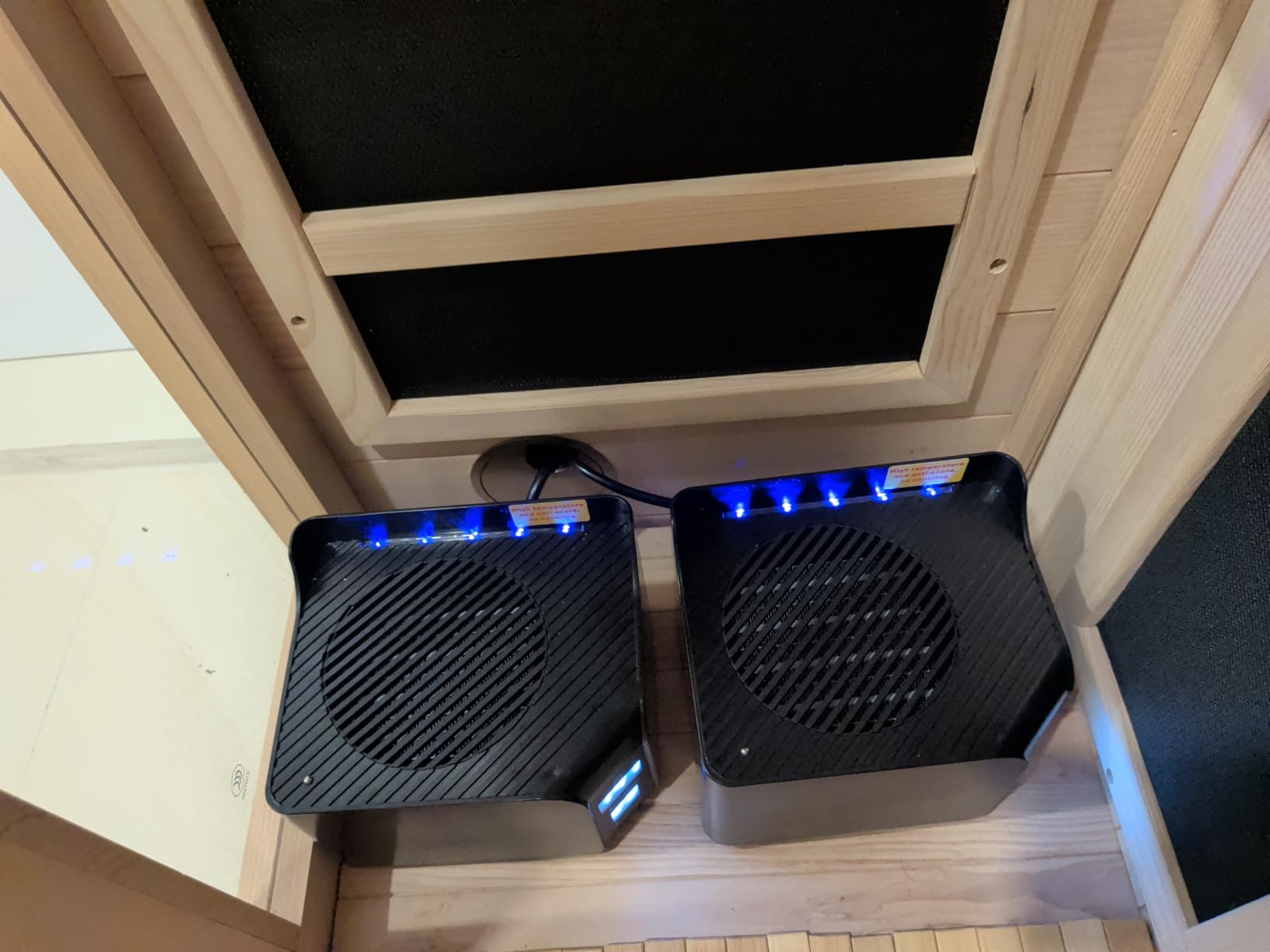
The design has no stones and no water path at all, so there is no löyly to speak of and nothing to replace. The temperature display toggles between Fahrenheit and Celsius by holding the plus and minus keys for three seconds, which is easier than it sounds to use once you know it.
Understand the cycling behaviour before you decide. The outlet runs hot during use, and the unit drops into brief cool-down periods before reheating, so the temperature inside a tent moves rather than sitting flat. In a loose fabric enclosure that swing is exactly what you feel.
Who this heater is for
Anyone with a portable sauna tent, a sauna blanket setup, or an insulated box who wants more heat without touching their panel. It is also a sensible second heater for a small enclosure that loses temperature fast in winter.
Who should skip it
Do not put this in a timber sauna room, a barrel, or a container build. It cannot heat a real enclosure, it produces no steam, and it is not a path to a 190F wet session. If you are building a fixed sauna, the money goes far better on a 240V unit with a stone load.
5. Harvia M3 Wood-Burning Stove – Best for the Wood-Fired Experience
Harvia M3 Woodburning Sauna Heater
16.5kW wood fired
212-459 cu.ft
100 lb floor standing
Stones and ash box included
Pros
- 16.5kW output with a visible fire behind the glass door
- Stainless steel air-flow spoiler and a solid door seal
- Stones and ash box included in the box
- Graphite black finish suits cedar interiors
Cons
- 100 pounds so freight handling is needed
- Requires a chimney and fire clearances
- Manual tending and ash removal every session
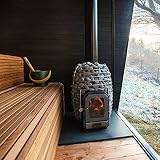
The Harvia M3 is the wood-burning pick, and it delivers the part of the sauna experience an electric heater cannot: a real fire, a chimney, and the sound and smell of splitting wood. It outputs 16.5kW which is 15777 BTU, covers rooms of 212 to 459 cubic feet, and stands on the floor rather than mounting to a wall.
The build is the story here. A stainless steel air-flow spoiler manages the draw, the door seal and latch are described consistently as solid across reviews, and the glass door lets you see the fire, which is half the reason to go wood-burning in the first place. The stones, the ash box, and the manual are all in the box.
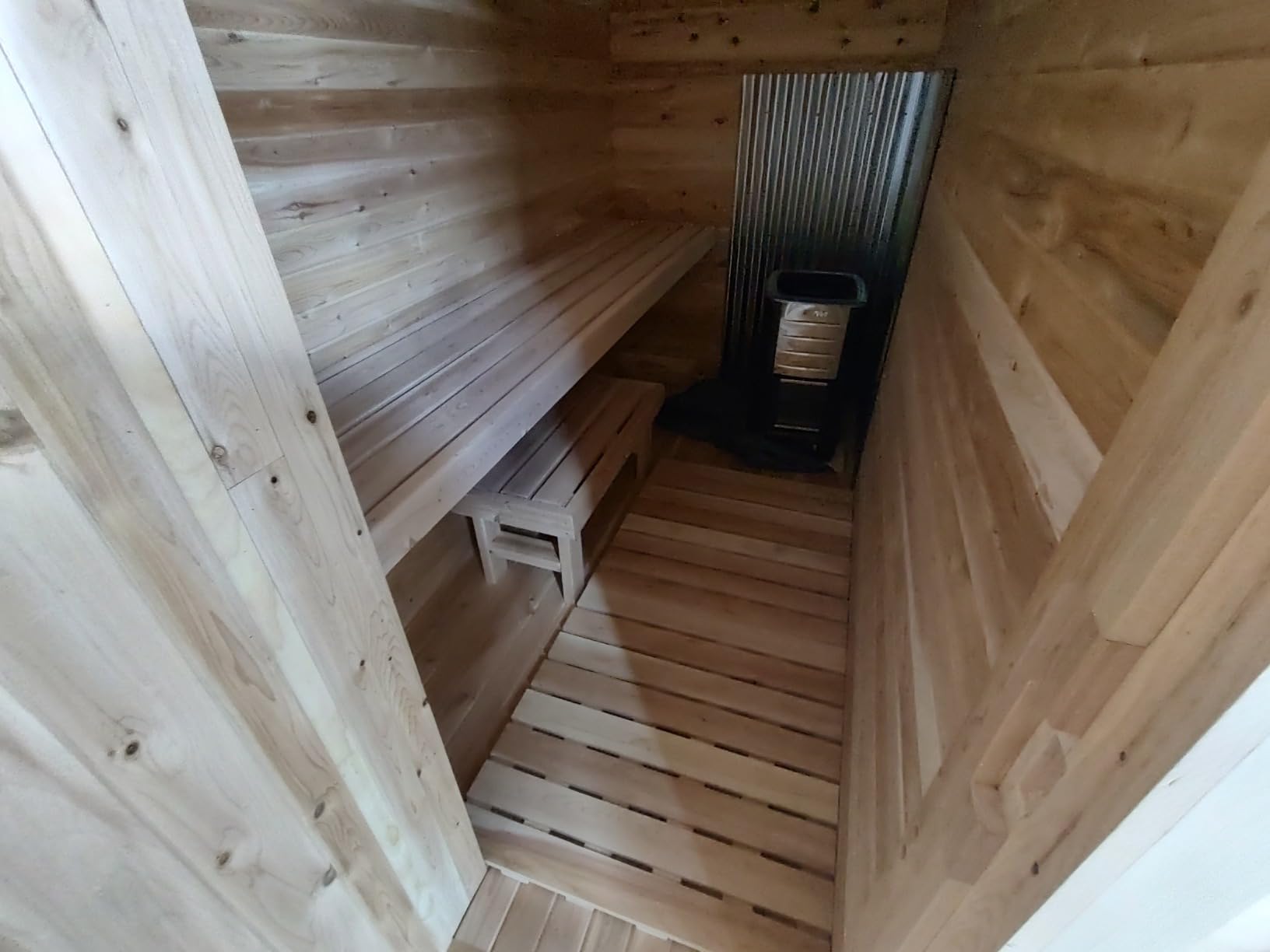
Buyers should read the warranty terms properly. This carries a limited two-year consumer warranty and a six-month commercial warranty, so it is a different contract from what an electric model with a five-year body warranty offers. If you plan a commercial or shared sauna, that difference matters more than the feature list.
Weight is the logistics fact. At 100 pounds this arrives as freight and needs a real plan to get from the driveway to the sauna floor. Wood fuel also means a chimney system sized to the appliance, fire clearances, a permit in many jurisdictions, and someone tending the fire for an hour before and during the session.
When wood heat is the right call
Choose wood when the session is the point, not the temperature. It suits an off-grid build, a remote cabin, a property where running a new 240V circuit is impractical, and anyone who wants a sauna they light themselves and let burn down. It also pairs naturally with an electric unit for weekday convenience.
When it is the wrong call
Skip the M3 if you want a sauna that heats itself to a set temperature while you are still at work, if nobody will tend the fire, or if your property cannot take a chimney. Run a 100 pound stove and a flue in a room without planning is how people end up with a smoke problem and no heat.
6. Mxmoonant 6kW Digital – Best With a Digital Readout
Mxmoonant Sauna Heater, 6KW 220V Electric Sauna Heaters Digital Control
6kW
220V
170-300 cu.ft
30-40 lb stones not included
840 stainless elements
Pros
- Built-in digital display shows live temperature
- Wall-mounted so bench and floor space stay clear
- Good heat output reported in an 8x8 home build
- Setup instructions reviewers found clear
Cons
- All five screws must come off to reach the control board
- Stones and plug are not included
- One report of total failure after about 10 uses
Most heaters in this roundup use analog knobs or a separate control panel. The Mxmoonant puts a digital display on the heater itself, showing real-time temperature, which is the closest thing to app control you get at this level without a separate module. It runs 6kW on 220V and covers 170 to 300 cubic feet, again landing on a typical residential cabin.
The elements are 840 stainless steel, and the reviews describe fast and even heating in an 8 by 8 foot home build, which is a credible data point for anyone sizing on that footprint. The wall-mounted format keeps the floor clear under the benches.
Two things to weigh. The heater is hardwired with no plug included, and a licensed electrician is the recommendation. More awkward still, the digital control cover requires all five screws to be removed to access the board, so any adjustment means partly disassembling the front of your sauna heater.
When the digital display earns its place
It suits people who like a number rather than a guess, particularly for keeping a consistent temperature between two people bathing together, or for anyone who does not want to mount and wire a separate control panel on the wall of a small room.
When to look elsewhere
The 12-review base is small, and it includes at least one report of complete failure after around ten uses, so durability evidence here is thinner than anywhere else in the group. If your priority is proven longevity over display convenience, the Finlandia or the HUUM kit have more ownership history behind them.
7. HUUM Hive Wood 13kW – Best for the Biggest Stone Load
HUUM Hive Wood 13 kW Sauna Stove, 198 pounds of Rounded Olivine Stones Included (for saunas Between 210-460 cu ft.)
13kW wood fired
212-459 cu.ft
198 lb stones included
Stainless steel
3-year warranty
Pros
- 198 lb stone load that holds heat after the fire dies
- Engineered firebox burns cleanly on less wood
- Stainless steel body finished only with natural oils
- 3-year residential warranty
Cons
- One reviewer reported thin metal glowing under load
- Small hardware was missing on delivery
- Highest spend in this roundup
The Hive Wood is the stone-dominant pick: 13kW of wood-fired output with 199 pounds of rounded olivine stones included, for rooms between 210 and 460 cubic feet. Owners consistently describe stones that stay hot for up to an hour after the fire has died down, which is the practical difference between a heavy stone mass and a light one.
Design-wise it is the most attractive object in the roundup. The firebox structure is engineered to raise output while cutting wood consumption and emissions, the stones sit in direct contact with the heat source for even heat, and the steel is treated only with natural oils rather than a sprayed finish that would off-gas into the room.
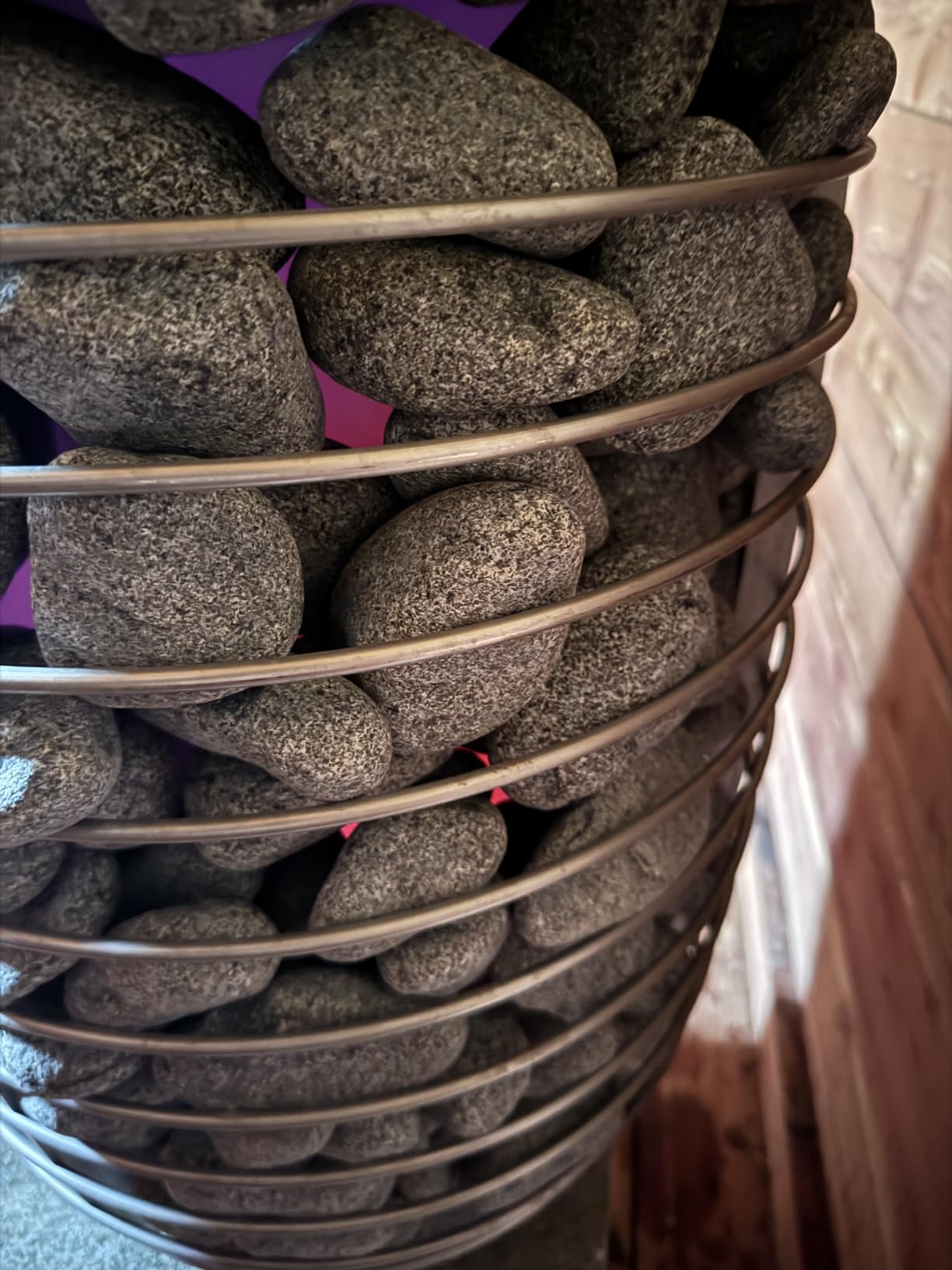
Warranty is better than the other wood pick here, at three years residential against two. The 7-review base is the problem. One reviewer reported the metal glowing with minimal flame and possible distortion of the firebox, and another found small hardware missing on delivery, and both of those are the kind of detail you cannot resolve with a thin sample.
We would note that a glowing firebox is a real question to put to the seller before you commit, and that a wood stove of this size belongs in a room with a properly sized flue and a floor that can take the weight.
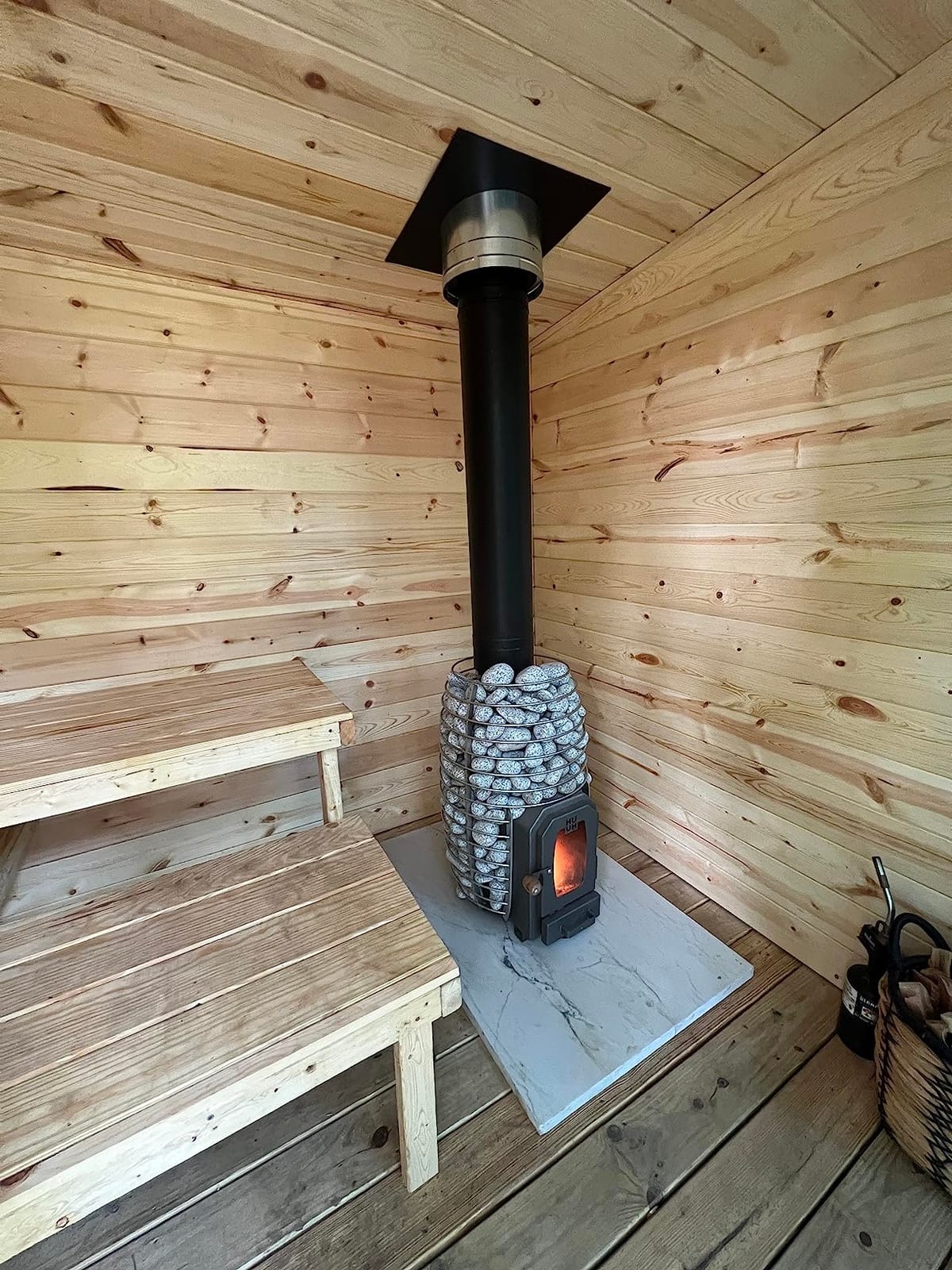
Why the Hive Wood is worth the spend
Stone mass is the actual quality lever in a sauna, and this heater has more of it than anything else here by a wide margin. If your priority is the softest possible löyly and long sessions that stay hot after you stop feeding the fire, this is the direct answer.
Why it is not for everyone
It is the highest spend in the roundup, needs a chimney and fire clearances like any wood stove, and carries the thinnest review evidence. Buy it when the room is large, the budget is real, and you want a visible stove as a feature rather than a hidden heat source.
8. Woanger 350W Infrared Panel – Best for Retrofitting an Existing Sauna
Woanger 1 Pcs Infrared Sauna Heater Panel 120V Far Carbon Fiber Heat Plate
350W
120V
Hardwired
81 by 23 by 5 cm panel
2 inch profile
Pros
- Slim panel sits flush inside wall studs
- Thickened reflector improves output and stability
- Useful for supplementing an existing sauna
- Booklet includes placement and layout diagrams
Cons
- Hardwired with no plug cord or controller included
- 350W per panel needs several for a room
- Basic construction outside the wood trim
This is a far-infrared panel and not a conventional sauna heater, so we include it with a clear label rather than dropping it. It is a 350W 120V carbon fiber panel that mounts flush in a sauna wall, and the useful case is retrofitting: adding gentle radiant heat to an existing cabin without taking up bench space or running a heavy circuit.
The profile is the reason it works in a built room. At roughly 2 inches thick it sits between studs without intruding into where people sit, and the metal reflector has been thickened for stability and efficiency. Owners building their own cabins single out the instruction booklet, which includes layout and placement diagrams.
Limitations are obvious once you look at the numbers. At 350W per panel you need several for a real room, and there is no plug, no power cord, and no controller in the box, so a qualified electrician has to tie it into an existing sauna control panel.
Where a panel like this helps
It suits a builder who wants a low-profile heat source in a shallow wall build, or a retrofit for a small cabin that needs a little more radiant warmth. It is also cheap to add incrementally, one panel at a time.
Where it will disappoint
Panels produce no löyly and no stones, and they warm surfaces rather than air. If you want a traditional wet sauna at 190F with dense steam, this is the wrong technology, whatever the listing calls it. We cover the difference in our infrared sauna roundup.
9. Harvia The Wall 8kW – Best Bench-Integrated Design
Harvia The Wall Electric Sauna Heater, Black, 240V, 8kW
8kW
240V single phase
33.3 amps
Up to 423 cu.ft
Stones included
Pros
- Bench integration frees up floor and seating space
- Illuminated controls with built-in overheat protection
- Stone protector fitted as standard
- Sauna stones included in the box
Cons
- Needs 240V service and about 33 amps
- 75 pounds to handle during install
- Only 5 reviews for long-term data
The Wall solves a real space problem. At 8kW and rated up to 423 cubic feet it has the output of a large cabin heater, but the installation integrates it into the bench structure so it occupies no floor space of its own. The controls are illuminated, which matters in a dark changing room, and overheat protection and a stone protector are built in.
It draws 33.3 amps on 240V single phase, so this is a serious electrical commitment, and the unit weighs 75 pounds, which is the heaviest electric heater here. You can install it left or right handed depending on your bench layout, and the direct rock-to-element contact supports even heat distribution.
We want to be straight about the evidence. Five reviews, all positive, and a 4.7 average, is a thin sample for a decision this expensive. The rating is the highest in the roundup, but a 4.7 across five owners tells you less about year ten than a 4.6 across 86 does.
When the bench design is the deciding factor
Choose it when floor area is tight, when the heater should be visually integrated into the bench rather than standing in the room, and when you want stones and controls supplied as one package with a 240V feed already planned.
When to pick a different heater
It is not the right unit for a room under 250 cubic feet, and it is not the right choice if you want deep ownership history behind the design. For those, the Finlandia FLB-80 covers the same output band with a far larger base of real-world use.
10. iTHERAU 1500W 120V Dry Heater – Best for Portable Sauna Boxes
Dry Sauna Heater 110V – 120V, Portable Hot Air Heater for Sauna Tent
1500W
110-120V
68F-155F range
0-99 minute timer
1 lb
Pros
- One pound and easy to carry between rooms
- Clip mount fits sauna box steel tubes
- LED display for temperature and time
- Dry heat with no water or steam mess
Cons
- Maximum temperature is capped at 155F
- Only 5 reviews from a short recent window
- 1500W is not meant for a full-size room
Where the ZONEMEL is a general dry heater, the iTHERAU is designed around a specific fixture: it has a clip mount that attaches to the steel tube of a portable sauna box. At one pound and 8.7 inches square, it is the most portable unit in the roundup, and owners report a tent or box reaching around 150F within minutes.
Controls are a small LED display for temperature and time, with an adjustable 68F to 155F range and a 0 to 99 minute timer. The housing uses heat-resistant materials, and the air outlet runs hot during operation, which is normal for this style of unit.
Two limits. The 155F ceiling is a hard cap, so it will not produce a traditional sauna temperature, and the review base is five entries from a short recent window, which is exactly the kind of data we would not build a purchase decision on for a fixed room.
Where the clip mount earns its place
It is for a specific box or tent with a steel tube frame, or for anyone who wants a spare heater to keep in a cupboard and clip in when needed. The one-pound weight means it is genuinely easy to move between a bedroom, a garage, or a spare room.
Where it does not apply
It is not a heater for a built sauna room, a barrel, or a container, and the 155F ceiling means no 190F session. If you need serious heat in a real enclosure, spend the money on one of the 240V units above.
11. GoldenWave 2000W 110V – Best for Homes with No 240V Service
GoldenWave Far-Infrared Sauna Heater 110V/ 2000W with Plug for Home Sauna
2000W
110-120V plug-in
35-140 cu.ft
1-2 people
Canadian hemlock
Pros
- Plugs into a household outlet with no electrician
- Stone-free and waterless so nothing needs replacing
- Touch panel plus app preheating from outside
- Cool-touch hemlock shell with tip-over shutoff
Cons
- Only rated for 35-140 cu.ft and 1-2 people
- Only 4 reviews limit reliability data
- 1-year warranty is short against premium brands
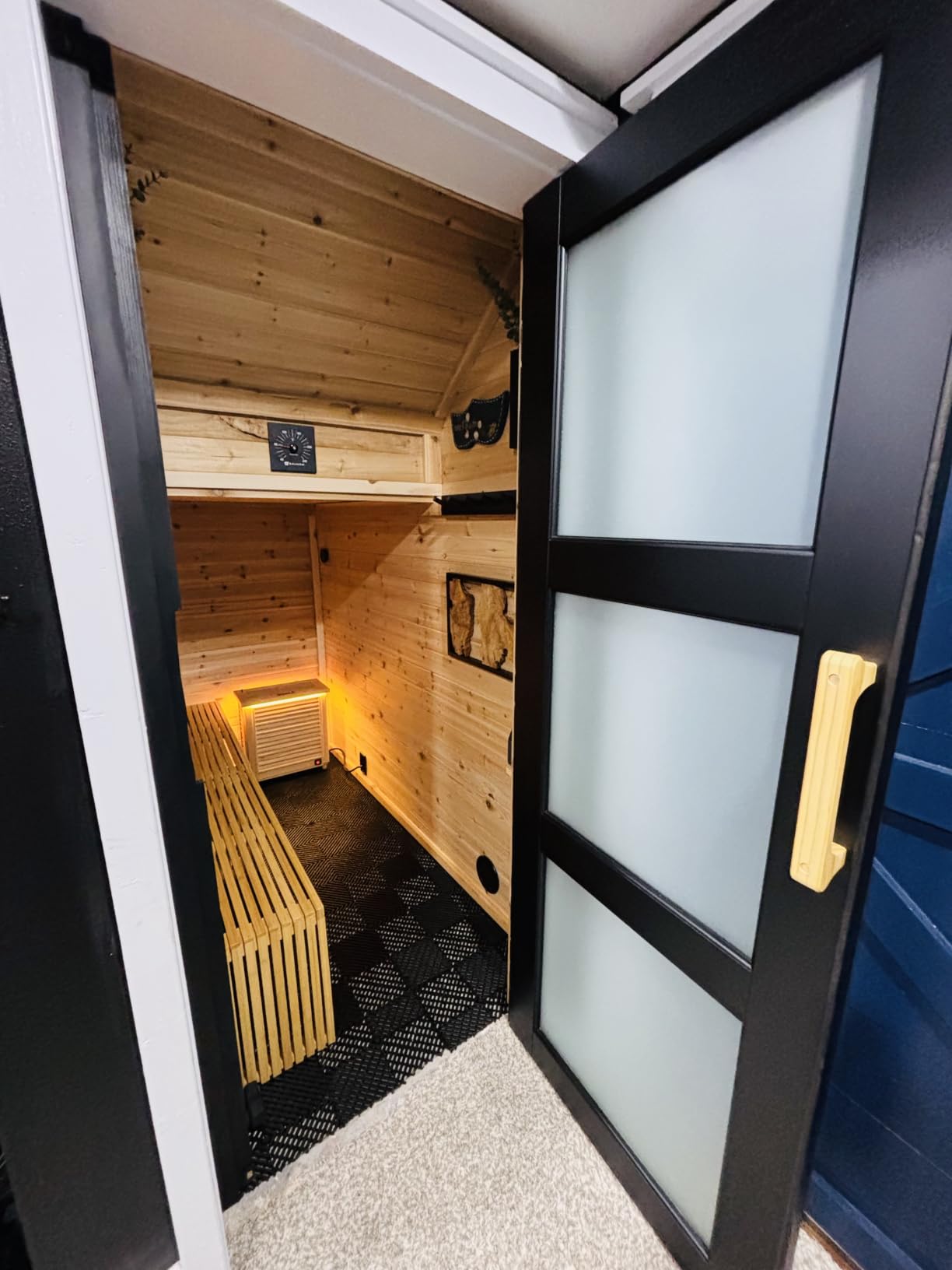
The GoldenWave solves the hardest version of the problem: a sauna in an apartment, a basement with no 240V run, or a rental where touching the panel is not an option. It is a 2000W far-infrared graphene heater that plugs into a standard household outlet, rated for 35 to 140 cubic feet and one or two people.
Because it is stone-free and waterless, there is nothing to replace and no water to manage, which suits small urban spaces. The controls are a touch panel plus a smartphone app with timers, so you can start the heat from outside the room, and the outer shell is natural Canadian hemlock that stays cool to the touch with tip-over auto shutoff and 150C overheat protection.
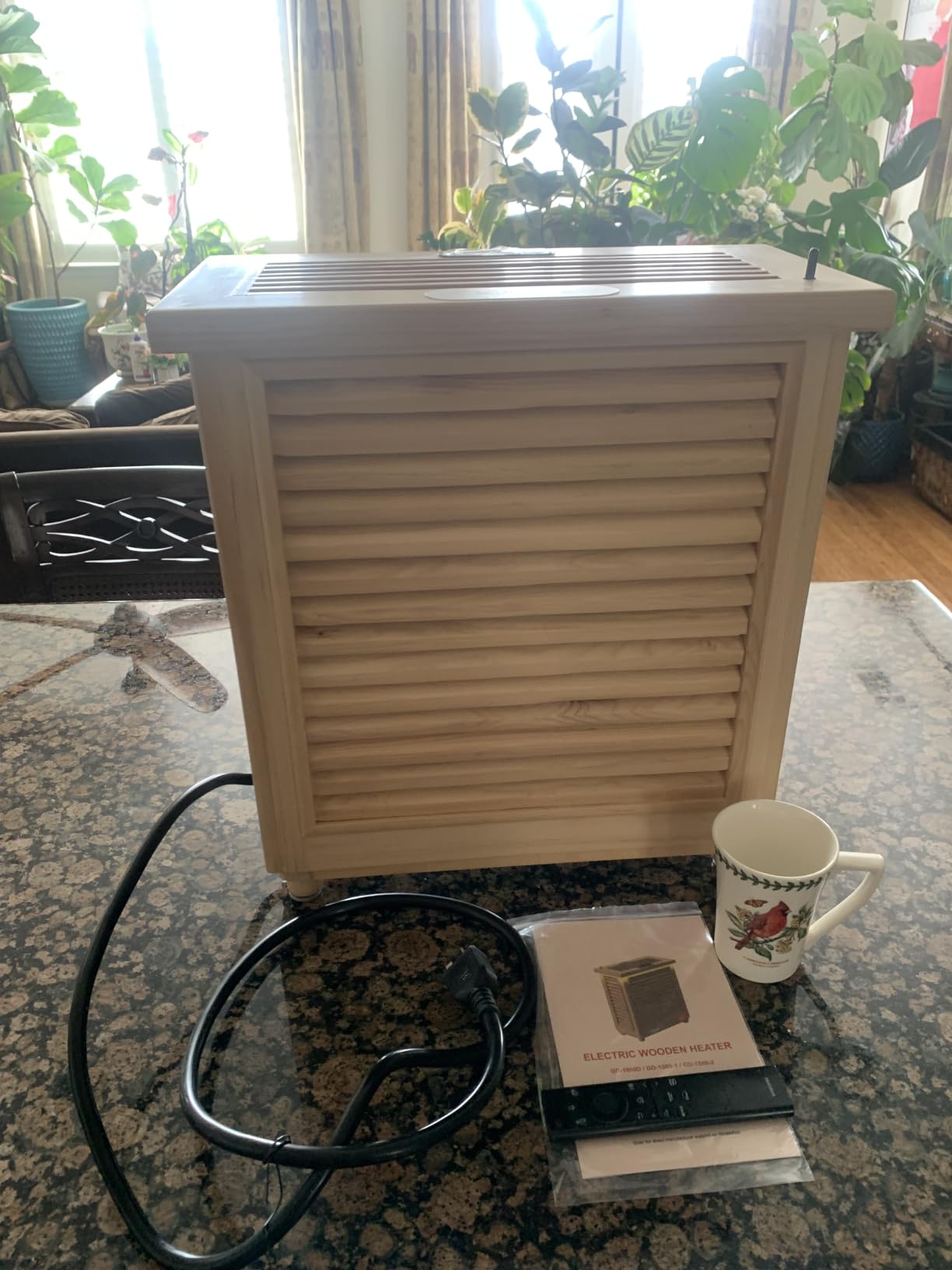
Read this as a small-room appliance rather than a sauna heater on the low end of a range. The 140 cubic foot ceiling and one-to-two-person rating define it completely, and it is also usable as a space heater or a clothes dryer, which tells you where its design comes from.
The warranty is one year, which is the shortest in this roundup, and there are only four reviews. Both are reasons to think of it as a convenience purchase for a small space rather than a long-term sauna investment.
Who this is genuinely for
A couple, a small apartment unit, a basement corner, or a guest room where running a 50A circuit is simply not happening. It is also the rare sauna product you can unbox and use the same afternoon with no installer.
Who should keep looking
Anyone building a real sauna room, anyone who wants a 190F wet session with löyly, and anyone hoping for a wood or steam experience. The technology is different by design, and no amount of wattage turns it into a conventional heater.
12. HUUM Drop 6kW with UKU Control – Best Complete Kit
HUUM Drop Series Sauna Heater with UKU Control Bundles (Sauna Stones Inlcuded) (6kW – Local – Black)
6kW
240V single phase
25 amps
30A breaker
177-353 cu.ft
Full kit
Pros
- Arrives with stones bracket control panel and sensors
- UKU Local panel sets temperature and time on site
- Water drop design exposes more stones for milder heat
- Limited 5-year warranty on the body
Cons
- Highest spend in this roundup
- Only 2 reviews available
- Installer must supply the main feed wire
The HUUM Drop is the most complete package here, and package contents are the single most common disappointment in this category. This kit includes the heater, the UKU Local control panel, temperature and door sensors with cabling, the main control module, the wall display, the mounting bracket, and the sauna stones. There is one box to open and one system to learn.
On paper the electrical spec is the cleanest in the roundup: 6kW on 240V single phase drawing 25 amps, which is a 30 amp breaker, on 10 AWG conductor. The room range is 177 to 353 cubic feet, and the same model is available at 4.5, 7.5, and 9kW if your volume lands outside that band.
The water drop design leaves more of the stone mass exposed, which is how you get milder heat that lasts longer with less water thrown on it. The UKU Local panel adjusts temperature and heating time on site without any network connection, so it works standalone.
Two honest notes. The installer has to supply the main voltage feed wire, so the package is complete on the control side but not on the wiring side. And the warranty is limited to five years excluding elements, which is worth reading as a partial warranty rather than a blanket one.
Why the kit format is worth paying for
Forum buyers repeatedly report the trap of a package arriving without its controller, or a listing that states a voltage the unit does not have. This one has the panel, the sensors, the cabling, the bracket, and the stones, which removes an entire class of install-day problem.
Who should choose something else
With only two reviews, this is the thinnest evidence base in the roundup, and it costs the most. It is the right buy if you want the design and the complete kit and you accept that, but if your priority is proven long-term reliability on a budget, the Finlandia and Harvia models have far deeper ownership histories.
How to size a sauna heater (2026)
Size a home sauna heater at roughly 1 kW per 45 cubic feet of room volume, then add 1 to 2 kW if the room has a glass door, masonry walls, tile, or an uninsulated concrete floor, and round up to the next listed model whose manufacturer room range covers your adjusted volume. That single line is the whole method, and the five steps below are how you apply it correctly.
The 1 kW per 45 cubic feet figure is a starting point, not a law. It assumes a well-insulated room with a normal amount of glass and a wood-lined interior. A sauna lined in plywood loses noticeably less than one lined in brick, and a floor poured directly onto concrete loses a lot more than one raised on joists.
1. Measure the room in three dimensions and multiply. Length times width times height gives cubic feet. A sauna with a sloping roof or a loft should use the average height, not the peak.
2. Add your heat loss. One glass door is worth about 1 kW of extra capacity. Masonry, brick, or concrete walls add more, as does a concrete slab floor. Insulated wood panel on studs loses very little.
3. Divide by 45 and read the result as kilowatts. An 8 by 8 by 7 foot room is 448 cubic feet before adjustments, which is close to 10 kW of nominal demand before glass.
4. Check the result against the manufacturer’s stated room range for each model, and discard any heater whose range does not cover your adjusted volume. The range is a real limit set by the element size and the stone mass, not marketing copy.
5. Verify your electrical capacity before you buy, not after. A heater you cannot feed is not a bargain at any price. This is the step most skipped and the reason most returns happen.
One warning about oversizing. A heater far larger than the room cycles on and off in short bursts, the rocks bake rather than soak, and the thermostat overshoots. Sizing to the top of the stated range is right; sizing well past it buys you nothing except a faster electric bill.
What the 200 rule means for a home sauna
The 200 rule is a residential code and safety limit, not a sizing rule. It caps residential sauna ceiling height at 7 feet, with 6 feet 6 inches of clear height above the bench, and 200 cubic feet is the common maximum residential volume that follows from it. Above those limits you are into commercial territory with different construction and electrical requirements.
Where it bites hardest is ceiling height. If you build a sauna with a 9 foot cathedral ceiling in a home, you are outside residential guidance for that ceiling height, and an inspector can require you to bring the ceiling down. Check local code before you frame the roof.
What electrical service do you need for a sauna heater?
Almost every home sauna heater needs a dedicated 240V single phase circuit on its own two-pole breaker, sized at roughly 4.2 amps per kilowatt, and no other equipment shares that circuit. A sauna is treated as a continuous load in most jurisdictions, which is why the breaker has headroom over the heater’s running draw.
Here is the mapping, using the heaters in this roundup as the reference points. Multiply any wattage by 4.2 to get running amps at 240V, then size the two-pole breaker above that number, and confirm the wire gauge with your electrician because it depends on run length and local code.
1.5kW to 2kW units: 6.3 to 8.4 amps. These are 120V plug-in products such as the GoldenWave, and they need nothing more than a household outlet.
4.5kW: 18.8 amps, as the Harvia KIP shows. Typically a 30 amp two-pole breaker.
6kW: 25 amps, which is the HUUM Drop figure, and a 30 amp breaker. The VEVOR and Mxmoonant in this roundup sit in the same band, so a 6kW install is the most common residential upgrade.
8kW: 33.3 amps, as the Harvia The Wall lists. Typically a 40 amp two-pole breaker.
9kW: about 37.5 amps, and this is the answer to the most-asked sizing question in this category. A 9kW heater needs a dedicated 50 amp two-pole breaker on its own circuit, never a shared one.
Before you order anything, open the panel cover and count what is there. You need a free double-width slot for the two-pole breaker, and you need the panel to have the spare capacity for the load, not just the slot. Panels in older homes are frequently full, and the fix is a subpanel rather than a bigger breaker on an existing circuit.
Two things homeowners get wrong that electricians correct constantly. The first is putting a 6kW heater, at 27.3 amps, on a 20 amp two-pole breaker, which will trip under load. The second is assuming a shared circuit is fine because the heaters are rarely used at once. A sauna is the one appliance you do not want tripping in the middle of a session with people in the room.
Forum threads also raise a documentation problem worth repeating here: listings that state one voltage and units that arrive with another. Verify voltage, phase, amps, and the required breaker on the actual product page before you commit, and confirm it against the manual that ships in the box.
As a general note on fixed-works heating in a garage or outbuilding, our garage heater guide covers the same service and circuit questions from the other direction.
Electric vs wood-burning sauna heaters for home use
Electric wins on convenience, control, and installation; wood wins on experience, off-grid capability, and running cost. Almost every owner who tries both ends up owning one of each, using wood for the ritual and electric for the weekday.
An electric heater reaches temperature unattended, holds it accurately with a thermostat, needs a chimney for nothing, and produces no smoke or ash. Installation is the trade: 240V service, a two-pole breaker, and usually a permit and inspection. Running cost is metered but modest, because the thermostat cycles the elements after warm-up.
A wood-burning stove needs a chimney sized to the appliance, fire clearances, a permit in many areas, and someone to manage the fire through the session. In return you get a fire you can watch, the smell of a wood stove, and heat that does not depend on your electrical supply at all, which is why it is the answer for off-grid cabins.
The stone question is where the two converge. A heavy stone mass improves both, and the HUUM Hive Wood shows what that looks like at 198 pounds. What differs is how the stones get hot: radiantly from a firebox, or from electric elements with direct rock-to-element contact.
On space, wall-mounted electric heaters leave the floor entirely clear, while floor-standing wood stoves need a footprint and a hearth area. That is the trade most often misjudged before a build starts.
Stone capacity and löyly: why pounds of rock matter as much as kW
Löyly, the soft burst of steam you throw by ladling water on hot rocks, comes from the stones, not the elements. A large stone mass absorbs heat over a long session and releases it steadily, so a heater with 100 pounds of rock throws noticeably softer steam than one with 20 pounds at the same kilowattage.
As a rough guide, look for 20 to 25 pounds of stone per kilowatt on a wet sauna, and treat anything under 10 pounds of capacity as light. The VEVOR at 6kW asks for 33 pounds and the Mxmoonant asks for 30 to 40, which is a reasonable ratio, while the HUUM Hive Wood at 13kW and 198 pounds is the outlier on the other end.
Use igneous stones only. Olivine, diabase, peridotite, and vulcanite are volcanic or igneous rock that has been through the heat cycle before. Sedimentary stones such as sandstone, limestone, and slate contain water pockets that turn to steam violently and can crack or throw fragments, and the stones included with a budget heater are frequently the wrong type.
Replace stones on a cycle of roughly five to seven years, or sooner if they crack, shed grit into the heater, or smell of scorched oil. Keep two sets so the sauna can be racked with one set while the other cools and dries.
What to skip when buying a home sauna heater
Skip infrared panels sold as sauna heaters, sub-3kW portable units promised for a real room, uncertified marketplace imports, and any listing whose voltage does not match the unit. These four categories cause more disappointment than wrong sizing does.
Infrared panels and far-infrared cabins use a different heat mechanism, warm surfaces rather than air, produce no löyly, and run at lower ambient temperatures. They are legitimate products with their own merits, and our infrared sauna guide covers them properly, but a 350W panel marketed to replace a 6kW sauna heater is a mismatch, not a bargain.
Sub-3kW portable dry heaters are made for tent and box saunas, not timber rooms. Anything promising a 150F cabin from a 1500W appliance without a stone load is describing a different product than the one you are reading about. That said, two of our picks are deliberately in this category, because for a tent or box sauna they are the correct tool.
Uncertified imports are the real risk. Look for UL, ETL, or CE listing and a manufacturer with a service network in your country, because without it an element failure means replacing the whole appliance and an inspector may refuse the install. Brands with a dealer network let you buy a part instead of a new heater, and that difference shows up in year six.
Finally, check what is in the box before you commit. Forum buyers report packages arriving without a controller, without stones, or with a supply voltage that does not match the listing. The specs on this page state what each package includes so you can hold the seller to it.
Frequently Asked Questions
What size electric heater do I need for my sauna?
Use roughly 1 kW per 45 cubic feet of room volume, then add 1 to 2 kW if the room has a glass door, masonry walls, tile, or an uninsulated concrete floor. Round up to the next model whose manufacturer room range covers your adjusted volume.
What size circuit breaker do I need for a 9kW sauna heater?
A 9kW 240V single-phase heater draws about 37.5 amps, so it needs a dedicated 50 amp two-pole breaker on its own circuit. Never share that circuit with other equipment, and have the wire gauge confirmed by a licensed electrician.
What is the 200 rule sauna?
The 200 rule is a residential code and safety limit, not a sizing rule. It limits residential sauna ceiling height to 7 feet, with 6 feet 6 inches of clear height above the bench, and 200 cubic feet is the common maximum residential volume that follows from it.
How much electricity is needed for a sauna?
Multiply kW by hours of use and by your electricity rate, then remember the thermostat cycles the elements after the room reaches temperature, so the raw figure is a planning ceiling rather than a real cost. A 6kW heater running for two hours a week uses far less than the nameplate suggests.
Is a sauna considered a continuous load?
In most US and Canadian jurisdictions a sauna heater is treated as a continuous load, which is why the two-pole breaker is sized above the running draw and the circuit serves nothing else. Requirements vary locally, so confirm the classification with your electrician or inspector before the install.
Which electric sauna heater is the most efficient?
Efficiency here means matching kW to volume and holding stone temperature with a heavy stone load, not kW alone. Aim for roughly 20 to 25 pounds of igneous stone per kilowatt, and size to the top of a model’s stated room range rather than past it.
What type of firewood is best for a sauna?
Seasoned dense hardwoods such as birch, oak, and hickory burn hottest and cleanest, and they throw less spark and less creosote into the flue than resinous softwood. Dry wood matters more than species, because wet fuel smoulders, soaks heat into the chimney, and builds tar.
What is the downside to an infrared sauna?
Infrared saunas warm surfaces rather than air, run at lower ambient temperatures, and use no stones, so there is no löyly and no traditional steam throw. They are perfectly good products for a different purpose, but they are not interchangeable with a kW-rated sauna heater.
Final verdict
Our pick for most home saunas is the VEVOR 6kW, with the Finlandia FLB-80 the answer if your room sits above 250 cubic feet and you want the deepest ownership history. The HUUM Drop kit is worth paying for if you would rather buy once and have a package that arrives complete, the Harvia KIP 4.5kW is the low-amps option for a modest panel, and the Harvia M3 is the answer when the fire is the reason you are building the room.
Before any of them, check the two numbers that decide everything: the measured cubic volume of your room and the spare capacity in your electrical panel. Get those right and the choice narrows to taste.