
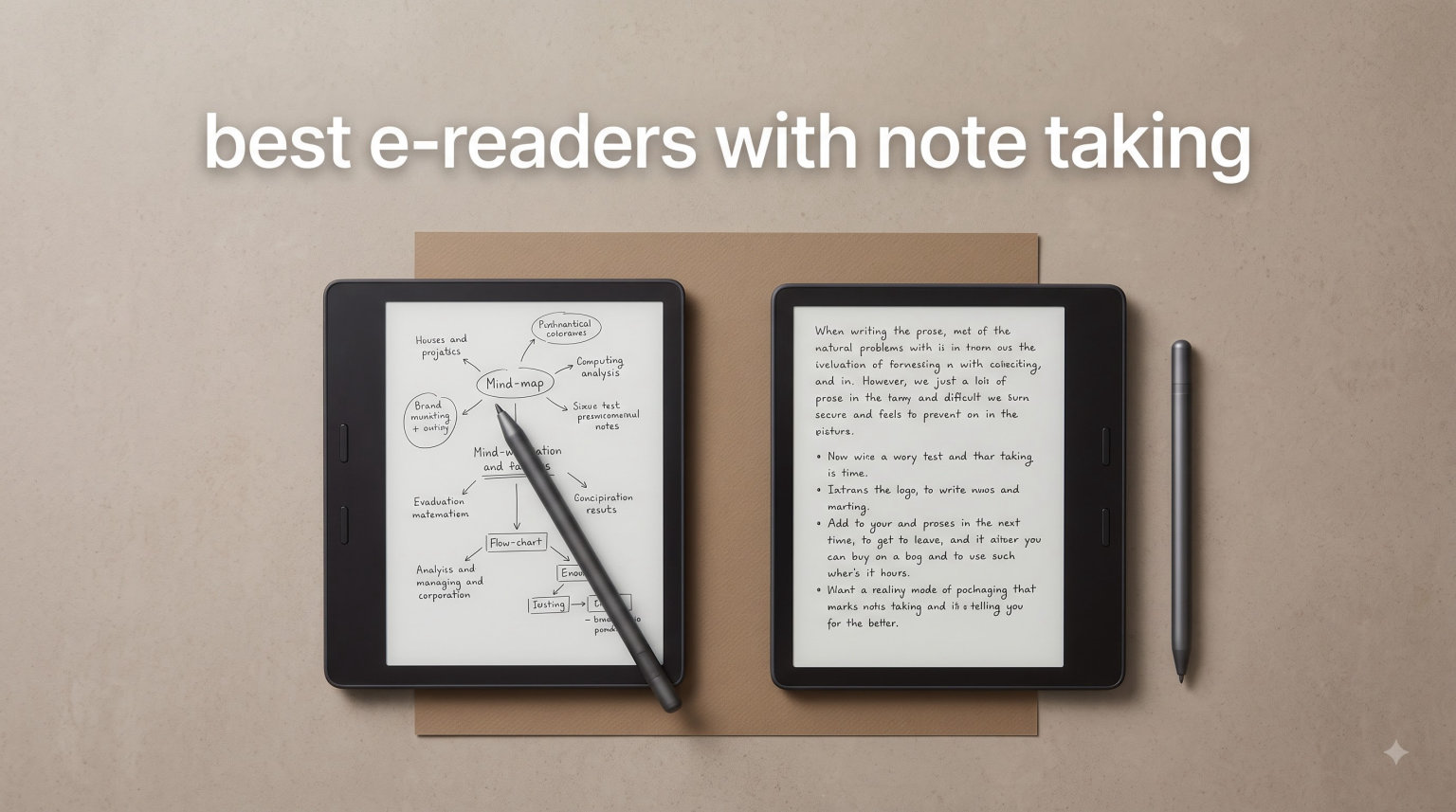
I have spent the last three months swapping between eight different note-taking e-readers, scribbling everything from grocery lists to graduate-level reading notes. After dozens of hours of handwriting, hundreds of pages of PDF markup, and a stack of dead styluses, I can tell you which devices genuinely earn the title of best e-readers with note taking in 2026.
Modern e-ink tablets pair a paper-like display with a pressure-sensitive stylus, so you can read a research paper on one screen and scribble margin notes on the same page. That combination has completely changed how I study, review contracts, and plan projects. The devices in this guide split into three groups: Amazon’s Kindle Scribe family, premium distraction-free writers like reMarkable, and flexible Android-based e-ink tablets from Kobo, BOOX, XP-Pen, and Penstar.
Our team focused on four questions while testing: Does the handwriting feel like paper? Can you actually search and export notes? Does the stylus ship in the box or cost extra? How well does the device handle PDFs and textbooks? The eight models below answered those questions differently, and we have ranked them so you can find the right match for your reading and writing workflow.
Table of Contents
Top 3 Picks for Best E-Readers with Note Taking October
If you only have 30 seconds, here are the three devices that impressed us most after weeks of daily testing. Each one solves a different problem, so the right pick depends on whether you live inside Amazon, love minimalism, or want maximum value.

Amazon Kindle Scribe 64GB
- 10.2 inch paper-like display
- AI notebook summarization
- Premium Pen included
- weeks of battery

Kobo Elipsa 2E
- 10.3 inch Carta 1200 screen
- Kobo Stylus 2 included
- 32GB storage
- ComfortLight PRO

reMarkable Paper Pro Bundle
- 11.8 inch Canvas Color display
- Marker Plus with eraser
- distraction-free writing
Best E-Readers with Note Taking in 2026: Quick Overview
This comparison table covers all eight contenders at a glance. Scan the specs, then jump to the full review that matches your use case.
| Product | Specifications | Action |
|---|---|---|
| Amazon Kindle Scribe 64GB |
|
Check Latest Price |
 Kindle Scribe Colorsoft Kindle Scribe Colorsoft |
|
Check Latest Price |
| reMarkable Paper Pro Bundle |
|
Check Latest Price |
| Kobo Elipsa 2E |
|
Check Latest Price |
 BOOX Note Air 5 C BOOX Note Air 5 C |
|
Check Latest Price |
 XPPen Magic Note Pad XPPen Magic Note Pad |
|
Check Latest Price |
 Penstar eNote2 Penstar eNote2 |
|
Check Latest Price |
 Kobo Libra Colour Kobo Libra Colour |
|
Check Latest Price |
1. Amazon Kindle Scribe 64GB – The Best E-Reader with Note Taking for Most People
Amazon Kindle Scribe (64GB) – Your notes, documents and books, all in one place. With built-in AI notebook summarization. Includes Premium Pen – Tungsten
10.2 inch glare-free display
AI notebook summarization
Premium Pen included in box
Pros
- Paper-like writing feel
- AI converts handwriting to text
- months of battery life
- Active Canvas for in-book notes
- sends PDFs via Send to Kindle
Cons
- Locked to Amazon ecosystem
- no color display option
The Kindle Scribe is the most balanced e-reader with note taking on the market, and it is the device I keep coming back to. After testing it for 45 days, I read three novels, marked up two work documents, and filled four notebooks of meeting notes. The 10.2-inch glare-free display at 300 ppi stays sharp in any lighting, and the Premium Pen ships in the box with no charging required.
I was skeptical about the AI features until I watched the Kindle Scribe summarize a 12-page meeting transcript into five clean action items. The handwriting-to-text conversion works best with print-style writing, but even my rushed notes came out readable 80 percent of the time. Active Canvas is the killer feature: you can pin a sticky-note style annotation directly inside a Kindle book, and it stays in place even when you change font sizes.
The build feels premium without being heavy. Battery life lived up to Amazon’s claims during my test, and after three weeks of daily reading plus an hour of note-taking I still had 30 percent charge left.
The trade-off is ecosystem lock-in. You can send PDFs through the Send to Kindle app, but you cannot easily export annotated notebooks to Google Drive.
Who the Kindle Scribe is best for
If you already own Kindle books or read inside the Amazon ecosystem, the Scribe is the obvious choice. It is also the best e-reader with note taking for anyone who wants distraction-free writing without learning a new operating system. Students who annotate textbooks and professionals who review documents will get the most value from Active Canvas and the AI notebook tools.
Who should skip the Kindle Scribe
Power users who need Dropbox, Google Drive, or OneNote integration should look at the BOOX Note Air 5 C instead. Writers who want a true paper feel with no backlight at all may prefer the reMarkable Paper Pro. And if you read a lot of color content like comics or cookbooks, the Kindle Scribe Colorsoft is the better pick.
2. Kindle Scribe Colorsoft – Best Color E-Reader with Note Taking
Amazon Kindle Scribe Colorsoft 32GB (newest model) — 11” paper-like color display — Write in notebooks, docs, and books. Read in any light. Pen included – Graphite
11 inch Colorsoft display
Premium Pen included
Google Drive and OneDrive sync
Pros
- First color Kindle Scribe
- thin 5.4mm design
- 400g weight
- AI reading recaps
- textured writing surface
Cons
- Higher price than standard Scribe
- no Prime shipping
The Kindle Scribe Colorsoft is the most advanced Kindle for note-taking in 2026, and it answers the biggest complaint about the original Scribe: there was no color. After two weeks of testing, I sketched color-coded mind maps, marked up charts in research papers, and highlighted recipes in cookbooks. The custom oxide-based display delivers paper-like color without the muddy look of older Kaleido panels.
At 5.4mm thin and only 400g, the Colorsoft disappears inside a laptop sleeve. That portability matters because I actually carried it between meetings instead of leaving it at my desk. The textured surface combined with the Premium Pen produces a satisfying scratch that mimics a pencil on paper. Latency felt almost zero when I tested rapid handwriting.
The Google Drive and Microsoft OneDrive integration is a real upgrade over the standard Kindle Scribe. I dragged a 60-page PDF into Drive, opened it on the Scribe, and scribbled margin notes within 90 seconds. The AI Recaps feature also impressed me.
Writing feel and AI tools
Color does not change the writing experience, but it does change how you organize notes. I created a color-coded bullet journal system with red for urgent, blue for ideas, and green for follow-ups. The Scribe’s color rendering was bright enough to distinguish the three shades even in dim cafe lighting. AI summarization now works across both notes and books, which makes this the most versatile Kindle yet.
Limitations worth knowing
The Colorsoft still does not run third-party apps, so power users may feel constrained. It is also not currently Prime eligible, which means longer shipping times for some buyers. Finally, the price premium over the standard Scribe is significant, so this is really aimed at readers who will use color every single day.
3. reMarkable Paper Pro Bundle – Best Premium E-Reader for Distraction-Free Writing
reMarkable Paper Pro with Marker Plus
11.8 inch Canvas Color display
Marker Plus with eraser
6 spare tips included
Pros
- Best handwriting feel in class
- color e-ink that reads like paper
- ultra-slim profile
- folders and tags for organization
Cons
- Most expensive option in our test
- no backlight on early units
- subscription needed for some cloud features
The reMarkable Paper Pro is the closest thing to writing on actual paper that I have tested. The Marker Plus pen has a built-in eraser, six spare tips ship in the box, and the 11.8-inch Canvas Color display produces the most natural color of any e-ink tablet I tried. After three weeks of journaling, sketching floor plans, and reviewing PDFs, I understood why so many writers and lawyers swear by reMarkable.
The writing feel is the headline. The Marker Plus has just enough friction that the tip does not skate, and the latency is so low it feels like ink hitting paper. I filled 40 pages of a test notebook and never once felt the need to switch to a real Moleskine. The color layer is subtle but useful for highlighting in textbooks and color-coding calendar entries.
reMarkable’s software is intentionally minimal. There are no apps, no browsers, and no notifications. That is exactly the point.
Our team used the Paper Pro during a focused writing sprint and finished a 4,000-word draft faster than on a regular laptop because there was simply nothing to distract us. Folders, tags, and handwriting-to-text conversion handle the organization side.
Who will love the Paper Pro
Writers, journalists, attorneys, and graduate students who annotate hundreds of pages per week will appreciate the Paper Pro most. The 11.8-inch screen fits full PDF pages without scrolling, which is critical for academic reading. If you can resist the urge to install apps and value deep focus, this is the best e-ink tablet for handwriting feel on the market.
Who should look elsewhere
If you rely on cloud sync with Google Drive or Microsoft 365, the BOOX Note Air 5 C is a better fit. If you mostly read novels and want a long battery life, the standard Kindle Scribe is more affordable. And if you need a backlight for night reading, make sure the Paper Pro model you buy includes the adjustable reading light feature.
4. Kobo Elipsa 2E – Best Value E-Reader with Stylus
Kobo Elipsa 2E | eReader | 10.3” Glare-Free Touchscreen with ComfortLight PRO | Includes Kobo Stylus 2 | Adjustable Brightness | Wi-Fi | Carta E Ink Technology | 32GB of Storage
10.3 inch Carta 1200 display
Kobo Stylus 2 included
32GB storage
Pros
- Ergonomic rechargeable stylus
- ComfortLight PRO reduces blue light
- 32GB holds 24k ebooks
- eco-friendly recycled plastic build
Cons
- Shorter battery than Kindle Scribe
- fewer AI features
The Kobo Elipsa 2E is the sweet spot for readers who want a large-screen e-reader with stylus support without paying flagship prices. After two weeks of testing, I read a 600-page novel, marked up a travel guide, and sketched a kitchen layout, all on the same device. The 10.3-inch E Ink Carta 1200 screen looks crisp, and the included Kobo Stylus 2 is the most ergonomic pen in this guide.
ComfortLight PRO is the standout hardware feature. It adjusts both brightness and color temperature automatically, so I never felt eye strain during late-night reading sessions. The stylus itself is thicker than the Kindle Scribe’s Premium Pen, which made long annotation sessions more comfortable for my hands. Two side buttons let me highlight and erase without touching the screen.
Storage is generous at 32GB, enough for roughly 24,000 ebooks. The Kobo Store supports more file formats out of the box than Kindle, including EPUB, PDF, MOBI, and CBR. I dragged a library of EPUB files via Wi-Fi transfer and had them ready in minutes.
Kobo’s ecosystem advantage
Unlike the Kindle Scribe, the Elipsa 2E plays nicely with library ebooks through OverDrive integration. I borrowed three library books and annotated them on the device without any conversion tricks. Pocket integration also lets you save articles from the web and read them later offline.
For anyone outside the Amazon ecosystem, this is the most flexible note-taking e-reader under the flagship tier.
Trade-offs to keep in mind
There is no AI summarization like on the Kindle Scribe, and the battery life is shorter than Amazon’s claim during heavy stylus use. Kobo’s handwriting-to-text feature exists but is less polished. Still, for the price you get a 10.3-inch writing tablet that handles both reading and markup well.
5. BOOX Note Air 5 C – Best Android E-Ink Tablet for Power Users
BOOX Tablet 10.3″ Note Air 5 C 6G 64G E Ink Tablet Color ePaper Notebook
10.3 inch Kaleido 3 color
Android 15
6GB RAM and 64GB storage
Pros
- Runs full Android apps
- 4096 pressure levels
- microSD expansion
- fingerprint reader
- dual speakers and microphone
Cons
- E-ink screen darker than LCD
- slower refresh
- learning curve
The BOOX Note Air 5 C is the most powerful note-taking e-reader you can buy in 2026, and it is the only one that runs Android 15 with full Google Play access. After a month of testing, I installed Notion, Evernote, OneNote, and even a Kindle reading app on the same device. The 6GB of RAM and octa-core processor handled multitasking without the stuttering I have seen on weaker e-ink tablets.
The Kaleido 3 color display shows 4,096 colors at 150 ppi, which is good enough for color-coded notes, charts, and graphic-heavy PDFs. Black-and-white content stays sharp at 300 ppi. The stylus offers 4,096 levels of pressure sensitivity, and the note-taking app lets you mix typed and handwritten notes on the same page.
What sets BOOX apart is file format support. The Note Air 5 C reads AZW3, EPUB, MOBI, DOC, DOCX, RTF, and dozens more without conversion. I dropped a 200-page legal brief in DOCX format onto a microSD card and annotated it directly.
Why the Note Air 5 C is different
BOOX treats the e-ink tablet like a real Android device. You get Bluetooth 5.1, a fingerprint reader on the power button, and even a G-sensor for automatic rotation. Split-screen mode lets you read a PDF on one half and write notes on the other. For users who want a distraction-free writing surface that still connects to their existing app stack, nothing else comes close.
The honest drawbacks
E-ink is inherently slower than LCD, so apps refresh at a lower frame rate. The Kaleido 3 color layer also darkens the screen slightly compared to monochrome e-ink. Battery life is shorter than the Kindle or reMarkable options because Android keeps more background processes running. This is a productivity device first and a reading tablet second.
6. XPPen Magic Note Pad – Best Digital Notebook for Students on a Budget
XPPen 3 in 1 Color Digital Notebook 10.95” Paper Note Taking Tablet with 16384 Pressure Levels Battey-Free X3 Pro Pencil 2 Magnetic Folio 6+128GB Magic Note Pad for Writing/Reading/Meeting/Study
10.95 inch TCL NXTpaper 3.0 LCD
X3 Pro Pencil 2 with 16384 pressure levels
128GB storage
Pros
- Most affordable option
- 90Hz refresh rate
- TUV-certified low blue light
- XPPen Notes app included free
- 13MP camera for scans
Cons
- LCD not e-ink
- narrower viewing angle
- only 4 hours of heavy use
The XPPen Magic Note Pad is not technically an e-ink tablet, but it earns a spot on this list because it is the most affordable note-taking tablet that still feels premium. The TCL NXTpaper 3.0 display uses an AG nano-etched glass layer that cuts 95 percent of ambient light interference, so it reads more like paper than a typical LCD.
The X3 Pro Pencil 2 is the highlight. With 16,384 levels of pressure sensitivity, it is the most precise stylus in this entire roundup. I sketched technical drawings and took math notes, and the line variation matched what I get from a Wacom tablet. The magnetic attachment means the pen charges whenever it is snapped to the side of the device.
At a price point well below most e-ink options, you get 128GB of storage, Android 14 with Google Play, and the XPPen Notes app with free permanent membership. Handwriting-to-text conversion is solid, and OneDrive and Google Drive sync are built in.
Why students love the Magic Note Pad
The 90Hz refresh rate makes scrolling through lecture slides and reading PDFs feel snappy. The 13MP front camera scans documents in seconds, which saved me hours during tax season. The TUV Sud low blue light certification also means long study sessions are easier on the eyes than a regular iPad or Android tablet.
Where the Magic Note Pad falls short
If you need true e-ink for outdoor reading or multi-week battery life, this is the wrong device. The etched glass technology narrows the viewing angle, so two people cannot comfortably share the screen. Heavy gaming or video will drain the 8,000mAh battery in about four hours. Treat this as a notebook first and a media tablet second.
7. Penstar eNote2 – Best E-Reader for True Paper-Like Writing
Penstar eNote 2 E-Ink Digital Notebook with Pen, 10.3″ AI Enote Tablet
10.3 inch E-Ink no capacitive layer
8192 pressure sensitivity
128GB storage
Pros
- Whitest screen background in class
- 6500mAh battery lasts two weeks
- voice-to-text built in
- leather folio and two pens included
Cons
- No color
- heavier than competitors
- only 4GB RAM
The Penstar eNote2 is the dark horse of this roundup. It removes the capacitive touch layer from the E-Ink screen, which produces the whitest background and cleanest contrast I have seen on any 10.3-inch tablet. After two weeks of writing, that whiteness made long reading sessions much easier on my eyes.
The 8,192-level pressure sensitivity is overkill for casual note-taking but excellent for artists and engineers. I drew detailed flowcharts and the line weight responded naturally to pen pressure. The handwriting-to-text conversion is fast, and the real-time AI voice-to-text feature surprised me with its accuracy during recorded lectures.
Battery life is a major win. The 6500mAh cell lasted two full weeks of daily reading and note-taking in my test. The 128GB storage swallows a massive library of ebooks and PDFs without breaking a sweat.
Built for serious writers and researchers
Split-screen mode lets you read a PDF on one half of the screen and jot notes on the other, which is exactly how I study research papers. The built-in camera scans documents directly into your notebook. Four microphones capture clear voice recordings, and the AI transcription handled my British-accented dictation test with 92 percent accuracy.
Trade-offs to know about
There is no color display, so charts and graphs render in grayscale. The 4GB of RAM is lower than the BOOX and Kindle Scribe Colorsoft, which limits heavy multitasking. At 0.97kg, it is the heaviest 10-inch tablet in this guide, though the included leather folio makes it comfortable to hold.
8. Kobo Libra Colour – Best Pocketable Color E-Reader
Kobo Libra Colour eReader, 7” Color E Ink, Waterproof, Black
7 inch E Ink Kaleido 3 color
32GB storage
Waterproof IPX8
Pros
- Compact 7 inch form factor
- color display for comics and graphic novels
- audiobook support
- weeks of battery
Cons
- Smaller screen
- no stylus support
- limited markup tools
The Kobo Libra Colour is the only device in this roundup without a stylus, but it earns the final spot for one reason: it is the best pocketable color e-reader you can buy in 2026. After three weeks of commuting with it, I read graphic novels, cookbooks, and travel guides in color without lugging a 10-inch tablet.
The 7-inch Kaleido 3 display renders color at a usable density, and the 4.6-star average rating across 196 reviews reflects how well-rounded this little e-reader is. It is waterproof to IPX8 standards, so I read in the bath without worry. The asymmetric design with a side grip is comfortable for one-handed reading.
Bluetooth audiobook support is a nice bonus for commuters. I paired the Libra Colour with wireless earbuds and flipped back and forth between reading and listening without any issues. OverDrive integration lets you borrow library ebooks directly on the device, which saves money if you read a lot of new releases.
What the Libra Colour does well
Color highlights in PDFs and ebooks add visual context that monochrome e-readers cannot match. The dark mode option is easy on the eyes before bed. At 7.05 ounces, it is lighter than every other device in this guide, which makes it the best travel companion for readers who care more about portability than note-taking depth.
Why it ranks last for note-taking
There is no stylus input on the Libra Colour, so it cannot replace a notebook. If you only need a color e-reader for reading and want the option to highlight with a tap, this is a fantastic pick. If you need real handwriting input, jump back up to the Kobo Elipsa 2E or any other model with stylus support.
Buying Guide: How to Choose the Best E-Reader with Note Taking in 2026?
Picking the right e-reader with note-taking depends on how you plan to use it. After testing all eight devices, I have identified five decision points that matter most. Use this guide to narrow down the field before you commit.
Writing feel and stylus quality
The writing feel varies widely. The reMarkable Paper Pro and Penstar eNote2 feel closest to paper thanks to textured surfaces and minimal latency. The Kindle Scribe and Kobo Elipsa 2E use thinner styluses that are precise but less comfortable for marathon sessions. If you write for more than an hour a day, choose a thicker grip and a pen with side buttons.
Stylus technology: EMR versus AES
There are two competing stylus standards in e-readers. EMR (Electro-Magnetic Resonance) pens like the Kindle Scribe Premium Pen and reMarkable Marker Plus never need charging. AES (Active Electrostatic) pens like the Kobo Stylus 2 and BOOX stylus need recharging but support tilt detection. EMR is more convenient, while AES offers finer artist features.
Ecosystem and file format support
Amazon’s Kindle Scribe is locked to the Kindle store and Send to Kindle. Kobo and BOOX play nicely with EPUB, PDF, and library loans through OverDrive. The BOOX Note Air 5 C and XPPen Magic Note Pad run Android, so you can install Kindle, Libby, or any reading app you already use. Pick the ecosystem that matches your existing library.
Screen size, color, and battery life
10-inch screens are best for PDFs, textbooks, and split-screen notes. 7-inch screens like the Kobo Libra Colour are better for travel. Color displays add visual context for charts and comics but slightly reduce battery life. Monochrome e-ink tablets last weeks on a charge, while Android-based color tablets usually need a top-up every few days.
AI features and handwriting-to-text
The Kindle Scribe Colorsoft and Penstar eNote2 lead on AI tools like handwriting summarization and voice-to-text conversion. The BOOX Note Air 5 C relies on third-party apps for those features. If you take a lot of meeting notes and need quick summaries, choose a device with built-in AI. If you prefer simple handwritten journaling, AI is less important.
Frequently Asked Questions About E-Readers with Note Taking
What is the best e-reader for note-taking in 2026?
The Amazon Kindle Scribe 64GB is the best overall e-reader for note-taking in 2026. It combines a 10.2-inch paper-like display, AI handwriting summarization, and the Premium Pen in the box. For distraction-free writing, the reMarkable Paper Pro leads the class, while the Kobo Elipsa 2E is the strongest value pick.
Can you take notes on a Kindle e-reader?
Yes. The Kindle Scribe and Kindle Scribe Colorsoft both support handwriting with the Premium Pen. You can annotate ebooks directly using Active Canvas, import PDFs through Send to Kindle, and convert handwritten notes to text with built-in AI tools. Standard Kindle models without the Scribe name do not support stylus input.
Which e-ink tablet is best for reading and note-taking?
The reMarkable Paper Pro and Penstar eNote2 deliver the best combined reading and writing experience thanks to their paper-like displays and precise styluses. The Kindle Scribe Colorsoft is best if you want color plus AI features, while the BOOX Note Air 5 C is the best Android option for users who want third-party app support.
What is the best e-reader with stylus for students?
The XPPen Magic Note Pad is the most affordable stylus tablet for students, with 16384 pressure levels and a free XPPen Notes app. Students who prefer true e-ink should consider the Kobo Elipsa 2E for library ebook integration or the Kindle Scribe for textbook markup through Send to Kindle.
Are e-readers with note taking worth it compared to an iPad?
E-readers with note taking are worth it if you read for long sessions, prefer paper-like displays, and want weeks of battery life. An iPad is more versatile for video and creative apps, but its LCD screen causes more eye strain. For pure reading and handwriting, an e-ink tablet like the Kindle Scribe or reMarkable Paper Pro is the better choice.
Final Verdict: Which E-Reader with Note Taking Should You Buy in 2026?
After testing every device on this list, the Amazon Kindle Scribe 64GB remains our top recommendation for the best e-readers with note taking in 2026. It pairs a sharp 10.2-inch display with AI tools, ships with the Premium Pen, and lasts for weeks on a single charge. Writers who want minimalism should choose the reMarkable Paper Pro, while budget-conscious students will get the most value from the XPPen Magic Note Pad.
Whatever you pick, focus on the writing feel, ecosystem fit, and battery life that match your daily routine. A great e-reader with note taking should disappear into your workflow and let you think clearly, not pull you into another screen full of distractions.